


ASTM D143-22
(Test Method)Standard Test Methods for Small Clear Specimens of Timber
Standard Test Methods for Small Clear Specimens of Timber
SIGNIFICANCE AND USE
4.1 These test methods cover tests on small clear specimens of wood that are made to provide the following:
4.1.1 Data for comparing the mechanical properties of various species,
4.1.2 Data for the establishment of correct strength functions, which in conjunction with results of tests of timbers in structural sizes (see Test Methods D198 and Test Methods D4761), afford a basis for establishing allowable stresses, and
4.1.3 Data to determine the influence on the mechanical properties of such factors as density, locality of growth, position in cross section, height of timber in the tree, change of properties with seasoning or treatment with chemicals, and change from sapwood to heartwood.
SCOPE
1.1 These test methods cover the determination of various strength and related properties of wood by testing small clear specimens.
1.1.1 These test methods represent procedures for evaluating the different mechanical and physical properties, controlling factors such as specimen size, moisture content, temperature, and rate of loading.
1.1.2 Sampling and collection of material is discussed in Practice D5536. Sample data, computation sheets, and cards have been incorporated, which were of assistance to the investigator in systematizing records.
1.1.3 The values stated in inch-pound units are to be regarded as the standard. The values given in parentheses are mathematical conversions to SI units that are provided for information only and are not considered standard. When a weight is prescribed, the basic inch-pound unit of weight (lbf) and the basic SI unit of mass (Kg) are cited.
1.2 The procedures for the various tests appear in the following order:
Sections
Photographs of Specimens
5
Control of Moisture Content and Temperature
6
Record of Heartwood and Sapwood
7
Static Bending
8
Compression Parallel to Grain
9
Impact Bending
10
Toughness
11
Compression Perpendicular to Grain
12
Hardness
13
Shear Parallel to Grain
14
Cleavage
15
Tension Parallel to Grain
16
Tension Perpendicular to Grain
17
Nail Withdrawal
18
Specific Gravity and Shrinkage in Volume
19
Radial and Tangential Shrinkage
20
Moisture Determination
21
Permissible Variations
22
Calibration
23
1.3 This standard does not purport to address all of the safety concerns, if any, associated with its use. It is the responsibility of the user of this standard to establish appropriate safety, health, and environmental practices and determine the applicability of regulatory limitations prior to use.
1.4 This international standard was developed in accordance with internationally recognized principles on standardization established in the Decision on Principles for the Development of International Standards, Guides and Recommendations issued by the World Trade Organization Technical Barriers to Trade (TBT) Committee.
General Information
- Status
- Historical
- Publication Date
- 14-May-2022
- Technical Committee
- D07 - Wood
- Drafting Committee
- D07.01 - Fundamental Test Methods and Properties
- Current Stage
Relations
- Effective Date
- 15-Nov-2023
- Effective Date
- 01-Mar-2020
- Effective Date
- 01-Apr-2019
- Effective Date
- 01-Nov-2018
- Effective Date
- 15-Nov-2017
- Effective Date
- 15-Nov-2016
- Effective Date
- 01-Nov-2015
- Effective Date
- 01-Jun-2015
- Effective Date
- 01-Jun-2014
- Effective Date
- 01-May-2014
- Effective Date
- 01-May-2014
- Effective Date
- 01-Feb-2014
- Effective Date
- 01-Feb-2014
- Effective Date
- 01-Oct-2013
- Effective Date
- 01-Apr-2013


ASTM D143-22 - Standard Test Methods for Small Clear Specimens of Timber


REDLINE ASTM D143-22 - Standard Test Methods for Small Clear Specimens of Timber


ASTM D143-22 - Standard Test Methods for Small Clear Specimens of Timber
Frequently Asked Questions
ASTM D143-22 is a standard published by ASTM International. Its full title is "Standard Test Methods for Small Clear Specimens of Timber". This standard covers: SIGNIFICANCE AND USE 4.1 These test methods cover tests on small clear specimens of wood that are made to provide the following: 4.1.1 Data for comparing the mechanical properties of various species, 4.1.2 Data for the establishment of correct strength functions, which in conjunction with results of tests of timbers in structural sizes (see Test Methods D198 and Test Methods D4761), afford a basis for establishing allowable stresses, and 4.1.3 Data to determine the influence on the mechanical properties of such factors as density, locality of growth, position in cross section, height of timber in the tree, change of properties with seasoning or treatment with chemicals, and change from sapwood to heartwood. SCOPE 1.1 These test methods cover the determination of various strength and related properties of wood by testing small clear specimens. 1.1.1 These test methods represent procedures for evaluating the different mechanical and physical properties, controlling factors such as specimen size, moisture content, temperature, and rate of loading. 1.1.2 Sampling and collection of material is discussed in Practice D5536. Sample data, computation sheets, and cards have been incorporated, which were of assistance to the investigator in systematizing records. 1.1.3 The values stated in inch-pound units are to be regarded as the standard. The values given in parentheses are mathematical conversions to SI units that are provided for information only and are not considered standard. When a weight is prescribed, the basic inch-pound unit of weight (lbf) and the basic SI unit of mass (Kg) are cited. 1.2 The procedures for the various tests appear in the following order: Sections Photographs of Specimens 5 Control of Moisture Content and Temperature 6 Record of Heartwood and Sapwood 7 Static Bending 8 Compression Parallel to Grain 9 Impact Bending 10 Toughness 11 Compression Perpendicular to Grain 12 Hardness 13 Shear Parallel to Grain 14 Cleavage 15 Tension Parallel to Grain 16 Tension Perpendicular to Grain 17 Nail Withdrawal 18 Specific Gravity and Shrinkage in Volume 19 Radial and Tangential Shrinkage 20 Moisture Determination 21 Permissible Variations 22 Calibration 23 1.3 This standard does not purport to address all of the safety concerns, if any, associated with its use. It is the responsibility of the user of this standard to establish appropriate safety, health, and environmental practices and determine the applicability of regulatory limitations prior to use. 1.4 This international standard was developed in accordance with internationally recognized principles on standardization established in the Decision on Principles for the Development of International Standards, Guides and Recommendations issued by the World Trade Organization Technical Barriers to Trade (TBT) Committee.
SIGNIFICANCE AND USE 4.1 These test methods cover tests on small clear specimens of wood that are made to provide the following: 4.1.1 Data for comparing the mechanical properties of various species, 4.1.2 Data for the establishment of correct strength functions, which in conjunction with results of tests of timbers in structural sizes (see Test Methods D198 and Test Methods D4761), afford a basis for establishing allowable stresses, and 4.1.3 Data to determine the influence on the mechanical properties of such factors as density, locality of growth, position in cross section, height of timber in the tree, change of properties with seasoning or treatment with chemicals, and change from sapwood to heartwood. SCOPE 1.1 These test methods cover the determination of various strength and related properties of wood by testing small clear specimens. 1.1.1 These test methods represent procedures for evaluating the different mechanical and physical properties, controlling factors such as specimen size, moisture content, temperature, and rate of loading. 1.1.2 Sampling and collection of material is discussed in Practice D5536. Sample data, computation sheets, and cards have been incorporated, which were of assistance to the investigator in systematizing records. 1.1.3 The values stated in inch-pound units are to be regarded as the standard. The values given in parentheses are mathematical conversions to SI units that are provided for information only and are not considered standard. When a weight is prescribed, the basic inch-pound unit of weight (lbf) and the basic SI unit of mass (Kg) are cited. 1.2 The procedures for the various tests appear in the following order: Sections Photographs of Specimens 5 Control of Moisture Content and Temperature 6 Record of Heartwood and Sapwood 7 Static Bending 8 Compression Parallel to Grain 9 Impact Bending 10 Toughness 11 Compression Perpendicular to Grain 12 Hardness 13 Shear Parallel to Grain 14 Cleavage 15 Tension Parallel to Grain 16 Tension Perpendicular to Grain 17 Nail Withdrawal 18 Specific Gravity and Shrinkage in Volume 19 Radial and Tangential Shrinkage 20 Moisture Determination 21 Permissible Variations 22 Calibration 23 1.3 This standard does not purport to address all of the safety concerns, if any, associated with its use. It is the responsibility of the user of this standard to establish appropriate safety, health, and environmental practices and determine the applicability of regulatory limitations prior to use. 1.4 This international standard was developed in accordance with internationally recognized principles on standardization established in the Decision on Principles for the Development of International Standards, Guides and Recommendations issued by the World Trade Organization Technical Barriers to Trade (TBT) Committee.
ASTM D143-22 is classified under the following ICS (International Classification for Standards) categories: 79.040 - Wood, sawlogs and sawn timber. The ICS classification helps identify the subject area and facilitates finding related standards.
ASTM D143-22 has the following relationships with other standards: It is inter standard links to ASTM D143-23, ASTM D4442-20, ASTM D4761-19, ASTM D4761-18, ASTM D3043-17, ASTM D4442-16, ASTM D5536-15, ASTM D4442-15, ASTM E4-14, ASTM D2395-14e1, ASTM D2395-14, ASTM D198-14, ASTM D198-14e1, ASTM D198-13, ASTM D4761-13. Understanding these relationships helps ensure you are using the most current and applicable version of the standard.
ASTM D143-22 is available in PDF format for immediate download after purchase. The document can be added to your cart and obtained through the secure checkout process. Digital delivery ensures instant access to the complete standard document.
Standards Content (Sample)
This international standard was developed in accordance with internationally recognized principles on standardization established in the Decision on Principles for the
Development of International Standards, Guides and Recommendations issued by the World Trade Organization Technical Barriers to Trade (TBT) Committee.
Designation: D143 − 22
Standard Test Methods for
Small Clear Specimens of Timber
This standard is issued under the fixed designation D143; the number immediately following the designation indicates the year of
original adoption or, in the case of revision, the year of last revision. A number in parentheses indicates the year of last reapproval. A
superscript epsilon (´) indicates an editorial change since the last revision or reapproval.
INTRODUCTION
The need to classify wood species by evaluating the physical and mechanical properties of small
clear specimens has always existed. Because of the great variety of species, variability of the material,
continually changing conditions of supply, many factors affecting test results, and ease of comparing
variables, the need will undoubtedly continue to exist.
In the preparation of these methods for testing small clear specimens, consideration was given both
to the desirability of adopting test methods that would yield results comparable to those already
available and to the possibility of embodying such improvements as experience has shown desirable.
In view of the many thousands of tests made under a single comprehensive plan by the U.S. Forest
Service, the former Forest Products Laboratories of Canada (now FPInnovations), and other similar
organizations, these test methods naturally conform closely to the methods used by those institutions.
These test methods are the outgrowth of a study of both American and European experience and
methods. The general adoption of these test methods will tend toward a world-wide unification of
results, permitting an interchange and correlation of data, and establishing the basis for a cumulative
body of fundamental information on the timber species of the world. Many of the figures in this
standard use sample data and computation sheets from testing done in the 1950s and earlier. These
figures remain in the standard because they are still valid depictions of the recording and plotting of
test results and also provide a historical link to the large body of test data on small clear specimens
already in existence for this long-standing test method.
Descriptionsofsomeofthestrengthtestsrefertoprimarymethodsandsecondarymethods.Primary
methods provide for specimens of 2-in. by 2-in. (50 mm by 50 mm) cross section. This size of
specimen has been extensively used for the evaluation of various mechanical and physical properties
of different species of wood, and a large number of data based on this primary method have been
obtained and published.
The 2-in. by 2-in. (50 mm by 50 mm) size has the advantage in that it embraces a number of growth
rings, is less influenced by earlywood and latewood differences than smaller size specimens, and is
large enough to represent a considerable portion of the sampled material. It is advisable to use primary
method specimens wherever possible. There are circumstances, however, when it is difficult or
impossible to obtain clear specimens of 2 by 2-in. cross section having the required 30 in. (760 mm)
length for static bending tests. With the increasing incidence of smaller second growth trees, and the
desirability in certain situations to evaluate a material which is too small to provide a 2-in. by 2-in.
cross section, a secondary method which utilizes a 1-in. by 1-in. (25 mm by 25 mm) cross section has
been included. This cross section is established for compression parallel to grain and static bending
tests, while the 2-in. by 2-in. cross section is retained for impact bending, compression perpendicular
to grain, hardness, shear parallel to grain, cleavage, and tension perpendicular to grain.Toughness and
tension parallel to grain are special tests using specimens of smaller cross section.
The user is cautioned that test results between two different sizes of specimens are not necessarily
directly comparable. Guidance on the effect of specimen size on a property being evaluated is beyond
the scope of these test methods and should be sought elsewhere.
Wheretheapplication,measurement,orrecordingofloadanddeflectioncanbeaccomplishedusing
electronic equipment and computerized apparatus, such devices are encouraged. It is important that all
data measurement and recording equipment, whether electronic or mechanical, be accurate and
reliable to the degree specified.
Copyright © ASTM International, 100 Barr Harbor Drive, PO Box C700, West Conshohocken, PA 19428-2959. United States
D143 − 22
1. Scope 2. Referenced Documents
1.1 These test methods cover the determination of various 2.1 ASTM Standards:
strength and related properties of wood by testing small clear D9 Terminology Relating to Wood and Wood-Based Prod-
specimens. ucts
1.1.1 These test methods represent procedures for evaluat- D198 Test Methods of Static Tests of Lumber in Structural
ing the different mechanical and physical properties, control- Sizes
ling factors such as specimen size, moisture content, D2395 TestMethodsforDensityandSpecificGravity(Rela-
temperature, and rate of loading. tive Density) of Wood and Wood-Based Materials
1.1.2 Sampling and collection of material is discussed in D3043 Test Methods for Structural Panels in Flexure
Practice D5536. Sample data, computation sheets, and cards D4442 Test Methods for Direct Moisture Content Measure-
have been incorporated, which were of assistance to the ment of Wood and Wood-Based Materials
investigator in systematizing records. D4761 Test Methods for Mechanical Properties of Lumber
1.1.3 The values stated in inch-pound units are to be and Wood-Based Structural Materials
regarded as the standard. The values given in parentheses are D5536 Practice for Sampling ForestTrees for Determination
mathematical conversions to SI units that are provided for of Clear Wood Properties
information only and are not considered standard. When a E4 Practices for Force Calibration and Verification of Test-
weight is prescribed, the basic inch-pound unit of weight (lbf) ing Machines
and the basic SI unit of mass (Kg) are cited. E2309 Practices for Verification of Displacement Measuring
Systems and Devices Used in Material Testing Machines
1.2 The procedures for the various tests appear in the
following order:
3. Summary of Test Methods
Sections
3.1 The mechanical tests are static bending, compression
Photographs of Specimens 5
Control of Moisture Content and Temperature 6 parallel to grain, impact bending toughness, compression
Record of Heartwood and Sapwood 7
perpendicular to grain, hardness, shear parallel to grain,
Static Bending 8
cleavage, tension parallel to grain, tension-perpendicular-to-
Compression Parallel to Grain 9
Impact Bending 10
grain, and nail-withdrawal tests. These tests are permitted for
Toughness 11
both green and air-dry material as specified in these test
Compression Perpendicular to Grain 12
methods. In addition, test methods for evaluating such physical
Hardness 13
Shear Parallel to Grain 14
properties as specific gravity, shrinkage in volume, radial
Cleavage 15
shrinkage, and tangential shrinkage are presented.
Tension Parallel to Grain 16
Tension Perpendicular to Grain 17
NOTE 1—The test for shearing strength perpendicular to the grain
Nail Withdrawal 18
(sometimes termed “vertical shear”) is not included as one of the principal
Specific Gravity and Shrinkage in Volume 19
mechanical tests since in such a test the strength is limited by the shearing
Radial and Tangential Shrinkage 20
resistance parallel to the grain.
Moisture Determination 21
Permissible Variations 22
4. Significance and Use
Calibration 23
1.3 This standard does not purport to address all of the
4.1 These test methods cover tests on small clear specimens
safety concerns, if any, associated with its use. It is the
of wood that are made to provide the following:
responsibility of the user of this standard to establish appro-
4.1.1 Data for comparing the mechanical properties of
priate safety, health, and environmental practices and deter-
various species,
mine the applicability of regulatory limitations prior to use.
4.1.2 Data for the establishment of correct strength
1.4 This international standard was developed in accor-
functions, which in conjunction with results of tests of timbers
dance with internationally recognized principles on standard-
in structural sizes (see Test Methods D198 and Test Methods
ization established in the Decision on Principles for the
D4761), afford a basis for establishing allowable stresses, and
Development of International Standards, Guides and Recom-
4.1.3 Data to determine the influence on the mechanical
mendations issued by the World Trade Organization Technical
properties of such factors as density, locality of growth,
Barriers to Trade (TBT) Committee.
position in cross section, height of timber in the tree, change of
properties with seasoning or treatment with chemicals, and
change from sapwood to heartwood.
These test methods are under the jurisdiction of ASTM Committee D07 on
Wood and are the direct responsibility of Subcommittee D07.01 on Fundamental
Test Methods and Properties. For referenced ASTM standards, visit the ASTM website, www.astm.org, or
Current edition approved May 15, 2022. Published June 2022. Originally contact ASTM Customer Service at service@astm.org. For Annual Book of ASTM
approved in 1922. Last previous edition approved in 2021 as D143 – 21. DOI: Standards volume information, refer to the standard’s Document Summary page on
10.1520/D0143-22. the ASTM website.
D143 − 22
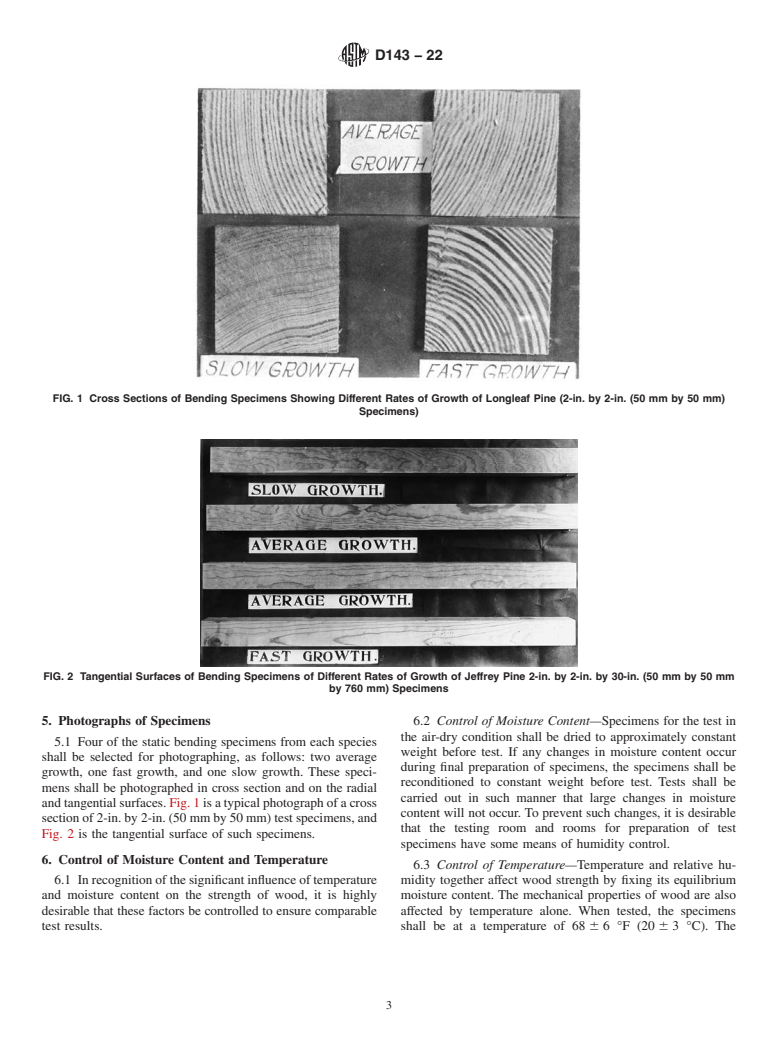
FIG. 1 Cross Sections of Bending Specimens Showing Different Rates of Growth of Longleaf Pine (2-in. by 2-in. (50 mm by 50 mm)
Specimens)
FIG. 2 Tangential Surfaces of Bending Specimens of Different Rates of Growth of Jeffrey Pine 2-in. by 2-in. by 30-in. (50 mm by 50 mm
by 760 mm) Specimens
5. Photographs of Specimens 6.2 Control of Moisture Content—Specimens for the test in
the air-dry condition shall be dried to approximately constant
5.1 Four of the static bending specimens from each species
weight before test. If any changes in moisture content occur
shall be selected for photographing, as follows: two average
during final preparation of specimens, the specimens shall be
growth, one fast growth, and one slow growth. These speci-
reconditioned to constant weight before test. Tests shall be
mens shall be photographed in cross section and on the radial
carried out in such manner that large changes in moisture
andtangentialsurfaces.Fig.1isatypicalphotographofacross
content will not occur. To prevent such changes, it is desirable
sectionof2-in.by2-in.(50mmby50mm)testspecimens,and
that the testing room and rooms for preparation of test
Fig. 2 is the tangential surface of such specimens.
specimens have some means of humidity control.
6. Control of Moisture Content and Temperature
6.3 Control of Temperature—Temperature and relative hu-
6.1 Inrecognitionofthesignificantinfluenceoftemperature midity together affect wood strength by fixing its equilibrium
and moisture content on the strength of wood, it is highly moisture content. The mechanical properties of wood are also
desirable that these factors be controlled to ensure comparable affected by temperature alone. When tested, the specimens
test results. shall be at a temperature of 68 66°F(20 6 3 °C). The
D143 − 22
temperature at the time of test shall in all instances be recorded
as a specific part of the test record.
7. Record of Heartwood and Sapwood
7.1 Proportion of Sapwood—If heartwood and sapwood
present in the specimen can be distinguished by visual
inspection, the proportion of sapwood present shall be esti-
mated as required for the purposes of the test program and
recorded for each test specimen.
8. Static Bending
8.1 Size of Specimens—The static bending tests shall be
made on 2 in. by 2 in. by 30 in. (50 mm by 50 mm by 760 mm)
primary method specimens or 1 in. by 1 in. by 16 in. (25 mm
by 25 mm by 410 mm) secondary method specimens. The
actual height and width at the center and the length shall be
measured (see 22.2).
8.2 Loading Span and Supports—Use center loading and a
span length of 28 in. (710 mm) for the primary method and 14
in. (360 mm) for the secondary method. These spans were
established in order to maintain a minimum span-to-depth ratio
of 14. Both supporting knife edges shall be provided with
FIG. 4 Example of a Bearing Block for Static Bending Tests
bearing plates and rollers of such thickness that the distance
fromthepointofsupporttothecentralplaneisnotgreaterthan
a chord length of not less than 2 in. (50 mm) shall be used for
the depth of the specimen (Fig. 3). The knife edges shall be
secondary method specimens. The bearing block shall be
adjustable laterally to permit adjustment for slight twist in the
fabricated with a material that will not appreciably deform
specimen.
under load.
NOTE 2—An example of laterally adjustable supports is provided in
8.4 Placement of Growth Rings—The specimen shall be
Figure 1 of Test Methods D3043.
placed so that the load will be applied through the bearing
8.3 Bearing Block—Arigid bearing block having a radius of
block to the tangential surface nearest the pith.
3 in. (76 mm) and a chord length of not less than 3 ⁄16 in. (97
mm) that is fixed from rotation shall be used for applying the 8.5 Speed of Testing—The load shall be applied continu-
load for primary method specimens.An example is provided in ously throughout the test at a rate of motion of the movable
Fig. 4. A similar block having a radius of 1 ⁄2 in. (38 mm) for crosshead of 0.10 in. (2.5 mm)/min, for primary method
FIG. 3 Static Bending Test Assembly Showing Test Method of Load Application, Specimen Supported on Rollers and Laterally Adjust-
able Knife Edges, and Test Method of Measuring Deflection at Neutral Axis by Means of Yoke and Displacement Measurement Device
D143 − 22
specimens,andatarateof0.05in.(1.3mm)/minforsecondary 9. Compression Parallel to Grain
method specimens (see 22.3).
9.1 Size of Specimens—The compression-parallel-to-grain
tests shall be made on 2 in. by 2 in. by 8 in. (50 mm by 50 mm
8.6 Load-Deflection Curves:
by 200 mm) primary method specimens, or 1 by 1 by 4 in. (25
8.6.1 At a minimum, the load-deflection curves shall be
by 25 by 100 mm) secondary method specimens. The actual
recorded and the test continued up to the maximum load for all
cross-sectional dimensions and the length shall be measured
static bending tests. If required for the purposes of the study, it
(see 22.2).
shall be permitted to continue both loading and the load-
deflection measurement beyond the maximum load. 9.2 End Surfaces Parallel—Special care shall be used in
preparing the compression-parallel-to-grain test specimens to
NOTE 3—One situation where the user may choose to continue the test
ensure that the end grain surfaces will be parallel to each other
and the load-deflection measurements beyond the maximum load is if the
and at right angles to the longitudinal axis. At least one platen
total energy under the flexural load-deflection curve is a parameter of
of the testing machine shall be equipped with a spherical
concern. In these instances for primary method specimens, it has been
customarytocontinuethetestandrecordtheload-deflectioncurvebeyond bearing to obtain uniform distribution of load over the ends of
the maximum load to a 6 in. (152 mm) deflection or until the specimen
the specimen.
fails to support a load of 200 lbf (890 N). For secondary method
9.3 Speed of Testing—The load shall be applied continu-
specimens, it has been customary to continue loading to a 3 in. (76 mm)
deflection, or until the specimen fails to support a load of 50 lbf (222 N). ously throughout the test at a rate of motion of the movable
crosshead of 0.003 in./in. (mm/mm) of nominal specimen
8.6.2 Deflections of the neutral plane at the center of the
length/min (see 22.3).
length shall be taken with respect to points in the neutral plane
above the supports.Alternatively, deflection shall be permitted 9.4 Load-Compression Curves:
to be taken relative to the tension surface at midspan, provided 9.4.1 Load-compression curves shall be taken over a central
gauge length not exceeding 6 in. (150 mm) for primary method
that vertical displacements which occur at the reactions are
taken into account. specimens, and 2 in. (50 mm) for secondary method speci-
mens. Load-compression readings shall be continued until the
8.6.3 Within the proportional limit, deflection readings shall
proportional limit is well passed, as indicated by the curve.
be taken with a yoke-mounted displacement measurement
device capable of at least a Class B rating when evaluated in
NOTE 5—See Fig. 7 for a sample compression-parallel-to-grain data
accordance with Practice E2309.After the proportional limit is
sheet form.
reached, less refinement is necessary in observing deflections.
9.4.2 Deformations shall be recorded using displacement
It shall be permissible to continue the deflection measurement
measurement devices that are capable of a ClassArating when
beyond the proportional limit using an alternative means of
evaluated in accordance with Practice E2309.
deflection measurement capable of at least a Class C rating
9.4.3 Figs. 8 and 9 illustrate two types of compressometers
when evaluated in accordance with Practice E2309. To char-
that have been found satisfactory for wood testing. Similar
acterize the load-deflection curve, the load and deflection shall
apparatus is available for measurements of compression over a
be measured and recorded at a maximum interval spacing of
2 in. (50 mm) gauge length.
0.10 in. (2.5 mm) and after abrupt changes in load. Continuous
9.5 Position of Failures—In order to obtain satisfactory and
load and deflection data acquisition is preferred.
uniform results, it is necessary that the failures be made to
8.6.4 When data are recorded manually, the load and de-
develop in the body of the specimen. With specimens of
flection of the first failure, the maximum load, and points of
uniform cross section, this result can best be obtained when the
sudden change shall be read and shown on the curve sheet,
ends are at a very slightly lower moisture content than the
eveniftheydonotoccuratoneoftheregularloadordeflection
body. With green material, it will usually suffice to close-pile
increments. When data are recorded electronically, the data
the specimens, cover the body with a damp cloth, and expose
recording rate shall be sufficient to capture the same points so
the ends for a short time. For dry material, it shall be permitted
that they can be similarly reported.
to pile the specimens in a similar manner and place them in a
desiccator, if failures in test indicate that a slight end-drying is
NOTE 4—See Fig. 5 for a sample static bending data sheet form.
necessary.
8.7 Description of Failure—Static bending (flexural) fail-
9.6 Descriptions of Failure—Compression failures shall be
ures shall be classified in accordance with the appearance of
classified in accordance with the appearance of the fractured
the fractured surface and the manner in which the failure
surface(Fig.10).Incasetwoormorekindsoffailuresdevelop,
develops (Fig. 6). Where appropriate, the fractured surfaces
all shall be described in the order of their occurrence; for
shall be roughly divided into “brash” and “fibrous”, the term
example, shearing followed by brooming. Each type of ob-
“brash” indicating abrupt failure and “fibrous” indicating a
served failure mode shall be photographed or sketched.
fracture showing splinters. Each type of observed failure mode
shall be photographed or sketched.
9.7 Weight and Moisture Content—See 8.8.
8.8 Weight and Moisture Content—The specimen shall be
9.8 Ring and Latewood Measurement—When practicable,
weighed immediately before test, and after the test a moisture the number of rings per inch (average ring width in millime-
sectionapproximately1in.(25mm)inlengthshallbecutfrom
ters) and the proportion of summerwood shall be measured
the specimen near the point of failure (see 21.1 and 22.1). over a representative inch (centimeter) of cross section of the
D143 − 22
FIG. 5 Sample Data Sheet for a Manually Recorded Static Bending Test
test specimen. In determining the proportion of summerwood, 10.2 Loading and Span—Use center loading and a span
it is essential that the end surface be prepared so as to permit length of 28 in. (710 mm).
accurate latewood measurement. When the fibers are broomed
10.3 Bearing Block—A metal tup of curvature correspond-
over at the ends from sawing, a light sanding, planing, or
ing to the bearing block shown in Fig. 4 shall be used in
similar treatment of the ends is recommended.
applying the load.
10.4 Placement of Growth Rings—The specimen shall be
10. Impact Bending
placed so that the load will be applied through the bearing
10.1 Size of Specimens—The impact bending tests shall be
block to the tangential surface nearest the pith.
made on 2 in. by 2 in. by 30 in. (50 mm by 50 mm by 760 mm)
specimens. The actual height and width at the center and the 10.5 Procedure—Make the tests by increment drops in a
length shall be measured (see 22.2). Hatt-Turner or similar impact machine (see Fig. 11). The first
D143 − 22
NOTE 7—See Fig. 13 for a sample of a manually recorded impact
bending data sheet form. A sample data and computation card are shown
in Fig. 14.
10.10 Weight and Moisture Content—See 8.8.
11. Toughness
11.1 A single-blow impact test on a small specimen is
recognized as a valuable and desirable test. Several types of
machines such as the Toughness, Izod and Amsler have been
used,butinsufficientinformationisavailabletodecidewhether
one procedure is superior to another, or whether the results by
the different test methods can be directly correlated. If the
Toughness machine is used, the following procedure has been
found satisfactory. To aid in standardization and to facilitate
comparisons, the size of the toughness specimen has been
made equal to that accepted internationally.
11.2 Size of Specimen—The toughness tests shall be made
on 0.79 in. by 0.79 in. by 11 in. (20 mm by 20 mm by 280 mm)
specimens. The actual height and width at the center and the
length shall be measured (see 22.2).
11.3 Loading and Span—Center loading and a span length
of 9.47 in. (240 mm) shall be used. The load shall be applied
to a radial or tangential surface on alternate specimens.
11.4 Bearing Block—An aluminum tup (Fig. 15) having a
radius of ⁄4 in. (19 mm) shall be used in applying the load.
NOTE 1—The term “cross grain” shall be considered to include all 11.5 Apparatus and Procedure—Make the tests in a pendu-
deviations of grain from the direction of the longitudinal axis or
lum type toughness machine (See Fig. 15).Adjust the machine
longitudinal edges of the specimen. It should be noted that spiral grain
before test so that the pendulum hangs vertically, and adjust it
may be present even to a serious extent without being evident from a
to compensate for friction. Adjust the cable so that the load is
casual observation.
applied to the specimen when the pendulum swings to 15°
NOTE 2—The presence of cross grain having a slope that deviates more
from the vertical, so as to produce complete failure by the time
than 1 in 20 from the longitudinal edges of the specimen shall be cause for
culling the test.
the downward swing is completed. Choose the weight position
FIG. 6 Types of Failures in Static Bending
and initial angle (30, 45, or 60°) of the pendulum, so that
complete failure of the specimen is obtained on one drop. Most
drop shall be 1 in. (25 mm), after which increase the drops by
satisfactory results are obtained when the difference between
1 in. increments until a height of 10 in. (250 mm) is reached.
the initial and final angle is at least 10°.
Then use a 2 in. (50 mm) increment until complete failure
NOTE 8—Many pendulum-type toughness machines are based on a
occurs or a 6 in. (150 mm) deflection is reached.
design developed and used at the USDA F
...
This document is not an ASTM standard and is intended only to provide the user of an ASTM standard an indication of what changes have been made to the previous version. Because
it may not be technically possible to adequately depict all changes accurately, ASTM recommends that users consult prior editions as appropriate. In all cases only the current version
of the standard as published by ASTM is to be considered the official document.
Designation: D143 − 21 D143 − 22
Standard Test Methods for
Small Clear Specimens of Timber
This standard is issued under the fixed designation D143; the number immediately following the designation indicates the year of
original adoption or, in the case of revision, the year of last revision. A number in parentheses indicates the year of last reapproval. A
superscript epsilon (´) indicates an editorial change since the last revision or reapproval.
INTRODUCTION
The need to classify wood species by evaluating the physical and mechanical properties of small
clear specimens has always existed. Because of the great variety of species, variability of the material,
continually changing conditions of supply, many factors affecting test results, and ease of comparing
variables, the need will undoubtedly continue to exist.
In the preparation of these methods for testing small clear specimens, consideration was given both
to the desirability of adopting test methods that would yield results comparable to those already
available and to the possibility of embodying such improvements as experience has shown desirable.
In view of the many thousands of tests made under a single comprehensive plan by the U.S. Forest
Service, the former Forest Products Laboratories of Canada (now FP Innovations), FPInnovations),
and other similar organizations, these test methods naturally conform closely to the methods used by
those institutions. These test methods are the outgrowth of a study of both American and European
experience and methods. The general adoption of these test methods will tend toward a world-wide
unification of results, permitting an interchange and correlation of data, and establishing the basis for
a cumulative body of fundamental information on the timber species of the world. Many of the figures
in this standard use sample data and computation sheets from testing done in the 1950s and earlier.
These figures remain in the standard because they are still valid depictions of the recording and
plotting of test results and also provide a historical link to the large body of test data on small clear
specimens already in existence for this long-standing test method.
Descriptions of some of the strength tests refer to primary methods and secondary methods. Primary
methods provide for specimens of 22-in. by 2-in. (50 mm by 50 mm) cross section. This size of
specimen has been extensively used for the evaluation of various mechanical and physical properties
of different species of wood, and a large number of data based on this primary method have been
obtained and published.
The 22-in. by 2-in. (50 mm by 50 mm) size has the advantage in that it embraces a number of
growth rings, is less influenced by earlywood and latewood differences than smaller size specimens,
and is large enough to represent a considerable portion of the sampled material. It is advisable to use
primary method specimens wherever possible. There are circumstances, however, when it is difficult
or impossible to obtain clear specimens of 2 by 2-in. cross section having the required 30 in. (760 mm)
length for static bending tests. With the increasing incidence of smaller second growth trees, and the
desirability in certain situations to evaluate a material which is too small to provide a 22-in. by 2-in.
cross section, a secondary method which utilizes a 11-in. by 1-in. (25 mm by 25 mm) cross section
has been included. This cross section is established for compression parallel to grain and static bending
tests, while the 22-in. by 2-in. cross section is retained for impact bending, compression perpendicular
to grain, hardness, shear parallel to grain, cleavage, and tension perpendicular to grain. Toughness and
tension parallel to grain are special tests using specimens of smaller cross section.
These test methods are under the jurisdiction of ASTM Committee D07 on Wood and are the direct responsibility of Subcommittee D07.01 on Fundamental Test Methods
and Properties.
Current edition approved June 1, 2021May 15, 2022. Published July 2021June 2022. Originally approved in 1922. Last previous edition approved in 20142021 as
D143 – 14.D143 – 21. DOI: 10.1520/D0143-21.10.1520/D0143-22.
Copyright © ASTM International, 100 Barr Harbor Drive, PO Box C700, West Conshohocken, PA 19428-2959. United States
D143 − 22
The user is cautioned that test results between two different sizes of specimens are not necessarily
directly comparable. Guidance on the effect of specimen size on a property being evaluated is beyond
the scope of these test methods and should be sought elsewhere.
Where the application, measurement, or recording of load and deflection can be accomplished using
electronic equipment and computerized apparatus, such devices are encouraged. It is important that all
data measurement and recording equipment, whether electronic or mechanical, be accurate and
reliable to the degree specified.
D143 − 22
1. Scope
1.1 These test methods cover the determination of various strength and related properties of wood by testing small clear
specimens.
1.1.1 These test methods represent procedures for evaluating the different mechanical and physical properties, controlling factors
such as specimen size, moisture content, temperature, and rate of loading.
1.1.2 Sampling and collection of material is discussed in Practice D5536. Sample data, computation sheets, and cards have been
incorporated, which were of assistance to the investigator in systematizing records.
1.1.3 The values stated in inch-pound units are to be regarded as the standard. The values given in parentheses are mathematical
conversions to SI units that are provided for information only and are not considered standard. When a weight is prescribed, the
basic inch-pound unit of weight (lbf) and the basic SI unit of mass (Kg) are cited.
1.2 The procedures for the various tests appear in the following order:
Sections
Photographs of Specimens 5
Control of Moisture Content and Temperature 6
Record of Heartwood and Sapwood 7
Static Bending 8
Compression Parallel to Grain 9
Impact Bending 10
Toughness 11
Compression Perpendicular to Grain 12
Hardness 13
Shear Parallel to Grain 14
Cleavage 15
Tension Parallel to Grain 16
Tension Perpendicular to Grain 17
Nail Withdrawal 18
Specific Gravity and Shrinkage in Volume 19
Radial and Tangential Shrinkage 20
Moisture Determination 21
Permissible Variations 22
Calibration 23
1.3 This standard does not purport to address all of the safety concerns, if any, associated with its use. It is the responsibility
of the user of this standard to establish appropriate safety, health, and environmental practices and determine the applicability of
regulatory limitations prior to use.
1.4 This international standard was developed in accordance with internationally recognized principles on standardization
established in the Decision on Principles for the Development of International Standards, Guides and Recommendations issued
by the World Trade Organization Technical Barriers to Trade (TBT) Committee.
2. Referenced Documents
2.1 ASTM Standards:
D9 Terminology Relating to Wood and Wood-Based Products
D198 Test Methods of Static Tests of Lumber in Structural Sizes
D2395 Test Methods for Density and Specific Gravity (Relative Density) of Wood and Wood-Based Materials
D3043 Test Methods for Structural Panels in Flexure
D4442 Test Methods for Direct Moisture Content Measurement of Wood and Wood-Based Materials
D4761 Test Methods for Mechanical Properties of Lumber and Wood-Based Structural Materials
D5536 Practice for Sampling Forest Trees for Determination of Clear Wood Properties
E4 Practices for Force Calibration and Verification of Testing Machines
E2309 Practices for Verification of Displacement Measuring Systems and Devices Used in Material Testing Machines
For referenced ASTM standards, visit the ASTM website, www.astm.org, or contact ASTM Customer Service at service@astm.org. For Annual Book of ASTM Standards
volume information, refer to the standard’s Document Summary page on the ASTM website.
D143 − 22
3. Summary of Test Methods
3.1 The mechanical tests are static bending, compression parallel to grain, impact bending toughness, compression perpendicular
to grain, hardness, shear parallel to grain, cleavage, tension parallel to grain, tension-perpendicular-to-grain, and nail-withdrawal
tests. These tests are permitted for both green and air-dry material as specified in these test methods. In addition, test methods for
evaluating such physical properties as specific gravity, shrinkage in volume, radial shrinkage, and tangential shrinkage are
presented.
NOTE 1—The test for shearing strength perpendicular to the grain (sometimes termed “vertical shear”) is not included as one of the principal mechanical
tests since in such a test the strength is limited by the shearing resistance parallel to the grain.
4. Significance and Use
4.1 These test methods cover tests on small clear specimens of wood that are made to provide the following:
4.1.1 Data for comparing the mechanical properties of various species,
4.1.2 Data for the establishment of correct strength functions, which in conjunction with results of tests of timbers in structural
sizes (see Test Methods D198 and Test Methods D4761), afford a basis for establishing allowable stresses, and
4.1.3 Data to determine the influence on the mechanical properties of such factors as density, locality of growth, position in cross
section, height of timber in the tree, change of properties with seasoning or treatment with chemicals, and change from sapwood
to heartwood.
5. Photographs of Specimens
5.1 Four of the static bending specimens from each species shall be selected for photographing, as follows: two average growth,
one fast growth, and one slow growth. These specimens shall be photographed in cross section and on the radial and tangential
surfaces. Fig. 1 is a typical photograph of a cross section of 22-in. by 2-in. (50 mm by 50 mm) test specimens, and Fig. 2 is the
tangential surface of such specimens.
6. Control of Moisture Content and Temperature
6.1 In recognition of the significant influence of temperature and moisture content on the strength of wood, it is highly desirable
that these factors be controlled to ensure comparable test results.
FIG. 1 Cross Sections of Bending Specimens Showing Different Rates of Growth of Longleaf Pine (2(2-in. by 2-in. (50 mm by 50 mm)
Specimens)
D143 − 22
FIG. 2 Tangential Surfaces of Bending Specimens of Different Rates of Growth of Jeffrey Pine 22-in. by 22-in. by 30-in. (50 mm by 50
mm by 760 mm) Specimens
6.2 Control of Moisture Content—Specimens for the test in the air-dry condition shall be dried to approximately constant weight
before test. If any changes in moisture content occur during final preparation of specimens, the specimens shall be reconditioned
to constant weight before test. Tests shall be carried out in such manner that large changes in moisture content will not occur. To
prevent such changes, it is desirable that the testing room and rooms for preparation of test specimens have some means of
humidity control.
6.3 Control of Temperature—Temperature and relative humidity together affect wood strength by fixing its equilibrium moisture
content. The mechanical properties of wood are also affected by temperature alone. When tested, the specimens shall be at a
temperature of 68 6 6 °F (20 6 3 °C). The temperature at the time of test shall in all instances be recorded as a specific part of
the test record.
7. Record of Heartwood and Sapwood
7.1 Proportion of Sapwood—If heartwood and sapwood present in the specimen can be distinguished by visual inspection, the
proportion of sapwood present shall be estimated as required for the purposes of the test program and recorded for each test
specimen.
8. Static Bending
8.1 Size of Specimens—The static bending tests shall be made on 2 in. by 2 in. by 30 in. (50 mm by 50 mm by 760 mm) primary
method specimens or 1 in. by 1 in. by 16 in. (25 mm by 25 mm by 410 mm) secondary method specimens. The actual height and
width at the center and the length shall be measured (see 22.2).
8.2 Loading Span and Supports—Use center loading and a span length of 28 in. (710 mm) for the primary method and 14 in. (360
mm) for the secondary method. These spans were established in order to maintain a minimum span-to-depth ratio of 14. Both
supporting knife edges shall be provided with bearing plates and rollers of such thickness that the distance from the point of support
to the central plane is not greater than the depth of the specimen (Fig. 3). The knife edges shall be adjustable laterally to permit
adjustment for slight twist in the specimen.
NOTE 2—An example of laterally adjustable supports is provided in Figure 1 of Test Methods D3043.
8.3 Bearing Block—A rigid bearing block having a radius of 3 in. (76 mm) and a chord length of not less than 3 ⁄16 in. (97 mm)
that is fixed from rotation shall be used for applying the load for primary method specimens. An example is provided in Fig. 4.
A similar block having a radius of 1 ⁄2 in. (38 mm) for a chord length of not less than 2 in. (50 mm) shall be used for secondary
method specimens. The bearing block shall be fabricated with a material that will not appreciably deform under load.
8.4 Placement of Growth Rings—The specimen shall be placed so that the load will be applied through the bearing block to the
tangential surface nearest the pith.
D143 − 22
FIG. 3 Static Bending Test Assembly Showing Test Method of Load Application, Specimen Supported on Rollers and Laterally Adjust-
able Knife Edges, and Test Method of Measuring Deflection at Neutral Axis by Means of Yoke and Displacement Measurement Device
FIG. 4 Example of a Bearing Block for Static Bending Tests
8.5 Speed of Testing—The load shall be applied continuously throughout the test at a rate of motion of the movable crosshead of
0.10 in. (2.5 mm)/min, for primary method specimens, and at a rate of 0.05 in. (1.3 mm)/min for secondary method specimens (see
22.3).
8.6 Load-Deflection Curves:
8.6.1 At a minimum, the load-deflection curves shall be recorded and the test continued up to the maximum load for all static
bending tests. If required for the purposes of the study, it shall be permitted to continue both loading and the load-deflection
measurement beyond the maximum load.
D143 − 22
NOTE 3—One situation where the user may choose to continue the test and the load-deflection measurements beyond the maximum load is if the total
energy under the flexural load-deflection curve is a parameter of concern. In these instances for primary method specimens, it has been customary to
continue the test and record the load-deflection curve beyond the maximum load to a 6 in. (152 mm) deflection or until the specimen fails to support a
load of 200 lbf (890 N). For secondary method specimens, it has been customary to continue loading to a 3 in. (76 mm) deflection, or until the specimen
fails to support a load of 50 lbf (222 N).
8.6.2 Deflections of the neutral plane at the center of the length shall be taken with respect to points in the neutral plane above
the supports. Alternatively, deflection shall be permitted to be taken relative to the tension surface at midspan, provided that vertical
displacements which occur at the reactions are taken into account.
8.6.3 Within the proportional limit, deflection readings shall be taken with a yoke-mounted displacement measurement device
capable of at least a Class B rating when evaluated in accordance with Practice E2309. After the proportional limit is reached, less
refinement is necessary in observing deflections. It shall be permissible to continue the deflection measurement beyond the
proportional limit using an alternative means of deflection measurement capable of at least a Class C rating when evaluated in
accordance with Practice E2309. To characterize the load-deflection curve, the load and deflection shall be measured and recorded
at a maximum interval spacing of 0.10 in. (2.5 mm) and after abrupt changes in load. Continuous load and deflection data
acquisition is preferred.
8.6.4 When data are recorded manually, the load and deflection of the first failure, the maximum load, and points of sudden change
shall be read and shown on the curve sheet, even if they do not occur at one of the regular load or deflection increments. When
data are recorded electronically, the data recording rate shall be sufficient to capture the same points so that they can be similarly
reported.
NOTE 4—See Fig. 5 for a sample static bending data sheet form.
8.7 Description of Failure—Static bending (flexural) failures shall be classified in accordance with the appearance of the fractured
surface and the manner in which the failure develops (Fig. 6). Where appropriate, the fractured surfaces shall be roughly divided
into “brash” and “fibrous”, the term “brash” indicating abrupt failure and “fibrous” indicating a fracture showing splinters. Each
type of observed failure mode shall be photographed or sketched.
8.8 Weight and Moisture Content—The specimen shall be weighed immediately before test, and after the test a moisture section
approximately 1 in. (25 mm) in length shall be cut from the specimen near the point of failure (see 21.1 and 22.1).
9. Compression Parallel to Grain
9.1 Size of Specimens—The compression-parallel-to-grain tests shall be made on 2 in. by 2 in. by 8 in. (50 mm by 50 mm by 200
mm) primary method specimens, or 1 by 1 by 4 in. (25 by 25 by 100 mm) secondary method specimens. The actual cross-sectional
dimensions and the length shall be measured (see 22.2).
9.2 End Surfaces Parallel—Special care shall be used in preparing the compression-parallel-to-grain test specimens to ensure that
the end grain surfaces will be parallel to each other and at right angles to the longitudinal axis. At least one platen of the testing
machine shall be equipped with a spherical bearing to obtain uniform distribution of load over the ends of the specimen.
9.3 Speed of Testing—The load shall be applied continuously throughout the test at a rate of motion of the movable crosshead of
0.003 in./in. (mm/mm) of nominal specimen length/min (see 22.3).
9.4 Load-Compression Curves:
9.4.1 Load-compression curves shall be taken over a central gagegauge length not exceeding 6 in. (150 mm) for primary method
specimens, and 2 in. (50 mm) for secondary method specimens. Load-compression readings shall be continued until the
proportional limit is well passed, as indicated by the curve.
NOTE 5—See Fig. 7 for a sample compression-parallel-to-grain data sheet form.
D143 − 22
FIG. 5 Sample Data Sheet for a Manually Recorded Static Bending Test
9.4.2 Deformations shall be recorded using displacement measurement devices that are capable of a Class A rating when evaluated
in accordance with Practice E2309.
9.4.3 Figs. 8 and 9 illustrate two types of compressometers that have been found satisfactory for wood testing. Similar apparatus
is available for measurements of compression over a 2 in. (50 mm) gagegauge length.
9.5 Position of Failures—In order to obtain satisfactory and uniform results, it is necessary that the failures be made to develop
in the body of the specimen. With specimens of uniform cross section, this result can best be obtained when the ends are at a very
slightly lower moisture content than the body. With green material, it will usually suffice to close-pile the specimens, cover the
D143 − 22
NOTE 1—The term “cross grain” shall be considered to include all deviations of grain from the direction of the longitudinal axis or longitudinal edges
of the specimen. It should be noted that spiral grain may be present even to a serious extent without being evident from a casual observation.
NOTE 2—The presence of cross grain having a slope that deviates more than 1 in 20 from the longitudinal edges of the specimen shall be cause for
culling the test.
FIG. 6 Types of Failures in Static Bending
body with a damp cloth, and expose the ends for a short time. For dry material, it shall be permitted to pile the specimens in a
similar manner and place them in a desiccator, if failures in test indicate that a slight end-drying is necessary.
9.6 Descriptions of Failure—Compression failures shall be classified in accordance with the appearance of the fractured surface
(Fig. 10). In case two or more kinds of failures develop, all shall be described in the order of their occurrence; for example, shearing
followed by brooming. Each type of observed failure mode shall be photographed or sketched.
9.7 Weight and Moisture Content—See 8.8.
9.8 Ring and Latewood Measurement—When practicable, the number of rings per inch (average ring width in millimeters) and
the proportion of summerwood shall be measured over a representative inch (centimeter) of cross section of the test specimen. In
determining the proportion of summerwood, it is essential that the end surface be prepared so as to permit accurate latewood
measurement. When the fibers are broomed over at the ends from sawing, a light sanding, planing, or similar treatment of the ends
is recommended.
10. Impact Bending
10.1 Size of Specimens—The impact bending tests shall be made on 2 in. by 2 in. by 30 in. (50 mm by 50 mm by 760 mm)
specimens. The actual height and width at the center and the length shall be measured (see 22.2).
10.2 Loading and Span—Use center loading and a span length of 28 in. (710 mm).
10.3 Bearing Block—A metal tup of curvature corresponding to the bearing block shown in Fig. 4 shall be used in applying the
load.
D143 − 22
FIG. 7 Sample Data Sheet for a Manually Recorded Compression-Parallel-to-Grain Test
10.4 Placement of Growth Rings—The specimen shall be placed so that the load will be applied through the bearing block to the
tangential surface nearest the pith.
10.5 Procedure—Make the tests by increment drops in a Hatt-Turner or similar impact machine (see Fig. 11). The first drop shall
be 1 in. (25 mm), after which increase the drops by 1 in. increments until a height of 10 in. (250 mm) is reached. Then use a 2
in. (50 mm) increment until complete failure occurs or a 6 in. (150 mm) deflection is reached.
10.6 Weight of Hammer—A 50 lbm (22.5 kg) hammer shall be used with drops up to the capacity of the machine provided that
complete failure or a 6 in. (150 mm) deflection will result for all specimens of a species. For all other cases, a 100 lbm (45 kg)
hammer shall be used.
D143 − 22
FIG. 8 Compression-Parallel-to-Grain Test Assembly Using an Automatic Type of Compressometer to Measure Deformations
(The wire in the lower right-hand corner connects the compressometer with the recording unit.)
FIG. 9 Compression-Parallel-to-Grain Test Assembly Showing Method of Measuring Deformations by Means of Roller-Type Compres-
someter
10.7 Deflection Records—When desired, records giving the deflection for each drop and the set, if any, shall be made until the first
failure occurs. This record will also afford data from which the exact height of drop can be scaled for at least the first four falls.
NOTE 6—See Fig. 12 for a sample drum record.
10.8 Drop Causing Failure—The height of drop causing either complete failure or a 6 in. (150 mm) deflection shall be observed
for each specimen.
D143 − 22
FIG. 10 Types of Failures in Compression
10.9 Description of Failure—The failure shall be classified in accordance with the directions for static bending in 8.7. Each type
of observed failure mode shall be photographed or sketched.
NOTE 7—See Fig. 13 for a sample of a manually recorded impact bending data sheet form. A sample data and computation card are shown in Fig. 14.
10.10 Weight and Moisture Content—See 8.8.
11. Toughness
11.1 A single-blow impact test on a small specimen is recognized as a valuable and desirable test. Several types of machines such
as the Toughness, Izod and Amsler have been used, but insufficient information
...
NOTICE: This standard has either been superseded and replaced by a new version or withdrawn.
Contact ASTM International (www.astm.org) for the latest information
Designation: D143 − 22
Standard Test Methods for
Small Clear Specimens of Timber
This standard is issued under the fixed designation D143; the number immediately following the designation indicates the year of
original adoption or, in the case of revision, the year of last revision. A number in parentheses indicates the year of last reapproval. A
superscript epsilon (´) indicates an editorial change since the last revision or reapproval.
INTRODUCTION
The need to classify wood species by evaluating the physical and mechanical properties of small
clear specimens has always existed. Because of the great variety of species, variability of the material,
continually changing conditions of supply, many factors affecting test results, and ease of comparing
variables, the need will undoubtedly continue to exist.
In the preparation of these methods for testing small clear specimens, consideration was given both
to the desirability of adopting test methods that would yield results comparable to those already
available and to the possibility of embodying such improvements as experience has shown desirable.
In view of the many thousands of tests made under a single comprehensive plan by the U.S. Forest
Service, the former Forest Products Laboratories of Canada (now FPInnovations), and other similar
organizations, these test methods naturally conform closely to the methods used by those institutions.
These test methods are the outgrowth of a study of both American and European experience and
methods. The general adoption of these test methods will tend toward a world-wide unification of
results, permitting an interchange and correlation of data, and establishing the basis for a cumulative
body of fundamental information on the timber species of the world. Many of the figures in this
standard use sample data and computation sheets from testing done in the 1950s and earlier. These
figures remain in the standard because they are still valid depictions of the recording and plotting of
test results and also provide a historical link to the large body of test data on small clear specimens
already in existence for this long-standing test method.
Descriptions of some of the strength tests refer to primary methods and secondary methods. Primary
methods provide for specimens of 2-in. by 2-in. (50 mm by 50 mm) cross section. This size of
specimen has been extensively used for the evaluation of various mechanical and physical properties
of different species of wood, and a large number of data based on this primary method have been
obtained and published.
The 2-in. by 2-in. (50 mm by 50 mm) size has the advantage in that it embraces a number of growth
rings, is less influenced by earlywood and latewood differences than smaller size specimens, and is
large enough to represent a considerable portion of the sampled material. It is advisable to use primary
method specimens wherever possible. There are circumstances, however, when it is difficult or
impossible to obtain clear specimens of 2 by 2-in. cross section having the required 30 in. (760 mm)
length for static bending tests. With the increasing incidence of smaller second growth trees, and the
desirability in certain situations to evaluate a material which is too small to provide a 2-in. by 2-in.
cross section, a secondary method which utilizes a 1-in. by 1-in. (25 mm by 25 mm) cross section has
been included. This cross section is established for compression parallel to grain and static bending
tests, while the 2-in. by 2-in. cross section is retained for impact bending, compression perpendicular
to grain, hardness, shear parallel to grain, cleavage, and tension perpendicular to grain. Toughness and
tension parallel to grain are special tests using specimens of smaller cross section.
The user is cautioned that test results between two different sizes of specimens are not necessarily
directly comparable. Guidance on the effect of specimen size on a property being evaluated is beyond
the scope of these test methods and should be sought elsewhere.
Where the application, measurement, or recording of load and deflection can be accomplished using
electronic equipment and computerized apparatus, such devices are encouraged. It is important that all
data measurement and recording equipment, whether electronic or mechanical, be accurate and
reliable to the degree specified.
Copyright © ASTM International, 100 Barr Harbor Drive, PO Box C700, West Conshohocken, PA 19428-2959. United States
D143 − 22
1. Scope 2. Referenced Documents
1.1 These test methods cover the determination of various 2.1 ASTM Standards:
strength and related properties of wood by testing small clear D9 Terminology Relating to Wood and Wood-Based Prod-
specimens. ucts
1.1.1 These test methods represent procedures for evaluat- D198 Test Methods of Static Tests of Lumber in Structural
ing the different mechanical and physical properties, control- Sizes
ling factors such as specimen size, moisture content, D2395 Test Methods for Density and Specific Gravity (Rela-
temperature, and rate of loading. tive Density) of Wood and Wood-Based Materials
1.1.2 Sampling and collection of material is discussed in D3043 Test Methods for Structural Panels in Flexure
Practice D5536. Sample data, computation sheets, and cards D4442 Test Methods for Direct Moisture Content Measure-
have been incorporated, which were of assistance to the ment of Wood and Wood-Based Materials
investigator in systematizing records. D4761 Test Methods for Mechanical Properties of Lumber
1.1.3 The values stated in inch-pound units are to be and Wood-Based Structural Materials
regarded as the standard. The values given in parentheses are D5536 Practice for Sampling Forest Trees for Determination
mathematical conversions to SI units that are provided for of Clear Wood Properties
information only and are not considered standard. When a E4 Practices for Force Calibration and Verification of Test-
weight is prescribed, the basic inch-pound unit of weight (lbf) ing Machines
and the basic SI unit of mass (Kg) are cited. E2309 Practices for Verification of Displacement Measuring
Systems and Devices Used in Material Testing Machines
1.2 The procedures for the various tests appear in the
following order:
3. Summary of Test Methods
Sections
3.1 The mechanical tests are static bending, compression
Photographs of Specimens 5
Control of Moisture Content and Temperature 6
parallel to grain, impact bending toughness, compression
Record of Heartwood and Sapwood 7
perpendicular to grain, hardness, shear parallel to grain,
Static Bending 8
cleavage, tension parallel to grain, tension-perpendicular-to-
Compression Parallel to Grain 9
Impact Bending 10 grain, and nail-withdrawal tests. These tests are permitted for
Toughness 11
both green and air-dry material as specified in these test
Compression Perpendicular to Grain 12
methods. In addition, test methods for evaluating such physical
Hardness 13
Shear Parallel to Grain 14
properties as specific gravity, shrinkage in volume, radial
Cleavage 15
shrinkage, and tangential shrinkage are presented.
Tension Parallel to Grain 16
Tension Perpendicular to Grain 17
NOTE 1—The test for shearing strength perpendicular to the grain
Nail Withdrawal 18
(sometimes termed “vertical shear”) is not included as one of the principal
Specific Gravity and Shrinkage in Volume 19
mechanical tests since in such a test the strength is limited by the shearing
Radial and Tangential Shrinkage 20
resistance parallel to the grain.
Moisture Determination 21
Permissible Variations 22
4. Significance and Use
Calibration 23
1.3 This standard does not purport to address all of the
4.1 These test methods cover tests on small clear specimens
safety concerns, if any, associated with its use. It is the
of wood that are made to provide the following:
responsibility of the user of this standard to establish appro-
4.1.1 Data for comparing the mechanical properties of
priate safety, health, and environmental practices and deter-
various species,
mine the applicability of regulatory limitations prior to use.
4.1.2 Data for the establishment of correct strength
1.4 This international standard was developed in accor-
functions, which in conjunction with results of tests of timbers
dance with internationally recognized principles on standard-
in structural sizes (see Test Methods D198 and Test Methods
ization established in the Decision on Principles for the
D4761), afford a basis for establishing allowable stresses, and
Development of International Standards, Guides and Recom-
4.1.3 Data to determine the influence on the mechanical
mendations issued by the World Trade Organization Technical
properties of such factors as density, locality of growth,
Barriers to Trade (TBT) Committee.
position in cross section, height of timber in the tree, change of
properties with seasoning or treatment with chemicals, and
change from sapwood to heartwood.
These test methods are under the jurisdiction of ASTM Committee D07 on
Wood and are the direct responsibility of Subcommittee D07.01 on Fundamental
Test Methods and Properties. For referenced ASTM standards, visit the ASTM website, www.astm.org, or
Current edition approved May 15, 2022. Published June 2022. Originally contact ASTM Customer Service at service@astm.org. For Annual Book of ASTM
approved in 1922. Last previous edition approved in 2021 as D143 – 21. DOI: Standards volume information, refer to the standard’s Document Summary page on
10.1520/D0143-22. the ASTM website.
D143 − 22
FIG. 1 Cross Sections of Bending Specimens Showing Different Rates of Growth of Longleaf Pine (2-in. by 2-in. (50 mm by 50 mm)
Specimens)
FIG. 2 Tangential Surfaces of Bending Specimens of Different Rates of Growth of Jeffrey Pine 2-in. by 2-in. by 30-in. (50 mm by 50 mm
by 760 mm) Specimens
5. Photographs of Specimens 6.2 Control of Moisture Content—Specimens for the test in
the air-dry condition shall be dried to approximately constant
5.1 Four of the static bending specimens from each species
weight before test. If any changes in moisture content occur
shall be selected for photographing, as follows: two average
during final preparation of specimens, the specimens shall be
growth, one fast growth, and one slow growth. These speci-
reconditioned to constant weight before test. Tests shall be
mens shall be photographed in cross section and on the radial
carried out in such manner that large changes in moisture
and tangential surfaces. Fig. 1 is a typical photograph of a cross
content will not occur. To prevent such changes, it is desirable
section of 2-in. by 2-in. (50 mm by 50 mm) test specimens, and
that the testing room and rooms for preparation of test
Fig. 2 is the tangential surface of such specimens.
specimens have some means of humidity control.
6. Control of Moisture Content and Temperature
6.3 Control of Temperature—Temperature and relative hu-
6.1 In recognition of the significant influence of temperature midity together affect wood strength by fixing its equilibrium
and moisture content on the strength of wood, it is highly moisture content. The mechanical properties of wood are also
desirable that these factors be controlled to ensure comparable affected by temperature alone. When tested, the specimens
test results. shall be at a temperature of 68 6 6 °F (20 6 3 °C). The
D143 − 22
temperature at the time of test shall in all instances be recorded
as a specific part of the test record.
7. Record of Heartwood and Sapwood
7.1 Proportion of Sapwood—If heartwood and sapwood
present in the specimen can be distinguished by visual
inspection, the proportion of sapwood present shall be esti-
mated as required for the purposes of the test program and
recorded for each test specimen.
8. Static Bending
8.1 Size of Specimens—The static bending tests shall be
made on 2 in. by 2 in. by 30 in. (50 mm by 50 mm by 760 mm)
primary method specimens or 1 in. by 1 in. by 16 in. (25 mm
by 25 mm by 410 mm) secondary method specimens. The
actual height and width at the center and the length shall be
measured (see 22.2).
8.2 Loading Span and Supports—Use center loading and a
span length of 28 in. (710 mm) for the primary method and 14
in. (360 mm) for the secondary method. These spans were
established in order to maintain a minimum span-to-depth ratio
of 14. Both supporting knife edges shall be provided with
FIG. 4 Example of a Bearing Block for Static Bending Tests
bearing plates and rollers of such thickness that the distance
from the point of support to the central plane is not greater than
a chord length of not less than 2 in. (50 mm) shall be used for
the depth of the specimen (Fig. 3). The knife edges shall be
secondary method specimens. The bearing block shall be
adjustable laterally to permit adjustment for slight twist in the
fabricated with a material that will not appreciably deform
specimen.
under load.
NOTE 2—An example of laterally adjustable supports is provided in
8.4 Placement of Growth Rings—The specimen shall be
Figure 1 of Test Methods D3043.
placed so that the load will be applied through the bearing
8.3 Bearing Block—A rigid bearing block having a radius of
block to the tangential surface nearest the pith.
3 in. (76 mm) and a chord length of not less than 3 ⁄16 in. (97
mm) that is fixed from rotation shall be used for applying the 8.5 Speed of Testing—The load shall be applied continu-
load for primary method specimens. An example is provided in ously throughout the test at a rate of motion of the movable
Fig. 4. A similar block having a radius of 1 ⁄2 in. (38 mm) for crosshead of 0.10 in. (2.5 mm)/min, for primary method
FIG. 3 Static Bending Test Assembly Showing Test Method of Load Application, Specimen Supported on Rollers and Laterally Adjust-
able Knife Edges, and Test Method of Measuring Deflection at Neutral Axis by Means of Yoke and Displacement Measurement Device
D143 − 22
specimens, and at a rate of 0.05 in. (1.3 mm)/min for secondary 9. Compression Parallel to Grain
method specimens (see 22.3).
9.1 Size of Specimens—The compression-parallel-to-grain
tests shall be made on 2 in. by 2 in. by 8 in. (50 mm by 50 mm
8.6 Load-Deflection Curves:
by 200 mm) primary method specimens, or 1 by 1 by 4 in. (25
8.6.1 At a minimum, the load-deflection curves shall be
by 25 by 100 mm) secondary method specimens. The actual
recorded and the test continued up to the maximum load for all
cross-sectional dimensions and the length shall be measured
static bending tests. If required for the purposes of the study, it
(see 22.2).
shall be permitted to continue both loading and the load-
deflection measurement beyond the maximum load. 9.2 End Surfaces Parallel—Special care shall be used in
preparing the compression-parallel-to-grain test specimens to
NOTE 3—One situation where the user may choose to continue the test
ensure that the end grain surfaces will be parallel to each other
and the load-deflection measurements beyond the maximum load is if the
and at right angles to the longitudinal axis. At least one platen
total energy under the flexural load-deflection curve is a parameter of
of the testing machine shall be equipped with a spherical
concern. In these instances for primary method specimens, it has been
bearing to obtain uniform distribution of load over the ends of
customary to continue the test and record the load-deflection curve beyond
the maximum load to a 6 in. (152 mm) deflection or until the specimen
the specimen.
fails to support a load of 200 lbf (890 N). For secondary method
9.3 Speed of Testing—The load shall be applied continu-
specimens, it has been customary to continue loading to a 3 in. (76 mm)
deflection, or until the specimen fails to support a load of 50 lbf (222 N). ously throughout the test at a rate of motion of the movable
crosshead of 0.003 in./in. (mm/mm) of nominal specimen
8.6.2 Deflections of the neutral plane at the center of the
length/min (see 22.3).
length shall be taken with respect to points in the neutral plane
9.4 Load-Compression Curves:
above the supports. Alternatively, deflection shall be permitted
9.4.1 Load-compression curves shall be taken over a central
to be taken relative to the tension surface at midspan, provided
that vertical displacements which occur at the reactions are gauge length not exceeding 6 in. (150 mm) for primary method
specimens, and 2 in. (50 mm) for secondary method speci-
taken into account.
mens. Load-compression readings shall be continued until the
8.6.3 Within the proportional limit, deflection readings shall
proportional limit is well passed, as indicated by the curve.
be taken with a yoke-mounted displacement measurement
device capable of at least a Class B rating when evaluated in
NOTE 5—See Fig. 7 for a sample compression-parallel-to-grain data
accordance with Practice E2309. After the proportional limit is
sheet form.
reached, less refinement is necessary in observing deflections.
9.4.2 Deformations shall be recorded using displacement
It shall be permissible to continue the deflection measurement
measurement devices that are capable of a Class A rating when
beyond the proportional limit using an alternative means of
evaluated in accordance with Practice E2309.
deflection measurement capable of at least a Class C rating
9.4.3 Figs. 8 and 9 illustrate two types of compressometers
when evaluated in accordance with Practice E2309. To char-
that have been found satisfactory for wood testing. Similar
acterize the load-deflection curve, the load and deflection shall
apparatus is available for measurements of compression over a
be measured and recorded at a maximum interval spacing of
2 in. (50 mm) gauge length.
0.10 in. (2.5 mm) and after abrupt changes in load. Continuous
9.5 Position of Failures—In order to obtain satisfactory and
load and deflection data acquisition is preferred.
uniform results, it is necessary that the failures be made to
8.6.4 When data are recorded manually, the load and de-
develop in the body of the specimen. With specimens of
flection of the first failure, the maximum load, and points of
uniform cross section, this result can best be obtained when the
sudden change shall be read and shown on the curve sheet,
ends are at a very slightly lower moisture content than the
even if they do not occur at one of the regular load or deflection
body. With green material, it will usually suffice to close-pile
increments. When data are recorded electronically, the data
the specimens, cover the body with a damp cloth, and expose
recording rate shall be sufficient to capture the same points so
the ends for a short time. For dry material, it shall be permitted
that they can be similarly reported.
to pile the specimens in a similar manner and place them in a
desiccator, if failures in test indicate that a slight end-drying is
NOTE 4—See Fig. 5 for a sample static bending data sheet form.
necessary.
8.7 Description of Failure—Static bending (flexural) fail-
9.6 Descriptions of Failure—Compression failures shall be
ures shall be classified in accordance with the appearance of
classified in accordance with the appearance of the fractured
the fractured surface and the manner in which the failure
surface (Fig. 10). In case two or more kinds of failures develop,
develops (Fig. 6). Where appropriate, the fractured surfaces
all shall be described in the order of their occurrence; for
shall be roughly divided into “brash” and “fibrous”, the term
example, shearing followed by brooming. Each type of ob-
“brash” indicating abrupt failure and “fibrous” indicating a
served failure mode shall be photographed or sketched.
fracture showing splinters. Each type of observed failure mode
shall be photographed or sketched.
9.7 Weight and Moisture Content—See 8.8.
8.8 Weight and Moisture Content—The specimen shall be 9.8 Ring and Latewood Measurement—When practicable,
weighed immediately before test, and after the test a moisture
the number of rings per inch (average ring width in millime-
section approximately 1 in. (25 mm) in length shall be cut from ters) and the proportion of summerwood shall be measured
the specimen near the point of failure (see 21.1 and 22.1). over a representative inch (centimeter) of cross section of the
D143 − 22
FIG. 5 Sample Data Sheet for a Manually Recorded Static Bending Test
test specimen. In determining the proportion of summerwood, 10.2 Loading and Span—Use center loading and a span
it is essential that the end surface be prepared so as to permit length of 28 in. (710 mm).
accurate latewood measurement. When the fibers are broomed
10.3 Bearing Block—A metal tup of curvature correspond-
over at the ends from sawing, a light sanding, planing, or
ing to the bearing block shown in Fig. 4 shall be used in
similar treatment of the ends is recommended.
applying the load.
10.4 Placement of Growth Rings—The specimen shall be
10. Impact Bending
placed so that the load will be applied through the bearing
10.1 Size of Specimens—The impact bending tests shall be
block to the tangential surface nearest the pith.
made on 2 in. by 2 in. by 30 in. (50 mm by 50 mm by 760 mm)
specimens. The actual height and width at the center and the 10.5 Procedure—Make the tests by increment drops in a
length shall be measured (see 22.2). Hatt-Turner or similar impact machine (see Fig. 11). The first
D143 − 22
NOTE 7—See Fig. 13 for a sample of a manually recorded impact
bending data sheet form. A sample data and computation card are shown
in Fig. 14.
10.10 Weight and Moisture Content—See 8.8.
11. Toughness
11.1 A single-blow impact test on a small specimen is
recognized as a valuable and desirable test. Several types of
machines such as the Toughness, Izod and Amsler have been
used, but insufficient information is available to decide whether
one procedure is superior to another, or whether the results by
the different test methods can be directly correlated. If the
Toughness machine is used, the following procedure has been
found satisfactory. To aid in standardization and to facilitate
comparisons, the size of the toughness specimen has been
made equal to that accepted internationally.
11.2 Size of Specimen—The toughness tests shall be made
on 0.79 in. by 0.79 in. by 11 in. (20 mm by 20 mm by 280 mm)
specimens. The actual height and width at the center and the
length shall be measured (see 22.2).
11.3 Loading and Span—Center loading and a span length
of 9.47 in. (240 mm) shall be used. The load shall be applied
to a radial or tangential surface on alternate specimens.
11.4 Bearing Block—An aluminum tup (Fig. 15) having a
radius of ⁄4 in. (19 mm) shall be used in applying the load.
NOTE 1—The term “cross grain” shall be considered to include all 11.5 Apparatus and Procedure—Make the tests in a pendu-
deviations of grain from the direction of the longitudinal axis or
lum type toughness machine (See Fig. 15). Adjust the machine
longitudinal edges of the specimen. It should be noted that spiral grain
before test so that the pendulum hangs vertically, and adjust it
may be present even to a serious extent without being evident from a
to compensate for friction. Adjust the cable so that the load is
casual observation.
applied to the specimen when the pendulum swings to 15°
NOTE 2—The presence of cross grain having a slope that deviates more
than 1 in 20 from the longitudinal edges of the specimen shall be cause for from the vertical, so as to produce complete failure by the time
culling the test.
the downward swing is completed. Choose the weight position
FIG. 6 Types of Failures in Static Bending
and initial angle (30, 45, or 60°) of the pendulum, so that
complete failure of the specimen is obtained on one drop. Most
drop shall be 1 in. (25 mm), after which increase the drops by
satisfactory results are obtained when the difference between
1 in. increments until a height of 10 in. (250 mm) is reached.
the initial and final angle is at least 10°.
Then use a 2 in. (50 mm) increment until complete failure
NOTE 8—Many pendulum-type toughness machines are based on a
occurs or a 6 in. (150 mm) deflection is reached.
design developed and used at the USDA Forest Products Laboratory in
10.6 Weight of Hammer—A 50 lbm (22.5 kg) hammer shall
...
Questions, Comments and Discussion
Ask us and Technical Secretary will try to provide an answer. You can facilitate discussion about the standard in here.
Loading comments...