

ASTM D7823-20
(Test Method)Standard Test Method for Determination of Low Level Phthalates in Poly (Vinyl Chloride) Plastics by Thermal Desorption—Gas Chromatography/Mass Spectrometry
General Information
- Abstract
SIGNIFICANCE AND USE
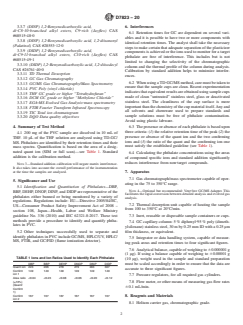
5.1 Identification and Quantitation of Phthalates—DBP, BBP, DEHP, DNOP, DINP, and DIDP are representative of the phthalates either banned or being monitored by a variety of regulations. Regulations include: EU—Directive 2005/84/EC, US—Consumer Product Safety Improvement Act of 2008 – section 108, Japan—Health, Labor and Welfare Ministry guideline No. 336 (2010) and IEC 62321-8:2017. These test methods provide a procedure to identify and quantify phthalates in PVC.
5.2 Other techniques successfully used to separate and identify phthalates in PVC include GC/MS, HPLC/UV, HPLC/MS, FTIR, and GC/FID (flame ionization detector).
SCOPE
1.1 This test method provides a procedure to identify and quantify phthalates by thermal desorption (TD) gas chromatography (GC) mass spectrometry (MS). Six phthalates are used to demonstrate the use of the procedure: BBP, DBP, DEHP, DNOP, DINP and DIDP.
1.2 Within the context of this method, “low level” is defined as 1000 ppm.
1.3 The values in SI units are to be regarded as standard.
1.4 This test method includes references, notes and footnotes that provide explanatory material. These notes and footnotes (excluding those in the tables and figures) shall not be considered as requirements of this method.
1.5 This standard does not purport to address all of the safety concerns, if any, associated with its use. It is the responsibility of the user of this standard to establish appropriate safety, health, and environmental practices and determine the applicability of regulatory limitations prior to use.
Note 1: The method can be extended to include other ortho-phthalates in a number of polymeric substrates.
Note 2: There is no known ISO equivalent to this standard.
1.6 This international standard was developed in accordance with internationally recognized principles on standardization established in the Decision on Principles for the Development of International Standards, Guides and Recommendations issued by the World Trade Organization Technical Barriers to Trade (TBT) Committee.
- Status
- Published
- Publication Date
- 31-Jan-2020
- Technical Committee
- D20 - Plastics
- Drafting Committee
- D20.70 - Analytical Methods
Buy Documents
ASTM D7823-20 - Standard Test Method for Determination of Low Level Phthalates in Poly (Vinyl Chloride) Plastics by Thermal Desorption—Gas Chromatography/Mass Spectrometry
REDLINE ASTM D7823-20 - Standard Test Method for Determination of Low Level Phthalates in Poly (Vinyl Chloride) Plastics by Thermal Desorption—Gas Chromatography/Mass Spectrometry
Overview
ASTM D7823-20: Standard Test Method for Determination of Low Level Phthalates in Poly (Vinyl Chloride) Plastics by Thermal Desorption–Gas Chromatography/Mass Spectrometry provides a reliable analytical procedure to identify and quantify specific phthalates in PVC plastics at concentrations as low as 1000 ppm. This test focuses on six commonly regulated phthalates: BBP, DBP, DEHP, DNOP, DINP, and DIDP. The method addresses significant regulatory requirements, including those set by the European Union Directive 2005/84/EC, the US Consumer Product Safety Improvement Act, and Japan’s Ministry of Health, Labor and Welfare guidelines. Utilizing thermal desorption (TD) followed by gas chromatography/mass spectrometry (GC/MS), this standard is tailored for assessing compliance in industries where phthalate content in PVC materials is closely regulated.
Key Topics
- Target Phthalates: The method targets low-level detection of six primary phthalates: BBP, DBP, DEHP, DNOP, DINP, and DIDP, representing those most scrutinized by health and safety regulations.
- Analytical Technique: Employs thermal desorption-GC/MS, providing specific retention times and mass spectral data for accurate identification and quantitation.
- Sample Preparation: Involves dissolving PVC samples in THF, followed by thermal desorption for effective release of phthalates.
- Interference Control: The method minimizes interference through use of standard addition calibration and specific ion monitoring, addressing potential matrix effects in PVC.
- Precision and Repeatability: Backed by interlaboratory studies, the method achieves high repeatability and reproducibility between laboratories.
- Regulatory Alignment: Provides a compliance mechanism with global regulations on phthalates in consumer and industrial PVC products.
Applications
- Regulatory Compliance: Ensures manufacturers and suppliers of PVC products meet mandatory restrictions for phthalate content, as required by the EU, US, Japan, and other jurisdictions.
- Quality Assurance: Applied in routine quality control to verify that finished PVC goods such as toys, medical devices, cables, and flooring materials do not exceed specified phthalate limits.
- Product Development: Supports R&D by enabling rapid screening of PVC formulations for presence of regulated plasticizers, aiding in the development of phthalate-free materials.
- Third-Party Testing: Used by independent laboratories for certification, inspection, and verification of PVC products for export or import, safeguarding supply chain integrity.
- Extension to Other Polymers: While primarily developed for PVC, the method can be adapted to analyze ortho-phthalates in other polymeric materials as required.
- Environmental and Health Monitoring: Assists stakeholders assessing potential exposure risks from phthalate migration in consumer goods and packaging.
Related Standards
- IEC 62321-8:2017: Provides methods for the determination of phthalates in electrical and electronic products.
- ASTM D7083: Practice for determination of plasticizers in PVC by gas chromatography.
- ASTM D883, D1600: Terminology standards relating to plastics and abbreviated terms.
- ASTM E177, E355, E594, E691: Methodology and terminology for precision, bias, and chromatographic analysis.
- EU Directive 2005/84/EC: Restricts phthalate use in toys and childcare articles.
- US CPSIA Section 108: Regulates phthalates in children’s products.
- Japan Ministry of Health, Labor and Welfare Guideline No. 336 (2010): Guidance on phthalates in food contact materials.
By following ASTM D7823-20, organizations in the plastics, electronics, toys, and packaging industries can ensure consistent, accurate, and regulatory-compliant determination of low-level phthalates in PVC materials, supporting global market access and consumer safety.
Relations
- Effective Date
- 01-Feb-2020
- Effective Date
- 01-Feb-2024
- Effective Date
- 01-Nov-2023
- Effective Date
- 01-Jan-2020
- Effective Date
- 01-Sep-2019
- Effective Date
- 01-Aug-2019
- Effective Date
- 15-Apr-2019
- Effective Date
- 01-Feb-2019
- Effective Date
- 01-Dec-2018
- Effective Date
- 01-Nov-2018
- Refers
ASTM D1600-18 - Standard Terminology for Abbreviated Terms Relating to Plastics (Withdrawn 2024) - Effective Date
- 01-Jan-2018
- Effective Date
- 15-Aug-2017
- Effective Date
- 01-May-2014
- Effective Date
- 01-Feb-2014
- Effective Date
- 01-May-2013
Buy Documents
ASTM D7823-20 - Standard Test Method for Determination of Low Level Phthalates in Poly (Vinyl Chloride) Plastics by Thermal Desorption—Gas Chromatography/Mass Spectrometry
REDLINE ASTM D7823-20 - Standard Test Method for Determination of Low Level Phthalates in Poly (Vinyl Chloride) Plastics by Thermal Desorption—Gas Chromatography/Mass Spectrometry
Get Certified
Connect with accredited certification bodies for this standard

DIN CERTCO
DIN Group product certification.

Smithers Quality Assessments
US management systems and product certification.
Sponsored listings
Frequently Asked Questions
ASTM D7823-20 is a standard published by ASTM International. Its full title is "Standard Test Method for Determination of Low Level Phthalates in Poly (Vinyl Chloride) Plastics by Thermal Desorption—Gas Chromatography/Mass Spectrometry". This standard covers: SIGNIFICANCE AND USE 5.1 Identification and Quantitation of Phthalates—DBP, BBP, DEHP, DNOP, DINP, and DIDP are representative of the phthalates either banned or being monitored by a variety of regulations. Regulations include: EU—Directive 2005/84/EC, US—Consumer Product Safety Improvement Act of 2008 – section 108, Japan—Health, Labor and Welfare Ministry guideline No. 336 (2010) and IEC 62321-8:2017. These test methods provide a procedure to identify and quantify phthalates in PVC. 5.2 Other techniques successfully used to separate and identify phthalates in PVC include GC/MS, HPLC/UV, HPLC/MS, FTIR, and GC/FID (flame ionization detector). SCOPE 1.1 This test method provides a procedure to identify and quantify phthalates by thermal desorption (TD) gas chromatography (GC) mass spectrometry (MS). Six phthalates are used to demonstrate the use of the procedure: BBP, DBP, DEHP, DNOP, DINP and DIDP. 1.2 Within the context of this method, “low level” is defined as 1000 ppm. 1.3 The values in SI units are to be regarded as standard. 1.4 This test method includes references, notes and footnotes that provide explanatory material. These notes and footnotes (excluding those in the tables and figures) shall not be considered as requirements of this method. 1.5 This standard does not purport to address all of the safety concerns, if any, associated with its use. It is the responsibility of the user of this standard to establish appropriate safety, health, and environmental practices and determine the applicability of regulatory limitations prior to use. Note 1: The method can be extended to include other ortho-phthalates in a number of polymeric substrates. Note 2: There is no known ISO equivalent to this standard. 1.6 This international standard was developed in accordance with internationally recognized principles on standardization established in the Decision on Principles for the Development of International Standards, Guides and Recommendations issued by the World Trade Organization Technical Barriers to Trade (TBT) Committee.
SIGNIFICANCE AND USE 5.1 Identification and Quantitation of Phthalates—DBP, BBP, DEHP, DNOP, DINP, and DIDP are representative of the phthalates either banned or being monitored by a variety of regulations. Regulations include: EU—Directive 2005/84/EC, US—Consumer Product Safety Improvement Act of 2008 – section 108, Japan—Health, Labor and Welfare Ministry guideline No. 336 (2010) and IEC 62321-8:2017. These test methods provide a procedure to identify and quantify phthalates in PVC. 5.2 Other techniques successfully used to separate and identify phthalates in PVC include GC/MS, HPLC/UV, HPLC/MS, FTIR, and GC/FID (flame ionization detector). SCOPE 1.1 This test method provides a procedure to identify and quantify phthalates by thermal desorption (TD) gas chromatography (GC) mass spectrometry (MS). Six phthalates are used to demonstrate the use of the procedure: BBP, DBP, DEHP, DNOP, DINP and DIDP. 1.2 Within the context of this method, “low level” is defined as 1000 ppm. 1.3 The values in SI units are to be regarded as standard. 1.4 This test method includes references, notes and footnotes that provide explanatory material. These notes and footnotes (excluding those in the tables and figures) shall not be considered as requirements of this method. 1.5 This standard does not purport to address all of the safety concerns, if any, associated with its use. It is the responsibility of the user of this standard to establish appropriate safety, health, and environmental practices and determine the applicability of regulatory limitations prior to use. Note 1: The method can be extended to include other ortho-phthalates in a number of polymeric substrates. Note 2: There is no known ISO equivalent to this standard. 1.6 This international standard was developed in accordance with internationally recognized principles on standardization established in the Decision on Principles for the Development of International Standards, Guides and Recommendations issued by the World Trade Organization Technical Barriers to Trade (TBT) Committee.
ASTM D7823-20 is classified under the following ICS (International Classification for Standards) categories: 83.040.30 - Auxiliary materials and additives for plastics. The ICS classification helps identify the subject area and facilitates finding related standards.
ASTM D7823-20 has the following relationships with other standards: It is inter standard links to ASTM D7823-18, ASTM D883-24, ASTM D883-23, ASTM D883-20, ASTM E594-96(2019), ASTM D883-19c, ASTM D883-19a, ASTM D883-19, ASTM D883-18a, ASTM D883-18, ASTM D1600-18, ASTM D883-17, ASTM E177-14, ASTM D1600-14, ASTM E691-13. Understanding these relationships helps ensure you are using the most current and applicable version of the standard.
ASTM D7823-20 is available in PDF format for immediate download after purchase. The document can be added to your cart and obtained through the secure checkout process. Digital delivery ensures instant access to the complete standard document.
Standards Content (Sample)
This international standard was developed in accordance with internationally recognized principles on standardization established in the Decision on Principles for the
Development of International Standards, Guides and Recommendations issued by the World Trade Organization Technical Barriers to Trade (TBT) Committee.
Designation: D7823 − 20
Standard Test Method for
Determination of Low Level Phthalates in Poly (Vinyl
Chloride) Plastics by Thermal Desorption—Gas
Chromatography/Mass Spectrometry
This standard is issued under the fixed designation D7823; the number immediately following the designation indicates the year of
original adoption or, in the case of revision, the year of last revision. A number in parentheses indicates the year of last reapproval. A
superscript epsilon (´) indicates an editorial change since the last revision or reapproval.
1. Scope* D1600 TerminologyforAbbreviatedTermsRelatingtoPlas-
tics
1.1 This test method provides a procedure to identify and
D3465 Test Method for Purity of Monomeric Plasticizers by
quantify phthalates by thermal desorption (TD) gas chroma-
Gas Chromatography
tography (GC) mass spectrometry (MS). Six phthalates are
D7083 Practice for Determination of Monomeric Plasticiz-
used to demonstrate the use of the procedure: BBP, DBP,
ers in Poly (Vinyl Chloride) (PVC) by Gas Chromatogra-
DEHP, DNOP, DINP and DIDP.
phy
1.2 Withinthecontextofthismethod,“lowlevel”isdefined
E177 Practice for Use of the Terms Precision and Bias in
as 1000 ppm.
ASTM Test Methods
E355 Practice for Gas ChromatographyTerms and Relation-
1.3 The values in SI units are to be regarded as standard.
ships
1.4 This test method includes references, notes and foot-
E594 Practice for Testing Flame Ionization Detectors Used
notes that provide explanatory material. These notes and
in Gas or Supercritical Fluid Chromatography
footnotes (excluding those in the tables and figures) shall not
E691 Practice for Conducting an Interlaboratory Study to
be considered as requirements of this method.
Determine the Precision of a Test Method
1.5 This standard does not purport to address all of the
IEEE/ASTM SI{10 Practice for Use of the International
safety concerns, if any, associated with its use. It is the
System of Units (SI), the Modernized Metric System
responsibility of the user of this standard to establish appro-
2.2 ASTM Adjuncts:
priate safety, health, and environmental practices and deter-
Adjunct to D7823 Vinyl Plasticizer Library—Total Ion
mine the applicability of regulatory limitations prior to use.
Chromatograms and Mass Spectra
NOTE 1—The method can be extended to include other ortho-phthalates
in a number of polymeric substrates.
3. Terminology
NOTE 2—There is no known ISO equivalent to this standard.
3.1 Definitions—For definition of plastic terms used in this
1.6 This international standard was developed in accor-
test method, see Terminologies D883 and D1600.
dance with internationally recognized principles on standard-
ization established in the Decision on Principles for the
3.2 For units, symbols, and abbreviations used in this test
Development of International Standards, Guides and Recom-
method refer to Practices E594, E355,or SI10.
mendations issued by the World Trade Organization Technical
3.3 Compounds and Instrumentation:
Barriers to Trade (TBT) Committee.
3.3.1 (DOA) Hexanedioic acid, 1,6{bis(2{ethylhexyl) ester
CAS #103{23{1
2. Referenced Documents
3.3.2 (DINCH) 1,2{Cyclohexanedicarboxylic acid, dinonyl
2.1 ASTM Standards:
ester, branched and linear CAS #474919{59{0
D883 Terminology Relating to Plastics
3.3.3 (DBP) 1,2{Benzenedicarboxylic acid, 1,2{di{n{butyl
ester CAS #84{74{2
This test method is under the jurisdiction ofASTM Committee D20 on Plastics
3.3.4 (BBP) Benzyl butyl phthalate CAS #85{68{7
and is the direct responsibility of Subcommittee D20.70 on Analytical Methods.
3.3.5 (DEHP) Bis(2{ethyhexyl) phthalate CAS #117{81{7
Current edition approved Feb. 1, 2020. Published March 2020. Originally
3.3.6 (DNOP) Di(n{octyl) phthalate CAS #117{84{0
approved in 2013. Last previous edition approved in 2018 as D7823 – 18. DOI:
10.1520/D7823-20.
For referenced ASTM standards, visit the ASTM website, www.astm.org, or
contact ASTM Customer Service at service@astm.org. For Annual Book of ASTM
Standards volume information, refer to the standard’s Document Summary page on Available from ASTM International Headquarters. Order Adjunct No.
the ASTM website. ADJD7823S-EA. Original adjunct produced in 2016.
*A Summary of Changes section appears at the end of this standard
Copyright © ASTM International, 100 Barr Harbor Drive, PO Box C700, West Conshohocken, PA 19428-2959. United States
D7823 − 20
3.3.7 (DINP) 1,2{Benzenedicarboxylic acid, 6. Interferences
di{C8{10{branched alkyl esters, C9{rich (Jayflex) CAS
6.1 Retention times for GC are dependent on several vari-
#68515{48{0
ables and it is possible to have two or more components with
3.3.8 (DINP) 1,2{Benzenedicarboxylic acid, 1,2{diisononyl
identical retention times. The analyst shall take the necessary
(Palatinol) CAS #28553{12{0
steps to make certain that adequate separation of the plasticizer
3.3.9 (DIDP) 1,2{Benzenedicarboxylic acid,
components is achieved or the ions used to monitor for a target
di{C9{11{branched alkyl esters, C10{rich (Jayflex) CAS
phthalate are free of interference. This includes but is not
#68515{49{1
limited to changing the selectivity of the chromatographic
3.3.10 (DIDP)1,2{Benzenedicarboxylicacid,1,2{diisodecyl
column and the thermal profile of the column during analysis.
CAS #26761{40{0
Calibration by standard addition helps to minimize interfer-
3.3.11 TD Thermal Desorption
ences.
3.3.12 GC Gas Chromatography
6.2 WhenusingaTD{GC/MSmethod,caremustbetakento
3.3.13 GC/MS Gas Chromatography/Mass Spectrometry
ensure that the sample cups are clean. Recent experimentation
3.3.14 PVC Poly (vinyl chloride)
indicatesthatequivalentresultsareobtainedusingsamplecups
3.3.15 THF GC grade or higher “Tetrahydrofuran”
made of clean “untreated” stainless steel, glass or deactivated
3.3.16 DCM GC grade or higher “Methylene Chloride”
stainless steel. The cleanliness of the cup surface is more
3.3.17 EGA{MS Evolved Gas Analysis{mass spectrometry
importantthanthechemistryofthecupmaterialitself.Anyand
3.3.18 FTIR Fourier Transform Infrared Spectroscopy
all solvents and chemware used to prepare standards and
3.3.19 TIC Total ion chromatogram
sample solutions must be free of phthalate contamination.
3.3.20 DQO Data quality objectives
Avoid using plastic labware.
4. Summary of Test Method
6.3 The presence or absence of each phthalateisbasedupon
three criteria: (1) the relative retention time of the peak (2) the
4.1 200 mg of the PVC sample are dissolved in 10 mL of
presence or absence of the quant ion and the two confirming
THF. 10 µL of the THF solution are analyzed using TD-GC/
ions and (3) the ratio of the quant and the confirming ion one
MS. Phthalates are identified by their retention times and their
must satisfy the established guideline (see Table 1).
mass spectra. Quantification is based on the area of a desig-
nated quant ion (SIM or full scan)—see Table 1. Standard
6.4 Calculating the phthalate concentrations using the areas
addition is the calibration method.
of compound specific ions and standard addition significantly
reduces interference from non{target compounds.
NOTE 3—Standard addition calibration will negate matrix interference.
It also takes into account the overall performance of the instrumentation
at the time the samples are analyzed.
7. Apparatus
7.1 Gas chromatograph/mass spectrometer capable of oper-
5. Significance and Use
ating in the 75 to 350°C range.
5.1 Identification and Quantitation of Phthalates—DBP,
NOTE 4—Optional but recommended: Vent{free GC/MS Adapter. This
BBP, DEHP, DNOP, DINP, and DIDPare representative of the
facilitates the rapid conversion between detailed analysis and evolved gas
phthalates either banned or being monitored by a variety of
analysis.
regulations. Regulations include: EU—Directive 2005/84/EC,
7.2 Thermal desorption unit capable of heating the sample
US—Consumer Product Safety Improvement Act of 2008 –
from 100 to 350°C at 20°C/min.
section 108, Japan—Health, Labor and Welfare Ministry
guideline No. 336 (2010) and IEC 62321-8:2017. These test 7.3 Inert, reusable or disposable sample containers or cups.
methods provide a procedure to identify and quantify phtha-
7.4 GC capillary column: 5 % diphenyl{95 % poly (dimeth-
lates in PVC.
ylsiloxane) stainless steel, 30 mby 0.25 mmIDwitha0.25µm
5.2 Other techniques successfully used to separate and
film thickness, or equivalent.
identify phthalates in PVC include GC/MS, HPLC/UV, HPLC/
7.5 Integrator or data handling system, capable of measur-
MS, FTIR, and GC/FID (flame ionization detector).
ing peak areas and retention times to four significant figures.
7.6 Analyticalbalance,capableofweighingto 60.000001g
(1 µg). If using a balance capable of weighing to 60.00001 g
TABLE 1 Ions and Ion Ratios Used to Identify Each Phthalate
(10 µg), weight used in the sample and standard preparation
DBP BBP DEHP DNOP DINP DIDP
must be scaled accordingly in order to ensure that the data are
Quant ion 223 206 279 279 293 307
accurate to three significant figures.
Confirm 149 149 149 149 149 149
ion 1
7.7 Pressure regulators, for all required gas cylinders.
Area ratio <0.04 <0.23 <0.08 <0.06 <0.20 <0.12
(±10%)
7.8 Flow meter, or other means of measuring gas flow rates
(Quant/
60.1 mL/min.
Confirm
1)
Confirm 167 167 167 167 167 167
8. Reagents and Materials
ion 2
8.1 Helium carrier gas, chromatographic grade.
D7823 − 20
8.2 Methylene chloride (DCM) or n{hexane for preparing 9. Safety and Precautions
the phthalate standard solution (Solution #1, 10.2), spectral
9.1 Use THF and methylene chloride in a well{ventilated
quality or chromatographic grade.
space.
8.3 Tetrahydrofuran (THF), or a solvent suitable for prepar-
10. Preparation of the Analytical Samples (based upon
ing the PVC sample (Solution #2, 10.3), spectral quality or
usinga1µg balance) Weights must be scaled up if
chromatographic grade.
using a 10-µg balance.
8.4 Standards of the appropriate phthalates for use when
10.1 Three solutions must be prepared: (1) a stock solution
constructing an external calibration curve or when preparing
of the target phthalate standards, (2) a solution of the sample
Solution #3 (10.4) that is used for the standard addition
and (3) the sample solution spiked with the standard stock
procedure. Use technical grade DINP and DIDP when prepar-
solution.
ing the calibration standard.
10.2 Solution #1—Prepare a stock standard solution of the
NOTE 5—DINP and DIDP, when used in various PVC formulations are
phthalates by dissolving 0.30 mg of each phthalate in 10 mLof
technical mixtures. Here is specific information on DINP and DIDP. For
more information, please refer to Appendix X3. methylene chloride (0.30 mg/10 mL). N{hexane has also been
Jayflex DIDP: 1,2{ Benzenedicarboxylic acid, di{ C9{ 11{ branched
used with success. See Fig. 1 for a typical chromatogram.
alkyl esters, C10{ rich: CAS# 68515{ 49{ 1.
10.3 Solution #2—Dissolve 200 mg of the sample in 10 mL
Jayflex DINP: 1,2{ Benzenedicarboxylic acid, di{ C8{ 10{ branched
alkyl esters, C9{ rich: CAS# 68515{ 48{ 0. THF (200 mg/10 mL). Shake (or sonicate) the solution for five
FIG. 1 Solution #1—Phthalates Standard Mixture in DCM (see 10.2)
D7823 − 20
not affect either the accuracy or precision of the phthalate determination.
minutes—see Note 6.The solution is likely to range from clear
toslightlycloudy.Place10µLofthesamplesolutioninaclean
10.4 Solution #3—Place 10 µL of the sample solution (#2)
sample cup. Evaporate the solvent; the sample is ready to
into a clean sample cup. Add 10 µL of the phthalate standard
analyze. See Figs. 2 and 3 for example chromatograms.
solution (#1). Evaporate the solvent.
NOTE 6—A critical step in the accurate determination of phthalates is
NOTE 8—To expedite the evaporation process, pass a steady stream of
sample homogeneity. This is discussed in more detail in Appendix X2.
NOTE 7—It is possible that the solution will contain inorganic material. a high purity inert gas using clean, (plasticizer- and additive-free) tubing
Studies have shown that the presence of insoluble inorganic material will over the sample cup.
FIG. 2 Solution #2—Chromatograms (TIC) of PVC with Three Different Plasticizers, TD-GC/MS Analysis (see 10.3 and 11.3)
D7823 − 20
FIG. 3 Solution #2—Reproducibility of PVC-DINCH (n=6) (see 10.3 and 11.3)
11. Procedure 11.2 Establish the relative retention time and mass spectrum
of each phthalate using Solution #1—10.2: The following
11.1 Establish that the analytical system contains concen-
conditions were used to obtain the example chromatograms
trations of phthalate contamination that are lower than the
shown in Figs. 1-4:
background contamination acceptable to the project specific
Data Quality Objectives by analyzing 10 µL of THF.
D7823 − 20
FIG. 4 Solution #3—Standard Addition (see 11.7)
Thermal Desorption (TD){GC/MS Parameters Solvent delay: 6 min
TD temperature: 100 { 20°C/min { 320°C (5 min hold) Column: UA{5 (5 % Diphenyl{95 % dimethyl
Py interface: 320°C (Auto mode), polysiloxane) 30 m by 0.25 mm i.d,
GC injector : 300°C 0.25 µm film) or equivalent
GC oven: 80 (1 min hold) to 200°C (at 50°C/ Column He flow: 1.2 mL/min, Split ratio: 1/20
min). Mass range: 29{600 m/z,
Injection at 80°C avoids thermal Scan speed: 2.57 scans/sec,
shock, which improves analytical Threshold: 50
precision. The initial ramp rate is not MSD Transfer Line Temp.: 300°C
critical and will be a function of the Ion Source (EI) temp.: 230°C
performance of the GC oven.
200°C to 320°C (15°C/min), 2 min
hold 320°C
D7823 − 20
11.2.1 Confirm the TD zone using Evolved Gas Analysis 12. Example calculations
(EGA){MS. The total ion chromatogram of the sample (Solu-
12.1 Atypical set of standard addition curves are presented
tion #2, 10.3) needs to be similar to that presented in Appendix
in Fig. 5. Included in Fig. 5 is an example of how to calculate
X1. The thermal zone normally will not vary from sample-to-
the concentration of the target phthalate and the analytical
sample; thus, EGA need not be performed on every sample in
precision (n=6) of the method.
the batch.Acheck sample when the polymer substrate changes
should be performed in order to verify the limits of the thermal
13. Quality Control
zone.
13.1 Perform the quality checks outlined in Table 2.
11.3 Analyze the sample (Solution #2, 10.3) using the TABLE 2 System Performance Verification
conditions outlined in 11.2. Typical chromatograms are shown
Sample Description Frequency Rationale
Method Blank 10 µL Prior to sample analysis Verifies that the
in Figs. 2 and 3. The precision of the TD method is shown in
THF and after the analysis of phthalate background is
Fig. 3.
10 samples below the maximum
level of phthalate set by
11.4 Peak identifications are based on relative retention
the project’s DQO
data, full scan extracted ion chromatograms of both the quant
Laboratory Control Prior to sample analysis Verifies the stability of
and confirming ions and the ion area ratios as indicated in Sample 10 µL of and after the analysis of the chromatographic
Sample #1 10 samples system and the stock
Table 1. Phthalate quantitation is based upon the peak areas of
solution.
the quant ions listed in Table 1. The assumption being made is
13.2 Ensure the system is free of phthalate contamination
that the sole source of the quant ion at a predetermined
b
...
This document is not an ASTM standard and is intended only to provide the user of an ASTM standard an indication of what changes have been made to the previous version. Because
it may not be technically possible to adequately depict all changes accurately, ASTM recommends that users consult prior editions as appropriate. In all cases only the current version
of the standard as published by ASTM is to be considered the official document.
Designation: D7823 − 18 D7823 − 20
Standard Test Method for
Determination of Low Level Phthalates in Poly (Vinyl
Chloride) Plastics by Thermal Desorption—Gas
Chromatography/Mass Spectrometry
This standard is issued under the fixed designation D7823; the number immediately following the designation indicates the year of
original adoption or, in the case of revision, the year of last revision. A number in parentheses indicates the year of last reapproval. A
superscript epsilon (´) indicates an editorial change since the last revision or reapproval.
1. Scope*
1.1 This test method provides a procedure to identify and quantify phthalates by thermal desorption (TD) gas chromatography
(GC) mass spectrometry (MS). Six phthalates are used to demonstrate the use of the procedure: BBP, DBP, DEHP, DNOP, DINP
and DIDP.
1.2 Within the context of this method, “low level” is defined as 1000 ppm.
1.3 The values in SI units are to be regarded as standard.
1.4 This test method includes references, notes and footnotes that provide explanatory material. These notes and footnotes
(excluding those in the tables and figures) shall not be considered as requirements of this method.
1.5 This standard does not purport to address all of the safety concerns, if any, associated with its use. It is the responsibility
of the user of this standard to establish appropriate safety, health, and environmental practices and determine the applicability of
regulatory limitations prior to use.
NOTE 1—The method can be extended to include other ortho-phthalates in a number of polymeric substrates.
NOTE 2—There is no known ISO equivalent to this standard.
1.6 This international standard was developed in accordance with internationally recognized principles on standardization
established in the Decision on Principles for the Development of International Standards, Guides and Recommendations issued
by the World Trade Organization Technical Barriers to Trade (TBT) Committee.
2. Referenced Documents
2.1 ASTM Standards:
D883 Terminology Relating to Plastics
D1600 Terminology for Abbreviated Terms Relating to Plastics
D3465 Test Method for Purity of Monomeric Plasticizers by Gas Chromatography
D7083 Practice for Determination of Monomeric Plasticizers in Poly (Vinyl Chloride) (PVC) by Gas Chromatography
E177 Practice for Use of the Terms Precision and Bias in ASTM Test Methods
E355 Practice for Gas Chromatography Terms and Relationships
E594 Practice for Testing Flame Ionization Detectors Used in Gas or Supercritical Fluid Chromatography
E691 Practice for Conducting an Interlaboratory Study to Determine the Precision of a Test Method
IEEE/ASTM SI{10 Practice for Use of the International System of Units (SI), the Modernized Metric System
2.2 ASTM Adjuncts:
Adjunct to D7823 Vinyl Plasticizer Library—Total Ion Chromatograms and Mass Spectra
3. Terminology
3.1 Definitions—For definition of plastic terms used in this test method, see Terminologies D883 and D1600.
3.2 For units, symbols, and abbreviations used in this test method refer to Practices E594, E355, or SI10.
This test method is under the jurisdiction of ASTM Committee D20 on Plastics and is the direct responsibility of Subcommittee D20.70 on Analytical Methods.
Current edition approved Nov. 1, 2018Feb. 1, 2020. Published November 2018March 2020. Originally approved in 2013. Last previous edition approved in 20162018 as
D7823 – 16.D7823 – 18. DOI: 10.1520/D7823-18.10.1520/D7823-20.
For referenced ASTM standards, visit the ASTM website, www.astm.org, or contact ASTM Customer Service at service@astm.org. For Annual Book of ASTM Standards
volume information, refer to the standard’s Document Summary page on the ASTM website.
Available from ASTM International Headquarters. Order Adjunct No. ADJD7823S-EA. Original adjunct produced in 2016.
*A Summary of Changes section appears at the end of this standard
Copyright © ASTM International, 100 Barr Harbor Drive, PO Box C700, West Conshohocken, PA 19428-2959. United States
D7823 − 20
3.3 Compounds and Instrumentation:
3.3.1 (DOA) Hexanedioic acid, 1,6{bis(2{ethylhexyl) ester CAS #103{23{1
3.3.2 (DINCH) 1,2{Cyclohexanedicarboxylic acid, dinonyl ester, branched and linear CAS #474919{59{0
3.3.3 (DBP) 1,2{Benzenedicarboxylic acid, 1,2{di{n{butyl ester CAS #84{74{2
3.3.4 (BBP) Benzyl butyl phthalate CAS #85{68{7
3.3.5 (DEHP) Bis(2{ethyhexyl) phthalate CAS #117{81{7
3.3.6 (DNOP) Di(n{octyl) phthalate CAS #117{84{0
3.3.7 (DINP) 1,2{Benzenedicarboxylic acid,
di{C8{10{branched alkyl esters, C9{rich (Jayflex) CAS #68515{48{0
3.3.8 (DINP) 1,2{Benzenedicarboxylic acid, 1,2{diisononyl (Palatinol) CAS #28553{12{0
3.3.9 (DIDP) 1,2{Benzenedicarboxylic acid,
di{C9{11{branched alkyl esters, C10{rich (Jayflex) CAS #68515{49{1
3.3.10 (DIDP) 1,2{Benzenedicarboxylic acid, 1,2{diisodecyl CAS #26761{40{0
3.3.11 TD Thermal Desorption
3.3.12 GC Gas Chromatography
3.3.13 GC/MS Gas Chromatography/Mass Spectrometry
3.3.14 PVC Poly (vinyl chloride)
3.3.15 THF GC grade or higher “Tetrahydrofuran”
3.3.16 DCM GC grade or higher “Methylene Chloride”
3.3.17 EGA{MS Evolved Gas Analysis{mass spectrometry
3.3.18 FTIR Fourier Transform Infrared Spectroscopy
3.3.19 TIC Total ion chromatogram
3.3.20 DQO Data quality objectives
4. Summary of Test Method
4.1 200 mg of the PVC sample are dissolved in 10 mL of THF. 10 μL of the THF solution are analyzed using TD-GC/MS.
Phthalates are identified by their retention times and their mass spectra. Quantification is based on the area of a designated quant
ion (SIM or full scan)—see Table 1. Standard addition is the calibration method.
NOTE 3—Standard addition calibration will negate matrix interference. It also takes into account the overall performance of the instrumentation at the
time the samples are analyzed.
5. Significance and Use
5.1 Identification and Quantitation of Phthalates—DBP, BBP, DEHP, DNOP, DINP, and DIDP are representative of the
phthalates either banned or being monitored by a variety of regulations. Regulations include: EU—Directive 2005/84/EC,
US—Consumer Product Safety Improvement Act of 2008 – section 108, Japan—Health, Labor and Welfare Ministry guideline No.
336 (2010) and IEC 62321-8:2017. These test methods provide a procedure to identify and quantify phthalates in PVC.
5.2 Other techniques successfully used to separate and identify phthalates in PVC include GC/MS, HPLC/UV, HPLC/MS,
FTIR, and GC/FID (flame ionization detector).
6. Interferences
6.1 Retention times for GC are dependent on several variables and it is possible to have two or more components with identical
retention times. The analyst shall take the necessary steps to make certain that adequate separation of the plasticizer components
is achieved or the ions used to monitor for a target phthalate are free of interference. This includes but is not limited to changing
the selectivity of the chromatographic column and the thermal profile of the column during analysis. Calibration by standard
addition helps to minimize interferences.
TABLE 1 Ions and Ion Ratios Used to Identify Each Phthalate
DBP BBP DEHP DNOP DINP DIDP
Quant ion 223 206 279 279 293 307
Confirm 149 149 149 149 149 149
ion 1
Area ratio <0.04 <0.23 <0.08 <0.06 <0.20 <0.12
(±10%)
(Quant/
Confirm
1)
Confirm 167 167 167 167 167 167
ion 2
D7823 − 20
6.2 When using a TD{GC/MS method, care must be taken to ensure that the sample cups are clean. Recent experimentation
indicates that equivalent results are obtained using sample cups made of clean “untreated” stainless steel, glass or deactivated
stainless steel. The cleanliness of the cup surface is more important than the chemistry of the cup material itself. Any and all
solvents and chemware used to prepare standards and sample solutions must be free of phthalate contamination. Avoid using plastic
labware.
6.3 The presence or absence of each phthalate is based upon three criteria: (1) the relative retention time of the peak (2) the
presence or absence of the quant ion and the two confirming ions and (3) the ratio of the quant and the confirming ion one must
satisfy the established guideline (see Table 1).
6.4 Calculating the phthalate concentrations using the areas of compound specific ions and standard addition significantly
reduces interference from non{target compounds.
7. Apparatus
7.1 Gas chromatograph/mass spectrometer capable of operating in the 75 to 350°C range.
NOTE 4—Optional but recommended: Vent{free GC/MS Adapter. This facilitates the rapid conversion between detailed analysis and evolved gas
analysis.
7.2 Thermal desorption unit capable of heating the sample from 100 to 350°C at 20°C/min.
7.3 Inert, reusable or disposable sample containers or cups.
7.4 GC capillary column: 5 % diphenyl{95 % poly (dimethylsiloxane) stainless steel, 30 m by 0.25 mm ID with a 0.25 μm film
thickness, or equivalent.
7.5 Integrator or data handling system, capable of measuring peak areas and retention times to four significant figures.
7.6 Analytical balance, capable of weighing to 60.000001 g (1 μg). If using a balance capable of weighing to 60.00001 g (10
μg), weight used in the sample and standard preparation must be scaled accordingly in order to ensure that the data are accurate
to three significant figures.
7.7 Pressure regulators, for all required gas cylinders.
7.8 Flow meter, or other means of measuring gas flow rates 60.1 mL/min.
8. Reagents and Materials
8.1 Helium carrier gas, chromatographic grade.
8.2 Methylene chloride (DCM) or n{hexane for preparing the phthalate standard solution (Solution #1, 10.2), spectral quality
or chromatographic grade.
8.3 Tetrahydrofuran (THF), or a solvent suitable for preparing the PVC sample (Solution #2, 10.3), spectral quality or
chromatographic grade.
8.4 Standards of the appropriate phthalates for use when constructing an external calibration curve or when preparing Solution
#3 (10.4) that is used for the standard addition procedure. Use technical grade DINP and DIDP when preparing the calibration
standard.
NOTE 5—DINP and DIDP, when used in various PVC formulations are technical mixtures. Here is specific information on DINP and DIDP. For more
information, please refer to Appendix X3.
Jayflex DIDP: 1,2{ Benzenedicarboxylic acid, di{ C9{ 11{ branched alkyl esters, C10{ rich: CAS# 68515{ 49{ 1.
Jayflex DINP: 1,2{ Benzenedicarboxylic acid, di{ C8{ 10{ branched alkyl esters, C9{ rich: CAS# 68515{ 48{ 0.
9. Safety and Precautions
9.1 Use THF and methylene chloride in a well{ventilated space.
10. Preparation of the Analytical Samples (based upon using a 1 μg balance) Weights must be scaled up if using a
10-μg balance.
10.1 Three solutions must be prepared: (1) a stock solution of the target phthalate standards, (2) a solution of the sample and
(3) the sample solution spiked with the standard stock solution.
10.2 Solution #1—Prepare a stock standard solution of the phthalates by dissolving 0.30 mg of each phthalate in 10 mL of
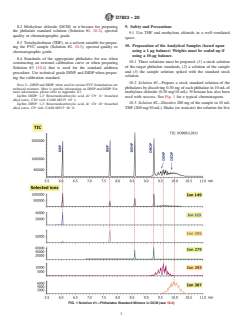
methylene chloride (0.30 mg/10 mL). N{hexane has also been used with success. See Fig. 1 for a typical chromatogram.
10.3 Solution #2—Dissolve 200 mg of the sample in 10 mL THF (200 mg/10 mL). Shake (or sonicate) the solution for five
minutes—see Note 6. The solution is likely to range from clear to slightly cloudy. Place 10 μL of the sample solution in a clean
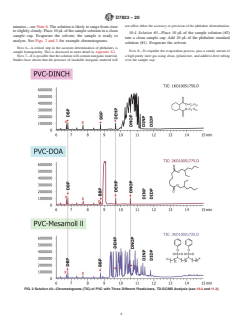
sample cup. Evaporate the solvent; the sample is ready to analyze. See Figs. 2 and 3 for example chromatograms.
NOTE 6—A critical step in the accurate determination of phthalates is sample homogeneity. This is discussed in more detail in Appendix X2.
D7823 − 20
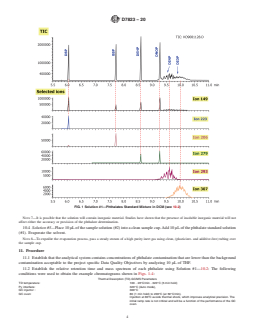
FIG. 1 Solution #1—Phthalates Standard Mixture in DCM (see 10.2)
NOTE 7—It is possible that the solution will contain inorganic material. Studies have shown that the presence of insoluble inorganic material will not
affect either the accuracy or precision of the phthalate determination.
10.4 Solution #3—Place 10 μL of the sample solution (#2) into a clean sample cup. Add 10 μL of the phthalate standard solution
(#1). Evaporate the solvent.
NOTE 8—To expedite the evaporation process, pass a steady stream of a high purity inert gas using clean, (plasticizer- and additive-free) tubing over
the sample cup.
11. Procedure
11.1 Establish that the analytical system contains concentrations of phthalate contamination that are lower than the background
contamination acceptable to the project specific Data Quality Objectives by analyzing 10 μL of THF.
11.2 Establish the relative retention time and mass spectrum of each phthalate using Solution #1—10.2: The following
conditions were used to obtain the example chromatograms shown in Figs. 1-4:
Thermal Desorption (TD){GC/MS Parameters
TD temperature: 100 { 20°C/min { 320°C (5 min hold)
Py interface: 320°C (Auto mode),
GC injector : 300°C
GC oven: 80 (1 min hold) to 200°C (at 50°C/min).
Injection at 80°C avoids thermal shock, which improves analytical precision. The
initial ramp rate is not critical and will be a function of the performance of the GC
oven.
D7823 − 20
FIG. 2 Solution #2—Chromatograms (TIC) of PVC with Three Different Plasticizers, TD-GC/MS Analysis (see 10.3 and 11.3)
200°C to 320°C (15°C/min), 2 min hold 320°C
Solvent delay: 6 min
Column: UA{5 (5 % Diphenyl{95 % dimethyl polysiloxane) 30 m by 0.25 mm i.d, 0.25 μm
film) or equivalent
Column He flow: 1.2 mL/min, Split ratio: 1/20
Mass range: 29{600 m/z,
Scan speed: 2.57 scans/sec,
Threshold: 50
MSD Transfer Line Temp.: 300°C
Ion Source (EI) temp.: 230°C
D7823 − 20
FIG. 3 Solution #2—Reproducibility of PVC-DINCH (n=6) (see 10.3 and 11.3)
11.2.1 Confirm the TD zone using Evolved Gas Analysis (EGA){MS. The total ion chromatogram of the sample (Solution #2,
10.3) needs to be similar to that presented in Appendix X1. The thermal zone normally will not vary from sample-to-sample; thus,
EGA need not be performed on every sample in the batch. A check sample when the polymer substrate changes should be
performed in order to verify the limits of the thermal zone.
11.3 Analyze the sample (Solution #2, 10.3) using the conditions outlined in 11.2. Typical chromatograms are shown in Figs.
2 and 3. The precision of the TD method is shown in Fig. 3.
11.4 Peak identifications are based on relative retention data, full scan extracted ion chromatograms of both the quant and
confirming ions and the ion area ratios as indicated in Table 1. Phthalate quantitation is based upon the peak areas of the quant
D7823 − 20
FIG. 4 Solution #3—Standard Addition (see 11.7)
ions listed in Table 1. The assumption being made is that the sole source of the quant ion at a predetermined retention time is the
phthalate. Use the peak area of the quant ion can be used to accurately determine the amount of the phthalate.
11.5 If using selected ion monitoring (SIM), peak identification is based solely on the presence or absence of the quant ion and
the two confirming ions at predetermined retention times. Quantitation is based on the area of the quant ion.
11.6 When DINP and DIDP are both present in a sample or standard, use m/z 127 as a qualifying ion for DINP and m/z 289
for DIDP. This is because DINP and DIDP partially co{elute and both produce m/z 149 and 167. If 149 qualifier ion ratios are set
when DINP and DIDP are at equal concentrations, then any samples with different ratios will produce substantially different
149/167 ratios, potentially leading to a false negative.
NOTE 9—A typical total ion chromatogram obtained using the conditions specified in 11.2 is shown in Fig. 1. Because the absolute retention times are
dependent upon the e
...