

ASTM D4660-23
(Test Method)Standard Test Methods for Polyurethane Raw Materials: Determination of the Isomer Content of Toluenediisocyanate
General Information
- Abstract
SIGNIFICANCE AND USE
5.1 These test methods are suitable for research or for quality control to determine the isomer content of toluene diisocyanates.
5.2 The isomer content of a toluene diisocyanate relates to its reactivity.
SCOPE
1.1 These test methods measure the amount of toluene-2,6-diisocyanate (2,6-TDI) isomer or toluene–2,4–diisocyanate (2,4-TDI) isomer in mixtures of the 2,4- and 2,6-isomers of toluenediisocyanate (TDI). Two different test methods are provided to give accurate results over the broad range of isomer concentrations possible.
1.1.1 Test Method A—Applicable to TDI samples containing 5 to 95 % of 2,6-TDI isomer (5 to 95 % 2,4-TDI isomer).
1.1.2 Test Method B—Applicable to TDI samples containing 0 to 5 % of 2,6-TDI isomer (95 to 100 % 2,4-TDI isomer).
Note 1: These test methods are equivalent to ISO 15064.
1.2 The values stated in SI units are to be regarded as standard.
1.3 This standard does not purport to address all of the safety concerns, if any, associated with its use. It is the responsibility of the user of this standard to establish appropriate safety, health, and environmental practices and determine the applicability of regulatory limitations prior to use.
1.4 This international standard was developed in accordance with internationally recognized principles on standardization established in the Decision on Principles for the Development of International Standards, Guides and Recommendations issued by the World Trade Organization Technical Barriers to Trade (TBT) Committee.
- Status
- Published
- Publication Date
- 14-Mar-2023
- Technical Committee
- D20 - Plastics
- Drafting Committee
- D20.22 - Cellular Materials - Plastics and Elastomers
Buy Documents
ASTM D4660-23 - Standard Test Methods for Polyurethane Raw Materials: Determination of the Isomer Content of Toluenediisocyanate
REDLINE ASTM D4660-23 - Standard Test Methods for Polyurethane Raw Materials: Determination of the Isomer Content of Toluenediisocyanate
Overview
ASTM D4660-23: Standard Test Methods for Polyurethane Raw Materials: Determination of the Isomer Content of Toluenediisocyanate specifies laboratory methods for the quantitative measurement of the isomer composition of toluenediisocyanate (TDI), a key raw material in polyurethane production. This standard is vital for both research and quality control applications, providing accurate determination of the ratios of the two primary TDI isomers: toluene-2,4-diisocyanate (2,4-TDI) and toluene-2,6-diisocyanate (2,6-TDI). The isomer content of TDI directly impacts the reactivity and final properties of polyurethane materials, making reliable testing essential for ensuring product consistency and performance.
Key Topics
- Isomer determination: Two methods (Test Method A and Test Method B) cover a wide range of isomer concentrations, enabling the analysis of most TDI samples encountered in industrial practice.
- Test Method A: Applicable to TDI samples containing 5 to 95% of 2,6-TDI isomer (or 5 to 95% 2,4-TDI isomer), using infrared spectrophotometry on cyclohexane solutions.
- Test Method B: Designed for samples with 0 to 5% 2,6-TDI isomer (and 95 to 100% 2,4-TDI), suitable for high-purity 2,4-TDI, using direct infrared measurement without dilution.
- Calibration: Use of pure isomer standards to establish calibration curves for precise quantification.
- Precision and repeatability: The standard provides repeatability and reproducibility statistics for intra-lab and inter-lab comparisons, supporting robust data generation in quality control environments.
- Safety: Emphasizes strict precautions due to the hazardous nature of isocyanates, highlighting the importance of appropriate personal protective equipment and handling in controlled environments.
Applications
The determination of TDI isomer content as outlined in ASTM D4660-23 serves several critical roles in the polyurethane industry:
- Quality Control: Ensures that TDI feedstocks meet customer and specification requirements for isomer composition, which is critical for maintaining product performance and consistency.
- Research and Development: Facilitates the development and optimization of new polyurethane formulations by enabling accurate material characterization.
- Supplier Verification: Assists in qualifying and validating suppliers by confirming the isomer distribution of their TDI batches.
- Process Optimization: Supports fine-tuning of manufacturing processes where the reactivity of TDI may alter key product attributes, such as hardness, flexibility, and aging characteristics of polyurethane goods.
- Regulatory Compliance: Fosters adherence to international trade and safety standards, since accurate reporting of chemical composition is often required by regulations.
The methods are suitable for routine laboratory analysis in chemical plants, third-party testing laboratories, and R&D settings focused on polyurethane production.
Related Standards
- ISO 15064: Plastics-Aromatic Isocyanates for Use in the Production of Polyurethanes-Determination of the Isomer Ratio in Toluenediisocyanate (Test methods in ASTM D4660-23 are equivalent to ISO 15064, supporting global harmonization.)
- ASTM D883: Terminology Relating to Plastics
- ASTM E180: Practice for Determining the Precision of ASTM Methods for Analysis and Testing of Industrial and Specialty Chemicals
- ASTM E691: Practice for Conducting an Interlaboratory Study to Determine the Precision of a Test Method
- ASTM E2935: Practice for Evaluating Equivalence of Two Testing Processes
By adhering to ASTM D4660-23, users enhance quality assurance, consistency, and regulatory compliance in the polyurethane supply chain, ensuring the reliable performance of TDI-based products.
Relations
- Effective Date
- 01-Feb-2024
- Effective Date
- 01-Nov-2023
- Effective Date
- 01-Apr-2022
- Effective Date
- 01-Jan-2020
- Effective Date
- 01-Aug-2019
- Effective Date
- 15-Apr-2019
- Effective Date
- 01-Feb-2019
- Effective Date
- 01-Dec-2018
- Effective Date
- 01-Nov-2018
- Effective Date
- 01-Oct-2017
- Refers
ASTM E2935-17 - Standard Practice for Conducting Equivalence Testing in Laboratory Applications - Effective Date
- 01-Oct-2017
- Effective Date
- 01-Oct-2017
- Effective Date
- 15-Aug-2017
- Refers
ASTM E2935-16 - Standard Practice for Conducting Equivalence Testing in Laboratory Applications - Effective Date
- 15-Nov-2016
- Refers
ASTM E2935-15 - Standard Practice for Conducting Equivalence Testing in Laboratory Applications - Effective Date
- 01-Oct-2015
Buy Documents
ASTM D4660-23 - Standard Test Methods for Polyurethane Raw Materials: Determination of the Isomer Content of Toluenediisocyanate
REDLINE ASTM D4660-23 - Standard Test Methods for Polyurethane Raw Materials: Determination of the Isomer Content of Toluenediisocyanate
Get Certified
Connect with accredited certification bodies for this standard

DIN CERTCO
DIN Group product certification.

Smithers Quality Assessments
US management systems and product certification.
Sponsored listings
Frequently Asked Questions
ASTM D4660-23 is a standard published by ASTM International. Its full title is "Standard Test Methods for Polyurethane Raw Materials: Determination of the Isomer Content of Toluenediisocyanate". This standard covers: SIGNIFICANCE AND USE 5.1 These test methods are suitable for research or for quality control to determine the isomer content of toluene diisocyanates. 5.2 The isomer content of a toluene diisocyanate relates to its reactivity. SCOPE 1.1 These test methods measure the amount of toluene-2,6-diisocyanate (2,6-TDI) isomer or toluene–2,4–diisocyanate (2,4-TDI) isomer in mixtures of the 2,4- and 2,6-isomers of toluenediisocyanate (TDI). Two different test methods are provided to give accurate results over the broad range of isomer concentrations possible. 1.1.1 Test Method A—Applicable to TDI samples containing 5 to 95 % of 2,6-TDI isomer (5 to 95 % 2,4-TDI isomer). 1.1.2 Test Method B—Applicable to TDI samples containing 0 to 5 % of 2,6-TDI isomer (95 to 100 % 2,4-TDI isomer). Note 1: These test methods are equivalent to ISO 15064. 1.2 The values stated in SI units are to be regarded as standard. 1.3 This standard does not purport to address all of the safety concerns, if any, associated with its use. It is the responsibility of the user of this standard to establish appropriate safety, health, and environmental practices and determine the applicability of regulatory limitations prior to use. 1.4 This international standard was developed in accordance with internationally recognized principles on standardization established in the Decision on Principles for the Development of International Standards, Guides and Recommendations issued by the World Trade Organization Technical Barriers to Trade (TBT) Committee.
SIGNIFICANCE AND USE 5.1 These test methods are suitable for research or for quality control to determine the isomer content of toluene diisocyanates. 5.2 The isomer content of a toluene diisocyanate relates to its reactivity. SCOPE 1.1 These test methods measure the amount of toluene-2,6-diisocyanate (2,6-TDI) isomer or toluene–2,4–diisocyanate (2,4-TDI) isomer in mixtures of the 2,4- and 2,6-isomers of toluenediisocyanate (TDI). Two different test methods are provided to give accurate results over the broad range of isomer concentrations possible. 1.1.1 Test Method A—Applicable to TDI samples containing 5 to 95 % of 2,6-TDI isomer (5 to 95 % 2,4-TDI isomer). 1.1.2 Test Method B—Applicable to TDI samples containing 0 to 5 % of 2,6-TDI isomer (95 to 100 % 2,4-TDI isomer). Note 1: These test methods are equivalent to ISO 15064. 1.2 The values stated in SI units are to be regarded as standard. 1.3 This standard does not purport to address all of the safety concerns, if any, associated with its use. It is the responsibility of the user of this standard to establish appropriate safety, health, and environmental practices and determine the applicability of regulatory limitations prior to use. 1.4 This international standard was developed in accordance with internationally recognized principles on standardization established in the Decision on Principles for the Development of International Standards, Guides and Recommendations issued by the World Trade Organization Technical Barriers to Trade (TBT) Committee.
ASTM D4660-23 is classified under the following ICS (International Classification for Standards) categories: 83.040.30 - Auxiliary materials and additives for plastics. The ICS classification helps identify the subject area and facilitates finding related standards.
ASTM D4660-23 has the following relationships with other standards: It is inter standard links to ASTM D883-24, ASTM D883-23, ASTM E456-13a(2022)e1, ASTM D883-20, ASTM D883-19c, ASTM D883-19a, ASTM D883-19, ASTM D883-18a, ASTM D883-18, ASTM E456-13A(2017)e1, ASTM E2935-17, ASTM E456-13A(2017)e3, ASTM D883-17, ASTM E2935-16, ASTM E2935-15. Understanding these relationships helps ensure you are using the most current and applicable version of the standard.
ASTM D4660-23 is available in PDF format for immediate download after purchase. The document can be added to your cart and obtained through the secure checkout process. Digital delivery ensures instant access to the complete standard document.
Standards Content (Sample)
This international standard was developed in accordance with internationally recognized principles on standardization established in the Decision on Principles for the
Development of International Standards, Guides and Recommendations issued by the World Trade Organization Technical Barriers to Trade (TBT) Committee.
Designation: D4660 − 23
Standard Test Methods for
Polyurethane Raw Materials: Determination of the Isomer
Content of Toluenediisocyanate
This standard is issued under the fixed designation D4660; the number immediately following the designation indicates the year of
original adoption or, in the case of revision, the year of last revision. A number in parentheses indicates the year of last reapproval. A
superscript epsilon (´) indicates an editorial change since the last revision or reapproval.
1. Scope* cialty Chemicals (Withdrawn 2009)
E456 Terminology Relating to Quality and Statistics
1.1 These test methods measure the amount of toluene-2,6-
E691 Practice for Conducting an Interlaboratory Study to
diisocyanate (2,6-TDI) isomer or toluene–2,4–diisocyanate
Determine the Precision of a Test Method
(2,4-TDI) isomer in mixtures of the 2,4- and 2,6-isomers of
E2935 Practice for Evaluating Equivalence of Two Testing
toluenediisocyanate (TDI). Two different test methods are
Processes
provided to give accurate results over the broad range of
2.2 ISO Standard:
isomer concentrations possible.
ISO 15064 Plastics—Aromatic Isocyanates for Use in the
1.1.1 Test Method A—Applicable to TDI samples containing
Production of Polyurethanes—Determination of the Iso-
5 to 95 % of 2,6-TDI isomer (5 to 95 % 2,4-TDI isomer).
mer Ratio in Toluenediisocyanate
1.1.2 Test Method B—Applicable to TDI samples containing
0 to 5 % of 2,6-TDI isomer (95 to 100 % 2,4-TDI isomer).
3. Terminology
NOTE 1—These test methods are equivalent to ISO 15064.
3.1 Terms used in this standard are defined in accordance
1.2 The values stated in SI units are to be regarded as
with Terminology D883, unless otherwise specified. For terms
standard.
relating to precision and bias and associated issues, the terms
1.3 This standard does not purport to address all of the
used in this standard are defined in accordance with Terminol-
safety concerns, if any, associated with its use. It is the
ogy E456.
responsibility of the user of this standard to establish appro-
3.2 Definitions of Terms Specific to This Standard:
priate safety, health, and environmental practices and deter-
3.2.1 isomer—a compound having the same molecular for-
mine the applicability of regulatory limitations prior to use.
mula (percentage composition and molecular weight) as an-
1.4 This international standard was developed in accor-
other compound but differs in chemical or physical properties.
dance with internationally recognized principles on standard-
3.2.2 isomer content—the amount of an isomer expressed as
ization established in the Decision on Principles for the
a percentage of total 2,4- and 2,6-TDI isomer amount.
Development of International Standards, Guides and Recom-
mendations issued by the World Trade Organization Technical
4. Summary of Test Methods
Barriers to Trade (TBT) Committee.
4.1 Both test methods are based on the quantitative mea-
surement of absorption bands arising from out-of-plane C-H
2. Referenced Documents
deformation vibrations of the aromatic ring.
2.1 ASTM Standards:
4.2 In Test Method A, the infrared spectrum of a cyclo-
D883 Terminology Relating to Plastics
hexane solution of the sample is recorded in the 770 to
E180 Practice for Determining the Precision of ASTM
−1 −1
840-cm region. The absorbance ratio of the 805 cm to the
Methods for Analysis and Testing of Industrial and Spe-
–1
782 cm band is measured and converted to percent 2,6-TDI,
or percent 2,4-TDI, or both, from a previously established
calibration curve.
These test methods are under the jurisdiction of ASTM Committee D20 on
−1
Plastics and are the direct responsibility of Subcommittee D20.22 on Cellular 4.3 In Test Method B, the absorbance of the 782-cm band
Materials - Plastics and Elastomers.
is measured from an infrared spectrum of an undiluted sample
Current edition approved March 15, 2023. Published March 2023. Originally
approved in 1959. Last previous edition approved in 2018 as D4660 - 18. DOI:
10.1520/D4660-23.
2 3
For referenced ASTM standards, visit the ASTM website, www.astm.org, or The last approved version of this historical standard is referenced on
contact ASTM Customer Service at service@astm.org. For Annual Book of ASTM www.astm.org.
Standards volume information, refer to the standard’s Document Summary page on Available from American National Standards Institute (ANSI), 25 W. 43rd St.,
the ASTM website. 4th Floor, New York, NY 10036, http://www.ansi.org.
*A Summary of Changes section appears at the end of this standard
Copyright © ASTM International, 100 Barr Harbor Drive, PO Box C700, West Conshohocken, PA 19428-2959. United States
D4660 − 23
and then converted to percent 2,6-TDI from a previously 7.3 Diisocyanate Standards—Pure samples of 2,4-TDI and
established calibration curve. 2,6-TDI are required for calibration. The following criteria can
be used to judge purity:
5. Significance and Use
Pure Isomer Freezing point Refractive Index Density
@ 20C n D @ 20C/4C
5.1 These test methods are suitable for research or for
2,4-TDI 22.0°C 1.56781 1.2186
quality control to determine the isomer content of toluene
2,6-TDI 18.2°C 1.57111 1.2270
diisocyanates.
8. Sampling
5.2 The isomer content of a toluene diisocyanate relates to
its reactivity.
8.1 Since organic isocyanates react with atmospheric
moisture, take special precautions in sampling. Usual sampling
6. Apparatus
methods, even when conducted rapidly, can cause contamina-
tion of the sample with insoluble urea. Therefore, blanket the
6.1 Spectrophotometer—Any single- or double-beam re-
sample with dry air or nitrogen at all times. Warning—
cording infrared spectrophotometer accurate to 0.2 % transmis-
Diisocyanates are eye, skin and respiratory irritants at concen-
sion and capable of resolving the two peaks of the 2,4-TDI
−1
trations above the occupational exposure limit (TLV or PEL).
isomer doublet at 805-815 cm (see Fig. 1).
Diisocyanates can cause skin and respiratory sensitization
6.2 Cells, sealed sodium chloride (NaCl) liquid absorption
(asthma) in some people. Once sensitized, it is essential to limit
cells with 0.2-mm (Test Method A) and 0.1-mm (Test Method
further exposure to diisocyanates. Use a combination of
B) path lengths. The actual thicknesses of the cells are to be
engineering controls and personal protective equipment, in-
known to 60.002 mm.
cluding respiratory, skin and eye protection, to prevent over-
6.3 Glassware, 25-mL, glass-stoppered, volumetric flasks,
exposure to diisocyanates. Consult the product suppliers’
10-mL, glass-stoppered, flasks, 0.80-mL volumetric pipet, and
Safety Data Sheet (SDS) for more detailed information about
an all-glass syringe.
potential health effects and other specific safety and handling
instructions for the product.
7. Reagents and Materials
9. Test Conditions
7.1 Purity of Reagents—Use reagent grade chemicals in all
tests. Unless otherwise noted, all reagents conform to the
9.1 Since isocyanates react with moisture, keep laboratory
specifications of the Committee on Analytical Reagents of the
humidity low, preferably around 50 % relative humidity.
American Chemical Society where such specifications are
TEST METHOD A—SAMPLES CONTAINING 5 TO
available. Other grades are acceptable, provided it is ascer-
95 % 2,6-TDI
tained that the reagent is of sufficiently high purity to permit its
use without lessening the accuracy of the determination.
10. Calibration
7.2 Cyclohexane, anhydrous, stored over molecular sieve.
10.1 Weigh amounts of pure 2,4-TDI and 2,6-TDI into dry,
10-mL, glass-stoppered flasks (Note 2) to obtain the weight
ratios given in 10.1.1 or 10.1.2. Carefully shake the mixtures.
Reagent Chemicals, American Chemical Society Specifications, American From the weights of pure 2,4-TDI and 2,6-TDI, calculate the
Chemical Society, Washington, DC. For suggestions on the testing of reagents not
weight ratios (2,4-TDI to 2,6-TDI), or the weight percent
listed by the American Chemical Society, see Analar Standards for Laboratory
composition of the mixtures, or both, expressed to four
Chemicals, BDH Ltd., Poole, Dorset, U.K., and the United States Pharmacopeia
significant figures.
and National Formulary, U.S. Pharmacopeial Convention, Inc. (USPC), Rockville,
MD.
–1 –1
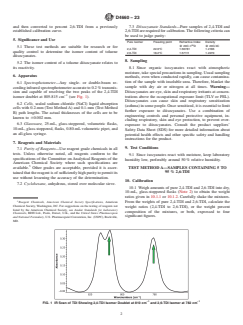
FIG. 1 IR Scan of TDI Showing 2,4-TDI Isomer Doublet at 810 cm and 2,6-TDI Isomer at 782 cm
D4660 − 23
NOTE 2—Carefully dry all glassware since the diisocyanates react TABLE 2 Approximate Standard Mixtures for Narrow-Range
Calibration, 15–25 % 2,6-TDI
readily with moisture.
Weight Ratio
10.1.1 Approximate standard mixtures for wide-range cali-
%, 2,4-TDI %, 2,6-TDI 2,4-/2,6-TDI
bration are given in Table 1 (5-95 % 2,6-TDI).
75.0 25.0 3.00
10.1.2 Approximate standard mixtures for narrow-range
78.5 21.5 3.65
calibrations (see Note 3) are given in Table 2 (15-25 %
79.0 21.0 3.76
2,6-TDI) and Table 3 (30-40 % 2,6-TDI).
79.5 20.5 3.88
80.0 20.0 4.00
NOTE 3—Calibration over a narrow range covering the expected isomer
80.5 19.5 4.13
ratio gives more accurate results than a wide-range calibration.
81.0 19.0 4.26
81.5 18.5 4.40
10.2 Preparation of Standard Solutions— Using a pipet,
85.0 15.0 5.67
transfer 0.80 mL (0.98 g) of standard mixture into a dry, 25-mL
glass-stoppered, volumetric flask. Dilute to volume with cy-
clohexane and mix thoroughly.
TABLE 3 Approximate Standard Mixtures for Narrow-Range
Calibration, 30–40 % 2,6-TDI
10.3 Fill two 0.2-mm sealed, liquid absorption cells (one for
Weight Ratio
a single-beam instrument) with cyclohexane and record its
−1
%, 2,4-TDI %, 2,6-TDI 2,4-/2,6-TDI
spectrum from 770 to 840 cm . Refill the sample cell with a
60.0 40.0 1.50
standard solution from 10.2 and record the spectrum superim-
63.5 36.5 1.74
posing it over the previously recorded solv
...
This document is not an ASTM standard and is intended only to provide the user of an ASTM standard an indication of what changes have been made to the previous version. Because
it may not be technically possible to adequately depict all changes accurately, ASTM recommends that users consult prior editions as appropriate. In all cases only the current version
of the standard as published by ASTM is to be considered the official document.
Designation: D4660 − 18 D4660 − 23
Standard Test Methods for
Polyurethane Raw Materials: Determination of the Isomer
Content of Toluenediisocyanate
This standard is issued under the fixed designation D4660; the number immediately following the designation indicates the year of
original adoption or, in the case of revision, the year of last revision. A number in parentheses indicates the year of last reapproval. A
superscript epsilon (´) indicates an editorial change since the last revision or reapproval.
1. Scope*
1.1 These test methods measure the amount of toluene-2,6-diisocyanate (2,6-TDI) isomer or toluene–2,4–diisocyanate (2,4-TDI)
isomer in mixtures of the 2,4- and 2,6-isomers of toluenediisocyanate (TDI). Two different test methods are provided to give
accurate results over the broad range of isomer concentrations possible.
1.1.1 Test Method A—Applicable to TDI samples containing 5 to 95 % of 2,6-TDI isomer (5 to 95 % 2,4-TDI isomer).
1.1.2 Test Method B—Applicable to TDI samples containing 0 to 5 % of 2,6-TDI isomer (95 to 100 % 2,4-TDI isomer).
NOTE 1—These test methods are equivalent to ISO 15064.
1.2 The values stated in SI units are to be regarded as standard.
1.3 This standard does not purport to address all of the safety concerns, if any, associated with its use. It is the responsibility
of the user of this standard to establish appropriate safety, health, and environmental practices and determine the applicability of
regulatory limitations prior to use.
1.4 This international standard was developed in accordance with internationally recognized principles on standardization
established in the Decision on Principles for the Development of International Standards, Guides and Recommendations issued
by the World Trade Organization Technical Barriers to Trade (TBT) Committee.
2. Referenced Documents
2.1 ASTM Standards:
D883 Terminology Relating to Plastics
E180 Practice for Determining the Precision of ASTM Methods for Analysis and Testing of Industrial and Specialty Chemicals
(Withdrawn 2009)
E456 Terminology Relating to Quality and Statistics
E691 Practice for Conducting an Interlaboratory Study to Determine the Precision of a Test Method
E2935 Practice for Evaluating Equivalence of Two Testing Processes
These test methods are under the jurisdiction of ASTM Committee D20 on Plastics and are the direct responsibility of Subcommittee D20.22 on Cellular Materials -
Plastics and Elastomers.
Current edition approved April 1, 2018March 15, 2023. Published April 2018March 2023. Originally approved in 1959. Last previous edition approved in 20122018 as
D4660 - 12.D4660 - 18. DOI: 10.1520/D4660-18.10.1520/D4660-23.
For referenced ASTM standards, visit the ASTM website, www.astm.org, or contact ASTM Customer Service at service@astm.org. For Annual Book of ASTM Standards
volume information, refer to the standard’s Document Summary page on the ASTM website.
The last approved version of this historical standard is referenced on www.astm.org.
*A Summary of Changes section appears at the end of this standard
Copyright © ASTM International, 100 Barr Harbor Drive, PO Box C700, West Conshohocken, PA 19428-2959. United States
D4660 − 23
2.2 ISO Standard:
ISO 15064 Plastics—Aromatic Isocyanates for Use in the Production of Polyurethanes—Determination of the Isomer Ratio in
Toluenediisocyanate
3. Terminology
3.1 Terminology in these test methods isTerms used in this standard are defined in accordance with Terminology D883, unless
otherwise specified. For terms relating to precision and bias and associated issues, the terms used in this standard are defined in
accordance with Terminology E456.
3.2 Definitions of Terms Specific to This Standard:
3.2.1 isomer—a compound having the same molecular formula (percentage composition and molecular weight) as another
compound but differs in chemical or physical properties.
3.2.2 isomer content—the amount of an isomer expressed as a percentage of total 2,42,4- and 2,6-TDI isomer amount.
4. Summary of Test Methods
4.1 Both test methods are based on the quantitative measurement of absorption bands arising from out-of-plane C-H deformation
vibrations of the aromatic ring.
−1
4.2 In Test Method A, the infrared spectrum of a cyclohexane solution of the sample is recorded in the 770 to 840-cm region.
−1 –1
The absorbance ratio of the 805 cm to the 782 cm band is measured and converted to percent 2,6-TDI, or percent 2,4-TDI,
or both, from a previously established calibration curve.
−1
4.3 In Test Method B, the absorbance of the 782-cm band is measured from an infrared spectrum of an undiluted sample and
then converted to percent 2,6-TDI from a previously established calibration curve.
5. Significance and Use
5.1 These test methods are suitable for research or for quality control to determine the isomer content of toluene diisocyanates.
5.2 The isomer content of a toluene diisocyanate relates to its reactivity.
6. Apparatus
6.1 Spectrophotometer—Any single- or double-beam recording infrared spectrophotometer accurate to 0.2 % transmission and
−1
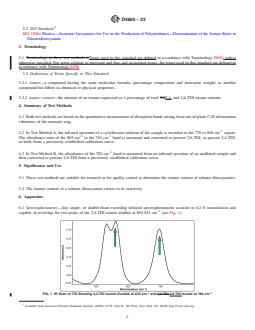
capable of resolving the two peaks of the 2,4-TDI isomer doublet at 805-815 cm (see Fig. 1).
–1 –1
FIG. 1 IR Scan of TDI Showing 2,4-TDI Isomer Doublet at 810 cm and 2,6 TDI 2,6-TDI Isomer at 782 cm
Available from American National Standards Institute (ANSI), 25 W. 43rd St., 4th Floor, New York, NY 10036, http://www.ansi.org.
D4660 − 23
6.2 Cells, sealed sodium chloride (NaCl) liquid absorption cells with 0.2-mm (Test Method A) and 0.1-mm (Test Method B) path
lengths. The actual thicknesses of the cells are to be known to 60.002 mm.
6.3 Glassware, 25-mL, glass-stoppered, volumetric flasks, 10-mL, glass-stoppered, flasks, 0.80-mL volumetric pipet, and an
all-glass syringe.
7. Reagents and Materials
7.1 Purity of Reagents—Use reagent grade chemicals in all tests. Unless otherwise noted, all reagents conform to the specifications
of the Committee on Analytical Reagents of the American Chemical Society where such specifications are available. Other grades
are acceptable, provided it is ascertained that the reagent is of sufficiently high purity to permit its use without lessening the
accuracy of the determination.
7.2 Cyclohexane, anhydrous, stored over molecular sieve.
7.3 Diisocyanate Standards—Pure samples of 2,4-TDI and 2,6-TDI are required for calibration. The following criteria can be used
to judge purity:
Pure Isomer Freezing point Refractive Index Density
@ 20C n D @ 20C/4C
2,4-TDI 22.0°C 1.56781 1.2186
2,6-TDI 18.2°C 1.57111 1.2270
8. Sampling
8.1 Since organic isocyanates react with atmospheric moisture, take special precautions in sampling. Usual sampling methods,
even when conducted rapidly, can cause contamination of the sample with insoluble urea. Therefore, blanket the sample with dry
air or nitrogen at all times. Warning—Diisocyanates are eye, skin and respiratory irritants at concentrations above the occupational
exposure limit (TLV or PEL). Diisocyanates can cause skin and respiratory sensitization (asthma) in some people. Once sensitized,
it is essential to limit further exposure to diisocyanates. Use a combination of engineering controls and personal protective
equipment, including respiratory, skin and eye protection, to prevent over-exposure to diisocyanates. Consult the product suppliers’
Safety Data Sheet (SDS) for more detailed information about potential health effects and other specific safety and handling
instructions for the product.
9. Test Conditions
9.1 Since isocyanates react with moisture, keep laboratory humidity low, preferably around 50 % relative humidity.
TEST METHOD A—SAMPLES CONTAINING 5 TO 95 % 2,6-TDI
10. Calibration
10.1 Weigh amounts of pure 2,4-TDI and 2,6-TDI into dry, 10-mL, glass-stoppered flasks (Note 2) to obtain the weight ratios
given in 10.1.1 or 10.1.2. Carefully shake the mixtures. From the weights of pure 2,4-TDI and 2,6-TDI, calculate the weight ratios
(2,4-TDI to 2,6-TDI), or the weight percent composition of the mixtures, or both, expressed to four significant figures.
NOTE 2—Carefully dry all glassware since the diisocyanates react readily with moisture.
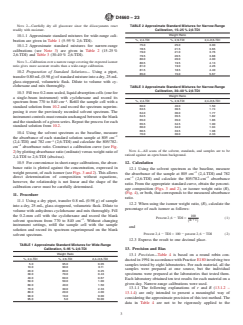
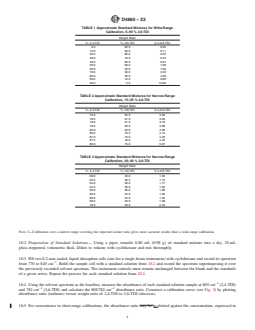
10.1.1 Approximate standard mixtures for wide-range calibration are given in Table 1 (5-95 % 2,6-TDI).
10.1.2 Approximate standard mixtures for narrow-range calibrations (see Note 3) are given in Table 2 (15-25 % 2,6-TDI) and
Table 3 (30-40 % 2,6-TDI).
Reagent Chemicals, American Chemical Society Specifications, American Chemical Society, Washington, DC. For suggestions on the testing of reagents not listed by
the American Chemical Society, see Analar Standards for Laboratory Chemicals, BDH Ltd., Poole, Dorset, U.K., and the United States Pharmacopeia and National
Formulary, U.S. Pharmacopeial Convention, Inc. (USPC), Rockville, MD.
D4660 − 23
TABLE 1 Approximate Standard Mixtures for Wide-Range
Calibration, 5–95 % 2,6-TDI
Weight Ratio
%, 2,4-TDI %, 2,6-TDI 2,4-/2,6-TDI
5.0 95.0 0.05
10.0 90.0 0.11
20.0 80.0 0.25
30.0 70.0 0.43
40.0 60.0 0.67
50.0 50.0 1.00
60.0 40.0 1.50
70.0 30.0 2.33
80.0 20.0 4.00
90.0 10.0 9.00
95.0 5.0 19.00
TABLE 2 Approximate Standard Mixtures for Narrow-Range
Calibration, 15–25 % 2,6-TDI
Weight Ratio
%, 2,4-TDI %, 2,6-TDI 2,4-/2,6-TDI
75.0 25.0 3.00
78.5 21.5 3.65
79.0 21.0 3.76
79.5 20.5 3.88
80.0 20.0 4.00
80.5 19.5 4.13
81.0 19.0 4.26
81.5 18.5 4.40
85.0 15.0 5.67
TABLE 3 Approximate Standard Mixtures for Narrow-Range
Calibration, 30–40 % 2,6-TDI
Weight Ratio
%, 2,4-TDI %, 2,6-TDI 2,4-/2,6-TDI
60.0 40.0 1.50
63.5 36.5 1.74
64.0 36.0 1.77
64.5 35.5 1.82
65.0 35.0 1.86
65.5 34.5 1.90
66.0 34.0 1.94
66.5 33.5 1.98
70.0 30.0 2.33
NOTE 3—Calibration over a narrow range covering the expected isomer ratio gives more accurate results than a wide-range calibration.
10.2 Preparation of Standard Solutions— Using a pipet, transfer 0.80 mL (0.98 g) of standard mixture into a dry, 25-mL
glass-stoppered, volumetric flask. Dilute to volume with cyclohexane and mix thoroughly.
10.3 Fill two 0.2-mm sealed, liquid absorption cells (one for a single-beam instrument) with cyclohexane and record its spectrum
−1
from 770 to 840 cm . Refill the sample cell with a standard solution from 10.2 and record the spectrum superimposing it over
the previously recorded solvent spectrum. The instrument controls must remain unchanged bet
...