

ASTM D714-02(2017)
(Test Method)Standard Test Method for Evaluating Degree of Blistering of Paints
General Information
- Abstract
SIGNIFICANCE AND USE
3.1 A phenomenon peculiar to painted surfaces is the formation of blisters relative to some system weakness. This test method provides a standard procedure of describing the size and density of the blisters so that comparisons of severity can be made.
SCOPE
1.1 This test method employs photographic reference standards to evaluate the degree of blistering that may develop when paint systems are subjected to conditions which will cause blistering. While primarily intended for use on metal and other nonporous surfaces, this test method may be used to evaluate blisters on porous surfaces, such as wood, if the size of blisters falls within the scope of these reference standards. When the reference standards are used as a specification of performance, the permissible degree of blistering of the paint system shall be agreed upon by the purchaser and the seller.
1.2 This standard does not purport to address all of the safety concerns, if any, associated with its use. It is the responsibility of the user of this standard to establish appropriate safety, health, and environmental practices and determine the applicability of regulatory limitations prior to use.
1.3 This international standard was developed in accordance with internationally recognized principles on standardization established in the Decision on Principles for the Development of International Standards, Guides and Recommendations issued by the World Trade Organization Technical Barriers to Trade (TBT) Committee.
- Status
- Published
- Publication Date
- 30-Nov-2017
- Technical Committee
- D01 - Paint and Related Coatings, Materials, and Applications
- Drafting Committee
- D01.25 - Evaluation of Weathering Effects
Overview
ASTM D714-02(2017): Standard Test Method for Evaluating Degree of Blistering of Paints provides a reliable and systematic approach for assessing the degree of blistering that may occur on painted surfaces. Developed by ASTM International, this standard is widely recognized and used for both quality control and performance evaluation in paint and coating industries. It uses photographic reference standards to objectively classify blister size and frequency, enabling consistency in reporting and comparability of results across different materials and environments.
Key Topics
- Blistering of Paints: The standard addresses blistering - a phenomenon where bubbles or blisters form beneath the paint film due to system weakness or exposure to adverse conditions.
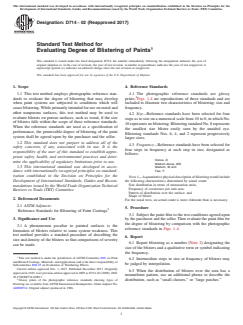
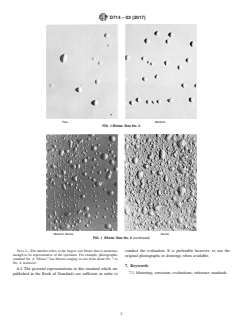
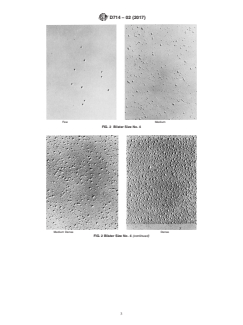
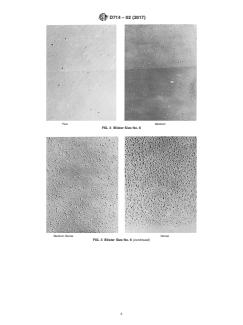
- Photographic Reference Standards: Evaluation relies on a set of glossy photographic prints, representing various blister sizes (scale from 10 to 0) and frequencies (Few, Medium, Medium Dense, Dense).
- Applicability to Different Surfaces: While primarily intended for use on metal and other nonporous surfaces, the method also applies to porous substrates like wood, provided blister sizes fit within the specified reference standards.
- Assessment Procedure: The painted specimen is subjected to agreed-upon test conditions, then evaluated by direct visual comparison against the photographic standards.
- Standardized Reporting: Results are reported using a combination of numeric and qualitative descriptors to indicate both the largest prevalent blister size and the frequency or distribution across the surface.
Applications
ASTM D714-02(2017) is essential across a range of industries and applications, including:
- Quality Assurance in Manufacturing: Paint and coating manufacturers use this standard to evaluate products during development and production, ensuring durability under specified environmental conditions.
- Field Inspections: Maintenance teams and inspectors employ this method to document and communicate the condition of painted or coated surfaces on assets such as bridges, storage tanks, ships, and pipelines.
- Product Performance Comparison: Enables purchasers and sellers to objectively compare paint systems and agree on performance specifications regarding permissible blistering.
- Research and Development: Laboratories use the standard in the development of new paint formulations to achieve improved resistance to blistering.
- Regulatory Compliance: Helps demonstrate adherence to contractual or regulatory requirements for paint and protective coating performance.
This method brings practical value by providing objective, visual criteria for the evaluation and communication of paint blistering, reducing subjectivity in assessment and supporting product improvement.
Related Standards
Users of ASTM D714-02(2017) may also find the following standards relevant:
- ASTM D610 - Standard Test Method for Evaluating Degree of Rusting on Painted Steel Surfaces.
- ASTM D1654 - Standard Test Method for Evaluation of Painted or Coated Specimens Subjected to Corrosive Environments.
- ASTM D3359 - Standard Test Methods for Measuring Adhesion by Tape Test.
- ASTM D522 - Standard Test Methods for Mandrel Bend Test of Attached Organic Coatings.
These related standards cover complementary aspects of paint and coating performance, such as rusting, corrosion resistance, adhesion, and flexibility, providing a comprehensive framework for the evaluation of protective coatings in a variety of environments.
Keywords: ASTM D714, paint blistering, blister size, reference standards, paint performance evaluation, coatings inspection, corrosion, quality assurance, photographic standards, paint coating standards.
Frequently Asked Questions
ASTM D714-02(2017) is a standard published by ASTM International. Its full title is "Standard Test Method for Evaluating Degree of Blistering of Paints". This standard covers: SIGNIFICANCE AND USE 3.1 A phenomenon peculiar to painted surfaces is the formation of blisters relative to some system weakness. This test method provides a standard procedure of describing the size and density of the blisters so that comparisons of severity can be made. SCOPE 1.1 This test method employs photographic reference standards to evaluate the degree of blistering that may develop when paint systems are subjected to conditions which will cause blistering. While primarily intended for use on metal and other nonporous surfaces, this test method may be used to evaluate blisters on porous surfaces, such as wood, if the size of blisters falls within the scope of these reference standards. When the reference standards are used as a specification of performance, the permissible degree of blistering of the paint system shall be agreed upon by the purchaser and the seller. 1.2 This standard does not purport to address all of the safety concerns, if any, associated with its use. It is the responsibility of the user of this standard to establish appropriate safety, health, and environmental practices and determine the applicability of regulatory limitations prior to use. 1.3 This international standard was developed in accordance with internationally recognized principles on standardization established in the Decision on Principles for the Development of International Standards, Guides and Recommendations issued by the World Trade Organization Technical Barriers to Trade (TBT) Committee.
SIGNIFICANCE AND USE 3.1 A phenomenon peculiar to painted surfaces is the formation of blisters relative to some system weakness. This test method provides a standard procedure of describing the size and density of the blisters so that comparisons of severity can be made. SCOPE 1.1 This test method employs photographic reference standards to evaluate the degree of blistering that may develop when paint systems are subjected to conditions which will cause blistering. While primarily intended for use on metal and other nonporous surfaces, this test method may be used to evaluate blisters on porous surfaces, such as wood, if the size of blisters falls within the scope of these reference standards. When the reference standards are used as a specification of performance, the permissible degree of blistering of the paint system shall be agreed upon by the purchaser and the seller. 1.2 This standard does not purport to address all of the safety concerns, if any, associated with its use. It is the responsibility of the user of this standard to establish appropriate safety, health, and environmental practices and determine the applicability of regulatory limitations prior to use. 1.3 This international standard was developed in accordance with internationally recognized principles on standardization established in the Decision on Principles for the Development of International Standards, Guides and Recommendations issued by the World Trade Organization Technical Barriers to Trade (TBT) Committee.
ASTM D714-02(2017) is classified under the following ICS (International Classification for Standards) categories: 87.040 - Paints and varnishes. The ICS classification helps identify the subject area and facilitates finding related standards.
ASTM D714-02(2017) is available in PDF format for immediate download after purchase. The document can be added to your cart and obtained through the secure checkout process. Digital delivery ensures instant access to the complete standard document.
Standards Content (Sample)
This international standard was developed in accordance with internationally recognized principles on standardization established in the Decision on Principles for the
Development of International Standards, Guides and Recommendations issued by the World Trade Organization Technical Barriers to Trade (TBT) Committee.
Designation: D714 − 02 (Reapproved 2017)
Standard Test Method for
Evaluating Degree of Blistering of Paints
This standard is issued under the fixed designation D714; the number immediately following the designation indicates the year of
original adoption or, in the case of revision, the year of last revision. A number in parentheses indicates the year of last reapproval. A
superscript epsilon (´) indicates an editorial change since the last revision or reapproval.
This standard has been approved for use by agencies of the U.S. Department of Defense.
1. Scope 4. Reference Standards
1.1 This test method employs photographic reference stan- 4.1 The photographic reference standards are glossy
dards to evaluate the degree of blistering that may develop prints. Figs. 1-4 are reproductions of these standards and are
when paint systems are subjected to conditions which will included to illustrate two characteristics of blistering: size and
cause blistering.While primarily intended for use on metal and frequency.
other nonporous surfaces, this test method may be used to
4.2 Size—Reference standards have been selected for four
evaluate blisters on porous surfaces, such as wood, if the size
steps as to size on a numerical scale from 10 to 0, in which No.
of blisters falls within the scope of these reference standards.
10representsnoblistering.BlisteringstandardNo.8represents
When the reference standards are used as a specification of
the smallest size blister easily seen by the unaided eye.
performance, the permissible degree of blistering of the paint
Blistering standards Nos. 6, 4, and 2 represent progressively
system shall be agreed upon by the purchaser and the seller.
larger sizes.
1.2 This standard does not purport to address all of the
4.3 Frequency—Reference standards have been selected for
safety concerns, if any, associated with its use. It is the
four steps in frequency at each step in size, designated as
responsibility of the user of this standard to establish appro-
follows:
priate safety, health, and environmental practices and deter-
Dense, D,
mine the applicability of regulatory limitations prior to use.
Medium dense, MD,
1.3 This international standard was developed in accor-
Medium, M, and
Few, F.
dance with internationally recognized principles on standard-
ization established in the Decision on Principles for the
NOTE1—Aquantitativephysicaldescriptionofblisteringwouldinclude
Development of International Standards, Guides and Recom- the following characteristics determined by actual count:
Size distribution in terms of mensuration units,
mendations issued by the World Trade Organization Technical
Frequency of occurrence per unit area,
Barriers to Trade (TBT) Committee.
Pattern of distribution over the surface, and
Shape of blister
2. Referenced Documents
For the usual tests, an actual count is more elaborate than is necessary.
2.1 ASTM Adjuncts:
5. Procedure
Reference Standards for Blistering of Paint Coatings
5.1 Subject the paint film to the test conditions agreed upon
by the purchaser and the seller.Then evaluate the paint film for
3. Significance and Use
the degree of blistering by comparison with the photographic
3.1 A phenomenon peculiar to painted surfaces is the
reference standards in Figs. 1-4.
formation of blisters relative to some system weakness. This
test method provides a standard procedure of describing the
6. Report
size and density of the blisters so that comparisons of severity
6.1 Report blistering as a number (Note 2) designating the
can be made.
size of the blisters and
...