


ASTM D3731-87(2012)
(Practice)Standard Practices for Measurement of Chlorophyll Content of Algae in Surface Waters
Standard Practices for Measurement of Chlorophyll Content of Algae in Surface Waters
SIGNIFICANCE AND USE
4.1 Data on the chlorophyll content of the algae have the following applications:
4.1.1 To provide estimates of algal biomass and productivity.
4.1.2 To provide general information on the taxonomic composition (major groups) of the algae, based on the relative amounts of chlorophyll a, b, and c, and the physiological condition of algal communities, which is related to the relative abundance of pheopigments.
4.1.3 To determine long-term trends in water quality.
4.1.4 To determine the trophic status of surface waters.
4.1.5 To detect adverse effects of pollutants on plankton and periphyton in receiving waters.
4.1.6 To determine maximum growth rates and yields in algal growth potential tests.
SCOPE
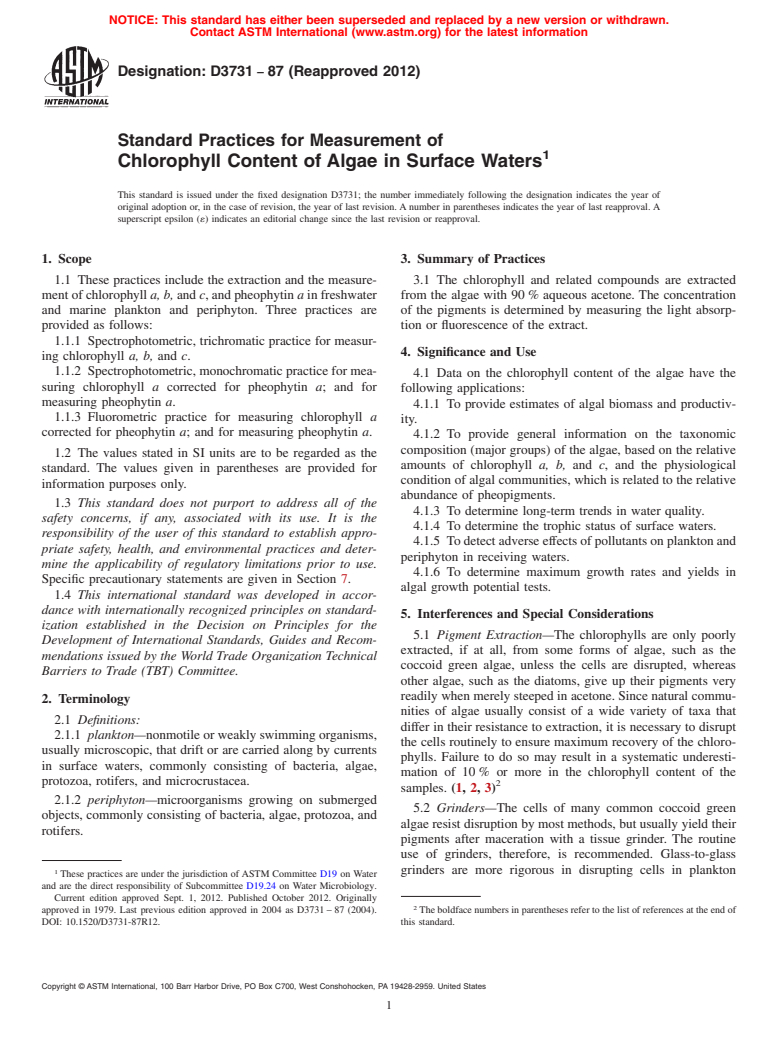
1.1 These practices include the extraction and the measurement of chlorophyll a, b, and c, and pheophytin a in freshwater and marine plankton and periphyton. Three practices are provided as follows:
1.1.1 Spectrophotometric, trichromatic practice for measuring chlorophyll a, b, and c.
1.1.2 Spectrophotometric, monochromatic practice for measuring chlorophyll a corrected for pheophytin a; and for measuring pheophytin a.
1.1.3 Fluorometric practice for measuring chlorophyll a corrected for pheophytin a; and for measuring pheophytin a.
1.2 The values stated in SI units are to be regarded as the standard. The values given in parentheses are provided for information purposes only.
1.3 This standard does not purport to address all of the safety problems, if any, associated with its use. It is the responsibility of the user of this standard to establish appropriate safety and health practices and determine the applicability of regulatory limitations prior to use. Specific precautionary statements are given in Section 7.
General Information
Relations
Standards Content (Sample)
NOTICE: This standard has either been superseded and replaced by a new version or withdrawn.
Contact ASTM International (www.astm.org) for the latest information
Designation: D3731 − 87 (Reapproved 2012)
Standard Practices for Measurement of
Chlorophyll Content of Algae in Surface Waters
This standard is issued under the fixed designation D3731; the number immediately following the designation indicates the year of
original adoption or, in the case of revision, the year of last revision.Anumber in parentheses indicates the year of last reapproval.A
superscript epsilon (´) indicates an editorial change since the last revision or reapproval.
1. Scope 3. Summary of Practices
1.1 These practices include the extraction and the measure- 3.1 The chlorophyll and related compounds are extracted
mentofchlorophyll a, b,and c,andpheophytin ainfreshwater from the algae with 90% aqueous acetone. The concentration
and marine plankton and periphyton. Three practices are of the pigments is determined by measuring the light absorp-
provided as follows: tion or fluorescence of the extract.
1.1.1 Spectrophotometric, trichromatic practice for measur-
4. Significance and Use
ing chlorophyll a, b, and c.
1.1.2 Spectrophotometric,monochromaticpracticeformea-
4.1 Data on the chlorophyll content of the algae have the
suring chlorophyll a corrected for pheophytin a; and for
following applications:
measuring pheophytin a.
4.1.1 To provide estimates of algal biomass and productiv-
1.1.3 Fluorometric practice for measuring chlorophyll a
ity.
corrected for pheophytin a; and for measuring pheophytin a.
4.1.2 To provide general information on the taxonomic
composition (major groups) of the algae, based on the relative
1.2 The values stated in SI units are to be regarded as the
amounts of chlorophyll a, b, and c, and the physiological
standard. The values given in parentheses are provided for
condition of algal communities, which is related to the relative
information purposes only.
abundance of pheopigments.
1.3 This standard does not purport to address all of the
4.1.3 To determine long-term trends in water quality.
safety concerns, if any, associated with its use. It is the
4.1.4 To determine the trophic status of surface waters.
responsibility of the user of this standard to establish appro-
4.1.5 Todetectadverseeffectsofpollutantsonplanktonand
priate safety, health, and environmental practices and deter-
periphyton in receiving waters.
mine the applicability of regulatory limitations prior to use.
4.1.6 To determine maximum growth rates and yields in
Specific precautionary statements are given in Section 7.
algal growth potential tests.
1.4 This international standard was developed in accor-
dance with internationally recognized principles on standard-
5. Interferences and Special Considerations
ization established in the Decision on Principles for the
5.1 Pigment Extraction—The chlorophylls are only poorly
Development of International Standards, Guides and Recom-
extracted, if at all, from some forms of algae, such as the
mendations issued by the World Trade Organization Technical
coccoid green algae, unless the cells are disrupted, whereas
Barriers to Trade (TBT) Committee.
other algae, such as the diatoms, give up their pigments very
readily when merely steeped in acetone. Since natural commu-
2. Terminology
nities of algae usually consist of a wide variety of taxa that
2.1 Definitions:
differ in their resistance to extraction, it is necessary to disrupt
2.1.1 plankton—nonmotileorweaklyswimmingorganisms,
the cells routinely to ensure maximum recovery of the chloro-
usually microscopic, that drift or are carried along by currents
phylls. Failure to do so may result in a systematic underesti-
in surface waters, commonly consisting of bacteria, algae,
mation of 10% or more in the chlorophyll content of the
protozoa, rotifers, and microcrustacea.
samples. (1, 2, 3)
2.1.2 periphyton—microorganisms growing on submerged
5.2 Grinders—The cells of many common coccoid green
objects, commonly consisting of bacteria, algae, protozoa, and
algae resist disruption by most methods, but usually yield their
rotifers.
pigments after maceration with a tissue grinder. The routine
use of grinders, therefore, is recommended. Glass-to-glass
grinders are more rigorous in disrupting cells in plankton
These practices are under the jurisdiction ofASTM Committee D19 on Water
and are the direct responsibility of Subcommittee D19.24 on Water Microbiology.
Current edition approved Sept. 1, 2012. Published October 2012. Originally
approved in 1979. Last previous edition approved in 2004 as D3731–87 (2004). Theboldfacenumbersinparenthesesrefertothelistofreferencesattheendof
DOI: 10.1520/D3731-87R12. this standard.
Copyright © ASTM International, 100 Barr Harbor Drive, PO Box C700, West Conshohocken, PA 19428-2959. United States
D3731 − 87 (2012)
concentrated by centrifugation, and in periphyton scrapings, 5.8 Light Sensitivity of Extracts—Chlorophyll solutions de-
than are TFE-fluorocarbon-to-glass grinders, and their use for grade rapidly in strong light. Work with these solutions,
this purpose is preferred. However, TFE fluorocarbon-to-glass therefore, should be carried out in subdued light, and all
grinders perform well with glass-fiber filters. Other cell dis- vessels, tubes, and so forth, containing the pigment extracts
ruption methods, such as sonication, may be used if, for each should be covered with aluminum foil or other opaque sub-
typeofsample,itisdemonstratedthatthechlorophyllrecovery stance.
is comparable to that obtained with tissue grinders (4).
6. Apparatus
5.3 Filters—Glass-fiber filters usually provide a higher re-
covery of chlorophyll than is obtained with membrane filters
6.1 Filters, Glass-fiber filters, providing quantitative reten-
when extraction-resistant algae are present in the samples, and
tion of particles equal to or greater than 0.45 µm in diameter.
should be employed routinely (4).
6.2 Filtering Apparatus suitable for use with glass-fiber
5.4 Chlorophyll-Related Pigments—Naturally occurring,
filters.
structurally related chlorophyll precursors and degradation
6.3 Tissue Homogenizer—Tissue grinder consisting of a
products, such as the chlorophyllides, pheophytins, and
motor-driven pestle and enclosing glass tube (glass to glass or
pheophorbides, commonly occur in pigment extracts and may
TFE-fluorocarbon-to-glass grinder).
absorb light in the same region of the spectrum as the
chlorophylls.Thesecompoundsmayinterferewiththeanalysis
6.4 Spectrophotometer suitable for use over the range from
by indicating falsely high chlorophyll concentrations.
600 to 750 nm, with a resolution of 2 nm or better, and
5.4.1 This practice includes a correction for pheophytin a
equipped with sample cells having a light path of 1, 5, and 10
only. Pheophytin a is similar in structure to chlorophyll a, but
cm, with a capacity of 10 mL or less.
lacks the magnesium atom (Mg) in the porphyrin ring. The
6.5 Fluorometer (Optional):
magnesium can be removed from chlorophyll in the laboratory
by acidifying the extract. When a solution of pure chlorophyll
6.5.1 Spectrophotofluorometer that provides an excitation
a is converted to pheophytin a by acidification, the absorption
wavelengthof430nmanddetectionofemissionovertherange
peakisreducedtoapproximately60%ofitsoriginalvalueand
from 600 to 700 nm, or:
shifts from 664 to 665 nm, resulting in a before:after acidifi-
6.5.2 Filter Fluorometer equipped with a blue light source
5 3
cation absorption peak ratio (OD664/OD665) of 1.70. This
and blue excitation filter and a sharp cut off filter
phenomenon is utilized in correcting the apparent concentra-
6.6 Centrifuge that can provide a centrifugal force of 1000
tion of chlorophyll a for the presence of pheophytin a.
g; head with swing-out buckets preferred.
Unwanted degradation of chlorophyll to pheophytin in the
phytoplankton on filters, or in periphyton samples, or in the
6.7 Centrifuge Tubes, screw-cap or stoppered, conical,
acetone extract, by the occurrence of acidic conditions can be
graduated, 15-mL. Avoid cap liners soluble in acetone and
prevented by the addition of a magnesium carbonate suspen-
neoprene rubber stoppers.
siontotheplanktonsamplebeforefilteringortotheperiphyton
samples before grinding, and by adding a small amount of a
7. Reagents and Materials
sodium bicarbonate solution to the aqueous acetone when it is
7.1 Aqueous Acetone, 90 %—Add 1 volume of distilled
prepared. Addition of magnesium carbonate may also aid in
water to 9 volumes of reagent grade acetone.Add 5 drops of 1
clarifying the samples following steeping (5).
N sodium bicarbonate solution per litre. (Caution—the vol-
5.5 Turbidity—The optical density of the extract is mea-
ume:volume relationship between the acetone and water must
sured at 750 nm to correct for turbidity.
be strictly followed to prevent shifts in the absorption peaks.)
5.6 Spectrophotometer Resolution—The absorption peak of
7.2 Hydrochloric Acid (1 N)—Add one volume of concen-
acetone solutions of chlorophyll extracts is relatively narrow,
tratedhydrochloricacid(HCl,spgr1.19)toelevenvolumesof
and a spectrophotometer with a resolution of 2 nm or better is
distilled water.
required to obtain accurate results. If instruments of lower
resolution are employed, the concentration of chlorophyll a
7.3 Magnesium Carbonate Suspension—Add1gof finely
may be significantly underestimated depending on the band
powderedmagnesiumcarbonateto100mLofdistilledwaterin
width. At a spectral band width of 20 nm, the error in the
a stoppered Erlenmeyer flask. Shake immediately before use.
estimate of the chlorophyll a concentration may be as large as
7.4 Sodium Bicarbonate Solution (1 N)—Prepare by dis-
40%.
solving 8.4 g of sodium bicarbonate in 100 mL of distilled
5.7 Fluorometer Filters—In the fluorometric practice, inter-
water.
ferences from light emitted by chlorophyll b and chlorophyll c
are greatly reduced by the use of a sharp cut-off red filter that
blocks all light with a wavelength of less than 650 nm (6).
Kontes type C, glass-to-glass grinder or its equivalent, has been found suitable
for this purpose. Available from Kontes Manufacturing Co., Spruce St., Vineland,
Corning CS-2-64 filter or its equivalent, has been found suitable for this NJ 08360.
purpose.AvailablefromCorningGlassWorks,388BeartownRd.,PaintedPost,NY Corning CS-5-60 filter has been found satisfactory. Equivalent filters may be
14870. used.
D3731 − 87 (2012)
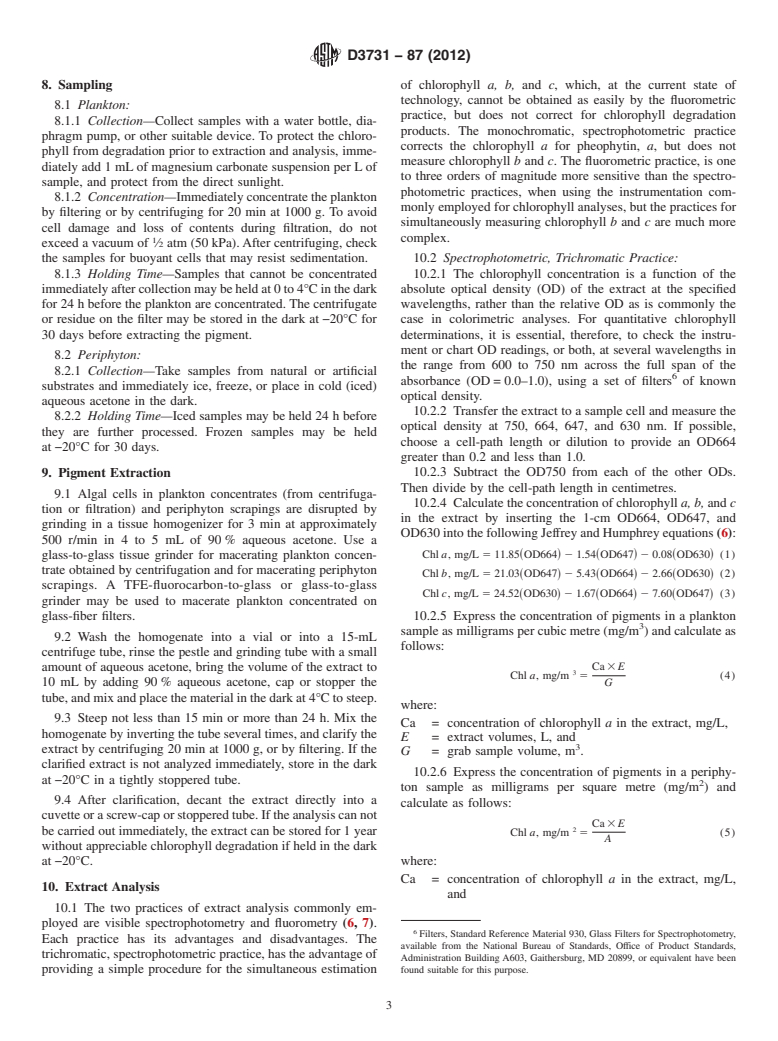
8. Sampling of chlorophyll a, b, and c, which, at the current state of
technology, cannot be obtained as easily by the fluorometric
8.1 Plankton:
practice, but does not correct for chlorophyll degradation
8.1.1 Collection—Collect samples with a water bottle, dia-
products. The monochromatic, spectrophotometric practice
phragm pump, or other suitable device. To protect the chloro-
corrects the chlorophyll
...
Questions, Comments and Discussion
Ask us and Technical Secretary will try to provide an answer. You can facilitate discussion about the standard in here.