

ASTM C1517-16
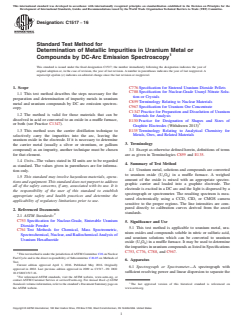
(Test Method)Standard Test Method for Determination of Metallic Impurities in Uranium Metal or Compounds by DC-Arc Emission Spectroscopy
General Information
- Abstract
SIGNIFICANCE AND USE
5.1 This test method is applicable to uranium metal, uranium oxides and compounds soluble in nitric or sulfuric acid, and uranium solutions which can be converted to uranium oxide (U3O8) in a muffle furnace. It may be used to determine the impurities in uranium compounds as listed in Specifications C753, C776, C788, and C967.
SCOPE
1.1 This test method describes the steps necessary for the preparation and determination of impurity metals in uranium metal and uranium compounds by DC arc emission spectroscopy.
1.2 The method is valid for those materials that can be dissolved in acid or converted to an oxide in a muffle furnace, or both (see Practice C1347).
1.3 This method uses the carrier distillation technique to selectively carry the impurities into the arc, leaving the uranium oxide in the electrode. If it is necessary to determine the carrier metal (usually a silver or strontium, or gallium compound) as an impurity, another technique must be chosen for that element.
1.4 Units—The values stated in SI units are to be regarded as standard. The values given in parentheses are for information only.
1.5 This standard may involve hazardous materials, operations and equipment. This standard does not purport to address all of the safety concerns, if any, associated with its use. It is the responsibility of the user of this standard to establish appropriate safety and health practices and determine the applicability of regulatory limitations prior to use.
- Status
- Published
- Publication Date
- 31-Mar-2016
- Technical Committee
- C26 - Nuclear Fuel Cycle
- Drafting Committee
- C26.05 - Methods of Test
Buy Documents
ASTM C1517-16 - Standard Test Method for Determination of Metallic Impurities in Uranium Metal or Compounds by DC-Arc Emission Spectroscopy
REDLINE ASTM C1517-16 - Standard Test Method for Determination of Metallic Impurities in Uranium Metal or Compounds by DC-Arc Emission Spectroscopy
Overview
ASTM C1517-16 is the standard test method established by ASTM International for the determination of metallic impurities in uranium metal and uranium compounds using DC-Arc Emission Spectroscopy. This analytical procedure is crucial for the nuclear industry, where purity levels in uranium materials must meet stringent requirements. The method applies to uranium metal, uranium oxides, uranium compounds dissolvable in nitric or sulfuric acid, and uranium solutions convertible to uranium oxide (U₃O₈).
By utilizing the DC-arc emission spectroscopy technique, this standard enables laboratories to accurately assess trace metallic impurity content, supporting quality control across various stages of the nuclear fuel cycle.
Key Topics
- Scope of Analysis: The method is suited for uranium metal, oxides, and acid-soluble compounds, as well as uranium solutions processed into uranium oxide. Samples must be capable of conversion to oxide or direct acid dissolution.
- Carrier Distillation Technique: This procedure selectively transports metallic impurities into the DC arc, separating them from the uranium oxide, which remains in the electrode. This approach enhances selectivity and analytical sensitivity for trace metals.
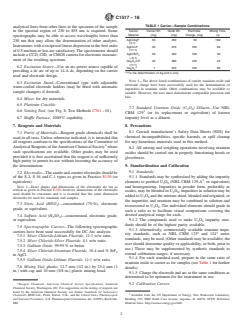
- Sample Preparation: Uranium compounds are converted to uranium oxide in a muffle furnace. After proper mixing with a spectrographic carrier (such as silver chloride-lithium fluoride or gallium oxide), the sample is loaded into a graphite electrode for analysis.
- Instrumentation: Requires a high-resolution spectrograph or spectrometer (typically with a CCD, CID, or CMOS camera), capable of covering the spectral region of 230 to 855 nm.
- Calibration and Standardization: Involves preparing uranium oxide standards spiked with known impurities and using calibration curves or direct comparison for quantification.
- Safety Considerations: Working with uranium and acids presents chemical and radiological hazards. Proper laboratory safety protocols and regulatory compliance are emphasized.
Applications
- Nuclear Fuel Quality Assurance: Ensures uranium materials meet impurity specifications for use in nuclear reactors, minimizing undesirable reactor behavior and fuel failures.
- Process Control: Monitors raw materials and intermediates in uranium processing, supporting consistent production quality.
- Research and Development: Facilitates impurity profiling in experimental uranium products or new fuel forms.
- Regulatory Compliance: Supports adherence to international and national standards for nuclear materials.
Industries such as nuclear energy, uranium refining, research laboratories, and regulatory agencies rely on ASTM C1517-16 to maintain rigorous control over the chemical composition of uranium products.
Related Standards
- ASTM C753 - Specification for Nuclear-Grade, Sinterable Uranium Dioxide Powder
- ASTM C776 - Specification for Sintered Uranium Dioxide Pellets
- ASTM C788 - Specification for Nuclear-Grade Uranyl Nitrate Solution or Crystals
- ASTM C967 - Specification for Uranium Ore Concentrate
- ASTM C1347 - Practice for Preparation and Dissolution of Uranium Materials for Analysis
- ASTM C761 - Test Methods for Analysis of Uranium Hexafluoride
These related ASTM standards provide complementary procedures and quality criteria, covering various forms of uranium materials and additional analytical methods.
Keywords: ASTM C1517-16, metallic impurities, uranium metal, uranium oxide, DC-arc emission spectroscopy, carrier distillation, nuclear fuel quality, uranium analysis, trace metals, standardization.
Relations
- Effective Date
- 01-Apr-2016
- Effective Date
- 01-Jan-2024
- Effective Date
- 01-Feb-2020
- Effective Date
- 01-Jan-2020
- Effective Date
- 15-May-2019
- Effective Date
- 01-Feb-2018
- Effective Date
- 15-May-2016
- Effective Date
- 01-Feb-2016
- Effective Date
- 01-Jul-2015
- Effective Date
- 15-May-2015
- Effective Date
- 15-Aug-2014
- Effective Date
- 15-Jun-2014
- Effective Date
- 01-Apr-2014
- Effective Date
- 15-Feb-2014
- Effective Date
- 15-Jan-2014
Buy Documents
ASTM C1517-16 - Standard Test Method for Determination of Metallic Impurities in Uranium Metal or Compounds by DC-Arc Emission Spectroscopy
REDLINE ASTM C1517-16 - Standard Test Method for Determination of Metallic Impurities in Uranium Metal or Compounds by DC-Arc Emission Spectroscopy
Get Certified
Connect with accredited certification bodies for this standard

DNV
DNV is an independent assurance and risk management provider.

Lloyd's Register
Lloyd's Register is a global professional services organisation specialising in engineering and technology.
DNV Energy Systems
Energy and renewable energy certification.
Sponsored listings
Frequently Asked Questions
ASTM C1517-16 is a standard published by ASTM International. Its full title is "Standard Test Method for Determination of Metallic Impurities in Uranium Metal or Compounds by DC-Arc Emission Spectroscopy". This standard covers: SIGNIFICANCE AND USE 5.1 This test method is applicable to uranium metal, uranium oxides and compounds soluble in nitric or sulfuric acid, and uranium solutions which can be converted to uranium oxide (U3O8) in a muffle furnace. It may be used to determine the impurities in uranium compounds as listed in Specifications C753, C776, C788, and C967. SCOPE 1.1 This test method describes the steps necessary for the preparation and determination of impurity metals in uranium metal and uranium compounds by DC arc emission spectroscopy. 1.2 The method is valid for those materials that can be dissolved in acid or converted to an oxide in a muffle furnace, or both (see Practice C1347). 1.3 This method uses the carrier distillation technique to selectively carry the impurities into the arc, leaving the uranium oxide in the electrode. If it is necessary to determine the carrier metal (usually a silver or strontium, or gallium compound) as an impurity, another technique must be chosen for that element. 1.4 Units—The values stated in SI units are to be regarded as standard. The values given in parentheses are for information only. 1.5 This standard may involve hazardous materials, operations and equipment. This standard does not purport to address all of the safety concerns, if any, associated with its use. It is the responsibility of the user of this standard to establish appropriate safety and health practices and determine the applicability of regulatory limitations prior to use.
SIGNIFICANCE AND USE 5.1 This test method is applicable to uranium metal, uranium oxides and compounds soluble in nitric or sulfuric acid, and uranium solutions which can be converted to uranium oxide (U3O8) in a muffle furnace. It may be used to determine the impurities in uranium compounds as listed in Specifications C753, C776, C788, and C967. SCOPE 1.1 This test method describes the steps necessary for the preparation and determination of impurity metals in uranium metal and uranium compounds by DC arc emission spectroscopy. 1.2 The method is valid for those materials that can be dissolved in acid or converted to an oxide in a muffle furnace, or both (see Practice C1347). 1.3 This method uses the carrier distillation technique to selectively carry the impurities into the arc, leaving the uranium oxide in the electrode. If it is necessary to determine the carrier metal (usually a silver or strontium, or gallium compound) as an impurity, another technique must be chosen for that element. 1.4 Units—The values stated in SI units are to be regarded as standard. The values given in parentheses are for information only. 1.5 This standard may involve hazardous materials, operations and equipment. This standard does not purport to address all of the safety concerns, if any, associated with its use. It is the responsibility of the user of this standard to establish appropriate safety and health practices and determine the applicability of regulatory limitations prior to use.
ASTM C1517-16 is classified under the following ICS (International Classification for Standards) categories: 27.120.30 - Fissile materials and nuclear fuel technology. The ICS classification helps identify the subject area and facilitates finding related standards.
ASTM C1517-16 has the following relationships with other standards: It is inter standard links to ASTM C1517-09, ASTM C859-24, ASTM C967-20, ASTM E135-20, ASTM E135-19, ASTM C761-18, ASTM E135-16, ASTM C753-16, ASTM E135-15a, ASTM E135-15, ASTM E135-14b, ASTM C859-14a, ASTM E135-14a, ASTM E135-14, ASTM C859-14. Understanding these relationships helps ensure you are using the most current and applicable version of the standard.
ASTM C1517-16 is available in PDF format for immediate download after purchase. The document can be added to your cart and obtained through the secure checkout process. Digital delivery ensures instant access to the complete standard document.
Standards Content (Sample)
This international standard was developed in accordance with internationally recognized principles on standardization established in the Decision on Principles for the
Development of International Standards, Guides and Recommendations issued by the World Trade Organization Technical Barriers to Trade (TBT) Committee.
Designation: C1517 − 16
Standard Test Method for
Determination of Metallic Impurities in Uranium Metal or
Compounds by DC-Arc Emission Spectroscopy
This standard is issued under the fixed designation C1517; the number immediately following the designation indicates the year of
original adoption or, in the case of revision, the year of last revision.Anumber in parentheses indicates the year of last reapproval.A
superscript epsilon (´) indicates an editorial change since the last revision or reapproval.
1. Scope C776Specification for Sintered Uranium Dioxide Pellets
C788Specification for Nuclear-Grade Uranyl Nitrate Solu-
1.1 This test method describes the steps necessary for the
tion or Crystals
preparation and determination of impurity metals in uranium
C859Terminology Relating to Nuclear Materials
metal and uranium compounds by DC arc emission spectros-
C967Specification for Uranium Ore Concentrate
copy.
C1347Practice for Preparation and Dissolution of Uranium
1.2 The method is valid for those materials that can be
Materials for Analysis
dissolved in acid or converted to an oxide in a muffle furnace,
E130Practice for Designation of Shapes and Sizes of
or both (see Practice C1347). 3
Graphite Electrodes (Withdrawn 2013)
E135Terminology Relating to Analytical Chemistry for
1.3 This method uses the carrier distillation technique to
selectively carry the impurities into the arc, leaving the Metals, Ores, and Related Materials
uranium oxide in the electrode. If it is necessary to determine
3. Terminology
the carrier metal (usually a silver or strontium, or gallium
compound) as an impurity, another technique must be chosen
3.1 Except as otherwise defined herein, definitions of terms
for that element.
are as given in Terminologies C859 and E135.
1.4 Units—The values stated in SI units are to be regarded
4. Summary of Test Method
as standard. The values given in parentheses are for informa-
4.1 Uranium metal, solutions and compounds are converted
tion only.
to uranium oxide (U O ) in a muffle furnace. A weighed
3 8
1.5 This standard may involve hazardous materials, opera-
amount of the oxide is mixed with an appropriate spectro-
tions and equipment. This standard does not purport to address
graphic carrier and loaded into a graphite electrode. The
all of the safety concerns, if any, associated with its use. It is
electrode is excited in a DC arc and the light is dispersed by a
the responsibility of the user of this standard to establish
spectrograph or spectrometer. The resulting spectrum is mea-
appropriate safety and health practices and determine the
sured electronically using a CCD, CID, or CMOS camera
applicability of regulatory limitations prior to use.
sensitive to the proper regions. The line intensities are com-
pared directly to calibration curves derived from the arced
2. Referenced Documents
standards.
2.1 ASTM Standards:
C753Specification for Nuclear-Grade, Sinterable Uranium
5. Significance and Use
Dioxide Powder
5.1 This test method is applicable to uranium metal, ura-
C761Test Methods for Chemical, Mass Spectrometric,
nium oxides and compounds soluble in nitric or sulfuric acid,
Spectrochemical,Nuclear,andRadiochemicalAnalysisof
and uranium solutions which can be converted to uranium
Uranium Hexafluoride
oxide (U O ) in a muffle furnace. It may be used to determine
3 8
theimpuritiesinuraniumcompoundsaslistedinSpecifications
C753, C776, C788, and C967.
ThistestmethodisunderthejurisdictionofASTMCommitteeC26onNuclear
Fuel Cycle and is the direct responsibility of Subcommittee C26.05 on Methods of
6. Apparatus
Test.
Current edition approved April 1, 2016. Published May 2016. Originally
6.1 Spectrograph or Spectrometer—A spectrograph with
approved in 2002. Last previous edition approved in 2009 as C1517–09. DOI:
sufficient resolving power and linear dispersion to separate the
10.1520/C1517-16.
For referenced ASTM standards, visit the ASTM website, www.astm.org, or
contact ASTM Customer Service at service@astm.org. For Annual Book of ASTM
Standards volume information, refer to the standard’s Document Summary page on The last approved version of this historical standard is referenced on
the ASTM website. www.astm.org.
Copyright © ASTM International, 100 Barr Harbor Drive, PO Box C700, West Conshohocken, PA 19428-2959. United States
C1517 − 16
TABLE 1 Carrier—Sample Combinations
analytical lines from other lines in the spectrum of the sample
in the spectral region of 230 to 855 nm is required. Some Carrier Carrier Wt, Oxide Wt, Electrode Mixing Time,
Material (mg) (mg) Charge, (mg) (s)
spectrographs may be able to access wavelengths lower than
AgCl/AgF 50 250 50 180
230 nm that may allow the determination of other analytes.
(4:1)
Instrumentswithareciprocallineardispersioninthefirstorder
AgCl/LiF 30 270 100 60
(11:1)
of0.5nm/mmorlessaresatisfactory.Thespectrometershould
AgCl/SrF 50 450 100 30
includeaCCD,CID,orCMOScameraforelectronicmeasure-
(~6:1)
ment of the resulting spectrum.
Ga O /LiF 20 380 100 25
2 3
(11:1)
6.2 Excitation Source—Use an arc power source capable of
A
Ga O 7 343 100 60
2 3
providing a dc arc of up to 14-A dc, depending on the carrier
A
For the determination of Ag and Li only.
used and electrode design.
NOTE 1—The above listed combinations of carrier, uranium oxide and
6.3 Excitation Stand—Conventional type with adjustable
electrode charge have been successfully used for the determination of
water-cooled electrode holders (may be fitted with automatic
impurities in uranium oxide. Other combinations may be available or
sample changers if desired).
suitable. However, the user must demonstrate comparable precision and
bias.
6.4 Mixer, for dry materials.
6.5 Platinum Crucible.
7.7 Standard Uranium Oxide (U O ) Diluent—Use NBL
3 8
6.6 Venting Tool, (see Fig. 8, Test Methods C761–01).
CRM 129 (or its replacement or equivalent) of known
6.7 Muffle Furnace, 1000°C capability. impurity level as a diluent.
8. Precautions
7. Reagents and Materials
8.1 Consult manufacturer’s Safety Data Sheets (SDS) for
7.1 Purity of Materials—Reagent grade chemicals shall be
chemical incompatibilities, specific hazards, or spill cleanup
used in all tests. Unless otherwise indicated, it is intended that
for any hazardous materials used in this method.
all reagents conform to the specifications of the Committee of
AnalyticalReagentsoftheAmericanChemicalSociety where
8.2 All mixing and weighing operations involving uranium
such specifications are available. Other grades may be used
oxides should be carried out in properly functioning hoods or
provided it is first ascertained that the reagent is of sufficiently
gloveboxes.
high purity to permit its use without lessening the accuracy of
9. Standardization and Calibration
the determination.
7.2 Electrodes—Theanodeandcounterelectrodesshouldbe 9.1 Standards:
9.1.1 Standards may be synthesized by adding the impurity
of the S-2, S 16 and C-1 types as given in Practice E130 (or
elements to purified U O (NBL CRM 129-A , or equivalent)
equivalent).
3 8
NOTE 1—Exact shapes and dimensions of the electrodes are not as and homogenizing. Impurities in powder form, preferably as
critical as given in Practice E130; however, dimensions of the electrodes
oxides,maybeblendedinU O ;impuritiesinsolutionmaybe
3 8
used should be consistent and it is essential that the same dimension
addedtoU O andthemixturedried,blendedandreignited,or
3 8
electrodes be used for standards and samples.
the impurities and uranium may be combined in solution and
7.3 Nitric Acid (HNO )—concentrated (70%), electronic
reconverted to U O . The individual elements should grade in
3 8
grade, or equivalent.
such a ratio as to facilitate visual comparisons covering the
7.4 Sulfuric Acid (H SO )—concentrated, electronic grade, desired analytical range for each.
2 4
9.1.2 The compounds used to make U O impurity stan-
or equivalent.
3 8
dards should be of the highest purity available.
7.5 Spectrographic Carrier—The following spectrographic
9.1.3 Alternatively, commercially available uranium impu-
carriers have been used successfully for DC Arc analysis:
5 5
rity standards, such as NBL CRM 123 and 124 series
7.5.1 Silver Chloride-Lithium Fluoride, 11:1 w/w ratio.
standards,maybeused.(Otherstandardsmaybeavailable;the
7.5.2 Silver Chloride-Silver Fluoride, 4:1 w/w ratio.
user should determine quality or applicability, or both, prior to
7.5.3 Gallium Oxide, 99.99% or better.
use.) These may be supplemented by synthetic standards to
7.5.4 Silver Chloride-Strontium Fluoride, 16.4 mol% SrF
extend calibration ranges, if necessary.
in AgCl.
9.1.4 For each standard used, prepare in the same ratio of
7.5.5 Gallium Oxide-Lithium Fluoride, 11:1 w/w ratio.
uraniumoxidetocarrierasforsamples(seeTable1forfurther
7.6 Mixing Vial, plastic, 12.7 mm (1/2 in.) by 25.4 mm (1
details).
in.) with cap and 10 mm (3/8 in.) plastic mixing bead.
9.1.5 Chargetheelectrodeandarcatthesameconditionsas
determined to be optimum for the instrument in use.
9.2 Calibration Curves:
Reagent Chemicals, American Chemical Society Specifications, American
Chemical Society, Washington, DC. For suggestions on the testing of reagents not
listed by the American Chemical Society, see Analar Standards for Laboratory
Chemicals, BDH Ltd., Poole, Dorset, U.K., and
...
This document is not an ASTM standard and is intended only to provide the user of an ASTM standard an indication of what changes have been made to the previous version. Because
it may not be technically possible to adequately depict all changes accurately, ASTM recommends that users consult prior editions as appropriate. In all cases only the current version
of the standard as published by ASTM is to be considered the official document.
Designation: C1517 − 09 C1517 − 16
Standard Test Method for
Determination of Metallic Impurities in Uranium Metal or
Compounds by DC-Arc Emission Spectroscopy
This standard is issued under the fixed designation C1517; the number immediately following the designation indicates the year of
original adoption or, in the case of revision, the year of last revision. A number in parentheses indicates the year of last reapproval. A
superscript epsilon (´) indicates an editorial change since the last revision or reapproval.
1. Scope
1.1 This test method describes the steps necessary for the preparation and determination of impurity metals in uranium metal
and uranium compounds by DC arc emission spectroscopy.
1.2 The method is valid for those materials that can be dissolved in acid and/oror converted to an oxide in a muffle furnace
furnace, or both (see Practice C1347).
1.3 This method uses the carrier distillation technique to selectively carry the impurities into the arc, leaving the uranium oxide
in the electrode. If it is necessary to determine the carrier metal(usually metal (usually a silver or strontium, or gallium compound)
as an impurity, another technique must be chosen for that element.
1.4 Units—The values stated in SI units are to be regarded as standard. The values given in parentheses are for information only.
1.5 This standard may involve hazardous materials, operations and equipment. This standard does not purport to address all
of the safety concerns, if any, associated with its use. It is the responsibility of the user of this standard to establish appropriate
safety and health practices and determine the applicability of regulatory limitations prior to use.
2. Referenced Documents
2.1 ASTM Standards:
C753 Specification for Nuclear-Grade, Sinterable Uranium Dioxide Powder
C761 Test Methods for Chemical, Mass Spectrometric, Spectrochemical, Nuclear, and Radiochemical Analysis of Uranium
Hexafluoride
C776 Specification for Sintered Uranium Dioxide Pellets
C788 Specification for Nuclear-Grade Uranyl Nitrate Solution or Crystals
C859 Terminology Relating to Nuclear Materials
C967 Specification for Uranium Ore Concentrate
C1347 Practice for Preparation and Dissolution of Uranium Materials for Analysis
E130 Practice for Designation of Shapes and Sizes of Graphite Electrodes (Withdrawn 2013)
E135 Terminology Relating to Analytical Chemistry for Metals, Ores, and Related Materials
3. Terminology
3.1 See definitions and terms Except as otherwise defined herein, definitions of terms are as given in Terminologies C859 and
E135.
4. Summary of Test Method
4.1 Uranium metal, solutions and compounds are converted to uranium oxide (U O ) in a muffle furnace. A weighed amount
3 8
of the oxide is mixed with an appropriate spectrographic carrier and loaded into a graphite electrode. The electrode is excited in
a DC arc and the light is dispersed by a spectrograph or spectrometer. The resulting spectrum is measured electronically using a
This test method is under the jurisdiction of ASTM Committee C26 on Nuclear Fuel Cycle and is the direct responsibility of Subcommittee C26.05 on Methods of Test.
Current edition approved June 1, 2009April 1, 2016. Published July 2009May 2016. Originally approved in 2002. Last previous edition approved in 20022009 as
C1517 – 02.C1517 – 09. DOI: 10.1520/C1517-09.10.1520/C1517-16.
For referenced ASTM standards, visit the ASTM website, www.astm.org, or contact ASTM Customer Service at service@astm.org. For Annual Book of ASTM Standards
volume information, refer to the standard’s Document Summary page on the ASTM website.
The last approved version of this historical standard is referenced on www.astm.org.
Copyright © ASTM International, 100 Barr Harbor Drive, PO Box C700, West Conshohocken, PA 19428-2959. United States
C1517 − 16
CCD, CID, or CMOS camera or photographed on photographic plates or film sensitive to the proper regions. The line intensities
are compared directly to standard plates or to calibration curves derived from the arced standards.
5. Significance and Use
5.1 This test method is applicable to uranium metal, uranium oxides and compounds soluble in nitric or sulfuric acid, and
uranium solutions which can be converted to uranium oxide (U O ) in a muffle furnace. It may be used to determine the impurities
3 8
in uranium compounds as listed in Specifications C753, C776, C788, and C967.
6. Apparatus
6.1 Spectrograph or Spectrometer—A spectrograph with sufficient resolving power and linear dispersion to separate the
analytical lines from other lines in the spectrum of the sample in the spectral region of 230.0230 to 855.0855 nm is required. Some
spectrographs may be able to access wavelengths lower than 230 nm that may allow the determination of other analytes.
Instruments with a reciprocal linear dispersion in the first order of 0.5 nm/mm or less are satisfactory. A direct-reading spectrometer
of comparable quality may be substituted for equipment listed, in which case the directions given by the manufacturer should be
substituted for those in this procedure.The spectrometer should include a CCD, CID, or CMOS camera for electronic measurement
of the resulting spectrum.
6.2 Excitation Source—Use an arc power source capable of providing a dc arc of up to 14-A dc, depending on the carrier used
and electrode design.
6.3 Excitation Stand—Conventional type with adjustable water-cooled electrode holders (may be fitted with automatic sample
changers if desired).
6.4 Photographic Processing Equipment—Use developing, fixing, washing and drying equipment.
6.5 Microphotometer, having a precision of at least 6 1 % for transmittances.
6.4 Mixer, for dry materials.
6.5 Platinum Crucible.
6.6 Venting Tool, (see Fig. 8, Test Methods C761). – 01).
6.7 Muffle Furnace, 1000°C capability.
7. Reagents and Materials
7.1 Purity of Materials—Reagent grade chemicals shall be used in all tests. Unless otherwise indicated, it is intended that all
reagents conform to the specifications of the Committee of Analytical Reagents of the American Chemical Society where such
specifications are available. Other grades may be used provided it is first ascertained that the reagent is of sufficiently high purity
to permit its use without lessening the accuracy of the determination.
7.2 Electrodes—The anode and counter electrodes should be of the S-2, S 16 and C-1 types as given in Practice E130 (or
equivalent).
NOTE 1—Exact shapes and dimensions of the electrodes are not as critical as given in Practice E130; however, dimensions of the electrodes used should
be consistent and it is essential that the same dimension electrodes be used for standards and samples.
7.3 Photographic Processing Solutions—Prepare solutions as noted in available literature (1,2).
7.4 Photographic Film/Plates—Use photo emulsion SA-1 and 1-N or equivalent.
7.5 Powder Paper.
7.3 Nitric Acid (HNO )—concentrated (70 %), electronic grade, or equivalent.
7.4 Sulfuric Acid (H SO )—concentrated, electronic grade, or equivalent.
2 4
7.5 Spectrographic Carrier—The following spectrographic carriers have been used successfully for DC Arc analysis:
7.5.1 Silver Chloride-Lithium Fluoride, 11:1 w/w ratio.
7.5.2 Silver Chloride-Silver Fluoride, 4:1 w/w ratio.
7.5.3 Gallium Oxide, 99.99 % or better.
7.5.4 Silver Chloride-Strontium Fluoride, 16.4 mol % SrF in AgCl.
7.5.5 Gallium Oxide-Lithium Fluoride, 11:1 w/w ratio.
7.6 Mixing Vial, plastic, 12.7 mm (1/2 in.) by 25.4 mm (1 in.) with cap and 10 mm (3/8 in.) plastic mixing bead.
Reagent Chemicals, American Chemical Society Specifications, American Chemical Society, Washington, DC. For suggestions on the testing of reagents not listed by
the American Chemical Society, see Analar Standards for Laboratory Chemicals, BDH Ltd., Poole, Dorset, U.K., and the United States Pharmacopeia and National
Formulary, U.S. Pharmacopeial Convention, Inc. (USPC), Rockville, MD.
C1517 − 16
TABLE 1 Carrier—Sample Combinations
Carrier Carrier Wt, Oxide Wt, Electrode Mixing Time,
Material (mg) (mg) Charge, (mg) (s)
AgCl/AgF 50 250 50 180
(4:1)
AgCl/LiF 30 270 100 60
(11:1)
AgCl/SrF 50 450 100 30
(~6:1)
Ga O /LiF 20 380 100 25
2 3
(11:1)
A
Ga O 7 343 100 60
2 3
A
For the determination of Ag and Li only.
4 3
7.7 Standard Uranium Oxide (U O ) Diluent—Use NBL CRM 129 (or its replacement or equivalent) of known impurity level
3 8
as a diluent.
8. Precautions
8.1 Consult manufacturer’s Material Safety Data Sheets (MSDS)(SDS) for chemical incompatibilities, specific hazards, or spill
cleanup for any hazardous materials used in this method.
8.2 All mixing and weighing operations involving uranium oxides should be carried out in properly functioning hoods or
exhaust boxes.gloveboxes.
9. Standardization and Calibration
9.1 Standards:
9.1.1 Standards may be synthesized by adding the impurity elements to purified U O (NBL CRM 129129-A , or equivalent)
3 8
and homogenizing. Impurities in powder form, preferably as oxides, may be blended in U O ; impurities in solution may be added
3 8
to U O and the mixture dried, blended and reignited, or the impurities and uranium may be combined in solution and reconverted
3 8
to U O . The individual elements should grade in such a ratio as to facilitate visual comparisons covering the desired analytical
3 8
range for each.
9.1.2 The compounds used to make U O impurity standards should be of the highest purity available.
3 8
5 5
9.1.3 Alternatively, commercially available uranium impurity standards, such as NBL CRM 123 and 124 series standards, may
be used. (Other standards may be available; the user should determine quality and/or applicability or applicability, or both, prior
to use.) These may be supplemented by synthetic standards to extend calibration ranges, if necessary.
9.1.4 For each standard used, prepare in the same ratio of uranium oxide to carrier as for samples (see Table 1 for further
details).
9.1.5 Charge the electrode and arc at the same conditions as determined to be optimum for the instrument in use.
9.2 Calibration Curves:
9.2.1 If a microphotometer is used, determine emulsi
...