

ASTM F3209-16
(Guide)Standard Guide for Autologous Platelet-Rich Plasma for Use in Tissue Engineering and Cell Therapy
General Information
- Abstract
SIGNIFICANCE AND USE
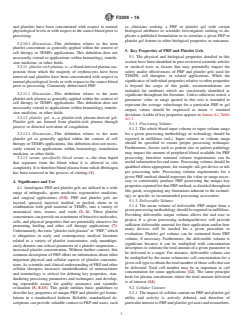
4.1 Autologous PRP and platelet gels are utilized in a wide range of orthopedic, sports medicine, regenerative medicine, and surgical applications (3-5). PRP and platelet gels are layered, sprayed, injected, molded, or packed, alone or in combination with graft material or TEMPs, into a variety of anatomical sites, tissues, and voids (3, 6). These platelet concentrates can provide an assortment of bioactive molecules, cells, and physical properties that are potentially attractive for promoting healing and other cell therapy applications (7). Unfortunately, the term “platelet-rich plasma” or “PRP,” which is ubiquitous in early and contemporary medical literature related to a variety of platelet concentrates, only unambiguously denotes one critical parameter of a platelet suspension—increased platelet concentration. Without further context, this common description of PRP offers no information about other important physical and cellular aspects of platelet concentrations. As scientific and clinical understanding of PRP and other cellular therapies increases standardization of nomenclature and terminology is critical for defining key properties, standardizing processing parameters and techniques, and developing repeatable assays for quality assurance and scientific evaluation (5, 8-13). This guide outlines basic guidelines to describe key properties of unique PRP and platelet gel formulations in a standardized fashion. Reliable, standardized descriptions can provide valuable context to PRP end users, such as clinicians seeking a PRP or platelet gel with certain biological attributes or scientific investigators seeking to duplicate a published formulation or to correlate a given PRP or platelet gel feature to other biological properties or outcomes.
SCOPE
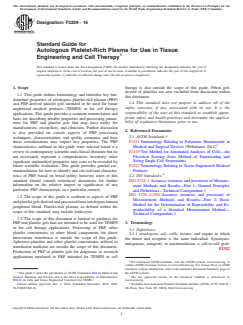
1.1 This guide defines terminology and identifies key fundamental properties of autologous platelet-rich plasma (PRP) and PRP-derived platelet gels intended to be used for tissue engineered medical products (TEMPS) or for cell therapy applications. This guide provides a common nomenclature and basis for describing notable properties and processing parameters for PRP and platelet gels that may have utility for manufacturers, researchers, and clinicians. Further discussion is also provided on certain aspects of PRP processing techniques, characterization, and quality assurance and how those considerations may impact key properties. The PRP characteristics outlined in this guide were selected based n a review of contemporary scientific and clinical literature but do not necessarily represent a comprehensive inventory; other significant unidentified properties may exist or be revealed by future scientific evaluation. This guide provides general recommendations for how to identify and cite relevant characteristics of PRP, based on broad utility; however, users of this standard should consult referenced documents for further information on the relative import or significance of any particular PRP characteristic in a particular context.
1.2 The scope of this guide is confined to aspects of PRP and platelet gels derived and processed from autologous human peripheral blood. Platelet-rich plasma, as defined within the scope of this standard, may include leukocytes.
1.3 The scope of this document is limited to guidance for PRP and platelet gels that are intended to be used for TEMPS or for cell therapy applications. Processing of PRP, other platelet concentrates or other blood components for direct intravenous transfusion is outside the scope of this guide. Apheresis platelets and other platelet concentrates utilized in transfusion medicine are outside the scope of this document. Production of PRP or platelet gels for diagnostic or research applications unrelated to PRP intended for TEMPS or cell therapy is also outside the scope of this guide. Fibrin gels devoid of platelets are also excluded from discussion within this document.
1.4 This standar...
- Status
- Published
- Publication Date
- 30-Sep-2016
- Technical Committee
- F04 - Medical and Surgical Materials and Devices
- Drafting Committee
- F04.43 - Cells and Tissue Engineered Constructs for TEMPs
Overview
ASTM F3209-16 is the Standard Guide for Autologous Platelet-Rich Plasma (PRP) for Use in Tissue Engineering and Cell Therapy. Issued by ASTM International, this guide establishes standardized terminology and key properties for PRP and PRP-derived platelet gels within the context of tissue engineered medical products (TEMPs) and cell therapy. The standard aims to improve consistency in describing PRP characteristics and processing parameters, aiding clinicians, manufacturers, and researchers in selecting, preparing, and evaluating PRP formulations for regenerative medicine, orthopedic, surgical, and sports medicine applications.
Standardizing the description, processing, and characterization of autologous PRP ensures that users can reliably compare and reproduce formulations, supporting quality assurance and scientific investigation in emerging cell therapies.
Key Topics
- Standardized Nomenclature and Terminology: The guide defines essential terms related to PRP, platelet gels, cell therapy, and regenerative medicine, reducing ambiguity in clinical and scientific communication.
- Key PRP Properties: Focus on critical parameters such as platelet, leukocyte, and erythrocyte concentrations, activation state, processing volume, deliverable output, and supplemental biomarkers.
- Processing Guidelines: Includes recommendations for blood collection, use of anticoagulants, temperature requirements, and timeframes to preserve PRP quality and cell viability.
- Quality Assurance: Emphasizes validated cell counting techniques and reporting methods to ensure accuracy and repeatability across studies and clinical applications.
- Impact of Donor and Processing Variables: Addresses factors such as donor hematological status, medications, and blood draw techniques that may affect PRP product quality.
- Clinical and Research Context: The guide outlines the distinctions between PRP used in cell therapy and TEMPs versus products intended for transfusion or unrelated diagnostic applications, which are not covered by this standard.
Applications
ASTM F3209-16 supports a wide range of applications in tissue engineering and cell therapy by defining characteristics crucial for the development and use of autologous platelet-rich plasma. Main applications include:
- Orthopedics and Sports Medicine: PRP and platelet gels can be injected, sprayed, layered, or packed into musculoskeletal tissues to enhance healing and recovery.
- Regenerative Medicine: Facilitates the use of PRP in cell therapy protocols aimed at regenerating or repairing damaged tissues and organs.
- Surgical Procedures: Standardized PRP preparations can be combined with grafts or scaffolds in surgical settings, where bioactive molecules may promote tissue integration and healing.
- Research and Product Development: Manufactures and investigators benefit from standardized descriptors to compare PRP processing techniques, replicate studies, and correlate PRP properties to biological outcomes.
- Quality Control: Enables repeatable assays for scientific evaluation and consistency in clinical supply chains.
Related Standards
Implementing ASTM F3209-16 often involves reference to additional ASTM and ISO standards that complement its guidance:
- ASTM F1251: Terminology Relating to Polymeric Biomaterials in Medical and Surgical Devices
- ASTM F2149: Test Method for Automated Analyses of Cells
- ASTM F2312: Terminology Relating to Tissue Engineered Medical Products
- ISO 5725-1 / ISO 5725-2: Accuracy (trueness and precision) of Measurement Methods and Results
These standards support standardized measurement, description, and analysis essential for the safe and effective use of autologous PRP in regenerative medicine.
Keywords: autologous platelet-rich plasma, PRP, tissue engineering, cell therapy, regenerative medicine, standardized nomenclature, platelet gel, ASTM F3209-16, PRP processing, quality assurance
Relations
- Effective Date
- 01-Feb-2020
- Effective Date
- 15-Jan-2016
- Effective Date
- 01-Apr-2011
- Effective Date
- 01-Jun-2010
- Effective Date
- 01-Oct-2007
- Effective Date
- 01-Nov-2004
- Effective Date
- 10-Sep-2003
- Effective Date
- 10-Apr-2003
- Effective Date
- 10-Oct-2001
- Effective Date
- 01-Jan-1995
Get Certified
Connect with accredited certification bodies for this standard

BSI Group
BSI (British Standards Institution) is the business standards company that helps organizations make excellence a habit.

TÜV Rheinland
TÜV Rheinland is a leading international provider of technical services.

TÜV SÜD
TÜV SÜD is a trusted partner of choice for safety, security and sustainability solutions.
Sponsored listings
Frequently Asked Questions
ASTM F3209-16 is a guide published by ASTM International. Its full title is "Standard Guide for Autologous Platelet-Rich Plasma for Use in Tissue Engineering and Cell Therapy". This standard covers: SIGNIFICANCE AND USE 4.1 Autologous PRP and platelet gels are utilized in a wide range of orthopedic, sports medicine, regenerative medicine, and surgical applications (3-5). PRP and platelet gels are layered, sprayed, injected, molded, or packed, alone or in combination with graft material or TEMPs, into a variety of anatomical sites, tissues, and voids (3, 6). These platelet concentrates can provide an assortment of bioactive molecules, cells, and physical properties that are potentially attractive for promoting healing and other cell therapy applications (7). Unfortunately, the term “platelet-rich plasma” or “PRP,” which is ubiquitous in early and contemporary medical literature related to a variety of platelet concentrates, only unambiguously denotes one critical parameter of a platelet suspension—increased platelet concentration. Without further context, this common description of PRP offers no information about other important physical and cellular aspects of platelet concentrations. As scientific and clinical understanding of PRP and other cellular therapies increases standardization of nomenclature and terminology is critical for defining key properties, standardizing processing parameters and techniques, and developing repeatable assays for quality assurance and scientific evaluation (5, 8-13). This guide outlines basic guidelines to describe key properties of unique PRP and platelet gel formulations in a standardized fashion. Reliable, standardized descriptions can provide valuable context to PRP end users, such as clinicians seeking a PRP or platelet gel with certain biological attributes or scientific investigators seeking to duplicate a published formulation or to correlate a given PRP or platelet gel feature to other biological properties or outcomes. SCOPE 1.1 This guide defines terminology and identifies key fundamental properties of autologous platelet-rich plasma (PRP) and PRP-derived platelet gels intended to be used for tissue engineered medical products (TEMPS) or for cell therapy applications. This guide provides a common nomenclature and basis for describing notable properties and processing parameters for PRP and platelet gels that may have utility for manufacturers, researchers, and clinicians. Further discussion is also provided on certain aspects of PRP processing techniques, characterization, and quality assurance and how those considerations may impact key properties. The PRP characteristics outlined in this guide were selected based n a review of contemporary scientific and clinical literature but do not necessarily represent a comprehensive inventory; other significant unidentified properties may exist or be revealed by future scientific evaluation. This guide provides general recommendations for how to identify and cite relevant characteristics of PRP, based on broad utility; however, users of this standard should consult referenced documents for further information on the relative import or significance of any particular PRP characteristic in a particular context. 1.2 The scope of this guide is confined to aspects of PRP and platelet gels derived and processed from autologous human peripheral blood. Platelet-rich plasma, as defined within the scope of this standard, may include leukocytes. 1.3 The scope of this document is limited to guidance for PRP and platelet gels that are intended to be used for TEMPS or for cell therapy applications. Processing of PRP, other platelet concentrates or other blood components for direct intravenous transfusion is outside the scope of this guide. Apheresis platelets and other platelet concentrates utilized in transfusion medicine are outside the scope of this document. Production of PRP or platelet gels for diagnostic or research applications unrelated to PRP intended for TEMPS or cell therapy is also outside the scope of this guide. Fibrin gels devoid of platelets are also excluded from discussion within this document. 1.4 This standar...
SIGNIFICANCE AND USE 4.1 Autologous PRP and platelet gels are utilized in a wide range of orthopedic, sports medicine, regenerative medicine, and surgical applications (3-5). PRP and platelet gels are layered, sprayed, injected, molded, or packed, alone or in combination with graft material or TEMPs, into a variety of anatomical sites, tissues, and voids (3, 6). These platelet concentrates can provide an assortment of bioactive molecules, cells, and physical properties that are potentially attractive for promoting healing and other cell therapy applications (7). Unfortunately, the term “platelet-rich plasma” or “PRP,” which is ubiquitous in early and contemporary medical literature related to a variety of platelet concentrates, only unambiguously denotes one critical parameter of a platelet suspension—increased platelet concentration. Without further context, this common description of PRP offers no information about other important physical and cellular aspects of platelet concentrations. As scientific and clinical understanding of PRP and other cellular therapies increases standardization of nomenclature and terminology is critical for defining key properties, standardizing processing parameters and techniques, and developing repeatable assays for quality assurance and scientific evaluation (5, 8-13). This guide outlines basic guidelines to describe key properties of unique PRP and platelet gel formulations in a standardized fashion. Reliable, standardized descriptions can provide valuable context to PRP end users, such as clinicians seeking a PRP or platelet gel with certain biological attributes or scientific investigators seeking to duplicate a published formulation or to correlate a given PRP or platelet gel feature to other biological properties or outcomes. SCOPE 1.1 This guide defines terminology and identifies key fundamental properties of autologous platelet-rich plasma (PRP) and PRP-derived platelet gels intended to be used for tissue engineered medical products (TEMPS) or for cell therapy applications. This guide provides a common nomenclature and basis for describing notable properties and processing parameters for PRP and platelet gels that may have utility for manufacturers, researchers, and clinicians. Further discussion is also provided on certain aspects of PRP processing techniques, characterization, and quality assurance and how those considerations may impact key properties. The PRP characteristics outlined in this guide were selected based n a review of contemporary scientific and clinical literature but do not necessarily represent a comprehensive inventory; other significant unidentified properties may exist or be revealed by future scientific evaluation. This guide provides general recommendations for how to identify and cite relevant characteristics of PRP, based on broad utility; however, users of this standard should consult referenced documents for further information on the relative import or significance of any particular PRP characteristic in a particular context. 1.2 The scope of this guide is confined to aspects of PRP and platelet gels derived and processed from autologous human peripheral blood. Platelet-rich plasma, as defined within the scope of this standard, may include leukocytes. 1.3 The scope of this document is limited to guidance for PRP and platelet gels that are intended to be used for TEMPS or for cell therapy applications. Processing of PRP, other platelet concentrates or other blood components for direct intravenous transfusion is outside the scope of this guide. Apheresis platelets and other platelet concentrates utilized in transfusion medicine are outside the scope of this document. Production of PRP or platelet gels for diagnostic or research applications unrelated to PRP intended for TEMPS or cell therapy is also outside the scope of this guide. Fibrin gels devoid of platelets are also excluded from discussion within this document. 1.4 This standar...
ASTM F3209-16 is classified under the following ICS (International Classification for Standards) categories: 11.100.30 - Analysis of blood and urine. The ICS classification helps identify the subject area and facilitates finding related standards.
ASTM F3209-16 has the following relationships with other standards: It is inter standard links to ASTM F2312-11(2020), ASTM F2149-16, ASTM F2312-11, ASTM F2312-10, ASTM F2149-01(2007), ASTM F2312-04, ASTM F2312-03, ASTM F1251-89(2003), ASTM F2149-01, ASTM F1251-89(1995). Understanding these relationships helps ensure you are using the most current and applicable version of the standard.
ASTM F3209-16 is available in PDF format for immediate download after purchase. The document can be added to your cart and obtained through the secure checkout process. Digital delivery ensures instant access to the complete standard document.
Standards Content (Sample)
This international standard was developed in accordance with internationally recognized principles on standardization established in the Decision on Principles for the
Development of International Standards, Guides and Recommendations issued by the World Trade Organization Technical Barriers to Trade (TBT) Committee.
Designation: F3209 − 16
Standard Guide for
Autologous Platelet-Rich Plasma for Use in Tissue
Engineering and Cell Therapy
This standard is issued under the fixed designation F3209; the number immediately following the designation indicates the year of
original adoption or, in the case of revision, the year of last revision. A number in parentheses indicates the year of last reapproval. A
superscript epsilon (´) indicates an editorial change since the last revision or reapproval.
1. Scope therapy is also outside the scope of this guide. Fibrin gels
devoid of platelets are also excluded from discussion within
1.1 This guide defines terminology and identifies key fun-
this document.
damental properties of autologous platelet-rich plasma (PRP)
1.4 This standard does not purport to address all of the
and PRP-derived platelet gels intended to be used for tissue
safety concerns, if any, associated with its use. It is the
engineered medical products (TEMPS) or for cell therapy
responsibility of the user of this standard to establish appro-
applications. This guide provides a common nomenclature and
priate safety and health practices and determine the applica-
basis for describing notable properties and processing param-
bility of regulatory limitations prior to use.
eters for PRP and platelet gels that may have utility for
manufacturers, researchers, and clinicians. Further discussion
2. Referenced Documents
is also provided on certain aspects of PRP processing
techniques, characterization, and quality assurance and how 2.1 ASTM Standards:
F1251 Terminology Relating to Polymeric Biomaterials in
those considerations may impact key properties. The PRP
characteristics outlined in this guide were selected based n a Medical and Surgical Devices (Withdrawn 2012)
F2149 Test Method for Automated Analyses of Cells—the
review of contemporary scientific and clinical literature but do
not necessarily represent a comprehensive inventory; other Electrical Sensing Zone Method of Enumerating and
Sizing Single Cell Suspensions
significant unidentified properties may exist or be revealed by
F2312 Terminology Relating to Tissue Engineered Medical
future scientific evaluation. This guide provides general rec-
ommendations for how to identify and cite relevant character- Products
istics of PRP, based on broad utility; however, users of this
2.2 ISO Standards:
standard should consult referenced documents for further
ISO 5725–1 Accuracy (trueness and precision) of Measure-
information on the relative import or significance of any
ment Methods and Results—Part 1: General Principles
particular PRP characteristic in a particular context.
and Definitions—Technical Corrigendum 1
ISO 5725–2:1994 Accuracy (trueness and precision) of
1.2 The scope of this guide is confined to aspects of PRP
Measurement Methods and Results—Part 2: Basic
andplateletgelsderivedandprocessedfromautologoushuman
Method for the Determination of Repeatability and Re-
peripheral blood. Platelet-rich plasma, as defined within the
producibility of a Standard Measurement Method—
scope of this standard, may include leukocytes.
Technical Corrigendum 1
1.3 The scope of this document is limited to guidance for
PRP and platelet gels that are intended to be used for TEMPS 3. Terminology
or for cell therapy applications. Processing of PRP, other
3.1 Definitions:
platelet concentrates or other blood components for direct
3.1.1 atuologous, adj—cells, tissues, and organs in which
intravenous transfusion is outside the scope of this guide.
the donor and recipient is the same individual. Synonyms:
Apheresis platelets and other platelet concentrates utilized in
autogenous, autograft, or autotransfusion, a self-to-self graft.
transfusion medicine are outside the scope of this document.
F2312
Production of PRP or platelet gels for diagnostic or research
applications unrelated to PRP intended for TEMPS or cell
For referenced ASTM standards, visit the ASTM website, www.astm.org, or
contact ASTM Customer Service at service@astm.org. For Annual Book of ASTM
Standards volume information, refer to the standard’s Document Summary page on
This guide is under the jurisdiction of ASTM Committee F04 on Medical and the ASTM website.
Surgical Materials and Devices and is the direct responsibility of Subcommittee The last approved version of this historical standard is referenced on
F04.43 on Cells and Tissue Engineered Constructs for TEMPs. www.astm.org.
Current edition approved Oct. 1, 2016. Published December 2016. DOI: Available fromAmerican National Standards Institute (ANSI), 25 W. 43rd St.,
10.1520/F3209-16. 4th Floor, New York, NY 10036, http://www.ansi.org.
Copyright © ASTM International, 100 Barr Harbor Drive, PO Box C700, West Conshohocken, PA 19428-2959. United States
F3209 − 16
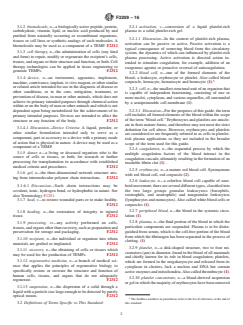
3.1.2 biomolecule, n—a biologically active peptide, protein, 3.2.1 activation, v—conversion of a liquid platelet-rich
carbohydrate, vitamin, lipid, or nucleic acid produced by and plasma to a solid platelet-rich gel.
purified from naturally occurring or recombinant organisms,
3.2.1.1 Discussion—In the context of platelet-rich plasma,
tissues or cell lines or synthetic analogs of such molecules. A
activation can be passive or active. Passive activation is a
biomolecule may be used as a component of a TEMP. F2312
typical consequence of removing blood from the circulatory
3.1.3 cell therapy, n—the administration of cells (any kind
system, the dynamics of which can influenced by platelet-rich
and form) to repair, modify or regenerate the recipient’s cells,
plasma processing. Active activation is directed action in-
tissues, and organs or their structure and function, or both. Cell
tended to stimulate coagulation, for example, addition of an
therapy technologies can be applied in tissue engineering to
exogenous agonist or proactive reversal of anticoagulation.
generate TEMPs. F2312
3.2.2 blood cell, n—one of the formed elements of the
3.1.4 device, n—an instrument, apparatus, implement, blood; a leukocyte, erythrocyte or platelet. Also called blood
corpuscle, hemacyte, hematocyte and hemocyte (1).
machine,contrivance,implant, in vitroreagent,orothersimilar
or related article intended for use in the diagnosis of disease or
3.2.3 cell, n—thesmalleststructuralunitofanorganismthat
other conditions, or in the cure, mitigation, treatment, or
is capable of independent functioning, consisting of one or
prevention of disease, in man or other animals, which does not
more nuclei, cytoplasm, and various organelles, all surrounded
achieve its primary intended purposes through chemical action
by a semipermeable cell membrane (1).
within or on the body of man or other animals and which is not
3.2.3.1 Discussion—For the purposes of this guide, the term
dependent upon being metabolized for the achievement of its
cell includes all formed elements of the blood within the scope
primary intended purposes. Devices are intended to affect the
of the term “blood cell.” Erythrocytes and platelets are anucle-
structure or any function of the body. F2312
ate in their mature forms, and therefore may not meet the strict
3.1.4.1 Discussion—Device Criteria: A liquid, powder, or
definition for cell above. However, erythrocytes and platelets
other similar formulation intended only to serve as a
are considered or are frequently referred to as cells in platelet-
component, part or accessory to a device with a primary mode
rich plasma applications so they are included in the broader
of action that is physical in nature. A device may be used as a
scope of the term used for this guide.
component of a TEMP.
3.2.4 coagulation, n—the sequential process by which the
3.1.5 donor, n—a living or deceased organism who is the
multiple coagulation factors of the blood interact in the
source of cells or tissues, or both, for research or further
coagulationcascade,ultimatelyresultingintheformationofan
processing for transplantation in accordance with established
insoluble fibrin clot (1) .
medical criteria and procedures. F2312
3.2.5 erythrocyte, n—a mature red blood cell. Synonymous
3.1.6 gel, n—the three-dimensional network structure aris-
with red blood cell, red corpuscle (2).
ing from intermolecular polymer chain interactions. F2312
3.2.6 leukocyte, n—a colorless blood cell capable of ame-
3.1.6.1 Discussion—Such chain interactions may be boidmovement;thereareseveraldifferenttypes,classifiedinto
the two large groups granular leukocytess (basophils,
covalent, ionic, hydrogen bond, or hydrophobic in nature. See
also Terminology F1251. eosinophils, and neutrophils) and nongranular leukocytess
(lymphocytes and monocytes).Also called white blood cells or
3.1.7 heal, v—to restore wounded parts or to make healthy.
F2312 corpuscles (1).
3.2.7 peripheral blood, n—the blood in the systemic circu-
3.1.8 healing, n—the restoration of integrity to injured
lation (1).
tissue. F2312
3.2.8 plasma, n—the fluid portion of the blood in which the
3.1.9 processing, vt—any activity performed on cells,
particulate components are suspended. Plasma is to be distin-
tissues,andorgansotherthanrecovery,suchaspreparationand
guished from serum, which is the cell-free portion of the blood
preservation for storage and packaging. F2312
from which the fibrinogen has been separated in the process of
3.1.10 recipient, n—the individual or organism into whom
clotting. (1)
materials are grafted or implanted. F2312
3.2.9 platelet, n—a disk-shaped structure, two to four mi-
3.1.11 recovery, n—the obtaining of cells or tissues which
crometers (µm) in diameter, found in the blood of all mammals
may be used for the production of TEMPs. F2312
and chiefly known for its role in blood coagulation; platelets,
3.1.12 regenerative medicine, n—a branch of medical sci-
which are formed in the megakaryocyte and released from its
ence that applies the principles of regenerative biology to
cytoplasm in clusters, lack a nucleus and DNA but contain
specifically restore or recreate the structure and function of
activeenzymesandmitochondria.Alsocalledthrombocyte (1).
human cells, tissues, and organs that do not adequately
3.2.10 platelet concentrate, n—a blood-derived suspension
regenerate. F2312
orgelinwhichthemajorityoferythrocyteshavebeenremoved
3.1.13 suspension, n—the dispersion of a solid through a
liquidwithaparticlesizelargeenoughtobedetectedbypurely
optical means. F2312
The boldface numbers in parentheses refer to the list of references at the end of
3.2 Definitions of Terms Specific to This Standard: this standard.
F3209 − 16
and platelets have been concentrated with respect to normal as clinicians seeking a PRP or platelet gel with certain
physiological levels or with respect to the source blood prior to biological attributes or scientific investigators seeking to du-
processing. plicate a published formulation or to correlate a given PRP or
platelet gel feature to other biological properties or outcomes.
3.2.10.1 Discussion—This definition relates to the term
platelet concentrate as generally applied within the context of
5. Key Properties of PRP and Platelet Gels
cell therapy or TEMPs applications. This definition does not
5.1 The physical and biological properties detailed in this
necessarily extend to applications within hematology, transfu-
section have been identified in peer-reviewed scientific articles
sion medicine, or other fields.
or medical texts as factors that may potentially impact the
3.2.11 platelet-rich plasma, n—a blood-derived plasma sus-
safety and/or effectiveness of PRP and platelet gels used for
pension from which the majority of erythrocytes have been
TEMPS, cell therapies, or related applications. While the
removed and platelets have been concentrated with respect to
significance of individual properties relative to other properties
normal physiological levels or with respect to the source blood
is beyond the scope of this guide, recommendations are
prior to processing. Commonly abbreviated PRP.
included for attributes which are consistently identified as
3.2.11.1 Discussion—This definition relates to the term
significant throughout the literature. Unless otherwise noted, a
platelet-rich plasma as generally applied within the context of
parameter value or range quoted in this text is intended to
cell therapy or TEMPs applications. This definition does not
represent the average value/range for a particular PRP or gel
necessarily extend to applications within hematology, transfu-
output; values should be expressed as mean 6 standard
sion medicine, or other fields.
deviation.AtableofkeypropertiesappearsinAnnexA1,Table
3.2.12 platelet gel, n—a platelet-rich plasma-derived gel.
A1.1.
Platelet gels are formed from platelet-rich plasma through
5.1.1 Processing Volume:
passive or directed activation of coagulation.
5.1.2 The whole blood input volume or input volume range
for a given processing methodology or technology should be
3.2.12.1 Discussion—This definition relates to the term
reported in milliliters (mL). Input volume or volume range
platelet gel as generally applied within the context of cell
should be specified to ensure proper processing technique.
therapy or TEMPs applications. this definition does not neces-
Furthermore, factors such as patient size or patient pathology
sarily extend to applications within hematology, transfusion
may impact the amount of peripheral blood available for PRP
medicine, or other fields.
processing, therefore minimal volume requirements can be
3.2.13 serum, specifically blood serum, n—the clear liquid
useful information for end users. Processing volume should be
that separates from the blood when it is allowed to clot
qualifiedwhereappropriate,forexample:mLperdeviceormL
completely. It is therefore blood plasma from which fibrinogen
per processing tube. Processing volume requirements for a
has been removed in the process of clotting (1).
given PRP method should represent the value or range neces-
sary to consistently produce PRP possessing the unique key
4. Significance and Use
propertiesreportedforthatPRPmethod,asdetailedthroughout
4.1 Autologous PRP and platelet gels are utilized in a wide
this guide, recognizing any limitations inherent to the technol-
range of orthopedic, sports medicine, regenerative medicine,
ogy or specific to recommended processing accessories.
and surgical applications (3-5). PRP and platelet gels are
5.1.3 Deliverable Volume:
layered, sprayed, injected, molded, or packed, alone or in
5.1.4 The mean volume of deliverable PRP output from a
combination with graft material or TEMPs, into a variety of
givenprocessingmethodologyshouldbereportedinmilliliters.
anatomical sites, tissues, and voids (3, 6). These platelet
Providing deliverable output volume allows the end user to
concentratescanprovideanassortmentofbioactivemolecules,
project if a given processing technique/device will provide
cells, and physical properties that are potentially attractive for
sufficient deliverable material for their application and/or how
promoting healing and other cell therapy applications (7).
many devices will be needed for a given procedure or
Unfortunately, the term “platelet-rich plasma” or “PRP,” which
evaluation. Platelet gel volume can be estimated from PRP
is ubiquitous in early and contemporary medical literature
volume, if necessary. Furthermore, the deliverable volume is
related to a variety of platelet concentrates, only unambigu-
significant because it can be multiplied with concentration
ously denotes one critical parameter of a platelet suspension—
descriptors to estimate the total amount of a given parameter to
increased platelet concentration. Without further context, this
be delivered to a target. For instance, deliverable volume can
common description of PRP offers no information about other
be multiplied by the mean volumetric cell concentration for a
important physical and cellular aspects of platelet concentra-
givencelltypetoobtainthetotalnumberofthosecellsthatcan
tions.As scientific and clinical understanding of PRPand other
be delivered. Total cell number may be as important as cell
cellular therapies increases standardization of nomenclature
concentration for some applications (12). The same principle
and terminology is critical for defining key properties, stan-
hods for plasma constituents where the total amount delivered
dardizing processing parameters and techniques, and develop-
is of interest (14).
ing repeatable assays for quality assurance and scientific
5.2 Cellular Content:
evaluation (5, 8-13). This guide outlines basic guidelines to
describe key properties of unique PRP and platelet gel formu- 5.2.1 The impact of cellular content on PRPand platelet gel
lations in a standardized fashion. Reliable, standardized de- utility and activity is actively debated, and therefore of
scriptions can provide valuable context to PRPend users, such particularinteresttoPRPandplateletgelusersandresearchers.
F3209 − 16
ThetypesofcellsthatmakeupagivenPRPformulation,along concentrations and fold increases can also be provided, when
with their relative concentrations within the suspension, are available. Differential concentration data can be divided into
routinely identified as fundamentally critical characteristics of granulocytes, lymphocytes and monocytes or further detailed
PRP and platelet gels. The scope of this guide is limited to to differentiate between basophils, eosinophils and neutrophils
platelet suspensions derived from peripheral blood, therefore within the granulocyte subpopulation.
three cell populations of primary interest: platelets, leukocytes
5.2.5 Erythorocyte Concentration:
and erythrocytes.
5.2.5.1 The presence of erythrocytes in PRP or platelet gels
5.2.2 Accurate and repeatable cell identification and count-
hasbeencitedasdetrimentalforsomecelltherapyapplications
ingmethodologiesarenecessaryformeaningfuldescriptionsof
(12). PRP processing technologies typically aim to reduce the
cellular content. These considerations are briefly discussed in
concentrationoferythrocytesinthefinalPRPoutputorremove
7.5.
them completely. PRP erythrocyte concentration should be
5.2.3 Platelet Concentration and Quantity:
reported in erythrocytes/microliter. Fold concentration
increase/decrease can also be provided as a supplemental
5.2.3.1 Platelets are notable because of their primary role in
descriptor. If significant hemolysis is observed, serum/plasma
hemostasis and coagulation, their participation in wound heal-
free hemoglobin should be reported in milligrams/deciliter.
ing activities, and their releasable internal stores of cytokines
and growth factors. Any cellular suspension labeled PRP
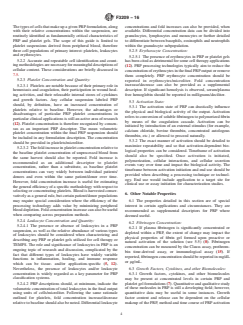
5.3 Activation State:
should, by definition, have an increased concentration of
5.3.1 The activation state of PRP can drastically influence
platelets relative to baseline. However, the advantages or
the physical and biological activity of the output. Activation
disadvantages of particular PRP platelet concentrations in
refers to conversion of soluble fibrinogen to polymerized fibrin
particular clinical applications is still an active area of research
by means of the coagulation cascade. Activation can be
(12). Platelet concentration is therefore recognized by consen-
initiated by introduction of an external stimulus (for example,
sus as an important PRP descriptor. The mean volumetric
calcium chloride, bovine thrombin, concentrated autologous
platelet concentration within the final PRP suspension should
thrombin, etc.) or allowed to proceed naturally.
be included in any formulation description. The concentration
5.3.2 The exact manner of activation should be detailed to
should be provided in platelets/microliter.
maximize repeatability and so that activation-dependent bio-
5.2.3.2 Thefoldincreaseinplateletconcentrationrelativeto
logical properties can be considered. Timeframe of activation
the baseline platelet concentration of unprocessed blood from
should also be specified. Once activation is initiated,
the same harvest should also be reported. Fold increase is
polymerization, cellular interactions, and cellular secretion
recommended as an additional descriptor to platelet
events vary over time and impact the biological activity. The
concentration, rather than a substitute, as baseline platelet
timeframe between activation initiation and end use should be
concentrations can vary widely between individual patients/
provided when describing a processing technique or technol-
donors and even within the same patient/donor over time.
ogy. End use would include application to a target site for
However, fold concentration increase is useful for estimating
clinical use or assay initiation for characterization studies.
thegeneralefficiencyofaspecificmethodologywithrespectto
selecting or concentrating platelets. Blood is harvested conser-
6. Other Notable Properties
vatively as a general rule, but certain patient/donor populations
may require special consideration where the efficiency of the
6.1 The properties detailed in this section are of special
processing technology adds value by minimizing peripheral
interest in certain applications and circumstances. They are
blood depletion. Fold concentration increase can also be useful
recommended as supplemental descriptors for PRP where
when comparing across preparation methods.
deemed useful.
5.2.4 Leukocyte Concentration and Quantity:
6.2 Fibrinogen Concentration:
5.2.4.1 The presence or absence of leukocytes in a PRP
6.2.1 If plasma fibrinogen is significantly concentrated or
suspension, as well as the relative abundance of various types
depleted within a PRP, the extent of change may impact the
of leukocytes should be considered when characterizing and
physical properties of fibrin gel formed upon proactive or
describing any PRP or platelet gels utilized for cell therapy or
natural activation of the solution (see 5.5) (8). Fibrinogen
TEMPS. The role and s
...