

ASTM E676-02(2019)
(Specification)Standard Specification for Interchangeable Taper-Ground Joints
General Information
- Abstract
ABSTRACT
This specification covers the required properties of only the ground surfaces of interchangeable taper-ground joints used in laboratory and industrial equipment in full-length, medium length, short length, and international length grindings. It includes information on the testing method for the products. After testing, samples should conform to the required quality of surface finish, taper, and leakage for the specific joint size designation.
SCOPE
1.1 This specification covers designations, dimensions, and tolerances for only the ground surfaces of interchangeable taper-ground joints for laboratory and industrial equipment in full-length, medium-length, short-length, and international-length (ISO K-6 series) grindings.
Note 1: The dimensions pertaining to full-length, medium-length, and short-length joints, other than for the tolerance on length of grind, were taken directly from the now obsolete Commercial Standard CS 21.
Note 2: Tolerances on the diameters of the international-length joints do not agree with those given in ISO Recommendation R 383. These tolerances have been established to agree with those of CS 21 in order to prevent the negative projection (large end of inner joint being smaller than large end of outer joint) permitted by ISO.
Note 3: Although glass is the most commonly used material for ground joints, other materials may be used as specified. Taper-ground joints constructed from glass should be of suitable chemical and thermal properties in accordance with Specification E438. Joints should be as free as possible of visible defects and conform to Specification E671.
1.2 The following precautionary caveat pertains only to the Test Method portion, Section 4, of this specification. This standard does not purport to address all of the safety concerns, if any, associated with its use. It is the responsibility of the user of this standard to establish appropriate safety, health, and environmental practices and determine the applicability of regulatory limitations prior to use.
1.3 This international standard was developed in accordance with internationally recognized principles on standardization established in the Decision on Principles for the Development of International Standards, Guides and Recommendations issued by the World Trade Organization Technical Barriers to Trade (TBT) Committee.
- Status
- Published
- Publication Date
- 31-Dec-2018
- Technical Committee
- E41 - Laboratory Apparatus
- Drafting Committee
- E41.01 - Laboratory Ware and Supplies

Overview
ASTM E676-02(2019): Standard Specification for Interchangeable Taper-Ground Joints establishes comprehensive requirements for the ground surfaces of interchangeable taper-ground joints commonly used in laboratory and industrial equipment. This international standard specifies the designations, dimensions, and tolerances for joints available in full-length, medium-length, short-length, and international-length (ISO K-6 series) forms. The document also outlines test methods to ensure quality parameters such as surface finish, taper, and leakage, enhancing the reliability and compatibility of laboratory glassware and related equipment across global supply chains.
Key Topics
- Designations and Dimensions: Defines a range of standard joint sizes suitable for various laboratory and industrial applications. Dimensions are provided for full-length, medium-length, short-length, and international-length versions, facilitating global interchangeability.
- Tolerances: Specifies strict tolerances for diameter and grind length to ensure reliable connections and leak-free performance. International-length tolerances are aligned with historical U.S. standards to maintain backward compatibility.
- Surface Finish: Requires a fine finish on all ground surfaces, with the roughness average (Ra) not exceeding 1 µm, ensuring precision fits and minimal risk of contamination.
- Material Suitability: While glass is the preferred material, the specification allows for alternate materials as needed, provided they meet required chemical and thermal performance criteria.
- Testing Methods: Describes cleaning procedures, assembly practices, and a standard leak test, where joints must not exceed a maximum leak rate under controlled conditions.
- Marking and Identification: Stipulates mandatory product markings that include standard taper, size designation, and manufacturer’s trademark to facilitate traceability and assurance of quality.
Applications
- Laboratory Glassware: Widely used in chemistry and life science labs for assembling apparatus where secure, leak-tight connections are essential for experiments and processes.
- Industrial Equipment: Supports the assembly of processing and analytical systems, ensuring consistent performance under various chemical and thermal conditions.
- Research and Quality Assurance: Provides a standardized basis for equipment fabrication and procurement, reducing variability and increasing safety in laboratory setups.
- Educational Institutions: Enables reliable construction and maintenance of teaching apparatus in educational labs.
The adoption of ASTM E676-02(2019) supports seamless integration of labware components from different manufacturers, promoting global interoperability and supply chain efficiency.
Related Standards
- ASTM E438: Specification for chemical and thermal properties of glass used in laboratory apparatus.
- ASTM E671: Requirements for maximum permissible thermal residual stress in annealed glass laboratory ware.
- ASTM E920 & ASTM E921: Packaging standards for laboratory apparatus, ensuring safe transport and storage.
- ASTM E1133: Practice for performance testing of packaged laboratory equipment.
- ASTM E1157: Specification for sampling and testing reusable laboratory glassware.
- ISO R 383: International reference for dimensions of conical ground glass joints (note: some tolerances differ from ASTM E676).
- CS 21: Historical U.S. Department of Commerce standard for ground joints, referenced for legacy compatibility.
Practical Value
By providing clear guidelines for the manufacture, testing, and interchangeability of taper-ground joints, ASTM E676-02(2019) underpins the reliability and safety of laboratory and industrial operations. Laboratories, manufacturers, and suppliers benefit from reduced risk of leaks, improved repeatability, and compatibility across equipment lines. Adhering to this standard also helps organizations meet international trade and procurement requirements, supporting compliance and quality assurance initiatives in scientific and industrial communities.
Relations
- Effective Date
- 01-Jan-2019
- Effective Date
- 01-Feb-2024
- Effective Date
- 01-Jul-2019
- Effective Date
- 01-Jan-2018
- Effective Date
- 01-Nov-2013
- Effective Date
- 01-Dec-2011
- Effective Date
- 01-Dec-2011
- Effective Date
- 01-Dec-2011
- Effective Date
- 01-Sep-2010
- Effective Date
- 15-May-2010
- Effective Date
- 01-Apr-2010
- Effective Date
- 01-Nov-2008
- Effective Date
- 01-Nov-2006
- Effective Date
- 01-Nov-2006
- Effective Date
- 01-Oct-2005
Get Certified
Connect with accredited certification bodies for this standard

ECOCERT
Organic and sustainability certification.

Eurofins Food Testing Global
Global leader in food, environment, and pharmaceutical product testing.

Intertek Bangladesh
Intertek certification and testing services in Bangladesh.
Sponsored listings
Frequently Asked Questions
ASTM E676-02(2019) is a technical specification published by ASTM International. Its full title is "Standard Specification for Interchangeable Taper-Ground Joints". This standard covers: ABSTRACT This specification covers the required properties of only the ground surfaces of interchangeable taper-ground joints used in laboratory and industrial equipment in full-length, medium length, short length, and international length grindings. It includes information on the testing method for the products. After testing, samples should conform to the required quality of surface finish, taper, and leakage for the specific joint size designation. SCOPE 1.1 This specification covers designations, dimensions, and tolerances for only the ground surfaces of interchangeable taper-ground joints for laboratory and industrial equipment in full-length, medium-length, short-length, and international-length (ISO K-6 series) grindings. Note 1: The dimensions pertaining to full-length, medium-length, and short-length joints, other than for the tolerance on length of grind, were taken directly from the now obsolete Commercial Standard CS 21. Note 2: Tolerances on the diameters of the international-length joints do not agree with those given in ISO Recommendation R 383. These tolerances have been established to agree with those of CS 21 in order to prevent the negative projection (large end of inner joint being smaller than large end of outer joint) permitted by ISO. Note 3: Although glass is the most commonly used material for ground joints, other materials may be used as specified. Taper-ground joints constructed from glass should be of suitable chemical and thermal properties in accordance with Specification E438. Joints should be as free as possible of visible defects and conform to Specification E671. 1.2 The following precautionary caveat pertains only to the Test Method portion, Section 4, of this specification. This standard does not purport to address all of the safety concerns, if any, associated with its use. It is the responsibility of the user of this standard to establish appropriate safety, health, and environmental practices and determine the applicability of regulatory limitations prior to use. 1.3 This international standard was developed in accordance with internationally recognized principles on standardization established in the Decision on Principles for the Development of International Standards, Guides and Recommendations issued by the World Trade Organization Technical Barriers to Trade (TBT) Committee.
ABSTRACT This specification covers the required properties of only the ground surfaces of interchangeable taper-ground joints used in laboratory and industrial equipment in full-length, medium length, short length, and international length grindings. It includes information on the testing method for the products. After testing, samples should conform to the required quality of surface finish, taper, and leakage for the specific joint size designation. SCOPE 1.1 This specification covers designations, dimensions, and tolerances for only the ground surfaces of interchangeable taper-ground joints for laboratory and industrial equipment in full-length, medium-length, short-length, and international-length (ISO K-6 series) grindings. Note 1: The dimensions pertaining to full-length, medium-length, and short-length joints, other than for the tolerance on length of grind, were taken directly from the now obsolete Commercial Standard CS 21. Note 2: Tolerances on the diameters of the international-length joints do not agree with those given in ISO Recommendation R 383. These tolerances have been established to agree with those of CS 21 in order to prevent the negative projection (large end of inner joint being smaller than large end of outer joint) permitted by ISO. Note 3: Although glass is the most commonly used material for ground joints, other materials may be used as specified. Taper-ground joints constructed from glass should be of suitable chemical and thermal properties in accordance with Specification E438. Joints should be as free as possible of visible defects and conform to Specification E671. 1.2 The following precautionary caveat pertains only to the Test Method portion, Section 4, of this specification. This standard does not purport to address all of the safety concerns, if any, associated with its use. It is the responsibility of the user of this standard to establish appropriate safety, health, and environmental practices and determine the applicability of regulatory limitations prior to use. 1.3 This international standard was developed in accordance with internationally recognized principles on standardization established in the Decision on Principles for the Development of International Standards, Guides and Recommendations issued by the World Trade Organization Technical Barriers to Trade (TBT) Committee.
ASTM E676-02(2019) is classified under the following ICS (International Classification for Standards) categories: 71.040.20 - Laboratory ware and related apparatus. The ICS classification helps identify the subject area and facilitates finding related standards.
ASTM E676-02(2019) has the following relationships with other standards: It is inter standard links to ASTM E676-02(2012), ASTM E438-92(2024), ASTM E920-97(2019), ASTM E438-92(2018), ASTM E920-97(2013), ASTM E1157-87(2011), ASTM E438-92(2011), ASTM E1157-87(2018)e1, ASTM E1133-86(2010), ASTM E921-97(2010), ASTM E671-98(2010), ASTM E920-97(2008), ASTM E1157-87(2006), ASTM E438-92(2006), ASTM E1133-86(2005). Understanding these relationships helps ensure you are using the most current and applicable version of the standard.
ASTM E676-02(2019) is available in PDF format for immediate download after purchase. The document can be added to your cart and obtained through the secure checkout process. Digital delivery ensures instant access to the complete standard document.
Standards Content (Sample)
This international standard was developed in accordance with internationally recognized principles on standardization established in the Decision on Principles for the
Development of International Standards, Guides and Recommendations issued by the World Trade Organization Technical Barriers to Trade (TBT) Committee.
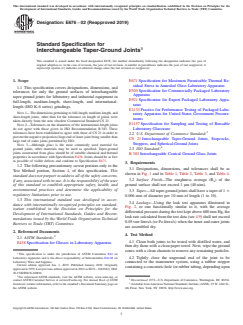
Designation: E676 −02 (Reapproved 2019)
Standard Specification for
Interchangeable Taper-Ground Joints
This standard is issued under the fixed designation E676; the number immediately following the designation indicates the year of
original adoption or, in the case of revision, the year of last revision. A number in parentheses indicates the year of last reapproval. A
superscript epsilon (´) indicates an editorial change since the last revision or reapproval.
1. Scope E671 Specification for Maximum Permissible Thermal Re-
sidual Stress in Annealed Glass Laboratory Apparatus
1.1 This specification covers designations, dimensions, and
E920 Specification for Commercially Packaged Laboratory
tolerances for only the ground surfaces of interchangeable
Apparatus
taper-ground joints for laboratory and industrial equipment in
E921 Specification for Export Packaged Laboratory Appa-
full-length, medium-length, short-length, and international-
ratus
length (ISO K-6 series) grindings.
E1133 Practice for Performance Testing of Packaged Labo-
NOTE 1—The dimensions pertaining to full-length, medium-length, and
ratory Apparatus for United States Government Procure-
short-length joints, other than for the tolerance on length of grind, were
ments
taken directly from the now obsolete Commercial Standard CS 21.
E1157 Specification for Sampling and Testing of Reusable
NOTE 2—Tolerances on the diameters of the international-length joints
Laboratory Glassware
do not agree with those given in ISO Recommendation R 383. These
tolerances have been established to agree with those of CS 21 in order to
2.2 U.S. Department of Commerce Standard:
prevent the negative projection (large end of inner joint being smaller than
CS 21 Interchangeable Taper-Ground Joints, Stopcocks,
large end of outer joint) permitted by ISO.
Stoppers, and Spherical-Ground Joints
NOTE 3—Although glass is the most commonly used material for
ground joints, other materials may be used as specified. Taper-ground
2.3 ISO Standard:
joints constructed from glass should be of suitable chemical and thermal
R 383 Interchangeable Conical Ground Glass Joints
properties in accordance with Specification E438. Joints should be as free
as possible of visible defects and conform to Specification E671.
3. Requirements
1.2 The following precautionary caveat pertains only to the
3.1 Designations, dimensions, and tolerances shall be as
Test Method portion, Section 4, of this specification. This
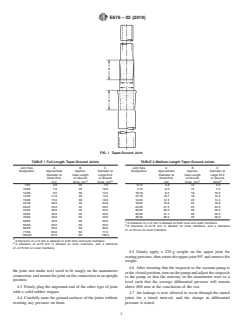
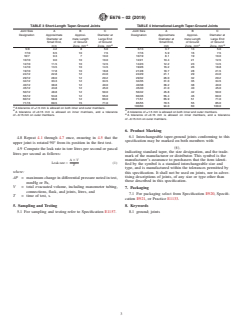
shown in Fig. 1 and in Table 1, Table 2, Table 3, and Table 4.
standarddoesnotpurporttoaddressallofthesafetyconcerns,
3.2 Surface Finish—The roughness average (R)ofthe
ifany,associatedwithitsuse.Itistheresponsibilityoftheuser
a
ground surface shall not exceed 1 µm (40 uim).
of this standard to establish appropriate safety, health, and
environmental practices and determine the applicability of
3.3 Taper—All taper-ground joints shall have a taper of 1 6
regulatory limitations prior to use.
0.006 mm of diameter per 10 mm of length (1 to 10).
1.3 This international standard was developed in accor-
3.4 Leakage—Using the leak test apparatus illustrated in
dance with internationally recognized principles on standard-
Fig. 2, or one functionally similar to it, with the average
ization established in the Decision on Principles for the
differential pressure during the test kept above 600 mm Hg, the
Development of International Standards, Guides and Recom-
leak rate calculated from the test data (see 4.9) shall not exceed
mendations issued by the World Trade Organization Technical
0.05 torr·litres/s (or Pa·litres/s) when the inner and outer joints
Barriers to Trade (TBT) Committee.
are assembled dry.
2. Referenced Documents
4. Test Method
2.1 ASTM Standards:
4.1 Clean both joints to be tested with distilled water, and
E438 Specification for Glasses in Laboratory Apparatus
then dry them with a clean paper towel. Next, wipe the ground
zones with a clean chamois to remove any remaining particles.
This specification is under the jurisdiction of ASTM Committee E41 on
Laboratory Apparatus and is the direct responsibility of Subcommittee E41.01 on 4.2 Tightly close the unground end of the joint to be
Laboratory Ware and Supplies.
connected to the manometer system, using a rubber stopper
Current edition approved Jan. 1, 2019. Published January 2019. Originally
containing a concentric hole (or rubber tubing, depending upon
approvedin1979.Lastpreviouseditionapprovedin2012asE676 – 02(2012).DOI:
10.1520/E0676-02R19.
For referenced ASTM standards, visit the ASTM website, www.astm.org, or
contact ASTM Customer Service at service@astm.org. For Annual Book of ASTM Discontinued 1979—U.S. Department of Commerce, Washington, DC 20234.
Standards volume information, refer to the standard’s Document Summary page on Available from American National Standards Institute (ANSI), 25 W. 43rd St.,
the ASTM website. 4th Floor, New York, NY 10036, http://www.ansi.org.
Copyright © ASTM International, 100 Barr Harbor Drive, PO Box C700, West Conshohocken, PA 19428-2959. United States
E676 − 02 (2019)
FIG. 1 Taper-Ground Joint
TABLE 1 Full-Length Taper-Ground Joints TABLE 2 Medium-Length Taper-Ground Joints
Joint Size A B C Joint Size A B C
Designation Approximate Approxi- Diameter at Designation Approximate Approxi- Diameter at
Diameter at mate Length Large End Diameter at mate Length Large End
Small End, of Ground of Ground Small End, of Ground of Ground
A B A B
mm Zone, mm Zone, mm mm Zone, mm Zone
7/25 5.0 25 7.5 5/12 3.8 12 5.0
10/30 7.0 30 10.0 7/15 6.0 15 7.5
12/30 9.5 30 12.5 10/18 8.2 18 10.0
14/35 11.0 35 14.5 12/18 10.7 18 12.5
19/38 15.0 38 18.8 14/20 12.5 20 14.5
24/40 20.0 40 24.0 19/22 16.6 22 18.8
29/42 25.
...