

ASTM D905-08(2021)
(Test Method)Standard Test Method for Strength Properties of Adhesive Bonds in Shear by Compression Loading
General Information
- Abstract
SIGNIFICANCE AND USE
4.1 It cannot be assumed that this test method measures the true shear strength of the adhesive bond. Many factors interfere or bias the measurement including the strength of the wood, the specimen, the shear tool designs themselves, and the rate of loading.
4.1.1 Wood failure is very common in joints made with strong adhesives. Although high wood failure is normally desired, when it occurs the measured strength is lower than the true adhesive bond strength.
4.1.2 Stress concentrations at the notches of the specimen tend to lower the measured strength. In a similar test for the shear strength of solid wood, Test Methods D143, these effects are self correcting so that the measured strength is close to the true shear strength of the wood. By analogy the same may be true in this test method, however, other factors are also involved and may alter the relationship.
4.1.3 The rate of loading affects the strength of an adhesive bond according to the adhesive’s rheological properties. The more viscoelastic or plastic the adhesive, the greater effect. Thermosetting adhesives like urea- and phenol-formaldehyde are elastic. Their bond strengths can be measured over a range of loading rate from 0.038 to 1.27 cm/min (0.015 to 0.5 in./min) with no apparent affect. Thermoplastic adhesives like polyvinyl acetate, hot melts, and elastomer-based adhesives exhibit a broad range of elastic, viscoelastic, and plastic behaviors. Their bond strengths will be affected to varying degrees by changing the loading rate. Generally, increasing the rate, increases the measured strength.
4.2 This test method is suitable for product research and development, qualifying adhesives in accordance with certain product or performance specifications, and monitoring bonding process control. This test method may be suitable for comparing and selecting adhesives, however, such comparisons must be made with caution since the measured strength of some adhesives may be different in different types o...
SCOPE
1.1 This test method covers the determination of the comparative shear strengths of adhesive bonds used for bonding wood and other similar materials, when tested on a standard specimen under specified conditions of preparation, conditioning, and loading in compression. This test method is intended primarily as an evaluation of adhesives for wood.
1.2 The values stated in SI units are to be regarded as standard. The values given in parentheses after SI units are provided for information only and are not considered standard.
1.3 This standard does not purport to address all of the safety concerns, if any, associated with its use. It is the responsibility of the user of this standard to establish appropriate safety, health, and environmental practices and determine the applicability of regulatory limitations prior to use.
1.4 This international standard was developed in accordance with internationally recognized principles on standardization established in the Decision on Principles for the Development of International Standards, Guides and Recommendations issued by the World Trade Organization Technical Barriers to Trade (TBT) Committee.
- Status
- Published
- Publication Date
- 31-Mar-2021
- Technical Committee
- D14 - Adhesives
- Drafting Committee
- D14.30 - Wood Adhesives
Overview
ASTM D905-08(2021), published by ASTM International, specifies the standard test method for measuring the strength properties of adhesive bonds in shear by compression loading. This test method is primarily focused on comparing the shear strengths of adhesive bonds used for bonding wood and similar materials, utilizing standardized specimens and controlled conditions. Widely recognized in materials research, quality assurance, and adhesive performance evaluation, ASTM D905 is an essential reference for professionals working with wood adhesives and for those ensuring product compliance with industry requirements.
Key Topics
Purpose and Scope
ASTM D905 is designed to provide a comparative method for evaluating the shear strength of adhesive joints, particularly those involving wood substrates. It involves testing under prescribed specimen dimensions, preparation procedures, and controlled loading conditions.Factors Influencing Results
The strength value measured may not indicate the true shear strength of the adhesive. Several factors can affect results:- Wood strength and specimen integrity
- Shear tool design
- Rate of loading
- Stress concentrations at specimen notches
- Type and rheological properties of the adhesive
Adhesive and Wood Types
The method accommodates a variety of adhesives, including thermosetting (such as urea- and phenol-formaldehyde) and thermoplastic (polyvinyl acetate, hot melts, elastomer-based) adhesives. The type of adhesive and its behavior under load can significantly influence measured bond strength.Test Specimens and Conditioning Standardized specimen size and conditioning protocols ensure repeatable results. Specimens are typically derived from hard maple blocks with specified grain orientation and moisture content, bonded per adhesive manufacturer’s instructions, and conditioned prior to testing.
Testing Procedure The adhesive-bonded specimens are subjected to compression shear using a calibrated machine, and the shear stress at failure is calculated based on the bond line area.
Applications
Product Research and Development Enables evaluation and comparison of new adhesive formulations and bonding techniques, supporting innovation in engineered wood products and composite materials.
Adhesive Qualification and Performance Monitoring Assists manufacturers in qualifying adhesives for use according to specific product or performance standards. Also supports ongoing process control for adhesive bonding operations by monitoring adhesive performance over time.
Selection and Comparison of Adhesives Provides a quantitative basis for comparing adhesives, aiding in the selection of the optimal product for wood bonding applications. Caution is advised, as comparisons may be influenced by joint type and test conditions.
Quality Assurance in Manufacture Used as a reference test in quality control to ensure adhesive joints meet required strength criteria before product release.
Regulatory and Standards Compliance Employed by regulatory bodies, industry groups, and procurement agencies to verify compliance with international standards for adhesive strength in wood products.
Related Standards
ASTM D143
Test Methods for Small Clear Specimens of Timber, referenced for preparation, conditioning, and measurement techniques related to wood strength testing.ASTM D907
Terminology of Adhesives, which provides the definitions of terms used in ASTM adhesive standards.ASTM D5266
Practice for Estimating the Percentage of Wood Failure in Adhesive-Bonded Joints, important for assessing the mode of failure in tested specimens.World Trade Organization (WTO) TBT Principles
This standard is developed following internationally recognized principles for standardization outlined by the WTO Technical Barriers to Trade (TBT) Committee.
Keywords: ASTM D905, adhesive shear strength, compression loading, wood adhesives, materials testing, adhesive performance, quality assurance, bonding process control, adhesive bond strength, laboratory standards.
Relations
- Effective Date
- 15-Nov-2023
- Effective Date
- 01-Apr-2020
- Effective Date
- 01-May-2013
- Effective Date
- 01-Jul-2012
- Effective Date
- 01-May-2012
- Effective Date
- 01-Dec-2011
- Effective Date
- 01-Jan-2011
- Effective Date
- 01-Sep-2009
- Effective Date
- 01-Oct-2008
- Effective Date
- 15-Aug-2008
- Effective Date
- 01-Mar-2008
- Effective Date
- 10-Apr-2007
- Effective Date
- 01-Apr-2007
- Effective Date
- 01-Dec-2006
- Effective Date
- 01-Apr-2005
Get Certified
Connect with accredited certification bodies for this standard

DIN CERTCO
DIN Group product certification.

Smithers Quality Assessments
US management systems and product certification.
Sponsored listings
Frequently Asked Questions
ASTM D905-08(2021) is a standard published by ASTM International. Its full title is "Standard Test Method for Strength Properties of Adhesive Bonds in Shear by Compression Loading". This standard covers: SIGNIFICANCE AND USE 4.1 It cannot be assumed that this test method measures the true shear strength of the adhesive bond. Many factors interfere or bias the measurement including the strength of the wood, the specimen, the shear tool designs themselves, and the rate of loading. 4.1.1 Wood failure is very common in joints made with strong adhesives. Although high wood failure is normally desired, when it occurs the measured strength is lower than the true adhesive bond strength. 4.1.2 Stress concentrations at the notches of the specimen tend to lower the measured strength. In a similar test for the shear strength of solid wood, Test Methods D143, these effects are self correcting so that the measured strength is close to the true shear strength of the wood. By analogy the same may be true in this test method, however, other factors are also involved and may alter the relationship. 4.1.3 The rate of loading affects the strength of an adhesive bond according to the adhesive’s rheological properties. The more viscoelastic or plastic the adhesive, the greater effect. Thermosetting adhesives like urea- and phenol-formaldehyde are elastic. Their bond strengths can be measured over a range of loading rate from 0.038 to 1.27 cm/min (0.015 to 0.5 in./min) with no apparent affect. Thermoplastic adhesives like polyvinyl acetate, hot melts, and elastomer-based adhesives exhibit a broad range of elastic, viscoelastic, and plastic behaviors. Their bond strengths will be affected to varying degrees by changing the loading rate. Generally, increasing the rate, increases the measured strength. 4.2 This test method is suitable for product research and development, qualifying adhesives in accordance with certain product or performance specifications, and monitoring bonding process control. This test method may be suitable for comparing and selecting adhesives, however, such comparisons must be made with caution since the measured strength of some adhesives may be different in different types o... SCOPE 1.1 This test method covers the determination of the comparative shear strengths of adhesive bonds used for bonding wood and other similar materials, when tested on a standard specimen under specified conditions of preparation, conditioning, and loading in compression. This test method is intended primarily as an evaluation of adhesives for wood. 1.2 The values stated in SI units are to be regarded as standard. The values given in parentheses after SI units are provided for information only and are not considered standard. 1.3 This standard does not purport to address all of the safety concerns, if any, associated with its use. It is the responsibility of the user of this standard to establish appropriate safety, health, and environmental practices and determine the applicability of regulatory limitations prior to use. 1.4 This international standard was developed in accordance with internationally recognized principles on standardization established in the Decision on Principles for the Development of International Standards, Guides and Recommendations issued by the World Trade Organization Technical Barriers to Trade (TBT) Committee.
SIGNIFICANCE AND USE 4.1 It cannot be assumed that this test method measures the true shear strength of the adhesive bond. Many factors interfere or bias the measurement including the strength of the wood, the specimen, the shear tool designs themselves, and the rate of loading. 4.1.1 Wood failure is very common in joints made with strong adhesives. Although high wood failure is normally desired, when it occurs the measured strength is lower than the true adhesive bond strength. 4.1.2 Stress concentrations at the notches of the specimen tend to lower the measured strength. In a similar test for the shear strength of solid wood, Test Methods D143, these effects are self correcting so that the measured strength is close to the true shear strength of the wood. By analogy the same may be true in this test method, however, other factors are also involved and may alter the relationship. 4.1.3 The rate of loading affects the strength of an adhesive bond according to the adhesive’s rheological properties. The more viscoelastic or plastic the adhesive, the greater effect. Thermosetting adhesives like urea- and phenol-formaldehyde are elastic. Their bond strengths can be measured over a range of loading rate from 0.038 to 1.27 cm/min (0.015 to 0.5 in./min) with no apparent affect. Thermoplastic adhesives like polyvinyl acetate, hot melts, and elastomer-based adhesives exhibit a broad range of elastic, viscoelastic, and plastic behaviors. Their bond strengths will be affected to varying degrees by changing the loading rate. Generally, increasing the rate, increases the measured strength. 4.2 This test method is suitable for product research and development, qualifying adhesives in accordance with certain product or performance specifications, and monitoring bonding process control. This test method may be suitable for comparing and selecting adhesives, however, such comparisons must be made with caution since the measured strength of some adhesives may be different in different types o... SCOPE 1.1 This test method covers the determination of the comparative shear strengths of adhesive bonds used for bonding wood and other similar materials, when tested on a standard specimen under specified conditions of preparation, conditioning, and loading in compression. This test method is intended primarily as an evaluation of adhesives for wood. 1.2 The values stated in SI units are to be regarded as standard. The values given in parentheses after SI units are provided for information only and are not considered standard. 1.3 This standard does not purport to address all of the safety concerns, if any, associated with its use. It is the responsibility of the user of this standard to establish appropriate safety, health, and environmental practices and determine the applicability of regulatory limitations prior to use. 1.4 This international standard was developed in accordance with internationally recognized principles on standardization established in the Decision on Principles for the Development of International Standards, Guides and Recommendations issued by the World Trade Organization Technical Barriers to Trade (TBT) Committee.
ASTM D905-08(2021) is classified under the following ICS (International Classification for Standards) categories: 83.180 - Adhesives. The ICS classification helps identify the subject area and facilitates finding related standards.
ASTM D905-08(2021) has the following relationships with other standards: It is inter standard links to ASTM D143-23, ASTM D5266-13(2020), ASTM D5266-13, ASTM D907-12a, ASTM D907-12, ASTM D907-11a, ASTM D907-11, ASTM D143-09, ASTM D907-08b, ASTM D907-08a, ASTM D907-08, ASTM D143-94(2000)e1, ASTM D143-94(2007), ASTM D907-06, ASTM D5266-99(2005). Understanding these relationships helps ensure you are using the most current and applicable version of the standard.
ASTM D905-08(2021) is available in PDF format for immediate download after purchase. The document can be added to your cart and obtained through the secure checkout process. Digital delivery ensures instant access to the complete standard document.
Standards Content (Sample)
This international standard was developed in accordance with internationally recognized principles on standardization established in the Decision on Principles for the
Development of International Standards, Guides and Recommendations issued by the World Trade Organization Technical Barriers to Trade (TBT) Committee.
Designation: D905 − 08 (Reapproved 2021)
Standard Test Method for
Strength Properties of Adhesive Bonds in Shear by
Compression Loading
This standard is issued under the fixed designation D905; the number immediately following the designation indicates the year of
original adoption or, in the case of revision, the year of last revision. A number in parentheses indicates the year of last reapproval. A
superscript epsilon (´) indicates an editorial change since the last revision or reapproval.
This standard has been approved for use by agencies of the U.S. Department of Defense.
INTRODUCTION
The accuracy of the results of strength tests of adhesive bonds will depend on the conditions under
which the bonding process is carried out. Unless otherwise agreed upon by the manufacturer and the
purchaser, the bonding conditions shall be prescribed by the manufacturer of the adhesive. In order to
ensure that complete information is available to the individual conducting the tests, the manufacturer
of the adhesive shall furnish numerical values and other specific information for each of the following
variables:
(1) The moisture content of the wood at the time of bonding.
(2) Complete mixing directions for the adhesive.
(3) Conditions for applications of the adhesive including the rate of spread or thickness of film,
number of coats to be applied, whether to be applied to one or both surfaces, and the conditions of
drying where more than one coat is required.
(4) Assembly conditions before application of pressure, including the room temperature, length of
time, and whether open or closed assembly is to be used.
(5) Curing conditions, including the amount of pressure to be applied, the length of time under
pressure and the temperature of assembly when under pressure. It should be stated whether this
temperature is that of the bond line, or of the atmosphere at which the assembly is to be maintained.
(6) Conditioning procedure before testing, unless a standard procedure is specified, including the
length of time, temperature, and relative humidity.
Arangemaybeprescribedforanyvariablebythemanufactureroftheadhesiveifitcanbeassumed
by the test operator that any arbitrarily chosen value within such a range or any combination of such
values for several variables will be acceptable to both the manufacturer and the purchaser of the
adhesive.
1. Scope conditioning, and loading in compression. This test method is
intended primarily as an evaluation of adhesives for wood.
1.1 This test method covers the determination of the com-
parative shear strengths of adhesive bonds used for bonding
1.2 The values stated in SI units are to be regarded as
wood and other similar materials, when tested on a standard
standard. The values given in parentheses after SI units are
specimen under specified conditions of preparation,
provided for information only and are not considered standard.
1.3 This standard does not purport to address all of the
This test method is under the jurisdiction of ASTM Committee D14 on
safety concerns, if any, associated with its use. It is the
Adhesives and is the direct responsibility of Subcommittee D14.30 on Wood
Adhesives. responsibility of the user of this standard to establish appro-
Current edition approved April 1, 2021. Published April 2021. Originally
priate safety, health, and environmental practices and deter-
approved in 1947. Last previous edition approved in 2013 as D905 – 08 (2013).
mine the applicability of regulatory limitations prior to use.
DOI: 10.1520/D0905-08R21.
Copyright © ASTM International, 100 Barr Harbor Drive, PO Box C700, West Conshohocken, PA 19428-2959. United States
D905 − 08 (2021)
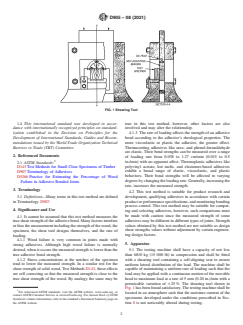
FIG. 1 Shearing Tool
1.4 This international standard was developed in accor- true in this test method, however, other factors are also
dance with internationally recognized principles on standard- involved and may alter the relationship.
ization established in the Decision on Principles for the 4.1.3 The rate of loading affects the strength of an adhesive
Development of International Standards, Guides and Recom- bond according to the adhesive’s rheological properties. The
mendations issued by the World Trade Organization Technical more viscoelastic or plastic the adhesive, the greater effect.
Barriers to Trade (TBT) Committee. Thermosetting adhesives like urea- and phenol-formaldehyde
are elastic. Their bond strengths can be measured over a range
2. Referenced Documents
of loading rate from 0.038 to 1.27 cm/min (0.015 to 0.5
in./min) with no apparent affect. Thermoplastic adhesives like
2.1 ASTM Standards:
polyvinyl acetate, hot melts, and elastomer-based adhesives
D143 Test Methods for Small Clear Specimens of Timber
exhibit a broad range of elastic, viscoelastic, and plastic
D907 Terminology of Adhesives
behaviors. Their bond strengths will be affected to varying
D5266 Practice for Estimating the Percentage of Wood
degrees by changing the loading rate. Generally, increasing the
Failure in Adhesive Bonded Joints
rate, increases the measured strength.
3. Terminology
4.2 This test method is suitable for product research and
3.1 Definitions—Many terms in this test method are defined
development, qualifying adhesives in accordance with certain
in Terminology D907. productorperformancespecifications,andmonitoringbonding
process control. This test method may be suitable for compar-
4. Significance and Use
ing and selecting adhesives, however, such comparisons must
be made with caution since the measured strength of some
4.1 It cannot be assumed that this test method measures the
adhesives may be different in different types of joints. Strength
trueshearstrengthoftheadhesivebond.Manyfactorsinterfere
values obtained by this test method are not suitable as design
orbiasthemeasurementincludingthestrengthofthewood,the
shear strengths values without adjustment by certain engineer-
specimen, the shear tool designs themselves, and the rate of
ing design factors.
loading.
4.1.1 Wood failure is very common in joints made with
5. Apparatus
strong adhesives. Although high wood failure is normally
desired, when it occurs the measured strength is lower than the
5.1 The testing machine shall have a capacity of not less
true adhesive bond strength. than 6810 kg (15 000 lb) in compression and shall be fitted
4.1.2 Stress concentrations at the notches of the specimen
with a shearing tool containing a self-aligning seat to ensure
tend to lower the measured strength. In a similar test for the uniform lateral distribution of the load. The machine shall be
shear strength of solid wood, Test Methods D143, these effects
capable of maintaining a uniform rate of loading such that the
are self correcting so that the measured strength is close to the load may be applied with a continuous motion of the movable
true shear strength of the wood. By analogy the same may be
head to maximum load at a rate of 5 mm (0.20 in.)/min with a
permissible variation of 625 %. The shearing tool shown in
Fig.1hasbeenfoundsatisfactory.Thetestingmachineshallbe
For referenced ASTM standards, visit the ASTM website, www.astm.org, or
located in an atmosphere such that the moisture content of the
contact ASTM Customer Service at service@astm.org. For Annual Book of ASTM
specimens developed under the conditions prescribed in Sec-
Standards volume information, refer to the standard’s Document Summary page on
the ASTM website. tion 8 is not noticeably altered during testing.
D905 − 08 (2021)
6. Test Specimens
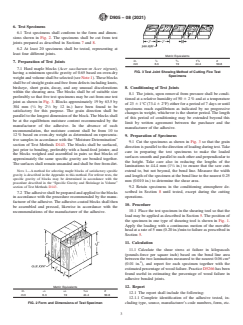
6.1 Test specimens shall conform to the form and dimen-
sions shown in Fig. 2. The specimens shall be cut from test
joints prepared as described in Sections 7 and 8.
6.2 At least 20 specimens shall be tested, representing at
least four different joints.
Metric Equivalents
1 3 3
in. ⁄4 ⁄4 1 ⁄4 2
7. Preparation of Test Joints
mm 6.3 19 44.4 50.8
7.1 Hard maple blocks (Acer saccharum or Acer nigrum),
FIG. 3 Test Joint Showing Method of Cutting Five Test
having a minimum specific gravity of 0.65 based on oven-dry
Specimens
weight and volume shall be selected (seeNote 1).These blocks
shall be of straight grain and free from defects including knots,
birdseye, short grain, decay, and any unusual discolorations 8. Conditioning of Test Joints
within the shearing area. The blocks shall be of suitable size
8.1 The joints, upon removal from pressure shall be condi-
preferably so that five test specimens may be cut from one test
tioned at a relative humidity of 50 6 2 % and at a temperature
joint as shown in Fig. 3. Blocks approximately 19 by 63.5 by
of 23 6 1°C (73.4 6 2°F) either for a period of 7 days or until
3 1
304 mm ( ⁄4 by 2 ⁄2 by 12 in.) have been found to be
specimens reach equilibrium as indicated by no progressive
satisfactor
...