


ASTM E3224-19
(Guide)Standard Guide for Building Energy Performance and Improvement Evaluation in the Assessment of Property Condition
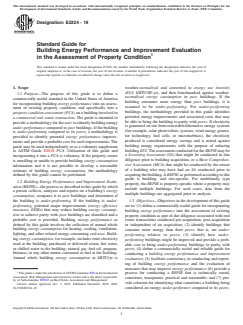
Standard Guide for Building Energy Performance and Improvement Evaluation in the Assessment of Property Condition
SIGNIFICANCE AND USE
4.1 Uses—This guide is intended for use on a voluntary basis by parties who wish to conduct a BEPIE. The process defined in this guide involves: (1) the collection of building and equipment information, including whole building energy consumption, much of which is typically collected as part of an E2018 PCA; (2) weather-normalizing the whole building energy consumption to obtain an EUI; (3) benchmarking the EUI to compare against the EUI of peer buildings; and (4) determining if the building’s EUI is under-performing compared to the EUI of peer buildings. If the building’s EUI is under-performing, the guide (1) evaluates the extent to which the building is under-performing; (2) provides guidance on what energy efficiency improvements might be made to bring the building to the performance level of its peers; and (3) provides guidance to obtain a probable cost for these energy efficiency improvements. The guide is intended principally as an approach to conducting a standardized building energy performance inquiry in connection with commercial real estate involved in a commercial real estate transaction with the intent to identify a condition of EUI under-performance compared to peer buildings. The guide provides for two approaches: a Screening Assessment (SA) that may be conducted, for example, as an adjunct to an E2018 PCA during due diligence prior to an acquisition, and a More Comprehensive Assessment (MCA) that would include more rigorous investigation as may, for example, be conducted by a building owner seeking to make an investment in EEMs. This guide is intended to reflect a commercially practical and reasonable inquiry.
4.2 Clarifications on Use:
4.2.1 Use in Conjunction with an E2018 PCA—This guide, when added as a supplemental scope of work to an E2018 PCA, is designed to assist the user and Consultant in developing information about energy consumption and energy efficiency improvements that may be undertaken to reduce energy consumption in a buil...
SCOPE
1.1 Purpose—The purpose of this guide is to define a commercially useful standard in the United States of America for incorporating building energy performance into an assessment of existing property condition, and specifically into a property condition assessment (PCA) on a building involved in a commercial real estate transaction. The guide is intended to provide a methodology for the user to identify building energy under-performance compared to peer buildings. If the building is under-performing compared to its peers, a methodology is provided to identify potential energy performance improvements and provide a probable cost for such improvements. The guide may be used independently or as a voluntary supplement to ASTM Guide E2018 PCA. Utilization of this guide and incorporating it into a PCA is voluntary. If the property owner is unwilling or unable to provide building energy consumption information and it is not possible to develop a reasonable estimate of building energy consumption, the methodology defined by this guide cannot be performed.
1.2 Building Energy Performance and Improvement Evaluation (BEPIE)—the process as described in this guide by which a person collects, analyzes and reports on a building’s energy consumption, compares it to peer buildings and determines if the building is under-performing. If the building is under-performing, potential major improvements (energy efficiency measures, EEMs) that may reduce building energy consumption to achieve parity with peer buildings are identified and a probable cost is provided. Building energy performance as defined by this guide involves the collection of annual whole building energy consumption for heating, cooling, ventilation, lighting, and other related energy-consuming end-uses. Building energy consumption, for example, includes total electricity used at the building; purchased or delivered steam, hot water, or chilled water to the building; natur...
General Information
- Status
- Published
- Publication Date
- 30-Sep-2019
- Technical Committee
- E50 - Environmental Assessment, Risk Management and Corrective Action
- Drafting Committee
- E50.02 - Real Estate Assessment and Management
Relations
- Effective Date
- 01-Jan-2024
- Effective Date
- 01-Jun-2023
- Effective Date
- 15-Aug-2015
- Effective Date
- 15-Jan-2011
- Effective Date
- 01-Jul-2008
- Effective Date
- 10-Dec-2001
- Effective Date
- 10-Dec-2001
Overview
ASTM E3224-19: Standard Guide for Building Energy Performance and Improvement Evaluation in the Assessment of Property Condition offers a comprehensive framework for evaluating the energy performance of existing buildings in the context of commercial real estate transactions. Developed by ASTM International, this guide is intended to be used voluntarily by property owners, consultants, and stakeholders to assess building energy consumption, identify under-performance relative to peer buildings, and estimate the cost of potential energy efficiency improvements.
The guide defines a standardized methodology known as Building Energy Performance and Improvement Evaluation (BEPIE). It can be used independently or as a supplement to an ASTM E2018 Property Condition Assessment (PCA). The goal is to facilitate informed decision-making regarding property acquisition, investment in energy efficiency measures (EEMs), and ongoing asset management.
Key Topics
BEPIE Methodology: The guide outlines a four-step process:
- Collection of whole building energy consumption and equipment data (often integrated with PCA data).
- Weather-normalization of energy consumption to determine Energy Use Intensity (EUI).
- Benchmarking EUI against similar, peer buildings to identify under-performance.
- If under-performing, evaluating the degree of under-performance, recommending potential EEMs, and estimating probable costs for improvements.
Screening Assessment (SA) vs. More Comprehensive Assessment (MCA):
- SA: A preliminary energy review, frequently added to an E2018 PCA during due diligence.
- MCA: An in-depth analysis, typically conducted by building owners considering investment in energy upgrades.
Data Collection and Documentation: Accurate collection of annual energy consumption for major end-uses (heating, cooling, lighting, ventilation, etc.) is critical. Data must be aggregated for multifamily or multi-building properties, and all sources and assumptions should be thoroughly documented.
Benchmarking and Peer Comparison: Benchmarking is essential for contextualizing a building's energy performance. Peer groups should be as geographically and functionally similar as possible, with statistical analysis to account for variability.
Applications
ASTM E3224-19 provides practical value in several contexts:
- Commercial Real Estate Transactions: Supports buyers and lenders in identifying energy under-performance risks and potential future capital needs during property acquisition.
- Property Condition Assessments (PCA): Enhances traditional PCAs with a standardized evaluation of building energy performance, informing more holistic decision-making.
- Asset Management and Operations: Assists building owners and managers in prioritizing and implementing energy efficiency measures, reducing operational costs, and aligning with sustainability goals.
- Portfolio Benchmarking: Standardized assessments help institutional investors and portfolio managers compare buildings across regions or sectors using consistent metrics.
- Sustainability and Certification Initiatives: Supports supplementary analysis for programs like ENERGY STAR®, LEED®, and other building energy efficiency certifications.
Related Standards
ASTM E3224-19 references and complements several established standards and industry resources:
- ASTM E2018: Guide for Property Condition Assessments - Baseline Property Condition Assessment Process.
- ASTM E2797: Practice for Building Energy Performance Assessment for a Building Involved in a Real Estate Transaction.
- ASHRAE Standards:
- ASHRAE 211: Standard for Commercial Building Energy Audits.
- ASHRAE 90.1: Energy Standard for Buildings Except Low-Rise Residential Buildings.
- ASHRAE 189.1: Standard for High-Performance Green Buildings.
- U.S. EPA ENERGY STAR® Portfolio Manager: Online tool for benchmarking building energy and water consumption.
- U.S. DOE Commercial and Residential Energy Consumption Surveys (CBECS/RECS): Key data sources for establishing peer group benchmarks.
By adopting ASTM E3224-19, stakeholders can ensure a consistent, transparent, and technically sound approach to evaluating and improving building energy performance, ultimately enhancing property value, reducing operational costs, and supporting sustainability objectives.
Keywords: ASTM E3224-19, Building Energy Performance, Property Condition Assessment, BEPIE, Energy Use Intensity, Benchmarking, Energy Efficiency, Commercial Real Estate, E2018 PCA, Energy Assessment Standard.
Get Certified
Connect with accredited certification bodies for this standard

ICC Evaluation Service
Building products evaluation and certification.

QAI Laboratories
Building and construction product testing and certification.

Aboma Certification B.V.
Specialized in construction, metal, and transport sectors.
Sponsored listings
Frequently Asked Questions
ASTM E3224-19 is a guide published by ASTM International. Its full title is "Standard Guide for Building Energy Performance and Improvement Evaluation in the Assessment of Property Condition". This standard covers: SIGNIFICANCE AND USE 4.1 Uses—This guide is intended for use on a voluntary basis by parties who wish to conduct a BEPIE. The process defined in this guide involves: (1) the collection of building and equipment information, including whole building energy consumption, much of which is typically collected as part of an E2018 PCA; (2) weather-normalizing the whole building energy consumption to obtain an EUI; (3) benchmarking the EUI to compare against the EUI of peer buildings; and (4) determining if the building’s EUI is under-performing compared to the EUI of peer buildings. If the building’s EUI is under-performing, the guide (1) evaluates the extent to which the building is under-performing; (2) provides guidance on what energy efficiency improvements might be made to bring the building to the performance level of its peers; and (3) provides guidance to obtain a probable cost for these energy efficiency improvements. The guide is intended principally as an approach to conducting a standardized building energy performance inquiry in connection with commercial real estate involved in a commercial real estate transaction with the intent to identify a condition of EUI under-performance compared to peer buildings. The guide provides for two approaches: a Screening Assessment (SA) that may be conducted, for example, as an adjunct to an E2018 PCA during due diligence prior to an acquisition, and a More Comprehensive Assessment (MCA) that would include more rigorous investigation as may, for example, be conducted by a building owner seeking to make an investment in EEMs. This guide is intended to reflect a commercially practical and reasonable inquiry. 4.2 Clarifications on Use: 4.2.1 Use in Conjunction with an E2018 PCA—This guide, when added as a supplemental scope of work to an E2018 PCA, is designed to assist the user and Consultant in developing information about energy consumption and energy efficiency improvements that may be undertaken to reduce energy consumption in a buil... SCOPE 1.1 Purpose—The purpose of this guide is to define a commercially useful standard in the United States of America for incorporating building energy performance into an assessment of existing property condition, and specifically into a property condition assessment (PCA) on a building involved in a commercial real estate transaction. The guide is intended to provide a methodology for the user to identify building energy under-performance compared to peer buildings. If the building is under-performing compared to its peers, a methodology is provided to identify potential energy performance improvements and provide a probable cost for such improvements. The guide may be used independently or as a voluntary supplement to ASTM Guide E2018 PCA. Utilization of this guide and incorporating it into a PCA is voluntary. If the property owner is unwilling or unable to provide building energy consumption information and it is not possible to develop a reasonable estimate of building energy consumption, the methodology defined by this guide cannot be performed. 1.2 Building Energy Performance and Improvement Evaluation (BEPIE)—the process as described in this guide by which a person collects, analyzes and reports on a building’s energy consumption, compares it to peer buildings and determines if the building is under-performing. If the building is under-performing, potential major improvements (energy efficiency measures, EEMs) that may reduce building energy consumption to achieve parity with peer buildings are identified and a probable cost is provided. Building energy performance as defined by this guide involves the collection of annual whole building energy consumption for heating, cooling, ventilation, lighting, and other related energy-consuming end-uses. Building energy consumption, for example, includes total electricity used at the building; purchased or delivered steam, hot water, or chilled water to the building; natur...
SIGNIFICANCE AND USE 4.1 Uses—This guide is intended for use on a voluntary basis by parties who wish to conduct a BEPIE. The process defined in this guide involves: (1) the collection of building and equipment information, including whole building energy consumption, much of which is typically collected as part of an E2018 PCA; (2) weather-normalizing the whole building energy consumption to obtain an EUI; (3) benchmarking the EUI to compare against the EUI of peer buildings; and (4) determining if the building’s EUI is under-performing compared to the EUI of peer buildings. If the building’s EUI is under-performing, the guide (1) evaluates the extent to which the building is under-performing; (2) provides guidance on what energy efficiency improvements might be made to bring the building to the performance level of its peers; and (3) provides guidance to obtain a probable cost for these energy efficiency improvements. The guide is intended principally as an approach to conducting a standardized building energy performance inquiry in connection with commercial real estate involved in a commercial real estate transaction with the intent to identify a condition of EUI under-performance compared to peer buildings. The guide provides for two approaches: a Screening Assessment (SA) that may be conducted, for example, as an adjunct to an E2018 PCA during due diligence prior to an acquisition, and a More Comprehensive Assessment (MCA) that would include more rigorous investigation as may, for example, be conducted by a building owner seeking to make an investment in EEMs. This guide is intended to reflect a commercially practical and reasonable inquiry. 4.2 Clarifications on Use: 4.2.1 Use in Conjunction with an E2018 PCA—This guide, when added as a supplemental scope of work to an E2018 PCA, is designed to assist the user and Consultant in developing information about energy consumption and energy efficiency improvements that may be undertaken to reduce energy consumption in a buil... SCOPE 1.1 Purpose—The purpose of this guide is to define a commercially useful standard in the United States of America for incorporating building energy performance into an assessment of existing property condition, and specifically into a property condition assessment (PCA) on a building involved in a commercial real estate transaction. The guide is intended to provide a methodology for the user to identify building energy under-performance compared to peer buildings. If the building is under-performing compared to its peers, a methodology is provided to identify potential energy performance improvements and provide a probable cost for such improvements. The guide may be used independently or as a voluntary supplement to ASTM Guide E2018 PCA. Utilization of this guide and incorporating it into a PCA is voluntary. If the property owner is unwilling or unable to provide building energy consumption information and it is not possible to develop a reasonable estimate of building energy consumption, the methodology defined by this guide cannot be performed. 1.2 Building Energy Performance and Improvement Evaluation (BEPIE)—the process as described in this guide by which a person collects, analyzes and reports on a building’s energy consumption, compares it to peer buildings and determines if the building is under-performing. If the building is under-performing, potential major improvements (energy efficiency measures, EEMs) that may reduce building energy consumption to achieve parity with peer buildings are identified and a probable cost is provided. Building energy performance as defined by this guide involves the collection of annual whole building energy consumption for heating, cooling, ventilation, lighting, and other related energy-consuming end-uses. Building energy consumption, for example, includes total electricity used at the building; purchased or delivered steam, hot water, or chilled water to the building; natur...
ASTM E3224-19 is classified under the following ICS (International Classification for Standards) categories: 91.120.10 - Thermal insulation of buildings. The ICS classification helps identify the subject area and facilitates finding related standards.
ASTM E3224-19 has the following relationships with other standards: It is inter standard links to ASTM E2018-24, ASTM E2018-23, ASTM E2018-15, ASTM E2797-11, ASTM E2018-08, ASTM E2018-01, ASTM E2018-99. Understanding these relationships helps ensure you are using the most current and applicable version of the standard.
ASTM E3224-19 is available in PDF format for immediate download after purchase. The document can be added to your cart and obtained through the secure checkout process. Digital delivery ensures instant access to the complete standard document.
Standards Content (Sample)
This international standard was developed in accordance with internationally recognized principles on standardization established in the Decision on Principles for the
Development of International Standards, Guides and Recommendations issued by the World Trade Organization Technical Barriers to Trade (TBT) Committee.
Designation: E3224 − 19
Standard Guide for
Building Energy Performance and Improvement Evaluation
in the Assessment of Property Condition
This standard is issued under the fixed designation E3224; the number immediately following the designation indicates the year of
original adoption or, in the case of revision, the year of last revision.Anumber in parentheses indicates the year of last reapproval.A
superscript epsilon (´) indicates an editorial change since the last revision or reapproval.
1. Scope weather-normalized and converted to energy use intensity
(EUI, kBTU/SF-yr), and then benchmarked against weather-
1.1 Purpose—The purpose of this guide is to define a
normalized energy consumption in peer buildings. If the
commercially useful standard in the United States of America
building consumes more energy than peer buildings, it is
for incorporating building energy performance into an assess-
assumed to be under-performing. For under-performing
ment of existing property condition, and specifically into a
buildings, the methodology provided in this guide identifies
property condition assessment (PCA)onabuildinginvolvedin
potential energy improvements and associated costs that may
a commercial real estate transaction. The guide is intended to
be able to bring the building to parity with peers. If electricity
provide a methodology for the user to identify building energy
is generated on site from renewable/alternative energy systems
under-performancecomparedto peerbuildings.Ifthebuilding
(for example, solar photovoltaic systems, wind energy genera-
is under-performing compared to its peers, a methodology is
tor technology, fuel cells, or microturbines), the electricity
provided to identify potential energy performance improve-
produced is considered energy savings and is netted against
mentsandprovideaprobablecostforsuchimprovements.The
building energy requirements with the purpose of reducing
guidemaybeusedindependentlyorasavoluntarysupplement
building EUI.Theassessmentconductedforthe BEPIEmaybe
to ASTM Guide E2018 PCA. Utilization of this guide and
a Screening Assessment (SA) that might be conducted in due
incorporating it into a PCA is voluntary. If the property owner
diligence prior to building acquisition, or a More Comprehen-
is unwilling or unable to provide building energy consumption
sive Assessment (MCA) that might be conducted by the owner
information and it is not possible to develop a reasonable
of a building who may have had an SA conducted prior to
estimate of building energy consumption, the methodology
acquiringthebuilding.A BEPIEasperformedaccordingtothis
defined by this guide cannot be performed.
guide is building- and site-specific. For multifamily type
1.2 Building Energy Performance and Improvement Evalu-
property, the BEPIE is property-specific where a property may
ation (BEPIE)—theprocessasdescribedinthisguidebywhich
include multiple buildings. For such cases, data from the
a person collects, analyzes and reports on a building’s energy
multiple buildings are aggregated prior to analysis.
consumption, compares it to peer buildings and determines if
the building is under-performing. If the building is under-
1.3 Objectives—Objectivesinthedevelopmentofthisguide
performing, potential major improvements (energy effıciency
areto:(1)defineacommerciallyusefulguideforincorporating
measures, EEMs) that may reduce building energy consump-
building energy performance into the assessment of existing
tion to achieve parity with peer buildings are identified and a
propertyconditionaspartofduediligenceassociatedwithreal
probable cost is provided. Building energy performance as
estate transactions conducted pre-acquisition, post-acquisition
defined by this guide involves the collection of annual whole
or independent of an acquisition; (2) identify buildings that
building energy consumption for heating, cooling, ventilation,
consume more energy than their peers, that is, are under-
lighting, and other related energy-consuming end-uses. Build-
performing relative to peers; (3) identify how under-
ing energy consumption, for example, includes total electricity
performing buildings might be improved and provide a prob-
used at the building; purchased or delivered steam, hot water,
able cost to bring under-performing buildings to parity with
or chilled water to the building; natural gas, fuel oil, propane,
peers; (4) define a commercially useful and reliable guide for
biomass, or any other matter consumed as fuel at the building.
conducting a building energy performance and improvement
Annual whole building energy consumption in kBTU/yr is
evaluation; (5) facilitate consistency in conducting and report-
ing of building energy performance and the evaluation of
measures that may improve energy performance; (6) provide a
ThisguideisunderthejurisdictionofASTMCommitteeE50onEnvironmental
process for conducting a BEPIE that is technically sound,
Assessment, Risk Management and CorrectiveAction and is the direct responsibil-
consistent, transparent, practical and reasonable; and (7) pro-
ity of Subcommittee E50.02 on Real Estate Assessment and Management.
vide criterion for identifying what constitutes a building being
Current edition approved Oct. 1, 2019. Published December 2019. DOI:
10.1520/E3224–19 considered an energy under-performer compared to its peers.
Copyright © ASTM International, 100 Barr Harbor Drive, PO Box C700, West Conshohocken, PA 19428-2959. United States
E3224 − 19
1.4 Documentation—The scope of this guide includes data 1.10 This international standard was developed in accor-
collection, compilation, analysis and reporting. All sources, dance with internationally recognized principles on standard-
records and resources relied upon in the BEPIE assessment ization established in the Decision on Principles for the
should to be documented. Development of International Standards, Guides and Recom-
mendations issued by the World Trade Organization Technical
1.5 Considerations Outside the Scope—The use of this
Barriers to Trade (TBT) Committee.
guide is limited to the conduct of a BEPIE as defined by this
guide. While this information may be used in assessing
2. Referenced Documents
building valuation or for other reasons, any such use is solely
2.1 ASTM Standards:
between the user and the Consultant and beyond the scope of
E2018Guide for Property ConditionAssessments: Baseline
this guide.
Property Condition Assessment Process
1.6 Organization of the Guide—BEPIE has 14 sections and
E2797Practice for Building Energy Performance Assess-
12 appendices. The appendices are included for informational
ment for a Building Involved in a Real EstateTransaction
purposes only and are provided for guidance in implementing
2.2 ASHRAE Standards:
this guide.
ASHRAE/ACCA Standard 211Standard for Commercial
Section 1 Describes the scope of the guide.
Building Energy Audits
Section 2 Identifies referenced documents.
ASHRAE Standard 189.1ASHRAE Standard 189.1, Stan-
Section 3 Provides terminology pertinent to the guide.
Section 4 Discusses the significance and use of the guide. dardfortheDesignofHigh-PerformanceGreenBuildings
Section 5 Discusses the relationship between this guide and ASTM
ASHRAE 90.1Energy Standard for Buildings Except Low-
E2018, ASTM E2797 and ASHRAE 211.
Rise Residential Buildings
Section 6 Describes the user’s responsibilities under this guide.
Section 7 Describes the data collection needs for this guide. ASHRAE HandbookFundamentals, 2017
Section 8 Describes the building energy performance and improvement
ASHRAE HandbookHVAC Systems and Equipment, 2016
evaluation process.
ASHRAE, 2011Procedures for Commercial Building En-
Section 9 Describes the benchmarking process.
Section 10 Describes the process for conducting a screening assess-
ergy Audits, 2nd Edition
ment.
ASHRAE Equipment Service Life Database (https://
Section 11 Describes the more comprehensive assessment process.
xp20.ashrae.org/publicdatabase/)
Section 12 Describes reporting of findings and conclusions.
Section 13 Identifies non-scope considerations.
2.3 Other References:
Section 14 Identifies keywords associated with the guide.
DSIREDatabase of Federal, State, Local Government and
Appendix X1 Driving Forces for Considering Building Energy Performance
Utility Incentives for Renewable Energy and Energy
in PCAs.
Appendix X2 Common Commercial Building Types.
Efficiency (http://www.dsireusa.org)
Appendix X3 EPA Portfolio Manager.
Fannie MaeHigh Performance Building Module Protocol
Appendix X4 Commercial (CBECS) and Residential (RECS) Building En-
ergy Consumption Surveys. (refer to Section 5.08 of Fannie Mae Form 4099, Instruc-
Appendix X5 U.S. Climate Zones.
tions for Performing a Multifamily Property Condition
Appendix X6 Building Performance Database.
Assessment, June 2019)
Appendix X7 EULs of Common Energy-consuming Equipment.
Fannie Mae Energy and Water Survey Database(https://
Appendix X8 EEM Replacement Schedule Considerations.
Appendix X9 Energy Savings for Common EEMs.
www.fanniemae.com/multifamily/green-initiative-
Appendix X10 Common Energy and Water Savings Measures.
market-research-survey)
Appendix X11 Building Energy Performance and Sustainability Certifications.
Appendix X12 Sample BEPIE Screening Assessment Report Format Federal Energy Management ProgramEnergy- and Cost-
Savings Calculators (https//www.energy.gov/eere/femp/
1.7 This guide cannot replace education or experience and
energy-and-cost-savings-calculators-energy-efficient-
should be used in conjunction with professional judgment. Not
products)
all aspects of this guide may be applicable in all circum-
RS MeansGreen Building Costs, 2019
stances. This ASTM guide is not intended to represent or
U.S. DOE 2011Buildings Energy Data Book, last revised
replace the standard of care by which the adequacy of a given
September 2017
professional service must be judged, nor should this guide be
U.S. DOE Building Performance DatabaseOffice of Energy
applied without consideration of a building’s many unique
Efficiency and Renewable Energy (https://
aspects. The word “standard” in the title means only that the
www.energy.gov/eere/buildings/building-performance-
guide has been approved through the ASTM consensus process.
database-bpd)
1.8 Nothing in this guide is intended to create or imply the
U.S. DOE Commercial Buildings Energy Consumption
existence of a legal obligation for reporting building energy
Survey (CBECS) 2012 (https://www.eia.gov/
performance or other building-related information. Any con-
consumption/commercial/data/2012/)
sideration of whether such an obligation exists under any
federal, state, local, or common law is beyond the scope of this
guide.
For referenced ASTM standards, visit the ASTM website, www.astm.org, or
1.9 This standard does not purport to address all of the
contact ASTM Customer Service at service@astm.org. For Annual Book of ASTM
Standards volume information, refer to the standard’s Document Summary page on
safety concerns, if any, associated with its use. It is the
the ASTM website.
responsibility of the user of this standard to establish appro-
Available from American Society of Heating, Refrigerating, and Air-
priate safety, health, and environmental practices and deter-
Conditioning Engineers, Inc. (ASHRAE), 1791 Tullie Circle, NE, Atlanta, GA
mine the applicability of regulatory limitations prior to use. 30329, http://www.ashrae.org.
E3224 − 19
U.S. DOE Residential Energy Consumption Survey sumption to achieve parity with peer buildings are identified
(RECS) 2015 (https://www.eia.gov/consumption/ and a probable cost provided.
residential/data/2015/)
3.2.4 building performance database (BPD), n—maintained
U.S. EPA, ENERGY STAR® Portfolio ManagerCommer-
by the U.S. DOE, the BPD is the nation’s largest dataset of
cial Property Benchmarking (https://www.energystar.gov/
information about the energy-related characteristics of com-
buildings/facility-owners-and-managers/existing-
mercial and residential buildings (refer to Appendix X6). The
buildings/use-portfolio-manager)
BPD combines, cleanses and anonymizes data collected by
U.S. EPA, ENERGY STAR® Portfolio ManagerMultifam-
federal,stateandlocalgovernments,utilities,energyefficiency
ily Property Energy Consumption Benchmarking (https://
programs, building owners and private companies, and makes
www.energystar.gov/buildings/owners_and_managers/
it available to the public. The website allows individuals to
existingbuildings/find_resources_your_property_type/
explore the data across real estate sectors and regions, and
energy_star_multifamily_housing)
compare various physical and operational characteristics to
U.S. EPA, ENERGY STAR® Portfolio ManagerMultifam-
gain a better understanding of market conditions and trends in
ily Property Water Use Benchmarking (https://
energy performance. Basic building information and energy
portfoliomanager.zendesk.com/hc/en-us/categories/
consumption data can be used to compare to similar buildings
202438517-Water-Benchmarking)
andidentifyhighandlowperformers.The BPDcanbeusedto
U.S. EPA, WaterSense™Multifamily Housing Water As-
analyze trends within custom-defined local peer groups for
sessment Worksheets, Version 1, October 2018
specific real estate sub-markets. The website may be accessed
U.S. EPA, WaterSense™Water Efficiency Management
at: https://www.energy.gov/eere/buildings/building-
Guide, Bathroom Suite, EPA 832-F-17-016d, November
performance-database.
3.2.5 climate zone, n—zones with common weather charac-
U.S. EPA, WaterSense™Water Efficiency Management
teristics. ASHRAE 90.1 and the IECC divide the U.S. into
Guide, Residential Kitchen and Laundry, EPA 832-F-17-
eight (8) climate zones and three (3) moisture regions (A, B
016b, November 2017
and C). The 2003 CBECS divided the U.S. into 5 climatically
U.S. EPA, WaterSense™Water Efficiency Management
homogeneous zones, as defined by the National Oceanic and
Guide, Landscaping and Irrigation, EPA 832-F-17-016b,
Atmospheric Administration (NOAA). Each NOAA climate
November 2017
division was based on its 30-year average heating degree-days
U.S. EPA, WaterSense™Water Efficiency Management
(HDD) and cooling degree-days (CDD) for the period 1971
Guide, Mechanical Systems, EPA 832-F-17-016c, No-
through 2000. The 2012 CBECS no longer uses historical
vember 2017
HDD- and CDD-based climate zones and is instead using
climate regions created by the Building America program,
3. Terminology
sponsored by the U.S. Department of Energy’s Office of
3.1 Definitions—This section provides definitions and de-
Energy Efficiency and Renewable Energy (EERE). (Refer to
scriptionsoftermsandalistofacronymsforkeywordsusedin
Appendix X5.)
this guide. The terms are an integral part of this guide and are
3.2.6 commercial real estate, n—improved real property,
critical to an understanding of the guide and its use.
except a dwelling or property with four or less dwelling units
3.2 Definitions of Terms Specific to This Standard: exclusively for residential use. The term includes, but is not
limited to, improved real property used for retail, office,
3.2.1 actual knowledge, n—the knowledge possessed by an
industrial, hospitality, agricultural, or other commercial, medi-
individual rather than an entity. Actual knowledge, as used in
cal or educational purposes; property used for residential
this guide, is to be distinguished from knowledge provided by
purposes that has five or more residential dwelling units.
others, or information contained in documents obtained in
performing a BEPIE.
3.2.7 commercial real estate transaction, n—a transfer of
title to or possession of commercial real estate, rental of space
3.2.2 adjusted energy use intensity (EUI-a), n—site EUI as
in commercial real estate under a lease for a set period of time
described in 3.2.19 adjusted by incorporating the 10% vari-
in return for consideration, a transfer of a leasehold interest in
ability allowance (see 3.2.46). If the median (50th percentile)
commercial real estate, or receipt of a security interest in
EUI of peer buildings is 60 kBTU/SF-yr, the acceptable upper
commercial real estate, except that it does not include such
range for the median EUI of peer buildings is 66 kBTU/SF-yr,
transactions with respect to an individual dwelling, or a
thatis,the EUI-a.Hence,ifthebuilding EUIis66kBTU/SF-yr
building containing four or less dwelling units, unless used for
or less, the guide would not consider the building as under-
commercial purposes such as the operation of such dwellings
performing.
for profit.
3.2.3 building energy performance and improvement evalu-
3.2.8 Consultant, n—apersonqualifiedtoperformthe SAor
ation (BEPIE), n—the process as described in this guide by
MCA in this guide. (Refer to 3.2.26, 3.2.39 and 8.6.)
which a person collects, analyzes and reports on a building’s
energy consumption, compares its weather-normalized EUI to 3.2.9 cooling degree-days (CDD), n—for each day with an
peer buildings and determines if the building is under- average temperature higher than 65°F (18.3°C), CDD is the
performing. If the building is under-performing, potential difference between the average temperature and 65 °F
energy improvements that may reduce building energy con- (18.3°C). For example, on a day with a mean temperature of
E3224 − 19
80°F (26.6°C), 15 CDD would be recorded. CDD data by example,aretypicallyinthousandsofBTUperyear(kBTU/yr
month and region is published by the Energy Information or kBTU/SF-yr). The units of building electricity energy
Administration. CDD historical data by month and region is consumption, for example, are typically in kWh per year or
published by the National Oceanic andAtmosphericAdminis- kWh/SF-yr. Energy consumption as described in this guide
tration’s(NOAA)NationalWeatherServiceClimatePrediction
refers to site energy consumption, unless noted otherwise.
Center, Camp Springs, MD for 200 major weather stations
3.2.16 energy performance, n—annual building or property
around the country, and by others, including NOAA’s National
electricity (kWh/yr) and fuel (MM BTU/yr) energy
Climatic Data Center in Ashville, NC. Information is also
consumption, excluding parking area energy consumption, for
available at http://www.degreedays.net.
example, pole lighting and, if applicable, parking area venti-
3.2.10 data gap, n—lack of or inability to collect informa-
lation. Energy performance may be in units of total energy
tion required by this guide despite good faith efforts by the
consumed annually, for example, MM BTU/yr, or as energy
person or entity seeking to gather such information. Data gaps
use intensity, that is, kBTU/SF-yr. Energy performance is
may result from incompleteness in any of the activities
typically associated with a specific twelve month period (or
associated with this guide, including, but not limited to the
thirteenmonthsifneededtogetafullyearof energy consump-
collection of a minimum of one year (twelve months) of
tion data) and may be weather-normalized.
historical building energy consumption data. Every effort
3.2.17 ENERGY STAR®, n—a voluntary program launched
shouldbemadetoresolveanysignificant data gapissuethatis
by the U.S. Environmental ProtectionAgency (EPA) and now
material to conducting the BEPIE.
managed by the EPA and U.S. Department of Energy (DOE)
3.2.11 district energy, n—is secondary energy that is gener-
designed to assist businesses and individuals reduce energy
atedoffsiteanddeliveredtoafacilityintheformofsteam,hot
costs and protect the environment through higher energy
water, or chilled water.
efficiency.
3.2.12 easily visible, adj—describes observations of items,
3.2.18 ENERGY STAR® certification, n—a building can
components and systems that are conspicuous, apparent, and
apply for an ENERGY STAR® certification within EPA Port-
obvious during the walk-through without: intrusion, relocation
folio Manager if its ENERGY STAR® score is 75 or higher,
or removal of materials, exploratory probing, use of special
indicatingthatitperforms(thatis,hasan EUI)betterthan75%
protective clothing, or use of any equipment (such as hand
of similar buildings nationwide. The information submitted in
tools, meters of any kind, ladders, and so forth). (Refer to
the application must be third party-verified annually by a
E2018.)
licensed Professional Engineer (PE) or Registered Architect
3.2.13 end-use, n—describes major energy-consuming uses
(RA).Ifverificationhasnottakenplacewithinthepriortwelve
inabuilding,includingbutnotlimitedto:spaceheating,space
months, the ENERGY STAR® certification for a building is no
cooling, ventilation, lighting, domestic hot water heating,
longer active.
refrigeration, cooking, office equipment, computers and mis-
3.2.19 energy use intensity (EUI), n—wholebuildingannual
cellaneous. The Commercial Buildings Energy Consumption
energy consumption divided by the building’s gross floor area;
Survey(CBECS)andResidentialEnergyConsumptionSurvey
also referred to as site EUI. The units of building energy use
(RECS)areexcellentsourcestobegintoobtaininsightintothe
intensity are typically kBTU/SF-yr. When used for
energy consumption associated with major building end-uses
benchmarking, the EUI is weather-normalized. EUI is associ-
asafunctionofpropertytypeindifferent climate zones.Utility
atedwithabuildinghavingaspecificpropertyuse(mayalsobe
Technical Resource Manuals (refer to Appendix X9) may also
referred to as specific property type) with characteristics or
be a source for end-use energy consumption data.
otherfactorsthatmayfacilitatecomparisonwithsimilaruse(or
3.2.14 energy effıciency measure (EEM), n—a measure
type)buildingshavingsimilarcharacteristics. EUIasdescribed
(such as a high efficiency condensing boiler or high efficiency
in this guide is determined on a site energy consumption basis.
packaged air conditioner or LED lighting) that may be
3.2.20 estimated useful life (EUL), n—the median length of
installed, or an operational change (such as modifying the
time (in years) that an energy effıciency measure is functional
set-back temperature) that may be implemented in a building,
or considered practically useable without incurring significant
to reduce energy consumption.
operational and maintenance penalties. Many factors may
3.2.15 energy consumption, n—total electricity, natural gas,
affect measure lifetime, including but not limited to delivery
heating oil, district steam, district hot water, district cooling
method, initial equipment sizing, maintenance standards, op-
water, propane, and so forth, used by a building for heating,
eratingconditionsandoperatinghours.The EULisalsousedto
cooling, lighting, powering, or fueling end-uses. Energy gen-
determine the length of time over which the benefits of an
erated on-site by renewable energy sources such as solar and
energy effıciency measuremaybeexpectedtoaccrue.(Referto
wind should be identified separately (as energy generated
Appendix X7.)
on-site by renewable sources may be netted out when deter-
mining building energy consumption). Energy consumption 3.2.21 geographic, adj—for this guide, geographic refers to
may be applied to energy effıciency measures (EEMs), whole an area defined within the bounds of a county. When compar-
buildings, building end-uses, or energy sources, for example, ingabuilding’s EUIto peerbuildings,itispreferablethat peer
electricity or fuel. The units of whole building energy con- buildings be located in the same geographic area as the
sumption (also referred to as site energy consumption), for building being evaluated.
E3224 − 19
3.2.22 gross floor area (GFA), n—area(insquarefeet)onall tocorrectspaceheatingandspacecooling energy consumption
floor levels within the perimeter of the outside walls of a end-uses (refer to 9.8.3 and 9.8.4).
building as measured from the outside surface of the exterior
3.2.28 peer, n—asusedinthisguide,asimilartypebuilding
walls, with no deduction for hallways, stairs, closets, columns,
with similar use, preferably in the same geographic area or
or other interior features, excluding parking area. Gross floor
climate zone. When used in the process of benchmarking, the
area is distinguished from the gross leasable or rentable area
energy consumption of peer buildings is statistically analyzed
(GRA),whichistheoccupiedareaonallfloorlevelsforwhich
to determine the median (50th percentile). A 10% variability
a tenant is charged for occupancy under a lease. Leasable area
allowance is factored around the median such that the median
may exclude common areas (such as lobbies and foyers,
constitutes a range rather than a discrete point.
stairways and elevators, corridors and passages, mechanical
3.2.29 practically reviewable, adj—information that is pro-
rooms, rest rooms, and so forth). Only gross floor area is used
vided by the source in a manner and in a form that, upon
in the energy metrics associated with this guide, for example,
examination, yields information relevant to the property with-
in the determination of EUI.
out the need for extraordinary analysis of irrelevant data.
3.2.23 heating degree-days (HDD), n—foreachdaywithan
3.2.30 primary energy, n—raw fuel, such as natural gas or
average temperature lower than 65°F (18.3°C), HDD is the
fueloil,thatisburnedon-siteatabuildingtocreateheatand/or
difference between the average temperature and 65 °F
electricity.
(18.3°C). For example, on a day with a mean temperature of
40°F (4.4°C), 25 HDD would be recorded. HDD data by 3.2.31 property condition assessment (PCA), n—process by
month and region is published by the Energy Information which a person or entity observes a property, interviews
Administration. HDD historical data by month and region is sources, and reviews available documentation for the purpose
published by NOAA’s National Weather Service Climate of developing an opinion about a property’s current physical
Prediction Center, Camp Springs, MD for 200 major weather
condition. (Refer to E2018.)
stations around the country, and by others, including NOAA’s
3.2.32 readily accessible, adj—describes easily visibleareas
National Climatic Data Center inAshville, NC. Information is
of a property that are promptly made available for observation
also available at http://www.degreedays.net.
by the Consultant or individual conducting the walk-through
3.2.24 LEED®, n—Leadership in Energy and Environmen- survey and does not require removal or relocation of materials
tal Design certification for buildings developed by the non- or personal property, such as furniture, floor, wall, or ceiling
profit U.S. Green Building Council (USGBC). It includes a set coverings; and that are safely accessible. (Refer to E2018.)
of rating systems for the design, construction, operation, and
3.2.33 readily available, adj—information or records that
maintenance of green buildings to help building owners and
are easily and promptly provided by a source to the individual
operators be environmentally responsible and use resources
making a request through an appropriate inquiry and without
efficiently.The rating system is credit-based, allowing projects
the need to research archive files.
toearnpointsforenvironmentallyfriendlyactionstakenduring
3.2.34 reasonable time and cost, adj—information that is
construction and operation of a building. The more points
obtainable within reasonable time and cost constraints means
earned, the higher the rating (Certified: 40-49 points, Silver:
that the information will be provided by the source (such as a
50-59 points, Gold: 70-79 points, and Platinum: 80-110
request made to a building owner or local utility company
points). The point system includes many considerations in
serving the building) within 20 calendar days of receiving a
addition to a building’s energy performance. As such, even
written, telephone, or in-person request at no more than a
though the building has gone through the comprehensive
nominal cost intended to cover the source’s cost of retrieving
third-party LEED® certification process, the building cannot
and duplicating the information, and providing it to the
automatically be considered as highly energy efficient.
individual requesting it.
3.2.25 major renovation, n—building renovation that either
3.2.35 reasonably ascertainable, adj—information that is
involves expansion (or reduction) of the building’s gross floor
readily available, practically reviewable, and available in a
area by 10% or more or impacts whole building energy
reasonabletimeatareasonablecostforretrieval,reproduction,
consumption by more than 10%.
or forwarding.
3.2.26 More Comprehensive Assessment (MCA), n—thepro-
3.2.36 renewable energy, n—means a source of energy that
cessdescribedinSection11.TheMCAmaybeperformedafter
occurs naturally or is regenerated naturally, including, without
an SA(referto3.2.39)hasbeenconductedorindependentofan
limitation such sources as: geothermal energy, solar energy,
SA.
waterpower (hydro) and wind.
3.2.27 normalize, v—to reduce to a norm, such as normal-
3.2.37 repositioning, n—changing a building’s use, for
izing building energy consumption by removing the influence
example,fromofficetoretail,orfromindustrialtomultifamily.
of weather, for example, HDD and CDD, or factoring in
For dated and inefficient commercial properties, building
building size, for example, GFA.To normalize a whole
repositioning may be a more cost-effective and energy-saving
building’s energy consumption for a specific twelve month
modernization strategy than demolition and new construction.
period (in kBTU/yr) to remove the influence of weather, the
HDD and CDD associated with the specific twelve month 3.2.38 Savings-to-Investment Ratio (SIR), n—ratio that
period,andthelong-termaverage HDDand CDD,canbeused equals expected lifecycle energy cost savings (discounted to
E3224 − 19
presentvalueusinganappropriatediscountrate)dividedbythe terSense™ label’s integrity and credibility by verifying and
initialinvestmentmade to achieve these savings.A SIRgreater testing products for conformance to WaterSense™
than one means that projected present value lifecycle energy specifications, efficiency, and performance.
cost savings from the installed measures exceeds the total
3.3 Acronyms and Abbreviations:
investment, inclusive of any financing costs.
3.3.1 ASHRAE—American Society of Heating, Refrigerat-
3.2.39 Screening Assessment (SA), n—theprocessdescribed
ing and Air-Conditioning Engineers
in Section 10. The SA may be performed independently, for
3.3.2 ASTM—ASTM International
example, in the property acquisition due diligence process, or
3.3.3 BEPIE—Building Energy Performance and Improve-
as an initial screen to an MCA that may be performed for the
ment Evaluation
owner of a property.
3.3.4 BPD—U.S. DOE Building Performance Database
3.2.40 secondary energy, n—energy product (heat or elec-
3.3.5 BTU—British thermal units
tricity) created from a raw fuel, such as electricity purchased
from the grid or energy (heat or cooling) received from a
3.3.6 CBECS—U.S. DOE Commercial Building Energy
district system.
Consumption Survey
3.2.41 site energy consumption, n—amount of heat and
3.3.7 CDD—cooling degree days
electricity consumed by a building as reflected in its utility/
3.3.8 cf—cubic feet
energy bills. Site energy consumption may also be referred to
3.3.9 DHW—domestic hot water
as whole building energy consumption. Site energy may be
3.3.10 DOE—U.S. Department of Energy
delivered to a building in one of two forms: primary energy or
secondary energy or both. Energy consumption and the meth-
3.3.11 EEM—energy efficiency measure
odology developed in BEPIE are based upon site energy
3.3.12 EER—energyefficiencyratio(forexample,efficiency
consumption.
rating for air conditioning equipment)
3.2.42 source energy consumption, n—source energy con-
3.3.13 EPA—U.S. Environmental Protection Agency
sumption represents the total amount of raw fuel that is
3.3.14 EUI—energy use intensity (typically in units of
required to operate a building and incorporates transmission,
kBTU/SF-yr)
delivery, and production losses at/from the source. Source
energy consumption is different from site energy consumption. 3.3.15 EUI-a—adjusted EUI to reflect the variability allow-
ance
While source energy consumption is not used in the method-
ology associated with a BEPIE, it is used by U.S. EPA to
3.3.16 EUL—estimated useful life
determine a building’s greenhouse gas (carbon) emissions.
3.3.17 GBI—Green Building Initiative
3.2.43 Technical Resource Manual (TRM), n—utility Tech-
3.3.18 GFA—building gross floor area in SF
nical Resource Manuals typically provide a standardized, fair
3.3.19 GRA—building gross rentable (or leasable) area in
and transparent approach in the geographic area where the
SF
utility operates for estimating energy savings in energy effi-
ciency improvement programs. The TRM provides standard-
3.3.20 HDD—heating degree days
ized energy savings calculations and assumptions at the mea-
3.3.21 HVAC—heating, ventilation, and air conditioning
sure level, for example, individual EEM, for estimating energy
3.3.22 IRR—internal rate of return
and demand savings. (Refer to Appendix X9.)
3.3.23 k—kilo (10 )
3.2.44 under-performing, adj—a building’s weather-
3.3.24 kcf—thousand cubic feet
normalized EUI is considered under-performing when it is
greater than the adjusted weather-normalized (EUI-a)of peer
3.3.25 kW—kilowatt (10 Watt)
buildings used in the benchmarking process.
3.3.26 kWh—kilowatt-hour
3.2.45 user, n—partyseekingtousethisguidetocompletea
3.3.27 LED—light emitting diode
BEPIE.A user may include, without limitation, a potential
3.3.28 LEED—Leadership in Energy and Environmental
purchaser of the property, a potential tenant of the property, an
Design
owner of the property, a lender or a property manager.
3.3.29 MCA—more comprehensive assessment (refer to
3.2.46 variability allowance, n—a 10% adjustment to the
BEPIE process)
median (50th percentile) weather-normalized EUI of peer
3.3.30 MM—million (10 )
buildings to account for potential EUI variability that might
exist due to possible building differences in the same building
3.3.31 NOAA—National Oceanic and Atmospheric Admin-
use (or type) category that may impact the EUI (refer also to
istration
3.2.2).
3.3.32 NOI—net operating income
3.2.47 WaterSense™, adj—products with the WaterSense™
3.3.33 NPV—net present value
label meet EPA’s specifications for water efficiency and
3.3.34 PCA—property condition assessment
performance, and are backed by independent, third-party
certification. Certifying organizations help maintain the Wa- 3.3.35 PV—photovoltaic
E3224 − 19
3.3.36 RECS—U.S. DOE Residential Energy Consumption 4.3 Who May Conduct—A BEPIEshouldbeperformedbya
Survey qualified Consultant or individual (hereafter referred to as the
“Consultant”) with the education, training and experience
3.3.37 ROI—return on investment
necessary to perform the requirements of this guide (refer to
3.3.38 SA—screening assessment (refer to BEPIE process)
8.6). No practical approach can be designed to eliminate the
role of professional judgment and the value and need for
3.3.39 SF—square feet
experience in the individual performing the inquiry. The
3.3.40 SIR—savings-to-investment ratio
professional experience of the Consultant is, consequently,
3.3.41 WUI—water use intensity, gal/SF important to the performance of a BEPIE.
3.3.42 yr—year 4.4 Additional Services—Additional services not included
within the scope of this guide may be contracted for between
the userandthe Consultant(referto13.1–13.2).Forexample,
4. Significance and Use
the user or Consultant may also wish to apply for LEED® or
4.1 Uses—This guide is intended for use on a voluntary
ENERGY STAR® certification.
basis by parties who wish to conduct a BEPIE. The process
4.5 Principles—Thefollowingprinciplesareanintegralpart
definedinthisguideinvolves:(1)thecollectionofbuildingand
ofthisguideandareintendedtobereferredtoinresolvingany
equipment information, including whole building energy
ambiguity or exercising such discretion as is accorded the user
consumption,muchofwhichistypicallycollectedaspartofan
or Consultant in performing a BEPIE.
E2018 PCA; (2) weather-normalizing the whole building
energy consumption to obtain an EUI; (3) benchmarking the 4.5.1 Uncertainty is not eliminated—No BEPIE standard
can wholly eliminate uncertainty in determining the myriad of
EUI to compare against the EUI of peer buildings; and (4)
determining if the building’s EUI is under-performing com- variables that can impact the energy consumption of a building
on a property and the energy savings that might be realized by
pared to the EUI of peer buildings. If the building’s EUI is
under-performing, the guide (1) evaluates the extent to which making energy efficiency improvements. The BEPIE is in-
tended to reduce, but not eliminate, uncertainty regarding the
the building is under-performing; (2) provides guidance on
what energy efficiency improvements might be made to bring impact of such variables.
the building to the performance level of its peers; and (3) 4.5.2 Assessment is not exhaustive—Thisguideisnotmeant
provides guidance to obtain a probable cost for these energy to be an exhaustive assessment. There is a point at which the
efficiency improvements. The guide is intended principally as cost of the information obtained or the time required to gather
an approach to conducting a standardized building energy itoutweighstheusefulnessoftheinformationand,infact,may
performanceinquiryinconnectionwith commercial real estate be a material detriment to the orderly completion of a com-
involvedina commercial real estate transactionwiththeintent mercial real estate transaction. One of the purposes of this
to identify a condition of EUI under-performance compared to guide is to identify a balance between the competing goals of
peer buildings. The guide provides for two approaches: a limiting the costs and time demands inherent in performing a
Screening Assessment (SA) that may be conducted, for BEPIE and the reduction of uncertainty about unknown con-
example, as an adjunct to an E2018 PCA during due diligence ditions resulting from collecting additional information.
prior to an acquisition, and a More Comprehensive Assessment 4.5.3 Level of inquiry is variable—Not every building will
(MCA) that would include more rigorous investigation as may,
warrant the same level of assessment. The appropriate level of
for example, be conducted by a building owner seeking to
assessmentshouldbeguidedbythetypeandcomplexityofthe
make an investment in EEMs. This guide is intended to reflect
property being evaluated, the needs of the user, and the
a commercially practical and reasonable inquiry.
informationalreadyavailableordevelopedinthecourseofthe
inquiry.
4.2 Clarifications on Use:
4.6 Rules of Engagement—The contractual and legal obli-
4.2.1 Use in Conjunction with an E2018 PCA—This guide,
gations between a Consultant and a user (and other parties, if
when added as a supplemental scope of work to an E2018
any) are outside the scope of this guide. No specific legal
PCA, is designed to assist the user and Consultant in develop-
relationship between the Consultant and user was considered
ing information about energy consumption and energy effi-
during the preparation of this guide.
ciency improvements that may be undertaken to reduce energy
consumptioninabuildinginvolvedina commercial real estate
5. Relationship to ASTM Standard E2018, ASTM E2797
transaction. The guide also has utility to a wide range of
and ASHRAE 211
situations, including those that may not involve a commercial
real estate transaction.The guide is not intended to replace an
5.1 ASTM Standard E2018 PCA is directed principally at
E2018 PCA, but rather to supplement it.
the physical status of a building and associated property,
4.2.2 Independent Use—This guide may also be used inde-
including the building’s structure, electrical and mechanical
pendently of any other building or property condition assess-
systems, HVAC, roofing and plumbing systems, code
ment.
compliance, parking lot, and sidewalk physical condition, with
4.2.3 Site-Specific—This guide is site and property-specific the objective of identifying deficiencies and the associated
in that it relates to an existing building’s or property’s energy probable cost to remedy these deficiencies. This guide may be
performance. used to supplement an E2018 PCA when a user requests that
E3224 − 19
building energy performance compared to peer buildings be 5.3 ASHRAE 211, Standard for Commercial Building En-
included in the PCA, and if under-performing, requests what ergy Audits—This standard defines the scope of work associ-
energy efficiency improvement measures might be taken to ated with the conduct of a Level 1, 2 or 3 energy audit.
reduce energy consumptionandprovideaprobablecostofsuch 5.3.1 BEPIE—ASHRAE 211 is referenced in this standard
to identify what may be involved in conducting an MCA.
measures. Section 7 summarizes the major activities in an
E2018 PCA and what additional information would be needed
to perform a BEPIE. 6. User Responsibilities
5.1.1 BEPIE—This guide is intended to be used indepen-
6.1 Scope—The purpose of this section is to describe tasks
dently or as a supplement to an E2018 PCA.
to be performed by the user that will assist the Consultant
5.1.1.1 The BEPIE may be conducted concurrently with an
conductingthe BEPIEonabuildingconnectedtoa commercial
E2018 PCA.
real estate transaction.Thesetasksdonotrequirethetechnical
expertise of a Consultant and are generally not performed by
5.1.1.2 The BEPIE may be conducted independently of an
the Consultants performing a PCA, unless directed to do so by
E2018 PCA. When conducting a BEPIE independent of an
the user.Ina commercial real estate transaction, it is common
E2018 PCA, certain data collection requirements associated
for the user to be the prospective property purchaser (the
with an E2018 PCA would still need to be collected for the
buyer), with the Consultant working for this user.
BEPIE (refer to 7.1).
Notwithstanding,therelevantinformationaboutthebuildingis
5.2 ASTM Standard E2797, Building Energy Performance
bestobtainedfromthepropertyowner(forexample,theseller),
Assessment Standard is directed at collecting whole building
or operator, and/or key site manager.As such, it is not unusual
energy consumption data to ensure that building energy con-
to find the user requesting information directly from the seller,
sumption is representative, particularly when energy consump-
with the understanding that such person is under no legal
tion data is to be submitted to meet the requirements of energy
obligation to provide the information. It is also not unusual to
disclosure legislation (refer to Appendix X1) or when used in
find the user requesting the Consultant to obtain the informa-
benchmarking analysis.
tionneededdirectlyfromtheseller(thatis,aspartofthe PCA).
5.2.1 For building energy consumption data to be
Ifthepropertyownerisunwillingorunabletoprovidebuilding
representative, E2797 establishes the following minimum re-
energy consumption information, a BEPIE cannot be per-
quirements: formed.
5.2.1.1 Building energy consumption data should be col-
6.2 Specialized Knowledge or Experience of the User—If
lected preferably over the previous three years, with a mini-
the userhasanyspecializedknowledgeorexperiencethatmay
mum of one year, or back to the last major renovation if
be material to the BEPIE (such as a recent energy audit that
completed less than three years prior. If only the previous
may have been conducted), it is the user’s responsibility to
year’s data is collected, no major renovation should have been
communicate any information based on such specialized
completed in that time. A major renovation is defined as a
knowledge or experience to the Consultant before the Consul-
building renovation that either involves expansion (or reduc-
tant conducts the BEPIE.
tion) of the building’s GFA by 10% or more or impacts whole
6.3 Non-responsiveness—If the user is unable to obtain the
building energy consumption by more than 10%.
information requested directly from the property owner (or
5.2.1.2 Building energy consumption data excludes any
seller in a commercial real estate transaction) or a
...
Questions, Comments and Discussion
Ask us and Technical Secretary will try to provide an answer. You can facilitate discussion about the standard in here.
Loading comments...