

ASTM E355-96(2021)e1
(Practice)Standard Practice for Gas Chromatography Terms and Relationships
General Information
- Abstract
ABSTRACT
This practice presents the terms, parameters, symbols, units, and relationships used in gas elution chromatography. Most of the terms described herein should also apply to other kinds of gas chromatography and various liquid column chromatographic techniques. At this time, however, they are not standardized for the latter usage. These terms include names of techniques, apparatuses and reagents, parameters used in data recording and presentation of isothermal retention data, and retention parameters.
SCOPE
1.1 This practice covers primarily the terms and relationships used in gas elution chromatography. However, most of the terms should also apply to other kinds of gas chromatography and are also valid in the various liquid column chromatographic techniques, although at this time they are not standardized for the latter usage.
1.2 This international standard was developed in accordance with internationally recognized principles on standardization established in the Decision on Principles for the Development of International Standards, Guides and Recommendations issued by the World Trade Organization Technical Barriers to Trade (TBT) Committee.
- Status
- Published
- Publication Date
- 31-Mar-2021
- Technical Committee
- E13 - Molecular Spectroscopy and Separation Science
- Drafting Committee
- E13.19 - Separation Science
Overview
ASTM E355-96(2021)e1, Standard Practice for Gas Chromatography Terms and Relationships, establishes a clear and consistent nomenclature, set of parameters, symbols, units, and relationships for use in gas elution chromatography. Developed by ASTM Committee E13 on Molecular Spectroscopy and Separation Science, this standard provides the fundamental terminology for gas chromatography (GC) techniques, covering key apparatus, procedures, and data handling. While primarily focused on gas elution chromatography, many defined terms are applicable to all gas chromatography methods as well as liquid column chromatography, though the latter is not yet standardized within this document.
By ensuring clear communication across research, laboratory, and industrial settings, this standard addresses an essential requirement: standardized GC terminology that supports accurate data comparison, method validation, and regulatory compliance. It aligns with international principles for standardization as outlined by the World Trade Organization Technical Barriers to Trade (TBT) Committee.
Key Topics
ASTM E355 covers a broad set of gas chromatography concepts, including:
- Chromatographic Techniques: Definitions for gas chromatography (GC), gas-liquid chromatography (GLC), gas-solid chromatography (GSC), and more specialized forms such as isothermal gas chromatography, programmed temperature gas chromatography, and reaction gas chromatography.
- Apparatus: Standardized terms for sample inlet systems (direct inlets, split/splitless injection, programmed-temperature vaporizers), columns (packed, open-tubular, wall-coated, porous-layer, support-coated), detectors (differential, integral, spectrometric), and traps.
- Chromatographic Parameters: Definitions and units for retention time, peak width, plate number, peak resolution, retention index, and phase ratio, as well as details on flow rates, temperatures, and pressures.
- Data Recording and Interpretation: Standardization of chromatogram features including baselines, peak interpretation, step height, and area calculations.
- Retention Parameters: Thorough listing of gas retention data types (e.g., retention time/volume, specific retention volume, retention index) and calculation of separation factors and resolution.
Applications
Consistent terminology and parameter usage are critical for:
- Analytical Laboratories: Standardizing reporting and interpretation of gas chromatographic data for method development, routine analysis, and quality control.
- Research and Academic Institutions: Facilitating collaboration and dissemination of data by ensuring uniform language in scientific publications and inter-laboratory studies.
- Regulatory Compliance: Supporting adherence to regulatory and quality standards through unambiguous communication of GC results and procedures.
- Instrument Development and Manufacturing: Enabling manufacturers of GC instruments and consumables (columns, detectors, standards) to ensure compatibility and clear documentation for international markets.
- Training and Education: Aiding in teaching materials and training programs to promote best practices and reduce errors due to misinterpretation.
Having a standardized terminology minimizes ambiguities when discussing chromatographic techniques, comparing results between labs, or establishing protocols with traceable measurements in the chemical, pharmaceutical, environmental, and food industries.
Related Standards
Additional standards relevant to gas chromatography terminology and methodology include:
- ASTM E260 - Standard Practice for Packed Column Gas Chromatography
- ISO 9169 - Air Quality-Definition and Determination of Performance Characteristics of an Automatic Measuring System
- ASTM E2547 - Standard Terminology for Liquid Chromatography and Related Techniques
These, alongside ASTM E355, form a robust framework for precision, clarity, and interoperability in chromatography-based disciplines. For access to the full text and updates, consult the official ASTM International website.
Get Certified
Connect with accredited certification bodies for this standard

ECOCERT
Organic and sustainability certification.

Eurofins Food Testing Global
Global leader in food, environment, and pharmaceutical product testing.

Intertek Bangladesh
Intertek certification and testing services in Bangladesh.
Sponsored listings
Frequently Asked Questions
ASTM E355-96(2021)e1 is a standard published by ASTM International. Its full title is "Standard Practice for Gas Chromatography Terms and Relationships". This standard covers: ABSTRACT This practice presents the terms, parameters, symbols, units, and relationships used in gas elution chromatography. Most of the terms described herein should also apply to other kinds of gas chromatography and various liquid column chromatographic techniques. At this time, however, they are not standardized for the latter usage. These terms include names of techniques, apparatuses and reagents, parameters used in data recording and presentation of isothermal retention data, and retention parameters. SCOPE 1.1 This practice covers primarily the terms and relationships used in gas elution chromatography. However, most of the terms should also apply to other kinds of gas chromatography and are also valid in the various liquid column chromatographic techniques, although at this time they are not standardized for the latter usage. 1.2 This international standard was developed in accordance with internationally recognized principles on standardization established in the Decision on Principles for the Development of International Standards, Guides and Recommendations issued by the World Trade Organization Technical Barriers to Trade (TBT) Committee.
ABSTRACT This practice presents the terms, parameters, symbols, units, and relationships used in gas elution chromatography. Most of the terms described herein should also apply to other kinds of gas chromatography and various liquid column chromatographic techniques. At this time, however, they are not standardized for the latter usage. These terms include names of techniques, apparatuses and reagents, parameters used in data recording and presentation of isothermal retention data, and retention parameters. SCOPE 1.1 This practice covers primarily the terms and relationships used in gas elution chromatography. However, most of the terms should also apply to other kinds of gas chromatography and are also valid in the various liquid column chromatographic techniques, although at this time they are not standardized for the latter usage. 1.2 This international standard was developed in accordance with internationally recognized principles on standardization established in the Decision on Principles for the Development of International Standards, Guides and Recommendations issued by the World Trade Organization Technical Barriers to Trade (TBT) Committee.
ASTM E355-96(2021)e1 is classified under the following ICS (International Classification for Standards) categories: 01.040.71 - Chemical technology (Vocabularies); 71.040.50 - Physicochemical methods of analysis. The ICS classification helps identify the subject area and facilitates finding related standards.
ASTM E355-96(2021)e1 is available in PDF format for immediate download after purchase. The document can be added to your cart and obtained through the secure checkout process. Digital delivery ensures instant access to the complete standard document.
Standards Content (Sample)
This international standard was developed in accordance with internationally recognized principles on standardization established in the Decision on Principles for the
Development of International Standards, Guides and Recommendations issued by the World Trade Organization Technical Barriers to Trade (TBT) Committee.
´1
Designation: E355 − 96 (Reapproved 2021)
Standard Practice for
Gas Chromatography Terms and Relationships
This standard is issued under the fixed designation E355; the number immediately following the designation indicates the year of
original adoption or, in the case of revision, the year of last revision. A number in parentheses indicates the year of last reapproval. A
superscript epsilon (´) indicates an editorial change since the last revision or reapproval.
This standard has been approved for use by agencies of the U.S. Department of Defense.
ε NOTE—Table 1 was corrected editorially in April 2021.
1. Scope the sample is introduced as a liquid, it is vaporized in the
system prior to or during passage through the separation
1.1 This practice covers primarily the terms and relation-
column.
ships used in gas elution chromatography. However, most of
the terms should also apply to other kinds of gas chromatog- 2.5 Gas-Frontal Chromatography is a technique in which a
raphy and are also valid in the various liquid column chro- continuous stream of carrier gas mixed with sample vapor is
matographic techniques, although at this time they are not instantaneously replaced by a continuous stream of carrier gas
standardized for the latter usage. containing sample vapor at a different concentration. The
concentration profile is therefore step-shaped at the column
1.2 This international standard was developed in accor-
inlet.
dance with internationally recognized principles on standard-
ization established in the Decision on Principles for the
2.6 Gas-Displacement Chromatography employs a desor-
Development of International Standards, Guides and Recom- bent as the carrier gas or in the carrier gas to displace a less
mendations issued by the World Trade Organization Technical
strongly held solute from the stationary phase which in turn
Barriers to Trade (TBT) Committee. displaces the next less strongly held one etc., causing the
components to emerge in the normal order, that is, least-to-
2. Names of Techniques most strongly absorbed.
2.1 Gas Chromatography, abbreviated as GC, comprises all 2.7 Isothermal Gas Chromatography is the version of the
chromatographic methods in which the moving phase is technique in which the column temperature is held constant
gaseous. The stationary phase may be either a dry granular during the passage of the sample components through the
solid or a liquid supported by the granules or by the wall of the separation column.
column, or both. Separation is achieved by differences in the
2.8 Programmed Temperature Gas Chromatography
distribution of the components of a sample between the mobile
(PTGC), is the version of the technique in which the column
and stationary phases, causing them to move through the
temperature is changed with time during the passage of the
column at different rates and from it at different times. In this
sample components through the separation column. In linear
recommended practice gas elution chromatography is implied.
PTGC the program rate is constant during analysis. Isothermal
2.2 Gas-Liquid Chromatography, abbreviated as GLC, uti- intervals may be included in the temperature program.
lizesaliquidasthestationaryphase,whichactsasasolventfor
2.9 Programmed Flow, Pressure, or Velocity Gas Chroma-
the sample components.
tographyistheversionofthetechniqueinwhichthecarriergas
2.3 Gas-Solid Chromatography, abbreviated as GSC, uti- flow, pressure, or velocity is changed during analysis.
lizes an active solid (adsorbent) as the stationary phase.
2.10 Reaction Gas Chromatography is the version of the
technique in which the composition of the sample is changed
2.4 Gas Elution Chromatography utilizes a continuous inert
gasflowasthecarriergasandthesampleisintroducedasagas between sample introduction and the detector.The reaction can
take place upstream of the column when the chemical compo-
or a liquid with a finite volume into the carrier gas stream. If
sition of the individual components passing through the col-
umn differs from that of the original sample, or between the
column and the detector when the original sample components
This practice is under the jurisdiction of ASTM Committee E13 on Molecular
are separated in the column but their chemical composition is
Spectroscopy and Separation Science and is the direct responsibility of Subcom-
mittee E13.19 on Separation Science.
changed prior to entering the detection device.
Current edition approved April 1, 2021. Published April 2021. Originally
2.11 Pyrolysis Gas Chromatography is the version of reac-
approved in 1968. Last previous edition approved in 2014 as E355 – 96 (2014).
DOI: 10.1520/E0355-96R21E01. tion gas chromatography in which the original sample is
Copyright © ASTM International, 100 Barr Harbor Drive, PO Box C700, West Conshohocken, PA 19428-2959. United States
´1
E355 − 96 (2021)
decomposed by heat to more volatile components prior to solid layer consists of the particles of a solid support which
passage through the separation column. were deposited on the inside tube wall.
3.3 Detectors, are devices that indicate the presence of
3. Apparatus
eluted components in the carrier gas emerging from the
column.
3.1 Sample Inlet Systems, represent the means for introduc-
ing samples into the separation column, including the heated 3.3.1 Differential Concentration Detectors, measure the in-
zones permitting the vaporization of the introduced liquid stantaneous proportion of eluted sample components in the
samples prior to their passage through the column. Sample carrier gas passing through the detector.
introduction can be carried out by introduction of a liquid, 3.3.2 Differential Mass Detectors, measure the instanta-
solid, or gas into the carrier-gas stream. The sample may be neous rate of arrival of sample components at the detector.
vaporized before or after introduction into the column. 3.3.3 Integral Detectors, measure the accumulated quantity
3.1.1 Direct Inlets, rapidly vaporize the sample prior to
of sample component(s) reaching the detector.
enteringthecolumn.Allofthesamplevaporentersthecolumn. 3.3.4 Spectrometric Detectors, measure and record spectra
3.1.2 On-Column Inlets, introduce a liquid sample into the
of eluting components, such as the mass spectrum of the
column. The sample vaporizes as the column section contain- infrared spectrum.
ing the liquid heats up after injection.
3.4 Traps, are devices for recovering sample components
3.1.3 Split Inlets, rapidly vaporize the sample prior to
from the mobile phase eluting from GC columns.
entering the column. A defined fraction of the sample vapor
entersthecolumn;theremainderleavestheinletthroughavent
4. Reagents
ataflowrate F .Theratioofthetotalinletflow(F + F)tothe
v v c
4.1 Carrier Gas is the Mobile Phase used to sweep or elute
column flow (F ) is called the split ratio (s):
c
the sample components through and from the column.
F 1F
v c
s 5 (1)
4.2 The Stationary Phase is composed of the active immo-
F
c
bile materials within the column that selectively delay the
3.1.4 Splitless Injection, utilizes a split inlet wherein the
passage of sample components by dissolving or adsorbing
split vent flow is blocked during the injection period such that
them, or both. Inert materials that merely provide physical
most of the sample vapor enters the column. The injection
support for the stationary phase or occupy space within the
period is typically one minute. The split vent flow is reestab-
column are not part of the stationary phase.
lished afterward usually for the remainder of the run.
4.2.1 Liquid Stationary Phase is one type of stationary
3.1.5 Programmed-Temperature Vaporizers (PTV), accept a
phase which is dispersed on the solid support or the inner
liquid sample that vaporizes as the inlet system heats up after
column wall and causes the separation of the sample compo-
injection. A PTV may operate in either a split, splitless,
nents by differences in the partitioning of the sample compo-
on-column, or direct mode.
nents between the mobile and liquid phases.
3.1.6 A Retention Gap, is a section of tubing inserted
4.2.2 An Active Solid is one that has ab- or adsorptive
between the inlet and the analytical column proper. The
properties by means of which chromatographic separations
retention gap may have an inner diameter different than the
may be achieved.
analytical column. The retention gap has significantly lower
4.3 The Solid Support is the inert material that holds the
retaining power than the analytical column; in practice the
stationary(liquid)phaseinintimatecontactwiththecarriergas
retention gap is deactivated but not coated.
flowing through it. It may consist of porous or impenetrable
3.2 Columns, consist of tubes that contain the stationary
particles or granules which hold the liquid phase and between
phase and through which the gaseous mobile phase flows.
which the carrier gas flows, or the interior wall of the column
3.2.1 Packed Columns, are filled with granular packing that
itself, or a combination of these.
is kept in place by gas-permeable plugs at both ends.
4.4 The Column Packing consists of all the material used to
3.2.2 Open-Tubular Columns, have unobstructed central
fill packed columns, including the solid support and the liquid
gasflow channels.
phase or the active solid.
3.2.2.1 Wall-Coated Open-Tubular Columns, abbreviated
4.4.1 The Liquid-Phase Loading describes the relative
WCOT columns, have the liquid phase coated directly on the
amount of liquid phase present in a packed column when the
inside, relatively smooth wall of the column tubing.
column packing consists only of the liquid phase plus the solid
3.2.2.2 Porous-Layer Open-Tubular Columns, abbreviated
support. It is usually expressed as weight percent of liquid
PLOT columns, have a solid porous layer present on the tube
phase present in the column packing:
wall but still maintain the unobstructed central gas-flow
channel. This porous solid layer can either act as an adsorbent Liquid 2 phase loading, wt% (2)
or a support which in turn is coated with a thin film of the
amount of liquid phase 3100
~ !
liquidphase,orboth.Thesolidlayercaneitherbedepositedon
~amount of liquid phase1amount of solid support!
the inside tube wall or formed by chemical means from the
wall. 4.5 Solutes are the introduced sample components that are
3.2.2.3 Support-Coated Open-Tubular Columns, abbrevi- delayed by the column as they are eluted through it by the
ated SCOT columns, refer to those PLOT Columns where the carrier gas.
´1
E355 − 96 (2021)
4.6 Unretained Substances are not delayed by the column 5.3 The following definitions apply to chromatograms ob-
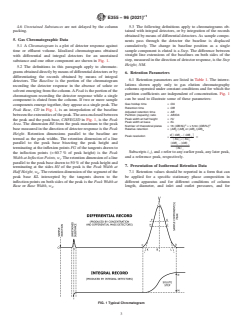
packing. tained with integral detectors, or by integration of the records
obtained by means of differential detectors.As sample compo-
5. Gas Chromatographic Data
nents pass through the detector the baseline is displaced
cumulatively. The change in baseline position as a single
5.1 A Chromatogram is a plot of detector response against
sample component is eluted is a Step. The difference between
time or effluent volume. Idealized chromatograms obtained
straight line extensions of the baselines on both sides of the
with differential and integral detectors for an unretained
step, measured in the direction of detector response, is the Step
substance and one other component are shown in Fig. 1.
Height, NM.
5.2 The definitions in this paragraph apply to chromato-
gramsobtaineddirectlybymeansofdifferentialdetectorsorby
6. Retention Parameters
differentiating the records obtained by means of integral
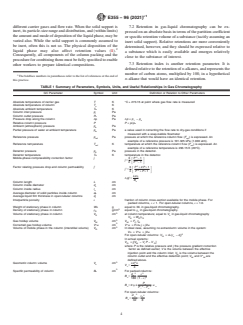
6.1 Retention parameters are listed in Table 1. The interre-
detectors. The Baseline is the portion of the chromatogram
lations shown apply only to gas elution chromatography
recording the detector response in the absence of solute or
columns operated under constant conditions and for which the
solvent emerging from the column.APeak is the portion of the
partition coefficients are independent of concentration. Fig. 1
c
...