

ASTM D3300-20
(Test Method)Standard Test Method for Dielectric Breakdown Voltage of Insulating Liquids Under Impulse Conditions
General Information
- Abstract
SIGNIFICANCE AND USE
3.1 This test method is most commonly performed using a negative polarity needle or a sharp defined point to an opposing grounded sphere (NPS). The NPS breakdown voltage of fresh unused liquids measured in the highly divergent field in this configuration depends on the insulating liquid composition, decreasing with increasing concentration of aromatic, particularly polyaromatic, hydrocarbon molecules in liquids of petroleum origin and decreasing with ester molecular structure, either natural or synthetic.
3.2 This test method may be used to evaluate the continuity of composition of an insulating liquid from shipment to shipment. The NPS impulse breakdown voltage of an insulating liquid can also be substantially lowered by contact with materials of construction, by service aging, particulate matter, and by other impurities. Test results lower than those expected for a given fresh liquid may also indicate use or contamination.
3.3 Although polarity of the voltage wave has little or no effect on the breakdown strength of an insulating liquid in uniform fields, polarity does have a marked effect on the breakdown voltage in nonuniform electric fields.
3.4 Transient voltages may also vary over a wide range in both the time to reach crest value and the time to decay to half crest or to zero magnitude. The IEEE standard lightning impulse test (see 2.2) specifies a 1.2 by 50-μs negative polarity wave.
SCOPE
1.1 This test method covers the determination of the dielectric breakdown voltage of insulating liquids in a highly divergent field under impulse conditions and has been found applicable to liquids of petroleum origin, natural and synthetic esters.
1.2 The values stated in inch-pound units are to be regarded as standard. The values given in parentheses are mathematical conversions to SI units that are provided for information only and are not considered standard.
1.3 This standard does not purport to address all of the safety concerns, if any, associated with its use. It is the responsibility of the user of this standard to establish appropriate safety, health, and environmental practices and determine the applicability of regulatory limitations prior to use.
1.4 This international standard was developed in accordance with internationally recognized principles on standardization established in the Decision on Principles for the Development of International Standards, Guides and Recommendations issued by the World Trade Organization Technical Barriers to Trade (TBT) Committee.
- Status
- Published
- Publication Date
- 31-Oct-2020
- Technical Committee
- D27 - Electrical Insulating Liquids and Gases
- Drafting Committee
- D27.05 - Electrical Test
Buy Documents

ASTM D3300-20 - Standard Test Method for Dielectric Breakdown Voltage of Insulating Liquids Under Impulse Conditions
REDLINE ASTM D3300-20 - Standard Test Method for Dielectric Breakdown Voltage of Insulating Liquids Under Impulse Conditions
Overview
ASTM D3300-20 is the Standard Test Method for Dielectric Breakdown Voltage of Insulating Liquids Under Impulse Conditions. Developed by ASTM International, this standard specifies procedures for determining the dielectric breakdown voltage of electrical insulating liquids-such as those of petroleum origin, natural esters, and synthetic esters-when subjected to impulse voltages in highly divergent fields. Accurate assessment of breakdown voltage under these conditions is crucial for ensuring the quality, reliability, and safety of insulating liquids used in high-voltage electrical equipment.
This method utilizes a negative polarity needle or point-to-sphere electrode configuration, with results influenced by the composition and purity of the insulating liquid. Changes in the measured breakdown voltage can indicate variations in chemical composition, contamination, service aging, or the presence of impurities.
Key Topics
- Dielectric Breakdown Voltage: The main focus is on measuring the highest voltage an insulating liquid can withstand before electrical breakdown occurs under an impulse wave, which is representative of real-world surges.
- Impulse Conditions: Testing is conducted using standardized impulse waves, such as the IEEE-recommended 1.2 by 50-microsecond negative polarity wave, to simulate lightning or switching surges.
- Sample Evaluation: The test helps evaluate consistency and purity of insulating liquids across different shipments, and detect contamination or deterioration.
- Electrode Configuration: Point-to-sphere electrode arrangement is specified, with particular care required for electrode preparation and test cell setup to ensure reliable and repeatable results.
- Statistical Analysis: Results from repeated breakdown tests are statistically analyzed to verify consistency, using calculated means and standard deviations, with defined acceptance criteria.
Applications
The ASTM D3300-20 standard is widely used in the electrical power and equipment manufacturing sectors to:
- Quality Control: Verify that new or in-service insulating liquids meet required dielectric performance levels before being installed in transformers, switchgear, capacitors, and similar high-voltage apparatus.
- Shipment Verification: Check the continuity and quality of insulating liquids in bulk shipments to ensure no contamination or significant composition change has occurred during transport.
- Contamination Detection: Identify contamination from particulates, moisture, construction materials, or aged oil, which can significantly lower breakdown voltage and compromise equipment safety.
- Research & Development: Evaluate the impact of liquid composition, such as aromatic content or ester structure, on dielectric strength, supporting the development of advanced, high-performance insulating fluids.
Proper dielectric testing in accordance with ASTM D3300-20 can help prevent costly failures and extend the operational life of electrical equipment by ensuring insulating liquids provide adequate protection under impulse voltage stress.
Related Standards
Organizations and professionals using ASTM D3300-20 for dielectric breakdown voltage testing of insulating liquids may also refer to:
- ASTM D923 - Practices for Sampling Electrical Insulating Liquids
- ASTM D2864 - Terminology Relating to Electrical Insulating Liquids and Gases
- IEEE Standard 4 - Techniques for High-Voltage Testing (referenced for impulse wave methods)
- Other relevant ASTM and IEEE standards covering sampling, handling, and further electrical properties of insulating liquids
Complying with ASTM D3300-20 and related standards helps electrical and power industry practitioners maintain safety, equipment integrity, and regulatory compliance, while supporting global best practices in dielectric testing of insulating fluids.
Relations
- Effective Date
- 01-Dec-2023
- Effective Date
- 01-Mar-2017
- Effective Date
- 01-Feb-2017
- Effective Date
- 01-Oct-2015
- Effective Date
- 15-May-2010
- Effective Date
- 15-May-2010
- Effective Date
- 01-Jan-2009
- Effective Date
- 15-Jul-2007
- Effective Date
- 01-Jul-2007
- Effective Date
- 15-Jun-2006
- Effective Date
- 10-Jun-2002
- Effective Date
- 10-Jun-2002
- Effective Date
- 10-Oct-1997
Buy Documents
ASTM D3300-20 - Standard Test Method for Dielectric Breakdown Voltage of Insulating Liquids Under Impulse Conditions
REDLINE ASTM D3300-20 - Standard Test Method for Dielectric Breakdown Voltage of Insulating Liquids Under Impulse Conditions
Get Certified
Connect with accredited certification bodies for this standard

IMQ S.p.A. (Certification)
Italian electrical product certification.

SLG Prüf- und Zertifizierungs GmbH
German testing and certification body.

UL Solutions
Global safety science company with testing, inspection and certification.
Sponsored listings
Frequently Asked Questions
ASTM D3300-20 is a standard published by ASTM International. Its full title is "Standard Test Method for Dielectric Breakdown Voltage of Insulating Liquids Under Impulse Conditions". This standard covers: SIGNIFICANCE AND USE 3.1 This test method is most commonly performed using a negative polarity needle or a sharp defined point to an opposing grounded sphere (NPS). The NPS breakdown voltage of fresh unused liquids measured in the highly divergent field in this configuration depends on the insulating liquid composition, decreasing with increasing concentration of aromatic, particularly polyaromatic, hydrocarbon molecules in liquids of petroleum origin and decreasing with ester molecular structure, either natural or synthetic. 3.2 This test method may be used to evaluate the continuity of composition of an insulating liquid from shipment to shipment. The NPS impulse breakdown voltage of an insulating liquid can also be substantially lowered by contact with materials of construction, by service aging, particulate matter, and by other impurities. Test results lower than those expected for a given fresh liquid may also indicate use or contamination. 3.3 Although polarity of the voltage wave has little or no effect on the breakdown strength of an insulating liquid in uniform fields, polarity does have a marked effect on the breakdown voltage in nonuniform electric fields. 3.4 Transient voltages may also vary over a wide range in both the time to reach crest value and the time to decay to half crest or to zero magnitude. The IEEE standard lightning impulse test (see 2.2) specifies a 1.2 by 50-μs negative polarity wave. SCOPE 1.1 This test method covers the determination of the dielectric breakdown voltage of insulating liquids in a highly divergent field under impulse conditions and has been found applicable to liquids of petroleum origin, natural and synthetic esters. 1.2 The values stated in inch-pound units are to be regarded as standard. The values given in parentheses are mathematical conversions to SI units that are provided for information only and are not considered standard. 1.3 This standard does not purport to address all of the safety concerns, if any, associated with its use. It is the responsibility of the user of this standard to establish appropriate safety, health, and environmental practices and determine the applicability of regulatory limitations prior to use. 1.4 This international standard was developed in accordance with internationally recognized principles on standardization established in the Decision on Principles for the Development of International Standards, Guides and Recommendations issued by the World Trade Organization Technical Barriers to Trade (TBT) Committee.
SIGNIFICANCE AND USE 3.1 This test method is most commonly performed using a negative polarity needle or a sharp defined point to an opposing grounded sphere (NPS). The NPS breakdown voltage of fresh unused liquids measured in the highly divergent field in this configuration depends on the insulating liquid composition, decreasing with increasing concentration of aromatic, particularly polyaromatic, hydrocarbon molecules in liquids of petroleum origin and decreasing with ester molecular structure, either natural or synthetic. 3.2 This test method may be used to evaluate the continuity of composition of an insulating liquid from shipment to shipment. The NPS impulse breakdown voltage of an insulating liquid can also be substantially lowered by contact with materials of construction, by service aging, particulate matter, and by other impurities. Test results lower than those expected for a given fresh liquid may also indicate use or contamination. 3.3 Although polarity of the voltage wave has little or no effect on the breakdown strength of an insulating liquid in uniform fields, polarity does have a marked effect on the breakdown voltage in nonuniform electric fields. 3.4 Transient voltages may also vary over a wide range in both the time to reach crest value and the time to decay to half crest or to zero magnitude. The IEEE standard lightning impulse test (see 2.2) specifies a 1.2 by 50-μs negative polarity wave. SCOPE 1.1 This test method covers the determination of the dielectric breakdown voltage of insulating liquids in a highly divergent field under impulse conditions and has been found applicable to liquids of petroleum origin, natural and synthetic esters. 1.2 The values stated in inch-pound units are to be regarded as standard. The values given in parentheses are mathematical conversions to SI units that are provided for information only and are not considered standard. 1.3 This standard does not purport to address all of the safety concerns, if any, associated with its use. It is the responsibility of the user of this standard to establish appropriate safety, health, and environmental practices and determine the applicability of regulatory limitations prior to use. 1.4 This international standard was developed in accordance with internationally recognized principles on standardization established in the Decision on Principles for the Development of International Standards, Guides and Recommendations issued by the World Trade Organization Technical Barriers to Trade (TBT) Committee.
ASTM D3300-20 is classified under the following ICS (International Classification for Standards) categories: 29.040.10 - Insulating oils. The ICS classification helps identify the subject area and facilitates finding related standards.
ASTM D3300-20 has the following relationships with other standards: It is inter standard links to ASTM D923-15(2023), ASTM D2864-17a, ASTM D2864-17, ASTM D923-15, ASTM D2864-10e1, ASTM D2864-10, ASTM D2864-09, ASTM D923-07, ASTM D2864-07, ASTM D2864-06, ASTM D2864-00a, ASTM D2864-02, ASTM D923-97. Understanding these relationships helps ensure you are using the most current and applicable version of the standard.
ASTM D3300-20 is available in PDF format for immediate download after purchase. The document can be added to your cart and obtained through the secure checkout process. Digital delivery ensures instant access to the complete standard document.
Standards Content (Sample)
This international standard was developed in accordance with internationally recognized principles on standardization established in the Decision on Principles for the
Development of International Standards, Guides and Recommendations issued by the World Trade Organization Technical Barriers to Trade (TBT) Committee.
Designation: D3300 − 20
Standard Test Method for
Dielectric Breakdown Voltage of Insulating Liquids Under
Impulse Conditions
This standard is issued under the fixed designation D3300; the number immediately following the designation indicates the year of
original adoption or, in the case of revision, the year of last revision. A number in parentheses indicates the year of last reapproval. A
superscript epsilon (´) indicates an editorial change since the last revision or reapproval.
1. Scope 3. Significance and Use
1.1 This test method covers the determination of the dielec-
3.1 This test method is most commonly performed using a
tric breakdown voltage of insulating liquids in a highly
negativepolarityneedleorasharpdefinedpointtoanopposing
divergent field under impulse conditions and has been found
grounded sphere (NPS). The NPS breakdown voltage of fresh
applicable to liquids of petroleum origin, natural and synthetic
unused liquids measured in the highly divergent field in this
esters.
configuration depends on the insulating liquid composition,
decreasing with increasing concentration of aromatic, particu-
1.2 The values stated in inch-pound units are to be regarded
larly polyaromatic, hydrocarbon molecules in liquids of petro-
as standard. The values given in parentheses are mathematical
leum origin and decreasing with ester molecular structure,
conversions to SI units that are provided for information only
either natural or synthetic.
and are not considered standard.
3.2 This test method may be used to evaluate the continuity
1.3 This standard does not purport to address all of the
of composition of an insulating liquid from shipment to
safety concerns, if any, associated with its use. It is the
shipment. The NPS impulse breakdown voltage of an insulat-
responsibility of the user of this standard to establish appro-
ing liquid can also be substantially lowered by contact with
priate safety, health, and environmental practices and deter-
materials of construction, by service aging, particulate matter,
mine the applicability of regulatory limitations prior to use.
and by other impurities. Test results lower than those expected
1.4 This international standard was developed in accor-
for a given fresh liquid may also indicate use or contamination.
dance with internationally recognized principles on standard-
ization established in the Decision on Principles for the
3.3 Although polarity of the voltage wave has little or no
Development of International Standards, Guides and Recom-
effect on the breakdown strength of an insulating liquid in
mendations issued by the World Trade Organization Technical
uniform fields, polarity does have a marked effect on the
Barriers to Trade (TBT) Committee.
breakdown voltage in nonuniform electric fields.
3.4 Transient voltages may also vary over a wide range in
2. Referenced Documents
both the time to reach crest value and the time to decay to half
2.1 ASTM Standards:
crest or to zero magnitude. The IEEE standard lightning
D923 Practices for Sampling Electrical Insulating Liquids
impulse test (see 2.2) specifies a 1.2 by 50-µs negative polarity
D2864 Terminology Relating to Electrical Insulating Liq-
wave.
uids and Gases
2.2 IEEE Documents:
4. Apparatus
IEEE Standard 4-1995 Techniques for High-Voltage Test-
4.1 Impulse Generator, capable of producing a standard 1.2
ing
by 50-µs full wave adjustable to positive or negative polarity.
The generator shall have a nominal voltage rating of at least
1 300 kV adjustable in 10-kV steps. Generators having a
This test method is under the jurisdiction of ASTM Committee D27 on
Electrical Insulating Liquids and Gases and is the direct responsibility of Subcom- capability of 1000 W·s (1000 J) at 300 kV have been found
mittee D27.05 on Electrical Test.
satisfactory.
Current edition approved Nov. 1, 2020. Published November 2020. Originally
approved in 1974. Last previous edition approved in 2012 as D3300 – 12. DOI:
4.2 Voltage-Control Equipment—The controls shall include
10.1520/D3300-20.
a suitable measuring device for predetermining the crest
For referenced ASTM standards, visit the ASTM website, www.astm.org, or
voltage to within 65 %.Avoltage stabilizer is desirable at the
contact ASTM Customer Service at service@astm.org. For Annual Book of ASTM
input to the d-c power supply used for charging the impulse-
Standards volume information, refer to the standard’s Document Summary page on
the ASTM website.
generator capacitors.
Available from the Institute of Electrical and Electronics Engineers, 445 Hoes
Lane, Piscataway, NJ 08855-1331. 4.3 Electrodes:
Copyright © ASTM International, 100 Barr Harbor Drive, PO Box C700, West Conshohocken, PA 19428-2959. United States
D3300 − 20
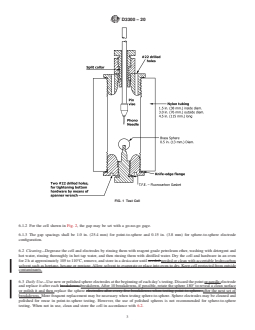
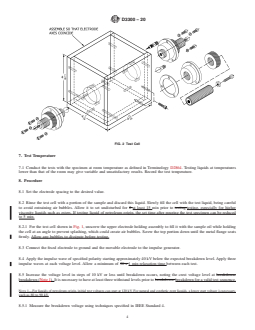
4.3.1 Theelectrodesshallconsistofapolishedsteelorbrass ortestliquidsused.TestcellssuchasthoseshowninFig.1and
sphere of 0.5 in. (12.7 mm) diameter and a steel point. The Fig. 2 have been found satisfactory.
point may be an ordinary steel phonograph needle with a 0.06 4.4.2 The sphere electrode shall be rigidly fixed and the
mm 6 20 % radius of curvature of point. Needles with drawn point electrode mounted such that the gap may be adjusted
tips are not recommended. from zero to the required value.
4.3.2 The effect of variation in the radius of curvature of
5. Sampling
point is subject to further investigation. Both electrodes shall
be easily replaceable.
5.1 Obtain a sample of the insulating liquid to be tested
using appropriate ASTM sampling apparatus in accordance
4.4 Test Cell:
with Practices D923.
4.4.1 The test cell shall be made of a material of high
dielectric strength and of such dimensions that the electrical
6. Adjustments and Care of Electrodes and Test Cell
breakdown is restricted to the electrode gap.Test cell materials
shall resist attack by, and be insoluble in, any of the cleaning
6.1 Electrode Spacing:
6.1.1 For the cell shown in Fig. 1, reduce the electrode gap
to zero spacing. Proceed very carefully to avoid damaging the
The following steel needle has been found satisfactory for this method: Type L
point.Thepointofcontactshallbeestablishedelectricallywith
Nickel Plated Steel Phonograph Needle.
anohmmeter.Openthegaptothespecifiedspacingusingadial
The sole source of supply of the apparatus known to the committee at this time
is Victrola Repair Service, 206 Cliff St., St. Johnsbury, VT, 05819. If you are aware micrometer or other suitable method.
of alternative suppliers, please provide this information to ASTM International
6.1.2 For the cell shown in Fig. 2, the gap may be set with
Headquarters.Your comments will receive careful consideration at a meeting of the
1 a go-no-go gage.
responsible technical committee, which you may attend.
FIG. 1 Test Cell
D3300 − 20
FIG. 2 Test Cell
6.1.3 The gap spacings shall be 1.0 in. (25.4 mm) for 8.2 Rinse the test cell with a portion of the sample and
point-to-sphere and 0.15 in. (3.8 mm) for sphere-to-sphere discardthisliquid.Slowlyfillthecellwiththetestliquid,being
electrode configuration. careful to avoid entraining air bubbles. Allow it to set undis-
turbed for at least 15 min prior to testing, especially for higher
6.2 Cleaning—Degrease the cell and electrodes by rinsing
viscosity liquids such as esters. If testing liquid of petroleum
them with reagent grade petroleum ether, washing with deter-
origin, the set
...
This document is not an ASTM standard and is intended only to provide the user of an ASTM standard an indication of what changes have been made to the previous version. Because
it may not be technically possible to adequately depict all changes accurately, ASTM recommends that users consult prior editions as appropriate. In all cases only the current version
of the standard as published by ASTM is to be considered the official document.
Designation: D3300 − 12 D3300 − 20
Standard Test Method for
Dielectric Breakdown Voltage of Insulating Oils of
Petroleum Origin Liquids Under Impulse Conditions
This standard is issued under the fixed designation D3300; the number immediately following the designation indicates the year of
original adoption or, in the case of revision, the year of last revision. A number in parentheses indicates the year of last reapproval. A
superscript epsilon (´) indicates an editorial change since the last revision or reapproval.
1. Scope
1.1 This test method covers the determination of the dielectric breakdown voltage of insulating oilsliquids in a highly divergent
field under impulse conditions.conditions and has been found applicable to liquids of petroleum origin, natural and synthetic esters.
1.2 The values stated in inch-pound units are to be regarded as standard. The values given in parentheses are mathematical
conversions to SI units that are provided for information only and are not considered standard.
1.3 This standard does not purport to address all of the safety concerns, if any, associated with its use. It is the responsibility
of the user of this standard to establish appropriate safety safety, health, and healthenvironmental practices and determine the
applicability of regulatory limitations prior to use.
1.4 This international standard was developed in accordance with internationally recognized principles on standardization
established in the Decision on Principles for the Development of International Standards, Guides and Recommendations issued
by the World Trade Organization Technical Barriers to Trade (TBT) Committee.
2. Referenced Documents
2.1 ASTM Standards:
D923 Practices for Sampling Electrical Insulating Liquids
D2864 Terminology Relating to Electrical Insulating Liquids and Gases
2.2 IEEE Documents:
IEEE Standard 4-1995 Techniques for High-Voltage Testing
3. Significance and Use
3.1 This test method is most commonly performed using a negative polarity point opposing a needle or a sharp defined point to
an opposing grounded sphere (NPS). The NPS breakdown voltage of fresh unused oilsliquids measured in the highly divergent
field in this configuration depends on oil the insulating liquid composition, decreasing with increasing concentration of aromatic,
particularly polyaromatic, hydrocarbon molecules.molecules in liquids of petroleum origin and decreasing with ester molecular
structure, either natural or synthetic.
This test method is under the jurisdiction of ASTM Committee D27 on Electrical Insulating Liquids and Gases and is the direct responsibility of Subcommittee D27.05
on Electrical Test.
Current edition approved Jan. 1, 2012Nov. 1, 2020. Published January 2012November 2020. Originally approved in 1974. Last previous edition approved in 20062012
as D3300 – 00D3300 – 12.(2006). DOI: 10.1520/D3300-12.10.1520/D3300-20.
For referenced ASTM standards, visit the ASTM website, www.astm.org, or contact ASTM Customer Service at service@astm.org. For Annual Book of ASTM Standards
volume information, refer to the standard’s Document Summary page on the ASTM website.
Available from the Institute of Electrical and Electronics Engineers, 445 Hoes Lane, Piscataway, NJ 08855-1331.
Copyright © ASTM International, 100 Barr Harbor Drive, PO Box C700, West Conshohocken, PA 19428-2959. United States
D3300 − 20
3.2 This test method may be used to evaluate the continuity of composition of an oil insulating liquid from shipment to shipment.
The NPS impulse breakdown voltage of an oil insulating liquid can also be substantially lowered by contact with materials of
construction, by service aging, particulate matter, and by other impurities. Test results lower than those expected for a given fresh
oilliquid may also indicate use or contamination of that oil.contamination.
3.3 Although polarity of the voltage wave has little or no effect on the breakdown strength of an oil insulating liquid in uniform
fields, polarity does have a marked effect on the breakdown voltage of an oil in nonuniform electric fields.
3.4 Transient voltages may also vary over a wide range in both the time to reach crest value and the time to decay to half crest
or to zero magnitude. The IEEE standard lightning impulse test (see 2.2) specifies a 1.2 by 50-μs negative polarity wave.
4. Apparatus
4.1 Impulse Generator, capable of producing a standard 1.2 by 50-μs full wave adjustable to positive or negative polarity. The
generator shall have a nominal voltage rating of at least 300 kV adjustable in 10-kV steps. Generators having a capability of 1000
W·s (1000 J) at 300 kV have been found satisfactory.
4.2 Voltage-Control Equipment—The controls shall include a suitable measuring device for predetermining the crest voltage to
within 65 %. A voltage stabilizer is desirable at the input to the d-c power supply used for charging the impulse-generator
capacitors.
4.3 Electrodes:
4.3.1 The electrodes shall consist of a polished steel or brass sphere of 0.5 in. (12.7 mm) diameter and a steel point. The point
may be an ordinary steel phonograph needle with a 0.06 mm 6 20 % radius of curvature of point. Needles with drawn tips are
not recommended.
4.3.2 The effect of variation in the radius of curvature of point is subject to further investigation. Both electrodes shall be easily
replaceable.
4.4 Test Cell:
4.4.1 The test cell shall be made of a material of high dielectric strength and of such dimensions that the electrical breakdown is
restricted to the electrode gap. Test cell materials shall resist attack by, and be insoluble in, any of the cleaning or test liquids used.
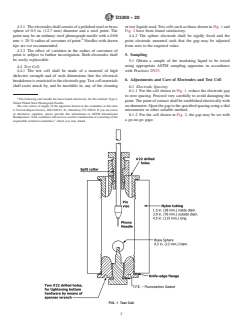
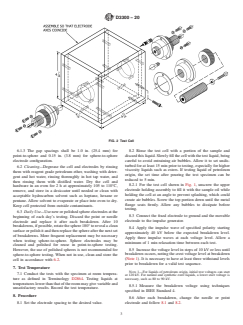
Test cells such as those shown in Fig. 1 and Fig. 2 have been found satisfactory.
4.4.2 The sphere electrode shall be rigidly fixed and the point electrode mounted such that the gap may be adjusted from zero to
the required value.
5. Sampling
5.1 Obtain a sample of the insulating liquid to be tested using appropriate ASTM sampling apparatus in accordance with Practices
D923.
6. Adjustments and Care of Electrodes and Test Cell
6.1 Electrode Spacing:
6.1.1 For the cell shown in Fig. 1, reduce the electrode gap to zero spacing. Proceed very carefully to avoid damaging the point.
The point of contact shall be established electrically with an ohmmeter. Open the gap to the specified spacing using a dial
micrometer or other suitable method.
The following steel needle has been found satisfactory for this method: Type L Nickel Plated Steel Phonograph Needle.
The sole source of supply of the apparatus known to the committee at this time is Victrola Repair Service, 206 Cliff St., St. Johnsbury, VT, 05819. If you are aware of
alternative suppliers, please provide this information to ASTM International Headquarters. Your comments will receive careful consideration at a meeting of the responsible
technical committee, which you may attend.
D3300 − 20
FIG. 1 Test Cell
6.1.2 For the cell shown in Fig. 2, the gap may be set with a go-no-go gage.
6.1.3 The gap spacings shall be 1.0 in. (25.4 mm) for point-to-sphere and 0.15 in. (3.8 mm) for sphere-to-sphere electrode
configuration.
6.2 Cleaning—Degrease the cell and electrodes by rinsing them with reagent grade petroleum ether, washing with detergent and
hot water, rinsing thoroughly in hot tap water, and then rinsing them with distilled water. Dry the cell and hardware in an oven
for 2 h at approximately 105 to 110°C, remove, and store in a desiccator until needed.needed or clean with acceptable hydrocarbon
solvent such as heptane, hexane or pentane. Allow solvent to evaporate or place into oven to dry. Keep cell protected from outside
...