

ASTM D4890-18
(Test Method)Standard Test Methods for Polyurethane Raw Materials: Determination of Gardner and APHA Color of Polyols
General Information
- Abstract
SIGNIFICANCE AND USE
5.1 These test methods are suitable for quality control, as specification tests, and for research. Color is an important property of urethane products.
SCOPE
1.1 These test methods measure visually the color of clear polyester and polyether liquids. They apply only to materials whose colors have light-absorption characteristics similar to those of the standards. An alternative method is Test Method D1209 (see Note 1).
1.2 Units—The values stated in SI units are to be regarded as standard. No other units of measurement are included in this standard.
1.3 This standard does not purport to address all of the safety concerns, if any, associated with its use. It is the responsibility of the user of this standard to establish appropriate safety and health practices and determine the applicability of regulatory limitations prior to use.
Note 1: Test Method A of this standard is equivalent to ISO 6271-1. Test Method B of this standard is equivalent to ISO 4630-1.
1.4 This international standard was developed in accordance with internationally recognized principles on standardization established in the Decision on Principles for the Development of International Standards, Guides and Recommendations issued by the World Trade Organization Technical Barriers to Trade (TBT) Committee.
- Status
- Published
- Publication Date
- 31-Jul-2018
- Technical Committee
- D20 - Plastics
- Drafting Committee
- D20.22 - Cellular Materials - Plastics and Elastomers
Buy Documents
ASTM D4890-18 - Standard Test Methods for Polyurethane Raw Materials: Determination of Gardner and APHA Color of Polyols
REDLINE ASTM D4890-18 - Standard Test Methods for Polyurethane Raw Materials: Determination of Gardner and APHA Color of Polyols
Overview
ASTM D4890-18 is an international standard that specifies test methods for visually determining the color of clear polyester and polyether polyols, which are raw materials used in polyurethane production. The standard covers two primary color determination methods: the Gardner color scale and the APHA (also known as the Pt-Co or platinum-cobalt) color scale. These test methods are widely used in quality control, specification tests, and research, as color is a critical property influencing the performance and quality of urethane products.
This standard is developed and maintained by ASTM International and aligns with globally recognized principles on standardization. It applies specifically to materials whose colors have light-absorption characteristics similar to the provided standards.
Key Topics
Test Methods
- Gardner Color Method (Method A): Compares the polyol sample visually to a series of Gardner color standards using glass tubes.
- APHA Color Method (Method B): Compares the polyol sample to platinum-cobalt color standards using Nessler tubes.
Applicability
- Focuses on clear polyester and polyether liquids.
- Methods are most accurate for samples with color properties similar to the reference standards.
Units of Measurement
- All values are reported in SI units.
Precision and Reliability
- Repeatability and reproducibility are established through interlaboratory studies.
- Test procedures incorporate practices to minimize subjective variation.
Safety and Handling
- Users must establish appropriate safety procedures and confirm regulatory compliance.
Applications
ASTM D4890-18 is essential in the plastics and polyurethane industry for the following reasons:
Quality Control:
Ensuring that polyols used in manufacturing polyurethane products meet specified color standards, which can influence product aesthetics and performance.Product Specification:
Enables manufacturers and customers to reference objective color values when specifying raw material requirements in procurement and product development.Research and Development:
Facilitates the evaluation of formulation changes, raw material sources, and processing effects on the color of polyols.Regulatory Compliance and Reporting:
Provides verified and reproducible methods for reporting polyol color in regulatory and technical documentation.
Related Standards
The testing approach and terminology in ASTM D4890-18 are closely related to several other international and ASTM standards, including:
- ASTM D883: Terminology Relating to Plastics
- ASTM D1193: Specification for Reagent Water
- ASTM D1209: Test Method for Color of Clear Liquids (Platinum-Cobalt Scale)
- ASTM D5386: Test Method for Color of Liquids Using Tristimulus Colorimetry
- ASTM D6166: Test Method for Instrumental Determination of Gardner Color
- ASTM E177: Use of the Terms Precision and Bias in ASTM Test Methods
- ASTM E308: Computing the Colors of Objects by Using the CIE System
- ASTM E691: Conducting Interlaboratory Study to Determine the Precision of a Test Method
- ISO 4630-1/2: Estimation of Colour by the Gardner Colour Scale (Visual and Spectroscopic Methods)
- ISO 6271-1/2: Estimation of Colour by the Platinum-Cobalt Scale (Visual and Spectroscopic Methods)
Keywords: polyurethane raw materials, polyols, Gardner color, APHA color, platinum-cobalt scale, color determination, quality control, ASTM D4890, visual color measurement, clear liquids.
By following ASTM D4890-18, manufacturers and laboratories can achieve consistent, reproducible, and internationally recognized results for polyol color assessment, supporting product quality and compliance throughout the supply chain.
Relations
- Effective Date
- 01-Feb-2024
- Effective Date
- 01-Nov-2023
- Refers
ASTM E1164-23 - Standard Practice for Obtaining Spectrometric Data for Object-Color Evaluation - Effective Date
- 01-Nov-2023
- Effective Date
- 01-Jan-2020
- Effective Date
- 01-Aug-2019
- Effective Date
- 15-Apr-2019
- Effective Date
- 01-Feb-2019
- Effective Date
- 01-Dec-2018
- Effective Date
- 01-Nov-2018
- Effective Date
- 15-Aug-2017
- Effective Date
- 01-May-2017
- Effective Date
- 01-Apr-2015
- Effective Date
- 01-May-2014
- Effective Date
- 01-May-2013
- Effective Date
- 01-May-2013
Buy Documents
ASTM D4890-18 - Standard Test Methods for Polyurethane Raw Materials: Determination of Gardner and APHA Color of Polyols
REDLINE ASTM D4890-18 - Standard Test Methods for Polyurethane Raw Materials: Determination of Gardner and APHA Color of Polyols
Get Certified
Connect with accredited certification bodies for this standard

DIN CERTCO
DIN Group product certification.

Smithers Quality Assessments
US management systems and product certification.
Sponsored listings
Frequently Asked Questions
ASTM D4890-18 is a standard published by ASTM International. Its full title is "Standard Test Methods for Polyurethane Raw Materials: Determination of Gardner and APHA Color of Polyols". This standard covers: SIGNIFICANCE AND USE 5.1 These test methods are suitable for quality control, as specification tests, and for research. Color is an important property of urethane products. SCOPE 1.1 These test methods measure visually the color of clear polyester and polyether liquids. They apply only to materials whose colors have light-absorption characteristics similar to those of the standards. An alternative method is Test Method D1209 (see Note 1). 1.2 Units—The values stated in SI units are to be regarded as standard. No other units of measurement are included in this standard. 1.3 This standard does not purport to address all of the safety concerns, if any, associated with its use. It is the responsibility of the user of this standard to establish appropriate safety and health practices and determine the applicability of regulatory limitations prior to use. Note 1: Test Method A of this standard is equivalent to ISO 6271-1. Test Method B of this standard is equivalent to ISO 4630-1. 1.4 This international standard was developed in accordance with internationally recognized principles on standardization established in the Decision on Principles for the Development of International Standards, Guides and Recommendations issued by the World Trade Organization Technical Barriers to Trade (TBT) Committee.
SIGNIFICANCE AND USE 5.1 These test methods are suitable for quality control, as specification tests, and for research. Color is an important property of urethane products. SCOPE 1.1 These test methods measure visually the color of clear polyester and polyether liquids. They apply only to materials whose colors have light-absorption characteristics similar to those of the standards. An alternative method is Test Method D1209 (see Note 1). 1.2 Units—The values stated in SI units are to be regarded as standard. No other units of measurement are included in this standard. 1.3 This standard does not purport to address all of the safety concerns, if any, associated with its use. It is the responsibility of the user of this standard to establish appropriate safety and health practices and determine the applicability of regulatory limitations prior to use. Note 1: Test Method A of this standard is equivalent to ISO 6271-1. Test Method B of this standard is equivalent to ISO 4630-1. 1.4 This international standard was developed in accordance with internationally recognized principles on standardization established in the Decision on Principles for the Development of International Standards, Guides and Recommendations issued by the World Trade Organization Technical Barriers to Trade (TBT) Committee.
ASTM D4890-18 is classified under the following ICS (International Classification for Standards) categories: 83.040.30 - Auxiliary materials and additives for plastics; 83.080.20 - Thermoplastic materials. The ICS classification helps identify the subject area and facilitates finding related standards.
ASTM D4890-18 has the following relationships with other standards: It is inter standard links to ASTM D883-24, ASTM D883-23, ASTM E1164-23, ASTM D883-20, ASTM D883-19c, ASTM D883-19a, ASTM D883-19, ASTM D883-18a, ASTM D883-18, ASTM D883-17, ASTM E308-17, ASTM E308-15, ASTM E177-14, ASTM E177-13, ASTM E691-13. Understanding these relationships helps ensure you are using the most current and applicable version of the standard.
ASTM D4890-18 is available in PDF format for immediate download after purchase. The document can be added to your cart and obtained through the secure checkout process. Digital delivery ensures instant access to the complete standard document.
Standards Content (Sample)
This international standard was developed in accordance with internationally recognized principles on standardization established in the Decision on Principles for the
Development of International Standards, Guides and Recommendations issued by the World Trade Organization Technical Barriers to Trade (TBT) Committee.
Designation: D4890 − 18
Standard Test Methods for
Polyurethane Raw Materials: Determination of Gardner and
APHA Color of Polyols
This standard is issued under the fixed designation D4890; the number immediately following the designation indicates the year of
original adoption or, in the case of revision, the year of last revision. A number in parentheses indicates the year of last reapproval. A
superscript epsilon (´) indicates an editorial change since the last revision or reapproval.
1. Scope* D6166 Test Method for Color of Pine Chemicals and Re-
lated Products (Instrumental Determination of Gardner
1.1 These test methods measure visually the color of clear
Color)
polyester and polyether liquids. They apply only to materials
E177 Practice for Use of the Terms Precision and Bias in
whose colors have light-absorption characteristics similar to
ASTM Test Methods
those of the standards. An alternative method is Test Method
E308 Practice for Computing the Colors of Objects by Using
D1209 (see Note 1).
the CIE System
1.2 Units—The values stated in SI units are to be regarded
E691 Practice for Conducting an Interlaboratory Study to
as standard. No other units of measurement are included in this
Determine the Precision of a Test Method
standard.
E1164 Practice for Obtaining Spectrometric Data for Object-
1.3 This standard does not purport to address all of the
Color Evaluation
safety concerns, if any, associated with its use. It is the
2.2 ISO Standards:
responsibility of the user of this standard to establish appro-
ISO 4630-1 Clear Liquids—Estimation of Colour by the
priate safety, health, and environmental practices and deter-
Gardner Colour Scale—Part 1: Visual Method
mine the applicability of regulatory limitations prior to use.
ISO 4630-2 Clear Liquids—Estimation of Colour by the
Gardner Colour Scale—Part 2: Spectroscopic Method
NOTE 1—Test Method A of this standard is equivalent to ISO 6271-1.
ISO 6271-1 Clear Liquids—Estimation of Colour by the
Test Method B of this standard is equivalent to ISO 4630-1.
Platinum-Cobalt Scale—Part 1: Visual Method
1.4 This international standard was developed in accor-
ISO 6271-2 Clear Liquids—Estimation of Colour by the
dance with internationally recognized principles on standard-
Platinum-Cobalt Scale—Part 2: Spectroscopic Method
ization established in the Decision on Principles for the
Development of International Standards, Guides and Recom-
3. Terminology
mendations issued by the World Trade Organization Technical
3.1 For definitions of terms used in these test methods see
Barriers to Trade (TBT) Committee.
Terminology D883.
2. Referenced Documents
4. Summary of Test Method
2.1 ASTM Standards:
4.1 In Test Method A, the color of the material to be tested
D883 Terminology Relating to Plastics
is compared to a series of color standards with defined
D1193 Specification for Reagent Water
chromaticity coordinates, prepared in one of three ways. The
D1209 Test Method for Color of Clear Liquids (Platinum-
results are reported as the color standard, which best matches
Cobalt Scale)
the sample.
D5386 Test Method for Color of Liquids Using Tristimulus
4.2 In Test Method B, the color of the material to be tested
Colorimetry
is compared to a series of platinum-cobalt color standards,
designated by mg of Pt/mL of standard solution. The results are
reported as the color standard, which best matches the sample
These test methods are under the jurisdiction of Committee D20 on Plastics and
(see Note 2).
are the direct responsibility of Subcommittee D20.22 on Cellular Materials - Plastics
and Elastomers.
NOTE 2—Color of liquids are also measured by visible spectroscopy
Current edition approved Aug. 1, 2018. Published August 2018. Originally
and the results converted to any of several color scales. These results are
approved in 1988. Last previous edition approved in 2013 as D4890 - 13. DOI:
converted to the APHA scale by appropriate manipulations, as for example
10.1520/D4890-18.
For referenced ASTM standards, visit the ASTM website, www.astm.org, or
contact ASTM Customer Service at service@astm.org. For Annual Book of ASTM
Standards volume information, refer to the standard’s Document Summary page on Available from American National Standards Institute (ANSI), 25 W. 43rd St.,
the ASTM website. 4th Floor, New York, NY 10036, http://www.ansi.org.
*A Summary of Changes section appears at the end of this standard
Copyright © ASTM International, 100 Barr Harbor Drive, PO Box C700, West Conshohocken, PA 19428-2959. United States
D4890 − 18
in Test Method D5386 and ISO 6271-2. These results are converted to the
color equivalence to a freshly prepared solution containing 3 g
Gardner scale by appropriate manipulations, as for example in Test
of K Cr O in 100 mL of H SO (sp gr 1.84).
2 2 7 2 4
Method ISO 4630-2.
9.3 Hydrochloric Acid (1 to 17)—Mix 1 volume of concen-
5. Significance and Use
trated hydrochloric acid (HCl, sp gr 1.19) with 17 volumes of
water.
5.1 These test methods are suitable for quality control, as
specification tests, and for research. Color is an important
9.4 Hydrochloric Acid (0.1 N)—Prepare 0.1 N HCl.
property of urethane products.
9.5 Potassium Chloroplatinate (PtCl ).
6. Sampling
9.6 Potassium Dichromate (K Cr O ).
2 2 7
6.1 Polyesters and polyethers usually contain molecules
9.7 Sulfuric Acid (sp gr 1.84)—Concentrated sulfuric acid
covering an appreciable range of molecular weights. These
(H SO ).
2 4
have a tendency to fractionate during solidification. Unless the
10. Gardner Color Reference Standards
material is a liquid or finely ground solid it is necessary to melt
(using no higher temperature than necessary) and mix the resin 10.1 The primary standards for color shall consist of solu-
tions defined by their spectral transmittance in 1-cm cell with
well before removing a sample for analysis. Many polyols are
hygroscopic and care must be taken to provide minimum parallel sides. The chromaticity coordinates of these solutions
shall conform to those given in Table 1 when determined on a
exposure to atmospheric moisture during the sampling.
1-cm layer of the solution in accordance with Practice E1164
7. Purity of Reagents
and Test Methods E308 and D6166.
7.1 Purity of Reagents—Reagent-grade chemicals shall be
10.2 For comparison, permanent solutions of known color
used in all tests. Unless otherwise indicated, it is intended that
are more satisfactory. The approximate composition of solu-
all reagents shall conform to the specifications of the Commit-
tions giving each of the 18 Gardner colors is also given in
tee on Analytical Reagents of the American Chemical Society,
Table 1. The solutions shall be made from K PtCl in 0.1 N
2 6
where such specifications are available. Other grades are
HCl, or, in the darker colors, from stock solutions of FeCl ,
acceptable, provided it is first ascertained that the reagent is of
CoCl , and HCl (see 9.1, 9.2, and 9.3). Pre-prepared Gardner
sufficiently high purity to permit its use without reducing the
color standard solutions are commonly available for purchase.
accuracy of the determination.
10.3 If the solutions in 10.2 are unavailable, solutions of
7.2 Purity of Water—Unless otherwise indicated, references
K Cr O (sp gr 1.84) are used as reference standards. The
2 2 7
to water shall be understood to mean reagent water as defined
approximate composition of these standards is also given in
by Type IV or better of Specification D1193.
Table 1. Each solution must be freshly made for the color
comparison, using gentle heat, if necessary, to effect solution.
TEST METHOD A—GARDNER COLOR
10.4 Secondary reference standards are available in the
8. Apparatus
form of 18 colored glass disks, which are set into a pair of
larger, plastic disks and the latter mounted to rotate in a
8.1 Gardner-Holdt Tubes, of clear glass, with closed, flat,
housing for holding the sample tube and glass disk in close and
even bottoms, and having the following approximate dimen-
fixed proximity.
sions and markings:
8.1.1 A uniform internal length of 112 mm,
11. Procedure
8.1.2 A uniform internal diameter throughout the length of
11.1 Fill the tube with sample, free of solid particles or air
the tube of 10.75 mm, and
bubbles, so that the apparent upper edge of the liquid meniscus
8.1.3 An etched line around the outside of the tube 5 mm
is even with the lower etched line on the tube.
from the open end and a second etched line around the outside
of the tube 13 mm from the open end. 11.2 Determine the color by comparison with the reference
standard solutions prescribed in Table 1, by comparing the
9. Reagents
sample and the standard in Gardner-Holdt viscosity tubes as
described. Make the comparison at 25 6 5°C by placing tubes
9.1 Cobalt Chloride Solution—Prepare a solution contain-
close together and looking through them against a white
ing 1 part by weight of cobalt chloride (CoCl × 6H O) to 3
2 2
background or by comparison to the standards in a color disk.
parts of HCl (1 to 17).
9.2 Ferric Chloride Solution—Prepare a solution containing
12. Report
approximately 5 parts by weight of ferric chloride
12.1 Report the color of the sample in terms of the Gardner
(FeCl × 6H O) and 1.2 parts of HCl (1 to 17). Adjust to exact
3 2
standard number that is nearest to it in color. If the sample
Reagent Chemicals, American Chemical Society Specifications, American The sole source of supply of the glass color standards and color standard
Chemical Society, Washington, DC. For suggestions on the testing of reagents not solutions known to the committee at this time is BYK-Gardner USA, 9104 Guilford
listed by the American Chemical Society, see Analar Standards for Laboratory Road, Columbia, MD 21046. If you are aware of alternative suppliers, please
Chemicals, BDH Ltd., Poole, Dorset, U.K., and the United States Pharmacopeia provide this information to ASTM International Headquarters. Your comments will
and National Formulary, U.S. Pharmacopeial Convention, Inc. (USPC), Rockville, receive careful consideration at a meeting of the responsible technical committee,
MD. which you may attend.
D4890 − 18
TABLE 1 Gardner Reference Standard Color Solutions
A
Potassium
Chromaticity Coordinates Iron-Cobalt Solutions
Potassium
Gardner Color Standard Chloroplatinate,
Dichromate, g/100 mL
Ferric Chloride Cobalt Chloride
Number g/1000 mL of 0.1
B
Y x y Hydrochloric Acid, mL
Sulfuric Acid
Solution, mL Solution, mL
N HCl
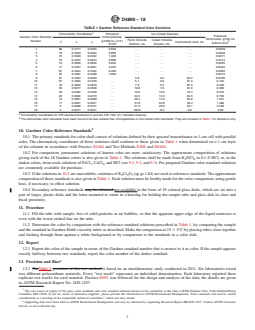
1 80 0.3177 0.3303 0.550 . . . . . . . . . 0.0039
2 79 0.3233 0.3352 0.865 . . . . . . . . . 0.0048
3 76 0.3329 0.3452 1.330 . . . . . . . . . 0.0071
4 75 0.3437 0.3644 2.080 . . . . . . . . . 0.0112
5 74 0.3558 0.3840 3.035 . . . . . . . . . 0
...
This document is not an ASTM standard and is intended only to provide the user of an ASTM standard an indication of what changes have been made to the previous version. Because
it may not be technically possible to adequately depict all changes accurately, ASTM recommends that users consult prior editions as appropriate. In all cases only the current version
of the standard as published by ASTM is to be considered the official document.
Designation: D4890 − 13 D4890 − 18
Standard Test Methods for
Polyurethane Raw Materials: Determination of Gardner and
APHA Color of Polyols
This standard is issued under the fixed designation D4890; the number immediately following the designation indicates the year of
original adoption or, in the case of revision, the year of last revision. A number in parentheses indicates the year of last reapproval. A
superscript epsilon (´) indicates an editorial change since the last revision or reapproval.
1. Scope*
1.1 These test methods measure visually the color of clear polyester and polyether liquids. They apply only to materials whose
colors have light-absorption characteristics similar to those of the standards. An alternative method is Test Method D1209 (see
Note 1).
1.2 Units—The values stated in SI units are to be regarded as standard. No other units of measurement are included in this
standard.
1.3 This standard does not purport to address all of the safety concerns, if any, associated with its use. It is the responsibility
of the user of this standard to establish appropriate safety and health practices and determine the applicability of regulatory
limitations prior to use.
NOTE 1—Test Method A of this standard is equivalent to ISO 6271-1. Test Method B of this standard is equivalent to ISO 4630-1.
1.4 This international standard was developed in accordance with internationally recognized principles on standardization
established in the Decision on Principles for the Development of International Standards, Guides and Recommendations issued
by the World Trade Organization Technical Barriers to Trade (TBT) Committee.
2. Referenced Documents
2.1 ASTM Standards:
D883 Terminology Relating to Plastics
D1193 Specification for Reagent Water
D1209 Test Method for Color of Clear Liquids (Platinum-Cobalt Scale)
D5386 Test Method for Color of Liquids Using Tristimulus Colorimetry
D6166 Test Method for Color of Pine Chemicals and Related Products (Instrumental Determination of Gardner Color)
E177 Practice for Use of the Terms Precision and Bias in ASTM Test Methods
E308 Practice for Computing the Colors of Objects by Using the CIE System
E691 Practice for Conducting an Interlaboratory Study to Determine the Precision of a Test Method
E1164 Practice for Obtaining Spectrometric Data for Object-Color Evaluation
2.2 ISO Standards:
ISO 4630-1 Clear Liquids—Estimation of Colour by the Gardner Colour Scale—Part 1: Visual Method
ISO 4630-2 Clear Liquids—Estimation of Colour by the Gardner Colour Scale—Part 2: Spectroscopic Method
ISO 6271-1 Clear Liquids—Estimation of ColorColour by the Platinum-Cobalt Scale—Part 1: Visual Method
ISO 6271-2 Clear Liquids—Estimation of ColorColour by the Platinum-Cobalt Scale—Part 2: Spectroscopic Method
3. Terminology
3.1 For definitions of terms used in these test methods see Terminology D883.
These test methods are under the jurisdiction of Committee D20 on Plastics and are the direct responsibility of Subcommittee D20.22 on Cellular Materials - Plastics
and Elastomers.
Current edition approved April 1, 2013Aug. 1, 2018. Published April 2013August 2018. Originally approved in 1988. Last previous edition approved in 20062013 as
D4890 - 06.D4890 - 13. DOI: 10.1520/D4890-13.10.1520/D4890-18.
For referenced ASTM standards, visit the ASTM website, www.astm.org, or contact ASTM Customer Service at service@astm.org. For Annual Book of ASTM Standards
volume information, refer to the standard’s Document Summary page on the ASTM website.
Available from American National Standards Institute (ANSI), 25 W. 43rd St., 4th Floor, New York, NY 10036, http://www.ansi.org.
*A Summary of Changes section appears at the end of this standard
Copyright © ASTM International, 100 Barr Harbor Drive, PO Box C700, West Conshohocken, PA 19428-2959. United States
D4890 − 18
4. Summary of Test Method
4.1 In Test Method A, the color of the material to be tested is compared to a series of color standards with defined
chromicitychromaticity coordinates, prepared onin one of three ways. The results are reported as the color standard, which best
matches the sample.
4.2 In Test Method B, the color of the material to be tested is compared to a series of platinum-cobalt color standards, designated
by mg of Pt/mL of standard solution. The results are reported as the color standard, which best matches the sample (see Note 2).
NOTE 2—Color of liquids are also measured by visible spectroscopy and the results converted to any of several color scales. These results are converted
to the APHA scale by appropriate manipulations, as for example in Test Method D5386 and ISO 6271-2. These results are converted to the Gardner scale
by appropriate manipulations, as for example in Test Method ISO 4630-2.
5. Significance and Use
5.1 These test methods are suitable for quality control, as specification tests, and for research. Color is an important property
of urethane products.
6. Sampling
6.1 Polyesters and polyethers usually contain molecules covering an appreciable range of molecular weights. These have a
tendency to fractionate during solidification. Unless the material is a liquid or finely ground solid it is necessary to melt (using no
higher temperature than necessary) and mix the resin well before removing a sample for analysis. Many polyols are hygroscopic
and care shouldmust be taken to provide minimum exposure to atmospheric moisture during the sampling.
7. Purity of Reagents
7.1 Purity of Reagents—Reagent-grade chemicals shall be used in all tests. Unless otherwise indicated, it is intended that all
reagents shall conform to the specifications of the Committee on Analytical Reagents of the American Chemical Society, where
such specifications are available. Other grades may be used, are acceptable, provided it is first ascertained that the reagent is of
sufficiently high purity to permit its use without lesseningreducing the accuracy of the determination.
7.2 Purity of Water—Unless otherwise indicated, references to water shall be understood to mean reagent water as defined by
Type IV or better of Specification D1193.
TEST METHOD A—GARDNER COLOR
8. Apparatus
8.1 Gardner-Holdt Tubes, of clear glass, with closed, flat, even bottoms, and having the following approximate dimensions and
markings:
8.1.1 A uniform internal length of 112 mm,
8.1.2 A uniform internal diameter throughout the length of the tube of 10.75 mm, and
8.1.3 An etched line around the outside of the tube 5 mm from the open end and a second etched line around the outside of
the tube 13 mm from the open end.
9. Reagents
9.1 Cobalt Chloride Solution—Prepare a solution containing 1 part by weight of cobalt chloride (CoCl × 6H O) to 3 parts of
2 2
HCl (1 to 17).
9.2 Ferric Chloride Solution—Prepare a solution containing approximately 5 parts by weight of ferric chloride (FeCl × 6H O)
3 2
and 1.2 parts of HCl (1 to 17). Adjust to exact color equivalence to a freshly prepared solution containing 3 g of K Cr O in 100
2 2 7
mL of H SO (sp gr 1.84).
2 4
9.3 Hydrochloric Acid (1 to 17)—Mix 1 volume of concentrated hydrochloric acid (HCl, sp gr 1.19) with 17 volumes of water.
9.4 Hydrochloric Acid (0.1 N)—Prepare 0.1 N HCl.
9.5 Potassium Chloroplatinate (PtCl ).
9.6 Potassium Dichromate (K Cr O ).
2 2 7
9.7 Sulfuric Acid (sp gr 1.84)—Concentrated sulfuric acid (H SO ).
2 4
Reagent Chemicals, American Chemical Society Specifications, American Chemical Society, Washington, DC. For suggestions on the testing of reagents not listed by
the American Chemical Society, see Analar Standards for Laboratory Chemicals, BDH Ltd., Poole, Dorset, U.K., and the United States Pharmacopeia and National
Formulary, U.S. Pharmacopeial Convention, Inc. (USPC), Rockville, MD.
D4890 − 18
TABLE 1 Gardner Reference Standard Color Solutions
A
Potassium
Chromaticity Coordinates Iron-Cobalt Solutions
Potassium
Gardner Color Standard Chloroplatinate,
Dichromate, g/100 mL
Ferric Chloride Cobalt Chloride
Number g/1000 mL of 0.1
B
Y x y Hydrochloric Acid, mL
Sulfuric Acid
Solution, mL Solution, mL
N HCl
1 80 0.3177 0.3303 0.550 . . . . . . . . . 0.0039
2 79 0.3233 0.3352 0.865 . . . . . . . . . 0.0048
3 76 0.3329 0.3452 1.330 . . . . . . . . . 0.0071
4 75 0.3437 0.3644 2.080 . . . . . . . . . 0.0112
5 74 0.3558 0.3840 3.035 . . . . . . . . . 0.0205
6 71 0.3767 0.4061 4.225 . . . . . . . . . 0.0322
7 67 0.4044 0.4352 6.400 . . . . . . . . . 0.0384
8 64 0.4207 0.4498 7.900 . . . . . . . . . 0.0515
9 61 0.4343 0.4640 . . . 3.8 3.0 93.2 0.0780
10 57 0.4503 0.4760 . . . 5.1 3.6 91.3 0.164
11 45 0.4842 0.4818 . . . 7.5 5.3 87.2 0.250
12 36 0.5077 0.4638 . . . 10.8 7.6 81.6 0.380
13 30 0.5392 0.4458 . . . 16.6 10.0 73.4 0.572
14 22 0.5646 0.4270 . . . 22.2 13.3 64.5 0.763
15 16 0.5857 0.4089 . . . 29.4 17.6 53.0 1.041
16 11 0.6047 0.3921 . . . 37.8 22.8 39.4 1.280
17 6 0.6290 0.3701 . . . 51.3 25.6 23.1 2.220
18 4 0.6477 0.3521 . . . 100.0 0.0 0.0 3.00
A
Chromaticity coordinates for CIE standard illuminant C and the CIE 1931 (2°) standard observer.
B
The dichromate color standards have been found to be less reliable than chloroplatinate or iron-cobalt color standards. They are included in Table 1 for reference only.
10. Gardner Color Reference Standards
10.1 The primary standards for color shall consist of solutions defined by their spectral transmittance in 1-cm cell with parallel
sides. The chromaticity coordinates of these solutions shall conform to those given in Table 1 when determined on a 1-cm layer
of the solution in accordance with Practice E1164 and Test Methods E308 and D6166.
10.2 For comparison, permanent solutions of known color are more satisfactory. The approximate composition of solutions
giving each of the 18 Gardner colors is also given in Table 1. The solutions shall be made from K PtCl in 0.1 N HCl, or, in the
2 6
darker colors, from stock solutions of FeCl , CoCl , and HCl (see 9.1, 9.2, and 9.3). Pre-prepared Gardner color standard solutions
3 2
are commonly available for purchase.
10.3 If the solutions in 10.2 are unavailable, solutions of K Cr O (sp gr 1.84) are used as reference standards. The approximate
2 2 7
composition of these standards is also given in Table 1. Each solution must be freshly made for the color comparison, using gentle
heat, if necessary, to effect solution.
10.4 Secondary reference standards may be obtained are available in the form of 18 colored glass disks, which are set into a
pair of larger, plastic disks and the latter mounted to rotate in a housing for holding the sample tube and glass disk in close and
fixed proximity.
11. Procedure
11.1 Fill the tube with sample, free of solid particles or air bubbles, so that the apparent upper edge of the liquid meniscus is
even with the lower etched line on the tube.
11.2 Determine the color by comparison with the reference standard solutions prescribed in Table 1, by comparing the sample
and the standard in Gardner-Holdt viscosity tubes as described. Make the comparison at 25 6 5°C by placing tubes close together
and looking through them against a white background or by comparison to the standards in a color disk.
12. Report
12.1 Report the color of the sample in terms of the Gardner standard number that is nearest to it in color. If the sample appears
exactly halfway between two standards, report the color number of the darker standard.
13. Precision and Bias
13.1 TheTable 2 precision of this test method is based on an interlaboratory study conducted in 2011. Six laboratories tested
two different polyurethane materials. Every “test result” represents an individual determination. Each laboratory reported three
replicate test results for each material. Practice E691 was followed for the design and analysis of the data; the details are given
in ASTM Research Report No. D20-1257.
The sole source of supply of the glass color standards and color standard solutions known to the committee at this time is BYK-Gardner USA, 9104 Guilford Road,
Columbia, MD 21046. If you are aware of alternative suppliers, please provide this information to ASTM International Headquarters. Your comments will receive careful
consideration at a meeting of the responsible technical committee, which you may attend.
Supporting data have been filed at ASTM International Headquarters and may be obtained by requesting Research Report RR:D20-1257. Contact ASTM Customer
Service at service@astm.org.
D4890 − 18
TABLE 2 Gardner Color (Gardner Color Standard Number)
A
Material Average Repeatability Reproducibility Repeatability Reproducibility
Standard Standard Limit Limit
Deviation Deviation
x¯ S S r R
r R
Jeffol 5.2 0.2 0.4 0.7 1.3
SD-441
Jeffol 9.6 0.2 1.0 0.7 2.7
SA-499
A
The average of the laboratories’ calculated averages.
13.1.1 Repeatability Limit (r)—Two test results obtained within one laboratory shall be judged not equivalent if they differ by
more than the “r” value for that material; “r” is the interval representing the critical difference between two test results for the same
material, obtained by the same operator using the same equipment on the same day in the same laboratory.
13.1.1.1 Repeatability limits are listed in Table 2.
13.1.2 Reproducibility
...