

ASTM C1740-16
(Practice)Standard Practice for Evaluating the Condition of Concrete Plates Using the Impulse-Response Method
General Information
- Abstract
SIGNIFICANCE AND USE
5.1 The impulse-response method is used to evaluate the condition of concrete slabs, pavements, bridge decks, walls, or other concrete plate structures. The method is also applicable to plate structures with overlays, such as concrete bridge decks with asphalt or portland cement concrete overlays. The impulse-response method is intended for rapid screening of structures to identify potential locations of anomalous conditions that require more detailed investigation.
5.2 This practice is not intended for integrity testing of piles. For such applications refer to Test Method D5882.
5.3 This practice can be used to locate delaminated or poorly consolidated concrete. It can also be used to locate regions of poor support or voids beneath slabs bearing on ground.
5.4 Results are used on a comparative basis for comparing concrete quality or support conditions at one point in the tested structural element with conditions at other points in the same element, or for comparing a structural element with another element of the same geometry. Invasive probing (drilling holes or chipping away concrete) or drilling of cores is used to confirm interpretations of impulse-response results.
5.5 Because concrete properties can vary from point to point in the structure due to differences in concrete age, batch-to-batch variability, or placement and consolidation practices, the measured mobility and dynamic stiffness can vary from point to point in a plate element of constant thickness.
Note 1: The flexural stiffness of a plate is directly proportional to the elastic modulus of the material and directly proportional to the thickness raised to the third power (5). As a result, variations in thickness will have a greater effect on variations in mobility than variations in elastic modulus.
5.6 The effective radius of influence of the hammer blow limits the maximum concrete element thickness that can be tested. The apparatus defined in this practice is intended for thicknesse...
SCOPE
1.1 This practice provides the procedure for using the impulse-response method to evaluate rapidly the condition of concrete slabs, pavements, bridge decks, walls, or other plate-like structures.
1.2 The values stated in SI units are to be regarded as standard. No other units of measurement are included in this standard.
1.3 This standard does not purport to address all of the safety concerns, if any, associated with its use. It is the responsibility of the user of this standard to establish appropriate safety and health practices and determine the applicability of regulatory limitations prior to use.
1.4 The text of this standard references notes and footnotes that provide explanatory material. These notes and footnotes (excluding those in tables and figures) shall not be considered as requirements of the standard.
- Status
- Published
- Publication Date
- 14-Dec-2016
- Technical Committee
- C09 - Concrete and Concrete Aggregates
- Drafting Committee
- C09.64 - Nondestructive and In-Place Testing
Buy Documents
ASTM C1740-16 - Standard Practice for Evaluating the Condition of Concrete Plates Using the Impulse-Response Method
REDLINE ASTM C1740-16 - Standard Practice for Evaluating the Condition of Concrete Plates Using the Impulse-Response Method
Overview
ASTM C1740-16: Standard Practice for Evaluating the Condition of Concrete Plates Using the Impulse-Response Method provides a standardized procedure for using the impulse-response method to rapidly assess the condition of concrete plates. This non-destructive testing (NDT) practice is applicable to concrete slabs, pavements, bridge decks, walls, and other plate-like elements, including structures with overlays such as asphalt or portland cement concrete. The goal is to quickly screen these structures to identify areas with potential defects or anomalies that may require further detailed investigation.
The impulse-response method is especially valued for its efficiency in providing comparative data on concrete quality and support conditions across multiple points, facilitating the early detection of issues such as delamination, voids, or poorly consolidated concrete.
Key Topics
- Impulse-Response Method: Utilizes mechanical impacts to generate stress waves in the tested concrete. A load cell-equipped hammer measures the impact force, while a velocity transducer captures the response, which is subsequently processed to derive mobility spectra.
- Parameters Measured:
- Average Mobility: Indicates relative flexibility and potential defects.
- Dynamic Stiffness: Reflects the structural quality and thickness.
- Mobility Slope: Used to identify poorly consolidated regions.
- Peak-Mean Mobility Ratio: Helps detect voids or loss of support.
- Comparative Analysis: Results are analyzed by comparing measured parameters across the tested grid to pinpoint anomalous locations. This comparative approach helps focus further investigational resources efficiently.
- Surface Preparation and Testing Procedure: The standard details requirements for preparing structures, grid layout, equipment calibration, and test execution to ensure consistent, reliable results.
Applications
The ASTM C1740-16 practice is used by civil and structural engineers, inspectors, and maintenance professionals for:
- Rapid Structural Evaluation: Ideal for assessing large surface areas like pavements, bridge decks, and slabs where visible inspection is difficult or insufficient.
- Detection of Structural Issues: Effective for identifying:
- Areas of delaminated or honeycombed concrete
- Voids or regions with inadequate subgrade support
- Comparative differences in material quality across structural elements
- Quality Assurance and Maintenance: Enables quick assessments of concrete plate conditions during construction or routine maintenance without invasive methods.
- Supporting Decision Making: Helps determine locations for core drilling or supplemental NDT investigations, maximizing investigative efficiency by targeting likely problem areas.
Note: The practice is not suitable for integrity testing of piles (refer to ASTM D5882 for such applications) and is limited to plate elements up to 1 meter thick. Environmental and operational factors such as traffic vibration and equipment noise must be considered during testing.
Related Standards
For comprehensive concrete evaluation and additional context, the following ASTM standards are referenced or related:
- ASTM C125: Terminology Relating to Concrete and Concrete Aggregates
- ASTM C1383: Test Method for Measuring the P-Wave Speed and the Thickness of Concrete Plates Using the Impact-Echo Method
- ASTM D5882: Test Method for Low Strain Impact Integrity Testing of Deep Foundations
- ASTM E1316: Terminology for Nondestructive Examinations
Practical Value
Utilizing ASTM C1740-16 ensures a standardized approach to the rapid, non-destructive evaluation of concrete plate structures. This enables timely maintenance decisions, supports infrastructure safety, and reduces the need for costly or disruptive invasive inspections. By leveraging the impulse-response method, stakeholders can effectively monitor and maintain the integrity of vital concrete structures, optimizing both safety and asset lifespan.
Keywords: concrete plate evaluation, impulse-response, nondestructive testing, dynamic mobility, dynamic stiffness, ASTM C1740, concrete slab inspection, rapid structural screening.
Relations
- Effective Date
- 01-Feb-2024
- Effective Date
- 15-Dec-2023
- Effective Date
- 15-Dec-2019
- Effective Date
- 01-Dec-2019
- Effective Date
- 01-Mar-2019
- Effective Date
- 01-Jan-2019
- Effective Date
- 01-Oct-2018
- Effective Date
- 01-Jul-2018
- Effective Date
- 01-Jan-2018
- Effective Date
- 01-Jan-2018
- Effective Date
- 15-Jun-2017
- Effective Date
- 01-Feb-2017
- Effective Date
- 15-Dec-2016
- Effective Date
- 01-Aug-2016
- Effective Date
- 01-Feb-2016
Buy Documents
ASTM C1740-16 - Standard Practice for Evaluating the Condition of Concrete Plates Using the Impulse-Response Method
REDLINE ASTM C1740-16 - Standard Practice for Evaluating the Condition of Concrete Plates Using the Impulse-Response Method
Get Certified
Connect with accredited certification bodies for this standard

DIBt (Deutsches Institut für Bautechnik)
German Institute for Building Technology.
DIN CERTCO
DIN Group product certification.

Aboma Certification B.V.
Specialized in construction, metal, and transport sectors.
Sponsored listings
Frequently Asked Questions
ASTM C1740-16 is a standard published by ASTM International. Its full title is "Standard Practice for Evaluating the Condition of Concrete Plates Using the Impulse-Response Method". This standard covers: SIGNIFICANCE AND USE 5.1 The impulse-response method is used to evaluate the condition of concrete slabs, pavements, bridge decks, walls, or other concrete plate structures. The method is also applicable to plate structures with overlays, such as concrete bridge decks with asphalt or portland cement concrete overlays. The impulse-response method is intended for rapid screening of structures to identify potential locations of anomalous conditions that require more detailed investigation. 5.2 This practice is not intended for integrity testing of piles. For such applications refer to Test Method D5882. 5.3 This practice can be used to locate delaminated or poorly consolidated concrete. It can also be used to locate regions of poor support or voids beneath slabs bearing on ground. 5.4 Results are used on a comparative basis for comparing concrete quality or support conditions at one point in the tested structural element with conditions at other points in the same element, or for comparing a structural element with another element of the same geometry. Invasive probing (drilling holes or chipping away concrete) or drilling of cores is used to confirm interpretations of impulse-response results. 5.5 Because concrete properties can vary from point to point in the structure due to differences in concrete age, batch-to-batch variability, or placement and consolidation practices, the measured mobility and dynamic stiffness can vary from point to point in a plate element of constant thickness. Note 1: The flexural stiffness of a plate is directly proportional to the elastic modulus of the material and directly proportional to the thickness raised to the third power (5). As a result, variations in thickness will have a greater effect on variations in mobility than variations in elastic modulus. 5.6 The effective radius of influence of the hammer blow limits the maximum concrete element thickness that can be tested. The apparatus defined in this practice is intended for thicknesse... SCOPE 1.1 This practice provides the procedure for using the impulse-response method to evaluate rapidly the condition of concrete slabs, pavements, bridge decks, walls, or other plate-like structures. 1.2 The values stated in SI units are to be regarded as standard. No other units of measurement are included in this standard. 1.3 This standard does not purport to address all of the safety concerns, if any, associated with its use. It is the responsibility of the user of this standard to establish appropriate safety and health practices and determine the applicability of regulatory limitations prior to use. 1.4 The text of this standard references notes and footnotes that provide explanatory material. These notes and footnotes (excluding those in tables and figures) shall not be considered as requirements of the standard.
SIGNIFICANCE AND USE 5.1 The impulse-response method is used to evaluate the condition of concrete slabs, pavements, bridge decks, walls, or other concrete plate structures. The method is also applicable to plate structures with overlays, such as concrete bridge decks with asphalt or portland cement concrete overlays. The impulse-response method is intended for rapid screening of structures to identify potential locations of anomalous conditions that require more detailed investigation. 5.2 This practice is not intended for integrity testing of piles. For such applications refer to Test Method D5882. 5.3 This practice can be used to locate delaminated or poorly consolidated concrete. It can also be used to locate regions of poor support or voids beneath slabs bearing on ground. 5.4 Results are used on a comparative basis for comparing concrete quality or support conditions at one point in the tested structural element with conditions at other points in the same element, or for comparing a structural element with another element of the same geometry. Invasive probing (drilling holes or chipping away concrete) or drilling of cores is used to confirm interpretations of impulse-response results. 5.5 Because concrete properties can vary from point to point in the structure due to differences in concrete age, batch-to-batch variability, or placement and consolidation practices, the measured mobility and dynamic stiffness can vary from point to point in a plate element of constant thickness. Note 1: The flexural stiffness of a plate is directly proportional to the elastic modulus of the material and directly proportional to the thickness raised to the third power (5). As a result, variations in thickness will have a greater effect on variations in mobility than variations in elastic modulus. 5.6 The effective radius of influence of the hammer blow limits the maximum concrete element thickness that can be tested. The apparatus defined in this practice is intended for thicknesse... SCOPE 1.1 This practice provides the procedure for using the impulse-response method to evaluate rapidly the condition of concrete slabs, pavements, bridge decks, walls, or other plate-like structures. 1.2 The values stated in SI units are to be regarded as standard. No other units of measurement are included in this standard. 1.3 This standard does not purport to address all of the safety concerns, if any, associated with its use. It is the responsibility of the user of this standard to establish appropriate safety and health practices and determine the applicability of regulatory limitations prior to use. 1.4 The text of this standard references notes and footnotes that provide explanatory material. These notes and footnotes (excluding those in tables and figures) shall not be considered as requirements of the standard.
ASTM C1740-16 is classified under the following ICS (International Classification for Standards) categories: 91.100.30 - Concrete and concrete products. The ICS classification helps identify the subject area and facilitates finding related standards.
ASTM C1740-16 has the following relationships with other standards: It is inter standard links to ASTM E1316-24, ASTM C1383-23, ASTM C125-19a, ASTM E1316-19b, ASTM E1316-19, ASTM C125-19, ASTM C125-18b, ASTM C125-18a, ASTM E1316-18, ASTM C125-18, ASTM E1316-17a, ASTM E1316-17, ASTM C125-16, ASTM E1316-16a, ASTM E1316-16. Understanding these relationships helps ensure you are using the most current and applicable version of the standard.
ASTM C1740-16 is available in PDF format for immediate download after purchase. The document can be added to your cart and obtained through the secure checkout process. Digital delivery ensures instant access to the complete standard document.
Standards Content (Sample)
This international standard was developed in accordance with internationally recognized principles on standardization established in the Decision on Principles for the
Development of International Standards, Guides and Recommendations issued by the World Trade Organization Technical Barriers to Trade (TBT) Committee.
Designation: C1740 − 16
Standard Practice for
Evaluating the Condition of Concrete Plates Using the
Impulse-Response Method
This standard is issued under the fixed designation C1740; the number immediately following the designation indicates the year of
original adoption or, in the case of revision, the year of last revision. A number in parentheses indicates the year of last reapproval. A
superscript epsilon (´) indicates an editorial change since the last revision or reapproval.
1. Scope* 3.1.1 Refer to Terminology C125 for general terms related
to concrete. Refer to Terminology E1316 for terms related to
1.1 This practice provides the procedure for using the
nondestructive ultrasonic examination that are applicable to
impulse-response method to evaluate rapidly the condition of
this practice.
concrete slabs, pavements, bridge decks, walls, or other plate-
like structures. 3.2 Definitions of Terms Specific to This Standard:
3.2.1 impulse-response method, n—a nondestructive test
1.2 The values stated in SI units are to be regarded as
method based on the use of mechanical impact to cause
standard. No other units of measurement are included in this
transient vibration of a concrete test element, the use of a
standard.
broadband velocity transducer placed on the test element
1.3 This standard does not purport to address all of the
adjacent to the impact point to measure the response, and the
safety concerns, if any, associated with its use. It is the
use of signal processing to obtain the mobility spectrum of the
responsibility of the user of this standard to establish appro-
test element.
priate safety and health practices and determine the applica-
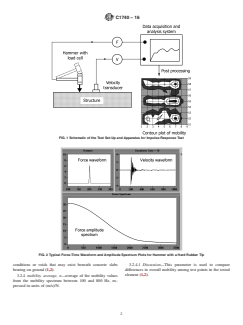
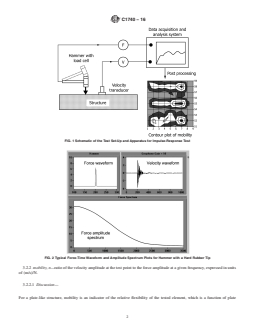
3.2.1.1 Discussion—Fig. 1 shows the testing configuration
bility of regulatory limitations prior to use.
for the impulse-response method. The hammer contains a load
1.4 The text of this standard references notes and footnotes
cell to measure the transient impact force and a velocity
that provide explanatory material. These notes and footnotes
transducer is used to measure the resulting motion of the test
(excluding those in tables and figures) shall not be considered
object (see top plots in Fig. 2). In plate-like structures, the
as requirements of the standard.
impact results predominantly in flexural vibration of the tested
element, although other modes can be excited. Waveforms
2. Referenced Documents
from the load cell and velocity transducer are converted to the
2.1 ASTM Standards: frequency domain and used to calculate the mobility spectrum,
C125 Terminology Relating to Concrete and Concrete Ag-
which is analyzed to obtain parameters representing the el-
gregates ement’s response to the impact. These parameters are used to
C1383 Test Method for Measuring the P-Wave Speed and
identify anomalous regions within the tested element.
the Thickness of Concrete Plates Using the Impact-Echo
3.2.2 mobility, n—ratio of the velocity amplitude at the test
Method
point to the force amplitude at a given frequency, expressed in
D5882 Test Method for Low Strain Impact Integrity Testing
units of (m/s)/N.
of Deep Foundations
3.2.2.1 Discussion—For a plate-like structure, mobility is an
E1316 Terminology for Nondestructive Examinations
indicator of the relative flexibility of the tested element, which
is a function of plate thickness, concrete elastic modulus,
3. Terminology
support conditions, and presence of internal defects. A higher
3.1 Definitions: mobility indicates that the element is relatively more flexible at
that test point (1,2).
3.2.3 mobility ratio, peak-mean, n—the ratio of the peak
This practice is under the jurisdiction of ASTM Committee C09 on Concrete mobility value between 0 to 100 Hz to the average mobility
and Concrete Aggregates and is the direct responsibility of Subcommittee C09.64 on
between 100 to 800 Hz
Nondestructive and In-Place Testing.
3.2.3.1 Discussion—A high ratio of the peak mobility to the
Current edition approved Dec. 15, 2016. Published January 2017. Originally
average mobility has been found to correlate with poor support
approved in 2010. Last previous edition approved in 2010 as C1740–10. DOI:
10.1520/C1740-16.
For referenced ASTM standards, visit the ASTM website, www.astm.org, or
contact ASTM Customer Service at service@astm.org. For Annual Book of ASTM
Standards volume information, refer to the standard’s Document Summary page on The boldface numbers in parentheses refer to a list of references at the end of
the ASTM website. this standard.
*A Summary of Changes section appears at the end of this standard
Copyright © ASTM International, 100 Barr Harbor Drive, PO Box C700, West Conshohocken, PA 19428-2959. United States
C1740 − 16
FIG. 1 Schematic of the Test Set-Up and Apparatus for Impulse-Response Test
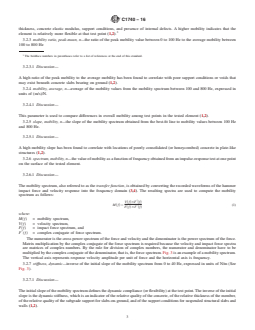
FIG. 2 Typical Force-Time Waveform and Amplitude Spectrum Plots for Hammer with a Hard Rubber Tip
conditions or voids that may exist beneath concrete slabs 3.2.4.1 Discussion—This parameter is used to compare
bearing on ground (1,2).
differences in overall mobility among test points in the tested
element (1,2).
3.2.4 mobility, average, n—average of the mobility values
from the mobility spectrum between 100 and 800 Hz, ex-
pressed in units of (m/s)/N.
C1740 − 16
3.2.5 slope, mobility, n—the slope of the mobility spectrum 3.2.7 stiffness, dynamic—inverse of the initial slope of the
obtained from the best-fit line to mobility values between 100 mobility spectrum from 0 to 40 Hz, expressed in units of N/m
Hz and 800 Hz. (See Fig. 3).
3.2.5.1 Discussion—A high mobility slope has been found
3.2.7.1 Discussion—The initial slope of the mobility spec-
to correlate with locations of poorly consolidated (or honey-
trum defines the dynamic compliance (or flexibility) at the test
combed) concrete in plate-like structures (1,2).
point. The inverse of the initial slope is the dynamic stiffness,
3.2.6 spectrum, mobility, n—the value of mobility as a which is an indicator of the relative quality of the concrete, of
the relative thickness of the member, of the relative quality of
function of frequency obtained from an impulse-response test
at one point on the surface of the tested element. the subgrade support for slabs-on-ground, and of the support
conditions for suspended structural slabs and walls (1,2).
3.2.6.1 Discussion—The mobility spectrum, also referred to
as the transfer function, is obtained by converting the recorded
4. Summary of Practice
waveforms of the hammer impact force and velocity response
into the frequency domain (3,4). The resulting spectra are used
4.1 A grid is laid out on the surface of the concrete element
to compute the mobility spectrum as follows:
to be tested. Grid spacing normally ranges between 500 mm
*
V~ƒ! × F ~ƒ!
and 2000 mm and is selected on the basis of the size and shape
M ƒ 5 (1)
~ !
*
F ƒ × F ƒ
~ ! ~ !
of the element to be tested. A closer spacing is used for smaller
elements and to locate smaller anomalous regions.
where:
M(ƒ) = mobility spectrum, 4.2 A hand-held hammer with a force measuring load cell is
V(ƒ) = velocity spectrum,
used to impact the concrete surface and generate transient
F(ƒ) = impact force spectrum, and
stress waves in the concrete test element. These waves set up
*
F (ƒ) = complex conjugate of force spectrum.
flexural and other vibrational modes of the element in the
vicinity of the test point.
The numerator is the cross power spectrum of the force
and velocity and the denominator is the power spectrum of
4.3 The impact point is within 100 6 25 mm of the velocity
the force. Matrix multiplication by the complex conjugate of
transducer used to measure the response due to the hammer
the force spectrum is required because the velocity and
blow.
impact force spectra are matrices of complex numbers. By
the rule for division of complex numbers, the numerator and 4.4 The force and velocity waveforms are recorded and
subjected to digital signal processing to obtain the mobility
denominator have to be multiplied by the complex conjugate
of the denominator, that is, the force spectrum. Fig. 3 is an spectrum at each test point. Key parameters are computed from
example of a mobility spectrum. The vertical axis represents the mobility spectra at the test points and displayed in the form
response velocity amplitude per unit of force and the of contour plots from which the likely locations of anomalous
horizontal axis is frequency. regions can be identified.
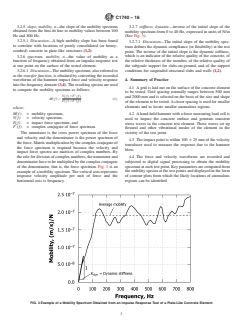
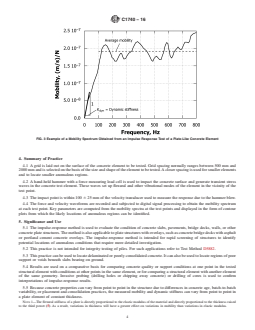
FIG. 3 Example of a Mobility Spectrum Obtained from an Impulse Response Test of a Plate-Like Concrete Element
C1740 − 16
5. Significance and Use 5.11 The practice is not applicable in the presence of
electrical noise, such as that produced by a generator or other
5.1 The impulse-response method is used to evaluate the
electrical sources, that is captured by the data-acquisition
condition of concrete slabs, pavements, bridge decks, walls, or
system.
other concrete plate structures. The method is also applicable
to plate structures with overlays, such as concrete bridge decks 4
6. Apparatus
with asphalt or portland cement concrete overlays. The
6.1 Fig. 1 is a schematic of the basic components of a
impulse-response method is intended for rapid screening of
suitable test system.
structures to identify potential locations of anomalous condi-
tions that require more detailed investigation.
6.2 Hammer—A nominal 1-kg hammer with a 50-mm
diameter cylindrical rubber tip of sufficient hardness to produce
5.2 This practice is not intended for integrity testing of piles.
an impact force amplitude spectrum spanning at least 2 kHz.
For such applications refer to Test Method D5882.
The hammer shall have a built-in load cell, capable of
5.3 This practice can be used to locate delaminated or measuring dynamic forces up to 20 kN. The resonant fre-
poorly consolidated concrete. It can also be used to locate quency of the load cell shall exceed 10 kHz.
NOTE 2—Commercially available hammers equipped with load cells
regions of poor support or voids beneath slabs bearing on
have been found to produce the required force amplitude spectrum. Fig. 2
ground.
shows a typical force-time waveform and force amplitude spectrum for a
hammer with a hard rubber tip. The maximum frequency in the amplitude
5.4 Results are used on a comparative basis for comparing
spectrum of the waves generated by hammer impact is related inversely to
concrete quality or support conditions at one point in the tested
the duration of the impact.
structural element with conditions at other points in the same
6.3 Transducer—A broadband, induction coil, velocity
element, or for comparing a structural element with another
transducer (geophone) that responds to normal surface motion.
element of the same geometry. Invasive probing (drilling holes
The transducer shall have a natural frequency less than 15 Hz
or chipping away concrete) or drilling of cores is used to
and a constant sensitivity over the range 15 to 1000 Hz.
confirm interpretations of impulse-response results.
NOTE 3—Commercially available induction coil velocity transducers
with a base diameter of 50 mm have been found suitable. Such a
5.5 Because concrete properties can vary from point to point
transducer is housed in a case with three protruding screws or spikes
in the structure due to differences in concrete age, batch-to-
around its perimeter forming a tripod for stability during testing. No
batch variability, or placement and consolidation practices, the
coupling material such as gel or grease is needed to couple the transducer
measured mobility and dynamic stiffness can vary from point
to the concrete.
to point in a plate element of constant thickness.
6.4 Data-Acquisition and Analysis System—Hardware and
NOTE 1—The flexural stiffness of a plate is directly proportional to the
software for acquiring, recording, and processing the outputs of
elastic modulus of the material and directly proportional to the thickness
the hammer load cell and velocity transducer. The system shall
raised to the third power (5). As a result, variations in thickness will have
be capable of displaying test results immediately after impact
a greater effect on variations in mobility than variations in elastic
modulus. and storing test results.
5.6 The effective radius of influence of the hammer blow NOTE 4—A portable computer with a two-channel data-acquisition card
or a portable two-channel waveform analyzer is acceptable. A computer
limits the maximum concrete element thickness that can be
data-acquisition card with a voltage range of 6 5 V and 8-bit resolution
tested. The apparatus defined in this practice is intended for
has been found to be suitable for the transducer described. Higher voltage
thicknesses less than 1 m.
ranges and resolutions are also suitable.
5.7 For highway applications, results may be influenced by 6.4.1 The sampling rate for each channel shall be 10 kHz or
traffic noise or low frequency structural vibrations set up by
higher (sampling interval of 100 μs or less). The recorded
normal movement of traffic across a structure. The intermittent waveforms from the load cell and velocity transducer shall
nature of these noises, however, may allow testing during
contain at least 1024 points each (see Note 5). The system shall
traffic flow on adjacent portions of the structure. Engineering be capable of triggering on the signal from the hammer
judgment is required to determine whether the response has
channel.
been influenced by traffic-induced vibrations.
NOTE 5—The sampling frequency should be about 10 times the
maximum frequency of interest. For typical concrete structural elements,
5.8 Heavy loads on suspended slabs may affect test results
the maximum frequency of interest is about 1 kHz. For a sampling rate of
by altering the frequencies and shapes of different modes of
10 kHz and 1024 points, the frequency resolution is about 10 Hz. For
vibration. Debris on the test surface may interfere with
faster sampling rates, the number of points in the waveforms should be
obtaining a sharp impact and with measuring the response. increased to maintain a similar frequency resolution. Typical signal
processing software that is used to compute the velocity and force spectra
5.9 The practice is not applicable in the presence of vibra-
requires that the number of points in the waveforms be a power of 2 (for
tions created by mechanical equipment (jack hammers, sound- example, 512, 1024, 2048 and so forth).
ing with a hammer, mechanical sweepers, and the like)
6.4.2 The voltage range of the data-acquisition system shall
impacting the structure.
be matched with the sensitivity of the transducers so that the
5.10 Tests conducted next to or directly over structural
elements that stiffen the plate will result in reduced mobility
and not be representative of the internal conditions of the plate. Suitable apparatus is available commercially.
C1740 − 16
peak hammer force and response velocity are measured with- shall give the sensitivity in mV/(m/s). Transducer calibration
out clipping of the signals. shall be renewed at least every 12 months or sooner if there is
6.4.3 Software shall be provided for acquiring, recording, an indication of improper performance.
displaying, analyzing, and storing data. The display shall
7. Preparation of Test Surface
include voltage versus time waveforms for both the impact
force and velocity measurements for each test. The software
7.1 The test surface can be dry, moist or wet, but not
shall
...
This document is not an ASTM standard and is intended only to provide the user of an ASTM standard an indication of what changes have been made to the previous version. Because
it may not be technically possible to adequately depict all changes accurately, ASTM recommends that users consult prior editions as appropriate. In all cases only the current version
of the standard as published by ASTM is to be considered the official document.
Designation: C1740 − 10 C1740 − 16
Standard Practice for
Evaluating the Condition of Concrete Plates Using the
Impulse-Response Method
This standard is issued under the fixed designation C1740; the number immediately following the designation indicates the year of
original adoption or, in the case of revision, the year of last revision. A number in parentheses indicates the year of last reapproval. A
superscript epsilon (´) indicates an editorial change since the last revision or reapproval.
1. Scope Scope*
1.1 This practice provides the procedure for using the impulse-response method to evaluate rapidly the condition of concrete
slabs, pavements, bridge decks, walls, or other plate-like structures.
1.2 The values stated in SI units are to be regarded as standard. No other units of measurement are included in this standard.
1.3 This standard does not purport to address all of the safety concerns, if any, associated with its use. It is the responsibility
of the user of this standard to establish appropriate safety and health practices and determine the applicability of regulatory
limitations prior to use.
1.4 The text of this standard references notes and footnotes that provide explanatory material. These notes and footnotes
(excluding those in tables and figures) shall not be considered as requirements of the standard.
2. Referenced Documents
2.1 ASTM Standards:
C125 Terminology Relating to Concrete and Concrete Aggregates
C1383 Test Method for Measuring the P-Wave Speed and the Thickness of Concrete Plates Using the Impact-Echo Method
D5882 Test Method for Low Strain Impact Integrity Testing of Deep Foundations
E1316 Terminology for Nondestructive Examinations
3. Terminology
3.1 Definitions:
3.1.1 Refer to Terminology C125 for general terms related to concrete. Refer to Test Method C1383 for terms related to
stress-wave testing of concrete and refer to Terminology E1316 for additional terms related to nondestructive ultrasonic
examination that are applicable to this practice.
3.2 Definitions of Terms Specific to This Standard:
3.2.1 impulse-response method, n—a nondestructive test method based on the use of mechanical impact to cause transient
vibration of a concrete test element, the use of a broadband velocity transducer placed on the test element adjacent to the impact
point to measure the response, and the use of signal processing to obtain the mobility spectrum of the test element.
This practice is under the jurisdiction of ASTM Committee C09 on Concrete and Concrete Aggregates and is the direct responsibility of Subcommittee C09.64 on
Nondestructive and In-Place Testing.
Current edition approved Dec. 15, 2010Dec. 15, 2016. Published January 2011January 2017. Originally approved in 2010. Last previous edition approved in 2010 as
C1740–10. DOI: 10.1520/C1740-10.10.1520/C1740-16.
For referenced ASTM standards, visit the ASTM website, www.astm.org, or contact ASTM Customer Service at service@astm.org. For Annual Book of ASTM Standards
volume information, refer to the standard’s Document Summary page on the ASTM website.
3.2.1.1 Discussion—
Fig. 1 shows the testing configuration for the impulse-response method. The hammer contains a load cell to measure the transient
impact force and a velocity transducer is used to measure the resulting motion of the test object (see top plots in Fig. 2). In
plate-like structures (as defined in Test Method structures, C1383), the impact results predominantly in flexural vibration of the
tested element, although other modes can be excited. Waveforms from the load cell and velocity transducer are converted to the
frequency domain and used to calculate the mobility spectrum, which is analyzed to obtain parameters representing the element’s
response to the impact. These parameters are used to identify anomalous regions within the tested element.
*A Summary of Changes section appears at the end of this standard
Copyright © ASTM International, 100 Barr Harbor Drive, PO Box C700, West Conshohocken, PA 19428-2959. United States
C1740 − 16
FIG. 1 Schematic of the Test Set-Up and Apparatus for Impulse-Response Test
FIG. 2 Typical Force-Time Waveform and Amplitude Spectrum Plots for Hammer with a Hard Rubber Tip
3.2.2 mobility, n—ratio of the velocity amplitude at the test point to the force amplitude at a given frequency, expressed in units
of (m/s)/N.
3.2.2.1 Discussion—
For a plate-like structure, mobility is an indicator of the relative flexibility of the tested element, which is a function of plate
C1740 − 16
thickness, concrete elastic modulus, support conditions, and presence of internal defects. A higher mobility indicates that the
element is relatively more flexible at that test point (1,2).
3.2.3 mobility ratio, peak-mean, n—the ratio of the peak mobility value between 0 to 100 Hz to the average mobility between
100 to 800 Hz
The boldface numbers in parentheses refer to a list of references at the end of this standard.
3.2.3.1 Discussion—
A high ratio of the peak mobility to the average mobility has been found to correlate with poor support conditions or voids that
may exist beneath concrete slabs bearing on ground (1,2).
3.2.4 mobility, average, n—average of the mobility values from the mobility spectrum between 100 and 800 Hz, expressed in
units of (m/s)/N.
3.2.4.1 Discussion—
This parameter is used to compare differences in overall mobility among test points in the tested element (1,2).
3.2.5 slope, mobility, n—the slope of the mobility spectrum obtained from the best-fit line to mobility values between 100 Hz
and 800 Hz.
3.2.5.1 Discussion—
A high mobility slope has been found to correlate with locations of poorly consolidated (or honeycombed) concrete in plate-like
structures (1,2).
3.2.6 spectrum, mobility, n—the value of mobility as a function of frequency obtained from an impulse-response test at one point
on the surface of the tested element.
3.2.6.1 Discussion—
The mobility spectrum, also referred to as the transfer function, is obtained by converting the recorded waveforms of the hammer
impact force and velocity response into the frequency domain (3,4). The resulting spectra are used to compute the mobility
spectrum as follows:
*
V ƒ 3F ƒ
~ ! ~ !
M~ƒ!5 (1)
*
F~ƒ!3F ~ƒ!
where:
M(ƒ) = mobility spectrum,
V(ƒ) = velocity spectrum,
F(ƒ) = impact force spectrum, and
*
F (ƒ) = complex conjugate of force spectrum.
The numerator is the cross power spectrum of the force and velocity and the denominator is the power spectrum of the force.
Matrix multiplication by the complex conjugate of the force spectrum is required because the velocity and impact force spectra
are matrices of complex numbers. By the rule for division of complex numbers, the numerator and denominator have to be
multiplied by the complex conjugate of the denominator, that is, the force spectrum. Fig. 3 is an example of a mobility spectrum.
The vertical axis represents response velocity amplitude per unit of force and the horizontal axis is frequency.
3.2.7 stiffness, dynamic—inverse of the initial slope of the mobility spectrum from 0 to 40 Hz, expressed in units of N/m (See
Fig. 3).
3.2.7.1 Discussion—
The initial slope of the mobility spectrum defines the dynamic compliance (or flexibility) at the test point. The inverse of the initial
slope is the dynamic stiffness, which is an indicator of the relative quality of the concrete, of the relative thickness of the member,
of the relative quality of the subgrade support for slabs-on-ground, and of the support conditions for suspended structural slabs and
walls (1,2).
C1740 − 16
FIG. 3 Example of a Mobility Spectrum Obtained from an Impulse Response Test of a Plate-Like Concrete Element
4. Summary of Practice
4.1 A grid is laid out on the surface of the concrete element to be tested. Grid spacing normally ranges between 500 mm and
2000 mm and is selected on the basis of the size and shape of the element to be tested. A closer spacing is used for smaller elements
and to locate smaller anomalous regions.
4.2 A hand-held hammer with a force measuring load cell is used to impact the concrete surface and generate transient stress
waves in the concrete test element. These waves set up flexural and other vibrational modes of the element in the vicinity of the
test point.
4.3 The impact point is within 100 6 25 mm of the velocity transducer used to measure the response due to the hammer blow.
4.4 The force and velocity waveforms are recorded and subjected to digital signal processing to obtain the mobility spectrum
at each test point. Key parameters are computed from the mobility spectra at the test points and displayed in the form of contour
plots from which the likely locations of anomalous regions can be identified.
5. Significance and Use
5.1 The impulse-response method is used to evaluate the condition of concrete slabs, pavements, bridge decks, walls, or other
concrete plate structures. The method is also applicable to plate structures with overlays, such as concrete bridge decks with asphalt
or portland cement concrete overlays. The impulse-response method is intended for rapid screening of structures to identify
potential locations of anomalous conditions that require more detailed investigation.
5.2 This practice is not intended for integrity testing of piles. For such applications refer to Test Method D5882.
5.3 This practice can be used to locate delaminated or poorly consolidated concrete. It can also be used to locate regions of poor
support or voids beneath slabs bearing on ground.
5.4 Results are used on a comparative basis for comparing concrete quality or support conditions at one point in the tested
structural element with conditions at other points in the same element, or for comparing a structural element with another element
of the same geometry. Invasive probing (drilling holes or chipping away concrete) or drilling of cores is used to confirm
interpretations of impulse-response results.
5.5 Because concrete properties can vary from point to point in the structure due to differences in concrete age, batch-to-batch
variability, or placement and consolidation practices, the measured mobility and dynamic stiffness can vary from point to point in
a plate element of constant thickness.
NOTE 1—The flexural stiffness of a plate is directly proportional to the elastic modulus of the material and directly proportional to the thickness raised
to the third power (5). As a result, variations in thickness will have a greater effect on variations in mobility than variations in elastic modulus.
C1740 − 16
5.6 The effective radius of influence of the hammer blow limits the maximum concrete element thickness that can be tested. The
apparatus defined in this practice is intended for thicknesses less than 1 m.
5.7 For highway applications, results may be influenced by traffic noise or low frequency structural vibrations set up by normal
movement of traffic across a structure. The intermittent nature of these noises, however, may allow testing during traffic flow on
adjacent portions of the structure. Engineering judgment is required to determine whether the response has been influenced by
traffic-induced vibrations.
5.8 Heavy loads on suspended slabs may affect test results by altering the frequencies and shapes of different modes of vibration.
Debris on the test surface may interfere with obtaining a sharp impact and with measuring the response.
5.9 The practice is not applicable in the presence of vibrations created by mechanical equipment (jack hammers, sounding with
a hammer, mechanical sweepers, and the like) impacting the structure.
5.10 Tests conducted next to or directly over structural elements that stiffen the plate will result in reduced mobility and not be
representative of the internal conditions of the plate.
5.11 The practice is not applicable in the presence of electrical noise, such as that produced by a generator or other electrical
sources, that is captured by the data-acquisition system.
6. Apparatus
6.1 Fig. 1 is a schematic of the basic components of a suitable test system.
6.2 Hammer—A nominal 1-kg hammer with a 50-mm diameter cylindrical rubber tip of sufficient hardness to produce an impact
force amplitude spectrum spanning at least 2 kHz. The hammer shall have a built-in load cell, capable of measuring dynamic forces
up to 20 kN. The resonant frequency of the load cell shall exceed 10 kHz.
NOTE 2—Commercially available hammers equipped with load cells have been found to produce the required force amplitude spectrum. Fig. 2 shows
a typical force-time waveform and force amplitude spectrum for a hammer with a hard rubber tip. The maximum frequency in the amplitude spectrum
of the waves generated by hammer impact is related inversely to the duration of the impact.
6.3 Transducer—A broadband, induction coil, velocity transducer (geophone) that responds to normal surface motion. The
transducer shall have a natural frequency less than 15 Hz and a constant sensitivity over the range 15 to 1000 Hz.
NOTE 3—Commercially available induction coil velocity transducers with a base diameter of 50 mm have been found suitable. Such a transducer is
housed in a case with three protruding screws or spikes around its perimeter forming a tripod for stability during testing. No coupling material such as
gel or grease is needed to couple the transducer to the concrete.
6.4 Data-Acquisition and Analysis System—Hardware and software for acquiring, recording, and processing the outputs of the
hammer load cell and velocity transducer. The system shall be capable of displaying test results immediately after impact and
storing test results.
NOTE 4—A portable computer with a two-channel data-acquisition card or a portable two-channel waveform analyzer is acceptable. A computer
data-acquisition card with a voltage range of 6 5 V and 8-bit resolution has been found to be suitable for the transducer described. Higher voltage ranges
and resolutions are also suitable.
6.4.1 The sampling rate for each channel shall be 10 kHz or higher (sampling interval of 100 μs or less). The recorded
waveforms from the load cell and velocity transducer shall contain at least 1024 points each (see Note 5). The system shall be
capable of triggering on the signal from the hammer channel.
NOTE 5—The sampling frequency should be about 10 times the maximum frequency of interest. For typical concrete structural elements, the maximum
frequency of interest is about 1 kHz. For a sampling rate of 10 kHz and 1024 points, the frequency resolution is about 10 Hz. For faster sampling rates,
the number of points in the waveforms should be increased to maintain a similar frequency resolution. Typical signal processing software that is used
to compute the velocity and force spectra requires that the number of points in the waveforms be a power of 2 (for example, 512, 1024, 2048 and so forth).
6.4.2 The voltage range of the data-acquisition system shall be matched with the sensitivity of the transducers so that the peak
hammer force and response velocity are measured without clipping of the signals.
6.4.3 Software shall be provided for acquiring, recording, displaying, analyzing, and storing data. The display shall include
voltage versus time waveforms for both the impact force and velocity measurements for each test. The software shall compute the
mobility spectrum from the recorded waveforms. The mobility spectrum shall be displayed immediately after the waveforms have
been captured.
NOTE 6—Fig. 4 is an example
...