

ASTM D6605-06(2020)
(Practice)Standard Practice for Determining the Color Stability of Hydrocarbon Resins After Heating
General Information
- Abstract
SIGNIFICANCE AND USE
5.1 This practice is useful for both quality control and research.
SCOPE
1.1 This practice covers determination of the color stability of a hydrocarbon resin by exposure to a specific temperature for a defined time period in a forced-draft oven.
1.2 Color stability is measured by the change in color of the test resin, measured via the yellowness index color scale, in accordance with Practice E313, or the procedure for Gardner Color, Test Method D6166.
1.3 The values stated in SI units are to be regarded as standard. The values given in parentheses are for information only.
1.4 This standard does not purport to address all of the safety concerns, if any, associated with its use. It is the responsibility of the user of this standard to establish appropriate safety, health, and environmental practices and determine the applicability of regulatory limitations prior to use.
1.5 This international standard was developed in accordance with internationally recognized principles on standardization established in the Decision on Principles for the Development of International Standards, Guides and Recommendations issued by the World Trade Organization Technical Barriers to Trade (TBT) Committee.
- Status
- Published
- Publication Date
- 31-May-2020
- Technical Committee
- D01 - Paint and Related Coatings, Materials, and Applications
- Drafting Committee
- D01.34 - Pine Chemicals and Hydrocarbon Resins


Overview
ASTM D6605-06(2020) is a standard practice developed by ASTM International for determining the color stability of hydrocarbon resins after exposure to heat. This practice is designed for use in both quality control and research environments, ensuring that hydrocarbon resins meet color stability requirements after being subjected to elevated temperatures over a specified period. The assessment of color stability is vital since changes in color can impact the performance and marketability of resin-based products.
The standard provides a detailed procedure for exposing hydrocarbon resin samples to a defined temperature in a forced-draft oven, followed by color measurement using either the yellowness index (according to ASTM E313) or the Gardner color method (according to ASTM D6166). The results help determine the extent of thermal discoloration and overall color retention, which are critical indicators of resin quality.
Key Topics
- Color Stability Determination: Defines the process by which hydrocarbon resins are heated to a specific temperature in a forced-draft oven for a set time and then analyzed for color change.
- Measurement Methods: Utilizes the yellowness index, in compliance with ASTM E313, and the Gardner color scale, per ASTM D6166, to quantify changes in resin color.
- Quality Assurance: Offers a standardized approach for comparing aged versus unaged resin samples, supporting robust quality control processes in resin manufacturing and formulation.
- Safety and Compliance: Highlights the responsibility of users to address safety, health, and environmental considerations and comply with regulatory requirements.
- Terminology: Refers to ASTM D6440 for definitions relating to hydrocarbon resins, ensuring clear communication and mutual understanding within the industry.
Applications
ASTM D6605-06(2020) is applicable to a broad range of industrial settings and research facilities involved in:
- Resin Manufacturing: Used by producers of hydrocarbon resins to verify product consistency and ensure that materials maintain desired color properties after thermal exposure during processing or end use.
- Product Development: Essential for research teams evaluating new resin formulations or additives intended to enhance color stability.
- Quality Control Laboratories: Provides a rigorous, repeatable method for routine color stability testing, ensuring batches meet defined specifications before reaching the market.
- Performance Benchmarking: Enables manufacturers and users to benchmark products and make informed decisions regarding formulation changes and supplier selection.
Related Standards
Several ASTM standards are referenced within ASTM D6605 to ensure precise methodology and consistent terminology:
- ASTM E313: Practice for Calculating Yellowness and Whiteness Indices from Instrumentally Measured Color Coordinates.
- ASTM D6166: Test Method for Color of Pine Chemicals and Related Products (Instrumental Determination of Gardner Color).
- ASTM D6440: Terminology Relating to Hydrocarbon Resins.
Additional relevant standards may include guidelines for equipment calibration, sample preparation, and safety protocol adherence. Compliance with these standards ensures robust, reliable color stability determinations that support industry best practices and international trade requirements.
Relations
- Effective Date
- 01-Jun-2020
- Effective Date
- 01-Sep-2018
- Effective Date
- 01-Jan-2015
- Effective Date
- 01-Nov-2012
- Effective Date
- 01-Dec-2010
- Effective Date
- 01-Jul-2010
- Effective Date
- 01-Jul-2008
- Effective Date
- 01-Oct-2005
- Effective Date
- 01-Sep-2005
- Effective Date
- 10-Jul-2003
- Effective Date
- 10-Dec-2001
- Effective Date
- 10-Dec-2001
- Effective Date
- 10-Dec-2000
Get Certified
Connect with accredited certification bodies for this standard

DIN CERTCO
DIN Group product certification.

Smithers Quality Assessments
US management systems and product certification.
Sponsored listings
Frequently Asked Questions
ASTM D6605-06(2020) is a standard published by ASTM International. Its full title is "Standard Practice for Determining the Color Stability of Hydrocarbon Resins After Heating". This standard covers: SIGNIFICANCE AND USE 5.1 This practice is useful for both quality control and research. SCOPE 1.1 This practice covers determination of the color stability of a hydrocarbon resin by exposure to a specific temperature for a defined time period in a forced-draft oven. 1.2 Color stability is measured by the change in color of the test resin, measured via the yellowness index color scale, in accordance with Practice E313, or the procedure for Gardner Color, Test Method D6166. 1.3 The values stated in SI units are to be regarded as standard. The values given in parentheses are for information only. 1.4 This standard does not purport to address all of the safety concerns, if any, associated with its use. It is the responsibility of the user of this standard to establish appropriate safety, health, and environmental practices and determine the applicability of regulatory limitations prior to use. 1.5 This international standard was developed in accordance with internationally recognized principles on standardization established in the Decision on Principles for the Development of International Standards, Guides and Recommendations issued by the World Trade Organization Technical Barriers to Trade (TBT) Committee.
SIGNIFICANCE AND USE 5.1 This practice is useful for both quality control and research. SCOPE 1.1 This practice covers determination of the color stability of a hydrocarbon resin by exposure to a specific temperature for a defined time period in a forced-draft oven. 1.2 Color stability is measured by the change in color of the test resin, measured via the yellowness index color scale, in accordance with Practice E313, or the procedure for Gardner Color, Test Method D6166. 1.3 The values stated in SI units are to be regarded as standard. The values given in parentheses are for information only. 1.4 This standard does not purport to address all of the safety concerns, if any, associated with its use. It is the responsibility of the user of this standard to establish appropriate safety, health, and environmental practices and determine the applicability of regulatory limitations prior to use. 1.5 This international standard was developed in accordance with internationally recognized principles on standardization established in the Decision on Principles for the Development of International Standards, Guides and Recommendations issued by the World Trade Organization Technical Barriers to Trade (TBT) Committee.
ASTM D6605-06(2020) is classified under the following ICS (International Classification for Standards) categories: 83.080.20 - Thermoplastic materials. The ICS classification helps identify the subject area and facilitates finding related standards.
ASTM D6605-06(2020) has the following relationships with other standards: It is inter standard links to ASTM D6605-06(2015), ASTM D6440-10(2018), ASTM E313-15, ASTM D6166-12, ASTM D6440-10, ASTM E313-10, ASTM D6166-08, ASTM E313-05, ASTM D6440-05, ASTM D6166-97(2003), ASTM D6440-00A, ASTM D6440-01, ASTM E313-00. Understanding these relationships helps ensure you are using the most current and applicable version of the standard.
ASTM D6605-06(2020) is available in PDF format for immediate download after purchase. The document can be added to your cart and obtained through the secure checkout process. Digital delivery ensures instant access to the complete standard document.
Standards Content (Sample)
This international standard was developed in accordance with internationally recognized principles on standardization established in the Decision on Principles for the
Development of International Standards, Guides and Recommendations issued by the World Trade Organization Technical Barriers to Trade (TBT) Committee.
Designation: D6605 − 06 (Reapproved 2020)
Standard Practice for
Determining the Color Stability of Hydrocarbon Resins After
Heating
This standard is issued under the fixed designation D6605; the number immediately following the designation indicates the year of
original adoption or, in the case of revision, the year of last revision. A number in parentheses indicates the year of last reapproval. A
superscript epsilon (´) indicates an editorial change since the last revision or reapproval.
1. Scope 3. Terminology
1.1 This practice covers determination of the color stability 3.1 Definitions:
of a hydrocarbon resin by exposure to a specific temperature
3.1.1 Fordefinitionsoftermsrelatingtohydrocarbonresins,
for a defined time period in a forced-draft oven.
see Terminology D6440.
1.2 Color stability is measured by the change in color of the
4. Summary of Practice
test resin, measured via the yellowness index color scale, in
accordance with Practice E313, or the procedure for Gardner
4.1 Specimens of the hydrocarbon resin(s) to be tested are
Color, Test Method D6166.
placed in 250-mL (8-oz) glass jars, which are placed in a
heating block that is in a ventilated oven set at 175°C. The
1.3 The values stated in SI units are to be regarded as
standard. The values given in parentheses are for information samples are kept in the oven for an agreed upon period.At the
end of this time, the samples are removed and allowed to cool.
only.
After cooling, the samples are dissolved in toluene. The color
1.4 This standard does not purport to address all of the
of each aged resin solution is measured and compared to that
safety concerns, if any, associated with its use. It is the
of a solution of the corresponding unaged resin. This color
responsibility of the user of this standard to establish appro-
increase is a measure of the (lack of) stability of the resin.
priate safety, health, and environmental practices and deter-
mine the applicability of regulatory limitations prior to use.
5. Significance and Use
1.5 This international standard was developed in accor-
dance with internationally recognized principles on standard-
5.1 This practice is useful for both quality control and
ization established in the Decision on Principles for the
research.
Development of International Standards, Guides and Recom-
mendations issued by the World Trade Organization Technical
6. Apparatus and Materials
Barriers to Trade (TBT) Committee.
6.1 Forced Draft Oven, with the ventilation set at maximum
capacity.
2. Referenced Documents
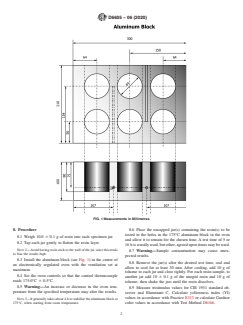
6.2 Aluminum Block, equipped with a control thermocouple
2.1 ASTM Standards:
(see Fig. 1).
D6166 Test Method for Color of Pine Chemicals and Re-
lated Products (Instrumental Determination of Gardner
6.3 Temperature Indicator.
Color)
6.4 Glass Jars, 250 mL (8 oz), with suitably lined screw
D6440 Terminology Relating to Hydrocarbon Resins
cap.
E313 Practice for Calculating Yellowness and Whiteness
Indices from Instrumentally Measured Color Coordinates
NOTE 1—TFE-fluorocarbon-lined caps work well.
6.5 Balance, readable to at least 0.1g.
This practice is under the jurisdiction of ASTM Committee D01 on Paint and
6.6 Shaker, used to facilitate the dissolution of the resin
Related Coatings, Materials, and Applications and is the direct responsibility of
specimens.
Subcommittee D01.34 on Pine Chemicals and Hydrocarbon Resins.
CurrenteditionapprovedJune1,2020.PublishedJuly2020.Originallyapproved
6.7 Spectrophotometer or Tristimulus Colorimeter.
in 2000. Last previous edition approved in 2015 as D6605 – 06 (2015). DOI:
10.1520/D6605-06R20.
7. Reagents
For referenced ASTM standards, visit the ASTM website, www.astm.org, or
contact ASTM Customer Servic
...