

ASTM B595-21
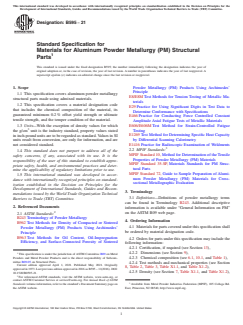
(Specification)Standard Specification for Materials for Aluminum Powder Metallurgy (PM) Structural Parts
General Information
- Abstract
ABSTRACT
This specification covers sintered aluminium structural parts made primarily from aluminum powders to which controlled amounts of master alloys or elemental copper, magnesium, and silicon have been added by blending. Structural parts shall be made by molding and sintering metal powders to produce finished parts conforming to the requirements of this specification. Chemical composition of copper, magnesium, and silicon content, as well as the density of the material shall conform to the requirements specified. Tests for the determination of the mechanical properties such as ultimate tensile strength, tensile yield strength, elongation and apparent Rockwell hardness of the material shall be performed.
SCOPE
1.1 This specification covers aluminum powder metallurgy structural parts made using admixed materials.
1.2 This specification covers a material designation code that includes the chemical composition of the material, its guaranteed minimum 0.2 % offset yield strength or ultimate tensile strength, and the temper condition of the material.
1.3 Units—With the exception of density values for which the g/cm3 unit is the industry standard, property values stated in inch-pound units are to be regarded as standard. Values in SI units result from conversion, are only for information, and are not considered standard.
1.4 This standard does not purport to address all of the safety concerns, if any, associated with its use. It is the responsibility of the user of this standard to establish appropriate safety, health, and environmental practices and determine the applicability of regulatory limitations prior to use.
1.5 This international standard was developed in accordance with internationally recognized principles on standardization established in the Decision on Principles for the Development of International Standards, Guides and Recommendations issued by the World Trade Organization Technical Barriers to Trade (TBT) Committee.
- Status
- Published
- Publication Date
- 31-Mar-2021
- Technical Committee
- B09 - Metal Powders and Metal Powder Products
- Drafting Committee
- B09.05 - Structural Parts
Buy Documents
ASTM B595-21 - Standard Specification for Materials for Aluminum Powder Metallurgy (PM) Structural Parts
REDLINE ASTM B595-21 - Standard Specification for Materials for Aluminum Powder Metallurgy (PM) Structural Parts
Overview
ASTM B595-21: Standard Specification for Materials for Aluminum Powder Metallurgy (PM) Structural Parts establishes requirements for sintered aluminum structural parts made predominantly from aluminum powders with controlled additions of copper, magnesium, and silicon. The standard details compositional, physical, and mechanical property criteria for aluminum PM parts, ensuring quality and reliable performance in industrial applications.
This internationally recognized ASTM standard is vital for manufacturers, purchasers, and quality assurance professionals involved in the production and procurement of structural components using powder metallurgy techniques. Compliance drives consistency in part durability, mechanical strength, and dimensional accuracy across industries.
Key Topics
- Material Compositions: Defines allowable ranges for aluminum, copper, magnesium, and silicon, as well as restrictions on other elements.
- Mechanical Properties: Specifies minimum yield and tensile strengths, elongation, hardness (Rockwell), and fatigue characteristics for various temper conditions (T2, T8).
- Physical Properties: Outlines required dry density ranges based on part type and condition.
- Designation System: Describes a standardized coding system for material composition, mechanical property guarantee, and temper condition (e.g., AC-2014-23-T2).
- Manufacturing Process: Covers powder mixing, compacting, sintering, sizing, and heat treatment requirements.
- Testing and Inspection: Mandates test procedures for chemical analysis, density, tensile properties, and metallographic evaluation, referencing specific ASTM and MPIF methods.
- Dimensional Tolerances and Workmanship: Ensures parts meet specified tolerances and aesthetic quality.
Applications
Aluminum powder metallurgy structural parts produced under ASTM B595-21 serve a wide range of industries where lightweight, corrosion-resistant, and high-strength components are essential. Key applications include:
- Automotive and Transportation: Engine components, transmission parts, brackets, and housings benefit from the precise strength-to-weight ratios enabled by aluminum PM.
- Aerospace: Structural components requiring tight tolerances, fatigue resistance, and thermal performance, such as brackets, connectors, and frames.
- Industrial Machinery: Gears, levers, and mounting parts where uniformity and mechanical reliability are vital.
- Electronics: Thermal management components leveraging aluminum's conductive properties and tailored porosity.
- Consumer Goods: Structural parts in appliances and sporting equipment that require lightweight but durable metal components.
The PM process, as regulated by ASTM B595-21, enables efficient, near-net-shape manufacturing, minimizing waste and post-processing. This is particularly advantageous for high-volume production while maintaining strict control over material characteristics and part geometry.
Related Standards
Utilization of ASTM B595-21 often involves reference to complementary ASTM and MPIF standards, including:
- ASTM B243: Terminology of Powder Metallurgy
- ASTM B962: Test Methods for Density of Compacted or Sintered PM Products Using Archimedes’ Principle
- ASTM B963: Test Methods for Oil Content, Oil-Impregnation Efficiency, and Surface-Connected Porosity
- ASTM E8/E8M: Test Methods for Tension Testing of Metallic Materials
- ASTM E29: Practice for Using Significant Digits in Test Data to Determine Conformance with Specifications
- MPIF Standard 10: Method for Determination of the Tensile Properties of PM Materials
- MPIF Standard 35-SP: Materials Standards for PM Structural Parts
By adhering to ASTM B595-21 and relevant related standards, manufacturers ensure that aluminum PM structural parts meet industry expectations for reliability, performance, and regulatory compliance. This standard plays a crucial role in the supply chain for advanced engineering applications utilizing powder metallurgy technology.
Relations
- Effective Date
- 01-Feb-2024
- Effective Date
- 01-Jan-2024
- Effective Date
- 01-Oct-2018
- Effective Date
- 01-Apr-2018
- Effective Date
- 15-Jul-2016
- Effective Date
- 01-Jul-2016
- Effective Date
- 01-Jul-2016
- Effective Date
- 01-Apr-2015
- Effective Date
- 01-Feb-2015
- Effective Date
- 01-Sep-2014
- Effective Date
- 01-Sep-2014
- Effective Date
- 01-Nov-2013
- Effective Date
- 01-Jun-2013
- Effective Date
- 01-Apr-2013
- Effective Date
- 01-Apr-2013
Buy Documents
ASTM B595-21 - Standard Specification for Materials for Aluminum Powder Metallurgy (PM) Structural Parts
REDLINE ASTM B595-21 - Standard Specification for Materials for Aluminum Powder Metallurgy (PM) Structural Parts
Get Certified
Connect with accredited certification bodies for this standard

Element Materials Technology
Materials testing and product certification.

Inštitut za kovinske materiale in tehnologije
Institute of Metals and Technology. Materials testing, metallurgical analysis, NDT.
Sponsored listings
Frequently Asked Questions
ASTM B595-21 is a technical specification published by ASTM International. Its full title is "Standard Specification for Materials for Aluminum Powder Metallurgy (PM) Structural Parts". This standard covers: ABSTRACT This specification covers sintered aluminium structural parts made primarily from aluminum powders to which controlled amounts of master alloys or elemental copper, magnesium, and silicon have been added by blending. Structural parts shall be made by molding and sintering metal powders to produce finished parts conforming to the requirements of this specification. Chemical composition of copper, magnesium, and silicon content, as well as the density of the material shall conform to the requirements specified. Tests for the determination of the mechanical properties such as ultimate tensile strength, tensile yield strength, elongation and apparent Rockwell hardness of the material shall be performed. SCOPE 1.1 This specification covers aluminum powder metallurgy structural parts made using admixed materials. 1.2 This specification covers a material designation code that includes the chemical composition of the material, its guaranteed minimum 0.2 % offset yield strength or ultimate tensile strength, and the temper condition of the material. 1.3 Units—With the exception of density values for which the g/cm3 unit is the industry standard, property values stated in inch-pound units are to be regarded as standard. Values in SI units result from conversion, are only for information, and are not considered standard. 1.4 This standard does not purport to address all of the safety concerns, if any, associated with its use. It is the responsibility of the user of this standard to establish appropriate safety, health, and environmental practices and determine the applicability of regulatory limitations prior to use. 1.5 This international standard was developed in accordance with internationally recognized principles on standardization established in the Decision on Principles for the Development of International Standards, Guides and Recommendations issued by the World Trade Organization Technical Barriers to Trade (TBT) Committee.
ABSTRACT This specification covers sintered aluminium structural parts made primarily from aluminum powders to which controlled amounts of master alloys or elemental copper, magnesium, and silicon have been added by blending. Structural parts shall be made by molding and sintering metal powders to produce finished parts conforming to the requirements of this specification. Chemical composition of copper, magnesium, and silicon content, as well as the density of the material shall conform to the requirements specified. Tests for the determination of the mechanical properties such as ultimate tensile strength, tensile yield strength, elongation and apparent Rockwell hardness of the material shall be performed. SCOPE 1.1 This specification covers aluminum powder metallurgy structural parts made using admixed materials. 1.2 This specification covers a material designation code that includes the chemical composition of the material, its guaranteed minimum 0.2 % offset yield strength or ultimate tensile strength, and the temper condition of the material. 1.3 Units—With the exception of density values for which the g/cm3 unit is the industry standard, property values stated in inch-pound units are to be regarded as standard. Values in SI units result from conversion, are only for information, and are not considered standard. 1.4 This standard does not purport to address all of the safety concerns, if any, associated with its use. It is the responsibility of the user of this standard to establish appropriate safety, health, and environmental practices and determine the applicability of regulatory limitations prior to use. 1.5 This international standard was developed in accordance with internationally recognized principles on standardization established in the Decision on Principles for the Development of International Standards, Guides and Recommendations issued by the World Trade Organization Technical Barriers to Trade (TBT) Committee.
ASTM B595-21 is classified under the following ICS (International Classification for Standards) categories: 77.150.10 - Aluminium products. The ICS classification helps identify the subject area and facilitates finding related standards.
ASTM B595-21 has the following relationships with other standards: It is inter standard links to ASTM B963-24, ASTM E8/E8M-24, ASTM B243-18, ASTM E1269-11(2018), ASTM E8/E8M-16, ASTM B243-16, ASTM E1416-16, ASTM B962-15, ASTM E8/E8M-15, ASTM B963-14, ASTM B962-14, ASTM B243-13, ASTM E8/E8M-13, ASTM B962-13, ASTM B963-13. Understanding these relationships helps ensure you are using the most current and applicable version of the standard.
ASTM B595-21 is available in PDF format for immediate download after purchase. The document can be added to your cart and obtained through the secure checkout process. Digital delivery ensures instant access to the complete standard document.
Standards Content (Sample)
This international standard was developed in accordance with internationally recognized principles on standardization established in the Decision on Principles for the
Development of International Standards, Guides and Recommendations issued by the World Trade Organization Technical Barriers to Trade (TBT) Committee.
Designation:B595 −21
Standard Specification for
Materials for Aluminum Powder Metallurgy (PM) Structural
Parts
This standard is issued under the fixed designation B595; the number immediately following the designation indicates the year of
original adoption or, in the case of revision, the year of last revision. A number in parentheses indicates the year of last reapproval. A
superscript epsilon (´) indicates an editorial change since the last revision or reapproval.
1. Scope Powder Metallurgy (PM) Products Using Archimedes’
Principle
1.1 This specification covers aluminum powder metallurgy
E8/E8M Test Methods for Tension Testing of Metallic Ma-
structural parts made using admixed materials.
terials
1.2 This specification covers a material designation code
E29 Practice for Using Significant Digits in Test Data to
that includes the chemical composition of the material, its
Determine Conformance with Specifications
guaranteed minimum 0.2 % offset yield strength or ultimate
E466 Practice for Conducting Force Controlled Constant
tensile strength, and the temper condition of the material.
Amplitude Axial Fatigue Tests of Metallic Materials
1.3 Units—With the exception of density values for which E606/E606M Test Method for Strain-Controlled Fatigue
Testing
the g/cm unit is the industry standard, property values stated
in inch-pound units are to be regarded as standard.Values in SI E1269 Test Method for Determining Specific Heat Capacity
by Differential Scanning Calorimetry
units result from conversion, are only for information, and are
not considered standard. E1416 Practice for Radioscopic Examination of Weldments
2.2 MPIF Standards:
1.4 This standard does not purport to address all of the
MPIF Standard 10, Method for Determination of the Tensile
safety concerns, if any, associated with its use. It is the
Properties of Powder Metallurgy (PM) Materials
responsibility of the user of this standard to establish appro-
MPIF Standard 35-SP, Materials Standards for PM Struc-
priate safety, health, and environmental practices and deter-
tural Parts
mine the applicability of regulatory limitations prior to use.
MPIF Standard 72, Guide to Sample Preparation of Alumi-
1.5 This international standard was developed in accor-
num Powder Metallurgy (PM) Materials for Cross-
dance with internationally recognized principles on standard-
sectional Metallographic Evaluation
ization established in the Decision on Principles for the
Development of International Standards, Guides and Recom-
3. Terminology
mendations issued by the World Trade Organization Technical
3.1 Definitions—Definitions of powder metallurgy terms
Barriers to Trade (TBT) Committee.
can be found in Terminology B243. Additional descriptive
2. Referenced Documents
information is available under “General Information on PM”
on the ASTM B09 web page.
2.1 ASTM Standards:
B243 Terminology of Powder Metallurgy
4. Ordering Information
B962 Test Methods for Density of Compacted or Sintered
4.1 Materials for parts covered under this specification shall
Powder Metallurgy (PM) Products Using Archimedes’
be ordered by material designation code.
Principle
B963 Test Methods for Oil Content, Oil-Impregnation
4.2 Orders for parts under this specification may include the
Efficiency, and Surface-Connected Porosity of Sintered
following information:
4.2.1 Certification, if required (see Section 13),
4.2.2 Dimensions (see Section 9),
This specification is under the jurisdiction ofASTM Committee B09 on Metal
Powders and Metal Powder Products and is the direct responsibility of Subcom- 4.2.3 Chemical composition (see 6.1, 10.1, and Table 1),
mittee B09.05 on Structural Parts.
4.2.4 Test methods and mechanical properties (see Section
Current edition approved April 1, 2021. Published May 2021. Originally
8, Table 2, Table 3, Table X1.1, and Table X1.2),
approvedin1973.Lastpreviouseditionapprovedin2016asB595 – 11(2016).DOI:
4.2.5 Density (see Section 7, Table X1.1, and Table X1.2),
10.1520/B0595-21.
For referenced ASTM standards, visit the ASTM website, www.astm.org, or
contact ASTM Customer Service at service@astm.org. For Annual Book of ASTM
Standards volume information, refer to the standard’s Document Summary page on Available from Metal Powder Industries Federation (MPIF), 105 College Rd.
the ASTM website. East, Princeton, NJ 08540, http://www.mpif.org.
Copyright © ASTM International, 100 Barr Harbor Drive, PO Box C700, West Conshohocken, PA 19428-2959. United States
B595−21
A,B
TABLE 1 Chemical Composition Requirements (wt.%)
of ASTM Standards or by any other approved method agreed
Material Al Cu Si Mg Element
between the producer and the purchaser.
Designation
Code
7. Physical Properties
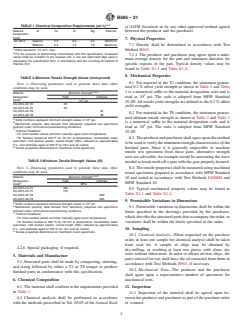
AC-2014 Balance 3.5 0.5 0.2 Minimum
Balance 5.5 1.2 1.0 Maximum
7.1 Density shall be determined in accordance with Test
A
Method B962.
Other elements: 1.5 wt.% max.
B
For the purpose of determining conformance with this specification, measured
7.1.1 The producer and purchaser may agree upon a mini-
values shall be rounded “to the nearest unit” in the last right-hand digit used in
mum average density for the part and minimum densities for
expressing the specification limit, in accordance with the rounding-off method of
specific regions of the part. Typical density values may be
Practice E29.
found in Table X1.1 and Table X1.2.
8. Mechanical Properties
TABLE 2 Minimum Tensile Strength Values (inch-pound)
8.1 For material in the T2 condition, the minimum guaran-
NOTE 1—Processing parameters used to generate these data; other
teed 0.2 % offset yield strength as shown in Table 2 and Table
conditions may be used.
A,B,D 3 is a numerical suffix to the material designation code and is
Material Minimum Strength
Designation Yield Ultimate read as 10 psi. The code is adopted from MPIF Standard
C 3
Code 10 psi
35-SP.Alltensileyieldstrengthsaredefinedasthe0.2 %offset
AC-2014-23-T2 23
yield strengths.
AC-2014-25-T2 25
AC-2014-32-T8 32
8.2 For material in the T8 condition, the minimum guaran-
AC-2014-38-T8 38
teed ultimate tensile strength as shown in Table 2 and Table 3
A 3
Suffix numbers represent minimum strength values in 10 psi
B is a numerical suffix to the material designation code and is
Mechanical property data derived from laboratory prepared test specimens
sintered under commercial manufacturing conditions read as 10 psi. The code is adopted from MPIF Standard
C
Thermal Treatment:
35-SP.
-T2: Cold worked (sized) and then naturally aged (room temperature)
-T8: Solution treated at 935 ºF for 70 min at temperature, immediately water
8.3 Theproducerandpurchasershallagreeuponthemethod
quenched, cold worked (sized), overall length (OAL) reduced by approximately
to be used to verify the minimum strength characteristics of the
2 %, and artificially aged at 320 ºF for 18 h and air cooled
D
finished parts. Since it is generally impossible to machine
Tensile properties determined on machined round specimens
tensile test specimens from these parts, alternative strength
tests are advisable. An example would be measuring the force
TABLE 3 Minimum Tensile Strength Values (SI)
needed to break teeth off a gear with the gear properly fixtured.
NOTE 1—Processing parameters used to generate these data, other
8.4 Thetensilepropertiesshallbemeasuredusingmachined
conditions may be used.
round specimens prepared in accordance with MPIF Standard
A,B,D
Material Minimum Strength
10 and tested in accordance with Test Methods E8/E8M and
Designation Yield Ultimate
MPIF Standard 10.
C
Code MPa
AC-2014-23-T2 160
8.5 Typical mechanical property values may be found in
AC-2014-25-T2 170
Table X1.1 and Table X1.2.
AC-2014-32-T8 220
AC-2014-38-T8 265
9. Permissible Variations in Dimensions
A 3
Suffix numbers represent minimum strength values in 10 psi
B
Mechanical property data derived from laboratory prepared test specimens 9.1 Permissible variations in dimensions shall be within the
sintered under commercial manufacturing conditions
limits specified in the drawings provided by the purchaser,
C
Thermal Treatment:
whichdescribethestructuralpartsthataccompanytheorder,or
-T2: Cold worked (sized) and then naturally aged (room temperature)
-T8: Solution treated at 502 ºC for 70 min at temperature, immediately water variations shall be within the limits specified in the order.
quenched, cold worked (sized), overall length (OAL) reduced by approximately
2 %, and artificially aged at 160 ºC for 18 h and air cooled 10. Sampling
D
Tensile properties determined on machined round specimens
10.1 Chemical Analysis—When requested on the purchase
order, at least one sample for chemical analysis shall be taken
from each lot. A sample of chips may be obtained by
4.2.6 Special packaging, if required.
dry-milling, or crushing at least two pieces with clean, dry
tools without lubrication. In order to obtain oil-free chips, the
5. Materials and Manufacture
parts selected for test shall have the oil extracted from them in
5.1 Structural parts shall be made by compacting, sintering,
accordance with Test Methods B963, if necessary.
and sizing followed by either a T2 or T8 temper to produce
10.2 Mechanical Tests—The producer and the purchaser
finished parts in conformance with this specification.
shall agree upon a representative number of specimens for
mechanical tests.
6. Chemical Composition
6.1 Thematerialshallconformtotherequirementsprovided 11. Inspection
in Table 1.
11.1 Inspection of the material shall be agreed upon be-
6.2 Chemical analysis shall be performed in accordance tween the producer and purchaser as part of the purchase order
with the methods prescribed in Vol. 03.05 of the Annual Book or contract.
B595−21
12. Rejection and Rehearing in this specification and the requirements have been met.When
specified in the purchase order or contract, a report of the test
12.1 Material that fails to conform to the requirements of
results shall be furnished. Test reports may be transmitted to
thisspecificationmayberejected.Rejectionshouldbereported
the purchaser by electronic services. The content of the
to the producer promptly and in writing. In the case of
electronically transmitted document shall conform to any
dissatisfaction with test results, the producer may make claim
existing agreement between the producer and purchaser.
for a rehearing.
13. Certification 14. Keywords
13.1 When specified in the purchase order or contract, the 14.1 aluminum alloys; nonferrous powder metallurgy; non-
purchaser shall be furnished certification stating samples rep- ferrous structural parts; powde
...
This document is not an ASTM standard and is intended only to provide the user of an ASTM standard an indication of what changes have been made to the previous version. Because
it may not be technically possible to adequately depict all changes accurately, ASTM recommends that users consult prior editions as appropriate. In all cases only the current version
of the standard as published by ASTM is to be considered the official document.
Designation: B595 − 11 (Reapproved 2016) B595 − 21
Standard Specification for
Sintered Aluminum Materials for Aluminum Powder
Metallurgy (PM) Structural Parts
This standard is issued under the fixed designation B595; the number immediately following the designation indicates the year of
original adoption or, in the case of revision, the year of last revision. A number in parentheses indicates the year of last reapproval. A
superscript epsilon (´) indicates an editorial change since the last revision or reapproval.
1. Scope
1.1 This specification covers sintered aluminum powder metallurgy structural parts made primarily from aluminum powders to
which controlled amounts of master alloys or elemental copper, magnesium, and silicon have been added by mixing.using admixed
materials.
1.2 This specification covers the following variables:a material designation code that includes the chemical composition of the
material, its guaranteed minimum 0.2 % offset yield strength or ultimate tensile strength, and the temper condition of the material.
1.2.1 Composition—Depending upon levels of copper, magnesium, and silicon content, two grades, and
1.2.2 Density—Type.
1.3 Parts ordered to this specification will be in one of the following conditions:
1.3.1 As-sintered,
1.3.2 As-repressed for additional density, or
1.3.3 All other conditions plus heat treated.
1.3 Units—With the exception of thedensity values for density, for which the useg/cm of the gram per cubic centimeter unit is
long-standingthe industry practice, thestandard, property values stated in SIinch-pound units are to be regarded as the standard.
standard. Values in SI units result from conversion, are only for information, and are not considered standard.
1.4 This standard does not purport to address all of the safety concerns, if any, associated with its use. It is the responsibility
of the user of this standard to establish appropriate safety, health, and environmental practices and determine the applicability of
regulatory limitations prior to use.
1.5 This international standard was developed in accordance with internationally recognized principles on standardization
established in the Decision on Principles for the Development of International Standards, Guides and Recommendations issued
by the World Trade Organization Technical Barriers to Trade (TBT) Committee.
This specification is under the jurisdiction of ASTM Committee B09 on Metal Powders and Metal Powder Products and is the direct responsibility of Subcommittee
B09.05 on Structural Parts.
Current edition approved June 1, 2016April 1, 2021. Published June 2016May 2021. Originally approved in 1973. Last previous edition approved in 20112016 as
B595 – 11.B595 – 11(2016). DOI: 10.1520/B0595-11R16.10.1520/B0595-21.
Copyright © ASTM International, 100 Barr Harbor Drive, PO Box C700, West Conshohocken, PA 19428-2959. United States
B595 − 21
2. Referenced Documents
2.1 ASTM Standards:
B243 Terminology of Powder Metallurgy
B962 Test Methods for Density of Compacted or Sintered Powder Metallurgy (PM) Products Using Archimedes’ Principle
B963 Test Methods for Oil Content, Oil-Impregnation Efficiency, and Surface-Connected Porosity of Sintered Powder
Metallurgy (PM) Products Using Archimedes’ Principle
E8E8/E8M Test Methods for Tension Testing of Metallic Materials [Metric] E0008_E0008M
E29 Practice for Using Significant Digits in Test Data to Determine Conformance with Specifications
E466 Practice for Conducting Force Controlled Constant Amplitude Axial Fatigue Tests of Metallic Materials
E606/E606M Test Method for Strain-Controlled Fatigue Testing
E1269 Test Method for Determining Specific Heat Capacity by Differential Scanning Calorimetry
E1416 Practice for Radioscopic Examination of Weldments
2.2 MPIF Standards:
MPIF Standard 10, Method for Determination of the Tensile Properties of Powder Metallurgy (PM) Materials
MPIF Standard 35-SP, Materials Standards for PM Structural Parts
MPIF Standard 72, Guide to Sample Preparation of Aluminum Powder Metallurgy (PM) Materials for Cross-sectional
Metallographic Evaluation
3. Terminology
3.1 Definitions—Definitions of powder metallurgy terms can be found in Terminology B243. Additional descriptive information
is available in the Related Material Section of Volume 02.05 of the under “General Information on PM” on the Annual Book of
ASTM Standards.ASTM B09 web page.
4. Ordering Information
4.1 Materials for parts covered under this specification shall be ordered by material designation code.
4.2 Orders for material toparts under this specification shallmay include the following information:
4.2.1 Certification, if required (see Section 13),
4.2.2 Dimensions (see Section 9.19),
4.2.3 Chemical composition (see 6.1),, 10.1, and Table 1),
4.2.4 Density (see Test methods and mechanical properties (see Section 7.18, Table 2, Table 3, Table X1.1, and Table X1.2),
4.1.4 State of heat treatment,
4.2.5 Mechanical property requirements (see Density (see Section 8.17),, Table X1.1, and Table X1.2),
4.2.6 Certification (seeSpecial packaging, 14.1).if required.
5. Materials and Manufacture
5.1 Structural parts shall be made by compacting and sintering metal powders compacting, sintering, and sizing followed by either
a T2 or T8 temper to produce finished parts conforming to the requirements of in conformance with this specification.
6. Chemical Composition
6.1 The material shall conform to the requirements of provided in Table 1.
For referenced ASTM standards, visit the ASTM website, www.astm.org, or contact ASTM Customer Service at service@astm.org. For Annual Book of ASTM Standards
volume information, refer to the standard’s Document Summary page on the ASTM website.
Available from Metal Powder Industries Federation (MPIF), 105 College Rd. East, Princeton, NJ 08540, http://www.mpif.org.
B595 − 21
TABLE 1 Chemical Requirements
Composition, mass %
A
Element
AXX-6061 ACXX-
A
Copper 0.5 max 3.5–5.0
Magnesium 0.4–1.2 0.2–0.8
Silicon 0.2–0.8 1.2 max
Aluminum, 96.0 91.5
min
Total of 1.5 1.5
other
elements,
determined
by
difference,
max
A,B
TABLE 1 Chemical Composition Requirements (wt.%)
Material Al Cu Si Mg Element
Designation
Code
AC-2014 Balance 3.5 0.5 0.2 Minimum
Balance 5.5 1.2 1.0 Maximum
A
“XX” denotes thermal condition – see footnote to Other elements: 1.5 wt.%
max.Table X1.1
B
For the purpose of determining conformance with this specification, measured
values shall be rounded “to the nearest unit” in the last right-hand digit used in
expressing the specification limit, in accordance with the rounding-off method of
Practice E29.
TABLE 3 Minimum Tensile Strength Values (SI)
NOTE 1—Processing parameters used to generate these data, other
conditions may be used.
A,B,D
Material Minimum Strength
Designation Yield Ultimate
C
Code MPa
AC-2014-23-T2 160
AC-2014-25-T2 170
AC-2014-32-T8 220
AC-2014-38-T8 265
A 3
Suffix numbers represent minimum strength values in 10 psi
B
Mechanical property data derived from laboratory prepared test specimens
sintered under commercial manufacturing conditions
C
Thermal Treatment:
-T2: Cold worked (sized) and then naturally aged (room temperature)
-T8: Solution treated at 502 ºC for 70 min at temperature, immediately water
quenched, cold worked (sized), overall length (OAL) reduced by approximately
2 %, and artificially aged at 160 ºC for 18 h and air cooled
D
Tensile properties determined on machined round specimens
6.2 The chemical Chemical analysis shall be madeperformed in accordance with the methods prescribed in the latest edition Vol.
03.05 of the Annual Book of ASTM Standards,Standards Vol 03.05, or by any other approved method agreed upon between the
manufacturerproducer and the purchaser.
7. Density Physical Properties
7.1 The parts shall conform to the density range prescribed in Table 2.
7.2 The density shall be measured in accordance with Test Method B962.
7.3 If the density does not vary more than 0.1 g/cm from one section of the structural part to any other section, the overall density
shall fall within the limits prescribed in Table 2.
B595 − 21
TABLE 2 Density
Type Dry Density, g/cm
I 2.30 to 2.45
II 2.45 to 2.60
III 2.60 min
TABLE 2 Minimum Tensile Strength Values (inch-pound)
NOTE 1—Processing parameters used to generate these data; other
conditions may be used.
A,B,D
Material Minimum Strength
Designation Yield Ultimate
C 3
Code 10 psi
AC-2014-23-T2 23
AC-2014-25-T2 25
AC-2014-32-T8 32
AC-2014-38-T8 38
A 3
Suffix numbers represent minimum strength values in 10 psi
B
Mechanical property data derived from laboratory prepared test specimens
sintered under commercial manufacturing conditions
C
Thermal Treatment:
-T2: Cold worked (sized) and then naturally aged (room temperature)
-T8: Solution treated at 935 ºF for 70 min at temperature, immediately water
quenched, cold worked (sized), overall length (OAL) reduced by approximately
2 %, and artificially aged at 320 ºF for 18 h and air cooled
D
Tensile properties determined on machined round specimens
7.1 If the density varies more than 0.1 g/cmDensity from one section of the structural part to any other section, the manufacturer
and the purchaser shall agree upon a critical section of the partshall be determined in accordance with Test Method B962 where
the stresses are the highest. The density of this critical section rather than the average density shall fall within the limits prescribed
in Table 2.
7.1.1 The producer and purchaser may agree upon a minimum average density for the part and minimum densities for specific
regions of the part. Typical density values may be found in Table X1.1 and Table X1.2.
8. Mechanical Properties
8.1 For material in the T2 condition, the minimum guaranteed 0.2 % offset yield strength as shown in Table 2 and Table 3 is a
numerical suffix to the material designation code and is read as 10 psi. The code is adopted from MPIF Standard 35-SP. All tensile
yield strengths are defined as the 0.2 % offset yield strengths.
8.2 For material in the T8 condition, the minimum guaranteed ultimate tensile strength as shown in Table 2 and Table 3 is a
numerical suffix to the material designation code and is read as 10 psi. The code is adopted from MPIF Standard 35-SP.
8.3 The manufacturerproducer and the purchaser shall agree on qualification tests for the determination of mechanical properties.
upon the method to be used to verify the minimum strength characteristics of the finished parts. Since it is generally impossible
to machine tensile test specimens from these parts, alternative strength tests are advisable. An example would be measuring the
force needed to break teeth off a gear with the gear properly fixtured.
8.2 These tests shall be performed on production parts.
8.3 These tests shall be determined after consideration of the function of the part.
8.4 The limits and sampling plan shall be agreed upon between the manufacturer and purchaser.tensile properties shall be
measured using machined round specimens prepared in accordance with MPIF Standard 10 and tested in accordance with Test
Methods E8/E8M and MPIF Standard 10.
8.5 All shipments of parts subsequent to the establishment ofTypical mechanical property values may be found in Table X1.1
testingand Table X1.2conditions shall conform to the limits agreed upon.
B595 − 21
NOTE 1—The mechanical properties in tension and compression that may be expected from standard specimens compacted to size are given in Appendix
X1 of this specification.
9. Dimensions and Tolerances Permissible Variations in Dimensions
9.1 Permissible variations in dimensions shall be within the limits specified onin the drawings describing the structural parts
accompanying the order or provided by the purchaser, which describe the structural parts that accompany the order, or variations
shall be within the limits specified in the order.
10. Workmanship, Finish, and Appearance
10.1 Structural parts shall be uniform in composition.
10.2 When parts are cut or fractured, the exposed surface shall be of uniform appearance.
10. Sampling
10.1 Chemical Analysis—If required by purchase agreement,When requested on the purchase order, at least one sample for
chemical analysis shall be taken from each lot. A representative sample of chips may be obtained by dry milling, drilling
dry-milling, or crushing at least two pieces with clean, dry tools without lubrication. To In order to obtain oil-free chips, the parts
selected for test shall have the oil extracted from them in accordance with Test MethodMethods B963, if necessary.
10.2 Mechanical Tests—The manufacturerproducer and the purchaser shall agree on the upon a representative number of
specimens for mechanical tests.
11. Inspection
11.1 Unless otherwise specified, inspection of parts supplied on contract shall be made by the purchaser.Inspection of the material
shall be agreed upon between the producer and purchaser as part of the purchase order or contract.
12. Rejection and Rehearing
12.1 PartsMaterial that failfails to conform to the requirements of this specification may be rejected. Rejection should be reported
to the producer or supplier promptly and in writing. In the case of dissatisfaction with test results, the producer or supplier may
make claim for rehearing. a rehearing.
13. Certification
13.1 When specified in the purchase order or contract, a pr
...