

ASTM E353-19e1
(Test Method)Standard Test Methods for Chemical Analysis of Stainless, Heat-Resisting, Maraging, and Other Similar Chromium-Nickel-Iron Alloys
General Information
- Abstract
SIGNIFICANCE AND USE
4.1 These test methods for the chemical analysis of metals and alloys are primarily intended as referee methods to test such materials for compliance with compositional specifications, particularly those under the jurisdiction of ASTM Committee A01 on Steel, Stainless Steel, and Related Alloys. It is assumed that all who use these test methods will be trained analysts capable of performing common laboratory procedures skillfully and safely. It is expected that work will be performed in a properly equipped laboratory under appropriate quality control practices such as those described in Guide E882.
SCOPE
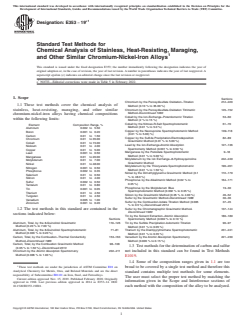
1.1 These test methods cover the chemical analysis of stainless, heat-resisting, maraging, and other similar chromium-nickel-iron alloys having chemical compositions within the following limits:
Element
Composition Range, %
Aluminum
0.002
to 5.50
Boron
0.001
to 0.20
Carbon
0.01
to 1.50
Chromium
0.01
to 35.00
Cobalt
0.01
to 15.00
Niobium
0.01
to 4.00
Copper
0.01
to 5.00
Lead
0.001
to 0.50
Manganese
0.01
to 20.00
Molybdenum
0.01
to 7.00
Nickel
0.01
to 48.00
Nitrogen
0.001
to 0.50
Phosphorus
0.002
to 0.35
Selenium
0.01
to 0.50
Silicon
0.01
to 4.00
Sulfur
0.002
to 0.50
Tantalum
0.01
to 0.80
Tin
0.001
to 0.05
Titanium
0.01
to 4.50
Tungsten
0.01
to 4.50
Vanadium
0.005
to 1.00
Zirconium
0.001
to 0.20
1.2 The test methods in this standard are contained in the sections indicated below:
Sections
Aluminum, Total, by the 8-Quinolinol Gravimetric Method (0.20 % to 7.00 %)
119–126
Aluminum, Total, by the 8-Quinolinol Spectrophotometric Method (0.003 % to 0.20 %)
71–81
Carbon, Total, by the Combustion–Thermal Conductivity Method–Discontinued 1986
153–163
Carbon, Total, by the Combustion Gravimetric Method (0.05 % to 1.50 %)–Discontinued 2013
98–108
Chromium by the Atomic Absorption Spectrometry Method (0.006 % to 1.00 %)
202–211
Chromium by the Peroxydisulfate Oxidation–Titration Method (0.10 % to 35.00 %)
212–220
Chromium by the Peroxydisulfate-Oxidation Titrimetric Method-Discontinued 1980
145–152
Cobalt by the Ion-Exchange–Potentiometric Titration Method (2 % to 15 %)
53–60
Cobalt by the Nitroso-R-Salt Spectrophotometric Method (0.01 % to 5.0 %)
61–70
Copper by the Neocuproine Spectrophotometric Method (0.01 % to 5.00) %)
109–118
Copper by the Sulfide Precipitation-Electrodeposition Gravimetric Method (0.01 % to 5.00 %)
82–89
Lead by the Ion-Exchange-Atomic Absorption Spectrometry Method (0.001 % to 0.50 %)
127–136
Manganese by the Periodate Spectrophotometric Method (0.01 % to 5.00 %)
9–18
Molybdenum by the Ion Exchange–8-Hydroxyquinoline Gravimetric Method
242–249
Molybdenum by the Thiocyanate Spectrophotometric Method (0.01 % to 1.50 %)
190–201
Nickel by the Dimethylglyoxime Gravimetric Method (0.1 % to 48.0 %)
172–179
Phosphorus by the Alkalimetric Method (0.02 % to 0.35 %)
164–171
Phosphorus by the Molybdenum Blue Spectrophotometric Method (0.002 % to 0.35 %)
19–30
Silicon by the Gravimetric Method (0.05 % to 4.00 %)
46–52
Sulfur by the Gravimetric Method-Discontinued 1988
30–36
Sulfur by the Combustion-Iodate Titration Method (0.005 % to 0.5 %)-Discontinued 2014
37–45
Sulfur by the Chromatographic Gravimetric Method-Discontinued 1980
137–144
Tin by the Solvent Extraction–Atomic Absorption Spectrometry Method (0.002 % to 0.10 %)
180–189
Tin by the Sulfide ...
- Status
- Published
- Publication Date
- 14-Nov-2019
- Technical Committee
- E01 - Analytical Chemistry for Metals, Ores, and Related Materials
- Drafting Committee
- E01.01 - Iron, Steel, and Ferroalloys
Overview
ASTM E353-19e1, titled Standard Test Methods for Chemical Analysis of Stainless, Heat-Resisting, Maraging, and Other Similar Chromium-Nickel-Iron Alloys, is a comprehensive standard developed by ASTM International. This standard outlines robust methods primarily used to determine the chemical composition of chromium-nickel-iron alloys, such as stainless and maraging steels, as well as other heat-resistant alloys. These test methods are recognized internationally and are primarily intended for use as referee methods to ensure compliance with compositional specifications, particularly those under ASTM Committee A01 on Steel, Stainless Steel, and Related Alloys.
Key Topics
- Scope of Application: Applies to the chemical analysis of alloys containing aluminum, boron, carbon, chromium, cobalt, copper, lead, manganese, molybdenum, nickel, nitrogen, phosphorus, selenium, silicon, sulfur, tantalum, tin, titanium, tungsten, vanadium, zirconium, and more, within specific compositional ranges.
- Analytical Methods:
- Gravimetric, spectrophotometric, potentiometric, atomic absorption spectrometry, and ion-exchange methods.
- Specified methods for elements such as aluminum, carbon, chromium, cobalt, copper, lead, manganese, molybdenum, nickel, phosphorus, silicon, sulfur, tin, titanium, vanadium, and zirconium.
- Not all elements are analyzed by a single method; the appropriate method should be chosen based on the alloy's composition and the method's applicability.
- Quality Control: Stresses the importance of conducting all analyses in properly equipped laboratories under appropriate quality control practices, such as those outlined in ASTM Guide E882.
- User Competence: Methods are intended for trained analysts skilled in laboratory procedures, ensuring reliable and accurate results.
- Safety: Users are responsible for observing relevant safety, health, and environmental practices and ensuring that all hazards are adequately addressed.
Applications
The ASTM E353-19e1 standard has important applications across multiple industries, especially where quality and performance of high-alloy steel are critical:
- Material Certification: Serves as a baseline for certifying stainless steels, heat-resistant alloys, and maraging steels during manufacturing and processing to verify that the material meets specified chemical composition requirements.
- Quality Assurance and Compliance: Commonly used for referee analysis in quality control laboratories to settle disputes or for third-party verification of alloy compositions.
- Metallurgical Research: Supports research and development by providing accurate methods to quantify alloy constituents, which is essential for alloy design and development.
- Regulatory and Contractual Conformance: Assures compliance with international and national specifications required for safety, performance, and reliability across aerospace, automotive, construction, power generation, and chemical processing sectors.
Related Standards
- ASTM E29: Practice for Using Significant Digits in Test Data to Determine Conformance with Specifications.
- ASTM E50: Practices for Apparatus, Reagents, and Safety Considerations for Chemical Analysis.
- ASTM E60: Practice for Analysis of Metals by Spectrophotometry.
- ASTM E173/E1601: Practices for Conducting Interlaboratory Studies of Methods for Chemical Analysis.
- ASTM E1019: Test Methods for Determination of Carbon, Sulfur, Nitrogen, and Oxygen in Steel, Iron, Nickel, and Cobalt Alloys.
- ASTM E882: Guide for Accountability and Quality Control in Chemical Analysis Laboratories.
- ASTM E1806: Practice for Sampling Steel and Iron for Determination of Chemical Composition.
- ISO 5725: Accuracy (trueness and precision) of measurement methods and results.
Practical Value
ASTM E353-19e1 provides highly reliable and validated test methods for chemical analysis, enabling manufacturers and laboratories to ensure that high-performance chromium-nickel-iron alloys conform to rigorous industry and regulatory standards. Accurate chemical characterization is vital for ensuring the safety, performance, and longevity of products used in critical applications. Adherence to these test methods also facilitates international trade and mutual recognition of materials through standardized practices.
Keywords: chemical analysis, stainless steel, heat-resisting alloys, maraging steel, chromium-nickel-iron alloys, spectrophotometric methods, gravimetric methods, quality control, ASTM E353, metallurgical analysis, compliance testing, alloy certification.
Relations
- Effective Date
- 15-Nov-2023
- Effective Date
- 15-Nov-2023
- Effective Date
- 01-Jan-2020
- Effective Date
- 01-Nov-2019
- Effective Date
- 15-May-2019
- Effective Date
- 01-Jul-2018
- Effective Date
- 01-Sep-2017
- Effective Date
- 01-Dec-2016
- Effective Date
- 01-Dec-2016
- Effective Date
- 01-Aug-2016
- Effective Date
- 15-May-2016
- Effective Date
- 01-Jul-2015
- Effective Date
- 15-May-2015
- Effective Date
- 15-Aug-2014
- Effective Date
- 01-Apr-2014
Get Certified
Connect with accredited certification bodies for this standard

Element Materials Technology
Materials testing and product certification.

Inštitut za kovinske materiale in tehnologije
Institute of Metals and Technology. Materials testing, metallurgical analysis, NDT.
Sponsored listings
Frequently Asked Questions
ASTM E353-19e1 is a standard published by ASTM International. Its full title is "Standard Test Methods for Chemical Analysis of Stainless, Heat-Resisting, Maraging, and Other Similar Chromium-Nickel-Iron Alloys". This standard covers: SIGNIFICANCE AND USE 4.1 These test methods for the chemical analysis of metals and alloys are primarily intended as referee methods to test such materials for compliance with compositional specifications, particularly those under the jurisdiction of ASTM Committee A01 on Steel, Stainless Steel, and Related Alloys. It is assumed that all who use these test methods will be trained analysts capable of performing common laboratory procedures skillfully and safely. It is expected that work will be performed in a properly equipped laboratory under appropriate quality control practices such as those described in Guide E882. SCOPE 1.1 These test methods cover the chemical analysis of stainless, heat-resisting, maraging, and other similar chromium-nickel-iron alloys having chemical compositions within the following limits: Element Composition Range, % Aluminum 0.002 to 5.50 Boron 0.001 to 0.20 Carbon 0.01 to 1.50 Chromium 0.01 to 35.00 Cobalt 0.01 to 15.00 Niobium 0.01 to 4.00 Copper 0.01 to 5.00 Lead 0.001 to 0.50 Manganese 0.01 to 20.00 Molybdenum 0.01 to 7.00 Nickel 0.01 to 48.00 Nitrogen 0.001 to 0.50 Phosphorus 0.002 to 0.35 Selenium 0.01 to 0.50 Silicon 0.01 to 4.00 Sulfur 0.002 to 0.50 Tantalum 0.01 to 0.80 Tin 0.001 to 0.05 Titanium 0.01 to 4.50 Tungsten 0.01 to 4.50 Vanadium 0.005 to 1.00 Zirconium 0.001 to 0.20 1.2 The test methods in this standard are contained in the sections indicated below: Sections Aluminum, Total, by the 8-Quinolinol Gravimetric Method (0.20 % to 7.00 %) 119–126 Aluminum, Total, by the 8-Quinolinol Spectrophotometric Method (0.003 % to 0.20 %) 71–81 Carbon, Total, by the Combustion–Thermal Conductivity Method–Discontinued 1986 153–163 Carbon, Total, by the Combustion Gravimetric Method (0.05 % to 1.50 %)–Discontinued 2013 98–108 Chromium by the Atomic Absorption Spectrometry Method (0.006 % to 1.00 %) 202–211 Chromium by the Peroxydisulfate Oxidation–Titration Method (0.10 % to 35.00 %) 212–220 Chromium by the Peroxydisulfate-Oxidation Titrimetric Method-Discontinued 1980 145–152 Cobalt by the Ion-Exchange–Potentiometric Titration Method (2 % to 15 %) 53–60 Cobalt by the Nitroso-R-Salt Spectrophotometric Method (0.01 % to 5.0 %) 61–70 Copper by the Neocuproine Spectrophotometric Method (0.01 % to 5.00) %) 109–118 Copper by the Sulfide Precipitation-Electrodeposition Gravimetric Method (0.01 % to 5.00 %) 82–89 Lead by the Ion-Exchange-Atomic Absorption Spectrometry Method (0.001 % to 0.50 %) 127–136 Manganese by the Periodate Spectrophotometric Method (0.01 % to 5.00 %) 9–18 Molybdenum by the Ion Exchange–8-Hydroxyquinoline Gravimetric Method 242–249 Molybdenum by the Thiocyanate Spectrophotometric Method (0.01 % to 1.50 %) 190–201 Nickel by the Dimethylglyoxime Gravimetric Method (0.1 % to 48.0 %) 172–179 Phosphorus by the Alkalimetric Method (0.02 % to 0.35 %) 164–171 Phosphorus by the Molybdenum Blue Spectrophotometric Method (0.002 % to 0.35 %) 19–30 Silicon by the Gravimetric Method (0.05 % to 4.00 %) 46–52 Sulfur by the Gravimetric Method-Discontinued 1988 30–36 Sulfur by the Combustion-Iodate Titration Method (0.005 % to 0.5 %)-Discontinued 2014 37–45 Sulfur by the Chromatographic Gravimetric Method-Discontinued 1980 137–144 Tin by the Solvent Extraction–Atomic Absorption Spectrometry Method (0.002 % to 0.10 %) 180–189 Tin by the Sulfide ...
SIGNIFICANCE AND USE 4.1 These test methods for the chemical analysis of metals and alloys are primarily intended as referee methods to test such materials for compliance with compositional specifications, particularly those under the jurisdiction of ASTM Committee A01 on Steel, Stainless Steel, and Related Alloys. It is assumed that all who use these test methods will be trained analysts capable of performing common laboratory procedures skillfully and safely. It is expected that work will be performed in a properly equipped laboratory under appropriate quality control practices such as those described in Guide E882. SCOPE 1.1 These test methods cover the chemical analysis of stainless, heat-resisting, maraging, and other similar chromium-nickel-iron alloys having chemical compositions within the following limits: Element Composition Range, % Aluminum 0.002 to 5.50 Boron 0.001 to 0.20 Carbon 0.01 to 1.50 Chromium 0.01 to 35.00 Cobalt 0.01 to 15.00 Niobium 0.01 to 4.00 Copper 0.01 to 5.00 Lead 0.001 to 0.50 Manganese 0.01 to 20.00 Molybdenum 0.01 to 7.00 Nickel 0.01 to 48.00 Nitrogen 0.001 to 0.50 Phosphorus 0.002 to 0.35 Selenium 0.01 to 0.50 Silicon 0.01 to 4.00 Sulfur 0.002 to 0.50 Tantalum 0.01 to 0.80 Tin 0.001 to 0.05 Titanium 0.01 to 4.50 Tungsten 0.01 to 4.50 Vanadium 0.005 to 1.00 Zirconium 0.001 to 0.20 1.2 The test methods in this standard are contained in the sections indicated below: Sections Aluminum, Total, by the 8-Quinolinol Gravimetric Method (0.20 % to 7.00 %) 119–126 Aluminum, Total, by the 8-Quinolinol Spectrophotometric Method (0.003 % to 0.20 %) 71–81 Carbon, Total, by the Combustion–Thermal Conductivity Method–Discontinued 1986 153–163 Carbon, Total, by the Combustion Gravimetric Method (0.05 % to 1.50 %)–Discontinued 2013 98–108 Chromium by the Atomic Absorption Spectrometry Method (0.006 % to 1.00 %) 202–211 Chromium by the Peroxydisulfate Oxidation–Titration Method (0.10 % to 35.00 %) 212–220 Chromium by the Peroxydisulfate-Oxidation Titrimetric Method-Discontinued 1980 145–152 Cobalt by the Ion-Exchange–Potentiometric Titration Method (2 % to 15 %) 53–60 Cobalt by the Nitroso-R-Salt Spectrophotometric Method (0.01 % to 5.0 %) 61–70 Copper by the Neocuproine Spectrophotometric Method (0.01 % to 5.00) %) 109–118 Copper by the Sulfide Precipitation-Electrodeposition Gravimetric Method (0.01 % to 5.00 %) 82–89 Lead by the Ion-Exchange-Atomic Absorption Spectrometry Method (0.001 % to 0.50 %) 127–136 Manganese by the Periodate Spectrophotometric Method (0.01 % to 5.00 %) 9–18 Molybdenum by the Ion Exchange–8-Hydroxyquinoline Gravimetric Method 242–249 Molybdenum by the Thiocyanate Spectrophotometric Method (0.01 % to 1.50 %) 190–201 Nickel by the Dimethylglyoxime Gravimetric Method (0.1 % to 48.0 %) 172–179 Phosphorus by the Alkalimetric Method (0.02 % to 0.35 %) 164–171 Phosphorus by the Molybdenum Blue Spectrophotometric Method (0.002 % to 0.35 %) 19–30 Silicon by the Gravimetric Method (0.05 % to 4.00 %) 46–52 Sulfur by the Gravimetric Method-Discontinued 1988 30–36 Sulfur by the Combustion-Iodate Titration Method (0.005 % to 0.5 %)-Discontinued 2014 37–45 Sulfur by the Chromatographic Gravimetric Method-Discontinued 1980 137–144 Tin by the Solvent Extraction–Atomic Absorption Spectrometry Method (0.002 % to 0.10 %) 180–189 Tin by the Sulfide ...
ASTM E353-19e1 is classified under the following ICS (International Classification for Standards) categories: 77.120.40 - Nickel, chromium and their alloys. The ICS classification helps identify the subject area and facilitates finding related standards.
ASTM E353-19e1 has the following relationships with other standards: It is inter standard links to ASTM E350-23, ASTM E352-23, ASTM E135-20, ASTM E1601-19, ASTM E135-19, ASTM E351-18, ASTM E50-17, ASTM E882-10(2016)e1, ASTM E882-10(2016), ASTM E50-11(2016), ASTM E135-16, ASTM E135-15a, ASTM E135-15, ASTM E135-14b, ASTM E135-14a. Understanding these relationships helps ensure you are using the most current and applicable version of the standard.
ASTM E353-19e1 is available in PDF format for immediate download after purchase. The document can be added to your cart and obtained through the secure checkout process. Digital delivery ensures instant access to the complete standard document.
Standards Content (Sample)
This international standard was developed in accordance with internationally recognized principles on standardization established in the Decision on Principles for the
Development of International Standards, Guides and Recommendations issued by the World Trade Organization Technical Barriers to Trade (TBT) Committee.
´1
Designation: E353 − 19
Standard Test Methods for
Chemical Analysis of Stainless, Heat-Resisting, Maraging,
and Other Similar Chromium-Nickel-Iron Alloys
This standard is issued under the fixed designation E353; the number immediately following the designation indicates the year of
original adoption or, in the case of revision, the year of last revision. A number in parentheses indicates the year of last reapproval. A
superscript epsilon (´) indicates an editorial change since the last revision or reapproval.
ε NOTE—Editorial corrections were made in Table 5 in February 2022.
1. Scope
Sections
Chromium by the Peroxydisulfate Oxidation–Titration 212–220
1.1 These test methods cover the chemical analysis of
Method (0.10 % to 35.00 %)
stainless, heat-resisting, maraging, and other similar Chromium by the Peroxydisulfate-Oxidation Titrimetric 145–152
Method-Discontinued 1980
chromium-nickel-iron alloys having chemical compositions
Cobalt by the Ion-Exchange–Potentiometric Titration 53–60
within the following limits:
Method (2%to15%)
Cobalt by the Nitroso-R-Salt Spectrophotometric 61–70
Element Composition Range, %
Method (0.01 % to 5.0 %)
Aluminum 0.002 to 5.50
Copper by the Neocuproine Spectrophotometric Method 109–118
Boron 0.001 to 0.20
(0.01%to5.00)%)
Carbon 0.01 to 1.50
Copper by the Sulfide Precipitation-Electrodeposition 82–89
Chromium 0.01 to 35.00
Gravimetric Method (0.01 % to 5.00 %)
Cobalt 0.01 to 15.00
Lead by the Ion-Exchange-Atomic Absorption 127–136
Niobium 0.01 to 4.00
Spectrometry Method (0.001 % to 0.50 %)
Copper 0.01 to 5.00
Manganese by the Periodate Spectrophotometric 9–18
Lead 0.001 to 0.50
Method (0.01 % to 5.00 %)
Manganese 0.01 to 20.00
Molybdenum by the Ion Exchange–8-Hydroxyquinoline 242–249
Molybdenum 0.01 to 7.00
Gravimetric Method
Nickel 0.01 to 48.00
Molybdenum by the Thiocyanate Spectrophotometric 190–201
Nitrogen 0.001 to 0.50
Method (0.01 % to 1.50 %)
Phosphorus 0.002 to 0.35
Nickel by the Dimethylglyoxime Gravimetric Method (0.1 172–179
Selenium 0.01 to 0.50
%to48.0%)
Silicon 0.01 to 4.00
Phosphorus by the Alkalimetric Method (0.02 % to 164–171
Sulfur 0.002 to 0.50
0.35 %)
Tantalum 0.01 to 0.80
Phosphorus by the Molybdenum Blue 19–30
Tin 0.001 to 0.05
Spectrophotometric Method (0.002 % to 0.35 %)
Titanium 0.01 to 4.50
Silicon by the Gravimetric Method (0.05 % to 4.00 %) 46–52
Tungsten 0.01 to 4.50
Sulfur by the Gravimetric Method-Discontinued 1988 30–36
Vanadium 0.005 to 1.00
Sulfur by the Combustion-Iodate Titration Method (0.005 37–45
Zirconium 0.001 to 0.20
%to0.5%)-Discontinued 2014
1.2 The test methods in this standard are contained in the Sulfur by the Chromatographic Gravimetric Method- 137–144
Discontinued 1980
sections indicated below:
Tin by the Solvent Extraction–Atomic Absorption 180–189
Sections
Spectrometry Method (0.002 % to 0.10 %)
Aluminum, Total, by the 8-Quinolinol Gravimetric 119–126 Tin by the Sulfide Precipitation-Iodometric Titration 90–97
Method (0.20 % to 7.00 %)
Method (0.01 % to 0.05 %)
Aluminum, Total, by the 8-Quinolinol Spectrophotometric 71–81 Titanium by the Diantipyrylmethane Spectrophotometric 231–241
Method (0.003 % to 0.20 %)
Method (0.01 % to 0.35 %)
Carbon, Total, by the Combustion–Thermal Conductivity 153–163 Vanadium by the Atomic Absorption Spectrometry 221–230
Method–Discontinued 1986
Method (0.006 % to 0.15 %)
Carbon, Total, by the Combustion Gravimetric Method 98–108
1.3 Test methods for the determination of carbon and sulfur
(0.05 % to 1.50 %)–Discontinued 2013
Chromium by the Atomic Absorption Spectrometry 202–211 not included in this standard can be found in Test Methods
Method (0.006 % to 1.00 %)
E1019.
1.4 Some of the composition ranges given in 1.1 are too
broad to be covered by a single test method and therefore this
These test methods are under the jurisdiction of ASTM Committee E01 on
Analytical Chemistry for Metals, Ores, and Related Materials and are the direct
standard contains multiple test methods for some elements.
responsibility of Subcommittee E01.01 on Iron, Steel, and Ferroalloys.
The user must select the proper test method by matching the
Current edition approved Nov. 15, 2019. Published February 2020. Originally
information given in the Scope and Interference sections of
approved in 1968. Last previous edition approved in 2014 as E353–14. DOI:
10.1520/E0353-19E01. each method with the composition of the alloy to be analyzed.
Copyright © ASTM International, 100 Barr Harbor Drive, PO Box C700, West Conshohocken, PA 19428-2959. United States
´1
E353 − 19
1.5 The values stated in SI units are to be regarded as E1806 Practice for Sampling Steel and Iron for Determina-
standard. tion of Chemical Composition
2.2 Other Document:
1.6 This standard does not purport to address all of the
ISO 5725 Precision of Test Methods—Determination of
safety concerns, if any, associated with its use. It is the
Repeatability and Reproducibility for Inter-Laboratory
responsibility of the user of this standard to establish appro-
Tests
priate safety, health, and environmental practices and deter-
mine the applicability of regulatory limitations prior to use.
3. Terminology
Specific hazards statements are given in Section 6 and in
special “Warning” paragraphs throughout these test methods.
3.1 For definitions of terms used in these test methods, refer
1.7 This international standard was developed in accor- to Terminology E135.
dance with internationally recognized principles on standard-
4. Significance and Use
ization established in the Decision on Principles for the
Development of International Standards, Guides and Recom-
4.1 These test methods for the chemical analysis of metals
mendations issued by the World Trade Organization Technical
and alloys are primarily intended as referee methods to test
Barriers to Trade (TBT) Committee.
such materials for compliance with compositional
specifications, particularly those under the jurisdiction of
2. Referenced Documents
ASTM Committee A01 on Steel, Stainless Steel, and Related
2.1 ASTM Standards:
Alloys. It is assumed that all who use these test methods will
D1193 Specification for Reagent Water
be trained analysts capable of performing common laboratory
E29 Practice for Using Significant Digits in Test Data to
proceduresskillfullyandsafely.Itisexpectedthatworkwillbe
Determine Conformance with Specifications
performed in a properly equipped laboratory under appropriate
E50 Practices for Apparatus, Reagents, and Safety Consid-
quality control practices such as those described in Guide
erations for Chemical Analysis of Metals, Ores, and
E882.
Related Materials
E60 Practice for Analysis of Metals, Ores, and Related 5. Apparatus, Reagents, and Instrumental Practices
Materials by Spectrophotometry
5.1 Apparatus—Specialized apparatus requirements are
E135 Terminology Relating to Analytical Chemistry for
listed in the “Apparatus” Section in each method.
Metals, Ores, and Related Materials
5.1.1 In the methods specifying spectrophotometric testing,
E173 Practice for Conducting Interlaboratory Studies of
the cells utilized to contain the reference material solutions and
Methods for Chemical Analysis of Metals (Withdrawn
the sample solutions in spectrophotometers are referred to as
1998)
“absorption cells.” Please note that the radiant energy passed
E350 Test Methods for Chemical Analysis of Carbon Steel,
through the cells can be measured as absorbance or transmit-
Low-Alloy Steel, Silicon Electrical Steel, Ingot Iron, and
tance.These methods refer to absorbance measurements. Refer
Wrought Iron
to Practices E60 for details.
E351 Test Methods for ChemicalAnalysis of Cast Iron—All
5.2 Reagents:
Types
5.2.1 Purity of Reagents—Unless otherwise indicated, all
E352 TestMethodsforChemicalAnalysisofToolSteelsand
reagents used in these test methods shall conform to the
Other Similar Medium- and High-Alloy Steels
“Reagent Grade” Specifications of the American Chemical
E354 Test Methods for Chemical Analysis of High-
Society. Other chemicals may be used, provided it is first
Temperature,Electrical,Magnetic,andOtherSimilarIron,
ascertained that they are of sufficiently high purity to permit
Nickel, and Cobalt Alloys
their use without adversely affecting the expected performance
E882 Guide for Accountability and Quality Control in the
of the determination, as indicated in the Precision and Bias
Chemical Analysis Laboratory
section.
E1019 Test Methods for Determination of Carbon, Sulfur,
5.2.2 Purity of Water—Unless otherwise indicated, refer-
Nitrogen, and Oxygen in Steel, Iron, Nickel, and Cobalt
ences to water shall mean reagent water as conforming toType
Alloys by Various Combustion and Inert Gas Fusion
IorTypeIIofSpecificationD1193.TypeIIIorIVmaybeused
Techniques
if they effect no measurable change in the blank or sample.
E1024 Guide for Chemical Analysis of Metals and Metal
Bearing Ores by Flame Atomic Absorption Spectropho- 5.3 Spectrophotometric Practice—Spectrophotometric
tometry (Withdrawn 2004) practice prescribed in these test methods shall conform to
E1601 Practice for Conducting an Interlaboratory Study to Practice E60.
Evaluate the Performance of an Analytical Method
Available fromAmerican National Standards Institute (ANSI), 25 W. 43rd St.,
For referenced ASTM standards, visit the ASTM website, www.astm.org, or 4th Floor, New York, NY 10036, www.ansi.org.
contact ASTM Customer Service at service@astm.org. For Annual Book of ASTM “Reagent Chemicals, American Chemical Society Specifications,” American
Standards volume information, refer to the standard’s Document Summary page on Chemical Society, Washington, DC, www.acs.org. For suggestions on the testing of
the ASTM website. Reagents not listed by the American Chemical Society, see the United States
The last approved version of this historical standard is referenced on Pharmacopeia and National Formulary, U.S. Pharmacopeial Convention, Inc.
www.astm.org. (USPC), Rockville, MD, www.uspnf.com.
´1
E353 − 19
6. Hazards precautions must be observed when filter spectrophotometers
are used: Select a filter with maximum transmittance between
6.1 For precautions to be observed in the use of certain
545nmand565nm.Thefiltermusttransmitnotmorethan5 %
reagents and equipment in these methods, refer to Practices
ofitsmaximumatawavelengthshorterthan530nm.Theband
E50.
width of the filter should be less than 30 nm when measured at
50 % of its maximum transmittance. Similar restrictions apply
7. Sampling
with respect to the wavelength region employed when other
7.1 For procedures to sample the material, refer to Practice
“wide-band” instruments are used.
E1806.
13.2 The spectral transmittance curve of permanganate ions
8. Interlaboratory Studies and Rounding Calculated
exhibits two useful minima, one at approximately 526 nm, and
Values
the other at 545 nm. The latter is recommended when a
“narrow-band” spectrophotometer is used.
8.1 These test methods have been evaluated as directed in
Practice E173 (withdrawn 1997) or ISO 5725. Practice E173
13.3 Tungsten,whenpresentinamountsofmorethan0.5 %
has been replaced by Practice E1601. The reproducibility, R2,
interferes by producing a turbidity in the final solution. A
of Practice E173 corresponds to the reproducibility index R of
special procedure is provided for use with samples containing
Practice E1601. The repeatability, R1, of Practice E173 corre-
more than 0.5 % tungsten which eliminates the problem by
sponds to the repeatability index, r, of Practice E1601.
preventing the precipitation of the tungsten.
8.2 Rounding of test results obtained using this test method
14. Reagents
shall be performed as directed in ASTM E29, Rounding
Method, unless an alternative rounding method is specified by
14.1 Manganese, Standard Solution (1 mL = 0.032 mg
the customer or applicable material specification.
Mn)—Transfer the equivalent of 0.4000 g of assayed, high-
purity manganese (purity: 99.99 % minimum), to a 500-mL
MANGANESE BY THE META PERIODATE
volumetric flask and dissolve in 20 mL of HNO by heating.
SPECTROPHOTOMETRIC METHOD
Cool, dilute to volume, and mix. Using a pipet, transfer 20 mL
to a 500-mL volumetric flask, dilute to volume, and mix.
9. Scope
14.2 Nitric-Phosphoric Acid Mixture—Cautiously, while
9.1 This method covers the determination of manganese
stirring, add 100 mL of HNO and 400 mL of H PO to 400
3 3 4
from 0.01 % to 5.00 %.
mL of water. Cool, dilute to 1 L, and mix. Prepare fresh as
10. Summary of Method needed.
10.1 Manganous ions are oxidized to permanganate ions by
14.3 Potassium Metaperiodate Solution(7.5g/L)—Dissolve
treatment with periodate. Tungsten when present at composi- 7.5 g of potassium metaperiodate (KIO ) in 200 mL of hot
tions greater than 0.5 % is kept in solution with H PO . HNO (1 + 1), add 400 mL of H PO , cool, dilute to 1 L, and
3 4
3 3 4
Solutions of the samples are fumed with HClO so that the mix.
effect of periodate is limited to the oxidation of manganese.
14.4 Water, Pretreated with Metaperiodate—Add 20 mL of
Spectrophotometric absorbance measurement is made at 545
KIO solution to 1 L of water, mix, heat at not less than 90°C
nm.
for 20 min to 30 min, and cool. Use this water to dilute
solutions to volume that have been treated with KIO solution
11. Concentration Range
to oxidize manganese, and thus avoid reduction of permangan-
11.1 The recommended concentration range is 0.15 mg to
ate ions by any reducing agents in the untreated water.
0.8 mg of manganese per 50 mL of solution, using a 1-cm cell
Caution—Avoid the use of this water for other purposes.
(see Note 1) and a spectrophotometer with a band width of 10
nm or less.
15. Preparation of Calibration Curve
NOTE 1—This method has been written for cells having a 1-cm light
15.1 Calibration Solutions—Using pipets, transfer 5 mL, 10
path and a “narrow-band” instrument. The concentration range depends
mL,15mL,20mL,and25mLofmanganesestandardsolution
upon band width and spectral region used as well as cell optical path
(1 mL = 0.032 mg Mn) to 50-mL borosilicate glass volumetric
length. Cells having other dimensions may be used, provided suitable
flasks, and if necessary, dilute to approximately 25 mL.
adjustments can be made in the amounts of sample and reagents used.
Proceed as directed in 15.3.
12. Stability of Color
15.2 Reference Solution—Transfer approximately 25 mL of
12.1 The color is stable for at least 24 h.
water to a 50-mL borosilicate glass volumetric flask. Proceed
as directed in 15.3.
13. Interferences
15.3 Color Development—Add 10 mL of KIO solution,
13.1 HClO treatment, which is used in the procedure,
and heat the solutions at not less than 90°C for 20 min to 30
yields solutions which can be highly colored due to the
min (Note 2). Cool, dilute to volume with pretreated water, and
presenceofCr(VI)ions.Althoughtheseionsandothercolored
mix.
ions in the sample solution undergo no further change in color
quality upon treatment with metaperiodate ion, the following NOTE 2—Immersing the flasks in a boiling water bath is a preferred
´1
E353 − 19
means of heating them for the specified period to ensure complete color
50 mL of water, and digest, if necessary, to dissolve the salts.
development.
Transfer the solution to either a 100-mLor 500-mLvolumetric
15.4 Spectrophotometry: flask as directed in 16.1. Proceed to 16.2.2.
15.4.1 Multiple-Cell Spectrophotometer—Measure the cell 16.2.1.2 For samples whose dissolution is hastened by HF:
correction using the Reference Solution (15.2) in absorption Add8mLto10mlofH PO , 10 mLof HClO ,5mLto6mL
3 4 4
cells with a 1-cm light path and using a light band centered at ofH SO ,3mLto4mLofHNO ,andafewdropsofHF.Heat
2 4 3
545 nm. Using the test cell, take the spectrophotometric moderately until the sample is decomposed, and then heat to
absorbance readings of the calibration solutions versus the copious white fumes for 10 min to 12 min or until the
Reference Solution (15.2). chromium is oxidized and the HCl is expelled, but avoid
15.4.2 Single-Cell Spectrophotometer—Transfer a suitable heating to fumes or SO . Cool, add 50 mL of water, digest, if
portion of the Reference Solution (15.2) to an absorption cell necessary, to dissolve the salts, cool, and transfer the solution
with a 1-cm light path and adjust the spectrophotometer to the to a 100-mL or 500-mL volumetric flask as directed in 16.1.
initial setting, using a light band centered at 545 nm. While Proceed to 16.2.2.
maintaining this adjustment, take the spectrophotometric 16.2.2 Cool the solution to room temperature, dilute to
abosrbance readings of the calibration solutions. volume, and mix.Allow insoluble matter to settle, or dry-filter
through a coarse paper and discard the first 15 mLto 20 mLof
15.5 Calibration Curve—Follow the instrument manufac-
the filtrate, before taking aliquots.
turer’s instructions for generating the calibration curve. Plot
16.2.3 Using a pipet, transfer 10 mL to 20 mL aliquots as
the net spectrophotometric absorbance readings of the calibra-
specified in 16.1 to two 50-mL borosilicate glass volumetric
tion solutions against the milligrams of manganese per 50 mL
flasks. Treat one portion as directed in 16.4. Treat the other
of solution.
portion as directed in 16.5.1.
16. Procedure
16.3 Reagent Blank Solution—Carry a reagent blank
through the entire procedure using the same amounts of all
16.1 Test Solution—Select and weigh a sample as follows:
reagents with the sample omitted.
Tolerance in
Sample Sample Dilution, Aliquot
16.4 Color Development—Proceed as directed in 15.3.
Manganese, % Mass, g Mass, mg mL Volume, mL
16.5 Reference Solutions:
0.01 to 0.5 0.80 0.5 100 20
16.5.1 Background Color Solution—To one of the sample
0.45 to 1.0 0.35 0.3 100 20
aliquots in a 50-mL volumetric flask, add 10 mL of HNO -
0.85 to 2.0 0.80 0.5 500 20
1.95 to 5.0 0.80 0.5 500 10
H PO mixture, and heat the solution at not less than 90 °C for
3 4
20 min to 30 min (Note 2). Cool, dilute to volume (with
Transfer it to a 300-mL Erlenmeyer flask.
untreated water), and mix.
16.1.1 TodissolvesamplesthatdonotrequireHF,add8mL
16.5.2 Reagent Blank Reference Solution—Transfer the re-
to 10 mL of HCl (1 + 1), and heat. Add HNO as needed to
agent blank solution (16.3) to the same size volumetric flask as
hasten dissolution, and then add 3 mLto 4 mLin excess.When
used for the test solutions and transfer the same size aliquots as
dissolution is complete, cool, then add 10 mL of HClO ;
used for the test solutions to two 50-mL volumetric flasks.
evaporate to fumes to oxidize chromium, if present, and to
Treat one portion as directed in 16.4 and use as reference
expel HCl. Continue fuming until salts begin to separate. Cool,
solution for test samples. Treat the other as directed in 16.5.1
add 50 mL of water, and digest if necessary to dissolve the
and use as reference solution for Background Color Solutions.
salts. Cool and transfer the solution to either a 100-mL or
16.6 Spectrophotometry—Establish the cell corrections with
500-mL volumetric flask as indicated in 16.1. Proceed to
the Reagent Blank Reference solution to be used as a reference
16.2.2.
solution for Background Color solutions. Take the spectropho-
16.2 For samples whose dissolution is hastened by HF, add
tometric absorbance readings of the Background Color Solu-
8 mLto 10 mLof HCl (1 + 1), and heat.Add HNO and a few
tionsandthetestsolutionsversustherespectiveReagentBlank
dropsofHFasneededtohastendissolution,andthenadd3mL
Reference Solutions as directed in 15.4.
to4mLofHNO .Whendissolutioniscomplete,cool,thenadd
10 mL of HClO , evaporate to fumes to oxidize chromium, if
17. Calculation
present, and to expel HCl. Continue fuming until salts begin to
17.1 Convertthenetspectrophotometricabsorbancereading
separate. Cool, add 50 mL of water, digest if necessary to
of the test solution and of the background color solution to
dissolve the salts, cool, and transfer the solution to either a
milligrams of manganese by means of the calibration curve.
100-mL or 500-mL volumetric flask as indicated in 16.1.
Calculate the percentage of manganese as follows:
Proceed to 16.2.2.
16.2.1 For Samples Containing More Than 0.5 % Tungsten: Manganese, % 5 A 2 B / C 310 (1)
~ ! ~ !
16.2.1.1 To dissolve samples that do not require HF, add 8
where:
mL to 10 mL of H PO , 10 mL of HClO,5mLto6mLof
3 4 4
A = manganese, mg, found in 50 mL of the final test
H SO ,and3mLto4mLofHNO . Heat moderately until the
2 4 3
solution,
sample is decomposed, and then heat to copious white fumes
B = apparent manganese, mg, found in 50 mL of the final
for 10 min to 12 min or until the chromium is oxidized and the
background color solution, and
HCl is expelled, but avoid heating to fumes of SO . Cool, add
´1
E353 − 19
22. Stability of Color
C = sample mass, g, represented in 50 mL of the final test
solution.
22.1 The molybdenum blue complex is stable for at least 2
h.
18. Precision and Bias
23. Interferences
18.1 Precision—Nine laboratories cooperated in testing this
method and obtained the data summarized in Table 1.
23.1 None of the elements usually present interfere except
arsenic, which is removed by volatilization as the bromide.
18.2 Bias—The accuracy of this test method has been
deemed satisfactory based upon the data for the certified
24. Apparatus
reference materials in Table 1. Users are encouraged to use
24.1 Glassware must be phosphorus-and arsenic-free. Boil
these or similar reference materials to verify that the test
the glassware with HCl and rinse with water before use. It is
method is performing accurately in their laboratories.
recommended that the glassware used for this determination be
PHOSPHORUS BY THE MOLYBDENUM BLUE
reserved for this use only. Many detergents contain phosphorus
SPECTROPHOTOMETRIC METHOD
and must not be used for cleaning purposes.
19. Scope
25. Reagents
19.1 This method covers the determination of phosphorus
25.1 Ammonium Molybdate Solution (20 g/L)—Cautiously,
from 0.002 % to 0.35 %.
while stirring and cooling, add 300 mLof H SO to 500 mLof
2 4
water and cool. Add 20 g of ammonium heptamolybdate
20. Summary of Method
(NH ) Mo O ·4H O), cautiously dilute to 1 L, and mix.
4 6 7 24 2
20.1 The sample is dissolved in mixed acids and the
25.2 Ammonium Molybdate-Hydrazine Sulfate Solution—
solution is fumed with HClO .Ammonium molybdate is added
Dilute 250 mL of the ammonium molybdate solution to 600
to react with the phosphorus to form the heteropoly phospho-
mL, add 100 mL of the hydrazine sulfate solution, dilute to 1
molybdate. This species is then reduced with hydrazine sulfate
L, and mix. Do not use a solution that has stood for more than
to form the molybdenum blue complex. Spectrophotometric
1h.
absorbance measurement is made at 650 nm or 825 nm,
25.3 Hydrazine Sulfate Solution (1.5 g/L)—Dissolve 1.5 g
depending upon the concentration.
of hydrazine sulfate ((NH ) · H2SO4) in water, dilute to 1 L,
2 2
and mix. Discard any unused solution after 24 h.
21. Concentration Range
25.4 Phosphorus Standard Solution A (1 mL = 1.0 mg
21.1 The recommended concentration range is from 0.005
P)—Transfer 2.292 g of anhydrous disodium hydrogen phos-
mg to 0.05 mg of phosphorus per 100 mL of solution when
phate (Na HPO ), previously dried to constant mass at 105 °C,
2 4
measuredat825nmandfrom0.05mgto0.3mgofphosphorus
to a 500-mL volumetric flask; dissolve in about 100 mL of
per 100 mL of solution when measured at 650 nm, using a
water, dilute to volume, and mix.
1-cm cell.
25.5 Phosphorus Standard Solution B (1 mL = 0.01 mg
NOTE3—Thistestmethodhasbeenwrittenforcellshavinga1-cmlight
P)—Using a pipet, transfer 10 mL of Solution A (1 mL = 1.0
path. Cells having other dimensions may be used, provided suitable
mg P) to a 1-L volumetric flask, add 50 mL of HClO (1 + 5),
adjustments are made in the amounts of sample and reagents used.
dilute to volume, and mix.
25.6 Phosphorus Standard Solution C (1 mL = 0.10 mg
P)—Using a pipet, transfer 50 mL of Solution A (1 mL = 1.0
TABLE 1 Statistical Information—Manganese by the
Metaperiodate Spectrophotometric Method mg P) to a 500-mL volumetric flask, add 50 mL of HClO (1
+ 5), dilute to volume, and mix.
Manganese Reproducibil-
Test Repeatability
Found, ity
, E173)
Material (R
1 25.7 Sodium Sulfite Solution (100 g/L)—Dissolve 100 g of
% (R , E173)
sodium sulfite (Na SO ) in water, dilute to 1 L, and mix.
1. Maraging steel 0.020 0.005 0.007 2 3
18Ni-8Co-5Mo
2. Maraging steel 0.209 0.009 0.017
26. Preparation of Calibration Curve for Concentrations
(NIST 1156, 0.21
from 0.005 mg/100 mL to 0.05 mg/100 mL
Mn)
3. Stainless steel 0.208 0.008 0.016
26.1 Calibration Solutions—Using pipets, transfer 5 mL, 10
24Cr-13Ni (NIST
mL, 15 mL, 25 mL, and 50 mL of Phosphorus Standard
447, 0.23 Mn)
4. Stainless steel 1.79 0.04 0.06 Solution B (1 mL = 0.01 mg P) to 100-mL volumetric flasks.
18Cr-9Ni (NIST
Add20mLofHClO ,dilutetovolume,andmix.Usingapipet,
101e, 1.77 Mn)
transfer 10 mL of each solution to a 100-mL borosilicate glass
5. Stainless steel 3.37 0.05 0.11
18.5Cr-9.5Ni (NIST
volumetric flask. Proceed as directed in 26.3.
443, 3.38 Mn)
26.2 Reagent Blank—Transfer 12 mLof HClO (1+5)toa
6. Stainless steel 4.60 0.04 0.13
20.5Cr-10Ni (NIST
100-mL borosilicate glass volumetric flask.
444, 4.62 Mn)
26.3 Color Development:
´1
E353 − 19
26.3.1 Add 15 mL of Na SO solution, boil gently for 30 s, the net spectrophotometric absorbance readings of the calibra-
2 3
and add 50 mL of ammonium molybdate-hydrazine sulfate tionsolutionsagainstthemilligramsofphosphorusper100mL
solution that has been prepared within the hour. of solution.
26.3.2 Heat the solutions at not less than 90 °C for 20 min,
quickly cool, dilute to volume, and mix. 28. Procedure
28.1 For Samples Containing Less Than 0.5 % Tungsten:
NOTE 4—Immersing the flasks in a boiling water bath is the preferred
means of heating them for complete color development.
28.1.1 Test Solution:
28.1.1.1 For compositions not greater than 0.30 %
26.4 Reference Solution—Water.
phosphorus, use a 1.0-g sample; for the composition range
26.5 Spectrophotometry:
from0.30%to0.35%phosphorus,usea0.85-gsample.Weigh
26.5.1 Multiple-Cell Spectrophotometer—Measure the re-
the sample to the nearest 0.5 mg, and transfer it to a 250-mL
agent blank (which includes the cell correction) versus the
Erlenmeyer flask.
reference solution (26.4) using absorption cells with a 1-cm
28.1.1.2 Add 15 mL of a freshly prepared mixture of 1
light path and using a light band centered at 825 nm. Using the
volume of HNO and 3 volumes of HCl, slowly and in small
test cell, take the spectrophotometric absorbance readings of
portions. When the reaction has ceased, add 10 mL of HClO
the calibration solutions versus the reference solution.
and evaporate to fumes. Remove the flask immediately to
26.5.2 Single-Cell Spectrophotometer—Transfer a suitable
, cool, and add 20 mL of HBr (1 +
avoid undue loss of HClO
portion of the reference solution (26.4) to an absorption cell
4). Evaporate the solution to copious white fumes and then,
with a 1-cm light path and adjust the spectrophotometer to the
without delay, fume strongly enough to cause the white fumes
initial setting using a light band centered at 825 nm. While
tocleartheneckoftheflask,andcontinueatthisratefor1min.
maintaining this adjustment, take the spectrophotometric ab-
28.1.1.3 Coolthesolution,add60mLofHClO (1+5),and
sorbance readings of the reagent blank solution and of the
swirl to dissolve the salts. Transfer to a 100-mL volumetric
calibration solutions.
flask, cool, dilute to volume, and mix. Allow insoluble matter
26.6 Calibration Curve—Follow the instrument manufac- to settle or dry filter the solution. Using a pipet, transfer 10-mL
portions to two 100-mL borosilicate glass volumetric flasks;
turer’s instructions for generating the calibration curve. Plot
the net spectrophotometric absorbance readings of the calibra- treat one as directed in 28.1.3 and the other as directed in
28.1.4.2.
tionsolutionsagainstthemilligramsofphosphorusper100mL
of solution. 28.1.2 Reagent Blank Solution—Carry a reagent blank
through the entire procedure using the same amount of all
reagents with the sample omitted.
27. Preparation of Calibration Curve for Concentrations
28.1.3 Color Development—Proceed with one of the 10-mL
from 0.05 mg/100 mL to 0.30 mg/100 mL
portions obtained in 28.1.1.3, as directed in 26.3.
27.1 —Calibration Solutions—Using pipets, transfer 5 mL,
28.1.4 Reference Solutions:
10 mL, 15 mL, 20 mL, 25 mL, and 30 mL of Phosphorus
28.1.4.1 Water—Use this as the reference solution for the
Standard Solution C (1 mL= 0.10 mg P) to 100-mLvolumetric
reagent blank solution.
flasks.Add 20 mLof HClO , dilute to volume, and mix. Using
28.1.4.2 Background Color Reference Solution—Add 15
a pipet, transfer 10 mL of each solution to a 100-mL borosili-
mL of Na SO solution to the second 10-mL portion obtained
2 3
cate glass volumetric flask.
in 28.1.1.3. Boil gently for 30 s, add 50 mLof H SO (3 + 37),
2 4
27.2 Reagent Blank—Proceed as directed in 26.2.
cool, dilute to volume, and mix. Use this as the reference
solution for the test solution.
27.3 Color Development—Proceed as directed in 26.3.
28.1.5 Spectrophotometry—Take the spectrophotometric
27.4 Reference Solution—Water.
absorbance readings of the reagent blank solution and of the
27.5 Spectrophotometry:
test solution (using the respective reference solutions) as
27.5.1 Multiple-Cell Spectrophotometer—Measure the re- directed in 26.5 or 27.5 depending upon the estimated compo-
agent blank (which includes the cell correction) versus the sition of phosphorus in the sample.
reference solution (27.4) using absorption cells with a 1-cm
light path and a light band centered at 650 nm. Using the test
cell, take the spectrophotometric absorbance readings of the
28.2 For Samples Containing More Than 0.5 % Tungsten:
calibration solutions versus the reference solution.
28.2.1 Test Solution:
27.5.2 Single-Cell Spectrophotometer—Transfer a suitable
28.2.1.1 For compositions not greater than 0.30 %
portion of the reference solution (27.4) to an absorption cell
phosphorus, transfer 0.100-g samples, weighed to the nearest
with a 1-cm light path and adjust the spectrophotometer to the
0.1 mg, to two 100-mLErlenmeyer flasks; for the composition
initial setting using a light band (no change) centered at 650
range from 0.30 % to 0.35 % phosphorus, transfer 0.085-g
nm. While maintaining this adjustment, take the spectrophoto-
samples, weighed to the nearest 0.1 mg, to two 100-mL
metricabsorbancereadingsofthereagentblanksolutionandof
Erlenmeyer flasks.
the calibration solutions.
28.2.1.2 Add 5 mL of a mixture of 1 volume of HNO and
27.6 Calibration Curve—Follow the instrument manufac- 3 volumes of HCl. When the reaction has ceased, add 2.5 mL
turer’s instructions for generating the calibration curve. Plot of HClO and 5 mL of HBr (1 + 4). Evaporate the solutions to
´1
E353 − 19
copious white fumes; then, without delay, fume strongly
enough to cause the white fumes to clear the neck of the flasks,
SULFUR BY THE COMBUSTION-IODATE
and continue at this rate for 1 min.
TITRATION METHOD
28.2.1.3 Cool the solutions, and add 10 mL of water. Filter
(This method, which consisted of Sections 37 through 45 of
through a 9-cm fine paper collecting the filtrate in a 100-mL
this standard, was discontinued in 2014.)
borosilicate glass volumetric flask. Wash the paper and in-
soluble matter 5 times with 3-mL portions of water. Treat one
SILICON BY THE GRAVIMETRIC METHOD
solution as directed in 28.2.3 and the other as directed in
28.2.4.
46. Scope
28.2.2 Reagent Blank Solution—Proceed as directed in
46.1 This method covers the determination of silicon from
28.2.1.2 and 28.2.1.3.
0.05 % to 4.00 %.
28.2.3 Color Development—Proceed as directed in 26.3.
28.2.4 Reference Solutions:
47. Summary of Method
28.2.4.1 Water—Use this as the reference solution for the
47.1 After dissolution of the sample, silicic acid is dehy-
reagent blank solution.
drated by fuming with H SO or HClO . The solution is
28.2.4.2 Background Color Reference Solution—Add 15
2 4 4
filtered,andtheimpuresilicaisignitedandweighed.Thesilica
mL of Na SO solution to the second 10-mL portion obtained
2 3
is then volatilized with HF.The residue is ignited and weighed;
in 28.2.1.3. Boil gently for 30 s, add 50 mLof H SO (3 + 37),
2 4
the loss in mass represents silica.
cool, dilute to volume, and mix. Use this as the reference
solution for the test solution.
48. Interferences
28.2.5 Spectrophotometry—Proceed as directed in 28.1.5.
48.1 The elements normally present do not interfere if their
29. Calculation
compositions are under the maximum limits shown in 1.1.
29.1 Convertthenetspectrophotometricabsorbancereading
of the test solution and of the reagent blank solution to
49. Reagents
milligrams of phosphorus by means of the appropriate calibra-
49.1 The analyst should ensure by analyzing blanks and
tion curve. Calculate the percent of phosphorus as follows:
other checks that possible silicon contamination of reagents
will not significantly bias the results.
phosphorus, % 5 A 2 B ⁄ C 3 10 (2)
~ ! ~ !
49.2 Perchloric Acid:
where:
49.2.1 Select a lot of HClO that contains not more than
A = phosphorus found in 100 mL of the final test solution,
0.0002 % silicon for the analysis of samples containing silicon
mg,
in the range from 0.02 % to 0.10 % and not more than 0.0004
B = phosphorus found in 100 mL of the final reagent blank
% silicon for samples containing more than 0.10 % by
solution, mg, and
determining duplicate values for silicon as directed in
C = sample represented in 100 mL of the final test solution,
49.2.2–49.2.6.
g.
49.2.2 Transfer 15 mL of HClO (Note 5) to each of two
30. Precision and Bias
400-mL beakers. To one of the beakers transfer an additional
50 mL of HClO . Using a pipet, transfer 20 mL of Na SiO
4 2 3
30.1 Precision—Nine laboratories cooperated in testing this
solution (1 mL= 1.00 mg Si) to each of the beakers. Evaporate
method and obtained the data summarized in Table 2.
the solutions to fumes and heat for 15 min to 20 min at such a
30.2 Bias—The accuracy of this test method has been
rate that HClO refluxes on the sides of the beakers. Cool
deemed satisfactory based upon the data for the certified
sufficiently, and add 100 mL of water (40 °C to 50 °C).
reference materials in Table 2. Users are encouraged to use
these or similar reference materials to verify that the test
NOTE5—The15-mLadditionofHClO4canbefromthesamelotasthe
method is performing accurately in their laboratories. onetobetested.Oncealothasbeenestablishedashavinglessthan0.0002
% silicon, it should preferably be used for the 15-mL addition in all
SULFUR BY THE GRAVIMETRIC METHOD subsequent tests of other lots of acid.
(This method, which consisted of Sections 30 through 36 of
49.2.3Add paper pulp and filter immediately, using low-ash
this standard, was discontinued in 1988.)
11-cm medium-porosity filter papers. Transfer the precipitates
to the papers, and scrub the beakers thoroughly with a
TABLE 2 Statistical Information—Phosphorus—Molybdenum
rubber-tipped rod. Wash the papers and precipitates alternately
Blue—Spectrophotometric Method
with 3-mLto 5-mLportions of hot HCl (1 + 19) and hot water,
Phosphorus Reproducibil-
Repeatability
foratotalof6times.FinallywashthepaperstwicewithH SO
Test Material Found, ity
2 4
(R , E173)
% (R , E173)
(1 + 49). Transfer the papers to platinum crucibles.
1. Stainless steel 18Cr-9Ni (NIST 0.025 0.001 0.004
49.2.4 Dry the papers and heat at 600 °C until the carbon is
101e, 0.025 P)
removed. Finally ignite at 1100 °C to 1150 °C to constant mass
2. Stainless steel 19Cr-14Ni-3Mo 0.026 0.002 0.004
(NIST 160a, 0.027 P)
(at least 30 min). Cool in a desiccator and weigh.
3. Stainless steel 17Cr-9Ni-0.25Se 0.128 0.007 0.012
49.2.5 Add enough H SO (1 + 1) to moisten the SiO , and
(NIST 339, 0.129 P) 2 4 2
add 3 mL to 5 mL of HF. Evaporate to dryness and then heat
´1
E353 − 19
at a gradually increasing rate until H SO is removed. Ignite HClO as specified in the table in 50.1. Remove and rinse the
2 4 4
for 15 min at 1100 °C to 1150 °C, cool in a desiccator, and cover glass; substitute a ribbed cover glass.
weigh.
50.3.2 Evaporate the solution to fumes and heat for 15 min
49.2.6 Calculate the percent of silicon as follows:
to 20 min at such a rate that the HClO refluxes on the sides of
thecontainer.Coolsufficientlyandadd100mLofwater(40°C
silicon, % 5 @~A 2 B! 2 ~C 2 D!# 30.4674⁄E 3100 (3)
to 50 °C). Stir to dissolve the salts and heat to boiling. If the
A = initialmassofcrucibleplusimpureSiO when65mLof
2 sample solution contains more than 100 mg of chromium, add,
HClO was taken, g,
4 while stirring, 1 mL of tartaric acid solution for each 25 mg of
B = final mass of crucible plus impurities when 65 mL of
chromium.
HClO was taken, g,
50.4 Add paper pulp and filter immediately, on a low-ash
C = initialmassofcrucibleplusimpureSiO when15mLof
11-cm medium-porosity filter paper. Collect the filtrate in a
HClO was taken, g,
600-mLbeaker. Transfer the precipitate to the paper, and scrub
D = final mass of crucible plus impurities when 15 mL of
the container thoroughly with a rubber-tipped rod. Wash the
HClO was taken, g, and
paperandprecipitatealternatelywith3-mLto5-mLportionsof
E = nominal mass (80 g) of 50 mL of HClO .
hot HCl (1 + 19) and hot water until iron salts are removed but
49.3 Sodium Silicate Solution—Transfer 11.0 g of sodium
for not more than a total of ten washings. If 50.3 was followed,
silicate (Na SiO ·9H O) to a 400-mL beaker. Add 150 mL of
2 3 2
wash the paper twice more with H SO (1 + 49), but do not
2 4
water and dissolve the salt. Filter through a medium paper,
collect these washings in the filtrate; discard the washings.
collecting the filtrate in a 1-L volumetric flask, dilute to
Transfer the paper to a platinum crucible and reserve.
volume, and mix. Store in a polyethylene bottle. Use this
50.5 Add 15 mL of HNO to the filtrate, stir, and evaporate
solution to determine the suitability of the HClO .
as directed in either 50.2 or 50.3, depending upon the dehy-
49.4 Tartaric Acid Solution (20.6 g/L)—Dissolve 20.6 g of
drating acid used. Filter immediately, using a low-ash, 9-cm-
tartaric acid (C H O ) in water, dilute to 1 L, and filter.
4 6 6
100-porosity filter paper, and wash as directed in 50.4.
49.5 Water—UsefreshlypreparedTypeIIwaterknowntobe
50.6 Transfer the paper and precipitate to the reserved
free of silicon. Water distilled from glass, demineralized in
platinum crucible. Dry the papers and then heat the crucible at
columns containing silicon compounds, or stored for extended
600 °C until the carbon is removed. Finally ignite at 1100 °C
periods in glass, or combination thereof, has been known to
to 1150 °C to constant mass (at least 30 min). Cool in a
absorb silicon.
desiccator and weigh.
50.7Add enough H SO (1 + 1) to moisten the impure SiO ,
50. Procedure
2 4 2
and add 3 mL to 5 mL of HF. Evaporate to dryness and then
50.1 Select and weigh a sample as follows:
heat at a gradually increasing rate until H SO is removed.
2 4
Tolerance in Dehydrating Acid, mL
Sample
Ignite at 1100 °C to 1150 °C for 15 min, cool in a desiccator,
Silicon, % Sample Mass, H SO
2 4
Mass, g HClO
mg (1+4)
and weigh. If the sample contains more than 0.5 % tungsten,
0.05 to 1.00 4.0 4 150 60
ignite at 750 °C instead of 1100 °C to 1150 °C after
1.00 to 2.00 3.0 3 100 50
2.00 to 4.00 2.0 2 100 40 volatilization of SiO .
Transfer it to a 400-mL beaker or a 300-mL porcelain
51. Calculation
casserole.
51.1 Calculate the percent of silicon as follows:
50.2 Sulfuric Acid Dehydration, if tungsten is greater than
0.5 %.
silicon, % 5 @~~A 2 B! 3 0.4674!⁄C# 3100 (4)
50.2.1 Add amounts of HCl or HNO , or mixtures and
where:
dilutions of these acids, that are sufficient to dissolve the
A = initial mass of crucible and impure SiO,g,
sample; and then add the H SO (1 + 4) as specified in 50.1,
2 4
B = final mass of crucible and residue, g, and
and cover. Heat until dissolution is complete. Remove and
C = sample used, g.
rinse the cover glass; substitute a ribbed cover glass.
50.2.2 Evaporate until salts begin to separate; at this point
52. Precision and Bias
evaporate the solution rapidly to the first appearance of fumes
andfumestronglyfor2minto3min.Coolsufficiently,andadd 52.1 Precision—Eleven laboratories cooperated in testing
100 mLof water (40 °C to 50 °C). Stir to dissolve the salts and
this method and obtained the data summarized in Table 3.
heat, if necessary, but do not boil. Proceed immediately as Samples with silicon compositions near the extreme limits of
directed in 50.4.
the scope were not available for testing.
50.3 Perchloric Acid Dehydration,iftungstenislessthan0.5
%, or use 50.2.
52.2 Bias—The accuracy of this test method has been
deemed satisfactory based upon the data for the certified
50.3.1 Add amounts of HCl or HNO , or mixtures and
dilutions of these acids, which are sufficient to dissolve the reference materials in Table 3. Users are encouraged to use
these or similar reference materials to verify that the test
sample, and cover. Heat until dissolution is complete. Add
HNO to provide a total of 35 mL to 40 mL, followed by method is performing accurately in their laboratories.
´1
E353 − 19
TABLE 3 Statistical Information—Silicon—Gravimetric Method
with water, and transfer the rinsings to the beaker.Add 150 mL
Silicon of water and 20 mL of HNO , and heat to dissolve the salts.
Repeatability Reproducibility
Test Material Found,
Cool, transfer to a 1-L volumetric flask, dilute to volume, and
(R , E173) (R , E173)
1 2
%
mix.
HCIO Dehydration
1. Stainless steel 18Cr-9Ni (NIST 101e, 0.428 0.014 0.021 57.2.2 Standardization—Calculate the cobalt concentration
0.43 Si)
as follows:
2. Stainless steel 19Cr-14Ni-3Mo 0.602 0.018 0.031
(NIST 160a, 0.605 Si)
cobalt, mg/mL=mass of CoSO,g, 30.38026 (5)
3. Stainless steel 18Cr-10Ni-0.4Ti 0.642 0.019 0.031
(NIST 121c, 0.64 Si)
57.3 Ion-Exchange Resin:
H SO Dehydration
2 4
57.3.1 Use an anion exchange resin of the alkyl quaternary
1. Stainless steel 18Cr-9Ni (NIST 101e, 0.428 0.021 0.033
ammonium type (chloride form) consisting of spherical beads
0.43 Si)
2. Stainless steel 19Cr-14Ni-3Mo (NBS 0.603 0.017 0.014
having a nominal crosslinkage of 8 %, and 0.075-mm to
160a, 0.605 Si)
0.037-mm (200-nominal to 400-nominal mesh) size. To re-
3. Stainless steel 18Cr-10Ni-0.4Ti 0.642 0.026 0.033
move those beads greater than about 180-µm in diameter as
(NIST 121c, 0.64 Si)
well as the excessively fine beads, treat the resin as follows:
Transferasupplyoftheresintoabeaker,coverwithwater,and
allow sufficient time (at least 30 min) for the beads to undergo
COBALT BY THE ION-EXCHANGE—
maximum swelling. Place a 180-µm (No. 80) screen, 150 mm
POTENTIOMETRIC TITRATION METHOD
in diameter over a 2-Lbeaker. Prepare a thin slurry of the resin
and pour it onto the screen. Wash the fine beads through the
53. Scope
screen, using a small stream of water. Discard the beads
53.1 This method covers the determination of cobalt from 2
retained on the screen, periodically, if necessary, to avoid
%to15%.
unduecloggingoftheopenings.Whenthebulkofthecollected
resin has settled, decant the water and transfer approximately
54. Summary of Method
100 mL of resin to a 400-mL beaker.Add 200 mL of HCl (1 +
Cobalt is separated from interfering elements by selective
19), stir vigorously, allow the resin to settle for 4 min to 6 min,
elution from an anion-exchange column using HCl. The cobalt
decant 150 mL to 175 mL of the suspension, and discard.
is oxidized to the trivalent state with ferricyanide, and the
RepeatthetreatmentwithHCl(1+19)twicemore,andreserve
excess ferricyanide is titrated potentiometrically with cobalt
the coarser resin for the column preparation.
solution.
57.3.2 Prepare the column as follows:
57.3.2.1 Place a 10-mm to 20-mm layer of glass wool or
55. Interferences
polyvinyl chloride plastic fiber in the bottom of the column,
55.1 The elements normally present do not interfere if their
and add a sufficient amount of the prepared resin to fill the
compositions are under the maximum limits shown in 1.1.
column to a height of approximately 140 mm. Place a 20-mm
layer of glass wool or polyviny
...