

ASTM D876-21
(Test Method)Standard Test Methods for Nonrigid Vinyl Chloride Polymer Tubing Used for Electrical Insulation
General Information
- Abstract
SIGNIFICANCE AND USE
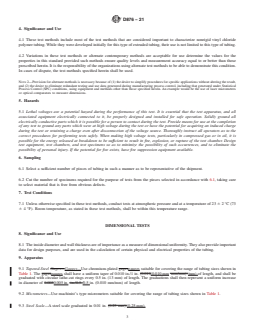
4.1 These test methods include most of the test methods that are considered important to characterize nonrigid vinyl chloride polymer tubing. While they were developed initially for this type of extruded tubing, their use is not limited to this type of tubing.
4.2 Variations in these test methods or alternate contemporary methods are acceptable for use determine the values for the properties in this standard provided such methods ensure quality levels and measurement accuracy equal to or better than those prescribed herein. It is the responsibility of the organizations using alternate test methods to be able to demonstrate this condition. In cases of dispute, the test methods specified herein shall be used.
Note 2: Provision for alternate methods is necessary because of (1) the desire to simplify procedures for specific applications without altering the result, and (2) the desire to eliminate redundant testing and use data generated during manufacturing process control, including that generated under Statistical Process Control (SPC) conditions, using equipment and methods other than those specified herein. An example would be the use of laser micrometers or optical comparators to measure dimensions.
SCOPE
1.1 These test methods cover the testing of general-purpose (Grade A), low-temperature (Grade B), and high-temperature (Grade C)2 nonrigid vinyl chloride polymer tubing, or its copolymers with other materials, for use as electrical insulation. For the purpose of these test methods nonrigid tubing shall be tubing having an initial elongation in excess of 100 % at break.
Note 1: These test methods are similar but not identical to those in IEC 60684–2.
1.2 The values stated in inch-pound units are to be regarded as standard, except for temperature, which shall be expressed in degrees Celsius. The values given in parentheses are mathematical conversions to SI units that are provided for information only and are not considered standard.
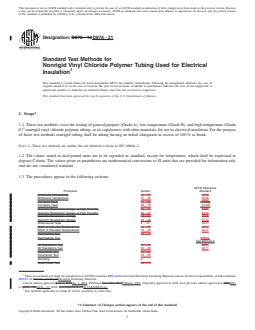
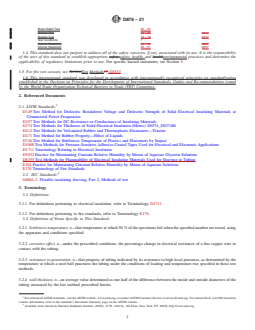
1.3 The procedures appear in the following sections:
Procedure
Section
ASTM Reference Standard
Brittleness Temperature
37 – 39
D746
Corrosion Tests
68 – 79
D1000
Dielectric Breakdown Voltage at High Humidity
59 – 67
E104
Dielectric Breakdown Voltage
52 – 58
D149
Dimensional Tests
8 – 14
D374
Effect of Elevated Temperatures
19 – 30
D412
Flammability Test
D8355,
Test Method A
Oil Resistance Test
29 – 36
D471
Penetration Test
40 – 45
Sampling
6
Strain Relief Test
62 – 67
Tension Test
16 – 18
D412
Test Conditions
7
Volume Resistivity
46 – 51
D257
1.4 This standard does not purport to address all of the safety concerns, if any, associated with its use. It is the responsibility of the user of this standard to establish appropriate safety, health, and environmental practices and determine the applicability of regulatory limitations prior to use. For specific hazard statements, see Section 5.
1.5 For fire test caveats, see Test Methods D8355.
1.6 This international standard was developed in accordance with internationally recognized principles on standardization established in the Decision on Principles for the Development of International Standards, Guides and Recommendations issued by the World Trade Organization Technical Barriers to Trade (TBT) Committee.
- Status
- Published
- Publication Date
- 31-Dec-2020
- Technical Committee
- D09 - Electrical and Electronic Insulating Materials
- Drafting Committee
- D09.07 - Electrical Insulating Materials
Buy Documents
ASTM D876-21 - Standard Test Methods for Nonrigid Vinyl Chloride Polymer Tubing Used for Electrical Insulation
REDLINE ASTM D876-21 - Standard Test Methods for Nonrigid Vinyl Chloride Polymer Tubing Used for Electrical Insulation
Overview
ASTM D876-21: Standard Test Methods for Nonrigid Vinyl Chloride Polymer Tubing Used for Electrical Insulation defines comprehensive testing procedures for evaluating the properties of nonrigid vinyl chloride polymer (PVC) tubing intended for electrical insulation. Developed by ASTM International, this standard is widely used to ensure consistent quality in both general-purpose, low-temperature, and high-temperature nonrigid PVC or its copolymers. This document provides essential guidance to manufacturers, suppliers, and users of flexible vinyl insulation tubing, ensuring safety, performance, and regulatory compliance in various electrical applications.
Key Topics
ASTM D876-21 details several critical test methods and parameters important for characterizing the mechanical, electrical, and thermal properties of nonrigid PVC tubing for electrical insulation purposes:
- Dimensional Tests: Measurement of inside diameter, outside diameter, and wall thickness for uniformity and design consistency.
- Tensile and Elongation Testing: Determination of tensile strength and ultimate elongation, assessing flexibility and stretchability.
- Effect of Elevated Temperatures: Evaluation of changes in elongation and weight after exposure to specified high temperatures, indicating thermal resistance.
- Oil Resistance: Assessment of tubing’s performance after contact with lubricating oils, critical for environments with potential oil exposure.
- Flammability: Testing the material’s resistance to ignition and flame spread.
- Brittleness Temperature: Determining the lowest temperature at which the tubing remains flexible, which is crucial for cold-weather performance.
- Penetration Resistance: Evaluating the tubing’s ability to withstand localized pressure without failing.
- Volume Resistivity: Measuring the electrical insulating properties, especially after moisture exposure.
Note: The standard allows for use of alternate contemporary or process-control test methods, provided they maintain at least equivalent accuracy and reliability.
Applications
Nonrigid PVC tubing tested under ASTM D876-21 is widely utilized as an electrical insulating material in a variety of environments and industries, such as:
- Wire and Cable Insulation: Protecting conductors in electrical and electronic wiring.
- Automotive Electrical Harnesses: Providing insulation and resilience against vibration, temperature changes, and oil exposure.
- Consumer Appliances: Electrical protection in home devices and small electronics.
- Industrial Equipment: Insulating components exposed to oils, high temperatures, or flexing stress.
- Aerospace and Defense Systems: Ensuring reliable insulation under rigorous service conditions.
The thorough testing regimen ensures that the tubing maintains performance attributes-such as flexibility, dielectric strength, dimensional stability, and resistance to environmental hazards-that are essential for protecting conductors and maintaining system safety and reliability.
Related Standards
ASTM D876-21 references and aligns with several key standards that support or complement its test methods and terminology, including:
- ASTM D149: Test Method for Dielectric Breakdown Voltage and Dielectric Strength
- ASTM D257: Test Methods for DC Resistance or Conductance of Insulating Materials
- ASTM D374: Thickness Measurement of Solid Electrical Insulation
- ASTM D412: Test Methods for Vulcanized Rubber and Thermoplastic Elastomers - Tension
- ASTM D471: Rubbery Property-Evaluation for Oil Resistance
- ASTM D746: Brittleness Temperature of Plastics and Elastomers
- ASTM D1000: Pressure-Sensitive Adhesive-Coated Tapes for Electrical/Electronic Applications
- ASTM D8355: Flammability Test Methods for Electrical Insulating Sleeving and Tubing
- IEC 60684-2: Flexible Insulating Sleeving - Methods of Test (International equivalency)
Practical Value
By adhering to ASTM D876-21, organizations can:
- Demonstrate compliance with industry and regulatory requirements
- Benchmark material performance and quality
- Reduce risk of product failure due to electrical, thermal, or mechanical stress
- Ensure compatibility across supply chains by using internationally recognized methods
- Minimize redundant testing and leverage data from process control when suitable
ASTM D876-21 supports the safe, reliable, and cost-effective use of nonrigid vinyl chloride polymer tubing in demanding electrical insulation applications worldwide.
Relations
- Effective Date
- 01-Mar-2024
- Effective Date
- 01-Jan-2024
- Effective Date
- 01-Jan-2020
- Effective Date
- 01-Mar-2019
- Effective Date
- 15-Dec-2018
- Effective Date
- 01-Mar-2018
- Effective Date
- 01-Jul-2017
- Effective Date
- 01-Nov-2015
- Effective Date
- 01-Aug-2015
- Effective Date
- 01-Aug-2015
- Effective Date
- 01-Feb-2015
- Effective Date
- 01-Nov-2014
- Effective Date
- 01-Oct-2014
- Effective Date
- 15-Aug-2014
- Effective Date
- 01-Aug-2014
Buy Documents
ASTM D876-21 - Standard Test Methods for Nonrigid Vinyl Chloride Polymer Tubing Used for Electrical Insulation
REDLINE ASTM D876-21 - Standard Test Methods for Nonrigid Vinyl Chloride Polymer Tubing Used for Electrical Insulation
Get Certified
Connect with accredited certification bodies for this standard

IMQ S.p.A. (Certification)
Italian electrical product certification.

SLG Prüf- und Zertifizierungs GmbH
German testing and certification body.

UL Solutions
Global safety science company with testing, inspection and certification.
Sponsored listings
Frequently Asked Questions
ASTM D876-21 is a standard published by ASTM International. Its full title is "Standard Test Methods for Nonrigid Vinyl Chloride Polymer Tubing Used for Electrical Insulation". This standard covers: SIGNIFICANCE AND USE 4.1 These test methods include most of the test methods that are considered important to characterize nonrigid vinyl chloride polymer tubing. While they were developed initially for this type of extruded tubing, their use is not limited to this type of tubing. 4.2 Variations in these test methods or alternate contemporary methods are acceptable for use determine the values for the properties in this standard provided such methods ensure quality levels and measurement accuracy equal to or better than those prescribed herein. It is the responsibility of the organizations using alternate test methods to be able to demonstrate this condition. In cases of dispute, the test methods specified herein shall be used. Note 2: Provision for alternate methods is necessary because of (1) the desire to simplify procedures for specific applications without altering the result, and (2) the desire to eliminate redundant testing and use data generated during manufacturing process control, including that generated under Statistical Process Control (SPC) conditions, using equipment and methods other than those specified herein. An example would be the use of laser micrometers or optical comparators to measure dimensions. SCOPE 1.1 These test methods cover the testing of general-purpose (Grade A), low-temperature (Grade B), and high-temperature (Grade C)2 nonrigid vinyl chloride polymer tubing, or its copolymers with other materials, for use as electrical insulation. For the purpose of these test methods nonrigid tubing shall be tubing having an initial elongation in excess of 100 % at break. Note 1: These test methods are similar but not identical to those in IEC 60684–2. 1.2 The values stated in inch-pound units are to be regarded as standard, except for temperature, which shall be expressed in degrees Celsius. The values given in parentheses are mathematical conversions to SI units that are provided for information only and are not considered standard. 1.3 The procedures appear in the following sections: Procedure Section ASTM Reference Standard Brittleness Temperature 37 – 39 D746 Corrosion Tests 68 – 79 D1000 Dielectric Breakdown Voltage at High Humidity 59 – 67 E104 Dielectric Breakdown Voltage 52 – 58 D149 Dimensional Tests 8 – 14 D374 Effect of Elevated Temperatures 19 – 30 D412 Flammability Test D8355, Test Method A Oil Resistance Test 29 – 36 D471 Penetration Test 40 – 45 Sampling 6 Strain Relief Test 62 – 67 Tension Test 16 – 18 D412 Test Conditions 7 Volume Resistivity 46 – 51 D257 1.4 This standard does not purport to address all of the safety concerns, if any, associated with its use. It is the responsibility of the user of this standard to establish appropriate safety, health, and environmental practices and determine the applicability of regulatory limitations prior to use. For specific hazard statements, see Section 5. 1.5 For fire test caveats, see Test Methods D8355. 1.6 This international standard was developed in accordance with internationally recognized principles on standardization established in the Decision on Principles for the Development of International Standards, Guides and Recommendations issued by the World Trade Organization Technical Barriers to Trade (TBT) Committee.
SIGNIFICANCE AND USE 4.1 These test methods include most of the test methods that are considered important to characterize nonrigid vinyl chloride polymer tubing. While they were developed initially for this type of extruded tubing, their use is not limited to this type of tubing. 4.2 Variations in these test methods or alternate contemporary methods are acceptable for use determine the values for the properties in this standard provided such methods ensure quality levels and measurement accuracy equal to or better than those prescribed herein. It is the responsibility of the organizations using alternate test methods to be able to demonstrate this condition. In cases of dispute, the test methods specified herein shall be used. Note 2: Provision for alternate methods is necessary because of (1) the desire to simplify procedures for specific applications without altering the result, and (2) the desire to eliminate redundant testing and use data generated during manufacturing process control, including that generated under Statistical Process Control (SPC) conditions, using equipment and methods other than those specified herein. An example would be the use of laser micrometers or optical comparators to measure dimensions. SCOPE 1.1 These test methods cover the testing of general-purpose (Grade A), low-temperature (Grade B), and high-temperature (Grade C)2 nonrigid vinyl chloride polymer tubing, or its copolymers with other materials, for use as electrical insulation. For the purpose of these test methods nonrigid tubing shall be tubing having an initial elongation in excess of 100 % at break. Note 1: These test methods are similar but not identical to those in IEC 60684–2. 1.2 The values stated in inch-pound units are to be regarded as standard, except for temperature, which shall be expressed in degrees Celsius. The values given in parentheses are mathematical conversions to SI units that are provided for information only and are not considered standard. 1.3 The procedures appear in the following sections: Procedure Section ASTM Reference Standard Brittleness Temperature 37 – 39 D746 Corrosion Tests 68 – 79 D1000 Dielectric Breakdown Voltage at High Humidity 59 – 67 E104 Dielectric Breakdown Voltage 52 – 58 D149 Dimensional Tests 8 – 14 D374 Effect of Elevated Temperatures 19 – 30 D412 Flammability Test D8355, Test Method A Oil Resistance Test 29 – 36 D471 Penetration Test 40 – 45 Sampling 6 Strain Relief Test 62 – 67 Tension Test 16 – 18 D412 Test Conditions 7 Volume Resistivity 46 – 51 D257 1.4 This standard does not purport to address all of the safety concerns, if any, associated with its use. It is the responsibility of the user of this standard to establish appropriate safety, health, and environmental practices and determine the applicability of regulatory limitations prior to use. For specific hazard statements, see Section 5. 1.5 For fire test caveats, see Test Methods D8355. 1.6 This international standard was developed in accordance with internationally recognized principles on standardization established in the Decision on Principles for the Development of International Standards, Guides and Recommendations issued by the World Trade Organization Technical Barriers to Trade (TBT) Committee.
ASTM D876-21 is classified under the following ICS (International Classification for Standards) categories: 29.035.20 - Plastics and rubber insulating materials. The ICS classification helps identify the subject area and facilitates finding related standards.
ASTM D876-21 has the following relationships with other standards: It is inter standard links to ASTM D1711-24, ASTM E176-24, ASTM D149-20, ASTM D5032-19, ASTM E176-18a, ASTM E176-18, ASTM D1000-17, ASTM D1711-15, ASTM E176-15a, ASTM E176-15ae1, ASTM E176-15, ASTM D1711-14a, ASTM E176-14c, ASTM E176-14b, ASTM E176-14a. Understanding these relationships helps ensure you are using the most current and applicable version of the standard.
ASTM D876-21 is available in PDF format for immediate download after purchase. The document can be added to your cart and obtained through the secure checkout process. Digital delivery ensures instant access to the complete standard document.
Standards Content (Sample)
This international standard was developed in accordance with internationally recognized principles on standardization established in the Decision on Principles for the
Development of International Standards, Guides and Recommendations issued by the World Trade Organization Technical Barriers to Trade (TBT) Committee.
Designation: D876 − 21
Standard Test Methods for
Nonrigid Vinyl Chloride Polymer Tubing Used for Electrical
Insulation
This standard is issued under the fixed designation D876; the number immediately following the designation indicates the year of
original adoption or, in the case of revision, the year of last revision. A number in parentheses indicates the year of last reapproval. A
superscript epsilon (´) indicates an editorial change since the last revision or reapproval.
This standard has been approved for use by agencies of the U.S. Department of Defense.
1. Scope* mine the applicability of regulatory limitations prior to use.
For specific hazard statements, see Section 5.
1.1 These test methods cover the testing of general-purpose
1.5 For fire test caveats, see Test Methods D8355.
(Grade A), low-temperature (Grade B), and high-temperature
(Grade C) nonrigid vinyl chloride polymer tubing, or its
1.6 This international standard was developed in accor-
copolymers with other materials, for use as electrical insula-
dance with internationally recognized principles on standard-
tion. For the purpose of these test methods nonrigid tubing
ization established in the Decision on Principles for the
shall be tubing having an initial elongation in excess of 100 %
Development of International Standards, Guides and Recom-
at break.
mendations issued by the World Trade Organization Technical
Barriers to Trade (TBT) Committee.
NOTE 1—These test methods are similar but not identical to those in
IEC 60684–2.
2. Referenced Documents
1.2 The values stated in inch-pound units are to be regarded
as standard, except for temperature, which shall be expressed 2.1 ASTM Standards:
in degrees Celsius. The values given in parentheses are D149 Test Method for Dielectric Breakdown Voltage and
mathematical conversions to SI units that are provided for DielectricStrengthofSolidElectricalInsulatingMaterials
information only and are not considered standard. at Commercial Power Frequencies
D257 Test Methods for DC Resistance or Conductance of
1.3 The procedures appear in the following sections:
Insulating Materials
ASTM Reference
D374 Test Methods for Thickness of Solid Electrical Insu-
Procedure Section Standard
Brittleness Temperature 37 – 39 D746 lation (Metric) D0374_D0374M
Corrosion Tests 68 – 79 D1000
D412 Test Methods forVulcanized Rubber andThermoplas-
Dielectric Breakdown Voltage at High Humidity 59 – 67 E104
tic Elastomers—Tension
Dielectric Breakdown Voltage 52 – 58 D149
Dimensional Tests 8 – 14 D374 D471 Test Method for Rubber Property—Effect of Liquids
Effect of Elevated Temperatures 19 – 30 D412
D746 Test Method for Brittleness Temperature of Plastics
Flammability Test D8355,
and Elastomers by Impact
Test Method A
Oil Resistance Test 29 – 36 D471
D1000 Test Methods for Pressure-Sensitive Adhesive-
Penetration Test 40–45
Coated Tapes Used for Electrical and Electronic Applica-
Sampling 6
tions
Strain Relief Test 62–67
Tension Test 16 – 18 D412
D1711 Terminology Relating to Electrical Insulation
Test Conditions 7
D5032 Practice for Maintaining Constant Relative Humidity
Volume Resistivity 46 – 51 D257
by Means of Aqueous Glycerin Solutions
1.4 This standard does not purport to address all of the
D8355 Test Methods for Flammability of Electrical Insulat-
safety concerns, if any, associated with its use. It is the
ing Materials Used for Sleeving or Tubing
responsibility of the user of this standard to establish appro-
E104 Practice for Maintaining Constant Relative Humidity
priate safety, health, and environmental practices and deter-
by Means of Aqueous Solutions
E176 Terminology of Fire Standards
These test methods are under the jurisdiction of ASTM Committee D09 on
Electrical and Electronic Insulating Materials and are the direct responsibility of
Subcommittee D09.07 on Electrical Insulating Materials.
Current edition approved Jan. 1, 2021. Published February 2021. Originally For referenced ASTM standards, visit the ASTM website, www.astm.org, or
approved in 1946. Last previous edition approved in 2013 as D876 – 13. DOI: contact ASTM Customer Service at service@astm.org. For Annual Book of ASTM
10.1520/D0876-21. Standards volume information, refer to the standard’s Document Summary page on
Test methods applicable to Grade B will be specified at a later date. the ASTM website.
*A Summary of Changes section appears at the end of this standard
Copyright © ASTM International, 100 Barr Harbor Drive, PO Box C700, West Conshohocken, PA 19428-2959. United States
D876 − 21
2.2 IEC Standards: the completion of any test to ground any parts which were at
60684–2 Flexible insulating sleeving, Part 2, Methods of high voltage during the test or have the potential for acquiring
test an induced charge during the test or retaining a charge even
after disconnection of the voltage source. Thoroughly instruct
3. Terminology
all operators as to the correct procedures for performing tests
3.1 Definitions: safely. When making high voltage tests, particularly in com-
pressed gas or in oil, it is possible for the energy released at
3.1.1 For definitions pertaining to electrical insulation, refer
to Terminology D1711. breakdowntobesuffıcienttoresultinfire,explosion,orrupture
of the test chamber. Design test equipment, test chambers, and
3.1.2 For definitions pertaining to fire standards, refer to
Terminology E176. test specimens so as to minimize the possibility of such
occurrences, and to eliminate the possibility of personal injury.
3.2 Definitions of Terms Specific to This Standard:
3.2.1 brittleness temperature, n—that temperature at which If the potential for fire exists, have fire suppression equipment
available.
50 % of the specimens fail when the specified number are
tested, using the apparatus and conditions specified.
6. Sampling
3.2.2 corrosive effect, n—under the prescribed conditions,
6.1 Select a sufficient number of pieces of tubing in such a
the percentage change in electrical resistance of a fine copper
manner as to be representative of the shipment.
wire in contact with the tubing.
6.2 Cutthenumberofspecimensrequiredforthepurposeof
3.2.3 resistance to penetration, n—that property of tubing
tests from the pieces selected in accordance with 6.1, taking
indicated by its resistance to high local pressures, as deter-
care to select material that is free from obvious defects.
mined by the temperature at which a steel ball punctures the
tubing under the conditions of loading and temperature rise
7. Test Conditions
specified in these test methods.
7.1 Unless otherwise specified in these test methods, con-
3.2.4 wall thickness, n—an average value determined as one
duct tests at atmospheric pressure and at a temperature of 23 6
half of the difference between the inside and outside diameters
2°C(73 6 4 °F). Room temperature, as stated in these test
of the tubing measured by the test method prescribed herein.
methods, shall be within this temperature range.
4. Significance and Use
DIMENSIONAL TESTS
4.1 Thesetestmethodsincludemostofthetestmethodsthat
are considered important to characterize nonrigid vinyl chlo-
8. Significance and Use
ride polymer tubing. While they were developed initially for
8.1 The inside diameter and wall thickness are of impor-
this type of extruded tubing, their use is not limited to this type
tance as a measure of dimensional uniformity. They also
of tubing.
provide important data for design purposes, and are used in the
4.2 Variations in these test methods or alternate contempo-
calculation of certain physical and electrical properties of the
rary methods are acceptable for use determine the values for
tubing.
the properties in this standard provided such methods ensure
9. Apparatus
qualitylevelsandmeasurementaccuracyequaltoorbetterthan
those prescribed herein. It is the responsibility of the organi-
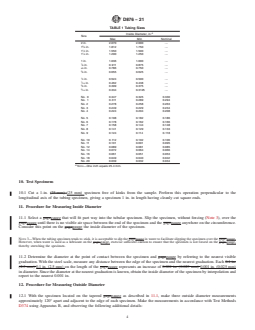
9.1 Tapered-Steel Gauges—Use chromium-plated gauges
zations using alternate test methods to be able to demonstrate
suitable for covering the range of tubing sizes shown in Table
this condition. In cases of dispute, the test methods specified
1. The gauges shall have a uniform taper of 0.010 in./1 in.
herein shall be used.
(0.010 mm⁄mm) of length, and shall be graduated with circular
lathe-cutringsevery0.5in.(13mm)oflength.Thegraduations
NOTE2—Provisionforalternatemethodsisnecessarybecauseof(1)the
shall then represent a uniform increase in diameter of
desire to simplify procedures for specific applications without altering the
result, and (2) the desire to eliminate redundant testing and use data 0.005 in.⁄0.5 in. (0.010 mm/mm) of length.
generated during manufacturing process control, including that generated
9.2 Micrometers—Use machinist’s type micrometers suit-
under Statistical Process Control (SPC) conditions, using equipment and
able for covering the range of tubing sizes shown in Table 1.
methods other than those specified herein. An example would be the use
of laser micrometers or optical comparators to measure dimensions.
9.3 Steel Scale—A steel scale graduated in 0.01 in.
(0.25 mm).
5. Hazards
5.1 Lethal voltages are a potential hazard during the 10. Test Specimens
performance of this test. It is essential that the test apparatus,
10.1 Cut a 1-in. (25 mm) specimen free of kinks from the
and all associated equipment electrically connected to it, be
sample. Perform this operation perpendicular to the longitudi-
properly designed and installed for safe operation. Solidly
nal axis of the tubing specimen, giving a specimen 1 in. in
ground all electrically conductive parts which it is possible for
length having cleanly cut square ends.
a person to contact during the test. Provide means for use at
11. Procedure for Measuring Inside Diameter
11.1 Select a gauge that will fit part way into the tubular
Available fromAmerican National Standards Institute (ANSI), 25 W. 43rd St.,
4th Floor, New York, NY 10036, http://www.ansi.org. specimen.Slipthespecimen,withoutforcing(Note3),overthe
D876 − 21
TABLE 1 Tubing Sizes
12.1.1 Support the micrometer to allow both hands to be
A
Inside Diameter, in. free for manipulation.
Size
Max Min Nominal 12.1.2 Measure the outside diameter adjacent to, but not on
2 in. 2.070 2.000 . or over the cut edge, and
1 ⁄4 in. 1.812 1.750 .
12.1.3 Rotate the tubular specimen, which is on the tapered
1 ⁄2 in. 1.550 1.500 .
mandrel, so that the rotation is an oscillating motion with the
1 ⁄4 in. 1.290 1.250 .
outside surface of the tube just touching the fixed anvil of the
1 in. 1.036 1.000 .
micrometer. Slowly move the micrometer spindle onto the
⁄8 in. 0.911 0.875 .
surface of the tube until the first definite increase in the
⁄4 in. 0.786 0.750 .
⁄8 in. 0.655 0.625 .
resistance to rotation of the specimen is encountered. The
micrometer reading at this time is the outside diameter of the
⁄2 in. 0.524 0.500 .
7 specimen.
⁄16 in. 0.462 0.438 .
⁄8 in. 0.399 0.375 .
⁄16 in. 0.334 0.3125 . 13. Report
13.1 Report the following information:
No. 0 0.347 0.325 0.330
No. 1 0.311 0.289 0.294
13.1.1 Inside diameter of the specimen to the nearest
No. 2 0.278 0.258 0.263
0.001 in. (0.025 mm),
No. 3 0.249 0.229 0.234
13.1.2 All readings on outside diameter of the specimen to
No. 4 0.224 0.204 0.208
the nearest 0.001 in.,
No. 5 0.198 0.182 0.186
13.1.3 Average outside diameter, and
No. 6 0.178 0.162 0.166
13.1.4 Average wall thickness.
No. 7 0.158 0.144 0.148
No. 8 0.141 0.129 0.133
No. 9 0.124 0.114 0.118
14. Precision and Bias
No. 10 0.112 0.102 0.106 14.1 The precision of this test method has not been deter-
No. 11 0.101 0.091 0.095
mined due to inadequate voluntary participation and funding
No. 12 0.089 0.081 0.085
needed to conduct the round-robin testing.Astatement of bias
No. 14 0.072 0.064 0.066
No. 16 0.061 0.051 0.053 is unavailable in view of the lack of a standard reference
No. 18 0.049 0.040 0.042
material for this property.
No. 20 0.039 0.032 0.034
A
NOTE—One inch equals 25.4 mm.
15. Flammability Test
15.1 Conduct flammability tests in accordance with method
A from Test Methods D8355.
gauge until there is no visible air space between the end of the
specimen and the gauge anywhere on the circumference.
TENSION TEST
Consider this point on the gauge the inside diameter of the
16. Procedure
specimen.
16.1 Determine the tensile strength and ultimate elongation
NOTE 3—When the tubing specimen tends to stick, it is acceptable to
dip the gauge in water to facilitate slipping the specimen over the gauge. in accordance with Test Methods D412, with the following
However, when water is used as a lubricant on the gauge, exercise
exceptions:
sufficient caution to ensure that the specimen is not forced on the gauge,
16.1.1 For sizes No. 20 to 0, inclusive, prepare six test
thereby stretching the specimen.
specimens by cutting lengths from the sample and subjecting
11.2 Determine the diameter at the point of contact between
them to the tension test in tubing form.
the specimen and gauge by referring to the nearest visible
16.1.2 For sizes ⁄16 in. to 2 in. (7.9 to 50 mm), inclusive, in
graduation.With the steel scale, measure any distance between
inside diameter prepare six test specimens taken from the
the edge of the specimen and the nearest graduation. Each
sample in the form as represented by Die B of Test Methods
0.1 in. (2.5 mm) on the length of the gauge represents an
D412. Do this by cutting one wall along a longitudinal axis,
increase of 0.001 in. (0.025 mm) in diameter. Since the diam-
flattening the piece, and applying Die B parallel to this axis.
eter at the nearest graduation is known, obtain the inside
16.1.3 Measure the inside and outside diameters in accor-
diameter of the specimen by interpolation and report to the
dance with Sections9–13.
nearest 0.001 in.
16.1.4 In determining the tensile strength use the average
area of the specimens selected.
12. Procedure for Measuring Outside Diameter
16.1.5 Mark two parallel gauge lines for use in determining
12.1 With the specimen located on the tapered gauge as elongationonthetubing,perpendiculartothelongitudinalaxis,
described in 11.1, make three outside diameter measurements one on each side of the center and 1 in. (25 mm) therefrom.
approximately 120° apart and adjacent to the edge of each 16.1.6 Make the distance between grips of the testing
specimen. Make the measurements in accordance with Test machine 4 in. (100 mm).
MethodsD374usingApparatusB,andobservingthefollowing 16.1.7 Use a uniform rate of travel of the power actuated
additional details: grip of 12 in. (305 mm)/min.
D876 − 21
16.1.8 Discard results on specimens that break outside of 21.1.2 Provision shall be made for suspending specimens,
the gauge marks and retest. preferably vertically, without bending and without touching
each other or the sides of the chamber. The specimen chamber
17. Report
shall be so designed, or the oven so compartmented, that air
passingoveranyspecimenshallnotcomeincontactwithother
17.1 Report the following information:
specimens in the oven.
17.1.1 Size of tubing from which the specimens were taken,
17.1.2 All observed and recorded data on which the calcu- 21.1.3 The temperature at any point along the length of the
lations are based, specimens shall vary not more than 61 °C from the specified
17.1.3 Average tensile strength determined on the best five temperature.
out of six specimens, and
21.1.4 The heating medium shall be air at atmospheric
17.1.4 Average ultimate elongation determined on the best pressure, and the source of heat shall be external to the
five out of six specimens.
specimen chamber or chambers.
21.1.5 The air flow shall be lengthwise along the specimens
18. Precision and Bias
and shall be at the rate of 100 6 10 in. (2500 6 250 mm)/min.
18.1 The precision of this test method has not been deter- 21.1.6 Tension Testing Machine—The tension testing ma-
mined due to inadequate voluntary participation and funding
chine shall be the same as prescribed in Test Methods D412.
needed to conduct the round-robin testing.Astatement of bias
is unavailable in view of the lack of a standard reference
22. Test Specimens
material for this property.
22.1 Cut six specimens from the sample (Section 5), and
prepare in a manner similar to that described in 16.1.1 and
16.1.2, according to the various sizes of tubing.
EFFECT OF ELEVATED TEMPERATURES
19. Scope
23. Procedure
19.1 The effect of elevated temperature is indicated by the
23.1 Suspendthreespecimensintheovendescribedin21.1.
changes in ultimate elongation and weight caused by exposure
Keep tubing specimens open throughout their entire lengths.
of the tubing to elevated temperatures for a specified time
Maintain the specimens at the temperatures listed below for a
under controlled conditions of air circulation.
period of 400 h:
GradeA, Grade B 100±1°C(212±2°F)
20. Significance and Use
Grade C 130±2°C(266±4°F)
20.1 Loss of elongation or weight as caused by exposure of
At the end of the specified time, remove the specimens, and
the tubing to elevated temperatures is indicative of factors such
keep them at room temperature for a period of 16 h but not
as volatile constituents or chemical changes in the tubing. The
longer than 20 h.After the rest period, place gauge lines, 2 in.
temperature used is higher than that recommended for continu-
(50 mm) apart, on each specimen. Place each specimen in the
ous service and the exposure period of Procedure B is
tension testing machine and determine the ultimate elongation
relatively short so that the test is suitable for use as an
as described in Section 16.
acceptance test for quality control. Longer exposure times and
23.2 Place gauge lines 2 in. (50 mm) apart on each of the
other temperatures are necessary for research purposes.
remaining three untreated specimens. Place each specimen in
20.2 Both methods shall be conducted to obtain full data on
the tension testing machine and determine the ultimate elon-
the effect of elevated temperatures. It is recommended that
gation.
ProcedureAbe correlated with the Strain Relief Test (Sections
NOTE 4—The results for elongation obtained in Test Method A of Test
65 to 69), since percentage change in ultimate elongation
Methods D8355 are an acceptable choice for use as the unaged values.
indicates the effect of elevated temperatures on a specimen
only if it originally has a minimum of internal strains. 23.3 Compare the ultimate elongation values from the aged
specimens to the values from the unaged specimens. If these
Specimens with initially high internal strains will, in general,
show less change in ultimate elongation than those with a ultimate elongation values are not within 10 % of the highest
minimum of strains. Use procedure A only for qualification or value obtained in the unaged specimens, test three additional
for comparative evaluation of various materials, not as an specimens. Use the average of all tests run as the final value of
inspection test for quality control purposes. ultimate elongation for aged specimens.
24. Report
Procedure A—Using Tension Test
24.1 Report the following information:
21. Apparatus
24.1.1 The sample size from which specimens were taken,
24.1.2 Average ultimate elongation of specimens before
21.1 Oven—The oven shall conform to the following re-
aging,
quirements:
21.1.1 The design shall be such that heated air passes 24.1.3 Average ultimate elongation of specimens after
aging, and
through the specimen chamber and is exhausted without being
recirculated. 24.1.4 Average percentage change in ultimate elongation.
D876 − 21
25. Precision and Bias a consequence it is important to ascertain the effect of
lubricating oil in contact with flexible vinyl tubing.
25.1 The precision of this test method has not been deter-
mined due to inadequate voluntary participation and funding 31.2 Correlate the oil resistance test with the Strain Relief
needed to conduct the round-robin testing.Astatement of bias Test (Sections62–67) since percentage change in ultimate
is unavailable in view of the lack of a standard reference elongation indicates the oil resistance of a specimen only if it
material for this property. originally has a minimum of internal strains. Specimens with
initially high internal strains will, in general, show less change
in ultimate elongation than those with a minimum of strains.
Procedure B—Using Weight Loss on Heating
32. Apparatus
26. Apparatus
32.1 The apparatus shall be the same as that described in
26.1 Chemical Balance.
Section 21.
26.2 Oven—The oven shall conform to the requirements
33. Test Specimens
prescribed in 21.1.
33.1 Cut three specimens from the sample (Section 5)ina
26.3 Desiccator.
manner similar to that described in 16.1.1 and 16.1.2 according
to the various sizes of tubing.
27. Test Specimens
34. Procedure
27.1 Cut test specimens 6 in. (152 mm) in length from
full-section tubing.
34.1 Totally immerse the test specimens in IRM 903 high-
swelling oil as described inTest Method D471, at temperatures
28. Procedure
listed below for a period of 4 h:
28.1 Place three specimens in a desiccator and condition
GradeA, Grade B 70±1°C(158± 2 °F)
them at room temperature over calcium chloride for 24 h. At
Grade C 105±1°C(221±2°F)
the end of this period immediately weigh the specimens.
At the end of this time, remove the specimens from the oil,
Suspend them vertically in the oven described in 21.1, without
blot to remove excess oil, allow them to cool at room
touching each other or the sides of the oven. Keep the tubing
temperature for 30 min, bathe in mineral spirits at room
specimens open throughout their entire lengths. Maintain the
temperature to remove the remaining film of oil from the
specimens at the temperatures listed below for 72 h:
surface, and wipe them dry. Place gauge marks 2 in. (50 mm)
GradeA, Grade B 100±1°C(212±2°F) apart on each specimen and determine the ultimate elongation
Grade C 130±2°C(266±4°F)
of each.
At the end of the specified time, remove the specimens, and
NOTE 5—This procedure formerly used ASTM No. 3 immersion oil as
keep them at room temperature over calcium chloride for 1 h.
described in Test Method D471 – 79 (Reapproved 1991). ASTM Oil No.
Upon removal from the desiccator immediately weigh the
3 was discontinued in 1990 and IRM 903 was specified as a replacement
specimens. forASTM Oil No. 3. Test Method D471 – 1995 incorporated this change.
Test Method D471 – 1995 described the properties of IRM 903.
29. Report
34.2 Compare the ultimate elongation values from the
29.1 Report the following information: oil-immersed specimens with the corresponding values from
29.1.1 The sample size from which specimens were taken, the specimens tested in Section 16. If the ultimate elongation
and
valuesfromoil-immersedspecimensarenotwithin10 %ofthe
29.1.2 The loss of weight calculated as a percentage of the highest value obtained for the specimens of Section 16,
original weight.
immerse three additional specimens in oil and test them. The
final value of ultimate elongation for specimens immersed in
30. Precision and Bias
oil shall be the average of all tests run.
30.1 The precision of this test method has not been deter-
35. Report
mined due to inadequate voluntary participation and funding
35.1 Report the following information:
neededtoconducttheround-robintesting.Thistestmethodhas
35.1.1 Sample size from which the specimens were taken,
nobiasbecausetheresultsareexpressedpurelyintermsofthis
35.1.2 Average ultimate elongation of the specimens before
test method.
aging,
35.1.3 Average ultimate elongation of the specimens after
OIL RESISTANCE TEST
aging, and
35.1.4 Average percentage change in ultimate elongation,
31. Significance and Use
and
31.1 The tubing covered in these test methods is often used
35.1.5 Type of oil used if other than IRM 903.
in places where it comes into contact with lubricating oils.
36. Precision and Bias
While the tubing is in service, it is possible that there will be
accidental oil spill on the surface or that there will be deposits 36.1 The precision of this test method has not been deter-
due to oil splashes resulting from lubricated moving parts. As mined due to inadequate voluntary participation and funding
D876 − 21
neededtoconducttheround-robintesting.Thistestmethodhas the resistance of tubing to penetration under such conditions.
nobiasbecausetheresultsareexpressedpurelyintermsofthis Differences in penetration temperature of less than 3 °C have
test method. no significance.
41. Apparatus
BRITTLENESS TEMPERATURE
41.1 Penetration Tester—A penetration tester as shown in
Fig.1isrecommended.Thecomponentpartsofthepenetration
37. Significance and Use
tester are:
37.1 This test establishes a quality level when the tubing is
41.1.1 Load-Bearing System, comprised of a ⁄16-in.
tested by the procedure specified. Results cannot be correlated
(1.6 mm) diameter magnetized steel rod, recessed at one end to
with those obtained by a mandrel bending or other simple
accommodate a ⁄16-in. diameter steel ball bearing against test
flexure tests. The brittleness temperature of different sizes of
1 1
specimens
...
This document is not an ASTM standard and is intended only to provide the user of an ASTM standard an indication of what changes have been made to the previous version. Because
it may not be technically possible to adequately depict all changes accurately, ASTM recommends that users consult prior editions as appropriate. In all cases only the current version
of the standard as published by ASTM is to be considered the official document.
Designation: D876 − 13 D876 − 21
Standard Test Methods for
Nonrigid Vinyl Chloride Polymer Tubing Used for Electrical
Insulation
This standard is issued under the fixed designation D876; the number immediately following the designation indicates the year of
original adoption or, in the case of revision, the year of last revision. A number in parentheses indicates the year of last reapproval. A
superscript epsilon (´) indicates an editorial change since the last revision or reapproval.
This standard has been approved for use by agencies of the U.S. Department of Defense.
1. Scope*
1.1 These test methods cover the testing of general-purpose (Grade A), low-temperature (Grade B), and high-temperature (Grade
C) nonrigid vinyl chloride polymer tubing, or its copolymers with other materials, for use as electrical insulation. For the purpose
of these test methods nonrigid tubing shall be tubing having an initial elongation in excess of 100 % at break.
NOTE 1—These test methods are similar but not identical to those in IEC 60684–2.
1.2 The values stated in inch-pound units are to be regarded as standard, except for temperature, which shall be expressed in
degrees Celsius. The values given in parentheses are mathematical conversions to SI units that are provided for information only
and are not considered standard.
1.3 The procedures appear in the following sections:
ASTM Reference
Procedure Section Standard
Brittleness Temperature 43 – 45 D746
Brittleness Temperature 37 – 39 D746
Corrosion Tests 74 – 85 D1000
Corrosion Tests 68 – 79 D1000
Dielectric Breakdown Voltage at High Humidity 65 – 73 E104
Dielectric Breakdown Voltage at High Humidity 59 – 67 E104
Dielectric Breakdown Voltage 58 – 64 D149
Dielectric Breakdown Voltage 52 – 58 D149
Dimensional Tests 8 – 14 D374
Effect of Elevated Temperatures 25 – 36 D412
Effect of Elevated Temperatures 19 – 30 D412
Flammability Test 15 – 21
Flammability Test D8355,
Test Method A
Oil Resistance Test 35 – 42 D471
Oil Resistance Test 29 – 36 D471
Penetration Test 46 – 51
Penetration Test 40 – 45
Sampling 6
Strain Relief Test 68 – 73
These test methods are under the jurisdiction of ASTM Committee D09 on Electrical and Electronic Insulating Materials and are the direct responsibility of Subcommittee
D09.07 on Flexible and Rigid Electrical Insulating Materials.
Current edition approved Nov. 1, 2013Jan. 1, 2021. Published December 2013February 2021. Originally approved in 1946. Last previous edition approved in 20092013
as D876 – 09.D876 – 13. DOI: 10.1520/D0876-13.10.1520/D0876-21.
Test methods applicable to Grade B will be specified at a later date.
*A Summary of Changes section appears at the end of this standard
Copyright © ASTM International, 100 Barr Harbor Drive, PO Box C700, West Conshohocken, PA 19428-2959. United States
D876 − 21
Strain Relief Test 62 – 67
Tension Test 22 – 24 D412
Tension Test 16 – 18 D412
Test Conditions 7
Volume Resistivity 52 – 57 D257
Volume Resistivity 46 – 51 D257
1.4 This standard does not purport to address all of the safety concerns, if any, associated with its use. It is the responsibility
of the user of this standard to establish appropriate safety safety, health, and healthenvironmental practices and determine the
applicability of regulatory limitations prior to use. For specific hazard statements, see Section 5.
1.5 For fire test caveats, see SectionTest Methods15 D8355.
1.6 This international standard was developed in accordance with internationally recognized principles on standardization
established in the Decision on Principles for the Development of International Standards, Guides and Recommendations issued
by the World Trade Organization Technical Barriers to Trade (TBT) Committee.
2. Referenced Documents
2.1 ASTM Standards:
D149 Test Method for Dielectric Breakdown Voltage and Dielectric Strength of Solid Electrical Insulating Materials at
Commercial Power Frequencies
D257 Test Methods for DC Resistance or Conductance of Insulating Materials
D374 Test Methods for Thickness of Solid Electrical Insulation (Metric) D0374_D0374M
D412 Test Methods for Vulcanized Rubber and Thermoplastic Elastomers—Tension
D471 Test Method for Rubber Property—Effect of Liquids
D746 Test Method for Brittleness Temperature of Plastics and Elastomers by Impact
D1000 Test Methods for Pressure-Sensitive Adhesive-Coated Tapes Used for Electrical and Electronic Applications
D1711 Terminology Relating to Electrical Insulation
D5032 Practice for Maintaining Constant Relative Humidity by Means of Aqueous Glycerin Solutions
D8355 Test Methods for Flammability of Electrical Insulating Materials Used for Sleeving or Tubing
E104 Practice for Maintaining Constant Relative Humidity by Means of Aqueous Solutions
E176 Terminology of Fire Standards
2.2 IEC Standards:
60684–2 Flexible insulating sleeving, Part 2, Methods of test
3. Terminology
3.1 Definitions:
3.1.1 For definitions pertaining to electrical insulation, refer to Terminology D1711.
3.1.2 For definitions pertaining to fire standards, refer to Terminology E176.
3.2 Definitions of Terms Specific to This Standard:
3.2.1 brittleness temperature, n—that temperature at which 50 % of the specimens fail when the specified number are tested, using
the apparatus and conditions specified.
3.2.2 corrosive effect, n—under the prescribed conditions, the percentage change in electrical resistance of a fine copper wire in
contact with the tubing.
3.2.3 resistance to penetration, n—that property of tubing indicated by its resistance to high local pressures, as determined by the
temperature at which a steel ball punctures the tubing under the conditions of loading and temperature rise specified in these test
methods.
3.2.4 wall thickness, n—an average value determined as one half of the difference between the inside and outside diameters of the
tubing measured by the test method prescribed herein.
For referenced ASTM standards, visit the ASTM website, www.astm.org, or contact ASTM Customer Service at service@astm.org. For Annual Book of ASTM Standards
volume information, refer to the standard’s Document Summary page on the ASTM website.
Available from American National Standards Institute (ANSI), 25 W. 43rd St., 4th Floor, New York, NY 10036, http://www.ansi.org.
D876 − 21
4. Significance and Use
4.1 These test methods include most of the test methods that are considered important to characterize nonrigid vinyl chloride
polymer tubing. While they were developed initially for this type of extruded tubing, their use is not limited to this type of tubing.
4.2 Variations in these test methods or alternate contemporary methods are acceptable for use determine the values for the
properties in this standard provided such methods ensure quality levels and measurement accuracy equal to or better than those
prescribed herein. It is the responsibility of the organizations using alternate test methods to be able to demonstrate this condition.
In cases of dispute, the test methods specified herein shall be used.
NOTE 2—Provision for alternate methods is necessary because of (1) the desire to simplify procedures for specific applications without altering the result,
and (2) the desire to eliminate redundant testing and use data generated during manufacturing process control, including that generated under Statistical
Process Control (SPC) conditions, using equipment and methods other than those specified herein. An example would be the use of laser micrometers
or optical comparators to measure dimensions.
5. Hazards
5.1 Lethal voltages are a potential hazard during the performance of this test. It is essential that the test apparatus, and all
associated equipment electrically connected to it, be properly designed and installed for safe operation. Solidly ground all
electrically conductive parts which it is possible for a person to contact during the test. Provide means for use at the completion
of any test to ground any parts which were at high voltage during the test or have the potential for acquiring an induced charge
during the test or retaining a charge even after disconnection of the voltage source. Thoroughly instruct all operators as to the
correct procedures for performing tests safely. When making high voltage tests, particularly in compressed gas or in oil, it is
possible for the energy released at breakdown to be suffıcient to result in fire, explosion, or rupture of the test chamber. Design
test equipment, test chambers, and test specimens so as to minimize the possibility of such occurrences, and to eliminate the
possibility of personal injury. If the potential for fire exists, have fire suppression equipment available.
6. Sampling
6.1 Select a sufficient number of pieces of tubing in such a manner as to be representative of the shipment.
6.2 Cut the number of specimens required for the purpose of tests from the pieces selected in accordance with 6.1, taking care
to select material that is free from obvious defects.
7. Test Conditions
7.1 Unless otherwise specified in these test methods, conduct tests at atmospheric pressure and at a temperature of 23 6 2 °C (73
6 4 °F). Room temperature, as stated in these test methods, shall be within this temperature range.
DIMENSIONAL TESTS
8. Significance and Use
8.1 The inside diameter and wall thickness are of importance as a measure of dimensional uniformity. They also provide important
data for design purposes, and are used in the calculation of certain physical and electrical properties of the tubing.
9. Apparatus
9.1 Tapered-Steel Gages—Gauges—Use chromium-plated gagesgauges suitable for covering the range of tubing sizes shown in
Table 1. The gagesgauges shall have a uniform taper of 0.010 in./1 in. (0.010(0.010 mm mm/mm) ⁄mm) of length, and shall be
graduated with circular lathe-cut rings every 0.5 in. (13 mm) of length. The graduations shall then represent a uniform increase
in diameter of 0.0050.005 in. in./0.5 ⁄0.5 in. (0.010 mm/mm) of length.
9.2 Micrometers—Use machinist’s type micrometers suitable for covering the range of tubing sizes shown in Table 1.
9.3 Steel Scale—A steel scale graduated in 0.01 in. (0.25 mm).(0.25 mm).
D876 − 21
TABLE 1 Tubing Sizes
A
Inside Diameter, in.
Size
Max Min Nominal
2 in. 2.070 2.000 .
1 ⁄4 in. 1.812 1.750 .
1 ⁄2 in. 1.550 1.500 .
1 ⁄4 in. 1.290 1.250 .
1 in. 1.036 1.000 .
⁄8 in. 0.911 0.875 .
⁄4 in. 0.786 0.750 .
⁄8 in. 0.655 0.625 .
⁄2 in. 0.524 0.500 .
⁄16 in. 0.462 0.438 .
⁄8 in. 0.399 0.375 .
⁄16 in. 0.334 0.3125 .
No. 0 0.347 0.325 0.330
No. 1 0.311 0.289 0.294
No. 2 0.278 0.258 0.263
No. 3 0.249 0.229 0.234
No. 4 0.224 0.204 0.208
No. 5 0.198 0.182 0.186
No. 6 0.178 0.162 0.166
No. 7 0.158 0.144 0.148
No. 8 0.141 0.129 0.133
No. 9 0.124 0.114 0.118
No. 10 0.112 0.102 0.106
No. 11 0.101 0.091 0.095
No. 12 0.089 0.081 0.085
No. 14 0.072 0.064 0.066
No. 16 0.061 0.051 0.053
No. 18 0.049 0.040 0.042
No. 20 0.039 0.032 0.034
A
NOTE—One inch equals 25.4 mm.
10. Test Specimens
10.1 Cut a 1-in. (25-mm) (25 mm) specimen free of kinks from the sample. Perform this operation perpendicular to the
longitudinal axis of the tubing specimen, giving a specimen 1 in. in length having cleanly cut square ends.
11. Procedure for Measuring Inside Diameter
11.1 Select a gagegauge that will fit part way into the tubular specimen. Slip the specimen, without forcing (Note 3), over the
gagegauge until there is no visible air space between the end of the specimen and the gagegauge anywhere on the circumference.
Consider this point on the gagegauge the inside diameter of the specimen.
NOTE 3—When the tubing specimen tends to stick, it is acceptable to dip the gagegauge in water to facilitate slipping the specimen over the gage.gauge.
However, when water is used as a lubricant on the gage,gauge, exercise sufficient caution to ensure that the specimen is not forced on the gage,gauge,
thereby stretching the specimen.
11.2 Determine the diameter at the point of contact between the specimen and gagegauge by referring to the nearest visible
graduation. With the steel scale, measure any distance between the edge of the specimen and the nearest graduation. Each 0.1 in.
(2.5 mm) 0.1 in. (2.5 mm) on the length of the gagegauge represents an increase of 0.001 in. (0.025 mm) 0.001 in. (0.025 mm)
in diameter. Since the diameter at the nearest graduation is known, obtain the inside diameter of the specimen by interpolation and
report to the nearest 0.001 in.
12. Procedure for Measuring Outside Diameter
12.1 With the specimen located on the tapered gagegauge as described in 11.1, make three outside diameter measurements
approximately 120° apart and adjacent to the edge of each specimen. Make the measurements in accordance with Test Methods
D374 using Apparatus B, and observing the following additional details:
D876 − 21
12.1.1 Support the micrometer to allow both hands to be free for manipulation.
12.1.2 Measure the outside diameter adjacent to, but not on or over the cut edge, and
12.1.3 Rotate the tubular specimen, which is on the tapered mandrel, so that the rotation is an oscillating motion with the outside
surface of the tube just touching the fixed anvil of the micrometer. Slowly move the micrometer spindle onto the surface of the
tube until the first definite increase in the resistance to rotation of the specimen is encountered. The micrometer reading at this time
is the outside diameter of the specimen.
13. Report
13.1 Report the following information:
13.1.1 Inside diameter of the specimen to the nearest 0.001 in. 0.001 in. (0.025 mm),
13.1.2 All readings on outside diameter of the specimen to the nearest 0.001 in.,
13.1.3 Average outside diameter, and
13.1.4 Average wall thickness.
14. Precision and Bias
14.1 The precision of this test method has not been determined due to inadequate voluntary participation and funding needed to
conduct the round-robin testing. A statement of bias is unavailable in view of the lack of a standard reference material for this
property.
15. Flammability Test
15.1 Conduct flammability tests in accordance with method A from Test Methods D8355.
FLAMMABILITY TEST
15. Scope
15.1 This is a fire-test-response standard. The test procedure described measures the resistance of the tubing to ignition or the
spread of flame after ignition when tested under the specified conditions.
15.2 This standard is used to measure and describe the response of materials, products, or assemblies to heat and flame under
controlled conditions, but does not by itself incorporate all factors required for fire hazard or fire risk assessment of the materials,
products, or assemblies under actual fire conditions.
15.3 Fire testing is inherently hazardous. Adequate safeguards for personnel and property shall be employed in conducting these
tests.
16. Significance and Use
16.1 This is an acceptable test for use to compare tubing made from different compounds provided that specimens with the same
dimensions are used, but it is not necessarily a measure of the flammability of the compound.
17. Apparatus
17.1 Sheet Metal Enclosure—A three-walled sheet metal enclosure 12 in. (300 mm) wide by 14 in. (360 mm) deep by 29 in. (740
D876 − 21
mm) high, open at the top. It shall be equipped with two parallel horizontal metal rods 16 in. (410 mm) apart, so situated that a
wire stretched perpendicularly across each rod shall be at a 70° angle with the horizontal. The lower rod shall be approximately
2 in. (50 mm) from the rear wall.
17.2 Bare Steel Wire—A length of bare steel wire, approximately 0.029 in. (0.74 mm) in diameter, shall be used for supporting
the specimens during the test.
17.3 Burner—A burner with a ⁄8-in. (9.5-mm) nominal bore and suitable for the gas supplied. The tube of the burner shall be
approximately 3 ⁄2 in. (90 mm) long above the primary inlet. It shall be mounted upon a positioning mechanism similar to that
shown in Fig. 1. As shown in the figure, a pivoted positioner which forms an extension of the center line of the burner barrel is
attached to the barrel of the burner so as to locate the exact point of impingement of the inner cone on the test specimen. The base
of the burner shall be tilted 25° from the horizontal during the period that the flame is applied to the specimen, and the flame shall
impinge upon the specimen at an angle of 45°. The system shall contain a gas regulating valve as well as a shutoff valve.
17.4 Gas Supply—Public utility or propane gas are acceptable for use. For referee purposes, commercial grade propane gas having
a nominal heating value of 2521 Btu/ft and a specific gravity of 0.508 at 60 °F shall be used at a line pressure of 11 in. (279 mm)
water column.
NOTE 4—If no regular delivery lines are available for propane gas, the use of small tanks is an acceptable alternate.
17.5 Timepiece—A timepiece measuring seconds shall be provided to measure the duration of flame application and specimen
burning time.
17.6 Flame Indicators—Strips of gummed paper shall be provided to be used in determining the length of specimen burned.
18. Test Specimens
18.1 Cut five test specimens approximately 22 in. (560 mm) in length from the sample.
19. Procedure
19.1 Conduct the test with the enclosure situated in a hood or cabinet free from drafts. Draw the specimen onto the wire. Attach
the specimen and the wire at one end to the middle of the upper horizontal bar by kinking the tubing and clamping so as to provide
a closed end to the specimen, thus preventing any chimney effects during the test. Pass the lower end of the wire protruding from
the open end of the tubing over the middle of the lower horizontal bar, and hold it taut against the bar by a weight of at least 1
lb (500 g), attached to the free end of the wire. In the case of tubing having a cross section deviating from circular, position the
edge having the smallest radius of curvature nearest the flame. Attach the paper indicator to the specimen so that the lower edge
is 10 in. (250 mm) above the point of flame application.
19.2 With the burner in a vertical position adjust the height of the flame to 5 in. (130 mm) with the inner cone at 1 ⁄2 in. (40 mm).
The distance between the end of the burner and the edge of the test specimen shall be 1 ⁄2 in. measured along the axis of the burner.
After preliminary positioning of the burner and before lighting the burner preparatory to application of the flame to the tubing,
pivot the positioner away from the flame area. The burner shall be in an upright position when ignited and shall be dropped into
testing position at the instant that the timer is started. Apply the flame to the specimen for 15 s and then extinguish it by turning
off the gas supply from outside the test cabinet.
19.3 Determine the duration of burning of the specimen from the time of extinction of the gas flame. Determine the length of
specimen burned either by direct measurement or by subtracting the length of the unburned portion from 10 in. (25.4 cm).
20. Report
20.1 Report the following information:
20.1.1 Inside diameter and average wall thickness of the sample, in inches, from which the specimens were taken (Sections 11
and 12),
D876 − 21
20.1.2 Maximum and minimum durations of burning, in seconds, for the five specimens; and the average duration of burning
based on the remaining three tests, after the exclusion of one maximum and one minimum value, and
20.1.3 Maximum and minimum burned lengths, in inches, for the five specimens, and the average burned length based on the
remaining three tests, after the exclusion of one maximum and one minimum value.
20.2 The results are the average duration of burning and the average burned length based on the remaining three tests after
exclusion of one maximum and one minimum value.
21. Precision and Bias
21.1 The precision of this test method has not been determined due to inadequate voluntary participation and funding needed to
conduct the round-robin testing. This test method has no bias because the results are expressed purely in terms of this test method.
TENSION TEST
16. Procedure
16.1 Determine the tensile strength and ultimate elongation in accordance with Test Methods D412, with the following exceptions:
16.1.1 For sizes No. 20 to 0, inclusive, prepare six test specimens by cutting lengths from the sample and subjecting them to the
tension test in tubing form.
16.1.2 For sizes ⁄16 in. to 2 in. (7.9 to 50 mm), inclusive, in inside diameter prepare six test specimens taken from the sample in
the form as represented by Die B of Test Methods D412. Do this by cutting one wall along a longitudinal axis, flattening the piece,
and applying Die B parallel to this axis.
16.1.3 Measure the inside and outside diameters in accordance with Sections 9 – 13.
16.1.4 In determining the tensile strength use the average area of the specimens selected.
16.1.5 Mark two parallel gagegauge lines for use in determining elongation on the tubing, perpendicular to the longitudinal axis,
one on each side of the center and 1 in. (25 mm) therefrom.
16.1.6 Make the distance between grips of the testing machine 4 in. (100 mm).
16.1.7 Use a uniform rate of travel of the power actuated grip of 12 in. (305 mm)/min.
16.1.8 Discard results on specimens that break outside of the gagegauge marks and retest.
17. Report
17.1 Report the following information:
17.1.1 Size of tubing from which the specimens were taken,
17.1.2 All observed and recorded data on which the calculations are based,
17.1.3 Average tensile strength determined on the best five out of six specimens, and
17.1.4 Average ultimate elongation determined on the best five out of six specimens.
D876 − 21
18. Precision and Bias
18.1 The precision of this test method has not been determined due to inadequate voluntary participation and funding needed to
conduct the round-robin testing. A statement of bias is unavailable in view of the lack of a standard reference material for this
property.
EFFECT OF ELEVATED TEMPERATURES
19. Scope
19.1 The effect of elevated temperature is indicated by the changes in ultimate elongation and weight caused by exposure of the
tubing to elevated temperatures for a specified time under controlled conditions of air circulation.
20. Significance and Use
20.1 Loss of elongation or weight as caused by exposure of the tubing to elevated temperatures is indicative of factors such as
volatile constituents or chemical changes in the tubing. The temperature used is higher than that recommended for continuous
service and the exposure period of Procedure B is relatively short so that the test is suitable for use as an acceptance test for quality
control. Longer exposure times and other temperatures are necessary for research purposes.
20.2 Both methods shall be conducted to obtain full data on the effect of elevated temperatures. It is recommended that Procedure
A be correlated with the Strain Relief Test (Sections 7165 to 7569), since percentage change in ultimate elongation indicates the
effect of elevated temperatures on a specimen only if it originally has a minimum of internal strains. Specimens with initially high
internal strains will, in general, show less change in ultimate elongation than those with a minimum of strains. Use procedure A
only for qualification or for comparative evaluation of various materials, not as an inspection test for quality control purposes.
Procedure A—Using Tension Test
21. Apparatus
21.1 Oven—The oven shall conform to the following requirements:
21.1.1 The design shall be such that heated air passes through the specimen chamber and is exhausted without being recirculated.
21.1.2 Provision shall be made for suspending specimens, preferably vertically, without bending and without touching each other
or the sides of the chamber. The specimen chamber shall be so designed, or the oven so compartmented, that air passing over any
specimen shall not come in contact with other specimens in the oven.
21.1.3 The temperature at any point along the length of the specimens shall vary not more than 61 °C from the specified
temperature.
21.1.4 The heating medium shall be air at atmospheric pressure, and the source of heat shall be external to the specimen chamber
or chambers.
21.1.5 The air flow shall be lengthwise along the specimens and shall be at the rate of 100 6 10 in. (2500 6 250 mm)/min.
21.1.6 Tension Testing Machine—The tension testing machine shall be the same as prescribed in Test Methods D412.
22. Test Specimens
22.1 Cut six specimens from the sample (Section 5), and prepare in a manner similar to that described in 22.1.116.1.1 and
22.1.216.1.2, according to the various sizes of tubing.
D876 − 21
23. Procedure
23.1 Suspend three specimens in the oven described in 27.121.1. Keep tubing specimens open throughout their entire lengths.
Maintain the specimens at the temperatures listed below for a period of 400 h:
Grade A, Grade B 100 ± 1 °C (212 ± 2 °F)
Grade C 130 ± 2 °C (266 ± 4 °F)
At the end of the specified time, remove the specimens, and keep them at room temperature for a period of 16 h but not longer
than 20 h. After the rest period, place gagegauge lines, 2 in. (50 mm) apart, on each specimen. Place each specimen in the tension
testing machine and determine the ultimate elongation as described in Section 2216.
23.2 Place gagegauge lines 2 in. (50 mm) apart on each of the remaining three untreated specimens. Place each specimen in the
tension testing machine and determine the ultimate elongation.
NOTE 4—The results for elongation obtained in SectionTest 21Method A of Test Methods D8355 are an acceptable choice for use as the unaged values.
23.3 Compare the ultimate elongation values from the aged specimens to the values from the unaged specimens. If these ultimate
elongation values are not within 10 % of the highest value obtained in the unaged specimens, test three additional specimens. Use
the average of all tests run as the final value of ultimate elongation for aged specimens.
24. Report
24.1 Report the following information:
24.1.1 The sample size from which specimens were taken,
24.1.2 Average ultimate elongation of specimens before aging,
24.1.3 Average ultimate elongation of specimens after aging, and
24.1.4 Average percentage change in ultimate elongation.
25. Precision and Bias
25.1 The precision of this test method has not been determined due to inadequate voluntary participation and funding needed to
conduct the round-robin testing. A statement of bias is unavailable in view of the lack of a standard reference material for this
property.
Procedure B—Using Weight Loss on Heating
26. Apparatus
26.1 Chemical Balance.
26.2 Oven—The oven shall conform to the requirements prescribed in 27.121.1.
26.3 Desiccator.
27. Test Specimens
27.1 Cut test specimens 6 in. (152 mm) in length from full-section tubing.
28. Procedure
28.1 Place three specimens in a desiccator and condition them at room temperature over calcium chloride for 24 h. At the end of
D876 − 21
this period immediately weigh the specimens. Suspend them vertically in the oven described in 27.121.1, without touching each
other or the sides of the oven. Keep the tubing specimens open throughout their entire lengths. Maintain the specimens at the
temperatures listed below for 72 h:
Grade A, Grade B 100 ± 1 °C (212 ± 2 °F)
Grade C 130 ± 2 °C (266 ± 4 °F)
At the end of the specified time, remove the specimens, and keep them at room temperature over calcium chloride for 1 h. Upon
removal from the desiccator immediately weigh the specimens.
29. Report
29.1 Report the following information:
29.1.1 The sample size from which specimens were taken, and
29.1.2 The loss of weight calculated as a percentage of the original weight.
30. Precision and Bias
30.1 The precision of this test method has not been determined due to inadequate voluntary participation and funding needed to
conduct the round-robin testing. This test method has no bias because the results are expressed purely in terms of this test method.
OIL RESISTANCE TEST
31. Significance and Use
31.1 The tubing covered in these test methods is often used in places where it comes into contact with lubricating oils. While the
tubing is in service, it is possible that there will be accidental oil spill on the surface or that there will be deposits due to oil splashes
resulting from lubricated moving parts. As a consequence it is important to ascertain the effect of lubricating oil in contact with
flexible vinyl tubing.
31.2 Correlate the oil resistance test with the Strain Relief Test (Sections 6862 – 7367) since percentage change in ultimate
elongation indicates the oil resistance of a specimen only if it originally has a minimum of internal strains. Specimens with initially
high internal strains will, in general, show less change in ultimate elongation than those with a minimum of strains.
32. Apparatus
32.1 The apparatus shall be the same as that described in Section 2721.
33. Test Specimens
33.1 Cut three sp
...