

ASTM E1909-13(2017)
(Guide)Standard Guide for Time-Intensity Evaluation of Sensory Attributes
General Information
- Abstract
SIGNIFICANCE AND USE
5.1 The purpose of time-intensity measurements is to establish the pattern of development and decline of a particular sensory characteristic under study. T-I evaluations are applicable when measurements at a single time point (an averaging process) are not sufficient to distinguish products that have very different temporal characteristics. As pointed out by Lee and Pangborn (2)3, “This averaging process results in the masking or complete loss of important information such as rate of onset of stimulation, time and duration of maximum intensity, rate of decay of perceived intensity, time of extinction, and total duration of the entire process.”
5.2 Products rated similarly using traditional single point techniques of product profiling may provide very different temporal sensory experiences to the consumer. Acceptability of the product may be affected, and traditional descriptive methodology does not reflect the changes in an attribute's intensity over time.
5.3 T-I has applications for a variety of products. Examples include: food products, ranging from short-term sweetness in a beverage to long-term elasticity in chewing gum; personal care products, measuring the development and longevity of shampoo lather and the residual skin feel of a skin cream; household care products, monitoring the intensity of scents over time; pharmaceuticals, monitoring skin cooling after application of a topical analgesic. Auditory signals or visual changes in products can also be evaluated by the T-I technique.
SCOPE
1.1 This guide covers procedures for conducting and analyzing time-intensity (T-I) evaluations of products or other sensory stimuli. Time-intensity is the measurement of the intensity of a single sensory sensation over time in response to a single exposure to a product or other sensory stimulus. Simultaneous evaluations of multiple sensory attributes are possible, although are outside of the scope of this document. See Reference List for more information.
1.2 This guide utilizes a specially trained panel to measure the intensity of a single continuous sensation during the time from initial exposure:
1.2.1 To its extinction,
1.2.2 To a specified intensity, or
1.2.3 To a predetermined limit of time.
1.3 Applications not covered in this guide include measuring:
1.3.1 Multiple sensations,
1.3.2 Multiple exposures within a single measurement, and
1.3.3 Qualitative or hedonic changes in the perceived sensation.
1.4 This guide includes protocols for the selection and training of judges, descriptions and use of physical data collection devices, and methods of data handling, summarization, and statistical analysis. Illustration of two different data handling and analysis approaches are included in the appendixes.
1.5 This guide is not applicable to measure product shelf life or stability that require evaluations over extended time.
1.6 This standard does not purport to address all of the safety concerns, if any, associated with its use. It is the responsibility of the user of this standard to establish appropriate safety, health and environmental practices and determine the applicability of regulatory limitations prior to use.
1.7 This international standard was developed in accordance with internationally recognized principles on standardization established in the Decision on Principles for the Development of International Standards, Guides and Recommendations issued by the World Trade Organization Technical Barriers to Trade (TBT) Committee.
- Status
- Published
- Publication Date
- 31-Jul-2017
- Technical Committee
- E18 - Sensory Evaluation
- Drafting Committee
- E18.03 - Sensory Theory and Statistics
Overview
ASTM E1909-13(2017), "Standard Guide for Time-Intensity Evaluation of Sensory Attributes," is an international standard developed by ASTM for the objective measurement and analysis of how a single sensory characteristic of a product evolves over time. The standard details procedures for conducting time-intensity (T-I) evaluations, focusing on capturing the onset, development, peak, decay, and extinction of sensory attributes following a single exposure to a stimulus. Unlike traditional profiling methods that capture only a single time-point or averaged score, T-I techniques are essential for identifying and differentiating products with similar intensities but different temporal profiles, thereby capturing the complete sensory experience as perceived by users.
Key Topics
- Purpose and Significance: Time-intensity measurements are designed to map the pattern of how a specific sensory attribute develops and declines, providing crucial insights beyond what single time-point measurements offer.
- Scope and Limitations: The guide applies to the evaluation of a single, continuous sensation (e.g., sweetness, cooling, flavor, scent) after a single exposure. It does not cover the measurement of multiple sensations or exposures within the same test nor assess product shelf life or long-term stability.
- Panel Selection and Training: T-I evaluations require specially trained panelists who can accurately track a single attribute over time. Rigorous screening, training, and panel performance monitoring are integral for consistent, reliable results.
- Data Collection Techniques: Two primary modes are described:
- Cued Techniques: Panelists respond at set intervals, guided by external cues.
- Real-Time Techniques: Continuous recording of attribute intensity using devices like computers with mice or joysticks.
- Statistical Analysis and Summarization: The guide outlines methods for summarizing and analyzing T-I data, offering approaches such as averaging, model fitting, and principal components analysis to convert complex temporal datasets into meaningful insights.
Applications
The ASTM E1909 Time-Intensity Evaluation method is widely applicable across multiple industries needing detailed sensory analysis:
- Food and Beverage: Evaluating temporal changes in sweetness (e.g., in beverages), flavor release and longevity (e.g., chewing gum), or textural properties like melt rate in margarine.
- Personal Care Products: Measuring the development and persistence of shampoo lather, residual feel of skin creams, or scent longevity in deodorants and soaps.
- Household Care: Tracking scent intensity decay in cleaning products over time.
- Pharmaceuticals: Monitoring attributes like cooling sensations from topical analgesics or dissolution rates for oral dosage forms.
- Other Sensory Modalities: T-I techniques can be extended to auditory or visual changes where the temporal evolution of a feature is crucial.
By using T-I evaluations, companies can develop products that more closely meet consumer expectations for sensory quality over the duration of use, leading to improved customer satisfaction and product differentiation.
Related Standards
Organizations seeking to implement time-intensity or other sensory evaluation protocols can reference related ASTM standards and international guidelines, such as:
- ASTM E253: Terminology Relating to Sensory Evaluation of Materials and Products
- ASTM Manual 26: Guidelines for sample preparation in sensory analysis
- ISO 4120: Sensory analysis – Methodology – Triangle test
- ISO 5492: Sensory analysis – Vocabulary
These standards complement ASTM E1909 by providing definitions, additional methodologies, and best practices for the broader field of sensory evaluation. Employing recognized international standards ensures compliance, data comparability, and credibility in product development and quality assurance processes.
Keywords: Time-intensity evaluation, sensory analysis, ASTME1909, temporal sensory attributes, product profiling, trained sensory panel, data analysis, food sensory standards, personal care sensory testing, household care sensory, ASTM sensory guides.
Relations
- Effective Date
- 01-Aug-2017
- Effective Date
- 15-Oct-2019
- Effective Date
- 01-Oct-2018
- Effective Date
- 15-Jun-2018
- Effective Date
- 01-May-2017
- Effective Date
- 01-Jun-2016
- Effective Date
- 01-Dec-2015
- Effective Date
- 01-Jun-2015
- Effective Date
- 15-Jan-2015
- Effective Date
- 01-Nov-2013
- Effective Date
- 01-May-2013
- Effective Date
- 01-Nov-2012
- Effective Date
- 01-May-2012
- Effective Date
- 01-Dec-2011
- Effective Date
- 15-Apr-2011
Get Certified
Connect with accredited certification bodies for this standard

BSI Group
BSI (British Standards Institution) is the business standards company that helps organizations make excellence a habit.

Bureau Veritas
Bureau Veritas is a world leader in laboratory testing, inspection and certification services.

DNV
DNV is an independent assurance and risk management provider.
Sponsored listings
Frequently Asked Questions
ASTM E1909-13(2017) is a guide published by ASTM International. Its full title is "Standard Guide for Time-Intensity Evaluation of Sensory Attributes". This standard covers: SIGNIFICANCE AND USE 5.1 The purpose of time-intensity measurements is to establish the pattern of development and decline of a particular sensory characteristic under study. T-I evaluations are applicable when measurements at a single time point (an averaging process) are not sufficient to distinguish products that have very different temporal characteristics. As pointed out by Lee and Pangborn (2)3, “This averaging process results in the masking or complete loss of important information such as rate of onset of stimulation, time and duration of maximum intensity, rate of decay of perceived intensity, time of extinction, and total duration of the entire process.” 5.2 Products rated similarly using traditional single point techniques of product profiling may provide very different temporal sensory experiences to the consumer. Acceptability of the product may be affected, and traditional descriptive methodology does not reflect the changes in an attribute's intensity over time. 5.3 T-I has applications for a variety of products. Examples include: food products, ranging from short-term sweetness in a beverage to long-term elasticity in chewing gum; personal care products, measuring the development and longevity of shampoo lather and the residual skin feel of a skin cream; household care products, monitoring the intensity of scents over time; pharmaceuticals, monitoring skin cooling after application of a topical analgesic. Auditory signals or visual changes in products can also be evaluated by the T-I technique. SCOPE 1.1 This guide covers procedures for conducting and analyzing time-intensity (T-I) evaluations of products or other sensory stimuli. Time-intensity is the measurement of the intensity of a single sensory sensation over time in response to a single exposure to a product or other sensory stimulus. Simultaneous evaluations of multiple sensory attributes are possible, although are outside of the scope of this document. See Reference List for more information. 1.2 This guide utilizes a specially trained panel to measure the intensity of a single continuous sensation during the time from initial exposure: 1.2.1 To its extinction, 1.2.2 To a specified intensity, or 1.2.3 To a predetermined limit of time. 1.3 Applications not covered in this guide include measuring: 1.3.1 Multiple sensations, 1.3.2 Multiple exposures within a single measurement, and 1.3.3 Qualitative or hedonic changes in the perceived sensation. 1.4 This guide includes protocols for the selection and training of judges, descriptions and use of physical data collection devices, and methods of data handling, summarization, and statistical analysis. Illustration of two different data handling and analysis approaches are included in the appendixes. 1.5 This guide is not applicable to measure product shelf life or stability that require evaluations over extended time. 1.6 This standard does not purport to address all of the safety concerns, if any, associated with its use. It is the responsibility of the user of this standard to establish appropriate safety, health and environmental practices and determine the applicability of regulatory limitations prior to use. 1.7 This international standard was developed in accordance with internationally recognized principles on standardization established in the Decision on Principles for the Development of International Standards, Guides and Recommendations issued by the World Trade Organization Technical Barriers to Trade (TBT) Committee.
SIGNIFICANCE AND USE 5.1 The purpose of time-intensity measurements is to establish the pattern of development and decline of a particular sensory characteristic under study. T-I evaluations are applicable when measurements at a single time point (an averaging process) are not sufficient to distinguish products that have very different temporal characteristics. As pointed out by Lee and Pangborn (2)3, “This averaging process results in the masking or complete loss of important information such as rate of onset of stimulation, time and duration of maximum intensity, rate of decay of perceived intensity, time of extinction, and total duration of the entire process.” 5.2 Products rated similarly using traditional single point techniques of product profiling may provide very different temporal sensory experiences to the consumer. Acceptability of the product may be affected, and traditional descriptive methodology does not reflect the changes in an attribute's intensity over time. 5.3 T-I has applications for a variety of products. Examples include: food products, ranging from short-term sweetness in a beverage to long-term elasticity in chewing gum; personal care products, measuring the development and longevity of shampoo lather and the residual skin feel of a skin cream; household care products, monitoring the intensity of scents over time; pharmaceuticals, monitoring skin cooling after application of a topical analgesic. Auditory signals or visual changes in products can also be evaluated by the T-I technique. SCOPE 1.1 This guide covers procedures for conducting and analyzing time-intensity (T-I) evaluations of products or other sensory stimuli. Time-intensity is the measurement of the intensity of a single sensory sensation over time in response to a single exposure to a product or other sensory stimulus. Simultaneous evaluations of multiple sensory attributes are possible, although are outside of the scope of this document. See Reference List for more information. 1.2 This guide utilizes a specially trained panel to measure the intensity of a single continuous sensation during the time from initial exposure: 1.2.1 To its extinction, 1.2.2 To a specified intensity, or 1.2.3 To a predetermined limit of time. 1.3 Applications not covered in this guide include measuring: 1.3.1 Multiple sensations, 1.3.2 Multiple exposures within a single measurement, and 1.3.3 Qualitative or hedonic changes in the perceived sensation. 1.4 This guide includes protocols for the selection and training of judges, descriptions and use of physical data collection devices, and methods of data handling, summarization, and statistical analysis. Illustration of two different data handling and analysis approaches are included in the appendixes. 1.5 This guide is not applicable to measure product shelf life or stability that require evaluations over extended time. 1.6 This standard does not purport to address all of the safety concerns, if any, associated with its use. It is the responsibility of the user of this standard to establish appropriate safety, health and environmental practices and determine the applicability of regulatory limitations prior to use. 1.7 This international standard was developed in accordance with internationally recognized principles on standardization established in the Decision on Principles for the Development of International Standards, Guides and Recommendations issued by the World Trade Organization Technical Barriers to Trade (TBT) Committee.
ASTM E1909-13(2017) is classified under the following ICS (International Classification for Standards) categories: 67.240 - Sensory analysis. The ICS classification helps identify the subject area and facilitates finding related standards.
ASTM E1909-13(2017) has the following relationships with other standards: It is inter standard links to ASTM E1909-13, ASTM E253-19, ASTM E253-18a, ASTM E253-18, ASTM E253-17, ASTM E253-16, ASTM E253-15b, ASTM E253-15a, ASTM E253-15, ASTM E253-13a, ASTM E253-13, ASTM E253-12a, ASTM E253-12, ASTM E253-11a, ASTM E253-11. Understanding these relationships helps ensure you are using the most current and applicable version of the standard.
ASTM E1909-13(2017) is available in PDF format for immediate download after purchase. The document can be added to your cart and obtained through the secure checkout process. Digital delivery ensures instant access to the complete standard document.
Standards Content (Sample)
This international standard was developed in accordance with internationally recognized principles on standardization established in the Decision on Principles for the
Development of International Standards, Guides and Recommendations issued by the World Trade Organization Technical Barriers to Trade (TBT) Committee.
Designation: E1909 − 13 (Reapproved 2017)
Standard Guide for
Time-Intensity Evaluation of Sensory Attributes
This standard is issued under the fixed designation E1909; the number immediately following the designation indicates the year of
original adoption or, in the case of revision, the year of last revision. A number in parentheses indicates the year of last reapproval. A
superscript epsilon (´) indicates an editorial change since the last revision or reapproval.
1. Scope ization established in the Decision on Principles for the
Development of International Standards, Guides and Recom-
1.1 This guide covers procedures for conducting and ana-
mendations issued by the World Trade Organization Technical
lyzing time-intensity (T-I) evaluations of products or other
Barriers to Trade (TBT) Committee.
sensory stimuli. Time-intensity is the measurement of the
intensity of a single sensory sensation over time in response to
2. Referenced Documents
a single exposure to a product or other sensory stimulus.
Simultaneous evaluations of multiple sensory attributes are 2.1 ASTM Standards:
possible, although are outside of the scope of this document. E253 Terminology Relating to Sensory Evaluation of Mate-
See Reference List for more information. rials and Products
1.2 This guide utilizes a specially trained panel to measure
3. Terminology
the intensity of a single continuous sensation during the time
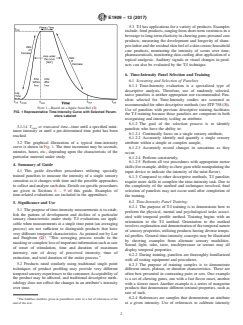
from initial exposure: 3.1 Definitions of Terms Specific to This Standard: See Fig.
1.
1.2.1 To its extinction,
1.2.2 To a specified intensity, or 3.1.1 area after I —post-peak area under the curve.
max
1.2.3 To a predetermined limit of time.
3.1.2 area before I —pre-peak area under the curve.
max
1.3 Applications not covered in this guide include measur-
3.1.3 AUC—area under the curve.
ing:
3.1.4 I or peak intensity—maximum observed intensity
max
1.3.1 Multiple sensations,
during the time of measurement.
1.3.2 Multiple exposures within a single measurement, and
3.1.5 perimeter—measured distance of perimeter of area
1.3.3 Qualitative or hedonic changes in the perceived sen-
delineated by T-I curve.
sation.
3.1.6 plateau—duration of peak intensity.
1.4 This guide includes protocols for the selection and
3.1.7 rate of increase—rateofintensityincreasebeforepeak
training of judges, descriptions and use of physical data
intensity (slope).
collection devices, and methods of data handling,
summarization, and statistical analysis. Illustration of two
3.1.8 rate of decrease—rate of intensity decrease after peak
different data handling and analysis approaches are included in
intensity (slope).
the appendixes.
3.1.9 T or duration time—time from onset of sensation
dur
1.5 Thisguideisnotapplicabletomeasureproductshelflife until it can no longer be perceived (T –T ).
ext onset
or stability that require evaluations over extended time.
3.1.10 T or time to extinction—time from initial exposure
ext
1.6 This standard does not purport to address all of the to the stimulus (T ) until it can no longer be perceived.
init
safety concerns, if any, associated with its use. It is the
3.1.11 T —time of initial exposure to the stimulus, typi-
init
responsibility of the user of this standard to establish appro-
cally when the clock starts.
priate safety, health and environmental practices and deter-
3.1.12 T —time to reach maximum intensity of the sen-
max
mine the applicability of regulatory limitations prior to use.
sation after exposure to the stimulus.
1.7 This international standard was developed in accor-
3.1.13 T —time point when the stimulus is first per-
onset
dance with internationally recognized principles on standard-
ceived after initial exposure to the stimulus.
This guide is under the jurisdiction of ASTM Committee E18 on Sensory
Evaluation and is the direct responsibility of Subcommittee E18.03 on Sensory
Theory and Statistics. For referenced ASTM standards, visit the ASTM website, www.astm.org, or
Current edition approved Aug. 1, 2017. Published August 2017. Originally contact ASTM Customer Service at service@astm.org. For Annual Book of ASTM
approved in 1997. Last previous edition approved in 2013 as E1909 – 13. DOI: Standards volume information, refer to the standard’s Document Summary page on
10.1520/E1909-13R17. the ASTM website.
Copyright © ASTM International, 100 Barr Harbor Drive, PO Box C700, West Conshohocken, PA 19428-2959. United States
E1909 − 13 (2017)
5.3 T-I has applications for a variety of products. Examples
include: food products, ranging from short-term sweetness in a
beverage to long-term elasticity in chewing gum; personal care
products, measuring the development and longevity of sham-
poo lather and the residual skin feel of a skin cream; household
care products, monitoring the intensity of scents over time;
pharmaceuticals, monitoring skin cooling after application of a
topical analgesic. Auditory signals or visual changes in prod-
ucts can also be evaluated by the T-I technique.
6. Time-Intensity Panel Selection and Training
6.1 Screening and Selection of Panelists
6.1.1 Time-Intensity evaluation is a specialized type of
descriptive analysis. Therefore, use of randomly selected,
naive panelists is neither appropriate nor recommended. Pan-
elists selected for Time-Intensity studies are screened as
recommended for other descriptive methods (see STP758 (3)).
NOTE 1—Based on a figure from Ref (1).
Use of panelists with previous descriptive training facilitates
FIG. 1 Representative Time-Intensity Curve with Selected Param-
the T-I training because these panelists are competent in both
eters Labeled
recognizing and intensity scaling an attribute.
6.1.2 The goal of the selection process is to identify
3.1.14 T or truncated time—time until a specified mini-
trun
panelists who have the ability to:
mum intensity or until a pre-determined time point has been
6.1.2.1 Continually focus on a single sensory attribute,
reached.
6.1.2.2 Accurately identify and quantify a single sensory
3.2 The graphical illustration of a typical time-intensity
attribute within a simple or complex sample,
curve is shown in Fig. 1. The time increment may be seconds,
6.1.2.3 Accurately record changes in sensations as they
minutes, hours, etc., depending upon the characteristic of the
occur,
particular material under study.
6.1.2.4 Perform consistently,
6.1.2.5 Perform all test procedures with appropriate motor
4. Summary of Guide
skills(forexample,abilitytochewgumwhilemanipulatingthe
4.1 This guide describes procedures utilizing specially
input device to indicate the intensity of the mint flavor).
trained panelists to measure the intensity of a single sensory
6.1.3 Compared to other descriptive methods, T-I panelists
sensation as it changes with time and the possible approaches
require more skills to complete the time-intensity task. Due to
to collect and analyze such data. Details on specific procedures
the complexity of the method and techniques involved, final
are given in Sections 6–9 of this guide. Examples of
selection of panelists may not occur until after completion of
time-related evaluations are included in the appendixes.
the training.
6.2 Time-Intensity Panel Training:
5. Significance and Use
6.2.1 The purpose of T-I training is to demonstrate how to
5.1 The purpose of time-intensity measurements is to estab-
perform the physical, mental and psychological tasks associ-
lish the pattern of development and decline of a particular
ated with temporal profile method. Training begins with an
sensory characteristic under study. T-I evaluations are appli-
orientation to the T-I method. Orientation to the method
cable when measurements at a single time point (an averaging
involves explanation and demonstration of the temporal nature
process) are not sufficient to distinguish products that have
of sensory properties, utilizing products having diverse tempo-
very different temporal characteristics. As pointed out by Lee
ral profiles. General time-intensity concepts may be illustrated
and Pangborn (2) , “This averaging process results in the
by showing examples from alternate sensory modalities.
maskingorcompletelossofimportantinformationsuchasrate
Sound, light, odor, taste, touch/pressure or texture may all
of onset of stimulation, time and duration of maximum
display temporal properties.
intensity, rate of decay of perceived intensity, time of
6.2.2 During training, panelists are thoroughly familiarized
extinction, and total duration of the entire process.”
with all testing equipment and procedures.
5.2 Products rated similarly using traditional single point
6.2.3 The purpose of training samples is to demonstrate
techniques of product profiling may provide very different
different onset, plateau, or duration characteristics. These are
temporalsensoryexperiencestotheconsumer.Acceptabilityof
often best presented in contrasting pairs or sets. One example
the product may be affected, and traditional descriptive meth-
is a set of chewing gums, one with a fast flavor onset, another
odology does not reflect the changes in an attribute’s intensity
with a slower onset. Another example is a series of margarine
over time.
products that demonstrate different textural properties, such as
rate of melt.
6.2.4 References are samples that demonstrate an attribute
The boldface numbers given in parentheses refer to a list of references at the
end of the text. at a given intensity. Use of references to calibrate intensity
E1909 − 13 (2017)
ratings occurs prior to the test. This is critical because in T-I measure mint flavor intensity changes over a 20 min period,
analysis, attribute intensity is recorded without interruption onetotwosamplesmaybethemaximumnumberpanelistscan
during the test. evaluate without excessive physical or mental fatigue.
Conversely, 5 to 6 potato chips may be evaluated for duration
6.3 Panel Performance Monitoring and Feedback
of crisp/crunchy attributes before fatigue sets in.
6.3.1 Monitor panelist performance during the training and
7.1.3 If the test is designed to measure the perception of an
evaluation sessions. At the start of the study, determine an
attribute to extinction, there is generally no need for lengthy
acceptable level of individualandgroupperformance.Thiscan
waiting periods between samples. However, a longer waiting
include deviation around a scale value at a specified time point
period is required when the perception of an attribute is
orsimilarindicator.STP758 (3)providesstatisticalprocedures
affected by a preceding sample. Examples include: allowing
suitable for monitoring panelist performance.
mouth temperature to return to normal after ice cream
6.3.2 Panelists should be able to demonstrate consistency in
evaluations,andrecoveryfromnumbingeffectsduetomenthol
their evaluations. One approach is to measure reproducibility
or spices.
in selected curve parameters, for example, I ,T ,T ,of
max max ext
7.1.4 Sample presentation order may be randomized, fixed,
their individual T-I curves. However, consistency with other
balanced, or presented as an incomplete block, depending on
panelistsislesslikelythanwithgeneraldescriptiveanalysis,as
study objectives. Typically, samples are presented in a bal-
each panelist tends to produce distinctive curve shapes. In T-I
anced order to minimize position bias, context effects, etc. as
analysis, within-panelist consistency, particularly in their abil-
recommended for most sensory evaluations. During training,
ity to communicate relative differences among samples, is
samples may be presented in fixed order (that is, all panelists
more important than panelist-to-panelist agreement. See dis-
see the same samples in the same order of presentation), to
cussion in Section 9.
facilitate discussion and learning.
6.3.3 One parameter that should show some degree of
agreement among the panelists is I , particularly if reference
max 7.2 Data Collection Considerations—In any time-intensity
standards for intensity are being utilized.The I value can be
max experiment, regardless of the type of data collection device
used to compare panelist performance with an appropriate
used, the rate at which information is collected must be
means-separation test, percent standard deviation, or other
determined. Data recording intervals are set to capture
analysis methods commonly used in monitoring descriptive
maximum/critical change on a product’s profile, with intensity
evaluations.
ratings collected at various time points depending on the study
objective (see Sections 8 and 9).
7. Panel Protocol
7.3 Sample Preparation—As with any sensory evaluation,
7.1 Specifics of the actual management of a time-intensity
sample preparation and presentation forT-I analysis need to be
panel are highly dependent upon study objectives. The follow-
controlled to eliminate extraneous effects. Recommended
ing topics represent major steps or considerations in the design
guidelines are to be followed (Manual 26) (4).
and execution of time-intensity panels. It is assumed that basic
7.3.1 Reference Samples—If appropriate in the test design,
panel training on the product of interest and selection of the
use of reference samples is recommended. References are
appropriate data collection device have been completed (see
evaluatedpriortotestsamples,sothattestsampleevaluationis
Sections 6 and 8, respectively).
conducted without interruption. References are evaluated by
7.1.1 Design Considerations—Before the panel is
the same technique as the test samples and may be used to
conducted, the following sample, experimental design, and
specify an attribute’s intensity at a specific point in time.
set-up issues are resolved:
7.3.2 Conditioning Sample—Use of a conditioning sample,
7.1.1.1 The first consideration in designing a time-intensity
presented prior to the actual test sample, can be used to
panel is to determine the length of time for data collection. It
calibrate panelists to the same sensation, and to some extent, to
can be relatively short, like the meltdown of a pat of butter
control first position bias or context effects. Consideration
when placed in the mouth, or relatively long, like the longevity
should be given to adaptation, carryover, and fatigue in
of mint flavor in a chewing gum.
deciding whether or not to use a conditioning sample.
7.1.1.2 Knowing the expected duration, and designing the
7.3.3 Inter-Stimulus Procedures—Specify whether panelists
study to cover critical changes in a product is prerequisite to
are to rinse, re-taste reference standards, or use a palate
other design considerations. The number of sampling points
cleanser such as a cracker, celery, etc. between samples.
and the time interval between points is set to capture the
7.4 Evaluation Procedures:
changes in an attribute at the time it occurs. Factors which may
7.4.1 Evaluation begins as soon as the stimulus is intro-
affect the duration of the attribute to be measured include:
duced to the panelist, for example, when the sample is applied,
sample form (crystalline versus dilute solution of sugar),
tasted, or smelled. The evaluation is completed upon reaching
sample size (larger amount of sample versus smaller amount of
sample), evaluation technique (dissolving versus chewing a a predetermined time limit, intensity, or extinction of the
sensation.
hard candy), and other materials (water hardness for soaps and
shampoos).
7.4.2 Standardized evaluation procedures such as the force
7.1.2 The number of samples evaluated in a panel session is and frequency of manipulations (for example, chews per
primarily dependent upon the duration of the time-intensity second of a cookie, rubs of a hand lotion, or whether to
sensation. If the evaluation of a chewing gum is designed to expectorate or swallow) must be specified and incorporated
E1909 − 13 (2017)
into the panel training and test procedures to assure all techniques are more cumbersome or complex hardware
panelists receive the same sample stimulus. requirements, the need for more sophisticated data handling
systems, and typically higher costs.
7.5 Other Panel Protocol Considerations:
7.5.1 Testing Environment—Follow recommended guide-
9. Data Handling, Analysis, and Summarization
lines for physical testing facilities in MNL 60 (5).
9.1 Introduction:
8. Data Collection Techniques 9.1.1 There are two aspects of T-I data that present chal-
lenges not typically encountered in other types of sensory data.
8.1 Introduction—The two modes of data collection in
9.1.2 First, instead of a single response associated with each
time-intensity evaluation are cued and real-time. With cued
stimulus, T-I data consists of a collection of responses consist-
techniques, panelists are instructed to report their responses at
ing of the intensity at each time point. The multiple values
specific, predetermined points in time during the evaluation.
arising from T-I data can either be handled directly by special
With real-time techniques, panelists report their responses
statistical analysis approaches or by data handling steps per-
continuously over time during the evaluation. Selection of one
formed prior to the statistical analysis.
technique over the other depends on such issues as the goals of
9.1.3 Second, T-I data typically exhibit greater panelist to
the study, the desired time points, available resources, and
panelist variability than found in other methods.This is seen in
economic considerations.
time-intensity curve shapes, sometimes referred to as “curve
8.2 Cued Techniques:
signatures”, that are either unique for each panelist or that fall
8.2.1 Thismodeofdatacollectionusesanexternaldeviceor
into various broad categories of shapes. Part of this variability
a person other than a panelist to provide an audible and/or a
in curve shape can be reduced by training and standardization
visualcueatthetimewhenaresponseisrequired.Examplesof
of techniques, but it is generally believed that it cannot be
cueing devices are: stop watches, visual or audible
completely eliminated.
metronomes, or both, other beeping or blinking devices with
9.1.4 The following section discusses several data handling
adjustable timing, and computers.
techniques for T-I data. It is important to understand that there
8.2.2 The main advantage of cued techniques is the simplic-
have not been a sufficient number of critically reviewed
ity of the task for the panelists.Also, cued techniques often are
published studies to warrant setting specific guidelines or
less costly than real-time techniques. Limitations of this mode
recommendations.
are low precision of data when short time intervals are used,
9.2 Data Handling—Several data handling techniques can
possible distraction or biasing of the panelists by the cueing
be used to process the multiple-valued nature of T-I data prior
device and, when applicable, by viewing of previous ratings.
to analysis. These techniques include: collecting only data
8.3 Real-Time Techniques:
relevant to the study objective, eliminating redundant data,
8.3.1 This mode of data collection uses a computer and removing data contributing to bias, smoothing noisy data, or
appropriate software that allows the panelists to report their
summarizing the data by extracting curve features of interest.
responses continuously during the evaluations. With 9.2.1 Study objectives can determine which data points are
computers, a scale is displayed on the computer screen and the
of interest. For example, if the purpose of the study only
panelist manipulates an input device, such as a mouse or requires information on the time to maximum intensity, then
joystick, to position the computer’s cursor on the scale to
only these specific data could be collected.
indicatetheintensityoftheattributeateachinstantintime.The 9.2.2 An example of redundant data would be the collection
on-board clock of the computer is used to establish the time
of response values more frequently than the response is
axis. changing. This would result in a response plateau that may not
8.3.2 Several options are available for recording data ob- be of interest in the study. In this case, the data between the
tained using real-time techniques. One approach is to measure start and the end of the plateau can simply be deleted from the
reported intensities at a fixed number of predetermined time- data file, leaving two points to define the plateau.
points—by instructing the computer to only record or store 9.2.3 Bias or data error arises when the response is influ-
data at selected time-points. (Note that the panelist would not
enced by factors other than the stimulus itself. Examples of
be aware of the time-points actually recorded for analysis.) such factors include variations in panelist evaluation
Another approach is to record all the data obtained in a
techniques, such as expectoration prior to the designated
real-time evaluation. The computer software may be instructed expectoration time. If it becomes known that such actions tend
to record a panelist’s intensity readings at a frequency that the
to result in characteristic response patterns, that is, an extrane-
computer allows. ous curve peak, then the associated response data could be
8.3.3 The main advantages of real-time techniques are the removed prior to analysis.
flexibility afforded the analyst for controlling the collection 9.2.4 If the response data do not exhibit regular or smooth
intervals and by having all of the panelists’ readings available trends, but rather has noisy fluctuations around a general trend,
fornumericalanalysisandinterpretation.Anotheradvantageof the data can be processed by “smoothing” algorithms. Such
most real-time techniques is that they do not allow the panelist algorithms replace the original data with transformed values
to view previously reported intensity values, thus eliminating that reflect the trend, but do not include the noisy fluctuations
the potential bias resulting from observations of the completed (6). The resulting smoothed data are typically what is used in
portion of the evolving T-I curve. Disadvantages of real-time any further analyses.
E1909 − 13 (2017)
9.2.5 The T-I data can also be reduced to just a set of key advantage of this approach over analyzing curve parameters is
curve characteristics. Each characteristic, or parameter, repre- thattheparameterestimatesmaybequiteimprecisewhenthere
sents a specific feature of the time-intensity curve. Commonly
are few time points. For example, if sweet intensity was
used parameters include the following (see Section 3 for collected on a gum only every minute, then T cannot be
max
definitions):
more precise than a minute. This approach requires examining
9.2.5.1 I ,
the time by stimulus interaction term in order to assess and
max
9.2.5.2 T , compare stimulus effects.
onset
9.2.5.3 T ,
max 9.3.5.1 When the number of time points becomes large, say
9.2.5.4 T ,
plateau greater than eight, examining such an interaction becomes
9.2.5.5 T
ext, unwieldy. In addition, assumptions on how time points corre-
9.2.5.6 Area under the whole, or part, of the curve,
late to each other, required for what is called the “univariate
9.2.5.7 Slopes,orratesofintensityincreaseordecrease,and
approach,” may not be met, particularly as the number of time
9.2.5.8 Other parameters defined as needed, such as curve
points increases. This can sometimes be handled by modeling
perimeter or curve shape.
the variance-covariance structure using general linear mixed
model methods (8).
9.3 Data Analysis:
9.3.5.2 Alternatives to a repeated measures analysis would
9.3.1 Several options for the analysis of T-I data are
described in the sections given below. It is important to note beeitheramultivariateanalysisofvariance(MANOVA)onthe
that not every method is applicable to every research situation. set of intensity values or separate analyses at each time point.
The methods vary in their complexity and the circumstances As the number of time points increase both techniques would
for which they are best suited. No matter what method is used become increasingly unwieldy. The MANOVA would also
it remains important to ensure that the data are accurate, that require a large amount of data, that is, judges, in order to be
theanalysis is consistentwithhowthestudywasdesigned,and feasible.
that analysis assumptions are met.
9.3.6 Analyses based on time-to-event models (9) can also
9.3.2 Since complete details on the analyses are not given be used for time intensity data if there is a specific time
below, statistical advice or references should be utilized as
parameter of interest or if the only data recorded were time
needed. parameters, such as T ,T ,orT . These models are
onset max ext
9.3.3 A preliminary step for most analyses should be a sometimes referred to as either “survival models” in the
visual inspection of the individual panelist time-intensity medical field or “failure models” in manufacturing. An ex-
graphs. This involves plotting out specific curves to identify ample “event” for T-I data would be the time when the
situations described in 9.2.1 and 9.2.2. Visual inspection will
sensation was no longer perceived, that is, T . The collection
ext
also help in making decisions regarding the most appropriate of event times would then be the data analyzed by these
data analysis.
techniques.
9.3.4 If curve parameters (see 9.2.5) are used as the “raw
9.3.6.1 Methods that do not rely on a particular time model,
data” for the statis
...