

ASTM D1514-23
(Test Method)Standard Test Method for Carbon Black-Sieve Residue
General Information
- Abstract
SIGNIFICANCE AND USE
4.1 The quantity of sieve residue of carbon black is important in some molded or extruded products as it may relate to the surface appearance of those products. The maximum residue in each application is normally determined and agreed to between the user and the producer.
SCOPE
1.1 This test method covers the determination of the water wash sieve residue in regular untreated carbon blacks. It may not be applicable to oil-treated carbon blacks because the oil would prevent proper wetting of the black by water.
1.2 The values stated in SI units are to be regarded as the standard. The values in parentheses are for information only.
1.3 This standard does not purport to address all of the safety concerns, if any, associated with its use. It is the responsibility of the user of this standard to establish appropriate safety, health, and environmental practices and determine the applicability of regulatory limitations prior to use. For specific precautionary statements, see Section 6.
1.4 This international standard was developed in accordance with internationally recognized principles on standardization established in the Decision on Principles for the Development of International Standards, Guides and Recommendations issued by the World Trade Organization Technical Barriers to Trade (TBT) Committee.
- Status
- Published
- Publication Date
- 31-Mar-2023
- Technical Committee
- D24 - Carbon Black
- Drafting Committee
- D24.31 - Non-Carbon Black Components of Carbon Black


Overview
ASTM D1514-23 is the internationally recognized standard test method for determining the water wash sieve residue in untreated carbon black. Developed by ASTM International, this standard is crucial for understanding and quantifying the non-carbon black residue present in carbon black samples. The sieve residue content can significantly affect the quality, surface appearance, and performance of molded or extruded products, making ASTM D1514-23 essential for manufacturers and end-users who require material consistency and reliable results throughout quality control processes.
This standard does not apply to oil-treated carbon blacks as oil may inhibit proper dispersion with water. It emphasizes the need for agreement between producer and user to set maximum acceptable residue thresholds, as these affect product aesthetics and properties.
Key Topics
Scope and Purpose
- Measures the water wash sieve residue in regular, untreated carbon blacks.
- Establishes a standard procedure for assessing impurities or non-carbon black particles that remain after water washing.
- Stresses mutual agreement on residue limits between producers and users to ensure product suitability.
Test Procedure Highlights
- A defined quantity of carbon black is washed through a specified wire-mesh sieve using water, isolating any residue.
- The remaining particles are dried, weighed, and results reported in mg/kg (ppm).
- Sampling protocols and sieve specifications are referenced to other ASTM standards for consistency.
Safety and Precision
- Users must follow appropriate safety, health, and environmental protocols when conducting the test.
- Precision data derived from interlaboratory testing supports the reliability of the method but notes that results may vary with different materials or testing conditions.
Reporting Requirements
- Reports must clearly identify samples, sieve numbers, and residue determination to ensure traceability and repeatability.
Applications
ASTM D1514-23 finds practical application primarily in the carbon black manufacturing and rubber and plastics industries:
- Quality Control: Ensures carbon black inputs have minimal non-carbon black residues, preserving the desired surface appearance in the final products.
- Product Development: Assists in optimizing materials for specific visual or mechanical properties, especially in molded or extruded components.
- Supplier-User Agreements: Provides a common baseline for negotiating acceptable residue limits for distinct applications, supporting product guarantees and customer specifications.
- Regulatory Compliance: Helps organizations align with quality standards and international trade expectations, contributing to standardized manufacturing protocols.
Related Standards
ASTM D1514-23 is frequently used in conjunction with the following standards:
- ASTM D1799: Practice for Carbon Black-Sampling Packaged Shipments
- ASTM D1900: Practice for Carbon Black-Sampling Bulk Shipments
- ASTM D4483: Practice for Evaluating Precision for Test Method Standards in the Rubber and Carbon Black Manufacturing Industries
- ASTM E11: Specification for Woven Wire Test Sieve Cloth and Test Sieves
By adhering to ASTM D1514-23, organizations benefit from improved product quality, reduced risk of customer complaints, and greater consistency in manufacturing processes. Employing this standard is a critical step for anyone involved with carbon black in quality-sensitive applications.
Relations
- Effective Date
- 01-Nov-2015
- Effective Date
- 01-Jun-2014
- Effective Date
- 01-Oct-2013
- Effective Date
- 01-May-2011
- Effective Date
- 01-May-2009
- Effective Date
- 01-Sep-2008
- Effective Date
- 01-Oct-2006
- Effective Date
- 01-May-2004
- Effective Date
- 01-Nov-2003
- Effective Date
- 10-Jun-2003
- Effective Date
- 10-Nov-2002
- Effective Date
- 10-May-2001
- Effective Date
- 10-May-2001
- Effective Date
- 10-Nov-1997
- Effective Date
- 15-Aug-1994
Get Certified
Connect with accredited certification bodies for this standard

DIN CERTCO
DIN Group product certification.

Smithers Quality Assessments
US management systems and product certification.
Sponsored listings
Frequently Asked Questions
ASTM D1514-23 is a standard published by ASTM International. Its full title is "Standard Test Method for Carbon Black-Sieve Residue". This standard covers: SIGNIFICANCE AND USE 4.1 The quantity of sieve residue of carbon black is important in some molded or extruded products as it may relate to the surface appearance of those products. The maximum residue in each application is normally determined and agreed to between the user and the producer. SCOPE 1.1 This test method covers the determination of the water wash sieve residue in regular untreated carbon blacks. It may not be applicable to oil-treated carbon blacks because the oil would prevent proper wetting of the black by water. 1.2 The values stated in SI units are to be regarded as the standard. The values in parentheses are for information only. 1.3 This standard does not purport to address all of the safety concerns, if any, associated with its use. It is the responsibility of the user of this standard to establish appropriate safety, health, and environmental practices and determine the applicability of regulatory limitations prior to use. For specific precautionary statements, see Section 6. 1.4 This international standard was developed in accordance with internationally recognized principles on standardization established in the Decision on Principles for the Development of International Standards, Guides and Recommendations issued by the World Trade Organization Technical Barriers to Trade (TBT) Committee.
SIGNIFICANCE AND USE 4.1 The quantity of sieve residue of carbon black is important in some molded or extruded products as it may relate to the surface appearance of those products. The maximum residue in each application is normally determined and agreed to between the user and the producer. SCOPE 1.1 This test method covers the determination of the water wash sieve residue in regular untreated carbon blacks. It may not be applicable to oil-treated carbon blacks because the oil would prevent proper wetting of the black by water. 1.2 The values stated in SI units are to be regarded as the standard. The values in parentheses are for information only. 1.3 This standard does not purport to address all of the safety concerns, if any, associated with its use. It is the responsibility of the user of this standard to establish appropriate safety, health, and environmental practices and determine the applicability of regulatory limitations prior to use. For specific precautionary statements, see Section 6. 1.4 This international standard was developed in accordance with internationally recognized principles on standardization established in the Decision on Principles for the Development of International Standards, Guides and Recommendations issued by the World Trade Organization Technical Barriers to Trade (TBT) Committee.
ASTM D1514-23 is classified under the following ICS (International Classification for Standards) categories: 83.040.20 - Rubber compounding ingredients. The ICS classification helps identify the subject area and facilitates finding related standards.
ASTM D1514-23 has the following relationships with other standards: It is inter standard links to ASTM D1900-06(2015), ASTM D1799-03a(2014), ASTM E11-13, ASTM D1900-06(2011), ASTM E11-09e1, ASTM D1799-03a(2008), ASTM D1900-06, ASTM E11-04, ASTM D1799-03a, ASTM D1799-03, ASTM D1799-02, ASTM E11-95, ASTM E11-01, ASTM D1799-93(1997), ASTM D1900-94(2002). Understanding these relationships helps ensure you are using the most current and applicable version of the standard.
ASTM D1514-23 is available in PDF format for immediate download after purchase. The document can be added to your cart and obtained through the secure checkout process. Digital delivery ensures instant access to the complete standard document.
Standards Content (Sample)
This international standard was developed in accordance with internationally recognized principles on standardization established in the Decision on Principles for the
Development of International Standards, Guides and Recommendations issued by the World Trade Organization Technical Barriers to Trade (TBT) Committee.
Designation: D1514 − 23
Standard Test Method for
Carbon Black—Sieve Residue
This standard is issued under the fixed designation D1514; the number immediately following the designation indicates the year of
original adoption or, in the case of revision, the year of last revision. A number in parentheses indicates the year of last reapproval. A
superscript epsilon (´) indicates an editorial change since the last revision or reapproval.
1. Scope 3. Summary of Test Method
3.1 A sample of carbon black is washed with water through
1.1 This test method covers the determination of the water
a wire-mesh screen of a specified size until all that remains is
wash sieve residue in regular untreated carbon blacks. It may
a non-carbon black residue. This residue is dried, weighed, and
not be applicable to oil-treated carbon blacks because the oil
the amount of residue is expressed as mg/kg (ppm) of the
would prevent proper wetting of the black by water.
original sample.
1.2 The values stated in SI units are to be regarded as the
standard. The values in parentheses are for information only. 4. Significance and Use
1.3 This standard does not purport to address all of the 4.1 The quantity of sieve residue of carbon black is impor-
tant in some molded or extruded products as it may relate to the
safety concerns, if any, associated with its use. It is the
surface appearance of those products. The maximum residue in
responsibility of the user of this standard to establish appro-
each application is normally determined and agreed to between
priate safety, health, and environmental practices and deter-
the user and the producer.
mine the applicability of regulatory limitations prior to use.
For specific precautionary statements, see Section 6.
5. Apparatus
1.4 This international standard was developed in accor-
3, 4
5.1 Sieve and Filtering Apparatus, as shown in Fig. 1.
dance with internationally recognized principles on standard-
ization established in the Decision on Principles for the
5.2 Balance, with a sensitivity of 0.01 g.
Development of International Standards, Guides and Recom-
5.3 Analytical Balance, with a sensitivity of 0.1 mg.
mendations issued by the World Trade Organization Technical
5.4 Oven, gravity-convection type, capable of temperature
Barriers to Trade (TBT) Committee.
regulation within 61°C at 125°C and temperature uniformity
within 65°C.
2. Referenced Documents
5.5 Sieves, of either phosphor bronze or stainless steel. The
2.1 ASTM Standards:
sieve shall be in accordance with Specification E11. The sieve
D1799 Practice for Carbon Black—Sampling Packaged
to be used shall be agreed upon between the purchaser and the
Shipments
seller.
D1900 Practice for Carbon Black—Sampling Bulk Ship-
5.6 Weighing Dishes.
ments
D4483 Practice for Evaluating Precision for Test Method
6. Precautions
Standards in the Rubber and Carbon Black Manufacturing
6.1 Keep the apparatus clean at all times to prevent con-
Industries
tamination.
E11 Specification for Woven Wire Test Sieve Cloth and Test
Sieves
Sieve and filtering apparatus available from Jaron Technologies LLC, 2338
Duncan St., Pampa, TX 79065, has been found suitable. The A2000 Test Set from
This test method is under the jurisdiction of ASTM Committee D24 on Carbon HITEC Luxembourg S.A., 49 rue du Baerendall, L-8212 Mamer, Luxembourg, has
Black and is the direct responsibility of Subcommittee D24.31 on Non-Carbon been found suitable. An ASTM specified apparatus modified with an enlarged funnel
Black Components of Carbon Black. leg ID (5.080 cm or 2.0 in.) and sieve screen OD (6.032 cm or 2.375 in.) has also
Current edition approved April 1, 2023. Published April 2023. Originally been found suitable.
approved in 1957. Last previous edition approved in 2020 as D1514 – 15 (2020). The sole source of supply of housing No. 20 and cartridge No. 30 known to the
DOI: 10.1520/D1514-23. committee at this time is Amtek, Plymouth Products Division, 562 Indiana Ave.,
For referenced ASTM standards, visit the ASTM website, www.astm.org, or Sheboygan, WI 53081. If you are aware of alternative suppliers, please provide this
contact ASTM Customer Service at service@astm.org. For Annual Book of ASTM information to ASTM International Headquarters. Your comments will receive
Standards volume information, refer to the standard’s Document Summary page on careful consideration at a meeting of the responsible technical committee, which
the ASTM website. you may attend.
Copyright © ASTM International, 100 Barr Harbor Drive, PO Box C700, West Conshohocken, PA 19428-2959. United States
D1514 − 23
and allow the water to run through it for 3 min. Stop the water
flow by closing valves A and C. Examine the sieve for
particles; if none are observed, the apparatus is ready for use.
9.4 Weigh 100.0 g of the carbon black on the balance.
9.5 Attach the proper sieve to the funnel and start the water
flow by opening valves A and C.
9.6 Add the carbon black slowly to the funnel to prevent
plugging of the sieve.
NOTE 1—If desired it is permissible to utilize wetting agents to facilitate
dispersion. Care must be taken to ensure that all of the solid material is
transferred from the vessel used for dispersing the black into the funnel of
the washing apparatus.
9.7 Use a gentle stream of water from the hose attached to
valve D to wash down any carbon black on the sides of the
funnel.
9.8 Continue washing until the wash water coming through
NOTE 1—Industrial/O.E.M. filter and pleated polyester fabric reusable the sieve is clear.
cartridges have been found to be a satisfactory strainer.
9.9 Remove the sieve holder and sieve from the funnel and
NOTE 2—Corrosion-free piping must be used.
rub the residue lightly with the finger to disaggregate any hard
NOTE 3—Detailed drawings can be obtained from Test Method
carbon black lumps which may not have been thoroughly wet
D1514 – 88a.
NOTE 4—Spray nozzle: Part No. 460.746.30 BE available from Lechler by the water.
Inc., 445 Kautz Rd., St. Charles, IL 60174, or Titan Specialties Inc., P.O.
9.10 Replace the sieve holder and sieve and wash for an
Box 2316, Pampa, TX 70066-2316.
additional 2 min.
FIG. 1 Schematic Diagram of Apparatus for Sieve Residue Deter-
mination
9.11 Remove the sieve holder and sieve and dry for 1 h at
125°C.
6.2 Examine the sieves each time they are used to make sure 9.12 Transfer the dried residue to a piece of smooth white
that no cracks or holes have developed. bond paper and rub gently to remove any carbon black
remaining on the residue. Rub until the white paper no longer
6.3 Examine the strainer periodically to ascertain that the
shows any smears.
filter screen is in good condition.
NOTE 2—The purpose of gently rubbing the residue is to remove any
7. Sampling
black that may be clinging to the grit
...
This document is not an ASTM standard and is intended only to provide the user of an ASTM standard an indication of what changes have been made to the previous version. Because
it may not be technically possible to adequately depict all changes accurately, ASTM recommends that users consult prior editions as appropriate. In all cases only the current version
of the standard as published by ASTM is to be considered the official document.
Designation: D1514 − 15 (Reapproved 2020) D1514 − 23
Standard Test Method for
Carbon Black—Sieve Residue
This standard is issued under the fixed designation D1514; the number immediately following the designation indicates the year of
original adoption or, in the case of revision, the year of last revision. A number in parentheses indicates the year of last reapproval. A
superscript epsilon (´) indicates an editorial change since the last revision or reapproval.
1. Scope
1.1 This test method covers the determination of the water wash sieve residue in regular untreated carbon blacks. It may not be
applicable to oil-treated carbon blacks because the oil would prevent proper wetting of the black by water.
1.2 The values stated in SI units are to be regarded as the standard. The values in parentheses are for information only.
1.3 This standard does not purport to address all of the safety concerns, if any, associated with its use. It is the responsibility
of the user of this standard to establish appropriate safety, health, and environmental practices and determine the applicability of
regulatory limitations prior to use. For specific precautionary statements, see Section 6.
1.4 This international standard was developed in accordance with internationally recognized principles on standardization
established in the Decision on Principles for the Development of International Standards, Guides and Recommendations issued
by the World Trade Organization Technical Barriers to Trade (TBT) Committee.
2. Referenced Documents
2.1 ASTM Standards:
D1799 Practice for Carbon Black—Sampling Packaged Shipments
D1900 Practice for Carbon Black—Sampling Bulk Shipments
D4483 Practice for Evaluating Precision for Test Method Standards in the Rubber and Carbon Black Manufacturing Industries
E11 Specification for Woven Wire Test Sieve Cloth and Test Sieves
3. Summary of Test Method
3.1 A sample of carbon black is washed with water through a wire-mesh screen of a specified size until all that remains is a
non-carbon black residue. This residue is dried, weighed, and the amount of residue is expressed as mg/kg (ppm) of the original
sample.
4. Significance and Use
4.1 The quantity of sieve residue of carbon black is important in some molded or extruded products as it may relate to the surface
appearance of those products. The maximum residue in each application is normally determined and agreed to between the user
and the producer.
This test method is under the jurisdiction of ASTM Committee D24 on Carbon Black and is the direct responsibility of Subcommittee D24.31 on Non-Carbon Black
Components of Carbon Black.
Current edition approved Nov. 1, 2020April 1, 2023. Published December 2020April 2023. Originally approved in 1957. Last previous edition approved in 20152020 as
ε1
D1514 – 15 (2020). . DOI: 10.1520/D1514-15R20.10.1520/D1514-23.
For referenced ASTM standards, visit the ASTM website, www.astm.org, or contact ASTM Customer Service at service@astm.org. For Annual Book of ASTM Standards
volume information, refer to the standard’s Document Summary page on the ASTM website.
Copyright © ASTM International, 100 Barr Harbor Drive, PO Box C700, West Conshohocken, PA 19428-2959. United States
D1514 − 23
5. Apparatus
3, 4
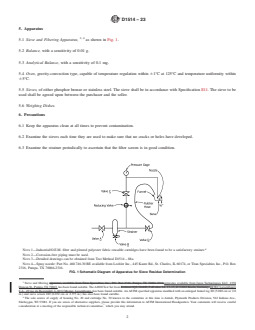
5.1 Sieve and Filtering Apparatus, as shown in Fig. 1.
5.2 Balance, with a sensitivity of 0.01 g.
5.3 Analytical Balance, with a sensitivity of 0.1 mg.
5.4 Oven, gravity-convection type, capable of temperature regulation within 61°C at 125°C and temperature uniformity within
65°C.
5.5 Sieves, of either phosphor bronze or stainless steel. The sieve shall be in accordance with Specification E11. The sieve to be
used shall be agreed upon between the purchaser and the seller.
5.6 Weighing Dishes.
6. Precautions
6.1 Keep the apparatus clean at all times to prevent contamination.
6.2 Examine the sieves each time they are used to make sure that no cracks or holes have developed.
6.3 Examine the strainer periodically to ascertain that the filter screen is in good condition.
NOTE 1—Industrial/O.E.M. filter and pleated polyester fabric reusable cartridges have been found to be a satisfactory strainer.
NOTE 2—Corrosion-free piping must be used.
NOTE 3—Detailed drawings can be obtained from Test Method D1514 – 88a.
NOTE 4—Spray nozzle: Part No. 460.746.30 BE available from Lechler Inc., 445 Kautz Rd., St. Charles, IL 60174, or Titan Specialties Inc., P.O. Box
2316, Pampa, TX 70066-2316.
FIG. 1 Schematic Diagram of Apparatus for Sieve Residue Determination
Sieve and filtering apparatus, available from Titan Specialties, Inc., P.O. Box 2316, Pampa, TX 70066-2316,apparatus available from Jaron Technologies LLC, 2338
Duncan St., Pampa, TX 79065, has been found suitable. The A2000 Test Set from Krahnen IQS, GmbH, Paffrather Str. 13–15, D-51069 Koeln, Germany, HITEC Luxembourg
S.A., 49 rue du Baerendall, L-8212 Mamer, Luxembourg, has been found suitable. An ASTM specified apparatus modified with an enlarged funnel leg ID (5.080 cm or 2.0
in.) and sieve screen OD (6.032 cm or 2.375 in.) has also been found suitable.
The sole source of supply of housing No. 20 and cartridge No. 30 known to the committee at this time is Amtek, Plymouth Products Division, 562 Indiana Ave.,
Sheboygan, WI 53081. If you are aware of alternative suppliers, please provide this information to ASTM International Headquarters. Your comments will receive careful
consideration at a meeting of the responsible technical committee, which you may attend.
D1514 − 23
7. Sampling
7.1 Samples shall be taken in accordance with Practice D1799 or Practice D1900.
8. Calculation
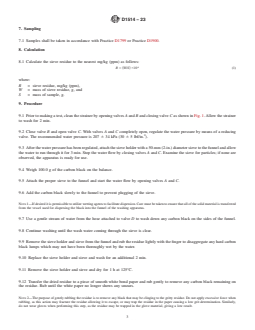
8.1 Calculate the sieve residue to the nearest mg/kg (ppm) as follows:
R 5 W/S ×10 (1)
~ !
where:
R = sieve residue, mg/kg (ppm),
W = mass of sieve residue, g, and
S = mass of sample, g.
9. Procedure
9.1 Prior to making a test, clean the strainer by opening valves A and B and closing valve C as shown in Fig. 1. Allow the strainer
to wash for 2 min.
9.2 Close valve B and open valve C. With valves A and C completely open, regulate the water pressure by means of a reducing
valve. The recommended water pressure is 207 6 34 kPa (30 6 5 lbf/in. ).
9.3 After the water pressure has been regulated, attach the sieve holder with a 50-mm (2-in.) diameter sieve to the funnel and allow
the water to run through it for 3 min. Stop the water flow by closing valves A and C. Examine the sieve for particles; if none are
observed, the apparatus is ready for use.
9.4 Weigh 100.0 g of the carbon black on the balance.
9.5 Attach the proper sieve to the funnel and start the water flow by opening valves A and C.
9.6 Add the carbon black slowly to the funnel to prevent plugging of the sieve.
NOTE 1—If desired it is permissible to utilize wetting agents to facilitate dispersion. Care must be taken to ensure that all of the solid material is transferred
from the vessel used for dispersing the black into the funnel of the washing apparatus.
9.7 Use a gentle stream of water from the hose attached to valve D to wash down any carbon black on the sides of the funnel.
9.8 Continue washing until the wash water comin
...