

ASTM D5855/D5855M-20
(Practice)Standard Practice for (Analytical Procedure) Determining Transmissivity and Storage Coefficient of Confined Nonleaky or Leaky Aquifer by Constant Drawdown Method in Flowing Well
General Information
- Abstract
SIGNIFICANCE AND USE
5.1 Assumptions—Leaky Aquifer:
5.1.1 Drawdown (sW) in the control well is constant,
5.1.2 Well is infinitesimal diameter and fully penetrates aquifer,
5.1.3 The aquifer is homogeneous, isotropic, and areally extensive, and
5.1.4 The control well is 100 % efficient.
5.2 Assumptions—Nonleaky Aquifer:
5.2.1 Drawdown (sW) in the control well is constant,
5.2.2 Well is infinitesimal diameter and fully penetrates aquifer,
5.2.3 The aquifer is homogeneous, isotropic, and areally extensive,
5.2.4 Discharge from the well is derived exclusively from storage in the nonleaky aquifer, and
5.2.5 The control well is 100 % efficient.
5.3 Implications of Assumptions:
5.3.1 The assumptions are applicable to confined aquifers and fully penetrating control wells. However, this practice may be applied to partially penetrating wells where the method may provide an estimate of hydraulic conductivity for the aquifer adjacent to the open interval of the well if the horizontal hydraulic conductivity is significantly greater than the vertical hydraulic conductivity.
5.3.2 Values obtained for storage coefficient are less reliable than the values calculated for transmissivity. Storage coefficient values calculated from control well data are not reliable.
Note 7: The quality of the result produced by this standard is dependent on the competence of the personnel performing it, and the suitability of the equipment and facilities used. Agencies that meet the criteria of Practice D3740 are generally considered capable of competent and objective testing/sampling/inspection/etc. Users of this standard are cautioned that compliance with Practice D3740 does not in itself assure reliable results. Reliable results depend on many factors; Practice D3740 provides a means of evaluating some of those factors.
SCOPE
1.1 This practice covers an analytical solution for determining transmissivity and storage coefficient of a leaky or nonleaky confined aquifer. It is used to analyze data on the flow rate from a control well while a constant head is maintained in the well.
1.2 This analytical procedure is used in conjunction with the field procedure in Practice D5786.
1.3 Limitations—The limitations of this technique for the determination of hydraulic properties of aquifers are primarily related to the correspondence between field situation and the simplifying assumption of the solution.
1.4 Units—The values stated in either SI units or inch-pound units are to be regarded separately as standard. The values in each system may not be exact equivalents; therefore each system shall be used independently of the other. Combining values from the two systems may result in non-conformance with the standard. Reporting of test results in units other than SI shall not be regarded as nonconformance with this practice.
1.5 All observed and calculated values shall conform to the guidelines for significant digits and rounding established in Practice D6026.
1.6 This practice offers a set of instructions for performing one or more specific operations. This document cannot replace education or experience and should be used in conjunction with professional judgment. Not all aspects of the practice may be applicable in all circumstances. This ASTM standard is not intended to represent or replace the standard of care by which the adequacy of a given professional service must be judged, nor should this document be applied without the consideration of a project’s many unique aspects. The word “Standard” in the title of this document means only that the document has been approved through the ASTM consensus process.
1.7 This standard does not purport to address all of the safety concerns, if any, associated with its use. It is the responsibility of the user of this standard to establish appropriate safety, health, and environmental practices and determine the applicability of regulatory limitations prior ...
- Status
- Published
- Publication Date
- 14-May-2020
- Technical Committee
- D18 - Soil and Rock
- Drafting Committee
- D18.21 - Groundwater and Vadose Zone Investigations
Buy Documents
ASTM D5855/D5855M-20 - Standard Practice for (Analytical Procedure) Determining Transmissivity and Storage Coefficient of Confined Nonleaky or Leaky Aquifer by Constant Drawdown Method in Flowing Well
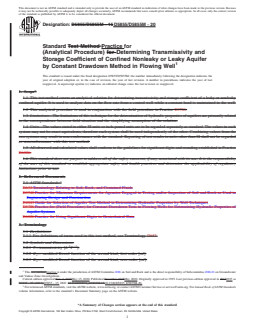
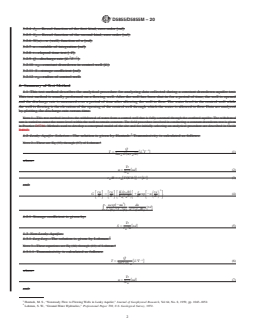
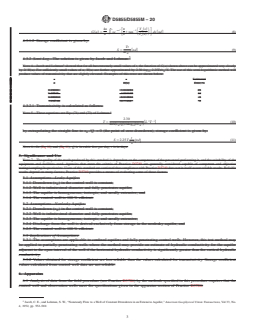
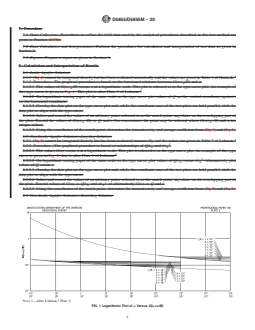
REDLINE ASTM D5855/D5855M-20 - Standard Practice for (Analytical Procedure) Determining Transmissivity and Storage Coefficient of Confined Nonleaky or Leaky Aquifer by Constant Drawdown Method in Flowing Well
Overview
ASTM D5855/D5855M-20 is a standard practice developed by ASTM International for the analytical determination of the transmissivity and storage coefficient of confined aquifers-either leaky or nonleaky-using the constant drawdown method in a flowing well. This standard provides a framework for analyzing well flow data under constant head conditions, enabling hydrogeologists and engineers to quantify key hydraulic properties necessary for groundwater resource management, aquifer characterization, and remediation projects.
The standard is intended for use with fully penetrating control wells under constant drawdown. It is most effective for homogeneous, isotropic, and laterally extensive aquifers, but with caution, it may also be applied to certain partially penetrating wells for localized hydraulic conductivity estimates.
Key Topics
- Analytical Solution: Uses analytical procedures for interpreting flow data from constant drawdown well tests to estimate transmissivity and storage coefficient.
- Aquifer Types: Addresses both leaky and nonleaky confined aquifers, with specific assumptions for each, such as constant drawdown and fully penetrating wells.
- Assumptions and Limitations:
- Constant drawdown in the control well.
- Well is of infinitesimal diameter and fully penetrates the aquifer.
- Aquifer is homogeneous, isotropic, and areally extensive.
- For nonleaky aquifers, all discharge is derived from aquifer storage.
- The quality of calculated storage coefficient values can be less reliable than transmissivity estimates.
- Integration and Data Analysis: Involves graphical matching of observed data with theoretical type curves (log-log or semi-log), based on established solutions by Hantush, Jacob, and Lohman.
- Reporting Requirements: Comprehensive documentation of the conceptual hydrogeological model, field methods, equipment, data collected, and test result interpretation is essential to ensure high-quality and reproducible results.
Applications
The constant drawdown method detailed in ASTM D5855/D5855M-20 is widely used by:
- Hydrogeologists and Water Resource Engineers: To evaluate and characterize aquifer properties for groundwater resource planning, well field design, and source water protection.
- Environmental Consultants: As part of site assessment and remediation, supporting decisions regarding groundwater extraction, containment, or recharge.
- Regulatory Agencies: For standardized data collection and reporting on aquifer tests in compliance with permitting and water rights frameworks.
- Construction and Infrastructure Projects: Supporting dewatering design, foundation analysis, and risk assessment where groundwater impacts are relevant.
The standard provides significant practical value by offering repeatable, consensus-based methodologies that can be used with a range of units (SI or inch-pound) and that integrate seamlessly with companion field standards such as ASTM D5786 for data acquisition.
Related Standards
ASTM D5855/D5855M-20 references and is complemented by several closely related ASTM standards:
- ASTM D653 - Terminology Relating to Soil, Rock, and Contained Fluids
- ASTM D3740 - Practice for Minimum Requirements for Agencies Engaged in Testing and/or Inspection of Soil and Rock
- ASTM D4043 - Guide for Selection of Aquifer Test Method in Determining Hydraulic Properties by Well Techniques
- ASTM D5786 - Practice for Field Procedure for Constant Drawdown Tests in Flowing Wells for Determining Hydraulic Properties of Aquifer Systems
- ASTM D6026 - Practice for Using Significant Digits in Geotechnical Data
These standards collectively offer a robust framework for the planning, execution, analysis, and reporting of aquifer tests as well as the evaluation of agency competency and test data reliability.
Keywords: transmissivity, storage coefficient, confined aquifer, leaky aquifer, nonleaky aquifer, constant drawdown, groundwater, aquifer test, ASTM D5855, flow test, well hydraulics, hydrogeology, groundwater resource management.
Relations
- Effective Date
- 01-Nov-2023
- Effective Date
- 01-Oct-2019
- Effective Date
- 01-Jan-2017
- Effective Date
- 01-Jan-2017
- Effective Date
- 01-Aug-2014
- Effective Date
- 01-May-2012
- Effective Date
- 01-May-2012
- Effective Date
- 01-Mar-2012
- Effective Date
- 01-Sep-2011
- Effective Date
- 01-Sep-2011
- Effective Date
- 01-Aug-2010
- Effective Date
- 01-Mar-2010
- Effective Date
- 01-Jan-2009
- Effective Date
- 01-Dec-2008
- Effective Date
- 01-Nov-2008
Buy Documents
ASTM D5855/D5855M-20 - Standard Practice for (Analytical Procedure) Determining Transmissivity and Storage Coefficient of Confined Nonleaky or Leaky Aquifer by Constant Drawdown Method in Flowing Well
REDLINE ASTM D5855/D5855M-20 - Standard Practice for (Analytical Procedure) Determining Transmissivity and Storage Coefficient of Confined Nonleaky or Leaky Aquifer by Constant Drawdown Method in Flowing Well
Get Certified
Connect with accredited certification bodies for this standard

CIS Institut d.o.o.
Personal Protective Equipment (PPE) certification body. Notified Body NB-2890 for EU Regulation 2016/425 PPE.

Kiwa BDA Testing
Building and construction product certification.
Kmetijski inštitut Slovenije
Agricultural Institute of Slovenia. Soil testing, plant health, agricultural product analysis.
Sponsored listings
Frequently Asked Questions
ASTM D5855/D5855M-20 is a standard published by ASTM International. Its full title is "Standard Practice for (Analytical Procedure) Determining Transmissivity and Storage Coefficient of Confined Nonleaky or Leaky Aquifer by Constant Drawdown Method in Flowing Well". This standard covers: SIGNIFICANCE AND USE 5.1 Assumptions—Leaky Aquifer: 5.1.1 Drawdown (sW) in the control well is constant, 5.1.2 Well is infinitesimal diameter and fully penetrates aquifer, 5.1.3 The aquifer is homogeneous, isotropic, and areally extensive, and 5.1.4 The control well is 100 % efficient. 5.2 Assumptions—Nonleaky Aquifer: 5.2.1 Drawdown (sW) in the control well is constant, 5.2.2 Well is infinitesimal diameter and fully penetrates aquifer, 5.2.3 The aquifer is homogeneous, isotropic, and areally extensive, 5.2.4 Discharge from the well is derived exclusively from storage in the nonleaky aquifer, and 5.2.5 The control well is 100 % efficient. 5.3 Implications of Assumptions: 5.3.1 The assumptions are applicable to confined aquifers and fully penetrating control wells. However, this practice may be applied to partially penetrating wells where the method may provide an estimate of hydraulic conductivity for the aquifer adjacent to the open interval of the well if the horizontal hydraulic conductivity is significantly greater than the vertical hydraulic conductivity. 5.3.2 Values obtained for storage coefficient are less reliable than the values calculated for transmissivity. Storage coefficient values calculated from control well data are not reliable. Note 7: The quality of the result produced by this standard is dependent on the competence of the personnel performing it, and the suitability of the equipment and facilities used. Agencies that meet the criteria of Practice D3740 are generally considered capable of competent and objective testing/sampling/inspection/etc. Users of this standard are cautioned that compliance with Practice D3740 does not in itself assure reliable results. Reliable results depend on many factors; Practice D3740 provides a means of evaluating some of those factors. SCOPE 1.1 This practice covers an analytical solution for determining transmissivity and storage coefficient of a leaky or nonleaky confined aquifer. It is used to analyze data on the flow rate from a control well while a constant head is maintained in the well. 1.2 This analytical procedure is used in conjunction with the field procedure in Practice D5786. 1.3 Limitations—The limitations of this technique for the determination of hydraulic properties of aquifers are primarily related to the correspondence between field situation and the simplifying assumption of the solution. 1.4 Units—The values stated in either SI units or inch-pound units are to be regarded separately as standard. The values in each system may not be exact equivalents; therefore each system shall be used independently of the other. Combining values from the two systems may result in non-conformance with the standard. Reporting of test results in units other than SI shall not be regarded as nonconformance with this practice. 1.5 All observed and calculated values shall conform to the guidelines for significant digits and rounding established in Practice D6026. 1.6 This practice offers a set of instructions for performing one or more specific operations. This document cannot replace education or experience and should be used in conjunction with professional judgment. Not all aspects of the practice may be applicable in all circumstances. This ASTM standard is not intended to represent or replace the standard of care by which the adequacy of a given professional service must be judged, nor should this document be applied without the consideration of a project’s many unique aspects. The word “Standard” in the title of this document means only that the document has been approved through the ASTM consensus process. 1.7 This standard does not purport to address all of the safety concerns, if any, associated with its use. It is the responsibility of the user of this standard to establish appropriate safety, health, and environmental practices and determine the applicability of regulatory limitations prior ...
SIGNIFICANCE AND USE 5.1 Assumptions—Leaky Aquifer: 5.1.1 Drawdown (sW) in the control well is constant, 5.1.2 Well is infinitesimal diameter and fully penetrates aquifer, 5.1.3 The aquifer is homogeneous, isotropic, and areally extensive, and 5.1.4 The control well is 100 % efficient. 5.2 Assumptions—Nonleaky Aquifer: 5.2.1 Drawdown (sW) in the control well is constant, 5.2.2 Well is infinitesimal diameter and fully penetrates aquifer, 5.2.3 The aquifer is homogeneous, isotropic, and areally extensive, 5.2.4 Discharge from the well is derived exclusively from storage in the nonleaky aquifer, and 5.2.5 The control well is 100 % efficient. 5.3 Implications of Assumptions: 5.3.1 The assumptions are applicable to confined aquifers and fully penetrating control wells. However, this practice may be applied to partially penetrating wells where the method may provide an estimate of hydraulic conductivity for the aquifer adjacent to the open interval of the well if the horizontal hydraulic conductivity is significantly greater than the vertical hydraulic conductivity. 5.3.2 Values obtained for storage coefficient are less reliable than the values calculated for transmissivity. Storage coefficient values calculated from control well data are not reliable. Note 7: The quality of the result produced by this standard is dependent on the competence of the personnel performing it, and the suitability of the equipment and facilities used. Agencies that meet the criteria of Practice D3740 are generally considered capable of competent and objective testing/sampling/inspection/etc. Users of this standard are cautioned that compliance with Practice D3740 does not in itself assure reliable results. Reliable results depend on many factors; Practice D3740 provides a means of evaluating some of those factors. SCOPE 1.1 This practice covers an analytical solution for determining transmissivity and storage coefficient of a leaky or nonleaky confined aquifer. It is used to analyze data on the flow rate from a control well while a constant head is maintained in the well. 1.2 This analytical procedure is used in conjunction with the field procedure in Practice D5786. 1.3 Limitations—The limitations of this technique for the determination of hydraulic properties of aquifers are primarily related to the correspondence between field situation and the simplifying assumption of the solution. 1.4 Units—The values stated in either SI units or inch-pound units are to be regarded separately as standard. The values in each system may not be exact equivalents; therefore each system shall be used independently of the other. Combining values from the two systems may result in non-conformance with the standard. Reporting of test results in units other than SI shall not be regarded as nonconformance with this practice. 1.5 All observed and calculated values shall conform to the guidelines for significant digits and rounding established in Practice D6026. 1.6 This practice offers a set of instructions for performing one or more specific operations. This document cannot replace education or experience and should be used in conjunction with professional judgment. Not all aspects of the practice may be applicable in all circumstances. This ASTM standard is not intended to represent or replace the standard of care by which the adequacy of a given professional service must be judged, nor should this document be applied without the consideration of a project’s many unique aspects. The word “Standard” in the title of this document means only that the document has been approved through the ASTM consensus process. 1.7 This standard does not purport to address all of the safety concerns, if any, associated with its use. It is the responsibility of the user of this standard to establish appropriate safety, health, and environmental practices and determine the applicability of regulatory limitations prior ...
ASTM D5855/D5855M-20 is classified under the following ICS (International Classification for Standards) categories: 13.060.10 - Water of natural resources. The ICS classification helps identify the subject area and facilitates finding related standards.
ASTM D5855/D5855M-20 has the following relationships with other standards: It is inter standard links to ASTM D3740-23, ASTM D3740-19, ASTM D5786-17, ASTM D4043-17, ASTM D653-14, ASTM D5786-95(2012), ASTM D3740-12a, ASTM D3740-12, ASTM D3740-11, ASTM D653-11, ASTM D4043-96(2010)e1, ASTM D3740-10, ASTM D653-09, ASTM D653-08a, ASTM D653-08. Understanding these relationships helps ensure you are using the most current and applicable version of the standard.
ASTM D5855/D5855M-20 is available in PDF format for immediate download after purchase. The document can be added to your cart and obtained through the secure checkout process. Digital delivery ensures instant access to the complete standard document.
Standards Content (Sample)
This international standard was developed in accordance with internationally recognized principles on standardization established in the Decision on Principles for the
Development of International Standards, Guides and Recommendations issued by the World Trade Organization Technical Barriers to Trade (TBT) Committee.
Designation:D5855/D5855M −20
Standard Practice for
(Analytical Procedure) Determining Transmissivity and
Storage Coefficient of Confined Nonleaky or Leaky Aquifer
by Constant Drawdown Method in Flowing Well
This standard is issued under the fixed designation D5855/D5855M; the number immediately following the designation indicates the
year of original adoption or, in the case of revision, the year of last revision. A number in parentheses indicates the year of last
reapproval. A superscript epsilon (´) indicates an editorial change since the last revision or reapproval.
1. Scope* the title of this document means only that the document has
been approved through the ASTM consensus process.
1.1 This practice covers an analytical solution for determin-
1.7 This standard does not purport to address all of the
ing transmissivity and storage coefficient of a leaky or non-
safety concerns, if any, associated with its use. It is the
leaky confined aquifer. It is used to analyze data on the flow
responsibility of the user of this standard to establish appro-
rate from a control well while a constant head is maintained in
priate safety, health, and environmental practices and deter-
the well.
mine the applicability of regulatory limitations prior to use.
1.2 Thisanalyticalprocedureisusedinconjunctionwiththe
1.8 This international standard was developed in accor-
field procedure in Practice D5786.
dance with internationally recognized principles on standard-
1.3 Limitations—The limitations of this technique for the
ization established in the Decision on Principles for the
determination of hydraulic properties of aquifers are primarily
Development of International Standards, Guides and Recom-
related to the correspondence between field situation and the
mendations issued by the World Trade Organization Technical
simplifying assumption of the solution.
Barriers to Trade (TBT) Committee.
1.4 Units—The values stated in either SI units or inch-
2. Referenced Documents
pound units are to be regarded separately as standard. The
values in each system may not be exact equivalents; therefore 2.1 ASTM Standards:
each system shall be used independently of the other. Combin-
D653Terminology Relating to Soil, Rock, and Contained
ing values from the two systems may result in non- Fluids
conformance with the standard. Reporting of test results in
D3740Practice for Minimum Requirements for Agencies
units other than SI shall not be regarded as nonconformance Engaged in Testing and/or Inspection of Soil and Rock as
with this practice.
Used in Engineering Design and Construction
D4043Guide for Selection of Aquifer Test Method in
1.5 All observed and calculated values shall conform to the
Determining Hydraulic Properties by Well Techniques
guidelines for significant digits and rounding established in
D5786Practice for (Field Procedure) for Constant Draw-
Practice D6026.
down Tests in Flowing Wells for Determining Hydraulic
1.6 This practice offers a set of instructions for performing
Properties of Aquifer Systems
one or more specific operations. This document cannot replace
D6026Practice for Using Significant Digits in Geotechnical
education or experience and should be used in conjunction
Data
with professional judgment. Not all aspects of the practice may
be applicable in all circumstances. This ASTM standard is not
3. Terminology
intended to represent or replace the standard of care by which
3.1 Derfinitions:
the adequacy of a given professional service must be judged,
3.1.1 Fordefinitionsofcommontechnicaltermsusedinthis
nor should this document be applied without the consideration
practice, refer to Terminology D653.
of a project’s many unique aspects. The word “Standard” in
3.2 Symbols and Dimensions:
2 −1
3.2.1 T—transmissivity [L T ].
This practice is under the jurisdiction of ASTM Committee D18 on Soil and
Rock and is the direct responsibility of Subcommittee D18.21 on Groundwater and
Vadose Zone Investigations. For referenced ASTM standards, visit the ASTM website, www.astm.org, or
Current edition approved May 15, 2020. Published May 2020. Originally contact ASTM Customer Service at service@astm.org. For Annual Book of ASTM
approved in 1995. Last previous edition approved in 2015 as D5855–15. DOI: Standards volume information, refer to the standard’s Document Summary page on
10.1520/D5855_D5855M-20. the ASTM website.
*A Summary of Changes section appears at the end of this standard
Copyright © ASTM International, 100 Barr Harbor Drive, PO Box C700, West Conshohocken, PA 19428-2959. United States
D5855/D5855M−20
3.2.2 K —modified Bessel function of the second kind, first Tt
S 5 @nd# (5)
order [nd]. r α
W
3.2.3 K —modifiedBesselfunctionofthesecondkind,zero
4.3 Non-Leaky Aquifer:
order [nd]. 4.3.1 Log-Log—The solution is given by Lohman.
3.2.4 J —Bessel function of the first kind, zero order [nd].
NOTE 3—These equations are Eq (66) through (69) of Lohman.
3.2.5 Y —Bessel function of the second kind, zero order
0 4.3.1.1 Transmissivity is calculated as follows:
[nd].
Q
2 21
T 5 @L T # (6)
3.2.6 W(u)—w (well) function of u [nd].
2πG~α!s
W
3.2.7 u—variable of integration [nd].
where:
3.2.8 t—elapsed time test [T].
Tt
3 −1
3.2.9 Q—discharge rate [L T ]. α 5 @nd# (7)
Sr
W
3.2.10 s —constant drawdown in control well [L].
W
and:
3.2.11 S—storage coefficient [nd].
4α ` π Y x
2 ~ !
o
2αx 21
3.2.12 r —radius of control well.
G~a! 5 * xe 1 tan dx @nd# (8)
F S DG
W
ο
π 2 J ~x!
o
4. Summary of Practice 4.3.1.2 Storage coefficient is given by:
4.1 This practice describes the analytical procedure for Tt
S 5 nd (9)
@ #
αr
analyzing data collected during a constant drawdown aquifer
W
test.Thispracticeisusuallyperformedonaflowingwell.After
4.3.2 Semi-Log—The solution is given by Jacob and
the well has been shut-in for a period of time, the well is
Lohman.
openedandthedischargerateismeasuredoveraperiodoftime
NOTE 4—Jacob and Lohman showed that for all but extremely small
after allowing the well to flow. The water level in the control
values of t, the function of G(a) shown above can be approximated very
wellwhilethewellisflowingistheelevationoftheopeningof
closely by 2/W(u). For sufficiently small values of u, W(u) are further
the control well through which the water is allowed to flow.
approximated by 2.30 log 2.25Tt/r S.The use of this semi-logarithmic
10 W
Data are analyzed by plotting the discharge rate versus time.
method will produce values of transmissivity that are slightly elevated.
Examples of this error are shown below:
NOTE 1—This practice involves the withdrawal of water from a control
Estimated
well that is fully screened through the confined aquifer. The withdrawal
u W(u) Error, %
rate is varied to cause the water level within the well to remain constant.
The field procedure involved in conducting a constant drawdown test is
0.25000 1.044283 25
given in Practice D5786. Methods used to develop a conceptual model of
0.00625 4.504198 10
the site and for initially selecting an analytical procedure are described in
0.000833 6.513694 5
Guide D4043.
1.25E-05 10.71258 2
4.2 Leaky Aquifer Solution—The solution is given by Han-
4.3.2.1 Transmissivity is calculated as follows:
tush. Transmissivity is calculated as follows:
NOTE 5—These equations are Eqs (71) and (73) of Lohman.
NOTE 2—These are Eq (93) through (97) of Lohman.
2.30
2 21
T 5 L T (10)
@ #
Q
4π∆ s /Q /∆log t/r
~ ! ~ !
2 21
W 10 W
T 5 L T (1)
@ #
2πs G α,r /B
~ !
W W
by extrapolating the straight line to s /Q =0 (the point of
W
where:
zero drawdown), storage coefficient is given by:
Tt
t
α 5 nd (2)
@ #
2 S 5 2.25 T @nd# (11)
Sr
W r
W
20.5 2 NOTE 6—In (Eq 10) and (Eq 11), Q is in cubic feet per day, t is in days.
r /B 5 r @T/~K'/b'!# @L # (3)
W W
and:
5. Significance and Use
r r K r /b r r
~ ! 5.1 Assumptions—Leaky Aquifer:
W W 1 w W
G 5 1 exp 2α . (4)
F G F GF G F S D G
B B K ~r /b! π B
5.1.1 Drawdown (s ) in the control well is constant,
0 W
W
5.1.2 Well is infinitesimal diameter and fully penetrates
` uexp 2αu du
~ !
aquifer,
· nd
* @ #
2 2 2 2
ο J u 1Y u u 1 r /B
~ ! ~ ! ~ !
0 0 W
5.1.3 The aquifer is homogeneous, isotropic, and areally
extensive, and
4.2.1 Storage coefficient is given by:
5.1.4 The control well is 100% efficient.
Hantush,M.S.,“NonsteadyFlowtoFlowingWellsinLeakyAquifer,” Journal
of Geophysical Research, Vol 64, No. 8, 1959, pp. 1043–1052. Jacob, C. E., and Lohman, S. W., “Nonsteady Flow to a Well of Constant
Lohman, S. W., “Ground-Water Hydraulics,” Professional Paper 708, U.S. Drawdown in an Extensive Aquifer,” American Geophysical Union Transactions,
Geological Survey, 1972. Vol 33, No. 4, 1952, pp. 552–569.
D5855/D5855M−20
5.2 Assumptions—Nonleaky Aquifer: 7. Procedure
5.2.1 Drawdown (s ) in the control well is constant,
W
7.1 Data Collection—Procedures to collect the field data
5.2.2 Well is infinitesimal diameter and fully penetrates
used by the analytical procedures described in this practice are
aquifer,
given in Practice D5786.
5.2.3 The aquifer is homogeneous, isotropic, and areally
7.2 Data Calculation and Interpretation—Perform the pro-
extensive,
cedures for calculation and interpretation of test data as given
5.2.4 Discharge from the well is derived exclusively from
in Section 8.
storage in the nonleaky aquifer, and
NOTE 8—Commercial software is available to perform the calculations
5.2.5 The control well is 100% efficient.
and plotting in this practice. Users should verify the correctness of the
5.3 Implications of Assumptions:
software and the results.
5.3.1 The assumptions are applicable to confined aquifers
7.3 Report—Prepare a report as given in Section 9.
andfullypenetratingcontrolwells.However,thispracticemay
beappliedtopartiallypenetratingwellswherethemethodmay
8. Calculation and Interpretation of Results
provide
...
This document is not an ASTM standard and is intended only to provide the user of an ASTM standard an indication of what changes have been made to the previous version. Because
it may not be technically possible to adequately depict all changes accurately, ASTM recommends that users consult prior editions as appropriate. In all cases only the current version
of the standard as published by ASTM is to be considered the official document.
Designation: D5855/D5855M − 15 D5855/D5855M − 20
Standard Test Method Practice for
(Analytical Procedure) for Determining Transmissivity and
Storage Coefficient of Confined Nonleaky or Leaky Aquifer
by Constant Drawdown Method in Flowing Well
This standard is issued under the fixed designation D5855/D5855M; the number immediately following the designation indicates the
year of original adoption or, in the case of revision, the year of last revision. A number in parentheses indicates the year of last
reapproval. A superscript epsilon (´) indicates an editorial change since the last revision or reapproval.
1. Scope*
1.1 This test method covers an analytical solution for determining transmissivity and storage coefficient of a leaky or nonleaky
confined aquifer. It is used to analyze data on the flow rate from a control well while a constant head is maintained in the well.
1.2 This analytical procedure is used in conjunction with the field procedure in Practice D5786.
1.3 Limitations—The limitations of this technique for the determination of hydraulic properties of aquifers are primarily related
to the correspondence between field situation and the simplifying assumption of the solution.
1.4 Units—The values stated in either SI units or inch-pound units are to be regarded separately as standard. The values in each
system may not be exact equivalents; therefore each system shall be used independently of the other. Combining values from the
two systems may result in non-conformance with the standard. Reporting of test results in units other than SI shall not be regarded
as nonconformance with this test method.
1.5 All observed and calculated values shall conform to the guidelines for significant digits and rounding established in Practice
D6026.
1.6 This standard does not purport to address all of the safety concerns, if any, associated with its use. It is the responsibility
of the user of this standard to establish appropriate safety and health practices and determine the applicability of regulatory
limitations prior to use.
2. Referenced Documents
2.1 ASTM Standards:
D653 Terminology Relating to Soil, Rock, and Contained Fluids
D3740 Practice for Minimum Requirements for Agencies Engaged in Testing and/or Inspection of Soil and Rock as Used in
Engineering Design and Construction
D4043 Guide for Selection of Aquifer Test Method in Determining Hydraulic Properties by Well Techniques
D5786 Practice for (Field Procedure) for Constant Drawdown Tests in Flowing Wells for Determining Hydraulic Properties of
Aquifer Systems
D6026 Practice for Using Significant Digits in Geotechnical Data
3. Terminology
3.1 Derfinitions:
3.1.1 For definitions of terms used in this test method, see Terminology D653.
3.2 Symbols and Dimensions:
2 −1
3.2.1 T—transmissivity [L T ].
3.2.2 K — modified Bessel function of the second kind, first order [nd].
3.2.3 K — modified Bessel function of the second kind, zero order [nd].
This test method practice is under the jurisdiction of ASTM Committee D18 on Soil and Rock and is the direct responsibility of Subcommittee D18.21 on Groundwater
and Vadose Zone Investigations.
Current edition approved Nov. 1, 2015May 15, 2020. Published December 2015May 2020. Originally approved in 1995. Last previous edition approved in 20132015 as
D5855 – 95 (2013).D5855 – 15. DOI: 10.1520/D5855_D5855M-15.10.1520/D5855_D5855M-20.
For referenced ASTM standards, visit the ASTM website, www.astm.org, or contact ASTM Customer Service at service@astm.org. For Annual Book of ASTM Standards
volume information, refer to the standard’s Document Summary page on the ASTM website.
*A Summary of Changes section appears at the end of this standard
Copyright © ASTM International, 100 Barr Harbor Drive, PO Box C700, West Conshohocken, PA 19428-2959. United States
D5855/D5855M − 20
3.2.4 J — Bessel function of the first kind, zero order [nd].
3.2.5 Y — Bessel function of the second kind, zero order [nd].
3.2.6 W(u)—w (well) function of u [nd].
3.2.7 u—variable of integration [nd].
3.2.8 t—elapsed time test [ T].
3 −1
3.2.9 Q—discharge rate [L T ].
3.2.10 s —constant drawdown in control well [L].
W
3.2.11 S—storage coefficient [nd].
3.2.12 r —radius of control well.
W
4. Summary of Test Method
4.1 This test method describes the analytical procedure for analyzing data collected during a constant drawdown aquifer test.
This test method is usually performed on a flowing well. After the well has been shut-in for a period of time, the well is opened
and the discharge rate is measured over a period of time after allowing the well to flow. The water level in the control well while
the well is flowing is the elevation of the opening of the control well through which the water is allowed to flow. Data are analyzed
by plotting the discharge rate versus time.
NOTE 1—This test method involves the withdrawal of water from a control well that is fully screened through the confined aquifer. The withdrawal
rate is varied to cause the water level within the well to remain constant. The field procedure involved in conducting a constant drawdown test is given
in Practice D5786. Methods used to develop a conceptual model of the site and for initially selecting an analytical procedure are described in Guide
D4043.
4.2 Leaky Aquifer Solution—The solution is given by Hantush. Transmissivity is calculated as follows:
NOTE 2—These are Eq (93) through (97) of Lohman.
Q
2 21
T 5 @L T # (1)
2πs G~α,r /B!
W W
where:
Tt
α5 @nd# (2)
Sr
W
20.5 2
r /B 5 r T/ K'/b' L (3)
@ ~ !# @ #
W W
and:
r r K ~r /b! r r
W W 1 w W
G 5 1 exp 2α . (4)
F G F G F G F S D G
B B K r /b π B
~ !
0 W
` uexp 2αu du
~ !
* · @nd#
2 2 2 2
ο
J ~u!1Y ~u! u 1~r /B!
0 0 W
4.2.1 Storage coefficient is given by:
Tt
S 5 nd (5)
@ #
r α
W
4.3 Non-Leaky Aquifer:
4.3.1 Log-Log—The solution is given by Lohman.
NOTE 3—These equations are Eq (66) through (69) of Lohman.
4.3.1.1 Transmissivity is calculated as follows:
Q
2 21
T 5 @L T # (6)
2πG~α!s
W
where:
Tt
α5 @nd# (7)
Sr
W
and:
Hantush, M. S., “Nonsteady Flow to Flowing Wells in Leaky Aquifer,” Journal of Geophysical Research, Vol 64, No. 8, 1959, pp. 1043–1052.
Lohman, S. W., “Ground-Water Hydraulics,” Professional Paper 708, U.S. Geological Survey, 1972.
D5855/D5855M − 20
4α ` π Y x
2 ~ !
o
2αx 21
G~a! 5 xe 1 tan dx @nd# (8)
* F S DG
ο
π 2 J ~x!
o
4.3.1.2 Storage coefficient is given by:
Tt
S 5 @nd# (9)
αr
W
4.3.2 Semi-Log—The solution is given by Jacob and Lohman.
NOTE 4—Jacob and Lohman showed that for all but extremely small values of t, the function of G(a) shown above can be approximated very closely
by 2/ W(u). For sufficiently small values of u, W(u) are further approximated by 2.30 log 2.25Tt/r S. The use of this semi-logarithmic method will
10 W
produce values of transmissivity that are slightly elevated. Examples of this error are shown below:
Estimated
u W(u) Error, %
0.25000 1.044283 25
0.00625 4.504198 10
0.000833 6.513694 5
1.25E-05 10.71258 2
4.3.2.1 Transmissivity is calculated as follows:
NOTE 5—These equations are Eqs (71) and (73) of Lohman.
2.30
2 21
T 5 @L T # (10)
4πΔ~s /Q!/Δlog ~t/r !
W 10 W
by extrapolating the straight line to s /Q = 0 (the point of zero drawdown), storage coefficient is given by:
W
t
S 5 2.25 T @nd# (11)
r
W
NOTE 6—In (Eq 10) and (Eq 11), Q is in cubic feet per day, t is in days.
5. Significance and Use
NOTE 7—The quality of the result produced by this standard is dependent on the competence of the personnel performing it, and the suitability of the
equipment and facilities used. Agencies that meet the criteria of Practice D3740 are generally considered capable of competent and objective
testing/sampling/inspection/etc. Users of this standard are cautioned that compliance with Practice D3740 does not in itself assure reliable results. Reliable
results depend on many factors; Practice D3740 provides a means of evaluating some of those factors.
5.1 Assumptions—Leaky Aquifer:
5.1.1 Drawdown (s ) in the control well is constant,
W
5.1.2 Well is infinitesimal diameter and fully penetrates aquifer,
5.1.3 The aquifer is homogeneous, isotropic, and areally extensive, and
5.1.4 The control well is 100 % efficient.
5.2 Assumptions—Nonleaky Aquifer:
5.2.1 Drawdown (s ) in the control well is constant,
W
5.2.2 Well is infinitesimal diameter and fully penetrates aquifer,
5.2.3 The aquifer is homogeneous, isotropic, and areally extensive,
5.2.4 Discharge from the well is derived exclusively from storage in the nonleaky aquifer, and
5.2.5 The control well is 100 % efficient.
5.3 Implications of Assumptions:
5.3.1 The assumptions are applicable to confined aquifers and fully penetrating control wells. However, this test method may
be applied to partially penetrating wells where the method may provide an estimate of hydraulic conductivity for the aquifer
adjacent to the open interval of the well if the horizontal hydraulic conductivity is significantly greater than the vertical hydraulic
conductivity.
5.3.2 Values obtained for storage coefficient are less reliable than the values calculated for transmissivity. Storage coefficient
values calculated from control well data are not reliable.
6. Apparatus
6.1 Analysis of data from the field procedure (see Practice D5786) by the methods specified in this procedure requires that the
control well and observation wells meet the specifications given in the apparatus section of Practice D5786.
Jacob, C. E., and Lohman, S. W., “Nonsteady Flow to a Well of Constant Drawdown in an Extensive Aquifer,” American Geophysical Union Transactions, Vol 33, No.
4, 1952, pp. 552–569.
D5855/D5855M − 20
7. Procedure
7.1 Data Collection—Procedures to collect the field data used by the analytical procedures described in this test method are
given in Practice D5786.
7.2 Data Calculation and Interpretation—Perform the procedures for calculation and interpretation of test data as given in
Section 8.
7.3 Report—Prepare a report as given in Section 9.
8. Calculation and Interpretation of Results
8.1 Leaky Aquifer Solution:
8.1.1 (Eq 4) cannot be integrated directly but has been evaluated numerically and the values are given in Table 1 of Hantush.
8.1.2 Procedure—The graphical procedure is based on the functional relations between G(α,r /B) and α.
W
8.1.2.1 Plot values of G(α,r /B) versus α at a logarithmic scale. This plot is referred to as the type curve plot. An example of
W
this type curve is given in Fig. 1. This plot is after Plate 5 of Lohman.
8.1.2.2 On logarithmic tracing paper of the same scale as the type curve plot values of Q on the vertical coordinate against t
on the horizontal coordinate.
8.1.2.3 Overlay the data plot on the type curve plot and, while the coordinate axes of the two plots are held parallel, shift the
data plot to align with the type curve.
8.1.2.4 Select and record the values of an arbitrary point, referred to as the match point, anywhere on the overlapping part of
the plots. Record the values of G(α,r ⁄B), α, Q, and t. For convenience the point may be selected where G(α,r ⁄B) and α are
W W
integer values.
8.1.2.5 Using the coordinates of the match point, determine the transmissivity and storage coefficient from (Eq 1) and (Eq 5).
8.2 Non-Leaky Aquifer Solution—Log-Log Solution:
8.2.1 (Eq 8) cannot be integrated directly but has been evaluated numerically and the values are given in Table 7 of Lohman.
8.2.2 Procedure—The graphical procedure is based on relationships of Q/s and t/r .
W W
8.2.2.1 Plot values G(α) versus α at a logarithmic scale. This plot is referred to as the type curve plot. An example of this type
curve is given in Fig. 2, that is after Plate 1 of Lohman.
8.2.2.2 On logarithmic tracing paper of the same scale as the type curve, plot values of Q/s versus t/r . Alternatively, plot
W W
values of Q versus t.
8.2.2.3 Overlay the data plot on the type curve plot and, while the coordinate axes of the two plots are held parallel, shift the
data plot to align with the type curve.
8.2.2.4 Select and record the values of an arbitrary point, referred to as the match point, anywhere on the overlapping part of
the plots. Record values of G(α), α, Q/s and t/r , or alternatively G(α), α, Q and t.
W W
8.2.2.5 Using the coordinates of the match point, determine the transmissivity and storage coefficient from (Eq 8) and (Eq 9).
8.3 Non-Leaky Aquifer Solution—Semi-Log Solution:
NOTE 1—After Lohman, Plate 5.
FIG. 1 Logarithmic Plot of α Versus G(α,r /B)
W
D5855/D5855M − 20
NOTE 1—After Lohman, Plate 1.
FIG. 2 Logarithmic Plot of α Versus G(α)
8.3.1 Procedure—The graphical procedure is based on the relationships between s ⁄Q and t/r .
W W
8.3.1.1 Plot values of s ⁄Q versus t/r on a semilogarithmic scale. An example of this plot is given in Fig. 3, that is after Fig.
W W
4 4
17 of Lohman. The tabulated data used for this plot are shown in Table 1, that is after Table 8 of Lohman.
8.3.1.2 From this semilogarithmic plot, determine s ⁄Q, Δ(s ⁄Q) and t/r .
W W W
8.3.1.3 Substitute these values into (Eq 10) and (Eq 11) to determine the transmissivity and storage coefficient.
9. Records
9.1 Report the following information:
9.1.1 Introduction—The introductory section is intended to present the scope and purpose of the constant drawdown method for
determining transmissivity and storage coefficient in a confined nonleaky aquifer. Summarize the field hydrogeologic conditions
and the field equipment and instrumentation including the construction of the control well, the method of measurement of discharge
rate, and the duration of the test. Discuss rationale for using the constant drawdown method.
9.1.2 Conceptual Model—Review the information available on the hydrogeology of the site; interpret and describe the
hydrogeology of the site as it pertains to the selection of this method for conducting and analyzing an aquifer test. Compare the
hydrogeologic characteristics of the site as it conforms and differs from the assumptions in the solution of the aquifer test method.
9.1.3 Equipment—Report the field installation and equipment for the test, including the construction, diameter, depth of
screened and gravel packed intervals, and location of the control well and discharge measurement device.
9.1.4 Instrumentation—Describe the field instrumentation for observing water levels, discharge rate, barometric changes, and
other environmental conditions pertinent to the test. Include a list of measuring devices used during the test, the manufacturers
name, model number, and basic specifications for each major item, and the name and date of the last calibration, if applicable.
9.1.5 Testing Procedures—State the steps taken in conducting pretest, discharge, and recovery phases of the test. Include the
frequency of measurements of discharge rate and other environmental data recorded during the testing procedure.
9.2 Presentation and Interpretation of Test Results:
9.2.1 Data—Present tables of data collected during the test.
9.2.2 Data Plots—Present data plots used in the analysis of data. Show overlays of data plots and type curve with match points
and corresponding values of parameters at match points.
9.2.3 Evaluate qualitatively the overall accuracy of the test, accuracy of observations, conformance of the hydrogeologic
conditions to the conceptual model assumptions.
10. Precision and Bias
10.1 Precision—Test data on precision is not presented due to the nature of this test method. It is either not feasible or too costly
at this time to have ten or more agencies participate in an in situ testing program at a given site.
10.2 Bias—There is no accepted reference value for this test method, therefore, bias cannot be determined. The bias caused by
the use of the semi-logarithmic method was previously noted.
D5855/D5855M − 20
FIG. 3 Semilogarithmic Plot of s /QVersust/r
w w
11. Keywords
11.1 aquifers; aquifer tests; control wells; groundwater; observation wells; storage coefficient; transmissivity
D5855/D5855M − 20
TABLE 1 Field Data for Flow Test on Artesia Heights Well Near
Grand Junction, CO., September 22, 1948
NOTE 1—Valve opened at 10:29 a.m. s = 92.33 ft; r = 0.276 ft. Data
w w
from Lohman (1965, Tables 6 and 7, Well 28).
Time s
w
Total Flow t
Rate of Flow Since
Q
Time of During
r
w
Flow Interval Flow
(ft
Observation Interval
−1 (min
(gpm) (min) Started
gal
(gal) −2
(min) ft )
min)
10:30 7.28 1 7.28 1 12.7 13.1
10:31 6.94 1 6.94 2 13.3 26.3
10:32 6.88 1 6.88 3 13.4 39.4
10:33 6.28 1 6.28 4 14.7 52.6
10:34 6.22 1 6.22 5 14.8 65.7
10:35 6.22 1 6.22 6 15.1 78.8
10:37 5.95 2 11.90 8 15.5 105
10:40 5.85 3 17.55 11 15.8 145
10:45 5.66 5 28.30 16 16.3 210
10:50 5.50 5 27.50 21 16.8 276
10:55 5.34 5 26.70 26 17.3 342
11:00 5.34 5 26.70 31 17.3 407
11:10 ⁄2 5.22 10.5 54.81 41.5 17.7 345
11:20 5.14 9.5 48.83 51 18.0 670
11:30 5.11 10 51.10 61 18.1 802
11:45 5.05 15 75.75 76 18.3 999
12:00 (noon) 5.00 15 75.00 91 18.5 1196
12:12 4.92 12 59.04 103 18.8 1354
12:22 4.88 11 53.68 113 18.9 1485
A
Total 114 596.98
A −1
596.98 gal per 114 min = 5.23 gal min , weighted average discharge.
SUMMARY OF CHANGES
In accordance with Committee D18 policy, this section identifies the location of changes to this standard since
the last edition (1995(Reapproved 2013)) that may impact the use of this standard. (November 1, 2015)
(1) Added Practice D3740 to the Referenced Documents section.
(2) Added Note 7 to Section 5 regarding the use of Practice D3740.
ASTM International takes no position respecting the validity of any patent rights asserted in connection with any item mentioned
in this standard. Users of this standard are expressly advised that determination of the validity of any such patent rights, and the risk
of infringement of
...