

SIST EN 305 550-6 V1.2.1:2025
(Main)Short Range Devices (SRD) to be used in the 40 GHz to 260 GHz frequency range - Harmonised Standard for access to radio spectrum - Part 6: Specific radiodetermination applications - Tank Level Probing Radar (TLPR) and Level Probing Radar (LPR) equipment operating in the frequency ranges 116 GHz to 148,5 GHz; 167 GHz to 182 GHz and 231,5 GHz to 250 GHz
General Information
- Abstract
The present document specifies technical requirements, limits and test methods for SRD radiodetermination equipment
using Ultra Wide Band (UWB) technology in the frequency ranges from 116 GHz to 148,5 GHz, from 167 GHz to
182 GHz, and from 231,5 GHz to 250 GHz for Level Probing Radar (LPR) and Tank Level Probing Radar (TLPR).
Level Probing Radars and Tank Level Probing Radars consist of a combined transmitter and receiver and are equipped
with an integral or dedicated antenna provided also by the EUT manufacturer. EUTs intended to be equipped with
antennas from third-party manufacturers are not covered by the scope of the present document.
Furthermore, the present document is limited to LPR and TLPR devices with FMCW modulation (see clause C.2.2 of
ETSI EN 303 883-1 [1]).
Further details of the covered LPR and TLPR EUT can be found in clause 4.2 of the present document.
NOTE 1: The relationship between the present document and essential requirements of article 3.2 of
Directive 2014/53/EU [i.1] is given in annex A.
NOTE 2: Equipment covered by the present document operates in accordance with clause 2.3 and clause 2.5 of
ECC Decision(22)03 [i.3] and the upcoming EC framework for UWB/SRDs for the range 116 GHz to
260 GHz, which is based on the results of ECC Report 334 [i.8]
- Status
- Published
- Publication Date
- 26-May-2025
- Technical Committee
- MOC - Mobile Communications
- Current Stage
- 6060 - National Implementation/Publication (Adopted Project)
- Start Date
- 19-May-2025
- Due Date
- 24-Jul-2025
- Completion Date
- 27-May-2025
- Directive
- 2014/53/EU - Directive 2014/53/EU of The European Parliament and of the Council of 16 April 2014 on the harmonisation of the laws of the Member States relating to the making available on the market of radio equipment and repealing Directive 1999/5/ECOJ Ref: 11.12.2025, L OJ Date: 11-Dec-2025
Buy Documents
ETSI EN 305 550-6 V1.1.0 (2024-10) - Short Range Devices (SRD) to be used in the 40 GHz to 260 GHz frequency range; Harmonised Standard for access to radio spectrum; Part 6: Specific radiodetermination applications - Tank Level Probing Radar (TLPR) and Level Probing Radar (LPR) equipment operating in the frequency ranges 116 GHz to 148,5 GHz; 167 GHz to 182 GHz and 231,5 GHz to 250 GHz

ETSI EN 305 550-6 V1.2.0 (2025-03) - Short Range Devices (SRD) to be used in the 40 GHz to 260 GHz frequency range; Harmonised Standard for access to radio spectrum; Part 6: Specific radiodetermination applications - Tank Level Probing Radar (TLPR) and Level Probing Radar (LPR) equipment operating in the frequency ranges 116 GHz to 148,5 GHz; 167 GHz to 182 GHz and 231,5 GHz to 250 GHz
ETSI EN 305 550-6 V1.2.1 (2025-05) - Short Range Devices (SRD) to be used in the 40 GHz to 260 GHz frequency range; Harmonised Standard for access to radio spectrum; Part 6: Specific radiodetermination applications - Tank Level Probing Radar (TLPR) and Level Probing Radar (LPR) equipment operating in the frequency ranges 116 GHz to 148,5 GHz; 167 GHz to 182 GHz and 231,5 GHz to 250 GHz

Overview
SIST EN 305 550-6 V1.2.1:2025 is a harmonised European standard that specifies the technical requirements, limits, and test methods for Short Range Devices (SRD) using Ultra Wide Band (UWB) technology for radiodetermination applications. This standard primarily addresses Tank Level Probing Radar (TLPR) and Level Probing Radar (LPR) equipment operating in specific high-frequency bands: 116 GHz to 148.5 GHz, 167 GHz to 182 GHz, and 231.5 GHz to 250 GHz. It ensures that SRD equipment with integrated or dedicated antennas provided by the manufacturer complies with the European legislative and technical frameworks for safe and interference-free access to the radio spectrum.
Key Topics
- Scope and Coverage: The standard applies exclusively to TLPR and LPR devices using FMCW (Frequency Modulated Continuous Wave) technology in specified GHz bands, focusing on radiodetermination for industrial tank level and general level measurement applications.
- Technical Requirements: The document sets out electromagnetic compatibility limits, performance criteria for transmitters and receivers, antenna gain and pattern specifications, and environmental profiles to ensure reliable operation and minimal interference.
- Testing and Compliance: It includes comprehensive test methods for transmitter frequency, spectral density, unwanted emissions, duty cycle, and receiver sensitivity and resilience, ensuring conformity with Directive 2014/53/EU (Radio Equipment Directive) and ECC Decision(22)03.
- Antenna Policy: Only equipment with integral or dedicated manufacturer-provided antennas are covered, ensuring predictable emission patterns. Devices intended for use with third-party antennas are out of scope.
- Environmental Considerations: Equipment is evaluated under both normal and extreme environmental conditions to guarantee robust performance.
Applications
- Industrial Process Automation: TLPR and LPR devices are extensively used for accurate and non-contact measurement of liquid and material levels in tanks, silos, and vessels within sectors such as chemical, oil and gas, water treatment, and food processing.
- Safety and Compliance: By adhering to harmonised standards, manufacturers ensure their products meet EU legal requirements for radio equipment and electromagnetic compatibility, easing market entry and facilitating CE marking.
- Interference Management: The standard’s strict technical and testing requirements help prevent interference with other radio services, supporting safe coexistence in increasingly crowded RF environments.
- Advanced Level Measurement: Use of UWB technology in specified high-frequency bands enables precise level gauging even in challenging industrial environments, owing to reduced signal attenuation and superior penetration capabilities.
Related Standards
- ETSI EN 303 883-1: Measurement techniques for transmitter requirements of SRD and UWB equipment.
- ETSI EN 303 883-2: Measurement techniques for receiver requirements, supporting detailed compliance assessments.
- ETSI TS 103 789: Detailed radar-related parameters and physical test setups for object detection and radar cross section evaluation.
- ETSI TS 103 941: Methods for evaluating SRD equipment under comprehensive environmental testing, including extremes.
- ECC Decision(22)03 and ECC Report 334: Regulatory framework and technical background for UWB radiodetermination in the 116 GHz to 260 GHz range.
- Directive 2014/53/EU (Radio Equipment Directive): Essential legal requirements for radio equipment in the European Union.
SIST EN 305 550-6 V1.2.1:2025 serves as a crucial guideline for manufacturers, integrators, and testing labs involved in developing and certifying high-frequency level probing radar systems. By following this standard, stakeholders can ensure product reliability, regulatory compliance, and market readiness in line with the latest advancements in radiodetermination and UWB technology.
Buy Documents
ETSI EN 305 550-6 V1.1.0 (2024-10) - Short Range Devices (SRD) to be used in the 40 GHz to 260 GHz frequency range; Harmonised Standard for access to radio spectrum; Part 6: Specific radiodetermination applications - Tank Level Probing Radar (TLPR) and Level Probing Radar (LPR) equipment operating in the frequency ranges 116 GHz to 148,5 GHz; 167 GHz to 182 GHz and 231,5 GHz to 250 GHz
ETSI EN 305 550-6 V1.2.0 (2025-03) - Short Range Devices (SRD) to be used in the 40 GHz to 260 GHz frequency range; Harmonised Standard for access to radio spectrum; Part 6: Specific radiodetermination applications - Tank Level Probing Radar (TLPR) and Level Probing Radar (LPR) equipment operating in the frequency ranges 116 GHz to 148,5 GHz; 167 GHz to 182 GHz and 231,5 GHz to 250 GHz
ETSI EN 305 550-6 V1.2.1 (2025-05) - Short Range Devices (SRD) to be used in the 40 GHz to 260 GHz frequency range; Harmonised Standard for access to radio spectrum; Part 6: Specific radiodetermination applications - Tank Level Probing Radar (TLPR) and Level Probing Radar (LPR) equipment operating in the frequency ranges 116 GHz to 148,5 GHz; 167 GHz to 182 GHz and 231,5 GHz to 250 GHz
Get Certified
Connect with accredited certification bodies for this standard

ANCE
Mexican certification and testing association.

Intertek Slovenia
Intertek testing, inspection, and certification services in Slovenia.

LNE (Laboratoire National de Métrologie et d'Essais)
French national laboratory for metrology and testing.
Sponsored listings
Frequently Asked Questions
SIST EN 305 550-6 V1.2.1:2025 is a standard published by the Slovenian Institute for Standardization (SIST). Its full title is "Short Range Devices (SRD) to be used in the 40 GHz to 260 GHz frequency range - Harmonised Standard for access to radio spectrum - Part 6: Specific radiodetermination applications - Tank Level Probing Radar (TLPR) and Level Probing Radar (LPR) equipment operating in the frequency ranges 116 GHz to 148,5 GHz; 167 GHz to 182 GHz and 231,5 GHz to 250 GHz". This standard covers: The present document specifies technical requirements, limits and test methods for SRD radiodetermination equipment using Ultra Wide Band (UWB) technology in the frequency ranges from 116 GHz to 148,5 GHz, from 167 GHz to 182 GHz, and from 231,5 GHz to 250 GHz for Level Probing Radar (LPR) and Tank Level Probing Radar (TLPR). Level Probing Radars and Tank Level Probing Radars consist of a combined transmitter and receiver and are equipped with an integral or dedicated antenna provided also by the EUT manufacturer. EUTs intended to be equipped with antennas from third-party manufacturers are not covered by the scope of the present document. Furthermore, the present document is limited to LPR and TLPR devices with FMCW modulation (see clause C.2.2 of ETSI EN 303 883-1 [1]). Further details of the covered LPR and TLPR EUT can be found in clause 4.2 of the present document. NOTE 1: The relationship between the present document and essential requirements of article 3.2 of Directive 2014/53/EU [i.1] is given in annex A. NOTE 2: Equipment covered by the present document operates in accordance with clause 2.3 and clause 2.5 of ECC Decision(22)03 [i.3] and the upcoming EC framework for UWB/SRDs for the range 116 GHz to 260 GHz, which is based on the results of ECC Report 334 [i.8]
The present document specifies technical requirements, limits and test methods for SRD radiodetermination equipment using Ultra Wide Band (UWB) technology in the frequency ranges from 116 GHz to 148,5 GHz, from 167 GHz to 182 GHz, and from 231,5 GHz to 250 GHz for Level Probing Radar (LPR) and Tank Level Probing Radar (TLPR). Level Probing Radars and Tank Level Probing Radars consist of a combined transmitter and receiver and are equipped with an integral or dedicated antenna provided also by the EUT manufacturer. EUTs intended to be equipped with antennas from third-party manufacturers are not covered by the scope of the present document. Furthermore, the present document is limited to LPR and TLPR devices with FMCW modulation (see clause C.2.2 of ETSI EN 303 883-1 [1]). Further details of the covered LPR and TLPR EUT can be found in clause 4.2 of the present document. NOTE 1: The relationship between the present document and essential requirements of article 3.2 of Directive 2014/53/EU [i.1] is given in annex A. NOTE 2: Equipment covered by the present document operates in accordance with clause 2.3 and clause 2.5 of ECC Decision(22)03 [i.3] and the upcoming EC framework for UWB/SRDs for the range 116 GHz to 260 GHz, which is based on the results of ECC Report 334 [i.8]
SIST EN 305 550-6 V1.2.1:2025 is classified under the following ICS (International Classification for Standards) categories: 33.060.20 - Receiving and transmitting equipment. The ICS classification helps identify the subject area and facilitates finding related standards.
SIST EN 305 550-6 V1.2.1:2025 is associated with the following European legislation: EU Directives/Regulations: 2014/53/EU. When a standard is cited in the Official Journal of the European Union, products manufactured in conformity with it benefit from a presumption of conformity with the essential requirements of the corresponding EU directive or regulation.
SIST EN 305 550-6 V1.2.1:2025 is available in PDF format for immediate download after purchase. The document can be added to your cart and obtained through the secure checkout process. Digital delivery ensures instant access to the complete standard document.
Standards Content (Sample)
Draft ETSI EN 305 550-6 V1.1.0 (2024-10)
HARMONISED EUROPEAN STANDARD
Short Range Devices (SRD) to be used in
the 40 GHz to 260 GHz frequency range;
Harmonised Standard for access to radio spectrum;
Part 6: Specific radiodetermination applications - Tank Level
Probing Radar (TLPR) and Level Probing Radar (LPR)
equipment operating in the frequency ranges
116 GHz to 148,5 GHz; 167 GHz to 182 GHz and
231,5 GHz to 250 GHz
2 Draft ETSI EN 305 550-6 V1.1.0 (2024-10)
Reference
DEN/ERM-TGUWB-627
Keywords
harmonised standard, measurement, radar,
sensor, SRD
ETSI
650 Route des Lucioles
F-06921 Sophia Antipolis Cedex - FRANCE
Tel.: +33 4 92 94 42 00 Fax: +33 4 93 65 47 16
Siret N° 348 623 562 00017 - APE 7112B
Association à but non lucratif enregistrée à la
Sous-Préfecture de Grasse (06) N° w061004871
Important notice
The present document can be downloaded from the
ETSI Search & Browse Standards application.
The present document may be made available in electronic versions and/or in print. The content of any electronic and/or
print versions of the present document shall not be modified without the prior written authorization of ETSI. In case of any
existing or perceived difference in contents between such versions and/or in print, the prevailing version of an ETSI
deliverable is the one made publicly available in PDF format on ETSI deliver.
Users should be aware that the present document may be revised or have its status changed,
this information is available in the Milestones listing.
If you find errors in the present document, please send your comments to
the relevant service listed under Committee Support Staff.
If you find a security vulnerability in the present document, please report it through our
Coordinated Vulnerability Disclosure (CVD) program.
Notice of disclaimer & limitation of liability
The information provided in the present deliverable is directed solely to professionals who have the appropriate degree of
experience to understand and interpret its content in accordance with generally accepted engineering or
other professional standard and applicable regulations.
No recommendation as to products and services or vendors is made or should be implied.
In no event shall ETSI be held liable for loss of profits or any other incidental or consequential damages.
Any software contained in this deliverable is provided "AS IS" with no warranties, express or implied, including but not
limited to, the warranties of merchantability, fitness for a particular purpose and non-infringement of intellectual property
rights and ETSI shall not be held liable in any event for any damages whatsoever (including, without limitation, damages
for loss of profits, business interruption, loss of information, or any other pecuniary loss) arising out of or related to the use
of or inability to use the software.
Copyright Notification
No part may be reproduced or utilized in any form or by any means, electronic or mechanical, including photocopying and
microfilm except as authorized by written permission of ETSI.
The content of the PDF version shall not be modified without the written authorization of ETSI.
The copyright and the foregoing restriction extend to reproduction in all media.
© ETSI 2024.
All rights reserved.
ETSI
3 Draft ETSI EN 305 550-6 V1.1.0 (2024-10)
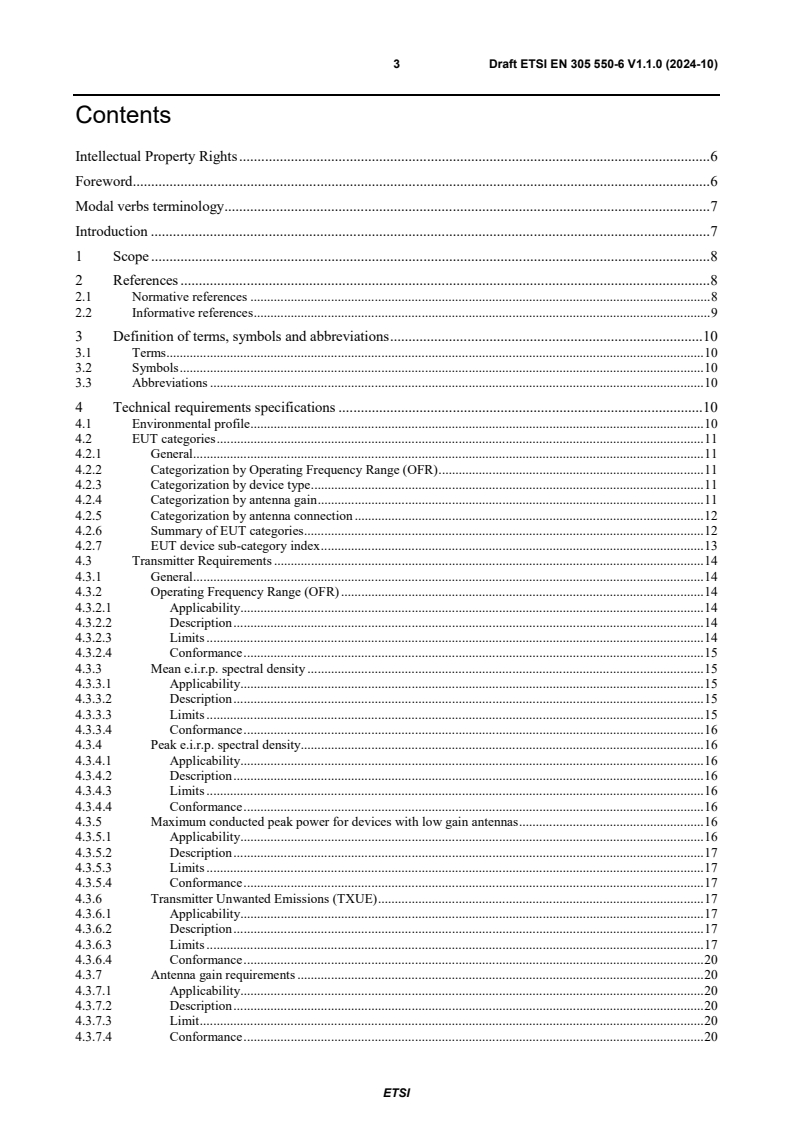
Contents
Intellectual Property Rights . 6
Foreword . 6
Modal verbs terminology . 7
Introduction . 7
1 Scope . 8
2 References . 8
2.1 Normative references . 8
2.2 Informative references . 9
3 Definition of terms, symbols and abbreviations . 10
3.1 Terms . 10
3.2 Symbols . 10
3.3 Abbreviations . 10
4 Technical requirements specifications . 10
4.1 Environmental profile . 10
4.2 EUT categories . 11
4.2.1 General . 11
4.2.2 Categorization by Operating Frequency Range (OFR) . 11
4.2.3 Categorization by device type . 11
4.2.4 Categorization by antenna gain . 11
4.2.5 Categorization by antenna connection . 12
4.2.6 Summary of EUT categories . 12
4.2.7 EUT device sub-category index . 13
4.3 Transmitter Requirements . 14
4.3.1 General . 14
4.3.2 Operating Frequency Range (OFR) . 14
4.3.2.1 Applicability. 14
4.3.2.2 Description . 14
4.3.2.3 Limits . 14
4.3.2.4 Conformance . 15
4.3.3 Mean e.i.r.p. spectral density . 15
4.3.3.1 Applicability. 15
4.3.3.2 Description . 15
4.3.3.3 Limits . 15
4.3.3.4 Conformance . 16
4.3.4 Peak e.i.r.p. spectral density. 16
4.3.4.1 Applicability. 16
4.3.4.2 Description . 16
4.3.4.3 Limits . 16
4.3.4.4 Conformance . 16
4.3.5 Maximum conducted peak power for devices with low gain antennas . 16
4.3.5.1 Applicability. 16
4.3.5.2 Description . 17
4.3.5.3 Limits . 17
4.3.5.4 Conformance . 17
4.3.6 Transmitter Unwanted Emissions (TXUE) . 17
4.3.6.1 Applicability. 17
4.3.6.2 Description . 17
4.3.6.3 Limits . 17
4.3.6.4 Conformance . 20
4.3.7 Antenna gain requirements . 20
4.3.7.1 Applicability. 20
4.3.7.2 Description . 20
4.3.7.3 Limit . 20
4.3.7.4 Conformance . 20
ETSI
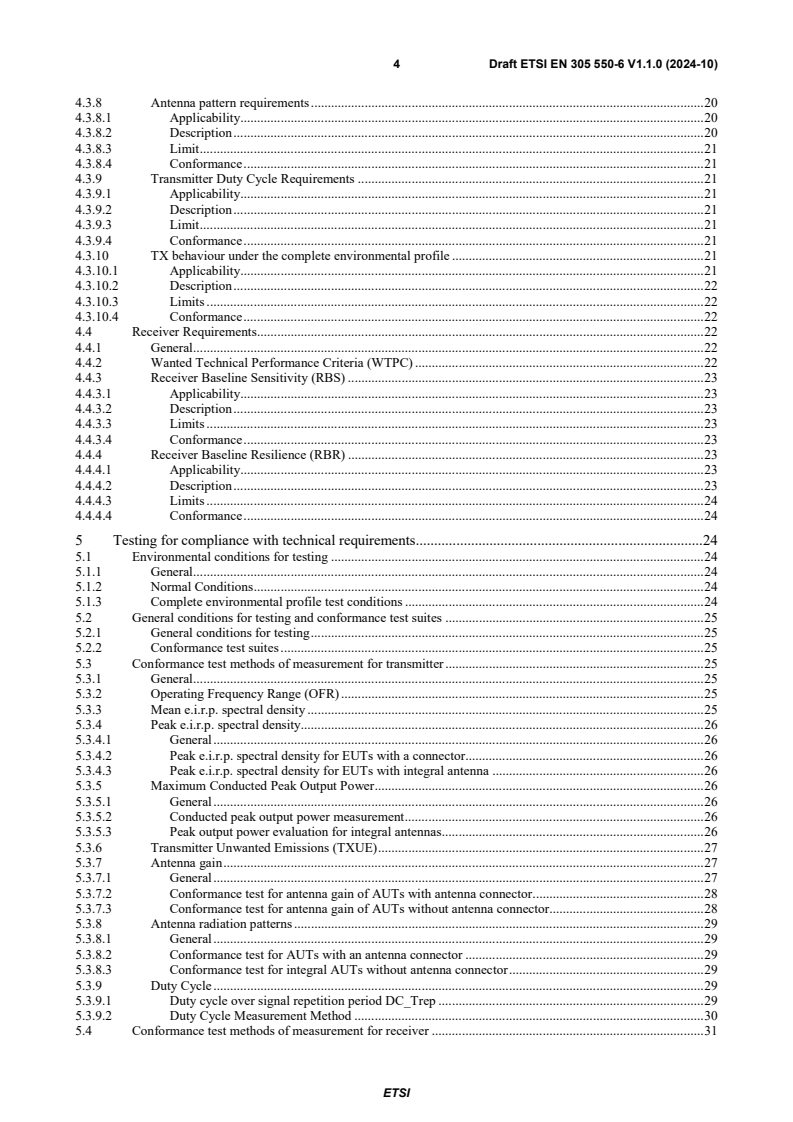
4 Draft ETSI EN 305 550-6 V1.1.0 (2024-10)
4.3.8 Antenna pattern requirements . 20
4.3.8.1 Applicability. 20
4.3.8.2 Description . 20
4.3.8.3 Limit . 21
4.3.8.4 Conformance . 21
4.3.9 Transmitter Duty Cycle Requirements . 21
4.3.9.1 Applicability. 21
4.3.9.2 Description . 21
4.3.9.3 Limit . 21
4.3.9.4 Conformance . 21
4.3.10 TX behaviour under the complete environmental profile . 21
4.3.10.1 Applicability. 21
4.3.10.2 Description . 22
4.3.10.3 Limits . 22
4.3.10.4 Conformance . 22
4.4 Receiver Requirements . 22
4.4.1 General . 22
4.4.2 Wanted Technical Performance Criteria (WTPC) . 22
4.4.3 Receiver Baseline Sensitivity (RBS) . 23
4.4.3.1 Applicability. 23
4.4.3.2 Description . 23
4.4.3.3 Limits . 23
4.4.3.4 Conformance . 23
4.4.4 Receiver Baseline Resilience (RBR) . 23
4.4.4.1 Applicability. 23
4.4.4.2 Description . 23
4.4.4.3 Limits . 24
4.4.4.4 Conformance . 24
5 Testing for compliance with technical requirements . 24
5.1 Environmental conditions for testing . 24
5.1.1 General . 24
5.1.2 Normal Conditions . 24
5.1.3 Complete environmental profile test conditions . 24
5.2 General conditions for testing and conformance test suites . 25
5.2.1 General conditions for testing . 25
5.2.2 Conformance test suites . 25
5.3 Conformance test methods of measurement for transmitter . 25
5.3.1 General . 25
5.3.2 Operating Frequency Range (OFR) . 25
5.3.3 Mean e.i.r.p. spectral density . 25
5.3.4 Peak e.i.r.p. spectral density. 26
5.3.4.1 General . 26
5.3.4.2 Peak e.i.r.p. spectral density for EUTs with a connector. 26
5.3.4.3 Peak e.i.r.p. spectral density for EUTs with integral antenna . 26
5.3.5 Maximum Conducted Peak Output Power . 26
5.3.5.1 General . 26
5.3.5.2 Conducted peak output power measurement . 26
5.3.5.3 Peak output power evaluation for integral antennas . 26
5.3.6 Transmitter Unwanted Emissions (TXUE) . 27
5.3.7 Antenna gain . 27
5.3.7.1 General . 27
5.3.7.2 Conformance test for antenna gain of AUTs with antenna connector . 28
5.3.7.3 Conformance test for antenna gain of AUTs without antenna connector. 28
5.3.8 Antenna radiation patterns . 29
5.3.8.1 General . 29
5.3.8.2 Conformance test for AUTs with an antenna connector . 29
5.3.8.3 Conformance test for integral AUTs without antenna connector . 29
5.3.9 Duty Cycle . 29
5.3.9.1 Duty cycle over signal repetition period DC_Trep . 29
5.3.9.2 Duty Cycle Measurement Method . 30
5.4 Conformance test methods of measurement for receiver . 31
ETSI
5 Draft ETSI EN 305 550-6 V1.1.0 (2024-10)
5.4.1 General . 31
5.4.2 Wanted Technical Performance Criteria (WTPC) . 31
5.4.3 Receiver Baseline Sensitivity (RBS) . 31
5.4.3.1 Radiated test setup for EUTs without antenna connector. 31
5.4.3.2 Conducted test setup for EUTs with antenna connector. 31
5.4.4 Receiver Baseline Resilience (RBR) . 32
5.4.4.1 Test setups for EUTs providing no access to the noise level of the receiver . 32
5.4.4.1.1 Radiated test setup for EUTs without antenna connector . 32
5.4.4.1.2 Conducted test setup for EUTs with antenna connector . 33
5.4.4.2 Test setups for EUTs providing access to the noise level of the receiver . 33
5.4.4.2.1 General . 33
5.4.4.2.2 Test procedure . 34
Annex A (informative): Relationship between the present document and the essential
requirements of Directive 2014/53/EU . 36
Annex B (informative): Selection of technical parameters . 38
Annex C (normative): Interferer signals for receiver baseline resilience . 40
C.1 General . 40
C.2 Interferer within the OFR . 40
C.3 Interferer outside of the OFR . 40
Annex D (normative): Test scenarios for receiver parameters measurements . 41
D.1 Introduction . 41
D.2 Definition of a real scenario . 41
D.3 Derivation of the radiated equivalent scenario . 42
D.4 Radar cross sections of suitable targets . 42
D.5 Evaluation of the Radar Cross Section (RCS) of standard radar targets . 43
Annex E (informative): Range of modulation parameters . 44
E.1 FMCW modulation schemes . 44
Annex F (informative): Installation requirements . 45
F.1 LPR installation requirements . 45
F.2 TLPR installation requirements . 45
Annex G (informative): Bibliography . 47
Annex H (informative): Change history . 48
History . 49
ETSI
6 Draft ETSI EN 305 550-6 V1.1.0 (2024-10)
Intellectual Property Rights
Essential patents
IPRs essential or potentially essential to normative deliverables may have been declared to ETSI. The declarations
pertaining to these essential IPRs, if any, are publicly available for ETSI members and non-members, and can be
found in ETSI SR 000 314: "Intellectual Property Rights (IPRs); Essential, or potentially Essential, IPRs notified to
ETSI in respect of ETSI standards", which is available from the ETSI Secretariat. Latest updates are available on the
ETSI Web server (https://ipr.etsi.org/).
Pursuant to the ETSI Directives including the ETSI IPR Policy, no investigation regarding the essentiality of IPRs,
including IPR searches, has been carried out by ETSI. No guarantee can be given as to the existence of other IPRs not
referenced in ETSI SR 000 314 (or the updates on the ETSI Web server) which are, or may be, or may become,
essential to the present document.
Trademarks
The present document may include trademarks and/or tradenames which are asserted and/or registered by their owners.
ETSI claims no ownership of these except for any which are indicated as being the property of ETSI, and conveys no
right to use or reproduce any trademark and/or tradename. Mention of those trademarks in the present document does
not constitute an endorsement by ETSI of products, services or organizations associated with those trademarks.
DECT™, PLUGTESTS™, UMTS™ and the ETSI logo are trademarks of ETSI registered for the benefit of its
Members. 3GPP™ and LTE™ are trademarks of ETSI registered for the benefit of its Members and of the 3GPP
Organizational Partners. oneM2M™ logo is a trademark of ETSI registered for the benefit of its Members and of the ®
oneM2M Partners. GSM and the GSM logo are trademarks registered and owned by the GSM Association.
Foreword
This draft Harmonised European Standard (EN) has been produced by ETSI Technical Committee Electromagnetic
compatibility and Radio spectrum Matters (ERM), and is now submitted for the combined Public Enquiry and Vote
phase of the ETSI Standardisation Request deliverable Approval Procedure.
The present document has been prepared under the Commission's standardisation request C(2015) 5376 final [i.2] to
provide one voluntary means of conforming to the essential requirements of Directive 2014/53/EU on the harmonisation
of the laws of the Member States relating to the making available on the market of radio equipment and repealing
Directive 1999/5/EC [i.1].
Once the present document is cited in the Official Journal of the European Union under that Directive, compliance with
the normative clauses of the present document given in Table A.1 confers, within the limits of the scope of the present
document, a presumption of conformity with the corresponding essential requirements of that Directive and associated
EFTA regulations.
The present document is part 6 of a multi-part deliverable covering Short Range Devices (SRD) to be used in the
40 GHz to 260 GHz frequency range; Harmonised standard for access to radio spectrum, as identified below:
Part 1: "Communication devices within 57 GHz to 64 GHz, 122 GHz to 123 GHz or 244 GHz to 246 GHz";
Part 2: "Radiodetermination for industrial applications (RDI & RDI-S) equipment operating within 116 GHz to
260 GHz";
Part 3: "Radiodetermination for consumer applications within 57 GHz to 64 GHz, 122 GHz to 130 GHz,
134 GHz to 148,5 GHz or 244 GHz to 246 GHz";
Part 4: "Radiodetermination devices at vehicles within 57 GHz to 64 GHz";
Part 5: "Ultra Short Range Communication Device (USRCD) within 57 GHz to 64 GHz";
Part 6: "Specific radiodetermination applications - Tank Level Probing Radar (TLPR) and Level Probing
Radar (LPR) equipment operating in the frequency ranges 116 GHz to 148,5 GHz; 167 GHz to
182 GHz and 231,5 GHz to 250 GHz".
ETSI
7 Draft ETSI EN 305 550-6 V1.1.0 (2024-10)
NOTE: The list above shows the planned multi-part deliverable, at the time, when the present document was
finalized.
Proposed national transposition dates
Date of latest announcement of this EN (doa): 3 months after ETSI publication
Date of latest publication of new National Standard
or endorsement of this EN (dop/e): 6 months after doa
Date of withdrawal of any conflicting National Standard (dow): 18 months after doa
Modal verbs terminology
In the present document "shall", "shall not", "should", "should not", "may", "need not", "will", "will not", "can" and
"cannot" are to be interpreted as described in clause 3.2 of the ETSI Drafting Rules (Verbal forms for the expression of
provisions).
"must" and "must not" are NOT allowed in ETSI deliverables except when used in direct citation.
Introduction
ETSI ERM TGUWB decided to develop more specific standards; this means instead of one generic ETSI
EN 305 550 for generic SRD within 40 GHz to 260 GHz, a standard family was started to reflect the intended use in
relation to the wanted technical performances in more detail.
The present document is the first version of the harmonised standard ETSI EN 305 550-6 for Level Probing
Radar (LPR) and Tank Level Probing Radar (TLPR) equipment using UWB technology in the frequency ranges
116 GHz to 148,5 GHz, 167 GHz to 182 GHz and 231,5 GHz to 250 GHz, and it is part of the standard family ETSI
EN 305 550-x which covers Short Range Devices (SRD) to be used in the 40 GHz to 260 GHz frequency range in
general.
ETSI
8 Draft ETSI EN 305 550-6 V1.1.0 (2024-10)
1 Scope
The present document specifies technical requirements, limits and test methods for SRD radiodetermination equipment
using Ultra Wide Band technology (UWB) in the frequency ranges from 116 GHz to 148,5 GHz, from 167 GHz to
182 GHz, and from 231,5 GHz to 250 GHz for Level Probing Radar (LPR) and Tank Level Probing Radar (TLPR).
Level Probing Radars and Tank Level Probing Radars consist of a combined transmitter and receiver and are equipped
with an integral or dedicated antenna provided also by the EUT manufacturer. EUTs intended to be equipped with
antennas from third-party manufacturers are not covered by the scope of the present document.
Furthermore, the present document is limited to LPR and TLPR devices with FMCW modulation (see clause C.2.2 of
ETSI EN 303 883-1 [1]).
Further details of the covered LPR and TLPR EUT can be found in clause 4.2 of the present document.
NOTE 1: The relationship between the present document and essential requirements of article 3.2 of
Directive 2014/53/EU [i.1] is given in annex A.
NOTE 2: Equipment covered by the present document operates in accordance with clause 2.3 and clause 2.5 of
ECC Decision(22)03 [i.3] and the upcoming EC framework for UWB/SRDs for the range 116 GHz to
260 GHz, which is based on the results of ECC Report 334 [i.9].
2 References
2.1 Normative references
References are either specific (identified by date of publication and/or edition number or version number) or non-
specific. For specific references, only the cited version applies. For non-specific references, the latest version of the
referenced document (including any amendments) applies.
Referenced documents which are not found to be publicly available in the expected location might be found at
https://docbox.etsi.org/Reference/.
NOTE: While any hyperlinks included in this clause were valid at the time of publication, ETSI cannot guarantee
their long term validity.
The following referenced documents are necessary for the application of the present document.
[1] ETSI EN 303 883-1 (V2.1.1) (2024-06): "Short Range Devices (SRD) and Ultra Wide Band
(UWB); Part 1: Measurement techniques for transmitter requirements".
[2] ETSI EN 303 883-2 (V2.1.1) (2024-06): "Short Range Devices (SRD) and Ultra Wide Band
(UWB); Part 2: Measurement techniques for receiver requirements".
[3] ETSI TS 103 789 (V1.1.1) (2023-05): "Short Range Devices (SRD) and Ultra Wide Band (UWB);
Radar related parameters and physical test setup for object detection, identification and RCS
measurement".
[4] ETSI TS 103 941 (V1.1.1) (2024-01): "Short Range Devices (SRD) and Ultra Wide Band (UWB);
Measurement setups and specifications for testing under full environmental profile (normal and
extreme environmental conditions)".
ETSI
9 Draft ETSI EN 305 550-6 V1.1.0 (2024-10)
2.2 Informative references
References are either specific (identified by date of publication and/or edition number or version number) or
non-specific. For specific references, only the cited version applies. For non-specific references, the latest version of the
referenced document (including any amendments) applies.
NOTE: While any hyperlinks included in this clause were valid at the time of publication, ETSI cannot guarantee
their long term validity.
The following referenced documents are not necessary for the application of the present document but they assist the
user with regard to a particular subject area.
[i.1] Directive 2014/53/EU of the European Parliament and of the Council of 16 April 2014 on the
harmonisation of the laws of the Member States relating to the making available on the market of
radio equipment and repealing Directive 1999/5/EC (RE-Directive).
[i.2] Commission implementing Decision C(2015) 5376 final of 4.8.2015 on a standardisation request
to the European Committee for Electrotechnical Standardisation and to the European
Telecommunications Standards Institute as regards radio equipment in support of Directive
2014/53/EU of the European Parliament and of the Council.
[i.3] ECC/DEC/(22)03 of 18 November 2022 on technical characteristics, exemption from individual
licensing and free circulation and use of specific radiodetermination applications in the frequency
range 116-260 GHz, amended 8 March 2024.
[i.4] CEPT ERC Recommendation 74-01 (October 2021): "Unwanted emissions in the spurious
domain".
[i.5] European Commission Implementing Decision (EU) 2022/180 amending Decision 2006/771/EC
as regards the update of harmonised technical conditions in the area of radio spectrum use for
short-range devices.
[i.6] IEC 61298-2:2008-10: "Process measurement and control devices - General methods and
procedures for evaluating performance - Part 2: Tests under reference conditions".
[i.7] ETSI EG 203 336 (V1.2.1) (2020-05): "Guide for the selection of technical parameters for the
production of Harmonised Standards covering article 3.1(b) and article 3.2 of Directive
2014/53/EU".
[i.8] ETSI TS 103 567 (V1.1.1) (2019-09): "Requirements on signal interferer handling".
[i.9] ECC Report 334: "UWB radiodetermination applications in the frequency range 116-260 GHz",
January 2022, amended 2023.
[i.10] ETSI TS 103 361 (V1.1.1) (2016-03): "Short Range Devices (SRD) using Ultra Wide Band
technology (UWB); Receiver technical requirements, parameters and measurement procedures to
fulfil the requirements of the Directive 2014/53/EU".
[i.11] ETSI TS 103 060 (V1.1.1) (2013-09): "Electromagnetic compatibility and Radio spectrum Matters
(ERM); Short Range Devices (SRD); Method for a harmonized definition of Duty Cycle Template
(DCT) transmission as a passive mitigation technique used by short range devices and related
conformance test methods".
[i.12] Committee on Radio Astronomy Frequencies (CRAF), European Science Foundation.
ETSI
10 Draft ETSI EN 305 550-6 V1.1.0 (2024-10)
3 Definition of terms, symbols and abbreviations
3.1 Terms
For the purposes of the present document, the terms given in ETSI EN 303 883-1 [1], ETSI EN 303 883-2 [2] and the
following apply:
Duty Cycle over signal repetition period (DC_Trep): ratio of the sum of all the active sweep durations T (sweeps,
on
scans) within the signal repetition period T
rep
NOTE: The signal repetition time T here is equivalent to the T in the measurement standard ETSI
rep meas,cycle
EN 303 883-1 [1].
Frequency Modulated Continuous Wave (FMCW) radar: modulation scheme which is based on a periodically
linear frequency sweep of the transmit signal
NOTE: See also clause E.1 and ETSI EN 303 883-1 [1], clause C.2.2.
step response time (of an LPR or TLPR): time span after a sudden distance change until the output value (distance
value) reaches 90 % of the final value for the first time
3.2 Symbols
For the purposes of the present document, the symbols given in ETSI EN 303 883-1 [1], ETSI EN 303 883-2 [2] and the
following apply:
f Higher frequency of the EUT's actual operating frequency range
H_EUT
f Lower frequency of the EUT's actual operating frequency range
L_EUT
f Regulated lower frequency limit of an operating frequency range
Rmin
f Regulated upper frequency limit of an operating frequency range
Rmax
T ramp duration time for FMCW modulation schemes, i.e. it is the active radar sweep duration when
on
the transmitter of the EUT is active
3.3 Abbreviations
For the purposes of the present document, the abbreviations given in ETSI EN 303 883-1 [1], ETSI EN 303 883-2 [2]
and the following apply:
AUT Antenna Under Test
e.i.r.p. equivalent isotropically radiated power
EFTA European Free Trade Union
IEC International Electrotechnical Commission
ITU-R International Telecommunication Union - Radio Sector
RCS Radar Cross Section
SGA Standard Gain Antenna
4 Technical requirements specifications
4.1 Environmental profile
The technical requirements of the present document apply under the environmental profile for operation of the
equipment, which shall be in accordance with its intended use, but as a minimum, shall include that specified in the test
conditions contained in the present document. The equipment shall comply with all the technical requirements of the
present document at all times when operating within the boundary limits of the operational environmental profile
defined by its intended use.
ETSI
11 Draft ETSI EN 305 550-6 V1.1.0 (2024-10)
4.2 EUT categories
4.2.1 General
The general requirements applicable for all TLPR and LPR are:
• Installation requirements from ECC/DEC/(22)03 [i.3] as listed in clause F for information.
• Receive-only devices, EUTs exhibiting a receive-only mode or a standby mode are not covered by the scope of
the present document. Hence, Rx spurious emission is not covered by the present document.
The WTPC to cover the intended use for all EUTs addressed by the present document are defined in clause 4.4.2.
In order to provide a clear EUT categorization regarding the wanted performance criteria (as specified in clause 4.4.2),
technical requirements, limits and test methods, the following sub-categories have been defined by:
• the used Operating Frequency Range (OFR), see clause 4.2.2;
• the used device type (T/LPR), see clause 4.2.3;
• the available antenna gain (GAIN), see clause 4.2.4;
• the used antenna connection (ANT), see clause 4.2.5.
4.2.2 Categorization by Operating Frequency Range (OFR)
The following categorization of LPR and TLPR EUTs by the Operating Frequency Range is used:
• OFR1: OFR of the EUT is contained in the frequency range 116 GHz to 148,5 GHz;
• OFR2: OFR of the EUT is contained in the frequency range 167 GHz to 182 GHz;
• OFR3: OFR of the EUT is contained in the frequency range 231,5 GHz to 250 GHz.
This categorization has been conducted, reflecting the different permitted frequency ranges which can be used for Level
Probing Radars and Tank Level Probing Radars in accordance with ECC/DEC/(22)03 [i.3].
4.2.3 Categorization by device type
The following categorization of LPR and TLPR EUTs by the antenna connection is used:
• LPR: EUT intended to be installed and operated according to clause F.1;
• TLPR: EUT intended to be installed and operated within a tank according to clause F.2.
This categorization has been conducted, reflecting the two equipment types in accordance with ECC/DEC/(22)03 [i.3],
clauses A.2.3 and A.2.5.
4.2.4 Categorization by antenna gain
The following categorization of LPR and TLPR EUTs by the antenna connection is used:
• GAIN1: EUT features an antenna with a high gain of ≥ 20 dBi;
• GAIN2: EUT features an antenna with a low gain of < 20 dBi.
This categorization has been conducted, reflecting the additional conducted peak power limit of 15 dBm for antenna
gain < 20 dBi in accordance with ECC/DEC/(22)03 [i.3].
ETSI
12 Draft ETSI EN 305 550-6 V1.1.0 (2024-10)
4.2.5 Categorization by antenna connection
The following categorization of LPR and TLPR EUTs by the antenna connection is used:
• ANT1: EUT features an antenna connector, e.g. the EUT is equipped with a dedicated antenna;
• ANT2: EUT has no antenna connector, e.g. the EUT is equipped with an integral antenna.
4.2.6 Summary of EUT categories
An overview of the applicability of transmitter requirements and receiver requirements for the different LPR and TLPR
sub-categories is shown in Table 1 and Table 2, respectively.
Table 1: Applicability of transmitter requirements for the different EUT categories
Categorization by
operating device antenna gain antenna
TX requirements Clause frequency range type (clause 4.2.4) connection
(clause 4.2.2) (clause 4.2.3) (clause 4.2.5)
OFR1 to OFR3 TLPR and LPR GAIN1 and GAIN2 ANT1 and ANT2
Operating frequency
4.3.2
range
applicable to any applicable to any applicable to any applicable to any
Mean e.i.r.p. spectral
4.3.3 category (OFR1 category (TLPR category (GAIN1 to category (ANT1
density
to OFR3) and LPR) GAIN2) to ANT2)
Peak e.i.r.p. spectral
4.3.4
density
applicable to any applicable to any applicable to any
Maximum conducted applicable only to
4.3.5 category (OFR1 category (TLPR category (ANT1
peak power GAIN2
to OFR3) and LPR) to ANT2)
applicable to any applicable to any applicable to any applicable to any
Unwanted emission 4.3.6 category (OFR1 category (TLPR category (GAIN1 to category (ANT1
to OFR3) and LPR) GAIN2) to ANT2)
applicable to any appli
...
Final draft ETSI EN 305 550-6 V1.2.0 (2025-03)
HARMONISED EUROPEAN STANDARD
Short Range Devices (SRD) to be used in
the 40 GHz to 260 GHz frequency range;
Harmonised Standard for access to radio spectrum;
Part 6: Specific radiodetermination applications - Tank Level
Probing Radar (TLPR) and Level Probing Radar (LPR)
equipment operating in the frequency ranges
116 GHz to 148,5 GHz; 167 GHz to 182 GHz and
231,5 GHz to 250 GHz
2 Final draft ETSI EN 305 550-6 V1.2.0 (2025-03)
Reference
DEN/ERM-TGUWB-627
Keywords
harmonised standard, measurement, radar,
sensor, SRD
ETSI
650 Route des Lucioles
F-06921 Sophia Antipolis Cedex - FRANCE
Tel.: +33 4 92 94 42 00 Fax: +33 4 93 65 47 16
Siret N° 348 623 562 00017 - APE 7112B
Association à but non lucratif enregistrée à la
Sous-Préfecture de Grasse (06) N° w061004871
Important notice
The present document can be downloaded from the
ETSI Search & Browse Standards application.
The present document may be made available in electronic versions and/or in print. The content of any electronic and/or
print versions of the present document shall not be modified without the prior written authorization of ETSI. In case of any
existing or perceived difference in contents between such versions and/or in print, the prevailing version of an ETSI
deliverable is the one made publicly available in PDF format on ETSI deliver repository.
Users should be aware that the present document may be revised or have its status changed,
this information is available in the Milestones listing.
If you find errors in the present document, please send your comments to
the relevant service listed under Committee Support Staff.
If you find a security vulnerability in the present document, please report it through our
Coordinated Vulnerability Disclosure (CVD) program.
Notice of disclaimer & limitation of liability
The information provided in the present deliverable is directed solely to professionals who have the appropriate degree of
experience to understand and interpret its content in accordance with generally accepted engineering or
other professional standard and applicable regulations.
No recommendation as to products and services or vendors is made or should be implied.
In no event shall ETSI be held liable for loss of profits or any other incidental or consequential damages.
Any software contained in this deliverable is provided "AS IS" with no warranties, express or implied, including but not
limited to, the warranties of merchantability, fitness for a particular purpose and non-infringement of intellectual property
rights and ETSI shall not be held liable in any event for any damages whatsoever (including, without limitation, damages
for loss of profits, business interruption, loss of information, or any other pecuniary loss) arising out of or related to the use
of or inability to use the software.
Copyright Notification
No part may be reproduced or utilized in any form or by any means, electronic or mechanical, including photocopying and
microfilm except as authorized by written permission of ETSI.
The content of the PDF version shall not be modified without the written authorization of ETSI.
The copyright and the foregoing restriction extend to reproduction in all media.
© ETSI 2025.
All rights reserved.
ETSI
3 Final draft ETSI EN 305 550-6 V1.2.0 (2025-03)
Contents
Intellectual Property Rights . 6
Foreword . 6
Modal verbs terminology . 7
Introduction . 7
1 Scope . 8
2 References . 8
2.1 Normative references . 8
2.2 Informative references . 9
3 Definition of terms, symbols and abbreviations . 10
3.1 Terms . 10
3.2 Symbols . 10
3.3 Abbreviations . 10
4 Technical requirements specifications . 10
4.1 Environmental profile . 10
4.2 EUT categories . 11
4.2.1 General . 11
4.2.2 Categorization by Operating Frequency Range (OFR) . 11
4.2.3 Categorization by device type . 11
4.2.4 Categorization by antenna gain . 11
4.2.5 Categorization by antenna connection . 12
4.2.6 Summary of EUT categories . 12
4.2.7 EUT device sub-category index . 13
4.3 Transmitter Requirements . 14
4.3.1 General . 14
4.3.2 Operating Frequency Range (OFR) . 14
4.3.2.1 Applicability. 14
4.3.2.2 Description . 14
4.3.2.3 Limits . 14
4.3.2.4 Conformance . 15
4.3.3 Mean e.i.r.p. spectral density . 15
4.3.3.1 Applicability. 15
4.3.3.2 Description . 15
4.3.3.3 Limits . 15
4.3.3.4 Conformance . 16
4.3.4 Peak e.i.r.p. spectral density. 16
4.3.4.1 Applicability. 16
4.3.4.2 Description . 16
4.3.4.3 Limits . 16
4.3.4.4 Conformance . 16
4.3.5 Maximum conducted peak power for devices with low gain antennas . 16
4.3.5.1 Applicability. 16
4.3.5.2 Description . 17
4.3.5.3 Limits . 17
4.3.5.4 Conformance . 17
4.3.6 Transmitter Unwanted Emissions (TXUE) . 17
4.3.6.1 Applicability. 17
4.3.6.2 Description . 17
4.3.6.3 Limits . 17
4.3.6.4 Conformance . 20
4.3.7 Antenna gain requirements . 20
4.3.7.1 Applicability. 20
4.3.7.2 Description . 20
4.3.7.3 Limit . 20
4.3.7.4 Conformance . 20
ETSI
4 Final draft ETSI EN 305 550-6 V1.2.0 (2025-03)
4.3.8 Antenna pattern requirements . 20
4.3.8.1 Applicability. 20
4.3.8.2 Description . 20
4.3.8.3 Limit . 21
4.3.8.4 Conformance . 21
4.3.9 Transmitter Duty Cycle Requirements . 21
4.3.9.1 Applicability. 21
4.3.9.2 Description . 21
4.3.9.3 Limit . 21
4.3.9.4 Conformance . 21
4.3.10 TX behaviour under the complete environmental profile . 21
4.3.10.1 Applicability. 21
4.3.10.2 Description . 22
4.3.10.3 Limits . 22
4.3.10.4 Conformance . 22
4.4 Receiver Requirements . 22
4.4.1 General . 22
4.4.2 Wanted Technical Performance Criteria (WTPC) . 22
4.4.3 Receiver Baseline Sensitivity (RBS) . 23
4.4.3.1 Applicability. 23
4.4.3.2 Description . 23
4.4.3.3 Limits . 23
4.4.3.4 Conformance . 23
4.4.4 Receiver Baseline Resilience (RBR) . 23
4.4.4.1 Applicability. 23
4.4.4.2 Description . 23
4.4.4.3 Limits . 24
4.4.4.4 Conformance . 24
5 Testing for compliance with technical requirements . 24
5.1 Environmental conditions for testing . 24
5.1.1 General . 24
5.1.2 Normal Conditions . 24
5.1.3 Complete environmental profile test conditions . 24
5.2 General conditions for testing and conformance test suites . 25
5.2.1 General conditions for testing . 25
5.2.2 Conformance test suites . 25
5.3 Conformance test methods of measurement for transmitter . 25
5.3.1 General . 25
5.3.2 Operating Frequency Range (OFR) . 25
5.3.3 Mean e.i.r.p. spectral density . 25
5.3.4 Peak e.i.r.p. spectral density. 26
5.3.4.1 General . 26
5.3.4.2 Peak e.i.r.p. spectral density for EUTs with a connector. 26
5.3.4.3 Peak e.i.r.p. spectral density for EUTs with integral antenna . 26
5.3.5 Maximum Conducted Peak Output Power . 26
5.3.5.1 General . 26
5.3.5.2 Conducted peak output power measurement . 26
5.3.5.3 Peak output power evaluation for integral antennas . 26
5.3.6 Transmitter Unwanted Emissions (TXUE) . 27
5.3.7 Antenna gain . 27
5.3.7.1 General . 27
5.3.7.2 Conformance test for antenna gain of AUTs with antenna connector . 28
5.3.7.3 Conformance test for antenna gain of AUTs without antenna connector. 28
5.3.8 Antenna radiation patterns . 29
5.3.8.1 General . 29
5.3.8.2 Conformance test for AUTs with an antenna connector . 29
5.3.8.3 Conformance test for integral AUTs without antenna connector . 29
5.3.9 Duty Cycle . 29
5.3.9.1 Duty cycle over signal repetition period DC_Trep . 29
5.3.9.2 Duty Cycle Measurement Method . 30
5.3.10 TX behaviour under full environmental profile . 31
ETSI
5 Final draft ETSI EN 305 550-6 V1.2.0 (2025-03)
5.4 Conformance test methods of measurement for receiver . 31
5.4.1 General . 31
5.4.2 Wanted Technical Performance Criteria (WTPC) . 31
5.4.3 Receiver Baseline Sensitivity (RBS) . 31
5.4.3.1 Radiated test setup for EUTs without antenna connector. 31
5.4.3.2 Conducted test setup for EUTs with antenna connector. 32
5.4.4 Receiver Baseline Resilience (RBR) . 32
5.4.4.1 Test setups for EUTs providing no access to the noise level of the receiver . 32
5.4.4.1.1 Radiated test setup for EUTs without antenna connector . 32
5.4.4.1.2 Conducted test setup for EUTs with antenna connector . 33
5.4.4.2 Test setups for EUTs providing access to the noise level of the receiver . 33
5.4.4.2.1 General . 33
5.4.4.2.2 Test procedure . 34
Annex A (informative): Relationship between the present document and the essential
requirements of Directive 2014/53/EU . 36
Annex B (informative): Selection of technical parameters . 38
Annex C (normative): Interferer signals for receiver baseline resilience . 40
C.1 General . 40
C.2 Interferer within the OFR . 40
C.3 Interferer outside of the OFR . 40
Annex D (normative): Test scenarios for receiver parameters measurements . 41
D.1 Introduction . 41
D.2 Definition of a real scenario . 41
D.3 Derivation of the radiated equivalent scenario . 42
D.4 Radar cross sections of suitable targets . 42
D.5 Evaluation of the Radar Cross Section (RCS) of standard radar targets . 43
Annex E (informative): Range of modulation parameters . 44
E.1 FMCW modulation schemes . 44
Annex F (informative): Installation requirements . 45
F.1 LPR installation requirements . 45
F.2 TLPR installation requirements . 45
Annex G (informative): Bibliography . 47
Annex H (informative): Change history . 48
History . 49
ETSI
6 Final draft ETSI EN 305 550-6 V1.2.0 (2025-03)
Intellectual Property Rights
Essential patents
IPRs essential or potentially essential to normative deliverables may have been declared to ETSI. The declarations
pertaining to these essential IPRs, if any, are publicly available for ETSI members and non-members, and can be
found in ETSI SR 000 314: "Intellectual Property Rights (IPRs); Essential, or potentially Essential, IPRs notified to
ETSI in respect of ETSI standards", which is available from the ETSI Secretariat. Latest updates are available on the
ETSI IPR online database.
Pursuant to the ETSI Directives including the ETSI IPR Policy, no investigation regarding the essentiality of IPRs,
including IPR searches, has been carried out by ETSI. No guarantee can be given as to the existence of other IPRs not
referenced in ETSI SR 000 314 (or the updates on the ETSI Web server) which are, or may be, or may become,
essential to the present document.
Trademarks
The present document may include trademarks and/or tradenames which are asserted and/or registered by their owners.
ETSI claims no ownership of these except for any which are indicated as being the property of ETSI, and conveys no
right to use or reproduce any trademark and/or tradename. Mention of those trademarks in the present document does
not constitute an endorsement by ETSI of products, services or organizations associated with those trademarks.
DECT™, PLUGTESTS™, UMTS™ and the ETSI logo are trademarks of ETSI registered for the benefit of its
Members. 3GPP™, LTE™ and 5G™ logo are trademarks of ETSI registered for the benefit of its Members and of the
3GPP Organizational Partners. oneM2M™ logo is a trademark of ETSI registered for the benefit of its Members and of ®
the oneM2M Partners. GSM and the GSM logo are trademarks registered and owned by the GSM Association.
Foreword
This final draft Harmonised European Standard (EN) has been produced by ETSI Technical Committee
Electromagnetic compatibility and Radio spectrum Matters (ERM), and is now submitted for the Vote phase of the
ETSI Standardisation Request deliverable Approval Procedure (SRdAP).
The present document has been prepared under the Commission's standardisation request C(2015) 5376 final [i.2] to
provide one voluntary means of conforming to the essential requirements of Directive 2014/53/EU on the harmonisation
of the laws of the Member States relating to the making available on the market of radio equipment and repealing
Directive 1999/5/EC [i.1].
Once the present document is cited in the Official Journal of the European Union under that Directive, compliance with
the normative clauses of the present document given in Table A.1 confers, within the limits of the scope of the present
document, a presumption of conformity with the corresponding essential requirements of that Directive and associated
EFTA regulations.
The present document is part 6 of a multi-part deliverable covering Short Range Devices (SRD) to be used in the
40 GHz to 260 GHz frequency range; Harmonised standard for access to radio spectrum, as identified below:
Part 1: "Communication devices within 57 GHz to 64 GHz, 122 GHz to 123 GHz or 244 GHz to 246 GHz";
Part 2: "Radiodetermination for industrial applications (RDI & RDI-S) equipment operating within 116 GHz to
260 GHz";
Part 3: "Radiodetermination for consumer applications within 57 GHz to 64 GHz, 122 GHz to 130 GHz,
134 GHz to 148,5 GHz or 244 GHz to 246 GHz";
Part 4: "Radiodetermination devices at vehicles within 57 GHz to 64 GHz";
Part 5: "Ultra Short Range Communication (USRC) equipment operating within 57 GHz to 64 GHz";
Part 6: "Specific radiodetermination applications - Tank Level Probing Radar (TLPR) and Level Probing
Radar (LPR) equipment operating in the frequency ranges 116 GHz to 148,5 GHz; 167 GHz to
182 GHz and 231,5 GHz to 250 GHz".
ETSI
7 Final draft ETSI EN 305 550-6 V1.2.0 (2025-03)
NOTE: The list above shows the planned multi-part deliverable, at the time, when the present document was
finalized.
Proposed national transposition dates
Date of latest announcement of this EN (doa): 3 months after ETSI publication
Date of latest publication of new National Standard
or endorsement of this EN (dop/e): 6 months after doa
Date of withdrawal of any conflicting National Standard (dow): 18 months after doa
Modal verbs terminology
In the present document "shall", "shall not", "should", "should not", "may", "need not", "will", "will not", "can" and
"cannot" are to be interpreted as described in clause 3.2 of the ETSI Drafting Rules (Verbal forms for the expression of
provisions).
"must" and "must not" are NOT allowed in ETSI deliverables except when used in direct citation.
Introduction
ETSI ERM TGUWB decided to develop more specific standards; this means instead of one generic ETSI
EN 305 550 for generic SRD within 40 GHz to 260 GHz, a standard family was started to reflect the intended use in
relation to the wanted technical performances in more detail.
The present document is the first version of the harmonised standard ETSI EN 305 550-6 for Level Probing
Radar (LPR) and Tank Level Probing Radar (TLPR) equipment using UWB technology in the frequency ranges
116 GHz to 148,5 GHz, 167 GHz to 182 GHz and 231,5 GHz to 250 GHz, and it is part of the standard family ETSI
EN 305 550-x which covers Short Range Devices (SRD) to be used in the 40 GHz to 260 GHz frequency range in
general.
ETSI
8 Final draft ETSI EN 305 550-6 V1.2.0 (2025-03)
1 Scope
The present document specifies technical requirements, limits and test methods for SRD radiodetermination equipment
using Ultra Wide Band (UWB) technology in the frequency ranges from 116 GHz to 148,5 GHz, from 167 GHz to
182 GHz, and from 231,5 GHz to 250 GHz for Level Probing Radar (LPR) and Tank Level Probing Radar (TLPR).
Level Probing Radars and Tank Level Probing Radars consist of a combined transmitter and receiver and are equipped
with an integral or dedicated antenna provided also by the EUT manufacturer. EUTs intended to be equipped with
antennas from third-party manufacturers are not covered by the scope of the present document.
Furthermore, the present document is limited to LPR and TLPR devices with FMCW modulation (see clause C.2.2 of
ETSI EN 303 883-1 [1]).
Further details of the covered LPR and TLPR EUT can be found in clause 4.2 of the present document.
NOTE 1: The relationship between the present document and essential requirements of article 3.2 of
Directive 2014/53/EU [i.1] is given in annex A.
NOTE 2: Equipment covered by the present document operates in accordance with clause 2.3 and clause 2.5 of
ECC Decision(22)03 [i.3] and the upcoming EC framework for UWB/SRDs for the range 116 GHz to
260 GHz, which is based on the results of ECC Report 334 [i.8].
2 References
2.1 Normative references
References are either specific (identified by date of publication and/or edition number or version number) or non-
specific. For specific references, only the cited version applies. For non-specific references, the latest version of the
referenced document (including any amendments) applies.
Referenced documents which are not found to be publicly available in the expected location might be found in the
ETSI docbox.
NOTE: While any hyperlinks included in this clause were valid at the time of publication, ETSI cannot guarantee
their long term validity.
The following referenced documents are necessary for the application of the present document.
[1] ETSI EN 303 883-1 (V2.1.1) (08-2024): "Short Range Devices (SRD) and Ultra Wide Band
(UWB); Part 1: Measurement techniques for transmitter requirements".
[2] ETSI EN 303 883-2 (V2.1.1) (08-2024): "Short Range Devices (SRD) and Ultra Wide Band
(UWB); Part 2: Measurement techniques for receiver requirements".
[3] ETSI TS 103 789 (V1.1.1) (05-2023): "Short Range Devices (SRD) and Ultra Wide Band (UWB);
Radar related parameters and physical test setup for object detection, identification and RCS
measurement".
[4] ETSI TS 103 941 (V1.1.1) (01-2024): "Short Range Devices (SRD) and Ultra Wide Band (UWB);
Measurement setups and specifications for testing under full environmental profile (normal and
extreme environmental conditions)".
ETSI
9 Final draft ETSI EN 305 550-6 V1.2.0 (2025-03)
2.2 Informative references
References are either specific (identified by date of publication and/or edition number or version number) or
non-specific. For specific references, only the cited version applies. For non-specific references, the latest version of the
referenced document (including any amendments) applies.
NOTE: While any hyperlinks included in this clause were valid at the time of publication, ETSI cannot guarantee
their long term validity.
The following referenced documents are not necessary for the application of the present document but they assist the
user with regard to a particular subject area.
[i.1] Directive 2014/53/EU of the European Parliament and of the Council of 16 April 2014 on the
harmonisation of the laws of the Member States relating to the making available on the market of
radio equipment and repealing Directive 1999/5/EC (RE-Directive).
[i.2] Commission implementing Decision C(2015) 5376 final of 4.8.2015 on a standardisation request
to the European Committee for Electrotechnical Standardisation and to the European
Telecommunications Standards Institute as regards radio equipment in support of Directive
2014/53/EU of the European Parliament and of the Council.
[i.3] ECC/DEC/(22)03 of 18 November 2022 on technical characteristics, exemption from individual
licensing and free circulation and use of specific radiodetermination applications in the frequency
range 116-260 GHz, amended 8 March 2024.
[i.4] CEPT ERC Recommendation 74-01 (October 2021): "Unwanted emissions in the spurious
domain".
[i.5] European Commission Implementing Decision (EU) 2022/180 of 8 February 2022 amending
Decision 2006/771/EC as regards the update of harmonised technical conditions in the area of
radio spectrum use for short-range devices.
[i.6] ETSI EG 203 336 (V1.2.1) (05-2020): "Guide for the selection of technical parameters for the
production of Harmonised Standards covering article 3.1(b) and article 3.2 of
Directive 2014/53/EU".
[i.7] ETSI TS 103 567 (V1.1.1) (09-2019): "Requirements on signal interferer handling".
[i.8] ECC Report 334: "UWB radiodetermination applications in the frequency range 116-260 GHz",
January 2022, amended 2023.
[i.9] ETSI TS 103 361 (V1.1.1) (03-2016): "Short Range Devices (SRD) using Ultra Wide Band
technology (UWB); Receiver technical requirements, parameters and measurement procedures to
fulfil the requirements of the Directive 2014/53/EU".
[i.10] ETSI TS 103 060 (V1.1.1) (09-2013): "Electromagnetic compatibility and Radio spectrum Matters
(ERM); Short Range Devices (SRD); Method for a harmonized definition of Duty Cycle Template
(DCT) transmission as a passive mitigation technique used by short range devices and related
conformance test methods".
[i.11] Committee on Radio Astronomy Frequencies (CRAF), European Science Foundation.
ETSI
10 Final draft ETSI EN 305 550-6 V1.2.0 (2025-03)
3 Definition of terms, symbols and abbreviations
3.1 Terms
For the purposes of the present document, the terms given in ETSI EN 303 883-1 [1], ETSI EN 303 883-2 [2] and the
following apply:
Duty Cycle over signal repetition period (DC_Trep): ratio of the sum of all the active sweep durations T (sweeps,
on
scans) within the signal repetition period T
rep
NOTE: The signal repetition time T here is equivalent to the T in the measurement standard ETSI
rep meas,cycle
EN 303 883-1 [1].
Frequency Modulated Continuous Wave (FMCW) radar: modulation scheme which is based on a periodically
linear frequency sweep of the transmit signal
NOTE: See also clause E.1 and ETSI EN 303 883-1 [1], clause C.2.2.
step response time (of an LPR or TLPR): time span after a sudden distance change until the output value (distance
value) reaches 90 % of the final value for the first time
3.2 Symbols
For the purposes of the present document, the symbols given in ETSI EN 303 883-1 [1], ETSI EN 303 883-2 [2] and the
following apply:
f _ Higher frequency of the EUT's actual operating frequency range
H EUT
f _ Lower frequency of the EUT's actual operating frequency range
L EUT
f Regulated lower frequency limit of an operating frequency range
Rmin
f Regulated upper frequency limit of an operating frequency range
Rmax
T Ramp duration time for FMCW modulation schemes
on
NOTE: I.e. it is the active radar sweep duration when the transmitter of the EUT is active.
3.3 Abbreviations
For the purposes of the present document, the abbreviations given in ETSI EN 303 883-1 [1], ETSI EN 303 883-2 [2]
and the following apply:
AUT Antenna Under Test
e.i.r.p. equivalent isotropically radiated power
EFTA European Free Trade Association
IEC International Electrotechnical Commission
ITU-R International Telecommunication Union - Radio Sector
RCS Radar Cross Section
SGA Standard Gain Antenna
4 Technical requirements specifications
4.1 Environmental profile
The technical requirements of the present document apply under the environmental profile for operation of the
equipment, which shall be in accordance with its intended use, but as a minimum, shall include that specified in the test
conditions contained in the present document. The equipment shall comply with all the technical requirements of the
present document at all times when operating within the boundary limits of the operational environmental profile
defined by its intended use.
ETSI
11 Final draft ETSI EN 305 550-6 V1.2.0 (2025-03)
4.2 EUT categories
4.2.1 General
The general requirements applicable for all TLPR and LPR are:
• Installation requirements from ECC/DEC/(22)03 [i.3] as listed in clause F for information.
• Receive-only devices, EUTs exhibiting a receive-only mode or a standby mode are not covered by the scope of
the present document. Hence, Rx spurious emission is not covered by the present document.
The WTPC to cover the intended use for all EUTs addressed by the present document are defined in clause 4.4.2.
In order to provide a clear EUT categorization regarding the wanted performance criteria (as specified in clause 4.4.2),
technical requirements, limits and test methods, the following sub-categories have been defined by:
• the used Operating Frequency Range (OFR), see clause 4.2.2;
• the used device type (T/LPR), see clause 4.2.3;
• the available antenna gain (GAIN), see clause 4.2.4;
• the used antenna connection (ANT), see clause 4.2.5.
4.2.2 Categorization by Operating Frequency Range (OFR)
The following categorization of LPR and TLPR EUTs by the Operating Frequency Range is used:
• OFR1: OFR of the EUT is contained in the frequency range 116 GHz to 148,5 GHz;
• OFR2: OFR of the EUT is contained in the frequency range 167 GHz to 182 GHz;
• OFR3: OFR of the EUT is contained in the frequency range 231,5 GHz to 250 GHz.
This categorization has been conducted, reflecting the different permitted frequency ranges which can be used for Level
Probing Radars and Tank Level Probing Radars in accordance with ECC/DEC/(22)03 [i.3].
4.2.3 Categorization by device type
The following categorization of LPR and TLPR EUTs by the antenna connection is used:
• LPR: EUT intended to be installed and operated according to clause F.1;
• TLPR: EUT intended to be installed and operated within a tank according to clause F.2.
This categorization has been conducted, reflecting the two equipment types in accordance with ECC/DEC/(22)03 [i.3],
clause A.2.3 and clause A.2.5.
4.2.4 Categorization by antenna gain
The following categorization of LPR and TLPR EUTs by the antenna connection is used:
• GAIN1: EUT features an antenna with a high gain of ≥ 20 dBi;
• GAIN2: EUT features an antenna with a low gain of < 20 dBi.
This categorization has been conducted, reflecting the additional conducted peak power limit of 15 dBm for antenna
gain < 20 dBi in accordance with ECC/DEC/(22)03 [i.3].
ETSI
12 Final draft ETSI EN 305 550-6 V1.2.0 (2025-03)
4.2.5 Categorization by antenna connection
The following categorization of LPR and TLPR EUTs by the antenna connection is used:
• ANT1: EUT features an antenna connector, e.g. the EUT is equipped with a dedicated antenna;
• ANT2: EUT has no antenna connector, e.g. the EUT is equipped with an integral antenna.
4.2.6 Summary of EUT categories
An overview of the applicability of transmitter requirements and receiver requirements for the different LPR and TLPR
sub-categories is shown in Table 1 and Table 2, respectively.
Table 1: Applicability of transmitter requirements for the different EUT categories
Categorization by
operating device antenna gain antenna
TX requirements Clause frequency range type (clause 4.2.4) connection
(clause 4.2.2) (clause 4.2.3) (clause 4.2.5)
OFR1 to OFR3 TLPR and LPR GAIN1 and GAIN2 ANT1 and ANT2
Operating frequency
4.3.2
range
applicable to any applicable to any applicable to any applicable to any
Mean e.i.r.p. spectral
4.3.3 category (OFR1 category (TLPR category (GAIN1 to category (ANT1
density
to OFR3) and LPR) GAIN2) to ANT2)
Peak e.i.r.p. spectral
4.3.4
density
applicable to any applicable to any applicable to any
Maximum conducted applicable only to
4.3.5 category (OFR1 category (TLPR category (ANT1
peak power GAIN2
to OFR3) and LPR) to ANT2)
applicable to any applicable to any applicable to any applicable to any
Unwanted emission 4.3.6 category (OFR1 category (TLPR category (GAIN
...
HARMONISED EUROPEAN STANDARD
Short Range Devices (SRD) to be used in
the 40 GHz to 260 GHz frequency range;
Harmonised Standard for access to radio spectrum;
Part 6: Specific radiodetermination applications - Tank Level
Probing Radar (TLPR) and Level Probing Radar (LPR)
equipment operating in the frequency ranges
116 GHz to 148,5 GHz; 167 GHz to 182 GHz and
231,5 GHz to 250 GHz
2 ETSI EN 305 550-6 V1.2.1 (2025-05)
Reference
DEN/ERM-TGUWB-627
Keywords
harmonised standard, measurement, radar,
sensor, SRD
ETSI
650 Route des Lucioles
F-06921 Sophia Antipolis Cedex - FRANCE
Tel.: +33 4 92 94 42 00 Fax: +33 4 93 65 47 16
Siret N° 348 623 562 00017 - APE 7112B
Association à but non lucratif enregistrée à la
Sous-Préfecture de Grasse (06) N° w061004871
Important notice
The present document can be downloaded from the
ETSI Search & Browse Standards application.
The present document may be made available in electronic versions and/or in print. The content of any electronic and/or
print versions of the present document shall not be modified without the prior written authorization of ETSI. In case of any
existing or perceived difference in contents between such versions and/or in print, the prevailing version of an ETSI
deliverable is the one made publicly available in PDF format on ETSI deliver repository.
Users should be aware that the present document may be revised or have its status changed,
this information is available in the Milestones listing.
If you find errors in the present document, please send your comments to
the relevant service listed under Committee Support Staff.
If you find a security vulnerability in the present document, please report it through our
Coordinated Vulnerability Disclosure (CVD) program.
Notice of disclaimer & limitation of liability
The information provided in the present deliverable is directed solely to professionals who have the appropriate degree of
experience to understand and interpret its content in accordance with generally accepted engineering or
other professional standard and applicable regulations.
No recommendation as to products and services or vendors is made or should be implied.
In no event shall ETSI be held liable for loss of profits or any other incidental or consequential damages.
Any software contained in this deliverable is provided "AS IS" with no warranties, express or implied, including but not
limited to, the warranties of merchantability, fitness for a particular purpose and non-infringement of intellectual property
rights and ETSI shall not be held liable in any event for any damages whatsoever (including, without limitation, damages
for loss of profits, business interruption, loss of information, or any other pecuniary loss) arising out of or related to the use
of or inability to use the software.
Copyright Notification
No part may be reproduced or utilized in any form or by any means, electronic or mechanical, including photocopying and
microfilm except as authorized by written permission of ETSI.
The content of the PDF version shall not be modified without the written authorization of ETSI.
The copyright and the foregoing restriction extend to reproduction in all media.
© ETSI 2025.
All rights reserved.
ETSI
3 ETSI EN 305 550-6 V1.2.1 (2025-05)
Contents
Intellectual Property Rights . 6
Foreword . 6
Modal verbs terminology . 7
Introduction . 7
1 Scope . 8
2 References . 8
2.1 Normative references . 8
2.2 Informative references . 9
3 Definition of terms, symbols and abbreviations . 10
3.1 Terms . 10
3.2 Symbols . 10
3.3 Abbreviations . 10
4 Technical requirements specifications . 11
4.1 Environmental profile . 11
4.2 EUT categories . 11
4.2.1 General . 11
4.2.2 Categorization by Operating Frequency Range (OFR) . 11
4.2.3 Categorization by device type . 11
4.2.4 Categorization by antenna gain . 12
4.2.5 Categorization by antenna connection . 12
4.2.6 Summary of EUT categories . 12
4.2.7 EUT device sub-category index . 13
4.3 Transmitter Requirements . 14
4.3.1 General . 14
4.3.2 Operating Frequency Range (OFR) . 14
4.3.2.1 Applicability. 14
4.3.2.2 Description . 15
4.3.2.3 Limits . 15
4.3.2.4 Conformance . 15
4.3.3 Mean e.i.r.p. spectral density . 15
4.3.3.1 Applicability. 15
4.3.3.2 Description . 15
4.3.3.3 Limits . 15
4.3.3.4 Conformance . 16
4.3.4 Peak e.i.r.p. spectral density. 16
4.3.4.1 Applicability. 16
4.3.4.2 Description . 16
4.3.4.3 Limits . 16
4.3.4.4 Conformance . 16
4.3.5 Maximum conducted peak power for devices with low gain antennas . 17
4.3.5.1 Applicability. 17
4.3.5.2 Description . 17
4.3.5.3 Limits . 17
4.3.5.4 Conformance . 17
4.3.6 Transmitter Unwanted Emissions (TXUE) . 17
4.3.6.1 Applicability. 17
4.3.6.2 Description . 17
4.3.6.3 Limits . 18
4.3.6.4 Conformance . 20
4.3.7 Antenna gain requirements . 20
4.3.7.1 Applicability. 20
4.3.7.2 Description . 20
4.3.7.3 Limit . 20
4.3.7.4 Conformance . 21
ETSI
4 ETSI EN 305 550-6 V1.2.1 (2025-05)
4.3.8 Antenna pattern requirements . 21
4.3.8.1 Applicability. 21
4.3.8.2 Description . 21
4.3.8.3 Limit . 21
4.3.8.4 Conformance . 21
4.3.9 Transmitter Duty Cycle Requirements . 21
4.3.9.1 Applicability. 21
4.3.9.2 Description . 21
4.3.9.3 Limit . 22
4.3.9.4 Conformance . 22
4.3.10 TX behaviour under the complete environmental profile . 22
4.3.10.1 Applicability. 22
4.3.10.2 Description . 22
4.3.10.3 Limits . 22
4.3.10.4 Conformance . 22
4.4 Receiver Requirements . 22
4.4.1 General . 22
4.4.2 Wanted Technical Performance Criteria (WTPC) . 23
4.4.3 Receiver Baseline Sensitivity (RBS) . 23
4.4.3.1 Applicability. 23
4.4.3.2 Description . 23
4.4.3.3 Limits . 23
4.4.3.4 Conformance . 23
4.4.4 Receiver Baseline Resilience (RBR) . 24
4.4.4.1 Applicability. 24
4.4.4.2 Description . 24
4.4.4.3 Limits . 24
4.4.4.4 Conformance . 24
5 Testing for compliance with technical requirements . 25
5.1 Environmental conditions for testing . 25
5.1.1 General . 25
5.1.2 Normal Conditions . 25
5.1.3 Complete environmental profile test conditions . 25
5.2 General conditions for testing and conformance test suites . 25
5.2.1 General conditions for testing . 25
5.2.2 Conformance test suites . 25
5.3 Conformance test methods of measurement for transmitter . 26
5.3.1 General . 26
5.3.2 Operating Frequency Range (OFR) . 26
5.3.3 Mean e.i.r.p. spectral density . 26
5.3.4 Peak e.i.r.p. spectral density. 26
5.3.4.1 General . 26
5.3.4.2 Peak e.i.r.p. spectral density for EUTs with a connector. 26
5.3.4.3 Peak e.i.r.p. spectral density for EUTs with integral antenna . 26
5.3.5 Maximum Conducted Peak Output Power . 27
5.3.5.1 General . 27
5.3.5.2 Conducted peak output power measurement . 27
5.3.5.3 Peak output power evaluation for integral antennas . 27
5.3.6 Transmitter Unwanted Emissions (TXUE) . 27
5.3.7 Antenna gain . 28
5.3.7.1 General . 28
5.3.7.2 Conformance test for antenna gain of AUTs with antenna connector . 28
5.3.7.3 Conformance test for antenna gain of AUTs without antenna connector. 29
5.3.8 Antenna radiation patterns . 29
5.3.8.1 General . 29
5.3.8.2 Conformance test for AUTs with an antenna connector . 29
5.3.8.3 Conformance test for integral AUTs without antenna connector . 29
5.3.9 Duty Cycle . 30
5.3.9.1 Duty cycle over signal repetition period DC_Trep . 30
5.3.9.2 Duty Cycle Measurement Method . 30
5.3.10 TX behaviour under full environmental profile . 31
ETSI
5 ETSI EN 305 550-6 V1.2.1 (2025-05)
5.4 Conformance test methods of measurement for receiver . 31
5.4.1 General . 31
5.4.2 Wanted Technical Performance Criteria (WTPC) . 32
5.4.3 Receiver Baseline Sensitivity (RBS) . 32
5.4.3.1 Radiated test setup for EUTs without antenna connector. 32
5.4.3.2 Conducted test setup for EUTs with antenna connector. 32
5.4.4 Receiver Baseline Resilience (RBR) . 33
5.4.4.1 Test setups for EUTs providing no access to the noise level of the receiver . 33
5.4.4.1.1 Radiated test setup for EUTs without antenna connector . 33
5.4.4.1.2 Conducted test setup for EUTs with antenna connector . 33
5.4.4.2 Test setups for EUTs providing access to the noise level of the receiver . 34
5.4.4.2.1 General . 34
5.4.4.2.2 Test procedure . 35
Annex A (informative): Relationship between the present document and the essential
requirements of Directive 2014/53/EU . 36
Annex B (informative): Selection of technical parameters . 38
Annex C (normative): Interferer signals for receiver baseline resilience . 40
C.1 General . 40
C.2 Interferer within the OFR . 40
C.3 Interferer outside of the OFR . 40
Annex D (normative): Test scenarios for receiver parameters measurements . 41
D.1 Introduction . 41
D.2 Definition of a real scenario . 41
D.3 Derivation of the radiated equivalent scenario . 42
D.4 Radar cross sections of suitable targets . 42
D.5 Evaluation of the Radar Cross Section (RCS) of standard radar targets . 43
Annex E (informative): Range of modulation parameters . 44
E.1 FMCW modulation schemes . 44
Annex F (informative): Installation requirements . 45
F.1 LPR installation requirements . 45
F.2 TLPR installation requirements . 45
Annex G (informative): Bibliography . 47
Annex H (informative): Change history . 48
History . 49
ETSI
6 ETSI EN 305 550-6 V1.2.1 (2025-05)
Intellectual Property Rights
Essential patents
IPRs essential or potentially essential to normative deliverables may have been declared to ETSI. The declarations
pertaining to these essential IPRs, if any, are publicly available for ETSI members and non-members, and can be
found in ETSI SR 000 314: "Intellectual Property Rights (IPRs); Essential, or potentially Essential, IPRs notified to
ETSI in respect of ETSI standards", which is available from the ETSI Secretariat. Latest updates are available on the
ETSI IPR online database.
Pursuant to the ETSI Directives including the ETSI IPR Policy, no investigation regarding the essentiality of IPRs,
including IPR searches, has been carried out by ETSI. No guarantee can be given as to the existence of other IPRs not
referenced in ETSI SR 000 314 (or the updates on the ETSI Web server) which are, or may be, or may become,
essential to the present document.
Trademarks
The present document may include trademarks and/or tradenames which are asserted and/or registered by their owners.
ETSI claims no ownership of these except for any which are indicated as being the property of ETSI, and conveys no
right to use or reproduce any trademark and/or tradename. Mention of those trademarks in the present document does
not constitute an endorsement by ETSI of products, services or organizations associated with those trademarks.
DECT™, PLUGTESTS™, UMTS™ and the ETSI logo are trademarks of ETSI registered for the benefit of its
Members. 3GPP™, LTE™ and 5G™ logo are trademarks of ETSI registered for the benefit of its Members and of the
3GPP Organizational Partners. oneM2M™ logo is a trademark of ETSI registered for the benefit of its Members and of ®
the oneM2M Partners. GSM and the GSM logo are trademarks registered and owned by the GSM Association.
Foreword
This Harmonised European Standard (EN) has been produced by ETSI Technical Committee Electromagnetic
compatibility and Radio spectrum Matters (ERM).
The present document has been prepared under the Commission's standardisation request C(2015) 5376 final [i.2] to
provide one voluntary means of conforming to the essential requirements of Directive 2014/53/EU on the harmonisation
of the laws of the Member States relating to the making available on the market of radio equipment and repealing
Directive 1999/5/EC [i.1].
Once the present document is cited in the Official Journal of the European Union under that Directive, compliance with
the normative clauses of the present document given in Table A.1 confers, within the limits of the scope of the present
document, a presumption of conformity with the corresponding essential requirements of that Directive and associated
EFTA regulations.
The present document is part 6 of a multi-part deliverable covering Short Range Devices (SRD) to be used in the
40 GHz to 260 GHz frequency range; Harmonised standard for access to radio spectrum, as identified below:
Part 1: "Communication devices within 57 GHz to 64 GHz, 122 GHz to 123 GHz or 244 GHz to 246 GHz";
Part 2: "Radiodetermination for industrial applications (RDI & RDI-S) equipment operating within 116 GHz to
260 GHz";
Part 3: "Radiodetermination for consumer applications within 57 GHz to 64 GHz, 122 GHz to 130 GHz,
134 GHz to 148,5 GHz or 244 GHz to 246 GHz";
Part 4: "Radiodetermination devices at vehicles within 57 GHz to 64 GHz";
Part 5: "Ultra Short Range Communication (USRC) equipment operating within 57 GHz to 64 GHz";
Part 6: "Specific radiodetermination applications - Tank Level Probing Radar (TLPR) and Level Probing
Radar (LPR) equipment operating in the frequency ranges 116 GHz to 148,5 GHz; 167 GHz to
182 GHz and 231,5 GHz to 250 GHz".
ETSI
7 ETSI EN 305 550-6 V1.2.1 (2025-05)
NOTE: The list above shows the planned multi-part deliverable, at the time, when the present document was
finalized.
National transposition dates
Date of adoption of this EN: 13 May 2025
Date of latest announcement of this EN (doa): 31 August 2025
Date of latest publication of new National Standard
or endorsement of this EN (dop/e): 28 February 2026
Date of withdrawal of any conflicting National Standard (dow): 28 February 2027
Modal verbs terminology
In the present document "shall", "shall not", "should", "should not", "may", "need not", "will", "will not", "can" and
"cannot" are to be interpreted as described in clause 3.2 of the ETSI Drafting Rules (Verbal forms for the expression of
provisions).
"must" and "must not" are NOT allowed in ETSI deliverables except when used in direct citation.
Introduction
ETSI ERM TGUWB decided to develop more specific standards; this means instead of one generic ETSI
EN 305 550 for generic SRD within 40 GHz to 260 GHz, a standard family was started to reflect the intended use in
relation to the wanted technical performances in more detail.
The present document is the first version of the harmonised standard ETSI EN 305 550-6 for Level Probing
Radar (LPR) and Tank Level Probing Radar (TLPR) equipment using UWB technology in the frequency ranges
116 GHz to 148,5 GHz, 167 GHz to 182 GHz and 231,5 GHz to 250 GHz, and it is part of the standard family ETSI
EN 305 550-x which covers Short Range Devices (SRD) to be used in the 40 GHz to 260 GHz frequency range in
general.
ETSI
8 ETSI EN 305 550-6 V1.2.1 (2025-05)
1 Scope
The present document specifies technical requirements, limits and test methods for SRD radiodetermination equipment
using Ultra Wide Band (UWB) technology in the frequency ranges from 116 GHz to 148,5 GHz, from 167 GHz to
182 GHz, and from 231,5 GHz to 250 GHz for Level Probing Radar (LPR) and Tank Level Probing Radar (TLPR).
Level Probing Radars and Tank Level Probing Radars consist of a combined transmitter and receiver and are equipped
with an integral or dedicated antenna provided also by the EUT manufacturer. EUTs intended to be equipped with
antennas from third-party manufacturers are not covered by the scope of the present document.
Furthermore, the present document is limited to LPR and TLPR devices with FMCW modulation (see clause C.2.2 of
ETSI EN 303 883-1 [1]).
Further details of the covered LPR and TLPR EUT can be found in clause 4.2 of the present document.
NOTE 1: The relationship between the present document and essential requirements of article 3.2 of
Directive 2014/53/EU [i.1] is given in annex A.
NOTE 2: Equipment covered by the present document operates in accordance with clause 2.3 and clause 2.5 of
ECC Decision(22)03 [i.3] and the upcoming EC framework for UWB/SRDs for the range 116 GHz to
260 GHz, which is based on the results of ECC Report 334 [i.8].
2 References
2.1 Normative references
References are either specific (identified by date of publication and/or edition number or version number) or non-
specific. For specific references, only the cited version applies. For non-specific references, the latest version of the
referenced document (including any amendments) applies.
Referenced documents which are not found to be publicly available in the expected location might be found in the
ETSI docbox.
NOTE: While any hyperlinks included in this clause were valid at the time of publication, ETSI cannot guarantee
their long term validity.
The following referenced documents are necessary for the application of the present document.
[1] ETSI EN 303 883-1 (V2.1.1) (08-2024): "Short Range Devices (SRD) and Ultra Wide Band
(UWB); Part 1: Measurement techniques for transmitter requirements".
[2] ETSI EN 303 883-2 (V2.1.1) (08-2024): "Short Range Devices (SRD) and Ultra Wide Band
(UWB); Part 2: Measurement techniques for receiver requirements".
[3] ETSI TS 103 789 (V1.1.1) (05-2023): "Short Range Devices (SRD) and Ultra Wide Band (UWB);
Radar related parameters and physical test setup for object detection, identification and RCS
measurement".
[4] ETSI TS 103 941 (V1.1.1) (01-2024): "Short Range Devices (SRD) and Ultra Wide Band (UWB);
Measurement setups and specifications for testing under full environmental profile (normal and
extreme environmental conditions)".
ETSI
9 ETSI EN 305 550-6 V1.2.1 (2025-05)
2.2 Informative references
References are either specific (identified by date of publication and/or edition number or version number) or
non-specific. For specific references, only the cited version applies. For non-specific references, the latest version of the
referenced document (including any amendments) applies.
NOTE: While any hyperlinks included in this clause were valid at the time of publication, ETSI cannot guarantee
their long term validity.
The following referenced documents are not necessary for the application of the present document but they assist the
user with regard to a particular subject area.
[i.1] Directive 2014/53/EU of the European Parliament and of the Council of 16 April 2014 on the
harmonisation of the laws of the Member States relating to the making available on the market of
radio equipment and repealing Directive 1999/5/EC (RE-Directive).
[i.2] Commission implementing Decision C(2015) 5376 final of 4.8.2015 on a standardisation request
to the European Committee for Electrotechnical Standardisation and to the European
Telecommunications Standards Institute as regards radio equipment in support of Directive
2014/53/EU of the European Parliament and of the Council.
[i.3] ECC/DEC/(22)03 of 18 November 2022 on technical characteristics, exemption from individual
licensing and free circulation and use of specific radiodetermination applications in the frequency
range 116-260 GHz, amended 8 March 2024.
[i.4] CEPT ERC Recommendation 74-01 (October 2021): "Unwanted emissions in the spurious
domain".
[i.5] European Commission Implementing Decision (EU) 2022/180 of 8 February 2022 amending
Decision 2006/771/EC as regards the update of harmonised technical conditions in the area of
radio spectrum use for short-range devices.
[i.6] ETSI EG 203 336 (V1.2.1) (05-2020): "Guide for the selection of technical parameters for the
production of Harmonised Standards covering article 3.1(b) and article 3.2 of
Directive 2014/53/EU".
[i.7] ETSI TS 103 567 (V1.1.1) (09-2019): "Requirements on signal interferer handling".
[i.8] ECC Report 334: "UWB radiodetermination applications in the frequency range 116-260 GHz",
January 2022, amended 2023.
[i.9] ETSI TS 103 361 (V1.1.1) (03-2016): "Short Range Devices (SRD) using Ultra Wide Band
technology (UWB); Receiver technical requirements, parameters and measurement procedures to
fulfil the requirements of the Directive 2014/53/EU".
[i.10] ETSI TS 103 060 (V1.1.1) (09-2013): "Electromagnetic compatibility and Radio spectrum Matters
(ERM); Short Range Devices (SRD); Method for a harmonized definition of Duty Cycle Template
(DCT) transmission as a passive mitigation technique used by short range devices and related
conformance test methods".
[i.11] Committee on Radio Astronomy Frequencies (CRAF), European Science Foundation.
ETSI
10 ETSI EN 305 550-6 V1.2.1 (2025-05)
3 Definition of terms, symbols and abbreviations
3.1 Terms
For the purposes of the present document, the terms given in ETSI EN 303 883-1 [1], ETSI EN 303 883-2 [2] and the
following apply:
Duty Cycle over signal repetition period (DC_Trep): ratio of the sum of all the active sweep durations T (sweeps,
on
scans) within the signal repetition period T
rep
NOTE: The signal repetition time T here is equivalent to the T in the measurement standard ETSI
rep meas,cycle
EN 303 883-1 [1].
Frequency Modulated Continuous Wave (FMCW) radar: modulation scheme which is based on a periodically
linear frequency sweep of the transmit signal
NOTE: See also clause E.1 and ETSI EN 303 883-1 [1], clause C.2.2.
step response time (of an LPR or TLPR): time span after a sudden distance change until the output value (distance
value) reaches 90 % of the final value for the first time
3.2 Symbols
For the purposes of the present document, the symbols given in ETSI EN 303 883-1 [1], ETSI EN 303 883-2 [2] and the
following apply:
f _ Higher frequency of the EUT's actual operating frequency range
H EUT
f _ Lower frequency of the EUT's actual operating frequency range
L EUT
f Regulated lower frequency limit of an operating frequency range
Rmin
f Regulated upper frequency limit of an operating frequency range
Rmax
T Ramp duration time for FMCW modulation schemes
on
NOTE: I.e. it is the active radar sweep duration when the transmitter of the EUT is active.
3.3 Abbreviations
For the purposes of the present document, the abbreviations given in ETSI EN 303 883-1 [1], ETSI EN 303 883-2 [2]
and the following apply:
AUT Antenna Under Test
DET Detector
e.i.r.p. equivalent isotropically radiated power
EFTA European Free Trade Association
FDM Frequency Domain Mitigation
IEC International Electrotechnical Commission
ITU-R International Telecommunication Union - Radio Sector
LPLPR Low Power Level Probing Radar
RCS Radar Cross Section
SA Spectrum Analyser
SGA Standard Gain Antenna
ETSI
11 ETSI EN 305 550-6 V1.2.1 (2025-05)
4 Technical requirements specifications
4.1 Environmental profile
The technical requirements of the present document apply under the environmental profile for operation of the
equipment, which shall be in accordance with its intended use, but as a minimum, shall include that specified in the test
conditions contained in the present document. The equipment shall comply with all the technical requirements of the
present document at all times when operating within the boundary limits of the operational environmental profile
defined by its intended use.
4.2 EUT categories
4.2.1 General
The general requirements applicable for all TLPR and LPR are:
• Installation requirements from ECC/DEC/(22)03 [i.3] as listed in clause F for information.
• Receive-only devices, EUTs exhibiting a receive-only mode or a standby mode are not covered by the scope of
the present document. Hence, Rx spurious emission is not covered by the present document.
The WTPC to cover the intended use for all EUTs addressed by the present document are defined in clause 4.4.2.
In order to provide a clear EUT categorization regarding the wanted performance criteria (as specified in clause 4.4.2),
technical requirements, limits and test methods, the following sub-categories have been defined by:
• the used Operating Frequency Range (OFR), see clause 4.2.2;
• the used device type (T/LPR), see clause 4.2.3;
• the available antenna gain (GAIN), see clause 4.2.4;
• the used antenna connection (ANT), see clause 4.2.5.
4.2.2 Categorization by Operating Frequency Range (OFR)
The following categorization of LPR and TLPR EUTs by the Operating Frequency Range is used:
• OFR1: OFR of the EUT is contained in the frequency range 116 GHz to 148,5 GHz;
• OFR2: OFR of the EUT is contained in the frequency range 167 GHz to 182 GHz;
• OFR3: OFR of the EUT is contained in the frequency range 231,5 GHz to 250 GHz.
This categorization has been conducted, reflecting the different permitted frequency ranges which can be used for Level
Probing Radars and Tank Level Probing Radars in accordance with ECC/DEC/(22)03 [i.3].
4.2.3 Categorization by device type
The following categorization of LPR and TLPR EUTs by the antenna connection is used:
• LPR: EUT intended to be installed and operated according to clause F.1;
• TLPR: EUT intended to be installed and operated within a tank according to clause F.2.
This categorization has been conducted, reflecting the two equipment types in accordance with ECC/DEC/(22)03 [i.3],
clause A.2.3 and clause A.2.5.
ETSI
12 ETSI EN 305 550-6 V1.2.1 (2025-05)
4.2.4 Categorization by antenna gain
The following categorization of LPR and TLPR EUTs by the antenna connection is used:
• GAIN1: EUT features an antenna with a high gain of ≥ 20 dBi;
• GAIN2: EUT features an antenna with a low gain of < 20 dBi.
This categorization has been conducted, reflecting the additional conducted peak power limit of 15 dBm for antenna
gain < 20 dBi in accordance with ECC/DEC/(22)03 [i.3].
4.2.5 Categorization by antenna connection
The following categorization of LPR and TLPR EUTs by the antenna connection is used:
• ANT1: EUT features an antenna connector, e.g. the EUT is equipped with a dedicated antenna;
• ANT2: EUT has no antenna connector, e.g. the EUT is equipped with an integral antenna.
4.2.6 Summary of EUT categories
An overview of the applicability of transmitter requirements and receiver requirements for the different LPR and TLPR
sub-categories is shown in Table 1 and Table 2, respectively.
Table 1: Applicability of transmitter requirements for the different EUT categories
Categorization by
operating device antenna gain antenna
TX requirements Clause frequency range type (clause 4.2.4) connection
(clause 4.2.2) (clause 4.2.3) (clause 4.2.5)
OFR1 to OFR3 TLPR and LPR GAIN1 and GAIN2 ANT1 and ANT2
Operating frequency
4.3.2
range
applicable to any applicable to any applicable to any applicable to any
Mean e.i.r.p. spectral
4.3.3 category (OFR1 category (TLPR category (GAIN1 to category (ANT1
density
to OFR3) and LPR) GAIN2) to ANT2)
Peak e.i.r.p. spectral
4.3.4
density
applicable to any applicable to any applicable to any
Maximum conducted applicable only to
4.3.5 category (OFR1 category (TLPR category (ANT1
peak power GAIN2
to OFR3) and LPR) to ANT2)
applicable to any applicable to any applicable to any applicable to any
Unwanted emission 4.3.6 category (OFR1 category (TLPR category (GAIN1 to category (ANT1
to OFR3) and LPR) GAIN2) to ANT2)
applicable to any applicable to any applicable to any applicable to any
Antenna gain
4.3.7 ca
...
SLOVENSKI STANDARD
01-julij-2025
Naprave kratkega dosega (SRD) za uporabo v frekvenčnem območju od 40 GHz do
260 GHz - Harmonizirani standard za dostop do radijskega spektra - 6. del:
Posebne aplikacije radiodeterminacije - Oprema radarja za sondiranje nivoja v
rezervoarjih (TLPR) in radarja za ugotavljanje ravni tekočine (LPR), ki deluje v
frekvenčnih območjih od 116 GHz do 148,5 GHz od 167 GHz do 182 GHz in od
231,5 GHz do 250 GHz
Short Range Devices (SRD) to be used in the 40 GHz to 260 GHz frequency range -
Harmonised Standard for access to radio spectrum - Part 6: Specific radiodetermination
applications - Tank Level Probing Radar (TLPR) and Level Probing Radar (LPR)
equipment operating in the frequency ranges 116 GHz to 148,5 GHz; 167 GHz to 182
GHz and 231,5 GHz to 250 GHz
Ta slovenski standard je istoveten z: ETSI EN 305 550-6 V1.2.1 (2025-05)
ICS:
33.060.20 Sprejemna in oddajna Receiving and transmitting
oprema equipment
2003-01.Slovenski inštitut za standardizacijo. Razmnoževanje celote ali delov tega standarda ni dovoljeno.
HARMONISED EUROPEAN STANDARD
Short Range Devices (SRD) to be used in
the 40 GHz to 260 GHz frequency range;
Harmonised Standard for access to radio spectrum;
Part 6: Specific radiodetermination applications - Tank Level
Probing Radar (TLPR) and Level Probing Radar (LPR)
equipment operating in the frequency ranges
116 GHz to 148,5 GHz; 167 GHz to 182 GHz and
231,5 GHz to 250 GHz
2 ETSI EN 305 550-6 V1.2.1 (2025-05)
Reference
DEN/ERM-TGUWB-627
Keywords
harmonised standard, measurement, radar,
sensor, SRD
ETSI
650 Route des Lucioles
F-06921 Sophia Antipolis Cedex - FRANCE
Tel.: +33 4 92 94 42 00 Fax: +33 4 93 65 47 16
Siret N° 348 623 562 00017 - APE 7112B
Association à but non lucratif enregistrée à la
Sous-Préfecture de Grasse (06) N° w061004871
Important notice
The present document can be downloaded from the
ETSI Search & Browse Standards application.
The present document may be made available in electronic versions and/or in print. The content of any electronic and/or
print versions of the present document shall not be modified without the prior written authorization of ETSI. In case of any
existing or perceived difference in contents between such versions and/or in print, the prevailing version of an ETSI
deliverable is the one made publicly available in PDF format on ETSI deliver repository.
Users should be aware that the present document may be revised or have its status changed,
this information is available in the Milestones listing.
If you find errors in the present document, please send your comments to
the relevant service listed under Committee Support Staff.
If you find a security vulnerability in the present document, please report it through our
Coordinated Vulnerability Disclosure (CVD) program.
Notice of disclaimer & limitation of liability
The information provided in the present deliverable is directed solely to professionals who have the appropriate degree of
experience to understand and interpret its content in accordance with generally accepted engineering or
other professional standard and applicable regulations.
No recommendation as to products and services or vendors is made or should be implied.
In no event shall ETSI be held liable for loss of profits or any other incidental or consequential damages.
Any software contained in this deliverable is provided "AS IS" with no warranties, express or implied, including but not
limited to, the warranties of merchantability, fitness for a particular purpose and non-infringement of intellectual property
rights and ETSI shall not be held liable in any event for any damages whatsoever (including, without limitation, damages
for loss of profits, business interruption, loss of information, or any other pecuniary loss) arising out of or related to the use
of or inability to use the software.
Copyright Notification
No part may be reproduced or utilized in any form or by any means, electronic or mechanical, including photocopying and
microfilm except as authorized by written permission of ETSI.
The content of the PDF version shall not be modified without the written authorization of ETSI.
The copyright and the foregoing restriction extend to reproduction in all media.
© ETSI 2025.
All rights reserved.
ETSI
3 ETSI EN 305 550-6 V1.2.1 (2025-05)
Contents
Intellectual Property Rights . 6
Foreword . 6
Modal verbs terminology . 7
Introduction . 7
1 Scope . 8
2 References . 8
2.1 Normative references . 8
2.2 Informative references . 9
3 Definition of terms, symbols and abbreviations . 10
3.1 Terms . 10
3.2 Symbols . 10
3.3 Abbreviations . 10
4 Technical requirements specifications . 11
4.1 Environmental profile . 11
4.2 EUT categories . 11
4.2.1 General . 11
4.2.2 Categorization by Operating Frequency Range (OFR) . 11
4.2.3 Categorization by device type . 11
4.2.4 Categorization by antenna gain . 12
4.2.5 Categorization by antenna connection . 12
4.2.6 Summary of EUT categories . 12
4.2.7 EUT device sub-category index . 13
4.3 Transmitter Requirements . 14
4.3.1 General . 14
4.3.2 Operating Frequency Range (OFR) . 14
4.3.2.1 Applicability. 14
4.3.2.2 Description . 15
4.3.2.3 Limits . 15
4.3.2.4 Conformance . 15
4.3.3 Mean e.i.r.p. spectral density . 15
4.3.3.1 Applicability. 15
4.3.3.2 Description . 15
4.3.3.3 Limits . 15
4.3.3.4 Conformance . 16
4.3.4 Peak e.i.r.p. spectral density. 16
4.3.4.1 Applicability. 16
4.3.4.2 Description . 16
4.3.4.3 Limits . 16
4.3.4.4 Conformance . 16
4.3.5 Maximum conducted peak power for devices with low gain antennas . 17
4.3.5.1 Applicability. 17
4.3.5.2 Description . 17
4.3.5.3 Limits . 17
4.3.5.4 Conformance . 17
4.3.6 Transmitter Unwanted Emissions (TXUE) . 17
4.3.6.1 Applicability. 17
4.3.6.2 Description . 17
4.3.6.3 Limits . 18
4.3.6.4 Conformance . 20
4.3.7 Antenna gain requirements . 20
4.3.7.1 Applicability. 20
4.3.7.2 Description . 20
4.3.7.3 Limit . 20
4.3.7.4 Conformance . 21
ETSI
4 ETSI EN 305 550-6 V1.2.1 (2025-05)
4.3.8 Antenna pattern requirements . 21
4.3.8.1 Applicability. 21
4.3.8.2 Description . 21
4.3.8.3 Limit . 21
4.3.8.4 Conformance . 21
4.3.9 Transmitter Duty Cycle Requirements . 21
4.3.9.1 Applicability. 21
4.3.9.2 Description . 21
4.3.9.3 Limit . 22
4.3.9.4 Conformance . 22
4.3.10 TX behaviour under the complete environmental profile . 22
4.3.10.1 Applicability. 22
4.3.10.2 Description . 22
4.3.10.3 Limits . 22
4.3.10.4 Conformance . 22
4.4 Receiver Requirements . 22
4.4.1 General . 22
4.4.2 Wanted Technical Performance Criteria (WTPC) . 23
4.4.3 Receiver Baseline Sensitivity (RBS) . 23
4.4.3.1 Applicability. 23
4.4.3.2 Description . 23
4.4.3.3 Limits . 23
4.4.3.4 Conformance . 23
4.4.4 Receiver Baseline Resilience (RBR) . 24
4.4.4.1 Applicability. 24
4.4.4.2 Description . 24
4.4.4.3 Limits . 24
4.4.4.4 Conformance . 24
5 Testing for compliance with technical requirements . 25
5.1 Environmental conditions for testing . 25
5.1.1 General . 25
5.1.2 Normal Conditions . 25
5.1.3 Complete environmental profile test conditions . 25
5.2 General conditions for testing and conformance test suites . 25
5.2.1 General conditions for testing . 25
5.2.2 Conformance test suites . 25
5.3 Conformance test methods of measurement for transmitter . 26
5.3.1 General . 26
5.3.2 Operating Frequency Range (OFR) . 26
5.3.3 Mean e.i.r.p. spectral density . 26
5.3.4 Peak e.i.r.p. spectral density. 26
5.3.4.1 General . 26
5.3.4.2 Peak e.i.r.p. spectral density for EUTs with a connector. 26
5.3.4.3 Peak e.i.r.p. spectral density for EUTs with integral antenna . 26
5.3.5 Maximum Conducted Peak Output Power . 27
5.3.5.1 General . 27
5.3.5.2 Conducted peak output power measurement . 27
5.3.5.3 Peak output power evaluation for integral antennas . 27
5.3.6 Transmitter Unwanted Emissions (TXUE) . 27
5.3.7 Antenna gain . 28
5.3.7.1 General . 28
5.3.7.2 Conformance test for antenna gain of AUTs with antenna connector . 28
5.3.7.3 Conformance test for antenna gain of AUTs without antenna connector. 29
5.3.8 Antenna radiation patterns . 29
5.3.8.1 General . 29
5.3.8.2 Conformance test for AUTs with an antenna connector . 29
5.3.8.3 Conformance test for integral AUTs without antenna connector . 29
5.3.9 Duty Cycle . 30
5.3.9.1 Duty cycle over signal repetition period DC_Trep . 30
5.3.9.2 Duty Cycle Measurement Method . 30
5.3.10 TX behaviour under full environmental profile . 31
ETSI
5 ETSI EN 305 550-6 V1.2.1 (2025-05)
5.4 Conformance test methods of measurement for receiver . 31
5.4.1 General . 31
5.4.2 Wanted Technical Performance Criteria (WTPC) . 32
5.4.3 Receiver Baseline Sensitivity (RBS) . 32
5.4.3.1 Radiated test setup for EUTs without antenna connector. 32
5.4.3.2 Conducted test setup for EUTs with antenna connector. 32
5.4.4 Receiver Baseline Resilience (RBR) . 33
5.4.4.1 Test setups for EUTs providing no access to the noise level of the receiver . 33
5.4.4.1.1 Radiated test setup for EUTs without antenna connector . 33
5.4.4.1.2 Conducted test setup for EUTs with antenna connector . 33
5.4.4.2 Test setups for EUTs providing access to the noise level of the receiver . 34
5.4.4.2.1 General . 34
5.4.4.2.2 Test procedure . 35
Annex A (informative): Relationship between the present document and the essential
requirements of Directive 2014/53/EU . 36
Annex B (informative): Selection of technical parameters . 38
Annex C (normative): Interferer signals for receiver baseline resilience . 40
C.1 General . 40
C.2 Interferer within the OFR . 40
C.3 Interferer outside of the OFR . 40
Annex D (normative): Test scenarios for receiver parameters measurements . 41
D.1 Introduction . 41
D.2 Definition of a real scenario . 41
D.3 Derivation of the radiated equivalent scenario . 42
D.4 Radar cross sections of suitable targets . 42
D.5 Evaluation of the Radar Cross Section (RCS) of standard radar targets . 43
Annex E (informative): Range of modulation parameters . 44
E.1 FMCW modulation schemes . 44
Annex F (informative): Installation requirements . 45
F.1 LPR installation requirements . 45
F.2 TLPR installation requirements . 45
Annex G (informative): Bibliography . 47
Annex H (informative): Change history . 48
History . 49
ETSI
6 ETSI EN 305 550-6 V1.2.1 (2025-05)
Intellectual Property Rights
Essential patents
IPRs essential or potentially essential to normative deliverables may have been declared to ETSI. The declarations
pertaining to these essential IPRs, if any, are publicly available for ETSI members and non-members, and can be
found in ETSI SR 000 314: "Intellectual Property Rights (IPRs); Essential, or potentially Essential, IPRs notified to
ETSI in respect of ETSI standards", which is available from the ETSI Secretariat. Latest updates are available on the
ETSI IPR online database.
Pursuant to the ETSI Directives including the ETSI IPR Policy, no investigation regarding the essentiality of IPRs,
including IPR searches, has been carried out by ETSI. No guarantee can be given as to the existence of other IPRs not
referenced in ETSI SR 000 314 (or the updates on the ETSI Web server) which are, or may be, or may become,
essential to the present document.
Trademarks
The present document may include trademarks and/or tradenames which are asserted and/or registered by their owners.
ETSI claims no ownership of these except for any which are indicated as being the property of ETSI, and conveys no
right to use or reproduce any trademark and/or tradename. Mention of those trademarks in the present document does
not constitute an endorsement by ETSI of products, services or organizations associated with those trademarks.
DECT™, PLUGTESTS™, UMTS™ and the ETSI logo are trademarks of ETSI registered for the benefit of its
Members. 3GPP™, LTE™ and 5G™ logo are trademarks of ETSI registered for the benefit of its Members and of the
3GPP Organizational Partners. oneM2M™ logo is a trademark of ETSI registered for the benefit of its Members and of ®
the oneM2M Partners. GSM and the GSM logo are trademarks registered and owned by the GSM Association.
Foreword
This Harmonised European Standard (EN) has been produced by ETSI Technical Committee Electromagnetic
compatibility and Radio spectrum Matters (ERM).
The present document has been prepared under the Commission's standardisation request C(2015) 5376 final [i.2] to
provide one voluntary means of conforming to the essential requirements of Directive 2014/53/EU on the harmonisation
of the laws of the Member States relating to the making available on the market of radio equipment and repealing
Directive 1999/5/EC [i.1].
Once the present document is cited in the Official Journal of the European Union under that Directive, compliance with
the normative clauses of the present document given in Table A.1 confers, within the limits of the scope of the present
document, a presumption of conformity with the corresponding essential requirements of that Directive and associated
EFTA regulations.
The present document is part 6 of a multi-part deliverable covering Short Range Devices (SRD) to be used in the
40 GHz to 260 GHz frequency range; Harmonised standard for access to radio spectrum, as identified below:
Part 1: "Communication devices within 57 GHz to 64 GHz, 122 GHz to 123 GHz or 244 GHz to 246 GHz";
Part 2: "Radiodetermination for industrial applications (RDI & RDI-S) equipment operating within 116 GHz to
260 GHz";
Part 3: "Radiodetermination for consumer applications within 57 GHz to 64 GHz, 122 GHz to 130 GHz,
134 GHz to 148,5 GHz or 244 GHz to 246 GHz";
Part 4: "Radiodetermination devices at vehicles within 57 GHz to 64 GHz";
Part 5: "Ultra Short Range Communication (USRC) equipment operating within 57 GHz to 64 GHz";
Part 6: "Specific radiodetermination applications - Tank Level Probing Radar (TLPR) and Level Probing
Radar (LPR) equipment operating in the frequency ranges 116 GHz to 148,5 GHz; 167 GHz to
182 GHz and 231,5 GHz to 250 GHz".
ETSI
7 ETSI EN 305 550-6 V1.2.1 (2025-05)
NOTE: The list above shows the planned multi-part deliverable, at the time, when the present document was
finalized.
National transposition dates
Date of adoption of this EN: 13 May 2025
Date of latest announcement of this EN (doa): 31 August 2025
Date of latest publication of new National Standard
or endorsement of this EN (dop/e): 28 February 2026
Date of withdrawal of any conflicting National Standard (dow): 28 February 2027
Modal verbs terminology
In the present document "shall", "shall not", "should", "should not", "may", "need not", "will", "will not", "can" and
"cannot" are to be interpreted as described in clause 3.2 of the ETSI Drafting Rules (Verbal forms for the expression of
provisions).
"must" and "must not" are NOT allowed in ETSI deliverables except when used in direct citation.
Introduction
ETSI ERM TGUWB decided to develop more specific standards; this means instead of one generic ETSI
EN 305 550 for generic SRD within 40 GHz to 260 GHz, a standard family was started to reflect the intended use in
relation to the wanted technical performances in more detail.
The present document is the first version of the harmonised standard ETSI EN 305 550-6 for Level Probing
Radar (LPR) and Tank Level Probing Radar (TLPR) equipment using UWB technology in the frequency ranges
116 GHz to 148,5 GHz, 167 GHz to 182 GHz and 231,5 GHz to 250 GHz, and it is part of the standard family ETSI
EN 305 550-x which covers Short Range Devices (SRD) to be used in the 40 GHz to 260 GHz frequency range in
general.
ETSI
8 ETSI EN 305 550-6 V1.2.1 (2025-05)
1 Scope
The present document specifies technical requirements, limits and test methods for SRD radiodetermination equipment
using Ultra Wide Band (UWB) technology in the frequency ranges from 116 GHz to 148,5 GHz, from 167 GHz to
182 GHz, and from 231,5 GHz to 250 GHz for Level Probing Radar (LPR) and Tank Level Probing Radar (TLPR).
Level Probing Radars and Tank Level Probing Radars consist of a combined transmitter and receiver and are equipped
with an integral or dedicated antenna provided also by the EUT manufacturer. EUTs intended to be equipped with
antennas from third-party manufacturers are not covered by the scope of the present document.
Furthermore, the present document is limited to LPR and TLPR devices with FMCW modulation (see clause C.2.2 of
ETSI EN 303 883-1 [1]).
Further details of the covered LPR and TLPR EUT can be found in clause 4.2 of the present document.
NOTE 1: The relationship between the present document and essential requirements of article 3.2 of
Directive 2014/53/EU [i.1] is given in annex A.
NOTE 2: Equipment covered by the present document operates in accordance with clause 2.3 and clause 2.5 of
ECC Decision(22)03 [i.3] and the upcoming EC framework for UWB/SRDs for the range 116 GHz to
260 GHz, which is based on the results of ECC Report 334 [i.8].
2 References
2.1 Normative references
References are either specific (identified by date of publication and/or edition number or version number) or non-
specific. For specific references, only the cited version applies. For non-specific references, the latest version of the
referenced document (including any amendments) applies.
Referenced documents which are not found to be publicly available in the expected location might be found in the
ETSI docbox.
NOTE: While any hyperlinks included in this clause were valid at the time of publication, ETSI cannot guarantee
their long term validity.
The following referenced documents are necessary for the application of the present document.
[1] ETSI EN 303 883-1 (V2.1.1) (08-2024): "Short Range Devices (SRD) and Ultra Wide Band
(UWB); Part 1: Measurement techniques for transmitter requirements".
[2] ETSI EN 303 883-2 (V2.1.1) (08-2024): "Short Range Devices (SRD) and Ultra Wide Band
(UWB); Part 2: Measurement techniques for receiver requirements".
[3] ETSI TS 103 789 (V1.1.1) (05-2023): "Short Range Devices (SRD) and Ultra Wide Band (UWB);
Radar related parameters and physical test setup for object detection, identification and RCS
measurement".
[4] ETSI TS 103 941 (V1.1.1) (01-2024): "Short Range Devices (SRD) and Ultra Wide Band (UWB);
Measurement setups and specifications for testing under full environmental profile (normal and
extreme environmental conditions)".
ETSI
9 ETSI EN 305 550-6 V1.2.1 (2025-05)
2.2 Informative references
References are either specific (identified by date of publication and/or edition number or version number) or
non-specific. For specific references, only the cited version applies. For non-specific references, the latest version of the
referenced document (including any amendments) applies.
NOTE: While any hyperlinks included in this clause were valid at the time of publication, ETSI cannot guarantee
their long term validity.
The following referenced documents are not necessary for the application of the present document but they assist the
user with regard to a particular subject area.
[i.1] Directive 2014/53/EU of the European Parliament and of the Council of 16 April 2014 on the
harmonisation of the laws of the Member States relating to the making available on the market of
radio equipment and repealing Directive 1999/5/EC (RE-Directive).
[i.2] Commission implementing Decision C(2015) 5376 final of 4.8.2015 on a standardisation request
to the European Committee for Electrotechnical Standardisation and to the European
Telecommunications Standards Institute as regards radio equipment in support of Directive
2014/53/EU of the European Parliament and of the Council.
[i.3] ECC/DEC/(22)03 of 18 November 2022 on technical characteristics, exemption from individual
licensing and free circulation and use of specific radiodetermination applications in the frequency
range 116-260 GHz, amended 8 March 2024.
[i.4] CEPT ERC Recommendation 74-01 (October 2021): "Unwanted emissions in the spurious
domain".
[i.5] European Commission Implementing Decision (EU) 2022/180 of 8 February 2022 amending
Decision 2006/771/EC as regards the update of harmonised technical conditions in the area of
radio spectrum use for short-range devices.
[i.6] ETSI EG 203 336 (V1.2.1) (05-2020): "Guide for the selection of technical parameters for the
production of Harmonised Standards covering article 3.1(b) and article 3.2 of
Directive 2014/53/EU".
[i.7] ETSI TS 103 567 (V1.1.1) (09-2019): "Requirements on signal interferer handling".
[i.8] ECC Report 334: "UWB radiodetermination applications in the frequency range 116-260 GHz",
January 2022, amended 2023.
[i.9] ETSI TS 103 361 (V1.1.1) (03-2016): "Short Range Devices (SRD) using Ultra Wide Band
technology (UWB); Receiver technical requirements, parameters and measurement procedures to
fulfil the requirements of the Directive 2014/53/EU".
[i.10] ETSI TS 103 060 (V1.1.1) (09-2013): "Electromagnetic compatibility and Radio spectrum Matters
(ERM); Short Range Devices (SRD); Method for a harmonized definition of Duty Cycle Template
(DCT) transmission as a passive mitigation technique used by short range devices and related
conformance test methods".
[i.11] Committee on Radio Astronomy Frequencies (CRAF), European Science Foundation.
ETSI
10 ETSI EN 305 550-6 V1.2.1 (2025-05)
3 Definition of terms, symbols and abbreviations
3.1 Terms
For the purposes of the present document, the terms given in ETSI EN 303 883-1 [1], ETSI EN 303 883-2 [2] and the
following apply:
Duty Cycle over signal repetition period (DC_Trep): ratio of the sum of all the active sweep durations T (sweeps,
on
scans) within the signal repetition period T
rep
NOTE: The signal repetition time T here is equivalent to the T in the measurement standard ETSI
rep meas,cycle
EN 303 883-1 [1].
Frequency Modulated Continuous Wave (FMCW) radar: modulation scheme which is based on a periodically
linear frequency sweep of the transmit signal
NOTE: See also clause E.1 and ETSI EN 303 883-1 [1], clause C.2.2.
step response time (of an LPR or TLPR): time span after a sudden distance change until the output value (distance
value) reaches 90 % of the final value for the first time
3.2 Symbols
For the purposes of the present document, the symbols given in ETSI EN 303 883-1 [1], ETSI EN 303 883-2 [2] and the
following apply:
f _ Higher frequency of the EUT's actual operating frequency range
H EUT
f _ Lower frequency of the EUT's actual operating frequency range
L EUT
f Regulated lower frequency limit of an operating frequency range
Rmin
f Regulated upper frequency limit of an operating frequency range
Rmax
T Ramp duration time for FMCW modulation schemes
on
NOTE: I.e. it is the active radar sweep duration when the transmitter of the EUT is active.
3.3 Abbreviations
For the purposes of the present document, the abbreviations given in ETSI EN 303 883-1 [1], ETSI EN 303 883-2 [2]
and the following apply:
AUT Antenna Under Test
DET Detector
e.i.r.p. equivalent isotropically radiated power
EFTA European Free Trade Association
FDM Frequency Domain Mitigation
IEC International Electrotechnical Commission
ITU-R International Telecommunication Union - Radio Sector
LPLPR Low Power Level Probing Radar
RCS Radar Cross Section
SA Spectrum Analyser
SGA Standard Gain Antenna
ETSI
11 ETSI EN 305 550-6 V1.2.1 (2025-05)
4 Technical requirements specifications
4.1 Environmental profile
The technical requirements of the present document apply under the environmental profile for operation of the
equipment, which shall be in accordance with its intended use, but as a minimum, shall include that specified in the test
conditions contained in the present document. The equipment shall comply with all the technical requirements of the
present document at all times when operating within the boundary limits of the operational environmental profile
defined by its intended use.
4.2 EUT categories
4.2.1 General
The general requirements applicable for all TLPR and LPR are:
• Installation requirements from ECC/DEC/(22)03 [i.3] as listed in clause F for information.
• Receive-only devices, EUTs exhibiting a receive-only mode or a standby mode are not covered by the scope of
the present document. Hence, Rx spurious emission is not covered by the present document.
The WTPC to cover the intended use for all EUTs addressed by the present document are defined in clause 4.4.2.
In order to provide a clear EUT categorization regarding the wanted performance criteria (as specified in clause 4.4.2),
technical requirements, limits and test methods, the following sub-categories have been defined by:
• the used Operating Frequency Range (OFR), see clause 4.2.2;
• the used device type (T/LPR), see clause 4.2.3;
• the available antenna gain (GAIN), see clause 4.2.4;
• the used antenna connection (ANT), see clause 4.2.5.
4.2.2 Categorization by Operating Frequency Range (OFR)
The following categorization of LPR and TLPR EUTs by the Operating Frequency Range is used:
• OFR1: OFR of the EUT is contained in the frequency range 116 GHz to 148,5 GHz;
• OFR2: OFR of the EUT is contained in the frequency range 167 GHz to 182 GHz;
• OFR3: OFR of the EUT is contained in the frequency range 231,5 GHz to 250 GHz.
This categorization has been conducted, reflecting the different permitted frequency ranges which can be used for Level
Probing Radars and Tank Level Probing Radars in accordance with ECC/DEC/(22)03 [i.3].
4.2.3 Categorization by device type
The following categorization of LPR and TLPR EUTs by the antenna connection is used:
• LPR: EUT intended to be installed and operated according to clause F.1;
• TLPR: EUT intended to be installed and operated within a tank according to clause F.2.
This categorization has been conducted, reflecting the two equipment types in accordance with ECC/DEC/(22)03 [i.3],
clause A.2.3 and clause A.2.5.
ETSI
12 ETSI EN 305 550-6 V1.2.1 (2025-05)
4.2.4 Categorization by antenna gain
The following categorization of LPR and TLPR EUTs by the antenna connection is used:
• GAIN1: EUT features an antenna with a high gain of ≥ 20 dBi;
• GAIN2: EUT features an antenna with a low gain of < 20 dBi.
This categorization has been conducted, reflecting the additional conducted peak power limit of 15 dBm for antenna
gain < 20 dBi in
...