

SIST EN 301 489-3 V2.3.2:2023
(Main)ElectroMagnetic Compatibility (EMC) standard for radio equipment and services - Part 3: Specific conditions for Short Range Devices (SRD) operating on frequencies between 9 kHz and 246 GHz - Harmonised Standard for ElectroMagnetic Compatibility
General Information
- Abstract
The present document covers the assessment of Short Range Devices (SRD) operating in the frequency range 9 kHz to
246 GHz in respect of ElectroMagnetic Compatibility (EMC).
The present document specifies the applicable test conditions, performance assessment, and performance criteria for
Short Range Devices (SRD) and the associated ancillary equipment.
The present document applies to the categories of SRD listed in Table 1 with the exception that the present document
does not apply to devices for which a product specific harmonised EMC standard is available.
- Status
- Published
- Public Enquiry End Date
- 28-Sep-2022
- Publication Date
- 08-Mar-2023
- Technical Committee
- MOC - Mobile Communications
- Current Stage
- 6060 - National Implementation/Publication (Adopted Project)
- Start Date
- 06-Mar-2023
- Due Date
- 11-May-2023
- Completion Date
- 09-Mar-2023
Buy Documents
ETSI EN 301 489-3 V2.1.2 (2021-03) - ElectroMagnetic Compatibility (EMC) standard for radio equipment and services; Part 3: Specific conditions for Short Range Devices (SRD) operating on frequencies between 9 kHz and 246 GHz; Harmonised Standard for ElectroMagnetic Compatibility
ETSI EN 301 489-3 V2.2.0 (2021-11) - ElectroMagnetic Compatibility (EMC) standard for radio equipment and services; Part 3: Specific conditions for Short Range Devices (SRD) operating on frequencies between 9 kHz and 246 GHz; Harmonised Standard for ElectroMagnetic Compatibility
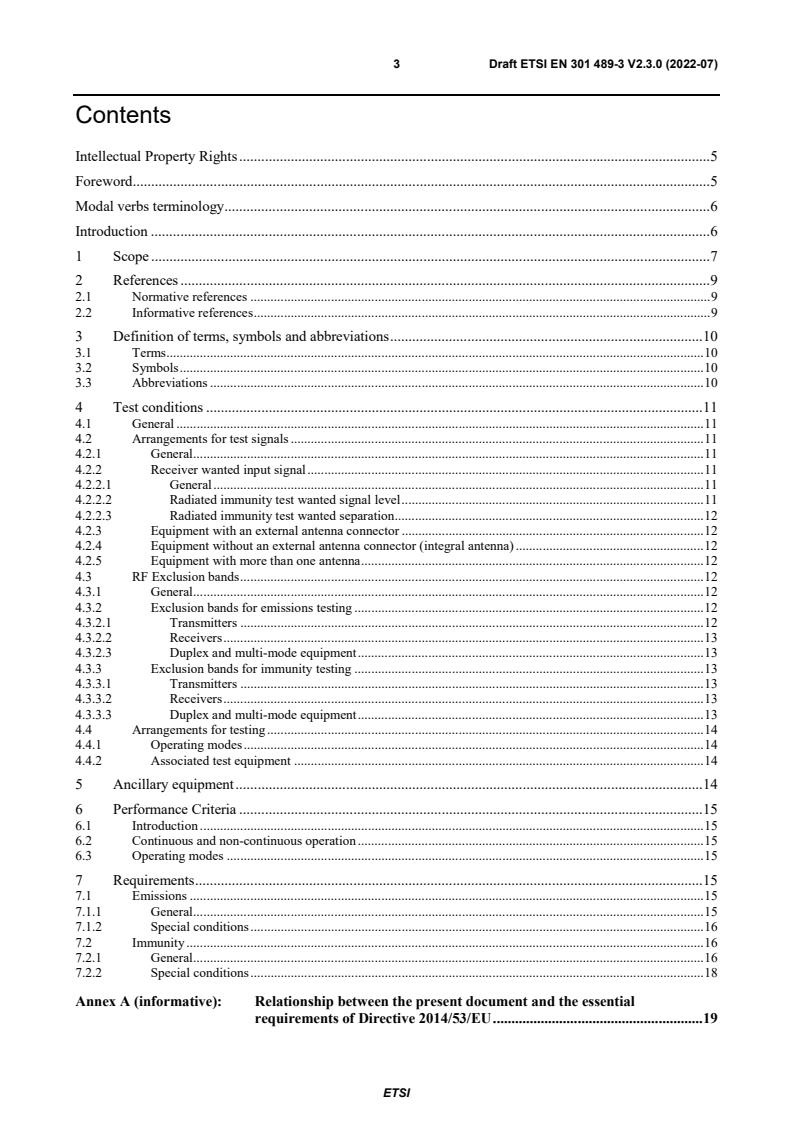

ETSI EN 301 489-3 V2.3.0 (2022-07) - ElectroMagnetic Compatibility (EMC) standard for radio equipment and services; Part 3: Specific conditions for Short Range Devices (SRD) operating on frequencies between 9 kHz and 246 GHz; Harmonised Standard for ElectroMagnetic Compatibility

ETSI EN 301 489-3 V2.3.1 (2022-11) - ElectroMagnetic Compatibility (EMC) standard for radio equipment and services; Part 3: Specific conditions for Short Range Devices (SRD) operating on frequencies between 9 kHz and 246 GHz; Harmonised Standard for ElectroMagnetic Compatibility
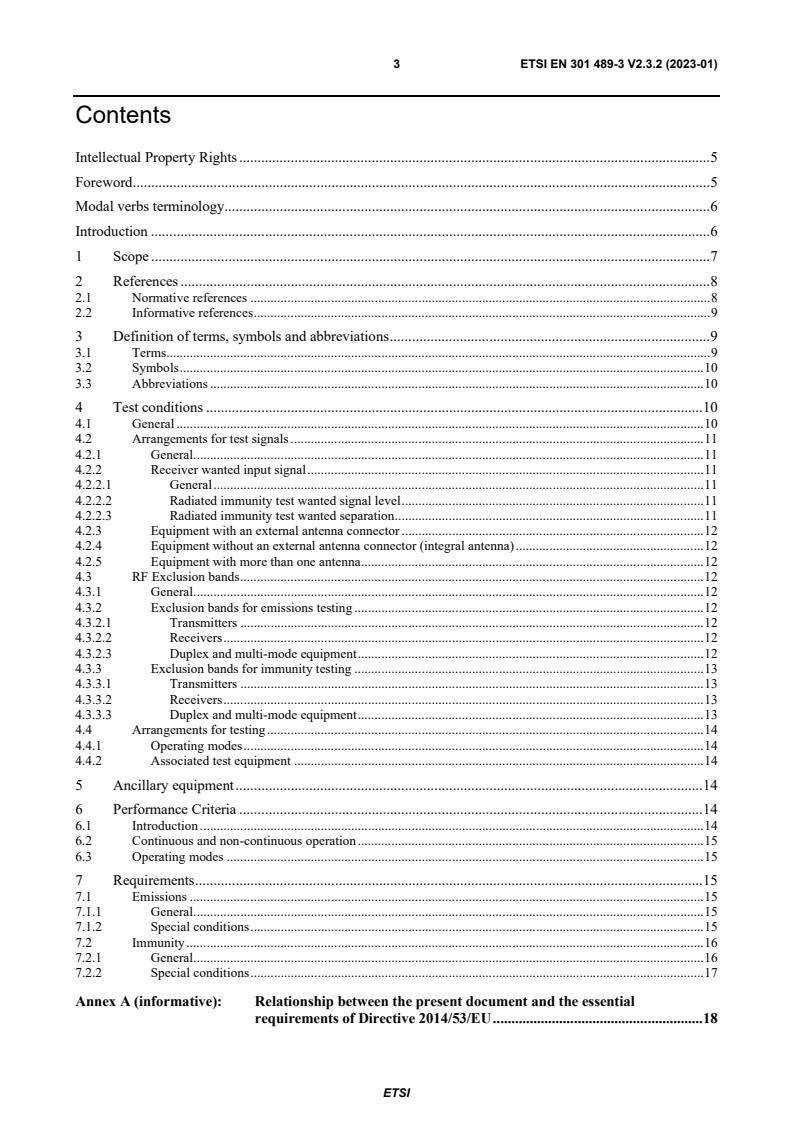

ETSI EN 301 489-3 V2.3.2 (2023-01) - ElectroMagnetic Compatibility (EMC) standard for radio equipment and services; Part 3: Specific conditions for Short Range Devices (SRD) operating on frequencies between 9 kHz and 246 GHz; Harmonised Standard for ElectroMagnetic Compatibility

Overview
SIST EN 301 489-3 V2.3.2:2023 is the harmonised European standard for Electromagnetic Compatibility (EMC) requirements focusing on Short Range Devices (SRD) operating within the 9 kHz to 246 GHz frequency range. Published by the Slovenian Institute for Standardization (SIST) and identical to ETSI EN 301 489-3, this standard is crucial for manufacturers, test laboratories, and regulatory authorities to ensure that SRDs operate reliably without causing or suffering from electromagnetic interference. The standard provides essential guidelines for test conditions, performance assessment, and compliance criteria, aligning with the essential requirements of Directive 2014/53/EU for the placing of radio equipment on the European market.
Key Topics
- Short Range Device (SRD) Categories: This standard covers a broad array of SRDs, including non-specific devices, medical implants, assistive listening devices, wireless audio/video equipment, inductive loop devices, RFID systems, transport telematics, PMR446 portable radios, and more.
- Electromagnetic Compatibility (EMC) Assessment: Outlines applicable EMC test conditions for emission and immunity, ensuring that SRDs meet European EMC regulations.
- Performance Criteria: Defines performance standards devices must maintain during EMC stress, supporting consistent functionality.
- Testing Protocols: Specifies the requirements for testing modes, signal levels, exclusion bands, and arrangements for devices with different antenna types.
- Ancillary Equipment: Addresses associated equipment used with SRDs, including requirements for EMC testing and performance.
- Regulatory Conformity: Provides a methodology to demonstrate presumption of conformity with Directive 2014/53/EU and relevant EFTA regulations for radio equipment.
Applications
SIST EN 301 489-3 is essential for a wide variety of practical applications, including:
- Consumer Electronics: SRDs in smart homes, alarms, remote controls, wearables, and personal audio systems.
- Healthcare: Active implantable devices, assistive listening devices, and equipment for medical data acquisition, ensuring safe operation in sensitive environments.
- Industrial and Scientific: Inductive devices for access control, asset tracking, RFID, and IoT (Internet of Things) devices for automation or logistics.
- Transportation: Wireless devices in telematics, vehicle-to-vehicle communication, and Intelligent Transport Systems.
- Security and Safety: Devices for alarm systems, anti-theft, emergency communications, and social alarms for personal safety.
- Professional Audio/Video: Systems including wireless microphones, in-ear monitors, and audio distribution that require reliable operation in challenging electromagnetic environments.
With the adoption of this EMC standard, manufacturers can ensure their products remain robust against electromagnetic disruptions. Compliance testing as described in SIST EN 301 489-3 is a critical step in achieving CE marking and accessing the European and global market for radio equipment.
Related Standards
- ETSI EN 301 489-1: Common technical requirements for EMC applicable to all radio equipment and services.
- EN 61000-4-4: Standard for electrical fast transient/burst immunity testing, cited as a requirement within the EMC assessment.
- ETSI EN 300 220-1: Technical characteristics and measurement methods for SRDs within 25 MHz to 1,000 MHz.
- Directive 2014/53/EU (RED): European legislation setting the framework for placing radio equipment on the market.
- Commission Implementing Decision (EU) 2019/1345: Details harmonized technical conditions for spectrum use by SRDs.
SIST EN 301 489-3 V2.3.2:2023 is part of a suite of harmonised EMC standards, supporting safe, interference-free operation of wireless and radio-enabled devices throughout the European Economic Area and beyond.
Buy Documents
ETSI EN 301 489-3 V2.1.2 (2021-03) - ElectroMagnetic Compatibility (EMC) standard for radio equipment and services; Part 3: Specific conditions for Short Range Devices (SRD) operating on frequencies between 9 kHz and 246 GHz; Harmonised Standard for ElectroMagnetic Compatibility
ETSI EN 301 489-3 V2.2.0 (2021-11) - ElectroMagnetic Compatibility (EMC) standard for radio equipment and services; Part 3: Specific conditions for Short Range Devices (SRD) operating on frequencies between 9 kHz and 246 GHz; Harmonised Standard for ElectroMagnetic Compatibility
ETSI EN 301 489-3 V2.3.0 (2022-07) - ElectroMagnetic Compatibility (EMC) standard for radio equipment and services; Part 3: Specific conditions for Short Range Devices (SRD) operating on frequencies between 9 kHz and 246 GHz; Harmonised Standard for ElectroMagnetic Compatibility
ETSI EN 301 489-3 V2.3.1 (2022-11) - ElectroMagnetic Compatibility (EMC) standard for radio equipment and services; Part 3: Specific conditions for Short Range Devices (SRD) operating on frequencies between 9 kHz and 246 GHz; Harmonised Standard for ElectroMagnetic Compatibility
ETSI EN 301 489-3 V2.3.2 (2023-01) - ElectroMagnetic Compatibility (EMC) standard for radio equipment and services; Part 3: Specific conditions for Short Range Devices (SRD) operating on frequencies between 9 kHz and 246 GHz; Harmonised Standard for ElectroMagnetic Compatibility
Get Certified
Connect with accredited certification bodies for this standard

ANCE
Mexican certification and testing association.

Intertek Slovenia
Intertek testing, inspection, and certification services in Slovenia.

LNE (Laboratoire National de Métrologie et d'Essais)
French national laboratory for metrology and testing.
Sponsored listings
Frequently Asked Questions
SIST EN 301 489-3 V2.3.2:2023 is a standard published by the Slovenian Institute for Standardization (SIST). Its full title is "ElectroMagnetic Compatibility (EMC) standard for radio equipment and services - Part 3: Specific conditions for Short Range Devices (SRD) operating on frequencies between 9 kHz and 246 GHz - Harmonised Standard for ElectroMagnetic Compatibility". This standard covers: The present document covers the assessment of Short Range Devices (SRD) operating in the frequency range 9 kHz to 246 GHz in respect of ElectroMagnetic Compatibility (EMC). The present document specifies the applicable test conditions, performance assessment, and performance criteria for Short Range Devices (SRD) and the associated ancillary equipment. The present document applies to the categories of SRD listed in Table 1 with the exception that the present document does not apply to devices for which a product specific harmonised EMC standard is available.
The present document covers the assessment of Short Range Devices (SRD) operating in the frequency range 9 kHz to 246 GHz in respect of ElectroMagnetic Compatibility (EMC). The present document specifies the applicable test conditions, performance assessment, and performance criteria for Short Range Devices (SRD) and the associated ancillary equipment. The present document applies to the categories of SRD listed in Table 1 with the exception that the present document does not apply to devices for which a product specific harmonised EMC standard is available.
SIST EN 301 489-3 V2.3.2:2023 is classified under the following ICS (International Classification for Standards) categories: 33.060.20 - Receiving and transmitting equipment; 33.100.01 - Electromagnetic compatibility in general. The ICS classification helps identify the subject area and facilitates finding related standards.
SIST EN 301 489-3 V2.3.2:2023 is associated with the following European legislation: EU Directives/Regulations: 2014/53/EU. When a standard is cited in the Official Journal of the European Union, products manufactured in conformity with it benefit from a presumption of conformity with the essential requirements of the corresponding EU directive or regulation.
SIST EN 301 489-3 V2.3.2:2023 is available in PDF format for immediate download after purchase. The document can be added to your cart and obtained through the secure checkout process. Digital delivery ensures instant access to the complete standard document.
Standards Content (Sample)
Draft ETSI EN 301 489-3 V2.1.2 (2021-03)
HARMONISED EUROPEAN STANDARD
ElectroMagnetic Compatibility (EMC)
standard for radio equipment and services;
Part 3: Specific conditions for
Short Range Devices (SRD)
operating on frequencies between 9 kHz and 246 GHz;
Harmonised Standard for ElectroMagnetic Compatibility
2 Draft ETSI EN 301 489-3 V2.1.2 (2021-03)
Reference
REN/ERM-EMC-402
Keywords
EMC, harmonised standard, SRD
ETSI
650 Route des Lucioles
F-06921 Sophia Antipolis Cedex - FRANCE
Tel.: +33 4 92 94 42 00 Fax: +33 4 93 65 47 16
Siret N° 348 623 562 00017 - NAF 742 C
Association à but non lucratif enregistrée à la
Sous-Préfecture de Grasse (06) N° 7803/88
Important notice
The present document can be downloaded from:
http://www.etsi.org/standards-search
The present document may be made available in electronic versions and/or in print. The content of any electronic and/or
print versions of the present document shall not be modified without the prior written authorization of ETSI. In case of any
existing or perceived difference in contents between such versions and/or in print, the prevailing version of an ETSI
deliverable is the one made publicly available in PDF format at www.etsi.org/deliver.
Users of the present document should be aware that the document may be subject to revision or change of status.
Information on the current status of this and other ETSI documents is available at
https://portal.etsi.org/TB/ETSIDeliverableStatus.aspx
If you find errors in the present document, please send your comment to one of the following services:
https://portal.etsi.org/People/CommiteeSupportStaff.aspx
Copyright Notification
No part may be reproduced or utilized in any form or by any means, electronic or mechanical, including photocopying
and microfilm except as authorized by written permission of ETSI.
The content of the PDF version shall not be modified without the written authorization of ETSI.
The copyright and the foregoing restriction extend to reproduction in all media.
© ETSI 2021.
All rights reserved.
DECT™, PLUGTESTS™, UMTS™ and the ETSI logo are trademarks of ETSI registered for the benefit of its Members.
3GPP™ and LTE™ are trademarks of ETSI registered for the benefit of its Members and
of the 3GPP Organizational Partners.
oneM2M™ logo is a trademark of ETSI registered for the benefit of its Members and
of the oneM2M Partners. ®
GSM and the GSM logo are trademarks registered and owned by the GSM Association.
ETSI
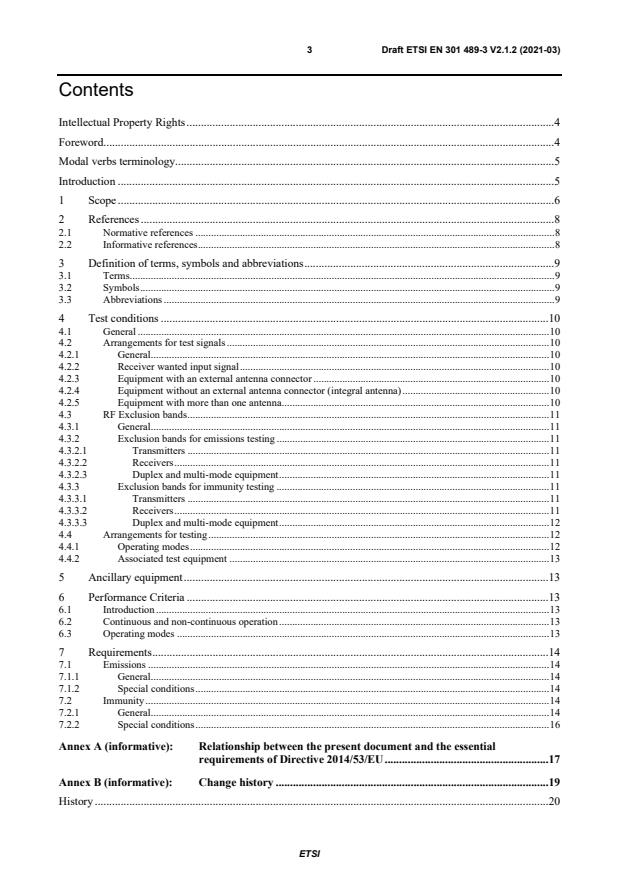
3 Draft ETSI EN 301 489-3 V2.1.2 (2021-03)
Contents
Intellectual Property Rights . 4
Foreword . 4
Modal verbs terminology . 5
Introduction . 5
1 Scope . 6
2 References . 8
2.1 Normative references . 8
2.2 Informative references . 8
3 Definition of terms, symbols and abbreviations . 9
3.1 Terms . 9
3.2 Symbols . 9
3.3 Abbreviations . 9
4 Test conditions . 10
4.1 General . 10
4.2 Arrangements for test signals . 10
4.2.1 General . 10
4.2.2 Receiver wanted input signal . 10
4.2.3 Equipment with an external antenna connector . 10
4.2.4 Equipment without an external antenna connector (integral antenna) . 10
4.2.5 Equipment with more than one antenna . 10
4.3 RF Exclusion bands . 11
4.3.1 General . 11
4.3.2 Exclusion bands for emissions testing . 11
4.3.2.1 Transmitters . 11
4.3.2.2 Receivers . 11
4.3.2.3 Duplex and multi-mode equipment . 11
4.3.3 Exclusion bands for immunity testing . 11
4.3.3.1 Transmitters . 11
4.3.3.2 Receivers . 11
4.3.3.3 Duplex and multi-mode equipment . 12
4.4 Arrangements for testing . 12
4.4.1 Operating modes . 12
4.4.2 Associated test equipment . 13
5 Ancillary equipment . 13
6 Performance Criteria . 13
6.1 Introduction . 13
6.2 Continuous and non-continuous operation . 13
6.3 Operating modes . 13
7 Requirements . 14
7.1 Emissions . 14
7.1.1 General . 14
7.1.2 Special conditions . 14
7.2 Immunity . 14
7.2.1 General . 14
7.2.2 Special conditions . 16
Annex A (informative): Relationship between the present document and the essential
requirements of Directive 2014/53/EU . 17
Annex B (informative): Change history . 19
History . 20
ETSI
4 Draft ETSI EN 301 489-3 V2.1.2 (2021-03)
Intellectual Property Rights
Essential patents
IPRs essential or potentially essential to normative deliverables may have been declared to ETSI. The information
pertaining to these essential IPRs, if any, is publicly available for ETSI members and non-members, and can be found
in ETSI SR 000 314: "Intellectual Property Rights (IPRs); Essential, or potentially Essential, IPRs notified to ETSI in
respect of ETSI standards", which is available from the ETSI Secretariat. Latest updates are available on the ETSI Web
server (https://ipr.etsi.org/).
Pursuant to the ETSI IPR Policy, no investigation, including IPR searches, has been carried out by ETSI. No guarantee
can be given as to the existence of other IPRs not referenced in ETSI SR 000 314 (or the updates on the ETSI Web
server) which are, or may be, or may become, essential to the present document.
Trademarks
The present document may include trademarks and/or tradenames which are asserted and/or registered by their owners.
ETSI claims no ownership of these except for any which are indicated as being the property of ETSI, and conveys no
right to use or reproduce any trademark and/or tradename. Mention of those trademarks in the present document does
not constitute an endorsement by ETSI of products, services or organizations associated with those trademarks.
Foreword
This draft Harmonised European Standard (EN) has been produced by ETSI Technical Committee Electromagnetic
compatibility and Radio spectrum Matters (ERM), and is now submitted for the combined Public Enquiry and Vote
phase of the ETSI standards EN Approval Procedure.
The present document has been prepared under the Commission's standardisation request C(2015) 5376 final [i.5] to
provide one voluntary means of conforming to the essential requirements of Directive 2014/53/EU on the harmonisation
of the laws of the Member States relating to the making available on the market of radio equipment and repealing
Directive 1999/5/EC [i.2].
Once the present document is cited in the Official Journal of the European Union under that Directive, compliance with
the normative clauses of the present document given in Table A.1 confers, within the limits of the scope of the present
document, a presumption of conformity with the corresponding essential requirements of that Directive and associated
EFTA regulations.
The present document is part 3 of a multi-part deliverable. Full details of the entire series can be found in part 1 [1]. A
guide to using the series can be found in ETSI TR 103 088 [i.4].
Proposed national transposition dates
Date of latest announcement of this EN (doa): 3 months after ETSI publication
Date of latest publication of new National Standard
or endorsement of this EN (dop/e): 6 months after doa
Date of withdrawal of any conflicting National Standard (dow): 18 months after doa
ETSI
5 Draft ETSI EN 301 489-3 V2.1.2 (2021-03)
Modal verbs terminology
In the present document "shall", "shall not", "should", "should not", "may", "need not", "will", "will not", "can" and
"cannot" are to be interpreted as described in clause 3.2 of the ETSI Drafting Rules (Verbal forms for the expression of
provisions).
"must" and "must not" are NOT allowed in ETSI deliverables except when used in direct citation.
Introduction
The product family of Short Range Devices covers a wide range of equipment types, which may have different sets of
performance criteria set out in the relevant radio standards and/or product standards.
The present document is intended for all SRD types and applies a standard set of performance criteria. This includes the
requirement that the equipment continues to operate as intended under certain standardised conditions of EMC stress.
The term "Short Range Device" (SRD) is intended to cover the radio equipment which provides either uni-directional or
bi-directional communication and which have low capability of causing interference to other radio equipment. SRDs
use either integral, dedicated or external antennas and all modes of modulation can be permitted subject to relevant
standards. For Short Range Devices individual licenses are normally not required.
ETSI
6 Draft ETSI EN 301 489-3 V2.1.2 (2021-03)
1 Scope
The present document covers the assessment of Short Range Devices (SRD) operating in the frequency range 9 kHz to
246 GHz in respect of ElectroMagnetic Compatibility (EMC).
The present document specifies the applicable test conditions, performance assessment, and performance criteria for
Short Range Devices (SRD) and the associated ancillary equipment.
The present document applies to the categories of SRD listed in Table 1 with the exception that the present document
does not apply to devices for which a product specific harmonised EMC standard is available.
NOTE 1: The entries in Table 1 of the present document are based on the Decision (EU) 2019/1345 [i.1], Table 1.
Table 1: Categories of short range device
Category of Short Range Scope of the category
Devices
Non-specific SRD. Covers all kinds of radio devices, regardless of the application
or their purpose, which fulfil the technical conditions as
specified for a given frequency band. Typical uses include
telemetry, telecommand, alarms, data transmissions in
general and other applications.
(See note 1).
Active medical implant Covers the radio part of active implantable medical devices
devices. that are intended to be fully or partially introduced, surgically
(See note 2). or medically, into the human body or that of an animal, and
where applicable their peripherals. Active implantable medical
devices are defined in Council Directive 90/385/EEC [i.3].
Assistive listening devices Covers radio communications systems that allow persons with
(ALDs). hearing impairment to increase their listening capability.
(See note 2). Typical system installations include one or more radio
transmitters and one or more radio receivers.
High duty cycle/continuous Covers radio devices that rely on low latency and high duty
transmission devices. cycle transmissions. These devices are typically used for
personal wireless audio and multimedia streaming systems
used for combined audio/video transmissions and audio/video
sync signals, mobile phones, automotive or home
entertainment system, wireless microphones, cordless
loudspeakers, cordless headphones, radio devices carried on
a person, assistive listening devices, in-ear monitoring,
wireless microphones for use at concerts or other stage
productions, and low power analogue FM transmitters.
Inductive devices. Covers radio devices that use magnetic fields with inductive
loop systems for near field communications. This typically
includes devices for car immobilisation, animal identification,
alarm systems, cable detection, waste management, personal
identification, wireless voice links, access control, proximity
sensors, anti-theft systems as well as RF anti-theft induction
systems, data transfer to hand-held devices, automatic article
identification, wireless control systems and automatic road
tolling.
Low duty cycle/high reliability Covers radio devices that rely on low overall spectrum
devices. utilisation and low duty cycle spectrum access rules to ensure
highly reliable spectrum access and transmissions in shared
bands. Typical applications include alarm systems that use
radio communication for indicating an alert condition at a
distant location and social alarm systems that allow reliable
communication for a person in distress.
Medical data acquisition Covers the transmission of non-voice data to and from non-
devices. implantable medical devices in order to monitor, diagnose and
(See note 2). treat patients in healthcare facilities or in their homes as
prescribed by duly authorised healthcare professionals.
ETSI
7 Draft ETSI EN 301 489-3 V2.1.2 (2021-03)
Category of Short Range Scope of the category
Devices
PMR446 devices. Covers hand portable equipment (without base station or
repeater use) carried on a person or manually operated,
which uses integral antennas only in order to maximise
sharing and minimise interference. PMR 446 equipment
operates in short-range peer-to-peer mode and excludes use
either as a part of infrastructure network or as a repeater.
Radio determination devices. Covers radio devices used for determining the position,
(See note 2). velocity and/or other characteristics of an object, or for
obtaining information relating to these parameters. Radio
determination equipment typically conducts measurements to
obtain such characteristics. Radio determination devices
exclude any kind of point-to-point or point-to-multipoint radio
communications.
Radio frequency identification Covers tag/interrogator based radio communications systems,
(RFID) devices. consisting of (i) radio devices (tags) attached to animate or
inanimate items and (ii) transmitter/receiver units
(interrogators) which activate the tags and receive data back.
Typical applications include the tracking and identification of
items, for instance for the purpose of electronic article
surveillance (EAS), and collecting and transmitting data
relating to the items to which tags are attached, which may be
either battery-less, battery assisted or battery powered. The
responses from a tag are validated by its interrogator and
passed to its host system.
Transport and traffic Covers radio devices that are used in the fields of transport
telematics devices. (road, rail, water or air, depending on the relevant technical
restrictions), traffic management, navigation, mobility
management and in intelligent transport systems (ITS).
Typical applications include interfaces between different
modes of transport, communication between vehicles (e.g. car
to car), between vehicles and fixed locations (e.g. car to
infrastructure) as well as communication from and to users.
Wideband data transmission Covers radio devices that use wideband modulation
devices. techniques to access the spectrum. Typical uses include
(See note 2). wireless access systems such as radio local area networks
(WAS/RLANs) or wideband SRDs in data networks.
NOTE 1: The Annex of the Decision (EU) 2019/1345 [i.1] lists the frequency bands and
associated conditions harmonised in the EU. There may be variations in individual
countries.
NOTE 2: A product specific harmonised EMC standard may be applicable for some devices
and should be used in preference to the present document.
Technical specifications related to the antenna port of radio equipment and radiated emissions from the enclosure port
of the radio equipment are not included in the present document. Such technical specifications are normally found in the
relevant product standards for the effective use of the radio spectrum.
The environmental classification and the emission and immunity requirements used in the present document are as
stated in ETSI EN 301 489-1 [1], except for any special conditions included in the present document.
NOTE 2: The relationship between the present document and essential requirements of article 3.1(b) of Directive
2014/53/EU [i.2] is given in Annex A.
ETSI
8 Draft ETSI EN 301 489-3 V2.1.2 (2021-03)
2 References
2.1 Normative references
References are either specific (identified by date of publication and/or edition number or version number) or non-
specific. For specific references, only the cited version applies. For non-specific references, the latest version of the
referenced document (including any amendments) applies.
Referenced documents which are not found to be publicly available in the expected location might be found at
https://docbox.etsi.org/Reference/.
NOTE: While any hyperlinks included in this clause were valid at the time of publication, ETSI cannot guarantee
their long term validity.
The following referenced documents are necessary for the application of the present document.
[1] ETSI EN 301 489-1 (V2.2.3) (11-2019): "ElectroMagnetic Compatibility (EMC) standard for
radio equipment and services; Part 1: Common technical requirements; Harmonised Standard for
ElectroMagnetic Compatibility".
[2] EN 61000-3-3 (2013): "Electromagnetic compatibility (EMC) - Part 3-3: Limits - Limitation of
voltage changes, voltage fluctuations and flicker in public low-voltage supply systems, for
equipment with rated current ≤ 16 A per phase and not subject to conditional connection",
(produced by CENELEC).
[3] EN 61000-3-11 (2000): "Electromagnetic compatibility (EMC) - Part 3-11: Limits - Limitation of
voltage changes, voltage fluctuations and flicker in public low-voltage supply systems -
Equipment with rated current ≤ 75 A and subject to conditional connection", (produced by
CENELEC).
[4] EN 61000-4-4 (2012): "Electromagnetic compatibility (EMC) - Part 4-4: Testing and measurement
techniques - Electric
...
Final draft ETSI EN 301 489-3 V2.2.0 (2021-11)
HARMONISED EUROPEAN STANDARD
ElectroMagnetic Compatibility (EMC)
standard for radio equipment and services;
Part 3: Specific conditions for
Short Range Devices (SRD)
operating on frequencies between 9 kHz and 246 GHz;
Harmonised Standard for ElectroMagnetic Compatibility
2 Final draft ETSI EN 301 489-3 V2.2.0 (2021-11)
Reference
REN/ERM-EMC-402
Keywords
EMC, harmonised standard, SRD
ETSI
650 Route des Lucioles
F-06921 Sophia Antipolis Cedex - FRANCE
Tel.: +33 4 92 94 42 00 Fax: +33 4 93 65 47 16
Siret N° 348 623 562 00017 - APE 7112B
Association à but non lucratif enregistrée à la
Sous-Préfecture de Grasse (06) N° w061004871
Important notice
The present document can be downloaded from:
http://www.etsi.org/standards-search
The present document may be made available in electronic versions and/or in print. The content of any electronic and/or
print versions of the present document shall not be modified without the prior written authorization of ETSI. In case of any
existing or perceived difference in contents between such versions and/or in print, the prevailing version of an ETSI
deliverable is the one made publicly available in PDF format at www.etsi.org/deliver.
Users of the present document should be aware that the document may be subject to revision or change of status.
Information on the current status of this and other ETSI documents is available at
https://portal.etsi.org/TB/ETSIDeliverableStatus.aspx
If you find errors in the present document, please send your comment to one of the following services:
https://portal.etsi.org/People/CommiteeSupportStaff.aspx
Notice of disclaimer & limitation of liability
The information provided in the present deliverable is directed solely to professionals who have the appropriate degree of
experience to understand and interpret its content in accordance with generally accepted engineering or
other professional standard and applicable regulations.
No recommendation as to products and services or vendors is made or should be implied.
In no event shall ETSI be held liable for loss of profits or any other incidental or consequential damages.
Any software contained in this deliverable is provided "AS IS" with no warranties, express or implied, including but not
limited to, the warranties of merchantability, fitness for a particular purpose and non-infringement of intellectual property
rights and ETSI shall not be held liable in any event for any damages whatsoever (including, without limitation, damages
for loss of profits, business interruption, loss of information, or any other pecuniary loss) arising out of or related to the use
of or inability to use the software.
Copyright Notification
No part may be reproduced or utilized in any form or by any means, electronic or mechanical, including photocopying and
microfilm except as authorized by written permission of ETSI.
The content of the PDF version shall not be modified without the written authorization of ETSI.
The copyright and the foregoing restriction extend to reproduction in all media.
© ETSI 2021.
All rights reserved.
ETSI
3 Final draft ETSI EN 301 489-3 V2.2.0 (2021-11)
Contents
Intellectual Property Rights . 4
Foreword . 4
Modal verbs terminology . 5
Introduction . 5
1 Scope . 6
2 References . 8
2.1 Normative references . 8
2.2 Informative references . 8
3 Definition of terms, symbols and abbreviations . 9
3.1 Terms . 9
3.2 Symbols . 9
3.3 Abbreviations . 9
4 Test conditions . 9
4.1 General . 9
4.2 Arrangements for test signals . 10
4.2.1 General . 10
4.2.2 Receiver wanted input signal . 10
4.2.3 Equipment with an external antenna connector . 10
4.2.4 Equipment without an external antenna connector (integral antenna) . 10
4.2.5 Equipment with more than one antenna . 10
4.3 RF Exclusion bands . 10
4.3.1 General . 10
4.3.2 Exclusion bands for emissions testing . 11
4.3.2.1 Transmitters . 11
4.3.2.2 Receivers . 11
4.3.2.3 Duplex and multi-mode equipment . 11
4.3.3 Exclusion bands for immunity testing . 11
4.3.3.1 Transmitters . 11
4.3.3.2 Receivers . 11
4.3.3.3 Duplex and multi-mode equipment . 12
4.4 Arrangements for testing . 12
4.4.1 Operating modes . 12
4.4.2 Associated test equipment . 12
5 Ancillary equipment . 13
6 Performance Criteria . 13
6.1 Introduction . 13
6.2 Continuous and non-continuous operation . 13
6.3 Operating modes . 13
7 Requirements . 13
7.1 Emissions . 13
7.1.1 General . 13
7.1.2 Special conditions . 14
7.2 Immunity . 14
7.2.1 General . 14
7.2.2 Special conditions . 16
Annex A (informative): Relationship between the present document and the essential
requirements of Directive 2014/53/EU . 17
Annex B (informative): Change history . 19
History . 20
ETSI
4 Final draft ETSI EN 301 489-3 V2.2.0 (2021-11)
Intellectual Property Rights
Essential patents
IPRs essential or potentially essential to normative deliverables may have been declared to ETSI. The declarations
pertaining to these essential IPRs, if any, are publicly available for ETSI members and non-members, and can be
found in ETSI SR 000 314: "Intellectual Property Rights (IPRs); Essential, or potentially Essential, IPRs notified to
ETSI in respect of ETSI standards", which is available from the ETSI Secretariat. Latest updates are available on the
ETSI Web server (https://ipr.etsi.org/).
Pursuant to the ETSI Directives including the ETSI IPR Policy, no investigation regarding the essentiality of IPRs,
including IPR searches, has been carried out by ETSI. No guarantee can be given as to the existence of other IPRs not
referenced in ETSI SR 000 314 (or the updates on the ETSI Web server) which are, or may be, or may become,
essential to the present document.
Trademarks
The present document may include trademarks and/or tradenames which are asserted and/or registered by their owners.
ETSI claims no ownership of these except for any which are indicated as being the property of ETSI, and conveys no
right to use or reproduce any trademark and/or tradename. Mention of those trademarks in the present document does
not constitute an endorsement by ETSI of products, services or organizations associated with those trademarks.
DECT™, PLUGTESTS™, UMTS™ and the ETSI logo are trademarks of ETSI registered for the benefit of its
Members. 3GPP™ and LTE™ are trademarks of ETSI registered for the benefit of its Members and of the 3GPP
Organizational Partners. oneM2M™ logo is a trademark of ETSI registered for the benefit of its Members and of the ®
oneM2M Partners. GSM and the GSM logo are trademarks registered and owned by the GSM Association.
Foreword
This final draft Harmonised European Standard (EN) has been produced by ETSI Technical Committee
Electromagnetic compatibility and Radio spectrum Matters (ERM), and is now submitted for the Vote phase of the
ETSI standards EN Approval Procedure.
The present document has been prepared under the Commission's standardisation request C(2015) 5376 final [i.5] to
provide one voluntary means of conforming to the essential requirements of Directive 2014/53/EU on the harmonisation
of the laws of the Member States relating to the making available on the market of radio equipment and repealing
Directive 1999/5/EC [i.2].
Once the present document is cited in the Official Journal of the European Union under that Directive, compliance with
the normative clauses of the present document given in Table A.1 confers, within the limits of the scope of the present
document, a presumption of conformity with the corresponding essential requirements of that Directive and associated
EFTA regulations.
The present document is part 3 of a multi-part deliverable. Full details of the entire series can be found in part 1 [1]. A
guide to using the series can be found in ETSI TR 103 088 [i.4].
Proposed national transposition dates
Date of latest announcement of this EN (doa): 3 months after ETSI publication
Date of latest publication of new National Standard
or endorsement of this EN (dop/e): 6 months after doa
Date of withdrawal of any conflicting National Standard (dow): 18 months after doa
ETSI
5 Final draft ETSI EN 301 489-3 V2.2.0 (2021-11)
Modal verbs terminology
In the present document "shall", "shall not", "should", "should not", "may", "need not", "will", "will not", "can" and
"cannot" are to be interpreted as described in clause 3.2 of the ETSI Drafting Rules (Verbal forms for the expression of
provisions).
"must" and "must not" are NOT allowed in ETSI deliverables except when used in direct citation.
Introduction
The product family of Short Range Devices covers a wide range of equipment types, which may have different sets of
performance criteria set out in the relevant radio standards and/or product standards.
The present document is intended for all SRD types and applies a standard set of performance criteria. This includes the
requirement that the equipment continues to operate as intended under certain standardised conditions of EMC stress.
The term "Short Range Device" (SRD) is intended to cover the radio equipment which provides either uni-directional or
bi-directional communication and which have low capability of causing interference to other radio equipment. SRDs
use either integral, dedicated or external antennas and all modes of modulation can be permitted subject to relevant
standards. For Short Range Devices individual licenses are normally not required.
ETSI
6 Final draft ETSI EN 301 489-3 V2.2.0 (2021-11)
1 Scope
The present document covers the assessment of Short Range Devices (SRD) operating in the frequency range 9 kHz to
246 GHz in respect of ElectroMagnetic Compatibility (EMC).
The present document specifies the applicable test conditions, performance assessment, and performance criteria for
Short Range Devices (SRD) and the associated ancillary equipment.
The present document applies to the categories of SRD listed in Table 1 with the exception that the present document
does not apply to devices for which a product specific harmonised EMC standard is available.
NOTE 1: The entries in Table 1 of the present document are based on the Decision (EU) 2019/1345 [i.1], Table 1.
Table 1: Categories of short range device
Category of Short Range Scope of the category
Devices
Non-specific SRD. Covers all kinds of radio devices, regardless of the application
or their purpose, which fulfil the technical conditions as
specified for a given frequency band. Typical uses include
telemetry, telecommand, alarms, data transmissions in
general and other applications.
(See note 1).
Active medical implant Covers the radio part of active implantable medical devices
devices. that are intended to be fully or partially introduced, surgically
(See note 2). or medically, into the human body or that of an animal, and
where applicable their peripherals. Active implantable medical
devices are defined in Council Directive 90/385/EEC [i.3].
Assistive Listening Devices Covers radio communications systems that allow persons with
(ALDs). hearing impairment to increase their listening capability.
(See note 2). Typical system installations include one or more radio
transmitters and one or more radio receivers.
High duty cycle/continuous Covers radio devices that rely on low latency and high duty
transmission devices. cycle transmissions. These devices are typically used for
personal wireless audio and multimedia streaming systems
used for combined audio/video transmissions and audio/video
sync signals, mobile phones, automotive or home
entertainment system, wireless microphones, cordless
loudspeakers, cordless headphones, radio devices carried on
a person, assistive listening devices, in-ear monitoring,
wireless microphones for use at concerts or other stage
productions, and low power analogue FM transmitters.
Inductive devices. Covers radio devices that use magnetic fields with inductive
loop systems for near field communications. This typically
includes devices for car immobilisation, animal identification,
alarm systems, cable detection, waste management, personal
identification, wireless voice links, access control, proximity
sensors, anti-theft systems as well as RF anti-theft induction
systems, data transfer to hand-held devices, automatic article
identification, wireless control systems and automatic road
tolling.
Low duty cycle/high reliability Covers radio devices that rely on low overall spectrum
devices. utilization and low duty cycle spectrum access rules to ensure
highly reliable spectrum access and transmissions in shared
bands. Typical applications include alarm systems that use
radio communication for indicating an alert condition at a
distant location and social alarm systems that allow reliable
communication for a person in distress.
Medical data acquisition Covers the transmission of non-voice data to and from non-
devices. implantable medical devices in order to monitor, diagnose and
(See note 2). treat patients in healthcare facilities or in their homes as
prescribed by duly authorized healthcare professionals.
ETSI
7 Final draft ETSI EN 301 489-3 V2.2.0 (2021-11)
Category of Short Range Scope of the category
Devices
PMR446 devices. Covers hand portable equipment (without base station or
repeater use) carried on a person or manually operated,
which uses integral antennas only in order to maximize
sharing and minimize interference. PMR 446 equipment
operates in short-range peer-to-peer mode and excludes use
either as a part of infrastructure network or as a repeater.
Radio determination devices. Covers radio devices used for determining the position,
(See note 2). velocity and/or other characteristics of an object, or for
obtaining information relating to these parameters. Radio
determination equipment typically conducts measurements to
obtain such characteristics. Radio determination devices
exclude any kind of point-to-point or point-to-multipoint radio
communications.
Radio Frequency Covers tag/interrogator based radio communications systems,
IDentification (RFID) devices. consisting of (i) radio devices (tags) attached to animate or
inanimate items and (ii) transmitter/receiver units
(interrogators) which activate the tags and receive data back.
Typical applications include the tracking and identification of
items, for instance for the purpose of Electronic Article
Surveillance (EAS), and collecting and transmitting data
relating to the items to which tags are attached, which may be
either battery-less, battery assisted or battery powered. The
responses from a tag are validated by its interrogator and
passed to its host system.
Transport and traffic Covers radio devices that are used in the fields of transport
telematics devices. (road, rail, water or air, depending on the relevant technical
restrictions), traffic management, navigation, mobility
management and in Intelligent Transport Systems (ITS).
Typical applications include interfaces between different
modes of transport, communication between vehicles (e.g. car
to car), between vehicles and fixed locations (e.g. car to
infrastructure) as well as communication from and to users.
Wideband data transmission Covers radio devices that use wideband modulation
devices. techniques to access the spectrum. Typical uses include
(See note 2). wireless access systems such as Radio Local Area Networks
(WAS/RLANs) or wideband SRDs in data networks.
NOTE 1: The Annex of the Decision (EU) 2019/1345 [i.1] lists the frequency bands and
associated conditions harmonised in the EU. There may be variations in individual
countries.
NOTE 2: A product specific harmonised EMC standard may be applicable for some devices
and should be used in preference to the present document.
Technical specifications related to the antenna port of radio equipment and radiated emissions from the enclosure port
of the radio equipment are not included in the present document. Such technical specifications are normally found in the
relevant product standards for the effective use of the radio spectrum.
Emissions requirements in the present document are only specified for frequencies above 9 kHz.
The environmental classification and the emission and immunity requirements used in the present document are as
stated in ETSI EN 301 489-1 [1], except for any special conditions included in the present document.
NOTE 2: The relationship between the present document and essential requirements of article 3.1(b) of Directive
2014/53/EU [i.2] is given in Annex A.
ETSI
8 Final draft ETSI EN 301 489-3 V2.2.0 (2021-11)
2 References
2.1 Normative references
References are either specific (identified by date of publication and/or edition number or version number) or non-
specific. For specific references, only the cited version applies. For non-specific references, the latest version of the
referenced document (including any amendments) applies.
Referenced documents which are not found to be publicly available in the expected location might be found at
https://docbox.etsi.org/Reference/.
NOTE: While any hyperlinks included in
...
Draft ETSI EN 301 489-3 V2.3.0 (2022-07)
HARMONISED EUROPEAN STANDARD
ElectroMagnetic Compatibility (EMC)
standard for radio equipment and services;
Part 3: Specific conditions for
Short Range Devices (SRD)
operating on frequencies between 9 kHz and 246 GHz;
Harmonised Standard for ElectroMagnetic Compatibility
2 Draft ETSI EN 301 489-3 V2.3.0 (2022-07)
Reference
REN/ERM-EMC-402
Keywords
EMC, harmonised standard, SRD
ETSI
650 Route des Lucioles
F-06921 Sophia Antipolis Cedex - FRANCE
Tel.: +33 4 92 94 42 00 Fax: +33 4 93 65 47 16
Siret N° 348 623 562 00017 - APE 7112B
Association à but non lucratif enregistrée à la
Sous-Préfecture de Grasse (06) N° w061004871
Important notice
The present document can be downloaded from:
http://www.etsi.org/standards-search
The present document may be made available in electronic versions and/or in print. The content of any electronic and/or
print versions of the present document shall not be modified without the prior written authorization of ETSI. In case of any
existing or perceived difference in contents between such versions and/or in print, the prevailing version of an ETSI
deliverable is the one made publicly available in PDF format at www.etsi.org/deliver.
Users of the present document should be aware that the document may be subject to revision or change of status.
Information on the current status of this and other ETSI documents is available at
https://portal.etsi.org/TB/ETSIDeliverableStatus.aspx
If you find errors in the present document, please send your comment to one of the following services:
https://portal.etsi.org/People/CommiteeSupportStaff.aspx
If you find a security vulnerability in the present document, please report it through our
Coordinated Vulnerability Disclosure Program:
https://www.etsi.org/standards/coordinated-vulnerability-disclosure
Notice of disclaimer & limitation of liability
The information provided in the present deliverable is directed solely to professionals who have the appropriate degree of
experience to understand and interpret its content in accordance with generally accepted engineering or
other professional standard and applicable regulations.
No recommendation as to products and services or vendors is made or should be implied.
In no event shall ETSI be held liable for loss of profits or any other incidental or consequential damages.
Any software contained in this deliverable is provided "AS IS" with no warranties, express or implied, including but not
limited to, the warranties of merchantability, fitness for a particular purpose and non-infringement of intellectual property
rights and ETSI shall not be held liable in any event for any damages whatsoever (including, without limitation, damages
for loss of profits, business interruption, loss of information, or any other pecuniary loss) arising out of or related to the use
of or inability to use the software.
Copyright Notification
No part may be reproduced or utilized in any form or by any means, electronic or mechanical, including photocopying and
microfilm except as authorized by written permission of ETSI.
The content of the PDF version shall not be modified without the written authorization of ETSI.
The copyright and the foregoing restriction extend to reproduction in all media.
© ETSI 2022.
All rights reserved.
ETSI
3 Draft ETSI EN 301 489-3 V2.3.0 (2022-07)
Contents
Intellectual Property Rights . 5
Foreword . 5
Modal verbs terminology . 6
Introduction . 6
1 Scope . 7
2 References . 9
2.1 Normative references . 9
2.2 Informative references . 9
3 Definition of terms, symbols and abbreviations . 10
3.1 Terms . 10
3.2 Symbols . 10
3.3 Abbreviations . 10
4 Test conditions . 11
4.1 General . 11
4.2 Arrangements for test signals . 11
4.2.1 General . 11
4.2.2 Receiver wanted input signal . 11
4.2.2.1 General . 11
4.2.2.2 Radiated immunity test wanted signal level . 11
4.2.2.3 Radiated immunity test wanted separation . 12
4.2.3 Equipment with an external antenna connector . 12
4.2.4 Equipment without an external antenna connector (integral antenna) . 12
4.2.5 Equipment with more than one antenna . 12
4.3 RF Exclusion bands . 12
4.3.1 General . 12
4.3.2 Exclusion bands for emissions testing . 12
4.3.2.1 Transmitters . 12
4.3.2.2 Receivers . 13
4.3.2.3 Duplex and multi-mode equipment . 13
4.3.3 Exclusion bands for immunity testing . 13
4.3.3.1 Transmitters . 13
4.3.3.2 Receivers . 13
4.3.3.3 Duplex and multi-mode equipment . 13
4.4 Arrangements for testing . 14
4.4.1 Operating modes . 14
4.4.2 Associated test equipment . 14
5 Ancillary equipment . 14
6 Performance Criteria . 15
6.1 Introduction . 15
6.2 Continuous and non-continuous operation . 15
6.3 Operating modes . 15
7 Requirements . 15
7.1 Emissions . 15
7.1.1 General . 15
7.1.2 Special conditions . 16
7.2 Immunity . 16
7.2.1 General . 16
7.2.2 Special conditions . 18
Annex A (informative): Relationship between the present document and the essential
requirements of Directive 2014/53/EU . 19
ETSI
4 Draft ETSI EN 301 489-3 V2.3.0 (2022-07)
Annex B (informative): Change history . 21
History . 22
ETSI
5 Draft ETSI EN 301 489-3 V2.3.0 (2022-07)
Intellectual Property Rights
Essential patents
IPRs essential or potentially essential to normative deliverables may have been declared to ETSI. The declarations
pertaining to these essential IPRs, if any, are publicly available for ETSI members and non-members, and can be
found in ETSI SR 000 314: "Intellectual Property Rights (IPRs); Essential, or potentially Essential, IPRs notified to
ETSI in respect of ETSI standards", which is available from the ETSI Secretariat. Latest updates are available on the
ETSI Web server (https://ipr.etsi.org/).
Pursuant to the ETSI Directives including the ETSI IPR Policy, no investigation regarding the essentiality of IPRs,
including IPR searches, has been carried out by ETSI. No guarantee can be given as to the existence of other IPRs not
referenced in ETSI SR 000 314 (or the updates on the ETSI Web server) which are, or may be, or may become,
essential to the present document.
Trademarks
The present document may include trademarks and/or tradenames which are asserted and/or registered by their owners.
ETSI claims no ownership of these except for any which are indicated as being the property of ETSI, and conveys no
right to use or reproduce any trademark and/or tradename. Mention of those trademarks in the present document does
not constitute an endorsement by ETSI of products, services or organizations associated with those trademarks.
DECT™, PLUGTESTS™, UMTS™ and the ETSI logo are trademarks of ETSI registered for the benefit of its
Members. 3GPP™ and LTE™ are trademarks of ETSI registered for the benefit of its Members and of the 3GPP
Organizational Partners. oneM2M™ logo is a trademark of ETSI registered for the benefit of its Members and of the ®
oneM2M Partners. GSM and the GSM logo are trademarks registered and owned by the GSM Association.
Foreword
This draft Harmonised European Standard (EN) has been produced by ETSI Technical Committee Electromagnetic
compatibility and Radio spectrum Matters (ERM) and is now submitted for the combined Public Enquiry and Vote
phase of the ETSI standards EN Approval Procedure.
The present document has been prepared under the Commission's standardisation request C(2015) 5376 final [i.5] to
provide one voluntary means of conforming to the essential requirements of Directive 2014/53/EU on the harmonisation
of the laws of the Member States relating to the making available on the market of radio equipment and repealing
Directive 1999/5/EC [i.2].
Once the present document is cited in the Official Journal of the European Union under that Directive, compliance with
the normative clauses of the present document given in Table A.1 confers, within the limits of the scope of the present
document, a presumption of conformity with the corresponding essential requirements of that Directive and associated
EFTA regulations.
The present document is part 3 of a multi-part deliverable. Full details of the entire series can be found in part 1 [1]. A
guide to using the series can be found in ETSI TR 103 088 [i.4].
Proposed national transposition dates
Date of latest announcement of this EN (doa): 3 months after ETSI publication
Date of latest publication of new National Standard
or endorsement of this EN (dop/e): 6 months after doa
Date of withdrawal of any conflicting National Standard (dow): 18 months after doa
ETSI
6 Draft ETSI EN 301 489-3 V2.3.0 (2022-07)
Modal verbs terminology
In the present document "shall", "shall not", "should", "should not", "may", "need not", "will", "will not", "can" and
"cannot" are to be interpreted as described in clause 3.2 of the ETSI Drafting Rules (Verbal forms for the expression of
provisions).
"must" and "must not" are NOT allowed in ETSI deliverables except when used in direct citation.
Introduction
The product family of Short Range Devices covers a wide range of equipment types, which may have different sets of
performance criteria set out in the relevant radio standards and/or product standards.
The present document is intended for all SRD types and applies a standard set of performance criteria. This includes the
requirement that the equipment continues to operate as intended under certain standardized conditions of EMC stress.
The term "Short Range Device" (SRD) is intended to cover the radio equipment which provides either uni-directional or
bi-directional communication and which have low capability of causing interference to other radio equipment. SRDs
use either integral, dedicated or external antennas and all modes of modulation can be permitted subject to relevant
standards. For Short Range Devices individual licenses are normally not required.
ETSI
7 Draft ETSI EN 301 489-3 V2.3.0 (2022-07)
1 Scope
The present document covers the assessment of Short Range Devices (SRD) operating in the frequency range 9 kHz to
246 GHz in respect of ElectroMagnetic Compatibility (EMC).
The present document specifies the applicable test conditions, performance assessment, and performance criteria for
Short Range Devices (SRD) and the associated ancillary equipment.
The present document applies to the categories of SRD listed in Table 1 with the exception that the present document
does not apply to devices for which a product specific harmonised EMC standard is available.
NOTE 1: The entries in Table 1 of the present document are based on the Decision (EU) 2019/1345 [i.1], Table 1.
Table 1: Categories of short range device
Category of Short Range Scope of the category
Devices
Non-specific SRD. Covers all kinds of radio devices, regardless of the application
or their purpose, which fulfil the technical conditions as
specified for a given frequency band. Typical uses include
telemetry, telecommand, alarms, data transmissions in
general and other applications.
(See note 1).
Active medical implant Covers the radio part of active implantable medical devices
devices. that are intended to be fully or partially introduced, surgically
(See note 2). or medically, into the human body or that of an animal, and
where applicable their peripherals. Active implantable medical
devices are defined in Council Directive 90/385/EEC [i.3].
Assistive Listening Devices Covers radio communications systems that allow persons with
(ALDs). hearing impairment to increase their listening capability.
(See note 2). Typical system installations include one or more radio
transmitters and one or more radio receivers.
High duty cycle/continuous Covers radio devices that rely on low latency and high duty
transmission devices. cycle transmissions. These devices are typically used for
personal wireless audio and multimedia streaming systems
used for combined audio/video transmissions and audio/video
sync signals, mobile phones, automotive or home
entertainment system, wireless microphones, cordless
loudspeakers, cordless headphones, radio devices carried on
a person, assistive listening devices, in-ear monitoring,
wireless microphones for use at concerts or other stage
productions, and low power analogue FM transmitters.
Inductive devices. Covers radio devices that use magnetic fields with inductive
loop systems for near field communications. This typically
includes devices for car immobilisation, animal identification,
alarm systems, cable detection, waste management, personal
identification, wireless voice links, access control, proximity
sensors, anti-theft systems as well as RF anti-theft induction
systems, data transfer to hand-held devices, automatic article
identification, wireless control systems and automatic road
tolling.
Low duty cycle/high reliability Covers radio devices that rely on low overall spectrum
devices. utilization and low duty cycle spectrum access rules to ensure
highly reliable spectrum access and transmissions in shared
bands. Typical applications include alarm systems that use
radio communication for indicating an alert condition at a
distant location and social alarm systems that allow reliable
communication for a person in distress.
Medical data acquisition Covers the transmission of non-voice data to and from non-
devices. implantable medical devices in order to monitor, diagnose and
(See note 2). treat patients in healthcare facilities or in their homes as
prescribed by duly authorized healthcare professionals.
ETSI
8 Draft ETSI EN 301 489-3 V2.3.0 (2022-07)
Category of Short Range Scope of the category
Devices
PMR446 devices. Covers hand portable equipment (without base station or
repeater use) carried on a person or manually operated,
which uses integral antennas only in order to maximize
sharing and minimize interference. PMR 446 equipment
operates in short-range peer-to-peer mode and excludes use
either as a part of infrastructure network or as a repeater.
Radio determination devices. Covers radio devices used for determining the position,
(See note 2). velocity and/or other characteristics of an object, or for
obtaining information relating to these parameters. Radio
determination equipment typically conducts measurements to
obtain such characteristics. Radio determination devices
exclude any kind of point-to-point or point-to-multipoint radio
communications.
Radio Frequency Covers tag/interrogator based radio communications systems,
IDentification (RFID) devices. consisting of (i) radio devices (tags) attached to animate or
inanimate items and (ii) transmitter/receiver units
(interrogators) which activate the tags and receive data back.
Typical applications include the tracking and identification of
items, for instance for the purpose of Electronic Article
Surveillance (EAS), and collecting and transmitting data
relating to the items to which tags are attached, which may be
either battery-less, battery assisted or battery powered. The
responses from a tag are validated by its interrogator and
passed to its host system.
Transport and traffic Covers radio devices that are used in the fields of transport
telematics devices. (road, rail, water or air, depending on the relevant technical
restrictions), traffic management, navigation, mobility
management and in Intelligent Transport Systems (ITS).
Typical applications include interfaces between different
modes of transport, communication between vehicles (e.g. car
to car), between vehicles and fixed locations (e.g. car to
infrastructure) as well as communication from and to users.
Wideband data transmission Covers radio devices that use wideband modulation
devices. techniques to access the spectrum. Typical uses include
(See note 2). wireless access systems such as Radio Local Area Networks
(WAS/RLANs) or wideband SRDs in data networks.
NOTE 1: The Annex of the Decision (EU) 2019/1345 [i.1] lists the frequency bands and
associated conditions harmonised in the EU. There may be variations in individual
countries.
NOTE 2: A product specific harmonised EMC standard may be applicable for some devices
and should be used in preference to the present document.
Technical specifications related to the antenna port of radio equipment and radiated emissions from the enclosure port
of the radio equipment are not included in the present document. Such technical specifications are normally found in the
relevant product standards for the effective use of the radio spectrum.
Emissions requirements in the present document are only specified for frequencies above 9 kHz.
The environmental classification and the emission and immunity requirements used in the present document are as
stated in ETSI EN 301 489-1 [1], except for any special conditions included in the present document.
NOTE 2: The relationship between the present document and essential requirements of article 3.1(b) of Directive
2014/53/EU [i.2] is given in Annex A.
ETSI
9 Draft ETSI EN 301 489-3 V2.3.0 (2022-07)
2 References
2.1 Normative references
References are either specific (identified by date of publication and/or edition number or version number) or
non-specific. For specific references, only the cited version applies. For non-specific references, the latest version of the
referenced document (including any amendments) applies.
Referenced documents which are not found to be publicly available in the expected location might be found at
https://docbox.etsi.org/Reference/.
NOTE: While any hyperlinks included in this clause were valid at the time of publication, ETSI cannot guarantee
their long term validity.
The following referenced documents are necessary for the application of the present document.
[1] ETSI EN 301 489-1 (V2.2.3) (11-2019): "ElectroMagnetic Compatibility (EMC) standard for
radio equipment and services; Part 1: Common technical requirements; Harmonised Standard for
ElectroMagnetic Compatibility".
[2] Void.
[3] Void.
[4] EN 61000-4-4 (2012): "Electromagnetic compatibility (EMC) - Part 4-4: Testing and measurement
techniques - Electrical fast transient/burst immunity test" (produced by CENELEC).
2.2 Informative references
References are either specific (identified by date of publication and/or edition number or version number) or
...
Final draft ETSI EN 301 489-3 V2.3.1 (2022-11)
HARMONISED EUROPEAN STANDARD
ElectroMagnetic Compatibility (EMC)
standard for radio equipment and services;
Part 3: Specific conditions for
Short Range Devices (SRD)
operating on frequencies between 9 kHz and 246 GHz;
Harmonised Standard for ElectroMagnetic Compatibility
2 Final draft ETSI EN 301 489-3 V2.3.1 (2022-11)
Reference
REN/ERM-EMC-402
Keywords
EMC, harmonised standard, SRD
ETSI
650 Route des Lucioles
F-06921 Sophia Antipolis Cedex - FRANCE
Tel.: +33 4 92 94 42 00 Fax: +33 4 93 65 47 16
Siret N° 348 623 562 00017 - APE 7112B
Association à but non lucratif enregistrée à la
Sous-Préfecture de Grasse (06) N° w061004871
Important notice
The present document can be downloaded from:
http://www.etsi.org/standards-search
The present document may be made available in electronic versions and/or in print. The content of any electronic and/or
print versions of the present document shall not be modified without the prior written authorization of ETSI. In case of any
existing or perceived difference in contents between such versions and/or in print, the prevailing version of an ETSI
deliverable is the one made publicly available in PDF format at www.etsi.org/deliver.
Users of the present document should be aware that the document may be subject to revision or change of status.
Information on the current status of this and other ETSI documents is available at
https://portal.etsi.org/TB/ETSIDeliverableStatus.aspx
If you find errors in the present document, please send your comment to one of the following services:
https://portal.etsi.org/People/CommiteeSupportStaff.aspx
If you find a security vulnerability in the present document, please report it through our
Coordinated Vulnerability Disclosure Program:
https://www.etsi.org/standards/coordinated-vulnerability-disclosure
Notice of disclaimer & limitation of liability
The information provided in the present deliverable is directed solely to professionals who have the appropriate degree of
experience to understand and interpret its content in accordance with generally accepted engineering or
other professional standard and applicable regulations.
No recommendation as to products and services or vendors is made or should be implied.
In no event shall ETSI be held liable for loss of profits or any other incidental or consequential damages.
Any software contained in this deliverable is provided "AS IS" with no warranties, express or implied, including but not
limited to, the warranties of merchantability, fitness for a particular purpose and non-infringement of intellectual property
rights and ETSI shall not be held liable in any event for any damages whatsoever (including, without limitation, damages
for loss of profits, business interruption, loss of information, or any other pecuniary loss) arising out of or related to the use
of or inability to use the software.
Copyright Notification
No part may be reproduced or utilized in any form or by any means, electronic or mechanical, including photocopying and
microfilm except as authorized by written permission of ETSI.
The content of the PDF version shall not be modified without the written authorization of ETSI.
The copyright and the foregoing restriction extend to reproduction in all media.
© ETSI 2022.
All rights reserved.
ETSI
3 Final draft ETSI EN 301 489-3 V2.3.1 (2022-11)
Contents
Intellectual Property Rights . 5
Foreword . 5
Modal verbs terminology . 6
Introduction . 6
1 Scope . 7
2 References . 8
2.1 Normative references . 8
2.2 Informative references . 9
3 Definition of terms, symbols and abbreviations . 9
3.1 Terms . 9
3.2 Symbols . 10
3.3 Abbreviations . 10
4 Test conditions . 10
4.1 General . 10
4.2 Arrangements for test signals . 10
4.2.1 General . 10
4.2.2 Receiver wanted input signal . 11
4.2.2.1 General . 11
4.2.2.2 Radiated immunity test wanted signal level . 11
4.2.2.3 Radiated immunity test wanted separation . 11
4.2.3 Equipment with an external antenna connector . 11
4.2.4 Equipment without an external antenna connector (integral antenna) . 11
4.2.5 Equipment with more than one antenna . 12
4.3 RF Exclusion bands . 12
4.3.1 General . 12
4.3.2 Exclusion bands for emissions testing . 12
4.3.2.1 Transmitters . 12
4.3.2.2 Receivers . 12
4.3.2.3 Duplex and multi-mode equipment . 12
4.3.3 Exclusion bands for immunity testing . 12
4.3.3.1 Transmitters . 12
4.3.3.2 Receivers . 12
4.3.3.3 Duplex and multi-mode equipment . 13
4.4 Arrangements for testing . 13
4.4.1 Operating modes . 13
4.4.2 Associated test equipment . 14
5 Ancillary equipment . 14
6 Performance Criteria . 14
6.1 Introduction . 14
6.2 Continuous and non-continuous operation . 14
6.3 Operating modes . 14
7 Requirements . 15
7.1 Emissions . 15
7.1.1 General . 15
7.1.2 Special conditions . 15
7.2 Immunity . 15
7.2.1 General . 15
7.2.2 Special conditions . 17
Annex A (informative): Relationship between the present document and the essential
requirements of Directive 2014/53/EU . 18
ETSI
4 Final draft ETSI EN 301 489-3 V2.3.1 (2022-11)
Annex B (informative): Change history . 20
History . 21
ETSI
5 Final draft ETSI EN 301 489-3 V2.3.1 (2022-11)
Intellectual Property Rights
Essential patents
IPRs essential or potentially essential to normative deliverables may have been declared to ETSI. The declarations
pertaining to these essential IPRs, if any, are publicly available for ETSI members and non-members, and can be
found in ETSI SR 000 314: "Intellectual Property Rights (IPRs); Essential, or potentially Essential, IPRs notified to
ETSI in respect of ETSI standards", which is available from the ETSI Secretariat. Latest updates are available on the
ETSI Web server (https://ipr.etsi.org/).
Pursuant to the ETSI Directives including the ETSI IPR Policy, no investigation regarding the essentiality of IPRs,
including IPR searches, has been carried out by ETSI. No guarantee can be given as to the existence of other IPRs not
referenced in ETSI SR 000 314 (or the updates on the ETSI Web server) which are, or may be, or may become,
essential to the present document.
Trademarks
The present document may include trademarks and/or tradenames which are asserted and/or registered by their owners.
ETSI claims no ownership of these except for any which are indicated as being the property of ETSI, and conveys no
right to use or reproduce any trademark and/or tradename. Mention of those trademarks in the present document does
not constitute an endorsement by ETSI of products, services or organizations associated with those trademarks.
DECT™, PLUGTESTS™, UMTS™ and the ETSI logo are trademarks of ETSI registered for the benefit of its
Members. 3GPP™ and LTE™ are trademarks of ETSI registered for the benefit of its Members and of the 3GPP
Organizational Partners. oneM2M™ logo is a trademark of ETSI registered for the benefit of its Members and of the ®
oneM2M Partners. GSM and the GSM logo are trademarks registered and owned by the GSM Association.
Foreword
This final draft Harmonised European Standard (EN) has been produced by ETSI Technical Committee
Electromagnetic compatibility and Radio spectrum Matters (ERM), and is now submitted for the Vote phase of the
ETSI standards EN Approval Procedure.
The present document has been prepared under the Commission's standardisation request C(2015) 5376 final [i.5] to
provide one voluntary means of conforming to the essential requirements of Directive 2014/53/EU on the harmonisation
of the laws of the Member States relating to the making available on the market of radio equipment and repealing
Directive 1999/5/EC [i.2].
Once the present document is cited in the Official Journal of the European Union under that Directive, compliance with
the normative clauses of the present document given in Table A.1 confers, within the limits of the scope of the present
document, a presumption of conformity with the corresponding essential requirements of that Directive and associated
EFTA regulations.
The present document is part 3 of a multi-part deliverable. Full details of the entire series can be found in part 1 [1]. A
guide to using the series can be found in ETSI TR 103 088 [i.4].
Proposed national transposition dates
Date of latest announcement of this EN (doa): 3 months after ETSI publication
Date of latest publication of new National Standard
or endorsement of this EN (dop/e): 6 months after doa
Date of withdrawal of any conflicting National Standard (dow): 18 months after doa
ETSI
6 Final draft ETSI EN 301 489-3 V2.3.1 (2022-11)
Modal verbs terminology
In the present document "shall", "shall not", "should", "should not", "may", "need not", "will", "will not", "can" and
"cannot" are to be interpreted as described in clause 3.2 of the ETSI Drafting Rules (Verbal forms for the expression of
provisions).
"must" and "must not" are NOT allowed in ETSI deliverables except when used in direct citation.
Introduction
The product family of Short Range Devices covers a wide range of equipment types, which may have different sets of
performance criteria set out in the relevant radio standards and/or product standards.
The present document is intended for all SRD types and applies a standard set of performance criteria. This includes the
requirement that the equipment continues to operate as intended under certain standardized conditions of EMC stress.
The term "Short Range Device" (SRD) is intended to cover the radio equipment which provides either uni-directional or
bi-directional communication and which have low capability of causing interference to other radio equipment. SRDs
use either integral, dedicated or external antennas and all modes of modulation can be permitted subject to relevant
standards. For Short Range Devices individual licenses are normally not required.
ETSI
7 Final draft ETSI EN 301 489-3 V2.3.1 (2022-11)
1 Scope
The present document covers the assessment of Short Range Devices (SRD) operating in the frequency range 9 kHz to
246 GHz in respect of ElectroMagnetic Compatibility (EMC).
The present document specifies the applicable test conditions, performance assessment, and performance criteria for
Short Range Devices (SRD) and the associated ancillary equipment.
The present document applies to the categories of SRD listed in Table 1 with the exception that the present document
does not apply to devices for which a product specific harmonised EMC standard is available.
NOTE 1: The entries in Table 1 of the present document are based on the Decision (EU) 2019/1345 [i.1], Table 1.
Table 1: Categories of short range device
Category of Short Range Scope of the category
Devices
Non-specific SRD Covers all kinds of radio devices, regardless of the application or their purpose, which
fulfil the technical conditions as specified for a given frequency band. Typical uses
include telemetry, telecommand, alarms, data transmissions in general and other
applications. (See note 1.)
Active medical implant Covers the radio part of active implantable medical devices that are intended to be
devices fully or partially introduced, surgically or medically, into the human body or that of an
(See note 2) animal, and where applicable their peripherals. Active implantable medical devices
are defined in Council Directive 90/385/EEC [i.3].
Assistive Listening Devices Covers radio communications systems that allow persons with hearing impairment to
(ALDs) increase their listening capability. Typical system installations include one or more
(See note 2) radio transmitters and one or more radio receivers.
High duty cycle/continuous Covers radio devices that rely on low latency and high duty cycle transmissions.
transmission devices These devices are typically used for personal wireless audio and multimedia
streaming systems used for combined audio/video transmissions and audio/video
sync signals, mobile phones, automotive or home entertainment system, wireless
microphones, cordless loudspeakers, cordless headphones, radio devices carried on
a person, assistive listening devices, in-ear monitoring, wireless microphones for use
at concerts or other stage productions, and low power analogue FM transmitters.
Inductive devices Covers radio devices that use magnetic fields with inductive loop systems for near
field communications. This typically includes devices for car immobilisation, animal
identification, alarm systems, cable detection, waste management, personal
identification, wireless voice links, access control, proximity sensors, anti-theft
systems as well as RF anti-theft induction systems, data transfer to hand-held
devices, automatic article identification, wireless control systems and automatic road
tolling.
Low duty cycle/high reliability Covers radio devices that rely on low overall spectrum utilization and low duty cycle
devices spectrum access rules to ensure highly reliable spectrum access and transmissions
in shared bands. Typical applications include alarm systems that use radio
communication for indicating an alert condition at a distant location and social alarm
systems that allow reliable communication for a person in distress.
Medical data acquisition Covers the transmission of non-voice data to and from non-implantable medical
devices devices in order to monitor, diagnose and treat patients in healthcare facilities or in
(See note 2) their homes as prescribed by duly authorized healthcare professionals.
PMR446 devices Covers hand portable equipment (without base station or repeater use) carried on a
person or manually operated, which uses integral antennas only in order to maximize
sharing and minimize interference. PMR 446 equipment operates in short-range
peer-to-peer mode and excludes use either as a part of infrastructure network or as a
repeater.
Radio determination devices Covers radio devices used for determining the position, velocity and/or other
(See note 2) characteristics of an object, or for obtaining information relating to these parameters.
Radio determination equipment typically conducts measurements to obtain such
characteristics. Radio determination devices exclude any kind of point-to-point or
point-to-multipoint radio communications.
ETSI
8 Final draft ETSI EN 301 489-3 V2.3.1 (2022-11)
Category of Short Range Scope of the category
Devices
Radio Frequency Covers tag/interrogator based radio communications systems, consisting of:
IDentification (RFID) devices i) radio devices (tags) attached to animate or inanimate items; and
ii) transmitter/receiver units (interrogators) which activate the tags and receive
data back.
Typical applications include the tracking and identification of items, for instance for
the purpose of Electronic Article Surveillance (EAS), and collecting and transmitting
data relating to the items to which tags are attached, which may be either
battery-less, battery assisted or battery powered. The responses from a tag are
validated by its interrogator and passed to its host system.
Transport and traffic Covers radio devices that are used in the fields of transport (road, rail, water or air,
telematics devices depending on the relevant technical restrictions), traffic management, navigation,
mobility management and in Intelligent Transport Systems (ITS). Typical applications
include interfaces between different modes of transport, communication between
vehicles (e.g. car to car), between vehicles and fixed locations (e.g. car to
infrastructure) as well as communication from and to users.
Wideband data transmission Covers radio devices that use wideband modulation techniques to access the
devices spectrum. Typical uses include wireless access systems such as Radio Local Area
(See note 2) Networks (WAS/RLANs) or wideband SRDs in data networks.
NOTE 1: The Annex of the Decision (EU) 2019/1345 [i.1] lists the frequency bands and associated conditions
harmonised in the EU. There may be variations in individual countries.
NOTE 2: A product specific harmonised EMC standard may be applicable for some devices and should be used in
preference to the present document.
Technical specifications related to the antenna port of radio equipment and radiated emissions from the enclosure port
of the radio equipment are not included in the present document. Such technical specifications are normally found in the
relevant product standards for the effective use of the radio spectrum.
Emissions requirements in the present document are only specified for frequencies above 9 kHz.
The environmental classification and the emission and immunity requirements used in the present document are as
stated in ETSI EN 301 489-1 [1], except for any special conditions included in the present document.
NOTE 2: The relationship between the present document and essential requirements of article 3.1(b) of Directive
2014/53/EU [i.2] is given in annex A.
2 References
2.1 Normative references
References are either specific (identified by date of publication and/or edition number or version number) or
non-specific. For specific references, only the cited version applies. For non-specific references, the latest version of the
referenced document (including any amendments) applies.
Referenced documents which are not found to be publicly available in the expected location might be found at
https://docbox.etsi.org/Reference/.
NOTE: While any hyperlinks included in this clause were valid at the time of publication, ETSI cannot guarantee
their long term validity.
The following referenced documents are necessary for the application of the present document.
[1] ETSI EN 301 489-1 (V2.2.3) (11-2019): "ElectroMagnetic Compatibility (EMC) standard for
radio equipment and services; Part 1: Common technical requirements; Harmonised Standard for
ElectroMagnetic Compatibility".
[2] Void.
[3] Void.
ETSI
9 Final draft ETSI EN 301 489-3 V2.3.1 (2022-11)
[4] EN 61000-4-4 (2012): "Electromagnetic compatibility (EMC) - Part 4-4: Testing and measurement
techniques - Electrical fast transient/burst immunity test" (produced by CENELEC).
2.2 Informative references
References are either specific (identified by date of publication and/or edition number or version number) or
non-specific. For specific references, only the cited version applies. For non-specific references, the latest version of
...
ETSI EN 301 489-3 V2.3.2 (2023-01)
HARMONISED EUROPEAN STANDARD
ElectroMagnetic Compatibility (EMC)
standard for radio equipment and services;
Part 3: Specific conditions for
Short Range Devices (SRD)
operating on frequencies between 9 kHz and 246 GHz;
Harmonised Standard for ElectroMagnetic Compatibility
2 ETSI EN 301 489-3 V2.3.2 (2023-01)
Reference
REN/ERM-EMC-402
Keywords
EMC, harmonised standard, SRD
ETSI
650 Route des Lucioles
F-06921 Sophia Antipolis Cedex - FRANCE
Tel.: +33 4 92 94 42 00 Fax: +33 4 93 65 47 16
Siret N° 348 623 562 00017 - APE 7112B
Association à but non lucratif enregistrée à la
Sous-Préfecture de Grasse (06) N° w061004871
Important notice
The present document can be downloaded from:
http://www.etsi.org/standards-search
The present document may be made available in electronic versions and/or in print. The content of any electronic and/or
print versions of the present document shall not be modified without the prior written authorization of ETSI. In case of any
existing or perceived difference in contents between such versions and/or in print, the prevailing version of an ETSI
deliverable is the one made publicly available in PDF format at www.etsi.org/deliver.
Users of the present document should be aware that the document may be subject to revision or change of status.
Information on the current status of this and other ETSI documents is available at
https://portal.etsi.org/TB/ETSIDeliverableStatus.aspx
If you find errors in the present document, please send your comment to one of the following services:
https://portal.etsi.org/People/CommiteeSupportStaff.aspx
If you find a security vulnerability in the present document, please report it through our
Coordinated Vulnerability Disclosure Program:
https://www.etsi.org/standards/coordinated-vulnerability-disclosure
Notice of disclaimer & limitation of liability
The information provided in the present deliverable is directed solely to professionals who have the appropriate degree of
experience to understand and interpret its content in accordance with generally accepted engineering or
other professional standard and applicable regulations.
No recommendation as to products and services or vendors is made or should be implied.
In no event shall ETSI be held liable for loss of profits or any other incidental or consequential damages.
Any software contained in this deliverable is provided "AS IS" with no warranties, express or implied, including but not
limited to, the warranties of merchantability, fitness for a particular purpose and non-infringement of intellectual property
rights and ETSI shall not be held liable in any event for any damages whatsoever (including, without limitation, damages
for loss of profits, business interruption, loss of information, or any other pecuniary loss) arising out of or related to the use
of or inability to use the software.
Copyright Notification
No part may be reproduced or utilized in any form or by any means, electronic or mechanical, including photocopying and
microfilm except as authorized by written permission of ETSI.
The content of the PDF version shall not be modified without the written authorization of ETSI.
The copyright and the foregoing restriction extend to reproduction in all media.
© ETSI 2023.
All rights reserved.
ETSI
3 ETSI EN 301 489-3 V2.3.2 (2023-01)
Contents
Intellectual Property Rights . 5
Foreword . 5
Modal verbs terminology . 6
Introduction . 6
1 Scope . 7
2 References . 8
2.1 Normative references . 8
2.2 Informative references . 9
3 Definition of terms, symbols and abbreviations . 9
3.1 Terms . 9
3.2 Symbols . 10
3.3 Abbreviations . 10
4 Test conditions . 10
4.1 General . 10
4.2 Arrangements for test signals . 11
4.2.1 General . 11
4.2.2 Receiver wanted input signal . 11
4.2.2.1 General . 11
4.2.2.2 Radiated immunity test wanted signal level . 11
4.2.2.3 Radiated immunity test wanted separation . 11
4.2.3 Equipment with an external antenna connector . 12
4.2.4 Equipment without an external antenna connector (integral antenna) . 12
4.2.5 Equipment with more than one antenna . 12
4.3 RF Exclusion bands . 12
4.3.1 General . 12
4.3.2 Exclusion bands for emissions testing . 12
4.3.2.1 Transmitters . 12
4.3.2.2 Receivers . 12
4.3.2.3 Duplex and multi-mode equipment . 12
4.3.3 Exclusion bands for immunity testing . 13
4.3.3.1 Transmitters . 13
4.3.3.2 Receivers . 13
4.3.3.3 Duplex and multi-mode equipment . 13
4.4 Arrangements for testing . 14
4.4.1 Operating modes . 14
4.4.2 Associated test equipment . 14
5 Ancillary equipment . 14
6 Performance Criteria . 14
6.1 Introduction . 14
6.2 Continuous and non-continuous operation . 15
6.3 Operating modes . 15
7 Requirements . 15
7.1 Emissions . 15
7.1.1 General . 15
7.1.2 Special conditions . 15
7.2 Immunity . 16
7.2.1 General . 16
7.2.2 Special conditions . 17
Annex A (informative): Relationship between the present document and the essential
requirements of Directive 2014/53/EU . 18
ETSI
4 ETSI EN 301 489-3 V2.3.2 (2023-01)
Annex B (informative): Change history . 20
History . 21
ETSI
5 ETSI EN 301 489-3 V2.3.2 (2023-01)
Intellectual Property Rights
Essential patents
IPRs essential or potentially essential to normative deliverables may have been declared to ETSI. The declarations
pertaining to these essential IPRs, if any, are publicly available for ETSI members and non-members, and can be
found in ETSI SR 000 314: "Intellectual Property Rights (IPRs); Essential, or potentially Essential, IPRs notified to
ETSI in respect of ETSI standards", which is available from the ETSI Secretariat. Latest updates are available on the
ETSI Web server (https://ipr.etsi.org/).
Pursuant to the ETSI Directives including the ETSI IPR Policy, no investigation regarding the essentiality of IPRs,
including IPR searches, has been carried out by ETSI. No guarantee can be given as to the existence of other IPRs not
referenced in ETSI SR 000 314 (or the updates on the ETSI Web server) which are, or may be, or may become,
essential to the present document.
Trademarks
The present document may include trademarks and/or tradenames which are asserted and/or registered by their owners.
ETSI claims no ownership of these except for any which are indicated as being the property of ETSI, and conveys no
right to use or reproduce any trademark and/or tradename. Mention of those trademarks in the present document does
not constitute an endorsement by ETSI of products, services or organizations associated with those trademarks.
DECT™, PLUGTESTS™, UMTS™ and the ETSI logo are trademarks of ETSI registered for the benefit of its
Members. 3GPP™ and LTE™ are trademarks of ETSI registered for the benefit of its Members and of the 3GPP
Organizational Partners. oneM2M™ logo is a trademark of ETSI registered for the benefit of its Members and of the ®
oneM2M Partners. GSM and the GSM logo are trademarks registered and owned by the GSM Association.
Foreword
This Harmonised European Standard (EN) has been produced by ETSI Technical Committee Electromagnetic
compatibility and Radio spectrum Matters (ERM).
The present document has been prepared under the Commission's standardisation request C(2015) 5376 final [i.5] to
provide one voluntary means of conforming to the essential requirements of Directive 2014/53/EU on the harmonisation
of the laws of the Member States relating to the making available on the market of radio equipment and repealing
Directive 1999/5/EC [i.2].
Once the present document is cited in the Official Journal of the European Union under that Directive, compliance with
the normative clauses of the present document given in Table A.1 confers, within the limits of the scope of the present
document, a presumption of conformity with the corresponding essential requirements of that Directive and associated
EFTA regulations.
The present document is part 3 of a multi-part deliverable. Full details of the entire series can be found in part 1 [1].
A guide to using the series can be found in ETSI TR 103 088 [i.4].
National transposition dates
Date of adoption of this EN: 23 January 2023
Date of latest announcement of this EN (doa): 30 April 2023
Date of latest publication of new National Standard
or endorsement of this EN (dop/e): 31 October 2023
Date of withdrawal of any conflicting National Standard (dow): 31 October 2024
ETSI
6 ETSI EN 301 489-3 V2.3.2 (2023-01)
Modal verbs terminology
In the present document "shall", "shall not", "should", "should not", "may", "need not", "will", "will not", "can" and
"cannot" are to be interpreted as described in clause 3.2 of the ETSI Drafting Rules (Verbal forms for the expression of
provisions).
"must" and "must not" are NOT allowed in ETSI deliverables except when used in direct citation.
Introduction
The product family of Short Range Devices covers a wide range of equipment types, which may have different sets of
performance criteria set out in the relevant radio standards and/or product standards.
The present document is intended for all SRD types and applies a standard set of performance criteria. This includes the
requirement that the equipment continues to operate as intended under certain standardized conditions of EMC stress.
The term "Short Range Device" (SRD) is intended to cover the radio equipment which provides either uni-directional or
bi-directional communication and which have low capability of causing interference to other radio equipment. SRDs
use either integral, dedicated or external antennas and all modes of modulation can be permitted subject to relevant
standards. For Short Range Devices individual licenses are normally not required.
ETSI
7 ETSI EN 301 489-3 V2.3.2 (2023-01)
1 Scope
The present document covers the assessment of Short Range Devices (SRD) operating in the frequency range 9 kHz to
246 GHz in respect of ElectroMagnetic Compatibility (EMC).
The present document specifies the applicable test conditions, performance assessment, and performance criteria for
Short Range Devices (SRD) and the associated ancillary equipment.
The present document applies to the categories of SRD listed in Table 1 with the exception that the present document
does not apply to devices for which a product specific harmonised EMC standard is available.
NOTE 1: The entries in Table 1 of the present document are based on the Decision (EU) 2019/1345 [i.1], Table 1.
Table 1: Categories of short range device
Category of Short Range Scope of the category
Devices
Non-specific SRD Covers all kinds of radio devices, regardless of the application or their purpose, which
fulfil the technical conditions as specified for a given frequency band. Typical uses
include telemetry, telecommand, alarms, data transmissions in general and other
applications. (See note 1.)
Active medical implant Covers the radio part of active implantable medical devices that are intended to be
devices fully or partially introduced, surgically or medically, into the human body or that of an
(See note 2) animal, and where applicable their peripherals. Active implantable medical devices
are defined in Council Directive 90/385/EEC [i.3].
Assistive Listening Devices Covers radio communications systems that allow persons with hearing impairment to
(ALDs) increase their listening capability. Typical system installations include one or more
(See note 2) radio transmitters and one or more radio receivers.
High duty cycle/continuous Covers radio devices that rely on low latency and high duty cycle transmissions.
transmission devices These devices are typically used for personal wireless audio and multimedia
streaming systems used for combined audio/video transmissions and audio/video
sync signals, mobile phones, automotive or home entertainment system, wireless
microphones, cordless loudspeakers, cordless headphones, radio devices carried on
a person, assistive listening devices, in-ear monitoring, wireless microphones for use
at concerts or other stage productions, and low power analogue FM transmitters.
Inductive devices Covers radio devices that use magnetic fields with inductive loop systems for near
field communications. This typically includes devices for car immobilisation, animal
identification, alarm systems, cable detection, waste management, personal
identification, wireless voice links, access control, proximity sensors, anti-theft
systems as well as RF anti-theft induction systems, data transfer to hand-held
devices, automatic article identification, wireless control systems and automatic road
tolling.
Low duty cycle/high reliability Covers radio devices that rely on low overall spectrum utilization and low duty cycle
devices spectrum access rules to ensure highly reliable spectrum access and transmissions
in shared bands. Typical applications include alarm systems that use radio
communication for indicating an alert condition at a distant location and social alarm
systems that allow reliable communication for a person in distress.
Medical data acquisition Covers the transmission of non-voice data to and from non-implantable medical
devices devices in order to monitor, diagnose and treat patients in healthcare facilities or in
(See note 2) their homes as prescribed by duly authorized healthcare professionals.
PMR446 devices Covers hand portable equipment (without base station or repeater use) carried on a
person or manually operated, which uses integral antennas only in order to maximize
sharing and minimize interference. PMR446 equipment operates in short-range peer-
to-peer mode and excludes use either as a part of infrastructure network or as a
repeater.
Radio determination devices Covers radio devices used for determining the position, velocity and/or other
(See note 2) characteristics of an object, or for obtaining information relating to these parameters.
Radio determination equipment typically conducts measurements to obtain such
characteristics. Radio determination devices exclude any kind of point-to-point or
point-to-multipoint radio communications.
ETSI
8 ETSI EN 301 489-3 V2.3.2 (2023-01)
Category of Short Range Scope of the category
Devices
Radio Frequency Covers tag/interrogator based radio communications systems, consisting of:
IDentification (RFID) devices i) radio devices (tags) attached to animate or inanimate items; and
ii) transmitter/receiver units (interrogators) which activate the tags and receive
data back.
Typical applications include the tracking and identification of items, for instance for
the purpose of Electronic Article Surveillance (EAS), and collecting and transmitting
data relating to the items to which tags are attached, which may be either
battery-less, battery assisted or battery powered. The responses from a tag are
validated by its interrogator and passed to its host system.
Transport and traffic Covers radio devices that are used in the fields of transport (road, rail, water or air,
telematics devices depending on the relevant technical restrictions), traffic management, navigation,
mobility management and in Intelligent Transport Systems (ITS). Typical applications
include interfaces between different modes of transport, communication between
vehicles (e.g. car to car), between vehicles and fixed locations (e.g. car to
infrastructure) as well as communication from and to users.
Wideband data transmission Covers radio devices that use wideband modulation techniques to access the
devices spectrum. Typical uses include Wireless Access Systems such as Radio Local Area
(See note 2) Networks (WAS/RLANs) or wideband SRDs in data networks.
NOTE 1: The Annex of the Decision (EU) 2019/1345 [i.1] lists the frequency bands and associated conditions
harmonised in the EU. There may be variations in individual countries.
NOTE 2: A product specific harmonised EMC standard may be applicable for some devices and should be used in
preference to the present document.
Technical specifications related to the antenna port of radio equipment and radiated emissions from the enclosure port
of the radio equipment are not included in the present document. Such technical specifications are normally found in the
relevant product standards for the effective use of the radio spectrum.
Emissions requirements in the present document are only specified for frequencies above 9 kHz.
The environmental classification and the emission and immunity requirements used in the present document are as
stated in ETSI EN 301 489-1 [1], except for any special conditions included in the present document.
NOTE 2: The relationship between the present document and essential requirements of article 3.1(b) of Directive
2014/53/EU [i.2] is given in annex A.
2 References
2.1 Normative references
References are either specific (identified by date of publication and/or edition number or version number) or
non-specific. For specific references, only the cited version applies. For non-specific references, the latest version of the
referenced document (including any amendments) applies.
Referenced documents which are not found to be publicly available in the expected location might be found at
https://docbox.etsi.org/Reference/.
NOTE: While any hyperlinks included in this clause were valid at the time of publication, ETSI cannot guarantee
their long term validity.
The following referenced documents are necessary for the application of the present document.
[1] ETSI EN 301 489-1 (V2.2.3) (11-2019): "ElectroMagnetic Compatibility (EMC) standard for
radio equipment and services; Part 1: Common technical requirements; Harmonised Standard for
ElectroMagnetic Compatibility".
[2] Void.
[3] Void.
ETSI
9 ETSI EN 301 489-3 V2.3.2 (2023-01)
[4] EN 61000-4-4 (2012): "Electromagnetic compatibility (EMC) - Part 4-4: Testing and measurement
techniques - Electrical fast transient/burst immunity test" (produced by CENELEC).
2.2 Informative references
References are either specific (identified by date of publication and/or edition number or version number) or
non-specific. For specific references, only the cited version applies. For non-specific references, the latest version of the
referenced document (including any amendments) applies.
NOTE: While any hyperlinks included in this clause were valid at the time of publication, ETSI cannot guarantee
their long term validity.
The following referenced documents are not necessary fo
...
SLOVENSKI STANDARD
01-maj-2023
Standard elektromagnetne združljivosti (EMC) za radijsko opremo in storitve - 3.
del: Posebni pogoji za naprave kratkega dosega (SRD), delujoče na frekvencah
med 9 kHz in 246 GHz - Harmonizirani standard za elektromagnetno združljivost
ElectroMagnetic Compatibility (EMC) standard for radio equipment and services - Part 3:
Specific conditions for Short Range Devices (SRD) operating on frequencies between 9
kHz and 246 GHz - Harmonised Standard for ElectroMagnetic Compatibility
Ta slovenski standard je istoveten z: ETSI EN 301 489-3 V2.3.2 (2023-01)
ICS:
33.060.20 Sprejemna in oddajna Receiving and transmitting
oprema equipment
33.100.01 Elektromagnetna združljivost Electromagnetic compatibility
na splošno in general
2003-01.Slovenski inštitut za standardizacijo. Razmnoževanje celote ali delov tega standarda ni dovoljeno.
ETSI EN 301 489-3 V2.3.2 (2023-01)
HARMONISED EUROPEAN STANDARD
ElectroMagnetic Compatibility (EMC)
standard for radio equipment and services;
Part 3: Specific conditions for
Short Range Devices (SRD)
operating on frequencies between 9 kHz and 246 GHz;
Harmonised Standard for ElectroMagnetic Compatibility
2 ETSI EN 301 489-3 V2.3.2 (2023-01)
Reference
REN/ERM-EMC-402
Keywords
EMC, harmonised standard, SRD
ETSI
650 Route des Lucioles
F-06921 Sophia Antipolis Cedex - FRANCE
Tel.: +33 4 92 94 42 00 Fax: +33 4 93 65 47 16
Siret N° 348 623 562 00017 - APE 7112B
Association à but non lucratif enregistrée à la
Sous-Préfecture de Grasse (06) N° w061004871
Important notice
The present document can be downloaded from:
http://www.etsi.org/standards-search
The present document may be made available in electronic versions and/or in print. The content of any electronic and/or
print versions of the present document shall not be modified without the prior written authorization of ETSI. In case of any
existing or perceived difference in contents between such versions and/or in print, the prevailing version of an ETSI
deliverable is the one made publicly available in PDF format at www.etsi.org/deliver.
Users of the present document should be aware that the document may be subject to revision or change of status.
Information on the current status of this and other ETSI documents is available at
https://portal.etsi.org/TB/ETSIDeliverableStatus.aspx
If you find errors in the present document, please send your comment to one of the following services:
https://portal.etsi.org/People/CommiteeSupportStaff.aspx
If you find a security vulnerability in the present document, please report it through our
Coordinated Vulnerability Disclosure Program:
https://www.etsi.org/standards/coordinated-vulnerability-disclosure
Notice of disclaimer & limitation of liability
The information provided in the present deliverable is directed solely to professionals who have the appropriate degree of
experience to understand and interpret its content in accordance with generally accepted engineering or
other professional standard and applicable regulations.
No recommendation as to products and services or vendors is made or should be implied.
In no event shall ETSI be held liable for loss of profits or any other incidental or consequential damages.
Any software contained in this deliverable is provided "AS IS" with no warranties, express or implied, including but not
limited to, the warranties of merchantability, fitness for a particular purpose and non-infringement of intellectual property
rights and ETSI shall not be held liable in any event for any damages whatsoever (including, without limitation, damages
for loss of profits, business interruption, loss of information, or any other pecuniary loss) arising out of or related to the use
of or inability to use the software.
Copyright Notification
No part may be reproduced or utilized in any form or by any means, electronic or mechanical, including photocopying and
microfilm except as authorized by written permission of ETSI.
The content of the PDF version shall not be modified without the written authorization of ETSI.
The copyright and the foregoing restriction extend to reproduction in all media.
© ETSI 2023.
All rights reserved.
ETSI
3 ETSI EN 301 489-3 V2.3.2 (2023-01)
Contents
Intellectual Property Rights . 5
Foreword . 5
Modal verbs terminology . 6
Introduction . 6
1 Scope . 7
2 References . 8
2.1 Normative references . 8
2.2 Informative references . 9
3 Definition of terms, symbols and abbreviations . 9
3.1 Terms . 9
3.2 Symbols . 10
3.3 Abbreviations . 10
4 Test conditions . 10
4.1 General . 10
4.2 Arrangements for test signals . 11
4.2.1 General . 11
4.2.2 Receiver wanted input signal . 11
4.2.2.1 General . 11
4.2.2.2 Radiated immunity test wanted signal level . 11
4.2.2.3 Radiated immunity test wanted separation . 11
4.2.3 Equipment with an external antenna connector . 12
4.2.4 Equipment without an external antenna connector (integral antenna) . 12
4.2.5 Equipment with more than one antenna . 12
4.3 RF Exclusion bands . 12
4.3.1 General . 12
4.3.2 Exclusion bands for emissions testing . 12
4.3.2.1 Transmitters . 12
4.3.2.2 Receivers . 12
4.3.2.3 Duplex and multi-mode equipment . 12
4.3.3 Exclusion bands for immunity testing . 13
4.3.3.1 Transmitters . 13
4.3.3.2 Receivers . 13
4.3.3.3 Duplex and multi-mode equipment . 13
4.4 Arrangements for testing . 14
4.4.1 Operating modes . 14
4.4.2 Associated test equipment . 14
5 Ancillary equipment . 14
6 Performance Criteria . 14
6.1 Introduction . 14
6.2 Continuous and non-continuous operation . 15
6.3 Operating modes . 15
7 Requirements . 15
7.1 Emissions . 15
7.1.1 General . 15
7.1.2 Special conditions . 15
7.2 Immunity . 16
7.2.1 General . 16
7.2.2 Special conditions . 17
Annex A (informative): Relationship between the present document and the essential
requirements of Directive 2014/53/EU . 18
ETSI
4 ETSI EN 301 489-3 V2.3.2 (2023-01)
Annex B (informative): Change history . 20
History . 21
ETSI
5 ETSI EN 301 489-3 V2.3.2 (2023-01)
Intellectual Property Rights
Essential patents
IPRs essential or potentially essential to normative deliverables may have been declared to ETSI. The declarations
pertaining to these essential IPRs, if any, are publicly available for ETSI members and non-members, and can be
found in ETSI SR 000 314: "Intellectual Property Rights (IPRs); Essential, or potentially Essential, IPRs notified to
ETSI in respect of ETSI standards", which is available from the ETSI Secretariat. Latest updates are available on the
ETSI Web server (https://ipr.etsi.org/).
Pursuant to the ETSI Directives including the ETSI IPR Policy, no investigation regarding the essentiality of IPRs,
including IPR searches, has been carried out by ETSI. No guarantee can be given as to the existence of other IPRs not
referenced in ETSI SR 000 314 (or the updates on the ETSI Web server) which are, or may be, or may become,
essential to the present document.
Trademarks
The present document may include trademarks and/or tradenames which are asserted and/or registered by their owners.
ETSI claims no ownership of these except for any which are indicated as being the property of ETSI, and conveys no
right to use or reproduce any trademark and/or tradename. Mention of those trademarks in the present document does
not constitute an endorsement by ETSI of products, services or organizations associated with those trademarks.
DECT™, PLUGTESTS™, UMTS™ and the ETSI logo are trademarks of ETSI registered for the benefit of its
Members. 3GPP™ and LTE™ are trademarks of ETSI registered for the benefit of its Members and of the 3GPP
Organizational Partners. oneM2M™ logo is a trademark of ETSI registered for the benefit of its Members and of the ®
oneM2M Partners. GSM and the GSM logo are trademarks registered and owned by the GSM Association.
Foreword
This Harmonised European Standard (EN) has been produced by ETSI Technical Committee Electromagnetic
compatibility and Radio spectrum Matters (ERM).
The present document has been prepared under the Commission's standardisation request C(2015) 5376 final [i.5] to
provide one voluntary means of conforming to the essential requirements of Directive 2014/53/EU on the harmonisation
of the laws of the Member States relating to the making available on the market of radio equipment and repealing
Directive 1999/5/EC [i.2].
Once the present document is cited in the Official Journal of the European Union under that Directive, compliance with
the normative clauses of the present document given in Table A.1 confers, within the limits of the scope of the present
document, a presumption of conformity with the corresponding essential requirements of that Directive and associated
EFTA regulations.
The present document is part 3 of a multi-part deliverable. Full details of the entire series can be found in part 1 [1].
A guide to using the series can be found in ETSI TR 103 088 [i.4].
National transposition dates
Date of adoption of this EN: 23 January 2023
Date of latest announcement of this EN (doa): 30 April 2023
Date of latest publication of new National Standard
or endorsement of this EN (dop/e): 31 October 2023
Date of withdrawal of any conflicting National Standard (dow): 31 October 2024
ETSI
6 ETSI EN 301 489-3 V2.3.2 (2023-01)
Modal verbs terminology
In the present document "shall", "shall not", "should", "should not", "may", "need not", "will", "will not", "can" and
"cannot" are to be interpreted as described in clause 3.2 of the ETSI Drafting Rules (Verbal forms for the expression of
provisions).
"must" and "must not" are NOT allowed in ETSI deliverables except when used in direct citation.
Introduction
The product family of Short Range Devices covers a wide range of equipment types, which may have different sets of
performance criteria set out in the relevant radio standards and/or product standards.
The present document is intended for all SRD types and applies a standard set of performance criteria. This includes the
requirement that the equipment continues to operate as intended under certain standardized conditions of EMC stress.
The term "Short Range Device" (SRD) is intended to cover the radio equipment which provides either uni-directional or
bi-directional communication and which have low capability of causing interference to other radio equipment. SRDs
use either integral, dedicated or external antennas and all modes of modulation can be permitted subject to relevant
standards. For Short Range Devices individual licenses are normally not required.
ETSI
7 ETSI EN 301 489-3 V2.3.2 (2023-01)
1 Scope
The present document covers the assessment of Short Range Devices (SRD) operating in the frequency range 9 kHz to
246 GHz in respect of ElectroMagnetic Compatibility (EMC).
The present document specifies the applicable test conditions, performance assessment, and performance criteria for
Short Range Devices (SRD) and the associated ancillary equipment.
The present document applies to the categories of SRD listed in Table 1 with the exception that the present document
does not apply to devices for which a product specific harmonised EMC standard is available.
NOTE 1: The entries in Table 1 of the present document are based on the Decision (EU) 2019/1345 [i.1], Table 1.
Table 1: Categories of short range device
Category of Short Range Scope of the category
Devices
Non-specific SRD Covers all kinds of radio devices, regardless of the application or their purpose, which
fulfil the technical conditions as specified for a given frequency band. Typical uses
include telemetry, telecommand, alarms, data transmissions in general and other
applications. (See note 1.)
Active medical implant Covers the radio part of active implantable medical devices that are intended to be
devices fully or partially introduced, surgically or medically, into the human body or that of an
(See note 2) animal, and where applicable their peripherals. Active implantable medical devices
are defined in Council Directive 90/385/EEC [i.3].
Assistive Listening Devices Covers radio communications systems that allow persons with hearing impairment to
(ALDs) increase their listening capability. Typical system installations include one or more
(See note 2) radio transmitters and one or more radio receivers.
High duty cycle/continuous Covers radio devices that rely on low latency and high duty cycle transmissions.
transmission devices These devices are typically used for personal wireless audio and multimedia
streaming systems used for combined audio/video transmissions and audio/video
sync signals, mobile phones, automotive or home entertainment system, wireless
microphones, cordless loudspeakers, cordless headphones, radio devices carried on
a person, assistive listening devices, in-ear monitoring, wireless microphones for use
at concerts or other stage productions, and low power analogue FM transmitters.
Inductive devices Covers radio devices that use magnetic fields with inductive loop systems for near
field communications. This typically includes devices for car immobilisation, animal
identification, alarm systems, cable detection, waste management, personal
identification, wireless voice links, access control, proximity sensors, anti-theft
systems as well as RF anti-theft induction systems, data transfer to hand-held
devices, automatic article identification, wireless control systems and automatic road
tolling.
Low duty cycle/high reliability Covers radio devices that rely on low overall spectrum utilization and low duty cycle
devices spectrum access rules to ensure highly reliable spectrum access and transmissions
in shared bands. Typical applications include alarm systems that use radio
communication for indicating an alert condition at a distant location and social alarm
systems that allow reliable communication for a person in distress.
Medical data acquisition Covers the transmission of non-voice data to and from non-implantable medical
devices devices in order to monitor, diagnose and treat patients in healthcare facilities or in
(See note 2) their homes as prescribed by duly authorized healthcare professionals.
PMR446 devices Covers hand portable equipment (without base station or repeater use) carried on a
person or manually operated, which uses integral antennas only in order to maximize
sharing and minimize interference. PMR446 equipment operates in short-range peer-
to-peer mode and excludes use either as a part of infrastructure network or as a
repeater.
Radio determination devices Covers radio devices used for determining the position, velocity and/or other
(See note 2) characteristics of an object, or for obtaining information relating to these parameters.
Radio determination equipment typically conducts measurements to obtain such
characteristics. Radio determination devices exclude any kind of point-to-point or
point-to-multipoint radio communications.
ETSI
8 ETSI EN 301 489-3 V2.3.2 (2023-01)
Category of Short Range Scope of the category
Devices
Radio Frequency Covers tag/interrogator based radio communications systems, consisting of:
IDentification (RFID) devices i) radio devices (tags) attached to animate or inanimate items; and
ii) transmitter/receiver units (interrogators) which activate the tags and receive
data back.
Typical applications include the tracking and identification of items, for instance for
the purpose of Electronic Article Surveillance (EAS), and collecting and transmitting
data relating to the items to which tags are attached, which may be either
battery-less, battery assisted or battery powered. The responses from a tag are
validated by its interrogator and passed to its host system.
Transport and traffic Covers radio devices that are used in the fields of transport (road, rail, water or air,
telematics devices depending on the relevant technical restrictions), traffic management, navigation,
mobility management and in Intelligent Transport Systems (ITS). Typical applications
include interfaces between different modes of transport, communication between
vehicles (e.g. car to car), between vehicles and fixed locations (e.g. car to
infrastructure) as well as communication from and to users.
Wideband data transmission Covers radio devices that use wideband modulation techniques to access the
devices spectrum. Typical uses include Wireless Access Systems such as Radio Local Area
(See note 2) Networks (WAS/RLANs) or wideband SRDs in data networks.
NOTE 1: The Annex of the Decision (EU) 2019/1345 [i.1] lists the frequency bands and associated conditions
harmonised in the EU. There may be variations in individual countries.
NOTE 2: A product specific harmonised EMC standard may be applicable for some devices and should be used in
preference to the present document.
Technical specifications related to the antenna port of radio equipment and radiated emissions from the enclosure port
of the radio equipment are not included in the present document. Such technical specifications are normally found in the
relevant product standards for the effective use of the radio spectrum.
Emissions requirements in the present document are only specified for frequencies above 9 kHz.
The environmental classification and the emission and immunity requirements used in the present document are as
stated in ETSI EN 301 489-1 [1], except for any special conditions included in the present document.
NOTE 2: The relationship between the present document and essential requirements of article 3.1(b) of Directive
2014/53/EU [i.2] is given in annex A.
2 References
2.1 Normative references
References are either specific (identified by date of publication and/or edition number or version number) or
non-specific. For specific references, only the cited version applies. For non-specific references, the latest version of the
referenced document (including any amendments) applies.
Referenced documents which are not found to be publicly available in the expected location might be found at
https://docbox.etsi.org/Reference/.
NOTE: While any hyperlinks included in this clause were valid at the time of publication, ETSI cannot guarantee
their long term validity.
The following referenced documents are necessary for the application of the present document.
[1] ETSI EN 301 489-1 (V2.2.3) (11-2019): "ElectroMagnetic Compatibility (EMC) standard for
radio equipment and services; Part 1: Common technical requirements; Harmonised Standard for
ElectroMagnetic Compatibility".
[2] Void.
[3] Void.
ETSI
9 ETSI EN 301 489-3 V2.3.2 (2023-01)
[4] EN 61000-4-4 (2012): "Electromagnetic compatibility (EMC) - Part 4-4: Testing and measurement
techniques - Electrical fast transient/burst immunity test" (produced by CENELEC).
2.2 Informative references
R
...