

SIST EN 303 883-1 V2.1.1:2024
(Main)Short Range Devices (SRD) and Ultra Wide Band (UWB) - Part 1: Measurement techniques for transmitter requirements
General Information
- Abstract
The present document summarizes the available information of possible measurement techniques and procedures for the
conformance measurement of various signal formats (e.g. Ultra Wide Band (UWB)) in order to comply with the given
transmission limits given in the current regulation.
- Status
- Published
- Public Enquiry End Date
- 31-Mar-2024
- Publication Date
- 28-Aug-2024
- Technical Committee
- MOC - Mobile Communications
- Current Stage
- 6060 - National Implementation/Publication (Adopted Project)
- Start Date
- 28-Aug-2024
- Due Date
- 02-Nov-2024
- Completion Date
- 29-Aug-2024
Buy Documents
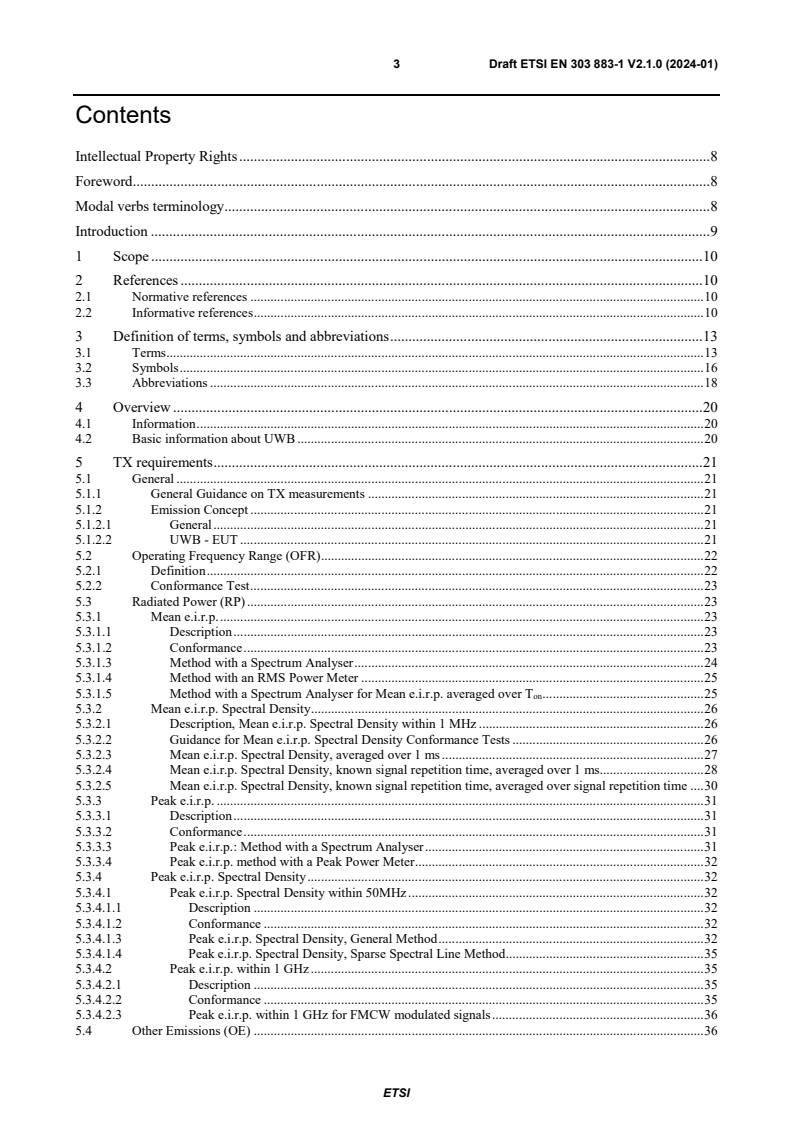
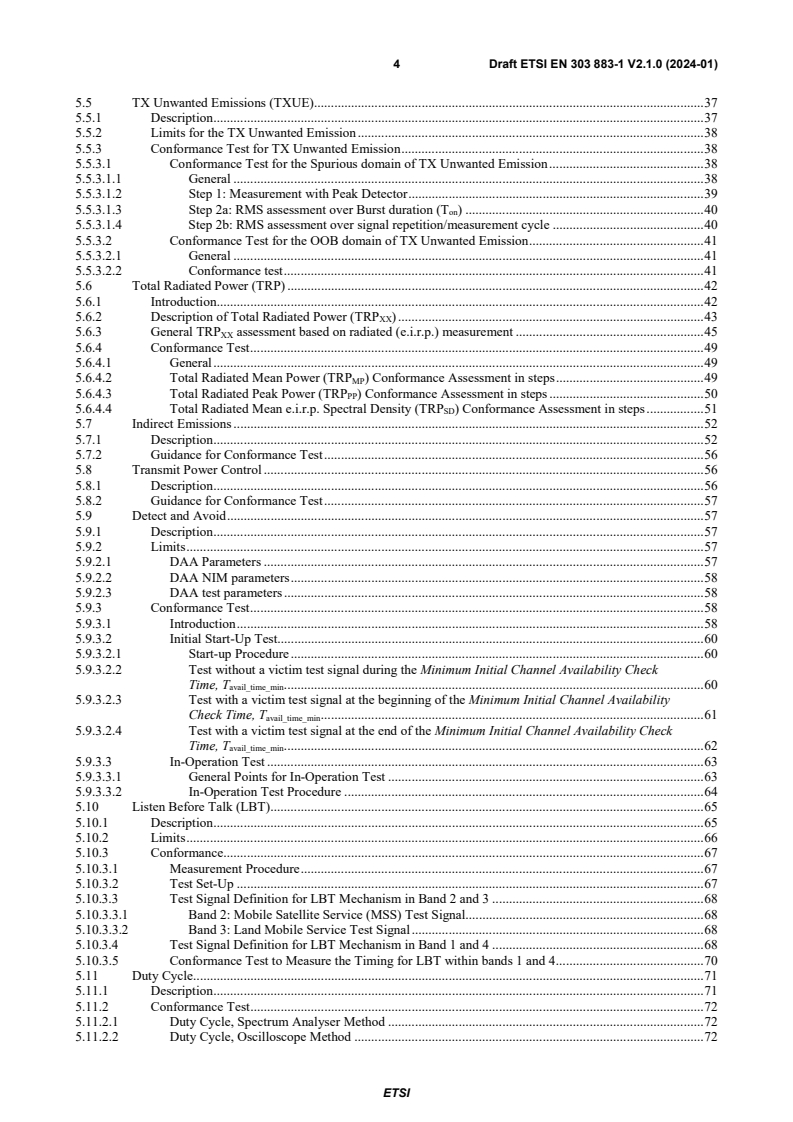
ETSI EN 303 883-1 V2.1.0 (2024-01) - Short Range Devices (SRD) and Ultra Wide Band (UWB); Part 1: Measurement techniques for transmitter requirements
ETSI EN 303 883-1 V2.1.1 (2024-06) - Short Range Devices (SRD) and Ultra Wide Band (UWB); Part 1: Measurement techniques for transmitter requirements
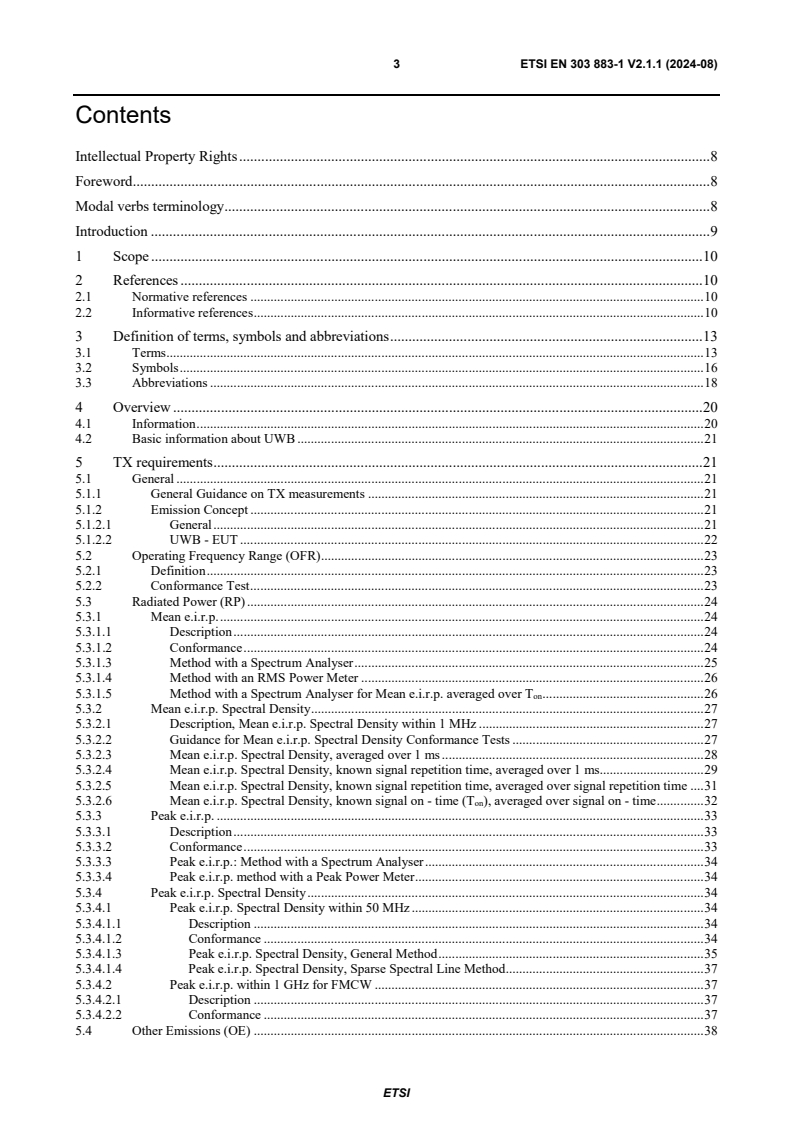
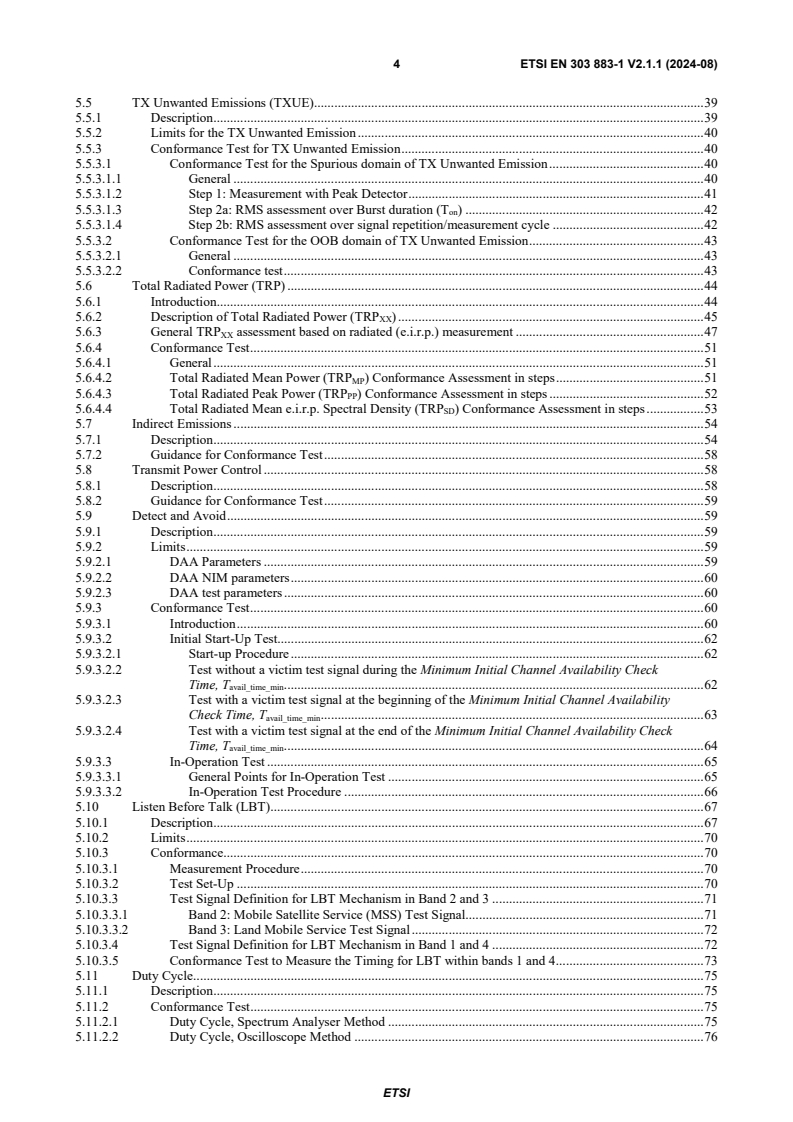
ETSI EN 303 883-1 V2.1.1 (2024-08) - Short Range Devices (SRD) and Ultra Wide Band (UWB); Part 1: Measurement techniques for transmitter requirements

Overview
SIST EN 303 883-1 V2.1.1:2024 is a Slovenian standard, identical to ETSI EN 303 883-1 V2.1.1, focused on Short Range Devices (SRD) and Ultra Wide Band (UWB) technologies. It provides a comprehensive overview of measurement techniques and test procedures for transmitter requirements, ensuring that SRD and UWB devices conform to regulatory transmission limits. This standard serves as a key reference for manufacturers, testing laboratories, and regulatory bodies involved in radio frequency equipment compliance, specifically addressing transmitter measurement methods for signal formats like UWB.
Key Topics
SIST EN 303 883-1 V2.1.1:2024 covers a broad spectrum of technical topics vital for conformance assessment:
- General transmitter requirements for SRD and UWB devices, including emission concepts and basic UWB information.
- Operating Frequency Range (OFR): Methods for defining and testing device frequency ranges.
- Power Measurements:
- Radiated Power (RP): Techniques for measuring mean and peak e.i.r.p., both in continuous and pulsed signals.
- Spectral Density Measurement: Procedures for mean and peak e.i.r.p. within specified bandwidths.
- Total Radiated Power (TRP): Steps for evaluating TRP, covering mean and peak levels.
- Unwanted Emissions: Guidance on identifying, measuring, and limiting spurious and out-of-band transmitter emissions.
- Conformance Tests: Clear step-by-step testing protocols for each parameter, including practical set-ups like anechoic chambers, open-area test sites, and recommendations for measurement equipment.
- Modulation and Duty Cycle: Assessment methods using spectrum analysers and oscilloscopes, including special attention to FMCW, pulsed, and stepped-frequency systems.
- Antenna Assessment: Procedures to determine antenna patterns and gains for both external and integrated antennas.
Applications
The standard has broad practical value for stakeholders in the wireless communications sector, particularly in:
- Product Development: Guiding engineers in developing SRD and UWB transmitters that meet the latest regulatory requirements.
- Conformity Testing: Enabling laboratories to accurately carry out transmitter compliance measurements before devices enter European or Slovenian markets.
- Regulatory Compliance: Assisting manufacturers and importers in demonstrating adherence to legal limits for emissions, thus ensuring market access and minimizing interference risks.
- Quality Assurance: Supporting integrators and OEMs in verifying transmitter performance, reducing post-market failures and returns.
- Research & Innovation: Providing technical foundation for academic and industrial research into next-generation SRD and UWB systems.
Related Standards
For a comprehensive approach to SRD and UWB transmitter compliance, consider these related standards:
- ETSI EN 303 883-1: The parent European standard on which SIST EN 303 883-1 V2.1.1 is based.
- ETSI EN 300 220 series: Relevant to SRD operating in designated frequency bands.
- EN 301 489 series: Electromagnetic compatibility standards for radio equipment.
- ETSI EN 302 065: Covers UWB communication devices, further complementing transmitter testing.
- CE marking directives: Such as the Radio Equipment Directive (RED), which outlines regulatory requirements for placing radio equipment on the EU market.
SIST EN 303 883-1 V2.1.1:2024 is essential for staying up-to-date on transmitter measurement standards for SRD and UWB devices, supporting compliance, interoperability, and innovation in wireless technology design and deployment.
Buy Documents
ETSI EN 303 883-1 V2.1.0 (2024-01) - Short Range Devices (SRD) and Ultra Wide Band (UWB); Part 1: Measurement techniques for transmitter requirements
ETSI EN 303 883-1 V2.1.1 (2024-06) - Short Range Devices (SRD) and Ultra Wide Band (UWB); Part 1: Measurement techniques for transmitter requirements
ETSI EN 303 883-1 V2.1.1 (2024-08) - Short Range Devices (SRD) and Ultra Wide Band (UWB); Part 1: Measurement techniques for transmitter requirements
Get Certified
Connect with accredited certification bodies for this standard

ANCE
Mexican certification and testing association.

Intertek Slovenia
Intertek testing, inspection, and certification services in Slovenia.

LNE (Laboratoire National de Métrologie et d'Essais)
French national laboratory for metrology and testing.
Sponsored listings
Frequently Asked Questions
SIST EN 303 883-1 V2.1.1:2024 is a standard published by the Slovenian Institute for Standardization (SIST). Its full title is "Short Range Devices (SRD) and Ultra Wide Band (UWB) - Part 1: Measurement techniques for transmitter requirements". This standard covers: The present document summarizes the available information of possible measurement techniques and procedures for the conformance measurement of various signal formats (e.g. Ultra Wide Band (UWB)) in order to comply with the given transmission limits given in the current regulation.
The present document summarizes the available information of possible measurement techniques and procedures for the conformance measurement of various signal formats (e.g. Ultra Wide Band (UWB)) in order to comply with the given transmission limits given in the current regulation.
SIST EN 303 883-1 V2.1.1:2024 is classified under the following ICS (International Classification for Standards) categories: 33.060.20 - Receiving and transmitting equipment. The ICS classification helps identify the subject area and facilitates finding related standards.
SIST EN 303 883-1 V2.1.1:2024 is available in PDF format for immediate download after purchase. The document can be added to your cart and obtained through the secure checkout process. Digital delivery ensures instant access to the complete standard document.
Standards Content (Sample)
Draft ETSI EN 303 883-1 V2.1.0 (2024-01)
EUROPEAN STANDARD
Short Range Devices (SRD)
and Ultra Wide Band (UWB);
Part 1: Measurement techniques
for transmitter requirements
2 Draft ETSI EN 303 883-1 V2.1.0 (2024-01)
Reference
REN/ERM-TGUWB-618
Keywords
SRD, testing, UWB
ETSI
650 Route des Lucioles
F-06921 Sophia Antipolis Cedex - FRANCE
Tel.: +33 4 92 94 42 00 Fax: +33 4 93 65 47 16
Siret N° 348 623 562 00017 - APE 7112B
Association à but non lucratif enregistrée à la
Sous-Préfecture de Grasse (06) N° w061004871
Important notice
The present document can be downloaded from:
https://www.etsi.org/standards-search
The present document may be made available in electronic versions and/or in print. The content of any electronic and/or
print versions of the present document shall not be modified without the prior written authorization of ETSI. In case of any
existing or perceived difference in contents between such versions and/or in print, the prevailing version of an ETSI
deliverable is the one made publicly available in PDF format at www.etsi.org/deliver.
Users of the present document should be aware that the document may be subject to revision or change of status.
Information on the current status of this and other ETSI documents is available at
https://portal.etsi.org/TB/ETSIDeliverableStatus.aspx
If you find errors in the present document, please send your comment to one of the following services:
https://portal.etsi.org/People/CommiteeSupportStaff.aspx
If you find a security vulnerability in the present document, please report it through our
Coordinated Vulnerability Disclosure Program:
https://www.etsi.org/standards/coordinated-vulnerability-disclosure
Notice of disclaimer & limitation of liability
The information provided in the present deliverable is directed solely to professionals who have the appropriate degree of
experience to understand and interpret its content in accordance with generally accepted engineering or
other professional standard and applicable regulations.
No recommendation as to products and services or vendors is made or should be implied.
In no event shall ETSI be held liable for loss of profits or any other incidental or consequential damages.
Any software contained in this deliverable is provided "AS IS" with no warranties, express or implied, including but not
limited to, the warranties of merchantability, fitness for a particular purpose and non-infringement of intellectual property
rights and ETSI shall not be held liable in any event for any damages whatsoever (including, without limitation, damages
for loss of profits, business interruption, loss of information, or any other pecuniary loss) arising out of or related to the use
of or inability to use the software.
Copyright Notification
No part may be reproduced or utilized in any form or by any means, electronic or mechanical, including photocopying and
microfilm except as authorized by written permission of ETSI.
The content of the PDF version shall not be modified without the written authorization of ETSI.
The copyright and the foregoing restriction extend to reproduction in all media.
© ETSI 2024.
All rights reserved.
ETSI
3 Draft ETSI EN 303 883-1 V2.1.0 (2024-01)
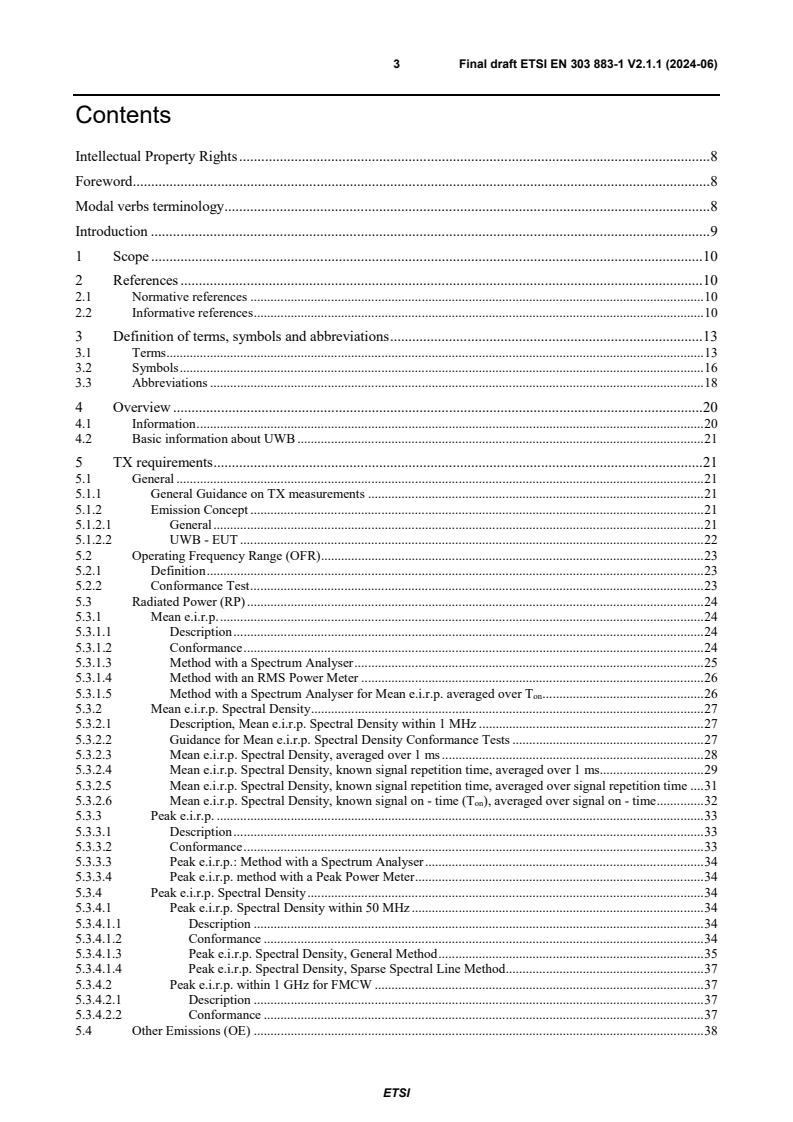
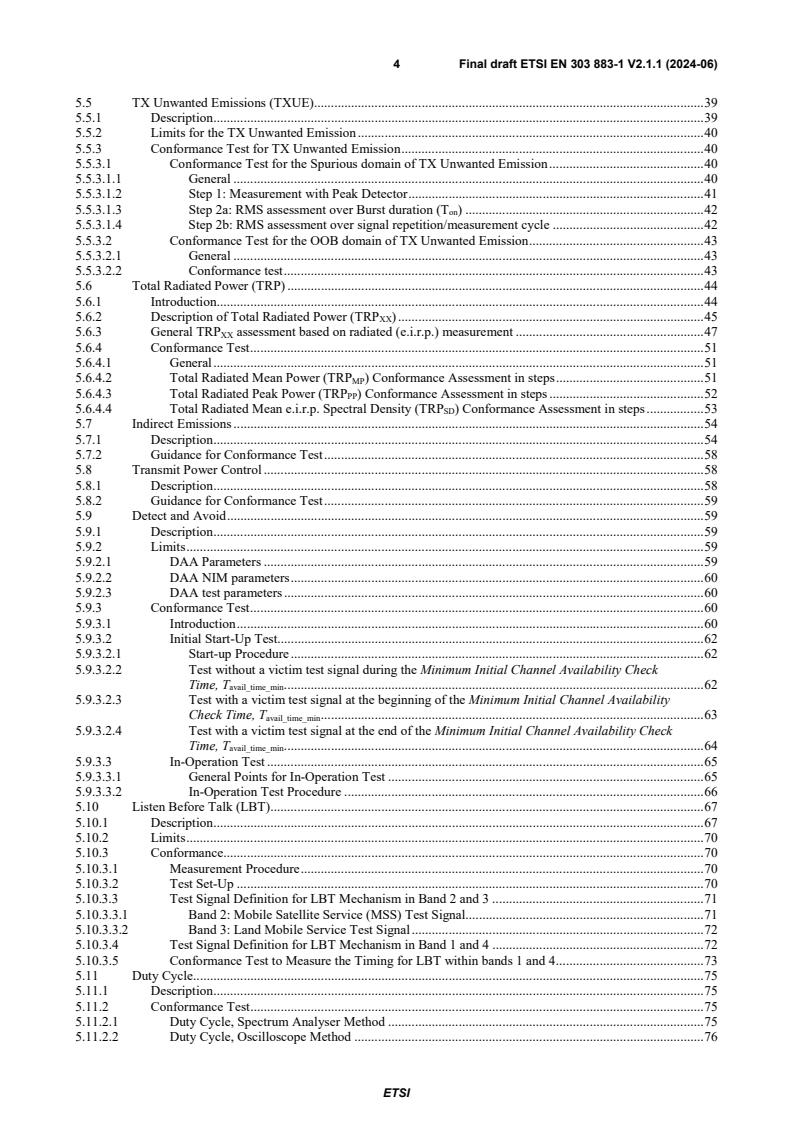
Contents
Intellectual Property Rights . 8
Foreword . 8
Modal verbs terminology . 8
Introduction . 9
1 Scope . 10
2 References . 10
2.1 Normative references . 10
2.2 Informative references . 10
3 Definition of terms, symbols and abbreviations . 13
3.1 Terms . 13
3.2 Symbols . 16
3.3 Abbreviations . 18
4 Overview . 20
4.1 Information . 20
4.2 Basic information about UWB . 20
5 TX requirements . 21
5.1 General . 21
5.1.1 General Guidance on TX measurements . 21
5.1.2 Emission Concept . 21
5.1.2.1 General . 21
5.1.2.2 UWB - EUT . 21
5.2 Operating Frequency Range (OFR) . 22
5.2.1 Definition . 22
5.2.2 Conformance Test . 23
5.3 Radiated Power (RP) . 23
5.3.1 Mean e.i.r.p. . 23
5.3.1.1 Description . 23
5.3.1.2 Conformance . 23
5.3.1.3 Method with a Spectrum Analyser . 24
5.3.1.4 Method with an RMS Power Meter . 25
5.3.1.5 Method with a Spectrum Analyser for Mean e.i.r.p. averaged over T . 25
on
5.3.2 Mean e.i.r.p. Spectral Density . 26
5.3.2.1 Description, Mean e.i.r.p. Spectral Density within 1 MHz . 26
5.3.2.2 Guidance for Mean e.i.r.p. Spectral Density Conformance Tests . 26
5.3.2.3 Mean e.i.r.p. Spectral Density, averaged over 1 ms . 27
5.3.2.4 Mean e.i.r.p. Spectral Density, known signal repetition time, averaged over 1 ms . 28
5.3.2.5 Mean e.i.r.p. Spectral Density, known signal repetition time, averaged over signal repetition time . 30
5.3.3 Peak e.i.r.p. . 31
5.3.3.1 Description . 31
5.3.3.2 Conformance . 31
5.3.3.3 Peak e.i.r.p.: Method with a Spectrum Analyser . 31
5.3.3.4 Peak e.i.r.p. method with a Peak Power Meter . 32
5.3.4 Peak e.i.r.p. Spectral Density . 32
5.3.4.1 Peak e.i.r.p. Spectral Density within 50MHz . 32
5.3.4.1.1 Description . 32
5.3.4.1.2 Conformance . 32
5.3.4.1.3 Peak e.i.r.p. Spectral Density, General Method . 32
5.3.4.1.4 Peak e.i.r.p. Spectral Density, Sparse Spectral Line Method. 35
5.3.4.2 Peak e.i.r.p. within 1 GHz . 35
5.3.4.2.1 Description . 35
5.3.4.2.2 Conformance . 35
5.3.4.2.3 Peak e.i.r.p. within 1 GHz for FMCW modulated signals . 36
5.4 Other Emissions (OE) . 36
ETSI
4 Draft ETSI EN 303 883-1 V2.1.0 (2024-01)
5.5 TX Unwanted Emissions (TXUE) . 37
5.5.1 Description . 37
5.5.2 Limits for the TX Unwanted Emission . 38
5.5.3 Conformance Test for TX Unwanted Emission . 38
5.5.3.1 Conformance Test for the Spurious domain of TX Unwanted Emission . 38
5.5.3.1.1 General . 38
5.5.3.1.2 Step 1: Measurement with Peak Detector . 39
5.5.3.1.3 Step 2a: RMS assessment over Burst duration (T ) . 40
on
5.5.3.1.4 Step 2b: RMS assessment over signal repetition/measurement cycle . 40
5.5.3.2 Conformance Test for the OOB domain of TX Unwanted Emission . 41
5.5.3.2.1 General . 41
5.5.3.2.2 Conformance test . 41
5.6 Total Radiated Power (TRP) . 42
5.6.1 Introduction. 42
5.6.2 Description of Total Radiated Power (TRP ) . 43
XX
5.6.3 General TRP assessment based on radiated (e.i.r.p.) measurement . 45
XX
5.6.4 Conformance Test . 49
5.6.4.1 General . 49
5.6.4.2 Total Radiated Mean Power (TRP ) Conformance Assessment in steps . 49
MP
5.6.4.3 Total Radiated Peak Power (TRP ) Conformance Assessment in steps . 50
PP
5.6.4.4 Total Radiated Mean e.i.r.p. Spectral Density (TRP ) Conformance Assessment in steps . 51
SD
5.7 Indirect Emissions . 52
5.7.1 Description . 52
5.7.2 Guidance for Conformance Test . 56
5.8 Transmit Power Control . 56
5.8.1 Description . 56
5.8.2 Guidance for Conformance Test . 57
5.9 Detect and Avoid . 57
5.9.1 Description . 57
5.9.2 Limits . 57
5.9.2.1 DAA Parameters . 57
5.9.2.2 DAA NIM parameters . 58
5.9.2.3 DAA test parameters . 58
5.9.3 Conformance Test . 58
5.9.3.1 Introduction . 58
5.9.3.2 Initial Start-Up Test. 60
5.9.3.2.1 Start-up Procedure . 60
5.9.3.2.2 Test without a victim test signal during the Minimum Initial Channel Availability Check
............................................................................................................................. 60
Time, Tavail_time_min
5.9.3.2.3 Test with a victim test signal at the beginning of the Minimum Initial Channel Availability
Check Time, T . 61
avail_time_min
5.9.3.2.4 Test with a victim test signal at the end of the Minimum Initial Channel Availability Check
Time, T . 62
avail_time_min
5.9.3.3 In-Operation Test . 63
5.9.3.3.1 General Points for In-Operation Test . 63
5.9.3.3.2 In-Operation Test Procedure . 64
5.10 Listen Before Talk (LBT) . 65
5.10.1 Description . 65
5.10.2 Limits . 66
5.10.3 Conformance. 67
5.10.3.1 Measurement Procedure . 67
5.10.3.2 Test Set-Up . 67
5.10.3.3 Test Signal Definition for LBT Mechanism in Band 2 and 3 . 68
5.10.3.3.1 Band 2: Mobile Satellite Service (MSS) Test Signal. 68
5.10.3.3.2 Band 3: Land Mobile Service Test Signal . 68
5.10.3.4 Test Signal Definition for LBT Mechanism in Band 1 and 4 . 68
5.10.3.5 Conformance Test to Measure the Timing for LBT within bands 1 and 4 . 70
5.11 Duty Cycle. 71
5.11.1 Description . 71
5.11.2 Conformance Test . 72
5.11.2.1 Duty Cycle, Spectrum Analyser Method . 72
5.11.2.2 Duty Cycle, Oscilloscope Method . 72
ETSI
5 Draft ETSI EN 303 883-1 V2.1.0 (2024-01)
5.11.2.3 Duty Cycle Measurement procedures for FMCW, stepped-frequency and Pulsed Systems . 74
5.11.2.3.1 General . 74
5.11.2.3.2 Method 1: Diode Power Detector . 74
5.11.2.3.3 Method 2: Spectrum Analyser . 75
5.11.2.3.4 Method 3: Synchronized Spectrum Analysers. 76
5.11.2.4 Duty Cycle Measurement Procedures within a frequency band for FMCW and stepped-frequency
systems . 77
5.11.2.4.1 General . 77
5.11.2.4.2 Synchronized Spectrum Analysers . 78
5.12 Antenna pattern/Antenna gain . 80
5.12.1 Description . 80
5.12.2 Conformance tests for external antennas . 81
5.12.2.1 General . 81
5.12.2.2 Determination against a known reference antenna . 82
5.12.2.2.1 General . 82
5.12.2.2.2 Measuring distance . 82
5.12.2.2.3 Measurement equipment requirements . 82
5.12.2.2.4 Test procedure . 83
5.12.2.3 Test based on a radiated measurement . 84
5.12.2.3.1 General . 84
5.12.2.3.2 Measuring distance . 84
5.12.2.3.3 Measurement equipment requirements . 84
5.12.2.3.4 Test procedure . 85
5.12.3 Conformance tests for integral antennas . 86
5.12.4 Guidance to assess emissions levels above regulated elevations . 86
Annex A (normative): General Considerations and test conditions . 89
A.1 Overview . 89
A.2 Product Information . 89
A.3 Guidance on EUT Modulation for Testing . 90
A.4 Requirements in Case of EUT with Scanning Antennas . 90
A.4.1 Classification . 90
A.4.2 Measurement of Fixed Beam EUT . 90
A.4.3 Measurement of Constant Pattern EUT . 90
A.4.4 Measurement of Variable Pattern EUT . 91
A.5 Test Conditions, Power Supply and Ambient Temperatures . 91
A.5.1 General . 91
A.5.2 Power Sources . 91
A.5.2.1 Power Sources for Stand-Alone Equipment . 91
A.5.2.2 Power sources for plug-in radio devices . 91
A.5.3 Normal and Extreme Test Conditions . 91
A.5.4 Test set-ups under environmental profile . 91
A.5.5 Assessment procedures over environmental profile . 91
A.6 Choice of Equipment for Test Suites . 92
A.6.1 Choice of Model . 92
A.6.2 Presentation . 92
A.7 Testing of Host Connected Equipment and Plug-In Radio Devices . 92
A.7.1 General . 92
A.7.2 The Use of a Host or Test Fixture for Testing Plug-In Radio Devices . 92
A.8 Interpretation of the measurement results . 93
A.8.1 General points on interpretation of the measurement results . 93
A.8.2 Measurement uncertainty is equal to or less than maximum acceptable uncertainty . 93
A.8.3 Measurement uncertainty is greater than maximum acceptable uncertainty . 94
Annex B (normative): Test setups . 95
B.1 Introduction . 95
ETSI
6 Draft ETSI EN 303 883-1 V2.1.0 (2024-01)
B.2 Radiated measurements . 95
B.2.1 General . 95
B.2.2 Test Sites and General Arrangements for Measurements Involving the Use of Radiated Fields . 96
B.2.2.1 General . 96
B.2.2.2 Anechoic Chamber . 96
B.2.2.3 Anechoic Chamber with a Conductive Ground Plane . 97
B.2.2.4 Open Area Test Site (OATS) . 98
B.2.2.5 Measurement Antenna . 99
B.2.2.6 Substitution Antenna. 99
B.2.2.7 Measuring Antenna . 100
B.2.2.8 Minimum Requirements for Test Sites for Measurements above 18 GHz . 100
B.2.3 Guidance on the Use of a Radiation Test Site . 101
B.2.3.1 General on Guidance on the Use of a Radiation Test Site . 101
B.2.3.2 Verification of the Test Site . 101
B.2.3.3 Preparation of the EUT . 101
B.2.3.4 Power Supplies to the EUT . 102
B.2.3.5 Range Length . 102
B.2.3.5.1 General . 102
B.2.3.5.2 Practical Test Distances for Accurate Measurements . 102
B.2.3.6 Site Preparation . 103
B.2.4 Coupling of Signals . 103
B.2.4.1 General . 103
B.2.4.2 Data Signals . 104
B.2.5 Standard Radiated Test Methods . 104
B.2.5.0 Initial Measurement Steps . 104
B.2.5.1 General Information on Test Methods . 104
B.2.5.2 Calibrated Setup . 104
B.2.5.3 Substitution Method . 105
B.2.6 Standard calibration method . 105
B.3 Conducted Measurements . 107
B.3.1 General . 107
B.3.2 Conducted measurement via cable connection . 108
B.3.3 Conducted measurement via waveguide connection . 109
B.3.4 Determination of a radiated power e.i.r.p. based on a conducted measurement . 110
B.4 Detailed Information to Standard Test Methods . 111
B.4.1 Spherical Scan with Automatic Measurement Antenna Placement . 111
B.4.1.1 General . 111
B.4.1.2 Calibrated Setup . 115
B.4.1.3 Substitution Method . 116
B.4.1.4 Spherical Scan with Rotating EUT . 116
B.4.1.4.1 General . 116
B.4.1.4.2 Calibrated Setup . 120
B.4.1.4.3 Substitution Method . 120
B.4.1.5 Spherical Scan Other Methods. 121
Annex C (normative): Signal Timing parameters . 122
C.1 Descriptions . 122
C.2 Signal Types . 122
C.2.1 Pulsed signals . 122
C.2.1.1 General . 122
C.2.1.2 Consideration for pulsed based signals if T > T . 123
dis PRT
C.2.1.3 Consideration for pulsed based signals if T < T . 123
dis PRT
C.2.2 FMCW signals . 124
C.2.2.1 General . 124
C.2.2.2 Single FMCW sweep within signal repetition time . 124
C.2.2.3 Multiple FMCW sweeps within T and T > t . 126
rep dis sweep;off
C.2.2.4 Multiple FMCW sweeps within T and T < t . 127
rep dis sweep;off
Annex D (normative): All Emission Measurement . 131
ETSI
7 Draft ETSI EN 303 883-1 V2.1.0 (2024-01)
D.1 General . 131
D.2 First step . 131
D.3 Second step . 133
Annex E (normative): Guidance for a pre-scan of EUT operating frequency range(s) . 134
Annex F (informative): Measurement of peak e.i.r.p. and mean (average) e.i.r.p. of constant
duty cycle wideband pulsed signals . 135
F.1 General . 135
F.2 Exemplary measurement of pulse signals . 135
F.3 Mean e.i.r.p. measurements . 136
F.3.1 General . 136
F.3.2 Method I: Zero span mode . 136
F.3.3 Method II: Channel power measurement . 137
F.3.4 Method III: Average power meters . 138
F.4 Peak e.i.r.p. measurements . 138
F.4.1 General . 138
F.4.2 Method I: Zero span mode - direct measurement . 138
F.4.3 Method II: Peak e.i.r.p. calculation . 139
F.5 Max and mean PSD . 140
Annex G (normative): TX Unwanted Emissions (TXUE) for EUT under ECC/DEC(22)03 . 142
Annex H (informative): Parameter and Specification in related Standards . 146
Annex I (informative): Change History . 150
History . 151
ETSI
8 Draft ETSI EN 303 883-1 V2.1.0 (2024-01)
Intellectual Property Rights
Essential patents
IPRs essential or potentially essential to normative deliverables may have been declared to ETSI. The declarations
pertaining to these essential IPRs, if any, are publicly available for ETSI members and non-members, and can be
found in ETSI SR 000 314: "Intellectual Property Rights (IPRs); Essential, or potentially Essential, IPRs notified to
ETSI in respect of ETSI standards", which is available from the ETSI Secretariat. Latest updates are available on the
ETSI Web server (https://ipr.etsi.org/).
Pursuant to the ETSI Directives including the ETSI IPR Policy, no investigation regarding the essentiality of IPRs,
including IPR searches, has been carried out by ETSI. No guarantee can be given as to the existence of other IPRs not
referenced in ETSI SR 000 314 (or the updates on the ETSI Web server) which are, or may be, or may become,
essential to the present document.
Trademarks
The present document may include trademarks and/or tradenames which are asserted and/or registered by their owners.
ETSI claims no ownership of these except for any which are indicated as being the property of ETSI, and conveys no
right to use or reproduce any trademark and/or tradename. Mention of those trademarks in the present document does
not constitute an endorsement by ETSI of products, services or organizations associated with those trademarks.
DECT™, PLUGTESTS™, UMTS™ and the ETSI logo are trademarks of ETSI registered for the benefit of its
Members. 3GPP™ and LTE™ are trademarks of ETSI registered for the benefit of its Members and of the 3GPP
Organizational Partners. oneM2M™ logo is a trademark of ETSI registered for the benefit of its Members and of the ®
oneM2M Partners. GSM and the GSM logo are trademarks registered and owned by the GSM Association.
Foreword
This draft European Standard (EN) has been produced by ETSI Technical Committee Electromagnetic compatibility
and Radio spectrum Matters (ERM), and is now submitted for the combined Public Enquiry and Vote phase of the ETSI
EN Approval Procedure.
The present document is part 1 of a multi-part deliverable covering Short Range Devices (SRD) and Ultra Wide Band
(UWB), as identified below:
Part 1: "Measurement techniques for transmitter requirements";
Part 2: "Measurement techniques for receiver requirements".
Proposed national transposition dates
Date of latest announcement of this EN (doa): 3 months after ETSI publication
Date of latest publication of new National Standard
or endorsement of this EN (dop/e): 6 months after doa
Date of withdrawal of any conflicting National Standard (dow): 6 months after doa
Modal verbs terminology
In the present document "shall", "shall not", "should", "should not", "may", "need not", "will", "will not", "can" and
"cannot" are to be interpreted as described in clause 3.2 of the ETSI Drafting Rules (Verbal forms for the expression of
provisions).
"must" and "must not" are NOT allowed in ETSI deliverables except when used in direct citation.
ETSI
9 Draft ETSI EN 303 883-1 V2.1.0 (2024-01)
Introduction
Ultra Wide Band (
...
Final draft ETSI EN 303 883-1 V2.1.1 (2024-06)
EUROPEAN STANDARD
Short Range Devices (SRD) and
Ultra Wide Band (UWB);
Part 1: Measurement techniques
for transmitter requirements
2 Final draft ETSI EN 303 883-1 V2.1.1 (2024-06)
Reference
REN/ERM-TGUWB-618
Keywords
SRD, testing, UWB
ETSI
650 Route des Lucioles
F-06921 Sophia Antipolis Cedex - FRANCE
Tel.: +33 4 92 94 42 00 Fax: +33 4 93 65 47 16
Siret N° 348 623 562 00017 - APE 7112B
Association à but non lucratif enregistrée à la
Sous-Préfecture de Grasse (06) N° w061004871
Important notice
The present document can be downloaded from:
https://www.etsi.org/standards-search
The present document may be made available in electronic versions and/or in print. The content of any electronic and/or
print versions of the present document shall not be modified without the prior written authorization of ETSI. In case of any
existing or perceived difference in contents between such versions and/or in print, the prevailing version of an ETSI
deliverable is the one made publicly available in PDF format at www.etsi.org/deliver.
Users of the present document should be aware that the document may be subject to revision or change of status.
Information on the current status of this and other ETSI documents is available at
https://portal.etsi.org/TB/ETSIDeliverableStatus.aspx
If you find errors in the present document, please send your comment to one of the following services:
https://portal.etsi.org/People/CommiteeSupportStaff.aspx
If you find a security vulnerability in the present document, please report it through our
Coordinated Vulnerability Disclosure Program:
https://www.etsi.org/standards/coordinated-vulnerability-disclosure
Notice of disclaimer & limitation of liability
The information provided in the present deliverable is directed solely to professionals who have the appropriate degree of
experience to understand and interpret its content in accordance with generally accepted engineering or
other professional standard and applicable regulations.
No recommendation as to products and services or vendors is made or should be implied.
In no event shall ETSI be held liable for loss of profits or any other incidental or consequential damages.
Any software contained in this deliverable is provided "AS IS" with no warranties, express or implied, including but not
limited to, the warranties of merchantability, fitness for a particular purpose and non-infringement of intellectual property
rights and ETSI shall not be held liable in any event for any damages whatsoever (including, without limitation, damages
for loss of profits, business interruption, loss of information, or any other pecuniary loss) arising out of or related to the use
of or inability to use the software.
Copyright Notification
No part may be reproduced or utilized in any form or by any means, electronic or mechanical, including photocopying and
microfilm except as authorized by written permission of ETSI.
The content of the PDF version shall not be modified without the written authorization of ETSI.
The copyright and the foregoing restriction extend to reproduction in all media.
© ETSI 2024.
All rights reserved.
ETSI
3 Final draft ETSI EN 303 883-1 V2.1.1 (2024-06)
Contents
Intellectual Property Rights . 8
Foreword . 8
Modal verbs terminology . 8
Introduction . 9
1 Scope . 10
2 References . 10
2.1 Normative references . 10
2.2 Informative references . 10
3 Definition of terms, symbols and abbreviations . 13
3.1 Terms . 13
3.2 Symbols . 16
3.3 Abbreviations . 18
4 Overview . 20
4.1 Information . 20
4.2 Basic information about UWB . 21
5 TX requirements . 21
5.1 General . 21
5.1.1 General Guidance on TX measurements . 21
5.1.2 Emission Concept . 21
5.1.2.1 General . 21
5.1.2.2 UWB - EUT . 22
5.2 Operating Frequency Range (OFR) . 23
5.2.1 Definition . 23
5.2.2 Conformance Test . 23
5.3 Radiated Power (RP) . 24
5.3.1 Mean e.i.r.p. . 24
5.3.1.1 Description . 24
5.3.1.2 Conformance . 24
5.3.1.3 Method with a Spectrum Analyser . 25
5.3.1.4 Method with an RMS Power Meter . 26
5.3.1.5 Method with a Spectrum Analyser for Mean e.i.r.p. averaged over T . 26
on
5.3.2 Mean e.i.r.p. Spectral Density . 27
5.3.2.1 Description, Mean e.i.r.p. Spectral Density within 1 MHz . 27
5.3.2.2 Guidance for Mean e.i.r.p. Spectral Density Conformance Tests . 27
5.3.2.3 Mean e.i.r.p. Spectral Density, averaged over 1 ms . 28
5.3.2.4 Mean e.i.r.p. Spectral Density, known signal repetition time, averaged over 1 ms . 29
5.3.2.5 Mean e.i.r.p. Spectral Density, known signal repetition time, averaged over signal repetition time . 31
5.3.2.6 Mean e.i.r.p. Spectral Density, known signal on - time (T ), averaged over signal on - time . 32
on
5.3.3 Peak e.i.r.p. . 33
5.3.3.1 Description . 33
5.3.3.2 Conformance . 33
5.3.3.3 Peak e.i.r.p.: Method with a Spectrum Analyser . 34
5.3.3.4 Peak e.i.r.p. method with a Peak Power Meter . 34
5.3.4 Peak e.i.r.p. Spectral Density . 34
5.3.4.1 Peak e.i.r.p. Spectral Density within 50 MHz . 34
5.3.4.1.1 Description . 34
5.3.4.1.2 Conformance . 34
5.3.4.1.3 Peak e.i.r.p. Spectral Density, General Method . 35
5.3.4.1.4 Peak e.i.r.p. Spectral Density, Sparse Spectral Line Method. 37
5.3.4.2 Peak e.i.r.p. within 1 GHz for FMCW . 37
5.3.4.2.1 Description . 37
5.3.4.2.2 Conformance . 37
5.4 Other Emissions (OE) . 38
ETSI
4 Final draft ETSI EN 303 883-1 V2.1.1 (2024-06)
5.5 TX Unwanted Emissions (TXUE) . 39
5.5.1 Description . 39
5.5.2 Limits for the TX Unwanted Emission . 40
5.5.3 Conformance Test for TX Unwanted Emission . 40
5.5.3.1 Conformance Test for the Spurious domain of TX Unwanted Emission . 40
5.5.3.1.1 General . 40
5.5.3.1.2 Step 1: Measurement with Peak Detector . 41
5.5.3.1.3 Step 2a: RMS assessment over Burst duration (T ) . 42
on
5.5.3.1.4 Step 2b: RMS assessment over signal repetition/measurement cycle . 42
5.5.3.2 Conformance Test for the OOB domain of TX Unwanted Emission . 43
5.5.3.2.1 General . 43
5.5.3.2.2 Conformance test . 43
5.6 Total Radiated Power (TRP) . 44
5.6.1 Introduction. 44
5.6.2 Description of Total Radiated Power (TRP ) . 45
XX
5.6.3 General TRP assessment based on radiated (e.i.r.p.) measurement . 47
XX
5.6.4 Conformance Test . 51
5.6.4.1 General . 51
5.6.4.2 Total Radiated Mean Power (TRP ) Conformance Assessment in steps . 51
MP
5.6.4.3 Total Radiated Peak Power (TRP ) Conformance Assessment in steps . 52
PP
5.6.4.4 Total Radiated Mean e.i.r.p. Spectral Density (TRP ) Conformance Assessment in steps . 53
SD
5.7 Indirect Emissions . 54
5.7.1 Description . 54
5.7.2 Guidance for Conformance Test . 58
5.8 Transmit Power Control . 58
5.8.1 Description . 58
5.8.2 Guidance for Conformance Test . 59
5.9 Detect and Avoid . 59
5.9.1 Description . 59
5.9.2 Limits . 59
5.9.2.1 DAA Parameters . 59
5.9.2.2 DAA NIM parameters . 60
5.9.2.3 DAA test parameters . 60
5.9.3 Conformance Test . 60
5.9.3.1 Introduction . 60
5.9.3.2 Initial Start-Up Test. 62
5.9.3.2.1 Start-up Procedure . 62
5.9.3.2.2 Test without a victim test signal during the Minimum Initial Channel Availability Check
............................................................................................................................. 62
Time, Tavail_time_min
5.9.3.2.3 Test with a victim test signal at the beginning of the Minimum Initial Channel Availability
Check Time, T . 63
avail_time_min
5.9.3.2.4 Test with a victim test signal at the end of the Minimum Initial Channel Availability Check
Time, T . 64
avail_time_min
5.9.3.3 In-Operation Test . 65
5.9.3.3.1 General Points for In-Operation Test . 65
5.9.3.3.2 In-Operation Test Procedure . 66
5.10 Listen Before Talk (LBT) . 67
5.10.1 Description . 67
5.10.2 Limits . 70
5.10.3 Conformance. 70
5.10.3.1 Measurement Procedure . 70
5.10.3.2 Test Set-Up . 70
5.10.3.3 Test Signal Definition for LBT Mechanism in Band 2 and 3 . 71
5.10.3.3.1 Band 2: Mobile Satellite Service (MSS) Test Signal. 71
5.10.3.3.2 Band 3: Land Mobile Service Test Signal . 72
5.10.3.4 Test Signal Definition for LBT Mechanism in Band 1 and 4 . 72
5.10.3.5 Conformance Test to Measure the Timing for LBT within bands 1 and 4 . 73
5.11 Duty Cycle. 75
5.11.1 Description . 75
5.11.2 Conformance Test . 75
5.11.2.1 Duty Cycle, Spectrum Analyser Method . 75
5.11.2.2 Duty Cycle, Oscilloscope Method . 76
ETSI
5 Final draft ETSI EN 303 883-1 V2.1.1 (2024-06)
5.11.2.3 Duty Cycle Measurement procedures for FMCW, stepped-frequency and Pulsed Systems . 78
5.11.2.3.1 General . 78
5.11.2.3.2 Method 1: Diode Power Detector . 78
5.11.2.3.3 Method 2: Spectrum Analyser . 79
5.11.2.3.4 Method 3: Synchronized Spectrum Analysers. 80
5.11.2.4 Duty Cycle Measurement Procedures within a frequency band for FMCW and stepped-frequency
systems . 82
5.11.2.4.1 General . 82
5.11.2.4.2 Synchronized Spectrum Analysers . 82
5.12 Antenna pattern/Antenna gain . 84
5.12.1 Description . 84
5.12.2 Conformance tests for external antennas . 86
5.12.2.1 General . 86
5.12.2.2 Determination against a known reference antenna . 86
5.12.2.2.1 General . 86
5.12.2.2.2 Measuring distance . 87
5.12.2.2.3 Measurement equipment requirements . 87
5.12.2.2.4 Test procedure . 87
5.12.2.3 Test based on a radiated measurement . 88
5.12.2.3.1 General . 88
5.12.2.3.2 Measuring distance . 89
5.12.2.3.3 Measurement equipment requirements . 89
5.12.2.3.4 Test procedure . 90
5.12.3 Conformance tests for integral antennas . 90
5.12.4 Guidance to assess emissions levels above regulated elevations . 91
Annex A (normative): General Considerations and test conditions . 94
A.1 Overview . 94
A.2 Product Information . 94
A.3 Guidance on EUT Modulation for Testing . 95
A.4 Requirements in Case of EUT with Scanning Antennas . 95
A.4.1 Classification . 95
A.4.2 Measurement of Fixed Beam EUT . 95
A.4.3 Measurement of Constant Pattern EUT . 95
A.4.4 Measurement of Variable Pattern EUT . 96
A.5 Test Conditions, Power Supply and Ambient Temperatures . 96
A.5.1 General . 96
A.5.2 Power Sources . 96
A.5.2.1 Power Sources for Stand-Alone Equipment . 96
A.5.2.2 Power sources for plug-in radio devices . 96
A.5.3 Normal and Extreme Test Conditions . 96
A.5.4 Test set-ups under environmental profile . 96
A.5.5 Assessment procedures over environmental profile . 96
A.6 Choice of Equipment for Test Suites . 97
A.6.1 Choice of Model . 97
A.6.2 Presentation . 97
A.7 Testing of Host Connected Equipment and Plug-In Radio Devices . 97
A.7.1 General . 97
A.7.2 The Use of a Host or Test Fixture for Testing Plug-In Radio Devices . 97
A.8 Interpretation of the measurement results . 98
A.8.1 General points on interpretation of the measurement results . 98
A.8.2 Measurement uncertainty is equal to or less than maximum acceptable uncertainty . 98
A.8.3 Measurement uncertainty is greater than maximum acceptable uncertainty . 99
Annex B (normative): Test setups . 100
B.1 Introduction . 100
ETSI
6 Final draft ETSI EN 303 883-1 V2.1.1 (2024-06)
B.2 Radiated measurements . 100
B.2.1 General . 100
B.2.2 Test Sites and General Arrangements for Measurements Involving the Use of Radiated Fields . 101
B.2.2.1 General . 101
B.2.2.2 Fully Anechoic Room (FAR). 101
B.2.2.3 Semi Anechoic Chamber (SAC) . 102
B.2.2.4 Open Area Test Site (OATS) . 103
B.2.2.5 Measurement Antenna . 104
B.2.2.6 Substitution Antenna. 104
B.2.2.7 Test Antenna . 105
B.2.2.8 Minimum Requirements for Test Sites for Measurements above 18 GHz . 105
B.2.3 Guidance on the Use of a Radiation Test Site . 106
B.2.3.1 General on Guidance on the Use of a Radiation Test Site . 106
B.2.3.2 Verification of the Test Site . 106
B.2.3.3 Preparation of the EUT . 106
B.2.3.4 Power Supplies to the EUT . 107
B.2.3.5 Range Length and measurement distance . 107
B.2.3.5.1 General . 107
B.2.3.5.2 Practical Test Distances for Accurate Measurements . 108
B.2.3.6 Site Preparation . 108
B.2.4 Coupling of Signals . 108
B.2.4.1 General . 108
B.2.4.2 Data Signals . 108
B.2.5 Standard Radiated Test Methods . 109
B.2.5.0 Initial Measurement Steps . 109
B.2.5.1 General Information on Test Methods . 109
B.2.5.2 Pre-substitution / calibrated method . 109
B.2.5.3 Substitution Method . 110
B.2.6 Method for determination of the correction factor . 110
B.3 Conducted Measurements . 112
B.3.1 General . 112
B.3.2 Conducted measurement via cable connection . 112
B.3.3 Conducted measurement via waveguide connection . 113
B.3.4 Determination of a radiated power e.i.r.p. based on a conducted measurement . 114
B.4 Spherical Scan . 115
B.4.1 General . 115
B.4.2 Different measurement systems . 115
B.4.3 Pre-substitution / calibrated method . 123
B.4.4 Substitution Method . 123
Annex C (normative): Signal Timing parameters . 125
C.1 Descriptions . 125
C.2 Signal Types . 125
C.2.1 Pulsed signals . 125
C.2.1.1 General . 125
C.2.1.2 Consideration for pulsed based signals if T > T . 126
dis PRT
C.2.1.3 Consideration for pulsed based signals if T < T . 126
dis PRT
C.2.2 FMCW signals . 127
C.2.2.1 General . 127
C.2.2.2 Single FMCW sweep within signal repetition time . 127
C.2.2.3 Multiple FMCW sweeps within T and T > t . 129
rep dis sweep;off
C.2.2.4 Multiple FMCW sweeps within T and T < t . 130
rep dis sweep;off
Annex D (normative): All Emission Measurement . 134
D.1 General . 134
D.2 First step . 134
D.3 Second step . 136
ETSI
7 Final draft ETSI EN 303 883-1 V2.1.1 (2024-06)
Annex E (normative): Guidance for a pre-scan of EUT operating frequency range(s) . 137
Annex F (informative): Measurement of peak e.i.r.p. and mean (average) e.i.r.p. of constant
duty cycle wideband pulsed signals . 138
F.1 General . 138
F.2 Exemplary measurement of pulse signals . 138
F.3 Mean e.i.r.p. measurements . 139
F.3.1 General . 139
F.3.2 Method I: Zero span mode . 139
F.3.3 Method II: Channel power measurement . 140
F.3.4 Method III: Average power meters . 141
F.4 Peak e.i.r.p. measurements . 141
F.4.1 General . 141
F.4.2 Method I: Zero span mode - direct measurement . 141
F.4.3 Method II: Peak e.i.r.p. calculation . 142
F.5 Max and mean PSD . 143
Annex G (normative): TX Unwanted Emissions (TXUE) for EUT under ECC/DEC/(22)03 . 145
Annex H (informative): Parameter and Specification in related Standards . 149
Annex I (informative): Change history . 152
History . 153
ETSI
8 Final draft ETSI EN 303 883-1 V2.1.1 (2024-06)
Intellectual Property Rights
Essential patents
IPRs essential or potentially essential to normative deliverables may have been declared to ETSI. The declarations
pertaining to these essential IPRs, if any, are publicly available for ETSI members and non-members, and can be
found in ETSI SR 000 314: "Intellectual Property Rights (IPRs); Essential, or potentially Essential, IPRs notified to
ETSI in respect of ETSI standards", which is available from the ETSI Secretariat. Latest updates are available on the
ETSI Web server (https://ipr.etsi.org/).
Pursuant to the ETSI Directives including the ETSI IPR Policy, no investigation regarding the essentiality of IPRs,
including IPR searches, has been carried out by ETSI. No guarantee can be given as to the existence of other IPRs not
referenced in ETSI SR 000 314 (or the updates on the ETSI Web server) which are, or may be, or may become,
essential to the present document.
Trademarks
The present document may include trademarks and/or tradenames which are asserted and/or registered by their owners.
ETSI claims no ownership of these except for any which are indicated as being the property of ETSI, and conveys no
right to use or reproduce any trademark and/or tradename. Mention of those trademarks in the present document does
not constitute an endorsement by ETSI of products, services or organizations associated with those trademarks.
DECT™, PLUGTESTS™, UMTS™ and the ETSI logo are trademarks of ETSI registered for the benefit of its
Members. 3GPP™ and LTE™ are trademarks of ETSI registered for the benefit of its Members and of the 3GPP
Organizational Partners. oneM2M™ logo is a trademark of ETSI registered for the benefit of its Members and of the ®
oneM2M Partners. GSM and the GSM logo are trademarks registered and owned by the GSM Association.
Foreword
This final draft European Standard (EN) has been produced by ETSI Technical Committee Electromagnetic
compatibility and Radio spectrum Matters (ERM), and is now submitted for the Vote phase of the ETSI EN Approval
Procedure.
The present document is part 1 of a multi-part deliverable covering Short Range Devices (SRD) and Ultra Wide Band
(UWB), as identified below:
Part 1: "Measurement techniques for transmitter requirements";
Part 2: "Measurement techniques for receiver requirements".
Proposed national transposition dates
Date of latest announcement of this EN (doa): 3 months after ETSI publication
Date of latest publication of new National Standard
or endorsement of this EN (dop/e): 6 months after doa
Date of withdrawal of any conflicting National Standard (dow): 6 months after doa
Modal verbs terminology
In the present document "shall", "shall not", "should", "should not", "may", "need not", "will", "will not", "can" and
"cannot" are to be interpreted as described in clause 3.2 of the ETSI Drafting Rules (Verbal forms for the expression of
provisions).
"must" and "must not" are NOT allowed in ETSI deliverables except when used in direct citation.
ETSI
9 Final draft ETSI EN 303 883-1 V2.1.1 (2024-06)
Introduction
Ultra Wide Band (UWB) radio technology enables a new generation of high-speed data devices for short-range
communication purposes as well as location tracking and Sensor devices and opens new markets with a variety of
innovative applications.
UWB devices may form an integral part of other portable electronic equipment such as future generation cellular
phones or laptops equipped with UWB enabled short-range air interfaces.
In addition, UWB devices with an operating frequency range of several hundreds of MHz up to several GHz allow tens
of centimetre-level accuracy real time localization and positioning even in the presence of severe multipath effects
caused by walls, furniture or any other harsh radio propagation environments.
Based on the broad variety of different
...
EUROPEAN STANDARD
Short Range Devices (SRD) and
Ultra Wide Band (UWB);
Part 1: Measurement techniques
for transmitter requirements
2 ETSI EN 303 883-1 V2.1.1 (2024-08)
Reference
REN/ERM-TGUWB-618
Keywords
SRD, testing, UWB
ETSI
650 Route des Lucioles
F-06921 Sophia Antipolis Cedex - FRANCE
Tel.: +33 4 92 94 42 00 Fax: +33 4 93 65 47 16
Siret N° 348 623 562 00017 - APE 7112B
Association à but non lucratif enregistrée à la
Sous-Préfecture de Grasse (06) N° w061004871
Important notice
The present document can be downloaded from the
ETSI Search & Browse Standards application.
The present document may be made available in electronic versions and/or in print. The content of any electronic and/or
print versions of the present document shall not be modified without the prior written authorization of ETSI. In case of any
existing or perceived difference in contents between such versions and/or in print, the prevailing version of an ETSI
deliverable is the one made publicly available in PDF format on ETSI deliver.
Users should be aware that the present document may be revised or have its status changed,
this information is available in the Milestones listing.
If you find errors in the present document, please send your comments to
the relevant service listed under Committee Support Staff.
If you find a security vulnerability in the present document, please report it through our
Coordinated Vulnerability Disclosure (CVD) program.
Notice of disclaimer & limitation of liability
The information provided in the present deliverable is directed solely to professionals who have the appropriate degree of
experience to understand and interpret its content in accordance with generally accepted engineering or
other professional standard and applicable regulations.
No recommendation as to products and services or vendors is made or should be implied.
In no event shall ETSI be held liable for loss of profits or any other incidental or consequential damages.
Any software contained in this deliverable is provided "AS IS" with no warranties, express or implied, including but not
limited to, the warranties of merchantability, fitness for a particular purpose and non-infringement of intellectual property
rights and ETSI shall not be held liable in any event for any damages whatsoever (including, without limitation, damages
for loss of profits, business interruption, loss of information, or any other pecuniary loss) arising out of or related to the use
of or inability to use the software.
Copyright Notification
No part may be reproduced or utilized in any form or by any means, electronic or mechanical, including photocopying and
microfilm except as authorized by written permission of ETSI.
The content of the PDF version shall not be modified without the written authorization of ETSI.
The copyright and the foregoing restriction extend to reproduction in all media.
© ETSI 2024.
All rights reserved.
ETSI
3 ETSI EN 303 883-1 V2.1.1 (2024-08)
Contents
Intellectual Property Rights . 8
Foreword . 8
Modal verbs terminology . 8
Introduction . 9
1 Scope . 10
2 References . 10
2.1 Normative references . 10
2.2 Informative references . 10
3 Definition of terms, symbols and abbreviations . 13
3.1 Terms . 13
3.2 Symbols . 16
3.3 Abbreviations . 18
4 Overview . 20
4.1 Information . 20
4.2 Basic information about UWB . 21
5 TX requirements . 21
5.1 General . 21
5.1.1 General Guidance on TX measurements . 21
5.1.2 Emission Concept . 21
5.1.2.1 General . 21
5.1.2.2 UWB - EUT . 22
5.2 Operating Frequency Range (OFR) . 23
5.2.1 Definition . 23
5.2.2 Conformance Test . 23
5.3 Radiated Power (RP) . 24
5.3.1 Mean e.i.r.p. . 24
5.3.1.1 Description . 24
5.3.1.2 Conformance . 24
5.3.1.3 Method with a Spectrum Analyser . 25
5.3.1.4 Method with an RMS Power Meter . 26
5.3.1.5 Method with a Spectrum Analyser for Mean e.i.r.p. averaged over T . 26
on
5.3.2 Mean e.i.r.p. Spectral Density . 27
5.3.2.1 Description, Mean e.i.r.p. Spectral Density within 1 MHz . 27
5.3.2.2 Guidance for Mean e.i.r.p. Spectral Density Conformance Tests . 27
5.3.2.3 Mean e.i.r.p. Spectral Density, averaged over 1 ms . 28
5.3.2.4 Mean e.i.r.p. Spectral Density, known signal repetition time, averaged over 1 ms . 29
5.3.2.5 Mean e.i.r.p. Spectral Density, known signal repetition time, averaged over signal repetition time . 31
5.3.2.6 Mean e.i.r.p. Spectral Density, known signal on - time (T ), averaged over signal on - time . 32
on
5.3.3 Peak e.i.r.p. . 33
5.3.3.1 Description . 33
5.3.3.2 Conformance . 33
5.3.3.3 Peak e.i.r.p.: Method with a Spectrum Analyser . 34
5.3.3.4 Peak e.i.r.p. method with a Peak Power Meter . 34
5.3.4 Peak e.i.r.p. Spectral Density . 34
5.3.4.1 Peak e.i.r.p. Spectral Density within 50 MHz . 34
5.3.4.1.1 Description . 34
5.3.4.1.2 Conformance . 34
5.3.4.1.3 Peak e.i.r.p. Spectral Density, General Method . 35
5.3.4.1.4 Peak e.i.r.p. Spectral Density, Sparse Spectral Line Method. 37
5.3.4.2 Peak e.i.r.p. within 1 GHz for FMCW . 37
5.3.4.2.1 Description . 37
5.3.4.2.2 Conformance . 37
5.4 Other Emissions (OE) . 38
ETSI
4 ETSI EN 303 883-1 V2.1.1 (2024-08)
5.5 TX Unwanted Emissions (TXUE) . 39
5.5.1 Description . 39
5.5.2 Limits for the TX Unwanted Emission . 40
5.5.3 Conformance Test for TX Unwanted Emission . 40
5.5.3.1 Conformance Test for the Spurious domain of TX Unwanted Emission . 40
5.5.3.1.1 General . 40
5.5.3.1.2 Step 1: Measurement with Peak Detector . 41
5.5.3.1.3 Step 2a: RMS assessment over Burst duration (T ) . 42
on
5.5.3.1.4 Step 2b: RMS assessment over signal repetition/measurement cycle . 42
5.5.3.2 Conformance Test for the OOB domain of TX Unwanted Emission . 43
5.5.3.2.1 General . 43
5.5.3.2.2 Conformance test . 43
5.6 Total Radiated Power (TRP) . 44
5.6.1 Introduction. 44
5.6.2 Description of Total Radiated Power (TRP ) . 45
XX
5.6.3 General TRP assessment based on radiated (e.i.r.p.) measurement . 47
XX
5.6.4 Conformance Test . 51
5.6.4.1 General . 51
5.6.4.2 Total Radiated Mean Power (TRP ) Conformance Assessment in steps . 51
MP
5.6.4.3 Total Radiated Peak Power (TRP ) Conformance Assessment in steps . 52
PP
5.6.4.4 Total Radiated Mean e.i.r.p. Spectral Density (TRP ) Conformance Assessment in steps . 53
SD
5.7 Indirect Emissions . 54
5.7.1 Description . 54
5.7.2 Guidance for Conformance Test . 58
5.8 Transmit Power Control . 58
5.8.1 Description . 58
5.8.2 Guidance for Conformance Test . 59
5.9 Detect and Avoid . 59
5.9.1 Description . 59
5.9.2 Limits . 59
5.9.2.1 DAA Parameters . 59
5.9.2.2 DAA NIM parameters . 60
5.9.2.3 DAA test parameters . 60
5.9.3 Conformance Test . 60
5.9.3.1 Introduction . 60
5.9.3.2 Initial Start-Up Test. 62
5.9.3.2.1 Start-up Procedure . 62
5.9.3.2.2 Test without a victim test signal during the Minimum Initial Channel Availability Check
............................................................................................................................. 62
Time, Tavail_time_min
5.9.3.2.3 Test with a victim test signal at the beginning of the Minimum Initial Channel Availability
Check Time, T . 63
avail_time_min
5.9.3.2.4 Test with a victim test signal at the end of the Minimum Initial Channel Availability Check
Time, T . 64
avail_time_min
5.9.3.3 In-Operation Test . 65
5.9.3.3.1 General Points for In-Operation Test . 65
5.9.3.3.2 In-Operation Test Procedure . 66
5.10 Listen Before Talk (LBT) . 67
5.10.1 Description . 67
5.10.2 Limits . 70
5.10.3 Conformance. 70
5.10.3.1 Measurement Procedure . 70
5.10.3.2 Test Set-Up . 70
5.10.3.3 Test Signal Definition for LBT Mechanism in Band 2 and 3 . 71
5.10.3.3.1 Band 2: Mobile Satellite Service (MSS) Test Signal. 71
5.10.3.3.2 Band 3: Land Mobile Service Test Signal . 72
5.10.3.4 Test Signal Definition for LBT Mechanism in Band 1 and 4 . 72
5.10.3.5 Conformance Test to Measure the Timing for LBT within bands 1 and 4 . 73
5.11 Duty Cycle. 75
5.11.1 Description . 75
5.11.2 Conformance Test . 75
5.11.2.1 Duty Cycle, Spectrum Analyser Method . 75
5.11.2.2 Duty Cycle, Oscilloscope Method . 76
ETSI
5 ETSI EN 303 883-1 V2.1.1 (2024-08)
5.11.2.3 Duty Cycle Measurement procedures for FMCW, stepped-frequency and Pulsed Systems . 78
5.11.2.3.1 General . 78
5.11.2.3.2 Method 1: Diode Power Detector . 78
5.11.2.3.3 Method 2: Spectrum Analyser . 79
5.11.2.3.4 Method 3: Synchronized Spectrum Analysers. 80
5.11.2.4 Duty Cycle Measurement Procedures within a frequency band for FMCW and stepped-frequency
systems . 82
5.11.2.4.1 General . 82
5.11.2.4.2 Synchronized Spectrum Analysers . 82
5.12 Antenna pattern/Antenna gain . 84
5.12.1 Description . 84
5.12.2 Conformance tests for external antennas . 86
5.12.2.1 General . 86
5.12.2.2 Determination against a known reference antenna . 86
5.12.2.2.1 General . 86
5.12.2.2.2 Measuring distance . 87
5.12.2.2.3 Measurement equipment requirements . 87
5.12.2.2.4 Test procedure . 87
5.12.2.3 Test based on a radiated measurement . 88
5.12.2.3.1 General . 88
5.12.2.3.2 Measuring distance . 89
5.12.2.3.3 Measurement equipment requirements . 89
5.12.2.3.4 Test procedure . 90
5.12.3 Conformance tests for integral antennas . 90
5.12.4 Guidance to assess emissions levels above regulated elevations . 91
Annex A (normative): General Considerations and test conditions . 94
A.1 Overview . 94
A.2 Product Information . 94
A.3 Guidance on EUT Modulation for Testing . 95
A.4 Requirements in Case of EUT with Scanning Antennas . 95
A.4.1 Classification . 95
A.4.2 Measurement of Fixed Beam EUT . 95
A.4.3 Measurement of Constant Pattern EUT . 95
A.4.4 Measurement of Variable Pattern EUT . 96
A.5 Test Conditions, Power Supply and Ambient Temperatures . 96
A.5.1 General . 96
A.5.2 Power Sources . 96
A.5.2.1 Power Sources for Stand-Alone Equipment . 96
A.5.2.2 Power sources for plug-in radio devices . 96
A.5.3 Normal and Extreme Test Conditions . 96
A.5.4 Test set-ups under environmental profile . 96
A.5.5 Assessment procedures over environmental profile . 96
A.6 Choice of Equipment for Test Suites . 97
A.6.1 Choice of Model . 97
A.6.2 Presentation . 97
A.7 Testing of Host Connected Equipment and Plug-In Radio Devices . 97
A.7.1 General . 97
A.7.2 The Use of a Host or Test Fixture for Testing Plug-In Radio Devices . 97
A.8 Interpretation of the measurement results . 98
A.8.1 General points on interpretation of the measurement results . 98
A.8.2 Measurement uncertainty is equal to or less than maximum acceptable uncertainty . 98
A.8.3 Measurement uncertainty is greater than maximum acceptable uncertainty . 99
Annex B (normative): Test setups . 100
B.1 Introduction . 100
ETSI
6 ETSI EN 303 883-1 V2.1.1 (2024-08)
B.2 Radiated measurements . 100
B.2.1 General . 100
B.2.2 Test Sites and General Arrangements for Measurements Involving the Use of Radiated Fields . 101
B.2.2.1 General . 101
B.2.2.2 Fully Anechoic Room (FAR). 101
B.2.2.3 Semi Anechoic Chamber (SAC) . 102
B.2.2.4 Open Area Test Site (OATS) . 103
B.2.2.5 Measurement Antenna . 104
B.2.2.6 Substitution Antenna. 104
B.2.2.7 Test Antenna . 105
B.2.2.8 Minimum Requirements for Test Sites for Measurements above 18 GHz . 105
B.2.3 Guidance on the Use of a Radiation Test Site . 106
B.2.3.1 General on Guidance on the Use of a Radiation Test Site . 106
B.2.3.2 Verification of the Test Site . 106
B.2.3.3 Preparation of the EUT . 106
B.2.3.4 Power Supplies to the EUT . 107
B.2.3.5 Range Length and measurement distance . 107
B.2.3.5.1 General . 107
B.2.3.5.2 Practical Test Distances for Accurate Measurements . 108
B.2.3.6 Site Preparation . 108
B.2.4 Coupling of Signals . 108
B.2.4.1 General . 108
B.2.4.2 Data Signals . 108
B.2.5 Standard Radiated Test Methods . 109
B.2.5.0 Initial Measurement Steps . 109
B.2.5.1 General Information on Test Methods . 109
B.2.5.2 Pre-substitution / calibrated method . 109
B.2.5.3 Substitution Method . 110
B.2.6 Method for determination of the correction factor . 110
B.3 Conducted Measurements . 112
B.3.1 General . 112
B.3.2 Conducted measurement via cable connection . 112
B.3.3 Conducted measurement via waveguide connection . 113
B.3.4 Determination of a radiated power e.i.r.p. based on a conducted measurement . 114
B.4 Spherical Scan . 115
B.4.1 General . 115
B.4.2 Different measurement systems . 115
B.4.3 Pre-substitution / calibrated method . 123
B.4.4 Substitution Method . 123
Annex C (normative): Signal Timing parameters . 125
C.1 Descriptions . 125
C.2 Signal Types . 125
C.2.1 Pulsed signals . 125
C.2.1.1 General . 125
C.2.1.2 Consideration for pulsed based signals if T > T . 126
dis PRT
C.2.1.3 Consideration for pulsed based signals if T < T . 126
dis PRT
C.2.2 FMCW signals . 127
C.2.2.1 General . 127
C.2.2.2 Single FMCW sweep within signal repetition time . 127
C.2.2.3 Multiple FMCW sweeps within T and T > t . 129
rep dis sweep;off
C.2.2.4 Multiple FMCW sweeps within T and T < t . 130
rep dis sweep;off
Annex D (normative): All Emission Measurement . 134
D.1 General . 134
D.2 First step . 134
D.3 Second step . 136
ETSI
7 ETSI EN 303 883-1 V2.1.1 (2024-08)
Annex E (normative): Guidance for a pre-scan of EUT operating frequency range(s) . 137
Annex F (informative): Measurement of peak e.i.r.p. and mean (average) e.i.r.p. of constant
duty cycle wideband pulsed signals . 138
F.1 General . 138
F.2 Exemplary measurement of pulse signals . 138
F.3 Mean e.i.r.p. measurements . 139
F.3.1 General . 139
F.3.2 Method I: Zero span mode . 139
F.3.3 Method II: Channel power measurement . 140
F.3.4 Method III: Average power meters . 141
F.4 Peak e.i.r.p. measurements . 141
F.4.1 General . 141
F.4.2 Method I: Zero span mode - direct measurement . 141
F.4.3 Method II: Peak e.i.r.p. calculation . 142
F.5 Max and mean PSD . 143
Annex G (normative): TX Unwanted Emissions (TXUE) for EUT under ECC/DEC/(22)03 . 145
Annex H (informative): Parameter and Specification in related Standards . 149
Annex I (informative): Change history . 152
History . 153
ETSI
8 ETSI EN 303 883-1 V2.1.1 (2024-08)
Intellectual Property Rights
Essential patents
IPRs essential or potentially essential to normative deliverables may have been declared to ETSI. The declarations
pertaining to these essential IPRs, if any, are publicly available for ETSI members and non-members, and can be
found in ETSI SR 000 314: "Intellectual Property Rights (IPRs); Essential, or potentially Essential, IPRs notified to
ETSI in respect of ETSI standards", which is available from the ETSI Secretariat. Latest updates are available on the
ETSI Web server (https://ipr.etsi.org/).
Pursuant to the ETSI Directives including the ETSI IPR Policy, no investigation regarding the essentiality of IPRs,
including IPR searches, has been carried out by ETSI. No guarantee can be given as to the existence of other IPRs not
referenced in ETSI SR 000 314 (or the updates on the ETSI Web server) which are, or may be, or may become,
essential to the present document.
Trademarks
The present document may include trademarks and/or tradenames which are asserted and/or registered by their owners.
ETSI claims no ownership of these except for any which are indicated as being the property of ETSI, and conveys no
right to use or reproduce any trademark and/or tradename. Mention of those trademarks in the present document does
not constitute an endorsement by ETSI of products, services or organizations associated with those trademarks.
DECT™, PLUGTESTS™, UMTS™ and the ETSI logo are trademarks of ETSI registered for the benefit of its
Members. 3GPP™ and LTE™ are trademarks of ETSI registered for the benefit of its Members and of the 3GPP
Organizational Partners. oneM2M™ logo is a trademark of ETSI registered for the benefit of its Members and of the ®
oneM2M Partners. GSM and the GSM logo are trademarks registered and owned by the GSM Association.
Foreword
This European Standard (EN) has been produced by ETSI Technical Committee Electromagnetic compatibility and
Radio spectrum Matters (ERM).
The present document is part 1 of a multi-part deliverable covering Short Range Devices (SRD) and Ultra Wide Band
(UWB), as identified below:
Part 1: "Measurement techniques for transmitter requirements";
Part 2: "Measurement techniques for receiver requirements".
National transposition dates
Date of adoption of this EN: 12 August 2024
Date of latest announcement of this EN (doa): 30 November 2024
Date of latest publication of new National Standard
or endorsement of this EN (dop/e): 31 May 2025
Date of withdrawal of any conflicting National Standard (dow): 31 May 2025
Modal verbs terminology
In the present document "shall", "shall not", "should", "should not", "may", "need not", "will", "will not", "can" and
"cannot" are to be interpreted as described in clause 3.2 of the ETSI Drafting Rules (Verbal forms for the expression of
provisions).
ETSI
9 ETSI EN 303 883-1 V2.1.1 (2024-08)
"must" and "must not" are NOT allowed in ETSI deliverables except when used in direct citation.
Introduction
Ultra Wide Band (UWB) radio technology enables a new generation of high-speed data devices for short-range
communication purposes as well as location tracking and Sensor devices and opens new markets with a variety of
innovative applications.
UWB devices may form an integral part of other portable electronic equipment such as future generation cellular
phones or laptops equipped with UWB enabled short-range air interfaces.
In addition, UWB devices with an operating frequency range of several hundreds of MHz up to several GHz allow tens
of centimetre-level accuracy real time localization and positioning even in the presence of severe multipath effects
caused by walls, furniture or any other harsh radio propagation environments.
Based on the broad variety of different applications and the broad possible frequency range of operation the number of
possible deployed physical signal formats can be very large. The existing range of physical signal and modulation
formats range from traditional carrier based systems like OFDM over spread spectrum based system to carrier less
systems based on base band pulses. The frequency regulation on the oth
...
SLOVENSKI STANDARD
01-oktober-2024
Naprave kratkega dosega (SRD) in ultra širokopasovna (UWB) tehnologija - 2. del:
Merilne tehnike za zahteve oddajnika
Short Range Devices (SRD) and Ultra Wide Band (UWB) - Part 1: Measurement
techniques for transmitter requirements
Ta slovenski standard je istoveten z: ETSI EN 303 883-1 V2.1.1 (2024-08)
ICS:
33.060.20 Sprejemna in oddajna Receiving and transmitting
oprema equipment
2003-01.Slovenski inštitut za standardizacijo. Razmnoževanje celote ali delov tega standarda ni dovoljeno.
EUROPEAN STANDARD
Short Range Devices (SRD) and
Ultra Wide Band (UWB);
Part 1: Measurement techniques
for transmitter requirements
2 ETSI EN 303 883-1 V2.1.1 (2024-08)
Reference
REN/ERM-TGUWB-618
Keywords
SRD, testing, UWB
ETSI
650 Route des Lucioles
F-06921 Sophia Antipolis Cedex - FRANCE
Tel.: +33 4 92 94 42 00 Fax: +33 4 93 65 47 16
Siret N° 348 623 562 00017 - APE 7112B
Association à but non lucratif enregistrée à la
Sous-Préfecture de Grasse (06) N° w061004871
Important notice
The present document can be downloaded from the
ETSI Search & Browse Standards application.
The present document may be made available in electronic versions and/or in print. The content of any electronic and/or
print versions of the present document shall not be modified without the prior written authorization of ETSI. In case of any
existing or perceived difference in contents between such versions and/or in print, the prevailing version of an ETSI
deliverable is the one made publicly available in PDF format on ETSI deliver.
Users should be aware that the present document may be revised or have its status changed,
this information is available in the Milestones listing.
If you find errors in the present document, please send your comments to
the relevant service listed under Committee Support Staff.
If you find a security vulnerability in the present document, please report it through our
Coordinated Vulnerability Disclosure (CVD) program.
Notice of disclaimer & limitation of liability
The information provided in the present deliverable is directed solely to professionals who have the appropriate degree of
experience to understand and interpret its content in accordance with generally accepted engineering or
other professional standard and applicable regulations.
No recommendation as to products and services or vendors is made or should be implied.
In no event shall ETSI be held liable for loss of profits or any other incidental or consequential damages.
Any software contained in this deliverable is provided "AS IS" with no warranties, express or implied, including but not
limited to, the warranties of merchantability, fitness for a particular purpose and non-infringement of intellectual property
rights and ETSI shall not be held liable in any event for any damages whatsoever (including, without limitation, damages
for loss of profits, business interruption, loss of information, or any other pecuniary loss) arising out of or related to the use
of or inability to use the software.
Copyright Notification
No part may be reproduced or utilized in any form or by any means, electronic or mechanical, including photocopying and
microfilm except as authorized by written permission of ETSI.
The content of the PDF version shall not be modified without the written authorization of ETSI.
The copyright and the foregoing restriction extend to reproduction in all media.
© ETSI 2024.
All rights reserved.
ETSI
3 ETSI EN 303 883-1 V2.1.1 (2024-08)
Contents
Intellectual Property Rights . 8
Foreword . 8
Modal verbs terminology . 8
Introduction . 9
1 Scope . 10
2 References . 10
2.1 Normative references . 10
2.2 Informative references . 10
3 Definition of terms, symbols and abbreviations . 13
3.1 Terms . 13
3.2 Symbols . 16
3.3 Abbreviations . 18
4 Overview . 20
4.1 Information . 20
4.2 Basic information about UWB . 21
5 TX requirements . 21
5.1 General . 21
5.1.1 General Guidance on TX measurements . 21
5.1.2 Emission Concept . 21
5.1.2.1 General . 21
5.1.2.2 UWB - EUT . 22
5.2 Operating Frequency Range (OFR) . 23
5.2.1 Definition . 23
5.2.2 Conformance Test . 23
5.3 Radiated Power (RP) . 24
5.3.1 Mean e.i.r.p. . 24
5.3.1.1 Description . 24
5.3.1.2 Conformance . 24
5.3.1.3 Method with a Spectrum Analyser . 25
5.3.1.4 Method with an RMS Power Meter . 26
5.3.1.5 Method with a Spectrum Analyser for Mean e.i.r.p. averaged over T . 26
on
5.3.2 Mean e.i.r.p. Spectral Density . 27
5.3.2.1 Description, Mean e.i.r.p. Spectral Density within 1 MHz . 27
5.3.2.2 Guidance for Mean e.i.r.p. Spectral Density Conformance Tests . 27
5.3.2.3 Mean e.i.r.p. Spectral Density, averaged over 1 ms . 28
5.3.2.4 Mean e.i.r.p. Spectral Density, known signal repetition time, averaged over 1 ms . 29
5.3.2.5 Mean e.i.r.p. Spectral Density, known signal repetition time, averaged over signal repetition time . 31
5.3.2.6 Mean e.i.r.p. Spectral Density, known signal on - time (T ), averaged over signal on - time . 32
on
5.3.3 Peak e.i.r.p. . 33
5.3.3.1 Description . 33
5.3.3.2 Conformance . 33
5.3.3.3 Peak e.i.r.p.: Method with a Spectrum Analyser . 34
5.3.3.4 Peak e.i.r.p. method with a Peak Power Meter . 34
5.3.4 Peak e.i.r.p. Spectral Density . 34
5.3.4.1 Peak e.i.r.p. Spectral Density within 50 MHz . 34
5.3.4.1.1 Description . 34
5.3.4.1.2 Conformance . 34
5.3.4.1.3 Peak e.i.r.p. Spectral Density, General Method . 35
5.3.4.1.4 Peak e.i.r.p. Spectral Density, Sparse Spectral Line Method. 37
5.3.4.2 Peak e.i.r.p. within 1 GHz for FMCW . 37
5.3.4.2.1 Description . 37
5.3.4.2.2 Conformance . 37
5.4 Other Emissions (OE) . 38
ETSI
4 ETSI EN 303 883-1 V2.1.1 (2024-08)
5.5 TX Unwanted Emissions (TXUE) . 39
5.5.1 Description . 39
5.5.2 Limits for the TX Unwanted Emission . 40
5.5.3 Conformance Test for TX Unwanted Emission . 40
5.5.3.1 Conformance Test for the Spurious domain of TX Unwanted Emission . 40
5.5.3.1.1 General . 40
5.5.3.1.2 Step 1: Measurement with Peak Detector . 41
5.5.3.1.3 Step 2a: RMS assessment over Burst duration (T ) . 42
on
5.5.3.1.4 Step 2b: RMS assessment over signal repetition/measurement cycle . 42
5.5.3.2 Conformance Test for the OOB domain of TX Unwanted Emission . 43
5.5.3.2.1 General . 43
5.5.3.2.2 Conformance test . 43
5.6 Total Radiated Power (TRP) . 44
5.6.1 Introduction. 44
5.6.2 Description of Total Radiated Power (TRP ) . 45
XX
5.6.3 General TRP assessment based on radiated (e.i.r.p.) measurement . 47
XX
5.6.4 Conformance Test . 51
5.6.4.1 General . 51
5.6.4.2 Total Radiated Mean Power (TRP ) Conformance Assessment in steps . 51
MP
5.6.4.3 Total Radiated Peak Power (TRP ) Conformance Assessment in steps . 52
PP
5.6.4.4 Total Radiated Mean e.i.r.p. Spectral Density (TRP ) Conformance Assessment in steps . 53
SD
5.7 Indirect Emissions . 54
5.7.1 Description . 54
5.7.2 Guidance for Conformance Test . 58
5.8 Transmit Power Control . 58
5.8.1 Description . 58
5.8.2 Guidance for Conformance Test . 59
5.9 Detect and Avoid . 59
5.9.1 Description . 59
5.9.2 Limits . 59
5.9.2.1 DAA Parameters . 59
5.9.2.2 DAA NIM parameters . 60
5.9.2.3 DAA test parameters . 60
5.9.3 Conformance Test . 60
5.9.3.1 Introduction . 60
5.9.3.2 Initial Start-Up Test. 62
5.9.3.2.1 Start-up Procedure . 62
5.9.3.2.2 Test without a victim test signal during the Minimum Initial Channel Availability Check
............................................................................................................................. 62
Time, Tavail_time_min
5.9.3.2.3 Test with a victim test signal at the beginning of the Minimum Initial Channel Availability
Check Time, T . 63
avail_time_min
5.9.3.2.4 Test with a victim test signal at the end of the Minimum Initial Channel Availability Check
Time, T . 64
avail_time_min
5.9.3.3 In-Operation Test . 65
5.9.3.3.1 General Points for In-Operation Test . 65
5.9.3.3.2 In-Operation Test Procedure . 66
5.10 Listen Before Talk (LBT) . 67
5.10.1 Description . 67
5.10.2 Limits . 70
5.10.3 Conformance. 70
5.10.3.1 Measurement Procedure . 70
5.10.3.2 Test Set-Up . 70
5.10.3.3 Test Signal Definition for LBT Mechanism in Band 2 and 3 . 71
5.10.3.3.1 Band 2: Mobile Satellite Service (MSS) Test Signal. 71
5.10.3.3.2 Band 3: Land Mobile Service Test Signal . 72
5.10.3.4 Test Signal Definition for LBT Mechanism in Band 1 and 4 . 72
5.10.3.5 Conformance Test to Measure the Timing for LBT within bands 1 and 4 . 73
5.11 Duty Cycle. 75
5.11.1 Description . 75
5.11.2 Conformance Test . 75
5.11.2.1 Duty Cycle, Spectrum Analyser Method . 75
5.11.2.2 Duty Cycle, Oscilloscope Method . 76
ETSI
5 ETSI EN 303 883-1 V2.1.1 (2024-08)
5.11.2.3 Duty Cycle Measurement procedures for FMCW, stepped-frequency and Pulsed Systems . 78
5.11.2.3.1 General . 78
5.11.2.3.2 Method 1: Diode Power Detector . 78
5.11.2.3.3 Method 2: Spectrum Analyser . 79
5.11.2.3.4 Method 3: Synchronized Spectrum Analysers. 80
5.11.2.4 Duty Cycle Measurement Procedures within a frequency band for FMCW and stepped-frequency
systems . 82
5.11.2.4.1 General . 82
5.11.2.4.2 Synchronized Spectrum Analysers . 82
5.12 Antenna pattern/Antenna gain . 84
5.12.1 Description . 84
5.12.2 Conformance tests for external antennas . 86
5.12.2.1 General . 86
5.12.2.2 Determination against a known reference antenna . 86
5.12.2.2.1 General . 86
5.12.2.2.2 Measuring distance . 87
5.12.2.2.3 Measurement equipment requirements . 87
5.12.2.2.4 Test procedure . 87
5.12.2.3 Test based on a radiated measurement . 88
5.12.2.3.1 General . 88
5.12.2.3.2 Measuring distance . 89
5.12.2.3.3 Measurement equipment requirements . 89
5.12.2.3.4 Test procedure . 90
5.12.3 Conformance tests for integral antennas . 90
5.12.4 Guidance to assess emissions levels above regulated elevations . 91
Annex A (normative): General Considerations and test conditions . 94
A.1 Overview . 94
A.2 Product Information . 94
A.3 Guidance on EUT Modulation for Testing . 95
A.4 Requirements in Case of EUT with Scanning Antennas . 95
A.4.1 Classification . 95
A.4.2 Measurement of Fixed Beam EUT . 95
A.4.3 Measurement of Constant Pattern EUT . 95
A.4.4 Measurement of Variable Pattern EUT . 96
A.5 Test Conditions, Power Supply and Ambient Temperatures . 96
A.5.1 General . 96
A.5.2 Power Sources . 96
A.5.2.1 Power Sources for Stand-Alone Equipment . 96
A.5.2.2 Power sources for plug-in radio devices . 96
A.5.3 Normal and Extreme Test Conditions . 96
A.5.4 Test set-ups under environmental profile . 96
A.5.5 Assessment procedures over environmental profile . 96
A.6 Choice of Equipment for Test Suites . 97
A.6.1 Choice of Model . 97
A.6.2 Presentation . 97
A.7 Testing of Host Connected Equipment and Plug-In Radio Devices . 97
A.7.1 General . 97
A.7.2 The Use of a Host or Test Fixture for Testing Plug-In Radio Devices . 97
A.8 Interpretation of the measurement results . 98
A.8.1 General points on interpretation of the measurement results . 98
A.8.2 Measurement uncertainty is equal to or less than maximum acceptable uncertainty . 98
A.8.3 Measurement uncertainty is greater than maximum acceptable uncertainty . 99
Annex B (normative): Test setups . 100
B.1 Introduction . 100
ETSI
6 ETSI EN 303 883-1 V2.1.1 (2024-08)
B.2 Radiated measurements . 100
B.2.1 General . 100
B.2.2 Test Sites and General Arrangements for Measurements Involving the Use of Radiated Fields . 101
B.2.2.1 General . 101
B.2.2.2 Fully Anechoic Room (FAR). 101
B.2.2.3 Semi Anechoic Chamber (SAC) . 102
B.2.2.4 Open Area Test Site (OATS) . 103
B.2.2.5 Measurement Antenna . 104
B.2.2.6 Substitution Antenna. 104
B.2.2.7 Test Antenna . 105
B.2.2.8 Minimum Requirements for Test Sites for Measurements above 18 GHz . 105
B.2.3 Guidance on the Use of a Radiation Test Site . 106
B.2.3.1 General on Guidance on the Use of a Radiation Test Site . 106
B.2.3.2 Verification of the Test Site . 106
B.2.3.3 Preparation of the EUT . 106
B.2.3.4 Power Supplies to the EUT . 107
B.2.3.5 Range Length and measurement distance . 107
B.2.3.5.1 General . 107
B.2.3.5.2 Practical Test Distances for Accurate Measurements . 108
B.2.3.6 Site Preparation . 108
B.2.4 Coupling of Signals . 108
B.2.4.1 General . 108
B.2.4.2 Data Signals . 108
B.2.5 Standard Radiated Test Methods . 109
B.2.5.0 Initial Measurement Steps . 109
B.2.5.1 General Information on Test Methods . 109
B.2.5.2 Pre-substitution / calibrated method . 109
B.2.5.3 Substitution Method . 110
B.2.6 Method for determination of the correction factor . 110
B.3 Conducted Measurements . 112
B.3.1 General . 112
B.3.2 Conducted measurement via cable connection . 112
B.3.3 Conducted measurement via waveguide connection . 113
B.3.4 Determination of a radiated power e.i.r.p. based on a conducted measurement . 114
B.4 Spherical Scan . 115
B.4.1 General . 115
B.4.2 Different measurement systems . 115
B.4.3 Pre-substitution / calibrated method . 123
B.4.4 Substitution Method . 123
Annex C (normative): Signal Timing parameters . 125
C.1 Descriptions . 125
C.2 Signal Types . 125
C.2.1 Pulsed signals . 125
C.2.1.1 General . 125
C.2.1.2 Consideration for pulsed based signals if T > T . 126
dis PRT
C.2.1.3 Consideration for pulsed based signals if T < T . 126
dis PRT
C.2.2 FMCW signals . 127
C.2.2.1 General . 127
C.2.2.2 Single FMCW sweep within signal repetition time . 127
C.2.2.3 Multiple FMCW sweeps within T and T > t . 129
rep dis sweep;off
C.2.2.4 Multiple FMCW sweeps within T and T < t . 130
rep dis sweep;off
Annex D (normative): All Emission Measurement . 134
D.1 General . 134
D.2 First step . 134
D.3 Second step . 136
ETSI
7 ETSI EN 303 883-1 V2.1.1 (2024-08)
Annex E (normative): Guidance for a pre-scan of EUT operating frequency range(s) . 137
Annex F (informative): Measurement of peak e.i.r.p. and mean (average) e.i.r.p. of constant
duty cycle wideband pulsed signals . 138
F.1 General . 138
F.2 Exemplary measurement of pulse signals . 138
F.3 Mean e.i.r.p. measurements . 139
F.3.1 General . 139
F.3.2 Method I: Zero span mode . 139
F.3.3 Method II: Channel power measurement . 140
F.3.4 Method III: Average power meters . 141
F.4 Peak e.i.r.p. measurements . 141
F.4.1 General . 141
F.4.2 Method I: Zero span mode - direct measurement . 141
F.4.3 Method II: Peak e.i.r.p. calculation . 142
F.5 Max and mean PSD . 143
Annex G (normative): TX Unwanted Emissions (TXUE) for EUT under ECC/DEC/(22)03 . 145
Annex H (informative): Parameter and Specification in related Standards . 149
Annex I (informative): Change history . 152
History . 153
ETSI
8 ETSI EN 303 883-1 V2.1.1 (2024-08)
Intellectual Property Rights
Essential patents
IPRs essential or potentially essential to normative deliverables may have been declared to ETSI. The declarations
pertaining to these essential IPRs, if any, are publicly available for ETSI members and non-members, and can be
found in ETSI SR 000 314: "Intellectual Property Rights (IPRs); Essential, or potentially Essential, IPRs notified to
ETSI in respect of ETSI standards", which is available from the ETSI Secretariat. Latest updates are available on the
ETSI Web server (https://ipr.etsi.org/).
Pursuant to the ETSI Directives including the ETSI IPR Policy, no investigation regarding the essentiality of IPRs,
including IPR searches, has been carried out by ETSI. No guarantee can be given as to the existence of other IPRs not
referenced in ETSI SR 000 314 (or the updates on the ETSI Web server) which are, or may be, or may become,
essential to the present document.
Trademarks
The present document may include trademarks and/or tradenames which are asserted and/or registered by their owners.
ETSI claims no ownership of these except for any which are indicated as being the property of ETSI, and conveys no
right to use or reproduce any trademark and/or tradename. Mention of those trademarks in the present document does
not constitute an endorsement by ETSI of products, services or organizations associated with those trademarks.
DECT™, PLUGTESTS™, UMTS™ and the ETSI logo are trademarks of ETSI registered for the benefit of its
Members. 3GPP™ and LTE™ are trademarks of ETSI registered for the benefit of its Members and of the 3GPP
Organizational Partners. oneM2M™ logo is a trademark of ETSI registered for the benefit of its Members and of the ®
oneM2M Partners. GSM and the GSM logo are trademarks registered and owned by the GSM Association.
Foreword
This European Standard (EN) has been produced by ETSI Technical Committee Electromagnetic compatibility and
Radio spectrum Matters (ERM).
The present document is part 1 of a multi-part deliverable covering Short Range Devices (SRD) and Ultra Wide Band
(UWB), as identified below:
Part 1: "Measurement techniques for transmitter requirements";
Part 2: "Measurement techniques for receiver requirements".
National transposition dates
Date of adoption of this EN: 12 August 2024
Date of latest announcement of this EN (doa): 30 November 2024
Date of latest publication of new National Standard
or endorsement of this EN (dop/e): 31 May 2025
Date of withdrawal of any conflicting National Standard (dow): 31 May 2025
Modal verbs terminology
In the present document "shall", "shall not", "should", "should not", "may", "need not", "will", "will not", "can" and
"cannot" are to be interpreted as described in clause 3.2 of the ETSI Drafting Rules (Verbal forms for the expression of
provisions).
ETSI
9 ETSI EN 303 883-1 V2.1.1 (2024-08)
"must" and "must not" are NOT allowed in ETSI deliverables except when used in direct citation.
Introduction
Ultra Wide Band (UWB) radio technology enables a new generation of high-speed data devices for short-range
communication purposes as we
...