

SIST EN 302 567 V1.2.1:2012
(Main)Broadband Radio Access Networks (BRAN) - 60 GHz Multiple-Gigabit WAS/RLAN Systems - Harmonized EN covering the essential requirements of article 3.2 of the R&TTE Directive
- Abstract
Revision to V1.1.1 to align the power limit to ERC Rec 70-03 Annex 3 by specifying a single power limit of +40dBm. Align the spurious emission limit above 40 GHz in line with the FCC limit to enable global regulation and a global product solution. Clarify the measurement method for the spurious emission limit. To consider changes because of the note 1 in Annex 3 of ERC Rec 70.03.
- Status
- Published
- Public Enquiry End Date
- 30-Sep-2011
- Publication Date
- 17-Jan-2012
- Technical Committee
- MOC - Mobile Communications
- Current Stage
- 6060 - National Implementation/Publication (Adopted Project)
- Start Date
- 16-Jan-2012
- Due Date
- 22-Mar-2012
- Completion Date
- 18-Jan-2012
- Directive
- 2014/53/EU - Directive 2014/53/EU of The European Parliament and of the Council of 16 April 2014 on the harmonisation of the laws of the Member States relating to the making available on the market of radio equipment and repealing Directive 1999/5/ECOJ Ref: L 101 (DATUM UMIKA Z DNEM 29.9.2023)
Buy Documents
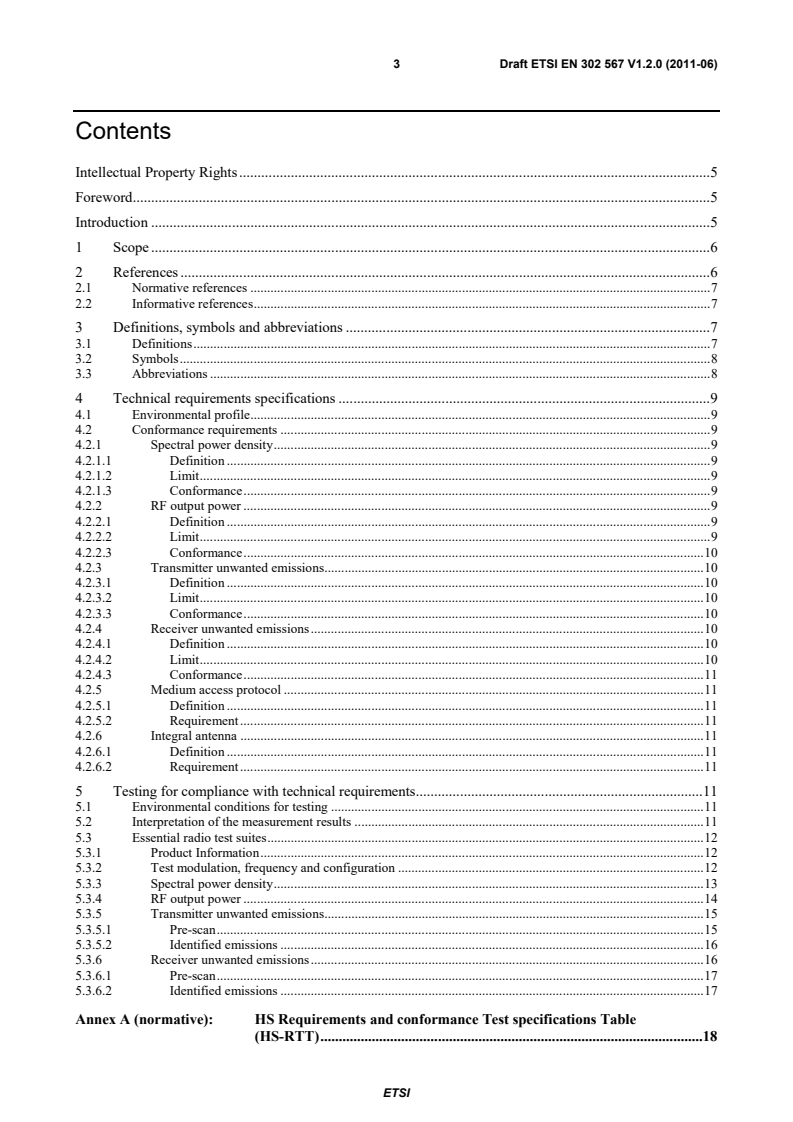
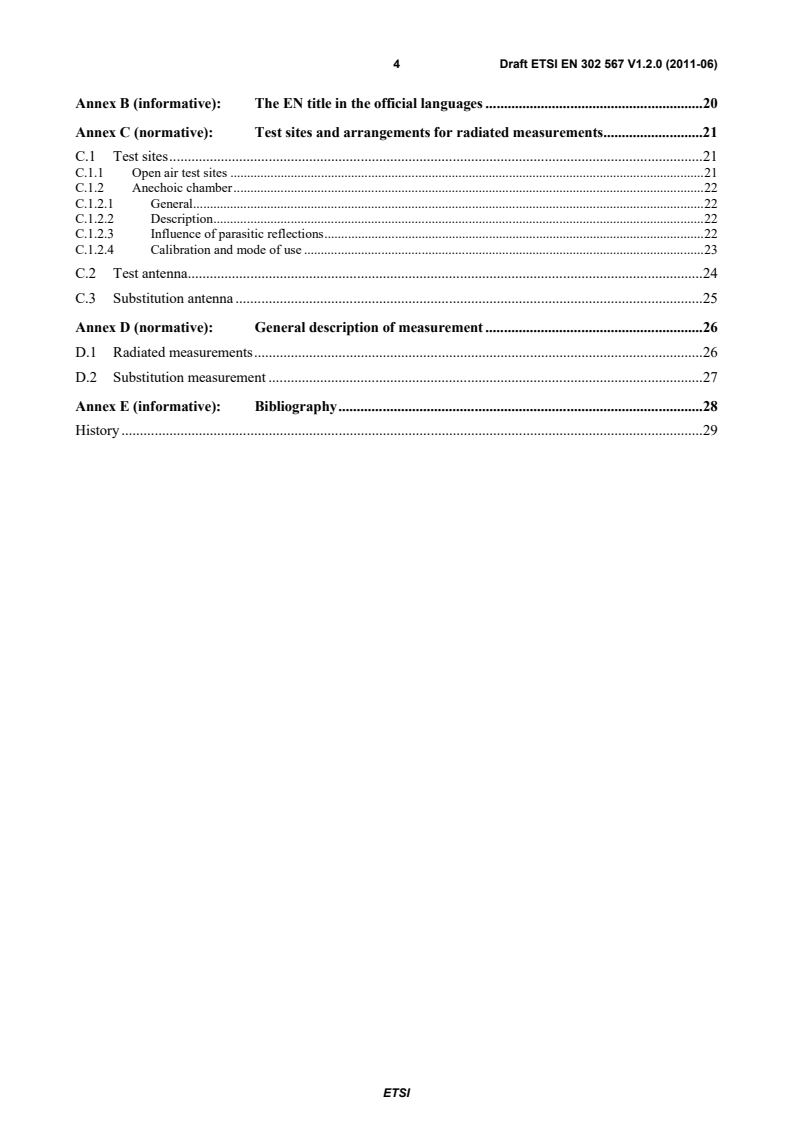
en_302567v010200c - Broadband Radio Access Networks (BRAN); 60 GHz Multiple-Gigabit WAS/RLAN Systems; Harmonized EN covering the essential requirements of article 3.2 of the R&TTE Directive
en_302567v010201p - Broadband Radio Access Networks (BRAN); 60 GHz Multiple-Gigabit WAS/RLAN Systems; Harmonized EN covering the essential requirements of article 3.2 of the R&TTE Directive
en_302567v010201v - Broadband Radio Access Networks (BRAN); 60 GHz Multiple-Gigabit WAS/RLAN Systems; Harmonized EN covering the essential requirements of article 3.2 of the R&TTE Directive



SIST EN 302 567 V1.2.1:2012 is a harmonized European standard from ETSI for 60 GHz multiple-gigabit WAS/RLAN systems. It specifies the radio characteristics and test methods used to show compliance with article 3.2 of the R&TTE Directive, so it is mainly for manufacturers, test laboratories, and compliance teams working on licence-exempt short-range equipment. The document focuses on spectral power density, RF output power, unwanted emissions, and the measurement arrangements needed to verify them.
What does SIST EN 302 567 V1.2.1:2012 specify?
SIST EN 302 567 V1.2.1:2012 specifies technical requirements and conformance tests for wireless access systems (WAS)/Radio Local Area Networks (RLAN) operating at multiple-gigabit data rates in the 60 GHz frequency range. It applies to equipment intended for licence-exempt short-range use and excludes outdoor Fixed Local Area Network Extension (FLANE) or Fixed Point-to-Point applications.
The standard is organized into scope, references, definitions, technical requirements, and testing, followed by annexes that link each requirement to its test method and describe radiated measurement sites and arrangements.
| Annex | What it covers |
|---|---|
| Annex A | HS Requirements and conformance Test specifications Table (HS-RTT) |
| Annex B | EN title in the official languages |
| Annex C | Test sites and arrangements for radiated measurements |
| Annex D | General description of measurement |
| Annex E | Bibliography |
What are the key requirements of SIST EN 302 567 V1.2.1:2012?
The standard’s core requirements are in clause 4, and the related test methods are in clause 5 and Annexes C and D. In practice, the equipment must be configured and measured in ways that reflect normal use, but with the highest declared power and the relevant channels selected.
Spectral power density and RF output power
Clause 4.2.1 limits the spectral power density to 13 dBm/MHz for indoor and outdoor use. Clause 4.2.2 limits the RF output power to 40 dBm for indoor and outdoor use. These limits apply to the whole system at the highest stated power level, and for a smart antenna system they apply to the configuration that gives the highest EIRP. For a buyer or lab, this means the product has to be checked at its worst-case transmit setup, not only in a nominal mode.
Unwanted emissions in transmit and receive
Clause 4.2.3 covers transmitter unwanted emissions in the spurious domain, with limits across ranges from 30 MHz up to 132 GHz. Clause 4.2.4 covers receiver unwanted emissions, again with limits up to 132 GHz. The document ties these limits to conducted power at the antenna connector and defines the spurious-domain boundary using occupied bandwidth. In practice, this tells the lab where to look for emissions and how far beyond the operating channel the scan must go.
Medium access protocol and integral antenna
Clause 4.2.5 requires a medium access protocol to be implemented and active under all circumstances. Clause 4.2.6 requires an integral antenna to provide interference protection for these licence-exempt RLAN applications. For an equipment designer, that means the product must include the access mechanism expected by the standard and use an antenna arrangement that is fixed as part of the equipment.
Environmental profile and test conditions
Clause 4.1 requires the supplier to declare the environmental profile, and the equipment must comply within that declared range. Clause 5.1 says tests are performed at representative points within that profile. This matters because compliance is not only about RF performance - the declared operating environment also has to match how the product is tested.
Measurement uncertainty and test interpretation
Clause 5.2 requires the test report to include measurement uncertainty for each parameter, and the uncertainty values must stay within the stated maxima. The clause also points to TR 100 028 for uncertainty calculation principles. In practice, a compliance report has to show both the measured value and the uncertainty used to judge pass or fail.
Essential radio test suites
Clause 5.3.2 sets the test configuration rules: use representative modulation, test the lowest, highest, and midpoint channels, and use the highest available power level. If the equipment supports multiple occupied bandwidths, each one has to be tested. Clause 5.3.3 measures spectral power density, clause 5.3.4 measures RF output power, clause 5.3.5 measures transmitter unwanted emissions, and clause 5.3.6 measures receiver unwanted emissions. These are the tests that matter most for conformity work.
Radiated measurement arrangements
The standard requires radiated measurements, using the test sites and methods in Annex C and Annex D. That is practical for 60 GHz equipment with integral antennas, where conducted measurement is not the normal approach. The annexes also describe open air test sites, anechoic chambers, test antennas, and substitution measurements, so the lab has a defined setup for repeatable results.
What terms does SIST EN 302 567 V1.2.1:2012 define?
- 60 GHz range or 60 GHz band - The permitted operating range, typically from 57 GHz to 66 GHz.
- Activity factor - The percentage of a one-minute period during which the equipment operates under a given set of conditions.
- Channel separation (ChS) - The minimum separation in MHz between adjacent channel center frequencies in the channel plan.
- Environmental profile - The range of environmental conditions under which the equipment must comply.
- Integral antenna - An antenna declared by the supplier as part of the radio equipment.
- Mean power - The transmitted or received power of a modulated signal in a bandwidth.
- Occupied Bandwidth (OBw) - The frequency bandwidth of the signal power at the -6 dBc points.
- Equivalent Isotropically Radiated Power (EIRP) - A radiated power reference used throughout the limits and measurements.
Who uses SIST EN 302 567 V1.2.1:2012?
Manufacturers of 60 GHz WAS/RLAN, WLAN, WPAN, and related short-range radio equipment use this standard when designing products and preparing compliance evidence. Test laboratories use it to set up radiated measurements, select channels, and report uncertainty for the essential radio test suites.
Quality managers, conformity assessors, and buyers use it to understand what performance claims matter: power, spectral density, unwanted emissions, and antenna configuration. It is also relevant to teams working from specifications such as IEEE 802.15.3c and ECMA TC48, since the scope says the standard is intended to support such systems.
What changed in SIST EN 302 567 V1.2.1:2012 from the previous edition?
SIST EN 302 567 V1.2.1:2012 is a revision of V1.1.1. The scope states that the revision:
- aligns the power limit to ERC Recommendation 70-03 Annex 3 by using a single power limit of +40 dBm
- aligns the spurious emission limit above 40 GHz with the FCC limit to support global regulation and a global product solution
- clarifies the measurement method for the spurious emission limit
- considers changes related to note 1 in Annex 3 of ERC Recommendation 70-03
Which standards are used with SIST EN 302 567 V1.2.1:2012?
The standard depends on several referenced documents for its legal basis, measurement rules, and emission definitions:
- Directive 1999/5/EC (R&TTE Directive) - the directive whose article 3.2 the standard supports
- ERC Recommendation 74-01 - defines unwanted emissions in the spurious domain
- ETSI TR 100 028 - gives uncertainty calculation principles for measurement results
- ITU-R Recommendation SM.1539-1 - helps define the boundary between out-of-band and spurious domains
- ERC Recommendation 70-03 - provides the short-range device spectrum context mentioned in the scope
- Commission Decision 2006/771/EC and Commission Decision 2010/368/EU - set the harmonized spectrum conditions for short-range devices
- ETSI TR 102 555 - describes the technical characteristics of multiple gigabit wireless systems in the 60 GHz range
- IEEE 802.15.3c and ECMA TC48 - are cited as supporting specifications for related system types
What does the SIST EN 302 567 V1.2.1:2012 document contain?
The document contains the technical limit tables for spectral power density, RF output power, and unwanted emissions, plus the clauses that define how those limits apply to the equipment. It also contains step-by-step test procedures for spectrum analyzer settings, duty-cycle handling, and burst measurements, including formulas used to turn measured values into EIRP-based results.
Annex C gives the radiated test sites and arrangements, including open air test sites and anechoic chambers. Annex D gives the general measurement methods, including radiated measurements and substitution measurements. Annex A ties each requirement to its conformance test status, which is the part most often used when checking whether a product has the full essential radio test suite covered.
Buy Documents
en_302567v010200c - Broadband Radio Access Networks (BRAN); 60 GHz Multiple-Gigabit WAS/RLAN Systems; Harmonized EN covering the essential requirements of article 3.2 of the R&TTE Directive
en_302567v010201p - Broadband Radio Access Networks (BRAN); 60 GHz Multiple-Gigabit WAS/RLAN Systems; Harmonized EN covering the essential requirements of article 3.2 of the R&TTE Directive
en_302567v010201v - Broadband Radio Access Networks (BRAN); 60 GHz Multiple-Gigabit WAS/RLAN Systems; Harmonized EN covering the essential requirements of article 3.2 of the R&TTE Directive
Get Certified
Connect with accredited certification bodies for this standard

BSI Group
BSI (British Standards Institution) is the business standards company that helps organizations make excellence a habit.

NYCE
Mexican standards and certification body.

ANCE
Mexican certification and testing association.
Sponsored listings
Frequently Asked Questions
SIST EN 302 567 V1.2.1:2012 is a standard published by the Slovenian Institute for Standardization (SIST). Its full title is "Broadband Radio Access Networks (BRAN) - 60 GHz Multiple-Gigabit WAS/RLAN Systems - Harmonized EN covering the essential requirements of article 3.2 of the R&TTE Directive". This standard covers: Revision to V1.1.1 to align the power limit to ERC Rec 70-03 Annex 3 by specifying a single power limit of +40dBm. Align the spurious emission limit above 40 GHz in line with the FCC limit to enable global regulation and a global product solution. Clarify the measurement method for the spurious emission limit. To consider changes because of the note 1 in Annex 3 of ERC Rec 70.03.
Revision to V1.1.1 to align the power limit to ERC Rec 70-03 Annex 3 by specifying a single power limit of +40dBm. Align the spurious emission limit above 40 GHz in line with the FCC limit to enable global regulation and a global product solution. Clarify the measurement method for the spurious emission limit. To consider changes because of the note 1 in Annex 3 of ERC Rec 70.03.
SIST EN 302 567 V1.2.1:2012 is classified under the following ICS (International Classification for Standards) categories: 33.060.01 - Radiocommunications in general; 35.110 - Networking. The ICS classification helps identify the subject area and facilitates finding related standards.
SIST EN 302 567 V1.2.1:2012 is associated with the following European legislation: EU Directives/Regulations: 2014/53/EU, TRRTP124. When a standard is cited in the Official Journal of the European Union, products manufactured in conformity with it benefit from a presumption of conformity with the essential requirements of the corresponding EU directive or regulation.
SIST EN 302 567 V1.2.1:2012 is available in PDF format for immediate download after purchase. The document can be added to your cart and obtained through the secure checkout process. Digital delivery ensures instant access to the complete standard document.
Standards Content (Sample)
Contents
- Introduction
- 6 Draft ETSI EN 302 567 V1.2.0 (2011-06)
- 1 Scope
- 2 References
- 7 Draft ETSI EN 302 567 V1.2.0 (2011-06)
- 2.1 Normative references
- 2.2 Informative references
- 3 Definitions, symbols and abbreviations
- 3.1 Definitions
- 66 GHz
- 8 Draft ETSI EN 302 567 V1.2.0 (2011-06)
- 3.2 Symbols
- 3.3 Abbreviations
- 9 Draft ETSI EN 302 567 V1.2.0 (2011-06)
- 4 Technical requirements specifications
- 4.1 Environmental profile
- 4.2 Conformance requirements
- 10 Draft ETSI EN 302 567 V1.2.0 (2011-06)
- 30 MHz to 47 MHz -36 dBm 100 kHz
- 47 MHz to 74 MHz -54 dBm 100 kHz
- 74 MHz to 87,5 MHz -36 dBm 100 kHz
- 1 GHz to 132 GHz -30 dBm 1 MHz
- 30 MHz to 1 GHz -57 dBm 100 kHz
- 1 GHz to 132 GHz -47 dBm 1 MHz
- 11 Draft ETSI EN 302 567 V1.2.0 (2011-06)
- 5 Testing for compliance with technical requirements
- 5.1 Environmental conditions for testing
- 5.2 Interpretation of the measurement results
- 12 Draft ETSI EN 302 567 V1.2.0 (2011-06)
- 5.3 Essential radio test suites
- 13 Draft ETSI EN 302 567 V1.2.0 (2011-06)
- 14 Draft ETSI EN 302 567 V1.2.0 (2011-06)
- 15 Draft ETSI EN 302 567 V1.2.0 (2011-06)
- 16 Draft ETSI EN 302 567 V1.2.0 (2011-06)
- 17 Draft ETSI EN 302 567 V1.2.0 (2011-06)
- 18 Draft ETSI EN 302 567 V1.2.0 (2011-06)
- 5 Medium access 4.2.5 U X
- 6 Integral antenna 4.2.6 U X
- 19 Draft ETSI EN 302 567 V1.2.0 (2011-06)
- 20 Draft ETSI EN 302 567 V1.2.0 (2011-06)
- 21 Draft ETSI EN 302 567 V1.2.0 (2011-06)
- 22 Draft ETSI EN 302 567 V1.2.0 (2011-06)
- 23 Draft ETSI EN 302 567 V1.2.0 (2011-06)
- 24 Draft ETSI EN 302 567 V1.2.0 (2011-06)
- 25 Draft ETSI EN 302 567 V1.2.0 (2011-06)
- 26 Draft ETSI EN 302 567 V1.2.0 (2011-06)
- 27 Draft ETSI EN 302 567 V1.2.0 (2011-06)
- 28 Draft ETSI EN 302 567 V1.2.0 (2011-06)
- Bibliography
- 29 Draft ETSI EN 302 567 V1.2.0 (2011-06)
Introduction
The present document is part of a set of standards developed by ETSI and is designed to fit in a modular structure to cover all radio and telecommunications terminal equipment within the scope of the R&TTE Directive [2]. The modular structure is shown in EG 201 399 [i.6].
ETSI
6 Draft ETSI EN 302 567 V1.2.0 (2011-06)
1 Scope
The present document applies to radio equipment types for wireless access systems (WAS)/Radio Local Area Networks (RLAN) operating at multiple-gigabit data rates in the 60 GHz frequency range. These applications may also be referred to as Wireless Personal Area Network (WPAN) or Wireless Local Area Network (WLAN) systems and are intended for licence-exempt short-range devices. Economic benefits of this usage apply to a variety of markets including communications, computing, and consumer electronics by enabling the transfer of large amounts of information in a short amount of time (for example, from a kiosk to a mobile phone) or the continuous streaming of uncompressed data (for example, the external video interfaces of a computer or high definition disc player). These networks operate over a short range with very wideband communications using a variety of directional medium and high gain antennas to enable a high degree of spectrum reuse, and may use a flexible bandwidth scheme under which they normally operate in a wideband mode, and periodically reduce their bandwidth (e.g. for antenna training and other activities).
The spectrum usage conditions for this equipment are set in Commission Decision 2006/771/EC [i.7] as amended by 2010/368/EU [i.8] and ERC Recommendation 70-03, annex 3 [i.5]. The technical characteristics of these applications are further described in TR 102 555 [i.1]. Equipment in this frequency range intended for outdoor Fixed Local Area Network Extension (FLANE) or Fixed Point-to-Point applications are not in the scope of the present document.
The present document is intended to support specifications such as those addressed in IEEE 802.15.3c [i.3], ECMA TC48 [i.4] and other international bodies.
These radio equipment types are capable of operating in all or any part of the frequency bands given in table 1. Table 1: Radiocommunications service frequency bands Radiocommunications service frequency bands Transmit 57 GHz to 66 GHz Receive 57 GHz to 66 GHz
The present document is intended to cover the provisions of Directive 1999/5/EC [2] (R&TTE Directive), article 3.2, which states that "….. radio equipment shall be so constructed that it effectively uses the spectrum allocated to terrestrial/space radio communications and orbital resources so as to avoid harmful interference". In addition to the present document, other ENs that specify technical requirements in respect of essential requirements under other parts of article 3 of the R&TTE Directive [2] may apply to equipment within the scope of the present document.
NOTE: A list of such ENs is included on the web site http://www.newapproach.org.
2 References
References are either specific (identified by date of publication and/or edition number or version number) or non-specific. For specific references, only the cited version applies. For non-specific references, the latest version of the referenced document (including any amendments) applies.
Referenced documents which are not found to be publicly available in the expected location might be found at http://docbox.etsi.org/Reference.
NOTE: While any hyperlinks included in this clause were valid at the time of publication, ETSI cannot guarantee their long term validity.
ETSI
7 Draft ETSI EN 302 567 V1.2.0 (2011-06)
2.1 Normative references
The following referenced documents are necessary for the application of the present document. [1] ERC Recommendation 74-01 (2011): "Unwanted Emissions in the Spurious Domain". [2] Directive 1999/5/EC of the European Parliament and of the Council of 9 March 1999 on radio equipment and telecommunications terminal equipment and the mutual recognition of their conformity (R&TTE Directive).
[3] ETSI TR 100 028 (V1.4.1) - (all parts): "Electromagnetic compatibility and Radio spectrum Matters (ERM); Uncertainties in the measurement of mobile radio equipment characteristics". [4] ITU-R Recommendation SM.1539-1 (2002): "Variation of the boundary between the out-of-band and spurious domains required for the application of Recommendations ITU-R SM.1541 and ITU-R SM.329".
2.2 Informative references
The following referenced documents are not necessary for the application of the present document but they assist the user with regard to a particular subject area.
[i.1] ETSI TR 102 555: "Electromagnetic compatibility and Radio spectrum Matters (ERM); Technical characteristics of multiple gigabit wireless systems in the 60 GHz range System Reference Document".
[i.2] Directive 98/34/EC of the European Parliament and of the Council of 22 June 1998 laying down a procedure for the provision of information in the field of technical standards and regulations. [i.3] IEEE 802.15.3c: "IEEE Standard for Information Technology - Specific Requirements - Part 15: Wireless Personal Area Networks with Millimeter Wave Alternative Physical Task Group 3c (TG3c)".
[i.4] ECMA TC48, High Rate Short Range Wireless Communications. [i.5] ERC Recommendation 70-03 (Tromsø 1997 and subsequent amendments): "Related to the Use of Short Range Devices (SRD)".
[i.6] ETSI EG 201 399: "Electromagnetic compatibility and Radio spectrum Matters (ERM); A guide to the production of Harmonized Standards for application under the R&TTE Directive". [i.7] Commission Decision 2006/771/EC of 9 November 2006 on harmonisation of the radio spectrum for use by short-range devices.
[i.8] Commission Decision 2010/368/EU of 30 June 2010 amending Decision 2006/771/EC on harmonisation of the radio spectrum for use by short-range devices.
3 Definitions, symbols and abbreviations
3.1 Definitions
For the purposes of the present document, the terms and definitions given in Directive 1999/5/EC [2] and the following apply:
60 GHz range or 60 GHz band: one of the variously permitted frequencies of operation, typically from 57 GHz to
66 GHz
activity factor: percentage over any one minute time period when equipment is operating under a given set of conditions ETSI
8 Draft ETSI EN 302 567 V1.2.0 (2011-06)
channel separation: minimum separation (in MHz) between the centre frequencies of two adjacent channels in the channel plan of the radio equipment environmental profile: declared range of environmental conditions under which equipment within the scope of the present document is required to be compliant integral antenna: antenna which is declared to be part of the radio equipment by the supplier NOTE 1: In some cases, it may not be possible to remove an integral antenna or expose an antenna connector without changing the output characteristics of the radio equipment. NOTE 2: Even with an integral antenna, it might still be possible to separate the antenna from the equipment using a special tool.
mean power: when applied to a modulated signal, this is the power (transmitted or received) in a bandwidth occupied bandwidth: frequency bandwidth of the signal power at the -6 dBc points smart antenna systems: equipment that combines multiple transmit and/or receive antenna elements with a signal processing function to increase its radiation and/or reception capabilities NOTE: This includes techniques such as spatial multiplexing, beam forming, cyclic delay diversity, etc.
3.2 Symbols
For the purposes of the present document, the following symbols apply:
dBc spectral density relative to the maximum spectral power density of the transmitted signal dBm decibel relative to one milliwatt dBr decibel relative to a given maximum power level GHz thousand millions of cycles kHz thousands of cycles μs millionths of seconds
3.3 Abbreviations
For the purposes of the present document, the following abbreviations apply:
ChS Channel Separation EIRP Equivalent Isotropically Radiated Power FLANE Fixed Local Area Network Extension OBw Occupied Bandwidth PDL spectral Power Density Limit RBw Resolution Bandwidth RF Radio Frequency RLAN Radio Local Area Network R&TTE Radio and Telecommunications Terminal Equipment UUT Unit Under Test WAS Wireless Access System WLAN Wireless Local Area Network WPAN Wireless Personal Area Network ETSI
9 Draft ETSI EN 302 567 V1.2.0 (2011-06)
4 Technical requirements specifications
4.1 Environmental profile
The technical requirements of the present document apply under the environmental profile for operation of the equipment, which shall be declared by the supplier. The equipment shall comply with all the technical requirements of the present document at all times when operating within the boundary limits of the declared operational environmental profile.
4.2 Conformance requirements
4.2.1 Spectral power density
4.2.1.1 Definition
The spectral power density is the mean Equivalent Isotropically Radiated Power (EIRP) density in Watts per Hertz during a transmission burst.
4.2.1.2 Limit
The maximum spectral power density is applicable to the system as a whole when operated at the highest stated power level. For a smart antenna system, the limit applies to the configuration that results in the highest EIRP. The maximum spectral power density shall be as indicated in table 2. Table 2: Spectral power density limit (PDL) Usage Maximum spectral power density (EIRP) Indoor and Outdoor 13 dBm / MHz
4.2.1.3 Conformance
Conformance tests for this requirement are defined in clause 5.3.3.
4.2.2 RF output power
4.2.2.1 Definition
The RF output power is the mean equivalent isotropically radiated power (EIRP) for the equipment during a transmission burst.
4.2.2.2 Limit
The maximum RF output power is applicable to the system as a whole when operated at the highest stated power level. For a smart antenna system, the limit applies to the configuration that results in the highest EIRP. The maximum RF output power in normal wideband operation shall be as indicated in table 3. Table 3: RF output power limit Usage Maximum power level (EIRP) Indoor and Outdoor 40 dBm
ETSI
10 Draft ETSI EN 302 567 V1.2.0 (2011-06)
4.2.2.3 Conformance
Conformance tests for this requirement are defined in clause 5.3.4.
4.2.3 Transmitter unwanted emissions
4.2.3.1 Definition
These are unwanted emissions in the spurious domain as noted in ERC Recommendation 74-01 [1] while the equipment is transmitting. The boundary where the spurious domain begins as given by ITU-R Recommendation SM.1539-1 [4] is considered to be the offset from the nominal centre frequency of the transmission by ±250 % of the relevant occupied bandwidth (OBw) for OBw ≤ 500 MHz and ± (500 MHz + 1,5 × OBw) for OBw > 500 MHz.
4.2.3.2 Limit
The level of unwanted emissions in the spurious domain shall conform to the limits given in table 4. NOTE: In line with ERC Recommendation 74-01 [1] these limits apply to the power levels conducted to the antenna connector.
Table 4: Transmitter spurious emissions Frequency range Emission Limit Measurement Bandwidth
30 MHz to 47 MHz -36 dBm 100 kHz
47 MHz to 74 MHz -54 dBm 100 kHz
74 MHz to 87,5 MHz -36 dBm 100 kHz
87,5 MHz to 118 MHz -54 dBm 100 kHz 118 MHz to 174 MHz -36 dBm 100 kHz 174 MHz to 230 MHz -54 dBm 100 kHz 230 MHz to 470 MHz -36 dBm 100 kHz 470 MHz to 862 MHz -54 dBm 100 kHz 862 MHz to 1 GHz -36 dBm 100 kHz
1 GHz to 132 GHz -30 dBm 1 MHz
4.2.3.3 Conformance
Conformance tests for this requirement are defined in clause 5.3.5.
4.2.4 Receiver unwanted emissions
4.2.4.1 Definition
These are unwanted emissions in the spurious domain as noted in ERC Recommendation 74-01 [1] while the equipment is receiving a transmission.
4.2.4.2 Limit
The level of unwanted emissions in the spurious domain shall conform to the limits given in table 5. NOTE: In line with ERC Recommendation 74-01 [1] these limits apply to the power levels conducted to the antenna connector.
Table 5: Receiver spurious emissions Frequency band Emission Limit Measurement Bandwidth
30 MHz to 1 GHz -57 dBm 100 kHz
1 GHz to 132 GHz -47 dBm 1 MHz
ETSI
11 Draft ETSI EN 302 567 V1.2.0 (2011-06)
4.2.4.3 Conformance
Conformance tests for this requirement are defined in clause 5.3.6.
4.2.5 Medium access protocol
4.2.5.1 Definition
A medium access protocol is a mechanism designed to facilitate spectrum sharing with other devices in the wireless network.
4.2.5.2 Requirement
A medium access protocol shall be implemented by the equipment and shall be active under all circumstances.
4.2.6 Integral antenna
4.2.6.1 Definition
An integral antenna is designed as a fixed part of the equipment, without the use of an external connector and as such cannot be disconnected from the equipment by a user with the intent to connect another antenna.
4.2.6.2 Requirement
An integral antenna shall be used to provide interference protection from these licence-exempt RLAN applications.
5 Testing for compliance with technical requirements
5.1 Environmental conditions for testing
Tests defined in the present document shall be carried out at representative points within the boundary limits of the declared operational environmental profile.
Where technical performance varies subject to environmental conditions, tests shall be carried out under a sufficient variety of environmental conditions (within the boundary limits of the declared operational environmental profile) to give confidence of compliance for the affected technical requirements.
5.2 Interpretation of the measurement results
The interpretation of the results recorded in a test report for the measurements described in the present document shall be as follows:
- the measured value related to the corresponding limit will be used to decide whether an equipment meets the requirements of the present document;
- the value of the measurement uncertainty for the measurement of each parameter shall be included in the test report;
- the recorded value of the measurement uncertainty shall be, for each measurement, equal to or lower than the figures in table 6.
For the test methods, according to the present document, the measurement uncertainty figures shall be calculated and shall correspond to an expansion factor (coverage factor) k = 1,96 or k = 2 (which provide confidence levels of respectively 95 % and 95,45 % in the case where the distributions characterizing the actual measurement uncertainties are normal (Gaussian)). Principles for the calculation of measurement uncertainty are contained in TR 100 028 [3]. ETSI
12 Draft ETSI EN 302 567 V1.2.0 (2011-06)
Table 6 is based on such expansion factors.
Table 6: Maximum measurement uncertainty Parameter Uncertainty
RF Frequency ±1 × 10 RF power, radiated ±6 dB Spurious emissions, radiated ±6 dB Humidity ±5 % Temperature ±1 °C Time ±10 %
5.3 Essential radio test suites
5.3.1 Product Information
The following information shall be stated by the manufacturer in order to carry out the test suites and/or to declare compliance to technical requirements for which no conformance test is included in the present document. a) The channel plan(s), being the centre frequencies that the UUT is capable of tuning. If the equipment is capable of supporting multiple channel plans in the course of normal operation (e.g. offering different sizes of normal wideband operation), each distinct channel plan and its related occupied bandwidth for normal wideband operation must be stated.
b) The test modulation(s) used by the UUT.
c) The medium access protocol(s) used by the UUT.
d) The integral antenna design used by the equipment and measures to prevent the user from connecting a different antenna.
5.3.2 Test modulation, frequency and configuration
The test modulation used should be representative of normal use of the equipment. Where the equipment is not capable of continuous RF transmission, the test modulation shall be such that:
a) The generated RF transmission is the same for each transmission. b) Transmissions occur regularly in time.
c) Sequences of transmissions can be repeated accurately.
...
Contents
- Introduction
- 6 ETSI EN 302 567 V1.2.1 (2012-01)
- 1 Scope
- 2 References
- 7 ETSI EN 302 567 V1.2.1 (2012-01)
- 2.1 Normative references
- 2.2 Informative references
- 3 Definitions, symbols and abbreviations
- 3.1 Definitions
- 66 GHz
- 8 ETSI EN 302 567 V1.2.1 (2012-01)
- 3.2 Symbols
- 3.3 Abbreviations
- 9 ETSI EN 302 567 V1.2.1 (2012-01)
- 4 Technical requirements specifications
- 4.1 Environmental profile
- 4.2 Conformance requirements
- 10 ETSI EN 302 567 V1.2.1 (2012-01)
- 30 MHz to 47 MHz -36 dBm 100 kHz
- 47 MHz to 74 MHz -54 dBm 100 kHz
- 74 MHz to 87,5 MHz -36 dBm 100 kHz
- 1 GHz to 132 GHz -30 dBm 1 MHz
- 30 MHz to 1 GHz -57 dBm 100 kHz
- 1 GHz to 132 GHz -47 dBm 1 MHz
- 11 ETSI EN 302 567 V1.2.1 (2012-01)
- 5 Testing for compliance with technical requirements
- 5.1 Environmental conditions for testing
- 5.2 Interpretation of the measurement results
- 12 ETSI EN 302 567 V1.2.1 (2012-01)
- 5.3 Essential radio test suites
- 13 ETSI EN 302 567 V1.2.1 (2012-01)
- 14 ETSI EN 302 567 V1.2.1 (2012-01)
- 15 ETSI EN 302 567 V1.2.1 (2012-01)
- 16 ETSI EN 302 567 V1.2.1 (2012-01)
- 17 ETSI EN 302 567 V1.2.1 (2012-01)
- 18 ETSI EN 302 567 V1.2.1 (2012-01)
- 5 Medium access 4.2.5 U X
- 6 Integral antenna 4.2.6 U X
- 19 ETSI EN 302 567 V1.2.1 (2012-01)
- 20 ETSI EN 302 567 V1.2.1 (2012-01)
- 21 ETSI EN 302 567 V1.2.1 (2012-01)
- 22 ETSI EN 302 567 V1.2.1 (2012-01)
- 23 ETSI EN 302 567 V1.2.1 (2012-01)
- 24 ETSI EN 302 567 V1.2.1 (2012-01)
- 25 ETSI EN 302 567 V1.2.1 (2012-01)
- 26 ETSI EN 302 567 V1.2.1 (2012-01)
- 27 ETSI EN 302 567 V1.2.1 (2012-01)
- 28 ETSI EN 302 567 V1.2.1 (2012-01)
- Bibliography
- 29 ETSI EN 302 567 V1.2.1 (2012-01)
Introduction
The present document is part of a set of standards developed by ETSI and is designed to fit in a modular structure to cover all radio and telecommunications terminal equipment within the scope of the R&TTE Directive [2]. The modular structure is shown in EG 201 399 [i.6].
ETSI
6 ETSI EN 302 567 V1.2.1 (2012-01)
1 Scope
The present document applies to radio equipment types for wireless access systems (WAS)/Radio Local Area Networks (RLAN) operating at multiple-gigabit data rates in the 60 GHz frequency range. These applications may also be referred to as Wireless Personal Area Network (WPAN) or Wireless Local Area Network (WLAN) systems and are intended for licence-exempt short-range devices. Economic benefits of this usage apply to a variety of markets including communications, computing, and consumer electronics by enabling the transfer of large amounts of information in a short amount of time (for example, from a kiosk to a mobile phone) or the continuous streaming of uncompressed data (for example, the external video interfaces of a computer or high definition disc player). These networks operate over a short range with very wideband communications using a variety of directional medium and high gain antennas to enable a high degree of spectrum reuse, and may use a flexible bandwidth scheme under which they normally operate in a wideband mode, and periodically reduce their bandwidth (e.g. for antenna training and other activities).
The spectrum usage conditions for this equipment are set in Commission Decision 2006/771/EC [i.7] as amended by 2010/368/EU [i.8] and ERC Recommendation 70-03, annex 3 [i.5]. The technical characteristics of these applications are further described in TR 102 555 [i.1]. Equipment in this frequency range intended for outdoor Fixed Local Area Network Extension (FLANE) or Fixed Point-to-Point applications are not in the scope of the present document.
The present document is intended to support specifications such as those addressed in IEEE 802.15.3c [i.3], ECMA TC48 [i.4] and other international bodies.
These radio equipment types are capable of operating in all or any part of the frequency bands given in table 1. Table 1: Radiocommunications service frequency bands Radiocommunications service frequency bands Transmit 57 GHz to 66 GHz Receive 57 GHz to 66 GHz
The present document is intended to cover the provisions of Directive 1999/5/EC [2] (R&TTE Directive), article 3.2, which states that "….. radio equipment shall be so constructed that it effectively uses the spectrum allocated to terrestrial/space radio communications and orbital resources so as to avoid harmful interference". In addition to the present document, other ENs that specify technical requirements in respect of essential requirements under other parts of article 3 of the R&TTE Directive [2] may apply to equipment within the scope of the present document.
NOTE: A list of such ENs is included on the web site http://www.newapproach.org.
2 References
References are either specific (identified by date of publication and/or edition number or version number) or non-specific. For specific references, only the cited version applies. For non-specific references, the latest version of the referenced document (including any amendments) applies.
Referenced documents which are not found to be publicly available in the expected location might be found at http://docbox.etsi.org/Reference.
NOTE: While any hyperlinks included in this clause were valid at the time of publication, ETSI cannot guarantee their long term validity.
ETSI
7 ETSI EN 302 567 V1.2.1 (2012-01)
2.1 Normative references
The following referenced documents are necessary for the application of the present document. [1] ERC Recommendation 74-01 (2011): "Unwanted Emissions in the Spurious Domain". [2] Directive 1999/5/EC of the European Parliament and of the Council of 9 March 1999 on radio equipment and telecommunications terminal equipment and the mutual recognition of their conformity (R&TTE Directive).
[3] ETSI TR 100 028 (V1.4.1) - (all parts): "Electromagnetic compatibility and Radio spectrum Matters (ERM); Uncertainties in the measurement of mobile radio equipment characteristics". [4] ITU-R Recommendation SM.1539-1 (2002): "Variation of the boundary between the out-of-band and spurious domains required for the application of Recommendations ITU-R SM.1541 and ITU-R SM.329".
2.2 Informative references
The following referenced documents are not necessary for the application of the present document but they assist the user with regard to a particular subject area.
[i.1] ETSI TR 102 555: "Electromagnetic compatibility and Radio spectrum Matters (ERM); Technical characteristics of multiple gigabit wireless systems in the 60 GHz range System Reference Document".
[i.2] Directive 98/34/EC of the European Parliament and of the Council of 22 June 1998 laying down a procedure for the provision of information in the field of technical standards and regulations. [i.3] IEEE 802.15.3c: "IEEE Standard for Information Technology - Specific Requirements - Part 15: Wireless Personal Area Networks with Millimeter Wave Alternative Physical Task Group 3c (TG3c)".
[i.4] ECMA TC48, High Rate Short Range Wireless Communications. [i.5] ERC Recommendation 70-03 (Tromsø 1997 and subsequent amendments): "Related to the Use of Short Range Devices (SRD)".
[i.6] ETSI EG 201 399: "Electromagnetic compatibility and Radio spectrum Matters (ERM); A guide to the production of Harmonized Standards for application under the R&TTE Directive". [i.7] Commission Decision 2006/771/EC of 9 November 2006 on harmonisation of the radio spectrum for use by short-range devices.
[i.8] Commission Decision 2010/368/EU of 30 June 2010 amending Decision 2006/771/EC on harmonisation of the radio spectrum for use by short-range devices. [i.9] Directive 98/48/EC of the European Parliament and of the Council of 20 July 1998 amending Directive 98/34/EC laying down a procedure for the provision of information in the field of technical standards and regulations.
3 Definitions, symbols and abbreviations
3.1 Definitions
For the purposes of the present document, the terms and definitions given in Directive 1999/5/EC [2] and the following apply:
60 GHz range or 60 GHz band: one of the variously permitted frequencies of operation, typically from 57 GHz to
66 GHz
ETSI
8 ETSI EN 302 567 V1.2.1 (2012-01)
activity factor: percentage over any one minute time period when equipment is operating under a given set of conditions channel separation: minimum separation (in MHz) between the centre frequencies of two adjacent channels in the channel plan of the radio equipment environmental profile: range of environmental conditions under which equipment within the scope of the present document is required to comply with the provisions of the present document integral antenna: antenna which is declared to be part of the radio equipment by the supplier NOTE 1: In some cases, it may not be possible to remove an integral antenna or expose an antenna connector without changing the output characteristics of the radio equipment. NOTE 2: Even with an integral antenna, it might still be possible to separate the antenna from the equipment using a special tool.
mean power: when applied to a modulated signal, this is the power (transmitted or received) in a bandwidth occupied bandwidth: frequency bandwidth of the signal power at the -6 dBc points smart antenna systems: equipment that combines multiple transmit and/or receive antenna elements with a signal processing function to increase its radiation and/or reception capabilities NOTE: This includes techniques such as spatial multiplexing, beam forming, cyclic delay diversity, etc.
3.2 Symbols
For the purposes of the present document, the following symbols apply:
dBc spectral density relative to the maximum spectral power density of the transmitted signal dBm decibel relative to one milliwatt dBr decibel relative to a given maximum power level GHz thousand millions of cycles kHz thousands of cycles μs millionths of seconds
3.3 Abbreviations
For the purposes of the present document, the following abbreviations apply:
ChS Channel Separation EIRP Equivalent Isotropically Radiated Power FLANE Fixed Local Area Network Extension OBw Occupied Bandwidth PDL spectral Power Density Limit RBw Resolution Bandwidth RF Radio Frequency RLAN Radio Local Area Network R&TTE Radio and Telecommunications Terminal Equipment UUT Unit Under Test WAS Wireless Access System WLAN Wireless Local Area Network WPAN Wireless Personal Area Network ETSI
9 ETSI EN 302 567 V1.2.1 (2012-01)
4 Technical requirements specifications
4.1 Environmental profile
The technical requirements of the present document apply under the environmental profile for operation of the equipment, which shall be declared by the supplier. The equipment shall comply with all the technical requirements of the present document at all times when operating within the boundary limits of the declared operational environmental profile.
4.2 Conformance requirements
4.2.1 Spectral power density
4.2.1.1 Definition
The spectral power density is the mean Equivalent Isotropically Radiated Power (EIRP) density in Watts per Hertz during a transmission burst.
4.2.1.2 Limit
The maximum spectral power density is applicable to the system as a whole when operated at the highest stated power level. For a smart antenna system, the limit applies to the configuration that results in the highest EIRP. The maximum spectral power density shall be as indicated in table 2. Table 2: Spectral power density limit (PDL) Usage Maximum spectral power density (EIRP) Indoor and Outdoor 13 dBm / MHz
4.2.1.3 Conformance
Conformance tests for this requirement are defined in clause 5.3.3.
4.2.2 RF output power
4.2.2.1 Definition
The RF output power is the mean equivalent isotropically radiated power (EIRP) for the equipment during a transmission burst.
4.2.2.2 Limit
The maximum RF output power is applicable to the system as a whole when operated at the highest stated power level. For a smart antenna system, the limit applies to the configuration that results in the highest EIRP. The maximum RF output power in normal wideband operation shall be as indicated in table 3. Table 3: RF output power limit Usage Maximum power level (EIRP) Indoor and Outdoor 40 dBm
ETSI
10 ETSI EN 302 567 V1.2.1 (2012-01)
4.2.2.3 Conformance
Conformance tests for this requirement are defined in clause 5.3.4.
4.2.3 Transmitter unwanted emissions
4.2.3.1 Definition
These are unwanted emissions in the spurious domain as noted in ERC Recommendation 74-01 [1] while the equipment is transmitting. The boundary where the spurious domain begins as given by ITU-R Recommendation SM.1539-1 [4] is considered to be the offset from the nominal centre frequency of the transmission by ±250 % of the relevant occupied bandwidth (OBw) for OBw ≤ 500 MHz and ± (500 MHz + 1,5 × OBw) for OBw > 500 MHz.
4.2.3.2 Limit
The level of unwanted emissions in the spurious domain shall conform to the limits given in table 4. NOTE: In line with ERC Recommendation 74-01 [1] these limits apply to the power levels conducted to the antenna connector.
Table 4: Transmitter spurious emissions Frequency range Emission Limit Measurement Bandwidth
30 MHz to 47 MHz -36 dBm 100 kHz
47 MHz to 74 MHz -54 dBm 100 kHz
74 MHz to 87,5 MHz -36 dBm 100 kHz
87,5 MHz to 118 MHz -54 dBm 100 kHz 118 MHz to 174 MHz -36 dBm 100 kHz 174 MHz to 230 MHz -54 dBm 100 kHz 230 MHz to 470 MHz -36 dBm 100 kHz 470 MHz to 862 MHz -54 dBm 100 kHz 862 MHz to 1 GHz -36 dBm 100 kHz
1 GHz to 132 GHz -30 dBm 1 MHz
4.2.3.3 Conformance
Conformance tests for this requirement are defined in clause 5.3.5.
4.2.4 Receiver unwanted emissions
4.2.4.1 Definition
These are unwanted emissions in the spurious domain as noted in ERC Recommendation 74-01 [1] while the equipment is receiving a transmission.
4.2.4.2 Limit
The level of unwanted emissions in the spurious domain shall conform to the limits given in table 5. NOTE: In line with ERC Recommendation 74-01 [1] these limits apply to the power levels conducted to the antenna connector.
Table 5: Receiver spurious emissions Frequency band Emission Limit Measurement Bandwidth
30 MHz to 1 GHz -57 dBm 100 kHz
1 GHz to 132 GHz -47 dBm 1 MHz
ETSI
11 ETSI EN 302 567 V1.2.1 (2012-01)
4.2.4.3 Conformance
Conformance tests for this requirement are defined in clause 5.3.6.
4.2.5 Medium access protocol
4.2.5.1 Definition
A medium access protocol is a mechanism designed to facilitate spectrum sharing with other devices in the wireless network.
4.2.5.2 Requirement
A medium access protocol shall be implemented by the equipment and shall be active under all circumstances.
4.2.6 Integral antenna
4.2.6.1 Definition
An integral antenna is designed as a fixed part of the equipment, without the use of an external connector and as such cannot be disconnected from the equipment by a user with the intent to connect another antenna.
4.2.6.2 Requirement
An integral antenna shall be used to provide interference protection from these licence-exempt RLAN applications.
5 Testing for compliance with technical requirements
5.1 Environmental conditions for testing
Tests defined in the present document shall be carried out at representative points within the boundary limits of the declared operational environmental profile.
Where technical performance varies subject to environmental conditions, tests shall be carried out under a sufficient variety of environmental conditions (within the boundary limits of the declared operational environmental profile) to give confidence of compliance for the affected technical requirements.
5.2 Interpretation of the measurement results
The interpretation of the results recorded in a test report for the measurements described in the present document shall be as follows:
- the measured value related to the corresponding limit will be used to decide whether an equipment meets the requirements of the present document;
- the value of the measurement uncertainty for the measurement of each parameter shall be included in the test report;
- the recorded value of the measurement uncertainty shall be, for each measurement, equal to or lower than the figures in table 6.
For the test methods, according to the present document, the measurement uncertainty figures shall be calculated and shall correspond to an expansion factor (coverage factor) k = 1,96 or k = 2 (which provide confidence levels of respectively 95 % and 95,45 % in the case where the distributions characterizing the actual measurement uncertainties are normal (Gaussian)). Principles for the calculation of measurement uncertainty are contained in TR 100 028 [3]. ETSI
12 ETSI EN 302 567 V1.2.1 (2012-01)
Table 6 is based on such expansion factors.
Table 6: Maximum measurement uncertainty Parameter Uncertainty
RF Frequency ±1 × 10 RF power, radiated ±6 dB Spurious emissions, radiated ±6 dB Humidity ±5 % Temperature ±1 °C Time ±10 %
5.3 Essential radio test suites
5.3.1 Product Information
The following information shall be stated by the manufacturer in order to carry out the test suites and/or to declare compliance to technical requirements for which no conformance test is included in the present document. a) The channel plan(s), being the centre frequencies that the UUT is capable of tuning. If the equipment is capable of supporting multiple channel plans in the course of normal operation (e.g. offering different sizes of normal wideband operation), each distinct channel plan and its related occupied bandwidth for normal wideband operation must be stated.
b) The test modulation(s) used by the UUT.
c) The medium access protocol(s) used by the UUT.
d) The integral antenna design used by the equipment and measures to prevent the user from connecting a different antenna.
5.3.2 Test modulation, frequency and configuration
The test modulation used should be representative of normal use of the equipment. Where the equipment is not capable of continuous RF transmission, the test modulation shall be such that:
a) The generated RF transmission is the same for each transmission. b) Transmissions occur regularly in time.
c) Sequences of transmissions can be repeated accurately.
...
Contents
- Introduction
- 6 Final draft ETSI EN 302 567 V1.2.1 (2011-11)
- 1 Scope
- 2 References
- 7 Final draft ETSI EN 302 567 V1.2.1 (2011-11)
- 2.1 Normative references
- 2.2 Informative references
- 3 Definitions, symbols and abbreviations
- 3.1 Definitions
- 66 GHz
- 8 Final draft ETSI EN 302 567 V1.2.1 (2011-11)
- 3.2 Symbols
- 3.3 Abbreviations
- 9 Final draft ETSI EN 302 567 V1.2.1 (2011-11)
- 4 Technical requirements specifications
- 4.1 Environmental profile
- 4.2 Conformance requirements
- 10 Final draft ETSI EN 302 567 V1.2.1 (2011-11)
- 30 MHz to 47 MHz -36 dBm 100 kHz
- 47 MHz to 74 MHz -54 dBm 100 kHz
- 74 MHz to 87,5 MHz -36 dBm 100 kHz
- 1 GHz to 132 GHz -30 dBm 1 MHz
- 30 MHz to 1 GHz -57 dBm 100 kHz
- 1 GHz to 132 GHz -47 dBm 1 MHz
- 11 Final draft ETSI EN 302 567 V1.2.1 (2011-11)
- 5 Testing for compliance with technical requirements
- 5.1 Environmental conditions for testing
- 5.2 Interpretation of the measurement results
- 12 Final draft ETSI EN 302 567 V1.2.1 (2011-11)
- 5.3 Essential radio test suites
- 13 Final draft ETSI EN 302 567 V1.2.1 (2011-11)
- 14 Final draft ETSI EN 302 567 V1.2.1 (2011-11)
- 15 Final draft ETSI EN 302 567 V1.2.1 (2011-11)
- 16 Final draft ETSI EN 302 567 V1.2.1 (2011-11)
- 17 Final draft ETSI EN 302 567 V1.2.1 (2011-11)
- 18 Final draft ETSI EN 302 567 V1.2.1 (2011-11)
- 5 Medium access 4.2.5 U X
- 6 Integral antenna 4.2.6 U X
- 19 Final draft ETSI EN 302 567 V1.2.1 (2011-11)
- 20 Final draft ETSI EN 302 567 V1.2.1 (2011-11)
- 21 Final draft ETSI EN 302 567 V1.2.1 (2011-11)
- 22 Final draft ETSI EN 302 567 V1.2.1 (2011-11)
- 23 Final draft ETSI EN 302 567 V1.2.1 (2011-11)
- 24 Final draft ETSI EN 302 567 V1.2.1 (2011-11)
- 25 Final draft ETSI EN 302 567 V1.2.1 (2011-11)
- 26 Final draft ETSI EN 302 567 V1.2.1 (2011-11)
- 27 Final draft ETSI EN 302 567 V1.2.1 (2011-11)
- 28 Final draft ETSI EN 302 567 V1.2.1 (2011-11)
- Bibliography
- 29 Final draft ETSI EN 302 567 V1.2.1 (2011-11)
Introduction
The present document is part of a set of standards developed by ETSI and is designed to fit in a modular structure to cover all radio and telecommunications terminal equipment within the scope of the R&TTE Directive [2]. The modular structure is shown in EG 201 399 [i.6].
ETSI
6 Final draft ETSI EN 302 567 V1.2.1 (2011-11)
1 Scope
The present document applies to radio equipment types for wireless access systems (WAS)/Radio Local Area Networks (RLAN) operating at multiple-gigabit data rates in the 60 GHz frequency range. These applications may also be referred to as Wireless Personal Area Network (WPAN) or Wireless Local Area Network (WLAN) systems and are intended for licence-exempt short-range devices. Economic benefits of this usage apply to a variety of markets including communications, computing, and consumer electronics by enabling the transfer of large amounts of information in a short amount of time (for example, from a kiosk to a mobile phone) or the continuous streaming of uncompressed data (for example, the external video interfaces of a computer or high definition disc player). These networks operate over a short range with very wideband communications using a variety of directional medium and high gain antennas to enable a high degree of spectrum reuse, and may use a flexible bandwidth scheme under which they normally operate in a wideband mode, and periodically reduce their bandwidth (e.g. for antenna training and other activities).
The spectrum usage conditions for this equipment are set in Commission Decision 2006/771/EC [i.7] as amended by 2010/368/EU [i.8] and ERC Recommendation 70-03, annex 3 [i.5]. The technical characteristics of these applications are further described in TR 102 555 [i.1]. Equipment in this frequency range intended for outdoor Fixed Local Area Network Extension (FLANE) or Fixed Point-to-Point applications are not in the scope of the present document.
The present document is intended to support specifications such as those addressed in IEEE 802.15.3c [i.3], ECMA TC48 [i.4] and other international bodies.
These radio equipment types are capable of operating in all or any part of the frequency bands given in table 1. Table 1: Radiocommunications service frequency bands Radiocommunications service frequency bands Transmit 57 GHz to 66 GHz Receive 57 GHz to 66 GHz
The present document is intended to cover the provisions of Directive 1999/5/EC [2] (R&TTE Directive), article 3.2, which states that "….. radio equipment shall be so constructed that it effectively uses the spectrum allocated to terrestrial/space radio communications and orbital resources so as to avoid harmful interference". In addition to the present document, other ENs that specify technical requirements in respect of essential requirements under other parts of article 3 of the R&TTE Directive [2] may apply to equipment within the scope of the present document.
NOTE: A list of such ENs is included on the web site http://www.newapproach.org.
2 References
References are either specific (identified by date of publication and/or edition number or version number) or non-specific. For specific references, only the cited version applies. For non-specific references, the latest version of the referenced document (including any amendments) applies.
Referenced documents which are not found to be publicly available in the expected location might be found at http://docbox.etsi.org/Reference.
NOTE: While any hyperlinks included in this clause were valid at the time of publication, ETSI cannot guarantee their long term validity.
ETSI
7 Final draft ETSI EN 302 567 V1.2.1 (2011-11)
2.1 Normative references
The following referenced documents are necessary for the application of the present document. [1] ERC Recommendation 74-01 (2011): "Unwanted Emissions in the Spurious Domain". [2] Directive 1999/5/EC of the European Parliament and of the Council of 9 March 1999 on radio equipment and telecommunications terminal equipment and the mutual recognition of their conformity (R&TTE Directive).
[3] ETSI TR 100 028 (V1.4.1) - (all parts): "Electromagnetic compatibility and Radio spectrum Matters (ERM); Uncertainties in the measurement of mobile radio equipment characteristics". [4] ITU-R Recommendation SM.1539-1 (2002): "Variation of the boundary between the out-of-band and spurious domains required for the application of Recommendations ITU-R SM.1541 and ITU-R SM.329".
2.2 Informative references
The following referenced documents are not necessary for the application of the present document but they assist the user with regard to a particular subject area.
[i.1] ETSI TR 102 555: "Electromagnetic compatibility and Radio spectrum Matters (ERM); Technical characteristics of multiple gigabit wireless systems in the 60 GHz range System Reference Document".
[i.2] Directive 98/34/EC of the European Parliament and of the Council of 22 June 1998 laying down a procedure for the provision of information in the field of technical standards and regulations. [i.3] IEEE 802.15.3c: "IEEE Standard for Information Technology - Specific Requirements - Part 15: Wireless Personal Area Networks with Millimeter Wave Alternative Physical Task Group 3c (TG3c)".
[i.4] ECMA TC48, High Rate Short Range Wireless Communications. [i.5] ERC Recommendation 70-03 (Tromsø 1997 and subsequent amendments): "Related to the Use of Short Range Devices (SRD)".
[i.6] ETSI EG 201 399: "Electromagnetic compatibility and Radio spectrum Matters (ERM); A guide to the production of Harmonized Standards for application under the R&TTE Directive". [i.7] Commission Decision 2006/771/EC of 9 November 2006 on harmonisation of the radio spectrum for use by short-range devices.
[i.8] Commission Decision 2010/368/EU of 30 June 2010 amending Decision 2006/771/EC on harmonisation of the radio spectrum for use by short-range devices.
3 Definitions, symbols and abbreviations
3.1 Definitions
For the purposes of the present document, the terms and definitions given in Directive 1999/5/EC [2] and the following apply:
60 GHz range or 60 GHz band: one of the variously permitted frequencies of operation, typically from 57 GHz to
66 GHz
activity factor: percentage over any one minute time period when equipment is operating under a given set of conditions ETSI
8 Final draft ETSI EN 302 567 V1.2.1 (2011-11)
channel separation: minimum separation (in MHz) between the centre frequencies of two adjacent channels in the channel plan of the radio equipment environmental profile: range of environmental conditions under which equipment within the scope of the present document is required to comply with the provisions of the present document integral antenna: antenna which is declared to be part of the radio equipment by the supplier NOTE 1: In some cases, it may not be possible to remove an integral antenna or expose an antenna connector without changing the output characteristics of the radio equipment. NOTE 2: Even with an integral antenna, it might still be possible to separate the antenna from the equipment using a special tool.
mean power: when applied to a modulated signal, this is the power (transmitted or received) in a bandwidth occupied bandwidth: frequency bandwidth of the signal power at the -6 dBc points smart antenna systems: equipment that combines multiple transmit and/or receive antenna elements with a signal processing function to increase its radiation and/or reception capabilities NOTE: This includes techniques such as spatial multiplexing, beam forming, cyclic delay diversity, etc.
3.2 Symbols
For the purposes of the present document, the following symbols apply:
dBc spectral density relative to the maximum spectral power density of the transmitted signal dBm decibel relative to one milliwatt dBr decibel relative to a given maximum power level GHz thousand millions of cycles kHz thousands of cycles μs millionths of seconds
3.3 Abbreviations
For the purposes of the present document, the following abbreviations apply:
ChS Channel Separation EIRP Equivalent Isotropically Radiated Power FLANE Fixed Local Area Network Extension OBw Occupied Bandwidth PDL spectral Power Density Limit RBw Resolution Bandwidth RF Radio Frequency RLAN Radio Local Area Network R&TTE Radio and Telecommunications Terminal Equipment UUT Unit Under Test WAS Wireless Access System WLAN Wireless Local Area Network WPAN Wireless Personal Area Network ETSI
9 Final draft ETSI EN 302 567 V1.2.1 (2011-11)
4 Technical requirements specifications
4.1 Environmental profile
The technical requirements of the present document apply under the environmental profile for operation of the equipment, which shall be declared by the supplier. The equipment shall comply with all the technical requirements of the present document at all times when operating within the boundary limits of the declared operational environmental profile.
4.2 Conformance requirements
4.2.1 Spectral power density
4.2.1.1 Definition
The spectral power density is the mean Equivalent Isotropically Radiated Power (EIRP) density in Watts per Hertz during a transmission burst.
4.2.1.2 Limit
The maximum spectral power density is applicable to the system as a whole when operated at the highest stated power level. For a smart antenna system, the limit applies to the configuration that results in the highest EIRP. The maximum spectral power density shall be as indicated in table 2. Table 2: Spectral power density limit (PDL) Usage Maximum spectral power density (EIRP) Indoor and Outdoor 13 dBm / MHz
4.2.1.3 Conformance
Conformance tests for this requirement are defined in clause 5.3.3.
4.2.2 RF output power
4.2.2.1 Definition
The RF output power is the mean equivalent isotropically radiated power (EIRP) for the equipment during a transmission burst.
4.2.2.2 Limit
The maximum RF output power is applicable to the system as a whole when operated at the highest stated power level. For a smart antenna system, the limit applies to the configuration that results in the highest EIRP. The maximum RF output power in normal wideband operation shall be as indicated in table 3. Table 3: RF output power limit Usage Maximum power level (EIRP) Indoor and Outdoor 40 dBm
ETSI
10 Final draft ETSI EN 302 567 V1.2.1 (2011-11)
4.2.2.3 Conformance
Conformance tests for this requirement are defined in clause 5.3.4.
4.2.3 Transmitter unwanted emissions
4.2.3.1 Definition
These are unwanted emissions in the spurious domain as noted in ERC Recommendation 74-01 [1] while the equipment is transmitting. The boundary where the spurious domain begins as given by ITU-R Recommendation SM.1539-1 [4] is considered to be the offset from the nominal centre frequency of the transmission by ±250 % of the relevant occupied bandwidth (OBw) for OBw ≤ 500 MHz and ± (500 MHz + 1,5 × OBw) for OBw > 500 MHz.
4.2.3.2 Limit
The level of unwanted emissions in the spurious domain shall conform to the limits given in table 4. NOTE: In line with ERC Recommendation 74-01 [1] these limits apply to the power levels conducted to the antenna connector.
Table 4: Transmitter spurious emissions Frequency range Emission Limit Measurement Bandwidth
30 MHz to 47 MHz -36 dBm 100 kHz
47 MHz to 74 MHz -54 dBm 100 kHz
74 MHz to 87,5 MHz -36 dBm 100 kHz
87,5 MHz to 118 MHz -54 dBm 100 kHz 118 MHz to 174 MHz -36 dBm 100 kHz 174 MHz to 230 MHz -54 dBm 100 kHz 230 MHz to 470 MHz -36 dBm 100 kHz 470 MHz to 862 MHz -54 dBm 100 kHz 862 MHz to 1 GHz -36 dBm 100 kHz
1 GHz to 132 GHz -30 dBm 1 MHz
4.2.3.3 Conformance
Conformance tests for this requirement are defined in clause 5.3.5.
4.2.4 Receiver unwanted emissions
4.2.4.1 Definition
These are unwanted emissions in the spurious domain as noted in ERC Recommendation 74-01 [1] while the equipment is receiving a transmission.
4.2.4.2 Limit
The level of unwanted emissions in the spurious domain shall conform to the limits given in table 5. NOTE: In line with ERC Recommendation 74-01 [1] these limits apply to the power levels conducted to the antenna connector.
Table 5: Receiver spurious emissions Frequency band Emission Limit Measurement Bandwidth
30 MHz to 1 GHz -57 dBm 100 kHz
1 GHz to 132 GHz -47 dBm 1 MHz
ETSI
11 Final draft ETSI EN 302 567 V1.2.1 (2011-11)
4.2.4.3 Conformance
Conformance tests for this requirement are defined in clause 5.3.6.
4.2.5 Medium access protocol
4.2.5.1 Definition
A medium access protocol is a mechanism designed to facilitate spectrum sharing with other devices in the wireless network.
4.2.5.2 Requirement
A medium access protocol shall be implemented by the equipment and shall be active under all circumstances.
4.2.6 Integral antenna
4.2.6.1 Definition
An integral antenna is designed as a fixed part of the equipment, without the use of an external connector and as such cannot be disconnected from the equipment by a user with the intent to connect another antenna.
4.2.6.2 Requirement
An integral antenna shall be used to provide interference protection from these licence-exempt RLAN applications.
5 Testing for compliance with technical requirements
5.1 Environmental conditions for testing
Tests defined in the present document shall be carried out at representative points within the boundary limits of the declared operational environmental profile.
Where technical performance varies subject to environmental conditions, tests shall be carried out under a sufficient variety of environmental conditions (within the boundary limits of the declared operational environmental profile) to give confidence of compliance for the affected technical requirements.
5.2 Interpretation of the measurement results
The interpretation of the results recorded in a test report for the measurements described in the present document shall be as follows:
- the measured value related to the corresponding limit will be used to decide whether an equipment meets the requirements of the present document;
- the value of the measurement uncertainty for the measurement of each parameter shall be included in the test report;
- the recorded value of the measurement uncertainty shall be, for each measurement, equal to or lower than the figures in table 6.
For the test methods, according to the present document, the measurement uncertainty figures shall be calculated and shall correspond to an expansion factor (coverage factor) k = 1,96 or k = 2 (which provide confidence levels of respectively 95 % and 95,45 % in the case where the distributions characterizing the actual measurement uncertainties are normal (Gaussian)). Principles for the calculation of measurement uncertainty are contained in TR 100 028 [3]. ETSI
12 Final draft ETSI EN 302 567 V1.2.1 (2011-11)
Table 6 is based on such expansion factors.
Table 6: Maximum measurement uncertainty Parameter Uncertainty
RF Frequency ±1 × 10 RF power, radiated ±6 dB Spurious emissions, radiated ±6 dB Humidity ±5 % Temperature ±1 °C Time ±10 %
5.3 Essential radio test suites
5.3.1 Product Information
The following information shall be stated by the manufacturer in order to carry out the test suites and/or to declare compliance to technical requirements for which no conformance test is included in the present document. a) The channel plan(s), being the centre frequencies that the UUT is capable of tuning. If the equipment is capable of supporting multiple channel plans in the course of normal operation (e.g. offering different sizes of normal wideband operation), each distinct channel plan and its related occupied bandwidth for normal wideband operation must be stated.
b) The test modulation(s) used by the UUT.
c) The medium access protocol(s) used by the UUT.
d) The integral antenna design used by the equipment and measures to prevent the user from connecting a different antenna.
5.3.2 Test modulation, frequency and configuration
The test modulation used should be representative of normal use of the equipment. Where the equipment is not capable of continuous RF transmission, the test modulation shall be such that:
a) The generated RF transmission is the same for each transmission. b) Transmissions occur regularly in time.
c) Sequences of transmissions can be repeated accurately.
...
2003-01.Slovenski inštitut za standardizacijo. Razmnoževanje celote ali delov tega standarda ni dovoljeno.577(Broadband Radio Access Networks (BRAN) - 60 GHz Multiple-Gigabit WAS/RLAN Systems - Harmonized EN covering the essential requirements of article 3.2 of the R&TTE Directive35.110OmreževanjeNetworking33.060.01Radijske komunikacije na splošnoRadiocommunications in generalICS:Ta slovenski standard je istoveten z:EN 302 567 Version 1.2.1SIST EN 302 567 V1.2.1:2012en01-marec-2012SIST EN 302 567 V1.2.1:2012SLOVENSKI
STANDARD
Final draft ETSI EN 302 567 V1.2.1 (2011-11) Broadband Radio Access Networks (BRAN); 60 GHz Multiple-Gigabit WAS/RLAN Systems; Harmonized EN covering the essential requirements of article 3.2 of the R&TTE Directive
Harmonized European Standard SIST EN 302 567 V1.2.1:2012
ETSI Final draft ETSI EN 302 567 V1.2.1 (2011-11)2
Reference REN/BRAN-0060008 Keywords access, broadband, LAN, radio, SRD, testing ETSI 650 Route des Lucioles F-06921 Sophia Antipolis Cedex - FRANCE
Tel.: +33 4 92 94 42 00
Fax: +33 4 93 65 47 16
Siret N° 348 623 562 00017 - NAF 742 C Association à but non lucratif enregistrée à la Sous-Préfecture de Grasse (06) N° 7803/88
Important notice Individual copies of the present document can be downloaded from: http://www.etsi.org The present document may be made available in more than one electronic version or in print. In any case of existing or perceived difference in contents between such versions, the reference version is the Portable Document Format (PDF). In case of dispute, the reference shall be the printing on ETSI printers of the PDF version kept on a specific network drive within ETSI Secretariat. Users of the present document should be aware that the document may be subject to revision or change of status. Information on the current status of this and other ETSI documents is available at http://portal.etsi.org/tb/status/status.asp If you find errors in the present document, please send your comment to one of the following services: http://portal.etsi.org/chaircor/ETSI_support.asp Copyright Notification No part may be reproduced except as authorized by written permission. The copyright and the foregoing restriction extend to reproduction in all media.
© European Telecommunications Standards Institute 2011. All rights reserved.
DECTTM, PLUGTESTSTM, UMTSTM and the ETSI logo are Trade Marks of ETSI registered for the benefit of its Members. 3GPPTM and LTE™ are Trade Marks of ETSI registered for the benefit of its Members and of the 3GPP Organizational Partners. GSM® and the GSM logo are Trade Marks registered and owned by the GSM Association. SIST EN 302 567 V1.2.1:2012
ETSI Final draft ETSI EN 302 567 V1.2.1 (2011-11)3 Contents Intellectual Property Rights . 5 Foreword . 5 Introduction . 5 1 Scope . 6 2 References . 6 2.1 Normative references . 7 2.2 Informative references . 7 3 Definitions, symbols and abbreviations . 7 3.1 Definitions . 7 3.2 Symbols . 8 3.3 Abbreviations . 8 4 Technical requirements specifications . 9 4.1 Environmental profile . 9 4.2 Conformance requirements . 9 4.2.1 Spectral power density . 9 4.2.1.1 Definition . 9 4.2.1.2 Limit . 9 4.2.1.3 Conformance . 9 4.2.2 RF output power . 9 4.2.2.1 Definition . 9 4.2.2.2 Limit . 9 4.2.2.3 Conformance . 10 4.2.3 Transmitter unwanted emissions . 10 4.2.3.1 Definition . 10 4.2.3.2 Limit . 10 4.2.3.3 Conformance . 10 4.2.4 Receiver unwanted emissions . 10 4.2.4.1 Definition . 10 4.2.4.2 Limit . 10 4.2.4.3 Conformance . 11 4.2.5 Medium access protocol . 11 4.2.5.1 Definition . 11 4.2.5.2 Requirement . 11 4.2.6 Integral antenna . 11 4.2.6.1 Definition . 11 4.2.6.2 Requirement . 11 5 Testing for compliance with technical requirements . 11 5.1 Environmental conditions for testing . 11 5.2 Interpretation of the measurement results . 11 5.3 Essential radio test suites . 12 5.3.1 Product Information . 12 5.3.2 Test modulation, frequency and configuration . 12 5.3.3 Spectral power density . 13 5.3.4 RF output power . 14 5.3.5 Transmitter unwanted emissions . 15 5.3.5.1 Pre-scan . 15 5.3.5.2 Identified emissions . 16 5.3.6 Receiver unwanted emissions . 16 5.3.6.1 Pre-scan . 17 5.3.6.2 Identified emissions . 17 Annex A (normative): HS Requirements and conformance Test specifications Table (HS-RTT) . 18 SIST EN 302 567 V1.2.1:2012
ETSI Final draft ETSI EN 302 567 V1.2.1 (2011-11)4 Annex B (informative): The EN title in the official languages . 20 Annex C (normative): Test sites and arrangements for radiated measurements . 21 C.1 Test sites . 21 C.1.1 Open air test sites . 21 C.1.2 Anechoic chamber . 22 C.1.2.1 General . 22 C.1.2.2 Description . 22 C.1.2.3 Influence of parasitic reflections . 22 C.1.2.4 Calibration and mode of use . 23 C.2 Test antenna . 24 C.3 Substitution antenna . 25 Annex D (normative): General description of measurement . 26 D.1 Radiated measurements . 26 D.2 Substitution measurement . 27 Annex E (informative): Bibliography . 28 History . 29
ETSI Final draft ETSI EN 302 567 V1.2.1 (2011-11)5 Intellectual Property Rights IPRs essential or potentially essential to the present document may have been declared to ETSI. The information pertaining to these essential IPRs, if any, is publicly available for ETSI members and non-members, and can be found in ETSI SR 000 314: "Intellectual Property Rights (IPRs); Essential, or potentially Essential, IPRs notified to ETSI in respect of ETSI standards", which is available from the ETSI Secretariat. Latest updates are available on the ETSI Web server (http://ipr.etsi.org). Pursuant to the ETSI IPR Policy, no investigation, including IPR searches, has been carried out by ETSI. No guarantee can be given as to the existence of other IPRs not referenced in ETSI SR 000 314 (or the updates on the ETSI Web server) which are, or may be, or may become, essential to the present document. Foreword This final draft Harmonized European Standard (EN) has been produced by ETSI Technical Committee Broadband Radio Access Networks (BRAN), and is now submitted for the Vote phase of the ETSI standards Two-step Approval Procedure. The present document has been produced by ETSI in response to a mandate from the European Commission issued under Council Directive 98/34/EC [i.2] (as amended) laying down a procedure for the provision of information in the field of technical standards and regulations. The title and reference to the present document are intended to be included in the publication in the Official Journal of the European Union of titles and references of Harmonized Standard under the Directive 1999/5/EC [2]. See article 5.1 of Directive 1999/5/EC [2] for information on presumption of conformity and Harmonised Standards or parts thereof the references of which have been published in the Official Journal of the European Union. The requirements relevant to Directive 1999/5/EC [2] are summarised in annex A.
Proposed national transposition dates Date of latest announcement of this EN (doa): 3 months after ETSI publication Date of latest publication of new National Standard or endorsement of this EN (dop/e):
6 months after doa Date of withdrawal of any conflicting National Standard (dow): 18 months after doa
Introduction The present document is part of a set of standards developed by ETSI and is designed to fit in a modular structure to cover all radio and telecommunications terminal equipment within the scope of the R&TTE Directive [2]. The modular structure is shown in EG 201 399 [i.6]. SIST EN 302 567 V1.2.1:2012
ETSI Final draft ETSI EN 302 567 V1.2.1 (2011-11)6 1 Scope The present document applies to radio equipment types for wireless access systems (WAS)/Radio Local Area
Networks (RLAN) operating at multiple-gigabit data rates in the 60 GHz frequency range. These applications may also be referred to as Wireless Personal Area Network (WPAN) or Wireless Local Area Network (WLAN) systems and are intended for licence-exempt short-range devices. Economic benefits of this usage apply to a variety of markets including communications, computing, and consumer electronics by enabling the transfer of large amounts of information in a short amount of time (for example, from a kiosk to a mobile phone) or the continuous streaming of uncompressed data (for example, the external video interfaces of a computer or high definition disc player). These networks operate over a short range with very wideband communications using a variety of directional medium and high gain antennas to enable a high degree of spectrum reuse, and may use a flexible bandwidth scheme under which they normally operate in a wideband mode, and periodically reduce their bandwidth (e.g. for antenna training and other activities). The spectrum usage conditions for this equipment are set in Commission Decision 2006/771/EC [i.7] as amended by 2010/368/EU [i.8] and ERC Recommendation 70-03, annex 3 [i.5]. The technical characteristics of these applications are further described in TR 102 555 [i.1]. Equipment in this frequency range intended for outdoor Fixed Local Area Network Extension (FLANE) or Fixed Point-to-Point applications are not in the scope of the present document. The present document is intended to support specifications such as those addressed in IEEE 802.15.3c [i.3], ECMA TC48 [i.4] and other international bodies. These radio equipment types are capable of operating in all or any part of the frequency bands given in table 1. Table 1: Radiocommunications service frequency bands
Radiocommunications service frequency bands Transmit 57 GHz to 66 GHz Receive 57 GHz to 66 GHz
The present document is intended to cover the provisions of Directive 1999/5/EC [2] (R&TTE Directive), article 3.2, which states that "…. radio equipment shall be so constructed that it effectively uses the spectrum allocated to terrestrial/space radio communications and orbital resources so as to avoid harmful interference". In addition to the present document, other ENs that specify technical requirements in respect of essential requirements under other parts of article 3 of the R&TTE Directive [2] may apply to equipment within the scope of the present document. NOTE: A list of such ENs is included on the web site http://www.newapproach.org. 2 References References are either specific (identified by date of publication and/or edition number or version number) or non-specific. For specific references, only the cited version applies. For non-specific references, the latest version of the referenced document (including any amendments) applies. Referenced documents which are not found to be publicly available in the expected location might be found at http://docbox.etsi.org/Reference. NOTE: While any hyperlinks included in this clause were valid at the time of publication, ETSI cannot guarantee their long term validity. SIST EN 302 567 V1.2.1:2012
...