

SIST EN 302 502 V2.1.1:2017
(Main)Wireless Access Systems (WAS) - 5,8 GHz fixed broadband data transmitting systems - Harmonised Standard covering the essential requirements of article 3.2 of Directive 2014/53/EU
General Information
- Abstract
The present document specifies technical characteristics and methods of measurements for Fixed Broadband Data
Transmitting Systems intended to operate in the 5,8 GHz band (5 725 MHz to 5 875 MHz). The present document is
equally applicable to systems utilizing integral or dedicated antennas.
The present document covers the essential requirements of article 3.2 of Directive 2014/53/EU [i.1] under the
conditions identified in annex A.
- Status
- Published
- Public Enquiry End Date
- 28-Feb-2017
- Publication Date
- 12-Apr-2017
- Technical Committee
- MOC - Mobile Communications
- Current Stage
- 6060 - National Implementation/Publication (Adopted Project)
- Start Date
- 20-Mar-2017
- Due Date
- 25-May-2017
- Completion Date
- 13-Apr-2017
Buy Documents


ETSI EN 302 502 V2.0.8 (2016-12) - Wireless Access Systems (WAS); 5,8 GHz fixed broadband data transmitting systems; Harmonised Standard covering the essential requirements of article 3.2 of Directive 2014/53/EU

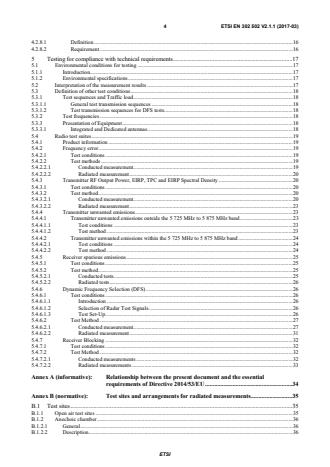
ETSI EN 302 502 V2.1.1 (2017-03) - Wireless Access Systems (WAS); 5,8 GHz fixed broadband data transmitting systems; Harmonised Standard covering the essential requirements of article 3.2 of Directive 2014/53/EU



Overview
SIST EN 302 502 V2.1.1:2017 is a harmonized European standard developed by the Slovenian Institute for Standardization (SIST), aligning with ETSI EN 302 502. The standard defines the technical characteristics and measurement methods for Fixed Broadband Data Transmitting Systems operating in the 5.8 GHz frequency band (5 725 MHz to 5 875 MHz).
This standard addresses both integral and dedicated antenna systems, including fixed point-to-point and point-to-multipoint broadband wireless access solutions. Importantly, SIST EN 302 502 V2.1.1:2017 provides one route to demonstrate conformity with essential radio equipment requirements under Article 3.2 of the Radio Equipment Directive 2014/53/EU, ensuring safe, efficient, and lawful operation across EU member states.
Key Topics
- Frequency Band Allocation: The standard covers devices intended for use in the 5.8 GHz band, specifically 5 725 MHz to 5 875 MHz.
- Technical Parameters: It includes mandatory specifications for:
- Channel center frequency designation and error limits
- Maximum transmitter RF output power and Equivalent Isotropically Radiated Power (EIRP)
- EIRP spectral density
- Power control capabilities
- Unwanted emissions, both within and outside the operating band
- Receiver spurious emissions
- Operational Features:
- Support for both integral and external (dedicated) antennas
- Dynamic Frequency Selection (DFS) to avoid interference, particularly with radar systems
- Transmit Power Control (TPC) to efficiently manage output and mitigate interference
- Measurement and Compliance Methods: The standard describes how to measure conformance with required technical limits, under defined environmental conditions.
- Environmental Considerations: The device must operate within its declared environmental profile and comply with all requirements under those conditions.
Applications
SIST EN 302 502 V2.1.1:2017 is essential for manufacturers, system integrators, and network operators focusing on:
- Fixed Broadband Wireless Access (FBWA): Ensuring reliable high-speed data transmission between fixed locations.
- Wireless Access Systems (WAS): Deployment of local area networks (LANs) and point-to-multipoint broadband solutions, facilitating last-mile connectivity.
- Industrial and Commercial Wireless Networks: Applications where robust, high-capacity wireless links are required for data backhaul or enterprise networking.
- Compliance for Market Access in the EU: Demonstrating conformity to Directive 2014/53/EU is a prerequisite for placing wireless broadband devices on the market.
By following this harmonized European standard, organizations benefit from:
- Regulatory Compliance: Smooth market access across the European Union without additional testing.
- Interference Management: Enhanced coexistence with other systems through DFS and TPC functionalities.
- Network Performance: Delivery of reliable high-speed broadband over unlicensed spectrum.
Related Standards
Organizations referencing SIST EN 302 502 V2.1.1:2017 may also consider these related standards and documents:
- Directive 2014/53/EU (Radio Equipment Directive): Lays out essential requirements for safety, electromagnetic compatibility, and radio spectrum use.
- ETSI EN 300 019-1-0: Covers environmental conditions and testing for telecom equipment.
- CEPT/ECC Report 68: Compatibility studies in the 5.8 GHz band, important for FWA systems.
- ETSI EN 301 893: Harmonized standard for 5 GHz RLAN equipment.
- ETSI TR 100 028-1/-2: Guides on measurement uncertainties for mobile radio characteristics.
For up-to-date information on harmonized standards and compliance, manufacturers should consult the European Commission and national standardization body websites.
Keywords: SIST EN 302 502 V2.1.1:2017, 5.8 GHz, broadband wireless access, Wireless Access Systems, fixed data transmitting, harmonized standard, 2014/53/EU, radio equipment compliance, fixed wireless, DFS, TPC, ETSI EN 302 502, broadband data transmission, antenna systems.
Buy Documents
ETSI EN 302 502 V2.0.8 (2016-12) - Wireless Access Systems (WAS); 5,8 GHz fixed broadband data transmitting systems; Harmonised Standard covering the essential requirements of article 3.2 of Directive 2014/53/EU
ETSI EN 302 502 V2.1.1 (2017-03) - Wireless Access Systems (WAS); 5,8 GHz fixed broadband data transmitting systems; Harmonised Standard covering the essential requirements of article 3.2 of Directive 2014/53/EU
Get Certified
Connect with accredited certification bodies for this standard

BSI Group
BSI (British Standards Institution) is the business standards company that helps organizations make excellence a habit.

NYCE
Mexican standards and certification body.

ANCE
Mexican certification and testing association.
Sponsored listings
Frequently Asked Questions
SIST EN 302 502 V2.1.1:2017 is a standard published by the Slovenian Institute for Standardization (SIST). Its full title is "Wireless Access Systems (WAS) - 5,8 GHz fixed broadband data transmitting systems - Harmonised Standard covering the essential requirements of article 3.2 of Directive 2014/53/EU". This standard covers: The present document specifies technical characteristics and methods of measurements for Fixed Broadband Data Transmitting Systems intended to operate in the 5,8 GHz band (5 725 MHz to 5 875 MHz). The present document is equally applicable to systems utilizing integral or dedicated antennas. The present document covers the essential requirements of article 3.2 of Directive 2014/53/EU [i.1] under the conditions identified in annex A.
The present document specifies technical characteristics and methods of measurements for Fixed Broadband Data Transmitting Systems intended to operate in the 5,8 GHz band (5 725 MHz to 5 875 MHz). The present document is equally applicable to systems utilizing integral or dedicated antennas. The present document covers the essential requirements of article 3.2 of Directive 2014/53/EU [i.1] under the conditions identified in annex A.
SIST EN 302 502 V2.1.1:2017 is classified under the following ICS (International Classification for Standards) categories: 33.060.01 - Radiocommunications in general; 35.110 - Networking. The ICS classification helps identify the subject area and facilitates finding related standards.
SIST EN 302 502 V2.1.1:2017 is associated with the following European legislation: EU Directives/Regulations: 1999/5/EC, 2005-01-1864, 2014/53/EU. When a standard is cited in the Official Journal of the European Union, products manufactured in conformity with it benefit from a presumption of conformity with the essential requirements of the corresponding EU directive or regulation.
SIST EN 302 502 V2.1.1:2017 is available in PDF format for immediate download after purchase. The document can be added to your cart and obtained through the secure checkout process. Digital delivery ensures instant access to the complete standard document.
Standards Content (Sample)
Draft ETSI EN 302 502 V2.0.8 (2016-12)
HARMONISED EUROPEAN STANDARD
Wireless Access Systems (WAS);
5,8 GHz fixed broadband data transmitting systems;
Harmonised Standard covering the essential requirements
of article 3.2 of Directive 2014/53/EU
2 Draft ETSI EN 302 502 V2.0.8 (2016-12)
Reference
REN/BRAN-0060021
Keywords
access, broadband, digital, fixed networks,
harmonised standard, multipoint
ETSI
650 Route des Lucioles
F-06921 Sophia Antipolis Cedex - FRANCE
Tel.: +33 4 92 94 42 00 Fax: +33 4 93 65 47 16
Siret N° 348 623 562 00017 - NAF 742 C
Association à but non lucratif enregistrée à la
Sous-Préfecture de Grasse (06) N° 7803/88
Important notice
The present document can be downloaded from:
http://www.etsi.org/standards-search
The present document may be made available in electronic versions and/or in print. The content of any electronic and/or
print versions of the present document shall not be modified without the prior written authorization of ETSI. In case of any
existing or perceived difference in contents between such versions and/or in print, the only prevailing document is the
print of the Portable Document Format (PDF) version kept on a specific network drive within ETSI Secretariat.
Users of the present document should be aware that the document may be subject to revision or change of status.
Information on the current status of this and other ETSI documents is available at
https://portal.etsi.org/TB/ETSIDeliverableStatus.aspx
If you find errors in the present document, please send your comment to one of the following services:
https://portal.etsi.org/People/CommiteeSupportStaff.aspx
Copyright Notification
No part may be reproduced or utilized in any form or by any means, electronic or mechanical, including photocopying
and microfilm except as authorized by written permission of ETSI.
The content of the PDF version shall not be modified without the written authorization of ETSI.
The copyright and the foregoing restriction extend to reproduction in all media.
© European Telecommunications Standards Institute 2016.
All rights reserved.
TM TM TM
DECT , PLUGTESTS , UMTS and the ETSI logo are Trade Marks of ETSI registered for the benefit of its Members.
TM
3GPP and LTE™ are Trade Marks of ETSI registered for the benefit of its Members and
of the 3GPP Organizational Partners.
GSM® and the GSM logo are Trade Marks registered and owned by the GSM Association.
ETSI
3 Draft ETSI EN 302 502 V2.0.8 (2016-12)
Contents
Intellectual Property Rights . 6
Foreword . 6
Modal verbs terminology . 6
Introduction . 6
1 Scope . 7
2 References . 7
2.1 Normative references . 7
2.2 Informative references . 7
3 Definitions, symbols and abbreviations . 8
3.1 Definitions . 8
3.2 Symbols . 9
3.3 Abbreviations . 9
4 Technical requirements specification . 10
4.1 Environmental profile . 10
4.2 Conformance requirements . 10
4.2.1 Designation of centre frequencies and frequency error . 10
4.2.1.1 Definition . 10
4.2.1.2 Limits . 10
4.2.1.3 Conformance . 10
4.2.2 Transmitter RF output power, EIRP and EIRP spectral density . 10
4.2.2.1 Definition . 10
4.2.2.2 Limits . 11
4.2.2.3 Conformance . 11
4.2.3 Transmitter unwanted emissions . 11
4.2.3.1 Transmitter unwanted emissions outside the 5 725 MHz to 5 875 MHz band . 11
4.2.3.1.1 Definition. 11
4.2.3.1.2 Limits . 11
4.2.3.1.3 Conformance . 11
4.2.3.2 Transmitter unwanted emissions within the 5 725 MHz to 5 875 MHz band . 11
4.2.3.2.1 Definition. 11
4.2.3.2.2 Limits . 12
4.2.3.2.3 Conformance . 12
4.2.4 Transmitter Power Control (TPC) . 12
4.2.4.1 Definition . 12
4.2.4.2 Limit . 12
4.2.4.3 Conformance . 12
4.2.5 Receiver spurious emissions . 13
4.2.5.1 Definition . 13
4.2.5.2 Limit . 13
4.2.5.3 Conformance . 13
4.2.6 Dynamic Frequency Selection (DFS) . 13
4.2.6.1 General Requirements . 13
4.2.6.2 DFS Technical requirements specifications . 13
4.2.6.2.1 Channel availability check and channel revalidation period . 13
4.2.6.2.2 In-Service Monitoring . 14
4.2.6.2.3 Channel Shutdown. 14
4.2.6.2.4 Non-Occupancy Period . 15
4.2.7 Receiver Blocking . 15
4.2.7.1 Applicability. 15
4.2.7.2 Definition . 15
4.2.7.3 Performance Criteria . 15
4.2.7.4 Limits . 16
4.2.7.5 Conformance . 16
4.2.8 User Access Restrictions . 16
ETSI
4 Draft ETSI EN 302 502 V2.0.8 (2016-12)
4.2.8.1 Definition . 16
4.2.8.2 Requirement . 16
5 Testing for compliance with technical requirements . 17
5.1 Environmental conditions for testing . 17
5.1.1 Introduction. 17
5.1.2 Environmental specifications . 17
5.2 Interpretation of the measurement results . 17
5.3 Definition of other test conditions . 18
5.3.1 Test sequences and Traffic load . 18
5.3.1.1 General test transmission sequences . 18
5.3.1.2 Test transmission sequences for DFS tests . 18
5.3.2 Test frequencies . 18
5.3.3 Presentation of Equipment . 18
5.3.3.1 Integrated and Dedicated antennas . 18
5.4 Radio test suites . 19
5.4.1 Product information . 19
5.4.2 Frequency error . 19
5.4.2.1 Test conditions . 19
5.4.2.2 Test methods . 19
5.4.2.2.1 Conducted measurement. 19
5.4.2.2.2 Radiated measurement . 20
5.4.3 Transmitter RF Output Power, EIRP, TPC and EIRP Spectral Density . 20
5.4.3.1 Test conditions . 20
5.4.3.2 Test method . 20
5.4.3.2.1 Conducted measurement. 20
5.4.3.2.2 Radiated measurement . 23
5.4.4 Transmitter unwanted emissions . 23
5.4.4.1 Transmitter unwanted emissions outside the 5 725 MHz to 5 875 MHz band . 23
5.4.4.1.1 Test conditions . 23
5.4.4.1.2 Test method . 23
5.4.4.2 Transmitter unwanted emissions within the 5 725 MHz to 5 875 MHz band . 24
5.4.4.2.1 Test conditions . 24
5.4.4.2.2 Test method . 24
5.4.5 Receiver spurious emissions . 25
5.4.5.1 Test conditions . 25
5.4.5.2 Test method . 25
5.4.5.2.1 Conducted tests . 25
5.4.5.2.2 Radiated tests . 26
5.4.6 Dynamic Frequency Selection (DFS) . 26
5.4.6.1 Test conditions . 26
5.4.6.1.1 Introduction . 26
5.4.6.1.2 Selection of Radar Test Signals . 26
5.4.6.1.3 Test Set-Up . 26
5.4.6.2 Test Method . 27
5.4.6.2.1 Conducted measurement. 27
5.4.6.2.2 Radiated measurement . 31
5.4.7 Receiver Blocking . 32
5.4.7.1 Test conditions . 32
5.4.7.2 Test Method . 32
5.4.7.2.1 Conducted measurements . 32
5.4.7.2.2 Radiated measurements . 33
Annex A (informative): Relationship between the present document and the essential
requirements of Directive 2014/53/EU . 34
Annex B (normative): Test sites and arrangements for radiated measurements . 35
B.1 Test sites . 35
B.1.1 Open air test sites . 35
B.1.2 Anechoic chamber . 36
B.1.2.1 General . 36
B.1.2.2 Description . 36
ETSI
5 Draft ETSI EN 302 502 V2.0.8 (2016-12)
B.1.2.3 Influence of parasitic reflections . 36
B.1.2.4 Calibration and mode of use . 37
B.2 Test antenna . 38
B.3 Substitution antenna . 39
Annex C (normative): General description of measurement . 40
C.1 Conducted measurements . 40
C.2 Radiated measurements . 40
C.3 Substitution measurement . 41
Annex D (normative): Dynamic Frequency Selection (DFS) parameters . 42
Annex E (informative): Bibliography . 45
Annex F (informative): Change History . 46
History . 47
ETSI
6 Draft ETSI EN 302 502 V2.0.8 (2016-12)
Intellectual Property Rights
IPRs essential or potentially essential to the present document may have been declared to ETSI. The information
pertaining to these essential IPRs, if any, is publicly available for ETSI members and non-members, and can be found
in ETSI SR 000 314: "Intellectual Property Rights (IPRs); Essential, or potentially Essential, IPRs notified to ETSI in
respect of ETSI standards", which is available from the ETSI Secretariat. Latest updates are available on the ETSI Web
server (https://ipr.etsi.org/).
Pursuant to the ETSI IPR Policy, no investigation, including IPR searches, has been carried out by ETSI. No guarantee
can be given as to the existence of other IPRs not referenced in ETSI SR 000 314 (or the updates on the ETSI Web
server) which are, or may be, or may become, essential to the present document.
Foreword
This draft Harmonised European Standard (EN) has been produced by ETSI Technical Committee Broadband Radio
Access Networks (BRAN), and is now submitted for the combined Public Enquiry and Vote phase of the ETSI
standards EN Approval Procedure.
The present document has been prepared under the Commission's standardisation request C(2015) 5376 final [i.2] to
provide one voluntary means of conforming to the essential requirements of Directive 2014/53/EU on the harmonisation
of the laws of the Member States relating to the making available on the market of radio equipment and repealing
Directive 1999/5/EC [i.1].
Once the present document is cited in the Official Journal of the European Union under that Directive, compliance with
the normative clauses of the present document given in table A.1 confers, within the limits of the scope of the present
document, a presumption of conformity with the corresponding essential requirements of that Directive, and associated
EFTA regulations.
Proposed national transposition dates
Date of latest announcement of this EN (doa): 3 months after ETSI publication
Date of latest publication of new National Standard
or endorsement of this EN (dop/e): 6 months after doa
Date of withdrawal of any conflicting National Standard (dow): 18 months after doa
Modal verbs terminology
In the present document "shall", "shall not", "should", "should not", "may", "need not", "will", "will not", "can" and
"cannot" are to be interpreted as described in clause 3.2 of the ETSI Drafting Rules (Verbal forms for the expression of
provisions).
"must" and "must not" are NOT allowed in ETSI deliverables except when used in direct citation.
Introduction
The present document covers 5,8 GHz high performance Broadband Fixed Wireless Access systems (BFWA) including
equipment which is used in wireless local area networks. Such networks provide high speed data communications in
between devices connected to the wireless infrastructure.
ETSI
7 Draft ETSI EN 302 502 V2.0.8 (2016-12)
1 Scope
The present document specifies technical characteristics and methods of measurements for Fixed Broadband Data
Transmitting Systems intended to operate in the 5,8 GHz band (5 725 MHz to 5 875 MHz). The present document is
equally applicable to systems utilizing integral or dedicated antennas.
The present document covers the essential requirements of article 3.2 of Directive 2014/53/EU [i.1] under the
conditions identified in annex A.
2 References
2.1 Normative references
References are specific, identified by date of publication and/or edition number or version number. Only the cited
version applies.
Referenced documents which are not found to be publicly available in the expected location might be found at
https://docbox.etsi.org/Reference/.
NOTE: While any hyperlinks included in this clause were valid at the time of publication, ETSI cannot guarantee
their long term validity.
The following referenced documents are necessary for the application of the present document.
Not applicable.
2.2 Informative references
References are either specific (identified by date of publication and/or edition number or version number) or
non-specific. For specific references, only the cited version applies. For non-specific references, the latest version of the
referenced document (including any amendments) applies.
NOTE: While any hyperlinks included in this clause were valid at the time of publication, ETSI cannot guarantee
their long term validity.
The following referenced documents are not necessary for the application of the present document but they assist the
user with regard to a particular subject area.
[i.1] Directive 2014/53/EU of the European Parliament and of the Council of 16 April 2014 on the
harmonisation of the laws of the Member States relating to the making available on the market of
radio equipment and repealing Directive 1999/5/EC.
[i.2] Commission Implementing Decision C(2015) 5376 final of 4.8.2015 on a standardisation request
to the European Committee for Electrotechnical Standardisation and to the European
Telecommunications Standards Institute as regards radio equipment in support of Directive
2014/53/EU of the European Parliament and of the Council.
[i.3] ETSI EN 300 019-1-0 (V2.1.2) (09-2003): "Environmental Engineering (EE); Environmental
conditions and environmental tests for telecommunications equipment; Part 1-0: Classification of
environmental conditions; Introduction".
[i.4] ETSI TR 100 028-1 (V1.4.1) (12-2001): "Electromagnetic compatibility and Radio spectrum
Matters (ERM); Uncertainties in the measurement of mobile radio equipment characteristics;
Part 1".
[i.5] ETSI TR 100 028-2 (V1.4.1) (12-2001): "Electromagnetic compatibility and Radio spectrum
Matters (ERM); Uncertainties in the measurement of mobile radio equipment characteristics;
Part 2".
ETSI
8 Draft ETSI EN 302 502 V2.0.8 (2016-12)
[i.6] CEPT/ECC Report 68 (Riga, June 2005): "Compatibility studies in the band 5725-5875 MHz
between Fixed Wireless Access (FWA) systems and other systems".
3 Definitions, symbols and abbreviations
3.1 Definitions
For the purposes of the present document, the terms and definitions given in Directive 2014/53/EU [i.1] and the
following apply:
antenna assembly: combination of the antenna (integral or dedicated), its coaxial cable and if applicable, its antenna
connector and associated switching components
available channel: channel identified as usable as an Operating Channel
Broadband Fixed Wireless Access (BFWA): operation of fixed Point to Point or fixed Point to Multipoint wireless
devices or systems used to connect fixed locations
burst: period during which radio waves are intentionally transmitted, preceded and succeeded by periods during which
no intentional transmission is made
dedicated antenna: antenna external to the equipment, using an antenna connector with a cable or a wave-guide
NOTE: The antenna has been designed or developed for one or more specific types of equipment. It is the
combination of dedicated antenna and radio equipment that is expected to be compliant with the
regulations.
environmental profile: declared range of environmental conditions under which equipment within the scope of the
present document is required to be compliant
in-service monitoring: mechanism to check a channel in use by the device for the presence of a radar signal with a
level above the Interference Detection Threshold
integral antenna: antenna designed as a fixed part of the equipment, without the use of an external connector and as
such which cannot be disconnected from the equipment by a user with the intend to connect another antenna
NOTE 1: An integral antenna may be fitted internally or externally. In the case where the antenna is external, a
non-detachable cable or wave-guide can be used.
NOTE 2: Even when equipment with an integral antenna is concerned, it might still be possible to separate the
antenna from the equipment using a special tool. In such cases the assessment of the radio equipment and
of the antenna against requirements of the present document may be done separately.
operating channel: Available Channel on which the FWA device has started transmissions
NOTE: An Operating Channel becomes again an Available Channel if the FWA device stopped all transmissions
on that channel and no radar signal was detected by the In-Service Monitoring.
operating nominal RF channel width: nominal amount of spectrum used by a single device operating on an identified
centre frequency
Transmit Power Control (TPC): technique in which the transmitter output power is controlled resulting in reduced
interference to other systems
Transmit Power Control range: power range over which the TPC is able to control the transmitter output power
unavailable channel: channel which cannot be considered by the FWA device for a certain period of time
(Non-Occupancy Period) after a radar signal was detected on that channel
ETSI
9 Draft ETSI EN 302 502 V2.0.8 (2016-12)
3.2 Symbols
For the purposes of the present document, the following symbols apply:
A Measured power output (dBm)
B Radar burst period
Ch Channel free from radars
f
Ch Channel occupied by a radar
r
ChS Nominal occupied channel bandwidth
D Measured power density
E Field strength
E Reference field strength
o
f Carrier frequency
c
G Antenna gain (dBi)
L Radar burst length
n Number of channels
P The conducted power level of the equipment
cond
P The maximum useable conducted power level from the equipment
cond_1
P The maximum conducted power level from the power range associated with the highest useable
cond_2
antenna assembly gain
P The minimum conducted power level from the equipment
cond_3
P The EIRP of the equipment
EIRP
R Distance
R Reference distance
o
S0 Signal power
T0 Time instant
T1 Time instant
T2 Time instant
T3 Time instant
W Radar pulse width
x Observed duty cycle
3.3 Abbreviations
For the purposes of the present document, the following abbreviations apply:
BFWA Broadband Fixed Wireless Access
BW Band Width
CW Continuous Wave
DFS Dynamic Frequency Selection
EFTA European Free Trade Association
EIRP Equivalent Isotropically Radiated Power
ERP Effective Radiated Power
FWA Fixed Wireless Access
IF Intermediate Frequencies
PD mean Power Density EIRP
PER Packet Error Rate
ppm parts per million
pps pulses per second
PRF Pulse Repetition Frequency
RF Radio Frequency
TPC Transmit Power Control
Tx Transmit, Transmitter
UUT Unit Under Test
ETSI
10 Draft ETSI EN 302 502 V2.0.8 (2016-12)
4 Technical requirements specification
4.1 Environmental profile
The technical requirements of the present document apply under the environmental profile for operation of the
equipment, which shall be declared by the manufacturer. The equipment shall comply with all the technical
requirements of the present document which are identified as applicable in annex A at all times when operating within
the boundary limits of the declared operational environmental profile.
4.2 Conformance requirements
4.2.1 Designation of centre frequencies and frequency error
4.2.1.1 Definition
Frequency error is the difference between the nominal channel centre frequency and the actual channel centre
frequency.
The nominal channel centre frequencies f , identified by the following expression:
c
5 725 + (n × 2,5) MHz, where either n = 2 to 58 for ChS = 10 MHz,
or n = 4 to 56 for ChS = 20 MHz.
4.2.1.2 Limits
The manufacturer shall declare the centre frequencies on which the equipment can operate. The equipment shall only
operate in channels centred on any of those frequencies identified in clause 4.2.1.1.
The actual carrier centre frequency shall be maintained within the range f ± 20 ppm of the nominal channel centre
c
frequency.
4.2.1.3 Conformance
Conformance tests as defined in clause 5.4.2 shall be carried out.
4.2.2 Transmitter RF output power, EIRP and EIRP spectral density
4.2.2.1 Definition
The RF output power is the mean conducted power applied to the antenna assembly, during a transmission burst.
The EIRP is the maximum radiated power of the equipment relative to an isotropic antenna.
The EIRP spectral density is the mean EIRP evaluated within a specified measurement bandwidth during a transmission
burst.
ETSI
11 Draft ETSI EN 302 502 V2.0.8 (2016-12)
4.2.2.2 Limits
The mean EIRP, RF power and EIRP spectral density when configured to operate at the highest stated power level
(P ) shall not exceed the limits in table 1.
cond_1
Table 1: Mean RF output power, EIRP and
power density limits at the highest power level
Channel Width Mean RF power into antenna mean EIRP Mean EIRP spectral density
(MHz) (dBm) (dBm) (dBm/MHz)
ChS
10 27 33 23
20 30 36 23
4.2.2.3 Conformance
Conformance tests as defined in clause 5.4.3 shall be carried out.
4.2.3 Transmitter unwanted emissions
4.2.3.1 Transmitter unwanted emissions outside the 5 725 MHz to 5 875 MHz band
4.2.3.1.1 Definition
These are radio frequency emissions outside the band 5 725 MHz to 5 875 MHz.
Equipment that, in addition to a transmit mode, also have a standby or idle mode, shall in these modes meet the
requirements defined in clause 4.2.5.
4.2.3.1.2 Limits
The level of unwanted emission shall not exceed the limits given in table 2.
Table 2: Transmitter unwanted emission limits
Frequency range Limit Bandwidth
(MHz) (dBm) (kHz)
(see note)
30 to 1 000 -36 100
1 000 to 5 725 -30 1 000
5 875 to 26 500 -30 1 000
4.2.3.1.3 Conformance
Conformance tests as defined in clause 5.4.4.1 shall be carried out.
4.2.3.2 Transmitter unwanted emissions within the 5 725 MHz to 5 875 MHz band
4.2.3.2.1 Definition
These are radio frequency emissions within the band 5 725 MHz to 5 875 MHz.
ETSI
5 587 MHz
5 725 MHz
12 Draft ETSI EN 302 502 V2.0.8 (2016-12)
4.2.3.2.2 Limits
The average level of the transmitted spectrum based on the declared ChS shall not exceed the limits given in figure 1
when operating under highest output power conditions.
Relative Level [dB]
0 dB = Reference Level
-20 dB
-28 dB
-40 dB
-30(-15) -20(-10) 20(10) (30)15
Frequency offset [MHz]
-12(-6) -9,5(-4,75) 9,5(4,75) 12(6)
NOTE 1: 0 dB Reference Level is the spectral density relative to the maximum spectral power density of the
transmitted signal.
NOTE 2: On the Frequency Offset axis, the figures apply to ChS = 20 MHz whereas the figures in parentheses
apply to ChS = 10 MHz.
NOTE 3: Emissions that fall outside the lower and upper band frequency limits of 5 725 MHz and 5 875 MHz
respectively shall instead meet the unwanted emission limits of clause 4.2.3.1.
Figure 1: Emission Mask
4.2.3.2.3 Conformance
Conformance tests as defined in clause 5.4.4.2 shall be carried out.
4.2.4 Transmitter Power Control (TPC)
4.2.4.1 Definition
Transmit Power Control (TPC) is a mechanism to reduce the aggregate power from a large number of devices to
improve the spectrum sharing conditions, see CEPT/ECC Report 68 [i.6].
4.2.4.2 Limit
The FWA device shall have the capability to reduce the operating mean EIRP level to a level not exceeding 24 dBm for
ChS = 20 MHz and 21 dBm for ChS = 10 MHz.
4.2.4.3 Conformance
Conformance tests as defined in clause 5.4.3 shall be carried out.
ETSI
13 Draft ETSI EN 302 502 V2.0.8 (2016-12)
4.2.5 Receiver spurious emissions
4.2.5.1 Definition
Receiver spurious emissions are emissions at any frequency when the equipment is in receive mode.
4.2.5.2 Limit
The spurious emissions of the receiver shall not exceed the limits given in table 3.
Table 3: Spurious radiated emission limits
Frequency range Maximum power ERP measurement
bandwidth
30 MHz to 1 GHz -57 dBm 100 kHz
1 GHz to 26,5 GHz -47 dBm 1 MHz
4.2.5.3 Conformance
Conformance tests as defined in clause 5.4.5 shall be carried out.
4.2.6 Dynamic Frequency Selection (DFS)
4.2.6.1 General Requirements
All devices in a FWA deployment shall employ full Dynamic Frequency Selection (DFS) functionality to detect
transmissions from other systems and to avoid co-channel operation with these systems, notably radar systems.
Dynamic Frequency Selection (DFS) is only required in the frequency range 5 725 MHz to 5 850 MHz.
The operational behaviour and DFS requirements for all equipment are as follows:
a) the equipment shall use a Radar Interference Detection function in order to detect radar signals;
b) before transmitting on a channel, which has not been identified as an Available Channel, the equipment shall
perform a Channel Availability Check (see clause 4.2.6.2.1) to ensure that there is no radar operating on the
channel;
c) during normal operation, the equipment shall monitor the Operating Channel (In-Service Monitoring) to ensure
that there is no radar operating on the channel;
d) if the equipment has detected a radar signal during In-Service Monitoring, the Channel Shutdown shall be
initiated and the Operating Channel becomes an Unavailable Channel;
e) the equipment shall not resume any transmissions on this Unavailable Channel during a period of time after a
radar signal was detected. This period is referred to as the Non-Occupancy Period (see clause 4.2.6.2.4);
f) after the end of a Non-Occupancy Period, a Channel Availability Check is required before an Unavailable
Channel can be identified as an Available Channel again;
g) a channel can only have one status at any specific time.
4.2.6.2 DFS Technical requirements specifications
4.2.6.2.1 Channel availability check and channel revalidation period
4.2.6.2.1.1 Definition
The Channel Availability Check is defined as the mechanism by which a device checks a channel for the presence of
radar signals.
ETSI
14 Draft ETSI EN 302 502 V2.0.8 (2016-12)
There shall be no transmissions by the device within the channel being checked during this process.
If no radars have been detected by this mechanism, the channel becomes an Available Channel.
Following a channel availability check during which no radars were detected, the Channel Revalidation Period is
defined as the period of time during which a channel identified as an Available Channel remains valid as such.
The device shall only start transmissions on Available Channels.
At each power-up, the device is assumed to have no Available Channels.
4.2.6.2.1.2 Limit
The Channel Availability Check shall be performed during a continuous period in time (Channel Availability Check
Time) which shall not be less than the value defined in table D.1.
During the Channel Availability Check, the device shall be capable of detecting any of the radar signals that fall within
the range given by tables D.3.1 and D.3.2 with a level above the Interference Detection Threshold defined in table D.2.
The detection probability for a given radar signal shall be greater than the value defined in tables D.3.1 and D.3.2.
The Channel Revalidation Period for Available Channels remains valid for a maximum period as defined in table D.1.
4.2.6.2.1.3 Conformance
Conformance tests for this requirement are defined in clause 5.4.6.
4.2.6.2.2 In-Service Monitoring
4.2.6.2.2.1 Definition
The In-Service Monitoring is defined as the process by which a device monitors the Operating Channel for the presence
of radar signals.
4.2.6.2.2.2 Limit
The In-Service Monitoring shall be used to continuously monitor an Operating Channel.
The In-Service-Monitoring shall start immediately after the device has started transmissions on an Operating Channel.
During the In-Service Monitoring, the device shall be capable of detecting any of the radar signals that fall within the
range given by table D.3 a) and by table D.3 b) with a level above the Interference Detection Threshold defined in
table D.2.
The detection probability for a given radar signal shall be greater than the value defined in table D.3 a) and in
table D.3 b).
4.2.6.2.2.3 Conformance
Conformance tests for this requirement are defined in clause 5.4.6.
4.2.6.2.3 Channel Shutdown
4.2.6.2.3.1 Definition
The Channel Shutdown is defined as the process initiated by the equipment immediately after a radar signal has been
detected on an Operating Channel.
The equipment shall stop transmitting on this channel, which it shall do within the Channel Move Time.
The aggregate duration of all transmissions of the equipment on this channel during the Channel Move Time shall be
limited to the Channel Closing Transmission Time. The aggregate duration of all transmissions shall not include quiet
periods in between transmissions.
ETSI
15 Draft ETSI EN 302 502 V2.0.8 (2016-12)
4.2.6.2.3.2 Limit
The Channel Shutdown process shall start immediately after a radar signal has been detected.
The Channel Move Time shall not exceed the limit defined in table D.1.
The Channel Closing Transmission Time shall not exceed the limit defined in table D.1.
4.2.6.2.3.3 Conformance
Conformance tests for this requirement are defined in clause 5.4.6.
4.2.6.2.4 Non-Occupancy Period
4.2.6.2.4.1 Definition
The Non-Occupancy Period is defined as the time during which the device shall not make any transmissions on a
channel after a radar signal was detected on that channel by either the Channel Availability Check or the In-Service
Monitoring.
A new Channel Availability Check is required before the channel can be identified again as an Available Channel.
4.2.6.2.4.2 Limit
The Non-Occupancy Period shall not be less than the value defined in table D.1.
4.2.6.2.4.3 Conformance
Conformance tests for this requirement are defined in clause 5.4.6.
4.2.7 Receiver Blocking
4.2.7.1 Applicability
The present requirement applies to all equipment within the scope of the present document.
4.2.7.2 Definition
Receiver blocking is a measure of the capability of the equipment to receive a wanted signal on its operating channel
without exceeding a given degradation due to the presence of an unwanted input signal (blocking signal) on frequencies
other than those of the operating bands provided in clause 1.
4.2.7.3 Performance Criteria
The mi
...
HARMONISED EUROPEAN STANDARD
Wireless Access Systems (WAS);
5,8 GHz fixed broadband data transmitting systems;
Harmonised Standard covering the essential requirements
of article 3.2 of Directive 2014/53/EU
2 ETSI EN 302 502 V2.1.1 (2017-03)
Reference
REN/BRAN-0060021
Keywords
access, broadband, digital, fixed networks,
harmonised standard, multipoint
ETSI
650 Route des Lucioles
F-06921 Sophia Antipolis Cedex - FRANCE
Tel.: +33 4 92 94 42 00 Fax: +33 4 93 65 47 16
Siret N° 348 623 562 00017 - NAF 742 C
Association à but non lucratif enregistrée à la
Sous-Préfecture de Grasse (06) N° 7803/88
Important notice
The present document can be downloaded from:
http://www.etsi.org/standards-search
The present document may be made available in electronic versions and/or in print. The content of any electronic and/or
print versions of the present document shall not be modified without the prior written authorization of ETSI. In case of any
existing or perceived difference in contents between such versions and/or in print, the only prevailing document is the
print of the Portable Document Format (PDF) version kept on a specific network drive within ETSI Secretariat.
Users of the present document should be aware that the document may be subject to revision or change of status.
Information on the current status of this and other ETSI documents is available at
https://portal.etsi.org/TB/ETSIDeliverableStatus.aspx
If you find errors in the present document, please send your comment to one of the following services:
https://portal.etsi.org/People/CommiteeSupportStaff.aspx
Copyright Notification
No part may be reproduced or utilized in any form or by any means, electronic or mechanical, including photocopying
and microfilm except as authorized by written permission of ETSI.
The content of the PDF version shall not be modified without the written authorization of ETSI.
The copyright and the foregoing restriction extend to reproduction in all media.
© European Telecommunications Standards Institute 2017.
All rights reserved.
TM TM TM
DECT , PLUGTESTS , UMTS and the ETSI logo are Trade Marks of ETSI registered for the benefit of its Members.
TM
3GPP and LTE™ are Trade Marks of ETSI registered for the benefit of its Members and
of the 3GPP Organizational Partners.
GSM® and the GSM logo are Trade Marks registered and owned by the GSM Association.
ETSI
3 ETSI EN 302 502 V2.1.1 (2017-03)
Contents
Intellectual Property Rights . 6
Foreword . 6
Modal verbs terminology . 6
Introduction . 6
1 Scope . 7
2 References . 7
2.1 Normative references . 7
2.2 Informative references . 7
3 Definitions, symbols and abbreviations . 8
3.1 Definitions . 8
3.2 Symbols . 9
3.3 Abbreviations . 9
4 Technical requirements specification . 10
4.1 Environmental profile . 10
4.2 Conformance requirements . 10
4.2.1 Designation of centre frequencies and frequency error . 10
4.2.1.1 Definition . 10
4.2.1.2 Limits . 10
4.2.1.3 Conformance . 10
4.2.2 Transmitter RF output power, EIRP and EIRP spectral density . 10
4.2.2.1 Definition . 10
4.2.2.2 Limits . 11
4.2.2.3 Conformance . 11
4.2.3 Transmitter unwanted emissions . 11
4.2.3.1 Transmitter unwanted emissions outside the 5 725 MHz to 5 875 MHz band . 11
4.2.3.1.1 Definition. 11
4.2.3.1.2 Limits . 11
4.2.3.1.3 Conformance . 11
4.2.3.2 Transmitter unwanted emissions within the 5 725 MHz to 5 875 MHz band . 11
4.2.3.2.1 Definition. 11
4.2.3.2.2 Limits . 12
4.2.3.2.3 Conformance . 12
4.2.4 Transmitter Power Control (TPC) . 12
4.2.4.1 Definition . 12
4.2.4.2 Limit . 12
4.2.4.3 Conformance . 12
4.2.5 Receiver spurious emissions . 13
4.2.5.1 Definition . 13
4.2.5.2 Limit . 13
4.2.5.3 Conformance . 13
4.2.6 Dynamic Frequency Selection (DFS) . 13
4.2.6.1 General Requirements . 13
4.2.6.2 DFS Technical requirements specifications . 13
4.2.6.2.1 Channel availability check and channel revalidation period . 13
4.2.6.2.2 In-Service Monitoring . 14
4.2.6.2.3 Channel Shutdown. 14
4.2.6.2.4 Non-Occupancy Period . 15
4.2.7 Receiver Blocking . 15
4.2.7.1 Applicability. 15
4.2.7.2 Definition . 15
4.2.7.3 Performance Criteria . 15
4.2.7.4 Limits . 16
4.2.7.5 Conformance . 16
4.2.8 User Access Restrictions . 16
ETSI
4 ETSI EN 302 502 V2.1.1 (2017-03)
4.2.8.1 Definition . 16
4.2.8.2 Requirement . 16
5 Testing for compliance with technical requirements . 17
5.1 Environmental conditions for testing . 17
5.1.1 Introduction. 17
5.1.2 Environmental specifications . 17
5.2 Interpretation of the measurement results . 17
5.3 Definition of other test conditions . 18
5.3.1 Test sequences and Traffic load . 18
5.3.1.1 General test transmission sequences . 18
5.3.1.2 Test transmission sequences for DFS tests . 18
5.3.2 Test frequencies . 18
5.3.3 Presentation of Equipment . 18
5.3.3.1 Integrated and Dedicated antennas . 18
5.4 Radio test suites . 19
5.4.1 Product information . 19
5.4.2 Frequency error . 19
5.4.2.1 Test conditions . 19
5.4.2.2 Test methods . 19
5.4.2.2.1 Conducted measurement. 19
5.4.2.2.2 Radiated measurement . 20
5.4.3 Transmitter RF Output Power, EIRP, TPC and EIRP Spectral Density . 20
5.4.3.1 Test conditions . 20
5.4.3.2 Test method . 20
5.4.3.2.1 Conducted measurement. 20
5.4.3.2.2 Radiated measurement . 23
5.4.4 Transmitter unwanted emissions . 23
5.4.4.1 Transmitter unwanted emissions outside the 5 725 MHz to 5 875 MHz band . 23
5.4.4.1.1 Test conditions . 23
5.4.4.1.2 Test method . 23
5.4.4.2 Transmitter unwanted emissions within the 5 725 MHz to 5 875 MHz band . 24
5.4.4.2.1 Test conditions . 24
5.4.4.2.2 Test method . 24
5.4.5 Receiver spurious emissions . 25
5.4.5.1 Test conditions . 25
5.4.5.2 Test method . 25
5.4.5.2.1 Conducted tests . 25
5.4.5.2.2 Radiated tests . 26
5.4.6 Dynamic Frequency Selection (DFS) . 26
5.4.6.1 Test conditions . 26
5.4.6.1.1 Introduction . 26
5.4.6.1.2 Selection of Radar Test Signals . 26
5.4.6.1.3 Test Set-Up . 26
5.4.6.2 Test Method . 27
5.4.6.2.1 Conducted measurement. 27
5.4.6.2.2 Radiated measurement . 31
5.4.7 Receiver Blocking . 32
5.4.7.1 Test conditions . 32
5.4.7.2 Test Method . 32
5.4.7.2.1 Conducted measurements . 32
5.4.7.2.2 Radiated measurements . 33
Annex A (informative): Relationship between the present document and the essential
requirements of Directive 2014/53/EU . 34
Annex B (normative): Test sites and arrangements for radiated measurements . 35
B.1 Test sites . 35
B.1.1 Open air test sites . 35
B.1.2 Anechoic chamber . 36
B.1.2.1 General . 36
B.1.2.2 Description . 36
ETSI
5 ETSI EN 302 502 V2.1.1 (2017-03)
B.1.2.3 Influence of parasitic reflections . 36
B.1.2.4 Calibration and mode of use . 37
B.2 Test antenna . 38
B.3 Substitution antenna . 39
Annex C (normative): General description of measurement . 40
C.1 Conducted measurements . 40
C.2 Radiated measurements . 40
C.3 Substitution measurement . 41
Annex D (normative): Dynamic Frequency Selection (DFS) parameters . 42
Annex E (informative): Bibliography . 45
Annex F (informative): Change History . 46
History . 47
ETSI
6 ETSI EN 302 502 V2.1.1 (2017-03)
Intellectual Property Rights
IPRs essential or potentially essential to the present document may have been declared to ETSI. The information
pertaining to these essential IPRs, if any, is publicly available for ETSI members and non-members, and can be found
in ETSI SR 000 314: "Intellectual Property Rights (IPRs); Essential, or potentially Essential, IPRs notified to ETSI in
respect of ETSI standards", which is available from the ETSI Secretariat. Latest updates are available on the ETSI Web
server (https://ipr.etsi.org/).
Pursuant to the ETSI IPR Policy, no investigation, including IPR searches, has been carried out by ETSI. No guarantee
can be given as to the existence of other IPRs not referenced in ETSI SR 000 314 (or the updates on the ETSI Web
server) which are, or may be, or may become, essential to the present document.
Foreword
This Harmonised European Standard (EN) has been produced by ETSI Technical Committee Broadband Radio Access
Networks (BRAN).
The present document has been prepared under the Commission's standardisation request C(2015) 5376 final [i.2] to
provide one voluntary means of conforming to the essential requirements of Directive 2014/53/EU on the harmonisation
of the laws of the Member States relating to the making available on the market of radio equipment and repealing
Directive 1999/5/EC [i.1].
Once the present document is cited in the Official Journal of the European Union under that Directive, compliance with
the normative clauses of the present document given in table A.1 confers, within the limits of the scope of the present
document, a presumption of conformity with the corresponding essential requirements of that Directive, and associated
EFTA regulations.
National transposition dates
Date of adoption of this EN: 6 March 2017
Date of latest announcement of this EN (doa): 30 June 2017
Date of latest publication of new National Standard
or endorsement of this EN (dop/e): 31 December 2017
Date of withdrawal of any conflicting National Standard (dow): 31 December 2018
Modal verbs terminology
In the present document "shall", "shall not", "should", "should not", "may", "need not", "will", "will not", "can" and
"cannot" are to be interpreted as described in clause 3.2 of the ETSI Drafting Rules (Verbal forms for the expression of
provisions).
"must" and "must not" are NOT allowed in ETSI deliverables except when used in direct citation.
Introduction
The present document covers 5,8 GHz high performance Broadband Fixed Wireless Access systems (BFWA) including
equipment which is used in wireless local area networks. Such networks provide high speed data communications in
between devices connected to the wireless infrastructure.
ETSI
7 ETSI EN 302 502 V2.1.1 (2017-03)
1 Scope
The present document specifies technical characteristics and methods of measurements for Fixed Broadband Data
Transmitting Systems intended to operate in the 5,8 GHz band (5 725 MHz to 5 875 MHz). The present document is
equally applicable to systems utilizing integral or dedicated antennas.
The present document covers the essential requirements of article 3.2 of Directive 2014/53/EU [i.1] under the
conditions identified in annex A.
2 References
2.1 Normative references
References are specific, identified by date of publication and/or edition number or version number. Only the cited
version applies.
Referenced documents which are not found to be publicly available in the expected location might be found at
https://docbox.etsi.org/Reference/.
NOTE: While any hyperlinks included in this clause were valid at the time of publication, ETSI cannot guarantee
their long term validity.
The following referenced documents are necessary for the application of the present document.
Not applicable.
2.2 Informative references
References are either specific (identified by date of publication and/or edition number or version number) or
non-specific. For specific references, only the cited version applies. For non-specific references, the latest version of the
referenced document (including any amendments) applies.
NOTE: While any hyperlinks included in this clause were valid at the time of publication, ETSI cannot guarantee
their long term validity.
The following referenced documents are not necessary for the application of the present document but they assist the
user with regard to a particular subject area.
[i.1] Directive 2014/53/EU of the European Parliament and of the Council of 16 April 2014 on the
harmonisation of the laws of the Member States relating to the making available on the market of
radio equipment and repealing Directive 1999/5/EC.
[i.2] Commission Implementing Decision C(2015) 5376 final of 4.8.2015 on a standardisation request
to the European Committee for Electrotechnical Standardisation and to the European
Telecommunications Standards Institute as regards radio equipment in support of Directive
2014/53/EU of the European Parliament and of the Council.
[i.3] ETSI EN 300 019-1-0 (V2.1.2) (09-2003): "Environmental Engineering (EE); Environmental
conditions and environmental tests for telecommunications equipment; Part 1-0: Classification of
environmental conditions; Introduction".
[i.4] ETSI TR 100 028-1 (V1.4.1) (12-2001): "Electromagnetic compatibility and Radio spectrum
Matters (ERM); Uncertainties in the measurement of mobile radio equipment characteristics;
Part 1".
[i.5] ETSI TR 100 028-2 (V1.4.1) (12-2001): "Electromagnetic compatibility and Radio spectrum
Matters (ERM); Uncertainties in the measurement of mobile radio equipment characteristics;
Part 2".
ETSI
8 ETSI EN 302 502 V2.1.1 (2017-03)
[i.6] CEPT/ECC Report 68 (Riga, June 2005): "Compatibility studies in the band 5725-5875 MHz
between Fixed Wireless Access (FWA) systems and other systems".
3 Definitions, symbols and abbreviations
3.1 Definitions
For the purposes of the present document, the terms and definitions given in Directive 2014/53/EU [i.1] and the
following apply:
antenna assembly: combination of the antenna (integral or dedicated), its coaxial cable and if applicable, its antenna
connector and associated switching components
available channel: channel identified as usable as an Operating Channel
Broadband Fixed Wireless Access (BFWA): operation of fixed Point to Point or fixed Point to Multipoint wireless
devices or systems used to connect fixed locations
burst: period during which radio waves are intentionally transmitted, preceded and succeeded by periods during which
no intentional transmission is made
dedicated antenna: antenna external to the equipment, using an antenna connector with a cable or a wave-guide
NOTE: The antenna has been designed or developed for one or more specific types of equipment. It is the
combination of dedicated antenna and radio equipment that is expected to be compliant with the
regulations.
environmental profile: declared range of environmental conditions under which equipment within the scope of the
present document is required to be compliant
in-service monitoring: mechanism to check a channel in use by the device for the presence of a radar signal with a
level above the Interference Detection Threshold
integral antenna: antenna designed as a fixed part of the equipment, without the use of an external connector and as
such which cannot be disconnected from the equipment by a user with the intend to connect another antenna
NOTE 1: An integral antenna may be fitted internally or externally. In the case where the antenna is external, a
non-detachable cable or wave-guide can be used.
NOTE 2: Even when equipment with an integral antenna is concerned, it might still be possible to separate the
antenna from the equipment using a special tool. In such cases the assessment of the radio equipment and
of the antenna against requirements of the present document may be done separately.
operating channel: Available Channel on which the FWA device has started transmissions
NOTE: An Operating Channel becomes again an Available Channel if the FWA device stopped all transmissions
on that channel and no radar signal was detected by the In-Service Monitoring.
operating nominal RF channel width: nominal amount of spectrum used by a single device operating on an identified
centre frequency
Transmit Power Control (TPC): technique in which the transmitter output power is controlled resulting in reduced
interference to other systems
Transmit Power Control range: power range over which the TPC is able to control the transmitter output power
unavailable channel: channel which cannot be considered by the FWA device for a certain period of time
(Non-Occupancy Period) after a radar signal was detected on that channel
ETSI
9 ETSI EN 302 502 V2.1.1 (2017-03)
3.2 Symbols
For the purposes of the present document, the following symbols apply:
A Measured power output (dBm)
B Radar burst period
Ch Channel free from radars
f
Ch Channel occupied by a radar
r
ChS Nominal occupied channel bandwidth
D Measured power density
E Field strength
E Reference field strength
o
f Carrier frequency
c
G Antenna gain (dBi)
L Radar burst length
n Number of channels
P The conducted power level of the equipment
cond
P The maximum useable conducted power level from the equipment
cond_1
P The maximum conducted power level from the power range associated with the highest useable
cond_2
antenna assembly gain
P The minimum conducted power level from the equipment
cond_3
P The EIRP of the equipment
EIRP
R Distance
R Reference distance
o
S0 Signal power
T0 Time instant
T1 Time instant
T2 Time instant
T3 Time instant
W Radar pulse width
x Observed duty cycle
3.3 Abbreviations
For the purposes of the present document, the following abbreviations apply:
BFWA Broadband Fixed Wireless Access
BW Band Width
CW Continuous Wave
DFS Dynamic Frequency Selection
EFTA European Free Trade Association
EIRP Equivalent Isotropically Radiated Power
ERP Effective Radiated Power
FWA Fixed Wireless Access
IF Intermediate Frequencies
PD mean Power Density EIRP
PER Packet Error Rate
ppm parts per million
pps pulses per second
PRF Pulse Repetition Frequency
RF Radio Frequency
TPC Transmit Power Control
Tx Transmit, Transmitter
UUT Unit Under Test
ETSI
10 ETSI EN 302 502 V2.1.1 (2017-03)
4 Technical requirements specification
4.1 Environmental profile
The technical requirements of the present document apply under the environmental profile for operation of the
equipment, which shall be declared by the manufacturer. The equipment shall comply with all the technical
requirements of the present document which are identified as applicable in annex A at all times when operating within
the boundary limits of the declared operational environmental profile.
4.2 Conformance requirements
4.2.1 Designation of centre frequencies and frequency error
4.2.1.1 Definition
Frequency error is the difference between the nominal channel centre frequency and the actual channel centre
frequency.
The nominal channel centre frequencies f , identified by the following expression:
c
5 725 + (n × 2,5) MHz, where either n = 2 to 58 for ChS = 10 MHz,
or n = 4 to 56 for ChS = 20 MHz.
4.2.1.2 Limits
The manufacturer shall declare the centre frequencies on which the equipment can operate. The equipment shall only
operate in channels centred on any of those frequencies identified in clause 4.2.1.1.
The actual carrier centre frequency shall be maintained within the range f ± 20 ppm of the nominal channel centre
c
frequency.
4.2.1.3 Conformance
Conformance tests as defined in clause 5.4.2 shall be carried out.
4.2.2 Transmitter RF output power, EIRP and EIRP spectral density
4.2.2.1 Definition
The RF output power is the mean conducted power applied to the antenna assembly, during a transmission burst.
The EIRP is the maximum radiated power of the equipment relative to an isotropic antenna.
The EIRP spectral density is the mean EIRP evaluated within a specified measurement bandwidth during a transmission
burst.
ETSI
11 ETSI EN 302 502 V2.1.1 (2017-03)
4.2.2.2 Limits
The mean EIRP, RF power and EIRP spectral density when configured to operate at the highest stated power level
(P ) shall not exceed the limits in table 1.
cond_1
Table 1: Mean RF output power, EIRP and
power density limits at the highest power level
Channel Width Mean RF power into antenna mean EIRP Mean EIRP spectral density
(MHz) (dBm) (dBm) (dBm/MHz)
ChS
10 27 33 23
20 30 36 23
4.2.2.3 Conformance
Conformance tests as defined in clause 5.4.3 shall be carried out.
4.2.3 Transmitter unwanted emissions
4.2.3.1 Transmitter unwanted emissions outside the 5 725 MHz to 5 875 MHz band
4.2.3.1.1 Definition
These are radio frequency emissions outside the band 5 725 MHz to 5 875 MHz.
Equipment that, in addition to a transmit mode, also have a standby or idle mode, shall in these modes meet the
requirements defined in clause 4.2.5.
4.2.3.1.2 Limits
The level of unwanted emission shall not exceed the limits given in table 2.
Table 2: Transmitter unwanted emission limits
Frequency range Limit Bandwidth
(MHz) (dBm) (kHz)
30 to 1 000 -36 100
1 000 to 5 725 -30 1 000
5 875 to 26 500 -30 1 000
4.2.3.1.3 Conformance
Conformance tests as defined in clause 5.4.4.1 shall be carried out.
4.2.3.2 Transmitter unwanted emissions within the 5 725 MHz to 5 875 MHz band
4.2.3.2.1 Definition
These are radio frequency emissions within the band 5 725 MHz to 5 875 MHz.
ETSI
5 587 MHz
5 725 MHz
12 ETSI EN 302 502 V2.1.1 (2017-03)
4.2.3.2.2 Limits
The average level of the transmitted spectrum based on the declared ChS shall not exceed the limits given in figure 1
when operating under highest output power conditions.
Relative Level [dB]
0 dB = Reference Level
-20 dB
-28 dB
-40 dB
-30(-15) -20(-10) 20(10) (30)15
Frequency offset [MHz]
-12(-6) -9,5(-4,75) 9,5(4,75) 12(6)
NOTE 1: 0 dB Reference Level is the spectral density relative to the maximum spectral power density of the
transmitted signal.
NOTE 2: On the Frequency Offset axis, the figures apply to ChS = 20 MHz whereas the figures in parentheses
apply to ChS = 10 MHz.
NOTE 3: Emissions that fall outside the lower and upper band frequency limits of 5 725 MHz and 5 875 MHz
respectively shall instead meet the unwanted emission limits of clause 4.2.3.1.
Figure 1: Emission Mask
4.2.3.2.3 Conformance
Conformance tests as defined in clause 5.4.4.2 shall be carried out.
4.2.4 Transmitter Power Control (TPC)
4.2.4.1 Definition
Transmit Power Control (TPC) is a mechanism to reduce the aggregate power from a large number of devices to
improve the spectrum sharing conditions, see CEPT/ECC Report 68 [i.6].
4.2.4.2 Limit
The FWA device shall have the capability to reduce the operating mean EIRP level to a level not exceeding 24 dBm for
ChS = 20 MHz and 21 dBm for ChS = 10 MHz.
4.2.4.3 Conformance
Conformance tests as defined in clause 5.4.3 shall be carried out.
ETSI
13 ETSI EN 302 502 V2.1.1 (2017-03)
4.2.5 Receiver spurious emissions
4.2.5.1 Definition
Receiver spurious emissions are emissions at any frequency when the equipment is in receive mode.
4.2.5.2 Limit
The spurious emissions of the receiver shall not exceed the limits given in table 3.
Table 3: Spurious radiated emission limits
Frequency range Maximum power ERP measurement
bandwidth
30 MHz to 1 GHz -57 dBm 100 kHz
1 GHz to 26,5 GHz -47 dBm 1 MHz
4.2.5.3 Conformance
Conformance tests as defined in clause 5.4.5 shall be carried out.
4.2.6 Dynamic Frequency Selection (DFS)
4.2.6.1 General Requirements
All devices in a FWA deployment shall employ full Dynamic Frequency Selection (DFS) functionality to detect
transmissions from other systems and to avoid co-channel operation with these systems, notably radar systems.
Dynamic Frequency Selection (DFS) is only required in the frequency range 5 725 MHz to 5 850 MHz.
The operational behaviour and DFS requirements for all equipment are as follows:
a) the equipment shall use a Radar Interference Detection function in order to detect radar signals;
b) before transmitting on a channel, which has not been identified as an Available Channel, the equipment shall
perform a Channel Availability Check (see clause 4.2.6.2.1) to ensure that there is no radar operating on the
channel;
c) during normal operation, the equipment shall monitor the Operating Channel (In-Service Monitoring) to ensure
that there is no radar operating on the channel;
d) if the equipment has detected a radar signal during In-Service Monitoring, the Channel Shutdown shall be
initiated and the Operating Channel becomes an Unavailable Channel;
e) the equipment shall not resume any transmissions on this Unavailable Channel during a period of time after a
radar signal was detected. This period is referred to as the Non-Occupancy Period (see clause 4.2.6.2.4);
f) after the end of a Non-Occupancy Period, a Channel Availability Check is required before an Unavailable
Channel can be identified as an Available Channel again;
g) a channel can only have one status at any specific time.
4.2.6.2 DFS Technical requirements specifications
4.2.6.2.1 Channel availability check and channel revalidation period
4.2.6.2.1.1 Definition
The Channel Availability Check is defined as the mechanism by which a device checks a channel for the presence of
radar signals.
ETSI
14 ETSI EN 302 502 V2.1.1 (2017-03)
There shall be no transmissions by the device within the channel being checked during this process.
If no radars have been detected by this mechanism, the channel becomes an Available Channel.
Following a channel availability check during which no radars were detected, the Channel Revalidation Period is
defined as the period of time during which a channel identified as an Available Channel remains valid as such.
The device shall only start transmissions on Available Channels.
At each power-up, the device is assumed to have no Available Channels.
4.2.6.2.1.2 Limit
The Channel Availability Check shall be performed during a continuous period in time (Channel Availability Check
Time) which shall not be less than the value defined in table D.1.
During the Channel Availability Check, the device shall be capable of detecting any of the radar signals that fall within
the range given by table D.3 a) and table D.3 b) with a level above the Interference Detection Threshold defined in
table D.2.
The detection probability for a given radar signal shall be greater than the value defined in table D.3 a) and table D.3 b).
The Channel Revalidation Period for Available Channels remains valid for a maximum period as defined in table D.1.
4.2.6.2.1.3 Conformance
Conformance tests for this requirement are defined in clause 5.4.6.
4.2.6.2.2 In-Service Monitoring
4.2.6.2.2.1 Definition
The In-Service Monitoring is defined as the process by which a device monitors the Operating Channel for the presence
of radar signals.
4.2.6.2.2.2 Limit
The In-Service Monitoring shall be used to continuously monitor an Operating Channel.
The In-Service-Monitoring shall start immediately after the device has started transmissions on an Operating Channel.
During the In-Service Monitoring, the device shall be capable of detecting any of the radar signals that fall within the
range given by table D.3 a) and by table D.3 b) with a level above the Interference Detection Threshold defined in
table D.2.
The detection probability for a given radar signal shall be greater than the value defined in table D.3 a) and in
table D.3 b).
4.2.6.2.2.3 Conformance
Conformance tests for this requirement are defined in clause 5.4.6.
4.2.6.2.3 Channel Shutdown
4.2.6.2.3.1 Definition
The Channel Shutdown is defined as the process initiated by the equipment immediately after a radar signal has been
detected on an Operating Channel.
The equipment shall stop transmitting on this channel, which it shall do within the Channel Move Time.
ETSI
15 ETSI EN 302 502 V2.1.1 (2017-03)
The aggregate duration of all transmissions of the equipment on this channel during the Channel Move Time shall be
limited to the Channel Closing Transmission Time. The aggregate duration of all transmissions shall not include quiet
periods in between transmissions.
4.2.6.2.3.2 Limit
The Channel Shutdown process shall start immediately after a radar signal has been detected.
The Channel Move Time shall not exceed the limit defined in table D.1.
The Channel Closing Transmission Time shall not exceed the limit defined in table D.1.
4.2.6.2.3.3 Conformance
Conformance tests for this requirement are defined in clause 5.4.6.
4.2.6.2.4 Non-Occupancy Period
4.2.6.2.4.1 Definition
The Non-Occupancy Period is defined as the time during which the device shall not make any transmissions on a
channel after a radar signal was detected on that channel by either the Channel Availability Check or the In-Service
Monitoring.
A new Channel Availability Check is required before the channel can be identified again as an Available Channel.
4.2.6.2.4.2 Limit
The Non-Occupancy Period shall not be less than the value defined in table D.1.
4.2.6.2.4.3 Conformance
Conformance tests for this requirement are defined in clause 5.4.6.
4.2.7 Receiver Blocking
4.2.7.1 Applicability
The present requirement applies to all equipment within the scope of the present document.
4.2.7.2 Definition
Receiver blocking is a measure of the capability of the equipment to receive a wanted signal on its operating channel
without exceeding a given degradation due to the presence of an unwanted input signal (blocking signal) on frequencies
other than those of the operating bands provided in clause 1.
4.2.7.3 Performance Criteria
The minimum performance criteria shall be a PER less than or equal to 10 %. The manufacturer may declare an
alternative performance criterion as long as that is appropriate for the intended use of the equipm
...
2003-01.Slovenski inštitut za standardizacijo. Razmnoževanje celote ali delov tega standarda ni dovoljeno.Wireless Access Systems (WAS) - 5,8 GHz fixed broadband data transmitting systems - Harmonised Standard covering the essential requirements of article 3.2 of Directive 2014/53/EU35.110OmreževanjeNetworking33.060.01Radijske komunikacije na splošnoRadiocommunications in generalICS:Ta slovenski standard je istoveten z:ETSI EN 302 502 V2.1.1 (2017-03)SIST EN 302 502 V2.1.1:2017en01-maj-2017SIST EN 302 502 V2.1.1:2017SLOVENSKI
STANDARD
HARMONISED EUROPEAN STANDARD SIST EN 302 502 V2.1.1:2017
ETSI ETSI EN 302 502 V2.1.1 (2017-03) 2
Reference REN/BRAN-0060021 Keywords access, broadband, digital, fixed networks, harmonised standard, multipoint ETSI 650 Route des Lucioles F-06921 Sophia Antipolis Cedex - FRANCE
Tel.: +33 4 92 94 42 00
Fax: +33 4 93 65 47 16
Siret N° 348 623 562 00017 - NAF 742 C Association à but non lucratif enregistrée à la Sous-Préfecture de Grasse (06) N° 7803/88
Important notice The present document can be downloaded from: http://www.etsi.org/standards-search The present document may be made available in electronic versions and/or in print. The content of any electronic and/or print versions of the present document shall not be modified without the prior written authorization of ETSI. In case of any existing or perceived difference in contents between such versions and/or in print, the only prevailing document is the print of the Portable Document Format (PDF) version kept on a specific network drive within ETSI Secretariat. Users of the present document should be aware that the document may be subject to revision or change of status. Information on the current status of this and other ETSI documents is available at https://portal.etsi.org/TB/ETSIDeliverableStatus.aspx If you find errors in the present document, please send your comment to one of the following services: https://portal.etsi.org/People/CommiteeSupportStaff.aspx Copyright Notification No part may be reproduced or utilized in any form or by any means, electronic or mechanical, including photocopying and microfilm except as authorized by written permission of ETSI. The content of the PDF version shall not be modified without the written authorization of ETSI. The copyright and the foregoing restriction extend to reproduction in all media.
© European Telecommunications Standards Institute 2017. All rights reserved.
DECTTM, PLUGTESTSTM, UMTSTM and the ETSI logo are Trade Marks of ETSI registered for the benefit of its Members. 3GPPTM and LTE™ are Trade Marks of ETSI registered for the benefit of its Members and of the 3GPP Organizational Partners. GSM® and the GSM logo are Trade Marks registered and owned by the GSM Association. SIST EN 302 502 V2.1.1:2017
ETSI ETSI EN 302 502 V2.1.1 (2017-03) 3 Contents Intellectual Property Rights . 6 Foreword . 6 Modal verbs terminology . 6 Introduction . 6 1 Scope . 7 2 References . 7 2.1 Normative references . 7 2.2 Informative references . 7 3 Definitions, symbols and abbreviations . 8 3.1 Definitions . 8 3.2 Symbols . 9 3.3 Abbreviations . 9 4 Technical requirements specification . 10 4.1 Environmental profile . 10 4.2 Conformance requirements . 10 4.2.1 Designation of centre frequencies and frequency error . 10 4.2.1.1 Definition . 10 4.2.1.2 Limits . 10 4.2.1.3 Conformance . 10 4.2.2 Transmitter RF output power, EIRP and EIRP spectral density . 10 4.2.2.1 Definition . 10 4.2.2.2 Limits . 11 4.2.2.3 Conformance . 11 4.2.3 Transmitter unwanted emissions . 11 4.2.3.1 Transmitter unwanted emissions outside the 5 725 MHz to 5 875 MHz band . 11 4.2.3.1.1 Definition. 11 4.2.3.1.2 Limits . 11 4.2.3.1.3 Conformance . 11 4.2.3.2 Transmitter unwanted emissions within the 5 725 MHz to 5 875 MHz band . 11 4.2.3.2.1 Definition. 11 4.2.3.2.2 Limits . 12 4.2.3.2.3 Conformance . 12 4.2.4 Transmitter Power Control (TPC) . 12 4.2.4.1 Definition . 12 4.2.4.2 Limit . 12 4.2.4.3 Conformance . 12 4.2.5 Receiver spurious emissions . 13 4.2.5.1 Definition . 13 4.2.5.2 Limit . 13 4.2.5.3 Conformance . 13 4.2.6 Dynamic Frequency Selection (DFS) . 13 4.2.6.1 General Requirements . 13 4.2.6.2 DFS Technical requirements specifications . 13 4.2.6.2.1 Channel availability check and channel revalidation period . 13 4.2.6.2.2 In-Service Monitoring . 14 4.2.6.2.3 Channel Shutdown. 14 4.2.6.2.4 Non-Occupancy Period . 15 4.2.7 Receiver Blocking . 15 4.2.7.1 Applicability. 15 4.2.7.2 Definition . 15 4.2.7.3 Performance Criteria . 15 4.2.7.4 Limits . 16 4.2.7.5 Conformance . 16 4.2.8 User Access Restrictions . 16 SIST EN 302 502 V2.1.1:2017
ETSI ETSI EN 302 502 V2.1.1 (2017-03) 4 4.2.8.1 Definition . 16 4.2.8.2 Requirement . 16 5 Testing for compliance with technical requirements . 17 5.1 Environmental conditions for testing . 17 5.1.1 Introduction. 17 5.1.2 Environmental specifications . 17 5.2 Interpretation of the measurement results . 17 5.3 Definition of other test conditions . 18 5.3.1 Test sequences and Traffic load . 18 5.3.1.1 General test transmission sequences . 18 5.3.1.2 Test transmission sequences for DFS tests . 18 5.3.2 Test frequencies . 18 5.3.3 Presentation of Equipment . 18 5.3.3.1 Integrated and Dedicated antennas . 18 5.4 Radio test suites . 19 5.4.1 Product information . 19 5.4.2 Frequency error . 19 5.4.2.1 Test conditions . 19 5.4.2.2 Test methods . 19 5.4.2.2.1 Conducted measurement. 19 5.4.2.2.2 Radiated measurement . 20 5.4.3 Transmitter RF Output Power, EIRP, TPC and EIRP Spectral Density . 20 5.4.3.1 Test conditions . 20 5.4.3.2 Test method . 20 5.4.3.2.1 Conducted measurement. 20 5.4.3.2.2 Radiated measurement . 23 5.4.4 Transmitter unwanted emissions . 23 5.4.4.1 Transmitter unwanted emissions outside the 5 725 MHz to 5 875 MHz band . 23 5.4.4.1.1 Test conditions . 23 5.4.4.1.2 Test method . 23 5.4.4.2 Transmitter unwanted emissions within the 5 725 MHz to 5 875 MHz band . 24 5.4.4.2.1 Test conditions . 24 5.4.4.2.2 Test method . 24 5.4.5 Receiver spurious emissions . 25 5.4.5.1 Test conditions . 25 5.4.5.2 Test method . 25 5.4.5.2.1 Conducted tests . 25 5.4.5.2.2 Radiated tests . 26 5.4.6 Dynamic Frequency Selection (DFS) . 26 5.4.6.1 Test conditions . 26 5.4.6.1.1 Introduction . 26 5.4.6.1.2 Selection of Radar Test Signals . 26 5.4.6.1.3 Test Set-Up . 26 5.4.6.2 Test Method . 27 5.4.6.2.1 Conducted measurement. 27 5.4.6.2.2 Radiated measurement . 31 5.4.7 Receiver Blocking . 32 5.4.7.1 Test conditions . 32 5.4.7.2 Test Method . 32 5.4.7.2.1 Conducted measurements . 32 5.4.7.2.2 Radiated measurements . 33 Annex A (informative): Relationship between the present document and the essential requirements of Directive 2014/53/EU . 34 Annex B (normative): Test sites and arrangements for radiated measurements . 35 B.1 Test sites . 35 B.1.1 Open air test sites . 35 B.1.2 Anechoic chamber . 36 B.1.2.1 General . 36 B.1.2.2 Description . 36 SIST EN 302 502 V2.1.1:2017
ETSI ETSI EN 302 502 V2.1.1 (2017-03) 5 B.1.2.3 Influence of parasitic reflections . 36 B.1.2.4 Calibration and mode of use . 37 B.2 Test antenna . 38 B.3 Substitution antenna . 39 Annex C (normative): General description of measurement . 40 C.1 Conducted measurements . 40 C.2 Radiated measurements . 40 C.3 Substitution measurement . 41 Annex D (normative): Dynamic Frequency Selection (DFS) parameters . 42 Annex E (informative): Bibliography . 45 Annex F (informative): Change History . 46 History . 47
ETSI ETSI EN 302 502 V2.1.1 (2017-03) 6 Intellectual Property Rights IPRs essential or potentially essential to the present document may have been declared to ETSI. The information pertaining to these essential IPRs, if any, is publicly available for ETSI members and non-members, and can be found in ETSI SR 000 314: "Intellectual Property Rights (IPRs); Essential, or potentially Essential, IPRs notified to ETSI in respect of ETSI standards", which is available from the ETSI Secretariat. Latest updates are available on the ETSI Web server (https://ipr.etsi.org/). Pursuant to the ETSI IPR Policy, no investigation, including IPR searches, has been carried out by ETSI. No guarantee can be given as to the existence of other IPRs not referenced in ETSI SR 000 314 (or the updates on the ETSI Web server) which are, or may be, or may become, essential to the present document. Foreword This Harmonised European Standard (EN) has been produced by ETSI Technical Committee Broadband Radio Access Networks (BRAN). The present document has been prepared under the Commission's standardisation request C(2015) 5376 final [i.2] to provide one voluntary means of conforming to the essential requirements of Directive 2014/53/EU on the harmonisation of the laws of the Member States relating to the making available on the market of radio equipment and repealing Directive 1999/5/EC [i.1]. Once the present document is cited in the Official Journal of the European Union under that Directive, compliance with the normative clauses of the present document given in table A.1 confers, within the limits of the scope of the present document, a presumption of conformity with the corresponding essential requirements of that Directive, and associated EFTA regulations.
National transposition dates Date of adoption of this EN: 6 March 2017 Date of latest announcement of this EN (doa): 30 June 2017 Date of latest publication of new National Standard or endorsement of this EN (dop/e):
31 December 2017 Date of withdrawal of any conflicting National Standard (dow): 31 December 2018
Modal verbs terminology In the present document "shall", "shall not", "should", "should not", "may", "need not", "will", "will not", "can" and "cannot" are to be interpreted as described in clause 3.2 of the ETSI Drafting Rules (Verbal forms for the expression of provisions). "must" and "must not" are NOT allowed in ETSI deliverables except when used in direct citation. Introduction The present document covers 5,8 GHz high performance Broadband Fixed Wireless Access systems (BFWA) including equipment which is used in wireless local area networks. Such networks provide high speed data communications in between devices connected to the wireless infrastructure. SIST EN 302 502 V2.1.1:2017
ETSI ETSI EN 302 502 V2.1.1 (2017-03) 7 1 Scope The present document specifies technical characteristics and methods of measurements for Fixed Broadband Data Transmitting Systems intended to operate in the 5,8 GHz band (5 725 MHz to 5 875 MHz). The present document is equally applicable to systems utilizing integral or dedicated antennas. The present document covers the essential requirements of article 3.2 of Directive 2014/53/EU [i.1] under the conditions identified in annex A. 2 References 2.1 Normative references References are specific, identified by date of publication and/or edition number or version number. Only the cited version applies. Referenced documents which are not found to be publicly available in the expected location might be found at https://docbox.etsi.org/Reference/. NOTE: While any hyperlinks included in this clause were valid at the time of publication, ETSI cannot guarantee their long term validity. The following referenced documents are necessary for the application of the present document. Not applicable. 2.2 Informative references References are either specific (identified by date of publication and/or edition number or version number) or non-specific. For specific references, only the cited version applies. For non-specific references, the latest version of the referenced document (including any amendments) applies. NOTE: While any hyperlinks included in this clause were valid at the time of publication, ETSI cannot guarantee their long term validity. The following referenced documents are not necessary for the application of the present document but they assist the user with regard to a particular subject area. [i.1] Directive 2014/53/EU of the European Parliament and of the Council of 16 April 2014 on the harmonisation of the laws of the Member States relating to the making available on the market of radio equipment and repealing Directive 1999/5/EC. [i.2] Commission Implementing Decision C(2015) 5376 final of 4.8.2015 on a standardisation request to the European Committee for Electrotechnical Standardisation and to the European Telecommunications Standards Institute as regards radio equipment in support of Directive 2014/53/EU of the European Parliament and of the Council. [i.3] ETSI EN 300 019-1-0 (V2.1.2) (09-2003): "Environmental Engineering (EE); Environmental conditions and environmental tests for telecommunications equipment; Part 1-0: Classification of environmental conditions; Introduction". [i.4] ETSI TR 100 028-1 (V1.4.1) (12-2001): "Electromagnetic compatibility and Radio spectrum Matters (ERM); Uncertainties in the measurement of mobile radio equipment characteristics; Part 1". [i.5] ETSI TR 100 028-2 (V1.4.1) (12-2001): "Electromagnetic compatibility and Radio spectrum Matters (ERM); Uncertainties in the measurement of mobile radio equipment characteristics; Part 2". SIST EN 302 502 V2.1.1:2017
ETSI ETSI EN 302 502 V2.1.1 (2017-03) 8 [i.6] CEPT/ECC Report 68 (Riga, June 2005): "Compatibility studies in the band 5725-5875 MHz between Fixed Wireless Access (FWA) systems and other systems". 3 Definitions, symbols and abbreviations 3.1 Definitions For the purposes of the present document, the terms and definitions given in Directive 2014/53/EU [i.1] and the following apply: antenna assembly: combination of the antenna (integral or dedicated), its coaxial cable and if applicable, its antenna connector and associated switching components available channel: channel identified as usable as an Operating Channel Broadband Fixed Wireless Access (BFWA): operation of fixed Point to Point or fixed Point to Multipoint wireless devices or systems used to connect fixed locations burst: period during which radio waves are intentionally transmitted, preceded and succeeded by periods during which no intentional transmission is made dedicated antenna: antenna external to the equipment, using an antenna connector with a cable or a wave-guide NOTE: The antenna has been designed or developed for one or more specific types of equipment. It is the combination of dedicated antenna and radio equipment that is expected to be compliant with the regulations. environmental profile: declared range of environmental conditions under which equipment within the scope of the present document is required to be compliant in-service monitoring: mechanism to check a channel in use by the device for the presence of a radar signal with a level above the Interference Detection Threshold integral antenna: antenna designed as a fixed part of the equipment, without the use of an external connector and as such which cannot be disconnected from the equipment by a user with the intend to connect another antenna NOTE 1: An integral antenna may be fitted internally or externally. In the case where the antenna is external, a non-detachable cable or wave-guide can be used. NOTE 2: Even when equipment with an integral antenna is concerned, it might still be possible to separate the antenna from the equipment using a special tool. In such cases the assessment of the radio equipment and of the antenna against requirements of the present document may be done separately. operating channel: Available Channel on which the FWA device has started transmissions NOTE: An Operating Channel becomes again an Available Channel if the FWA device stopped all transmissions on that channel and no radar signal was detected by the In-Service Monitoring. operating nominal RF channel width: nominal amount of spectrum used by a single device operating on an identified centre frequency Transmit Power Control (TPC): technique in which the transmitter output power is controlled resulting in reduced interference to other systems Transmit Power Control range: power range over which the TPC is able to control the transmitter output power unavailable channel: channel which cannot be considered by the FWA device for a certain period of time (Non-Occupancy Period) after a radar signal was detected on that channel SIST EN 302 502 V2.1.1:2017
ETSI ETSI EN 302 502 V2.1.1 (2017-03) 9 3.2 Symbols For the purposes of the present document, the following symbols apply: A Measured power output (dBm) B Radar burst period Chf Channel free from radars Chr Channel occupied by a radar ChS Nominal occupied channel bandwidth D Measured power density E Field strength Eo Reference field strength fc Carrier frequency G Antenna gain (dBi) L Radar burst length n Number of channels Pcond The conducted power level of the equipment Pcond_1 The maximum useable conducted power level from the equipment Pcond_2 The maximum conducted power level from the power range associated with the highest useable antenna assembly gain Pcond_3 The minimum conducted power level from the equipment PEIRP The EIRP of the equipment R Distance Ro Reference distance S0 Signal power T0 Time instant T1 Time instant T2 Time instant T3 Time instant W Radar pulse width x Observed duty cycle 3.3 Abbreviations For the purposes of the present document, the following abbreviations apply: BFWA Broadband Fixed Wireless Access BW Band Width CW Continuous Wave DFS Dynamic Frequency Selection EFTA European Free Trade Association EIRP Equivalent Isotropically Radiated Power ERP Effective Radiated Power FWA Fixed Wireless Access IF Intermediate Frequencies PD mean Power Density EIRP PER Packet Error Rate ppm parts per million pps pulses per second PRF Pulse Repetition Frequency RF Radio Frequency TPC Transmit Power Control Tx Transmit, Transmitter UUT Unit Under Test SIST EN 302 502 V2.1.1:2017
ETSI ETSI EN 302 502 V2.1.1 (2017-03) 10 4 Technical requirements specification 4.1 Environmental profile The technical requirements of the present document apply under the environmental profile for operation of the equipment, which shall be declared by the manufacturer. The equipment shall comply with all the technical requirements of the present document which are identified as applicable in annex A at all times when operating within the boundary limits of the declared operational environmental profile. 4.2 Conformance requirements 4.2.1 Designation of centre frequencies and frequency error 4.2.1.1 Definition Frequency error is the difference between the nominal channel centre frequency and the actual channel centre frequency. The nominal channel centre frequencies fc, identified by the following expression:
5 725 + (n × 2,5) MHz, where either n = 2 to 58 for ChS = 10 MHz,
or n = 4 to 56 for ChS = 20 MHz. 4.2.1.2 Limits The manufacturer shall declare the centre frequencies on which the equipment can operate. The equipment shall only operate in channels centred on any of those frequencies identified in clause 4.2.1.1. The actual carrier centre frequency shall be maintained within the range fc ± 20 ppm of the nominal channel centre frequency. 4.2.1.3 Conformance Conformance tests as defined in clause 5.4.2 shall be carried out. 4.2.2 Transmitter RF output power, EIRP and EIRP spectral density 4.2.2.1 Definition The RF output power is the mean conducted power applied to the antenna assembly, during a transmission burst. The EIRP is the maximum radiated power of the equipment relative to an isotropic antenna.
The EIRP spectral density is the mean EIRP evaluated within a specified measurement bandwidth during a transmission burst. SIST EN 302 502 V2.1.1:2017
ETSI ETSI EN 302 502 V2.1.1 (2017-03) 11 4.2.2.2 Limits The mean EIRP, RF power and EIRP spectral density when configured to operate at the highest stated power level (Pcond_1) shall not exceed the limits in table 1. Table 1: Mean RF output power, EIRP and
power density limits at the highest power level Channel Width (MHz) ChS Mean RF power into antenna (dBm) mean EIRP (dBm) Mean EIRP spectral density (dBm/MHz) 10 27 33 23 20 30 36 23
4.2.2.3 Conformance Conformance tests as defined in clause 5.4.3 shall be carried out. 4.2.3 Transmitter unwanted emissions 4.2.3.1 Transmitter unwanted emissions outside the 5 725 MHz to 5 875 MHz band 4.2.3.1.1 Definition These are radio frequency emissions outside the band 5 725 MHz to 5 875 MHz. Equipment that, in addition to a transmit mode, also have a standby or idle mode, shall in these modes meet the requirements defined in clause 4.2.5. 4.2.3.1.2 Limits The level of unwanted emission shall not exceed the limits given in table 2. Table 2: Transmitter unwanted emission limits Frequency range (MHz) Limit (dBm) Bandwidth (kHz) 30 to 1 000
-36 100 1 000 to 5 725 -30 1 000 5 875 to 26 500 -30 1 000
4.2.3.1.3 Conformance Conformance tests as defined in clause 5.4.4.1 shall be carried out. 4.2.3.2 Transmitter unwanted emissions within the 5 725 MHz to 5 875 MHz band 4.2.3.2.1 Definition These are radio frequency emissions within the band 5 725 MHz to 5 875 MHz. SIST EN 302 502 V2.1.1:2017
ETSI ETSI EN 302 502 V2.1.1 (2017-03) 12 4.2.3.2.2 Limits The average level of the transmitted spectrum based on the declared ChS shall not exceed the limits given in figure 1 when operating under highest output power conditions.
NOTE 1: 0 dB Reference Level is the spectral density relative to the maximum spectral power density of the transmitted signal. NOTE 2: On the Frequency Offset axis, the figures apply to ChS = 20 MHz whereas the figures in parentheses apply to ChS = 10 MHz. NOTE 3: Emissions that fall outside the lower and upper band frequency limits of 5 725 MHz and 5 875 MHz respectively shall instead meet the unwanted emission limits of clause 4.2.3.1.
Figure 1: Emission Mask 4.2.3.2.3 Conformance Conformance tests as defined in clause 5.4.4.2 shall be carried out. 4.2.4 Transmitter Power Control (TPC) 4.2.4.1 Definition Transmit Power Control (TPC) is a mechanism to reduce the aggregate power from a large number of devices to improve the spectrum sharing conditions, see CEPT/ECC Report 68 [i.6]. 4.2.4.2 Limit The FWA device shall have the capability to reduce the operating mean EIRP level to a level not exceeding 24 dBm for ChS = 20 MHz and 21 dBm for ChS = 10 MHz. 4.2.4.3 Conformance Conformance tests as defined in clause 5.4.3 shall be carried out. 09,5(4,75)-9,5(-4,75)20(10)-20(-10)(30)15-30(-15)12(6)-12(-6)Frequency offset [MHz]Relative
[]LeveldB0 dB = Reference Level-20 dB-28 dB-40 dB5 725 MHz5 5 MHz87SIST EN 302 502 V2.1.1:2017
ETSI ETSI EN 302 502 V2.1.1 (2017-03) 13 4.2.5 Receiver spurious emissions 4.2.5.1 Definition Receiver spurious emissions are emissions at any frequency when the equipment is in receive mode. 4.2.5.2 Limit The spurious emissions of the receiver shall not exceed the limits given in table 3. Table 3: Spurious radiated emission limits Frequency range Maximum power ERP measurement bandwidth 30 MHz to 1 GHz -57 dBm 100 kHz 1 GHz to 26,5 GHz -47 dBm 1 MHz
4.2.5.3 Conformance Conformance tests as defined in clause 5.4.5 shall be carried out. 4.2.6 Dynamic Frequency Selection (DFS) 4.2.6.1 General Requirements All devices in a FWA deployment shall employ full Dynamic Frequency Selection (DFS) functionality to detect transmissions from other systems and to avoid co-channel operation with these systems, notably radar systems. Dynamic Frequency Selection (DFS) is only required in the frequency range 5 725 MHz to 5 850 MHz. The operational behaviour and DFS requirements for all equipment are as follows: a) the equipment shall use a Radar Interference Detection function in order to detect radar signals; b) before transmitting on a channel, which has not been identified as an Available Channel, the equipment shall perform a Channel Availability Check (see clause 4.2.6.2.1) to ensure that there is no radar operating on the channel; c) during normal operation, the equipment shall monitor the Operating Channel (In-Service Monitoring) to ensure that there is no radar operating on the channel; d) if the equipment has detected a radar signal during In-Service Monitoring, the Channel Shutdown shall be initiated and the Operating Channel becomes an Unavailable Channel; e) the equipment shall not resume any transmissions on this Unavailable Channel during a period of time after a radar signal was detected. This period is referred to as the Non-Occupancy Period (see clause 4.2.6.2.4); f) after the end of a Non-Occupancy Period, a Channel Availability Check is required before an Unavailable Channel can be identified as an Available Channel again; g) a channel can only have one status at any specific time. 4.2.6.2 DFS Technical requirements specifications 4.2.6.2.1 Channel availability check and channel revalidation period 4.2.6.2.1.1 Definition The Channel Availability Check is defined as the mechanism by which a device checks a channel for the presence of radar signals. SIST EN 302 502 V2.1.1:2017
ETSI ETSI EN 302 502 V2.1.1 (2017-03) 14 There shall be no transmissions by the device within the channel being checked during this process. If no radars have been detected by this mechanism, the channel becomes an Available Channel. Following a channel availability check during which no radars were detected, the Channel Revalidation Period is defined as the period of time during which a channel identified as an Available Channel remains valid as such. The device shall only start transmissions on Available Channels. At each power-up, the device is assumed to have no Available Channels. 4.2.6.2.1.2 Limit The Channel Availability Check shall be performed during a continuous period in time (Channel Availability Check Time) which shall not be less than the value defined in table D.1. During the Channel Availability Check, the device shall be capable of detecting any of the radar signals that fall within the range given by table D.3 a) and table D.3 b) with a level above the Interference Detection Threshold defined in table D.2. The detection probability for a given radar signal shall be greater than the value defined in table D.3 a) and table D.3 b). The Channel Revalidation Period for Available Channels remains valid for a maximum period as defined in table D.1. 4.2.6.2.1.3 Conformance Conformance tests for this requirement are defined in clause 5.4.6. 4.2.6.2.2 In-Service Monitoring 4.2.6.2.2.1 Definition The In-Service Monitoring is defined as the process by which a device monitors the Operating Channel for the presence of radar signals. 4.2.6.2.2.2 Limit The In-Service Monitoring shall be used to continuously monitor an Operating Channel. The In-Service-Monitoring shall start immediately after the device has started transmissions on an Operating Channel. During the In-Service Monitoring, the device shall be capable of detecting any of the radar signals that fall within the range given by table D.3 a) and by table D.3 b) with a level above the Interference Detection Threshold defined in table D.2. The detection probability for a given radar signal shall be greater than the value defined in table D.3 a) and in table D.3 b). 4.2.6.2.2.3 Conformance Conformance tests for this requirement are defined in clause 5.4.6. 4.2.6.2.3 Channel Shutdown 4.2.6.2.3.1 Definition The Channel Shutdown is defined as the process initiated by the equipment immediately after a radar signal has been detected on an Operating Channel. The equipment shall stop transmitting on this channel, which it shall do within the Channel Move Time. SIST EN 302 502 V2.1.1:2017
ETSI ETSI EN 302 502 V2.1.1 (2017-03) 15 The aggregate duration of all transmissions of the equipment on this channel during the Channel Move Time shall be limited to the Channel Closing Transmission Time. The aggregate duration of all transmissions shall not include quiet periods in between transmissions. 4.2.6.2.3.2 Limit The Channel Shutdown process shall start immediately after a radar signal has been detected. The Channel Move Time shall not exceed the limit defined in table D.1. The Channel Closing Transmission Time shall not exceed the limit defined in table D.1. 4.2.6.2.3.3 Conformance Conformance tests for this requirement are defined in clause 5.4.6. 4.2.6.2.4 Non-Occupancy Period 4.2.6.2.4.1 Definition The Non-Occupancy Period is defined as the time during which the device shall not make any transmissions on a channel after a radar signal was detected on that channel by either the Channel Availability Check or the In-Service Monitoring. A new Channel Availability Check is required before the channel can be identified again as an Available Channel. 4.2.6.2.4.2 Limit The Non-Occupancy Period shall not be less than the value defined in table D.1. 4.2.6.2.4.3 Conformance Conformance tests for this requirement are defined in clause 5.4.6. 4.2.7 Receiver Blocking 4.2.7.1 Applicability The present requirement applies to all equipment within the scope of the present document. 4.2.7.2 Definition Receiver blocking is a measure of the capability of the equipment to receive a wanted signal on its operating channel without exceeding a given degradation due to the presence of an unwanted input signal (blocking signal) on frequencies other than those of the operating bands provided in clause 1. 4.2.7.3 Performance Criteria The minimum performance criteria shall be a PER less than or equal to 10 %. The manufacturer may declare an alternative performance criterion as long as that is appropriate for the intended use of the equipment (see clause 5.4.1). SIST EN 302 502 V2.1.1:2017
ETSI ETSI EN 302 502 V2.1.1 (2017-03) 16 4.2.7.4 Limits While maintaining the minimum performance criteria as defined in clause 4.2.7.3, the blocking levels at specified frequency offsets shall be equal to or greater than the limits defined in table 4. Table 4: Receiver Blocking parameters Wanted signal mean power from companion device (dBm) Blocking signal frequency
...