

SIST EN 15286:2013
(Main)Agglomerated stone - Slabs and tiles for wall finishes (internal and external)
General Information
- Abstract
This European Standard specifies requirements and appropriate test methods for cladding slabs and tiles of agglomerated stone of length or width up to 3 500 mm which are made for use as internal and external wall finishes and are either fixed mechanically or glued by adhesive or mortar. It also provides provisions for the evaluation of conformity and marking of these products.
This standard does not cover cladding slabs and tiles of agglomerated stone used for internal and external ceiling finishes. In addition, it does not cover slabs and tiles of agglomerated stone intended to be used in suspended ceilings. Products covered by the standards EN 14992, EN 13198, EN 13748-1 and EN 13748-2 are also excluded from the scope of the present standard.
- Status
- Published
- Publication Date
- 09-Jul-2013
- Technical Committee
- IKER - Ceramics
- Current Stage
- 6060 - National Implementation/Publication (Adopted Project)
- Start Date
- 02-Jul-2013
- Due Date
- 06-Sep-2013
- Completion Date
- 10-Jul-2013

Overview
EN 15286:2013 is a European Standard published by CEN that specifies requirements and test methods for agglomerated stone – slabs and tiles for wall finishes (internal and external). It covers cladding slabs and tiles with length or width up to 3 500 mm that are fixed either mechanically or bonded with adhesive or mortar. The standard also defines provisions for evaluation of conformity and product marking. Excluded are ceiling finishes, suspended-ceiling products and products covered by EN 14992, EN 13198, EN 13748-1 and EN 13748-2.
Key topics and technical requirements
EN 15286 organizes requirements and procedures into clear technical areas, including:
Geometric characteristics
- Dimensions (length, width, thickness) and tolerances, flatness and straight angles
- Surface finish and criteria for classifying products (e.g., Class A and Class B tolerances)
Physical and mechanical properties
- Apparent density and water absorption
- Flexural (bending) tensile strength
- Thermal properties: thermal conductivity, thermal shock resistance, linear thermal expansion, dimensional stability
- Durability: freeze–thaw resistance and durability of flexural strength
- Resistance to fixings and bond strength/adhesion when bonded or mechanically fixed
- Reaction to fire and release of dangerous substances
Test methods
- References to harmonized test procedures (EN 14617 series and other EN standards) for measuring the above properties
- Annexes covering measurement procedures for dimensions, flatness and straight angles, and visual acceptance criteria
Conformity & factory production control (FPC)
- Initial Type Testing (ITT), factory production control requirements, surveillance, modification procedures, and marking/labeling instructions (including Annex ZA linking to EU Construction Products Directive and CE marking processes).
Applications and who uses it
EN 15286 is intended for:
- Manufacturers of agglomerated stone cladding slabs and tiles to define product specifications and quality control
- Test laboratories performing mechanical, thermal and durability tests
- Architects and specifiers selecting compliant materials for internal and external wall finishes
- Installers and contractors assessing suitability for bonded or mechanically fixed cladding systems
- Regulators and certification bodies handling conformity assessment and CE marking
Practical applications include facades, interior feature walls, wet-area wall finishes, and other vertical cladding uses where durability, fire performance and dimensional stability are critical.
Related standards
- EN 14617 series (agglomerated stone test methods)
- EN 14618 (terminology and classification)
- EN 15285, EN 15388 (related agglomerated stone product standards)
- Relevant adhesive and reaction-to-fire standards referenced in EN 15286
Keywords: EN 15286:2013, agglomerated stone, cladding slabs, wall finishes, test methods, conformity assessment, CE marking, flexural strength, thermal expansion, water absorption.
Relations
- Effective Date
- 28-Jan-2026
- Effective Date
- 28-Jan-2026
- Effective Date
- 28-Jan-2026
- Effective Date
- 28-Jan-2026
- Effective Date
- 28-Jan-2026
- Effective Date
- 28-Jan-2026
- Effective Date
- 28-Jan-2026
- Effective Date
- 28-Jan-2026
- Effective Date
- 28-Jan-2026
- Effective Date
- 28-Jan-2026
- Effective Date
- 28-Jan-2026
- Effective Date
- 28-Jan-2026
- Effective Date
- 28-Jan-2026
- Effective Date
- 28-Jan-2026
- Effective Date
- 28-Jan-2026
Get Certified
Connect with accredited certification bodies for this standard

DIBt (Deutsches Institut für Bautechnik)
German Institute for Building Technology.
DIN CERTCO
DIN Group product certification.

Aboma Certification B.V.
Specialized in construction, metal, and transport sectors.
Sponsored listings
Frequently Asked Questions
SIST EN 15286:2013 is a standard published by the Slovenian Institute for Standardization (SIST). Its full title is "Agglomerated stone - Slabs and tiles for wall finishes (internal and external)". This standard covers: This European Standard specifies requirements and appropriate test methods for cladding slabs and tiles of agglomerated stone of length or width up to 3 500 mm which are made for use as internal and external wall finishes and are either fixed mechanically or glued by adhesive or mortar. It also provides provisions for the evaluation of conformity and marking of these products. This standard does not cover cladding slabs and tiles of agglomerated stone used for internal and external ceiling finishes. In addition, it does not cover slabs and tiles of agglomerated stone intended to be used in suspended ceilings. Products covered by the standards EN 14992, EN 13198, EN 13748-1 and EN 13748-2 are also excluded from the scope of the present standard.
This European Standard specifies requirements and appropriate test methods for cladding slabs and tiles of agglomerated stone of length or width up to 3 500 mm which are made for use as internal and external wall finishes and are either fixed mechanically or glued by adhesive or mortar. It also provides provisions for the evaluation of conformity and marking of these products. This standard does not cover cladding slabs and tiles of agglomerated stone used for internal and external ceiling finishes. In addition, it does not cover slabs and tiles of agglomerated stone intended to be used in suspended ceilings. Products covered by the standards EN 14992, EN 13198, EN 13748-1 and EN 13748-2 are also excluded from the scope of the present standard.
SIST EN 15286:2013 is classified under the following ICS (International Classification for Standards) categories: 91.100.15 - Mineral materials and products. The ICS classification helps identify the subject area and facilitates finding related standards.
SIST EN 15286:2013 has the following relationships with other standards: It is inter standard links to SIST EN 14617-2:2016, SIST EN 12004-2:2017, SIST EN 14617-11:2005, SIST EN 14617-16:2005, SIST EN 1015-12:2016, SIST EN 14617-5:2012, SIST EN 14617-12:2012, SIST EN 14617-1:2013, SIST EN 14617-8:2008, SIST EN 14617-6:2012, SIST EN ISO 10456:2008, SIST EN 13501-1:2019, SIST EN 13823:2020+A1:2022, SIST EN 14618:2009, SIST EN 16603-35-06:2014. Understanding these relationships helps ensure you are using the most current and applicable version of the standard.
SIST EN 15286:2013 is associated with the following European legislation: EU Directives/Regulations: 305/2011, 89/106/EEC; Standardization Mandates: M/121. When a standard is cited in the Official Journal of the European Union, products manufactured in conformity with it benefit from a presumption of conformity with the essential requirements of the corresponding EU directive or regulation.
SIST EN 15286:2013 is available in PDF format for immediate download after purchase. The document can be added to your cart and obtained through the secure checkout process. Digital delivery ensures instant access to the complete standard document.
Standards Content (Sample)
2003-01.Slovenski inštitut za standardizacijo. Razmnoževanje celote ali delov tega standarda ni dovoljeno.Künstlich hergestellter Stein - Platten und Fliesen für Wandflächen (innen und außen)Pierre agglomérée - Dalles et carreaux pour finitions murales (intérieures et extérieures)Agglomerated stone - Slabs and tiles for wall finishes (internal and external)91.100.15Mineralni materiali in izdelkiMineral materials and productsICS:Ta slovenski standard je istoveten z:EN 15286:2013SIST EN 15286:2013en,fr,de01-september-2013SIST EN 15286:2013SLOVENSKI
STANDARD
EUROPEAN STANDARD NORME EUROPÉENNE EUROPÄISCHE NORM
EN 15286
June 2013 ICS 91.100.15 English Version
Agglomerated stone - Slabs and tiles for wall finishes (internal and external)
Pierres agglomérées - Carreaux et plaques pour finitions murales (intérieures et extérieures)
Künstlich hergestellter Stein - Platten und Fliesen für Wandflächen (innen und außen) This European Standard was approved by CEN on 25 April 2013.
CEN members are bound to comply with the CEN/CENELEC Internal Regulations which stipulate the conditions for giving this European Standard the status of a national standard without any alteration. Up-to-date lists and bibliographical references concerning such national standards may be obtained on application to the CEN-CENELEC Management Centre or to any CEN member.
This European Standard exists in three official versions (English, French, German). A version in any other language made by translation under the responsibility of a CEN member into its own language and notified to the CEN-CENELEC Management Centre has the same status as the official versions.
CEN members are the national standards bodies of Austria, Belgium, Bulgaria, Croatia, Cyprus, Czech Republic, Denmark, Estonia, Finland, Former Yugoslav Republic of Macedonia, France, Germany, Greece, Hungary, Iceland, Ireland, Italy, Latvia, Lithuania, Luxembourg, Malta, Netherlands, Norway, Poland, Portugal, Romania, Slovakia, Slovenia, Spain, Sweden, Switzerland, Turkey and United Kingdom.
EUROPEAN COMMITTEE FOR STANDARDIZATION
COMITÉ EUROPÉEN DE NORMALISATION EUROPÄISCHES KOMITEE FÜR NORMUNG
Management Centre:
Avenue Marnix 17,
B-1000 Brussels © 2013 CEN All rights of exploitation in any form and by any means reserved worldwide for CEN national Members. Ref. No. EN 15286:2013: ESIST EN 15286:2013
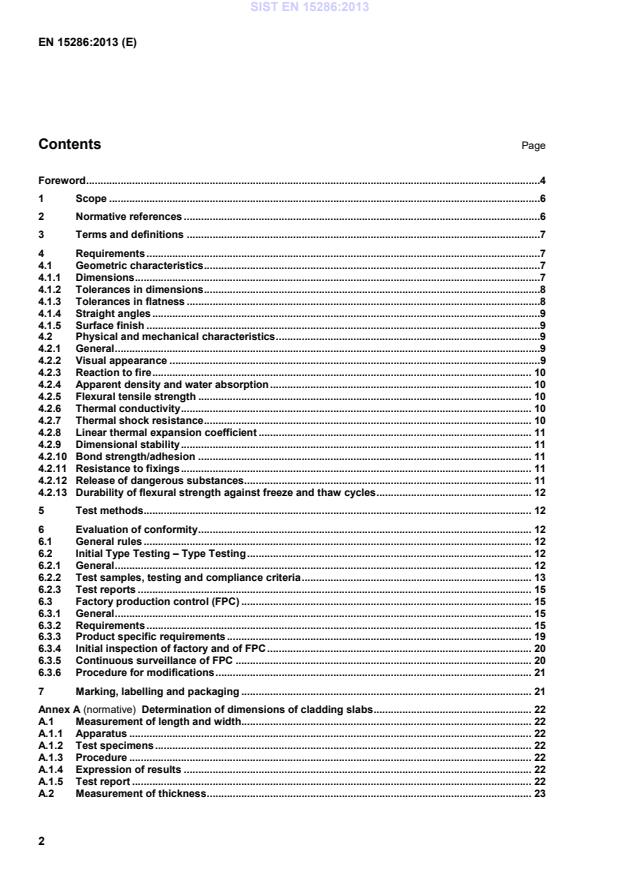
Determination of dimensions of cladding slabs . 22 A.1 Measurement of length and width. 22 A.1.1 Apparatus . 22 A.1.2 Test specimens . 22 A.1.3 Procedure . 22 A.1.4 Expression of results . 22 A.1.5 Test report . 22 A.2 Measurement of thickness . 23 SIST EN 15286:2013
Determination of straight angles of cladding slabs and tiles . 27 B.1 Apparatus . 27 B.2 Test specimens . 27 B.3 Procedure . 27 B.4 Expression of results . 27 B.5 Test report . 27 Annex C (normative)
Reference sample, visual inspection and acceptance criteria . 28 Annex ZA (informative)
Relationship between this European Standard and the Essential Requirements of EU Directive 89/106/EEC, Construction Products Directive . 30 ZA.1 Scope and relevant characteristics . 30 ZA.2 Procedures for attestation of conformity of agglomerated stone cladding slabs and tiles . 33 ZA.2.1 Systems of attestation of conformity . 33 ZA.2.2 EC certificate of conformity and EC declaration of conformity . 35 ZA.3 CE marking and labelling. 36 Bibliography . 42
A document on slabs and other cut-to-size products for flooring and stairs (internal and external) is under development within CEN/TC 246/WG 4. NOTE 2 An overview on standards for agglomerated stone products is given in Table 1. Table 1 — Standards for agglomerated stone products Harmonised product standards
EN 15285 Modular tiles for flooring and stairs (int. & ext.)
(under M/119) EN 15286 Slabs and tiles for
wall finishes
(int. & ext.)
(under M/121) Non-harmonised product standards
EN 15388 Slabs and cut-to-size products for vanity and kitchen tops
Main supporting standards
EN 14617 (all parts) Test methods
EN 14618 Terminology and classification
NOTE
A document on Slabs and other cut-to-size products for flooring and stairs (int. & ext.) (under M/119) ) is under development within CEN/TC 246/WG 4. SIST EN 15286:2013
According to the CEN-CENELEC Internal Regulations, the national standards organisations of the following countries are bound to implement this European Standard: Austria, Belgium, Bulgaria, Croatia, Cyprus, Czech Republic, Denmark, Estonia, Finland, Former Yugoslav Republic of Macedonia, France, Germany, Greece, Hungary, Iceland, Ireland, Italy, Latvia, Lithuania, Luxembourg, Malta, Netherlands, Norway, Poland, Portugal, Romania, Slovakia, Slovenia, Spain, Sweden, Switzerland, Turkey and the United Kingdom.SIST EN 15286:2013
This standard does not cover cladding slabs and tiles of agglomerated stone used for internal and external ceiling finishes. In addition, it does not cover slabs and tiles of agglomerated stone intended to be used in suspended ceilings. Products covered by the standards EN 14992, EN 13198, EN 13748-1 and EN 13748-2 are also excluded from the scope of the present standard. 2 Normative references The following documents, in whole or in part, are normatively referenced in this document and are indispensable for its application. For dated references, only the edition cited applies. For undated references, the latest edition of the referenced document (including any amendments) applies. EN 1015-12, Methods of test of mortar for masonry — Part 12: Determination of adhesive strength of hardened rendering and plastering mortars on substrates EN 1324, Adhesives for tiles — Determination of shear adhesion strength of dispersion adhesives EN 1348, Adhesives for tiles — Determination of tensile adhesion strength for cementitious adhesives EN 12003, Adhesive for tiles — Determination of shear adhesion strength of reaction resin adhesives EN 13501-1, Fire classification of construction products and building elements — Part 1: Classification using data from reaction to fire tests EN 13823, Reaction to fire tests for building products — Building products excluding floorings exposed to the thermal attack by a single burning item EN 14617-1, Agglomerated stone — Test methods — Part 1: Determination of apparent density and water absorption EN 14617-2, Agglomerated stone — Test methods — Part 2: Determination of flexural strength (bending) EN 14617-5, Agglomerated stone — Test methods — Part 5: Determination of freeze and thaw resistance EN 14617-6, Agglomerated stone — Test methods — Part 6: Determination of thermal shock resistance EN 14617-8, Agglomerated stone — Test methods — Part 8: Determination of resistance to fixing (Dowel Hole) EN 14617-11, Agglomerated stone — Test methods — Part 11: Determination of linear thermal expansion coefficient EN 14617-12, Agglomerated stone — Test methods — Part 12: Determination of dimensional stability EN 14617-16, Agglomerated stone — Test methods — Part 16: Determination of dimensions, geometric characteristics and surface quality of modular tiles EN 14618:2009, Agglomerated stone — Terminology and classification EN ISO 10456, Building materials and products — Hygrothermal properties — Tabulated design values and procedures for determining declared and design thermal values (ISO 10456) SIST EN 15286:2013
Figure 1 — Nominal dimensions of a cladding slab or a tile 3.2
class A cladding slab or tile cladding slab or tile with stricter tolerances in length, width and thickness (see Table 2) used for internal or external wall finishes, the surface of which can be textured (see Figure 2) or non-textured, either mechanically fixed or glued by adhesive or mortar
3.3 class B cladding slab or tile cladding slab or tile with wider tolerances in length, width and thickness (see Table 2) used for internal or external wall finishes, the surface of which can be textured (see Figure 2) or non-textured, with a mechanical fixing able to compensate the differences in thickness of a cladding slab or a tile, in order to ensure the overall planarity of the cladding Note 1 to entry: The differences in length and width are compensated by suitable open joint pattern in the wall. Note 2 to entry: Class B is not suitable for cladding slabs or tiles glued by adhesive or mortar.
4 Requirements 4.1 Geometric characteristics 4.1.1 Dimensions Measurements of dimensions (see Figure 2) of cladding tiles shall be carried out in accordance with EN 14617-16 and those of cladding slabs with Annex A. SIST EN 15286:2013
Tolerances in dimensions of cladding slabs and tiles
Class A Class B Length (l)
Width (b) < 600 mm ≥ 600 mm and
≤ 1 000 mm > 1 000 mm and ≤ 3 500 mm ≤ 3 500 mm Tolerances in length and width ± 0,5 mm ± 0,7 mm ± 1,0 mm ± 0,2 %,
but max. ± 2,0 mm Tolerances in thicknessa (d) ± 0,7 mm (-1/+3) mm a
Tolerances for thickness shall not apply for cladding slab and tile with textured upper surface where dmax - dmin > 1 mm (see Figure 2).
Key
dmin minimum thickness dmax
maximum thickness
Figure 2 – Cross section examples of the textured upper surface cladding slabs and tiles To calculate the weight of the cladding slab or tile with the textured upper surface the maximum thickness dmax shall be considered. To determine the breaking load of the cladding slab or tile with the textured upper surface the minimum thickness dmin shall be considered. 4.1.3 Tolerances in flatness Deviations in flatness of the surface of cladding tiles shall be determined according to EN 14617-16 and those of cladding slabs with Annex A and shall not exceed the tolerances, either 0,3 % of the length of diagonal of a cladding slab/tile or 4 mm, whichever is lower. SIST EN 15286:2013
dmax - dmin > 1 mm (see Figure 2). 4.1.4 Straight angles Straight angle of a cladding slab or a tile shall result by comparison of its two diagonal lengths measured as described in Annex B. The difference between the two diagonals lengths shall not deviate by more than that given in Table 3. Table 3 — Requirements for tolerances on diagonal lengths of cladding slabs and tiles Length (l) or width (b) (mm) < 600 ≥ 600 and ≤ 1 000
> 1 000 and ≤ 3 000
Tolerance for diagonal lengths (mm)
± 0,9 ± 1,2
± 3,0
4.1.5 Surface finish Surface finish shall extend uniformly to the edges of a cladding slab or a tile. Surface after its finishing shall have a regular appearance as a function of the finishing process and shall be worked to meet the declared surface finish. This should be established on the samples of a cladding slab or a tile submitted beforehand by the manufacturer to the purchaser. EXAMPLE Surface finishes of a cladding slab or a tile include: − fine ground surfaces, obtained, e.g. by means of a grinding disk of grain size F 220; − matte finished surfaces, obtained, e.g. by means of a polishing disk with grain size F 400; − highly polished surfaces, obtained, e.g. by means of a polishing disk or felt. 4.2 Physical and mechanical characteristics 4.2.1 General The characteristics of the cladding slabs or tiles in 4.2.2 to 4.2.12 shall be declared when these products are subject to regulatory requirements and may be declared otherwise with reference to intended end use conditions. Contractual specifications may be used to establish reference values, e.g. stated in design or manufacturer’s data sheet, due account being taken of any regulatory requirements applicable. 4.2.2 Visual appearance This characteristic of a cladding slab or a tile shall be declared. The colour, surface finish and brightness of the agglomerated stone, which a cladding slab or a tile is made of, shall be identified visually according to Annex C, e.g. by a range of samples selected in agreement between manufacturer and purchaser. Any visual variations, e.g. inclusions and veins, are permissible provided that they are characteristic of the relevant type of agglomerated stone and provided that they do not adversely affect the performances of the cladding slabs or tiles. SIST EN 15286:2013
A cladding slab or a tile made of an agglomerated stone, which does not comply with the provisions a) and b) given above and having an intended use subject to the reaction to fire regulatory requirements shall be classified in accordance with EN 13501-1 after being tested in accordance with the test standards given therein, including mounting and fixings in accordance with EN 13823. 4.2.4 Apparent density and water absorption
The values for apparent density and water absorption shall be declared when a cladding slab or a tile is fixed (glued) by an adhesive or mortar and is intended to be used in a location subject to water contact. They shall be determined according to EN 14617-1 and the results expressed accordingly. 4.2.5 Flexural tensile strength The value for flexural tensile (bending) strength of a cladding slab or a tile shall be declared when required. The flexural tensile strength shall be determined using the test method in EN 14617-2 and the results expressed accordingly. In case of the textured upper face cladding slabs and tiles, the textured surface shall be prepared by grinding until fully flat or use flat samples of the same material with the minimum thickness dmin (see Figure 2). 4.2.6 Thermal conductivity Where a cladding slab or a tile is fixed (glued) by adhesive or mortar and subject to regulatory requirements the value for thermal conductivity shall be declared. Thermal conductivity shall be based on the apparent density value, determined using the test method indicated in 4.2.4. This value shall be used to calculate the thermal conductivity according to EN ISO 10456. Thermal conductivity may also be obtained by testing in accordance with EN ISO 13787 and the results expressed in W/(m·K) rounded to the first decimal place. 4.2.7 Thermal shock resistance Where subject to regulatory requirements or where a cladding slab or a tile is intended to be used subject to critical thermal cycles, the value for thermal shock resistance shall be declared. The thermal shock resistance shall be determined using the test method in EN 14617-6 and the results expressed accordingly.
1) Commission Decision 96/603/EC, as amended (see [1]). SIST EN 15286:2013
6 Evaluation of conformity 6.1 General rules The compliance of agglomerated stone cladding slabs and tiles with the requirements of this standard and with the declared values (including classes) shall be demonstrated by: Initial Type Testing (ITT); factory production control by the manufacturer, including product assessment. The manufacturer shall always retain the overall control and shall have the necessary means to take responsibility for the product. For the purposes of testing, the products may be grouped into families, where it is considered that the results for one or more characteristics from any one product within the family are representative for the same characteristics for all products within that same family. A product may be in different product families for different characteristics. 6.2 Initial Type Testing – Type Testing 6.2.1 General Initial Type Testing and Type Testing shall be performed to demonstrate compliance with this European Standard. All essential characteristics, in bold letters in Table 4, for which the manufacturer declares performances, are subject to Initial Type Testing. In addition, the need to perform Type Tests applies to all other characteristics included in a standard when the manufacturer claims compliance, unless the standard gives provisions (e.g. use of previously existing data, CWFT and conventionally accepted performance) for declaring performances without performing tests. Tests previously performed in accordance with the provisions of this standard may be taken into account, provided that they were made to the same or a more rigorous test method, under the same system of attestation of conformity, on the same product or products of similar design, construction and functionality, such that the results are applicable to the product in question. NOTE Same system of attestation of conformity means testing by an independent third party for products covered by attestation of conformity system 1 and 3. SIST EN 15286:2013
4.1.1 EN 14617-16 b) or Annex A c) 4.1.1 Tolerances in dimensions 4.1.2 4.1.2 Tolerances in flatness 4.1.3 4.1.3 Straight angles 4.1.4 Annex B 4.1.4 Surface finish 4.1.5 Visual (see 4.1.5) 4.1.5 Visual appearance 4.2.2 Annex C 4.2.2 Reaction to fire, for an agglomerated stone containing a percentage d) of an organic material, if any, in its: − binder ≤ 0,1 % and aggregate ≤ 1 %, (CWT), or − otherwise based on test results 4.2.3
− See 4.2.3e), or
− See EN 13501-1 4.2.3 Apparent density and water absorption f) 4.2.4 EN 14617-1 4.2.4 Flexural strength 4.2.5 EN 14617-2 4.2.5 Thermal conductivity f) 4.2.6 EN 14617-1 g) 4.2.6 Thermal shock resistance 4.2.7 EN 14617-6 4.2.7 Linear thermal expansion coefficient 4.2.8 EN 14617-11 4.2.8 Dimensional stability 4.2.9 EN 14617-12 4.2.9 Bond strength/adhesion f) for: − cementitious adhesives − dispersion adhesives − reaction resin adhesives − mortar 4.2.10
EN 1348
EN 1324
EN 12003
EN 1015-12 4.2.10 Resistance to fixings h) 4.2.11 EN 14617-8 4.2.11 Release of dangerous substances 4.2.12 As relevant in accordance with 4.2.12 As relevant in accordance with 4.2.12 Durability of flexural strength against freeze and thaw cycles 4.2.13 EN 14617-5 4.2.13 a) Reference shall be made to Clause 4 in order to decide which characteristics need to be declared. b) For tiles only. c) For cladding slabs only. d) By mass or volume, whichever is the most onerous. e) Appropriate assessment shall be made to ensure meeting the requirements for classification without testing (CWT). f) For cladding slabs or tiles intended to be glued with adhesive or mortar.
g) To give a reference allowing data to be taken from EN ISO 10456. Alternatively, cladding slabs or tiles may be tested according to EN ISO 13787. h) For cladding slabs or tiles fixed mechanically only.
6.2.3 Test reports All type tests, and/or initial type tests and their results shall be documented in test reports. All test reports shall be retained by the manufacturer for at least 10 years after the last date of production of the cladding slabs or tiles to which they relate. 6.3 Factory production control (FPC) 6.3.1 General The manufacturer shall establish, document and maintain an FPC system to ensure that the products placed on the market comply with the declared performance of the characteristics. The FPC system shall consist of procedures, regular inspections and tests and/or assessments and the use of the results to control raw and other incoming materials or components, equipment, the production process and the product. All the elements, requirements and provisions adopted by the manufacturer shall be documented in a systematic manner in the form of written policies and procedures. This production control system documentation shall ensure a common understanding of conformity evaluation and enable the achievement of the required product characteristics and the effective operation of the production control system to be checked. Factory production control therefore brings together operational techniques and all measures allowing maintenance and control of the compliance of the product with this European Standard. 6.3.2 Requirements 6.3.2.1 General The manufacturer is responsible for organising the effective implementation of the FPC system. Tasks and responsibilities in the production control organisation shall be documented and this documentation shall be kept up-to-date. The responsibility, authority and the relationship between personnel that manages, performs or verifies work affecting product conformity, shall be defined. This applies in particular to personnel that needs to initiate actions preventing product non-conformities from occurring, actions in case of non-conformities and to identify and register product conformity problems. Personnel performing work affecting product conformity shall be competent on the basis of appropriate education, training, skills and experience for which records shall be maintained. In each factory the manufacturer may delegate the action to a person having the necessary authority to: identify procedures to demonstrate conformity of the product at appropriate stages; identify and record any instance of non-conformity; identify procedures to correct instances of non-conformity. The manufacturer shall draw up and keep up-to-date documents defining the factory production control. The manufacturer's documentation and procedures should be appropriate to the product and manufacturing process. The FPC system should achieve an appropriate level of confidence in the conformity of the product. This involves: a) the preparation of documented procedures and instructions relating to factory production control operations, in accordance with the requirements of the technical specification to which reference is made; SIST EN 15286:2013
Individual products, product batches or packages shall be identifiable and traceable with regard to their production origin. The manufacturer shall have written procedures ensuring that processes related to affixing traceability codes and/or markings are inspected regularly. SIST EN 15286:2013
Production control operations include some or all of the following operations: a) the specification and verification of raw materials and constituents; b) the controls and tests to be carried out during manufacture according to a frequency laid down; c) the verification
...