

SIST EN 13450:2003
(Main)Aggregates for railway ballast
- Abstract
This European Standard specifies requirements for natural crushed unbound aggregates for use in construction of railway track. For the purposes of this standard the aggregate is referred to as railway ballast. The necessity for testing for all properties specified in this standard is limited, depending upon the end use of the railway ballast.
- Status
- Published
- Publication Date
- 28-Feb-2003
- Withdrawal Date
- 13-Jun-2013
- Technical Committee
- AGR - Aggregates
- Current Stage
- 6060 - National Implementation/Publication (Adopted Project)
- Start Date
- 01-Mar-2003
- Due Date
- 01-Mar-2003
- Completion Date
- 01-Mar-2003
305/2011 - Regulation (eu) No 305/2011 of the European Parliament and of the Council of 9 march 2011 laying down harmonised conditions for the marketing of construction products and repealing council directive 89/106/eecOJ Ref: C 259 OJ Date: 08-Aug-2014
89/106/EEC - Construction productsOJ Ref: C 47 OJ Date: 27-Feb-2003


SIST EN 13450:2003 is the Slovenian adoption of EN 13450:2002 from CEN, published by SIST, for aggregates used as railway ballast in railway track construction. It specifies the required properties, test methods, conformity evaluation, designation and marking for natural, manufactured or recycled crushed unbound aggregates intended for this use. In practice, it helps producers, laboratories, purchasers and inspectors decide whether a ballast source and delivery meet the declared categories.
What does SIST EN 13450:2003 specify?
SIST EN 13450:2003 specifies the properties of railway ballast and how those properties are to be assessed and declared. It also sets out sampling, production, conformity evaluation, designation and marking so the material can be identified and checked consistently.
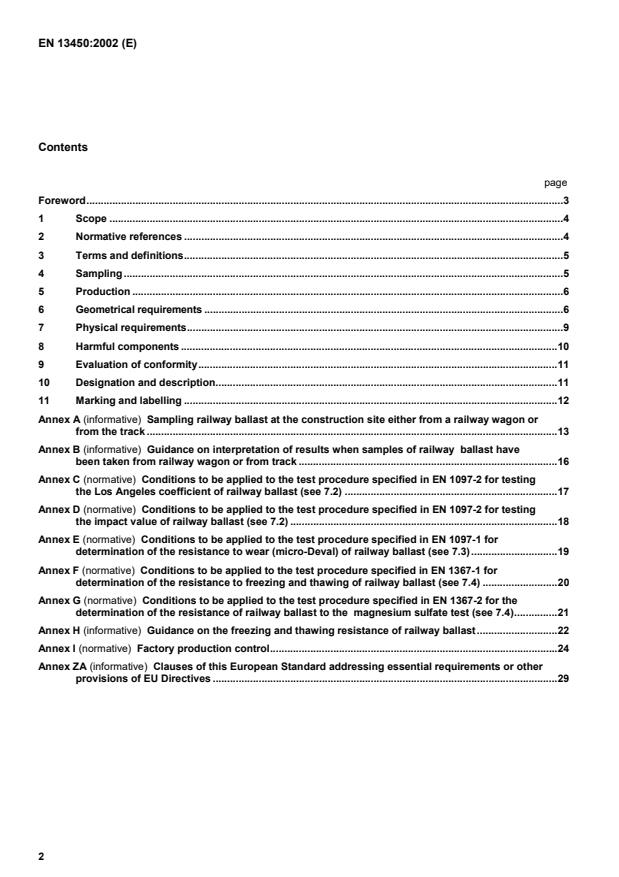
The document is organized into clauses 1 to 11 and annexes A to ZA.
| Annex | What it covers |
|---|---|
| A | Sampling railway ballast at the construction site from a railway wagon or from the track |
| B | Guidance on interpreting results for wagon or track samples |
| C | Conditions for the Los Angeles coefficient test |
| D | Conditions for the impact value test |
| E | Conditions for the micro-Deval wear test |
| F | Conditions for the freeze/thaw test |
| G | Conditions for the magnesium sulfate test |
| H | Guidance on freeze/thaw resistance |
| I | Factory production control |
| ZA | Clauses addressing EU Directive requirements and CE marking |
What are the key requirements of SIST EN 13450:2003?
SIST EN 13450:2003 focuses on declared categories for geometry, strength, wear and durability, plus controlled production and identification. The document repeatedly allows testing and declaration only for properties relevant to the intended end use, which matters because not every ballast application needs every test.
- Clause 4 - Sampling: Sampling is to follow EN 932-1. Annex A gives practical procedures for wagon and track sampling, and Annex B explains how to interpret those samples. This matters because compliance testing should be based on representative material from production, while site samples are mainly useful for checking transport damage or track issues.
- Clause 5 - Production: Natural railway ballast is to be produced without blending material from different geological sources. This helps keep the material consistent from source to source.
- Clause 6 - Geometrical requirements: Railway ballast size is designated by lower and upper sieve sizes, with D at 50 mm or 63 mm and d at 31.5 mm. Clause 6 also covers grading, fine particles, fines, particle shape and particle length, using declared categories or “No requirement” where appropriate. This is the part that tells the buyer how uniform the ballast should be and how much small material is acceptable.
- Clause 6 - Shape measures: Flakiness index is the reference test for particle shape, and shape index and particle length can also be declared. In practice, these properties affect packing, drainage and mechanical stability in the track bed.
- Clause 7 - Physical requirements: Clause 7 covers resistance to fragmentation by the Los Angeles coefficient, impact value, wear by micro-Deval, freeze/thaw resistance, particle density, water absorption and, for certain basaltic rocks, Sonnenbrand testing. Annexes C to G define the test conditions. These results show how the ballast is likely to perform under traffic, weather and repeated handling.
- Clause 8 - Harmful components: Railway ballast is to contain only the components and matter allowed by the standard. This protects track performance and keeps unwanted contaminants under control.
- Clauses 9 to 11 - Conformity, designation, marking: Producers carry out initial type tests and factory production control, identify the source and petrographic type, state the ballast size, and provide a delivery ticket with the designation, dispatch date, serial number and standard number. This is the information used in purchasing, inspection and traceability.
What terms does SIST EN 13450:2003 define?
- aggregate - Granular material used in construction; it may be natural, manufactured or recycled.
- railway ballast - Aggregate whose particle surfaces are totally crushed and that is used in railway track construction.
- natural railway ballast - Railway ballast from mineral sources that has had only mechanical processing.
- manufactured railway ballast - Railway ballast of mineral origin made by an industrial process involving thermal or other modifications.
- recycled railway ballast - Railway ballast made by processing previously used railway ballast.
- railway ballast size - The designation of ballast by lower d and upper D sieve sizes.
- category - A property level expressed as a range of values or a limiting value.
Who uses SIST EN 13450:2003?
SIST EN 13450:2003 is used by ballast producers, quarry operators, recycling operators, rail infrastructure contractors, test laboratories, quality managers and purchasers. It is also used by inspectors and notified bodies involved in conformity assessment and CE marking. In practice, these users rely on it for sampling, grading checks, performance testing, factory production control and delivery documentation.
Which standards are used with SIST EN 13450:2003?
- EN 932-1 - Sampling of aggregates.
- EN 932-2 - Reduction of laboratory samples.
- EN 932-3 - Simplified petrographic description.
- EN 932-5 - Common equipment and calibration.
- EN 933-1 - Particle size distribution by sieving.
- EN 933-3 - Flakiness index.
- EN 933-4 - Shape index.
- EN 1097-1 - Micro-Deval resistance to wear.
- EN 1097-2 - Resistance to fragmentation, used here for the Los Angeles coefficient and impact value with annex-specific conditions.
- EN 1097-6 - Particle density and water absorption.
- EN 1367-1 - Freeze/thaw resistance.
- EN 1367-2 - Magnesium sulfate test.
- EN 1367-3 - Sonnenbrand test for basalt and closely related rocks.
What does the SIST EN 13450:2003 document contain?
The document contains category tables for grading, fine particles, fines, flakiness index, shape index, particle length, resistance to fragmentation, impact value and resistance to wear. It also gives detailed annex procedures for sampling from wagons or track, and for test conditions that adapt EN 1097 and EN 1367 methods to railway ballast.
Annex I sets out a factory production control system, including organization, document control, raw material knowledge, inspection, test equipment, nonconforming product handling, storage and training. Annex ZA links the standard to EU Construction Products Directive requirements and shows how CE marking information is to be presented.
Relations
- Effective Date
- 01-Jul-2013
- Refers
SIST EN 932-1:1999 - Tests for general properties of aggregates - Part 1: Methods for sampling - Effective Date
- 28-Jan-2026
- Effective Date
- 28-Jan-2026
- Effective Date
- 28-Jan-2026
- Effective Date
- 28-Jan-2026
- Effective Date
- 28-Jan-2026
- Effective Date
- 28-Jan-2026
- Effective Date
- 28-Jan-2026
- Effective Date
- 28-Jan-2026
- Effective Date
- 28-Jan-2026
- Effective Date
- 28-Jan-2026
- Effective Date
- 28-Jan-2026
- Effective Date
- 28-Jan-2026
- Effective Date
- 28-Jan-2026
- Effective Date
- 28-Jan-2026
Get Certified
Connect with accredited certification bodies for this standard

DIBt (Deutsches Institut für Bautechnik)
German Institute for Building Technology.
DIN CERTCO
DIN Group product certification.

Aboma Certification B.V.
Specialized in construction, metal, and transport sectors.
Sponsored listings
Frequently Asked Questions
SIST EN 13450:2003 is a standard published by the Slovenian Institute for Standardization (SIST). Its full title is "Aggregates for railway ballast". This standard covers: This European Standard specifies requirements for natural crushed unbound aggregates for use in construction of railway track. For the purposes of this standard the aggregate is referred to as railway ballast. The necessity for testing for all properties specified in this standard is limited, depending upon the end use of the railway ballast.
This European Standard specifies requirements for natural crushed unbound aggregates for use in construction of railway track. For the purposes of this standard the aggregate is referred to as railway ballast. The necessity for testing for all properties specified in this standard is limited, depending upon the end use of the railway ballast.
SIST EN 13450:2003 is classified under the following ICS (International Classification for Standards) categories: 91.100.15 - Mineral materials and products. The ICS classification helps identify the subject area and facilitates finding related standards.
SIST EN 13450:2003 has the following relationships with other standards: It is inter standard links to SIST EN 13450:2013, SIST EN 932-1:1999, SIST EN 1097-1:1999, SIST EN 933-4:2008, SIST EN 1097-2:1999, SIST EN 1367-3:2002, SIST EN 1097-6:2002, SIST EN 932-5:2012, SIST EN 933-3:2012, SIST EN 933-1:1999, SIST EN 1367-1:2000, SIST EN 932-3:2022, SIST EN 1367-2:1999, SIST EN 16730:2016, SIST EN 13231-1:2013. Understanding these relationships helps ensure you are using the most current and applicable version of the standard.
SIST EN 13450:2003 is associated with the following European legislation: EU Directives/Regulations: 2010-01-4867, 305/2011, 89/106/EEC, EUR-PUB; Standardization Mandates: M/125. When a standard is cited in the Official Journal of the European Union, products manufactured in conformity with it benefit from a presumption of conformity with the essential requirements of the corresponding EU directive or regulation.
SIST EN 13450:2003 is available in PDF format for immediate download after purchase. The document can be added to your cart and obtained through the secure checkout process. Digital delivery ensures instant access to the complete standard document.
Standards Content (Sample)
2003-01.Slovenski inštitut za standardizacijo. Razmnoževanje celote ali delov tega standarda ni dovoljeno.Aggregates for railway ballastAgregati za grede železniških progGranulats pour ballasts de voies ferréesGesteinskörnungen für Gleisschotter91.100.15Mineralni materiali in izdelkiMineral materials and productsICS:SIST EN 13450:2003enTa slovenski standard je istoveten z:EN 13450:200201-marec-2003SIST EN 13450:2003SLOVENSKI
STANDARD
EUROPEAN STANDARDNORME EUROPÉENNEEUROPÄISCHE NORMEN 13450December 2002ICS 91.100.15English versionAggregates for railway ballastGranulats pour ballasts de voies ferréesGesteinskörnungen für GleisschotterThis European Standard was approved by CEN on 7 November 2002.CEN members are bound to comply with the CEN/CENELEC Internal Regulations which stipulate the conditions for giving this EuropeanStandard the status of a national standard without any alteration. Up-to-date lists and bibliographical references concerning such nationalstandards may be obtained on application to the Management Centre or to any CEN member.This European Standard exists in three official versions (English, French, German). A version in any other language made by translationunder the responsibility of a CEN member into its own language and notified to the Management Centre has the same status as the officialversions.CEN members are the national standards bodies of Austria, Belgium, Czech Republic, Denmark, Finland, France, Germany, Greece,Iceland, Ireland, Italy, Luxembourg, Malta, Netherlands, Norway, Portugal, Spain, Sweden, Switzerland and United Kingdom.EUROPEAN COMMITTEE FOR STANDARDIZATIONCOMITÉ EUROPÉEN DE NORMALISATIONEUROPÄISCHES KOMITEE FÜR NORMUNGManagement Centre: rue de Stassart, 36
B-1050 Brussels© 2002 CENAll rights of exploitation in any form and by any means reservedworldwide for CEN national Members.Ref. No. EN 13450:2002 E
Sampling railway ballast at the construction site either from a railway wagon orfrom the track.13Annex B (informative)
Guidance on interpretation of results when samples of railway
ballast havebeen taken from railway wagon or from track.16Annex C (normative)
Conditions to be applied to the test procedure specified in EN 1097-2 for testingthe Los Angeles coefficient of railway ballast (see 7.2).17Annex D (normative)
Conditions to be applied to the test procedure specified in EN 1097-2 for testingthe impact value of railway ballast (see 7.2).18Annex E (normative)
Conditions to be applied to the test procedure specified in EN 1097-1 fordetermination of the resistance to wear (micro-Deval) of railway ballast (see 7.3).19Annex F (normative)
Conditions to be applied to the test procedure specified in EN 1367-1 fordetermination of the resistance to freezing and thawing of railway ballast (see 7.4).20Annex G (normative)
Conditions to be applied to the test procedure specified in EN 1367-2 for thedetermination of the resistance of railway ballast to the
magnesium sulfate test (see 7.4).21Annex H (informative)
Guidance on the freezing and thawing resistance of railway ballast.22Annex I (normative)
Factory production control.24Annex ZA (informative)
Clauses of this European Standard addressing essential requirements or otherprovisions of EU Directives.29
treatments and for bound and unbound applications, excluding concrete, mortar and grout.EN 13139Aggregates for mortar.EN 13242Aggregates for unbound and hydraulically bound materials for use in civil engineeringwork and road construction.EN 13383-1Armourstone - Part 1: specification.Annexes A, B and H are informative and annexes C, D, E, F, G and I are normative.According to the CEN/CENELEC Internal Regulations, the national standards organizations of the followingcountries are bound to implement this European Standard : Austria, Belgium, Czech Republic, Denmark, Finland,France, Germany, Greece, Iceland, Ireland, Italy, Luxembourg, Malta, Netherlands, Norway, Portugal, Spain,Sweden, Switzerland and the United Kingdom.
For the purposes of thisstandard, the aggregate is referred to as railway ballast.It provides for the evaluation of conformity of the products to this European Standard.NOTE The requirements in this European Standard are based upon experience with aggregate types with an establishedpattern of use.
Care should be taken when considering the use of aggregates from sources with no such pattern of use, e.g.,recycled aggregates and aggregates arising from certain industrial by-products.
Such aggregates, that should comply with allthe requirements of this European Standard, could have other characteristics not included in Mandate M 125 (as amended) thatdo not apply to the generality of aggregate types with an established pattern of use and when required, provisions valid at theplace of use can be used to assess their suitability.2 Normative referencesThis European Standard incorporates by dated or undated reference, provisions from other publications. Thesenormative references are cited at the appropriate places in the text, and the publications are listed hereafter. Fordated references, subsequent amendments to or revisions of any of these publications apply to this EuropeanStandard only when incorporated in it by amendment or revision.
For undated references the latest edition of thepublication referred to applies (including amendments).EN 932-1:1996,Tests for general properties of aggregates — Part 1: Methods for sampling.EN 932-2,Tests for general properties of aggregates — Part 2: Methods for reducing laboratory samples.EN 932-3,Tests for general properties of aggregates — Part 3: Procedure and terminology for simplifiedpetrographic description.EN 932-5,Tests for general properties of aggregates — Part 5: Common equipment and calibration.EN 933-1:1997,Tests for geometrical properties of aggregates — Part 1: Determination of particle sizedistribution - Sieving method.EN 933-3,Tests for geometrical properties of aggregates — Part 3: Determination of particle shape- Flakiness index.EN 933-4,Tests for geometrical properties of aggregates — Part 4: Determination of particle shape- Shape index.EN 1097-1:1996,Tests for mechanical and physical properties of aggregates - Part 1: Determination of theresistance to wear (micro-Deval).EN 1097-2:1998,Tests for mechanical and physical properties of aggregates — Part 2: Methods for thedetermination of resistance to fragmentation.EN 1097-6:2000,Tests for mechanical and physical properties of aggregates — Part 6: Determination of particledensity and water absorption.EN 1367-1:1999,Tests for thermal and weathering properties of aggregates — Part 1: Determination of resistanceto freezing and thawing.EN 1367-2:1998,Tests for thermal and weathering properties of aggregates — Part 2: Magnesium sulfate test.EN 1367-3,Tests for thermal and weathering properties of aggregates — Part 3: Boiling test for“Sonnenbrand basalt”.
When required, the tests specified shall be carried out to determineappropriate properties.NOTE 1When the value of a property is required but not defined by specified limits the value should be declared by theproducer as an XXDeclared category, e.g., in Table 4 a value of flakiness index of say 40 corresponds to FI40 (Declared value).NOTE 2When a property is not required, a “No requirement” category can be used.NOTE 3Guidance on selection of appropriate categories for specific applications can be found in national provisions in theplace of use of the railway ballast.6.2 Railway ballast sizeRailway ballast size shall be designated by a pair of sieve sizes in millimetre with d as the lower limit designationsieve and D as the upper limit designation sieve between which most of the particle size distribution lies.For railway ballast D is 50 mm or 63 mm and d is 31,5 mm.6.3 GradingThe grading of the railway ballast determined in accordance with EN 933-1 shall be declared in accordance withthe relevant category specified in Table 1.Table 1 — Categories for gradingRailway ballast size 31,5 mm to 50 mmRailway ballast size 31,5 mm to 63 mmPercentage passing by massGrading categorySieve sizemmABCDEF8063504031,522,431,5 to 5031,5 to 6310010070 to 9930 to 651 to 250 to 3 50-10097 to 10070 to 9930 to 701 to 250 to 3 50-10095 to 10070 to 9925 to 751 to 250 to 3 50-10097 to 9965 to 9930 to 651 to 250 to 3- 5010095 to 9955 to 9925 to 751 to 250 to 3- 5010093 to 9945 to 7015 to 400 to 70 to 7-³ 85NOTE 1
The requirement for passing the 22,4 mm sieve applies to railway ballast sampled at the place of production.NOTE 2
In certain circumstances a 25 mm sieve may be used as an alternative to the 22,4 mm sieve when a tolerance of0 to 5 would apply (0 to 7 for category F).6.4 Fine particlesThe content of fine particles determined in accordance with EN 933-1 shall be declared in accordance with therelevant category specified in Table 2.
The requirement applies to railway ballast sampled at the place of production.6.5 FinesThe fines content determined in accordance with EN 933-1 shall be declared in accordance with the relevantcategory specified in Table 3.When required cleanliness shall be assessed from the fines content. Fines shall be considered non-harmful if thetotal fines content is less than the relevant category specified in Table 3 in accordance with the provisions valid inthe place of use of the aggregate.Table 3 — Categories for fines contentMaximum percentage passing by massSievesizeFines content categorymmABCDeclaredD0,0630,51,01,5> 1,5No requirementNOTE
The requirement applies to railway ballast sampled at the place of production.6.6 Particle shape6.6.1 Flakiness indexWhen required the shape of coarse railway ballast shall be determined in terms of the flakiness index as specifiedin EN 933-3.Flakiness index shall be the reference test for the determination of shape of railway ballast. The Flakiness indexshall be declared in accordance with the relevant category specified in Table 4.
SIDeclaredNo requirementSINR6.7 Particle lengthParticle length shall be assessed by measuring with an appropriate gauge or calipers.NOTELimits should be selected from the specified range until such a time as there is more data available on aggregateproperties related to performance.When required, the particle length shall be declared in accordance with the relevant category specified in Table 6.Table 6 — Categories for particle lengthPercentage by mass with length
100 mm in agreater than 40 kg sampleParticle length categoryABCDDeclaredE46812> 12No requirement
LARB DeclaredNo requirementLARB NRWhere required, the impact value of railway ballast (SZRB, using the conditions as specified in annex D),determined in accordance with EN 1097-2:1998, clause 6, shall be declared in accordance with the relevantcategory specified in Table 8.Table 8 — Categories for maximum values of resistance to impactImpact value%CategorySZRB 14 18 22> 22SZRB 14SZRB 18SZRB 22
SZRB DeclaredNo requirementSZRB NR
MDE RB DeclaredNo requirementMDE RB NR7.4 Durability7.4.1 Resistance to freezing and thawingWhen required, the durability of railway ballast in terms of freeze/thaw resistance, shall be assessed by either thefreeze/thaw test in accordance with EN 1367-1, using the conditions as specified in annex F, or the magnesium sulphatesoundness test in accordance with EN 1367-2, using the conditions as specified in annex G and the results declared.NOTEThere is limited experience of the use of either of these tests for assessing the durability of railway ballast.
Advice onthe applicability of the test methods and of using water absorption as a screening test is given in annex H.7.4.2 Particle densityWhen required the particle density shall be determined in accordance with EN 1097-6:2000, annex B and the resultsdeclared.7.4.3 Water absorptionWhen required the water absorption shall be determined in accordance with EN 1097-6:2000 annex B and the resultsdeclared.7.5 SonnenbrandIf signs of "Sonnenbrand" are known from a quarry of basalt or closely related rocks qualitative testing shall be carriedout in accordance with EN 1367-3 and the results declared.NOTE"Sonnenbrand" is a type of rock decay that can be present in some basalts and manifests itself under the influenceof atmospheric conditions. It starts with the appearance of grey/white coloured spots.
Usually hairline cracks are generatedradiating out from the spots and interconnecting them.
This reduces the strength of the mineral fabric, and as a result the rockdecays to small particles.
Depending on the source this process can take place within months of extraction or extend overseveral decades.
In exceptional cases a rapid decay results in the formation of large cracks and the breaking of aggregateparticles.8 Harmful componentsRailway ballast shall not contain other components or matter than specified in this standard.
a new source of aggregates is to be used.b)
there is a major change in the nature of the raw materials or in the processing conditions which may affect
the properties of the aggregates.The results of the initial tests shall be documented as the starting point of the factory production control for thatmaterial.
This shall particularly include the identification of any components likely to emit radiation above normalbackground levels, any components likely to release polyaromatic carbons or other dangerous substances.
If thecontent of any of these components exceeds the limits in force according to the provisions valid in the place of useof the railway ballast, the results of the initial tests shall be declared9.3 Factory production controlThe producer shall have in place a system of factory production control that complies with the requirements ofannex I.The records held by the producer shall indicate what quality control procedures are in operation during theproduction of the aggregate.NOTE 1The form of control applied to any aggregate depends upon its intended use and the regulations relating to that use.NOTE 2For inspection purposes only, railway ballast can be sampled from the track in accordance with annex A.10 Designation and description10.1 DesignationRailway ballast shall be identified in the following terms:a) source - if the material has been re-handled in a depot both source and depot shall be given;b) a simple indication of the petrographic type (see EN 932-3);c) railway ballast size;d) where required a producer's code to relate the designation to the description;e) any additional information needed to identify the particular railway ballast aggregate.10.2 Essential information for the description of a railway ballast aggregateOnly the items a) to c) in 10.1 are essential descriptions of a railway ballast aggregate.
The necessity for otherinformation depends on the situation and end use.NOTEThe purchaser should inform the supplier at the time of order of any special requirements associated with a particularend use.
Thespecification limits contained within this standard are based on the testing of samples taken at this location.
Themethod of sampling should be as specified in EN 932-1.However there will be occasions when it will be necessary to take a sample of railway ballast at the time of deliveryor from the track. Reasons can include to check if degradation has occurred during transport or to investigate aparticular track problem. In such situations one of the following sampling procedures should be adopted.A.2 Sampling railway ballast from a railway wagonA.2.1
Sampling of railway ballast at a construction site should be carried out in accordance with the principles anddefinitions specified in EN 932-1.A.2.2
Sampling should only be carried from a fully loaded wagon by use of a sampling box (see EN 932-1:1996,Figure 5) of inner dimensions length 700 mm, width 450 mm and height 250 mm.A.2.3
All the increments for one bulk sample should be taken from one wagon and from one discharge opening(slide or conveyor belt) of that wagon.A.2.4
A minimum of four increments should be taken.A.2.5
The first increment should be taken about 10 s after the commencement of unloading, the last increment about10 s before the end of unloading and intermediate increments at regular intervals in between the first and last.A.2.6
The discharge opening should be completely open at the time of sampling.A.2.7
The wagon should move at walking pace (about 3 km/h) over the sampling box.A.2.8
The contents of one sample box should constitute one increment.A.2.9
The increments should be mixed together to form a bulk sample on a clean flat surface or on a thick tearresistant plastic sheet.A.2.10
The bulk sample should be split into the required number of subsamples in accordance with EN 932-1.A.3 Sampling railway ballast from track without use of a steel frameA.3.1
The bulk sample should consist of one or more spaces between sleepers.A.3.2
If it is required to sample railway ballast from more than one space between sleepers then the first, fourth andthen every third space should be sampled.A.3.3 The railway ballast should be removed completely first by using a ballast fork and then a small shovel or similar.A.3.4
The railway ballast should be removed down to the bottom of the railway ballast layer. Care should be taken toensure that no damage is caused to the formation or the protective layer and that no particles originating from themare included in the sample.
The increments should be mixed together to form a bulk sample on clean, flat surface or on thick tear-resistant plastic sheet.A.3.6
The bulk sample should be split into the required number of subsamples, in accordance with EN 932-1.A.4 Sampling railway ballast from track using a steel frameA.4.1
A steel frame serrated at its lower edge, as shown in Figure A.1, can be used for railway ballast samplingfrom the track.Dimensions in millimetres83003201005502020A-AAA122020Key1Welding seam2Steel plateFigure A.1 - Frame for sampling railway ballastA.4.2
The sampling procedure should be as described in A.3 except that at each space between sleepers fromwhich it is required to take a sample, the steel frame should be driven into the railway ballast using a sledgehammer.
The steel frame should be driven between concrete sleepers without damaging the sleepers.
Railway ballast should be removed first with a ballast fork and the frame then driven deeper into the railwayballast. Removal of the bottom layer of railway ballast should be with a small shovel or similar. Care should be takento ensure that no damage is caused to the formation or the protective layer and that no particles originating fromthem are included in the sample.A.4.4
The increments should be mixed together to form a bulk sample on a clean, flat surface or thick tear-resistantplastic sheet.A.4.5
The bulk sample should be split into the required number of subsamples, in accordance with EN 932-1.
Wash each fraction separately, in accordance withEN 933-1:1997, 7.1, and dry them in the oven at (110 ± 5) °C to constant mass. Allow the fractions to cool to ambienttemperature.Reduce the mass of each size fraction as specified in EN 932-2 so that each has a mass of (5 000 ± 50) g. Combinethe two reduced fractions to produce a test portion with a total dry mass of (10 000 ± 100) g.C.5 Test procedureUnder EN 1097-2:1998, 5.3, the machine shall be rotated for 1000 revolutions instead of 500 revolutions at aspeed of 31 min-1 to 33 min-1.C.6 Calculation and expression of resultsUnder EN 1097-2:1998, 5.4, replace the equation:500005mLA-=by the following equation:100m00010RB-=C.7 Test reportReport that the test procedure was carried out in accordance with EN 1097-2:1998, clauses 4 and 5, applying theconditions of use as specified in this annex.
...