

SIST EN 60350-2:2018
(Main)Household electric cooking appliances - Part 2: Hobs - Methods for measuring performance
General Information
- Abstract
IEC 60350-2:2017(E) defines methods for measuring the performance of electric hobs for household use.
Appliances covered by this document can be built-in or designed to be placed on a work surface. The hob can also be a part of a cooking range.
This document does not apply to portable appliances for cooking, grilling and similar functions (see IEC 61817).
This document defines the main performance characteristics of hobs which are of interest to the user and specifies methods for measuring these characteristics.
This document does not specify a classification or ranking for performance.
This edition includes the following significant technical changes with respect to the previous edition:
a) terms and definitions revised and new definitions added (see 3);
b) following the new market trend, requirements related to so-called flexible and free induction zones - in this document named as cooking areas - are added;
c) specification for standardized and alternative cookware is introduced (see 5.6);
d) measurement procedure reflecting a household-like cooking process for measuring the energy consumption is introduced (see Clause 7 and Annex A);
e) revision of measurement procedure for determining the accuracy of control (see Clause 8);
f) new reproducible measurement procedure for assessing the heat distribution (see Clause 9);
g) additional requirements (according to IEC 62301:2011) on how to measure low-power modes.
- Status
- Published
- Publication Date
- 20-Feb-2018
- Technical Committee
- FGA - Consumer information related to household electrical appliances
- Current Stage
- 6060 - National Implementation/Publication (Adopted Project)
- Start Date
- 12-Feb-2018
- Due Date
- 19-Apr-2018
- Completion Date
- 21-Feb-2018
Buy Documents



SIST EN 60350-2:2018 - POZOR: del standarda je tudi Excel datoteka "IEC 60350-2 Annex E". BARVE
Overview - EN 60350-2:2018 (Hobs performance measurement)
EN 60350-2:2018 (based on IEC 60350-2:2017) is the European/CENELEC standard that defines methods for measuring the performance of household electric hobs. It applies to built‑in or work‑surface hobs and hobs that are part of cooking ranges, and explicitly excludes portable cooking/grilling appliances (see IEC 61817). The standard specifies how to measure key user‑relevant characteristics (energy consumption, heating‑up time, control accuracy, heat distribution, low‑power modes), but does not provide performance classifications or rankings.
Key topics and technical requirements
- Scope and definitions: Revised terms and new definitions for modern hob technologies, including flexible/free induction zones now called cooking areas.
- General test conditions: Test room, instrumentation, positioning, initial conditions and electrical supply (common modification: nominal 50 Hz ±1%).
- Cookware specification: Introduction of standardized cookware (Clause 5.6) and an alternative cookware option; standardized stainless‑steel bottoms are defined for repeatable tests.
- Energy consumption & heating‑up: Household‑like cooking process measurement procedure (Clause 7, Annex A) and an accompanying Excel calculation tool for normalized energy results (Wh/1 000 g water).
- Control accuracy: Revised procedures to determine the accuracy of temperature/power control (Clause 8).
- Heat distribution: New reproducible method for assessing heat distribution across zones or cooking areas (Clause 9).
- Low‑power/standby measurement: Requirements for measuring low‑power modes in line with IEC 62301:2011.
- Measurement uncertainty: Round‑robin data indicate an expanded uncertainty of about 2.75% (k=2) for energy consumption per cooking zone under test conditions.
Practical applications - who uses this standard
- Manufacturers and R&D teams - to develop, test and validate hob designs (solid plate, radiant, induction, flexible cooking areas) and to compare technical performance in a repeatable way.
- Test laboratories - to perform standardized performance tests and report energy consumption, heating times, control accuracy and heat distribution.
- Regulatory and compliance teams - to demonstrate conformity with EU ecodesign requirements (Commission Regulation (EU) No 66/2014 and Regulation (EC) No 1275/2008) via referenced clauses and informative annexes (ZZA, ZZB).
- Procurement and certification bodies - for specifying test methods in tender documents or certification schemes where objective performance measurement is required.
Related standards
- IEC 60350-2:2017 (international counterpart)
- IEC 62301:2011 (measurement of low power consumption)
- IEC 61817 (portable cooking appliances - excluded)
- Relevant CEN/CENELEC annexes link EN 60350-2 to EU ecodesign regulations.
Keywords: EN 60350-2:2018, IEC 60350-2, household electric cooking appliances, hobs, performance measurement, energy consumption, induction cooking areas, ecodesign.
Relations
- Effective Date
- 01-Mar-2018
- Effective Date
- 01-Mar-2018
- Effective Date
- 01-Sep-2025
- Effective Date
- 04-Aug-2026
- Refers
SIST EN ISO 80000-1:2013 - Quantities and units - Part 1: General (ISO 80000-1:2009 + Cor 1:2011) - Effective Date
- 09-Feb-2026
- Effective Date
- 03-Feb-2026
- Effective Date
- 03-Feb-2026
- Effective Date
- 03-Feb-2026
- Effective Date
- 01-Sep-2021
Buy Documents
SIST EN 60350-2:2018 - POZOR: del standarda je tudi Excel datoteka "IEC 60350-2 Annex E". BARVE
Frequently Asked Questions
SIST EN 60350-2:2018 is a standard published by the Slovenian Institute for Standardization (SIST). Its full title is "Household electric cooking appliances - Part 2: Hobs - Methods for measuring performance". This standard covers: IEC 60350-2:2017(E) defines methods for measuring the performance of electric hobs for household use. Appliances covered by this document can be built-in or designed to be placed on a work surface. The hob can also be a part of a cooking range. This document does not apply to portable appliances for cooking, grilling and similar functions (see IEC 61817). This document defines the main performance characteristics of hobs which are of interest to the user and specifies methods for measuring these characteristics. This document does not specify a classification or ranking for performance. This edition includes the following significant technical changes with respect to the previous edition: a) terms and definitions revised and new definitions added (see 3); b) following the new market trend, requirements related to so-called flexible and free induction zones - in this document named as cooking areas - are added; c) specification for standardized and alternative cookware is introduced (see 5.6); d) measurement procedure reflecting a household-like cooking process for measuring the energy consumption is introduced (see Clause 7 and Annex A); e) revision of measurement procedure for determining the accuracy of control (see Clause 8); f) new reproducible measurement procedure for assessing the heat distribution (see Clause 9); g) additional requirements (according to IEC 62301:2011) on how to measure low-power modes.
IEC 60350-2:2017(E) defines methods for measuring the performance of electric hobs for household use. Appliances covered by this document can be built-in or designed to be placed on a work surface. The hob can also be a part of a cooking range. This document does not apply to portable appliances for cooking, grilling and similar functions (see IEC 61817). This document defines the main performance characteristics of hobs which are of interest to the user and specifies methods for measuring these characteristics. This document does not specify a classification or ranking for performance. This edition includes the following significant technical changes with respect to the previous edition: a) terms and definitions revised and new definitions added (see 3); b) following the new market trend, requirements related to so-called flexible and free induction zones - in this document named as cooking areas - are added; c) specification for standardized and alternative cookware is introduced (see 5.6); d) measurement procedure reflecting a household-like cooking process for measuring the energy consumption is introduced (see Clause 7 and Annex A); e) revision of measurement procedure for determining the accuracy of control (see Clause 8); f) new reproducible measurement procedure for assessing the heat distribution (see Clause 9); g) additional requirements (according to IEC 62301:2011) on how to measure low-power modes.
SIST EN 60350-2:2018 is classified under the following ICS (International Classification for Standards) categories: 97.040.20 - Cooking ranges, working tables, ovens and similar appliances. The ICS classification helps identify the subject area and facilitates finding related standards.
SIST EN 60350-2:2018 has the following relationships with other standards: It is inter standard links to SIST EN 60350-2:2013/A11:2014, SIST EN 60350-2:2013, SIST EN IEC 60350-2:2025, SIST EN IEC 62301:2026, SIST EN ISO 80000-1:2013, SIST EN 60584-2:1999, SIST EN 50564:2011, SIST EN 50723:2023, SIST EN 60350-2:2018/A1:2021. Understanding these relationships helps ensure you are using the most current and applicable version of the standard.
SIST EN 60350-2:2018 is associated with the following European legislation: EU Directives/Regulations: 1275/2008, 66/2014; Standardization Mandates: M/495. When a standard is cited in the Official Journal of the European Union, products manufactured in conformity with it benefit from a presumption of conformity with the essential requirements of the corresponding EU directive or regulation.
SIST EN 60350-2:2018 is available in PDF format for immediate download after purchase. The document can be added to your cart and obtained through the secure checkout process. Digital delivery ensures instant access to the complete standard document.
Standards Content (Sample)
2003-01.Slovenski inštitut za standardizacijo. Razmnoževanje celote ali delov tega standarda ni dovoljeno.Elektrische Kochgeräte für den Hausgebrauch - Teil 2: Kochfelder - Verfahren zur Messung der GebrauchseigenschaftenProcédures d'essai de base des sous-systèmes de télécommunication à fibres optiques - Partie 1-1: Procédures d'essai des sous-systèmes généraux de télécommunication - Mesure de la puissance optique des émetteurs couplés à des câbles à fibres optiques unHousehold electric cooking appliances - Part 2: Hobs - Methods for measuring performance97.040.20Cooking ranges, working tables, ovens and similar appliancesICS:Ta slovenski standard je istoveten z:EN 60350-2:2018SIST EN 60350-2:2018en01-marec-2018SIST EN 60350-2:2018SLOVENSKI
STANDARDSIST EN 60350-2:2013/A11:2014SIST EN 60350-2:20131DGRPHãþD
EUROPEAN STANDARD NORME EUROPÉENNE EUROPÄISCHE NORM
EN 60350-2
January 2018 ICS 97.040.20
Supersedes
EN 60350-2:2013
English Version
Household electric cooking appliances -
Part 2: Hobs - Methods for measuring performance (IEC 60350-2:2017 , modified)
Appareils de cuisson électrodomestiques -
Partie 2: Tables de cuisson - Méthodes de mesure de l'aptitude à la fonction (IEC 60350-2:2017 , modifiée)
Elektrische Kochgeräte für den Hausgebrauch -
Teil 2: Kochfelder - Verfahren zur Messung der Gebrauchseigenschaften (IEC 60350-2:2017 , modifiziert) This European Standard was approved by CENELEC on 2017-05-15. CENELEC members are bound to comply with the CEN/CENELEC Internal Regulations which stipulate the conditions for giving this European Standard the status of a national standard without any alteration. Up-to-date lists and bibliographical references concerning such national standards may be obtained on application to the CEN-CENELEC Management Centre or to any CENELEC member.
This European Standard exists in three official versions (English, French, German). A version in any other language made by translation under the responsibility of a CENELEC member into its own language and notified to the CEN-CENELEC Management Centre has the same status as the official versions. CENELEC members are the national electrotechnical committees of Austria, Belgium, Bulgaria, Croatia, Cyprus, the Czech Republic, Denmark, Estonia, Finland, Former Yugoslav Republic of Macedonia, France, Germany, Greece, Hungary, Iceland, Ireland, Italy, Latvia, Lithuania, Luxembourg, Malta, the Netherlands, Norway, Poland, Portugal, Romania, Serbia, Slovakia, Slovenia, Spain, Sweden, Switzerland, Turkey and the United Kingdom. European Committee for Electrotechnical Standardization
Comité Européen de Normalisation Electrotechnique Europäisches Komitee für Elektrotechnische Normung CEN-CENELEC Management Centre: Rue de la Science 23,
B-1040 Brussels © 2018 CENELEC All rights of exploitation in any form and by any means reserved worldwide for CENELEC Members.
Ref. No. EN 60350-2:2018 E SIST EN 60350-2:2018
latest date by which this document has to be implemented at national level by publication of an identical national standard or by endorsement (dop) 2018-07-19 latest date by which the national standards conflicting with this document have to be withdrawn (dow) 2021-01-19
This document supersedes EN 60350-2:2013. An Excel 97-2003 data calculation program is available with this document for the automatic calculation of the energy consumption. Attention is drawn to the possibility that some of the elements of this document may be the subject of patent rights. CENELEC shall not be held responsible for identifying any or all such patent rights.
Clauses, subclauses, notes, tables, figures and annexes which are additional to those in IEC 60350-2:2017 are prefixed “Z”.
This document has been prepared under a mandate given to CENELEC by the European Commission and the European Free Trade Association, and supports essential requirements of EU Regulations.
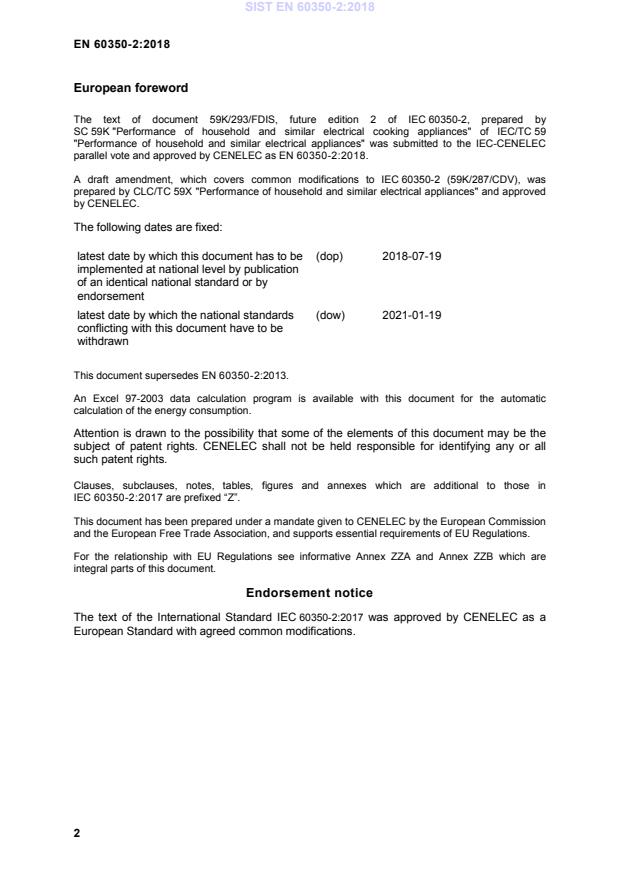
For the relationship with EU Regulations see informative Annex ZZA and Annex ZZB which are integral parts of this document. Endorsement notice The text of the International Standard IEC 60350-2:2017 was approved by CENELEC as a European Standard with agreed common modifications. SIST EN 60350-2:2018
5.2 Electricity supply
Replace the last paragraph of Subclause 5.2 by:
The supply frequency shall be at a nominal 50 Hz with a relative tolerance of ± 1 %.
Normative references to international publications with their corresponding European publications
The following documents, in whole or in part, are normatively referenced in this document and are indispensable for its application. For dated references, only the edition cited applies. For undated references, the latest edition of the referenced document (including any amendments) applies.
NOTE 1 When an International Publication has been modified by common modifications, indicated by (mod), the relevant EN/HD applies.
NOTE 2 Up-to-date information on the latest versions of the European Standards listed in this annex is available here: www.cenelec.eu
Publication Year Title EN/HD Year
IEC 60584-2 1982 Thermocouples -
Part 2: Tolerances EN 60584-2 1993
IEC 62301 - Electrical and electronic household and office equipment - Measurement of low power consumption EN 50564 - ISO 80000-1 2009
Quantities and units -
Part 1: General EN ISO 80000-1 2013
CIE 15.2
Colorimetry - -
Uncertainty of measurements
Following IEC/TR 61923 “Household electrical appliances – Method of measuring performance – Assessment of repeatability and reproducibility”, the following expanded uncertainties for measurements according to this European Standard may be assumed.
In 2011, a round robin test was performed with 12 laboratories participating from all over Europe. One of the objectives was to check the robustness and precision of the measurement of energy consumption. Three technologies were tested: “solid plate”, “radiant heater”, “induction”, along with three technologies for the control system: “switch”, “energy regulator”, and “electronic control”. The size of the hobs is the most common one on the market: 60 cm with 4 cooking zones. To cover a reasonable amount of labor only one cooking zone with a diameter of 180 mm were considered.
Results were analyzed by CLC/TC 59X/WG 10 together with CECED, and expanded uncertainties were calculated as shown in Table ZB.1.
Table ZB.1 – Relative expanded uncertainty a of measured values of this European Standard Measured parameter
Relative expanded uncertainty a of measured values of this European Standard Measured parameter
Relative expanded uncertainty of measured value b
(k = 2)
energy consumption per cooking zone calculated per kg 2,75 %
Energy consumption per cooking area calculated per kg c Energy consumption per hob calculated per kg c a The expanded uncertainty only describes the uncertainty of the measuring method while the variance of the product is not included.
b These values are the average of measurement figures taken from different technology, see above. c Not measured in this ring test.
Relationship between this European Standard and the ecodesign requirements of Commission Regulation (EU) No 66/2014 aimed to be covered
This European Standard has been prepared under a Commission’s standardization request M/495 Standardization mandate to CEN, CENELEC and ETSI under Directive 2009/125/EC relating to harmonized standards in the field of Ecodesign to provide one voluntary means of conforming to the ecodesign requirements of Commission Regulation (EU) No 66/2014 of 14 January 2013 implementing Directive 2009/125/EC of the European Parliament and of the Council with regard to ecodesign requirements for household hobs and range hoods [OJ L 29/33, 31.01.2014].
Once this standard is cited in the Official Journal of the European Union under that Regulation, compliance with the normative clauses of this standard given in Table ZZA.1 confers, within the limits of the scope of this standard, a presumption of conformity with the corresponding ecodesign requirements of that Regulation and associated EFTA Regulations.
Table ZZA.1 — Correspondence between this European Standard and Commission Regulation (EU) No 66/2014 of 14 January 2014 implementing Directive 2009/125/EC of the European Parliament and of the Council with regard to ecodesign requirements for household hobs [OJ L 29/33, 31.01.2014] and Commission’s standardization request M/495 Standardization mandate to CEN, CENELEC and ETSI under Directive 2009/125/EC relating to harmonized standards in the field of Ecodesign Ecodesign requirements of Regulation No 66/2014 [OJ L 29/33, 31.01.2014] Clause(s) / sub-clause(s) of this EN
Remarks / Notes
General description of the appliance model; number of cooking zones and/or areas; the heating technology. 1 Scope 2 Normative references 3 Terms and definitions
Determining the size of cooking zones and cooking areas.
6.3 Cooking zones and cooking areas
Measuring the energy consumption of a cooking zone or a cooking area of a domestic hob for one standardized cooking cycle.
5 General conditions for the measurement 7.1 General 7.2 Purpose 7.3 Determine a cookware set to assess a hob with cooking zones 7.4 Positioning the cookware on a cooking zone 7.5 Procedure for measuring the energy consumption of a cooking process Annex A.1 (normative) General Annex A.2 Hob with cooking area Annex A.3 Positioning on a cooking area Annex B (informative) Aids for measuring the energy consumption according to clause 7 Annex C (informative) Examples how to select and position the Excluding 5.6.2 as this alternative cookware leads only to comparative testing results. SIST EN 60350-2:2018
F.4 Cookware for measuring the energy consumption and heating up time Evaluation of the result on energy consumption and determining the normalized energy consumption in Wh / 1000 g water. 7.5.4 Evaluation and calculation
Calculation sheet
Annex E (informative) Data and Calculation Sheet: Energy consumption of a cooking process (see clause 7 and Annex A)
WARNING 1 — Presumption of conformity stays valid only as long as a reference to this European Standard is maintained in the list published in the Official Journal of the European Union. Users of this standard should consult frequently the latest list published in the Official Journal of the European Union. WARNING 2 — Other Union legislation may be applicable to the products falling within the scope of this standard. SIST EN 60350-2:2018
Relationship between this European Standard and the ecodesign requirements of Commission Regulation (EC) No 1275/2008 aimed to be covered
This European Standard has been prepared under a Commission’s standardization request M/439 Mandate to CEN, CENELEC and ETSI for standardization in the field of standby and off modes power consumption measurement for energy using products (EuPs) to provide one voluntary means of conforming to the ecodesign requirements of Commission Regulation (EC) No 1275/2008 of 17 December 2008 implementing Directive 2005/32/EC of the European Parliament and of the Council with regard to ecodesign requirements for standby and off mode electric power consumption of electrical and electronic household and office equipment [OJ L 339, 18.12.2008].
Once this standard is cited in the Official Journal of the European Union under that Regulation, compliance with the normative clauses of this standard given in Table ZZC.1 confers, within the limits of the scope of this standard, a presumption of conformity with the corresponding ecodesign requirements of that Regulation and associated EFTA regulations.
Table ZZB.1 – Correspondence between this European Standard and Commission Regulation (EC) No 1275/2008 of 17 December 2008 implementing Directive 2005/32/EC of the European Parliament and of the Council with regard to ecodesign requirements for standby and off mode electric power consumption of electrical and electronic household and office equipment [OJ L 339, 18.12.2008] and Commission’s standardization request M/439 Mandate to CEN, CENELEC and ETSI for standardization in the field of standby and off modes power consumption measurement for energy using products (EuPs) Ecodesign requirements of Regulation (EC) No 1275/2008 [OJ L 339, 18.12.2008]
Clause(s) and subclause(s) of this EN Remarks / Notes Power consumption requirements for standby- and off-mode 12 Power measurement of low power modes
WARNING 1 — Presumption of conformity stays valid only as long as a reference to this European Standard is maintained in the list published in the Official Journal of the European Union. Users of this standard should consult frequently the latest list published in the Official Journal of the European Union. WARNING 2 — Other Union legislation may be applicable to the products falling within the scope of this standard. SIST EN 60350-2:2018
IEC 60350-2 Edition 2.0 2017-08 INTERNATIONAL STANDARD
Household electric cooking appliances –
Part 2: Hobs – Methods for measuring performance
INTERNATIONAL ELECTROTECHNICAL COMMISSION
ICS 97.040.20
ISBN 978-2-8322-4767-9
– 2 – IEC 60350-2:2017 © IEC 2017 CONTENTS FOREWORD . 6 1 Scope . 8 2 Normative references . 8 3 Terms and definitions . 8 4 List of measurements . 11 4.1 Dimensions and mass . 11 4.2 Cooking zones and cooking areas . 11 4.3 Cleaning . 12 5 General conditions for the measurements . 12 5.1 Test room . 12 5.2 Electricity supply . 12 5.3 Instrumentation and measurements . 12 5.4 Positioning the appliance . 13 5.5 Initial conditions . 14 5.6 Cookware . 14 5.6.1 Standardized cookware . 14 5.6.2 Alternative cookware . 18 6 Dimensions and mass . 19 6.1 Overall dimensions . 19 6.2 Mass of the appliance . 21 6.3 Cooking zones and cooking areas . 21 6.3.1 Number of cooking zones per hob . 21 6.3.2 Dimensions of cooking zones . 21 6.3.3 Dimensions of cooking areas . 22 6.4 Level of solid hotplates . 22 6.5 Distance between cooking zones . 23 7 Energy consumption and heating up time . 23 7.1 General . 23 7.2 Purpose . 23 7.3 Determine a cookware set to assess a hob with cooking zones . 23 7.4 Positioning the cookware on a cooking zone . 24 7.5 Procedure for measuring the energy consumption of a cooking process . 25 7.5.1 Preparation . 25 7.5.2 Preliminary measurements . 25 7.5.3 Measuring the energy consumption . 27 7.5.4 Evaluation and calculation . 28 7.6 Procedure for measuring the heating up time . 29 8 Ability to control the temperature of a load . 29 8.1 Lower control position . 29 8.1.1 Purpose . 29 8.1.2 Cookware, positioning and ingredients. 30 8.1.3 Procedure . 30 8.1.4 Assessment . 31 8.2 Temperature overshoot of hotplates . 31 8.2.1 Purpose . 31 8.2.2 Ingredients and cookware . 31 SIST EN 60350-2:2018
IEC 60350-2:2017 © IEC 2017 – 3 –
8.2.3 Procedure . 31 8.2.4 Assessment . 31 9 Heat distribution and heat supply . 32 9.1 Measuring the heat distribution . 32 9.1.1 Test purpose . 32 9.1.2 Discs . 32 9.1.3 Pre-test for determining the setting . 33 9.1.4 Preparation of the disc for the main test . 34 9.1.5 Main test . 35 9.1.6 Assessment . 35 9.2 Measuring the continuous frying. 39 9.2.1 Purpose . 39 9.2.2 Specification of the frying pan . 40 9.2.3 Recipe for pancakes . 40 9.2.4 Procedure . 41 9.2.5 Assessment . 41 10 Heat performance of cooking zones . 41 10.1 Purpose . 41 10.2 Procedure . 41 11 Smallest detected diameter for induction cooking zones . 43 11.1 Purpose . 43 11.2 Procedure . 43 12 Power measurement of low power modes . 44 13 Spillage capacity of hobs . 44 Annex A (normative)
Further requirements for measuring the energy consumption and heating up time for cooking areas . 46 A.1 General . 46 A.2 Hob with cooking area . 46 A.2.1 General . 46 A.2.2 Cooking area without limitative marking . 46 A.2.3 Hob with cooking area with limitative marking . 47 A.2.4 Hob with cooking zones and cooking areas . 48 A.3 Positioning on a cooking area . 48 A.3.1 General . 48 A.3.2 Positioning on a cooking area without limitative markings . 48 A.3.3 Positioning on a cooking area with limitative markings . 49 Annex B (informative)
Aids for measuring the energy consumption according to Clause 7 . 53 B.1 Fixing the temperature measurement instrument to the lid – Example . 53 B.2 Marking the lowest possible simmering power setting . 53 Annex C (informative)
Examples how to select and position the cookware for measurements according to Clause 7 and Annex A . 55 C.1 Example 1 – Cooking zones . 55 C.2 Example 2 – cooking zones combined with cooking area with limitative markings . 56 C.3 Example 3 – cooking area with limitative markings > 3 controls with the area of control in front . 59 C.4 Example 4 – cooking area with limitative markings > 3 controls with the area of control at the side . 62 Annex D (normative)
Shade chart . 65 SIST EN 60350-2:2018
– 4 – IEC 60350-2:2017 © IEC 2017 Annex E (informative)
Data and calculation sheet: energy consumption of a cooking process (see Clause 7 and Annex A) . 67 Annex F (informative)
Addresses of suppliers . 68 F.1 General . 68 F.2 Disc material (C45) for measuring the smallest detected diameter . 68 F.3 Stainless steel for bottom material of the standardized cookware . 68 F.4 Cookware for measuring the energy consumption and heating up time. 68 F.5 Disc for measuring the heat distribution . 68 F.6 Lamp for digital measurement systems . 68 F.7 Digital measurement system . 69 F.8 Testcharts for checking the resolution of the imaging system . 69 Annex G (informative)
Example for assessing the lower control position . 70 G.1 General . 70 G.2 Criteria . 70 Bibliography . 71
Figure 1 – Standardized cookware . 18 Figure 2 – Dimensions of appliances. 20 Figure 3 – Dimensions of built-in hobs . 21 Figure 4 – Device for checking the level of solid hotplates . 22 Figure 5 – Overshoot measurement . 25 Figure 6 – Energy consumption measurement process
for a cooking process . 27 Figure 7 – Diametral lines . 39 Figure 8 – Disc to determine the smallest detected diameter . 44 Figure A.1 – Layout for a hob with cooking area
without limitative marking – Example . 46 Figure A.2 – Layouts for a hob with a cooking area with limitative marking – Examples . 47 Figure A.3 – Drawing layer . 49 Figure A.4 – Position a cookware set on a cooking area with limitative markings ≤ 3 controls – Example . 50 Figure A.5 – Position a cookware set on a cooking area with limitative markings > 3 controls – Example . 52 Figure B.1 – Position of the temperature
measurement instrument . 53 Figure B.2 – Polar coordinate paper – Example . 54 Figure C.1 – Example 1: tubular hotplates, solid hotplates, radiant cooking zone or induction cooking zone . 55 Figure C.2 – Example 1: selecting and positioning of cookware . 56 Figure C.3 – Example 2: induction or radiant cooking zones combined with a cooking area with limitative markings . 57 Figure C.4 – Example 2: selecting and positioning of cookware . 58 Figure C.5 – Example 3: Cooking area with limitative markings
> 3 controls with the area of the control in front . 59 Figure C.6 – Example 3: procedure how to shift the cookware
into the correct position – Step 1 . 60 Figure C.7 – Example 3: Procedure how to shift the cookware
into the correct position – Step 2 . 61 Figure C.8 – Example 4: Cooking area with limitative markings
> 3 controls with the area of the control at the side . 62 SIST EN 60350-2:2018
IEC 60350-2:2017 © IEC 2017 – 5 –
Figure C.9 – Example 4: procedure how to shift the cookware
into the correct position – Step 1 . 63 Figure C.10 – Example 4: procedure how to shift the cookware into the correct position – Step 2 . 64
Table 1 – Instruments . 13 Table 2 – Measurements . 13 Table 3 – Sizes of standardized cookware and water amounts . 15 Table 4 – Criteria for selecting the cookware set
regarding cooking zones . 24 Table 5 – Amount of oil . 30 Table 6 – Specifications for discs used for
measuring the heat distribution . 33 Table 7 – maximum time tmax for each size of disc . 37 Table 8 – Ingredients and cooking durations . 40 Table 9 – Quantities for heat performance test . 42 Table 10 – Frying times for potato chips . 42 Table A.1 – Criteria for the cookware set for measuring
cooking areas without limitative marking . 47 Table A.2 – Criteria for the cookware set for measuring
cooking areas with limitative marking. 48 Table D.1 – Classification of shade numbers regarding Ry . 65 Table D.2 – Examples for the shade charts regarding L*, Ry and the
specification of the limiting samples Hlimit and Hlower . 66
– 6 – IEC 60350-2:2017 © IEC 2017 INTERNATIONAL ELECTROTECHNICAL COMMISSION ____________
HOUSEHOLD ELECTRIC COOKING APPLIANCES –
Part 2: Hobs – Methods for measuring performance
FOREWORD 1) The International Electrotechnical Commission (IEC) is a worldwide organization for standardization comprising all national electrotechnical committees (IEC National Committees). The object of IEC is to promote international co-operation on all questions concerning standardization in the electrical and electronic fields. To this end and in addition to other activities, IEC publishes International Standards, Technical Specifications, Technical Reports, Publicly Available Specifications (PAS) and Guides (hereafter referred to as “IEC Publication(s)”). Their preparation is entrusted to technical committees; any IEC National Committee interested in the subject dealt with may participate in this preparatory work. International, governmental and non-governmental organizations liaising with the IEC also participate in this preparation. IEC collaborates closely with the International Organization for Standardization (ISO) in accordance with conditions determined by agreement between the two organizations. 2) The formal decisions or agreements of IEC on technical matters express, as nearly as possible, an international consensus of opinion on the relevant subjects since each technical committee has representation from all interested IEC National Committees.
3) IEC Publications have the form of recommendations for international use and are accepted by IEC National Committees in that sense. While all reasonable efforts are made to ensure that the technical content of IEC Publications is accurate, IEC cannot be held responsible for the way in which they are used or for any misinterpretation by any end user. 4) In order to promote international uniformity, IEC National Committees undertake to apply IEC Publications transparently to the maximum extent possible in their national and regional publications. Any divergence between any IEC Publication and the corresponding national or regional publication shall be clearly indicated in the latter. 5) IEC itself does not provide any attestation of conformity. Independent certification bodies provide conformity assessment services and, in some areas, access to IEC marks of conformity. IEC is not responsible for any services carried out by independent certification bodies. 6) All users should ensure that they have the latest edition of this publication. 7) No liability shall attach to IEC or its directors, employees, servants or agents including individual experts and members of its technical committees and IEC National Committees for any personal injury, property damage or other damage of any nature whatsoever, whether direct or indirect, or for costs (including legal fees) and expenses arising out of the publication, use of, or reliance upon, this IEC Publication or any other IEC Publications.
8) Attention is drawn to the Normative references cited in this publication. Use of the referenced publications is indispensable for the correct application of this publication. 9) Attention is drawn to the possibility that some of the elements of this IEC Publication may be the subject of patent rights. IEC shall not be held responsible for identifying any or all such patent rights. International Standard IEC 60350-2 has been prepared by subcommittee 59K: Performance of household and similar electrical cooking appliances, of IEC technical committee TC 59: Performance of household and similar electrical appliances. This second edition cancels and replaces the first edition published in 2011. This edition constitutes a technical revision. This edition includes the following significant technical changes with respect to the previous edition: a) terms and definitions revised and new definitions added (see 3); b) following the new market trend, requirements related to so-called flexible and free induction zones – in this document named as cooking areas – are added; c) specification for standardized and alternative cookware is introduced (see 5.6); d) measurement procedure reflecting a household-like cooking process for measuring the energy consumption is introduced (see Clause 7 and Annex A); SIST EN 60350-2:2018
IEC 60350-2:2017 © IEC 2017 – 7 –
e) revision of measurement procedure for determining the accuracy of control (see Clause 8); f) new reproducible measurement procedure for assessing the heat distribution (see Clause 9); g) additional requirements (according to IEC 62301:2011) on how to measure low-power modes. In this document, terms in bold characters are defined in Clause 3. This standard contains attached files in the form of a spreadsheet. These files are intended to be used as a complement and do not form an integral part of the standard.
The text of this International Standard is based on the following documents: FDIS Report on voting 59K/293/FDIS 59K/294/RVD
Full information on the voting for the approval of this International Standard can be found in the report on voting indicated in the above table. This document has been drafted in accordance with the ISO/IEC Directives, Part 2. A list of all parts in the IEC 60350 series, published under the general title Household electric cooking appliances, can be found on the IEC website. The committee has decided that the contents of this document will remain unchanged until the stability date indicated on the IEC website under "http://webstore.iec.ch" in the data related to the specific document. At this date, the document will be
• reconfirmed, • withdrawn, • replaced by a revised edition, or • amended. A bilingual version of this publication may be issued at a later date.
IMPORTANT – The 'colour inside' logo on the cover page of this publication indicates that it contains colours which are considered to be useful for the correct understanding of its contents. Users should therefore print this document using a colour printer.
– 8 – IEC 60350-2:2017 © IEC 2017 HOUSEHOLD ELECTRIC COOKING APPLIANCES –
Part 2: Hobs – Methods for measuring performance
1 Scope This part of IEC 60350 defines methods for measuring the performance of electric hobs for household use. Appliances covered by this document can be built-in or designed to be placed on a work surface. The hob can also be a part of a cooking range. This document does not apply to portable appliances for cooking, grilling and similar functions (see IEC 61817). This document defines the main performance characteristics of hobs which are of interest to the user and specifies methods for measuring these characteristics. This document does not specify a classification or ranking for performance. NOTE 1 Some of the tests which are specified in this document are not considered to be reproducible since the results can vary between laboratories. They are therefore intended for comparative testing purposes only. NOTE 2 This document does not deal with safety requirements (IEC 60335-2-6 and IEC 60335-2-9). 2 Normative references The following documents are referred to in the text in such a way that some or all of their content constitutes requirements of this document. For dated references, only the edition cited applies. For undated references, the latest edition of the referenced document (including any amendments) applies. IEC 62301:2011, Household electrical appliances – Measurement of standby power IEC 60364-5-54, Low-voltage electrical installations – Part 5-54: Selection and erection of electrical equipment – Earthing arrangements and protective conductors ISO 80000-1:2009, Quantities and units – Part 1: General 3 Terms and definitions For the purposes of this document, the following terms and definitions apply. ISO and IEC maintain terminological databases for use in standardization at the following addresses: • IEC Electropedia: available at http://www.electropedia.org/ • ISO Online browsing platform: available at http://www.iso.org/obp 3.1
cooking range appliance having a hob and at least one oven and which may incorporate a grill SIST EN 60350-2:2018
IEC 60350-2:2017 © IEC 2017 – 9 –
Note 1 to entry: Methods for measuring performance of ovens are described in IEC 60350-1. 3.2
hob appliance or part of an appliance which incorporates one or more cooking zones and/or cooking areas including a control unit Note 1 to entry: A hob is also known as a cooktop. Note 2 to entry: The control unit can be included in the hob itself or integrated in a cooking range. 3.3
cooking zone limitative marking on the surface of a hob where one cookware is placed and heated or an attached area to the surface EXAMPLE
A cooking zone can be: – a single zone or a multiple zone (see 3.4 and 3.5); – a solid hotplate (see 3.6);
– a tubular hotplate (see 3.7); – a radiant cooking zone (see 3.8); – an induction cooking zone (see 3.9). Note 1 to entry: Cooking zones which are used without cookware but by positioning the food directly on the surface are not included. Note 2 to entry: Sometimes there is a decoration symbol, e.g. a cross, to mark the centre of the cooking zone additionally. 3.4
single zone cooking zone marked for one cookware size 3.5
multiple zone cooking zone marked for more than one cookware size and shape which can be circular, elliptical or a combination EXAMPLE 1 Circular multiple zone for three different cookware sizes:
[IEC 60417-Pr17-001] EXAMPLE 2 Circular and elliptical multiple zone:
[IEC 60417-5492:2002-10] SIST EN 60350-2:2018
– 10 – IEC 60350-2:2017 © IEC 2017 3.6
solid hotplate cooking zone having a closed surface, which is usually constructed from cast iron, with an integrated heating element 3.7
tubular hotplate cooking zone having a surface which is formed by the configuration of a tubular heated heating element in a substantially flat plane 3.8
radiant cooking zone cooking zone on which the pan is heated by means of a radiant heating element below the glass ceramic which could have a heating ribbon, heating spiral or a tungsten wire which is located in a quartz glass bulb or combination of these 3.9
induction cooking zone cooking zone on which the pan is heated by means of an induction element below the glass ceramic or similar where the eddy currents are inducted in the bottom of the pan by a magnetic field 3.10
cooking area without limitative markings area where cookware is placed and heated by an inducted magnetic field without limitative markings EXAMPLE See Figure A.1 Note 1 to entry: Cooking areas which are used without cookware but by positioning the food directly on the surface are not included. Note 2 to entry: Sometimes there are one or more decoration symbols, e.g. a cross, on the cooking area to mark the centre position where the cookware is placed. 3.11
cooking area with limitative markings area where cookware is placed and heated by an inducted magnetic field where the area is marked to show the limits where more than one cookware can be used simultaneously while the cookware pieces can be used and controlled separately from each other at the same time EXAMPLE See Figure A.2 Note 1 to entry: Cooking areas which are used without cookware but by positioning the food directly on the surface are not included. Note 2 to entry: The cooking area is also used combined for one cookware, even if there is more than one control. 3.12
control part of the hob for adjusting the power or temperature respectively of a cooking zone or a cooking area for one piece of cookware, independent from technical solution (e.g. knobs, touch controls etc.) Note 1 to entry: The power is generally indicated as numbers, but also temperature values and symbols are possible. Note 2 to entry: Controls integrated outside of the hob in a separate device or as part of a built-in-oven are also included. SIST EN 60350-2:2018
IEC 60350-2:2017 © IEC 2017 – 11 –
3.13
warming zone area used
...