

SIST EN 746-1:2000+A1:2009
(Main)Industrial thermoprocessing equipment - Part 1: Common safety requirements for industrial thermoprocessing equipment
General Information
- Abstract
1.1 This part of EN 746 specifies common safety requirements for industrial thermoprocessing equipment (for example industrial furnaces and industrial heating equipment), which meets the definition for machinery given in EN ISO 12100-1:2003.
It details the anticipated significant hazards associated with industrial thermoprocessing equipment and specifies the appropriate preventative measures for reduction or elimination of these hazards.
This standard gives general principles and common requirements for the reduction of risks for equipments covered by the scope.
The common requirements apply to all of the subsequent parts of this EN 746 dealing with specific equipment unless an exception is stated in the relevant Part. The general principles (subclauses are pointed out) will be used to establish the specific technical measures in the subsequent Part(s) dealing with safety requirements for particular equipment.
NOTE For similar equipment not covered by the particular Parts of this standard, EN 746-1 can be used to assist in the reduction of risk for the Hazards identified in clause 4 (List of Hazards).
1.2 This part of EN 746 is applicable to industrial thermoprocessing equipments for use in fields such as:
- Metallurgical and metal working plant;
- Glass making plant;
- Ceramic manufacturing plant;
- Cement, lime and gypsum manufacturing plant;
- Chemical plant;
- Waste incineration equipment;
And heated by:
- Gaseous fuels;
- Liquid fuels;
- Solid fuels;
- Mixed fuels;
- Electricity.
The thermoprocessing equipment covered by this Part of EN 746 is further specified in clause 3.
A more detailed list of thermoprocessing equipment within these categories is given in Annex A.
In the remainder of this standard the expression "equipment" will be used.
This Part of EN 746 is not applicable to blast furnaces, converters (in steel plants), boilers, welding machines or food processing equipment.
1.3 This Part of EN 746 specifies the requirements to be
- Status
- Published
- Publication Date
- 07-Sep-2009
- Technical Committee
- I13 - Imaginarni 13
- Current Stage
- 6060 - National Implementation/Publication (Adopted Project)
- Start Date
- 19-Aug-2009
- Due Date
- 24-Oct-2009
- Completion Date
- 08-Sep-2009
- Directive
- 2006/42/EC - Directive 2006/42/EC of the European Parliament and of the Council of 17 May 2006 on machinery, and amending Directive 95/16/EC (recast)OJ Ref: C 309, TIP C, L 7.9.2026 UMIK 20.1.2027 OJ Date: 18-Dec-2009 Conflicting Date: 20-Jan-2027
Buy Documents



Overview
EN 746-1:1997+A1:2009 is the CEN harmonized standard that sets common safety requirements for industrial thermoprocessing equipment (for example industrial furnaces and industrial heating equipment) that meet the machinery definition in EN ISO 12100-1:2003. It identifies the significant hazards associated with thermoprocessing equipment and specifies general principles and preventative measures to reduce or eliminate those hazards across the lifecycle - design, commissioning, operation, maintenance and decommissioning. EN 746-1 is a Type-C standard and includes Amendment A1 (2009).
Key Topics and Requirements
EN 746-1 addresses broad safety areas and risk-reduction obligations that apply to subsequent parts of the EN 746 series. Major technical topics include:
- Hazard identification and risk reduction: List of foreseeable hazards (clause 4) and general risk-reduction principles.
- Mechanical safety: protection against moving parts, ejection, implosion, structural failure.
- Electrical safety: safe electrical equipment design and compliance with relevant electrical standards.
- Thermal safety: prevention of fire, explosion, scalding, contact with hot surfaces, hot gases and flames.
- Noise and vibration: controls and ergonomic measures to limit exposure.
- Radiation: thermal, optical, ionising and non-ionising radiation considerations.
- Materials and substances: control of harmful by-products, poisoning risks and environmental pollution.
- Human factors and ergonomics: design for safe operation and maintenance.
- Malfunctions and missing safety devices: measures for foreseeable faults and incorrect fitting.
- Information for use: marking, technical data, installation, commissioning and comprehensive instruction handbooks (operation, maintenance, decommissioning).
The standard also provides informative annexes such as a detailed list of covered thermoprocessing equipment, test report examples and permit-to-work templates, and shows the relationship to EU Machinery Directive requirements.
Applications and Who Uses It
EN 746-1 is applicable to thermoprocessing equipment used in industries such as:
- Metallurgy and metalworking
- Glass and ceramic manufacturing
- Cement, lime and gypsum production
- Chemical plants and waste incineration
It covers equipment heated by gaseous, liquid, solid, mixed fuels or electricity. Typical users:
- Manufacturers and OEMs of industrial furnaces and heating equipment
- Design and process engineers integrating thermoprocessing systems
- Health & safety engineers and compliance teams
- Maintenance personnel, installers and certification bodies
Note: EN 746-1 does not apply to blast furnaces, converters in steel plants, boilers, welding machines or food processing equipment.
Related Standards
- EN ISO 12100 (machinery safety - risk assessment and design principles)
- EN 746 series (Parts 2–8 cover combustion systems, atmosphere gases, salt baths, vacuum, quenching, etc.)
- Referenced product/discipline standards (e.g., EN 60204-1 for electrical equipment of machines)
Using EN 746-1 helps demonstrate compliance with the EU Machinery Directive and provides a consistent framework for reducing risks in industrial thermoprocessing equipment.
Relations
- Effective Date
- 25-Aug-2026
- Effective Date
- 09-Feb-2026
- Effective Date
- 09-Feb-2026
- Effective Date
- 09-Feb-2026
- Effective Date
- 09-Feb-2026
- Refers
SIST EN 60825-1:2014 - Safety of laser products - Part 1: Equipment classification and requirements - Effective Date
- 09-Feb-2026
- Effective Date
- 09-Feb-2026
- Effective Date
- 09-Feb-2026
- Effective Date
- 09-Feb-2026
- Effective Date
- 09-Feb-2026
- Effective Date
- 09-Feb-2026
- Effective Date
- 28-Jan-2026
- Effective Date
- 28-Jan-2026
- Effective Date
- 28-Jan-2026
- Effective Date
- 28-Jan-2026
Buy Documents
Get Certified
Connect with accredited certification bodies for this standard

DVS-ZERT GmbH
German welding certification society.
CARES (UK Certification Authority for Reinforcing Steels)
UK certification for reinforcing steels and construction.
EWF/IIW (European/International Welding Federation)
International welding personnel certification.
Sponsored listings
Frequently Asked Questions
SIST EN 746-1:2000+A1:2009 is a standard published by the Slovenian Institute for Standardization (SIST). Its full title is "Industrial thermoprocessing equipment - Part 1: Common safety requirements for industrial thermoprocessing equipment". This standard covers: 1.1 This part of EN 746 specifies common safety requirements for industrial thermoprocessing equipment (for example industrial furnaces and industrial heating equipment), which meets the definition for machinery given in EN ISO 12100-1:2003. It details the anticipated significant hazards associated with industrial thermoprocessing equipment and specifies the appropriate preventative measures for reduction or elimination of these hazards. This standard gives general principles and common requirements for the reduction of risks for equipments covered by the scope. The common requirements apply to all of the subsequent parts of this EN 746 dealing with specific equipment unless an exception is stated in the relevant Part. The general principles (subclauses are pointed out) will be used to establish the specific technical measures in the subsequent Part(s) dealing with safety requirements for particular equipment. NOTE For similar equipment not covered by the particular Parts of this standard, EN 746-1 can be used to assist in the reduction of risk for the Hazards identified in clause 4 (List of Hazards). 1.2 This part of EN 746 is applicable to industrial thermoprocessing equipments for use in fields such as: - Metallurgical and metal working plant; - Glass making plant; - Ceramic manufacturing plant; - Cement, lime and gypsum manufacturing plant; - Chemical plant; - Waste incineration equipment; And heated by: - Gaseous fuels; - Liquid fuels; - Solid fuels; - Mixed fuels; - Electricity. The thermoprocessing equipment covered by this Part of EN 746 is further specified in clause 3. A more detailed list of thermoprocessing equipment within these categories is given in Annex A. In the remainder of this standard the expression "equipment" will be used. This Part of EN 746 is not applicable to blast furnaces, converters (in steel plants), boilers, welding machines or food processing equipment. 1.3 This Part of EN 746 specifies the requirements to be
1.1 This part of EN 746 specifies common safety requirements for industrial thermoprocessing equipment (for example industrial furnaces and industrial heating equipment), which meets the definition for machinery given in EN ISO 12100-1:2003. It details the anticipated significant hazards associated with industrial thermoprocessing equipment and specifies the appropriate preventative measures for reduction or elimination of these hazards. This standard gives general principles and common requirements for the reduction of risks for equipments covered by the scope. The common requirements apply to all of the subsequent parts of this EN 746 dealing with specific equipment unless an exception is stated in the relevant Part. The general principles (subclauses are pointed out) will be used to establish the specific technical measures in the subsequent Part(s) dealing with safety requirements for particular equipment. NOTE For similar equipment not covered by the particular Parts of this standard, EN 746-1 can be used to assist in the reduction of risk for the Hazards identified in clause 4 (List of Hazards). 1.2 This part of EN 746 is applicable to industrial thermoprocessing equipments for use in fields such as: - Metallurgical and metal working plant; - Glass making plant; - Ceramic manufacturing plant; - Cement, lime and gypsum manufacturing plant; - Chemical plant; - Waste incineration equipment; And heated by: - Gaseous fuels; - Liquid fuels; - Solid fuels; - Mixed fuels; - Electricity. The thermoprocessing equipment covered by this Part of EN 746 is further specified in clause 3. A more detailed list of thermoprocessing equipment within these categories is given in Annex A. In the remainder of this standard the expression "equipment" will be used. This Part of EN 746 is not applicable to blast furnaces, converters (in steel plants), boilers, welding machines or food processing equipment. 1.3 This Part of EN 746 specifies the requirements to be
SIST EN 746-1:2000+A1:2009 is classified under the following ICS (International Classification for Standards) categories: 25.180.01 - Industrial furnaces in general. The ICS classification helps identify the subject area and facilitates finding related standards.
SIST EN 746-1:2000+A1:2009 has the following relationships with other standards: It is inter standard links to SIST ISO 7000:2004, SIST EN 60825-1:1999, SIST EN 60519-2:2007, SIST EN 61310-2:2008, SIST EN IEC 60519-1:2020, SIST EN 60825-1:2014, SIST EN 61310-1:2008, SIST EN 60519-3:2005, SIST EN IEC 60519-4:2022, SIST EN IEC 60519-8:2020, SIST EN IEC 60519-6:2024, SIST EN ISO 11690-2:2021, SIST EN ISO 14119:2025, SIST EN ISO 13577-2:2024, SIST EN 746-3:2022. Understanding these relationships helps ensure you are using the most current and applicable version of the standard.
SIST EN 746-1:2000+A1:2009 is associated with the following European legislation: EU Directives/Regulations: 2006/42/EC, 98/37/EC, EUR-PUB; Standardization Mandates: M/079, M/396. When a standard is cited in the Official Journal of the European Union, products manufactured in conformity with it benefit from a presumption of conformity with the essential requirements of the corresponding EU directive or regulation.
SIST EN 746-1:2000+A1:2009 is available in PDF format for immediate download after purchase. The document can be added to your cart and obtained through the secure checkout process. Digital delivery ensures instant access to the complete standard document.
Standards Content (Sample)
2003-01.Slovenski inštitut za standardizacijo. Razmnoževanje celote ali delov tega standarda ni dovoljeno.Industrijska termoprocesna oprema - 1. del: Splošne varnostne zahteve za industrijsko termoprocesno opremoIndustrielle Thermoprozessanlagen - Teil 1: Allgemeine Sicherheitsanforderungen an industrielle ThermoprozessanlagenEquipements thermiques industriels - Partie 1: Prescriptions générales de sécurité pour les équipements thermiques industrielsIndustrial thermoprocessing equipment - Part 1: Common safety requirements for industrial thermoprocessing equipment25.180.01Industrial furnaces in generalICS:Ta slovenski standard je istoveten z:EN 746-1:1997+A1:2009SIST EN 746-1:2000+A1:2009en01-oktober-2009SIST EN 746-1:2000+A1:2009SLOVENSKI
STANDARD
EUROPEAN STANDARD NORME EUROPÉENNE EUROPÄISCHE NORM
EN 746-1:1997+A1
August 2009 ICS 25.180.01 Supersedes EN 746-1:1997English Version
Industrial thermoprocessing equipment - Part 1: Common safety requirements for industrial thermoprocessing equipment
Equipements thermiques industriels - Partie 1: Prescriptions générales de sécurité pour les équipements thermiques industriels
Industrielle Thermoprozessanlagen - Teil 1: Allgemeine Sicherheitsanforderungen an industrielle Thermoprozessanlagen This European Standard was approved by CEN on 15 February 1997 and includes Amendment 1 approved by CEN on 16 July 2009.
CEN members are bound to comply with the CEN/CENELEC Internal Regulations which stipulate the conditions for giving this European Standard the status of a national standard without any alteration. Up-to-date lists and bibliographical references concerning such national standards may be obtained on application to the CEN Management Centre or to any CEN member.
This European Standard exists in three official versions (English, French, German). A version in any other language made by translation under the responsibility of a CEN member into its own language and notified to the CEN Management Centre has the same status as the official versions.
CEN members are the national standards bodies of Austria, Belgium, Bulgaria, Cyprus, Czech Republic, Denmark, Estonia, Finland, France, Germany, Greece, Hungary, Iceland, Ireland, Italy, Latvia, Lithuania, Luxembourg, Malta, Netherlands, Norway, Poland, Portugal, Romania, Slovakia, Slovenia, Spain, Sweden, Switzerland and United Kingdom.
EUROPEAN COMMITTEE FOR STANDARDIZATION
COMITÉ EUROPÉEN DE NORMALISATION EUROPÄISCHES KOMITEE FÜR NORMUNG
Management Centre:
Avenue Marnix 17,
B-1000 Brussels © 2009 CEN All rights of exploitation in any form and by any means reserved worldwide for CEN national Members. Ref. No. EN 746-1:1997+A1:2009: ESIST EN 746-1:2000+A1:2009
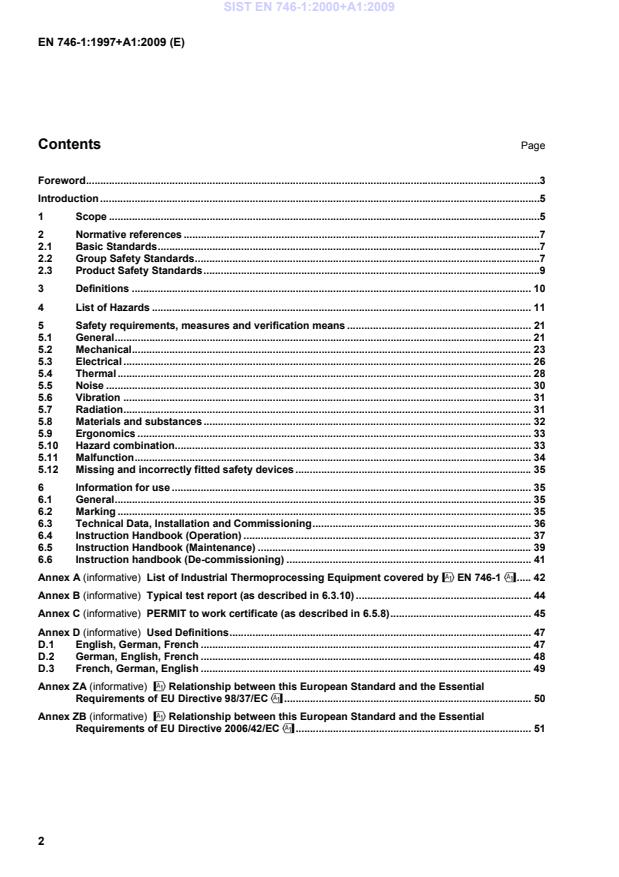
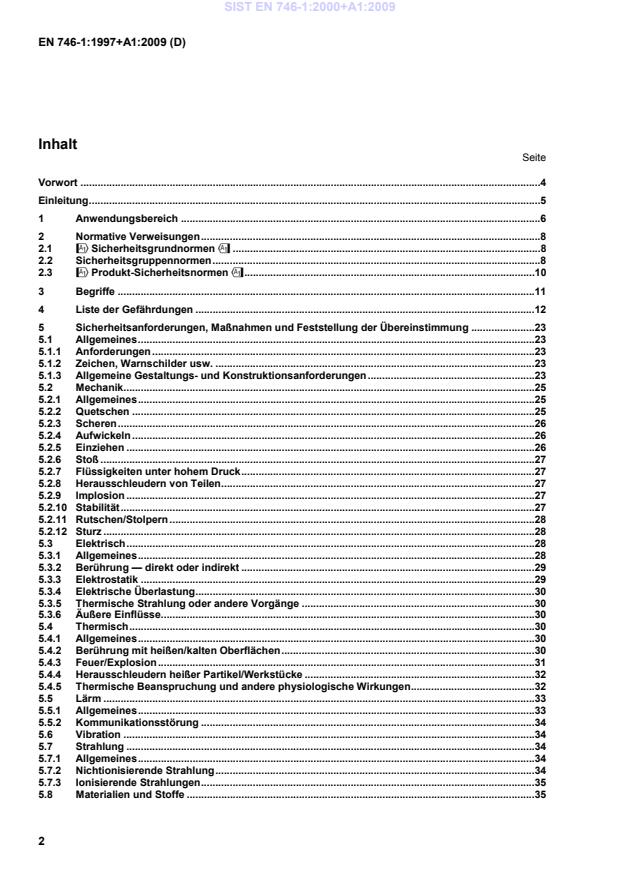
List of Industrial Thermoprocessing Equipment covered by !EN 746-1" . 42Annex B (informative)
Typical test report (as described in 6.3.10) . 44Annex C (informative)
PERMIT to work certificate (as described in 6.5.8) . 45Annex D (informative)
Used Definitions . 47D.1English, German, French . 47D.2German, English, French . 48D.3French, German, English . 49Annex ZA (informative)
!Relationship between this European Standard and the Essential Requirements of EU Directive 98/37/EC" . 50Annex ZB (informative)
!Relationship between this European Standard and the Essential Requirements of EU Directive 2006/42/EC" . 51 SIST EN 746-1:2000+A1:2009
(IEC 60204-1:2005, modified) !IEC 60364-4-41, Low-voltage electrical installations — Part 4-41: Protection for safety — Protection against electric shock" !IEC 60364-4-43, Electrical installations of buildings — Part 4-43: Protection for safety — Protection against overcurrent" !deleted text" !IEC 60364-4-44, Low-voltage electrical installations — Part 4-44: Protection for safety — Protection against voltage disturbances and electromagnetic disturbances" !deleted text" 2.2 Group Safety Standards !deleted text" EN 349, Safety of machinery — Minimum gaps to avoid crushing of parts of the human body !deleted text" EN 547-1, Safety of machinery — Human body measurements — Part 1: Principles for determining the dimensions required for openings for whole body access into machinery EN 547-2, Safety of machinery — Human body measurements — Part 2: Principles for determining the dimensions required for access openings !deleted text" EN 614-1, Safety of machinery — Ergonomic design principles — Part 1: Terminology and general principles EN 626-1, Safety of machinery — Reduction of risks to health from hazardous substances emitted by machinery — Part 1: Principles and specifications for machinery manufacturers !deleted text" EN 842, Safety of machinery — Visual danger signals — General requirements, design and testing !EN 953, Safety of machinery — Guards — General requirements for the design and construction of fixed and movable guards" !deleted text" SIST EN 746-1:2000+A1:2009
(IEC 60825-1:2007)" EN 61310-1, Safety of machinery — Indication, marking and actuation — Part 1: Requirements for visual, auditory and tactile signals !(IEC 61310-1:2007)" EN 61310-2, Safety of machinery — Indication, marking and actuation — Part 2: Requirements for marking !(IEC 61310-2:2007)" !EN ISO 7731, Ergonomics — Danger signals for public and work areas — Auditory danger signals
(ISO 7731:2003)" !EN ISO 13849-1, Safety of machinery — Safety-related parts of control systems — Part 1: General principles for design (ISO 13849-1:2006)" !EN ISO 13850, Safety of machinery — Emergency stop — Principles for design (ISO 13850:2006)" !EN ISO 13857, Safety of machinery — Safety distances to prevent hazard zones being reached by upper and lower limbs (ISO 13857:2008)" !IEC 60405, Nuclear instrumentation — Constructional requirements and classification of radiometric gauges" !IEC 60417-DB, Graphical symbols for use on equipment" ISO 7000, Graphical symbols for use on equipment — Index and synopsis ISO 7243, Hot environments — Estimation of the heat stress on working man, based on the WGBT-index (wet bulb globe temperature) ISO 7933, Hot environments — Analytical determination and interpretation of thermal stress using calculation of required sweat rate SIST EN 746-1:2000+A1:2009
and/or products (e.g. tiles, sanitary ware, table ware, bricks) to process the product to its intermediate or final state. Plant and/or equipment for the reheating and drying of such products to apply glaze and other decoration to the item. 3.4 cement, lime and gypsum manufacturing plant plant and/or equipment used to calcine and/or fire selected raw materials to produce cement, lime and gypsum. 3.5 chemical plant plant and/or equipment which provides the heat input into chemical plants used in processes such as thermo-chemical reactions, oxygenation, catalysing, reduction, chain reactions and distillation. 3.6 waste incineration equipment equipment used to dispose of by burning, household and industrial waste, sewage sludge, tyres, special and toxic waste, medical and hospital waste but excluding atomic waste. 3.7 drying equipment equipment used to cure or expel moisture or volatiles from a product or material by heating. 3.8 cooling equipment equipment with heating and/or cooling systems used to reduce the temperature of products. SIST EN 746-1:2000+A1:2009
General design concept (Structure, access for operation, maintenance and cleaning, lighting, etc.) 5.1.1 to 5.1.3 2 MECHANICAL 2.1
2.2
2.3 General
Crushing
Shearing
Moving parts Traps created by auto and manual feeding/take-off mechanisms
Moving parts, moving of charging doors, feeding/take-off mechanism Design, structural details
Emergency stops; Guards
Fit guard,
fit interlocks,
Means of warning (audible, visual),
Provision of safety distances,
Provision of warning signs,
Emergency stops,
Push button with visual inspection, Maintenance/cleaning, good practice (particularly on guards). Fit guard,
Fit interlocks, 5.2.1
!EN ISO 13850", !EN 953"
5.2.2, !EN 953".
prEN 1088
!EN ISO 7731", prEN 842, EN 981, EN 61310-1
!EN ISO 13857"; EN 349; !deleted text"; EN 547-1
ISO 7000; EN 61310-1
!EN ISO 13850"
5.2.3; !EN 953"
prEN 1088,
(continued)
2.4
2.5
2.6
2.7
2.8
2.9
2.10
Entanglement
Drawing-in
Impact
High pressure fluids
Ejection of parts
Implosion
Stability
Rotating shafts (e.g. fan shafts, conveyors, transmission machinery)
Nips created by rolls (e.g. conveyors)
Struck by moving parts (e.g. doors, chargers)
Hydraulic leaks/failure Steam and service fluids
Molten metal, Process components/materials, Machinery parts
Ejection of parts
Collapsing of parts or equipment or materials; Movement of components or of machinery
Means of warning (audible, visual),
Provision of warning signs,
Safety distances, Perimeter fencing, marking, Push button with visual inspection.
Guards
Guards
Guards, Perimeter fencing systems or signs
Prevent as far as possible by adopting good maintenance procedures. Design features; Guards,
Containing and draining.
Effective protection of defined areas or sections;
Provision of personal protective equipment
Guarding, Design features, Method of operation
Design features; method of operation
Design (e.g. civil engineering) and maintenance; Design, training, understanding of the system, signs
!EN ISO 7731", prEN 842, EN 61310-1, EN 981
ISO 7000, EN 61310-1
EN 349, EN 547-1
!EN 953" 5.2.4
!EN 953" 5.2.5
!EN 953" 5.2.6
5.2.7 prEN 982, prEN 983
!EN 953"
5.2.8
6.4.15
!EN 953"
5.2.9 prEN 746-7
5.2.10
ISO 7000, EN 61310-1
(continued)
2.12
Slip/trip
Falls
Floor surfaces, Walkway surfaces,
Spilled fluids,
Inadequate lighting.
1 – From equipment;
2 – Into equipment (e.g. openings, charging);
3 – Inadequate lighting Ladders, walkways designed in accordance with defined specifications: no trip conditions; easy to maintain and clean; good maintenance and cleaning.
Provide containment and draining;
Provide adequate lighting
Ensure openings are covered or guarded
Provide adequate hand holds; Flat safe surrounding floors; Ensure openings closed during normal operation;
Provide adequate lighting 5.2.11
5.2.12 3 ELECTRICAL 3.1
3.2 3.2.1 General
Contact Direct
Exposed or accessible live connectors, bus bars, etc. – For electroheat installations, design and operation to be in accordance with EN 60519-1, EN 60519-2, and other parts of IEC 519 – For all other thermoproc. equipment: design and operation in accordance with !IEC 60364-4-41", !IEC 60364-4-43", !deleted text", !IEC 60364-4-44", !deleted text", !deleted text", !deleted text", !deleted text" and EN 60204-1. Appropriate protection (fixed/interlocking guards), locked control cabinets, safety audit, enclosed electrical control and supply rooms – For electroheat installations: see
EN 60519-1,
EN 60519-2,
!EN 60519-3" and following parts; 5.3.1 EN 60519-1; EN 60519-2, !EN 60519/IEC 60519 Parts 3 to 9"
!IEC 60364-4-41", !IEC 60364-4-43", !deleted text", !IEC 60364-4-44", !deleted text", !deleted text", !deleted text", !deleted text" and EN 60204-1
5.3.2 !EN 953" prEN 1088
EN 60519-1 EN 60519-2 !EN 60519/IEC 60519 Parts 3 to 9"
(continued) SIST EN 746-1:2000+A1:2009
3.2.2
3.3
3.4
3.5 Slip/trip
Indirect
Electrostatics
Electrical overload and short circuit
Thermal radiation or other hazard
Insulation breakdown Earthing faults Physical contact
Discharge into the measuring, controlling and regulating devices e.g. stored programme system or computer
Breakdown/reduction of electrical insulation; Fire; Radiation; Ejection of molten particles; Chemical reactions.
Fire;
Molten metal, Molten metal fusion in an electrical panel; Heat
– For thermoproc. equipm. see: !IEC 60364-4-41", !EC 60364-4-43", !deleted text", !IEC 60364-4-44", !deleted text", !deleted text", !deleted text", !deleted text";
– Guards
– For electroheat installations: see EN 60519-1,
EN 60519-2, !EN 60519-3" and following parts
– For thermoprocess equipment see:
!IEC 60364-4-41", !IEC 60364-4-43", !deleted text", !IEC 60364-4-44", !deleted text", !deleted text", !deleted text", !deleted text"
Design and protection in accordance with supplier's requirements
Adequate protection should avoid this factor during normal operation: – design; – correct placement and protection of tables.
Protect as far as possible from fire/explosion effects;
Protect from any likely splash of molten metal;
Equipment and cabling designed and positioned to avoid damage (e.g. heat shields, cooling). !IEC 60364-4-41" !IEC 60364-4-43" !deleted text" !IEC 60364-4-44" !deleted text"
5.3.2.2 !EN 953"; prEN 1088
5.3.2 EN 60519-1 EN 60519-2 !EN 60519/IEC 60519 Parts 3 to 9"
!IEC 60364-4-41" !IEC 60364-4-43" !deleted text" !IEC 60364-4-44" !deleted text"
5.3.3
5.3.4 EN 60519-1 EN 60519-2 !EN 60519/IEC 60519 Parts 3 to 9" !IEC 60364-4-41" !IEC 60364-4-43" !deleted text" !IEC 60364-4-44" !deleted text"
5.3.5
(continued)
Induced Voltage peaks (in control circuits) by switching high currents or voltage; Disturbing signals in control circuits, RF interference, Lightning. For electroheat installations with high electromagnetic fields:
– forbidden area for people with pacemakers
Proper design for control circuits 5.3.6 6.4.17
5.3.6 4 THERMAL 4.1
4.2
4.3
4.3.1
General
Heat sources
Fire/explosion
Fire
Contact with hot/cold surfaces Heat radiation
Contact with hot gases and flames
Ejection of hot parts (molten material or liquids);
Extremes of temperature
Failure of controls and/or equipment leading to fire;
Escape of flames
Escape of materials
Heat transfer fluids fire
Fires in quench oil
Fires in service oil/fuel oil Design features
Reduce access where possible; provide protection (insulation behind barriers and screens, ventilation etc.)
Provide warnings; Danger zone marking; personal protective equipment provision and usage;
Provision of information in Instruction handbook: – commissioning, – use, – maintenance.
Design work position to minimise exposures. Personal protective equipment
Design, operation Handbook
Guards, maintenance
Guards, proper procedures and maintenance
Proper procedures and devices for the use of heat transfer fluids,
Maintain cleanliness, agitate, control temperature, avoid contamination, auto extinguish system
Protection, design, maintenance.
5.4.1 ISO 7933
5.4.2 !EN ISO 13732-1" !EN 953"
6.4.15
6.4
ISO 7933 6.4.15
5.4.3.1 6.4
6.4 !EN 953"
6.4 !EN 953"
5.4.3.1
5.4.3.1 !EN 746-8"
(continued)
4.4
4.5
Explosion
Ejection of hot particles/work-pieces
Thermal stress/other physiological effects Failure of control and/or equipment leading to explosion; ejection of hot parts or liquids
Flame failure: generation of explosive atmospheres
Failure of purge (evacuating gases)
Molten metal, process components/materials, machinery parts
Contact with hot surfaces or liquids, extremes of temperature (including draughts, cold). Provision of explosion relief sufficient to prevent disintegration of equipment, provision of explosion relief designed to deflect effects away from work areas
Instruction handbook: – commissioning – use – maintenance
Design to prevent escape of unburnt gases, flash back in the pipework
Design work position to minimise exposures
Protection against ejection of service or process fluids
Flame safeguard, provision of adequate explosion relief, remove explosion hazards
Purging procedures clearly defined (e.g. Number of volume changes) in accordance with circumstances
Effective protection of defined areas or sections; guarding, design features
Method of operation
Personal protective equipment provision
Reduce access, where possible, protection by: insulation barriers, screens, ventilation, etc.
Provide warnings, danger zone marking
Personal protective equipment
Provision and usage, provision of information in instruction handbook 5.4.3.2 !EN 1127-1",
6.4, 6.5
5.1.3
5.4.4
5.4.3.2 EN 746-2
5.4.3.2 EN 746-2 EN 746-3
5.4.4 !EN 953"
6.4
6.4.15
5.4.5
EN 61310-1, ISO 7000
6.4.15;
6.4
(continued)
Design work position to minimize exposures ISO 7933 5 NOISE 5.1
5.2
5.3
Noise effects
Hearing loss and physiological effects
Interference with communications Sound emission
Sound emission
Messages incorrectly heard, warnings not understood due to sound emission Noise-reducing design, enclosures, silencers, reduce vibration
Noise reduction measures, soundproof booth, hearing protectors
Ensure the functioning of the communication system, noise reducing measures
Provide audible/visual alarms 5.5.1 EN ISO 11690-2, 6.4.7
5.5.1 6.4.7
5.5.2 6.4.7
!EN ISO 7731" prEN 842 6 VIBRATION 6.1 Vibration effects Vibration effects (also physiological) Design, maintenance anti-vibration mountings 5.6 !EN 1299" 7 RADIATION 7.1
7.2
7.2.1
7.2.2
7.2.3
7.2.4
General
Non-ionizing radiation
Infrared, visible, UV radiation
Electric Arc
Laser beam
Electromagnetic field:
Low frequency, Medium frequency, High frequency
Burning from flames, arcs, furnace walls, materials
Excessive heat, UV eye and skin damage, damage to sight, eye and tissue damage
Eye and tissue damage
Contact with eye
Exposure of pacemaker, physiological effects
Induced burns from the wearing of/or implanted metals on persons
Prevent direct sight of radiation sources
Provision and use of safety tinted glasses or tinted view holes, provide warning signs
Prevent direct sight of radiation sources
Provision and use of safety tinted glasses or tinted view holes, provide warning signs
Any laser application should meet EN 60825
Specific exclusion of users of pacemaker
Instructions concerning removal of metal objects in contact with the body 5.7.1
5.7.2
5.7.2.1
ISO 7243 ISO 7933 6.4.16 EN 61310-1
5.7.2.1 5.7.2.2
6.4.16 EN 61310-1
5.7.2.3 EN 60825
5.7.2.4 6.4.17
5.7.2.4 6.4.17
(continued)
7.2.5
7.3
Microwaves
Ionizing radiation
Body tissue and organ damage (Physiological)
Accidental exposure to ionising radiation Measures to prevent persons with implanted metal from being in the area
Provision in accordance with !EN 60519-6".
Use only sealed sources in accordance with !IEC 60405".
Provide marking and warning signs. 5.7.2.4 6.4.17
5.7.2.5 !EN 60519-6"
5.7.3 !IEC 60405"
ISO 7000 EN 61310-1 EN 61310-2
8 MATERIALS AND SUBSTANCES 8.1
8.2
8.3
8.4
General
Harmful by-products
Fire/explosion
Biological and microbiological contamination
Escape of dust/fume from combustion, from process, from workpiece, from quenching
Gas-by-products from special atmospheres (these can be toxic, flammable, asphyxiant or cause distress) including inhalation, ingestion, absorption, asphyxiation, toxicity
see 4.3.1 and 4.3.2
Exposure to biological and microbiological organisms e.g. contaminated cooling systems or processed material
Provision of local exhaust ventilation, provision of proper evacuation
Provision of detecting devices, provision of specific danger warning sign, provision of warning devices, periodic environmental sampling of working atmosphere,
defined maintenance procedures
Flameguards
Fuel cut-off devices and interlocks Fire detectors – flammable gas detectors
Specify treatment for systems, adequate filtration, prevent contact and exposure
5.8.1
5.8.2 EN 626-1
EN 746-3
6.5
5.8.3 !EN 1127-1"
EN 746-2 EN 746-3
5.8.4 6.4.5
9 ERGONOMIC 9.1
General
Insufficient lighting
Vicinity of the machine or process Principles for design Referenced group standards to be observed
Provide sufficient lighting 5.9 EN 614-1
5.1.3
(continued)
Table 1: (continued) 1 Clause 2 Hazard 3 Hazardous Situation 4 Preventative Measures 5 References 10 HAZARD COMBINATION 10.1 General Refer to clause 5.10.1 General (design) provision to prevent enhanced cumulative effects of hazardous combination 5.10.1 11 MALFUNCTION 11.1
11.2
11.3
11.4
11.5
11.6
11.7
11.8 General
Failure of energy supply
Failure of service fluids
Ejection of parts (or fluids)
Errors of fitting/assembly
Effect of malfunction of control system devices
Lack of information/warning devices
Warning signs
Failure of equipment
Loss of control (process and power)
Partial or total loss of services
Failure of equipment to operate correctly
See 2.7, 2.8, 4.4
See also stability 4.2.10
Unexpected operating condition
No reaction to situations requiring remedial action (Auto or Manual) e.g. flame failure, high temp etc. Overuse of devices and hence loss of effectiveness
No warning of particular dangers (in addition to the device)
Inadequate instructions to operating personnel
Inadequate maintenance
Effective safe shut-down, provision of preferential supply systems
Stand-by safety and reserve supply system
Instruction, training, good maintenance
Design, training, understanding of the system, marking, identification, etc.
Well-trained and instructed personnel, good maintenance
Provide means to identify dangerous deviations from normal operation. Maintenance, design, training
Comply with EN 61310-1 Signs are to be pictorially clear, correctly positioned, difficult to remove or permanently marked.
Instruction handbook, training
Instruction handbook, maintenance at prescribed intervals 5.11.1
5.11.2 6.3.9
5.11.2 6.3.9
6.4 6.5
5.2.7 5.2.8 5.4.4
5.11.4 6.4.1 6.5.1
5.3.6 5.11.5 6.4 6.5 !EN ISO 13849-1"
5.11.6 EN 981 EN 61310-1 EN 61310-2
5.11.7 6.2.3 6.2.4
5.11.8 6.4
6.4 6.5
(continued)
12.2
12.3
12.4
12.5
12.6
12.7
12.8
12.9
12.10
12.11 General
Guards
Safety devices
Start/stop
Information/warning signs
Energy supply disconnection devices
Emergency stops
Feeeding/take-off devices
Adjustment/ maintenance
Gases evacuation
Failure of equipment a) by operator
b) by manufacturer or supplier
Absence or incorrect fitting can cause injury or death to the operator or bystanders
Absence or incorrect fitting can cause injury or death to the operator or bystanders
Absence or incorrect fitting can cause injury or death to the operator or bystanders
Absence or incorrect fitting can cause injury or death to the operator or bystanders
Absence or incorrect fitting can cause injury or death to the operator or bystanders
Absence or incorrect fitting can cause injury or death to the operator or bystanders
Absence or incorrect fitting can cause injury or death to the operator or bystanders
Absence or incorrect fitting can cause injury or death to the operator or bystanders
Absence or incorrect fitting can cause injury or death to the operator or bystanders
Absence or incorrect fitting can cause injury or death to the operator or bystanders
Maintenance, design, training.
Maintenance, design, training.
Maintenance, design, training.
Maintenance, design, training.
Properly energy isolating devices
Maintenance, design, training.
Maintenance, design, training.
Maintenance, design, training.
Refer to clause 5.8.2 and 6.5.13 of this standard and
EN 746-2 and EN 746-3.
Maintenance, design, training.
Maintenance, design, training.
5.12.1
6.4 6.5
5.1.3 6.4 6.5
6.4 6.5 prEN 1037
6.4 6.5 EN 61310-1
5.12.2 !EN ISO 12100-2:2003" prEN 1037
!EN ISO 13850" 6.4 6.5
6.4 6.5
6.4 6.5
5.8.2 6.5.13 EN 746-2 EN 746-3
5.11.8 6.4 6.5
...
2003-01.Slovenski inštitut za standardizacijo. Razmnoževanje celote ali delov tega standarda ni dovoljeno.Industrijska termoprocesna oprema - 1. del: Splošne varnostne zahteve za industrijsko termoprocesno opremoIndustrielle Thermoprozessanlagen - Teil 1: Allgemeine Sicherheitsanforderungen an industrielle ThermoprozessanlagenEquipements thermiques industriels - Partie 1: Prescriptions générales de sécurité pour les équipements thermiques industrielsIndustrial thermoprocessing equipment - Part 1: Common safety requirements for industrial thermoprocessing equipment25.180.01Industrial furnaces in generalICS:Ta slovenski standard je istoveten z:EN 746-1:1997+A1:2009SIST EN 746-1:2000+A1:2009en,fr,de01-oktober-2009SIST EN 746-1:2000+A1:2009SLOVENSKI
STANDARD
EUROPÄISCHE NORM EUROPEAN STANDARD NORME EUROPÉENNE
EN 746-1:1997+A1
August 2009 ICS 25.180.01 Ersatz für EN 746-1:1997Deutsche Fassung
Industrielle Thermoprozessanlagen - Teil 1: Allgemeine Sicherheitsanforderungen an industrielle Thermoprozessanlagen
Industrial thermoprocessing equipment - Part 1: Common safety requirements for industrial thermoprocessing equipment
Equipements thermiques industriels - Partie 1: Prescriptions générales de sécurité pour les équipements thermiques industriels Diese Europäische Norm wurde vom CEN am 15. Februar 1997 angenommen und schließt Änderung 1 ein, die am 16. Juli 2009 vom CEN angenommen wurde.
Die CEN-Mitglieder sind gehalten, die CEN/CENELEC-Geschäftsordnung zu erfüllen, in der die Bedingungen festgelegt sind, unter denen dieser Europäischen Norm ohne jede Änderung der Status einer nationalen Norm zu geben ist. Auf dem letzen Stand befindliche Listen dieser nationalen Normen mit ihren bibliographischen Angaben sind beim Management-Zentrum des CEN oder bei jedem CEN-Mitglied auf Anfrage erhältlich.
Diese Europäische Norm besteht in drei offiziellen Fassungen (Deutsch, Englisch, Französisch). Eine Fassung in einer anderen Sprache, die von einem CEN-Mitglied in eigener Verantwortung durch Übersetzung in seine Landessprache gemacht und dem Zentralsekretariat mitgeteilt worden ist, hat den gleichen Status wie die offiziellen Fassungen.
CEN-Mitglieder sind die nationalen Normungsinstitute von Belgien, Bulgarien, Dänemark, Deutschland, Estland, Finnland, Frankreich, Griechenland, Irland, Island, Italien, Lettland, Litauen, Luxemburg, Malta, den Niederlanden, Norwegen, Österreich, Polen, Portugal, Rumänien, Schweden, der Schweiz, der Slowakei, Slowenien, Spanien, der Tschechischen Republik, Ungarn, dem Vereinigten Königreich und Zypern.
EUROPÄISCHES KOMITEE FÜR NORMUNG EUROPEAN COMMITTEE FOR STANDARDIZATION
COMITÉ EUROPÉEN DE NORMALISATION
Management-Zentrum:
Avenue Marnix 17,
B-1000 Brüssel © 2009 CEN Alle Rechte der Verwertung, gleich in welcher Form und in welchem Verfahren, sind weltweit den nationalen Mitgliedern von CEN vorbehalten.Ref. Nr. EN 746-1:1997+A1:2009 DSIST EN 746-1:2000+A1:2009
Liste industrieller Thermoprozessanlagen, die vom !EN 746-1" erfasst werden.45Anhang B (informativ)
Typischer Prüfbericht (wie in 6.3.10 beschrieben).48Anhang C (informativ)
Befahrerlaubnis (wie in 6.5.8 beschrieben).49Anhang D (informativ)
Gebrauchte Definitionen.51D.1 Deutsch — Englisch — Französisch.51D.2 Englisch — Deutsch — Französisch.51D.3 Französisch — Englisch — Deutsch.52Anhang ZA (informativ)
!Zusammenhang zwischen dieser Europäischen Norm und den grundlegenden Anforderungen der EG-Richtlinie 98/37/EG".53Anhang ZB (informativ)
!Zusammenhang zwischen dieser Europäischen Norm und den grundlegenden Anforderungen der EG-Richtlinie 2006/42/EG".54
Die Arbeitsgruppe, die diesen Teil der EN 746 erarbeitet hat, bestand aus Fachleuten aus Deutschland, Frankreich, Italien, Schweden und dem Vereinigten Königreich. Diese Norm bildet einen Teil der Sicherheitsnormen für die industriellen Thermoprozessanlagen. Die vollständige Liste aller Teile von EN 746 ist nachstehend angegeben: EN 746, Industrielle Thermoprozessanlagen ⎯ Teil 1: Allgemeine Sicherheitsanforderungen an industrielle Thermoprozessanlagen ⎯ Teil 2: Sicherheitsanforderungen an Feuerungen und Brennstoffführungssysteme ⎯ Teil 3: Sicherheitsanforderungen für die Erzeugung und Anwendung von Schutz- und Reaktionsgase ⎯ Teil 4: Besondere Sicherheitsanforderungen an Feuerverzinkungsanlagen ⎯ Teil 5: Besondere Sicherheitsanforderungen an Salzbad-Wärmebehandlungseinrichtungen und -anlagen ⎯ Teil 6: Besondere Sicherheitsanforderungen an Einschmelz-, Umschmelzanlagen und Anlagen zur Flüssigphasenbehandlung ⎯ Teil 7: Besondere Sicherheitsanforderungen an Vakuum-Thermoprozessanlagen ⎯ Teil 8: Besondere Sicherheitsanforderungen an Abschreckanlagen Dieses Dokument wurde unter einem Mandat erarbeitet, das die Europäische Kommission und die Europäische Freihandelszone dem CEN erteilt haben, und unterstützt grundlegende Anforderungen der EG-Richtlinien. !Zum Zusammenhang mit EG-Richtlinie(n) siehe informative Anhänge ZA und ZB, die Bestandteile dieses Dokuments sind." Eine Bewertung der vorhersehbaren Risiken, die aus der Benutzung der Anlage entstehen, ist bei der Erstellung dieser Norm durchgeführt worden. Entsprechend der CEN/CENELEC-Geschäftsordnung sind die nationalen Normungsinstitute der folgenden Länder gehalten, diese Europäische Norm zu übernehmen: Belgien, Bulgarien, Dänemark, Deutschland, Estland, Finnland, Frankreich, Griechenland, Irland, Island, Italien, Lettland, Litauen, Luxemburg, Malta, Niederlande, Norwegen, Österreich, Polen, Portugal, Rumänien, Schweden, Schweiz, Slowakei, Slowenien, Spanien, Tschechische Republik, Ungarn, Vereinigtes Königreich und Zypern. SIST EN 746-1:2000+A1:2009
Sicherheit von Maschinen — Sicherheitsabstände gegen das Erreichen von Gefahrstellen mit en oberen und unteren Gliedmaßen (ISO 13857:2008) " EN 349, Sicherheit von Maschinen — Mindestabstände zur Vermeidung des Quetschens von Körperteilen !gestrichener Text" !EN ISO 13850, Sicherheit von Maschine
— Not-Halt-Gestaltungsleitsätze (ISO 13850:2006)" !gestrichener Text" !EN ISO 7731, Ergonomie — Gefahrensignale für öffentliche Bereiche und Arbeitsstätten — Akustische Gefahrensignale (ISO 7731:2003)" EN 547-1, Sicherheit von Maschinen — Körpermaße des Menschen — Teil 1: Grundlagen zur Bestimmung von Abmessungen für Ganzkörper-Zugänge an Maschinenarbeitsplätzen SIST EN 746-1:2000+A1:2009
— Teil 1: Heiße Oberflächen (ISO 13732-1:2006)" EN 614-1, Sicherheit von Maschinen — Ergonomische Gestaltungsgrundsätze — Teil 1: Begriffe und allge-meine Leitsätze EN 626-1, Sicherheit von Maschinen — Reduzierung des Gesundheitsrisikos durch Gefahrstoffe, die von Maschinen ausgehen — Teil 1: Grundsätze und Festlegungen für Maschinenhersteller EN 842, Sicherheit von Maschinen — Optische Gefahrensignale — Allgemeine Anforderungen, Gestaltung und Prüfung !gestrichener Text" !EN 953, Sicherheit von Maschinen — Trennende Schutzeinrichtungen — Allgemeine Anforderungen an Gestaltung und Bau von feststehenden und beweglichen trennenden Schutzeinrichtungen" !gestrichener Text" !EN ISO 13849-1, Sicherheit von Maschinen — Sicherheitsbezogene Teile von Steuerungen — Teil 1: Allgemeine Gestaltungsleitsätze (ISO 13849-1:2006)" EN 981, Sicherheit von Maschinen — System akustischer und optischer Gefahrensignale und Informa-tionssignale EN 982, Sicherheit von Maschinen — Sicherheitstechnische Anforderungen an fluidtechnische Anlagen und deren Bauteile — Hydraulik EN 983, Sicherheit von Maschinen — Sicherheitstechnische Anforderungen an fluidtechnische Anlagen und deren Bauteile — Pneumatik EN 1037, Sicherheit von Maschinen — Vermeidung von unerwartetem Anlauf EN 1088, Sicherheit von Maschinen — Verriegelungseinrichtungen in Verbindung mit trennenden Schutzein-richtungen — Leitsätze für Gestaltung und Auswahl !EN 1127-1, Explosionsfähige Atmosphären — Explosionsschutz — Teil 1: Grundlagen und Methodik" !EN 1299, Mechanische Schwingungen und Stöße — Schwingungsisolierung von Maschinen — Angaben für den Einsatz von Quellenisolierungen" EN ISO 11690-2, Akustik — Richtlinien für die Gestaltung lärmarmer maschinenbestückter Arbeitsstätten — Teil 2: Lärmminderungsmaßnahmen (ISO 11690-2:1996) EN 60825-1, Sicherheit von Laser-Einrichtungen — Teil 1: Klassifizierung von Anlagen und Anforderungen (IEC 90825-1:2007) EN 61310-1, Sicherheit von Maschinen — Anzeigen, Kennzeichen und Bedienen — Teil 1: Anforderungen an sichtbare, hörbare und tastbare Signale (!IEC 61310-1:2007") EN 61310-2, Sicherheit von Maschinen — Anzeigen, Kennzeichen und Bedienen — Teil 2: Anforderungen an die Kennzeichnung (!IEC 61310-2:2007") SIST EN 746-1:2000+A1:2009
Allgemeines Konstruktions-konzept und Ausführungs-konzept (Bau, Zugang, Instandhaltung, Reinigung, Beleuchtung usw.) 5.1.1 bis 5.1.3 4.2 Mechanisch Konstruktion und Ausfüh-rung, bauliche Einzelheiten 5.2.1 4.2.1 Allgemeines
Not-Aus-Einrichtungen, trennende Schutzein-richtungen !EN ISO 13850", !EN 953" 4.2.2 Quetschen Bewegliche Teile, Fangstellen infolge automatischer und
Trennende Schutzein-richtungen anbringen 5.2.2, !EN 953"
manueller Zuführung/ abnehmbare Mechanismen Verriegelungen anbringen EN 1088
Warneinrichtungen (hörbar, sichtbar) !EN ISO 7731", EN 842, EN 981, EN 61310-1
Schaffung von Sicherheits-abständen !EN ISO 13857", EN 349, !gelöschter Text", EN 547-1
Anbringung von Warnzeichen ISO 7000, EN 61310-1
Not-Aus-Einrichtung !EN ISO 13850"
Leuchttaste, Instandhaltung/-Reinigung Erfahrung (besonders bei trennenden Schutzeinrichtungen)
5.2.5 4.2.6 Stoß Stoß durch bewegliche Teile (z. B. Türen, Ladeeinrichtungen) Trennende Schutzeinrichtungen, Umzäunung der äußeren Grenzen oder Warnzeichen !EN 953",
5.2.6 So weit wie möglich durch Anwendung guter Instand-haltungsverfahren verhüten. Konstruktionsmerkmale 5.2.7 EN 982; EN 983; Trennende Schutzeinrichtungen !EN 953" 4.2.7 Flüssigkeiten unter hohem Druck Hydraulik-Leck/Ausfall; Dampf und andere Betriebflüssigkeiten Auffangen und Ableiten
Wirksamer Schutz definierter Bereiche oder Abschnitte 5.2.8 Persönliche Schutzausrüstungen 6.4.15 4.2.8 Heraus-schleudern von Teilen Geschmolzenes Metall; Prozesskomponenten/-materialien; Maschinenteile Trennende Schutzeinrichtungen, Konstruktionsmerkmale, Betriebsart !EN 953" 4.2.9 Implosion Herausschleudern von Teilen Konstruktionsmerkmale; Betriebsart 5.2.9 prEN 746-7 Konstruktion und Ausführung (z. B. Bauwesen) und Instand-haltung; Konstruktion und Ausführung, Ausbildung, Anlagenkenntnis 5.2.10 4.2.10 Stabilität Zusammenfallen von Teilen oder der Anlage oder von Materialien; Bewegung von Bauteilen oder Maschinen Warnzeichen ISO 7000; EN 61310-1 SIST EN 746-1:2000+A1:2009
4.2.11 Rutschen/ Stolpern Ungenügende Beleuchtung. Ausreichende Beleuchtung vorsehen.
4.2.12 Stürzen 1 — Von der Anlage ausgehend Sicherstellen, dass Öffnungen abgedeckt oder geschützt sind. 5.2.12
2 — In die Anlage (z. B. Öffnungen, Beschickung) Angemessene Handgriffe vorsehen; Fußböden in der Umgebung müssen sicher und eben sein; Sicherstellen, dass bei bestimmungsgemäßem Betrieb Öffnungen geschlossen sind;
3 — Ungenügende Beleuchtung Ausreichende Beleuchtung vorsehen.
4.3 Elektrisch 4.3.1 Allgemeines
Für Elektrowärmeanlagen müssen Konstruktion und Betrieb der EN 60519-1, EN 60519-2, !IEC 60519-3" sowie den anderen Teilen der !IEC 60519" entsprechen
5.3.1; EN 60519-1, EN 60519-2,
!IEC 60519-3" bis !EN 60519-9"
Für alle anderen Thermo-prozessanlagen: Konstruktion und Ausführung sowie Betrieb entsprechend: !IEC 60364-4-41",
!IEC 60364 4-43",
!gestrichener Text",
!IEC 60364-4-44",
!gestrichener Text",
!gestrichener Text",
!gestrichener Text"
und EN 60204-1. !IEC 60364-4-41",!IEC 60364-4-43",!gestrichener Text", !IEC 60364-4-44", !gestrichener Text",!gestrichener Text", !gestrichener Text" und EN 60204-1 SIST EN 746-1:2000+A1:2009
siehe EN 60519-1, EN 60519-2, !IEC 60519-3" und die übrigen Teile von !IEC 60519" EN 60519-1, EN 60519-2,
!IEC 60519 -3 bis -9"
Für Thermoprozessanlagen siehe: !IEC 60364-4-41",
!IEC 60364-4-43",
!gestrichener Text", !IEC 60364-4-44",
!gestrichener Text",
!gestrichener Text",
!gestrichener Text" !IEC 60364-4-41",!IEC 60364-4-43",!gestrichener Text", !IEC 60364-4-44", !gestrichener Text", !gestrichener Text", !gestrichener Text"4.3.2.1 direkt Berührbare aktiver Teile wie Steckverbinder, Sammel-schienen usw. Trennende Schutzeinrichtungen. 5.3.2.2;
!EN 953"; EN 1088 4.3.2.2 indirekt Isolationsfehler Erdschluss Körperschluss Für Elektrowärmeanlagen:
siehe EN 60519-1, EN 60519-2, !IEC 60519-3" und die übrigen Teile 5.3.2; EN 60519-1; EN 60519-2; !IEC 60519-3" bis !EN 60519-9"
Für Thermoprozessanlagen siehe: !IEC 60364-4-41",
!IEC 60364-4-43",
!gestrichener Text",
!IEC 60364-4-44",
!gestrichener Text",
!gestrichener Text",
!gestrichener Text" !IEC 60364-4-41",!IEC 60364-4-43",!gestrichener Text", !IEC 60364-4-44", !gestrichener Text", !gestrichener Text", !gestrichener Text"4.3.3 Elektrostatik Entladung in Mess-, Steuer- und Regeleinrichtungen, z. B. speicherprogrammierbare Steuerungen oder Rechner Konstruktion and Ausführung und Schutz gemäß den Anfor-derungen des Herstellers 5.3.3 SIST EN 746-1:2000+A1:2009
!IEC 60519-3" bis -9 ,
!IEC 60364-4-41",!IEC 60364-4-43",!gestrichener Text", !gestrichener Text", !IEC 60364-4-44", !gestrichener Text"Feuer So gut wie möglich gegen Feuer- und Explosions-wirkungen schützen Geschmolzenes Metall; Verschmelzung in einer elektrischen Schalttafel Gegen mögliche Spritzer geschmolzenen Metalls schützen 4.3.5 Thermische Strahlung oder andere Vorgänge Wärme Anlage und Verkabelung so konstruieren und anordnen, dass Beschädigungen vermieden werden (z. B. Wärmeabschirmungen, Kühlung) 5.3.5 4.3.6 Äußere Einflüsse Elektromagnetische Felder (siehe auch 7.2.4) Für Elektrowärmeanlagen mit elektromagnetischen Feldern: ⎯ verbotener Bereich für Menschen mit Herzschrittmachern 5.3.6; 6.4.17
Induzierte Spannungsspitzen (in Steuerstromkreisen) durch Schalten hoher Ströme oder Spannungen; Störsignale in Steuerstrom-kreisen; HF-Interferenz; Blitzeinwirkung Richtige Konstruktion und Ausführung für Steuer-stromkreise 5.3.6 SIST EN 746-1:2000+A1:2009
Konstruktionsmerkmale 5.4.1; ISO 7933 Berührung mit warmen/kalten Oberflächen;
Wärmestrahlung Zugang nach Möglichkeit einschränken; Schutz vorsehen (Wärme-dämmungen und Abschirmun-gen, Lüftung usw.); Warnungen anbringen 5.4.2; !EN ISO 13732-1";!EN 953"; Berührung mit heißen Gasen und Flammen Gefahrbereich kennzeichnen; Bereitstellung und Nutzung von persönlicher Schutzaus-rüstung 6.4.15 Herausschleudern heißer Teile (geschmolzenes Material oder Flüssigkeiten) Information in der Betriebsanleitung angeben; Inbetriebnahme, Verwendung, Instandhaltung; 6.4; 4.4.2 Wärmequellen Extreme Temperaturen Arbeitsstelle so konstruieren und ausführen, dass sie keiner extremen Temperatur ausgesetzt wird; Einwirkungen minimiert werden; Persönliche Schutzausrüstung ISO 7933; 6.4.15. 4.4.3 Feuer/ Explosion Ausfall von Steuerungen und/oder der Anlage, die zu Brand führen Konstruktion und Ausführung; Betriebsanleitung 5.4.3.1; 6.4 Austritt von Flammen trennende Schutzeinrichtung; Instandhaltung 6.4; !EN 953" Austritt von Materialien trennende Schutzeinrichtung; gute Verfahren; Instandhaltung 6.4;
!EN 953" Brand durch Wärmeträgerfluid Richtige Verfahren und Einrichtungen für die Verwendung von Wärmeträgerfluiden 5.4.3.1 Brände in Abschrecköl Reinhaltung; Umwälzen; Temperaturüberwachung; Verschmutzung verhindern, automatische Löscheinrichtung 5.4.3.1; EN 746-8 4.4.3.1 Feuer Brände in Betriebsöl/ Brennstoff Schutz; Konstruktion und Ausführung; Instandhaltung
Ausfall der Steuerung und/oder der Anlage, die zur Explosion führt; Herausschleudern heißer Teile oder Flüssigkeiten; Schutz gegen Herausschleudern von Betriebs- oder Prozess-Flüssigkeiten 5.4.4 4.4.3.2 Explosion Flammenausfall: Erzeugung explosionsfähiger Atmosphäre Flammenüberwachungsein-richtung; Vorsehen einer angemessenen Explosions-druckentlastung 5.4.3.2; EN 746-2
Gefährdung durch Explosion beseitigen
Ausfall der Spülung (Ableitung der Gase) Deutlich definierte Spülvorgänge (z. B. Anzahl der Volumenwechsel), den Umständen entsprechend 5.4.3.2;
EN 746-2; EN 746-3 Wirksamer Schutz definierter Bereiche oder Abschnitte; Trennende Schutzeinrichtungen; Konstruktionsmerkmale 5.4.4 !EN 953" Betriebsverfahren 6.4 4.4.4 Herausschleu-dern heißer Partikel/ Werkstücke Geschmolzenes Metall; Prozesskomponenten/-Materialien; Maschinenteile Persönliche Schutzausrüstung vorsehen 6.4.15 SIST EN 746-1:2000+A1:2009
...