

SIST EN 18219:2026
(Main)Digital product passport - Unique identifiers
General Information
- Abstract
This document defines the principles and specifies the requirements and guidelines for unique product identifiers, unique economic operator identifiers, and unique facility identifiers used in digital product passports. It covers the following areas:
a) global uniqueness;
b) persistence;
c) syntax;
d) granularity;
e) interoperability;
f) openness.
This document accommodates unique product identifiers at three granularity levels of specificity: model, batch, or individual item, to support various operational needs.
This document describes identification (ID) schemes that use issuing agencies, self-issuing systems, or a combination of both.
- Status
- Published
- Public Enquiry End Date
- 18-Sep-2025
- Publication Date
- 15-Jun-2026
- Technical Committee
- DPP - Digital Product Passport
- Current Stage
- 6060 - National Implementation/Publication (Adopted Project)
- Start Date
- 05-Jun-2026
- Due Date
- 10-Aug-2026
- Completion Date
- 16-Jun-2026
(EU) 2024/1781 - Regulation (EU) 2024/1781 of the European Parliament and of the Council of 13 June 2024 establishing a framework for the setting of ecodesign requirements for sustainable products, amending Directive (EU) 2020/1828 and Regulation (EU) 2023/1542 and repealing Directive 2009/125/ECText with EEA relevanceOJ Ref: OJ L, 2026/1736 OJ Date: 15-Jul-2026

Overview
SIST EN 18219:2026 - Digital product passport: Unique identifiers is a European standard that establishes the key principles, requirements, and guidelines for unique identifiers within digital product passports (DPPs). Developed by the Slovenian Institute for Standardization (SIST) in collaboration with CEN/CENELEC, this standard provides a robust framework for assigning unique product, economic operator, and facility identifiers to enhance the traceability, transparency, and interoperability of products throughout their life cycle. The document supports sustainability objectives, regulatory compliance, and digital transformation by ensuring reliable and persistent identification practices for all stakeholders in the product value chain.
Key Topics
- Global Uniqueness: Each identifier must be distinct and non-reusable, ensuring clear differentiation between products, operators, and facilities globally.
- Persistence: Unique identifiers are designed to remain associated with their assigned object throughout its life cycle, including after changes in ownership or status.
- Syntax: The standard mandates clear, standardized structures for identifiers, facilitating consistent recognition and use across multiple systems and platforms.
- Granularity: Supports identification at the model, batch, or individual item level, allowing organizations to choose the appropriate specificity for operational and regulatory needs.
- Interoperability: Ensures unique identifiers can be exchanged, accessed, and utilized seamlessly across different systems, platforms, and organizational boundaries.
- Openness: Promotes transparency by making identification rules, processes, and standards accessible to support broad adoption and implementation.
These foundational principles are reinforced with specific requirements and guidelines to support robust, secure, and globally recognized identification schemes suitable for diverse industries and use cases.
Applications
The application of SIST EN 18219:2026 extends across various sectors that require digital product passports for compliance, sustainability, or operational efficiency, such as manufacturing, supply chain management, retail, and recycling. Key practical uses include:
- Regulatory compliance: Meets requirements under the European Green Deal, ESPR (Ecodesign for Sustainable Product Regulation), and related EU legislation for product transparency and traceability.
- Enhanced traceability: Facilitates end-to-end tracking of product information, including attributes like durability, repairability, recycled content, and availability of spare parts, supporting circular economy initiatives.
- Supply chain integration: Enables seamless sharing and verification of product data among manufacturers, distributors, retailers, and recyclers via persistent, resolvable unique identifiers.
- Digital product lifecycle management: Assists organizations in recording, maintaining, and updating essential product data digitally, streamlining returns, recalls, and sustainability reporting.
- Consumer empowerment: Provides consumers with direct access to detailed, verified product information through web-enabled identifiers and data carriers, supporting informed purchasing decisions.
The standard supports both centralized issuing agencies and self-issuing systems, adapting to different organizational models and digital transformation strategies.
Related Standards
SIST EN 18219:2026 aligns with, and references, several international and European identification and data exchange standards, enhancing compatibility and future-proof implementation:
- ISO/IEC 6523 (Structure for the identification of organizations)
- ISO/IEC 15459 (Unique identification of products and groupings)
- ISO/IEC 17360 (Supply chain applications of RFID)
- ISO 17442 (Legal Entity Identifier - LEI)
- ISO 26324 (Digital Object Identifier system)
- EN IEC 61406 (Identification Link)
- Decentralized Identifiers (DIDs) - W3C
- Verifiable Credentials Data Model - W3C
Implementing SIST EN 18219:2026 ensures seamless integration with these standards, supporting global interoperability, regulatory compliance, and effective digital product passport management.
Keywords: digital product passport, unique product identifier, traceability, DPP standard, interoperability, sustainability, supply chain, persistent identifier, product information, regulatory compliance, SIST EN 18219:2026.
Relations
- Effective Date
- 17-Jun-2026
- Effective Date
- 17-Jun-2026
- Refers
SIST EN IEC 61406-1:2023 - Identification Link - Part 1: General requirements (IEC 61406-1:2022) - Effective Date
- 17-Jun-2026
- Effective Date
- 17-Jun-2026
- Effective Date
- 17-Jun-2026
- Effective Date
- 17-Jun-2026
- Effective Date
- 17-Jun-2026
Get Certified
Connect with accredited certification bodies for this standard

BSI Group
BSI (British Standards Institution) is the business standards company that helps organizations make excellence a habit.

Bureau Veritas
Bureau Veritas is a world leader in laboratory testing, inspection and certification services.

DNV
DNV is an independent assurance and risk management provider.
Sponsored listings
Frequently Asked Questions
SIST EN 18219:2026 is a standard published by the Slovenian Institute for Standardization (SIST). Its full title is "Digital product passport - Unique identifiers". This standard covers: This document defines the principles and specifies the requirements and guidelines for unique product identifiers, unique economic operator identifiers, and unique facility identifiers used in digital product passports. It covers the following areas: a) global uniqueness; b) persistence; c) syntax; d) granularity; e) interoperability; f) openness. This document accommodates unique product identifiers at three granularity levels of specificity: model, batch, or individual item, to support various operational needs. This document describes identification (ID) schemes that use issuing agencies, self-issuing systems, or a combination of both.
This document defines the principles and specifies the requirements and guidelines for unique product identifiers, unique economic operator identifiers, and unique facility identifiers used in digital product passports. It covers the following areas: a) global uniqueness; b) persistence; c) syntax; d) granularity; e) interoperability; f) openness. This document accommodates unique product identifiers at three granularity levels of specificity: model, batch, or individual item, to support various operational needs. This document describes identification (ID) schemes that use issuing agencies, self-issuing systems, or a combination of both.
SIST EN 18219:2026 is classified under the following ICS (International Classification for Standards) categories: 13.020.20 - Environmental economics. Sustainability; 35.240.63 - IT applications in trade. The ICS classification helps identify the subject area and facilitates finding related standards.
SIST EN 18219:2026 has the following relationships with other standards: It is inter standard links to SIST ISO 26324:2025, SIST ISO/IEC 15459-3:2025, SIST EN IEC 61406-1:2023, SIST ISO/IEC 15459-2:2025, SIST ISO/IEC 15459-4:2025, SIST ISO/IEC 15459-6:2025, SIST EN IEC 61406-2:2024. Understanding these relationships helps ensure you are using the most current and applicable version of the standard.
SIST EN 18219:2026 is associated with the following European legislation: EU Directives/Regulations: 2023/1542, 2024/1781, (EU) 2024/1781, EUR-PUB; Standardization Mandates: M/604, M/604 Amd 1. When a standard is cited in the Official Journal of the European Union, products manufactured in conformity with it benefit from a presumption of conformity with the essential requirements of the corresponding EU directive or regulation.
SIST EN 18219:2026 is available in PDF format for immediate download after purchase. The document can be added to your cart and obtained through the secure checkout process. Digital delivery ensures instant access to the complete standard document.
Standards Content (Sample)
SLOVENSKI STANDARD
01-julij-2026
Digitalni potni list izdelka - Enoznačni identifikatorji
Digital product passport - Unique identifiers
Digitaler Produktpass - Eindeutige Kennungen
Passeport numérique des produits - Identifiants uniques
Ta slovenski standard je istoveten z: EN 18219:2026
ICS:
13.020.20 Okoljska ekonomija. Environmental economics.
Trajnostnost Sustainability
35.240.63 Uporabniške rešitve IT v IT applications in trade
trgovini
2003-01.Slovenski inštitut za standardizacijo. Razmnoževanje celote ali delov tega standarda ni dovoljeno.
EUROPEAN STANDARD EN 18219
NORME EUROPÉENNE
EUROPÄISCHE NORM
May 2026
ICS 35.240.63
English version
Digital product passport - Unique identifiers
Passeport numérique des produits - Identifiants Digitaler Produktpass - Eindeutige Kennungen
uniques
This European Standard was approved by CEN on 3 May 2026.
This European Standard was corrected and reissued by the CEN-CENELEC Management Centre on 2 June 2026.
CEN and CENELEC members are bound to comply with the CEN/CENELEC Internal Regulations which stipulate the conditions for
giving this European Standard the status of a national standard without any alteration. Up-to-date lists and bibliographical
references concerning such national standards may be obtained on application to the CEN-CENELEC Management Centre or to
any CEN and CENELEC member.
This European Standard exists in three official versions (English, French, German). A version in any other language made by
translation under the responsibility of a CEN and CENELEC member into its own language and notified to the CEN-CENELEC
Management Centre has the same status as the official versions.
CEN and CENELEC members are the national standards bodies and national electrotechnical committees of Austria, Belgium,
Bulgaria, Croatia, Cyprus, Czech Republic, Denmark, Estonia, Finland, France, Germany, Greece, Hungary, Iceland, Ireland, Italy,
Latvia, Lithuania, Luxembourg, Malta, Netherlands, Norway, Poland, Portugal, Republic of North Macedonia, Romania, Serbia,
Slovakia, Slovenia, Spain, Sweden, Switzerland, Türkiye and United Kingdom.
CEN-CENELEC Management Centre:
Rue de la Science 23, B-1040 Brussels
© 2026 CEN/CENELEC All rights of exploitation in any form and by any means Ref. No. EN 18219:2026 E
reserved worldwide for CEN national Members and for
CENELEC Members.
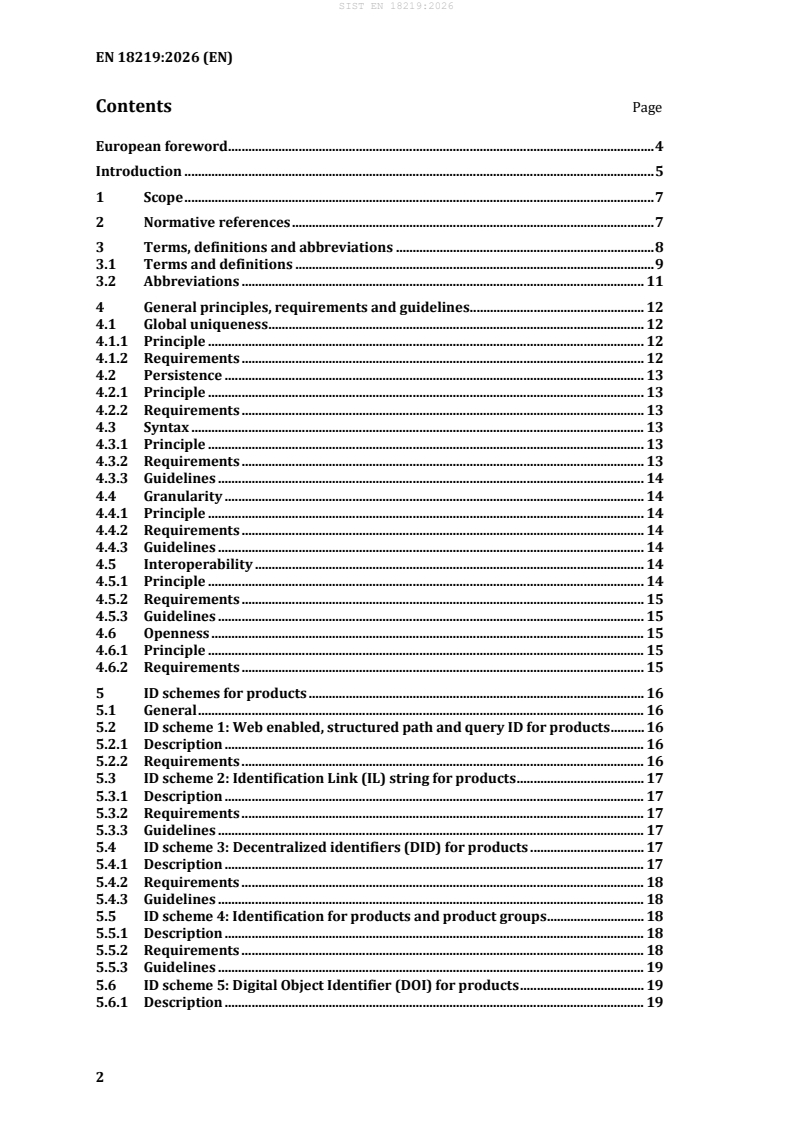
Contents Page
European foreword . 4
Introduction . 5
1 Scope . 7
2 Normative references . 7
3 Terms, definitions and abbreviations . 8
3.1 Terms and definitions . 9
3.2 Abbreviations . 11
4 General principles, requirements and guidelines . 12
4.1 Global uniqueness . 12
4.1.1 Principle . 12
4.1.2 Requirements . 12
4.2 Persistence . 13
4.2.1 Principle . 13
4.2.2 Requirements . 13
4.3 Syntax . 13
4.3.1 Principle . 13
4.3.2 Requirements . 13
4.3.3 Guidelines . 14
4.4 Granularity . 14
4.4.1 Principle . 14
4.4.2 Requirements . 14
4.4.3 Guidelines . 14
4.5 Interoperability . 14
4.5.1 Principle . 14
4.5.2 Requirements . 15
4.5.3 Guidelines . 15
4.6 Openness . 15
4.6.1 Principle . 15
4.6.2 Requirements . 15
5 ID schemes for products . 16
5.1 General . 16
5.2 ID scheme 1: Web enabled, structured path and query ID for products . 16
5.2.1 Description . 16
5.2.2 Requirements . 16
5.3 ID scheme 2: Identification Link (IL) string for products . 17
5.3.1 Description . 17
5.3.2 Requirements . 17
5.3.3 Guidelines . 17
5.4 ID scheme 3: Decentralized identifiers (DID) for products . 17
5.4.1 Description . 17
5.4.2 Requirements . 18
5.4.3 Guidelines . 18
5.5 ID scheme 4: Identification for products and product groups . 18
5.5.1 Description . 18
5.5.2 Requirements . 18
5.5.3 Guidelines . 19
5.6 ID scheme 5: Digital Object Identifier (DOI) for products . 19
5.6.1 Description . 19
5.6.2 Requirements . 19
6 ID schemes for economic operators and facilities . 19
6.1 General . 19
6.2 ID scheme 6: Economic operator identification using ISO/IEC 6523 . 20
6.2.1 Description . 20
6.2.2 Requirements . 20
6.2.3 Guidelines . 20
6.3 ID scheme 7: Economic operator and facility identification per ISO/IEC 15418
..................................................................................................................................................... 20
6.3.1 Description . 20
6.3.2 Requirements . 21
6.4 ID scheme 8: Economic operator identification in data systems using
Decentralized identifiers (DID) . 21
6.4.1 Description . 21
6.4.2 Requirements . 21
6.4.3 Guidelines . 21
6.5 ID scheme 9: Economic operator identification used in data systems per
Digital Object Identifiers (DOI) . 22
6.5.1 Description . 22
6.5.2 Requirements . 22
Annex A (informative) Selecting identification granularity levels for products . 23
Annex B (informative) Overview of ID schemes for products . 25
Annex C (informative) Overview of ID schemes for economic operators and facilities
..................................................................................................................................................... 47
Annex ZA (informative) Relationship between this European Standard and the
essential requirements of (EU) 2024/1781 aimed to be covered . 56
Bibliography . 58
European foreword
This document (EN 18219:2026) has been prepared by Technical Committee CEN/CLC/JTC 24
“Digital product passport – Framework and system”, the secretariat of which is held by DIN.
This European Standard shall be given the status of a national standard, either by publication of
an identical text or by endorsement, at the latest by November 2026, and conflicting national
standards shall be withdrawn at the latest by November 2026.
Attention is drawn to the possibility that some of the elements of this document may be the
subject of patent rights. CEN shall not be held responsible for identifying any or all such patent
rights.
This document has been prepared under a standardization request addressed to CEN by the
European Commission. The Standing Committee of the EFTA States subsequently approves these
requests for its Member States.
For relationship with EU Legislation, see informative Annex ZA, which is an integral part of this
document.
Any feedback and questions on this document should be directed to the users’ national standards
body. A complete listing of these bodies can be found on the CEN website.
According to the CEN-CENELEC Internal Regulations, the national standards organisations of the
following countries are bound to implement this European Standard: Austria, Belgium, Bulgaria,
Croatia, Cyprus, Czech Republic, Denmark, Estonia, Finland, France, Germany, Greece, Hungary,
Iceland, Ireland, Italy, Latvia, Lithuania, Luxembourg, Malta, Netherlands, Norway, Poland,
Portugal, Republic of North Macedonia, Romania, Serbia, Slovakia, Slovenia, Spain, Sweden,
Switzerland, Türkiye and the United Kingdom.
Introduction
0.1 Background
A digital product passport (DPP) is a key enabling mechanism to make product information
traceable and accessible across value chains – supporting economic operators, manufacturers,
distributors, repairers, recyclers and consumers to make informed decisions and to support a
circular economy. The implementation of digital product passports will be carried out
progressively. Sector-specific initiatives will determine the precise DPP content and
requirements for individual product groups.
To support the implementation of DPPs, 8 standards have been developed so far:
— EN 18219:2026 – Digital product passport – Unique identifiers (this document)
— EN 18220:2026 – Digital product passport – Data carriers
— EN 18216:2026 – Digital product passport – Data exchange protocols
— EN 18222: 2026 – Digital Product Passport – Application Programming Interfaces (APIs) for
the product passport lifecycle management and searchability
— EN 18223:2026 – Digital Product Passport – System interoperability
— EN 18221:2026 – Digital product passport – data storage, archiving, and data persistence
— EN 18239:— – Digital Product Passport – access rights management, information system
security, and business confidentiality
— EN 18246:— – Digital Product Passport – Data authentication, reliability and integrity
0.2 Overview
This document provides the foundation for the identification of products, economic operators,
and facilities to be used for digital product passports.
Clause 4 sets out the principles, requirements, and guidelines that apply across all identification
use cases. These are structured around six key areas: global uniqueness, persistence, syntax,
granularity, interoperability, and openness.
— Principles: Provide the intent and purpose for each area.
— Requirements: Define what shall be fulfilled when implementing identifiers, serving as the
foundation for assessment and compliance.
— Guidelines: Offer optional recommendations that can support or enhance implementation but
are not mandatory.
Clause 5 specifies the permitted identification schemes for creating a unique product identifier.
Five different schemes are described, each of which may be used to meet the requirements
established in Clause 4, provided that both the rules of the chosen scheme and the requirements
of Clause 4 are fully satisfied.
Clause 6 specifies the permitted identification schemes for creating a unique economic operator
identifier and unique facility identifier. Four schemes are described, each of which may be used
Under preparation. Stage at the time of publication: prEN 18239:2025.
Under preparation. Stage at the time of publication: prEN 18246:2025.
to meet the requirements established in Clause 4, provided that both the rules of the chosen
scheme and the requirements of Clause 4 are fully satisfied.
In addition, the document includes informative annexes to support practical understanding and
implementation:
— Annex A: Selecting identification granularity levels for products;
— Annex B: Overview of identification schemes for products;
— Annex C: Overview of identification schemes for economic operators and facilities;
— Annex ZA: Relationship between this European Standard and the essential requirements of
2024/1781.
1 Scope
This document defines the principles and specifies the requirements and guidelines for unique
product identifiers, unique economic operator identifiers, and unique facility identifiers used in
digital product passports. It covers the following areas:
a) global uniqueness;
b) persistence;
c) syntax;
d) granularity;
e) interoperability;
f) openness.
This document accommodates unique product identifiers at three granularity levels of specificity:
model, batch, or individual item, to support various operational needs.
This document describes identification (ID) schemes that use issuing agencies, self-issuing
systems, or a combination of both.
2 Normative references
The following documents are referred to in the text in such a way that some or all of their content
constitutes requirements of this document. For dated references, only the edition cited applies.
For undated references, the latest edition of the referenced document (including any
amendments) applies.
ISO/IEC 646:1991, Information technology — ISO 7-bit coded character set for information
interchange
ISO/IEC 6523-1:2023, Information technology — Structure for the identification of organizations
and organization parts — Part 1: Identification of organization identification schemes
ISO/IEC 6523-2:2025, Information technology — Structure for the identification of organizations
and organization parts — Part 2: Registration of organization identification schemes
ISO/IEC 10646:2020, Information technology — Universal coded character set (UCS)
ISO/IEC 15418:2016, Information technology — Automatic identification and data capture
techniques — GS1 Application Identifiers and ASC MH10 Data Identifiers and maintenance
ISO/IEC 15434:2025, Information technology — Automatic identification and data capture
techniques — Syntax for high-capacity ADC media
ISO/IEC 15459-2:2015, Information technology — Automatic identification and data capture
techniques — Unique identification — Part 2: Registration procedures
ISO/IEC 15459-3:2014, Information technology — Automatic identification and data capture
techniques — Unique identification — Part 3: Common rules
ISO/IEC 15459-4:2014, Information technology — Automatic identification and data capture
techniques — Unique identification — Part 4: Individual products and product packages
ISO/IEC 15459-6:2014, Information technology — Automatic identification and data capture
techniques — Unique identification — Part 6: Groupings
ISO/IEC 15961-1:2021, Information technology — Data protocol for radio frequency identification
(RFID) for item management — Part 1: Application interface
ISO/IEC 17360:2023, Automatic identification and data capture techniques — Supply chain
applications of RFID — Product tagging, product packaging, transport units, returnable transport
units and returnable packaging items
ISO/IEC 18975:2024, Information technology — Automatic identification and data capture
techniques — Encoding and resolving identifiers over HTTP
ISO/IEC 19762:2025, Information technology — Automatic identification and data capture (AIDC)
techniques — Vocabulary
ISO 26324:2025, Information and documentation — Digital object identifier system
EN 18220:2026, Digital product passport - Data carriers
EN IEC 61406-1:2022, Identification Link - Part 1: General requirements
EN IEC 61406-2:2024, Identification link - Part 2: Types/models, lots/batches, items and
characteristics
DIN 16598:2022, Syntax keyboard and Web compatible encoding of data elements in machine
readable symbols applied with ASC Data Identifiers
GS1, Digital Link Standard: Syntax U.R.I. Version 1.6.0:2022,
https://www.gs1.org/standards/gs1-digital-link
GS1. EPC Tag Data Standard (TDS), Version 2.3:2025, https://www.gs1.org/standards/epc-tag-
data-standard
GS1, General Specifications Standard, Version 25.0:2025,
https://ref.gs1.org/standards/genspecs/
IETF. RFC 3986:2005, https://www.rfc-editor.org/rfc/rfc3986
W3C, Decentralized Identifier Resolution (DID Resolution) v0.3:2025,
https://www.w3.org/TR/did-resolution/
W3C, Decentralized Identifiers (DIDs) v1.0:2022, https://www.w3.org/TR/did-1.0/
W3C, Verifiable Credentials Data Model v2:2025, https://www.w3.org/TR/vc-data-model/
3 Terms, definitions and abbreviations
For the purposes of this document, the terms and definitions given in ISO/IEC 19762:2025 and
the following apply.
ISO and IEC maintain terminology databases for use in standardization at the following
addresses:
— ISO Online browsing platform: available at http://www.iso.org/obp
— IEC Electropedia: available at http://www.electropedia.org/
3.1 Terms and definitions
3.1.1
batch
subset of a model (3.1.11) that is grouped by an economic operator based on common
characteristics
3.1.2
consumer
individual member of the general public purchasing or using goods, property or services for
private purposes
[SOURCE: EN ISO 14025:2010, 3.16]
3.1.3
digital product passport
DPP
digital record of product characteristics throughout its life cycle that is accessible via electronic
means through a data carrier
Note 1 to entry: Example characteristics include environmental sustainability, environmental impact, and
recyclability.
3.1.4
domain
specified area of knowledge, application, or activity within which a unique identifier is used
3.1.5
economic operator
manufacturer, authorized representative, importer, distributor, dealer or fulfilment service
provider that places the product on the market
3.1.6
identification scheme
ID scheme
system for allocating identifiers to objects
[SOURCE: ISO/IEC 6523-1:2023, 3.6, modified — "registered" removed]
3.1.7
interoperability
ability of two or more systems or applications to exchange information and to mutually use the
information that has been exchanged
[SOURCE: ISO/IEC 22123-1:2023, 3.6.1]
3.1.8
issuing agency
organisation entrusted by a Registration Authority (RA) to manage unique identification schemes
3.1.9
item
single unit of a model (3.1.11)
3.1.10
life cycle
consecutive and interlinked stages of a product system, from raw material acquisition or
generation from natural resources to final disposal
[SOURCE: ISO 14040:2006, 3.1]
3.1.11
model
version of a product of which all units share the same technical characteristics and the same
model identifier
3.1.12
object
entity to which specified requirements apply
EXAMPLE Product, process, service, system, installation, project, data, design, material, claim, person,
body or organization, or any combination thereof.
[SOURCE: ISO/IEC 17000:2020, 4.2, modified — the synonym “object of conformity assessment”
has been deleted and Note 1 to entry has been deleted]
3.1.13
persistence
process to keep a unique identifier associated with an identified object throughout its life cycle
3.1.14
placed on the market
first making available of a product
3.1.15
preservation
activity of ensuring that a unique identifier and its denotation remain stable, valid, and retrievable
for as long as required
3.1.16
product
any physical good that is placed on the market (3.1.14) or put into service (3.1.17)
3.1.17
put into service
first use, for its intended purpose, of a product
3.1.18
resolution
process in which an identifier is translated or mapped to another identifier, associated
information or metadata about the object it represents
3.1.19
resolver
system or service that performs resolution (3.1.18)
3.1.20
self-issuing system
decentralized identification scheme
system or mechanism that an organization uses to generate and assign unique identifiers to its
objects without the intervention or oversight of an external authority
3.1.21
state-of-the-art
developed stage of technical capability at a given time as regards products, processes and
services, based on the relevant consolidated findings of science, technology and experience
[SOURCE: ISO/IEC Guide 2:2004, 1.4]
3.1.22
unique economic operator identifier
unique string of characters for the identification of an actors involved in a product’s value chain
3.1.23
unique facility identifier
unique string of characters for the identification of location or building involved in a product’s
value chain or used by actors involved in a product’s value chain
3.1.24
unique identifier
string of characters that is required to be unique among all identifiers used for all objects for a
specific purpose
Note 1 to entry: A unique identifier refers to unique product identifier (3.1.25), unique economic operator
identifier (3.1.22), and unique facility identifier (3.1.23).
[SOURCE: ISO 29404:2015, 3.26, modified — Note 1 to entry removed and a new Note 1 to entry
added]
3.1.25
unique product identifier
unique string of characters for the identification of a product that also enables a web link to the
digital product passport
3.2 Abbreviations
For the purposes of this document, the following abbreviations apply.
Abbreviation Meaning
AIDC Automatic identification and data capture
AI Application Identifier (GS1)
ASC Accredited Standards Committee
DI Data Identifier (ASC MH10.8.2)
DID Decentralized Identifier
DOI Digital Object Identifier
DPP digital product passport
EPC Electronic Product Code
EFTA European Free Trade Association
ETSI European Telecommunications Standards Institute
GLN Global Location Number
GLEIF Global Legal Entity Identifier Foundation
GTIN Global Trade Item Number
HTTP Hypertext Transfer Protocol
HTTPS Hypertext Transfer Protocol Secure
IAC Issuing Agency Code
ICD International Code Designator
ID Identifier / Identification
IEC International Electrotechnical Commission
IL Identification Link
ISO International Organization for Standardization
LEI Legal Entity Identifier
MH10 ANSI-Accredited Committee MH10 on Material Handling
RFID Radio-frequency identification
SGTIN Serialized Global Trade Item Number
URI Uniform Resource Identifier
URL Uniform Resource Locator
VC Verifiable Credential
W3C World Wide Web Consortium
4 General principles, requirements and guidelines
4.1 Global uniqueness
4.1.1 Principle
The principle of global uniqueness ensures that each identifier is distinct, at least exclusive within
its domain of use, and non-coexisting, enabling clear object differentiation and thus reducing the
risk of misidentification. Products receive at least one globally unique product identifier at one of
the three levels of granularity (model, batch, or individual item), and when not yet available, the
economic operator or facility is assigned a globally unique economic operator identifier or a
globally unique facility identifier. The uniqueness is ensured by applying mechanisms,
specifications and rules as described in one of the identification schemes in this document when
placing products on the market or putting them into service.
4.1.2 Requirements
A unique identifier shall be globally unique, by ensuring:
1) No reassignment: The same unique identifier shall not be used to identify different objects.
2) Distinct: A unique identifier shall be globally unique within its domain and unambiguous
across all potential contexts in which it may be used.
3) Non-coexistence: A unique identifier, once issued, shall not coexist with or be reassigned to
another object.
4) Cross domain identification: To ensure uniqueness across domains, the ID scheme for the
unique identifier specified in this document shall be provided to registries.
4.2 Persistence
4.2.1 Principle
The principle of persistence ensures that the unique identifier remains associated with the same
object at least throughout its life cycle. The purpose of a persistent identifier is to accurately
represent an object for as long as it exists, regardless of changes in company status, ownership,
location, including mergers, acquisitions, splits or spin-offs. The economic operator is responsible
for recording, maintaining, and securely storing each identifier, either directly or through a DPP
service provider, to ensure persistence.
4.2.2 Requirements
The unique identifier shall provide persistence, with responsibility assigned for:
1) Consistency: The unique identifier, once assigned, shall remain unchanged and consistently
refer to the same object without ambiguity, throughout the life cycle of the object.
2) Preservation: The unique identifier shall be preserved, at least throughout its expected
duration, or as long as required by applicable regulations.
3) Permanence: The unique identifier shall remain available, including in the event of
insolvency, liquidation, or a cessation.
Note: For products placed on the European market, the EU DPP registry ensures a minimum level
of preservation and permanence of identifiers.
4.3 Syntax
4.3.1 Principle
The principle of syntax establishes a clear, standardized structure for unique identifiers, ensuring
consistent recognition and usage across systems, services, and platforms when needed. This
structure supports interoperability and efficient processing, by enabling the mapping between
different syntaxes. The unique identifiers maintain a distinguishable format to enhance
identification, searchability and retrieval. The length is specified for optimized processing and
storage, and the syntax structure enables accessibility and usability on smartphones, other
similar consumer devices and common web browsers.
4.3.2 Requirements
The unique identifier shall follow a predefined syntax, by ensuring:
1) Character set: The unique identifier shall be a string of characters conforming to
ISO/IEC 646:1991. If used as a URI, the string shall follow IETF, RFC 3986:2005 and keep
unreserved characters as-is and percent-encode all other Unicode characters per
ISO/IEC 10646:2020.
2) Web use: The unique product identifier shall either be provided in the form of a URL or
derivable into a URL (e.g. resolvable URI to URL) through a specified conversion method
according to the ID schemes specified in this document, thereby ensuring compatibility with
web-based systems.
4.3.3 Guidelines
1) Structure: The unique identifier may conform to a structural pattern defined by the chosen
ID scheme, supporting easier parsing and recognition across various systems, services and
platforms.
2) Variable length: Unique identifiers may use variable length.
4.4 Granularity
4.4.1 Principle
The principle of granularity ensures that a unique identifier accurately represents the object it
refers to, when needed. Identifiers are aligned with the characteristics of the objects they
represent, including distinctions between different types of identifiers and varying levels of
granularity. Additionally, identifiers facilitate access to a digital product passport, either directly,
via a data carrier, or through a resolution mechanism.
4.4.2 Requirements
The unique product identifier shall maintain its intended meaning, by ensuring:
1) Granularity: Each product identifier shall be unique at least at the smallest granularity level
it serves, whether it is a model, batch, or item.
2) Granularity consistency: The granularity level of a unique product identifier shall remain
consistent once the product is placed on the market or put into service.
3) Change in granularity: If a change in granularity becomes necessary that cannot be
accommodated with the existing identifier, a new or extended unique product identifier shall
be assigned. The new or extended identifier shall be linked to the old unique identifier to
maintain traceability.
4.4.3 Guidelines
1) Granularity level: In cases where regulatory requirements offer the choice for identification
at the model, batch or item level, a more granular level of specificity for the unique product
identifier (e.g. using batch instead of model, or item instead of batch) may be adopted to
enhance traceability or meet specific operational needs.
2) Resolver: A resolver may be used for the resolution of a unique identifier.
3) Hierarchy: A unique product identifier may be structured to represent multiple levels of
granularity, such as model, batch and individual item identification, within a single
hierarchical format.
4.5 Interoperability
4.5.1 Principle
The principle of interoperability is enabled by the global uniqueness and the digital product
system. In addition, unique identifiers ensure seamless operation across systems, services, and
platforms without modification of the identifier or the platform, enabling consistent
interpretation and unambiguous data exchange. A structured format supports compatibility with
external components to enable automated processing and integration across industries.
Portability ensures continuity across technological and organizational transitions. Key
interoperability interfaces include data carriers, web links, APIs, and digital product passports.
4.5.2 Requirements
The unique identifier shall be interoperable, by ensuring:
1) Data carrier: The unique product identifier shall be retrievable from a data carrier specified
in EN 18220:2026, linking it to a digital product passport.
2) Digital access: The unique product identifier shall be provided to retailers and online
marketplaces for consumers to obtain the product’s DPP.
3) Compatibility: The unique product identifier shall be encoded via a syntax that is compatible
with external devices, such as professional scanning devices, smartphones and similar digital
consumer devices.
4) Existing ID: Whenever possible, the use of existing ID schemes within one of the identification
schemes specified in this document shall be enabled.
4.5.3 Guidelines
1) Smartphones and similar devices: When using state-of-the-art smartphones and similar
consumer devices, the unique product identifier should be automatically useable and
compatible with all major operating systems and browsers.
2) Portability: The unique identifier scheme should support intended systems, services,
platforms or third-party without losing their meaning or function.
4.6 Openness
4.6.1 Principle
The principle of openness promotes transparency by ensuring that policies, processes, and
standards are publicly accessible, allowing stakeholders to study and implement them. The use
of widely accessible rules and procedures foster broad adoption and interoperability. Openness
also facilitates the transition or switching between systems, services, service providers and
platforms without compromising functionality or data integrity. Identifiers are used to access
DPP public information without requiring registration, download DPP specific software, or
authentication. Openness aims to avoid unnecessary restrictions that can possibly limit access,
use, or innovation.
4.6.2 Requirements
The unique identifier shall remain open and transparent, by ensuring:
1) Transparency: The ID scheme and unique identifier shall be based on a system where policies,
processes, and standards can be studied, influenced, and used under fair, reasonable, and
non-discriminatory terms.
2) Consumer usage: To access public information, especially for consumer usage, the unique
identifier shall be useable without the need to register, download DPP-specific software, or
add user credentials.
3) No undue restrictions: The unique identifier shall not result in vendor lock-in. It shall also not
impose limitations on use, except where such restrictions are technically necessary to ensure
global uniqueness and interoperability.
5 ID schemes for products
5.1 General
A unique product identifier shall fulfil the requirements in Clause 4 and comply with one of the
schemes in Clause 5. A product shall have a unique product identifier which shall be based on one
of the ID schemes defined in Clause 5.
5.2 ID scheme 1: Web enabled, structured path and query ID for products
5.2.1 Description
This ID scheme ensures globally unique identification based on ISO/IEC 15459-4 (individual
products) and ISO/IEC 15459-6 (grouped products). It structures identifiers using
ISO/IEC 15418 and encodes them in URLs or resolves them via HTTP as per ISO/IEC 18975. Users
can choose between two web-enabled approaches: a structured path format or a query string
format. The scheme enables direct web access to digital product passports and supports offline
parsing for supply chain and point-of-sale processes. This ID scheme is based on issuing agencies
as per ISO/IEC 15459-2, ISO/IEC 15459-3 and ISO/IEC 15418.
5.2.2 Requirements
5.2.2.1 Web enabled, structured path ID for products
To ensure compliance with this ID scheme, the following requirements shall be met:
a) adhere to ISO/IEC 15459-4:2014 for individual products or ISO/IEC 15459-6:2014 for
product groupings,
b) apply the GS1 Application Identifier (AI) or the ASC MH10.8.2 Data Identifier (DI) in
accordance with ISO/IEC 15418:2016,
c) follow the structured path approach specified in ISO/IEC 18975:2024 for encoding and
resolving identifiers over HTTPS,
d) conform with GS1, Digital Link Standard: URI Syntax, Version 1.6.0:2022 for users of GS1
Application Identifiers (AI), or
e) conform with EN IEC 61406-2:2024 or ISO/IEC 18975:2024 for users of ASC MH10.8.2 Data
Identifiers (DI),
f) apply ISO/IEC 15459-3:2014 for global uniqueness, and
g) use a registered Issuing Agency Code according to ISO/IEC 15459-2:2015.
5.2.2.2 Web enabled, query string ID for products
To ensure compliance with this ID scheme, the following requirements shall be met:
a) adhere to ISO/IEC 15459-4:2014 for individual products and/or ISO/IEC 15459-6:2014 for
product groupings,
b) apply the ASC MH10.8.2 Data Identifiers (DI) in accordance with ISO/IEC 15418:2016,
c) follow the query approach specified in ISO/IEC 18975:2024 for encoding and resolving
identifiers over HTTPS, and
d) apply ISO/IEC 15459-3:2014 for global uniqueness, and
e) use a registered Issuing Agency Code according to ISO/IEC 15459-2:2015.
5.3 ID scheme 2: Identification Link (IL) string for products
5.3.1 Description
This ID scheme using Identification Links (IL) in URL format, based on EN IEC 61406-1, enables
unique product identification on item level. Combining EN IEC 61406-1 and EN IEC 61406-2
extends the possible usage to product level, lot/batch level and item level, and allows usage to
identify other entities such as organizations and locations. It allows economic operators to encode
existing product ID schemes (model, batch, or item) directly into an IL string. IL strings are based
on a self-issuing system, without external dependencies while supporting additional structuring
via ASC MH10.8.2 Data Identifiers (DI) specified in ISO/IEC 15418. This approach ensures
compatibility with existing ID schemes and enables direct web access to digital product passports.
5.3.2 Requirements
5.3.2.1 Item level identification (only)
To ensure compliance with this ID scheme, the following requirements shall be met:
a) adhere to EN IEC 61406-1:2022, with optional use of EN IEC 61406-2:2024, when a unique
string of characters is sufficient, and no syntactical or semantic intelligence is required.
5.3.2.2 Model, batch and item level identification
To ensure compliance with this ID scheme, the following requirements shall be met:
a) use EN IEC 61406-1:2022 combined with EN IEC 61406-2:2024 when encoding
standardized syntax and semantics is required.
b) include ASC MH10.8.2 Data Identifiers (DI) as specified in ISO/IEC 15418:2016 to define
model, batch, and item identification.
5.3.3 Guidelines
The following should be used:
a) Identification Link according to EN IEC 61406-1:2022, where the string of characters of the
IL should be short, e.g. to be encoded into a 96-bit RFID chip or to allow a compact 2D-code
for small products; or where protection against the threat of counting up the product serial
number shall be intercepted by masking model and serial number with a random
alphanumerical string.
b) Identification Link according to EN IEC 61406-2:2024 for comprehensive product
identification across model, batch, and item levels, ensuring semantic interoperability with
existing ID schemes. It also can contain internal further information about the kind of
identified object, for example product, person, location or document or additional data
elements or classifications.
5.4 ID scheme 3: Decentralized identifiers (DID) for products
5.4.1 Description
This ID scheme is a self-issuing system that utilizes Decentralized Identifiers (DIDs) for self-
generated, globally unique identification. DIDs support cryptographic authentication and privacy
preserving information management. The scheme ensures interoperability with centralized,
federated, and decentralized ID systems. Methods such as did:web, did:ethr, and did:ebsi provide
flexible implementations, with did:web offering a lightweight, non-DLT solution where
did:ebsi/did:ethr enable dynamic updates of deep links to digital product passports, e.g. in the
case the economic operator responsible for the DPP changes. A DID can represent any level of
granularity (batch, model, item). This approach enhances security, flexibility, and adaptability for
digital identity management.
5.4.2 Requirements
To ensure compliance with this ID scheme, the following requirements shall be met:
a) adhere to W3C, Decentralized Identifiers (DIDs) v1.0:2022 to ensure proper DID syntax, core
...