

SIST EN 60898-1:2019
(Main)Electrical accessories - Circuit-breakers for overcurrent protection for household and similar installations - Part 1: Circuit-breakers for a.c. operation (IEC 60898-1:2015, modified))
General Information
- Abstract
IEC 60898-1:2015(E) applies to a.c. air-break circuit-breakers for operation at 50 Hz, 60 Hz or 50/60 Hz, having a rated voltage not exceeding 440 V (between phases), a rated current not exceeding 125 A and a rated short-circuit capacity not exceeding 25 000 A. This second edition cancels and replaces the first edition published in 2002, Amendment 1:2002 and Amendment 2:2003. This edition constitutes a technical revision. This edition includes the following significant technical changes with respect to the previous edition:
a) Revision of 9.5 Terminals
b) Revision of the test of glow wire
c) Simplification of the figures for short circuit tests.
The contents of the corrigendum of November 2015 have been included in this copy.
- Status
- Published
- Public Enquiry End Date
- 30-Jun-2017
- Publication Date
- 24-Feb-2019
- Technical Committee
- EPR - Electrical accessories
- Current Stage
- 6060 - National Implementation/Publication (Adopted Project)
- Start Date
- 25-Jan-2019
- Due Date
- 01-Apr-2019
- Completion Date
- 25-Feb-2019
- Directive
- 2014/35/EU - Directive 2014/35/EU of the European Parliament and of the Council of 26 February 2014 on the harmonisation of the laws of the Member States relating to the making available on the market of electrical equipment designed for use within certain voltage limitsOJ Ref: L 306/30 OJ Date: 27-Nov-2019
2014/35/EU - Directive 2014/35/EU of the European Parliament and of the Council of 26 February 2014 on the harmonisation of the laws of the Member States relating to the making available on the market of electrical equipment designed for use within certain voltage limitsOJ Ref: L 306/30 OJ Date: 27-Nov-2019


Overview
SIST EN 60898-1:2019 is a European standard published by CENELEC (CLC) that specifies requirements for circuit-breakers for overcurrent protection in household and similar electrical installations, focusing on alternating current (a.c.) operation. It aligns broadly with IEC 60898-1:2015 and includes European-specific modifications. This standard applies to a.c. air-break circuit-breakers designed for use at frequencies of 50 Hz, 60 Hz, or 50/60 Hz, with rated voltages up to 440 V (between phases), rated currents up to 125 A, and short-circuit capacities up to 25,000 A.
SIST EN 60898-1:2019 ensures that circuit-breakers provide reliable protection against overloads and short-circuits in residential and similar settings, contributing to electrical safety and installation compliance across Europe.
Key Topics
Scope and Classification
- Applies to a.c. air-break circuit-breakers for household and similar installations.
- Rated voltage: up to 440 V (phase-to-phase).
- Rated current: up to 125 A.
- Short-circuit capacity: up to 25,000 A.
- Covers operation in overvoltage category III and suitability for IT systems.
Significant Technical Updates (over previous edition)
- Revision and improvement of terminal requirements.
- Updated glow wire test procedures.
- Simplification of short-circuit test figures.
Marking and Product Information
- Specifies essential marking requirements for circuit-breakers, including rated values, manufacturer details, and applicable standards.
- Requires energy limiting class marking when applicable.
Installation and Operation Conditions
- Defines standard operating conditions: ambient temperature range, maximum altitude, humidity tolerance, and resistance to external magnetic fields.
- Provides guidelines for clearances, creepage distances, and solid insulation.
Testing and Compliance
- Outlines several type and routine tests: insulation resistance, dielectric strength, impulse withstand voltage, and leakage current.
- Details humidity, mechanical, and electromagnetic environment requirements.
Applications
SIST EN 60898-1:2019 is critical for ensuring electrical safety and system reliability in the following contexts:
- Residential Buildings: Circuit-breakers installed in homes to protect wiring and connected equipment from overcurrent events.
- Commercial and Light Industrial Installations: Applies to similar locations where domestic-type circuit-breakers are suitable.
- Distribution Boards and Consumer Units: Used as primary protection devices, especially in modular assemblies.
- Retrofitting and Upgrades: Ensures compatibility and safety in upgrading existing electrical panels.
The standard enables manufacturers, specifiers, installers, and inspectors to use common requirements for circuit-breakers, promoting consistency, interoperability, and regulatory compliance across the European market.
Related Standards
For comprehensive overcurrent protection and coordination in electrical installations, consider these frequently referenced standards alongside SIST EN 60898-1:2019:
- IEC 60898-1: International version covering general requirements for a.c. circuit-breakers for household and similar installations.
- EN 60715: Specifies dimensions for mounting rails, relevant for installation compatibility.
- HD 60364-4-43: Provides additional requirements for overcurrent protection in various types of electrical systems.
- EN 60664 Series: Covers insulation coordination for electrical equipment.
- EN 60947 Series: For circuit-breakers in industrial environments and for higher current or voltage ratings.
Adherence to SIST EN 60898-1:2019 ensures that overcurrent protection devices installed in European homes and similar premises meet rigorous safety, performance, and interoperability criteria, ultimately protecting people and property from electrical hazards.
Relations
- Effective Date
- 22-Jan-2019
- Effective Date
- 22-Jan-2019
- Effective Date
- 22-Jan-2019
- Effective Date
- 22-Jan-2019
- Effective Date
- 22-Jan-2019
- Effective Date
- 22-Jan-2019
- Effective Date
- 22-Jan-2019
- Effective Date
- 22-Jan-2019
- Effective Date
- 22-Jan-2019
- Effective Date
- 20-Feb-2026
- Effective Date
- 20-Feb-2026
- Effective Date
- 10-Feb-2026
- Refers
SIST IEC 60050-461:2017 - International Electrotechnical Vocabulary - Part 461: Electric cables - Effective Date
- 10-Feb-2026
- Effective Date
- 10-Feb-2026
- Effective Date
- 10-Feb-2026
Get Certified
Connect with accredited certification bodies for this standard

IMQ S.p.A. (Certification)
Italian electrical product certification.

SLG Prüf- und Zertifizierungs GmbH
German testing and certification body.

UL Solutions
Global safety science company with testing, inspection and certification.
Sponsored listings
Frequently Asked Questions
SIST EN 60898-1:2019 is a standard published by the Slovenian Institute for Standardization (SIST). Its full title is "Electrical accessories - Circuit-breakers for overcurrent protection for household and similar installations - Part 1: Circuit-breakers for a.c. operation (IEC 60898-1:2015, modified))". This standard covers: IEC 60898-1:2015(E) applies to a.c. air-break circuit-breakers for operation at 50 Hz, 60 Hz or 50/60 Hz, having a rated voltage not exceeding 440 V (between phases), a rated current not exceeding 125 A and a rated short-circuit capacity not exceeding 25 000 A. This second edition cancels and replaces the first edition published in 2002, Amendment 1:2002 and Amendment 2:2003. This edition constitutes a technical revision. This edition includes the following significant technical changes with respect to the previous edition: a) Revision of 9.5 Terminals b) Revision of the test of glow wire c) Simplification of the figures for short circuit tests. The contents of the corrigendum of November 2015 have been included in this copy.
IEC 60898-1:2015(E) applies to a.c. air-break circuit-breakers for operation at 50 Hz, 60 Hz or 50/60 Hz, having a rated voltage not exceeding 440 V (between phases), a rated current not exceeding 125 A and a rated short-circuit capacity not exceeding 25 000 A. This second edition cancels and replaces the first edition published in 2002, Amendment 1:2002 and Amendment 2:2003. This edition constitutes a technical revision. This edition includes the following significant technical changes with respect to the previous edition: a) Revision of 9.5 Terminals b) Revision of the test of glow wire c) Simplification of the figures for short circuit tests. The contents of the corrigendum of November 2015 have been included in this copy.
SIST EN 60898-1:2019 is classified under the following ICS (International Classification for Standards) categories: 29.120.50 - Fuses and other overcurrent protection devices. The ICS classification helps identify the subject area and facilitates finding related standards.
SIST EN 60898-1:2019 has the following relationships with other standards: It is inter standard links to SIST EN 60898-1:2004/IS3:2007, SIST EN 60898-1:2004/IS2:2007, SIST EN 60898-1:2004/A12:2008, SIST EN 60898-1:2004/A1:2006, SIST EN 60898-1:2004/IS1:2007, SIST EN 60898-1:2004/A13:2012, SIST EN 60898-1:2004/A11:2006, SIST EN 60898-1:2004, SIST EN 60898-1:2004/IS4:2007, SIST IEC 60050-713:2021, SIST IEC 60050-471:2017, SIST IEC 60050-731:1997, SIST IEC 60050-461:2017, SIST IEC 60050-103:2026, SIST IEC 60050-614:2023. Understanding these relationships helps ensure you are using the most current and applicable version of the standard.
SIST EN 60898-1:2019 is associated with the following European legislation: EU Directives/Regulations: 2014/35/EU, 2014/35/EU; Standardization Mandates: M/511. When a standard is cited in the Official Journal of the European Union, products manufactured in conformity with it benefit from a presumption of conformity with the essential requirements of the corresponding EU directive or regulation.
SIST EN 60898-1:2019 is available in PDF format for immediate download after purchase. The document can be added to your cart and obtained through the secure checkout process. Digital delivery ensures instant access to the complete standard document.
Standards Content (Sample)
2003-01.Slovenski inštitut za standardizacijo. Razmnoževanje celote ali delov tega standarda ni dovoljeno.Electrical accessories - Circuit-breakers for overcurrent protection for household and similar installations - Part 1: Circuit-breakers for a.c. operation (IEC 60898-1:2015, modified))29.120.50Fuses and other overcurrent protection devicesICS:Ta slovenski standard je istoveten z:EN 60898-1:2019SIST EN 60898-1:2019en,fr,de01-april-2019SIST EN 60898-1:2019SLOVENSKI
STANDARDSIST EN 60898-1:2004/IS2:2007SIST EN 60898-1:2004/IS1:2007SIST EN 60898-1:2004/IS4:2007SIST EN 60898-1:2004/IS3:2007SIST EN 60898-1:2004/A13:2012SIST EN 60898-1:2004/A1:2006SIST EN 60898-1:2004SIST EN 60898-1:2004/A12:2008SIST EN 60898-1:2004/A11:20061DGRPHãþD
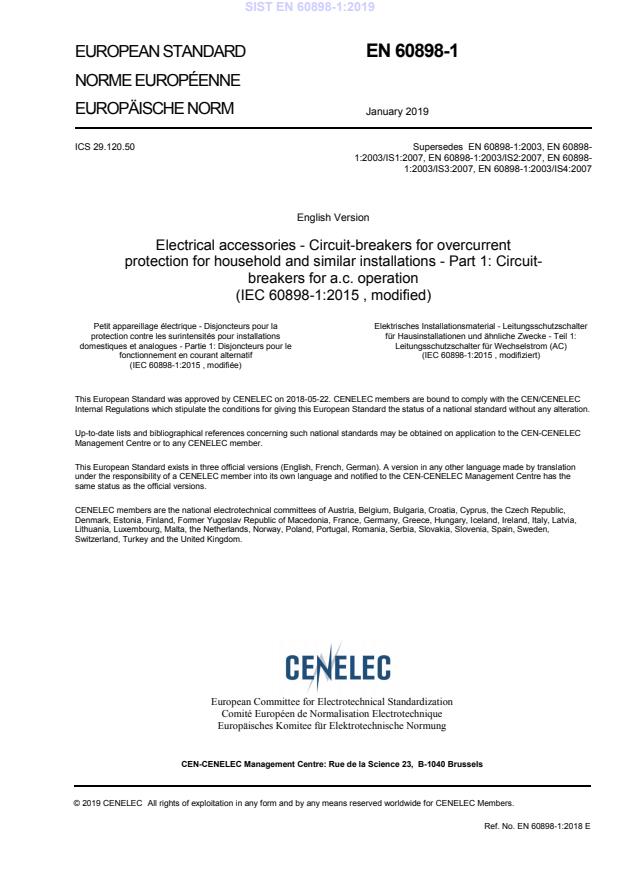
EUROPEAN STANDARD NORME EUROPÉENNE EUROPÄISCHE NORM
EN 60898-1
January 2019 ICS 29.120.50
Supersedes
EN 60898-1:2003, EN 60898-1:2003/IS1:2007, EN 60898-1:2003/IS2:2007, EN 60898-1:2003/IS3:2007, EN 60898-1:2003/IS4:2007
English Version
Electrical accessories - Circuit-breakers for overcurrent protection for household and similar installations - Part 1: Circuit-breakers for a.c. operation (IEC 60898-1:2015 , modified)
Petit appareillage électrique - Disjoncteurs pour la protection contre les surintensités pour installations domestiques et analogues - Partie 1: Disjoncteurs pour le fonctionnement en courant alternatif (IEC 60898-1:2015 , modifiée)
Elektrisches Installationsmaterial - Leitungsschutzschalter für Hausinstallationen und ähnliche Zwecke - Teil 1: Leitungsschutzschalter für Wechselstrom (AC) (IEC 60898-1:2015 , modifiziert) This European Standard was approved by CENELEC on 2018-05-22. CENELEC members are bound to comply with the CEN/CENELEC Internal Regulations which stipulate the conditions for giving this European Standard the status of a national standard without any alteration. Up-to-date lists and bibliographical references concerning such national standards may be obtained on application to the CEN-CENELEC Management Centre or to any CENELEC member.
This European Standard exists in three official versions (English, French, German). A version in any other language made by translation under the responsibility of a CENELEC member into its own language and notified to the CEN-CENELEC Management Centre has the same status as the official versions. CENELEC members are the national electrotechnical committees of Austria, Belgium, Bulgaria, Croatia, Cyprus, the Czech Republic, Denmark, Estonia, Finland, Former Yugoslav Republic of Macedonia, France, Germany, Greece, Hungary, Iceland, Ireland, Italy, Latvia, Lithuania, Luxembourg, Malta, the Netherlands, Norway, Poland, Portugal, Romania, Serbia, Slovakia, Slovenia, Spain, Sweden, Switzerland, Turkey and the United Kingdom. European Committee for Electrotechnical Standardization
Comité Européen de Normalisation Electrotechnique Europäisches Komitee für Elektrotechnische Normung CEN-CENELEC Management Centre: Rue de la Science 23,
B-1040 Brussels © 2019 CENELEC All rights of exploitation in any form and by any means reserved worldwide for CENELEC Members.
Ref. No. EN 60898-1:2018 E SIST EN 60898-1:2019
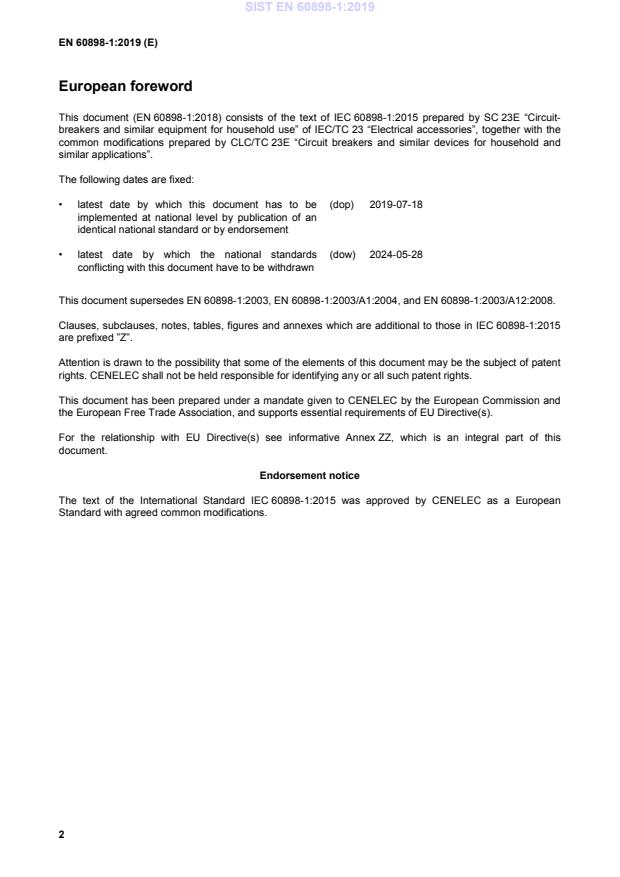
EN 60898-1:2018 (E)
3 1 Scope Add at the end of the 4th paragraph: …and overvoltage category III. NOTE 1 Additional requirements are necessary for circuit-breakers used in locations having more severe overvoltage conditions. Replace the 6th paragraph by: Circuit-breakers of this standard are suitable for use in IT systems provided that the requirements of HD 60364-4-43 are complied with. Add after this 11th paragraph: Supplementary requirements may be necessary for circuit-breakers of the screw-in types. Renumber NOTE 1 as NOTE 2. After NOTE 1 renumbered as NOTE 2, add: NOTE 3 Recommendations for the dimensional coordination between enclosures and circuit breakers for mounting on rails according to EN 60715 or equivalent means are given in the CENELEC report PD CLC/TR 50473. 2 Normative reference Replace the contents of the clause by: NOTE Normative references to international standards are given in Annex ZB. 3 Terms and definitions Add the following new definitions: 3.2.15 type test test of one or more devices made to a certain design to show that the design meets certain requirements [SOURCE: IEC 60050-441:1984, 441-53-01, modified] 3.2.16 routine test test to which each individual device is subjected during or after manufacture to ascertain whether it complies with certain criteria [SOURCE: IEV 411-53-02, modified] 3.5.15 Replace by: conventional non-tripping current Int specified value of current which the circuit-breaker is capable of carrying for a specified time designated as conventional time, without tripping [SOURCE: IEC 60050-442:1998, 442-05-54] 3.5.16 Add at the end of the clause: [SOURCE: IEC 60050-441:1984, 442-05-55, modified] 3.6.11 Add to the end of the reference of the source: “modified” SIST EN 60898-1:2019
EN 60898-1:2018 (E)
5 Table 1 — Standard values of rated voltage Circuit-breakers Circuit supplying the circuit-breaker Rated voltage of circuit-breakers for use in systems 230 V, 230/400 V, 400 V Single pole Single phase (phase to neutral or phase to phase) 230 V Three-phase 4-wire 230 V Single phase (phase to neutral) or three-phase, using 3 single-pole circuit-breakers (3-wire or 4-wire) 230/400 V Two-pole Single phase (phase to neutral or phase to phase) 230 V Single phase (phase to phase) 400 V Three phase (4-wire) 230 V Three-pole Three phase (3-wire or 4-wire) 400 V Four-pole Three phase (4-wire) 400 V NOTE
Wherever in this standard there is a reference to 230 V or 400 V, they may be read as 220 V or 240 V, 380 V or 415 V, respectively. Add after the table: Two-pole circuit breakers rated 230 V may have one or two protected poles. Two-pole circuit breakers rated 400 V shall have two protected poles. Three-pole circuit breakers shall have three protected poles. Four-pole circuit breakers may have three or four protected poles. 5.3.4.1 Add an asterisk “(*)” after 1 500 A. Replace the note by: (*) Only for circuit-breakers incorporated or associated with and in the immediate vicinity of socket-outlets or switches for household and similar applications. 5.3.4.2 Replace by: 5.3.4.2 Standard values above 10 000 A up to and including 25 000 A For values above 10 000 A up to and including 25 000 A the standard values are: 15 000 A, 20 000 A and 25 000 A. The corresponding power factor range is given in 9.12.5. 5.3.5 Table 2 Delete a after 20 In. Delete the note “a For special cases values up to …” SIST EN 60898-1:2019
EN 60898-1:2018 (E)
7 6.3 Guidance table for marking Marking and other product information Each MCB shall be marked in a durable manner with all or, for small apparatus, part of the following data: Markings may be on the MCB itself Product information in catalogue If, for small devices the space available does not allow all the above data to be marked, at least this information shall be marked and visible when the device is installed. This information may be marked on the side or on the back of the device and be visible only before the device is installed. Alternatively the information may be on the inside of any cover which has to be removed in order to connect the supply wires. Any remaining information not marked shall be given in the manufacturer's catalogues. a)
manufacturer's name or trademark
X
b)
type designation, catalogue number or serial number
X
c)
rated voltage, with the symbol ý
X
d)
rated current without symbol “A” preceded by the symbol of overcurrent instantaneous tripping (B, C or D), for example B 16 X
e)
rated frequency if the circuit-breaker is designed only for one frequency (see 5.3.3)
X f)
rated short-circuit capacity in a rectangle, in amperes, without symbol “A”
X(*)
g)
wiring diagram, unless the correct mode of connection is evident
X X
h)
reference calibration temperature, if different from 30 °C
X i)
the degree of protection (only if different from IP20)
X j)
Void
k)
Void
l)
breaking capacity on one pole of multipole MCBs in case of short-circuit to earth Icn1
X
m) energy limiting class (e.g. 3) in a square in accordance with Annex ZA, as applicable
X(*)
X(**)
the position of use (symbol according to EN 60051), if necessary;
X
indication of the terminal for the neutral with “N”
X
additional marking of performance to other standards
X
(*) Icn and the energy limiting class, as applicable, shall be both on the device and combined together. (**) The manufacturer shall publish in his literature the I2t characteristic. SIST EN 60898-1:2019
Altitude Not exceeding 2 000 m
Relative humidity maximum value 40 °C 50 % c
External magnetic field Not exceeding 5 times the earth’s magnetic field in any direction Earth’s magnetic field d Position As stated by the manufacturer, with a tolerance of 2° in any direction e As stated by the manufacturer 2° in any direction Frequency Reference value ± 5 % f Rated value
± 5 % Sinusoidal wave distortion Not exceeding 5 % Zero 5 % a The maximum value of the mean daily temperature is +35 °C. b Values outside the range are admissible where more severe climatic conditions prevail, subject to agreement between manufacturer and user. c Higher relative humidities are admitted at lower temperature (for example 90 % at 20 °C). d When a circuit breaker is installed in proximity of a strong magnetic field, supplementary requirements may be necessary. e The device shall be fixed without causing deformation liable to impair its functions. f The tolerances given apply unless otherwise specified in the relevant test. g Extreme limits of –20 °C and +60 °C are admissible during storage and transportation, and should be taken into account in the design of the device. 7.2 Conditions of installation Circuit breakers shall be installed in accordance with the manufacturer’s instructions. 8 Requirements for construction and operation 8.1.2 Delete in paragraph 7, 2nd sentence “without operating handle” Delete Note 1 and replace “NOTE 2 “by “NOTE”. SIST EN 60898-1:2019
EN 60898-1:2018 (E)
9 8.1.3 Clearances and creepage distances Replace the whole subclause 8.1.3 by: 8.1.3 Clearances and creepage distances 8.1.3.1 General The minimum required clearances and creepage distances are given in Table 4 that is based on the circuit-breaker being designed for operating in an environment with pollution degree 2. The insulating materials are classified into material groups on the basis of their comparative tracking index (CTI) according to EN 60664-1. NOTE 1 The comparative tracking index (CTI) is declared by the manufacturer on the basis of tests carried out on the insulating material. NOTE 2 Information on the requirements for design of solid insulation is provided in EN 60664-1. Table 4 — Minimum clearances and creepage distances
Minimum
clearances mm Minimum creepage distancese, f mm Group IIIa h (175 V ≤ CTI < 400 V)d Group II (400 V ≤ CTI < 600 V)d Group I (600 V ≤ CTI)d Rated voltage V Working voltage e V Uimp 4 kV Item/Description 230/400 230 400
> 25 ≤ 50i 120 250 400
> 25 ≤ 50i 120 250 400
> 25 ≤ 50i 120 250 400 1. between live parts which are separated when the main contacts are in the open position a,j 4,0 1,2 2,0 4,0 4,0 0,9 2,0 4,0 4,0 0,6 2,0 4,0 4,0 2. between live parts of different polarity a,j, k 3,0 1,2 1,5 3,0 4,0 0,9 1,5 3,0 3,0 0,6 1,5 3,0 3,0 3. between circuits supplied from different sources, one of which being PELV or SELV g 8,0
3,0 6,0 8,0
3,0 6,0 8,0
3,0 6,0 8,0 SIST EN 60898-1:2019
Rated voltage V 230 / 400 230 / 400 230 / 400 4. between live parts and – accessible surfaces of operating means – screws or other means for fixing covers which have to be removed when mounting the circuit–breaker – surface on which the circuit-breaker is mounted b – screws or other means for fixing the circuit-breaker b – metal covers or boxes b – other accessible metal parts c – metal frames supporting flush-type circuit-breakers 3,0 4,0 3,0 3,0 NOTE 1 The values given for 400 V are also valid for 440 V. NOTE 2 The parts of the neutral path, if any, are considered to be live parts. a
For auxiliary and control contacts the values are given in the relevant standard. b
The values are doubled if clearances and creepage distances between live parts of the device and the metallic screen or the surface on which the circuit-breaker is mounted are not dependent on the design of the circuit-breaker only, so that they can be reduced when the circuit-breaker is mounted in the most unfavourable condition. c
Including a metal foil in contact with the surfaces of insulating material which are accessible after installation for normal use. The foil is pushed into corners, grooves, etc., by means of a straight unjointed test finger according to 9.6 (see Figure 8). d
See EN 60112. e
Interpolation is allowed in determining creepage distances corresponding to voltage values intermediate to those listed as working voltage. When interpolating, linear interpolation shall be used and values shall be rounded to the same number of digits as the values picked up from the tables. For determination of creepage distances, see Annex B. f
Creepage distances cannot be less than the associated clearances. g
To cover all different voltages including ELV in an auxiliary contact. h
For material group IIIb (100 V ≤ CTI < 175 V) the values for material group IIIa multiplied by 1,6 apply. i
For working voltages up to and including 25 V reference may be made to EN 60664-1. j
The clearance distances between the metal parts within the arc chamber may be less than 1mm, provided that the sum of distances is greater than prescribed in item 1 of Table 4. k This applies also to clearance and creepage distances between live parts of different polarity of circuit breakers mounted close to one another. 8.1.3.2 Clearances Compliance for item 1 in Table 4 is checked by measurement and by the tests of 9.7.5.4. Compliance for item 2 and 4 in Table 4 is checked by measurement or by the tests of 9.7.5.2. SIST EN 60898-1:2019
EN 60898-1:2018 (E)
11 The clearances of items 2 and 4 (except accessible surface after installation, see Note) may be reduced provided that the measured clearances are not shorter than the minimum allowed in IEC 60664-1 for homogenous field conditions. In this case, compliance for items 2 and 4 is always checked by the test of 9.7.5.2. NOTE Accessible surface after installation means any surface accessible by the user when the circuit-breaker is installed according to the manufacturer's instructions. The test finger can be applied to determine whether a surface is accessible or not. Compliance for item 3 in Table 4 is checked by measurement. 8.1.3.3 Creepage distances Compliance for item 1, 2, 3 and 4 is checked by measurement NOTE All measurements required in 8.1.3 are carried out in Test sequence A on one sample. Tests according to 9.7.2 to 9.7.5 are carried out in Test sequence B on three samples. 8.1.3.4 Solid insulation Compliance is checked by the tests according to 9.7.2, 9.7.3, 9.7.4 and 9.7.5 as applicable. 8.1.4.4 Replace in the last paragraph “parts of electronic devices” by “electronic parts, including circuit boards,” Add a new paragraph at the end of the subclause: Compliance is checked by inspection in accordance with manufacturer's declaration. 8.1.5.2 Delete the note after Table 5. 8.1.5.12 Add a new paragraph at the end of the subclause: Compliance is checked by inspection. 8.1.7.1 Delete from the first paragraph “, the holding in position of which does not depend solely on their plug-in connection(s),» 8.6.1 Table 7 Replace the row for test d by: d B
C
D 3 In
5 In
10 In
Cold a 0,1 s < t < 45 s (for In ≤ 32 A) 0,1 s < t < 90 s (for In > 32 A)
0,1 s < t < 15 s (for In ≤ 32 A) 0,1 s < t < 30 s (for In > 32 A)
0,1 s < t < 4 sb (for In ≤ 32 A) 0,1 s < t < 8 s (for In > 32 A) Tripping Current established by closing an auxiliary switch In the row for test e delete “b” after “20 In”. SIST EN 60898-1:2019
EN 60898-1:2018 (E)
13 9.7 Replace the whole Clause 9.7 by. 9.7 Test of dielectric properties 9.7.1 Resistance to humidity 9.7.1.1 Preparation of the circuit-breaker for test Parts which can be removed without the aid of a tool are removed and subjected to the humidity treatment with the main part; spring lids are kept open during this treatment. Inlet openings, if any, are left open; if knockouts are provided, one of them is opened. 9.7.1.2 Test conditions The humidity treatment is carried out in a humidity cabinet containing air with a relative humidity maintained between 91 % and 95 %. The temperature of the air in which the sample is placed is maintained within ± 1 °C of any convenient value T between 20 °C and 30 °C. Before being placed in the humidity cabinet, the sample is brought to a temperature between T and T +4 °C. 9.7.1.3 Test procedure The sample is kept in the cabinet for 48 h. NOTE 1 A relative humidity between 91 % and 95 % can be obtained by placing in the humidity cabinet a saturated solution of sodium sulphate (Na2SO4) or potassium nitrate (KNO3) in water having a sufficiently large contact surface with the air. NOTE 2 In order to achieve the specified conditions within the cabinet it is necessary to ensure constant circulation of the air within and, in general, to use a cabinet which is thermally insulated. 9.7.1.4 Condition of the circuit-breaker after the test After this treatment, the sample shall show no damage within the meaning of this standard and shall withstand the tests of 9.7.2, 9.7.3, 9.7.4, and 9.7.5.2. 9.7.2 Insulation resistance of the main circuit The circuit-breaker having been treated as specified in 9.7.1 is then removed from the cabinet. After an interval between 30 min and 60 min following this treatment, the insulation resistance is measured 5 s after application of a d.c. voltage of approximately 500 V, in the following order: a) with the circuit-breaker in the open position, between each pair of the terminals which are electrically connected together when the circuit-breaker is in the closed position, in turn on each pole; b) with the circuit-breaker in the closed position, between each pole and the others connected together; c) with the circuit-breaker in the closed position, between all poles connected together and the frame, including a metal foil or part in contact with the outer surface of the housing of insulating material but with the terminal areas kept completely free to avoid flashover between terminals and the metal foil; d) for circuit-breakers with a metal enclosure having an internal lining of insulating material, between the frame and a metal foil in contact with the inner surface of the lining of insulating material, including bushings and similar devices. The measurements a), b) and c) are carried out after having connected all auxiliary circuits to the frame. The term “frame” includes: — all accessible metal parts and a metal foil in contact with the surfaces of insulating material which are accessible after installation as for normal use; SIST EN 60898-1:2019
—
9.7.3 Dielectric strength of the main circuit After the circuit-breaker has passed the tests of 9.7.2 the test voltage specified is applied for 1 min between the parts indicated in 9.7.2. The test voltage shall have practically sinusoidal waveform, and a frequency between 45 Hz and 65 Hz. The source of the test voltage shall be capable of supplying a short-circuit current of at least 0,2 A. No overcurrent tripping device of the transformer shall operate when the current in the output circuit is lower than 100 mA. The values of the test voltage shall be as follows: — 2 000 V for items a) to c) of 9.7.2; — 2 500 V for item d) of 9.7.2; Initially, not more than half the prescribed voltage is applied, then it is raised to the full value within 5 s. No flashover or breakdown shall occur during the test. Glow discharges without drop in the voltage are neglected. 9.7.4 Insulation resistance and dielectric strength of auxiliary circuits
Insulation resistance and dielectric strength shall be verified according to a, b and c. a) The measurement of the insulation resistance and the dielectric strength tests for the auxiliary circuits are carried out immediately after the measurement of the insulation resistance and the dielectric strength tests for the main circuit, under the conditions given in b) and c) below. b) The measurements of the insulation resistance are carried out: — between the auxiliary circuits connected to each other and to the frame; — between each of the parts of the auxiliary circuits which might be isolated from the other parts in normal service and the whole of the other parts connected together, at a voltage of approximately 500 V d.c., after this voltage has been applied for 1 min.
c) A substantially sinusoidal voltage at rated frequency is applied for 1 min between the parts listed under b). The voltage values to be applied are specified in Table 13 SIST EN 60898-1:2019
EN 60898-1:2018 (E)
15 Table 13 – Test voltage of auxiliary circuits Rated voltage of auxiliary circuits (a.c. or d.c.) V Test voltage
V Greater than Up to and including
0 30 600 30 50 1 000 50 110 1 500 110 250 2 000 250 500 2 500 At the beginning of the test the voltage shall not exceed half the value specified. It is then increased steadily to the full value in not less than 5 s, but not more than 20 s. During the test, there shall be no flashover or perforation. NOTE 1 Discharges which do not correspond to a voltage drop are disregarded. NOTE 2 In the case of circuit breakers in which the auxiliary circuit is not accessible for verification of the requirements given in b), the tests can be made on samples specially prepared by the manufacturer or according to his instructions. NOTE 3 Auxiliary circuits do not include the control circuit of circuit breakers functionally dependent on line voltage. NOTE 4 Control circuits other than those of secondary circuit of detection transformers and control circuits connected to the main circuit are submitted to the same tests as the auxiliary circuits. 9.7.5 Verification of impulse withstand voltages (across clearances and across solid insulation) and of leakage current across open contacts 9.7.5.1 General testing procedure for the impulse withstand voltage tests The impulses are given by a generator producing positive and negative impulses having a front time of 1,2 -value of 50 ces being as follow: — ± 5 % for the peak value; — ± 30 % for the front time; — ± 20 % for the time to half-value. For each test, five positive impulses and five negative impulses are applied. The interval between consecutive impulses being at least 1 s for impulses of the same polarity and being at least 10 s for impulses of the opposite polarity When performing the impulse voltage test on complete circuit-breaker, the attenuation or amplification of the test voltage shall be taken into account. It needs to be ensured that the required value of the test voltage is applied across the terminals of the equipment under test. The surge impedance of the test apparatus shall have a nominal value of 500
In 9.7.5.2, for the verification of clearances within the basic insulation, on complete circuit-breaker, a very low impedance of the generator is needed for the test. For this purpose, a hybrid generator with a virtual impedance of 2 ohm is appropriate if internal components are not disconnected before testing. However, in any case, a measurement of the correct test voltage directly at the clearance is required. The shape of the impulses is adjusted with the circuit-breaker under test connected to the impulse generator. For this purpose appropriate voltage dividers and voltage sensors shall be used. SIST EN 60898-1:2019
4 4,9 4,8 4,7 4,4 4,0 9.7.5.3 Verification of leakage currents across open contacts (suitability for isolation) Each pole of circuit-breakers having been submitted to the tests of 9.12.11.2, or 9.12.11.3, or 9.12.11.4.2 or 9.12.11.4.3 or 9.12.11.4.4 is supplied at a voltage 1,1 times its rated operational voltage, the circuit-breaker being in the open position. The leakage current flowing across the open contacts is measured and shall not exceed 2 mA. SIST EN 60898-1:2019
EN 60898-1:2018 (E)
17 9.7.5.4 Verification of resistance of the insulation of open contacts against an impulse voltage (suitability for isolation) The test impulse voltage value is given in 5.3.6. These values are corrected for barometric pressure and/or altitude at which the tests are carried out, according to Table 15. Table 15 — Test voltage for verifying the suitability for isolation, referred to the rated impulse withstand voltage of the circuit breakers and the altitude where the test is carried out Nominal voltage
of the installation V Test voltages at corresponding altitude U1,2/50 a.c. peak
kV
Sea level 200 m 500 m 1 000 m 2 000 m Single and three-phase systems 230/400 6,2 6,0 5,8 5,6 5,0 The series of tests is carried out on a circuit-breaker fixed on a metal support as in normal use and with the contact in open position. The impulses are applied between: — the line terminals connected together; — and the load terminals connected together with the contacts in the open position. There shall be no disruptive discharges during the test. 9.9 Add after first paragraph the following note: NOTE A test voltage of a value less than 30 V can be used subject to the manufacturer's agreement. Delete in the end of last paragraph the second period. 9.10.1 Add the following paragraph: If the test is made in a test chamber, it shall be made in still air; the volume of the test chamber shall be such as not to affect the test results. 9.10.3.1 In the first paragraph, replace “9.10.2.2, 9.10.2.3 and 9.10.2.4 respectively” by “9.10.3.2, 9.10.3.3 and 9.10.3.4 respectively”. Add at the end of 9.10.3.1: The test may be performed at a convenient temperature within the range according to 7.1. 9.10.3.2 Replace the second line by: The opening time shall be not less than 0,1 s and not more than: — 45 s for rated currents up to and including 32 A, — 90 s for rated currents above 32 A. Add at the end: Moreover the circuit breaker shall perform the test of 9.10.2.2. SIST EN 60898-1:2019
EN 60898-1:2018 (E)
19 9.12.9.1 Add before the note: A circuit-breaker tested according to 9.12.9.2 needs not be tested according to 9.12.9.3. 9.12.9.2 To add at the end of the third paragraph of 9.12.9.2. “In case no information is available, two grids, one above and one below the circuit-breaker, shall be used.” Delete the 6th paragraph “For circuit-breakers … diameter of 0,12 mm.” In 7th paragraph, replace “1 500 A” by “3 000 A” to read: For test currents up to and including 3000 A, the distance “a” shall be 35 mm. 9.12.11.2.2 Modify the end of the 1st paragraph as follows: . at a power factor between 0,93 and 0,98, at a voltage 105 % of 400 V. 9.13.1 Introduce the following note after the title: NOTE The mechanical shock test is intended to test the latching means of the circuit breaker, not its mounting means. 9.14.3 Replace Note 1 by NOTE 1 void 9.15 Remove the note. SIST EN 60898-1:2019
Figure 6 — Calibration of the test circuit Figure 12 Replace the title by: Examples of mounting of a flush type circuit-breaker for mechanical impact test Annex A Replace the first paragraph by: There is no generally applicable method by which the short-circuit power factor can be determined with precision. Two examples of acceptable methods are given in this Annex A. Annex C C.1 SIST EN 60898-1:2019
EN 60898-1:2018 (E)
21 Replace in Table C.1, test sequence A, 9.5 with its corresponding description by: 8.1.5 Terminals for external conductors Replace in Table C.1, test sequence B, description of 9.7.5.4 by: Verification of resistance of the insulation of open contacts against an impulse voltage (suitability for isolation) Annex E After Annex E add (void) Delete the whole annex. Annex G Replace by: Annex G (void) and delete the whole annex. Annex H In fifth paragraph, replace “form” by “from”. To modify item 5 in the key of Figure H.1 as follows: 5 Grid (position is given as an example) Annex I I.2 Replace in I.2 b) by: b) Verification of the instantaneous tripping The test is carried out at any convenient voltage without necessarily blocking the operating mean in the closed position. The test may be carried out on each protected pole separately Annex J J.1 Delete the note. J.3.3 Delete the note. Annex K K.1 Delete the note. K.8.2.2 Delete NOTE 1. Annex L After Annex L add “(void)” Delete the whole annex. SIST EN 60898-1:2019
Classification of circuit-breakers Type B and C up to and including 63 A into energy limiting classes Circuit-breakers of B-type and C-type up to and including 63 A, shall be classified into energy limiting classes 1 or 3 in accordance with Table ZA.1 or Table ZA.2, as applicable, and be marked with the number of the energy limiting class in a square adjoining the symbol given in f) of Clause 6. This classification shall not be applied to circuit-breakers type D and to circuit-breakers with rated current higher than 63 A. Table ZA.1 – Permissible I2t (let-through) values for circuit-breakers type B with rated current up to and including 63 A
Type B Rated shortcircuit capacity A Class 1 Class 3 ≤ 63 A ≤ 16 A 20 A, 25 A, 32 A 40 A 50 A, 63 A 3 000 No limits specified 15 000 18 000 21 600 28 000 4 500 25 000 32 000 38 400 48 000 6 000 35 000 45 000 54 000 65 000 10 000 70 000 90 000 108 000 135 000 Table ZA.2 – Permissible I2t (let-through) values for circuit breakers type C with rated current up to and including 63 A
Type C Rated shortcircuit capacity A Class 1 Class 3 ≤ 63 A ≤ 16 A 20 A, 25 A, 32 A 40 A 50 A, 63 A 3 000 No limits specified 17 000 20 000 24 000 30 000 4 500 28 000 37 000 45 000 55 000 6 000 40 000 52 000 63 000 75 000 10 000 80 000 100 000 120 000 145 000 The maximum I2t values measured during the test sequence E1 or E2 as applicable serve as reference values for the classification Compliance with the requirements of Tables ZA.1 and ZA.2 is checked on the circuit-breakers with the highest rated current available within the range covered by each of these tables. If these current ratings are not included in the samples submitted to test sequence E1 or E2 of Annex C, the appropriate number of samples of these ratings shall be additionally submitted to that test sequence. None of the values measured shall exceed the permissible I2t value of the proposed energy limiting class in accordance with Tables ZA.1 and ZA.2. If circuit-breakers rated 40 A are submitted with the range of circuit-breakers with rating exceeding 16 A and their measured I2t values are lower than those indicated in Table ZA.1 or Table ZA.2 for rating 32 A, no relevant test is necessary for the circuit-breakers rated 32 A. SIST EN 60898-1:2019
EN 60898-1:2018 (E)
23 If circuit-breakers rated 50 A or 63 A are submitted with the range of circuit-breakers with rating exceeding 32 A and their measured I2t values are lower than those indicated in Table ZA.1 or Table ZA.2 for rating 40 A, no relevant test is necessary for the circuit-breakers rated 40 A. If circuit-breakers of D-type are submitted with the range of circuit-breakers of type B or type C and their measured I2t values are lower than those indicated in Table ZA.1 or Table ZA.2 respectively, no relevant test is necessary for the circuit-breakers of type B or type C respectively. If circuit-breakers of C-type are submitted with the range of circuit-breakers of type B and their measured I2t values are lower than those indicated in Table ZA.1, no relevant test is necessary for the circuit-breakers of type B. SIST EN 60898-1:2019
Normative references to international publications with their corresponding European publications The following documents are referred to in the text in such a way that some or all of their content constitutes requirements of this document. For dated references, only the edition cited applies. For undated references, the latest edition of the referenced document (including any amendments) applies. NOTE 1 Where an International Publication has been modified by common modifications, indicated by (mod), the relevant EN/HD applies. NOTE 2 Up-to-date information on the latest versions of the European Standards listed in this annex is available here: www.cenelec.eu. Publication Year Title EN / HD Year IEC 60051 Series Direct acting indicating analogue electrical measuring instruments and their accessories - EN 60051 Series IEC 60112
+A1 2003 2009 Method for the determination of the proof and the comparative tracking indices of solid insulating materia
...