


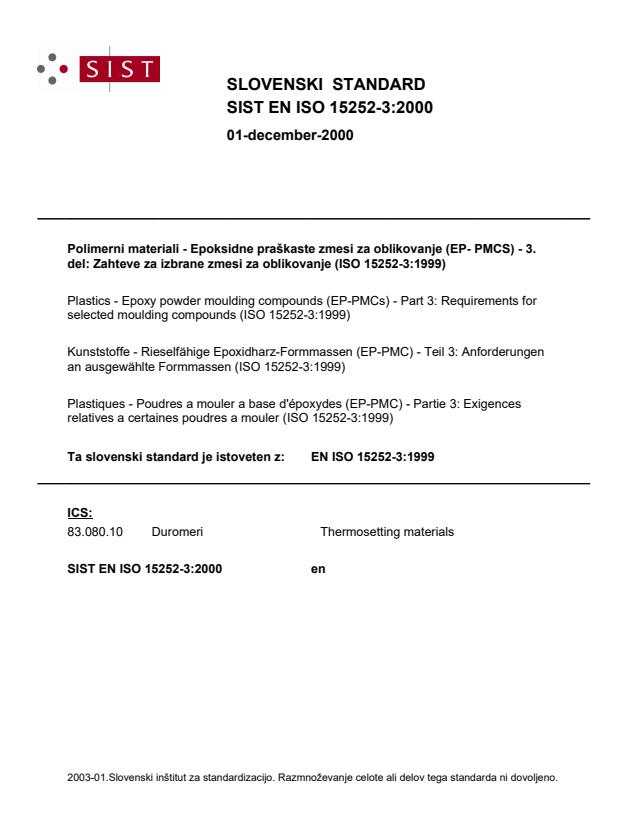
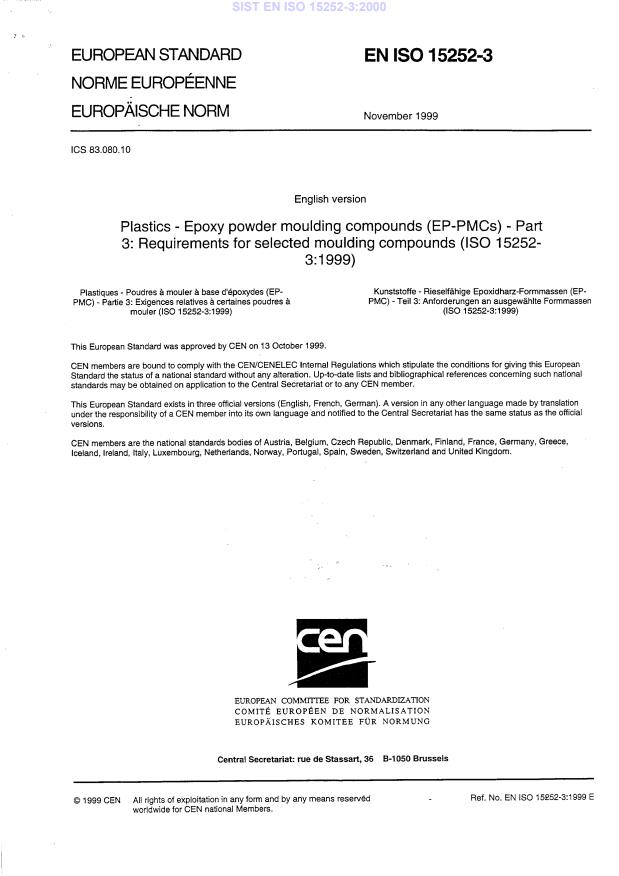
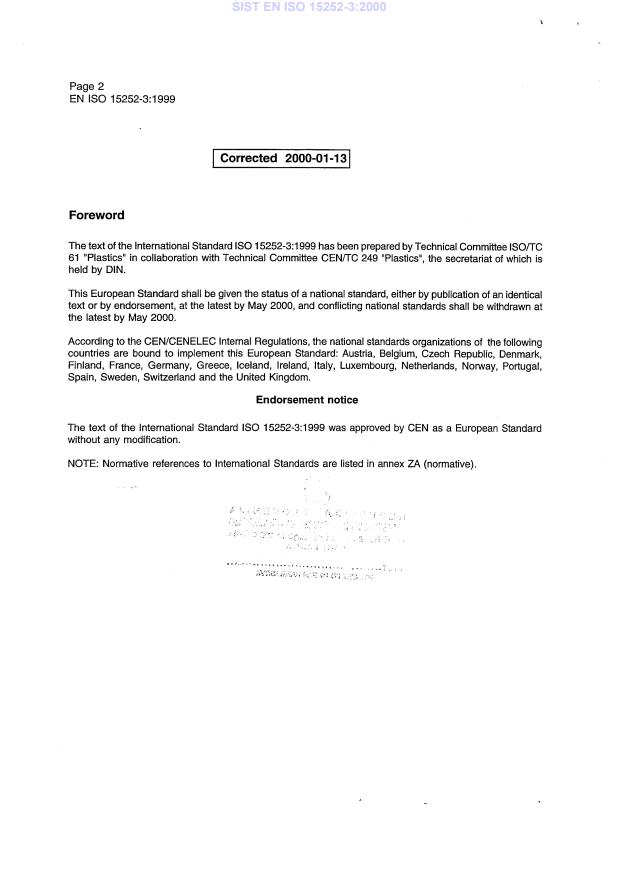
SIST EN ISO 15252-3:2000
(Main)Plastics - Epoxy powder moulding compounds (EP-PMCs) - Part 3: Requirements for selected moulding compounds (ISO 15252-3:1999)
Plastics - Epoxy powder moulding compounds (EP-PMCs) - Part 3: Requirements for selected moulding compounds (ISO 15252-3:1999)
This part of ISO 15252 specifies the requirements for the physical and chemical properties of epoxy powder
moulding compounds (EP-PMCs) and compression- or injection-moulded test specimens produced from them.
It is limited to those powder moulding compounds whose composition and properties are significantly different. It is
further limited to those moulding compounds which are of general technical and/or economic importance.
The properties which are used to characterize the moulding compounds, the test methods and the test conditions
are selected from those given in ISO 15252-2.
The moulding compounds are divided into types according to their composition and properties. The various types
are designated using the designation system defined in ISO 15252-1.
Kunststoffe - Rieselfähige Epoxidharz-Formmassen (EP-PMC) - Teil 3: Anforderungen an ausgewählte Formmassen (ISO 15252-3:1999)
In diesem Teil von ISO 15252 werden die Anforderungen an physikalische und chemische Eigenschaften von rieselfähigen Epoxidharz-Formmassen (EP-PMC) und daraus formgepreßten oder spritzgegossenen Probekörpern festgelegt. Die Auswahl ist auf solche Formmassen begrenzt, deren Zusammensetzung und Eigenschaften sich deutlich unterscheiden. Außerdem ist die Auswahl auf die Formmassen begrenzt, die von allgemeinerer technischer und/oder wirtschaftlicher Bedeutung sind.
Plastiques - Poudres a mouler a base d'époxydes (EP-PMC) - Partie 3: Exigences relatives a certaines poudres a mouler (ISO 15252-3:1999)
La présente partie de l'ISO 15252 spécifie les caractéristiques physiques et chimiques des poudres à mouler à
base d'époxydes (EP-PMC) et des éprouvettes moulées par injection ou par compression, produites à partir de ces
poudres.
Elle se limite aux poudres à mouler dont la composition et les propriétés diffèrent de manière significative. En
outre, elle ne concerne que les poudres à mouler dont l'importance technique et/ou économique est assez
générale.
Les propriétés qui sont utilisées pour caractériser les poudres à mouler, ainsi que les méthodes et conditions
d'essai, sont choisies parmi celles indiquées dans l'ISO 15252-2.
Les poudres à mouler sont réparties en différents types selon leur composition et leurs propriétés. Ces divers types
sont désignés en utilisant le système de désignation défini dans l'ISO 15252-1.
Polimerni materiali - Epoksidne praškaste zmesi za oblikovanje (EP- PMCS) - 3. del: Zahteve za izbrane zmesi za oblikovanje (ISO 15252-3:1999)
General Information
- Status
- Published
- Publication Date
- 30-Nov-2000
- Technical Committee
- IPMA - Polimer materials and products
- Current Stage
- 6060 - National Implementation/Publication (Adopted Project)
- Start Date
- 01-Dec-2000
- Due Date
- 01-Dec-2000
- Completion Date
- 01-Dec-2000
Overview
EN ISO 15252-3:1999 (ISO 15252-3:1999) defines the requirements for selected epoxy powder moulding compounds (EP‑PMCs) and for compression- or injection‑moulded test specimens made from them. This part of ISO 15252 is limited to powder moulding compounds whose composition and properties are significantly different and which are of general technical and/or economic importance. The standard sets required property values, divides compounds into types by composition (using the designation system in ISO 15252‑1), and selects test methods and conditions from ISO 15252‑2.
Key topics and technical requirements
- Scope of materials covered: Selected EP‑PMCs grouped by filler/reinforcement type and content (designations in the standard include combinations such as MD, GF+MD and GF+GG).
- Property categories specified:
- Mechanical: stress at break, flexural strength, Charpy impact (unnotched and notched)
- Thermal: temperature of deflection under load (HDT) for specified loads (T1.8 and T8.0), flammability (glow‑bar test categories)
- Electrical: dissipation factor (tan δ), volume and surface resistivity, proof tracking index (PTI)
- Other: water absorption, plus optional reporting of cure time, particle size and moisture content when agreed between parties
- Test specimens and methods: Preparation and test methods are drawn from ISO 15252‑2; property mean/value limits and allowed individual variation are defined in tables (Tables 1–3).
- Moulding processes: Requirements are given for both compression moulding and injection moulding; limits may differ between processes and should be interpreted accordingly.
- Designation and classification: Compound types use the designation system of ISO 15252‑1; Annex A provides a comparison of designations.
Practical applications and users
Who uses EN ISO 15252-3:
- Polymer and EP‑PMC manufacturers validating product performance and preparing specifications
- Materials engineers and OEMs (electronics, electrical insulation parts, automotive components) selecting moulding compounds to meet mechanical, thermal and electrical requirements
- Test laboratories and quality assurance teams defining test programs and acceptance criteria for compression or injection‑moulded parts
- Procurement and compliance teams specifying standardized property limits in supply contracts
Why it matters:
- Ensures consistent characterization of epoxy powder moulding compounds
- Facilitates comparability across suppliers and repeatable qualification of materials for critical thermal, mechanical and electrical applications
- Supports clear communication of filler types and performance classes via standardized designations
Related standards
- ISO 15252‑1: Designation system and basis for specifications (used to name compound types)
- ISO 15252‑2: Preparation of test specimens and determination of properties (defines test methods and conditions)
Keywords: EN ISO 15252-3:1999, epoxy powder moulding compounds, EP‑PMCs, property requirements, compression moulding, injection moulding, mechanical properties, thermal properties, electrical properties, ISO 15252-1, ISO 15252-2.

Frequently Asked Questions
SIST EN ISO 15252-3:2000 is a standard published by the Slovenian Institute for Standardization (SIST). Its full title is "Plastics - Epoxy powder moulding compounds (EP-PMCs) - Part 3: Requirements for selected moulding compounds (ISO 15252-3:1999)". This standard covers: This part of ISO 15252 specifies the requirements for the physical and chemical properties of epoxy powder moulding compounds (EP-PMCs) and compression- or injection-moulded test specimens produced from them. It is limited to those powder moulding compounds whose composition and properties are significantly different. It is further limited to those moulding compounds which are of general technical and/or economic importance. The properties which are used to characterize the moulding compounds, the test methods and the test conditions are selected from those given in ISO 15252-2. The moulding compounds are divided into types according to their composition and properties. The various types are designated using the designation system defined in ISO 15252-1.
This part of ISO 15252 specifies the requirements for the physical and chemical properties of epoxy powder moulding compounds (EP-PMCs) and compression- or injection-moulded test specimens produced from them. It is limited to those powder moulding compounds whose composition and properties are significantly different. It is further limited to those moulding compounds which are of general technical and/or economic importance. The properties which are used to characterize the moulding compounds, the test methods and the test conditions are selected from those given in ISO 15252-2. The moulding compounds are divided into types according to their composition and properties. The various types are designated using the designation system defined in ISO 15252-1.
SIST EN ISO 15252-3:2000 is classified under the following ICS (International Classification for Standards) categories: 83.080.10 - Thermosetting materials. The ICS classification helps identify the subject area and facilitates finding related standards.
SIST EN ISO 15252-3:2000 is available in PDF format for immediate download after purchase. The document can be added to your cart and obtained through the secure checkout process. Digital delivery ensures instant access to the complete standard document.
Standards Content (Sample)
SLOVENSKI STANDARD
01-december-2000
Polimerni materiali - Epoksidne praškaste zmesi za oblikovanje (EP- PMCS) - 3.
del: Zahteve za izbrane zmesi za oblikovanje (ISO 15252-3:1999)
Plastics - Epoxy powder moulding compounds (EP-PMCs) - Part 3: Requirements for
selected moulding compounds (ISO 15252-3:1999)
Kunststoffe - Rieselfähige Epoxidharz-Formmassen (EP-PMC) - Teil 3: Anforderungen
an ausgewählte Formmassen (ISO 15252-3:1999)
Plastiques - Poudres a mouler a base d'époxydes (EP-PMC) - Partie 3: Exigences
relatives a certaines poudres a mouler (ISO 15252-3:1999)
Ta slovenski standard je istoveten z: EN ISO 15252-3:1999
ICS:
83.080.10 Duromeri Thermosetting materials
2003-01.Slovenski inštitut za standardizacijo. Razmnoževanje celote ali delov tega standarda ni dovoljeno.
INTERNATIONAL ISO
STANDARD 15252-3
First edition
1999-11-15
Plastics — Epoxy powder moulding
compounds (EP-PMCs) —
Part 3:
Requirements for selected moulding
compounds
Plastiques — Poudres à mouler à base d'époxydes (EP-PMC) —
Partie 3: Exigences relatives à certaines poudres à mouler
Reference number
ISO 15252-3:1999(E)
�
©
ISO 1999
ISO 15252-3:1999(E)
PDF disclaimer
This PDF file may contain embedded typefaces. In accordance with Adobe's licensing policy, this file may be printed or viewed but shall not
be edited unless the typefaces which are embedded are licensed to and installed on the computer performing the editing. In downloading this
file, parties accept therein the responsibility of not infringing Adobe's licensing policy. The ISO Central Secretariat accepts no liability in this
area.
Adobe is a trademark of Adobe Systems Incorporated.
Details of the software products used to create this PDF file can be found in the General Info relative to the file; the PDF-creation parameters
were optimized for printing. Every care has been taken to ensure that the file is suitable for use by ISO member bodies. In the unlikely event
that a problem relating to it is found, please inform the Central Secretariat at the address given below.
© ISO 1999
All rights reserved. Unless otherwise specified, no part of this publication may be reproduced or utilized in any form or by any means, electronic
or mechanical, including photocopying and microfilm, without permission in writing from either ISO at the address below or ISO's member body
in the country of the requester.
ISO copyright office
Case postale 56 � CH-1211 Geneva 20
Tel. + 41 22 749 01 11
Fax + 41 22 734 10 79
E-mail copyright@iso.ch
Web www.iso.ch
Printed in Switzerland
ii © ISO 1999 – All rights reserved
ISO 15252-3:1999(E)
Foreword
ISO (the International Organization for Standardization) is a worldwide federation of national standards bodies (ISO
member bodies). The work of preparing International Standards is normally carried out through ISO technical
committees. Each member body interested in a subject for which a technical committee has been established has
the right to be represented on that committee. International organizations, governmental and non-governmental, in
liaison with ISO, also take part in the work. ISO collaborates closely with the International Electrotechnical
Commission (IEC) on all matters of electrotechnical standardization.
International Standards are drafted in accordance with the rules given in the ISO/IEC Directives, Part 3.
Draft International Standards adopted by the technical committees are circulated to the member bodies for voting.
Publication as an International Standard requires approval by at least 75 % of the member bodies casting a vote.
Attention is drawn to the possibility that some of the elements of this part of ISO 15252 may be the subject of
patent rights. ISO shall not be held responsible for identifying any or all such patent rights.
International Standard ISO 15252-3 was prepared by Technical Committee ISO/TC 61, Plastics, Subcommittee
SC 12, Thermosetting materials.
ISO 15252 consists of the following parts, under the general title Plastics — Epoxy powder moulding compounds
(EP-PMCs):
� Part 1: Designation system and basis for specifications
� Part 2: Preparation of test specimens and determination of properties
� Part 3: Requirements for selected moulding compounds
Annex A of this part of ISO 15252 is for information only.
© ISO 1999 – All rights reserved iii
INTERNATIONAL STANDARD ISO 15252-3:1999(E)
Plastics — Epoxy powder moulding compounds (EP-PMCs) —
Part 3:
Requirements for selected moulding compounds
1 Scope
This part of ISO 15252 specifies the requirements for the physical and chemical properties of epoxy powder
moulding compounds (EP-PMCs) and compression- or injection-moulded test specimens produced from them.
It is limited to those powder moulding compounds whose composition and properties are significantly different. It is
further limited to those moulding compounds which are of general technical and/or economic importance.
The properties which are used to characterize the moulding compounds, the test methods and the test conditions
are selected from those given in ISO 15252-2.
The moulding compounds are divided into types according to their composition and properties. The various types
are designated using the designation system defined in ISO 15252-1.
2 Normative references
The following normative documents contain provisions which, through reference in this text, constitute provisions of
this part of ISO 15252. For dated references, subsequent amendments to, or revisions of, any of these publications
do not apply. However, parties to agreements based on this part of ISO 15252 are encouraged to investigate the
possibility of applying the most recent editions of the normative documents indicated below. For undated
references, the latest edition of the normative document referred to applies. Members of ISO and IEC maintain
registers of currently valid International Standards.
ISO 472:1999, Plastics — Vocabulary.
ISO 15252-1:1999, Plastics — Epoxy powder moulding compounds (EP-PMCs) — Part 1: Designation system and
basis for specifications.
ISO 15252-2:1999, Plastics — Epoxy powder moulding compounds (EP-PMCs) — Part 2: Preparation of test
specimens and determination of properties.
3 Terms and definitions
For the purposes of this part of ISO 15252, the terms and definitions given in ISO 472, ISO 15252-1 and
ISO 15252-2 apply.
© ISO 1999 – All rights reserved 1
ISO 15252-3:1999(E)
4 Requirements
4.1 Property values
In order for an epoxy powder moulding compound to be considered as complying with this part of ISO 15252, it
shall meet the requirements given in the appropriate table (Table 1, 2 or 3).
Tables 1, 2 and 3 give the mean value obtained for the set of test specimens used to
...
Questions, Comments and Discussion
Ask us and Technical Secretary will try to provide an answer. You can facilitate discussion about the standard in here.
Loading comments...