

SIST EN 50121-4:2017/A1:2019
(Amendment)Railway applications - Electromagnetic compatibility - Part 4: Emission and immunity of the signalling and telecommunications apparatus
General Information
- Abstract
This European Standard applies to signalling and telecommunication apparatus that is installed inside the railway environment. Signalling and telecommunication apparatus mounted in vehicles is covered by EN 50121-3-2:2016, signalling and telecommunication apparatus installed inside the substation and connected to substation equipment is covered by EN 50121-5:2016.
This European Standard specifies limits for emission and immunity and provides performance criteria for signalling and telecommunications (S&T) apparatus (including power supply systems belonging to S&T) which may interfere with other apparatus inside the railway environment, or increase the total emissions for the railway environment and so risk causing Electro-Magnetic Interference (EMI) to apparatus outside the railway system.
The requirements specified in this standard apply for:
— vital equipment such as interlocking or command and control;
— apparatus inside the 3 m zone;
— ports of apparatus inside the 10 m zone with connection inside the 3 m zone;
— ports of apparatus inside the 10 m zone with cable length > 30 m.
Other apparatus not covered by at least one of these given cases should be in compliance with EN 61000-6-2.
If a port is intended to transmit or receive for the purpose of radio communication (intentional radiators, e.g. transponder systems), then the radiated emission requirement in this standard are not intended to be applicable to the intentional transmission from a radio-transmitter as defined by the ITU.
Immunity limits do not apply in the exclusion bands as defined in the corresponding EMC related standard for radio equipment.
The standard does not specify basic personal safety requirements for apparatus such as protection against electric shock, unsafe operation, insulation co-ordination and related dielectric tests. The requirements were developed for and are applicable to this set of apparatus when operating under normal conditions. Fault conditions of the apparatus have not been taken into account.
The frequency range considered is from DC to 400 GHz. No measurements need to be performed at frequencies where no requirement is specified.
For products in the scope of EN 61000-3-2, EN 61000-3-3, EN 61000-3-11 or EN 61000-3-12 the requirements of those standards also apply.
These specific provisions are to be used in conjunction with the general provisions in EN 50121-1:2016.
The immunity and emission levels do not of themselves guarantee that the integration of apparatus will necessarily be satisfactory. The standard cannot cover all the possible configurations of the apparatus, but the test levels are sufficient to achieve satisfactory EMC in the majority of cases.
- Status
- Published
- Publication Date
- 18-Aug-2019
- Technical Committee
- ŽEN - Electrical applications for railways
- Current Stage
- 6060 - National Implementation/Publication (Adopted Project)
- Start Date
- 12-Jul-2019
- Due Date
- 16-Sep-2019
- Completion Date
- 19-Aug-2019


Overview
EN 50121-4:2016/A1:2019 (CLC) is the European standard that defines electromagnetic compatibility (EMC) requirements for signalling and telecommunications (S&T) apparatus installed inside the railway environment. It specifies limits for emission and immunity and gives performance criteria for S&T equipment - including associated power-supply systems - that could interfere with other railway apparatus or increase total railway emissions and cause electromagnetic interference (EMI) outside the railway system. The standard covers the frequency range DC to 400 GHz and is published as an amendment to EN 50121-4:2016 (A1:2019).
Key Topics and Requirements
- Scope and applicability
- Applies to signalling and telecommunication apparatus installed inside the railway environment (not vehicle-mounted or substation-connected equipment).
- Vehicle-mounted S&T: see EN 50121-3-2:2016; substation-connected S&T: see EN 50121-5:2016.
- Zones and equipment covered
- Vital equipment (e.g., interlocking, command & control).
- Apparatus located inside the 3 m zone.
- Ports of apparatus inside the 10 m zone with connection inside the 3 m zone.
- Ports inside the 10 m zone with cable length > 30 m.
- Other apparatus default to EN 61000-6-2.
- Emission and immunity limits
- Defines EMC limits and performance criteria to reduce the risk of EMI within and outside the railway environment.
- Intentional radiators (radio transmitters, transponders) are excluded from the standard’s radiated emission requirements; immunity exclusion bands follow the corresponding radio EMC standards.
- Compliance and testing
- Tests are defined only where requirements exist - no measurements required at frequencies without specified limits.
- Fault conditions are not taken into account; requirements address normal operating conditions.
- For products under EN 61000-3-x (harmonic/current/voltage) standards, those standards also apply.
- Regulatory relationship
- The amendment aligns the standard with Directive 2014/30/EU (EMC Directive) and CENELEC standardization requests.
Applications and Users
Who uses EN 50121-4:
- Railway signalling and telecom equipment manufacturers for product design and EMC compliance
- System integrators and installation engineers for on-site EMC mitigation
- EMC test laboratories performing emission and immunity testing to railway EMC criteria
- Procurement, certification bodies, and safety assessors ensuring interoperability and regulatory conformity
Practical uses:
- Designing S&T apparatus with acceptable emission/immunity performance
- Planning cable routing and port placement to meet zone rules (3 m / 10 m)
- Preparing test specifications and compliance evidence for rail EMC certification
- Reducing risk of EMI affecting critical railway control systems or external services
Related Standards
- EN 50121-1:2016 (general provisions for railway EMC)
- EN 50121-3-2:2016 (vehicle-mounted signalling & telecom)
- EN 50121-5:2016 (substation-connected apparatus)
- EN 61000-6-2 and EN 61000-3-2 / 3-3 / 3-11 / 3-12 (industrial EMC / supply-related standards)
Keywords: EN 50121-4, railway EMC, electromagnetic compatibility, signalling apparatus, telecommunications apparatus, EMI, emission and immunity.
Relations
- Effective Date
- 09-Feb-2026
- Effective Date
- 09-Feb-2026
- Referred By
SIST EN 50121-1:2017 - Railway applications - Electromagnetic compatibility - Part 1: General - Effective Date
- 03-Feb-2026
- Effective Date
- 08-May-2018
- Effective Date
- 09-Apr-2024
- Effective Date
- 22-Dec-2020
Get Certified
Connect with accredited certification bodies for this standard

IRIS Certification (UNIFE)
International Railway Industry Standard certification.

TÜV SÜD Rail GmbH
TÜV SÜD railway certification services.

ANCE
Mexican certification and testing association.
Sponsored listings
Frequently Asked Questions
SIST EN 50121-4:2017/A1:2019 is a amendment published by the Slovenian Institute for Standardization (SIST). Its full title is "Railway applications - Electromagnetic compatibility - Part 4: Emission and immunity of the signalling and telecommunications apparatus". This standard covers: This European Standard applies to signalling and telecommunication apparatus that is installed inside the railway environment. Signalling and telecommunication apparatus mounted in vehicles is covered by EN 50121-3-2:2016, signalling and telecommunication apparatus installed inside the substation and connected to substation equipment is covered by EN 50121-5:2016. This European Standard specifies limits for emission and immunity and provides performance criteria for signalling and telecommunications (S&T) apparatus (including power supply systems belonging to S&T) which may interfere with other apparatus inside the railway environment, or increase the total emissions for the railway environment and so risk causing Electro-Magnetic Interference (EMI) to apparatus outside the railway system. The requirements specified in this standard apply for: — vital equipment such as interlocking or command and control; — apparatus inside the 3 m zone; — ports of apparatus inside the 10 m zone with connection inside the 3 m zone; — ports of apparatus inside the 10 m zone with cable length > 30 m. Other apparatus not covered by at least one of these given cases should be in compliance with EN 61000-6-2. If a port is intended to transmit or receive for the purpose of radio communication (intentional radiators, e.g. transponder systems), then the radiated emission requirement in this standard are not intended to be applicable to the intentional transmission from a radio-transmitter as defined by the ITU. Immunity limits do not apply in the exclusion bands as defined in the corresponding EMC related standard for radio equipment. The standard does not specify basic personal safety requirements for apparatus such as protection against electric shock, unsafe operation, insulation co-ordination and related dielectric tests. The requirements were developed for and are applicable to this set of apparatus when operating under normal conditions. Fault conditions of the apparatus have not been taken into account. The frequency range considered is from DC to 400 GHz. No measurements need to be performed at frequencies where no requirement is specified. For products in the scope of EN 61000-3-2, EN 61000-3-3, EN 61000-3-11 or EN 61000-3-12 the requirements of those standards also apply. These specific provisions are to be used in conjunction with the general provisions in EN 50121-1:2016. The immunity and emission levels do not of themselves guarantee that the integration of apparatus will necessarily be satisfactory. The standard cannot cover all the possible configurations of the apparatus, but the test levels are sufficient to achieve satisfactory EMC in the majority of cases.
This European Standard applies to signalling and telecommunication apparatus that is installed inside the railway environment. Signalling and telecommunication apparatus mounted in vehicles is covered by EN 50121-3-2:2016, signalling and telecommunication apparatus installed inside the substation and connected to substation equipment is covered by EN 50121-5:2016. This European Standard specifies limits for emission and immunity and provides performance criteria for signalling and telecommunications (S&T) apparatus (including power supply systems belonging to S&T) which may interfere with other apparatus inside the railway environment, or increase the total emissions for the railway environment and so risk causing Electro-Magnetic Interference (EMI) to apparatus outside the railway system. The requirements specified in this standard apply for: — vital equipment such as interlocking or command and control; — apparatus inside the 3 m zone; — ports of apparatus inside the 10 m zone with connection inside the 3 m zone; — ports of apparatus inside the 10 m zone with cable length > 30 m. Other apparatus not covered by at least one of these given cases should be in compliance with EN 61000-6-2. If a port is intended to transmit or receive for the purpose of radio communication (intentional radiators, e.g. transponder systems), then the radiated emission requirement in this standard are not intended to be applicable to the intentional transmission from a radio-transmitter as defined by the ITU. Immunity limits do not apply in the exclusion bands as defined in the corresponding EMC related standard for radio equipment. The standard does not specify basic personal safety requirements for apparatus such as protection against electric shock, unsafe operation, insulation co-ordination and related dielectric tests. The requirements were developed for and are applicable to this set of apparatus when operating under normal conditions. Fault conditions of the apparatus have not been taken into account. The frequency range considered is from DC to 400 GHz. No measurements need to be performed at frequencies where no requirement is specified. For products in the scope of EN 61000-3-2, EN 61000-3-3, EN 61000-3-11 or EN 61000-3-12 the requirements of those standards also apply. These specific provisions are to be used in conjunction with the general provisions in EN 50121-1:2016. The immunity and emission levels do not of themselves guarantee that the integration of apparatus will necessarily be satisfactory. The standard cannot cover all the possible configurations of the apparatus, but the test levels are sufficient to achieve satisfactory EMC in the majority of cases.
SIST EN 50121-4:2017/A1:2019 is classified under the following ICS (International Classification for Standards) categories: 33.100.01 - Electromagnetic compatibility in general; 45.020 - Railway engineering in general. The ICS classification helps identify the subject area and facilitates finding related standards.
SIST EN 50121-4:2017/A1:2019 has the following relationships with other standards: It is inter standard links to SIST-TS CEN/TS 15427-1-2:2021, SIST EN 13272:2012, SIST EN 50121-1:2017, SIST EN 50121-4:2017, kSIST FprEN 50121-4:2026, kSIST FprEN 50121-4:2022. Understanding these relationships helps ensure you are using the most current and applicable version of the standard.
SIST EN 50121-4:2017/A1:2019 is associated with the following European legislation: EU Directives/Regulations: 2014/30/EU; Standardization Mandates: M/522, M/552. When a standard is cited in the Official Journal of the European Union, products manufactured in conformity with it benefit from a presumption of conformity with the essential requirements of the corresponding EU directive or regulation.
SIST EN 50121-4:2017/A1:2019 is available in PDF format for immediate download after purchase. The document can be added to your cart and obtained through the secure checkout process. Digital delivery ensures instant access to the complete standard document.
Standards Content (Sample)
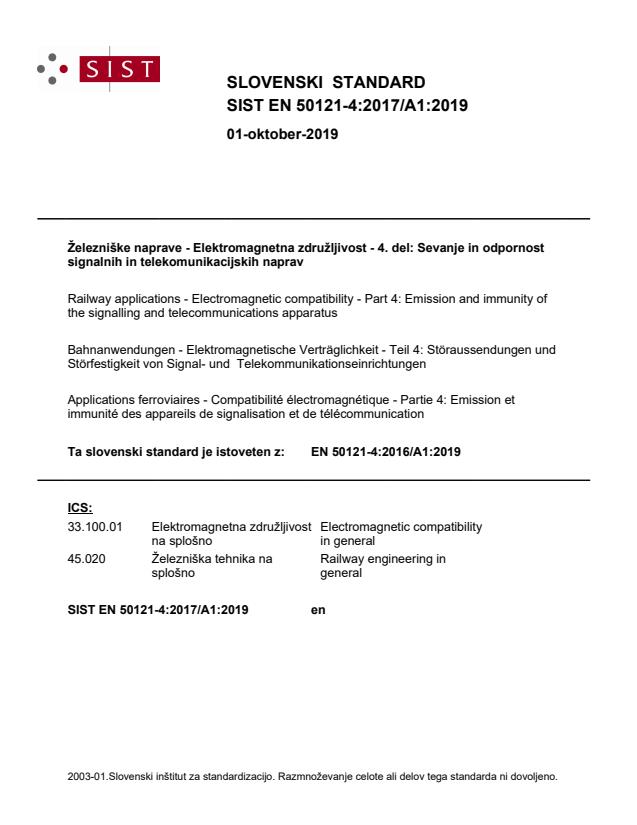
SLOVENSKI STANDARD
01-oktober-2019
Železniške naprave - Elektromagnetna združljivost - 4. del: Sevanje in odpornost
signalnih in telekomunikacijskih naprav
Railway applications - Electromagnetic compatibility - Part 4: Emission and immunity of
the signalling and telecommunications apparatus
Bahnanwendungen - Elektromagnetische Verträglichkeit - Teil 4: Störaussendungen und
Störfestigkeit von Signal- und Telekommunikationseinrichtungen
Applications ferroviaires - Compatibilité électromagnétique - Partie 4: Emission et
immunité des appareils de signalisation et de télécommunication
Ta slovenski standard je istoveten z: EN 50121-4:2016/A1:2019
ICS:
33.100.01 Elektromagnetna združljivost Electromagnetic compatibility
na splošno in general
45.020 Železniška tehnika na Railway engineering in
splošno general
2003-01.Slovenski inštitut za standardizacijo. Razmnoževanje celote ali delov tega standarda ni dovoljeno.
EUROPEAN STANDARD EN 50121-4:2016/A1
NORME EUROPÉENNE
EUROPÄISCHE NORM
April 2019
ICS 29.280; 33.100.01; 45.020
English Version
Railway applications - Electromagnetic compatibility - Part 4:
Emission and immunity of the signalling and telecommunications
apparatus
Applications ferroviaires - Compatibilité électromagnétique - Bahnanwendungen - Elektromagnetische Verträglichkeit -
Partie 4: Emission et immunité des appareils de Teil 4: Störaussendungen und Störfestigkeit von Signal-
signalisation et de télécommunication und Telekommunikationseinrichtungen
This amendment A1 modifies the European Standard EN 50121-4:2016; it was approved by CENELEC on 2018-10-30. CENELEC
members are bound to comply with the CEN/CENELEC Internal Regulations which stipulate the conditions for giving this amendment the
status of a national standard without any alteration.
Up-to-date lists and bibliographical references concerning such national standards may be obtained on application to the CEN-CENELEC
Management Centre or to any CENELEC member.
This amendment exists in three official versions (English, French, German). A version in any other language made by translation under the
responsibility of a CENELEC member into its own language and notified to the CEN-CENELEC Management Centre has the same status as
the official versions.
CENELEC members are the national electrotechnical committees of Austria, Belgium, Bulgaria, Croatia, Cyprus, the Czech Republic,
Denmark, Estonia, Finland, Former Yugoslav Republic of Macedonia, France, Germany, Greece, Hungary, Iceland, Ireland, Italy, Latvia,
Lithuania, Luxembourg, Malta, the Netherlands, Norway, Poland, Portugal, Romania, Serbia, Slovakia, Slovenia, Spain, Sweden,
Switzerland, Turkey and the United Kingdom.
European Committee for Electrotechnical Standardization
Comité Européen de Normalisation Electrotechnique
Europäisches Komitee für Elektrotechnische Normung
CEN-CENELEC Management Centre: Rue de la Science 23, B-1040 Brussels
© 2019 CENELEC All rights of exploitation in any form and by any means reserved worldwide for CENELEC Members.
Ref. No.
...