

SIST EN 50131-4:2019
(Main)Alarm systems - Intrusion and hold-up systems - Part 4: Warning devices
General Information
- Abstract
This document includes requirements for warning devices used for notification in intrusion and hold up alarm systems installed in buildings. Four grades of warning device are described corresponding to each of the four security grades given in EN 50131-1. Requirements are also given for four environmental classes covering applications in indoor and outdoor locations as specified in EN 50130-5.
This document does not deal with requirements for compliance with EC regulatory Directives, such as the EMC Directive, Low Voltage Directive, etc. except that it specifies the equipment operating conditions for EMC susceptibility testing as required by EN 50130-4.
- Status
- Published
- Publication Date
- 08-Aug-2019
- Technical Committee
- EAL - Alarm systems
- Current Stage
- 6060 - National Implementation/Publication (Adopted Project)
- Start Date
- 25-Jul-2019
- Due Date
- 29-Sep-2019
- Completion Date
- 09-Aug-2019



Overview
EN 50131-4:2019 - "Alarm systems - Intrusion and hold‑up systems - Part 4: Warning devices" (CLC/CENELEC) defines requirements and test methods for warning devices used in building‑installed intrusion and hold‑up alarm systems. The standard describes four warning device grades that correspond to the four security grades in EN 50131-1 and defines four environmental classes (indoor/outdoor applications) aligned with EN 50130-5. It sets functional, environmental, tamper, electrical, acoustic and self‑test requirements and the test procedures to demonstrate compliance. EN 50131-4:2019 supersedes the 2009 edition and clarifies test methodology and alignment with other EN 50131 product standards.
Key topics and requirements
- Warning device grading: Defines performance expectations for the four device grades matching EN 50131-1 security grades.
- Functional requirements: Response to trigger commands, timing, acoustic characteristics and maximum sound duration limits.
- Acoustic testing: Measurement methods for audible output (referenced in Annex A) and pass/fail criteria for sound level.
- Tamper protection and detection: Requirements for enclosure protection, detection of opening or removal, and penetration resistance.
- Environmental classes: Tests and construction requirements for indoor and outdoor installations per EN 50130-5.
- EMC susceptibility: Specifies operating conditions for EMC immunity testing consistent with EN 50130-4 (note: it does not replace EC regulatory directives such as EMC or Low Voltage Directives).
- Electrical and power: Requirements and tests for operating voltage range, current consumption, remote powering vs self‑powered devices, storage device standby/operating times, recharge behaviour, loss of remote power and short‑circuit protection.
- Self‑test and remote testability: Local and remote self‑test provisions and recommended test protocols (informative examples included).
- Marking and documentation: Mandatory marking, user documentation and test record requirements.
- Test procedures: Detailed test sections for functional performance, reduced functional tests, tamper, electrical, marking and environmental testing.
Applications and who uses it
- Alarm system manufacturers designing sirens, horns, strobes and combined warning devices.
- System designers and integrators specifying devices to meet a required security grade and environmental class.
- Installers documenting compliance and selecting appropriate devices for indoor/outdoor use.
- Testing laboratories and certification bodies conducting type and performance testing.
- Specifiers and facility managers ensuring installed warning devices meet regulatory and system requirements for intrusion and hold‑up protection.
Related standards
- EN 50131-1 (system requirements)
- EN 50130-4 (EMC immunity - product family)
- EN 50130-5 (environmental test methods)
- EN 50131-6 (power supplies)
- EN 61672-1, EN 60529, EN 62262 and EN 60068-2-75 (referenced test and measurement standards)
Keywords: EN 50131-4:2019, alarm systems, warning devices, intrusion and hold‑up, warning device grades, environmental classes, EMC susceptibility, tamper detection, self‑powered, remotely powered.
Relations
- Replaces
SIST EN 50131-4:2009 - Alarm systems - Intrusion and hold-up systems -- Part 4: Warning devices - Effective Date
- 01-Sep-2019
- Effective Date
- 09-Feb-2026
- Effective Date
- 03-Feb-2026
- Effective Date
- 03-Feb-2026
Get Certified
Connect with accredited certification bodies for this standard

CIS Institut d.o.o.
Personal Protective Equipment (PPE) certification body. Notified Body NB-2890 for EU Regulation 2016/425 PPE.

Kiwa BDA Testing
Building and construction product certification.
Kmetijski inštitut Slovenije
Agricultural Institute of Slovenia. Soil testing, plant health, agricultural product analysis.
Sponsored listings
Frequently Asked Questions
SIST EN 50131-4:2019 is a standard published by the Slovenian Institute for Standardization (SIST). Its full title is "Alarm systems - Intrusion and hold-up systems - Part 4: Warning devices". This standard covers: This document includes requirements for warning devices used for notification in intrusion and hold up alarm systems installed in buildings. Four grades of warning device are described corresponding to each of the four security grades given in EN 50131-1. Requirements are also given for four environmental classes covering applications in indoor and outdoor locations as specified in EN 50130-5. This document does not deal with requirements for compliance with EC regulatory Directives, such as the EMC Directive, Low Voltage Directive, etc. except that it specifies the equipment operating conditions for EMC susceptibility testing as required by EN 50130-4.
This document includes requirements for warning devices used for notification in intrusion and hold up alarm systems installed in buildings. Four grades of warning device are described corresponding to each of the four security grades given in EN 50131-1. Requirements are also given for four environmental classes covering applications in indoor and outdoor locations as specified in EN 50130-5. This document does not deal with requirements for compliance with EC regulatory Directives, such as the EMC Directive, Low Voltage Directive, etc. except that it specifies the equipment operating conditions for EMC susceptibility testing as required by EN 50130-4.
SIST EN 50131-4:2019 is classified under the following ICS (International Classification for Standards) categories: 13.310 - Protection against crime; 13.320 - Alarm and warning systems. The ICS classification helps identify the subject area and facilitates finding related standards.
SIST EN 50131-4:2019 has the following relationships with other standards: It is inter standard links to SIST EN 50131-4:2009, SIST EN 15999-2:2025, SIST EN 50600-2-5:2016, SIST EN 50600-2-5:2021. Understanding these relationships helps ensure you are using the most current and applicable version of the standard.
SIST EN 50131-4:2019 is associated with the following European legislation: EU Directives/Regulations: 2012-01-0929, 2020-01-0063. When a standard is cited in the Official Journal of the European Union, products manufactured in conformity with it benefit from a presumption of conformity with the essential requirements of the corresponding EU directive or regulation.
SIST EN 50131-4:2019 is available in PDF format for immediate download after purchase. The document can be added to your cart and obtained through the secure checkout process. Digital delivery ensures instant access to the complete standard document.
Standards Content (Sample)
SLOVENSKI STANDARD
01-september-2019
Nadomešča:
SIST EN 50131-4:2009
Alarmni sistemi - Sistemi za javljanje vloma in ropa - 4. del: Opozorilne naprave
Alarm systems - Intrusion and hold-up systems - Part 4: Warning devices
Alarmanlagen - Einbruch- und Überfallmeldeanlagen - Teil 4: Signalgeber
Systèmes d’alarme - Systèmes d’alarme contre l’intrusion et les hold-up - Partie 4:
Dispositifs d’avertissement
Ta slovenski standard je istoveten z: EN 50131-4:2019
ICS:
13.310 Varstvo pred kriminalom Protection against crime
13.320 Alarmni in opozorilni sistemi Alarm and warning systems
2003-01.Slovenski inštitut za standardizacijo. Razmnoževanje celote ali delov tega standarda ni dovoljeno.
EUROPEAN STANDARD EN 50131-4
NORME EUROPÉENNE
EUROPÄISCHE NORM
April 2019
ICS 13.320 Supersedes EN 50131-4:2009
English Version
Alarm systems - Intrusion and hold-up systems - Part 4: Warning
devices
Systèmes d'alarme - Systèmes d'alarme contre l'intrusion et Alarmanlagen - Einbruch- und Überfallmeldeanlagen - Teil
les hold-up - Partie 4: Dispositifs d'avertissement 4: Signalgeber
This European Standard was approved by CENELEC on 2018-12-31. CENELEC members are bound to comply with the CEN/CENELEC
Internal Regulations which stipulate the conditions for giving this European Standard the status of a national standard without any alteration.
Up-to-date lists and bibliographical references concerning such national standards may be obtained on application to the CEN-CENELEC
Management Centre or to any CENELEC member.
This European Standard exists in three official versions (English, French, German). A version in any other language made by translation
under the responsibility of a CENELEC member into its own language and notified to the CEN-CENELEC Management Centre has the
same status as the official versions.
CENELEC members are the national electrotechnical committees of Austria, Belgium, Bulgaria, Croatia, Cyprus, the Czech Republic,
Denmark, Estonia, Finland, Former Yugoslav Republic of Macedonia, France, Germany, Greece, Hungary, Iceland, Ireland, Italy, Latvia,
Lithuania, Luxembourg, Malta, the Netherlands, Norway, Poland, Portugal, Romania, Serbia, Slovakia, Slovenia, Spain, Sweden,
Switzerland, Turkey and the United Kingdom.
European Committee for Electrotechnical Standardization
Comité Européen de Normalisation Electrotechnique
Europäisches Komitee für Elektrotechnische Normung
CEN-CENELEC Management Centre: Rue de la Science 23, B-1040 Brussels
© 2019 CENELEC All rights of exploitation in any form and by any means reserved worldwide for CENELEC Members.
Ref. No. EN 50131-4:2019 E
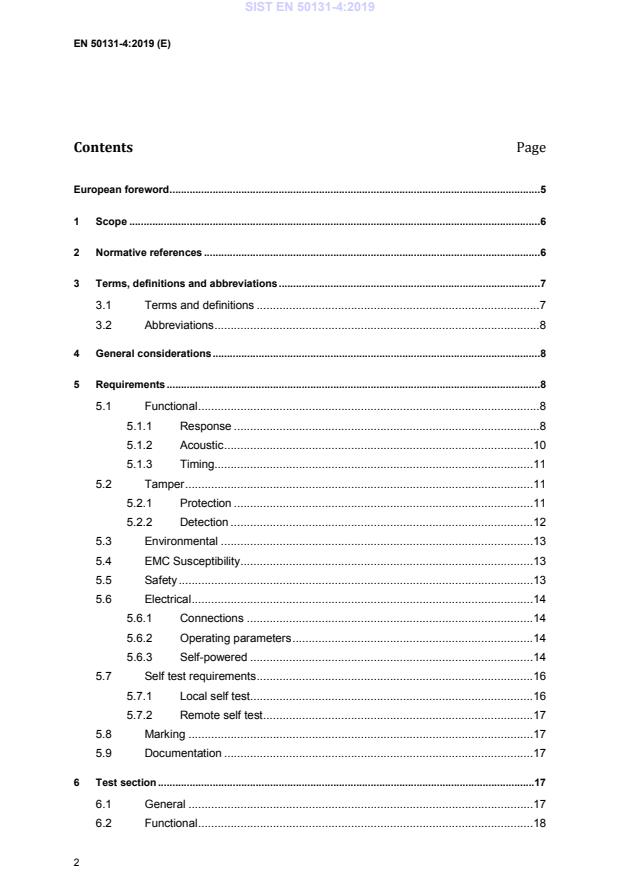
Contents Page
European foreword . 5
1 Scope . 6
2 Normative references . 6
3 Terms, definitions and abbreviations . 7
3.1 Terms and definitions . 7
3.2 Abbreviations . 8
4 General considerations . 8
5 Requirements . 8
5.1 Functional . 8
5.1.1 Response . 8
5.1.2 Acoustic . 10
5.1.3 Timing. 11
5.2 Tamper . 11
5.2.1 Protection . 11
5.2.2 Detection . 12
5.3 Environmental . 13
5.4 EMC Susceptibility . 13
5.5 Safety . 13
5.6 Electrical . 14
5.6.1 Connections . 14
5.6.2 Operating parameters . 14
5.6.3 Self-powered . 14
5.7 Self test requirements . 16
5.7.1 Local self test . 16
5.7.2 Remote self test . 17
5.8 Marking . 17
5.9 Documentation . 17
6 Test section .17
6.1 General . 17
6.2 Functional . 18
6.2.1 General conditions . 18
6.2.2 General mounting . 18
6.2.3 General testing procedures . 18
6.3 Reduced functional test . 18
6.3.1 Purpose . 18
6.3.2 Conditions . 18
6.3.3 Mounting . 18
6.3.4 Stimuli. 18
6.3.5 Measurement . 18
6.3.6 Pass/Fail criteria . 18
6.4 Response to events . 19
6.4.1 Response to trigger command . 19
6.4.2 Response to loss of trigger command interconnection integrity . 19
6.4.3 Maximum sound duration limit . 20
6.5 Acoustic output level . 20
6.5.1 Purpose . 20
6.5.2 Conditions . 20
6.5.3 Mounting . 20
6.5.4 Stimuli. 20
6.5.5 Measurement . 20
6.5.6 Pass/Fail criteria . 20
6.6 Tamper . 21
6.6.1 Opening by normal means . 21
6.6.2 Protection . 21
6.6.3 Detection of opening by normal means . 22
6.6.4 Detection of removal from mounting . 22
6.6.5 Detection of penetration . 23
6.7 Electrical tests . 23
6.7.1 Operating voltage range and current consumption . 23
6.7.2 Slow rise of remote power source voltage . 24
6.7.3 Remote power source voltage step change . 24
6.7.4 Storage device standby time . 25
6.7.5 Storage device operating time . 25
6.7.6 Storage device recharge rate . 26
6.7.7 Loss of remote power . 27
6.7.8 Remote power short circuit protection . 27
6.7.9 Storage device monitoring – Low residual energy . 28
6.7.10 Storage device monitoring – Failure . 28
6.8 Marking . 29
6.8.1 Purpose . 29
6.8.2 Conditions . 29
6.8.3 Mounting . 29
6.8.4 Stimuli. 29
6.8.5 Measurement . 29
6.8.6 Pass/Fail criteria . 29
6.9 Documentation . 29
6.9.1 Purpose . 29
6.9.2 Conditions . 29
6.9.3 Mounting . 29
6.9.4 Stimuli. 30
6.9.5 Measurement . 30
6.9.6 Pass/Fail criteria . 30
6.10 Environmental . 30
6.10.1 Impact. 30
6.10.2 Further environmental tests . 30
Annex A (normative) Sound level test for warning devices .33
A.1 General .33
A.2 Mounting arrangements .33
A.3 Instrumentation .33
A.4 Background noise level .33
A.5 Measurement of sound level .33
Annex B (informative) Example remote test protocol .36
European foreword
This document (EN 50131-4:2019) has been prepared by CLC/TC 79, “Alarm systems”.
The following dates are fixed:
• latest date by which this document has to be (dop) 2019-12-31
implemented at national level by publication of
an identical national standard or by
endorsement
• latest date by which the national standards (dow) 2021-12-31
conflicting with this document have to be
withdrawn
This document supersedes EN 50131-4:2009.
This revision includes changes:
— to remove technology specific terminology from requirements;
— to clarify the scope and detail of requirements;
— to clarify the application and methodology of tests;
— to align requirements and testing for tamper security with other parts of the EN 50131-x suite of
product standards;
— to align requirements for environmental testing with other parts of the EN 50131-x suite of product
standards;
— to improve editorial presentation.
Attention is drawn to the possibility that some of the elements of this document may be the subject of
patent rights. CENELEC shall not be held responsible for identifying any or all such patent rights.
1 Scope
This document includes requirements for warning devices used for notification in intrusion and hold up
alarm systems installed in buildings. Four grades of warning device are described corresponding to
each of the four security grades given in EN 50131-1. Requirements are also given for four
environmental classes covering applications in indoor and outdoor locations as specified in
EN 50130-5.
This document does not deal with requirements for compliance with EC regulatory Directives, such as
the EMC Directive, Low Voltage Directive, etc. except that it specifies the equipment operating
conditions for EMC susceptibility testing as required by EN 50130-4.
2 Normative references
The following documents are referred to in the text in such a way that some or all of their content
constitutes requirements of this document. For dated references, only the edition cited applies. For
undated references, the latest edition of the referenced document (including any amendments)
applies.
EN 50130-4, Alarm systems — Part 4: Electromagnetic compatibility — Product family standard:
Immunity requirements for components of fire, intruder, hold up, CCTV, access control and social
alarm systems
EN 50130-5, Alarm systems — Part 5: Environmental test methods
EN 50131-1, Alarm systems — Intrusion and hold-up systems — Part 1: System requirements
EN 50131-6, Alarm systems — Intrusion and hold-up systems — Part 6: Power supplies
EN 60068-2-75, Environmental testing — Part 2-75: Tests — Test Eh: Hammer tests (IEC 60068-2-
75)
EN 60529, Degrees of protection provided by enclosures (IP Code) (IEC 60529)
EN 61672-1, Electroacoustics — Sound level meters — Part 1: Specifications (IEC 61672-1)
EN 62262, Degrees of protection provided by enclosures for electrical equipment against external
mechanical impacts (IK code) (IEC 62262)
3 Terms, definitions and abbreviations
3.1 Terms and definitions
For the purposes of this document, the following terms and definitions apply.
ISO and IEC maintain terminological databases for use in standardization at the following addresses:
— IEC Electropedia: available at http://www.electropedia.org/
— ISO Online browsing platform: available at http://www.iso.org/obp
3.1.1
audible alarm
distinctive sound generated in response to an alarm condition
3.1.2
warning device
device that gives an audible alarm in response to a notification
Note 1 to entry: A warning device may also provide alert indications.
3.1.3
external warning device
warning device designed to be located outside the supervised premises which gives an external
audible alarm in response to a notification
3.1.4
internal warning device
warning device designed to be located within the supervised premises which gives an internal audible
alarm in response to a notification
3.1.5
enclosure
housing that contains the warning device components, normally comprises a backplate and a cover
3.1.6
external power source
energy supply external to the I&HAS which may be non-continuous, e.g. mains supply
3.1.7
reference point
centroid of the mounting face of the warning device enclosure projected onto the mounting surface
3.1.8
remote power source
electrical supply, which is not a part of the warning device, meeting the requirements of EN 50131-6
3.1.9
remotely powered warning device
warning device that does not incorporate its own power source
3.1.10
self-powered warning device
warning device that incorporates its own power source
3.1.11
standby condition
operational mode of a self-powered warning device during which it is powered from its internal storage
device, whilst not notifying an alarm condition
3.1.12
storage device – failure
condition of the storage device where it is no longer able to power the warning device
3.1.13
storage device – low residual energy
condition specified by the warning device manufacturer which indicates that the storage device is
nearly discharged
3.1.14
trigger command
notification signal or message passed to the warning device
3.1.15
visible damage
damage that would be visible to a person of normal eyesight viewing at a distance of 2 m under an
illumination level of 2 000 lx
3.2 Abbreviations
For the purposes of this document, the following abbreviations are used:
CIE - Control and indicating Equipment
I&HAS - Intrusion and Hold-up Alarm System(s)
WD - Warning Device
4 General considerations
This European Standard considers two different categories of warning device, remotely powered and
self-powered devices.
Self-powered warning devices are classified into one of four types, dependent upon the recharge
characteristics of the storage device and the source of recharge power. These four types are defined
in Table 9.
5 Requirements
5.1 Functional
5.1.1 Response
Depending upon the grade, warning devices shall have the functionality as defined in Table 1. Where
a function is provided, the warning device shall operate in accordance with the requirements of
Table 2.
NOTE Requirements for the interconnections are given in the specific interconnection standard(s).
Table 1 — Warning device functionality
Self-powered Remotely powered
Function Grade Grade
1 2 3 4 1 2 3 4
Trigger command M M M M M M M M
Tamper signal or
M M M M M M M M
message output
Fault signal or message
b b
Op M M Op Op Op Op
Op
output
a
Monitor of remote power M M M M Op Op Op Op
Monitor integrity of trigger
Op Op M M Op Op Op Op
command interconnection
b b
Local self test Op Op M M Op Op Op Op
Remote test input Op Op Op M Op Op Op Op
Key
Op Optional
M Mandatory
a
Remote power monitoring only applies to warning devices with a remote power source and an internal storage
device, see types X and Z as defined in Table 9.
b
Mandatory for type W devices as defined in Table 9.
Table 2 — Warning device responses
Self-powered WD Remote powered WD
Tamper Fault Tamper Fault
Event
Audible Audible
signal or signal or signal or signal or
alarm alarm
a
message message message message
Trigger command M NP NP M NP NP
Tamper event at
Op M NP Op M NP
the WD
Loss of remote
b b b
Op Op Op N/A Op Op
power source
Loss of trigger
command
c c c
Op Op Op Op Op Op
interconnection
integrity
Local self test pass NP NP NP NP NP NP
a
Local self test fail NP NP M NP NP M
Remote self test
d d
NP NP M NP NP M
pass
Remote self test
d d
NP NP M NP NP M
fail
Key
M Mandatory
Op Optional
NP Not Permitted
N/A Not applicable
a
The provision of a fault signal or message is not mandatory for all grades, see Table 1.
b
At least one of these actions shall occur at the warning device. For grade 3 and grade 4 warning devices, if
the loss of remote power source can be shown to be caused by a fault then a fault signal shall be generated,
otherwise a tamper signal shall be generated.
c
At least one of these actions shall occur at the warning device. For grade 3 and grade 4 warning devices, if
the loss of trigger command integrity can be shown to be caused by a fault then a fault signal shall be
generated, otherwise a tamper signal shall be generated.
d
The response to a remote test pass shall be different from the response to a remote test fail.
5.1.2 Acoustic
A warning device shall produce a varying sound output, which is distinctive and likely to attract
attention, with a mean acoustic output of no less than that defined in Table 3 at 1 m from the mounting
surface of the warning device throughout the manufacturer’s specified operating voltage range.
Acoustic output levels as measured in accordance with Annex A, taken at 30° intervals in the
horizontal plane, shall not be below the minimum individual level defined in Table 3 at 1 m from the
mounting surface. The mean acoustic output shall be calculated by the arithmetic sum of these values
divided by the number of measurements. For surface mounted devices (e.g. wall mounted devices)
this is required at angles between 15° and 165° to the surface, and for pole mounted devices it is for
the full 360°.
Table 3 — Acoustic output levels
Internal warning device External warning device
Minimum mean acoustic
80 dB(A) 100 dB(A)
output level
Minimum individual
75 dB(A) 95 dB(A)
acoustic output level
NOTE 1 It is considered restrictive to define exact waveforms of acceptable alarm tones, therefore the only
tests that can be applied are on the acoustic output level and that the tone is varying.
NOTE 2 Voice alarms are deemed to meet the requirements of a varying sound output.
NOTE 3 A warning device may also provide audible alert indications providing such indications are easily
distinguishable from an alarm.
NOTE 4 The acoustic output (sound level and/or frequency) of a warning device may be subject to variation
depending on local or national requirements.
5.1.3 Timing
A trigger command exceeding 400 ms shall be processed by the warning device.
A warning device shall commence its audible alarm within 1 s of receiving a valid trigger command to
do so. It shall cease its audible alarm within 1 s of receiving a valid cancellation of the trigger
command.
The warning device shall sound between these signals.
The maximum time for which an audible warning device shall sound continuously is 15 min.
NOTE 1 For remote powered warning device, where applicable, this requirement may be achieved by the CIE.
NOTE 2 The duration of the operational period of a warning device may be subject to variation depending on
local or national requirements
A tamper signal or message shall be generated within 1 s of a tamper condition occurring.
There shall be a response to loss of remote power source or loss of trigger command interconnection
integrity according to Tables 1 and 2, within 10 s of the fault occurring.
A response to local test fail according to Tables 1 and 2 shall occur within 10 s of detection of the fault.
5.2 Tamper
5.2.1 Protection
All component parts shall be housed in an enclosure meeting the impact requirements of the
appropriate grade given in Table 4.
Provision shall be made to allow adequate fixing of the enclosure to the mounting surface.
Table 4 — Enclosure construction
Internal warning device External warning device
Grade
1 2 3 4 1 2 3 4
Resistance to impact
06 06 07 08 07 07 08 08
(IK rating according to EN 62262)
The cover of the enclosure shall be secured with one or more screws or bolts or alternatively by a
mechanical lock. The cover of the enclosure shall be opened only with the use of one or more keys or
suitable tools.
It shall not be possible, without causing visible damage, to gain access to any electrical connections,
or elements providing adjustment, without first generating a tamper signal or message.
When the unit is mounted normally it shall not be possible, without causing visible damage, to
introduce a tool, as defined in Table 5, such that the operation of the warning device could be
adversely affected.
Table 5 — Tool dimension for tamper protection
Dimensions in millimetres
Grade 1 Grade 2 Grade 3 Grade 4
Steel rod as specified in
2,5 2,5 1 1
EN 60529, with diameter
Flat bar dimensions (±0,05 mm) 10 × 1 × 300 10 × 1 × 300 5 × 0,5 × 300 5 × 0,5 × 300
5.2.2 Detection
The tamper detection requirements for warning devices relative to the security grade are given in
Table 7.
Opening the warning device enclosure by normal means shall generate a tamper signal or message.
The enclosure shall not permit the introduction of a tool of dimension as specified in Table 5 and
Table 6, to defeat the tamper detection.
Table 6 — Tool dimension for tamper detection
Dimensions in millimetres
Grade 1 Grade 2 Grade 3 Grade 4
Steel wire of tensile strength
650 MPa - 825 MPa and NA NA Ø 1 × 300 Ø 1 × 300
a
dimensions
a
for example, welding rod wire meeting this specification is commonly available.
Attempts to remove the warning device from its mounting surface for a distance defined in Table 8 in a
perpendicular direction shall generate a tamper signal or message according to Table 7.
It shall not be possible to defeat the removal from mounting detection by sliding a
25 mm × 1 mm × 300 mm blade, or by use of pliers (of thickness 5 mm and reach 150 mm), between
the mounting surface and the warning device.
The warning device shall include means to detect penetration of the enclosure, which could cause
mis-operation of the warning device, as specified in Table 7, when a hole of 4 mm is made in the
enclosure.
Table 7 — Tamper detection
Internal warning device External warning device
Security grade
1 2 3 4 1 2 3 4
Opening by normal means M M M M M M M M
Removal from mounting – Op M M M Op M M M
Wire free WD
Removal from mounting – Op Op M M Op Op M M
Wired WD
Detection of penetration of
Op Op Op Op Op Op Op M
enclosure
Key
Op Optional
M Mandatory
Table 8 — Removal from mounting
Grade 1 Grade 2 Grade 3 Grade 4
Maximum distance before tamper
a a
10 mm 10 mm 5 mm 5 mm
detection
a
If removal from mounting detection is provided.
5.3 Environmental
The environmental classification shall be as described in EN 50131-1. All the relevant environmental
tests shall be carried out at the appropriate level for all security grades, as given in EN 50130-5.
The warning device shall meet the requirements of the relevant environmental class as specified by
the manufacturer.
For operational tests, the warning device shall not generate unintentional activations, tamper, fault or
other signals or messages, when subjected to the specified range of environmental conditions.
For endurance tests, the warning device shall continue to meet the requirements of this European
Standard after being subjected to the specified range of environmental conditions.
See 6.10 for the relevant tests and severity.
5.4 EMC Susceptibility
For all grades the warning device shall meet the performance requirements of this European Standard
when subject to the EMC conditions and severity levels defined in EN 50130-4.
NOTE EMC emissions are covered by EC regulatory Directives.
5.5 Safety
NOTE Safety requirements are covered by EC regulatory Directives.
5.6 Electrical
5.6.1 Connections
The means of electrical connection shall be appropriate for the physical size and current carrying
capacity of the required conductors. The method of termination shall not damage the conductors.
Terminal blocks and other components utilized for connections shall be identifiable with numbers or
other marks specified in the documentation
If external metal enclosures are used with a facility to connect to the equi-potential bonding, e.g. for
the purpose of protection from lightning strikes, then there shall be the provision to clamp wires with a
2 2
cross sectional area of 4 mm to 16 mm .
5.6.2 Operating parameters
5.6.2.1 Voltage range
The warning device shall meet all the functional requirements when the supply voltage range lies
between the manufacturer’s stated values.
5.6.2.2 Slow remote power source voltage rise
−1
When the warning device is subject to a slow input voltage rise from zero of 1 Vs , then it shall
function normally when the supply voltage reaches the minimum operating voltage.
5.6.2.3 Remote power source voltage step change
When the warning device is subject to a step in the input voltage between maximum and minimum,
and vice versa, there shall be no change in the status of the warning device, and no signals or
messages shall be generated.
5.6.2.4 Current consumption
The warning device’s quiescent and peak current consumption on each connection shall not exceed
those specified by the manufacturer in the alarm sounding and non alarm sounding states, at the
nominal supply voltage.
5.6.3 Self-powered
5.6.3.1 General
Where a self-powered warning device’s own power source is not used to power other I&HAS
components, then the requirements of EN 50131-6 do not apply to that power source.
Where a self-powered warning device incorporates its own storage device, the following additional
requirements apply:
5.6.3.2 Storage device operating time
The storage device shall have sufficient capacity for at least 10 consecutive maximum sound duration
periods, or at least 30 min; whichever is the shorter. At the end of this time, the individual acoustic
output 1 m from the warning device at, at least, one of the measurement points specified in 5.1.2, shall
meet the requirements of Table 3.
5.6.3.3 Storage device standby time
The storage device shall have sufficient capacity to maintain the warning device in its standby
condition for the periods specified in Table 9.
Table 9 — Storage device standby duration
Remote Integral
Storage
Type power recharge Grade 1 Grade 2 Grade 3 Grade 4
device type
source capability
Non Not
W None 1 year 1 year 1 year 1 year
rechargeable applicable
Non Not
X
Yes 24 h 24 h 120 h 120 h
rechargeable applicable
Y None Rechargeable Yes 24 h 24 h 120 h 120 h
Yes, from
remote
Z Yes Rechargeable 12 h 12 h 60 h 60 h
power
source
NOTE 1 A type W warning device could, for example, have a dry cell as its only means of power. This
storage device has no means of recharge and will need replacing before it is completely exhausted.
NOTE 2 A type X warning device could, for example, be remotely powered from the I&HAS and with
a dry cell as its storage device. This storage device has no means of recharge and will need replacing
before it is completely exhausted.
NOTE 3 A type Y warning device could, for example, recharge its storage device by means of a solar
cell, or connection to an external power source (e.g. mains supply).
NOTE 4 A type Z warning device could, for example, be normally powered from the I&HAS, and this
power source is also used to recharge its storage device.
At the end of the standby period, the storage device shall meet the operating time requirements of
5.6.3.2.
For types X and Z, where loss of the remote power supply causes the warning device to activate (see
Table 2) a standby condition is not required, the requirements of Table 9 do not apply, and the storage
device shall only meet the operating time requirements of 5.6.3.2.
5.6.3.4 Recharge rate
Type Y and Z warning devices shall be capable of supplying current at the appropriate voltage to
recharge the storage device equivalent to 80 % of that supplied by the storage device in meeting the
requirements of 5.6.3.2 and 5.6.3.3 within the periods as specified in Table 10.
Table 10 — Recharge periods
Grade 1 Grade 2 Grade 3 Grade 4
Maximum time to
72 h 72 h 24 h 24 h
recharge
5.6.3.5 Remote power monitoring
Where the warning device has a remote power source and this power source is lost, then the warning
device shall respond according to Table 2.
5.6.3.6 Remote power short circuit protection
Where the warning device has a remote power source it shall not be possible to discharge the storage
device through a short circuit applied to the remote power source connections.
5.7 Self test requirements
5.7.1 Local self test
5.7.1.1 General
A local self test shall be performed under the control of the warning device.
A fault signal or message shall be generated within 10 s of detection of any of the conditions in
Table 11.
Table 11 — Self test monitoring
Grade 1 Grade 2 Grade 3 Grade 4
Storage device -
a a
low residual Op Op M M
energy
Storage device -
Op Op M M
failure
Key
Op Optional
M Mandatory
a
Mandatory for type W devices as defined in Table 9.
5.7.1.2 Storage device monitoring
5.7.1.2.1 Storage device monitoring – Low residual energy
The residual energy in the storage device shall be monitored in accordance with Table 11.
A storage device low residual energy fault occurs when the residual energy of the storage device falls
below that specified by the warning device manufacturer. This residual energy shall be greater than
the minimum energy required to operate the warning device.
Non rechargeable storage devices shall be monitored continuously. Rechargeable storage devices
shall only be monitored when the warning device is in its standby condition.
For type X warning devices without a standby condition, the requirements of 5.7.1.2.1 shall only apply
when the remote power source is available.
For type Z warning devices without a standby condition, the requirements of 5.7.1.2.1 do not apply.
The warning device manufacturer shall declare in their documentation the monitored condition of the
storage device that will generate this fault signal or message.
5.7.1.2.2 Storage device monitoring – Failure
Where the storage device is rechargeable and in accordance with Table 11, means shall be provided
to determine whether the storage device is no longer able to power the warning device e.g. by
applying a load to the storage device and monitoring the terminal voltage. These means shall not be
achieved by monitoring terminal voltage alone.
The maximum time period for detection of a storage device failure shall be 24 h.
For type Y and Z warning devices the requirements of 5.7.1.2.2 shall only apply when the storage
device recharge source is available.
5.7.2 Remote self test
Any remote test sequence shall not prevent the warning device from operating in accordance with
Table 2.
If a remote test is initiated, the warning device shall not remain in test mode for a period in excess of
60 s.
An audible alarm or a tamper signal or message shall not be used to communicate the pass or fail of a
remote test request. One possible test sequence is shown in Annex B.
5.8 Marking
The warning device shall be marked in accordance with EN 50131-1.
5.9 Documentation
The warning device shall be accompanied by documentation in accordance with EN 50131-1.
Additionally, the documentation shall contain the following information:
a) brief description of operation;
b) type of warning device (i.e. internal or external, remote or self-powered);
c) installation requirements, (e.g. wall or pole mounting);
d) method of adjustment/configuration;
e) operating instructions;
f) connection details, including sufficient detail to enable effective interface and operation as part of
the I&HAS;
g) supply voltage range and nominal supply voltage(s);
h) quiescent and peak current consumption on each connection in the alarm sounding and non
alarm sounding states, at the nominal supply voltage;
i) suitable storage device type, capacity and low residual energy condition (where applicable);
j) response of the warning device to loss of remote power, and trigger command interconnection
integrity (where applicable);
k) for type Y devices the conditions required to guarantee the storage device recharge time;
l) type of acoustic output, (e.g. tone, voice etc.);
m) maximum sound duration time (where applicable).
6 Test section
6.1 General
All the test parameters specified shall carry a general tolerance of ± 10 % unless otherwise stated.
All tests shall be performed at the manufacturer’s specified nominal supply voltage, unless otherwise
stated.
6.2 Functional
6.2.1 General conditions
The general atmospheric conditions in the measurement and tests laboratory shall follow the
requirements below, unless stated otherwise.
Temperature: 15 °C to 35 °C
Relative humidity: 25 % RH to 75 % RH
Air pressure: 86 kPa to 106 kPa
6.2.2 General mounting
The warning device shall be mounted in accordance with the manufacturer’s instructions.
6.2.3 General testing procedures
Manufacturer’s documented instructions regarding operation shall be read and applied to all tests.
6.3 Reduced functional test
6.3.1 Purpose
To check that the warning device is operational before undergoing other tests and that it continues to
function after these tests, e.g. impact, environmental etc.
6.3.2 Conditions
The general test conditions of 6.2.1 shall apply.
6.3.3 Mounting
The mounting conditions shall be sufficient to conduct a reduced functional test, and the requirements
of 6.2.2 do not necessarily apply.
6.3.4 Stimuli
Apply a trigger command. Once the warning device has activated, remove the trigger command.
Open the warning device by normal means.
6.3.5 Measurement
Monitor the acoustic output in response to the input stimuli.
Monitor the tamper signal or message output.
6.3.6 Pass/Fail criteria
The warning device shall generate a sound output in response to the trigger command. There is no
requirement to measure this, unless there is concern that the sound output is inadequate, in which
case the full sound output shall be measured in accordance with 6.5.1.
A tamper signal or message shall be generated when the warning device is opened by normal means.
6.4 Response to events
6.4.1 Response to trigger command
6.4.1.1 Purpose
To verify that after application of a stimulus as indicated by the manufacturer the warning device
responds within the correct time frame.
6.4.1.2 Conditions
The general test conditions of 6.2.1 shall apply.
6.4.1.3 Mounting
The general mounting conditions of 6.2.2 shall apply.
6.4.1.4 Stimuli
Apply a trigger command, of greater than 400 ms where appropriate. Wait for a period greater than
10 s but less than 1 min, and cancel the trigger command, in accordance with the manufacturer’s
instructions.
6.4.1.5 Measurement
Monitor the acoustic output in response to the input stimuli, and the time from the initial application of
the trigger command.
6.4.1.6 Pass/Fail criteria
The warning device shall activate within 1 s of the application of the trigger command. The warning
device shall continue to sound until no more than 1 s after the cancellation of the trigger command.
6.4.2 Response to loss of trigger command interconnection integrity
6.4.2.1 Purpose
To verify the correct response, according to Table 2 and as specified by the manufacturer, to a loss of
trigger command interconnection integrity.
6.4.2.2 Conditions
The general test conditions of 6.2.1 shall apply.
6.4.2.3 Mounting
The general mounting conditions of 6.2.2 shall apply.
6.4.2.4 Stimuli
Effect a loss of trigger command interconnection integrity.
6.4.2.5 Measurement
Monitor the performance of the warning device.
6.4.2.6 Pass/Fail criteria
Ensure that the warning device responds correctly to the loss of trigger command interconnection
integrity as defined in Table 2 within 10 s of the removal of the trigger command interconnection, and
that this response is in accordance with the supplied documentation.
6.4.3 Maximum sound duration limit
6.4.3.1 Purpose
To verify the maximum time for which the warning device sounder operates, and that the time limiting
device resets correctly.
NOTE This section is not applicable for warning devices without an integral time limiting device.
6.4.3.2 Conditions
The general test conditions of 6.2.1 shall apply.
6.4.3.3 Mounting
The general mounting conditions of 6.2.2 shall apply.
6.4.3.4 Stimuli
Activate the warning device using all methods identified in Table 2 which are applicable to the warning
device. Remove these stimuli after the warning device sound output ceases.
Then reapply one or all of the above stimuli.
6.4.3.5 Measurement
Monitor the acoustic output in response to the input stimuli. Record the time for which it operates.
6.4.3.6 Pass/Fail criteria
Ensure that the warning device sounds after the application of the stimuli for the time specified in the
supplied documentation, and for no longer than the time defined in 5.1.3.
Reapplication of one or all of the stimuli shall cause the warning device to sound.
6.5 Acoustic output level
6.5.1 Purpose
To verify that the warning device sound level meets the minimum requirements as defined in 5.1.2.
6.5.2 Conditions
The general test conditions of 6.2.1 shall apply. The test shall be carried out at the minimum and
maximum rated supply voltage, as specified by the manufacturer.
6.5.3 Mounting
The mounting conditions as defined in Annex A shall apply.
6.5.4 Stimuli
Apply a trigger command, and wait for the sound output to stabilize before starting to take any
readings.
6.5.5 Measurement
Measure the sound pressure level of the device under
...