

SIST EN 50131-2-8:2025
(Main)Alarm systems - Intrusion and hold-up systems - Part 2-8: Requirements for shock detectors
General Information
- Abstract
This document is for shock detectors installed in buildings to detect the shock or series of shocks due to a forcible attack through a physical barrier (for example doors or windows).
It specifies four security grades 1-4 (in accordance with EN 50131-1), specific or non-specific wired or wire-free shock detectors and uses environmental Classes I-IV (in accordance with EN 50130-5).
This document does not include requirements for detectors intended to detect penetration attacks on safes and vaults for example by drilling, cutting or thermal lance.
This document does not include requirements for shock detectors intended for use outdoors.
A shock detector needs to fulfil all the requirements of the specified grade.
Functions additional to the mandatory functions specified in this document can be included in the shock detector, providing they do not adversely influence the correct operation of the mandatory functions.
This document does not deal with requirements for compliance with regulatory directives, such as EMC-directive, low-voltage directive, etc., except that it specifies the equipment operating conditions for EMC- susceptibility testing as required by EN 50130-4.
This document does not apply to system interconnections.
- Status
- Published
- Public Enquiry End Date
- 29-Sep-2024
- Publication Date
- 18-Aug-2025
- Technical Committee
- EAL - Alarm systems
- Current Stage
- 6060 - National Implementation/Publication (Adopted Project)
- Start Date
- 08-Aug-2025
- Due Date
- 13-Oct-2025
- Completion Date
- 19-Aug-2025

Overview
EN 50131-2-8:2025 (CLC/CENELEC) is the European product standard for shock detectors used in building-based Intrusion and Hold-up Alarm Systems (I&HAS). It specifies functional, detection and immunity requirements, environmental classifications and test methods for shock detectors that sense shocks from forcible attacks on physical barriers (for example doors and windows). The standard defines four security grades (1–4) aligned with EN 50131-1 and uses environmental Classes I–IV per EN 50130-5. It replaces EN 50131-2-8:2016 and refines detection and immunity test methods.
Key topics and technical requirements
- Scope and exclusions
- Applies to indoor shock detectors (wired or wire-free) for buildings.
- Excludes outdoor detectors and specialised penetration detectors for safes/vaults.
- Security grades & environmental classes
- Four grades (1–4) with increasing mandatory requirements; a detector must meet all requirements of its declared grade.
- Environmental classes I–IV define operating conditions for EMC and environmental testing.
- Detection performance
- Mandatory detection of gross attacks (large single shock).
- Low shock integration attack detection (series of small impacts) is mandatory at Grade 4 and optional at lower grades.
- Designed to distinguish environmental shocks from attack-induced shocks; manufacturer-specified operating parameters must be verifiable.
- Immunity and robustness
- Immunity to nuisance sources (e.g., small objects hitting the mounting surface) is mandatory.
- Masking (e.g., magnetic interference) and tamper detection requirements vary by grade (becoming mandatory at higher grades).
- Event processing and signalling
- Defines mandatory/optional events and required signals/messages (intrusion, tamper, masking, low supply, total power loss, self-test results).
- Prioritisation of signals to avoid ambiguous simultaneous indications is recommended.
- Testing & documentation
- Detailed test methods, annexes (test magnets, attack carousels, mounting substrate) and environmental/electrical testing procedures.
- Requirements for marking, identification and manufacturer documentation.
Practical applications and users
Who uses EN 50131-2-8:2025:
- Security product manufacturers designing shock detectors for building intrusion systems.
- System integrators and installers specifying appropriate detector grades for doors/windows.
- Test laboratories and certification bodies performing type approval and compliance testing.
- Specifiers and procurement teams selecting products for commercial, residential or high-security installations. Practical use cases: perimeter/window/door protection in commercial buildings, retail premises and residential alarm systems as part of an I&HAS.
Related standards
- EN 50131-1 (system requirements)
- EN 50130-5 (environmental test methods)
- EN 50130-4 (EMC immunity test conditions)
- EN 50131-6 (power supplies)
- EN 60404 series (magnetic material test methods)
Keywords: EN 50131-2-8, shock detectors, intrusion alarm systems, security grade, environmental class, CLC, I&HAS, masking, tamper detection, low shock integration.
Relations
- Effective Date
- 03-Feb-2026
- Effective Date
- 03-Feb-2026
- Effective Date
- 03-Feb-2026
- Effective Date
- 03-Feb-2026
- Effective Date
- 09-Feb-2026
- Effective Date
- 20-Sep-2022
Get Certified
Connect with accredited certification bodies for this standard

CIS Institut d.o.o.
Personal Protective Equipment (PPE) certification body. Notified Body NB-2890 for EU Regulation 2016/425 PPE.

Kiwa BDA Testing
Building and construction product certification.
Kmetijski inštitut Slovenije
Agricultural Institute of Slovenia. Soil testing, plant health, agricultural product analysis.
Sponsored listings
Frequently Asked Questions
SIST EN 50131-2-8:2025 is a standard published by the Slovenian Institute for Standardization (SIST). Its full title is "Alarm systems - Intrusion and hold-up systems - Part 2-8: Requirements for shock detectors". This standard covers: This document is for shock detectors installed in buildings to detect the shock or series of shocks due to a forcible attack through a physical barrier (for example doors or windows). It specifies four security grades 1-4 (in accordance with EN 50131-1), specific or non-specific wired or wire-free shock detectors and uses environmental Classes I-IV (in accordance with EN 50130-5). This document does not include requirements for detectors intended to detect penetration attacks on safes and vaults for example by drilling, cutting or thermal lance. This document does not include requirements for shock detectors intended for use outdoors. A shock detector needs to fulfil all the requirements of the specified grade. Functions additional to the mandatory functions specified in this document can be included in the shock detector, providing they do not adversely influence the correct operation of the mandatory functions. This document does not deal with requirements for compliance with regulatory directives, such as EMC-directive, low-voltage directive, etc., except that it specifies the equipment operating conditions for EMC- susceptibility testing as required by EN 50130-4. This document does not apply to system interconnections.
This document is for shock detectors installed in buildings to detect the shock or series of shocks due to a forcible attack through a physical barrier (for example doors or windows). It specifies four security grades 1-4 (in accordance with EN 50131-1), specific or non-specific wired or wire-free shock detectors and uses environmental Classes I-IV (in accordance with EN 50130-5). This document does not include requirements for detectors intended to detect penetration attacks on safes and vaults for example by drilling, cutting or thermal lance. This document does not include requirements for shock detectors intended for use outdoors. A shock detector needs to fulfil all the requirements of the specified grade. Functions additional to the mandatory functions specified in this document can be included in the shock detector, providing they do not adversely influence the correct operation of the mandatory functions. This document does not deal with requirements for compliance with regulatory directives, such as EMC-directive, low-voltage directive, etc., except that it specifies the equipment operating conditions for EMC- susceptibility testing as required by EN 50130-4. This document does not apply to system interconnections.
SIST EN 50131-2-8:2025 is classified under the following ICS (International Classification for Standards) categories: 13.310 - Protection against crime; 13.320 - Alarm and warning systems. The ICS classification helps identify the subject area and facilitates finding related standards.
SIST EN 50131-2-8:2025 has the following relationships with other standards: It is inter standard links to SIST EN 50131-6:2018, SIST EN 60404-14:2004, SIST EN 60404-5:2015, SIST EN IEC 60404-8-1:2023, SIST EN 15999-2:2025, SIST EN 50131-2-8:2017. Understanding these relationships helps ensure you are using the most current and applicable version of the standard.
SIST EN 50131-2-8:2025 is available in PDF format for immediate download after purchase. The document can be added to your cart and obtained through the secure checkout process. Digital delivery ensures instant access to the complete standard document.
Standards Content (Sample)
SLOVENSKI STANDARD
01-september-2025
Alarmni sistemi - Sistemi za javljanje vloma in ropa - 2-8. del: Zahteve za javljalnike
udara
Alarm systems - Intrusion and hold-up systems - Part 2-8: Requirements for shock
detectors
Alarmanlagen - Einbruch- und Überfallmeldeanlagen - Teil 2-8: Anforderungen an
Erschütterungsmelder
Systèmes d'alarme - Systèmes d'alarme contre l'intrusion et les hold-up - Partie 2-8:
Exigences relatives aux détecteurs de chocs
Ta slovenski standard je istoveten z: EN 50131-2-8:2025
ICS:
13.310 Varstvo pred kriminalom Protection against crime
13.320 Alarmni in opozorilni sistemi Alarm and warning systems
2003-01.Slovenski inštitut za standardizacijo. Razmnoževanje celote ali delov tega standarda ni dovoljeno.
EUROPEAN STANDARD EN 50131-2-8
NORME EUROPÉENNE
EUROPÄISCHE NORM August 2025
ICS 13.320 Supersedes EN 50131-2-8:2016
English Version
Alarm systems - Intrusion and hold-up systems - Part 2-8:
Requirements for shock detectors
Systèmes d'alarme - Systèmes d'alarme contre l'intrusion et Alarmanlagen - Einbruch- und Überfallmeldeanlagen - Teil
les hold-up - Partie 2-8: Détecteurs d'intrusion - Détecteurs 2-8: Anforderungen an Erschütterungsmelder
de chocs
This European Standard was approved by CENELEC on 2025-07-15. CENELEC members are bound to comply with the CEN/CENELEC
Internal Regulations which stipulate the conditions for giving this European Standard the status of a national standard without any alteration.
Up-to-date lists and bibliographical references concerning such national standards may be obtained on application to the CEN-CENELEC
Management Centre or to any CENELEC member.
This European Standard exists in three official versions (English, French, German). A version in any other language made by translation
under the responsibility of a CENELEC member into its own language and notified to the CEN-CENELEC Management Centre has the
same status as the official versions.
CENELEC members are the national electrotechnical committees of Austria, Belgium, Bulgaria, Croatia, Cyprus, the Czech Republic,
Denmark, Estonia, Finland, France, Germany, Greece, Hungary, Iceland, Ireland, Italy, Latvia, Lithuania, Luxembourg, Malta, the
Netherlands, Norway, Poland, Portugal, Republic of North Macedonia, Romania, Serbia, Slovakia, Slovenia, Spain, Sweden, Switzerland,
Türkiye and the United Kingdom.
European Committee for Electrotechnical Standardization
Comité Européen de Normalisation Electrotechnique
Europäisches Komitee für Elektrotechnische Normung
CEN-CENELEC Management Centre: Rue de la Science 23, B-1040 Brussels
© 2025 CENELEC All rights of exploitation in any form and by any means reserved worldwide for CENELEC Members.
Ref. No. EN 50131-2-8:2025 E
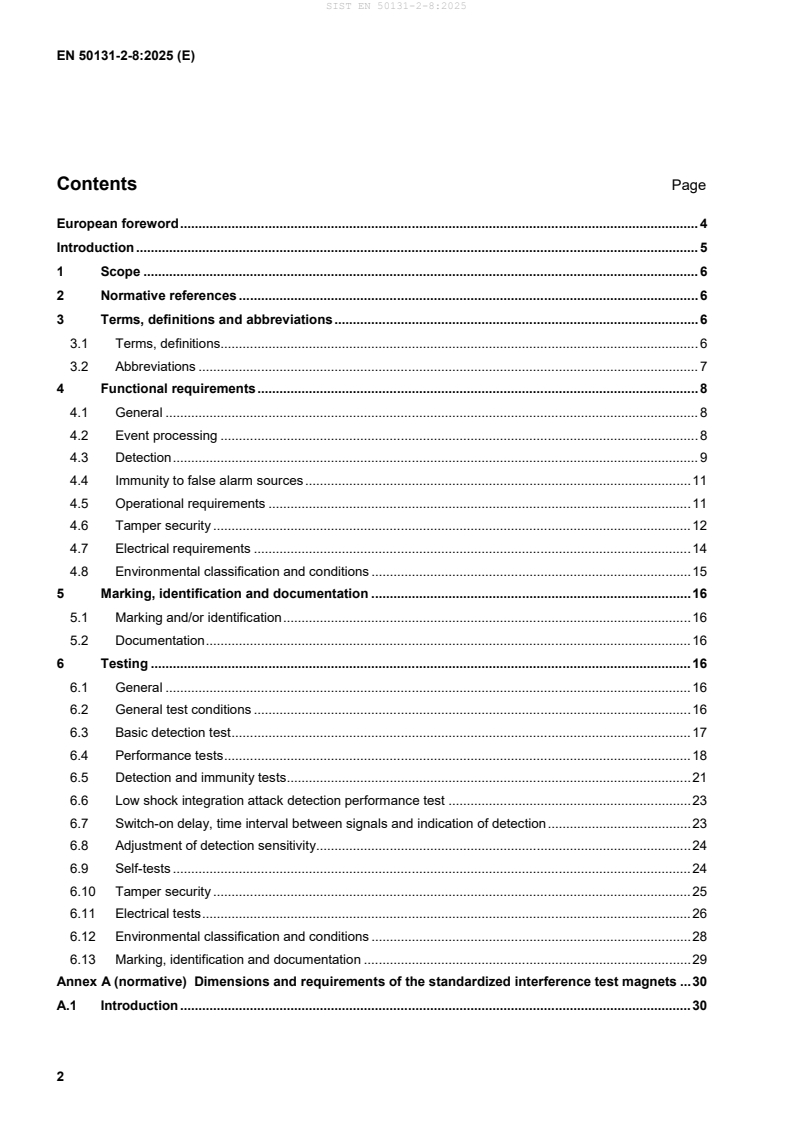
Contents Page
European foreword . 4
Introduction . 5
1 Scope . 6
2 Normative references . 6
3 Terms, definitions and abbreviations . 6
3.1 Terms, definitions. 6
3.2 Abbreviations . 7
4 Functional requirements . 8
4.1 General . 8
4.2 Event processing . 8
4.3 Detection . 9
4.4 Immunity to false alarm sources . 11
4.5 Operational requirements . 11
4.6 Tamper security . 12
4.7 Electrical requirements . 14
4.8 Environmental classification and conditions . 15
5 Marking, identification and documentation . 16
5.1 Marking and/or identification . 16
5.2 Documentation . 16
6 Testing . 16
6.1 General . 16
6.2 General test conditions . 16
6.3 Basic detection test . 17
6.4 Performance tests . 18
6.5 Detection and immunity tests . 21
6.6 Low shock integration attack detection performance test . 23
6.7 Switch-on delay, time interval between signals and indication of detection . 23
6.8 Adjustment of detection sensitivity . 24
6.9 Self-tests . 24
6.10 Tamper security . 25
6.11 Electrical tests . 26
6.12 Environmental classification and conditions . 28
6.13 Marking, identification and documentation . 29
Annex A (normative) Dimensions and requirements of the standardized interference test magnets . 30
A.1 Introduction . 30
A.2 Requirements . 30
Annex B (normative) General testing matrix . 33
Annex C (informative) Example list of small tools . 35
Annex D (normative) Mounting substrate . 36
Annex E (normative) Verification of detection performance and false alarm immunity . 37
Annex F (informative) Low shock integration attack test carousel . 39
Annex G (normative) Immunity to small objects hitting the mounting surface . 40
Bibliography . 42
European foreword
This document (EN 50131-2-8:2025) has been prepared by Technical Committee CLC/TC 79 “Alarm systems”.
The following dates are fixed:
• latest date by which this document has to be (dop) 2026–08–31
implemented at national level by publication of
an identical national standard or by
endorsement
• latest date by which the national standards (dow) 2028–08–31
conflicting with this document have to be
withdrawn
This document supersedes EN 50131-2-8:2016 and all of its amendments and corrigenda (if any).
— Reworked the document structure in general;
— Reworked the requirements and test sections in general;
— Redefined the detection performance requirements and test methods;
— Redefined the immunity requirements and test methods;
— Clarified wording wherever necessary to avoid misunderstanding and to optimize for reading.
Attention is drawn to the possibility that some of the elements of this document may be the subject of patent
rights. CENELEC shall not be held responsible for identifying any or all such patent rights.
Any feedback and questions on this document should be directed to the users’ national committee. A complete
listing of these bodies can be found on the CENELEC website.
Introduction
This document is a European Standard for shock detectors used as part of an Intrusion and Hold-up Alarm
System (I&HAS) installed in buildings. It includes four security grades and four environmental classes.
The purpose of a shock detector is to detect the shock or series of shocks due to a forcible attack through a
physical barrier (for example doors or windows).
The shock detector must provide the necessary range of signals or messages to be used by the rest of the
I&HAS.
The number and scope of these signals or messages will be more comprehensive for systems that are specified
at the higher grades.
This document is only concerned with the requirements and tests for the shock detectors. Other types of
detectors are covered by other documents identified as in the EN 50131-2 series.
1 Scope
This document is for shock detectors installed in buildings to detect the shock or series of shocks due to a
forcible attack through a physical barrier (for example doors or windows).
It specifies four security grades 1-4 (in accordance with EN 50131-1), specific or non-specific wired or wire-free
shock detectors and uses environmental Classes I-IV (in accordance with EN 50130-5).
This document does not include requirements for detectors intended to detect penetration attacks on safes and
vaults for example by drilling, cutting or thermal lance.
This document does not include requirements for shock detectors intended for use outdoors.
A shock detector needs to fulfil all the requirements of the specified grade.
Functions additional to the mandatory functions specified in this document can be included in the shock detector,
providing they do not adversely influence the correct operation of the mandatory functions.
This document does not deal with requirements for compliance with regulatory directives, such as EMC-
directive, low-voltage directive, etc., except that it specifies the equipment operating conditions for EMC-
susceptibility testing as required by EN 50130-4.
This document does not apply to system interconnections.
2 Normative references
The following documents are referred to in the text in such a way that some or all of their content constitutes
requirements of this document. For dated references, only the edition cited applies. For undated references, the
latest edition of the referenced document (including any amendments) applies.
EN 50130-4, Alarm systems - Part 4: Electromagnetic compatibility - Product family standard: Immunity
requirements for components of fire, intruder, hold up, CCTV, access control and social alarm systems
EN 50130-5, Alarm systems - Part 5: Environmental test methods
EN 50131-1, Alarm systems - Intrusion and hold-up systems - Part 1: System requirements
EN 50131-6, Alarm systems - Intrusion and hold-up systems - Part 6: Power supplies
EN 60404-5, Magnetic materials - Part 5: Permanent magnet (magnetically hard) materials - Methods of
measurement of magnetic properties (IEC 60404-5)
EN 60404-14, Magnetic materials - Part 14: Methods of measurement of the magnetic dipole moment of a
ferromagnetic material specimen by the withdrawal or rotation method (IEC 60404-14)
EN 60404-8-1, Magnetic materials - Part 8-1: Specifications for individual materials - Magnetically hard materials
(IEC 60404-8-1)
3 Terms, definitions and abbreviations
For the purposes of this document, the terms, definitions and abbreviations given in EN 50131-1 and the
following apply.
3.1 Terms, definitions
3.1.1
analyser
physical unit or processing capabilities used to process the signal(s) produced by one or more shock sensor(s)
and provides a signal or message to the I&HAS
3.1.2
gross attack
large single shock due to an impact on the supervised material
EXAMPLE impact generated by a sledge hammer on a concrete surface
3.1.3
low shock integration attack
series of low level shocks, due to a number of impacts on the supervised material integrating over a certain time
EXAMPLE impacts generated by chiselling on a concrete surface
3.1.4
masking
interference with the shock detector input capability, which prohibits the triggering of the shock detector
EXAMPLE disabling the shock detector with an external magnet
3.1.5
sealed shock detector
type of detector construction whereby there is no direct access to the internal components or connections
EXAMPLE a “potted” unit usually supplied with integral connecting cable
3.1.6
shock
sudden transient acceleration e.g. caused by a mechanical impact as a result of a forcible attack through a
physical barrier
3.1.7
shock detector
combination of one or more shock sensor(s) and an analyser which provides signalling or messaging to the
I&HAS
3.1.8
shock sensor
element which detects the mechanical energy caused by sudden transient acceleration and which produces a
signal for further analysis
3.1.9
shock test
operational test during which a shock detector is activated by using the standard triggering method in a controlled
environment
3.2 Abbreviations
CIE Control and Indicating Equipment
EMC Electro Magnetic Compatibility
I&HAS Intrusion and Hold-up Alarm System
4 Functional requirements
4.1 General
A shock detector consists of one or more shock sensor(s) and an analyser, which may either be in the same
housing, or in separate housings. Furthermore, the analyser can be integrated into another component of the
I&HAS (for example the CIE).
4.2 Event processing
Shock detectors shall process the events in accordance with Table 1.
Table 1 — Events to be processed by grade
Event Grade
1 2 3 4
Intrusion M M M M
Tamper detection Op M M M
Masking detection Op Op M M
c
Low supply voltage Op Op M M
a
Total loss of power supply Op M M M
b
Op Op M M
Local self-test
b
Op Op Op M
Remote self-test
M = Mandatory
Op = Optional
a
Total loss of power supply does not apply for message-based shock detectors.
b
Not required for non-processing shock detectors, e.g. purely mechanical.
c
For shock detectors using Type C power supplies the requirements of EN 50131-6 shall
apply.
Shock detectors shall generate signals or messages as shown Table 2.
Table 2 — Generation of signals or messages
Signals or messages
Event
Intrusion Tamper Fault
No event NP NP NP
Intrusion M NP NP
Tamper NP M NP
a
M Op M
Masking
Low supply voltage Op Op M
b
M Op Op
Total loss of power supply
a
NP NP NP
Local self-test pass
Local self-test fail NP NP M
a
M NP NP
Remote self-test pass
Remote self-test fail NP NP M
M = Mandatory
NP = Not Permitted
Op = Optional
This permits two methods of signalling a masking: either by the intrusion signal and fault signal, or by a
dedicated masking or message. Use of the intrusion signal and fault signal is preferable, as this requires
fewer connections between CIE and the shock detector. If multiple events overlap there will be some
signal combinations that may be ambiguous. To overcome this ambiguity, it is suggested that shock
detectors should not signal ‘intrusion’ and ‘fault’ at the same time except to indicate masking. This
implies that the shock detector should prioritize signals, e.g. 1 Intrusion, 2 Fault, 3 Masking.
When, in Table 1, an event may optionally generate signals or messages, they shall be as shown in this
table.
a
An independent signal or message may be provided instead.
b
Total loss of Power Supply does not apply for message-based shock detectors.
4.3 Detection
4.3.1 Detection performance
4.3.1.1 General
The shock detector shall be designed to distinguish between environmental shocks and shocks resulting from a
physical attack which may be intended to penetrate the structure. The shock detector may include means of
adjustment to suit different types of installation.
The operating parameters of the shock detector shall be verified as specified by the manufacturer.
The shock detector shall generate an intrusion alarm signal or message when a simulated structure penetration
is performed at all grades.
Table 3 — Detection performance
Detection performance Grade
1 2 3 4
Detection
Gross attack detection M M M M
Low shock integration attack detection Op Op Op M
Immunity
Immunity to small objects hitting the mounting surface M M M M
Standard immunity M M M M
Table 4 — Detection and immunity values
Test spheres
Peak acceleration
Requirement
Diameter
(g)
Mass (grams)
(mm)
Gross attack detection 111 30
(−0 %/+10 %
tolerance)
Low shock integration at-
14 15
(−0 %/+10 %
tack detection
tolerance)
Standard immunity 33 20
(−10 %/+0 %
tolerance)
10 – 18
Immunity to small objects
hitting the mounting sur- (0 % tolerance) 4 12
face
(with 60 % over 15g)
4.3.1.2 Gross attack detection
To ensure the shock detector can generate an alarm condition upon a single impact onto the mounting surface.
Example: attempting to break through a door by kicking or use of a hammer.
The shock detector shall generate an intrusion alarm signal or message within 10s when the value listed in
Table 4 is presented to the shock detector.
4.3.1.3 Low shock integration attack detection
To ensure the shock detector can generate an alarm condition upon multiple lower-level impacts onto the
mounting surface. Example: use of tools such as a chisel to remove material from a wall to create an opening.
The shock detector shall detect the low shock integration attack when the value listed in Table 4 is presented to
the shock detector 10 times with a gap of 2 s between each impact.
The shock detector shall generate an intrusion alarm signal or message within 28 s of the first impact.
4.3.2 Indication of detection
Shock detectors at grades 3 and 4 that include processing capabilities shall provide an indicator at the shock
detector to indicate when an intrusion alarm signal or message has been generated.
At grades 3 and 4 this indicator shall be capable of being enabled and disabled remotely at access level 2.
Shock detectors which are solely powered by the energy resulting from the impact or a series of impacts do not
require an indicator.
4.3.3 Adjustment of detection sensitivity
If the shock detector includes means to adjust the detection sensitivity, this may be performed remotely and/or
locally.
The adjustment may be performed remotely, provided it is only available at access level 3. e.g. via the CIE or
message based system.
The adjustment may be performed locally either by;
— means that are enclosed within the shock detector housing. e.g. pots, jumpers or links
or
— a method that does not involve opening the shock detector housing, provided that a tamper signal or
message is generated before the adjustment is completed, e.g. NFC token.
Where the adjustment is performed locally it shall not be possible to gain such access without generating a
tamper signal or message or causing visible damage.
4.4 Immunity to false alarm sources
4.4.1 General
When the shock detector is configured to meet the detection requirements it shall also have sufficient immunity
to false alarm sources without any further adjustment to the settings of the shock detector.
4.4.2 Immunity to small objects hitting the mounting surface
To reduce the probability of the shock detector generating a false alarm condition upon multiple small impacts
onto the mounting surface. Example: hail stones, sand, gravel, or debris blown by the wind.
The shock detector shall not detect the small objects hitting the mounting surface when the value listed in Table 4
is presented to the shock detector at a rate of (2 100 ± 10 %) impacts over 2,5 min.
4.4.3 Standard immunity
To ensure the shock detector does not generate a false alarm condition upon a single impact onto the mounting
surface, for example, normal opening or closing of a door or when a system is set or a letterbox is opened/closed
through the delivery of letters. The detector shall not generate an intrusion alarm signal or message when the
values of Table 4 are presented.
4.5 Operational requirements
4.5.1 Time interval between intrusion signals or messages
Shock detectors using wired interconnections shall be able to provide an intrusion alarm signal or message not
more than 15 s after the end of the preceding intrusion alarm signal or message.
Shock detectors using wire free interconnections shall be able to provide an intrusion alarm signal or message
after the end of the preceding intrusion alarm signal or message within the following times:
— Grade 1 300 s
— Grade 2 180 s
— Grade 3 30 s
— Grade 4 15 s
4.5.2 Switch on delay
The shock detector shall meet all functional requirements within 180 s of the power supply reaching its nominal
voltage as specified by the manufacturer.
4.5.3 Self-tests
4.5.3.1 Local self-test
According to Table 1, the shock detector shall provide the ability to perform a local self-test which is intended to
provide confidence that the shock detector is able to meet its basic performance requirements e.g. able to detect.
The results of the local self-test shall be notified according to Table 2. If a fault condition is detected on the
detection technology when a self-test is performed, the self-test shall be processed as a failed test.
The local self-test may be part of a continuous monitoring process or shall be performed as a specific function
at least once every 24 h.
If normal operation of the shock detector is inhibited during a local self-test, the time for which the shock detector
is inhibited shall be limited to a maximum of 30 s in any period of 2 h.
The following information shall be provided to the test house:
1. How to create a fault condition on the detection technology e.g. short the sensor signal output to ground
2. If the local self-test inhibits the shock detector, evidence that the inhibition is within the timing requirements.
4.5.3.2 Remote self-test
According to Table 1, the shock detector shall provide the ability to perform a remote self-test which is intended
to provide confidence that the shock detector is able to meet its basic performance requirements e.g. able to
detect.
When the shock detector receives a signal or message to perform a remote self-test, the shock detector shall
start the remote self-test within 10 s.
The shock detector shall complete a remote self-test within 30 s and return to normal operation.
The results of the remote self-test shall be notified according to Table 2.
Should an intrusion condition be detected when the remote self-test is being performed, the shock detector shall
not notify an intrusion alarm signal or message.
If an independent signal or message is used to notify a remote self-test pass, then it is permitted to notify an
intrusion alarm signal or message during the remote self-test.
If a fault condition is detected on the detection technology when a remote self-test is performed, the remote self-
test shall be processed as a failed test.
The following information shall be provided to the test house:
1. How to create a fault condition on the detection technology e.g. short the sensor signal output to ground.
2. How long the self-test takes to initiate and complete.
4.6 Tamper security
4.6.1 General
The tamper security requirements for each grade of shock detector are shown in Table 5. The requirements
apply to the shock detector and its individual components (e.g. multiple sensors).
Table 5 —Tamper security requirements
Requirement Grade 1 Grade 2 Grade 3 Grade 4
Resistance to unauthorised access to the
Required Required Required Required
inside of the shock detector
Detection of unauthorised access to the
Not Required Required Required Required
a
inside of the shock detector
Detection of removal from the mounting
Not Required Not Required Required Required
b
surface - wired shock detector
Detection of removal from the mounting
Not Required Required Required Required
surface - wirefree shock detector
Magnetic field immunity Not Required Required Required Required
Magnet Type defined in Annex A NA Type 1 Type 2 Type 2
Detection of, or immunity to magnetic Not Required Not Required Required Required
masking
NA NA Type 2 Type 2
Magnet Type defined in Annex A
Not
Detection of penetration of housing Not Required Not Required Required
Required
a
Not required for sealed shock detectors
b
Not required for sealed shock detectors that are flush mounted at grade 3
4.6.2 Resistance to and detection of unauthorised access to components and means of adjustment
All components and access to mounting screws shall be within the detector housing.
If the means of adjustment, which, when interfered with could affect the operation of the shock detector, the
means shall be within the detector housing.
Access within the detector housing shall require the use of an appropriate tool and depending on the grade as
specified in Table 5, shall generate a tamper signal or message before access can be gained.
It shall not be possible to gain such access without generating a tamper signal or message or causing visible
damage.
If the means of adjustment can be operated without the need to open the detector housing (e.g. via NFC
application), then level 3 access shall be required to make the adjustments.
Appropriate tools are provided in Annex C.
For flush mounted shock detectors, it is permitted that the mounting screws are not located within the housing.
Detection of unauthorised access to the inside of the shock detector is not required for sealed shock detectors.
4.6.3 Detection of removal from the mounting surface
A tamper signal or message shall be generated if the detector is removed from its mounting surface in
accordance with Table 5. The tamper detection mechanism shall not be defeated by the use of small tools as
per the examples in Annex C.
It should not be possible to defeat the removal from mounting detection by sliding a strip of steel 100 mm to
200 mm long by 10 mm to 20 mm wide, and 1 mm thick between the mounting surface and the shock detector.
4.6.4 Magnetic field immunity
It shall not be possible to inhibit any signal or message with a magnet of grade dependence according to Table 5,
e.g. by holding a relay switch closed by the use of a magnetic field. The magnet types shall be as described in
Annex A.
4.6.5 Detection of, or immunity to magnetic masking
In accordance with Table 5, means shall be provided to detect if the operation of the shock sensor is inhibited
when either pole of a magnet are placed on each surface of the shock detector housing, such that the detector
is no longer able to detect gross attacks. The magnet types shall be as described in Annex A.
If the operation of the shock sensor is inhibited, a masking signal or message shall be generated within 180 s.
If a shock detector continues to operate within its normal boundaries after the application of a masking condition,
then it is not required to generate a masking signal or message.
Masking shall be signalled according to the requirements of Table 2.
The masking signal or message shall restore within 180 s of the removal of the masking condition.
For shock detectors where detection of masking may be remotely disabled, the detection of masking shall
operate when the I&HAS is unset; it is not required to operate when the I&HAS is set.
4.6.6 Detection of penetration of housing
In accordance with Table 5, the shock detector shall detect an attempt to gain unauthorized access to the internal
components of the shock detector by creating an opening in the detector housing that is accessible when
mounted, (e.g. by drilling a hole).
If the shock detector is located in multiple housings, this requirement applies to each housing.
A tamper signal or message shall be generated within 10s if the housing is penetrated with an opening of at
least 1mm diameter.
4.7 Electrical requirements
4.7.1 General
The grade dependencies appear in Table 6. The following requirements do not apply to shock detectors having
Type C power supplies, for these shock detectors refer to EN 50131-6.
Table 6 — Electrical requirements
Test Grade 1 Grade 2 Grade 3 Grade 4
Shock detector current
Required Required Required Required
consumption
Input voltage range Required Required Required Required
Slow input voltage rise Not required Required Required Required
Input voltage ripple Not required Required Required Required
Input voltage step change Not required Required Required Required
Total loss of power supply Not required Required Required Required
4.7.2 Shock detector current consumption
When operating at the nominal input voltage, the quiescent and maximum current consumption of the shock
detector shall not exceed the figures claimed by the manufacturer.
4.7.3 Slow input voltage change and voltage range limits
The shock detector shall meet all functional requirements when the input voltage lies between ± 25 % of the
nominal value, or between the manufacturer’s stated values if greater.
When the supply voltage is lowered at a rate of 0,1 Vs-1 in steps not greater than 10 mV, the shock detector
shall function normally at the specified range limits.
When the low supply voltage is detected, the shock detector shall generate signals or messages according to
the requirements of Table 2, prior to the situation where the detector is unable to function correctly due to the
low supply voltage.
4.7.4 Input voltage ripple
The shock detector shall meet all functional requirements during the modulation of the input voltage by a peak
to peak voltage of 10 % of the nominal values, at a frequency of 100 Hz.
4.7.5 Input voltage step change
When the supply voltage is changed from nominal to nominal +25 % in 1ms and nominal to nominal −25 % in
1ms, the shock detector shall continue to function normally.
If the manufacturer claims a supply voltage range greater than nominal +25 % and nominal −25 %, the
manufacturer’s stated values will be applied.
No signals or messages shall be generated by a step in the input voltage, as described above.
4.7.6 Total loss of power supply
When there is total loss of power supply to the shock detector it shall generate signals or messages according
to the requirements of Table 2.
For message based systems, total loss of power supply may be determined by loss of communication with the
shock detector.
4.8 Environmental classification and conditions
4.8.1 Environmental classification
The environmental classifications are described in EN 50131-1. Which classification is applicable to the shock
detector shall be stated.
4.8.2 Immunity to environmental conditions
A shock detector shall meet the requirements of the environmental tests described in Tables 9 and 10 for the
classification declared by the manufacturer. These tests shall be performed in accordance with EN 50130-5 and
the EMC tests in accordance with EN 50130-4.
Unless specified otherwise for operational tests, the shock detector shall not generate unintentional signals or
messages when subjected to the specified range of environmental conditions.
Impact tests shall not be carried out on delicate shock detector components such as LEDs, optical windows or
lenses.
For endurance tests, the shock detector, shall continue to meet the requirements of this specification after being
subjected to the specified range of environmental conditions.
5 Marking, identification and documentation
5.1 Marking and/or identification
Marking and/or identification shall be applied to the product in accordance with the requirements of EN 50131-
1.
5.2 Documentation
The product shall be accompanied with clear and concise documentation in accordance with EN 50131-1, the
documentation shall additionally state:
a) a list of all options, functions, inputs, signals or messages, indications and their relevant characteristics;
b) the manufacturer’s diagram of the shock detector and its claimed typical detection areas for the minimum
and maximum sensitivity levels based on the material of the supervised structure;
c) the recommended mounting position, and the effect of changes to it on the claimed typical detection area;
d) the effect of adjustable controls on the shock detector performance or on the claimed typical detection area
and sensitivity levels including at least the minimum and maximum settings;
e) any disallowed field adjustable control settings or combinations of these;
f) any specific settings needed to meet the requirements of this specification at the claimed grade;
g) where sensitivity adjustments are provided, these shall be labelled as to their function;
h) the manufacturer’s quoted maximum, minimum and nominal operating voltage, and the maximum current
and quiescent current consumptions at those voltages.
6 Testing
6.1 General
The tests are intended to be primarily concerned with verifying the correct operation of the shock detector to the
specification provided by the manufacturer. All the test parameters specified carry a general tolerance of ± 10 %
unless otherwise stated. Tests shall be carried out as they appear in the general test matrix in Annex B.
6.2 General test conditions
6.2.1 Standard conditions for testing
The general atmospheric conditions in test and measurement laboratories shall be those as specified below,
unless stated otherwise.
— Temperature 15 °C to 35 °C
— Relative humidity 25 % RH to 75 % RH
— Air pressure 86 kPa to 106 kPa (860 mbar to 1 060 mbar)
All values are “inclusive values”.
6.2.2 General detection testing environment and procedures
6.2.2.1 General
The manufacturer’s documented instructions regarding operation shall be read and applied to all tests.
The shock detectors sensor elements shall be mounted according to the manufacturer’s description.
6.2.2.2 Test procedures
The tests of gross attack, low shock integration, standard immunity, Immunity to small objects hitting the
mounting surface and basic detection test shall be performed according to the test setup described in Annex E.
All other tests do not require a specific test setup, unless otherwise requested in the individual test section.
The shock detector shall be connected to the nominal supply voltage and connected to the monitoring system
that is appropriate to the test. The shock detector shall be allowed to stabilize for 180 s. The intrusion alarm
signal or message output shall be monitored. If multiple sensitivity modes are available, any non-compliant
modes shall be identified by the manufacturer. All compliant modes shall be tested.
6.2.2.3 Reference sensitivity level
It is permitted to adjust the sensitivity level to ensure that each shock detector sample will pass the detection
performance and immunity tests, if applicable. The sensitivity level of the detectors shall be recorded and defined
as reference sensitivity level. All subsequent tests shall be performed at the reference sensitivity level without
any further adjustments, unless stated differently in a certain test section.
6.2.2.4 Test sequence
The tests shall be performed in the following order, if applicable:
1. Pre-test calibration (6.4.2);
2. Standard immunity Test (6.5.3);
3. Gross attack detection performance test (6.5.2);
4. Low shock integration attack detection performance test (6.6);
5. Immunity to small objects hitting the mounting surface (6.5.4).
It is permitted to reorder the sequence of tests 2 and 3.
Any other test may be performed after those tests are performed in this order.
If during the series of detection performance tests, it is necessary to re-adjust sensitivity, the entire test series
shall be repeated to confirm compliance at the new sensitivity setting.
6.3 Basic detection test
6.3.1 General
The purpose of the basic detection test is to verify that a shock detector is still operational after exposure to the
environment conditioning or other test criteria.
6.3.2 Basic detection test method
The shock detector shall generate an intrusion alarm signal or message when the shock detector is mounted
according to the manufacturer’s instructions on the mounting substrate as specified in Annex D and set to its
reference sensitivity level while the following procedure is carried out.
Apply an impact to the mounting substrate using the parameters determined during the gross attack test (i.e.
release point and peak acceleration level).
The output of the shock detector shall be monitored for an intrusion alarm signal or message.
Pass / fail criteria:
The shock detector(s) shall produce an intrusion alarm signal or message when an impact is applied to the
mounting substrate.
6.4 Performance tests
6.4.1 General
The detection performance tests are conducted in conjunction with the immunity to false alarm sources tests of
6.5.3 and 6.5.4 in order to demonstrate that the detector has sufficient range of adjustment to ensure adequate
detection performance whilst providing immunity against sources of unwanted alarms when installed in the
service environment.
Mounting and configuration of the detector shall be in accordance with the manufacturer’s instructions and the
corresponding procedures of the following tests (Annex E, Figure E.2).
The physical shocks are created by rolling spheres of a predefined material, size and weight along an inclined
channel such that the spheres impact the substrate upon which the shock detector is mounted.
The magnitude of the physical shocks is varied by the choice of sphere size and weight (mass) and the position
along the inclined channel from where the sphere is released relative to the point of impact on the substrate
(acceleration).
Prior to the performance tests, the sensitivity of the detector shall be adjusted according to the manufacturer’s
instructions to determine the reference sensitivity level (6.2.2.3). The individual adjustment settings shall be
noted, as those levels used for the immunity tests carried out later.
If during the series of detection performance tests, it is necessary to re-adjust sensitivity, the entire test series
shall be repeated to confirm compliance at the new sensitivity setting.
The values defined in the following tests represent the minimum performance to be achieved by all shock
detectors, if further settings are allowed to achieve higher sensitivity, these shall be documented by the
manufacturer and duly tested. Immunity tests shall be carried out according to the standard immunity tests
defined in 6.5.3 and 6.5.4 when the shock detector is set and tested for each higher sensitivity level.
The general test conditions of 6.2 shall apply to all tests in this series.
6.4.2 Pre-test calibration
Before each performance test is conducted, the position along the inclined channel from where the sphere is
released relative to the point of impact on the mounting substrate must be determined.
Gross attack test
To determine the values used to validate the applied gross attack test levels the following steps shall be followed:
— Step 1. Mount an accelerometer on the mounting substrate at location (E) according to Annex E, Figure E.1.
This shall be the Validation accelerometer.
— Step 2. Temporarily mount (no permanent fixtures or fittings to be used) an accelerometer on the mounting
substrate at location (D) according to Annex E, Figure E.1. This shall be the Reference accelerometer.
Accelerometer manufacturer’s mounting recommendations shall be followed.
— Step 3. Monitor and record the outputs of the accelerometers to measure the peak acceleration levels of
the physical shock created.
— Step 4. Select the size and weight (mass) of the sphere as required by the gross attack test.
— Step 5. Vary the position from where the sphere is released along the inclined V-channel relative to the
point of impact on the mounting substrate (H) E.1, until a peak acceleration of 77 g ± 5 % is measured on
the reference accelerometer. Record the location of the release point.
NOTE To ensure the peak acceleration presented to the detector under test cannot be below the required value of 70 g
a margin of +10 % has been applied. For measuring purposes, a tolerance of 5 % is applied.
— Step 6. Repeat the measurement 10 times. If a
...