


oSIST prEN IEC 62688:2025
(Main)Concentrator photovoltaic (CPV) modules and assemblies - Safety qualification
Konzentrator-Photovoltaik (CPV-)Module und -Anordnungen - Sicherheitsqualifikation
Modules et ensembles photovoltaïques à concentration (CPV) - Qualification pour la sûreté de fonctionnement
Koncentratorski fotonapetostni (CPV) moduli in sestavi - Opredelitev varnosti
General Information
- Status
- Not Published
- Public Enquiry End Date
- 08-Dec-2025
- Technical Committee
- PVS - Solar photovoltaic energy systems
- Current Stage
- 4020 - Public enquire (PE) (Adopted Project)
- Start Date
- 19-Sep-2025
- Due Date
- 06-Feb-2026
- Completion Date
- 05-Dec-2025

Relations
- Revises
SIST EN IEC 62688:2018 - Concentrator photovoltaic (CPV) module and assembly safety qualification - Effective Date
- 09-Nov-2021
Overview
oSIST prEN IEC 62688:2025 sets forth the safety qualification requirements for concentrator photovoltaic (CPV) modules and assemblies. Developed by the International Electrotechnical Commission (IEC) and adopted by SIST, this standard establishes essential construction and testing requirements to ensure the safe electrical and mechanical operation of CPV modules over their expected service life. The document aims to assess and minimize risks such as electric shock, fire hazards, and personal injury from mechanical or environmental stresses.
This standard supports manufacturers, system integrators, and end users in deploying reliable CPV technology by aligning with internationally recognized safety criteria, contributing to consistent quality and market confidence in solar energy solutions.
Key Topics
Definitions and Concepts: The standard provides harmonized terms and definitions relevant to CPV modules, including components such as concentrator cells, optics, receivers, and assemblies, as well as key safety concepts like insulation types and installation environments.
Classification: CPV modules are classified based on intended application, location of installation, and protection levels, ensuring that safety requirements match real-world usage.
Design and Construction: Key requirements address materials selection, electrical insulation, mechanical strength, marking, and documentation. Ensuring correct design and construction is crucial for the long-term safety of CPV modules.
Testing Requirements: oSIST prEN IEC 62688:2025 details various mandatory tests to qualify modules, including visual inspection, electrical and mechanical tests, insulation assessment, weather durability, and fire resistance. These tests are structured to detect and mitigate potential failure modes under operational and environmental stresses.
Scope Limitations: The document applies to CPV modules and assemblies designed for maximum DC system voltages up to 1,500 V, excluding systems with integrated power components or floating PV applications, which are covered by other standards.
Applications
oSIST prEN IEC 62688:2025 is integral in several practical scenarios:
- CPV Manufacturers: Guide for designing, constructing, and qualifying modules and assemblies to ensure they meet global safety benchmarks, facilitating market access and reducing liability.
- Testing Laboratories: Basis for safety assessment procedures and certification schemes for CPV products.
- Solar Project Developers and Installers: Reference for evaluating product safety, ensuring that deployed CPV modules comply with regulatory and technical safety standards.
- Regulators and Inspectors: Use for compliance checks in line with national, regional, or international codes governing solar energy system safety.
By providing consistent criteria for safety testing and qualification, the standard helps minimize risks associated with the operation of high-concentration solar technologies, promoting renewable energy adoption and investment.
Related Standards
For comprehensive conformity and integrative safety, the following standards are closely related:
- IEC 62108: Concentrator photovoltaic (CPV) modules and assemblies – Design qualification and type approval.
- IEC 61730-1 and IEC 61730-2: Photovoltaic (PV) module safety qualification – Part 1: Requirements for construction; Part 2: Requirements for testing.
- IEC 62109-3: Safety of power converters for use in photovoltaic power systems – Part 3: Particular requirements for electronic devices in CPV systems.
- IEC TS 62915: Guidance for revising safety qualifications after material or design changes.
- IEC 61215-2: Specific testing protocols for module quality assurance.
Practical Value
Employing the guidance and requirements of oSIST prEN IEC 62688:2025 enhances the safety and reliability of CPV solar installations. By rigorously qualifying modules and assemblies, stakeholders reduce operational risks, extend equipment lifespans, and strengthen public and regulatory trust in advanced solar technologies. Adherence to this standard is a critical step toward harmonized international acceptance of CPV energy solutions.
Get Certified
Connect with accredited certification bodies for this standard

DNV
DNV is an independent assurance and risk management provider.

Lloyd's Register
Lloyd's Register is a global professional services organisation specialising in engineering and technology.
DNV Energy Systems
Energy and renewable energy certification.
Sponsored listings
Frequently Asked Questions
oSIST prEN IEC 62688:2025 is a draft published by the Slovenian Institute for Standardization (SIST). Its full title is "Concentrator photovoltaic (CPV) modules and assemblies - Safety qualification". This standard covers: Concentrator photovoltaic (CPV) modules and assemblies - Safety qualification
Concentrator photovoltaic (CPV) modules and assemblies - Safety qualification
oSIST prEN IEC 62688:2025 is classified under the following ICS (International Classification for Standards) categories: 27.160 - Solar energy engineering. The ICS classification helps identify the subject area and facilitates finding related standards.
oSIST prEN IEC 62688:2025 has the following relationships with other standards: It is inter standard links to SIST EN IEC 62688:2018. Understanding these relationships helps ensure you are using the most current and applicable version of the standard.
oSIST prEN IEC 62688:2025 is available in PDF format for immediate download after purchase. The document can be added to your cart and obtained through the secure checkout process. Digital delivery ensures instant access to the complete standard document.
Standards Content (Sample)
SLOVENSKI STANDARD
01-december-2025
Koncentratorski fotonapetostni (CPV) moduli in sestavi - Opredelitev varnosti
Concentrator photovoltaic (CPV) modules and assemblies - Safety qualification
Konzentrator-Photovoltaik (CPV-)Module und -Anordnungen - Sicherheitsqualifikation
Modules et ensembles photovoltaïques à concentration (CPV) - Qualification pour la
sûreté de fonctionnement
Ta slovenski standard je istoveten z: prEN IEC 62688:2025
ICS:
27.160 Sončna energija Solar energy engineering
2003-01.Slovenski inštitut za standardizacijo. Razmnoževanje celote ali delov tega standarda ni dovoljeno.
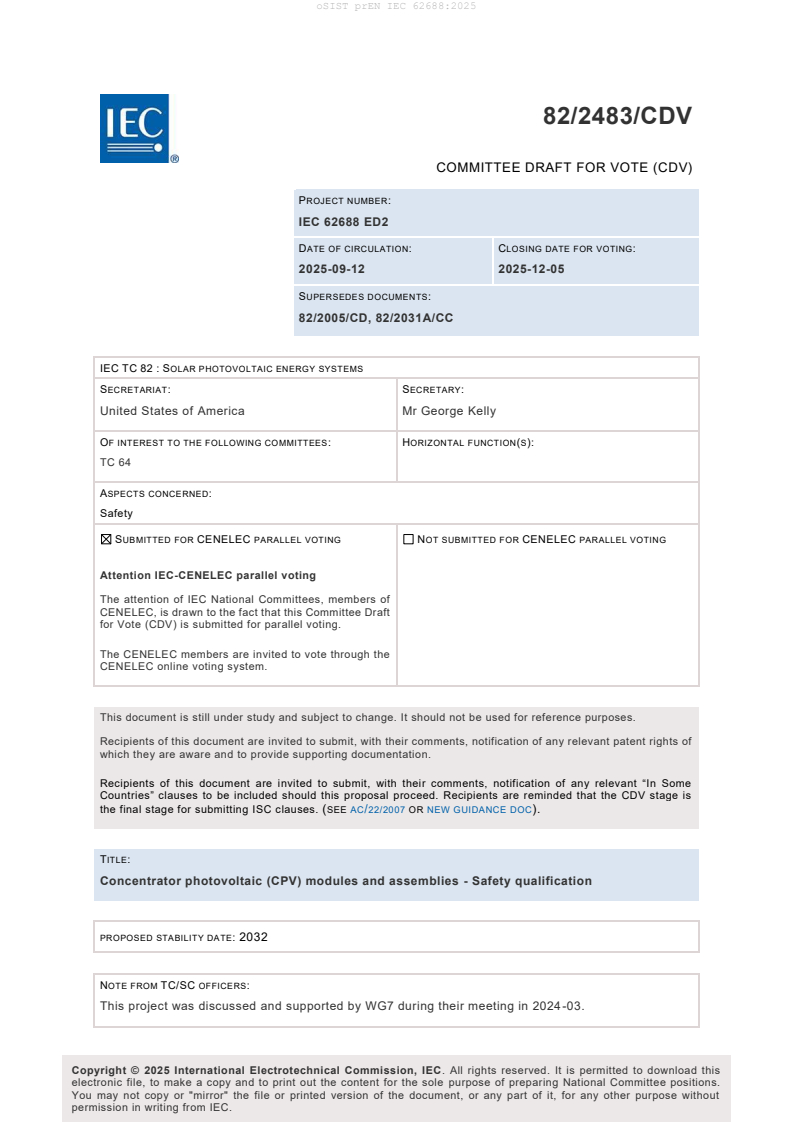
82/2483/CDV
COMMITTEE DRAFT FOR VOTE (CDV)
PROJECT NUMBER:
IEC 62688 ED2
DATE OF CIRCULATION: CLOSING DATE FOR VOTING:
2025-09-12 2025-12-05
SUPERSEDES DOCUMENTS:
82/2005/CD, 82/2031A/CC
IEC TC 82 : SOLAR PHOTOVOLTAIC ENERGY SYSTEMS
SECRETARIAT: SECRETARY:
United States of America Mr George Kelly
OF INTEREST TO THE FOLLOWING COMMITTEES: HORIZONTAL FUNCTION(S):
TC 64
ASPECTS CONCERNED:
Safety
SUBMITTED FOR CENELEC PARALLEL VOTING NOT SUBMITTED FOR CENELEC PARALLEL VOTING
Attention IEC-CENELEC parallel voting
The attention of IEC National Committees, members of
CENELEC, is drawn to the fact that this Committee Draft
for Vote (CDV) is submitted for parallel voting.
The CENELEC members are invited to vote through the
CENELEC online voting system.
This document is still under study and subject to change. It should not be used for reference purposes.
Recipients of this document are invited to submit, with their comments, notification of any relevant patent rights of
which they are aware and to provide supporting documentation.
Recipients of this document are invited to submit, with their comments, notification of any relevant “In Some
Countries” clauses to be included should this proposal proceed. Recipients are reminded that the CDV stage is
the final stage for submitting ISC clauses. (SEE AC/22/2007 OR NEW GUIDANCE DOC).
TITLE:
Concentrator photovoltaic (CPV) modules and assemblies - Safety qualification
PROPOSED STABILITY DATE: 2032
NOTE FROM TC/SC OFFICERS:
This project was discussed and supported by WG7 during their meeting in 2024-03.
electronic file, to make a copy and to print out the content for the sole purpose of preparing National Committee positions.
You may not copy or "mirror" the file or printed version of the document, or any part of it, for any other purpose without
permission in writing from IEC.
IEC CDV 62688 © IEC 2025
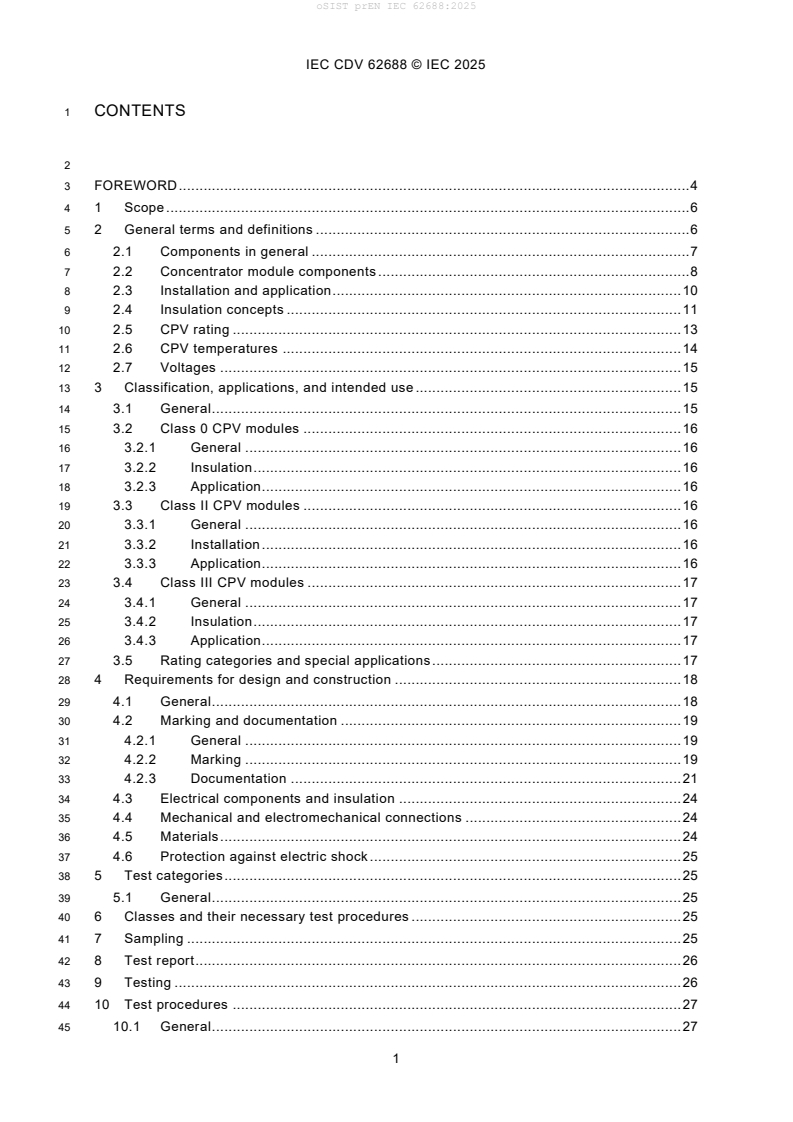
1 CONTENTS
3 FOREWORD . 4
4 1 Scope . 6
5 2 General terms and definitions . 6
6 2.1 Components in general . 7
7 2.2 Concentrator module components . 8
8 2.3 Installation and application . 10
9 2.4 Insulation concepts . 11
10 2.5 CPV rating . 13
11 2.6 CPV temperatures . 14
12 2.7 Voltages . 15
13 3 Classification, applications, and intended use . 15
14 3.1 General . 15
15 3.2 Class 0 CPV modules . 16
16 3.2.1 General . 16
17 3.2.2 Insulation . 16
18 3.2.3 Application . 16
19 3.3 Class II CPV modules . 16
20 3.3.1 General . 16
21 3.3.2 Installation . 16
22 3.3.3 Application . 16
23 3.4 Class III CPV modules . 17
24 3.4.1 General . 17
25 3.4.2 Insulation . 17
26 3.4.3 Application . 17
27 3.5 Rating categories and special applications . 17
28 4 Requirements for design and construction . 18
29 4.1 General . 18
30 4.2 Marking and documentation . 19
31 4.2.1 General . 19
32 4.2.2 Marking . 19
33 4.2.3 Documentation . 21
34 4.3 Electrical components and insulation . 24
35 4.4 Mechanical and electromechanical connections . 24
36 4.5 Materials . 24
37 4.6 Protection against electric shock . 25
38 5 Test categories . 25
39 5.1 General . 25
40 6 Classes and their necessary test procedures . 25
41 7 Sampling . 25
42 8 Test report . 26
43 9 Testing . 26
44 10 Test procedures . 27
45 10.1 General . 27
IEC CDV 62688 © IEC 2025
46 10.2 Visual inspection – MST 01 . 27
47 10.2.1 Purpose . 27
48 10.2.2 Procedure . 27
49 10.2.3 Pass criteria . 27
50 10.3 Performance at STC – MST 02 . 28
51 10.3.1 Purpose . 28
52 10.3.2 Procedure . 28
53 10.3.3 Pass criteria . 28
54 10.4 Maximum power determination – MST 03 . 28
55 10.4.1 Purpose . 28
56 10.4.2 Procedure . 28
57 10.4.3 Pass criteria . 28
58 10.5 Durability of markings – MST 05 . 28
59 10.6 Sharp edge test – MST 06 . 29
60 10.6.1 Purpose . 29
61 10.6.2 Procedure and pass criteria . 29
62 10.7 Bypass diode functionality test – MST 07 . 29
63 10.8 Accessibility test – MST 11 . 29
64 10.8.1 Purpose . 29
65 10.8.2 Procedure and pass criteria . 29
66 10.9 Cut susceptibility test – MST 12 . 29
67 10.9.1 Purpose . 29
68 10.9.2 Procedure and pass criteria . 29
69 10.10 Continuity test of equipotential bonding – MST 13 . 29
70 10.10.1 Purpose . 29
71 10.10.2 Procedure and pass criteria . 29
72 10.11 Impulse voltage test – MST 14 . 30
73 10.11.1 Purpose . 30
74 10.11.2 Procedure and pass criteria . 30
75 10.12 Insulation test – MST 16 . 30
76 10.13 Wet leakage current test – MST 17 . 30
77 10.13.1 Purpose . 30
78 10.13.2 Procedure . 30
79 10.13.3 Pass criteria . 31
80 10.14 Hot-spot endurance test – MST 22 . 31
81 10.15 Fire test – MST 23 and ignitability test – MST 24 . 31
82 10.16 Bypass diode thermal test – MST 25 . 31
83 10.17 Reverse-current overload test – MST 26 . 31
84 10.17.1 Purpose . 31
85 10.17.2 Procedure and pass criteria . 31
86 10.18 Module breakage test – MST 32 . 31
87 10.18.1 Purpose . 31
88 10.18.2 Procedure and pass criteria . 31
89 10.19 Screw connections test – MST 33 . 31
90 10.20 Static mechanical load test – MST 34 . 32
91 10.21 Robustness of terminations test – MST 42 . 32
92 10.22 Thermal cycling test – MST 51 . 32
93 10.23 Humidity-freeze test – MST 52 . 32
94 10.24 Damp heat test – MST 53 . 32
IEC CDV 62688 © IEC 2025
95 10.25 Cold conditioning test – MST 55 . 32
96 10.25.1 Purpose . 32
97 10.25.2 Procedure and pass criteria . 32
98 10.26 Dry-heat conditioning test – MST 56 . 32
99 10.26.1 Purpose . 32
100 10.26.2 Procedure and pass criteria . 32
101 10.27 Evaluation of insulation coordination – MST 57 . 32
102 10.27.1 Purpose . 32
103 10.27.2 Procedure and pass criteria . 33
104 10.28 Outdoor exposure (CPV-specific test) . 33
105 10.28.1 General . 33
106 10.28.2 Purpose . 33
107 10.28.3 Procedure . 33
108 10.28.4 Pass criteria . 33
109 10.29 Dust and water ingress protection test (CPV-specific test) . 33
110 10.29.1 Purpose . 33
111 10.29.2 Procedure . 33
112 10.29.3 Pass criteria . 34
113 10.30 Hail-impact test (CPV-specific test) . 34
114 10.30.1 Purpose . 34
115 10.30.2 Apparatus . 34
116 10.30.3 Procedure . 34
117 10.30.4 Pass criteria . 35
118 10.31 Off-axis beam damage (CPV-specific test) . 35
119 10.31.1 General . 35
120 10.31.2 Purpose . 35
121 10.31.3 Special case . 35
122 10.31.4 Procedure . 35
123 10.31.5 Requirements . 36
124 10.32 CPV temperature test (CPV-specific test). 36
125 10.32.1 Purpose . 36
126 10.32.2 Test apparatus . 36
127 10.32.3 Procedure . 36
128 10.32.4 Requirements . 37
129 10.33 Blocked heat sink test . 37
130 10.33.1 Purpose . 37
131 10.33.2 Procedure . 38
132 10.33.3 Pass criteria . 38
133 10.34 Locked-rotor test (CPV-specific test) . 38
134 10.34.1 Purpose . 38
135 10.34.2 Procedure . 38
136 10.34.3 Requirement . 39
138 Table 1 – Terms related to CPV . 10
139 Table 2 – Classes for protection against electric shock . 15
IEC CDV 62688 © IEC 2025
142 INTERNATIONAL ELECTROTECHNICAL COMMISSION
143 ____________
145 CONCENTRATOR PHOTOVOLTAIC (CPV)
146 MODULE AND ASSEMBLY SAFETY QUALIFICATION
149 FOREWORD
150 1) The International Electrotechnical Commission (IEC) is a worldwide organization for standardization comprising
151 all national electrotechnical committees (IEC National Committees). The object of IEC is to promote international
152 co-operation on all questions concerning standardization in the electrical and electronic fields. To this end and
153 in addition to other activities, IEC publishes International Standards, Technical Specifications, Technical Reports,
154 Publicly Available Specifications (PAS) and Guides (hereafter referred to as "IEC Publication(s)"). Their
155 preparation is entrusted to technical committees; any IEC National Committee interested in the subject dealt with
156 may participate in this preparatory work. International, governmental and non-governmental organizations liaising
157 with the IEC also participate in this preparation. IEC collaborates closely with the International Organization for
158 Standardization (ISO) in accordance with conditions determined by agreement between the two organizations.
159 2) The formal decisions or agreements of IEC on technical matters express, as nearly as possible, an international
160 consensus of opinion on the relevant subjects since each technical committee has representation from all
161 interested IEC National Committees.
162 3) IEC Publications have the form of recommendations for international use and are accepted by IEC National
163 Committees in that sense. While all reasonable efforts are made to ensure that the technical content of IEC
164 Publications is accurate, IEC cannot be held responsible for the way in which they are used or for any
165 misinterpretation by any end user.
166 4) In order to promote international uniformity, IEC National Committees undertake to apply IEC Publications
167 transparently to the maximum extent possible in their national and regional publications. Any divergence between
168 any IEC Publication and the corresponding national or regional publication shall be clearly indicated in the latter.
169 5) IEC itself does not provide any attestation of conformity. Independent certification bodies provide conformity
170 assessment services and, in some areas, access to IEC marks of conformity. IEC is not responsible for any
171 services carried out by independent certification bodies.
172 6) All users should ensure that they have the latest edition of this publication.
173 7) No liability shall attach to IEC or its directors, employees, servants or agents including individual experts and
174 members of its technical committees and IEC National Committees for any personal injury, property damage or
175 other damage of any nature whatsoever, whether direct or indirect, or for costs (including legal fees) and
176 expenses arising out of the publication, use of, or reliance upon, this IEC Publication or any other IEC
177 Publications.
178 8) Attention is drawn to the Normative references cited in this publication. Use of the referenced publications is
179 indispensable for the correct application of this publication.
180 9) IEC draws attention to the possibility that the implementation of this document may involve the use of (a)
181 patent(s). IEC takes no position concerning the evidence, validity or applicability of any claimed patent rights in
182 respect thereof. As of the date of publication of this document, IEC had not received notice of (a) patent(s), which
183 may be required to implement this document. However, implementers are cautioned that this may not represent
184 the latest information, which may be obtained from the patent database available at https://patents.iec.ch and/or
185 www.iso.org/patents. IEC shall not be held responsible for identifying any or all such patent rights.
186 IEC 62688 has been prepared by subcommittee WG7: Concentrator modules, of IEC technical
187 committee TC82: Solar photovoltaic energy systems. It is an International Standard.
188 This Ed.2 edition cancels and replaces the Ed.1 edition published in 2017-09-15. This edition
189 constitutes a technical revision.
190 This edition includes the following significant technical changes with respect to the previous
191 edition:
192 a) Harmonization with IEC61730-1 and -2;
193 The text of this International Standard is based on the following documents:
Draft Report on voting
XX/XX/FDIS XX/XX/RVD
IEC CDV 62688 © IEC 2025
195 Full information on the voting for its approval can be found in the report on voting indicated in
196 the above table.
197 The language used for the development of this International Standard is English.
198 This document was drafted in accordance with ISO/IEC Directives, Part 2, and developed in
199 accordance with ISO/IEC Directives, Part 1 and ISO/IEC Directives, IEC Supplement, and the
200 ISO/IEC Directives available at www.iec.ch/members_experts/refdocs. The main document
201 types developed by IEC are described in greater detail at www.iec.ch/publications.
202 The committee has decided that the contents of this document will remain unchanged until the
203 stability date indicated on the IEC website under webstore.iec.ch in the data related to the
204 specific document. At this date, the document will be
205 • reconfirmed,
206 • withdrawn,
207 • replaced by a revised edition, or
208 • amended.
IEC CDV 62688 © IEC 2025
211 CONCENTRATOR PHOTOVOLTAIC (CPV)
212 MODULE AND ASSEMBLY – SAFETY QUALIFICATION
215 1 Scope
216 This document, a part of IEC 62688, describes the fundamental construction and testing
217 requirements for concentrator photovoltaic (CPV) modules and assemblies to provide safe
218 electrical and mechanical operation during their expected lifetime. Specific topics are provided
219 to assess the prevention of electrical shock, fire hazards, and personal injuries due to
220 mechanical and environmental stresses.
221 Any change to materials, design, or internal spacing are subject to a reevaluation of the CPV
222 module or its component(s), as applicable, according to the specifications of IEC 62688 and
223 IEC TS 62915.
224 This document lists the tests that a CPV module must fulfill for safety qualifications. This
225 document pertains to the safety qualification. The sequence of tests specified in this document
226 may not test all possible safety aspects associated with the use of photovoltaic (PV) modules
227 in all possible applications. This document specifies the best sequence of tests available at the
228 time of writing.
229 Particularly, this document addresses testing requirements to ensure long-term operation in
230 open-air climates with 98th percentile module operating temperatures that are less than or equal
231 to 70 °C. The useful service life of modules depends on their design, operational environment,
232 and the conditions under which they are operated. Therefore, the test results are not construed
233 as a quantitative prediction of module lifetime. This document is intended for application to all
234 concentrator module materials, which are limited to a maximum DC system voltage of 1 500 V.
235 This document does not address the specific requirements of products that combine a
236 concentrator CPV module with power conversion equipment and those of monitoring or control
237 electronics such as integrated inverters, converters, or output-disabling functions, which are
238 addressed in IEC 62109-3. This document does not address the specific requirements of the
239 products used in floating PV systems and bifacial modules. Additional construction
240 requirements outlined in relevant ISO standards or the national or local codes that govern the
241 installation and use of PV modules in their intended locations can be applied in addition to the
242 requirements contained within this document.
243 This document attempts to define the basic requirements for various application classes of CPV
244 modules and assemblies; however, it does not encompass all national and regional codes.
245 This document is designed such that its test sequence can be coordinated with those of IEC
246 62108 so that a single set of samples may be used to perform both the safety and performance
247 evaluation of a CPV module and assembly.
248 CPV modules that are constructed in the flat-plate module format and operated at 3X and less
249 geometric concentration ratio are considered for the evaluation of the IEC 61730 Photovoltaic
250 (PV) module safety qualification – Part 1: Requirements for construction and Part 2:
251 Requirements for testing.
252 2 General terms and definitions
253 functional earthing
254 earthing for purposes other than electrical safety
255 [SOURCE: IEC 60050-195:2021, 195-01-13]
IEC CDV 62688 © IEC 2025
256 internal wiring
257 wiring and electrical connections that are included within the apparatus by its manufacturer
258 [SOURCE: IEC 60050-426:2020, 426-11-32]
259 external wiring
260 wiring that is not internal (3.1.2), which includes output cables
261 [SOURCE: IEC 61730-1 Ed3: 2023, 3.1.3]
262 laminate
263 product made by bonding two or more layers of the same or different materials
264 Note 1 to entry: This includes all components prior to attaching the junction box, frame or rail, and nameplate.
265 [SOURCE: IEC 60050-212:2010, 212-15-52, modified – Note 1 to entry has been added]
266 manufacturer
267 legal entity that manufactures a product or has a product designed or manufactured, and
268 markets the product under its name or trademark
269 [SOURCE: IEC 61730-1 Ed3: 2023, 3.1.5]
270 module quality test
271 MQT
272 CPV module quality test (MQT) is performed in accordance with the specifications of IEC
273 61215-2
274 [SOURCE: IEC 61730-1 Ed3:2023, 3.1.6 modified – “CPV” is added. ]
275 module safety test
276 MST
277 CPV module safety test (MST) is performed in accordance with the specifications of IEC
278 61730-2
279 [SOURCE: IEC 61730-1 Ed3:2023, 3.1.7 modified – “CPV” is added.]
280 representative sample
281 sample that includes all the components of the CPV module, except some repeated parts
282 [SOURCE: IEC 61730-2 Ed3:2023, 3.1 modified – “CPV” is added.]
283 very-large module
284 CPV module that exceeds 2,2 m in any dimension or exceeds 1,5 m in both dimensions
285 EXAMPLE: Both 2,3 m × 0,3 m and 1,6 m × 1,6 m modules are considered to be very large.
286 [SOURCE: IEC 61730-2 Ed3:2023, 3.2 modified – “CPV” is added.]
287 2.1 Components in general
288 backsheet
289 outer layer or a combination of outer layers of the PV module, located as a substrate on the
290 back of the PV module, which provides protection for the inner components of the PV module
291 from external stresses and weather elements and electrical insulation
292 [SOURCE: IEC 61730-1 Ed3: 2023, 3.2.1]
293 connector
294 component that terminates the conductors to provide connections to and disconnections from
295 a suitable mating component
296 [SOURCE: IEC 60050-581:2008, 581-06-01]
IEC CDV 62688 © IEC 2025
297 encapsulant
298 material used between the substrate and superstrate to provide environmental
299 protection for PV cells in a PV module
300 [SOURCE: IEC TS 61836:2016, 3.1.30, modified – Domain has been added.]
301 enclosure
302 part of an assembly providing a specified degree of protection for equipment against external
303 influences and a specified degree of protection against approach to or contact with live parts
304 [SOURCE: IEC 60050-441:1984, 441-13-01, modified – In the definition, the words "and against
305 contact with moving parts" have been deleted.]
306 frontsheet
307 outer layer or a combination of outer layers of the PV module, located as a superstrate at the
308 front of the PV module, and providing both protection for the inner components of the PV
309 module from external stresses and weather elements and electrical insulation
310 [SOURCE: IEC 61730-1 Ed3: 2023, 3.2.5]
311 insulation barrier
312 raised or recessed configuration of an insulator to increase creepage distance between
313 conducting surfaces
314 [SOURCE: IEC 60050-581:2008, 581-22-15]
315 junction box
316 closed or protected enclosure in which circuits are electrically connected
317 [SOURCE: IEC TS 61836:2016, 3.2.16]
318 potting
319 sealing of components and associated conductors with a compound to prevent ingress of
320 contaminants
321 [SOURCE: IEC 60050-581:2008, 581-24-20]
322 terminal
323 conductive part of a device, electric circuit, or electric network, provided for connecting that
324 device, electric circuit, or electric network to one or more external conductors.
325 Note 1 to entry: Can contain one or several contacts; the term therefore includes sockets and connectors.
326 [SOURCE: IEC 60050-151:2001, 151-12-12, modified – The original Note 1 to entry has been
327 replaced.]
328 2.2 Concentrator module components
329 concentrator
330 term associated with PV devices that use concentrated sunlight
331 [SOURCE: IEC 62108: 2022, 3.1]
332 concentrator cell
333 basic PV device that is used under the illumination of concentrated sunlight
334 [SOURCE: IEC 62108: 2022, 3.2]
335 concentrator optics
336 optical devices that perform one or more of the following functions from the input to output:
337 increasing the light intensity, filtering the spectrum, modifying the light intensity distribution, or
338 changing the light direction. Typically, it is a lens or a mirror.
339 Note 1 to entry: A primary optics receives unconcentrated sunlight directly from the sun. A secondary optics
340 receives concentrated or modified sunlight from another optical device such as the primary optics or another
341 secondary optics.
IEC CDV 62688 © IEC 2025
342 [SOURCE: IEC 62108: 2022, 3.3]
343 concentrator receiver
344 group of one or more concentrator cells and secondary optics (if present) that accepts
345 concentrated sunlight and incorporates the means for thermal and electric energy transfer
346 Note 1 to entry: A receiver can comprise several sub-receivers. The sub-receiver is a physically standalone device,
347 which is smaller than a full-size receiver.
348 [SOURCE: IEC 62108: 2022, 3.4]
349 concentrator module
350 a group of receivers, optics, and other related components, such as interconnection and
351 mounting systems, that accepts unconcentrated sunlight
352 Note 1 to entry: All the above components are usually prefabricated as one unit, and the focus point is not field
353 adjustable.
354 Note 2 to entry: A module can be composed of several sub-modules. The sub-module is a physically standalone
355 device, which is smaller than a full-size module.
356 [SOURCE: IEC 62108: 2022, 3.5]
357 concentrator assembly
358 a group of receivers, optics, and other related components, such as interconnection and
359 mounting, that accept unconcentrated sunlight
360 Note 1 to entry: All of the above components are usually shipped separately and require field installation; the focus
361 point is field adjustable.
362 Note 2: An assembly can consist of several subassemblies. The subassembly is a physically standalone smaller
363 portion of the full-size assembly.
364 [SOURCE: IEC 62108: 2022, 3.6]
365 control unit
366 hardware that is not stressed but is included in each measurement to enable greater confidence
367 in consistent measurements
368 [SOURCE: IEC 62108: 2022, 3.7]
IEC CDV 62688 © IEC 2025
369 Table 1 – Terms related to CPV
371 2.3 Installation and application
372 installation
373 permanent wiring system such as a raceway or conduit that prevents or reduces
374 wire and cable movement
375 [SOURCE: IEC 61730-1 Ed3: 2023, 3.3.3]
376 installation
377 unconstrained wiring system that consists of cables or wires that can move
378 freely
379 [SOURCE: IEC 61730-1 Ed3: 2023, 3.3.4]
380 nonrestricted-access area
381 area to which all persons, including those who are not skilled, trained, or instructed in electrical
382 safety, have general access
383 EXAMPLE: PV installations that are not protected against public access by any means.
384 Note 1 to entry: The roof of a building is considered a nonrestricted-access area, unless explicitly marked as a
385 restricted area.
386 [SOURCE: IEC 61730-1 Ed3: 2023, 3.3.5]
387 restricted-access area
388 area accessible only to electrically skilled and instructed persons with the proper authorization
389 EXAMPLE: Utility-scale PV installations are protected against public access by fences, location,
390 etc., where only persons skilled, trained, or instructed in electrical safety have access.
391 [SOURCE: IEC 60050-195:2021, 195-04-04, modified – The example has been added.]
IEC CDV 62688 © IEC 2025
392 2.4 Insulation concepts
393 accessible part
394 part that can be touched based on a standard test finger
395 Note 1 to entry: The standard test finger is shown in Figure 2, test probe B in IEC 61032:1997.
396 [SOURCE: IEC 60050-442:1998, 442-01-15, modified – Note 1 to entry has been added.]
397 live part
398 conductive part that is intended to be energized under normal operating conditions
399 [SOURCE: IEC 60050-195:2021, 195-02-19, modified – The second part of the definition has
400 been deleted because it is not applicable to DC.]
401 insulation system
402 insulating material, or an assembly of insulation materials, to be considered in relation to
403 associated conducting parts, as applied to a particular type, size, or part of the electrical
404 equipment
405 [SOURCE: IEC 60050-411:2007, 411-39-25]
406 electric insulation
407 insulation
408 part of an electrotechnical product that separates conducting parts at different
409 electric potentials during operation or insulates such parts from the surroundings
410 [SOURCE: IEC 60050-212:2010, 212-11-07, modified – The admitted term has been added as
411 a synonym and the domain has been specified.]
412 basic insulation
413 insulation that provides basic protection against electric shock
414 Note 1 to entry: This concept does not apply to the insulation used exclusively for functional purposes.
415 [SOURCE: IEC 60050-195:2021, 195-06-06, modified – In the definition, "against electric
416 shock" has been added.]
417 double insulation
418 insulation comprising both basic insulation (3.5.5) and supplementary insulation (3.5.9)
419 [SOURCE: IEC 60050-195:2021, 195-06-08, modified – reference numbers have been
420 changed.]
421 functional insulation
422 insulation between conductive parts, necessary for the proper functioning of the equipment
423 Note 1 to entry: Functional insulation, by definition, does not protect against electric shock. However, it can reduce
424 the likelihood of ignition and fire.
425 [SOURCE: IEC 60050-195:2021, 195-02-41, modified – Note 1 to entry has been added]
426 reinforced insulation
427 insulation of hazardous-live parts (3.5.2), which provides a degree of protection against electric
428 shocks equivalent to that of double insulation (3.5.6)
IEC CDV 62688 © IEC 2025
429 Note 1 to entry: Reinforced insulation may comprise several layers that cannot be tested individually as in the case
430 of basic or supplementary insulation.
431 [SOURCE: IEC 60050-195:2021, 195-06-09, modified – In the definition, "hazardous-live parts"
432 has been added, and reference numbers are changed.]
433 supplementary insulation
434 independent insulation applied in addition to basic insulation (3.5.5), which provides fault
435 protection
436 EXAMPLE: It can be used to reduce the risk of electric shock in the event of failure of basic
437 insulation.
438 [SOURCE: IEC 60050-195:2021, 195-06-07, modified – The example has been added and
439 reference numbers have been changed.]
440 solid insulation
441 solid insulating material, or a combination of solid insulating materials, placed between two
442 conductive parts, or between conductive and body parts
443 Note 1 to entry: It includes thin films and cemented joints with related but different testing and dimensioning
444 requirements.
445 [SOURCE: IEC 60050-903:2015, 903-04-14, modified – The example has been deleted and
446 Note 1 to entry has been added.]
447 cemented joint
448 joint comprising two insulating materials where the interface has been demonstrated to be
449 cemented, and is thus considered as solid insulation (3.5.10) with no interface for creepage
450 [SOURCE: IEC 61730-1 Ed3: 2023, 3.4.11, modified – reference numbers have been changed.]
451 relied upon insulation
452 RUI
453 solid insulation (3.5.10) system that provides protection against electric shock in the final
454 application, with material requirements for thickness, thermal endurance, and resistance to
455 environmental stress factors
456 Note 1 to entry: Thin films used as polymeric backsheets or front sheets can comprise RUI plus additional layers that
457 have other functions; for example, protecting the polymeric materials from ultraviolet radiation.
458 [SOURCE: IEC 61730-1 Ed3: 2023, 3.4.12, modified – reference numbers have been changed.]
459 breakdown voltage
460 VB-DC
461 DC voltage at which electric breakdown occurs under prescribed test conditions or when in use
462 Note 1 to entry: DC is applied in breakdown-voltage testing in the context of PV modules and component materials.
463 [SOURCE: IEC 60050-212:2010, 212-11-34, modified – The symbol and Note 1 to entry have
464 been added.]
465 material group
466 category of insulation materials according to IEC 60664-1
467 [SOURCE: IEC 61730-1 Ed3: 2023, 3.4.14]
IEC CDV 62688 © IEC 2025
468 comparative tracking index
469 CTI
470 numerical index related to the maximum voltage that a material can withstand without the
471 formation of a permanent and electrically conductive carbon (tracking) path and without the
472 occurrence of a persistent flame, when evaluated under the test conditions defined in IEC 60112
473 Note 1 to entry: The mentioned maximum test voltage is not in conjunction with any system or operational voltage,
474 but is used for the evaluation of material groups.
475 [SOURCE: IEC 60050-212:2010, 212-11-59, modified – The definition has been rephrased by
476 also clarifying that CTI is an index value to evaluate material groups according to IEC 60112.
477 Note 1 to entry has also been added.]
478 clearance
479 cl
480 shortest distance in air between two conductive parts or between a conductive part and an
481 accessible surface
482 [SOURCE: IEC 60050-581:2008, 581-27-76, modified – The definition has been extended by
483 "or between a conductive part and an accessible surface."]
484 creepage distance
485 cr
486 shortest distance along the surface of a solid insulating material between two conductive parts
487 or between conductive live parts (3.5.2) and accessible parts (3.5.1).
488 [SOURCE: IEC 60050-581:2008, 581-21-23, modified – The abbreviation has been added. In
489 the definition, a second pair of parts has been added, and reference numbers have been
490 changed.]
491 distance through insulation
492 DTI
493 thickness of RUI in a PV module, with the minimum allowable value defined by the maximum
494 working voltage.
495 [SOURCE: IEC 61730-1 Ed3: 2023, 3.4.18]
496 distance through solid insulation
497 shortest distance through solid insulation between two conductive parts
498 [SOURCE: IEC 60050-426:2020, 426-0
...