

oSIST prEN 12944-2:2026
(Main)Fertilizers, liming materials and inhibitors - Vocabulary - Part 2: Terms relating to fertilizers
- Abstract
This document defines terms relating to fertilizers.
- Status
- Not Published
- Public Enquiry End Date
- 01-Apr-2026
- Technical Committee
- KAT - Soil quality
- Current Stage
- 4020 - Public enquire (PE) (Adopted Project)
- Start Date
- 27-Jan-2026
- Due Date
- 16-Jun-2026
- Completion Date
- 29-Apr-2026

oSIST prEN 12944-2:2026 is a CEN draft European Standard that defines terms relating to fertilizers. It gives a common vocabulary for fertilizer products, nutrient forms, physical properties and safety-related concepts so that specifications, labels, test reports and product discussions use the same language.
What does oSIST prEN 12944-2:2026 specify?
oSIST prEN 12944-2:2026 specifies vocabulary for fertilizers only. It is part 2 of the EN 12944 series, which the foreword says also includes general terms and terms for liming materials.
The document is organized as follows:
| Part of the document | What it contains |
|---|---|
| Clause 1 | Scope |
| Clause 2 | Normative references |
| Clause 3 | Terms and definitions, grouped into five subject areas |
| Annex A | Informative index of all terms in English, French and German |
| Bibliography | Related standards and regulation cited in the document |
Clause 3 is arranged by topic:
- general terms related to products
- availability and declaration forms of primary macronutrients
- physical and physico-chemical properties
- safety
- other terms
What are the key requirements of oSIST prEN 12944-2:2026?
oSIST prEN 12944-2:2026 is a terminology standard, so its main technical content is the set of defined terms and the way they are grouped. In practice, the standard tells users which words to use when describing fertilizer composition, performance, handling and safety.
Product and source terms
Clause 3.1 defines names for fertilizer materials such as basic slag, dried blood, bone meal, manure, slurry, urea formaldehyde, methylene urea, isobutylidene diurea, crotonylidene diurea and triazone. These definitions matter when writing product descriptions or comparing ingredients, because the terms distinguish origin, processing route and slow-release chemistry.
Nutrient declaration terms
Clause 3.2 defines the main nitrogen, phosphorus and potassium forms used in fertilizer declarations, including total nitrogen, ammoniacal nitrogen, nitric nitrogen, ureic nitrogen, cyanamide nitrogen, total phosphorus, water-soluble phosphorus, neutral ammonium citrate soluble phosphorus, formic acid soluble phosphorus, total potassium and water-soluble potassium. It also defines cold and hot water soluble or insoluble nitrogen fractions, which are used for urea formaldehyde and methylene urea products. This helps users state exactly which nutrient fraction is being measured or reported.
Physical and physico-chemical properties
Clause 3.3 defines properties such as density, loose and tapped bulk density, sieving, undersize, oversize, crushing strength, caking, anti-caking agent, saturation temperature, gel strength, pourability, sedimentation, flow rate, free flowing, segregation, sphericity, porosity, disintegrable rate and salt out temperature. These terms matter in storage, transport, packaging and quality control because they describe how a fertilizer behaves as a solid or liquid.
Safety-related terms
Clause 3.4 defines resistance to detonation, oxidizing solid, oxidizing liquid, GHS label, seedling emergence and growth, and self-sustaining decomposition. These terms are used when assessing hazard, labelling a product, or checking how a fertilizer may behave in use or under test conditions.
Other performance terms
Clause 3.5 defines free acidity, neutralizing value, vegetative vigour, moisture, essential water, water of crystallisation, water of constitution and longevity. These definitions support product characterization, especially where release behavior, acid-base effect or plant response are part of the specification.
What terms does oSIST prEN 12944-2:2026 define?
oSIST prEN 12944-2:2026 defines a shared vocabulary for fertilizer chemistry, physical behavior and safety.
- CWIN - cold water-insoluble nitrogen, the nitrogen fraction that does not dissolve under the stated cold conditions.
- HWSN only - the part of nitrogen soluble at hot conditions but not at cold conditions, used for slow-release fertilizer characterisation.
- GHS label - the hazard information label used on the immediate container or outer packaging of a hazardous product.
- Resistance to detonation - the ability of certain ammonium nitrate fertilizers to avoid detonation under the specified test circumstances.
- Neutralizing value - a measure of the lime-equivalent effect of a product, expressed against calcium oxide or an equivalent unit.
- Water of crystallisation - essential water held in a stable solid hydrate.
- Longevity - the period over which slowly available nutrients are released to plants.
Who uses oSIST prEN 12944-2:2026?
oSIST prEN 12944-2:2026 is used by fertilizer manufacturers, formulators, laboratories, quality managers, buyers, regulators and specification writers. It helps them describe materials consistently, interpret declarations correctly and communicate about physical or safety properties without ambiguity.
It is especially useful when:
- preparing product specifications and technical data sheets
- checking nutrient declarations and analytical reports
- describing granule behavior, flow, caking or density
- drafting safety and hazard communication for fertilizers
- comparing products that use slow-release nitrogen chemistry
What changed in oSIST prEN 12944-2:2026 from the previous edition?
oSIST prEN 12944-2:2026 replaces EN 12944-2:1999 and EN 12944-2:1999/AC:2000. The foreword says the definitions were reviewed, amended and extended in light of new legislation and other European and international standards.
The stated changes include:
- added terms for slow-release nitrogen products and nutrient fractions
- added terms for physical properties and safety, including density, disintegrable rate, salt out temperature, resistance to detonation, oxidizing solid, oxidizing liquid, GHS label, seedling emergence and growth, self-sustaining decomposition, free acidity, neutralizing value, vegetative vigour, essential water, water of crystallisation, water of constitution and longevity
- moved particle size analysis by sieving/granulometry by sieving to prEN 12944-1 rev
- deleted apparent density
Which standards are used with oSIST prEN 12944-2:2026?
Clause 2 lists no normative references. The document is used together with related texts named in the foreword, introduction and bibliography:
- EN 12944-1 - general terms in the same vocabulary series
- EN 12944-3:2025 - terms relating to liming materials
- EN 13535 - classification of fertilizers and liming materials
- Regulation (EU) 2019/1009 - EU fertilising product rules
- ISO 8157:2022 - source vocabulary for many of the definitions used here
What does the oSIST prEN 12944-2:2026 document contain?
oSIST prEN 12944-2:2026 contains a structured list of definitions, with notes and source attributions for many entries. The body is grouped by topic so users can find terms for product types, nutrient fractions, physical behavior, safety and other properties quickly.
Annex A is an informative index in English, French and German, which helps users locate each defined term by language. The bibliography points to the companion parts of EN 12944 and to external references that influenced the wording.
Relations
- Effective Date
- 01-Mar-2026
- Effective Date
- 01-Mar-2026
Get Certified
Connect with accredited certification bodies for this standard

Control Union Certifications
Global certification for agriculture and sustainability.

ECOCERT
Organic and sustainability certification.

FSC International
Forest Stewardship Council certification.
Sponsored listings
Frequently Asked Questions
oSIST prEN 12944-2:2026 is a draft published by the Slovenian Institute for Standardization (SIST). Its full title is "Fertilizers, liming materials and inhibitors - Vocabulary - Part 2: Terms relating to fertilizers". This standard covers: This document defines terms relating to fertilizers.
This document defines terms relating to fertilizers.
oSIST prEN 12944-2:2026 is classified under the following ICS (International Classification for Standards) categories: 01.040.65 - Agriculture (Vocabularies); 65.080 - Fertilizers. The ICS classification helps identify the subject area and facilitates finding related standards.
oSIST prEN 12944-2:2026 has the following relationships with other standards: It is inter standard links to SIST EN 12944-2:2002/AC:2002, SIST EN 12944-2:2002. Understanding these relationships helps ensure you are using the most current and applicable version of the standard.
oSIST prEN 12944-2:2026 is associated with the following European legislation: EU Directives/Regulations: 2019/1009. When a standard is cited in the Official Journal of the European Union, products manufactured in conformity with it benefit from a presumption of conformity with the essential requirements of the corresponding EU directive or regulation.
oSIST prEN 12944-2:2026 is available in PDF format for immediate download after purchase. The document can be added to your cart and obtained through the secure checkout process. Digital delivery ensures instant access to the complete standard document.
Standards Content (Sample)
SLOVENSKI STANDARD
01-marec-2026
Gnojila, sredstva za apnjenje in inhibitorji - Slovar - 2. del: Izrazi v zvezi z gnojili
Fertilizers, liming materials and inhibitors - Vocabulary - Part 2: Terms relating to
fertilizers
Düngemittel und Kalkdünger - Vokabular - Teil 2: Begriffe für Düngemittel
Engrais et amendements calciques et/ou magnésiens - Vocabulaire - Partie 2: Termes
relatifs aux engrais
Ta slovenski standard je istoveten z: prEN 12944-2
ICS:
01.040.65 Kmetijstvo (Slovarji) Agriculture (Vocabularies)
65.080 Gnojila Fertilizers
2003-01.Slovenski inštitut za standardizacijo. Razmnoževanje celote ali delov tega standarda ni dovoljeno.
DRAFT
EUROPEAN STANDARD
prEN 12944-2
NORME EUROPÉENNE
EUROPÄISCHE NORM
January 2026
ICS 01.040.65 Will supersede EN 12944-2:1999
English Version
Fertilizers, liming materials and inhibitors - Vocabulary -
Part 2: Terms relating to fertilizers
Engrais, amendements minéraux basiques et Düngemittel, Kalkdünger und Hemmstoffe - Begriffe -
inhibiteurs - Vocabulaire - Partie 2: Termes relatifs aux Teil 2: Begriffe für Düngemittel
engrais
This draft European Standard is submitted to CEN members for enquiry. It has been drawn up by the Technical Committee
CEN/TC 260.
If this draft becomes a European Standard, CEN members are bound to comply with the CEN/CENELEC Internal Regulations
which stipulate the conditions for giving this European Standard the status of a national standard without any alteration.
This draft European Standard was established by CEN in three official versions (English, French, German). A version in any other
language made by translation under the responsibility of a CEN member into its own language and notified to the CEN-CENELEC
Management Centre has the same status as the official versions.
CEN members are the national standards bodies of Austria, Belgium, Bulgaria, Croatia, Cyprus, Czech Republic, Denmark, Estonia,
Finland, France, Germany, Greece, Hungary, Iceland, Ireland, Italy, Latvia, Lithuania, Luxembourg, Malta, Netherlands, Norway,
Poland, Portugal, Republic of North Macedonia, Romania, Serbia, Slovakia, Slovenia, Spain, Sweden, Switzerland, Türkiye and
United Kingdom.
Recipients of this draft are invited to submit, with their comments, notification of any relevant patent rights of which they are
aware and to provide supporting documentation.
Warning : This document is not a European Standard. It is distributed for review and comments. It is subject to change without
notice and shall not be referred to as a European Standard.
EUROPEAN COMMITTEE FOR STANDARDIZATION
COMITÉ EUROPÉEN DE NORMALISATION
EUROPÄISCHES KOMITEE FÜR NORMUNG
CEN-CENELEC Management Centre: Rue de la Science 23, B-1040 Brussels
© 2026 CEN All rights of exploitation in any form and by any means reserved Ref. No. prEN 12944-2:2026 E
worldwide for CEN national Members.
prEN 12944-2 (E)
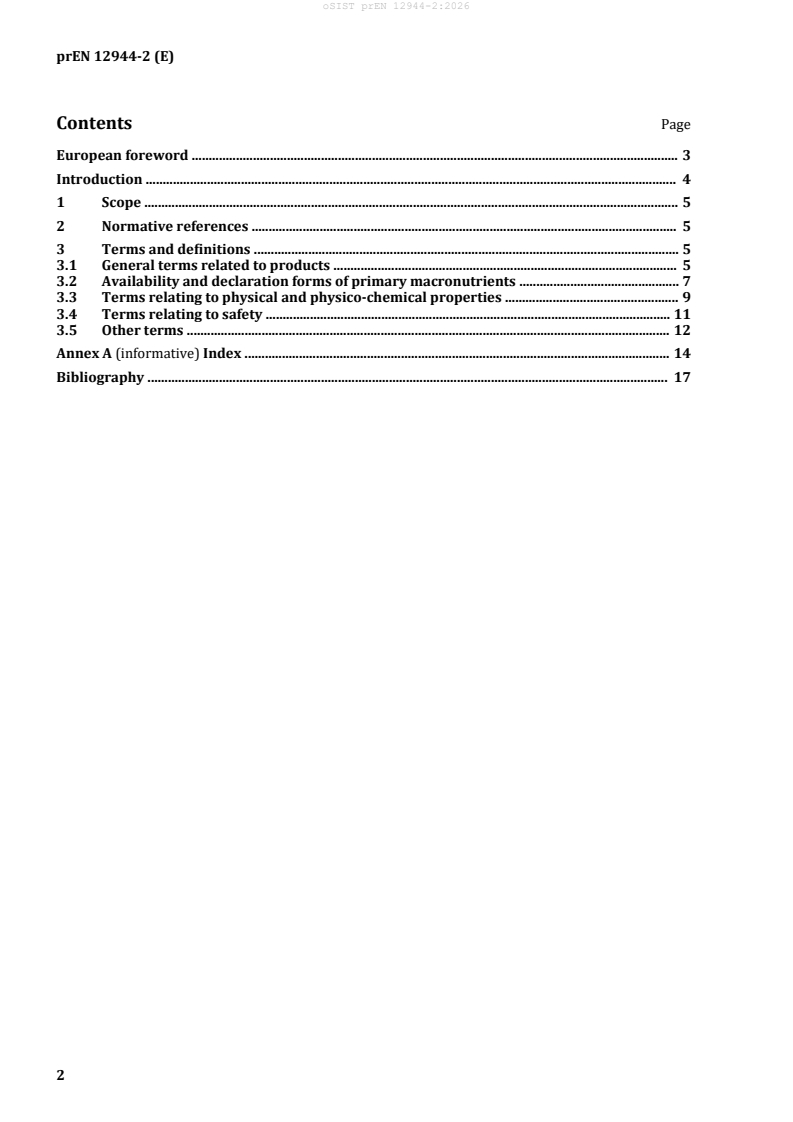
Contents Page
European foreword . 3
Introduction . 4
1 Scope . 5
2 Normative references . 5
3 Terms and definitions . 5
3.1 General terms related to products . 5
3.2 Availability and declaration forms of primary macronutrients . 7
3.3 Terms relating to physical and physico-chemical properties . 9
3.4 Terms relating to safety . 11
3.5 Other terms . 12
Annex A (informative) Index . 14
Bibliography . 17
prEN 12944-2 (E)
European foreword
This document (prEN 12944-2:2026) has been prepared by Technical Committee CEN/TC 260
“Fertilizers and liming materials”, the secretariat of which is held by DIN.
This document is currently submitted to the CEN Enquiry.
This document will supersede EN 12944-2:1999 and EN 12944-2:1999/AC:2000.
In comparison with the previous edition, the following technical modifications have been made:
— Définitions reviewed, amended and extended where appropriate in light of new legislation,
international and other European standards;
— Inclusion of the following terms: isobutylidene diurea, crotonylidene diurea, triazone, cold water-
insoluble nitrogen, cold water-soluble nitrogen, hot water-insoluble nitrogen, hot water-soluble
nitrogen, hot water-soluble nitrogen only, total nitrogen, ammoniacal nitrogen, nitric nitrogen,
ureic nitrogen, cyanamide nitrogen, total phosphorus, water-soluble phosphorus, neutral
ammonium citrate soluble phosphorus, formic acid soluble phosphorus, total potassium, water-
soluble potassium, density, disintegrable rate, salt out temperature, resistance to detonation,
oxidizing solid, oxidizing liquid, GHS label, seedling emergence and growth, self-sustaining
decomposition, free acidity, neutralizing value, vegetative vigour, essential water, water of
crystallisation, water of constitution, longevity;
— The term particle size analysis by sieving/granulometry by sieving was deleted and moved to prEN
12944-1 rev [1];
— The term apparent density was deleted.
This document has been prepared under a standardization request addressed to CEN by the European
Commission. The Standing Committee of the EFTA States subsequently approves these requests for its
Member States.
EN 12944, Fertilizers, liming materials and inhibitors — Vocabulary, currently consists of the
following parts:
— Part 1: General terms.
— Part 2: Terms relating to fertilizers.
— Part 3: Terms relating to liming materials.
These définitions do not necessarily correspond with those used in national legislation.
NOTE A classification scheme for fertilizers and liming materials is given in EN 13535 [2]
prEN 12944-2 (E)
Introduction
Fertilizers, liming materials and inhibitors are définéd in Regulation (EU) 2019/1009 [3].
An index of all terms définéd in this part of the EN 12944 series is given in Annex A, Table A.1 in English,
French and German.
prEN 12944-2 (E)
1 Scope
This document définés terms relating to fertilizers.
2 Normative references
There are no normative references in this document.
3 Terms and definitions
For the purposes of this document, the following terms and définitions apply.
ISO and IEC maintain terminology databases for use in standardization at the following addresses:
— ISO Online browsing platform: available at http://www.iso.org/obp
— IEC Electropedia: available at http://www.electropedia.org/
3.1 General terms related to products
3.1.1
basic slag
product obtained in iron-smelting by treatment of phosphorus-containing melts and with calcium silico-
phosphates as essential ingredients
Note 1 to entry: The terms “Thomas phosphate” and “Thomas slag” are used in some countries to describe basic
slag.
3.1.2
dried blood
blood meal
blood which has been dried and to which no other material has been added
3.1.3
bone meal
degreased bone which may be degelatinized and which has been ground or crushed to pass a sieve of
spécifiéd aperture size
3.1.4
dung
semi-solid excrements of animals used as fertilizers and/or soil improvers
3.1.5
fish compost
product obtained by composting fish and/or fish waste and to which no addition has been made
Note 1 to entry: Fish waste also includes fish excrements.
3.1.6
fish meal
product obtained by drying and grinding fish and/or fish waste and to which no addition has been made
3.1.7
guano
excrement and remains of any bats or birds, except poultry, containing nitrogen, phosphorus and
potassium, and to which no addition has been made
[SOURCE: ISO 8157:2022 [4], 3.2.8.12 – modifiéd, term changed from bat guano or bird guano to guano]
prEN 12944-2 (E)
3.1.8
leather waste
waste in a form of pieces or powder resulting from the manufacture of leather goods
3.1.9
liquid manure
liquid arising from animal urine and litter flüids or from a dung heap
3.1.10
manure
excrement and/or urine of farmed animals other than farmed fish, with or without litter
Note 1 to entry: Based on Regulation (EU) 2019/1009, Annex II, CMC 15 (2) (b) (viii) [3]
3.1.11
meat meal
product obtained by drying and grinding, or otherwise treating, flésh or flésh fibré and to which no
addition has been made
3.1.12
oil cake
residue remaining after the removal of the oil from oilseeds
3.1.13
peat
form of humus, created out of residual matter from plants grown and decayed in almost permanently
waterlogged conditions and which can contain a limited quantity of naturally occurring mineral material
3.1.14
slurry
semi-liquid éfflüént from livestock, consisting of urine and faeces, possibly diluted with water
[SOURCE: ISO 8157:2022 [4], 3.2.8.24]
3.1.15
urea formaldehyde
UF
slow-release nitrogenous fertilizer obtained by the reaction between urea and formaldehyde to produce
molecular chains of general formula NH -CO-NH(CH NHCONH) H
2 2 n
[SOURCE: ISO 8157:2022 [4], 3.2.8.26]
3.1.16
methylene urea
MU
polymethylene urea
slow-release nitrogenous fertilizer obtained by the reaction between urea and formaldehyde to produce
oligomers or adducts of urea and formaldehyde
Note 1 to entry: It is chiéfly composed of cold water soluble fraction from methylenediurea (MDU) and
dimethylenetriurea (DMTU) hot water soluble fraction from trimethylenetetraurea (TMTU) and
tetramethylenepentaurea (TMPU) and hot water insoluble fractions from longer chain oligomers. It is generally
free of methylolureas and methylol ethers. It is a source of slowly available nitrogen.
[SOURCE: ISO 8157:2022 [4], 3.2.8.26.1]
prEN 12944-2 (E)
3.1.17
isobutylidene diurea
IBDU
slow-release nitrogenous fertilizer obtained by the reaction between urea and isobutyraldehyde
Note 1 to entry: It is a source of slowly available nitrogen by virtue of particle size, solubility decreasing with
increase in particle size.
[SOURCE: ISO 8157:2022 [4], 3.2.8.26.2]
3.1.18
crotonylidene diurea
CDU
slow-release nitrogenous fertilizer obtained by the reaction between urea and crotonaldehyde
Note 1 to entry: It is a source of slowly available nitrogen.
[SOURCE: ISO 8157:2022 [4], 3.2.8.26.3]
3.1.19
triazone
water soluble compound of formula C H N O [5-(N-methyl)-urea-1,3,5-triazin-2-one or 5-
5 11 5 2
methyleneureido-2-oxohexahydro-s triazine], produced by reaction of urea, formaldehyde, and
ammonia
Note 1 to entry: It is a source of slowly available nitrogen.
[SOURCE: ISO 8157:2022 [4], 3.2.8.26.9]
3.1.20
urea condensate
product of reaction between urea and aldehyde(s) that produces a slow-release nitrogenous fertilizer
EXAMPLE Urea formaldehyde (UF), methylene urea (MU), crotonylidene diurea (CDU), isobutylidene diurea
(IBDU), triazone.
[SOURCE: ISO 8157:2022 [4], 3.2.8.25]
3.2 Availability and declaration forms of primary macronutrients
3.2.1
cold water-insoluble nitrogen
CWIN
insoluble nitrogen fractions in urea formaldehyde or methylene urea products that are insoluble in
phosphate buffer solution (pH 7,5) or distilled water at 25 °C during a 15-min period
[SOURCE: ISO 8157:2022 [4], 3.2.8.26.4]
3.2.2
cold water-soluble nitrogen
CWSN
soluble nitrogen fraction in urea formaldehyde or methylene urea products that is soluble in phosphate
b
...