

SIST EN IEC 61215-1:2021
(Main)Terrestrial photovoltaic (PV) modules - Design qualification and type approval - Part 1: Test requirements
General Information
- Abstract
This document lays down requirements for the design qualification of terrestrial photovoltaic modules suitable for long-term operation in open-air climates. The useful service life of modules so qualified will depend on their design, their environment and the conditions under which they are operated. Test results are not construed as a quantitative prediction of module lifetime.
In climates where 98th percentile operating temperatures exceed 70 °C, users are recommended to consider testing to higher temperature test conditions as described in IEC TS 63126. Users desiring qualification of PV products with lesser lifetime expectations are recommended to consider testing designed for PV in consumer electronics, as described in IEC 63163 (under development). Users wishing to gain confidence that the characteristics tested in IEC 61215 appear consistently in a manufactured product may wish to utilize IEC TS 62941 regarding quality systems in PV manufacturing.
This document is intended to apply to all terrestrial flat plate module materials such as crystalline silicon module types as well as thin-film modules. It does not apply to systems that are not long-term applications, such as flexible modules installed in awnings or tenting.
This document does not apply to modules used with concentrated sunlight although it may be utilized for low concentrator modules (1 to 3 suns). For low concentration modules, all tests are performed using the irradiance, current, voltage and power levels expected at the design concentration.
This document does not address the particularities of PV modules with integrated electronics. It may however be used as a basis for testing such PV modules.
The objective of this test sequence is to determine the electrical characteristics of the module and to show, as far as possible within reasonable constraints of cost and time, that the module is capable of withstanding prolonged exposure outdoors. Accelerated test conditions are empirically based on those necessary to reproduce selected observed field failures and are applied equally across module types. Acceleration factors may vary with product design, and thus not all degradation mechanisms may manifest. Further general information on accelerated test methods including definitions of terms may be found in IEC 62506.
Some long-term degradation mechanisms can only reasonably be detected via component testing, due to long times required to produce the failure and necessity of stress conditions that are expensive to produce over large areas. Component tests that have reached a sufficient level of maturity to set pass/fail criteria with high confidence are incorporated into the IEC 61215 series via addition to Table 1. In contrast, the tests procedures described in this series, in IEC 61215-2, are performed on modules.
- Status
- Published
- Publication Date
- 09-May-2021
- Technical Committee
- PVS - Solar photovoltaic energy systems
- Current Stage
- 6060 - National Implementation/Publication (Adopted Project)
- Start Date
- 05-May-2021
- Due Date
- 10-Jul-2021
- Completion Date
- 10-May-2021



Overview
EN IEC 61215-1:2021 - Terrestrial photovoltaic (PV) modules - Design qualification and type approval - Part 1: Test requirements - is a CLC-adopted European version of IEC 61215-1 (2021). The standard defines test requirements and the overall test sequence used to demonstrate that terrestrial flat‑plate PV modules (crystalline silicon and thin‑film) are suitable for long‑term outdoor operation. It sets out what to document and mark, which sample types to test, pass/fail criteria, and the overall qualification/test flow but does not provide the detailed test procedures (those are in IEC 61215-2).
EN IEC 61215-1:2021 is explicitly intended for long‑term applications. It excludes short‑life flexible modules (awnings/tenting), high‑concentration systems (except low concentrators 1–3 suns with adjusted test levels), and does not fully address modules with integrated electronics (though it can be used as a basis).
Key topics and requirements
- Scope and applicability: terrestrial flat‑plate PV modules (crystalline and thin‑film), low‑concentrator allowance, exclusions noted.
- Test objectives: determine electrical characteristics and show resistance to prolonged outdoor exposure via empirically based accelerated testing; results are not a quantitative lifetime prediction.
- Test flow and gates: structured sequence (including Gate No. 1 verification of rated values and Gate No. 2 maximum power degradation checks) to guide type approval and design qualification.
- Marking & documentation: nameplate, datasheet minimums and derived rated values and tolerances required for verification.
- Pass criteria: electrical performance, visual defects, electrical safety requirements, and major visual defect definitions.
- Component vs module testing: component tests with mature pass/fail criteria may be incorporated (listed in Table 1); module procedures are described in IEC 61215‑2.
- Accelerated testing principles: acceleration factors vary by design; some degradation mechanisms require component‑level testing or different stressors (see IEC 62506 for general accelerated test methods).
- Special considerations: high‑temperature climates (98th percentile > 70 °C) should consider IEC TS 63126 temperature conditions; guidance on bifacial modules, simulator requirements and dynamic mechanical load tests is included in annexes.
Practical applications and users
Who uses this standard:
- PV manufacturers for design qualification and type approval
- Test laboratories and certification bodies performing PV module qualification
- Quality assurance and manufacturing engineers implementing PV quality systems
- Procurement teams, EPCs and project developers requiring certified PV modules
- Regulators and standards bodies assessing module conformity
Typical uses:
- Type approval and reliability evidence for commercial PV modules
- Baseline for R&D validation, product launch and vendor qualification
- Supporting warranty claims, procurement specifications and certification reports
Related standards
- IEC 61215‑2 (test procedures)
- IEC 61730‑1/2 (PV module safety)
- IEC 61853‑1 (performance testing & energy rating)
- IEC 62506 (accelerated test methods)
- IEC TS 63126 (high‑temperature testing)
- IEC TS 62941 (quality systems for PV manufacturing)
- IEC 62804‑1, IEC 62790, IEC 60904 series
Keywords: EN IEC 61215-1:2021, photovoltaic modules, PV module design qualification, type approval, PV testing, accelerated testing, terrestrial PV.
Relations
- Effective Date
- 01-Jun-2021
- Effective Date
- 09-Feb-2026
- Effective Date
- 09-Feb-2026
- Effective Date
- 03-Feb-2026
- Effective Date
- 03-Feb-2026
- Effective Date
- 03-Feb-2026
- Effective Date
- 03-Feb-2026
- Effective Date
- 03-Feb-2026
- Refers
SIST EN IEC 62790:2020 - Junction boxes for photovoltaic modules - Safety requirements and tests - Effective Date
- 03-Feb-2026
- Effective Date
- 03-Feb-2026
- Effective Date
- 03-Feb-2026
- Effective Date
- 03-Feb-2026
- Effective Date
- 03-Feb-2026
- Effective Date
- 03-Feb-2026
- Effective Date
- 03-Feb-2026
Get Certified
Connect with accredited certification bodies for this standard

DNV
DNV is an independent assurance and risk management provider.

Lloyd's Register
Lloyd's Register is a global professional services organisation specialising in engineering and technology.
DNV Energy Systems
Energy and renewable energy certification.
Sponsored listings
Frequently Asked Questions
SIST EN IEC 61215-1:2021 is a standard published by the Slovenian Institute for Standardization (SIST). Its full title is "Terrestrial photovoltaic (PV) modules - Design qualification and type approval - Part 1: Test requirements". This standard covers: This document lays down requirements for the design qualification of terrestrial photovoltaic modules suitable for long-term operation in open-air climates. The useful service life of modules so qualified will depend on their design, their environment and the conditions under which they are operated. Test results are not construed as a quantitative prediction of module lifetime. In climates where 98th percentile operating temperatures exceed 70 °C, users are recommended to consider testing to higher temperature test conditions as described in IEC TS 63126. Users desiring qualification of PV products with lesser lifetime expectations are recommended to consider testing designed for PV in consumer electronics, as described in IEC 63163 (under development). Users wishing to gain confidence that the characteristics tested in IEC 61215 appear consistently in a manufactured product may wish to utilize IEC TS 62941 regarding quality systems in PV manufacturing. This document is intended to apply to all terrestrial flat plate module materials such as crystalline silicon module types as well as thin-film modules. It does not apply to systems that are not long-term applications, such as flexible modules installed in awnings or tenting. This document does not apply to modules used with concentrated sunlight although it may be utilized for low concentrator modules (1 to 3 suns). For low concentration modules, all tests are performed using the irradiance, current, voltage and power levels expected at the design concentration. This document does not address the particularities of PV modules with integrated electronics. It may however be used as a basis for testing such PV modules. The objective of this test sequence is to determine the electrical characteristics of the module and to show, as far as possible within reasonable constraints of cost and time, that the module is capable of withstanding prolonged exposure outdoors. Accelerated test conditions are empirically based on those necessary to reproduce selected observed field failures and are applied equally across module types. Acceleration factors may vary with product design, and thus not all degradation mechanisms may manifest. Further general information on accelerated test methods including definitions of terms may be found in IEC 62506. Some long-term degradation mechanisms can only reasonably be detected via component testing, due to long times required to produce the failure and necessity of stress conditions that are expensive to produce over large areas. Component tests that have reached a sufficient level of maturity to set pass/fail criteria with high confidence are incorporated into the IEC 61215 series via addition to Table 1. In contrast, the tests procedures described in this series, in IEC 61215-2, are performed on modules.
This document lays down requirements for the design qualification of terrestrial photovoltaic modules suitable for long-term operation in open-air climates. The useful service life of modules so qualified will depend on their design, their environment and the conditions under which they are operated. Test results are not construed as a quantitative prediction of module lifetime. In climates where 98th percentile operating temperatures exceed 70 °C, users are recommended to consider testing to higher temperature test conditions as described in IEC TS 63126. Users desiring qualification of PV products with lesser lifetime expectations are recommended to consider testing designed for PV in consumer electronics, as described in IEC 63163 (under development). Users wishing to gain confidence that the characteristics tested in IEC 61215 appear consistently in a manufactured product may wish to utilize IEC TS 62941 regarding quality systems in PV manufacturing. This document is intended to apply to all terrestrial flat plate module materials such as crystalline silicon module types as well as thin-film modules. It does not apply to systems that are not long-term applications, such as flexible modules installed in awnings or tenting. This document does not apply to modules used with concentrated sunlight although it may be utilized for low concentrator modules (1 to 3 suns). For low concentration modules, all tests are performed using the irradiance, current, voltage and power levels expected at the design concentration. This document does not address the particularities of PV modules with integrated electronics. It may however be used as a basis for testing such PV modules. The objective of this test sequence is to determine the electrical characteristics of the module and to show, as far as possible within reasonable constraints of cost and time, that the module is capable of withstanding prolonged exposure outdoors. Accelerated test conditions are empirically based on those necessary to reproduce selected observed field failures and are applied equally across module types. Acceleration factors may vary with product design, and thus not all degradation mechanisms may manifest. Further general information on accelerated test methods including definitions of terms may be found in IEC 62506. Some long-term degradation mechanisms can only reasonably be detected via component testing, due to long times required to produce the failure and necessity of stress conditions that are expensive to produce over large areas. Component tests that have reached a sufficient level of maturity to set pass/fail criteria with high confidence are incorporated into the IEC 61215 series via addition to Table 1. In contrast, the tests procedures described in this series, in IEC 61215-2, are performed on modules.
SIST EN IEC 61215-1:2021 is classified under the following ICS (International Classification for Standards) categories: 27.160 - Solar energy engineering. The ICS classification helps identify the subject area and facilitates finding related standards.
SIST EN IEC 61215-1:2021 has the following relationships with other standards: It is inter standard links to SIST EN 61215-1:2017, SIST EN 450-2:2005, SIST CR 10313:2000, SIST EN IEC 60891:2022, SIST EN IEC 60904-10:2021, SIST EN 60269-6:2011, SIST EN 61853-1:2011, SIST EN 61140:2016, SIST EN IEC 62790:2020, SIST EN IEC 60904-3:2019, SIST EN IEC 61215-2:2021, SIST EN IEC 62941:2020, SIST EN IEC 61730-2:2018, SIST EN 62852:2015, SIST EN IEC 60904-1:2021. Understanding these relationships helps ensure you are using the most current and applicable version of the standard.
SIST EN IEC 61215-1:2021 is available in PDF format for immediate download after purchase. The document can be added to your cart and obtained through the secure checkout process. Digital delivery ensures instant access to the complete standard document.
Standards Content (Sample)
SLOVENSKI STANDARD
01-junij-2021
Nadomešča:
SIST EN 61215-1:2017
Prizemni fotonapetostni (PV) moduli - Ocena zasnove in odobritev tipa - 1. del:
Zahteve za preskušanje
Terrestrial photovoltaic (PV) modules - Design qualification and type approval - Part 1:
Test requirements
Modules photovoltaïques (PV) pour applications terrestres - Qualification de la
conception et homologation - Partie 1: Exigences d'essai
Ta slovenski standard je istoveten z: EN IEC 61215-1:2021
ICS:
27.160 Sončna energija Solar energy engineering
2003-01.Slovenski inštitut za standardizacijo. Razmnoževanje celote ali delov tega standarda ni dovoljeno.
EUROPEAN STANDARD EN IEC 61215-1
NORME EUROPÉENNE
EUROPÄISCHE NORM
April 2021
ICS 27.160 Supersedes EN 61215-1:2016 and all of its amendments
and corrigenda (if any)
English Version
Terrestrial photovoltaic (PV) modules - Design qualification and
type approval - Part 1: Test requirements
(IEC 61215-1:2021)
Modules photovoltaïques (PV) pour applications terrestres - Terrestrische Photovoltaik(PV)-Module - Bauarteignung und
Qualification de la conception et homologation - Partie 1: Bauartzulassung - Teil 1: Prüfanforderungen
Exigences d'essai (IEC 61215-1:2021)
(IEC 61215-1:2021)
This European Standard was approved by CENELEC on 2021-03-30. CENELEC members are bound to comply with the CEN/CENELEC
Internal Regulations which stipulate the conditions for giving this European Standard the status of a national standard without any alteration.
Up-to-date lists and bibliographical references concerning such national standards may be obtained on application to the CEN-CENELEC
Management Centre or to any CENELEC member.
This European Standard exists in three official versions (English, French, German). A version in any other language made by translation
under the responsibility of a CENELEC member into its own language and notified to the CEN-CENELEC Management Centre has the
same status as the official versions.
CENELEC members are the national electrotechnical committees of Austria, Belgium, Bulgaria, Croatia, Cyprus, the Czech Republic,
Denmark, Estonia, Finland, France, Germany, Greece, Hungary, Iceland, Ireland, Italy, Latvia, Lithuania, Luxembourg, Malta, the
Netherlands, Norway, Poland, Portugal, Republic of North Macedonia, Romania, Serbia, Slovakia, Slovenia, Spain, Sweden, Switzerland,
Turkey and the United Kingdom.
European Committee for Electrotechnical Standardization
Comité Européen de Normalisation Electrotechnique
Europäisches Komitee für Elektrotechnische Normung
CEN-CENELEC Management Centre: Rue de la Science 23, B-1040 Brussels
© 2021 CENELEC All rights of exploitation in any form and by any means reserved worldwide for CENELEC Members.
Ref. No. EN IEC 61215-1:2021 E
European foreword
The text of document 82/1828A/FDIS, future edition 2 of IEC 61215-1, prepared by IEC/TC 82 "Solar
photovoltaic energy systems" was submitted to the IEC-CENELEC parallel vote and approved by
CENELEC as EN IEC 61215-1:2021.
The following dates are fixed:
• latest date by which the document has to be implemented at national (dop) 2021-12-30
level by publication of an identical national standard or by endorsement
• latest date by which the national standards conflicting with the (dow) 2024-03-30
document have to be withdrawn
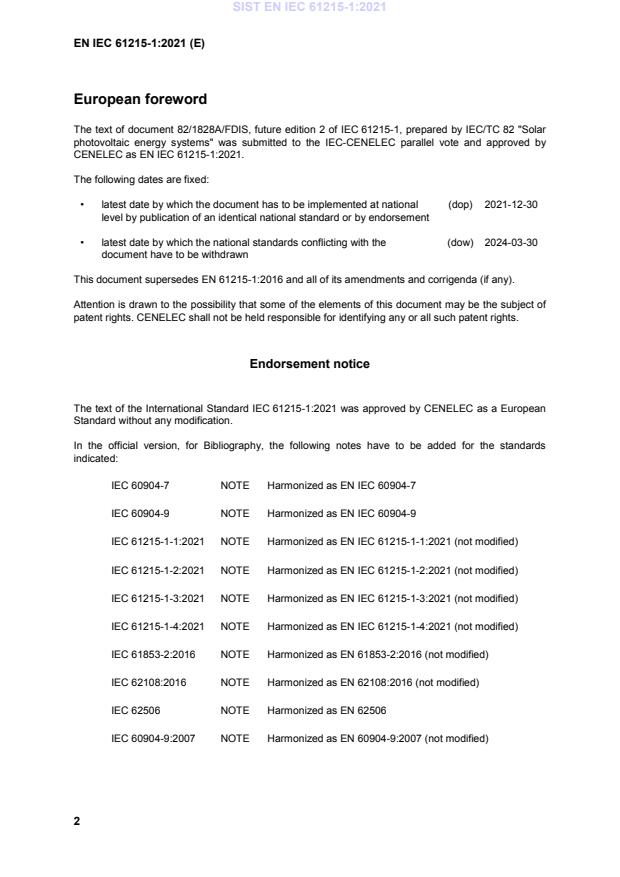
This document supersedes EN 61215-1:2016 and all of its amendments and corrigenda (if any).
Attention is drawn to the possibility that some of the elements of this document may be the subject of
patent rights. CENELEC shall not be held responsible for identifying any or all such patent rights.
Endorsement notice
The text of the International Standard IEC 61215-1:2021 was approved by CENELEC as a European
Standard without any modification.
In the official version, for Bibliography, the following notes have to be added for the standards
indicated:
IEC 60904-7 NOTE Harmonized as EN IEC 60904-7
IEC 60904-9 NOTE Harmonized as EN IEC 60904-9
IEC 61215-1-1:2021 NOTE Harmonized as EN IEC 61215-1-1:2021 (not modified)
IEC 61215-1-2:2021 NOTE Harmonized as EN IEC 61215-1-2:2021 (not modified)
IEC 61215-1-3:2021 NOTE Harmonized as EN IEC 61215-1-3:2021 (not modified)
IEC 61215-1-4:2021 NOTE Harmonized as EN IEC 61215-1-4:2021 (not modified)
IEC 61853-2:2016 NOTE Harmonized as EN 61853-2:2016 (not modified)
IEC 62108:2016 NOTE Harmonized as EN 62108:2016 (not modified)
IEC 62506 NOTE Harmonized as EN 62506
IEC 60904-9:2007 NOTE Harmonized as EN 60904-9:2007 (not modified)
Annex ZA
(normative)
Normative references to international publications
with their corresponding European publications
The following documents are referred to in the text in such a way that some or all of their content
constitutes requirements of this document. For dated references, only the edition cited applies. For
undated references, the latest edition of the referenced document (including any amendments)
applies.
NOTE 1 Where an International Publication has been modified by common modifications, indicated by (mod),
the relevant EN/HD applies.
NOTE 2 Up-to-date information on the latest versions of the European Standards listed in this annex is available
here: www.cenelec.eu.
Publication Year Title EN/HD Year
IEC 60269-6 - Low-voltage fuses - Part 6: EN 60269-6 -
Supplementary requirements for fuse-
links for the protection of solar
photovoltaic energy systems
IEC 60891 - Photovoltaic devices - Procedures for EN 60891 -
temperature and irradiance corrections to
measured I-V characteristics
IEC 60904-1 - Photovoltaic devices - Part 1: EN IEC 60904-1 -
Measurement of photovoltaic current-
voltage characteristics
IEC/TS 60904-1-2 2019 Photovoltaic devices - Part 1-2: - -
Measurement of current-voltage
characteristics of bifacial photovoltaic
(PV) devices
IEC 60904-3 - Photovoltaic devices - Part 3: EN IEC 60904-3 -
Measurement principles for terrestrial
photovoltaic (PV) solar devices with
reference spectral irradiance data
IEC 60904-10 - Photovoltaic devices - Part 10: Methods EN IEC 60904-10 -
of linear dependence and linearity
measurements
IEC/TS 60904-13 - Photovoltaic devices - Part 13: - -
Electroluminescence of photovoltaic
modules
IEC 61140 - Protection against electric shock - EN 61140 -
Common aspects for installation and
equipment
IEC 61215-2 - Terrestrial photovoltaic (PV) modules - EN IEC 61215-2 -
Design qualification and type approval -
Part 2: Test procedures
Publication Year Title EN/HD Year
IEC 61730-1 - Photovoltaic (PV) module safety EN IEC 61730-1 -
qualification - Part 1: Requirements for
construction
IEC 61730-2 - Photovoltaic (PV) module safety EN IEC 61730-2 -
qualification - Part 2: Requirements for
testing
IEC/TS 61836 - Solar photovoltaic energy systems - - -
Terms, definitions and symbols
IEC 61853-1 - Photovoltaic (PV) module performance EN 61853-1 -
testing and energy rating - Part 1:
Irradiance and temperature performance
measurements and power rating
IEC/TS 62782 - Photovoltaic (PV) modules - Cyclic - -
(dynamic) mechanical load testing
IEC 62790 - Junction boxes for photovoltaic modules - EN IEC 62790 -
Safety requirements and tests
IEC/TS 62804-1 - Photovoltaic (PV) modules - Test - -
methods for the detection of potential-
induced degradation - Part 1: Crystalline
silicon
IEC 62852 - Connectors for DC-application in EN 62852 -
photovoltaic systems - Safety
requirements and tests
IEC/TS 62915 - Photovoltaic (PV) modules - Type - -
approval, design and safety qualification -
Retesting
IEC 62941 - Terrestrial photovoltaic (PV) modules - EN IEC 62941 -
Quality system for PV module
manufacturing
IEC/TS 63163 — Terrestrial photovoltaic (PV) modules for - -
consumer products - Design qualification
and type approval
ISO/IEC Guide - Uncertainty of measurement - Part 3: - -
98-3 Guide to the expression of uncertainty in
measurement (GUM:1995)
Under preparation. Stage at the time of publication: ADTS.
IEC 61215-1 ®
Edition 2.0 2021-02
INTERNATIONAL
STANDARD
NORME
INTERNATIONALE
colour
inside
Terrestrial photovoltaic (PV) modules – Design qualification and type approval –
Part 1: Test requirements
Modules photovoltaïques (PV) pour applications terrestres – Qualification de la
conception et homologation –
Partie 1: Exigences d'essai
INTERNATIONAL
ELECTROTECHNICAL
COMMISSION
COMMISSION
ELECTROTECHNIQUE
INTERNATIONALE
ICS 27.160 ISBN 978-2-8322-9367-6
– 2 – IEC 61215-1:2021 © IEC 2021
CONTENTS
FOREWORD . 4
INTRODUCTION . 6
1 Scope . 7
2 Normative references . 7
3 Terms, definitions and abbreviated terms . 9
4 Test samples . 11
5 Marking and documentation . 13
5.1 Name plate . 13
5.2 Documentation . 13
5.2.1 Minimum requirements . 13
5.2.2 Information to be given in the documentation . 13
5.2.3 Assembly instructions . 15
6 Testing . 15
7 Pass criteria . 17
7.1 General . 17
7.2 Power output and electric circuitry . 18
7.2.1 Identification of rated values and tolerances . 18
7.2.2 Verification of rated label values → Gate No. 1 . 20
7.2.3 Maximum power degradation during type approval testing → Gate No. 2 . 23
7.2.4 Electrical circuitry . 23
7.3 Visual defects . 23
7.4 Electrical safety . 23
8 Major visual defects . 24
9 Report . 24
10 Modifications . 25
11 Test flow and procedures . 26
Annex A (informative) Changes from previous edition . 28
A.1 General . 28
A.2 Procedures for bifacial modules . 28
A.3 Use of representative samples . 30
A.4 Addition of dynamic mechanical load test . 31
A.5 Addition of test for potential induced degradation . 31
A.6 Simulator requirements . 33
A.6.1 General . 33
A.6.2 Rationale for changes to spectral requirements . 34
A.6.3 Rationale for changes to uniformity requirements . 35
A.7 References to retest guidelines . 36
A.8 Weight on junction boxes . 36
A.9 Correction to monolithically-integrated hot-spot endurance test . 36
A.10 Number of modules in sequence . 38
A.11 Removal of nominal module operating temperature (NMOT) . 39
A.12 Very low currents during thin-film tests . 40
A.13 Limit bypass diode testing to three diodes. 40
A.14 Revert the insulation test to 2005 version . 40
A.15 Bending test . 41
IEC 61215-1:2021 © IEC 2021 – 3 –
A.16 Stabilization option for boron oxygen LID (MQT 19.3) . 41
Bibliography . 42
Figure 1 – Geometry that shows radius of curvature of a flexible module . 10
Figure 2 – Full test flow for design qualification and type approval of photovoltaic
modules . 17
Figure 3 – Examples of hypothetical partial nameplates (left column), datasheets
(center column), and derived rated values and tolerances (right column) . 20
Figure A.1 – Derived temperature coefficients (α) for nine different mc‑Si products
types. 38
Table 1 – Required component tests . 17
Table 2 – Summary of Gate No. 1 requirements . 17
Table 3 – Summary of test levels . 26
Table A.1 – Published uncertainty values as a function of simulator uniformity class . 35
Table A.2 – Summary of foil placement during insulation test in three different
versions. . 40
– 4 – IEC 61215-1:2021 © IEC 2021
INTERNATIONAL ELECTROTECHNICAL COMMISSION
____________
TERRESTRIAL PHOTOVOLTAIC (PV) MODULES –
DESIGN QUALIFICATION AND TYPE APPROVAL –
Part 1: Test requirements
FOREWORD
1) The International Electrotechnical Commission (IEC) is a worldwide organization for standardization comprising
all national electrotechnical committees (IEC National Committees). The object of IEC is to promote
international co-operation on all questions concerning standardization in the electrical and electronic fields. To
this end and in addition to other activities, IEC publishes International Standards, Technical Specifications,
Technical Reports, Publicly Available Specifications (PAS) and Guides (hereafter referred to as "IEC
Publication(s)"). Their preparation is entrusted to technical committees; any IEC National Committee interested
in the subject dealt with may participate in this preparatory work. International, governmental and non-
governmental organizations liaising with the IEC also participate in this preparation. IEC collaborates closely
with the International Organization for Standardization (ISO) in accordance with conditions determined by
agreement between the two organizations.
2) The formal decisions or agreements of IEC on technical matters express, as nearly as possible, an international
consensus of opinion on the relevant subjects since each technical committee has representation from all
interested IEC National Committees.
3) IEC Publications have the form of recommendations for international use and are accepted by IEC National
Committees in that sense. While all reasonable efforts are made to ensure that the technical content of IEC
Publications is accurate, IEC cannot be held responsible for the way in which they are used or for any
misinterpretation by any end user.
4) In order to promote international uniformity, IEC National Committees undertake to apply IEC Publications
transparently to the maximum extent possible in their national and regional publications. Any divergence
between any IEC Publication and the corresponding national or regional publication shall be clearly indicated in
the latter.
5) IEC itself does not provide any attestation of conformity. Independent certification bodies provide conformity
assessment services and, in some areas, access to IEC marks of conformity. IEC is not responsible for any
services carried out by independent certification bodies.
6) All users should ensure that they have the latest edition of this publication.
7) No liability shall attach to IEC or its directors, employees, servants or agents including individual experts and
members of its technical committees and IEC National Committees for any personal injury, property damage or
other damage of any nature whatsoever, whether direct or indirect, or for costs (including legal fees) and
expenses arising out of the publication, use of, or reliance upon, this IEC Publication or any other IEC
Publications.
8) Attention is drawn to the Normative references cited in this publication. Use of the referenced publications is
indispensable for the correct application of this publication.
9) Attention is drawn to the possibility that some of the elements of this IEC Publication may be the subject of
patent rights. IEC shall not be held responsible for identifying any or all such patent rights.
International Standard IEC 61215-1 has been prepared by IEC technical committee 82: Solar
photovoltaic energy systems.
This second edition of IEC 61215-1 cancels and replaces the first edition of IEC 61215-1,
published in 2016; it constitutes a technical revision.
This edition includes the following significant technical changes with respect to the previous
edition:
a) Addition of a test taken from IEC TS 62782.
b) Addition of a test taken from IEC TS 62804-1.
c) Addition of test methods required for flexible modules. This includes the addition of the
bending test (MQT 22).
d) Addition of definitions, references and instructions on how to perform the IEC 61215
design qualification and type approval on bifacial PV modules.
IEC 61215-1:2021 © IEC 2021 – 5 –
e) Clarification of the requirements related to power output measurements.
f) Addition of weights to junction box during 200 thermal cycles.
g) Requirement that retesting be performed according to IEC TS 62915.
h) Removal of the nominal module operating test (NMOT), and associated test of
performance at NMOT, from the IEC 61215 series.
Informative Annex A explains the background and reasoning behind some of the more
substantial changes that were made in the IEC 61215 series in progressing from edition 1 to
edition 2.
The text of this International Standard is based on the following documents:
FDIS Report on voting
82/1828A/FDIS 82/1848/RVD
Full information on the voting for the approval of this International Standard can be found in
the report on voting indicated in the above table.
This document has been drafted in accordance with the ISO/IEC Directives, Part 2.
A list of all parts in the IEC 61215 series, published under the general title Terrestrial
photovoltaic (PV) modules – Design qualification and type approval, can be found on the IEC
website.
The committee has decided that the contents of this document will remain unchanged until the
stability date indicated on the IEC website under "http://webstore.iec.ch" in the data related to
the specific document. At this date, the document will be
• reconfirmed,
• withdrawn,
• replaced by a revised edition, or
• amended.
IMPORTANT – The 'colour inside' logo on the cover page of this publication indicates that it
contains colours which are considered to be useful for the correct understanding of its
contents. Users should therefore print this document using a colour printer.
– 6 – IEC 61215-1:2021 © IEC 2021
INTRODUCTION
Whereas Part 1 of this standards series describes requirements (both in general and specific
with respect to device technology), the sub-parts of Part 1 define technology variations and
Part 2 defines a set of test procedures necessary for design qualification and type approval.
The test procedures described in Part 2 are valid for all device technologies.
IEC 61215-1:2021 © IEC 2021 – 7 –
TERRESTRIAL PHOTOVOLTAIC (PV) MODULES –
DESIGN QUALIFICATION AND TYPE APPROVAL –
Part 1: Test requirements
1 Scope
This document lays down requirements for the design qualification of terrestrial photovoltaic
modules suitable for long-term operation in open-air climates. The useful service life of
modules so qualified will depend on their design, their environment and the conditions under
which they are operated. Test results are not construed as a quantitative prediction of module
lifetime.
th
In climates where 98 percentile operating temperatures exceed 70 °C, users are
recommended to consider testing to higher temperature test conditions as described in
IEC TS 63126. Users desiring qualification of PV products with lesser lifetime expectations
are recommended to consider testing designed for PV in consumer electronics, as described
in IEC TS 63163 (under development). Users wishing to gain confidence that the
characteristics tested in IEC 61215 appear consistently in a manufactured product may wish
to utilize IEC 62941 regarding quality systems in PV manufacturing.
This document is intended to apply to all terrestrial flat plate module materials such as
crystalline silicon module types as well as thin-film modules. It does not apply to systems that
are not long-term applications, such as flexible modules installed in awnings or tenting.
This document does not apply to modules used with concentrated sunlight although it may be
utilized for low concentrator modules (1 to 3 suns). For low concentration modules, all tests
are performed using the irradiance, current, voltage and power levels expected at the design
concentration.
This document does not address the particularities of PV modules with integrated electronics.
It may however be used as a basis for testing such PV modules.
The objective of this test sequence is to determine the electrical characteristics of the module
and to show, as far as possible within reasonable constraints of cost and time, that the
module is capable of withstanding prolonged exposure outdoors. Accelerated test conditions
are empirically based on those necessary to reproduce selected observed field failures and
are applied equally across module types. Acceleration factors may vary with product design,
and thus not all degradation mechanisms may manifest. Further general information on
accelerated test methods including definitions of terms may be found in IEC 62506.
Some long-term degradation mechanisms can only reasonably be detected via component
testing, due to long times required to produce the failure and necessity of stress conditions
that are expensive to produce over large areas. Component tests that have reached a
sufficient level of maturity to set pass/fail criteria with high confidence are incorporated into
the IEC 61215 series via addition to Table 1. In contrast, the tests procedures described in
this series, in IEC 61215-2, are performed on modules.
2 Normative references
The following documents are referred to in the text in such a way that some or all of their
content constitutes requirements of this document. For dated references, only the edition
cited applies. For undated references, the latest edition of the referenced document (including
any amendments) applies.
– 8 – IEC 61215-1:2021 © IEC 2021
IEC 60269-6, Low-voltage fuses – Part 6: Supplementary requirements for fuse-links for the
protection of solar photovoltaic energy systems
IEC 60891, Photovoltaic devices – Procedures for temperature and irradiance corrections to
measured I-V characteristics
IEC 60904-1, Photovoltaic devices – Part 1: Measurement of photovoltaic current-voltage
characteristics
IEC TS 60904-1-2:2019, Photovoltaic devices – Part 1-2: Measurement of current-voltage
characteristics of bifacial photovoltaic (PV) devices
IEC 60904-3, Photovoltaic devices – Part 3: Measurement principles for terrestrial
photovoltaic (PV) solar devices with reference spectral irradiance data
IEC 60904-10, Photovoltaic devices – Part 10: Methods of linear dependence and linearity
measurements
IEC TS 60904-13, Photovoltaic devices – Part 13: Electroluminescence of photovoltaic
modules
IEC 61140, Protection against electric shock – Common aspects for installation and
equipment
IEC 61215-2, Terrestrial photovoltaic (PV) modules – Design qualification and type approval –
Part 2: Test procedures
IEC 61730-1, Photovoltaic (PV) module safety qualification – Part 1: Requirements for
construction
IEC 61730-2, Photovoltaic (PV) module safety qualification – Part 2: Requirements for testing
IEC TS 61836, Solar photovoltaic energy systems – Terms, definitions and symbols
IEC 61853-1, Photovoltaic (PV) module performance testing and energy rating – Part 1:
Irradiance and temperature performance measurements and power rating
IEC TS 62782, Photovoltaic (PV) modules – Cyclic (dynamic) mechanical load testing
IEC 62790, Junction boxes for photovoltaic modules – Safety requirements and tests
IEC TS 62804-1, Photovoltaic (PV) modules – Test methods for the detection of potential-
induced degradation – Part 1: Crystalline silicon
IEC 62852, Connectors for DC-application in photovoltaic systems – Safety requirements and
tests
IEC TS 62915, Photovoltaic (PV) modules – Type approval, design and safety qualification –
Retesting
IEC 62941, Terrestrial photovoltaic (PV) modules – Quality system for PV module
manufacturing
IEC 61215-1:2021 © IEC 2021 – 9 –
IEC TS 63163: – Terrestrial photovoltaic (PV) modules for consumer products – Design
qualification and type approval
ISO/IEC Guide 98-3, Uncertainty of measurement – Part 3: Guide to the expression of
uncertainty in measurement (GUM:1995)
3 Terms, definitions and abbreviated terms
For the purposes of this document, the terms and definitions in IEC TS 61836 apply, as well
as the following.
ISO and IEC maintain terminological databases for use in standardization at the following
addresses:
• IEC Electropedia: available at http://www.electropedia.org/
• ISO Online browsing platform: available at http://www.iso.org/obp
3.1
bins of power classes
power (typically maximum power) sorting criteria from the PV module manufacturer
3.2
tolerances
value range of electrical parameters on the label of the PV module as given by the
manufacturer
3.3
MQT
Module Quality Test
3.4
type approval
conformity test made on one or more items representative of the production
[SOURCE: IEC 60050-581:2008, 581-21-08 – Type test]
3.5
reproducibility
closeness of agreement between the results of measurements of the same value of a
quantity, when the individual measurements are made under different conditions of
measurement:
– principle of measurement,
– method of measurement,
– observer,
– measuring instruments,
– reference standards,
– laboratory,
______________
Under preparation. Stage at the time of publication: ADTS.
– 10 – IEC 61215-1:2021 © IEC 2021
– under conditions of use of the instruments, different from those customarily used,
after intervals of time relatively long compared with the duration of a single measurement.
[consistent with the International Vocabulary of Metrology (VIM), 3.7]
Note 1 to entry: The concepts of "principle of measurement" and "method of measurement" are respectively
defined in VIM 2.3 and 2.4.
Note 2 to entry: The term "reproducibility" also applies to the instance where only certain of the above conditions
are taken into account, provided that these are stated.
Note 3 to entry: It is recommended that laboratories determine their reproducibility according to the formulas and
principles in ISO 5725-2.
[SOURCE: IEC 60050-311:2001, 311-06-07]
3.6
flexible module
PV module that exhibits a radius of curvature of 500 mm or less in at least one direction
according to the manufacturer’s specification and is capable of bending to conform to a flat or
curved surface
Note 1 to entry: A curved module with a rigid shape is not considered a flexible module.
Note 2 to entry: Radius of curvature is defined as shown in Figure 1. During testing, the applied radius of
curvature is no smaller than that specified by the manufacturer.
Figure 1 – Geometry that shows radius of curvature of a flexible module
3.7
representative sample
sample that includes all the components of the module, except some repeated parts
Note 1 to entry: The representative samples shall use all key materials and subassemblies, as detailed in
Clause 4.
3.8
very large module
module that exceeds the size of standard 2,2 m × 1,5 m commercially-available simulators
Note 1 to entry: A very large module exceeds 2,2 m in length or width, or exceeds 1,5 m in both dimensions. Thus
a 3 m × 0,3 m module is considered very large, as is a 2,2 m × 2,2 m module.
Note 2 to entry: Very large modules are exempt from class A simulator spatial irradiance uniformity requirements,
as detailed in IEC 61215-2 MQT 02.
Note 3 to entry: During test sequences representative samples may be substituted for very large modules, within
the limits described in Clause 4.
Note 4 to entry: In future editions, the size threshold to be considered a very large module will likely increase to
larger dimensions.
3.9
bifacial PV modules
modules that can convert irradiation received on both the front-side and rear-side into electric
energy by means of the photovoltaic effect
IEC 61215-1:2021 © IEC 2021 – 11 –
3.10
bifaciality coefficients
ratios between the I-V characteristics of the rear-side and the front-side of a bifacial module
each measured under Standard Test Conditions (STC – IEC TS 61836), namely the short-
circuit current bifaciality coefficient φ , the open-circuit voltage bifaciality coefficient φ
Isc Voc
and the maximum power bifaciality coefficient φ
Pmax
Note 1 to entry: Bifaciality coefficients are fully defined in IEC TS 60904-1-2:2019, 6.2.
3.11
bifacial nameplate irradiance
BNPI
higher irradiance at which nameplate verification is performed for bifacial modules,
2 2
corresponding to 1 000 W/m on the module front and 135 W/m on the module rear, applied
in any method allowed by IEC TS 60904-1-2
3.12
bifacial stress irradiance
BSI
higher irradiance at which currents for stress are measured on bifacial modules,
2 2
corresponding to 1 000 W/m on the module front and 300 W/m on the module rear, applied
by any method allowed in IEC TS 60904-1-2, I-V characteristic at which may be extrapolated
from lower irradiances
4 Test samples
The PV module samples shall have been manufactured from specified materials and
components in accordance with the relevant drawings and process sheets and have been
subjected to the manufacturer’s normal inspection, quality control and production acceptance
procedures. The PV modules shall be complete in every detail and shall be accompanied by
the manufacturer’s handling, mounting, and connection instructions. When the PV modules to
be tested are prototypes of a new design and not from production, this fact shall be noted in
the test report (see Clause 9).
The number of test samples required is derived from the applicable test sequences
(see Clause 11).
Special test samples may be required for tests such as the bypass diode test MQT 18
(see IEC 61215-2).
For qualification of multiple bins of power classes within the boundaries given in
IEC TS 62915 at least 2 modules each, from the lower end, median and higher end power
class shall be used for testing. If median power class does not exist the next higher class
shall be used. If qualification of a single power class shall be extended to further bins of
power classes within the boundaries given in IEC TS 62915 then at least 2 modules each,
from the lower end and higher end power class shall be used for label verification (see Gate
No.1 in 7.2.1). If a power class is extended only towards higher (or lower) bins, then modules
only from the higher (or lower) bins, respectively, shall be used for verification of rated label
values.
Qualification to multiple bins of power classes does not increase the minimum requirement of
one control sample used in 7.2.3.
It is advisable to provide additional spare samples meeting the same output power
requirements.
– 12 – IEC 61215-1:2021 © IEC 2021
If applicable, the test samples shall be used to represent a group or family of products, or
variations in the materials, or production processes used to produce the modules. The
additional samples required for the test programme are then derived from IEC TS 62915.
For very large modules (as defined in 3.8), representative samples (as defined in 3.7) may be
used for all qualification tests given in Clause 11 and IEC 61215-2. During the design and
manufacturing of the representative samples, attention should be paid to reach the maximum
similarity to the full-size product in all electrical, mechanical, and thermal characteristics
related to quality and reliability. The cell, encapsulation methods, interconnects, terminations,
clearance and creepage distances around all edges, and distance through solid insulation
(relied upon insulation and cemented joints) shall be the same as on the actual full-size
products. Limits are placed on how much one may reduce the dimensions of a very large
module in making representative samples for qualification testing. The reduced dimension(s)
shall be no less than one half the dimensions that define a very large module. In other words,
when reducing the shorter dimension, the representative sample shall be at least 0,75 m wide.
In reducing the longer dimension, the representative sample shall be at least 1,1 m long. If
representative samples are used for any test, the test report shall include a table listing the
dimensions of the product being qualified, and for each MQT, the dimensions of the samples
tested. The table shall contain the statement, "Smaller samples were used for some tests as
noted above. Use of smaller samples may affect test results." For determination of maximum
power degradation during testing (7.2.3) on a representative sample, P (Lab_GateNo.1)
max
refers to the representative sample’s initial stabilized measured power output. However, for
verification of rated label values (7.2.2) a standard production product shall be measured,
either at the test facility or utilizing a test at the manufacturer monitored by the testing entity.
If representative samples are utilized in Sequence E, then one extra module, full-sized, is
required, and shall be subjected only to MQT 16 (static mechanical load test) and the
requirements therein.
Any representative sample used for MQT 09 (hot-spot endurance test) shall contain the same
number of cells per bypass diode (i.e. the same substring size) as the full-size product.
NOTE It is preferable in any test to measure a full-size sample, rather than a representative sample, when
equipment size allows.
Prior to beginning the qualification test, care should be taken not to damage the samples in
transit. Such care may include adherence to best practices in packing and shipping,[1] as
well as electroluminescence imaging according to IEC TS 60904-13 before and after shipping
to make sure cracks have not developed in transit.
For the requirements in the IEC 61215 series, a module shall be considered "bifacial " if the
manufacturer claims bifaciality on the nameplate or datasheet, or if the module exhibits a
maximum power bifaciality coefficient ≥ 20 %. If a module is to be tested as a monofacial
module, the test laboratory shall verify that the module is monofacial by at least one of the
following methods:
a) Information from the manufacturer showing that the rear of the cell is fully metallized;
b) Spectrally-resolved backsheet transmission data from the module manufacturer; or
c) Determination of bifaciality coefficient on one sample according to the procedure in
IEC TS 60904-1-2.
______________
Numbers in square brackets refer to the Bibliography.
IEC 61215-1:2021 © IEC 2021 – 13 –
5 Marking and documentation
5.1 Name plate
Each module shall include the following clear and indelible markings. Unless otherwise
indicated, all the electrical parameters refer to STC:
a) name, registered trade name or registered trade mark of manufacturer;
b) type or model number designation;
c) serial number (unless marked on other part of product);
d) date and place of manufacture; alternatively serial number allowing to trace the date and
place of manufacture;
e) maximum system voltage;
f) class of protection against electrical shock (as defined in IEC 61140 and IEC 61730-1);
g) voltage at open-circuit or Voc including tolerances. For bifacial modules, open-circuit
voltage shall be reported at two irradiance levels. The first required irradiance level is
1 000 W/m2. The second required irradiance is BNPI, as defined in 3.11.
h) current at short-circuit or Isc including tolerances. For bifacial modules, short-circuit
current shall be reported at two irradiance levels, defined in 5.1g).
i) module maximum power or Pmax including binning and tolerances as defined in 3.1 and
3.2. For bifacial modules, Pmax shall be reported at the two irradiance levels, defined in
5.1g).
j) For bifacial modules the following information including tolerances, shall be given on the
nameplate: The values for the short-circuit current bifaciality coefficient φIsc, the open-
circuit voltage bifaciality coefficient φVoc, and the maximum power bifaciality coefficient
φPmax, measured at STC as defined in IEC TS 60904-1-2.
k) For flexible modules, the minimum radius of curvature.
For items a) through i) all electrical data shall be shown as relative to STC (1 000 W/m ,
25 °C, AM1.5 according to IEC TS 61836), except for bifacial modules where two irradiance
levels are required, as defined in 5.1g).
International symbols shall be used where applicable.
Compliance of marking is checked by inspection and MQT 06.1.
5.2 Documentation
5.2.1 Minimum requirements
Modules shall be supplied with documentation describing the methods of electrical and
mechanical installation as well as the electrical ratings of the module. The documentation
shall state the class of protection against electrical shock under which the module has been
qualified and any specific limitations required for that class. The documentation shall assure
that installers and operators receive appropriate and sufficient documentation for safe
installation, use, and maintenance of the PV modules.
NOTE It is considered to be sufficient that one set of documentation is supplied with the module shipping unit.
5.2.2 Information to be given in the documentation
a) all information required under 5.1 e) to i), and in addition j) for bifacial modules and k) for
flexible modules;
b) reverse current overload rating in accordance with IEC 61730-2 MST 26;
– 14 – IEC 61215-1:2021 © IEC 2021
– overcurrent protection device type and rating are e.g. given in IEC 60269-6.
Overcurrent protection devices with a 1 h, 1,35 I overload rating, where I is the rated
n n
value of the overcurrent protection device, are recommended;
– recommended maximum series/parallel PV module configurations;
c) manufacturer’s stated tolerance for V , I and maximum power output under standard
oc sc
test conditions;
d) temperature coefficient for voltage at open-circuit;
e) temperature coefficient for maximum power;
f) temperature coefficient for short-circuit current.
All electrical data mentioned above shall be shown as relative to standard test conditions
(1 000 W/m , 25 °C, AM1.5 according to IEC TS 61836). Moreover the following parameters
shall be specified:
g) performance at low irradiance (MQT 07).
International symbols shall be used where applicable.
Compliance is checked by inspection and MQT 04 through MQT 07.
The electrical documentation shall include a detailed description of the electrical installation
wiring method to be used. This description shall include:
h) the minimum cable diameters for modules intended for field wiring;
i) any limitations on wiring methods and wire management that apply to the wiring
compartment or box;
j) the size, type, material and temperature rating of the conductors to be used;
k) type of terminals for field wiring;
l) specific PV connector model/types and manufacturer to which the module connectors shall
be mated. Statement of the connector type only (such as "MC4 compatible ") is not
sufficient information to satisfy this requiremen
...