

oSIST prEN 15269-12:2025
(Main)Extended application of test results for fire resistance and/or smoke control for door, shutter and openable window assemblies, including their elements of building hardware - Part 12: Fire resistance of composite doors
- Abstract
EXAP standard specific to the materials typically used within composite fire and smoke control doors.
- Status
- Not Published
- Public Enquiry End Date
- 30-Oct-2025
- Technical Committee
- POZ - Požarna varnost
- Current Stage
- 4020 - Public enquire (PE) (Adopted Project)
- Start Date
- 01-Sep-2025
- Due Date
- 19-Jan-2026
- Completion Date
- 05-Nov-2025

Overview
oSIST prEN 15269-12:2025 is a draft European Standard developed by SIS (Slovenian Institute for Standardization) that specifies the protocol for extended application (EXAP) of fire resistance and smoke control test results for composite doors. Covering doorsets with composite or polymeric leaves or frames-or combinations with timber-based doors-this document enables manufacturers and specifiers to determine how fire resistance and/or smoke control performance demonstrated in standardized tests (EN 1634-1 and EN 1634-3) can apply to variations in product design, size, and configuration without repeat full-scale testing.
The standard applies to hinged or pivoted composite doors, their frames, glazed and solid side panels, fanlights, and relevant hardware configurations. It does not apply to horizontal doorsets.
Key Topics
- Scope of Extended Application (EXAP): Guidance on how to extend fire resistance and smoke control test results from standard configurations to alternative designs within composite fire doors, including leaf, frame, and hardware variations.
- Composite Doorset Definitions: Detailed coverage of terms such as composite door leaf (with trimmable or fixed sub-frame, PVC-U construction) and composite or timber-based frames.
- Fire Resistance & Smoke Control Test References: EXAP protocols are explicitly tied to fire resistance (EN 1634-1) and ambient temperature smoke control (EN 1634-3) European test methods.
- Permitted Variations & Assessment Process: How to determine which changes (e.g., size, configuration, hardware, glazing) may be covered by test evidence, and when additional testing is required.
- EXAP Reporting Requirements: Instructions on preparing compliant extended application reports in accordance with EN 15725 and EN 15269-1.
- Design Parameter Tables: Annexes specify which design modifications are allowable under EXAP and what additional test data or evidence may be necessary.
Applications
Implementing oSIST prEN 15269-12:2025 delivers practical benefits across the building and construction sector:
- Fire Door Manufacturers: Streamline product development by maximizing the use of existing fire resistance data across a family of composite doors, including those with alternative finishes, sizes, hardware, and glazing.
- Specifiers and Architects: Confidently select composite fire doors and windows with verified fire resistance and smoke control ratings across a range of configurations without demanding repeated full-scale testing for each variant.
- Testing Laboratories: Standardize assessment and reporting practices in line with European norms, ensuring clarity and consistency in extended application justifications.
- Certification Bodies: Assess compliance of composite fire and smoke control doors through referenced test reports, supporting regulatory and building code approvals.
Composite doors are widely used in residential, commercial, and public buildings for their combination of design flexibility, durability, and enhanced fire safety. This standard underpins the robust, evidence-based extension of fire classification, aiding compliance and innovation across European markets.
Related Standards
For comprehensive evaluation and application of fire-rated composite doors, note these related standards frequently referenced in oSIST prEN 15269-12:2025:
- EN 1634-1: Fire resistance testing for door, shutter, and openable window assemblies.
- EN 1634-3: Smoke control test methods for door and shutter assemblies, and openable windows.
- EN 15269-1: General requirements for EXAP of test results for fire resistance and/or smoke control.
- EN 15725: Reporting requirements for EXAP in construction products.
- EN 1363-1: General fire resistance test methods.
- EN 12519: Terminology for windows and pedestrian doors.
- EN ISO 13943: Fire safety - Vocabulary.
By aligning with these standards, stakeholders ensure consistency, regulatory compliance, and safety in the selection and specification of composite fire doors with extended application of test results.
Keywords: composite fire doors, fire resistance, smoke control, extended application, EN 15269-12, EN 1634-1, EN 1634-3, EXAP, doorset compliance, composite door testing, building hardware.
Get Certified
Connect with accredited certification bodies for this standard

DIBt (Deutsches Institut für Bautechnik)
German Institute for Building Technology.
DIN CERTCO
DIN Group product certification.

Kiwa BDA Testing
Building and construction product certification.
Sponsored listings
Frequently Asked Questions
oSIST prEN 15269-12:2025 is a draft published by the Slovenian Institute for Standardization (SIST). Its full title is "Extended application of test results for fire resistance and/or smoke control for door, shutter and openable window assemblies, including their elements of building hardware - Part 12: Fire resistance of composite doors". This standard covers: EXAP standard specific to the materials typically used within composite fire and smoke control doors.
EXAP standard specific to the materials typically used within composite fire and smoke control doors.
oSIST prEN 15269-12:2025 is classified under the following ICS (International Classification for Standards) categories: 13.220.50 - Fire-resistance of building materials and elements; 91.060.50 - Doors and windows. The ICS classification helps identify the subject area and facilitates finding related standards.
oSIST prEN 15269-12:2025 is associated with the following European legislation: Standardization Mandates: M/117. When a standard is cited in the Official Journal of the European Union, products manufactured in conformity with it benefit from a presumption of conformity with the essential requirements of the corresponding EU directive or regulation.
oSIST prEN 15269-12:2025 is available in PDF format for immediate download after purchase. The document can be added to your cart and obtained through the secure checkout process. Digital delivery ensures instant access to the complete standard document.
Standards Content (Sample)
SLOVENSKI STANDARD
01-oktober-2025
Razširjena uporaba rezultatov preskusov požarne odpornosti in/ali dimotesnosti
za vrata, zaporne elemente in okna, ki se odpirajo, vključno z njihovim okovjem -
12. del: Požarna odpornost kompozitnih vrat
Extended application of test results for fire resistance and/or smoke control for door,
shutter and openable window assemblies, including their elements of building hardware -
Part 12: Fire resistance of composite doors
Erweiterte Anwendung von Prüfergebnissen zur Feuerwiderstandsfähigkeit und/oder
Rauchdichtigkeit von Türen, Toren und zu öffnenden Fenstern einschließlich ihrer
Baubeschläge - Teil 12: Feuerwiderstandsfähigkeit von Verbundtüren
Ta slovenski standard je istoveten z: prEN 15269-12
ICS:
13.220.50 Požarna odpornost Fire-resistance of building
gradbenih materialov in materials and elements
elementov
91.060.50 Vrata in okna Doors and windows
2003-01.Slovenski inštitut za standardizacijo. Razmnoževanje celote ali delov tega standarda ni dovoljeno.
DRAFT
EUROPEAN STANDARD
NORME EUROPÉENNE
EUROPÄISCHE NORM
August 2025
ICS
English Version
Extended application of test results for fire resistance
and/or smoke control for door, shutter and openable
window assemblies, including their elements of building
hardware - Part 12: Fire resistance of composite doors
Erweiterte Anwendung von Prüfergebnissen zur
Feuerwiderstandsfähigkeit und/oder Rauchdichtigkeit
von Türen, Toren und zu öffnenden Fenstern
einschließlich ihrer Baubeschläge - Teil 12:
Feuerwiderstandsfähigkeit von Verbundtüren
This draft European Standard is submitted to CEN members for enquiry. It has been drawn up by the Technical Committee
CEN/TC 127.
If this draft becomes a European Standard, CEN members are bound to comply with the CEN/CENELEC Internal Regulations
which stipulate the conditions for giving this European Standard the status of a national standard without any alteration.
This draft European Standard was established by CEN in three official versions (English, French, German). A version in any other
language made by translation under the responsibility of a CEN member into its own language and notified to the CEN-CENELEC
Management Centre has the same status as the official versions.
CEN members are the national standards bodies of Austria, Belgium, Bulgaria, Croatia, Cyprus, Czech Republic, Denmark, Estonia,
Finland, France, Germany, Greece, Hungary, Iceland, Ireland, Italy, Latvia, Lithuania, Luxembourg, Malta, Netherlands, Norway,
Poland, Portugal, Republic of North Macedonia, Romania, Serbia, Slovakia, Slovenia, Spain, Sweden, Switzerland, Türkiye and
United Kingdom.
Recipients of this draft are invited to submit, with their comments, notification of any relevant patent rights of which they are
aware and to provide supporting documentation.
Warning : This document is not a European Standard. It is distributed for review and comments. It is subject to change without
notice and shall not be referred to as a European Standard.
EUROPEAN COMMITTEE FOR STANDARDIZATION
COMITÉ EUROPÉEN DE NORMALISATION
EUROPÄISCHES KOMITEE FÜR NORMUNG
CEN-CENELEC Management Centre: Rue de la Science 23, B-1040 Brussels
© 2025 CEN All rights of exploitation in any form and by any means reserved Ref. No. prEN 15269-12:2025 E
worldwide for CEN national Members.
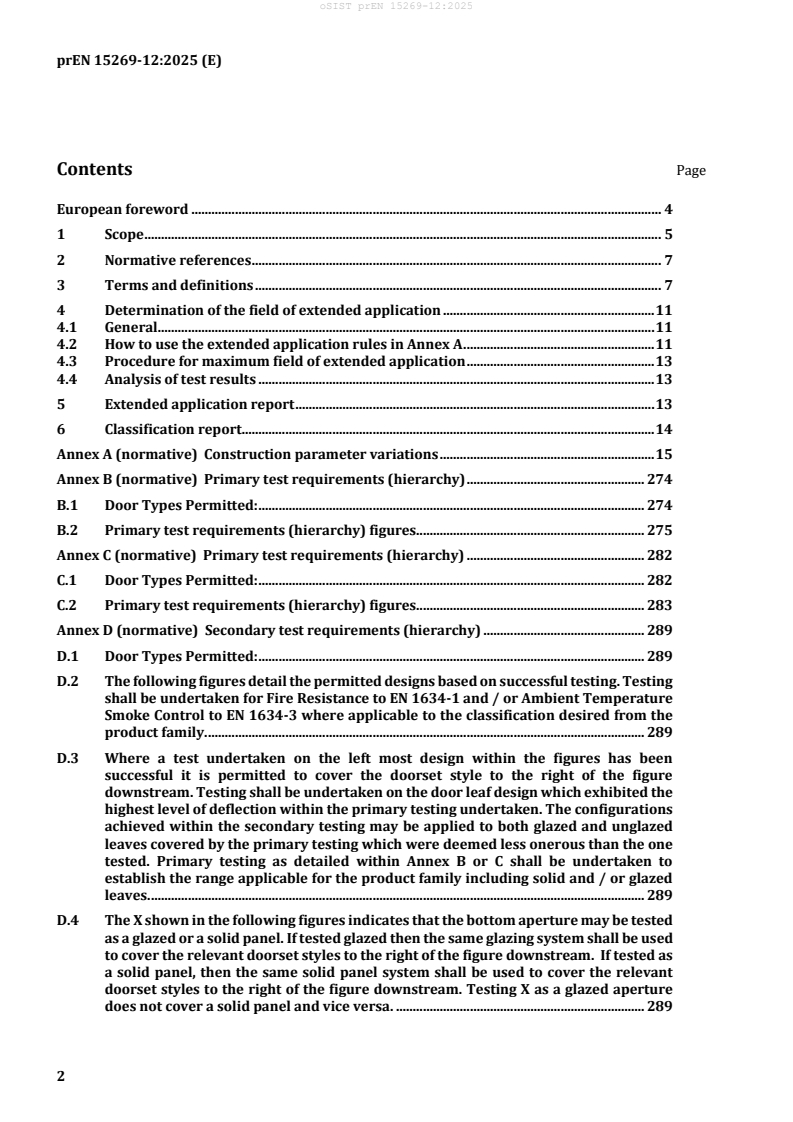
Contents Page
European foreword . 4
1 Scope . 5
2 Normative references . 7
3 Terms and definitions . 7
4 Determination of the field of extended application . 11
4.1 General. 11
4.2 How to use the extended application rules in Annex A . 11
4.3 Procedure for maximum field of extended application . 13
4.4 Analysis of test results . 13
5 Extended application report . 13
6 Classification report. 14
Annex A (normative) Construction parameter variations . 15
Annex B (normative) Primary test requirements (hierarchy) . 274
B.1 Door Types Permitted: . 274
B.2 Primary test requirements (hierarchy) figures. 275
Annex C (normative) Primary test requirements (hierarchy) . 282
C.1 Door Types Permitted: . 282
C.2 Primary test requirements (hierarchy) figures. 283
Annex D (normative) Secondary test requirements (hierarchy) . 289
D.1 Door Types Permitted: . 289
D.2 The following figures detail the permitted designs based on successful testing. Testing
shall be undertaken for Fire Resistance to EN 1634-1 and / or Ambient Temperature
Smoke Control to EN 1634-3 where applicable to the classification desired from the
product family. . 289
D.3 Where a test undertaken on the left most design within the figures has been
successful it is permitted to cover the doorset style to the right of the figure
downstream. Testing shall be undertaken on the door leaf design which exhibited the
highest level of deflection within the primary testing undertaken. The configurations
achieved within the secondary testing may be applied to both glazed and unglazed
leaves covered by the primary testing which were deemed less onerous than the one
tested. Primary testing as detailed within Annex B or C shall be undertaken to
establish the range applicable for the product family including solid and / or glazed
leaves. . 289
D.4 The X shown in the following figures indicates that the bottom aperture may be tested
as a glazed or a solid panel. If tested glazed then the same glazing system shall be used
to cover the relevant doorset styles to the right of the figure downstream. If tested as
a solid panel, then the same solid panel system shall be used to cover the relevant
doorset styles to the right of the figure downstream. Testing X as a glazed aperture
does not cover a solid panel and vice versa. . 289
Bibliography . 308
Table A.2 - Construction parameter variations - Section AB - Composite leaf – fixed size sub-frame 52
Table A.3 - Construction parameter variations - Section AC - Timber door leaf – made from a single sheet
of material without a sub-frame 85
Table A.4 - Construction parameter variations - Section AD - Composite leaf – PVC-U 119
Table A.5 - Construction parameter variations - Section B – Door frame 152
Table A.6 - Construction parameter variations - Section C – Hardware 171
Table A.7 - Construction parameter variations - Section D - Side / Overpanels (glazed and panelled) –
Transomed and Coupled 238
Table A.8 - Construction parameter variations - Section E – Glazing for door leaf 254
Table A.9 - Construction parameter variations - Section F - Supporting Construction and Attachment
(Technique) of door frame and /or side / over panels / fanlights 265
European foreword
This document (prEN 15269-12:2025) has been prepared by Technical Committee CEN/TC 127 “Fire
safety in buildings”, the secretariat of which is held by BSI.
This document is currently submitted to the CEN Enquiry.
1 Scope
This document covers hinged or pivoted doorsets and door assemblies with composite/polymeric based
leaves and / or composite/polymeric door frames. This document also covers timber-based door leaves
hung within composite / polymeric door frames. Composite doorsets with both or either the leaf or the
frame manufactured from a composite/polymeric material are covered by this document. It prescribes
the methodology for extending the application of test results obtained from fire resistance test(s)
conducted in accordance with EN 1634-1 and / or EN 1634-3. This document covers doorsets with
elements which are comprised of composite / polymeric material.
Subject to the completion of the appropriate test or tests, the extended application can cover all or some
of the following examples:
— integrity (E), integrity & radiation (EW) or integrity & insulation (EI or EI ) & Sa (S or S )
1 2 a3 a4
ambient temperature smoke control classifications;
— Glazed elements including vision panels and framed glazed doorsets;
— Glazed sidepanel or fanlight connected by transom/mullion or coupled frames;
— Solid (Non vision) sidepanel, or overpanel connected by transom/mullion or coupled frames;
— Items of building hardware;
— Decorative finishes;
— Intumescent, smoke, draught or acoustic seals;
— Alternative supporting construction(s) and fixing techniques.
The effect on the Classification ‘C’ for the doorsets following an extended application process is not
addressed in this document.
This document does not cover horizontal doorsets.
Refer to figure A.1 for example illustrations of composite doorsets covered by this document.
Composite door frame with composite door leaf:
Composite door frame with timber based door leaf:
Timber door frame with composite door leaf:
Metal door frame with composite door leaf:
Key
1 A composite door leaf as defined in section 3.
Figure A.1 — Composite doorsets covered by this document
2 Normative references
The following documents are referred to in the text in such a way that some or all of their content
constitutes requirements of this document. For dated references, only the edition cited applies. For
undated references, the latest edition of the referenced document (including any amendments) applies.
EN 1363-1, Fire resistance tests — Part 1: General requirements
EN 1634-1, Fire resistance and smoke control tests for door, shutter and openable window assemblies and
elements of building hardware — Part 1: Fire resistance test for doors, shutters and openable windows
EN 1634-3, Fire resistance and smoke control tests for door and shutter assemblies, openable windows and
elements of building hardware – Part 3: Smoke control test for door and shutter assemblies.
EN 12519, Windows and pedestrian doors — Terminology
EN 15269-1, Extended application of test results for fire resistance and/or smoke control for door, shutter
and openable window assemblies, including their elements of building hardware — Part 1: General
Requirements
EN 15725, Extended application reports on the fire performance of construction products and building
elements
EN ISO 13943, Fire safety — Vocabulary (ISO 13943)
3 Terms and definitions
For the purposes of this document, the terms and definitions given in EN 1363-1, EN 12519, EN ISO
13943, EN 1634-1, EN 1634-3 and EN 15269-1, EN 15725 and the following apply.
ISO and IEC maintain terminology databases for use in standardization at the following addresses:
— ISO Online browsing platform: available at https://www.iso.org/obp/
— IEC Electropedia: available at https://www.electropedia.org/
3.1
door frame
part of the doorset or door assembly from which the door leaf is supported and to which the door leaf is
hinged
Note 1 to entry: The door frame may also be used to support glazed sidepanels or fanlights or overpanels
3.2
door leaf
hinged or pivoted part within the door frame of a door assembly or doorset
3.3
glazing cassette
glass retention components used as a glazing system to secure and position a glass in a composite door
leaf or panel
3.4
composite doorset
hinged or pivoted doorset with non-cellulosic polymeric based leaf, with or without glazing in the leaf,
and/or a non-cellulosic polymeric door frame
Note 1 to entry: A timber/cellulosic-based door leaf hung within a non-cellulosic polymeric door frame is also
considered a composite doorset within this document
Note 2 to entry: A doorset with a non-cellulosic polymeric based door leaf hung within a timber/cellulosic or metal
door frame is also considered a composite doorset within this document
Note 3 to entry: A composite doorset may be either over-rebated or flush fit construction
3.5
composite leaf with trimmable sub-frame
door leaf typically of sandwich construction formed from a core material surrounded by a perimeter sub-
frame bonded between facings or skins, where adjusting the height and width of the door is by trimming
the leaf resulting in a change of sectional dimensions of the sub-frame
Note 1 to entry: The perimeter sub-frame forming the stiles and rails may be of the same or differing materials
3.6
composite leaf with fixed size sub-frame
door leaf typically of sandwich construction formed from a core material surrounded by a perimeter sub-
frame bonded between facings or skins, where adjusting the height and width of the door does not result
in any change to the sectional dimensions of the sub-frame
Note 1 to entry: The perimeter sub-frame forming the stiles and rails may be of the same or differing materials
3.7
timber door leaf
door leaf constructed from timber/cellulosic-based components which falls within the scope of EN
15269-3
Note 1 to entry: Used in this document only when hung within polymeric framing material
3.8
composite leaf – PVC-U
door leaf made using unplasticized poly(vinyl chloride) (PVC-U) profiles in accordance with EN 12608,
with or without reinforcement
3.9
sub-frame
structural element of the door leaf which form the rails and stiles of the door leaf, bonded/fixed between
the door facings
3.10
facing
non-cellulosic composite/polymeric, or steel material layer bonded / fixed to the core and/or sub-frame
to form the visible surface of the door leaf and are used for structural purposes
Note 1 to entry: Only steel facings with less than 1mm thickness are included in this document
Note 2 to entry: The visible face of the material may have a cosmetic appearance
3.11
lipping
edge piece added to the door leaf for structural purpose
3.12
decorative finish
outer layer of paint or material on the visible surface of the door leaf only used for decorative not for
structural or fire resistance purposes
3.13
core
material fitted central within the thickness of a door leaf or panel which may consist of a single sheet of
non-cellulosic material or a combination either of sheets of the same material or layers of different
materials or a non-cellulosic polymeric based insulating foam or mineral wool fibre
3.14
composite door frame
non-cellulosic or polymeric hollow or solid profile to which the leaf is hung
Note 1 to entry: This definition does not include frames constructed completely from metal
3.15
effective rebate depth
dimension of the door leaf thickness of overlapping adjacent edges of door leaf relative to the door frame,
transom or sidepanel or flush overpanel
Note 1 to entry: See Figure A.2 & Figure A.3
Dimensions in millimetres
Key
X1 Example of effective rebate depth in doorset to be tested.
X2 Example of resulting effective rebate depth during testing after movement of 20mm.
Y1 Example of over rebate to frame face clearance in doorset to be tested.
Y2 Example of resulting over rebate to frame face clearance during testing after movement of 20mm.
NOTE The dimensions 5mm, 44mm, 25mm and 24mm are examples only.
Figure A.2 — Effective rebate depth – Over rebated composite doors
Dimensions in millimetres
Key
1 Leaf flush with door frame
X1 Example of effective rebate depth in doorset to be tested.
X2 Example of resulting effective rebate depth during testing after movement of 20mm.
Y1 Example of leaf edge flush with frame face clearance in doorset to be tested.
Y2 Example of resulting leaf edge to frame face difference during testing after movement of 20mm.
NOTE The dimensions 44mm, 20mm and 24mm are examples only.
Figure A.3 — Effective rebate depth – Flush fit composite doors
3.16
exposed intumescent seal
intumescent strip which is fitted in the perimeter of the leaf or in the door frame and is visible when the
leaf is in the open position
3.17
concealed intumescent seal
intumescent strip which is fitted in the perimeter of the leaf or in the door frame and is not visible when
the leaf is in the open position, including seals behind lipping, veneers and laminates and / or within the
frame profile
3.18
witness groove
groove applied to the facing of polymeric sheet material which constitutes the facing of the leaf to give an
impression of a traditional stile and rail joinery doorset
4 Determination of the field of extended application
4.1 General
4.1.1 Before there can be any consideration for extended application, a representative doorset shall
have been tested in accordance with EN 1634-1 and / or EN 1634-3 to achieve a test result which could
generate a classification in accordance with EN 13501-2 at least equal to the classification subsequently
required from extended application considerations.
4.1.2 A review of the doorset construction parameters can indicate that one or more characteristics
may be improved by a particular parameter variation. All evaluations shall be made on the basis of
retaining the classifications obtainable from testing to EN 1634-1 and / or EN 1634-3, including those
lower than the test duration. However, this shall never lead to an increased classification for any specific
parameter beyond that achieved during any one test.
4.1.3 If no extended application rule exists for a particular parameter variation, then no extension or
change of this particular parameter is possible without further testing.
4.2 How to use the extended application rules in Annex A
4.2.1 Identify which of the specific sections of Annex A apply for the specific door leaf under evaluation.
— Annex A – Table A.2 – Section AA – Composite Door Leaf – Trimmable sub-frame
— Annex A – Table A.2 – Section AB – Composite Door Leaf – Fixed Size sub-frame
— Annex A – Table A.2 – Section AC – Timber Door Leaf – Made from a single sheet of material without
a sub-frame.
— Annex A – Table A.2 – Section AD – PVC-U Door Leaf
Only one of the above Sections of Annex A will apply to any particular product family based on the
constructional details of the door leaf. Refer to the definitions to define the particular section which would
be applicable.
4.2.2 The following table applies to all the above door leaf types:
— Annex A – Table A.2 – Section B – F – Common Sections
4.2.3 In order to utilise the hierarchy detailed within Annex’s B – D the product under evaluation shall
have:
• For all configurations two identical doorsets shall have been tested opening into and away from
the furnace for fire resistance and achieved the required performance relevant to the required
classification.
• Where glass is utilised, the glass configuration shall include at least one pane of insulated glass
(EW – glass with intumescent or ablative interlayer and EI – glass).
4.2.4 Identify the variations from the original test specimen(s) which are required to be covered by an
extended application report.
4.2.5 Locate the variations in the appropriate parameter variation by reference to columns (1) and (2)
of Annex A.
4.2.6 Review the contents of column (3) of Annex A whether any extended application is available
beyond the direct application rules in EN 1634-1 and / or EN 1634-3 without the need for further testing.
4.2.7 Where this is deemed to be possible, it can be recorded in the extended application report
together with any appropriate restrictions and the stated rules from column (3) of Annex A.
4.2.8 Where the variations required can only be achieved from additional testing, the additional test
can be made on a specimen type identified based on the detailed instruction given in column (4) of Annex
A.
4.2.9 Additional test requirement statements used in column (4):
The test requirements indicated below shall be conducted in both directions in all instances.
Table 1
S.0 A test on a single doorset within the product family range.
Test must replicate the most onerous relevant previous test result
S.1ᵃ
within the current tested product range.
Test must be carried out reproducing the primary test condition and
S.2ᵇ achieve an equal or improved performance relative to the classification
required. (consisting of a single doorset without sidelights)
Annex D gives the test protocol and hierarchy for various options on
S.3
leaf configurations including sidepanels, overpanels and fanlights.
ᵃ Most onerous result must be the lowest relevant performance in terms of mode of failure and/or
highest distortion but must also be evaluated taking the intended construction parameter
variation into account. For example, if the construction parameter variation involves a change to
glazing or sidepanel and overpanel configurations then the previous result where these have
been tested would need to be used to make the evaluation of most onerous. The result for a single
unglazed doorset would not be suitable and can therefore be discounted when making the
evaluation.
ᵇ When deciding if the additional test type S.1 or S.2 may be carried out consideration must
always be given to decide if the construction parameter variation would result in the product
becoming a different product family and therefore requiring a new product evaluation and an S.3
test programme being conducted.
4.3 Procedure for maximum field of extended application
4.3.1 It is possible to provide an extended field of application from a single test. However, where a
manufacturer envisages to produce a range of doors incorporating single doors with or without
sidepanels, overpanels or fanlights, with or without glazing, with alternative elements of building
hardware, etc., it is recommended that careful consideration is given to the complete range of doorset
designs and options. This helps to minimise the testing required before testing commences.
4.3.2 Establish all the parameter variations which are required to be part of the product range.
4.3.3 Determine which are the most important specification requirements and incorporate as many as
possible into the specimen(s) for the first tests in the series.
4.3.4 Conduct the first fire resistance and / or ambient temperature smoke control test or a series of
tests and then establish which of the original desired parameter variations have not been covered by the
fire resistance and / or ambient temperature smoke control tests, including direct application
possibilities where applicable (as identified within the tables herein).
4.3.5 Identify these parameter variations utilising Annex’s A – E and establish if any extended
application is possible without further testing.
4.3.6 Record this for the extended application report together with any restrictions and rules given in
column (3) in Annex A or Annex’s B-E.
4.3.7 Evaluate which, if any, of the desired parameter variations have not been covered by the field of
direct application or the initial field of extended application derived from 4.5.
4.3.8 Select the required outstanding parameter variations from column (1) and column (2) of Annex
A and observe from column (4) in Annex A which are the most appropriate, weakest specimen options
for further testing.
4.3.9 If the complete selection of required parameter variations has not been covered by the tests
completed in accordance with the above procedure, then an appropriate test or tests may be repeated
with the additional product variations incorporated.
4.4 Analysis of test results
4.4.1 In order to maximise the field of extended application, it is important that the test reports shall
record details of any failure throughout the duration of the test, as well as details of any significant
distortion where applicable.
4.4.2 Where a series of tests forms the basis for the extended application, the field of extended
application shall be based on the lowest performance achieved from the complete series of tests unless
premature failure has been attributed to one or more specific construction parameter variation.
4.4.3 Where it has been possible to identify specific parameter failures, the extended application for all
other construction parameter variations can be based on the performance achieved after isolating the
premature failure(s).
5 Extended application report
Prepare an extended application report in line with EN 15725 and in accordance with the requirements
of EN 15269-1, based on the results of evaluations in accordance with the above.
When additional test data based on representative specimens are used to extend the field of application,
the rationale for using the test data shall be mentioned in the EXAP report.
If the results of the testing being evaluated to generate an extended application led to a classification that
only covers one side (opening or closing) of the doorset, the rules defined within Annex A-E shall not be
used.
6 Classification report
The classification report shall be determined from the results of the extended application report and
presented in accordance with EN 13501-2.
Annex A
(normative)
Construction parameter variations
This table is designed to be used by experts competent in the field of fire resistance and ambient
temperature smoke control testing of products covered by the scope of this document. Where ambient
temperature smoke control is referred to within this document the leakage shall include leakage which
could occur at the threshold / bottom edge of the door leaf.
This table shall only be used to assess a field of extended application when at least one positive fire
resistance test to EN 1634-1 and / or ambient temperature smoke control test to EN 1634-3 has
generated a fire resistance and / or ambient temperature smoke control classification according to EN
13501-2 without the requirement to isolate any failure attributed to a particular element of the assembly
tested. Only results from fire resistance tests and / or ambient temperature smoke control tests in
accordance with the referenced European Standards may be used as basis for extended application.
The following sections detail the potential variation of elements of the tested construction permitted by
this extended field of application. This extended field of application as expressed deals with both the fire
resistance and ambient smoke control performance of the doorset design and therefore the following
table shall address both the fire and smoke evidence required to make such amendments.
The first two columns identify possible variations to the construction details of the specimen tested.
For some parameters, it is necessary to evaluate whether the specimen displayed a low level of distortion
during the fire resistance test. Where this is the case, the following level shall be used to establish low
distortion doorsets as measured using the maximum relative movement at any position between the edge
of the door leaf and door frame or the relative movement of the framing members for side and over
panels. The measurements shall be taken from the start of the fire resistance test at any time during the
complete required classification period. The deflections shall be measured at the positions given in EN
1634-1:
— Low: < 40 % of effective rebate depth;
The evaluation of the influence of a parameter variation on performance characteristics (E/EW/EI /EI
1 2
/Sa) lead to the judgement of the possibility of the extension of the field of application, the results of
which are given in column (3) of the following tables.
If the conditions specified in column (3) is not fulfilled, additional fire resistance and or ambient
temperature smoke control tests are deemed to be necessary. In this case, the type of specimen approved
for incorporation of the changed parameter is defined in column (4).
In order to maximize the possible field of extended application from a minimum number of fire resistance
and / or ambient temperature smoke control tests, the parameter changes have been spread over a series
of test specimens. The recommended tests for each parameter are dependent on the classification
required and the preferred options.
Where more than a single parameter variation is required, the influence on other variations shall also be
taken into account.
Some parameter variations may result in a door leaf with increased weight. For all design variations
contained within this EXAP document, the total weight of any design shall not exceed the loadbearing
capacity of the supporting items of building hardware.
Table A.1 – Timber groupings
Solid timber may be replaced by other solid timber of the same group of equal or higher
nominal density or solid timber of a higher group, where Group 4 is the highest group.
Nominal density
Group No. Type of timber
Kg/m
1 Softwood > 350 < 450
2 Hardwood > 350 < 450
3 Softwood ≥ 450
3a Beech (Fagus sylvatica) All
4 Hardwood ≥ 450
NOTE The density is nominally declared at a moisture level of 12% according to EN 350
The above table shall be used in the following way:
— If the tested timber was a softwood as identified in EN 350 and has a nominal density as defined
within group 1 (> 350 < 450), however the actual density of the timber element sampled and tested
was greater. 510kg/m3 for example. The tested timber and alternative timbers within the same group
shall be no less dense than the recorded tested density.
— When moving down the hierarchy to group No.2 (Hardwood) the nominal density permitted shall fall
within the range as identified in the table above. This rationale shall be followed down the table.
A.1 Table A.2 – Construction parameter variation – Section AA – Composite leaf – trimmable sub-frame
Construction Parameter Variation Possibility of Extension Additional Evidence Required.
(1) (2) (3) (4)
Section AA – Composite Leaf – Trimmable Sub-frame
AA.1 General
AA.1.1 Change of opening Change of tested opening direction Fire Resistance: Test to include change opening
direction for unglazed or glazed (including directions.
Not possible without additional
glazing retention system) door
test Fire Resistance:
leaf, where applicable.
S.3
Ambient Temperature Smoke Ambient Temperature Smoke
Control: Control:
Possible, providing the smoke S.3
leakage test is performed under
positive and negative pressure.
Whereby side or overpanels have
Otherwise not possible without
not been tested revert to S.1 in
additional test.
both instances
AA.1.2 Replacing type or changing Any modification to the tested Fire Resistance: Additional bi-directional test to
location of any intumescent seal intumescent seals or their location include modified seal or
Not possible without additional
on the door leaf or frame. positioning.
test
Fire Resistance:
S.3
Ambient Temperature Smoke
Control: Ambient Temperature Smoke
Control:
Not possible without additional
test S.3
Construction Parameter Variation Possibility of Extension Additional Evidence Required.
(1) (2) (3) (4)
Whereby side or overpanels have
not been tested revert to S.2 in
both instances.
AA.1.3 Non intumescent seals Add, remove or repositioning Fire Resistance: Additional bi-directional test to
(draught / smoke / acoustic etc.) include modified seal or
Not possible without additional
fitted to the leaf, frame or positioning.
test
threshold
Fire Resistance:
S.3
Ambient Temperature Smoke
Control: Ambient Temperature Smoke
Control:
Possible to add a further non
intumescent seal within the frame S.3
edge providing it does not require
the removal or repositioning of
Whereby side or overpanels have
any other material. Otherwise not
not been tested revert to S.1 in
possible without additional test
both instances.
AA.1.4 Leaf edge rebate Add, remove or modify rebate Fire Resistance: Additional bi-directional test to
detail to the leaf edge include modified leaf edge detail.
Not possible without additional
test Fire Resistance:
S.3
Ambient Temperature Smoke Ambient Temperature Smoke
Control: Control:
Not possible without additional S.3
test
Construction Parameter Variation Possibility of Extension Additional Evidence Required.
(1) (2) (3) (4)
Whereby side or overpanels have
not been tested revert to S.2 in
both instances.
AA.1.5 Latching condition Change in latching condition. (See Fire Resistance: Additional bi-directional test to
Section C of this Annex for include required latch condition.
Possible to change the latching
hardware variation)
condition from unlatched to Fire Resistance:
latched but not vice versa.
S.3
Otherwise not possible without
Ambient Temperature Smoke
additional test.
Control:
S.3
Ambient Temperature Smoke
Control:
Whereby side or overpanels have
Possible to change the latching
condition from unlatched to not been tested revert to S.2 in
both instances.
latched but not vice versa.
Otherwise not possible without
additional test.
AA.2 Size or Composition Variation of the Door Leaf
Leaf height and widths must be established as outlined in AA.2.1 & AA.2.2.
Once testing has been established to demonstrate the maximum leaf size in an untrimmed condition (AA.2.1) an additional test is to be performed
to establish the maximum trimmed dimension from the sub framing (AA.2.2). The range between the AA.2.1 and AA.2.2 is considered permitted
based on testing the limits of the range. AA.2.3 shall be constructed with the sub-frame as demonstrated within the test which supports AA.2.1
and may be trimmed up to the same amount as established within AA.2.2.
AA.2.1 Variation of leaf size, width Increase in leaf size, height or width Fire Resistance: Additional bi-directional test to
height include largest leaf size required.
Not possible without additional
test Fire Resistance:
S.3
Ambient Temperature Smoke Ambient Temperature Smoke
Control: Control:
Not possible without additional S.3
test
Whereby side or overpanels have
not been tested revert to S.2 in
both instances.
AA.2.2 Variation of leaf size, width Decrease in leaf size, height or Fire Resistance: Additional bi-directional test to
height width (achieved by trimming) include maximum leaf size fully
Not possible without additional
trimmed (to achieve minimum
test
sub-frame dimensions at the
maximum width and height
required).
Ambient Temperature Smoke
Control:
Fire Resistance:
Possible providing the sealing
S.3
system is unaffected and the sub-
Ambient Temperature Smoke
frame is not completely removed.
Control:
Otherwise not possible without
additional test. S.3
Whereby side or overpanels have
not been tested revert to S.2 in
both instances.
AA.2.3 Variation of leaf size, width Decrease in leaf size, height or Fire Resistance: Additional bi-directional test to
height width (achieved by constructing include reduced leaf size.
Possible providing the range of
the door leaf at reduced dimension
trimming remains as Fire Resistance:
while maintaining the tested sub-
demonstrated within A.2.1 & A.2.2
S.3
frame dimensions established by
and providing the reduction in leaf
rules AA.2.1 & AA.2.2)
Ambient Temperature Smoke
dimensions does not reduce the
Control:
quantity of restraining hardware,
i.e. latching positions or hinges.
S.3
Otherwise not possible without
additional test.
Whereby side or overpanels have
not been tested revert to S.2 in
Ambient Temperature Smoke
both instances.
Control:
Possible providing the reduction
in leaf dimensions does not reduce
the quantity of restraining
hardware, i.e. latching positions or
hinges and the sealing system is
unaffected. Otherwise not
possible without additional test.
AA.2.4 Variation of overall leaf Increase in overall leaf thickness Fire Resistance: Additional bi-directional test to
thickness include reduced leaf thickness.
Possible in line with rule for the
application of decorative facings Fire Resistance:
AA.3.1. Otherwise not possible
S.3
without additional test
Ambient Temperature Smoke Ambient Temperature Smoke
Control: Control:
Possible in line with rule for the S.3
application of decorative facings
AA.3.1. and providing that the
sealing system is not affected. Whereby side or overpanels have
not been tested revert to S.2 in
Otherwise not possible without
both instances.
additional test
AA.2.5 Variation of overall leaf Decrease in overall leaf thickness Fire Resistance: Additional bi-directional test to
thickness include reduced leaf thickness.
Not possible without additional
test Fire Resistance:
S.3
Ambient Temperature Smoke Ambient Temperature Smoke
Control: Control:
Not possible without additional S.3
test
Whereby side or overpanels have
not been tested revert to S.2 in
both instances.
AA.2.6 Polymeric material Alternative Fire Resistance: Additional bi-directional test to
composition include alternative plastic
Not possible without additional
composition.
test
Fire Resistance:
S.3
Ambient Temperature Smoke
Control: Ambient Temperature Smoke
Control:
Not possible without additional
test S.3
Whereby side or overpanels have
not been tested revert to S.2 in
both instances.
AA.2.7 Recycled material content Alternative Fire Resistance: Additional bi-directional test to
include alternative quantity of
Not possible without additional
recycled material content.
test
Fire Resistance:
S.3
Ambient Temperature Smoke
Control: Ambient Temperature Smoke
Control:
Not possible without additional
test S.3
Whereby side or overpanels have
not been tested revert to S.2 in
both instances.
AA.2.8 Variation of density of non- AA.2.8.1 Increase Fire Resistance: Additional bi-directional test to
cellulosic components within the include alternative density
Possible up to a maximum of 20%.
leaf construction materials.
Otherwise not possible without
additional test Fire Resistance:
S.3
Ambient Temperature Smoke Ambient Temperature Smoke
Control: Control:
Possible S.3
Whereby side or overpanels have
not been tested revert to S.2 in
both instances.
AA.2.8.2 Decrease Fire Resistance: Additional bi-directional test to
include alternative density
Not possible without additional
materials.
test
Fire Resistance:
S.3
Ambient Temperature Smoke
Control: Ambient Temperature Smoke
Control:
Possible up to a maximum of 20%.
Otherwise not possible without S.3
additional test
Whereby side or overpanels have
not been tested revert to S.2 in
both instances.
AA.2.9 Number of pieces of core Increase or Decrease number of Fire Resistance: Additional bi-directional test to
material pieces of core material within the include alternative number of
Not possible without additional
leaf pieces of core material.
test
Fire Resistance:
S.3
Ambient Temperature Smoke
Control: Ambient Temperature Smoke
Control:
Possible to increase or decrease
the number of pieces of core S.3
material in the core providing the
joints are not exposed and do not
Whereby side or overpanels have
allow for further leakage to occur.
not been tested revert to S.2 in
Otherwise not possible without
both instances.
additional test.
AA.2.10 Number of joints within Increase or Decrease number of Fire Resistance: Additional bi-directional test to
core material joints in core material within the include required number of joints
Not possible without additional
leaf within core material.
test
Fire Resistance:
S.3
Ambient Temperature Smoke Ambient Temperature Smoke
Control: Control:
Possible to increase or decrease S.3
the number of joints in the core
material providing the joints are
Whereby side or overpanels have
not exposed and do not allow for
not been tested revert to S.2 in
further leakage to occur.
both instances.
Otherwise not possible without
additional test.
AA.2.11 Jointing technique Change to jointing technique Fire Resistance: Additional bi-directional test to
between pieces of core material include alternative joi
...