

SIST EN 1889-2:2004+A1:2009
(Main)Machines for underground mines - Mobile machines working underground - Safety - Part 2: Rail locomotives
General Information
- Abstract
This European standard specifies the safety requirements and tests for rail locomotives for use in underground mining (i.e. mine locomotives) and other underground workings (e.g. tunnelling locomotives).
1.1 This European standard deals with the technical requirements to minimise the hazards listed in clause 4 which can arise during the commissioning, the operation and the maintenance of locomotives when carried out in accordance with the specifications given by the manufacturer or his authorised representative.
1.2 This European standard does not address the special hazards associated with the rack drive of rack and pinion locomotives.
1.3 This European standard does not deal with radiation and vibration. It does not address remote control locomotives or operation in potentially explosive atmospheres. Hazards due to noise are excluded from this standard, but a separate standard is in preparation where hazards due to noise will be addressed.1.4 This European standard applies to locomotives which are manufactured after the date of issue of this standard.
- Status
- Published
- Publication Date
- 02-Apr-2009
- Technical Committee
- VSN - Safety of machinery
- Current Stage
- 6060 - National Implementation/Publication (Adopted Project)
- Start Date
- 02-Apr-2009
- Due Date
- 07-Jun-2009
- Completion Date
- 03-Apr-2009
- Directive
- 2006/42/EC - Directive 2006/42/EC of the European Parliament and of the Council of 17 May 2006 on machinery, and amending Directive 95/16/EC (recast)OJ Ref: C 214, TIP C,7.9.2026 UMIK 20.1.2027 OJ Date: 08-Sep-2009 Conflicting Date: 20-Jan-2027

Overview
EN 1889-2:2003+A1:2009 - published by CEN - is the European safety standard for rail locomotives used underground (mine locomotives and tunnelling locomotives). It specifies mandatory safety requirements and test procedures to minimise hazards during commissioning, operation and maintenance when equipment is used in accordance with manufacturer instructions. The standard applies to locomotives manufactured after its issue date and excludes specific topics such as rack-and-pinion drives, radiation, vibration, remote-control systems, operation in potentially explosive atmospheres and noise (addressed separately).
Key topics and technical requirements
- Scope and risk management
- Defines significant hazards (clause 4) and requires risk-based mitigation measures.
- Mechanical safety
- Requirements to prevent crushing, shearing, entanglement, impact, overturning and uncontrolled movement.
- Braking and stopping
- Service, emergency and parking braking system requirements and brake testing procedures (Annex B).
- Electrical safety
- Protection against direct and indirect contact, electrostatic issues, and requirements for battery, trolley and diesel-electric systems.
- Fire and thermal safety
- Measures for fire prevention, fluid/fluid ignition risks and surface temperature limits.
- Ergonomics and driver station
- Cab layout and human factors (driver’s cab dimensions in Annex C), controls, visibility and lighting (headlight illuminance in Annex A).
- Verification and documentation
- Test methods and verification data (Annex D), plus a model description form for locomotives (Annex E).
- Operational considerations
- Information for use, maintenance instructions, and requirements to reduce hazards from exhaust gases, materials and working posture.
Practical applications and users
This standard is intended for:
- Manufacturers and designers of underground rail locomotives - to design compliant, safe machines.
- Mine operators and contractors - to specify purchases, ensure safe commissioning and define maintenance regimes.
- Safety engineers and compliance officers - for risk assessment, machine selection and conformity verification.
- Test laboratories and notified bodies - to perform required tests and verify compliance with CEN requirements. Practical uses include design validation, acceptance testing, operator training materials, and inclusion in procurement specifications for underground mining and tunnelling projects.
Related standards (selected)
EN 1889-2 references several normative standards for machinery safety and components, including:
- EN 1050 (risk assessment principles)
- EN 1070 (machinery terminology)
- EN 60204-1 (electrical equipment of machines)
- EN 1679-1 (safety of reciprocating engines)
- ISO/EN ergonomics and display/control standards
Using EN 1889-2:2003+A1:2009 ensures alignment with European safety practice for underground rail locomotives and supports conformity with relevant EU directives (see Annexes ZA and ZB).
Relations
- Effective Date
- 01-May-2009
- Effective Date
- 25-Aug-2026
- Effective Date
- 09-Feb-2026
- Effective Date
- 09-Feb-2026
- Effective Date
- 28-Jan-2026
- Effective Date
- 28-Jan-2026
- Effective Date
- 28-Jan-2026
- Effective Date
- 28-Jan-2026
- Effective Date
- 28-Jan-2026
- Effective Date
- 28-Jan-2026
- Effective Date
- 28-Jan-2026
- Effective Date
- 28-Jan-2026
- Effective Date
- 28-Jan-2026
- Effective Date
- 28-Jan-2026
- Refers
SIST EN ISO 8030:2014 - Rubber and plastics hoses - Method of test for flammability (ISO 8030:2014) - Effective Date
- 28-Jan-2026
Get Certified
Connect with accredited certification bodies for this standard

Bureau Veritas Chile
Bureau Veritas certification services in Chile.
Bureau Veritas Peru
Bureau Veritas certification services in Peru.
BVQI Peru
Bureau Veritas certification in Peru.
Sponsored listings
Frequently Asked Questions
SIST EN 1889-2:2004+A1:2009 is a standard published by the Slovenian Institute for Standardization (SIST). Its full title is "Machines for underground mines - Mobile machines working underground - Safety - Part 2: Rail locomotives". This standard covers: This European standard specifies the safety requirements and tests for rail locomotives for use in underground mining (i.e. mine locomotives) and other underground workings (e.g. tunnelling locomotives). 1.1 This European standard deals with the technical requirements to minimise the hazards listed in clause 4 which can arise during the commissioning, the operation and the maintenance of locomotives when carried out in accordance with the specifications given by the manufacturer or his authorised representative. 1.2 This European standard does not address the special hazards associated with the rack drive of rack and pinion locomotives. 1.3 This European standard does not deal with radiation and vibration. It does not address remote control locomotives or operation in potentially explosive atmospheres. Hazards due to noise are excluded from this standard, but a separate standard is in preparation where hazards due to noise will be addressed.1.4 This European standard applies to locomotives which are manufactured after the date of issue of this standard.
This European standard specifies the safety requirements and tests for rail locomotives for use in underground mining (i.e. mine locomotives) and other underground workings (e.g. tunnelling locomotives). 1.1 This European standard deals with the technical requirements to minimise the hazards listed in clause 4 which can arise during the commissioning, the operation and the maintenance of locomotives when carried out in accordance with the specifications given by the manufacturer or his authorised representative. 1.2 This European standard does not address the special hazards associated with the rack drive of rack and pinion locomotives. 1.3 This European standard does not deal with radiation and vibration. It does not address remote control locomotives or operation in potentially explosive atmospheres. Hazards due to noise are excluded from this standard, but a separate standard is in preparation where hazards due to noise will be addressed.1.4 This European standard applies to locomotives which are manufactured after the date of issue of this standard.
SIST EN 1889-2:2004+A1:2009 is classified under the following ICS (International Classification for Standards) categories: 73.100.40 - Haulage and hoisting equipment. The ICS classification helps identify the subject area and facilitates finding related standards.
SIST EN 1889-2:2004+A1:2009 has the following relationships with other standards: It is inter standard links to SIST EN 1889-2:2004, SIST ISO 3864:1995, SIST ISO 1813:1999, SIST EN 60204-1:1999, SIST EN ISO 13732-1:2008, SIST EN 292-2:1996/A1:2000, SIST EN ISO 4413:2011, SIST EN 894-1:2000+A1:2008, SIST EN 292-2:1996, SIST EN 1679-1:2000+A1:2011, SIST EN 418:1999, SIST EN ISO 4414:2011, SIST EN 292-1:1996, SIST EN ISO 7731:2008, SIST EN ISO 8030:2014. Understanding these relationships helps ensure you are using the most current and applicable version of the standard.
SIST EN 1889-2:2004+A1:2009 is associated with the following European legislation: EU Directives/Regulations: 2006/42/EC, 98/37/EC; Standardization Mandates: M/396, M/BC/CEN/91/1. When a standard is cited in the Official Journal of the European Union, products manufactured in conformity with it benefit from a presumption of conformity with the essential requirements of the corresponding EU directive or regulation.
SIST EN 1889-2:2004+A1:2009 is available in PDF format for immediate download after purchase. The document can be added to your cart and obtained through the secure checkout process. Digital delivery ensures instant access to the complete standard document.
Standards Content (Sample)
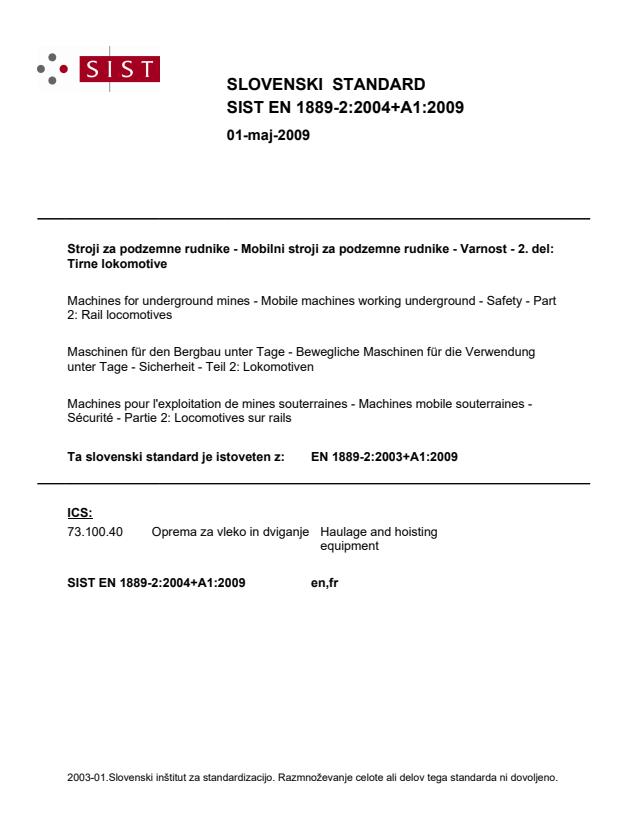
2003-01.Slovenski inštitut za standardizacijo. Razmnoževanje celote ali delov tega standarda ni dovoljeno.Stroji za podzemne rudnike - Mobilni stroji za podzemne rudnike - Varnost - 2. del: Tirne lokomotiveMaschinen für den Bergbau unter Tage - Bewegliche Maschinen für die Verwendung unter Tage - Sicherheit - Teil 2: LokomotivenMachines pour l'exploitation de mines souterraines - Machines mobile souterraines - Sécurité - Partie 2: Locomotives sur railsMachines for underground mines - Mobile machines working underground - Safety - Part 2: Rail locomotives73.100.40Oprema za vleko in dviganjeHaulage and hoisting equipmentICS:Ta slovenski standard je istoveten z:EN 1889-2:2003+A1:2009SIST EN 1889-2:2004+A1:2009en,fr01-maj-2009SIST EN 1889-2:2004+A1:2009SLOVENSKI
STANDARD
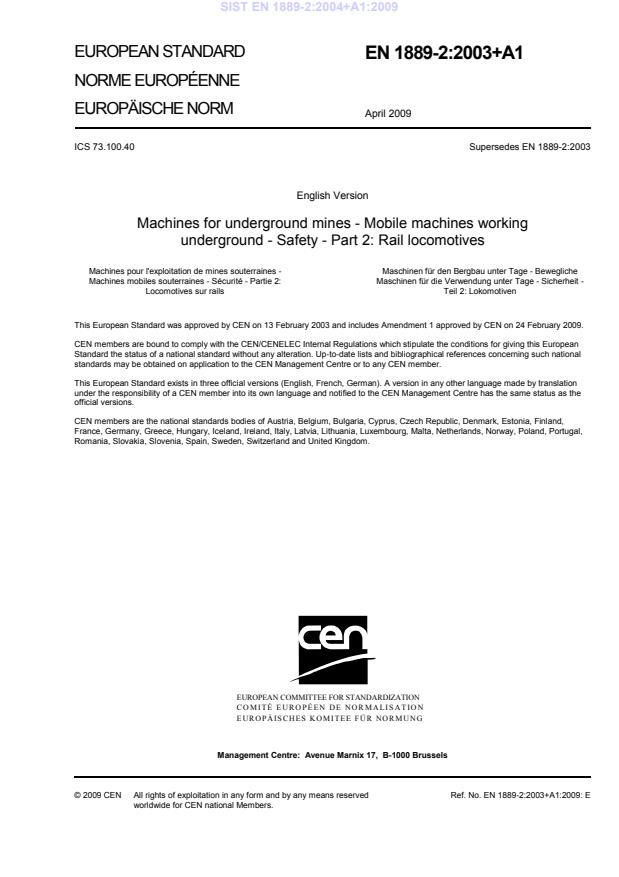
EUROPEAN STANDARD NORME EUROPÉENNE EUROPÄISCHE NORM
EN 1889-2:2003+A1
April 2009 ICS 73.100.40 Supersedes EN 1889-2:2003English Version
Machines for underground mines - Mobile machines working underground - Safety - Part 2: Rail locomotives
Machines pour l'exploitation de mines souterraines - Machines mobiles souterraines - Sécurité - Partie 2: Locomotives sur rails
Maschinen für den Bergbau unter Tage - Bewegliche Maschinen für die Verwendung unter Tage - Sicherheit - Teil 2: Lokomotiven This European Standard was approved by CEN on 13 February 2003 and includes Amendment 1 approved by CEN on 24 February 2009.
CEN members are bound to comply with the CEN/CENELEC Internal Regulations which stipulate the conditions for giving this European Standard the status of a national standard without any alteration. Up-to-date lists and bibliographical references concerning such national standards may be obtained on application to the CEN Management Centre or to any CEN member.
This European Standard exists in three official versions (English, French, German). A version in any other language made by translation under the responsibility of a CEN member into its own language and notified to the CEN Management Centre has the same status as the official versions.
CEN members are the national standards bodies of Austria, Belgium, Bulgaria, Cyprus, Czech Republic, Denmark, Estonia, Finland, France, Germany, Greece, Hungary, Iceland, Ireland, Italy, Latvia, Lithuania, Luxembourg, Malta, Netherlands, Norway, Poland, Portugal, Romania, Slovakia, Slovenia, Spain, Sweden, Switzerland and United Kingdom.
EUROPEAN COMMITTEE FOR STANDARDIZATION
COMITÉ EUROPÉEN DE NORMALISATION EUROPÄISCHES KOMITEE FÜR NORMUNG
Management Centre:
Avenue Marnix 17,
B-1000 Brussels © 2009 CEN All rights of exploitation in any form and by any means reserved worldwide for CEN national Members. Ref. No. EN 1889-2:2003+A1:2009: ESIST EN 1889-2:2004+A1:2009
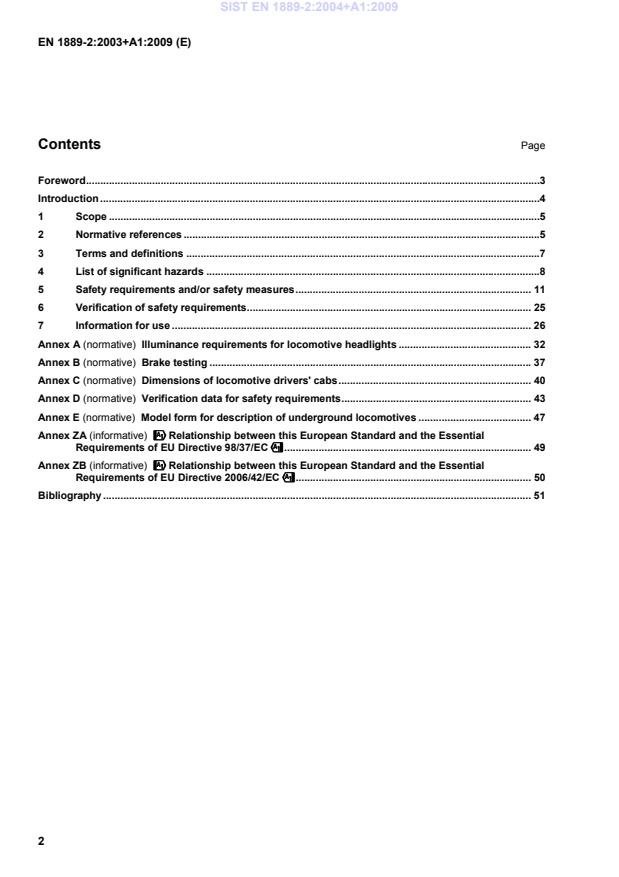
Illuminance requirements for locomotive headlights . 32 Annex B (normative)
Brake testing . 37 Annex C (normative)
Dimensions of locomotive drivers' cabs . 40 Annex D (normative)
Verification data for safety requirements . 43 Annex E (normative)
Model form for description of underground locomotives . 47 Annex ZA (informative)
!!!!Relationship between this European Standard and the Essential Requirements of EU Directive 98/37/EC"""" . 49 Annex ZB (informative)
!!!!Relationship between this European Standard and the Essential Requirements of EU Directive 2006/42/EC"""" . 50 Bibliography . 51
1.3 This European standard does not deal with radiation and vibration.
It does not address remote control locomotives or operation in potentially explosive atmospheres.
Hazards due to noise are excluded from this standard, but a separate standard is in preparation where hazards due to noise will be addressed. 1.4 This European standard applies to locomotives which are manufactured after the date of issue of this standard.
2 Normative references This European Standard incorporates by dated or undated reference, provisions from other publications. These normative references are cited at the appropriate places in the text, and the publications are listed hereafter. For dated references, subsequent amendments to or revisions of any of these publications apply to this European Standard only when incorporated in it by amendment or revision. For undated references the latest edition of the publication referred to applies (including amendments). EN 292-1:1991, Safety of machinery — Basic concepts, general principles for design - Part 1: Basic terminology, methodology EN 292-2:1991 + EN 292-2:1991/A1:1995, Safety of machinery — Basic concepts, general principles for design — Part 2: Technical principles and specifications EN 294, Safety of machinery — Safety distances to prevent danger zones being reached by the upper limbs
EN 349, Safety of machinery — Minimum gaps to avoid crushing of parts of the human body EN 418:1992, Safety of Machinery — Emergency stop equipment, functional aspects — Principles for design EN 457, Safety of machinery — Auditory danger signals — General requirements, design and testing (ISO 7731:1986, modified) EN 547-1, Safety of machinery — Human body measurements — Part 1: Principles for determining the dimensions required for openings for whole body access into machinery
EN 547-2, Safety of machinery — Human body measurements — Part 2: Principles for determining the dimensions required for access openings
EN 547-3, Safety of machinery — Human body measurements — Part 3: Anthropometric data EN 563, Safety of machinery — Temperatures of touchable surfaces — Ergonomics data to establish temperature limit values for hot surfaces SIST EN 1889-2:2004+A1:2009
EN 954-1, Safety of machinery — Safety related parts of control systems — Part 1: General principles for design
EN 982, Safety of machinery — Safety requirements for fluid power systems and their components — Hydraulics EN 983, Safety of machinery — Safety requirements for fluid power systems and their components — Pneumatics EN 1050:1996, Safety of machinery – Principles for risk assessment EN 1070:1998, Safety of machinery — Terminology EN 1679-1, Reciprocating internal combustion engines — Safety — Part 1: Compression ignition engines EN 13202:2000, Ergonomics of the thermal environment — Temperatures of touchable hot surfaces - Guidance for establishing surface temperature limit values in production standards with the aid of EN 563 EN 60204-1:1998, Safety of Machinery — Electrical equipment of machines — Part 1: General requirements EN ISO 3411, Earth-moving machinery — Human physical dimensions of operators and minimum operator space envelope (ISO 3411:1995) EN ISO 8030, Rubber and plastic hoses — Method of test for flammability ISO 1813, Belt drives — V-ribbed belts, joined V-belts and V-belts including wide section belts and hexagonal belts — Electrical conductivity of antistatic belts: Characteristics and methods of test ISO 3864, Safety colours and safety signs ISO 6405-1, Operation and maintenance of earth moving machinery — Specification for common symbols for operator controls and other displays ISO 6405-2, Earth-moving machinery – Symbols for operator controls and other displays - Part 2: Specific symbols for machines, equipment and accessories ISO 6805, Rubber hoses and hose assemblies for underground mining — Wire-reinforced hydraulic types for coal mining — Specification
IEC 60332-1, Tests on electric cables under fire conditions — Part 1: Test on a single vertical insulated wire or cable
In the extreme case the circumferential speed is zero (wheels locked) 3.7 slipping when the circumferential speed of driven wheels is greater than the speed of the locomotive beyond the normal creep speed of the driven wheels 3.8 battery locomotive electric locomotive which obtains its power from a battery or batteries 3.9 trolley locomotive electric locomotive which obtains its power from a roadway conductor 3.10 battery/trolley (compound) locomotive electric locomotive which obtains its power either from a battery or from a roadway conductor SIST EN 1889-2:2004+A1:2009
3.11 diesel locomotive diesel locomotive which obtains its power from a reciprocating internal combustion engine 3.12 mid-point switch disconnector device designed to disconnect the power of a traction battery at a place where the voltage between the positive take-off lead and the mid-point switch disconnector is approximately equal to that between the mid-point switch disconnector and the negative take-off lead 3.13 braking systems all the elements which combine together to brake and hold the locomotive. Such systems consist of a control, means of power transmission and the brake itself 3.13.1 service braking system primary system used for stopping and holding the locomotive 3.13.2 emergency braking system additional braking system other than the service braking system, that can be applied manually or automatically to stop the locomotive 3.13.3 parking braking system system used to hold a stopped locomotive in the stationary condition 3.14 firedamp flammable gas, consisting mainly of methane, found naturally in mines 4 List of significant hazards Table 1 contains all the significant hazards, hazardous situations and events, as far as they are dealt with in this standard, identified by risk assessment as significant for this type of machinery and which require action to eliminate or reduce the risk.
Table 1 — List of significant hazards with associated requirements
EN 1050:1996,
annex A Hazards according to EN 1050:1996, annex A Relevant clause/subclause of this standard
1 Mechanical hazards due to:5.1, 5.1.7, 5.2, 5.3, 5.13
- machine parts or workpieces, e.g.:
a) shape;
b) relative location;
c) mass and stability;
e) inadequacy of mechanical strength; 1.1 Crushing hazard 5.1.2, 5.1.3, 5.3, 5.13 1.2 Shearing hazard 5.1.2, 5.1.3, 5.3, 5.13 1.3 Cutting or severing hazard 5.1.2, 5.1.3, 5.13 1.4 Entanglement hazard 5.1.2, 5.1.3 1.5 Drawing-in or trapping hazard 5.1.2, 5.1.3, 5.13 1.6 Impact hazard 5.1.2, 5.1.3, 5.1.5, 5.3, 5.13 1.7 Stabbing or puncture hazard 5.1.2, 5.1.3, 5.13 1.8 Friction or abrasion hazard 5.1.2, 5.1.3, 5.13 1.9 High pressure fluid injection or ejection hazard 5.4.1, 5.4.2 2 Electrical hazard due to: 2.1 Contact of person with live parts (direct contact) 5.5 2.2 Contact of person with parts which have become live under faulty conditions (indirect contact) 5.5 2.4 Electrostatic phenomena 5.5.1 3 Thermal hazards, resulting in:
3.1 Burns and scalds by contact with objects or materials with an extreme high or low temperature, by flames or explosions and also by the radiation of heat sources 5.1, 5.4.1,5.4.2, 5.14 3.2 Damage to health by hot or cold working environment 5.13 7 Hazards generated by materials and substances (and their constituent elements) processed or used by the machinery
7.1 Hazards from contact with or inhalation of harmful fluid, gases, mists, fumes and dusts5.4.1, 5.4.2, 5.6 7.2 Fire or explosion hazard 5.4.2, 5.5, 5.6, 5.7, 5.14 8 Hazards generated by neglecting ergonomic principles in machinery design, e.g. hazards from:
8.1 Unhealthy postures or excessive effort 5.12, 5.13 8.2 Inadequate consideration of hand-arm or foot-leg anatomy 5.13 8.4 Inadequate area lighting 5.8 8.5 Mental overload and underload, stress 5.12 8.6 Human error 5.12
annex A Hazards according to EN 1050:1996, annex A Relevant clause/subclause of this standard 10 Unexpected start-up/over-run/over-speed (or any similar malfunction) from:
10.1 Failure/disorder of control supply
5.4, 5.5, 5.11, 5.12 11 Impossibility of stopping the machine in the best possible conditions 5.10, 5.11 13 Failure of the power supply 5.4, 5.5, 5.6, 5.11, 5.12 14 Failure of the control circuit 5.4, 5.5, 5.11, 5.12 15 Errors of fitting 7.1.1, 7.1.2, 7.1.4 17 Falling or ejected objects or fluids 5.4 18 Loss of stability/overturning of machinery 5.1, 5.2, 5.3, 5.13 20 Relating to the travelling function:
20.1 Movement when starting the engine 5.11,
20.2 Movement without a driver at the driving position 5.11.4.4 20.3 Movement without all parts in a safe position 5.12.1.2 20.5 Excessive oscillations when moving 5.1.4 20.6 Insufficient ability of machinery to be slowed down, stopped and immobilised 5.11, 5.12 21 Linked to the work position (inc. driving station) on machine:
21.1 Fall of persons during access to (or at/from) the work position 5.13.3, 5.13.5 21.2 Exhaust gases/lack of oxygen at the work position 5.6.1, 5.6.2, 5.6.3 21.3 Fire (flammability of the cab, lack of extinguishing means) 5.13, 5.14 21.4 Mechanical hazards at the work position:
c) fall of objects, penetration by objects; 5.13 21.5 Insufficient visibility from the work positions 5.13 21.6 Inadequate lighting 5.8, 5.12.3.5 21.7 Inadequate seating 5.13.7 22 Due to the control system:
22.1 Inadequate location of manual controls 5.12 22.2 Inadequate design of manual controls and their mode of operation 5.12 23 From handling the machine (lack of stability) 5.1.4 24 Due to the power source and to the transmission of power:
24.1 Hazards from the engine and the batteries 5.5, 5.6 24.3 Hazards from couplings and towing 5.1, 5.3 25 From/to third persons:
25.1 Unauthorised start-up/use 5.12
annex A Hazards according to EN 1050:1996, annex A Relevant clause/subclause of this standard
25.3 Lack or inadequacy of visual or acoustic warning means 5.9 26 Insufficient instructions for the driver/operator 7.1, 7.3 29 Hazards generated by neglecting ergonomic principles
5.13.1, 5.13.4, 5.13.6 29.1 Insufficient visibility from the driving position 30 Mechanical hazards/events due to:
30.2 Failing accelerator or brake control of machinery running on rails 5.11, 5.12 30.3 Failing or lack of deadman’s control of machinery running on rails 5.11.1.7 32 Fire and explosion 5.4, 5.5, 5.6, 5.7, 5.14 33 Emission of dust, gases etc. 5.6
5 Safety requirements and/or safety measures 5.1 General/basic requirements 5.1.1 For the application of EN 953, EN 982, EN 983, EN 457, EN 563, EN 547 and EN 60204-1 the manufacturer shall carry out an adequate risk assessment for the requirements thereof where choice is necessary. NOTE This specific risk assessment is part of the general risk assessment relating to the hazards not covered by this C standard. For hazards which are not covered by this standard, machinery shall conform as appropriate to EN 292. 5.1.2 All moving parts, with the exception of the wheels, drive lines and articulation area, shall be provided with guards according to EN 953. Gaps between guards and moving parts shall conform to EN 349 and EN 294. 5.1.3 Where hinged guards or covers can self-close, they shall be fitted with a support system to secure them in the open position. 5.1.4 Locomotives shall be fitted with suspension and shock absorbing systems to ensure that all wheels maintain contact with the rails and to absorb shock loading from the track. In the event of failure of the suspension system, no part of the locomotive shall contact moving parts of the running gear or be below than the upper level of the rails. This also applies to driver's cabs having their own bogie, e.g. driver's cabs of articulated locomotives. NOTE Suspension systems with self-damping, e.g. multi-leaf springs, may not need a separate shock absorbing system. 5.1.5 The front faces of locomotives shall be painted in a safety colour in accordance with ISO 3864. Locomotives shall have facilities for stowing any safety equipment (see also introduction, on negotiations). SIST EN 1889-2:2004+A1:2009
For the parts that require handling during maintenance the temperature of the touchable surface shall be in accordance with EN 563 for 5 s contact time.
Where this limit cannot be achieved, see 7.1.3. Exhaust pipes within reach during operation which exceed the touchable surface temperatures given in EN 13202 for 0,5 s shall be guarded against unintentional contact in accordance with EN 953. 5.1.7 With the exception of couplings and the current collector (for trolley locomotives), all other components shall be contained within the profile of the locomotive such that they are protected against accidental damage. 5.2 Design to facilitate handling Where purpose-designed attachment points are provided they shall be designed to have a calculated minimum factor of safety of 4 on ultimate breaking load in relation to their intended load carrying capacity.
They shall be shaped to suit the lifting means intended by the manufacturer, see 7.1.2. They shall be clearly and permanently marked with their load carrying capacity, e.g. by welding. Where any such attachment points could be used to lift or move the whole locomotive this factor of safety shall relate to the service weight of the locomotive. Articulated locomotives shall be fitted with means to avoid relative movements between parts. 5.3 Couplings
5.3.1 Locomotives shall be equipped with couplings to absorb and to transfer the tensile and compressive forces to the locomotive frame. The couplings and all parts of the locomotive lying in line with it shall be designed with a minimum safety factor of 10 against failure in relation to the maximum drawbar pull of the locomotive (or locomotives where these are designed to be used in tandem), for a minimum coefficient of static friction of 0,25 for steel tyres and 0,40 for rubber or polymer derivative tyres. NOTE Characteristics of the coupling are discussed between the manufacturer and the user, see introduction on negotiation.
5.3.2 In the fully compressed position of the coupling, it shall be possible to move freely a non-deformable sphere of 250 mm diameter between the front face of the locomotive and a vertical plane perpendicular to the longitudinal axis of the locomotive at the extreme end of the coupling. 5.3.3 If it is intended that safety chains are to be used the attachment points of these shall have a minimum breaking strength of not less than 2½ times the weight of the locomotive. 5.4 Fluid power systems 5.4.1 Hydraulic systems 5.4.1.1 Hydraulic systems shall be designed and installed to conform to EN 982. 5.4.1.2 Hydraulic systems (hydrostatic and hydrokinetic) shall be designed to enable non-toxic fluids as defined in the 7th SHCMOEI Report [1] to be used to minimize risks to health. 5.4.1.3 Hydraulic systems (hydrostatic and hydrokinetic) on locomotives shall be designed such that fire-resistant fluids can be used to minimise fire hazards (ISO 7745 and SHCMOEI 7th report) or the following precautions shall be taken for all systems exceeding 10 l total capacity:
a) Hydraulic lines (rigid metal and flexible pipelines) shall be segregated from any unprotected electrical cable or equipment (see 5.5.2.3), or any part of the locomotive, the surface of which, can become SIST EN 1889-2:2004+A1:2009
5.4.1.4 Hydropneumatic accumulators shall conform to EN 982. 5.4.1.5 Reservoirs for hydraulic fluids shall be protected against corrosion, be secured to the locomotive and incorporated in such a way (e.g. inside the rigid structure of the locomotive) that they are protected against mechanical damage. 5.4.1.6 The filling apertures of reservoirs for hydraulic fluids shall be within reach of an operator standing at rail level, otherwise means of access shall be provided.
The filling aperture shall be designed and positioned in such a way that any overflow or escape of hydraulic fluid is prevented under foreseeable operating conditions, including derailment.
Any cap fitted shall be secured to prevent it working loose in service and shall require an intentional action to release it.
When released it shall remain permanently attached to the locomotive. The location and marking of the filling point for any hydraulic system shall be designed to avoid the inadvertent introduction of other substances (e.g. liquid fuel, water, sand) into the hydraulic system. 5.4.1.7 Reservoirs for fluids shall have a drainage device at their lowest point. Provision shall be made for free flow and safe catchment of fluid without coming into the proximity of hot parts or electrical equipment. The design intent shall be to prevent any fluid residues collecting in parts of the locomotive outside the hydraulic system. 5.4.1.8 Hydraulic pressure relief valves shall only allow hydraulic fluid to be discharged back into the system. 5.4.1.9 Hydraulic lines shall be designed as rigid metal lines or as flexible hoses. Materials for hydraulic hoses and their components shall be in accordance with ISO 6805 and shall be fire-resistant so that it will self extinguish within 30 s of removal of the flame in accordance with EN ISO 8030. Safety factors of the hose assembly (including end fittings), shall be 2:1 for the dynamic pressure and 3:1 for burst pressure. Hydraulic lines shall be designed to take into account the relative movement between components. NOTE Where hose reinforced with steel wire is used consideration needs to be given to fatigue aspects.
Hydraulic hoses containing fluid with a pressure exceeding 5 MPa (50 bar) and/or having a temperature exceeding 50 °C and located within 1 m of the driver or operator shall be guarded, see 5.1.1 and 5.1.2.
Parts or components can be considered as guards.
NOTE Line connections should be limited in number and designed to minimise any possibility of leakage during operation. 5.4.1.10 Tanks for hydraulic fluid shall be fitted with a mechanically protected fluid level indicator with at least minimum and maximum operating levels. 5.4.1.11 Means shall be provided to monitor hydraulic fluid temperature and to warn the driver when the fluid temperature approaches the maximum specified by the manufacturer (see also 5.14). SIST EN 1889-2:2004+A1:2009
5.4.2 Pneumatic systems 5.4.2.1 Pneumatic systems shall be designed and installed in accordance with EN 983. 5.4.2.2 Compressors shall be designed to operate either on a lubricant which is resistant to carbonization (e.g. synthetic oils), or fitted with temperature monitoring.
5.4.2.3 A filter shall be incorporated in every compressor air intake system to prevent the ingress of foreign material.
5.5 Electrical equipment 5.5.1 General 5.5.1.1 Electrical equipment shall be designed, manufactured and installed in accordance with EN 60204-1. 5.5.1.2 All electric circuits, except for those cables between the starting battery and starter motor on diesel-powered locomotives, shall be protected by suitable fuses or protective devices in accordance with 7.2 and 7.3 of EN 60204-1:1998. 5.5.1.3 Where the chassis or frame of the locomotive is used as a current-carrying conductor, protection against electric shock by direct contact shall be provided by limitation of voltage on the frame to a maximum of 25 V ac or 60 V dc. (See 6.4 of EN 60204-1:1998). 5.5.2 Cables 5.5.2.1 Cables external to enclosures shall be flexible; the outer sheath shall be flame-retardant, self-extinguishing (in accordance with IEC 60332-1), and chemically resistant to oils and battery electrolyte in accordance with 13.1 of EN 60204-1:1998. In addition, cables for control, communication and monitoring circuits shall also be of adequate mechanical strength in accordance with 13.7.2 of EN 60204-1:1998. 5.5.2.2 All power conductors used in cables shall be manufactured of stranded copper or a material of at least equivalent flexibility and conductivity. 5.5.2.3 All power cables shall be segregated (e.g. by use of mechanical barriers or by a distance of 150 mm) from any fuel, lubrication or hydraulic lines, except where the cable is armoured or otherwise mechanically protected, or where hydraulic or fuel lines and cables terminate at the same components, or where fire resistant fluid is used in the hydraulic lines. 5.5.2.4 Cables shall be installed so that mechanical vibration does not cause their insulation to be worn away (e.g. by rubbing or chaffing) or the enclosed conductors to fail by flexing fatigue. NOTE The use of screen cable in conjunction with leakage to frame monitoring allows the advanced warning of insulation failure which may result in short circuit of the power conductors. 5.5.3 Battery-powered locomotives 5.5.3.1 For battery powered locomotives, a means of off-load isolation shall be provided for the battery. NOTE 1 Commonly this can be achieved by: SIST EN 1889-2:2004+A1:2009
NOTE 2 For changing and re charging the batteries it should only be possible. i) to disconnect the battery sockets and plugs after the switch disconnector has been opened; ii) to connect the battery sockets and plugs before the switch disconnector can be closed. 5.5.3.2 Locomotive traction batteries and their installation shall meet the following requirements: a) The battery terminals and other live parts of the battery shall be protected against contact, e.g. by insulating covers or caps. b) Means shall be provided for battery power to be disconnected by the driver.
Where this means is not located within the reach of the seated driver a remote tripping system shall be provided.
Disconnection of the battery power shall cause the locomotive emergency brake to be applied automatically. c) Switch disconnectors or disconnectors shall operate automatically if an external short-circuit occurs. d) Switch disconnectors shall operate automatically if, in the case of rigid connection (i.e. guided rigid plug and socket) between battery and locomotive, the battery is removed before separating the contacts. e) All circuits on the vehicle shall be connected to the out going side of the switch disconnector, with the exception of the control and lighting circuits, where these do not exceed 24 V. NOTE Nothing in this sub-clause prevents the use of a supplementary switch disconnector to allow auxiliary equipment on the locomotive or coupled vehicles to be powered. 5.5.3.3 Battery containers shall meet the following requirements: a) The battery shall be housed in a robust, vented, fire resistant container which shall be provided with external means to allow it to be lifted or removed from the locomotive without causing damage to the cells. Suitable ventilation openings shall be provided in the battery container, compartment and or cover so that dangerous accumulations of gases do not occur when the equipment is used or moved in accordance with manufacturer’s instructions. In assessing suitable ventilation, accumulations of electrolytic gases shall be kept below 2 % in air to avoid danger of ignition. NOTE These requirements do not apply to recharging, see 7.1.3. b) The finish of internal surfaces of battery containers shall be resistant to the chemical effects of the electrolyte. c) Means shall be provided to allow the battery container to be secured against horizontal movement relative to the locomotive during its operation. Such means shall be capable of withstanding likely external mechanical stresses during normal service. d) Batteries shall be covered.
Metal covers shall be designed to provide an air space of at least 30 mm above the live parts of the battery. SIST EN 1889-2:2004+A1:2009
The cover shall be fitted in such a way that its displacement needs an intentional manual action. f) Means shall be provided to enable the cover of the battery container to be locked in a closed position. g) The cover of the battery container shall be designed to prevent water or solid material from entering the container or blocking any ventilation openings. NOTE A solid top is usually necessary to stop dripping water and solid material dropping from above.
The sides and base should conform to IP 23 of EN 60529:1991 as a minimum. h) Where foreign material and or electrolyte can accumulate on the cell tops or within the container, the container shall be designed to facilitate cleaning.
i) Sparking or hot components which can reach a temperature of 300 °C or more, shall not be located where explosive gas/air mixtures can be present.
Battery connectors shall be accepted as non sparking components provided they are not used as an emergency switching-off device. 5.5.3.4 Indication shall be provided to the driver of the locomotive of the state of charge of the battery, together with a warning device when a state of deep discharge (approximately 50 % of the voltage at full load) is approached. NOTE 1 A higher level of discharge may be needed according to local conditions, see introduction on negotiation. NOTE 2 Additionally, a device can be provided which automatically isolates the battery after a predetermined period if the driver continues to operate the locomotive after the discharge warning is given.
5.5.4 Trolley and compound (i.e. battery/trolley) locomotives 5.5.4.1 It shall be possible to lower and raise current collectors from the driver's cab, without the driver leaving the cab. Means shall be provided for securing the current collector in its lowered position. 5.5.4.2 Current collectors shall be suitable for both directions of travel without needing to be reversed and, unless the collector shoe is laterally restricted, shall be at least 300 mm wide. 5.5.4.3 Trolley contact rollers shall not be used. 5.5.4.4 Live parts of the current collector shall be insulated with the exception of parts in direct contact with the conductor, with an allowance for wear. All other metal parts which are not live shall be electrically bonded to the frame and to the locomotive wheels. The driver's cab shall have a roof so arranged as to prevent the driver making accidental contact with any live conductor when in the cab. 5.5.4.5 The overcurrent protection of traction current cables shall be located as close as possible to the current collector.
The locomotive design shall be such that if the overcurrent protection is activated, the current collector is automatically lowered from the power supply. 5.5.4.6 In the case of compound locomotives the traction circuit shall be designed such that the battery cannot energise the current collector or the overhead conductor under any circumstances. SIST EN 1889-2:2004+A1:2009
5.6 Diesel locomotives 5.6.1 Only reciprocating internal combustion engines shall be used which meet the requirements of EN 1679-1 operating with a fuel with a flash point exceeding 55 °C.
Where locomotives are intended to be used in places with low ventilation flow, engine emission limits shall be reduced (see introduction, negotiation). NOTE For exhaust emission limits, Directive 97/68/EC should to be taken in to account. 5.6.2 Diesel engine exhaust gases shall be directed so as to minimise
penetration into the driver's cab or personnel compartment where this forms part of the locomotive, e.g. by vertical positioning of the exhaust outlet at a point which is not between the seat and roof level of the cab, or by on-board dilution.
Exhaust pipes shall be in a direction where there is least possible harm to surrounding persons during operation, e.g. positioned vertically upwards, or arranged such that the exhaust gas is diluted. 5.6.3 Where the locomotive is intended to be used in atmospheres containing methane (see introduction, negotiation). The emission values shall be given for 0, 0,5, 1,0 and 1,5 % CH4 in the air inlet to the engine.
The measurements shall be done at maximum speed with no load. NOTE The emission test for use in potentially explosive atmospheres should be done with the full flameproof equipment installed or simulated on the engine. 5.6.4 Where batteries are fitted for starting purposes and/or feeding other power circuits, the following apply: a) Batteries shall be positioned and secured to prevent mechanical damage. Spillage of liquid shall not be possible on components of the locomotive. b) Non-sealed batteries shall be housed and, vented.
c) The finish of internal surfaces of battery containers shall be resistant to the chemical effects of the electrolyte. d) The battery terminals shall be protected against contact, e.g. by insulating covers or shrouds. e) A switch disconnector shall be fitted close to the battery. 5.7 Fuel systems 5.7.1 Fuel tanks shall be manufactured from steel, protected against corrosion, fixed to the locomotive and be incorporated in such a way that they are protected against mechanical damage (e.g. inside the rigid structure of the locomotive). The tank shall conform to a pressure tightness test at a minimum pressure of 20
kPa for a period of at least 15 mins, following which no leakage shall be visible. 5.7.2 The filler inlets of fuel tanks shall be easily accessible. The filling aperture shall be designed and positioned in such a way that any overflow or escape of fuel is prevented when on any gradient for which the locomotive is designed. Any cap fitted shall be secured to prevent it working loose in service and shall require an intentional action to release it. When released it shall remain permanently attached to the locomotive. 5.7.3 Fuel tanks shall be vented to maintain atmospheric pressure within the tank by use of a breather filter rated
not greater than 125
µm, and prevent
the ingress of foreign material by use of
a tank filler filter rated not greater than 250 µm.
5.7.4 Fuel tanks shall have a supply shut-off device. See also EN 1679-1. SIST EN 1889-2:2004+A1:2009
Joints shall remain visible.
NOTE Line connections should be minimised in number and be designed to provide reliable protection against leaks during operation. 5.7.7 Fuel tanks shall be fitted with devices in accordance with 5.4.1.7. 5.8 Lighting 5.8.1 Locomotives shall be equipped for each direction of travel with at least one white headlight, at least one taillight, a parking light and at least one durable red reflector. NOTE 1 The head and taillights may be separate units or combined in one unit. NOTE 2 The taillights may also be used as parking lights. 5.8.2 Provision shall be made for adjustment of the direction of the headlight beam. Adjustment shall only be possible by using a tool.
5.8.3 The glasses of the lights and the reflectors shall be easily cleanable. 5.8.4 The taillights at each end of the locomotive shall be switched on automatically whenever the locomotive is energized.
5.8.5 Headlights shall conform to annex A for illuminance.
5.8.6 The taillight shall be rated at a minimum of 5 W. Any parking lights shall also be rated at a minimum of 5 W. 5.9 Audible warning Locomotives shall be equipped with a device to give a clearly audible warning of approach to personnel in the locomotive’s path.
Audible warnings shall conform to EN 457. It shall be possible to operate the means of audible warning from each driving position. 5.10 Sanding device 5.10.1 Locomotives, with the exception of trolley and compound locomotives, shall be equipped with a sanding device which can be operated from any driving position. The minimum requirement is for the sanding to be directed for the benefit of the braked wheels of the first axle in the direction of travel. NOTE Sanding devices are not usually fitted to trolley and compound locomotives as this can form an insulating layer between the locomotive wheels and the rails forming the current return path.
5.10.2 The sandboxes shall be designed to prevent the entry of moisture and impurities. It shall be easy to fill the sandboxes and to remove
...