

SIST EN 14319-1:2013
(Main)Thermal insulating products for building equipment and industrial installations - In-situ formed dispensed rigid polyurethane (PUR) and polyisocyanurate foam (PIR) products - Part 1: Specification for the rigid foam dispensed system before installation
General Information
- Abstract
This European Standard specifies requirements for in-situ formed dispensed rigid polyurethane (PUR) and polyisocyanurate (PIR) foam products for the insulation of building equipment and industrial installations, for example industrial storage vessels, pipes and ducts used for the supply of fuels, oil, other liquids, hot and cold water, air and other gases.
Depending on the type of foam products complying with this standard, they may have service temperature ranges which lie within the limits of ± 200 °C.
This Part 1 of this European Standard is a specification for the rigid foam system before installation.
Part 1 of this European Standard describes the product characteristics and it includes procedures for testing, marking and labelling and the rules for evaluation of conformity.
This European Standard does not specify the required levels of all properties to be achieved by a product to demonstrate fitness for purpose in a particular end-use application. The required levels are to be found in regulations or non-conflicting standards.
This European Standard does not cover factory made rigid polyurethane or polyisocyanurate foam insulation products or in-situ products intended to be used for the insulation of buildings.
This European Standard does not specify performance requirements for direct airborne sound insulation and acoustic absorption applications.
NOTE Foam products are either called flexible or rigid. The flexible products are used in upholstery and mattresses and are characterised by their ability to deflect, support and recover to their original thickness continually during their in-use phase. Those that are not flexible are termed rigid and do not possess these flexible characteristics. They are mostly used for thermal insulation purposes and vary widely in their compression strength values. Once the cell structure is crushed in a rigid foam, it does not recover its thickness fully. Some of these rigid foams are very low in density with very low compression strengths and are sometimes described "commercially" as "soft foams" or "semi-rigid" foams. This note has been included to clarify that all foams with such descriptions are covered by this standard’s used of the term rigid foam.
- Status
- Published
- Public Enquiry End Date
- 31-Oct-2012
- Publication Date
- 05-Jun-2013
- Technical Committee
- TOP - Thermal insulation
- Current Stage
- 6060 - National Implementation/Publication (Adopted Project)
- Start Date
- 23-Apr-2013
- Due Date
- 28-Jun-2013
- Completion Date
- 06-Jun-2013
- Directive
- 305/2011 - Regulation (eu) No 305/2011 of the European Parliament and of the Council of 9 march 2011 laying down harmonised conditions for the marketing of construction products and repealing council directive 89/106/eecOJ Ref: C 259 OJ Date: 08-Aug-2014
89/106/EEC - Construction productsOJ Ref: C 186 OJ Date: 28-Jun-2013

Overview - EN 14319-1:2013 (rigid PUR/PIR in-situ foam systems)
EN 14319-1:2013 is the CEN European Standard that specifies the requirements for in-situ formed dispensed rigid polyurethane (PUR) and polyisocyanurate (PIR) foam systems before installation. It covers product characteristics, required test and sampling procedures, marking and labelling, and rules for evaluation of conformity for foam systems used to thermally insulate building equipment and industrial installations (for example, storage vessels, pipes and ducts for fuels, oil, liquids, hot/cold water, air and other gases). Depending on the foam type, service temperatures may range across values up to about ±200 °C. This Part 1 document is the pre-installation (system) specification and is intended to be used together with Part 2 (installed product specification).
Key topics and technical requirements
- Scope and limits: Applies to in‑situ dispensed rigid PUR/PIR systems for technical building services and industrial installations; it does not cover factory-made rigid foam products or in-situ products intended for general building insulation.
- Product characteristics: Defines required product information and characteristics to be declared for system components prior to installation.
- Testing and test methods: Includes procedures for sampling, conditioning and specific tests (see annexes) covering thermal conductivity and aged thermal resistance, reaction profile and free-rise density, adhesion to substrates, reference density and other relevant measurements.
- Durability and ageing: Provides methods to determine initial and accelerated-aged thermal conductivity values and procedures to establish “safe” aged conductivity curves versus temperature.
- Reaction to fire: Contains normative annexes addressing reaction-to-fire testing for products and for standardized assemblies simulating end‑use applications.
- Conformity and factory control: Sets rules for initial type testing (ITT), factory production control (FPC) and evaluation of conformity required for market placement.
- Marking and CE: Specifies marking, labelling and technical documentation requirements; Annex ZA addresses links with EU Construction Products Directive and CE marking obligations.
Practical applications
- Thermal insulation of industrial storage vessels, process pipework, ducts and technical building services carrying fuels, oils, liquids, air and gases.
- Applications requiring on‑site (in-situ) dispensing and forming of rigid PU/PIR foam where tailored insulation thickness and shape are needed.
- Situations with a wide service temperature range where system selection and validated aged thermal performance are important.
Who should use EN 14319-1:2013
- Foam system manufacturers and formulators preparing pre‑installation product specifications
- Specifiers, consulting engineers and designers of industrial thermal insulation systems
- Installers and contractors performing on‑site dispensing of rigid PUR/PIR foam
- Testing laboratories, certification bodies and compliance officers managing ITT and FPC
- Procurement teams and asset owners requiring documented conformity and CE marking
Related standards
- EN 14319-2 (Part 2): Specification for the installed insulation products - to be used alongside Part 1 for end‑use application requirements
- Annex ZA of EN 14319-1: links to EU Construction Products Directive and CE marking requirements
Keywords: EN 14319-1:2013, rigid polyurethane, polyisocyanurate, in-situ formed dispensed foam, thermal insulation, industrial installations, testing, conformity, CE marking.
Relations
- Effective Date
- 05-Aug-2026
- Effective Date
- 22-Jul-2026
- Effective Date
- 28-Jan-2026
- Effective Date
- 28-Jan-2026
- Effective Date
- 28-Jan-2026
- Effective Date
- 28-Jan-2026
- Effective Date
- 28-Jan-2026
- Effective Date
- 28-Jan-2026
- Effective Date
- 28-Jan-2026
- Effective Date
- 28-Jan-2026
- Effective Date
- 28-Jan-2026
- Effective Date
- 28-Jan-2026
- Effective Date
- 28-Jan-2026
- Effective Date
- 28-Jan-2026
- Effective Date
- 28-Jan-2026
Get Certified
Connect with accredited certification bodies for this standard

DIBt (Deutsches Institut für Bautechnik)
German Institute for Building Technology.
DIN CERTCO
DIN Group product certification.

Aboma Certification B.V.
Specialized in construction, metal, and transport sectors.
Sponsored listings
Frequently Asked Questions
SIST EN 14319-1:2013 is a standard published by the Slovenian Institute for Standardization (SIST). Its full title is "Thermal insulating products for building equipment and industrial installations - In-situ formed dispensed rigid polyurethane (PUR) and polyisocyanurate foam (PIR) products - Part 1: Specification for the rigid foam dispensed system before installation". This standard covers: This European Standard specifies requirements for in-situ formed dispensed rigid polyurethane (PUR) and polyisocyanurate (PIR) foam products for the insulation of building equipment and industrial installations, for example industrial storage vessels, pipes and ducts used for the supply of fuels, oil, other liquids, hot and cold water, air and other gases. Depending on the type of foam products complying with this standard, they may have service temperature ranges which lie within the limits of ± 200 °C. This Part 1 of this European Standard is a specification for the rigid foam system before installation. Part 1 of this European Standard describes the product characteristics and it includes procedures for testing, marking and labelling and the rules for evaluation of conformity. This European Standard does not specify the required levels of all properties to be achieved by a product to demonstrate fitness for purpose in a particular end-use application. The required levels are to be found in regulations or non-conflicting standards. This European Standard does not cover factory made rigid polyurethane or polyisocyanurate foam insulation products or in-situ products intended to be used for the insulation of buildings. This European Standard does not specify performance requirements for direct airborne sound insulation and acoustic absorption applications. NOTE Foam products are either called flexible or rigid. The flexible products are used in upholstery and mattresses and are characterised by their ability to deflect, support and recover to their original thickness continually during their in-use phase. Those that are not flexible are termed rigid and do not possess these flexible characteristics. They are mostly used for thermal insulation purposes and vary widely in their compression strength values. Once the cell structure is crushed in a rigid foam, it does not recover its thickness fully. Some of these rigid foams are very low in density with very low compression strengths and are sometimes described "commercially" as "soft foams" or "semi-rigid" foams. This note has been included to clarify that all foams with such descriptions are covered by this standard’s used of the term rigid foam.
This European Standard specifies requirements for in-situ formed dispensed rigid polyurethane (PUR) and polyisocyanurate (PIR) foam products for the insulation of building equipment and industrial installations, for example industrial storage vessels, pipes and ducts used for the supply of fuels, oil, other liquids, hot and cold water, air and other gases. Depending on the type of foam products complying with this standard, they may have service temperature ranges which lie within the limits of ± 200 °C. This Part 1 of this European Standard is a specification for the rigid foam system before installation. Part 1 of this European Standard describes the product characteristics and it includes procedures for testing, marking and labelling and the rules for evaluation of conformity. This European Standard does not specify the required levels of all properties to be achieved by a product to demonstrate fitness for purpose in a particular end-use application. The required levels are to be found in regulations or non-conflicting standards. This European Standard does not cover factory made rigid polyurethane or polyisocyanurate foam insulation products or in-situ products intended to be used for the insulation of buildings. This European Standard does not specify performance requirements for direct airborne sound insulation and acoustic absorption applications. NOTE Foam products are either called flexible or rigid. The flexible products are used in upholstery and mattresses and are characterised by their ability to deflect, support and recover to their original thickness continually during their in-use phase. Those that are not flexible are termed rigid and do not possess these flexible characteristics. They are mostly used for thermal insulation purposes and vary widely in their compression strength values. Once the cell structure is crushed in a rigid foam, it does not recover its thickness fully. Some of these rigid foams are very low in density with very low compression strengths and are sometimes described "commercially" as "soft foams" or "semi-rigid" foams. This note has been included to clarify that all foams with such descriptions are covered by this standard’s used of the term rigid foam.
SIST EN 14319-1:2013 is classified under the following ICS (International Classification for Standards) categories: 91.100.60 - Thermal and sound insulating materials. The ICS classification helps identify the subject area and facilitates finding related standards.
SIST EN 14319-1:2013 has the following relationships with other standards: It is inter standard links to SIST EN 13238:2026, SIST EN 312:2011, SIST EN 508-1:2021, SIST EN 13823:2011, SIST EN ISO 9229:2008, SIST EN ISO 1716:2018, SIST EN ISO 12624:2022, SIST EN ISO 13787:2003, SIST EN 13501-1:2019, SIST EN ISO 29466:2023, SIST EN ISO 11925-2:2011, SIST EN ISO 1182:2020, SIST EN 826:1997, SIST EN 14308:2010, SIST EN 13172:2012. Understanding these relationships helps ensure you are using the most current and applicable version of the standard.
SIST EN 14319-1:2013 is associated with the following European legislation: EU Directives/Regulations: 305/2011, 89/106/EEC; Standardization Mandates: M/103. When a standard is cited in the Official Journal of the European Union, products manufactured in conformity with it benefit from a presumption of conformity with the essential requirements of the corresponding EU directive or regulation.
SIST EN 14319-1:2013 is available in PDF format for immediate download after purchase. The document can be added to your cart and obtained through the secure checkout process. Digital delivery ensures instant access to the complete standard document.
Standards Content (Sample)
2003-01.Slovenski inštitut za standardizacijo. Razmnoževanje celote ali delov tega standarda ni dovoljeno.Toplotnoizolacijski proizvodi za opremo stavb in industrijske inštalacije - Proizvodi iz trde poliuretanske pene (PUR) in poliizocianuratne pene (PIR), oblikovani na mestu vgradnje - 1. del: Specifikacija penastega sistema pred vgradnjoWärmedämmstoffe für die technische Gebäudeausrüstung und für betriebstechnische Anlagen in der Industrie - An der Verwendungsstelle hergestellte Wärmedämmung aus dispensiertem Polyurethan (PUR)- und Polyisocyanurat (PIR)-Hartschaum - Teil 1: Spezifikation für das Schaumsystem vor dem EinbauProduits d'isolation thermique destinés aux applications du bâtiment et aux installations industrielles - Produits en mousse rigide de polyuréthanne (PUR) et de polyisocyanurate (PIR) injectée, formés en place - Partie 1: Spécifications relatives aux systèmes d'injection du polyuréthanne et du polyisocyanurate rigide avant mise en œuvreThermal insulating products for building equipment and industrial installations - In-situ formed dispensed rigid polyurethane (PUR) and polyisocyanurate foam (PIR) products - Part 1: Specification for the rigid foam dispensed system before installation91.100.60Thermal and sound insulating materialsICS:Ta slovenski standard je istoveten z:EN 14319-1:2013SIST EN 14319-1:2013en,fr,de01-julij-2013SIST EN 14319-1:2013SLOVENSKI
STANDARD
EUROPEAN STANDARD NORME EUROPÉENNE EUROPÄISCHE NORM
EN 14319-1
January 2013 ICS 91.100.60 English Version
Thermal insulating products for building equipment and industrial installations - In-situ formed dispensed rigid polyurethane (PUR) and polyisocyanurate foam (PIR) products - Part 1: Specification for the rigid foam dispensed system before installation
Produits d'isolation thermique destinés aux applications du bâtiment et aux installations industrielles - Produits en mousse rigide de polyuréthanne (PUR) et de polyisocyanurate (PIR) injectée, formés en place - Partie 1: Spécifications relatives aux systèmes d'injection du polyuréthanne et du polyisocyanurate rigide avant mise en œuvre
Wärmedämmstoffe für die technische Gebäudeausrüstung und für betriebstechnische Anlagen in der Industrie - An der Verwendungsstelle hergestellter Wärmedämmstoff aus Polyurethan (PUR)- und Polyisocyanurat (PIR)-Gießschaum - Teil 1: Spezifikation für das Schaumsystem vor dem Einbau This European Standard was approved by CEN on 24 November 2012.
CEN members are bound to comply with the CEN/CENELEC Internal Regulations which stipulate the conditions for giving this European Standard the status of a national standard without any alteration. Up-to-date lists and bibliographical references concerning such national standards may be obtained on application to the CEN-CENELEC Management Centre or to any CEN member.
This European Standard exists in three official versions (English, French, German). A version in any other language made by translation under the responsibility of a CEN member into its own language and notified to the CEN-CENELEC Management Centre has the same status as the official versions.
CEN members are the national standards bodies of Austria, Belgium, Bulgaria, Croatia, Cyprus, Czech Republic, Denmark, Estonia, Finland, Former Yugoslav Republic of Macedonia, France, Germany, Greece, Hungary, Iceland, Ireland, Italy, Latvia, Lithuania, Luxembourg, Malta, Netherlands, Norway, Poland, Portugal, Romania, Slovakia, Slovenia, Spain, Sweden, Switzerland, Turkey and United Kingdom.
EUROPEAN COMMITTEE FOR STANDARDIZATION
COMITÉ EUROPÉEN DE NORMALISATION EUROPÄISCHES KOMITEE FÜR NORMUNG
Management Centre:
Avenue Marnix 17,
B-1000 Brussels © 2013 CEN All rights of exploitation in any form and by any means reserved worldwide for CEN national Members. Ref. No. EN 14319-1:2013: ESIST EN 14319-1:2013
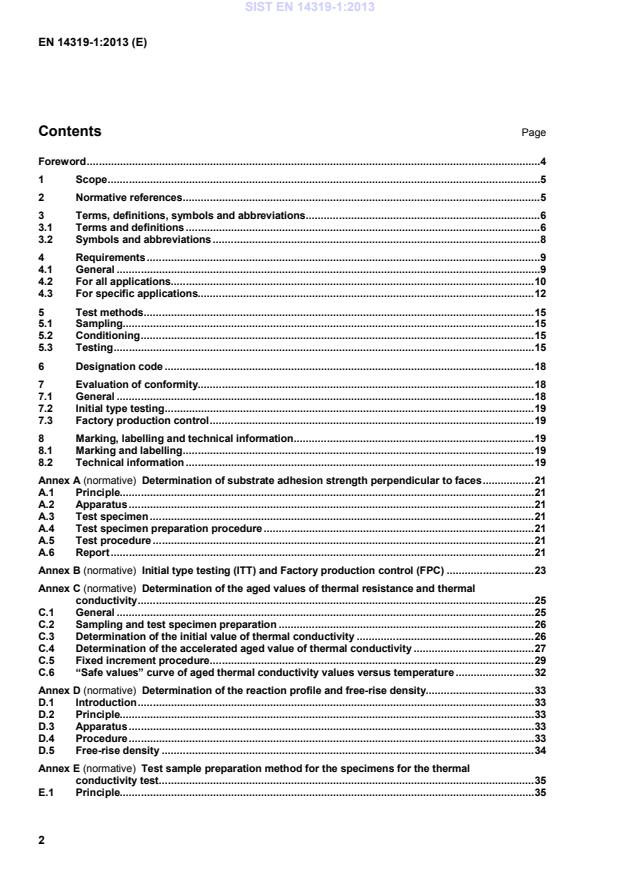
Determination of substrate adhesion strength perpendicular to faces . 21 A.1 Principle. 21 A.2 Apparatus . 21 A.3 Test specimen . 21 A.4 Test specimen preparation procedure . 21 A.5 Test procedure . 21 A.6 Report . 21 Annex B (normative)
Initial type testing (ITT) and Factory production control (FPC) . 23 Annex C (normative)
Determination of the aged values of thermal resistance and thermal conductivity . 25 C.1 General . 25 C.2 Sampling and test specimen preparation . 26 C.3 Determination of the initial value of thermal conductivity . 26 C.4 Determination of the accelerated aged value of thermal conductivity . 27 C.5 Fixed increment procedure . 29 C.6 “Safe values” curve of aged thermal conductivity values versus temperature . 32 Annex D (normative)
Determination of the reaction profile and free-rise density. 33 D.1 Introduction . 33 D.2 Principle. 33 D.3 Apparatus . 33 D.4 Procedure . 33 D.5 Free-rise density . 34 Annex E (normative)
Test sample preparation method for the specimens for the thermal conductivity test . 35 E.1 Principle. 35 SIST EN 14319-1:2013
Determination of the reference density . 36 F.1 Principle . 36 F.2 Procedure . 36 F.3 Measurement of the reference density . 36 Annex G (normative)
Test sample preparation method for the test specimens other than for determining thermal conductivity . 37 G.1 Principle . 37 G.2 Procedure . 37 Annex H (normative)
Reaction to fire of the product . 38 H.1 Scope . 38 H.2 Product and installation parameters . 38 H.3 Mounting and fixing . 39 H.4 Field of application . 41 Annex I (normative)
Reaction to fire of the products in standardised assemblies simulating end-use applications . 43 I.1 Scope . 43 I.2 Product and installation parameters . 43 I.3 Mounting and fixing . 44 I.4 Field of application . 47 Annex ZA (informative)
Clause of this European Standard addressing the provisions of the EU Construction Products Directive . 50 ZA.1 Scope and relevant characteristics . 50 ZA.2 Procedure for attestation of conformity of in-situ formed dispensed rigid polyurethane (PUR) and rigid polyisocyanurate foam (PIR) products. 52 ZA.3 CE Marking and labelling . 55 Bibliography . 57
According to the CEN/CENELEC Internal Regulations, the national standards organizations of the following countries are bound to implement this European Standard: Austria, Belgium, Bulgaria, Croatia, Cyprus, Czech Republic, Denmark, Estonia, Finland, Former Yugoslav Republic of Macedonia, France, Germany, Greece, Hungary, Iceland, Ireland, Italy, Latvia, Lithuania, Luxembourg, Malta, Netherlands, Norway, Poland, Portugal, Romania, Slovakia, Slovenia, Spain, Sweden, Switzerland, Turkey and the United Kingdom. SIST EN 14319-1:2013
1 Scope This European Standard specifies requirements for in-situ formed dispensed rigid polyurethane (PUR) and polyisocyanurate (PIR) foam products for the insulation of building equipment and industrial installations, for example industrial storage vessels, pipes and ducts used for the supply of fuels, oil, other liquids, hot and cold water, air and other gases. Depending on the type of foam products complying with this standard, they may have service temperature ranges which lie within the limits of ± 200 °C. This Part 1 of this European Standard is a specification for the rigid foam system before installation. Part 1 of this European Standard describes the product characteristics and it includes procedures for testing, marking and labelling and the rules for evaluation of conformity. This European Standard does not specify the required levels of all properties to be achieved by a product to demonstrate fitness for purpose in a particular end-use application. The required levels are to be found in regulations or non-conflicting standards. This European Standard does not cover factory made rigid polyurethane or polyisocyanurate foam insulation products or in-situ products intended to be used for the insulation of buildings. This European Standard does not specify performance requirements for direct airborne sound insulation and acoustic absorption applications. NOTE Foam products are either called flexible or rigid. The flexible products are used in upholstery and mattresses and are characterised by their ability to deflect, support and recover to their original thickness continually during their in-use phase. Those that are not flexible are termed rigid and do not possess these flexible characteristics. They are mostly used for thermal insulation purposes and vary widely in their compression strength values. Once the cell structure is crushed in a rigid foam, it does not recover its thickness fully. Some of these rigid foams are very low in density with very low compression strengths and are sometimes described “commercially” as “soft foams” or “semi-rigid” foams. This note has been included to clarify that all foams with such descriptions are covered by this standard’s used of the term rigid foam. 2 Normative references The following documents, in whole or in part, are normatively referenced in this document and are indispensable for its application. For dated references, only the edition cited applies. For undated references, the latest edition of the referenced document (including any amendments) applies. EN 312, Particleboards — Specifications EN 508-1, Roofing products from metal sheet — Specification for self-supporting products of steel, aluminium or stainless steel sheet — Part 1: Steel EN 520, Gypsum plasterboards — Definitions, requirements and test methods EN 823, Thermal insulating products for building applications — Determination of thickness
EN 826:1996, Thermal insulating products for building applications — Determination of compression behaviour EN 1602, Thermal insulating products for building applications — Determination of the apparent density EN 1604, Thermal insulating products for building applications — Determination of dimensional stability under specified temperature and humidity conditions SIST EN 14319-1:2013
EN 14308:2009, Thermal insulation products for building equipment and industrial installations — Factory made rigid polyurethane foam (PUR) and polyisocyanurate foam (PIR) products — Specification EN 14706, Thermal insulating products for building equipment and industrial installations — Determination of maximum service temperature EN ISO 1182, Reaction to fire tests for products — Non-combustibility test (ISO 1182) EN ISO 1716, Reaction to fire tests for products — Determination of the gross heat of combustion (calorific value) (ISO 1716) EN ISO 9229:2007, Thermal insulation — Vocabulary (ISO 9229:2007) EN ISO 11925-2:2010, Reaction to fire tests — Ignitability of products subjected to direct impingement of flame — Single-flame source test (ISO 11925-2:2010) EN ISO 13787, Thermal insulation products for building equipment and industrial installations — Determination of declared thermal conductivity (ISO 13787) ISO 4590, Rigid cellular plastics — Determination of the volume percentage of open cells and of closed cells 3 Terms, definitions, symbols and abbreviations 3.1 Terms and definitions For the purposes of this document, the terms and definitions given in EN ISO 9229:2007 and the following apply. SIST EN 14319-1:2013
polyurethane foam PUR
(in-situ formed products) rigid cellular plastics insulation material or product with a structure based on polymers mainly of the polyurethane type 3.1.2 polyisocyanurate foam PIR
(in-situ formed products) rigid cellular plastics insulation material or product with a structure based on polymers mainly of the polyisocyanurate type 3.1.3 polyurethane foam PU rigid cellular plastics insulation materials or products including both polymer types based mainly on polyurethane (PUR) or mainly on polyisocyanurate (PIR) groups 3.1.4 rigid foam dispensing system kit of constituent components which when dispensed generates the rigid polyurethane (PUR) or the rigid polyisocyanurate foam (PIR) characterised by the specified properties of the foam generated 3.1.5 isocyanate component liquid isocyanate material which is one of the components of the rigid foam system 3.1.6 polyol component liquid polyhydroxyl compound containing an expanding agent, catalysts and other additives which is one of the components of the foam system 3.1.7 cream time time which has elapsed between the time at which the stirring procedure for the mixed components was started and the moment when the foam is observed as starting to rise (usually measured in seconds) 3.1.8 gel time time which has elapsed between the time at which the stirring procedure for the mixed components was started and the moment when, by means of a rod (or a match) applied into the surface of the foam, a polymeric string can be drawn from the foam surface (usually measured in seconds) 3.1.9 tack-free time time which has elapsed between the time at which the stirring procedure for the mixed components was started and the moment when the middle of the top surface of the foam is no longer tacky to the touch 3.1.10 free-rise density density of the unfaced cut test specimen taken from the reaction profile test sample (see D.5) 3.1.11 mixing ratio proportions of the components of the rigid foam dispensing system specified by the manufacturer to be dispensed to generate the rigid polyurethane or polyisocyanurate foam Note 1 to entry: This can be expressed either as a weight or a volume ratio or both. SIST EN 14319-1:2013
mm ∆0l is the relative change in length
% ∆0b is the relative change in width
% ∆0d is the relative change in thickness
% λI is one test result of thermal conductivity
W/(m·K) ûλa is the ageing increment from measured aged values of thermal conductivity
W/(m·K) ûλf is the fixed ageing increment
W/(m·K) λD is the declared thermal conductivity (aged)
W/(m·K) µ is the water vapour diffusion resistance factor
- n
is the number of test results
- σ10 is the compressive stress at 10 % deformation
kPa σm is the compressive strength
kPa w
is the soluble chloride ion content
mg/kg SIST EN 14319-1:2013
is the symbol for the declared water vapour diffusion resistance factor CC(i1,i2,y)1c is the symbol for the declared level for compressive creep with i1 for the total reduction in thickness level, i2 for the compressive creep level, y for the corresponding time in years and 1c for the declared compression extrapolated deformation and y for the corresponding time in years CCC
is the symbol for the declared closed cell content CT
is the symbol for the declared cream time GT
is the symbol for the declared gel time RK is the symbol for the declared reference density TFT
is the symbol for the declared tack-free time WC
is the symbol for the declared soluble chloride content TL
is the symbol for the declared minimum service temperature TU
is the symbol for the declared maximum service temperature FRB
is the symbol for the declared beaker free-rise density FRC
is the symbol for the declared core free-rise density MU
is the symbol for the declared value for water vapour resistance factor 3.2.3 Abbreviations used in this standard PUR is
Rigid PolyUrethane Foam PU is
Rigid PolyUrethane foam including PUR and PIR types ITT is
Initial Type Test
PIR is
Rigid PolyIsocyanurate foam 4 Requirements 4.1 General The foam properties shall be assessed in accordance with Clause 5. To conform with this standard, foam systems shall meet the requirements of 4.2 and 4.3 as appropriate. NOTE The range of properties exhibited by PUR products is very wide. The same is true for PIR products and these two ranges often overlap. Though not in every case, generally PIR products have a higher upper service temperature and can perform better in reaction to fire tests. In all cases, for both PIR and PUR products, their individual performance claimed by the manufacturer is described by the levels of properties obtained. Accordingly, therefore, all the declaration clauses will be completed using the term PU to include both PUR and PIR products (see 3.1.3). One test result for a product property is the average of the measured values on the number of test specimens given in Table 6. SIST EN 14319-1:2013
The thermal conductivity values shall be determined by the manufacturer and verified in accordance with EN ISO 13787 and Annex C of this product standard. They shall be declared by the manufacturer according to measuring standards mentioned above, covering the product service temperature range. The following conditions apply: the measured values shall be expressed with three significant figures; the declared thermal conductivity curve shall be given as a limit curve, defined in EN ISO 13787 and measured using the details given in 5.3.2; the value of the declared thermal conductivity, D, shall be rounded upwards to the nearest 0,001 W/(m·K); the lowest reference test temperature required is -170 °C. The declared equation/limit curve is the “declared reference” with three significant figures, that is to
0,000 1 W/(m·K) for values below 0,1 t/(m·K) and in 0,001 W/(m·K) for
values above 0,1 t/(m·K). This shall be used as a reference for the verification of the declaration. When thermal conductivity is declared as a table derived from the curve, it shall be rounded upwards to the next 0,001 W/(m·K) for the full range of the thermal conductivities. NOTE In EN 14319-2, the declaration of the declared installed aged thermal resistance of an installed dispensed rigid PU foam is made by the installer. 4.2.3 Reaction to fire of the products 4.2.3.1 General The reaction to fire classification of the products not taking into account the end-use application shall be determined in accordance with EN 13501-1 and using data obtained from tests carried out according to procedures EN ISO 11925-2 and EN 13823 and utilising test specimens conforming to 4.2.3.2 and mounting and fixing procedures in accordance with 4.2.3.3. The PUR or PIR product may be qualified as one for which the Reaction to Fire classification is not susceptible to change during production of the system, provided that it can be demonstrated (for example with a production control system) that the characteristics responsible for change are within a range where no change of the declared classification for the product occurs. SIST EN 14319-1:2013
4.2.5.2 Durability of reaction to fire against ageing/degradation The reaction to fire performance of PUR and PIR products does not decrease with time in the applications covered by this standard. 4.2.5.3 Durability of reaction to fire against high temperature The reaction to fire performance of PUR/PIR products does not decrease with time for temperatures within the claimed service temperature range. SIST EN 14319-1:2013
4.3 For specific applications 4.3.1 General If there is no intended requirement for a property described in 4.3 for a product in the end-use application, then the property need not be determined and declared by the manufacturer. 4.3.2 Minimum service temperature The minimum service temperature, TL, in °C, shall be taken as either the value determined using the method given in 4.3.3 of EN 14308:2009 or the value declared by the manufacturer, whichever is the higher. 4.3.3 Maximum service temperature The maximum service temperature, TU, in °C, shall be taken as either the value determined using the method given in EN 14706 or the value declared by the manufacturer, whichever is the lower. 4.3.4 Compressive creep Compressive creep, 0ct, and total thickness reduction, 0t, shall be determined after at least 122 days of testing at a declared compressive stress, σc, given in steps of at least 1 kPa and the results extrapolated 30 times, corresponding to ten years, to obtain the declared levels in accordance with EN 1606. Compressive creep shall be declared in levels, i2, and the total thickness reduction shall be declared in levels i1, with steps of
0,5 % at the declared stress. No test result shall exceed the declared levels at the declared stress. Examples for declaration levels for compressive creep are given in Table 2. SIST EN 14319-1:2013
days Extrapolation time years Declared stress kPa Requirement % CC(i1/i2/10) σc
122 10 σc i1, i2 CC(i1/i2/25) σc
304 25 σc i1, i2 CC(i1/i2/50) σc
608 50 σc i1, i2
NOTE Referring to the designation code CC(i1/i2/y) σc, according to Clause 6, a declared level CC(3/2/25)40, for example, indicates a value not exceeding 2 % for compressive creep and 3 % for total thickness reduction after extrapolation at 25 years (i.e. 30 times 304 days of testing) under a declared stress of 40 kPa. 4.3.5 Reference density The reference density, RK, shall be determined in accordance with the method given in Annex F. The levels of reference density shall be as given in Table 3. Table 3 — Levels for reference
Level RK35 RK40 RK45 RK50 RK55 RK 60 RK 65 Requirement, kg/m3 ≥ 35 ≥ 40 ≥ 45 ≥ 50 ≥ 55 ≥ 60 ≥ 65
4.3.6 Rate of release of corrosive substances The amount of water soluble chloride shall be determined in accordance with EN 13468 (leaching time of
0,5 h at (100 ± 1) °C), with the chlorine content, w, given as the value in mg/kg of chlorine ion. 4.3.7 Dangerous substances National regulations on dangerous substances may require verification and declaration on release, and sometimes content, when construction products covered by this standard are placed on those markets. In the absence of European harmonized test methods, verification and declaration on release/content should be done, taking into account national provisions in the place of use. NOTE An informative database covering European and national provisions on dangerous substances is available at the Construction web site on EUROPA accessed through: http://ec.europa.eu/enterprise/construction/cpd-ds/ 4.3.8 Water vapour transmission
Water vapour transmission properties shall be determined in accordance with EN 12086, Method B (23 °C, 85 % R.H.). The water vapour resistance shall be declared as the water vapour resistance factor, µ }under the symbol MU. No test result shall be lower than the declared value. 4.3.9 Compressive stress or compressive strength Compressive stress at 10 % deformation,
σ10, or the compressive strength, σm, shall be determined in accordance with EN 826. No test result for either the compressive stress at 10 % deformation or the compressive strength, whichever is the smaller, shall be lower than the value given in Table 4, for the declared level. SIST EN 14319-1:2013
4.3.10 Reaction to fire of the products in standardised assemblies simulating end-use application(s) 4.3.10.1 General The reaction to fire classification taking into account the end-use application(s) should be determined in accordance with Annex I using EN 13501-1 and using data obtained from tests carried out according to the procedures given in EN ISO 11925-2 and I.3.1 and EN 13823 and using test specimens conforming to I.3.2.1 and mounting and fixing procedures in accordance with I.3.2.8. NOTE The ignitability procedure using EN ISO 11925-2 in Annex I is identical to the procedure given under H.3.1 and therefore need not be repeated. Accordingly, 4.3.11 contains only information relevant to testing carried out according to EN 13823 in Annex I. 4.3.10.2 Test specimens for the EN 13823 test
Prepare five test specimens in accordance with I.3.2.1. 4.3.10.3 Mounting and fixing procedure Test specimens prepared in accordance with 4.3.10.2 shall be mounted and fixed according to I.3.2.7 and I.3.2.8. 4.3.11 Continuous glowing combustion Where subject to regulations, the manufacturer shall declare the continuous glowing combustion of the product. In the absence of a European test method, the compliance with the requirement shall be made on the basis of any existing national test method. NOTE A test method is under development and the standard will be amended when this is available. SIST EN 14319-1:2013
1 (70 ± 2) °C and
(90 ± 5) % r.h. ∆0l ∆0b % ≤ 5 ≤ 2 ≤ 1
∆0d % ≤ 9 ≤ 6 ≤ 4
2 (-20 ± 3) °C ∆0l ∆0b % ≤ 1 ≤ 0,5 ≤ 0,5
∆0d % ≤ 2 ≤ 2 ≤ 2
5 Test methods 5.1 Sampling 5.1.1 Thermal conductivity Prepare a test sample in accordance with the method given in Annex E. 5.1.2 Other characteristics Prepare a test sample in accordance with Annex G. 5.2 Conditioning No special conditioning of the test specimens to be used for determining thermal conductivity shall be used. Neither shall they be used for the other properties unless otherwise specified in the test standards. In case of dispute, the test specimens shall be stored at (23 ± 2) °C and (50 ± 5) % relative humidity for at least 16 h prior to testing. 5.3 Testing 5.3.1 General Table 6 gives the dimensions of the test specimens, the minimum number of test specimens required to get one test result and any specific conditions which are necessary. 5.3.2 Thermal conductivity Thermal conductivity shall be determined in accordance with EN 12667 or EN 12939 for thick products.
The thermal conductivity shall be determined for the full service temperature range of the product. For factory production control, see Annex B. SIST EN 14319-1:2013
The aged thermal conductivity, λD, shall be determined using an aged product in accordance with EN 12667 or EN 12939 for thick products. Accordingly, the aged thermal conductivity shall be determined under the following conditions: A curve of thermal conductivity against temperature shall be constructed, similar to those derived by the EN ISO 13787 procedure, for the claimed service temperature range (3.1.14) appropriate to the product. This is best achieved by using measurements at a minimum of five temperatures distributed throughout this claimed service temperature range as follows. One shall be taken close to the maximum service temperature limit. A second one should be taken close to the minimum service temperature limit. A third one shall be measured at +10 °C and a fourth one close to -30 °C. At least one further additional measurement shall be chosen by the manufacturer in order to characterise the unique thermal conductivity temperature relationships associated with some of these products in the most appropriate way. After conditioning in accordance with C.5.2. Using a test specimen prepared from the sample prepared according to its end-use application which either has been aged in accordance with C.4.2 or, if a 20 mm thick cut faced test specimen is used, aged according to the normality test procedure given in C.5.2 and tested by the procedure given in C.6. Aged thermal conductivity values shall be measured directly at the specified temperatures at a measured thickness. SIST EN 14319-1:2013
Dimensions in millimetres Clause Property Test method Test specimen Specific conditions Dimensions Number to get one test result 4.2.1 Thickness measurements EN 823 Unless otherwise specified see EN 823 See 4.2.1 of the standard
4.2.2 Thermal conductivity EN 12667 See Annex C and 5.3.2 1 See Annex C EN 12939 4.2.3 Reaction to fire of the products EN 13501-1 See EN 13501-1
4.2.4 Reaction profile and free-rise density Annex D See D.3 and D.4 2
4.2.6 Closed cell content ISO 4590 (see ISO 4590) 3 sets
4.3.2 Minimum service temperature
See 4.3.3 of EN 14308:2009 1
4.3.3 Maximum service temperature EN 14706 100 x 100 x 50 b 1
100 x 100 x 100 c
4.3.4 Compressive creep EN 1606 D ≤ 50: 50 x 50 2 Condition specimens for min. 90 days
D > 50: 100 x 100
4.3.5 Reference Density Annex F 50 x 500 x 250 1
4.3.6 Rate of release of corrosive Substances EN 13468 10 g of product per test specimen 3 Tested at
100 °C for 0,5 h 4.3.7 Release of dangerous substancesc - - - a 4.3.8 Water vapour transmission EN 12086 See EN 12086:1997 (6.1)
≤ 500 cm2 x 50 or 5
> 500 cm2 x 50 3
4.3.9 Compressive stress or EN 826 See Clause 6 in EN 826:1996 3 e
compressive stre
...