

SIST EN 3820:2017
(Main)Aerospace series - Metric bolts, normal hexagon head, coarse tolerance normal shank, short thread, in titanium alloy, anodized, MoS2 lubricated - Classification: 1 100 MPa (at ambient temperature)/315 °C
General Information
- Abstract
This standard specifies the characteristics of bolts, normal hexagonal head, coarse tolerance normal shank, short thread, in titanium alloy, anodized, MoS2 lubricated.
Classification: 1 100 MPa / 315 °C.
- Status
- Published
- Publication Date
- 07-Nov-2017
- Technical Committee
- I13 - Imaginarni 13
- Current Stage
- 6060 - National Implementation/Publication (Adopted Project)
- Start Date
- 19-Oct-2017
- Due Date
- 24-Dec-2017
- Completion Date
- 08-Nov-2017

Overview
SIST EN 3820:2017 is a European standard established by CEN that defines the specifications for aerospace-grade metric bolts made from titanium alloys. These bolts feature a normal hexagon head, coarse tolerance normal shank, and short threads. They are anodized and lubricated with molybdenum disulfide (MoS2) to enhance performance and durability. The standard classifies these bolts as capable of withstanding a tensile strength of 1,100 MPa at ambient temperature and operational limits up to 315 °C.
This aerospace series standard ensures high reliability, precision, and consistency in the production and application of titanium bolts critical to aerospace components and assemblies.
Key Topics
Configuration and Dimensions
The bolts comply with ISO 3193 for dimensions and tolerances, expressed in millimeters. Dimensions account for anodizing but are measured prior to lubrication. Detailed dimensional tables specify thread sizes, head diameters, and lengths essential for accurate fit and function.Material Specifications
Titanium alloy materials conform to strength class 1,100 MPa as per TR 3775, supporting high-strength requirements while maintaining lightweight properties crucial for aerospace applications.Surface Treatment
Bolts are anodized to provide corrosion resistance and surface hardness. They are MoS2 lubricated according to EN 2491 with a precise coating thickness from 5 to 10 micrometers to reduce friction and wear during installation and service.Tolerance and Form
Form and position tolerances follow ISO 7913 to maintain assembly integrity and bolted joint performance. Sharp edges are chamfered between 0.1 to 0.4 micrometers to prevent stress concentrations.Marking and Identification
Bolts are marked in accordance with EN 2424 for aerospace products, enabling traceability and quality control. Marking styles depend on the bolt diameter range.Manufacturer Approval and Qualification
Manufacturers must comply with aerospace quality management systems per EN 9100 and certify bolts via EN 9133 to ensure product quality and performance reliability.
Applications
SIST EN 3820:2017 titanium bolts are primarily designed for aerospace engineering where strength-to-weight ratio, corrosion resistance, and temperature endurance are critical. Typical applications include:
- Aircraft structural assemblies
- Engine components subject to elevated temperatures
- Spacecraft and satellite structural fastenings
- High-performance aerospace manufacturing requiring reliable bolt performance under dynamic loads and temperature fluctuation
Their combination of titanium alloy, anodizing, and MoS2 lubrication ensures long service life with minimal maintenance, optimized for aerospace environments where safety and durability are paramount.
Related Standards
- EN 2424 – Marking standards for aerospace products, essential for traceability of parts.
- EN 2491 – Specification for molybdenum disulfide dry lubricant coatings and application methods.
- EN 9100 – Quality management system requirements tailored for aerospace, space, and defense organizations.
- EN 9133 – Qualification procedure for aerospace standard parts to certify manufacturing processes and product quality.
- ISO 3193 – General specification for metric aerospace bolts including dimensions and thread series.
- ISO 7913 – Tolerances of form and position applicable to aerospace bolts for optimal assembly precision.
Adopting SIST EN 3820:2017 helps aerospace manufacturers maintain compliance with stringent quality standards, ensuring bolt components meet operational durability, safety, and performance requirements in aerospace applications. Its focus on titanium alloy bolts with advanced surface treatment supports lightweight and robust fastener solutions essential for modern aerospace engineering.
Relations
- Effective Date
- 18-Oct-2017
- Effective Date
- 28-Jan-2026
- Effective Date
- 28-Jan-2026
- Effective Date
- 28-Jan-2026
- Effective Date
- 28-Jan-2026
- Effective Date
- 28-Jan-2026
- Effective Date
- 28-Jan-2026
- Effective Date
- 28-Jan-2026
- Effective Date
- 12-Mar-2014
Get Certified
Connect with accredited certification bodies for this standard

BUREAU VERITAS Certification Germany
Bureau Veritas certification in Germany.

Element Materials Technology
Materials testing and product certification.

AQMS Ltd.
AQMS provides ISO certification to SMEs across the UK.
Sponsored listings
Frequently Asked Questions
SIST EN 3820:2017 is a standard published by the Slovenian Institute for Standardization (SIST). Its full title is "Aerospace series - Metric bolts, normal hexagon head, coarse tolerance normal shank, short thread, in titanium alloy, anodized, MoS2 lubricated - Classification: 1 100 MPa (at ambient temperature)/315 °C". This standard covers: This standard specifies the characteristics of bolts, normal hexagonal head, coarse tolerance normal shank, short thread, in titanium alloy, anodized, MoS2 lubricated. Classification: 1 100 MPa / 315 °C.
This standard specifies the characteristics of bolts, normal hexagonal head, coarse tolerance normal shank, short thread, in titanium alloy, anodized, MoS2 lubricated. Classification: 1 100 MPa / 315 °C.
SIST EN 3820:2017 is classified under the following ICS (International Classification for Standards) categories: 49.030.20 - Bolts, screws, studs. The ICS classification helps identify the subject area and facilitates finding related standards.
SIST EN 3820:2017 has the following relationships with other standards: It is inter standard links to SIST EN 3820:2009, SIST EN 9100:2018, SIST EN 15947-5:2016, SIST EN 9133:2018, SIST EN 2491:2011, SIST EN 840-6:2004+A1:2008, SIST EN 2424:2008, SIST EN 14460:2006, SIST EN 3820:2009. Understanding these relationships helps ensure you are using the most current and applicable version of the standard.
SIST EN 3820:2017 is available in PDF format for immediate download after purchase. The document can be added to your cart and obtained through the secure checkout process. Digital delivery ensures instant access to the complete standard document.
Standards Content (Sample)
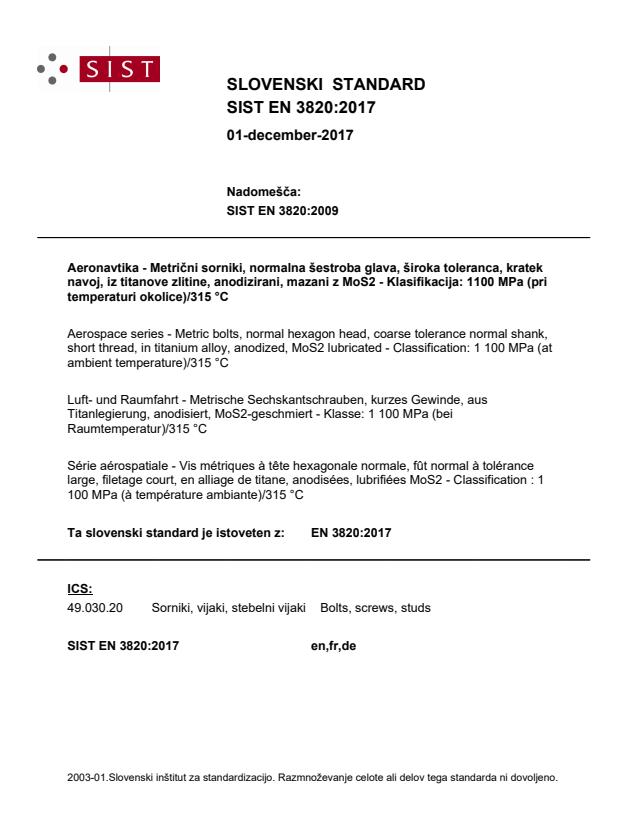
2003-01.Slovenski inštitut za standardizacijo. Razmnoževanje celote ali delov tega standarda ni dovoljeno.Luft- und Raumfahrt - Metrische Sechskantschrauben, kurzes Gewinde, aus Titanlegierung, anodisiert, MoS2-geschmiert - Klasse: 1 100 MPa (bei Raumtemperatur)/315 °CSérie aérospatiale - Vis métriques à tête hexagonale normale, fût normal à tolérance large, filetage court, en alliage de titane, anodisées, lubrifiées MoS2 - Classification : 1 100 MPa (à température ambiante)/315 °CAerospace series - Metric bolts, normal hexagon head, coarse tolerance normal shank, short thread, in titanium alloy, anodized, MoS2 lubricated - Classification: 1 100 MPa (at ambient temperature)/315 °C49.030.20Sorniki, vijaki, stebelni vijakiBolts, screws, studsICS:Ta slovenski standard je istoveten z:EN 3820:2017SIST EN 3820:2017en,fr,de01-december-2017SIST EN 3820:2017SLOVENSKI
STANDARDSIST EN 3820:20091DGRPHãþD
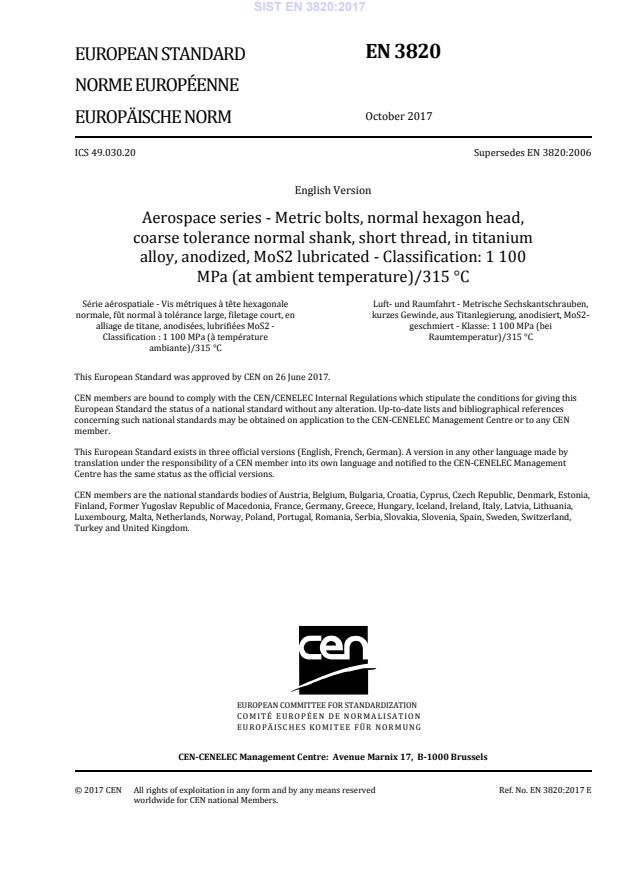
EUROPEAN STANDARD NORME EUROPÉENNE EUROPÄISCHE NORM
EN 3820
October
t r s y ICS
v {ä r u rä t r Supersedes EN
u z t rã t r r xEnglish Version
Aerospace series æ Metric boltsá normal hexagon headá coarse tolerance normal shanká short threadá in titanium alloyá anodizedá MoS t lubricated æ Classificationã
s
s r r Série aérospatiale æ Vis métriques à tête hexagonale normaleá fût normal à tolérance largeá filetage courtá en alliage de titaneá anodiséesá lubrifiées MoS t æ
Luftæ und Raumfahrt æ Metrische Sechskantschraubená kurzes Gewindeá aus Titanlegierungá anodisiertá MoS tæThis European Standard was approved by CEN on
t x June
t r s yä
egulations which stipulate the conditions for giving this European Standard the status of a national standard without any alterationä Upætoædate lists and bibliographical references concerning such national standards may be obtained on application to the CENæCENELEC Management Centre or to any CEN memberä
translation under the responsibility of a CEN member into its own language and notified to the CENæCENELEC Management Centre has the same status as the official versionsä
CEN members are the national standards bodies of Austriaá Belgiumá Bulgariaá Croatiaá Cyprusá Czech Republicá Denmarká Estoniaá Finlandá Former Yugoslav Republic of Macedoniaá Franceá Germanyá Greeceá Hungaryá Icelandá Irelandá Italyá Latviaá Lithuaniaá Luxembourgá Maltaá Netherlandsá Norwayá Polandá Portugalá Romaniaá Serbiaá Slovakiaá Sloveniaá Spainá Swedená Switzerlandá Turkey and United Kingdomä
EUROPEAN COMMITTEE FOR STANDARDIZATION COMITÉ EUROPÉEN DE NORMALISATION EUROPÄISCHES KOMITEE FÜR NORMUNG
CEN-CENELEC Management Centre:
Avenue Marnix 17,
B-1000 Brussels
t r s y CEN All rights of exploitation in any form and by any means reserved worldwide for CEN national Membersä Refä Noä EN
u z t rã t r s y ESIST EN 3820:2017
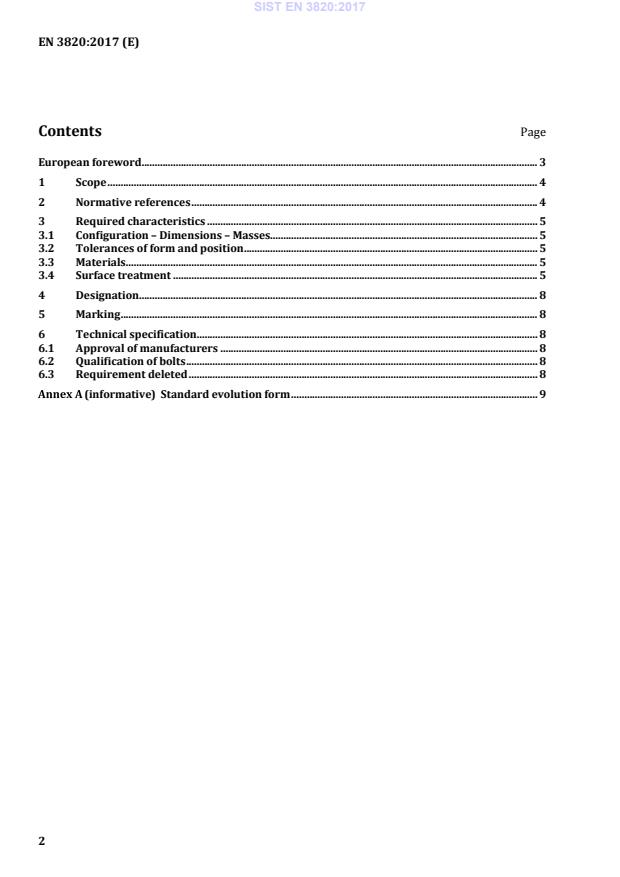
Page European foreword . 3 1 Scope . 4 2 Normative references . 4 3 Required characteristics . 5 3.1 Configuration – Dimensions – Masses. 5 3.2 Tolerances of form and position . 5 3.3 Materials . 5 3.4 Surface treatment . 5 4 Designation. 8 5 Marking . 8 6 Technical specification . 8 6.1 Approval of manufacturers . 8 6.2 Qualification of bolts . 8 6.3 Requirement deleted . 8
(informative)
Standard evolution form . 9
...