

SIST EN 61104:1999
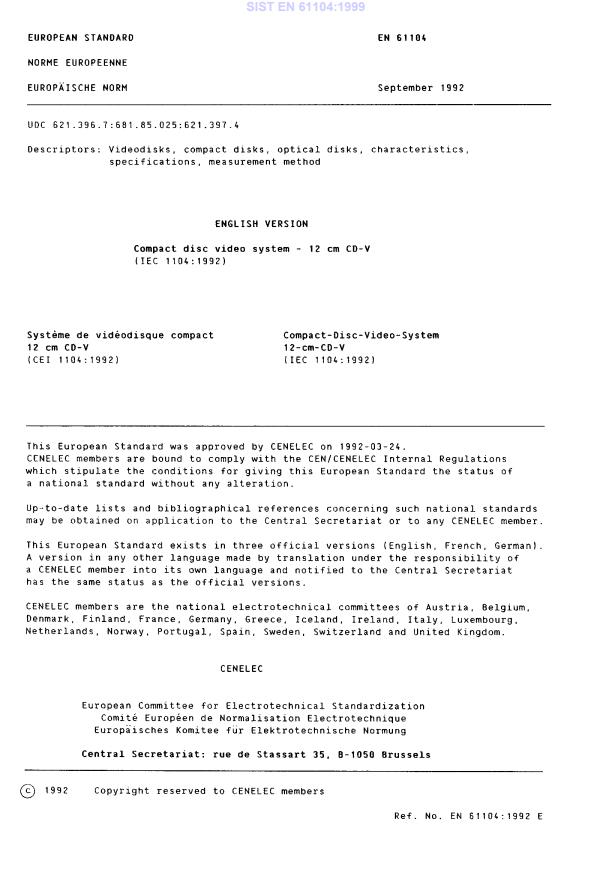
(Main)Compact disc video system - 12 cm CD-V
General Information
- Abstract
Specifies system parameters and applies to the pre-recorded optical reflective disc system called 'compact disc video (CD video)' containing digital audio and 'Laser Vision' video information. In the case of CD video, this standard modifies the relevant text in EN 60908.
- Status
- Published
- Publication Date
- 30-Jun-1999
- Technical Committee
- AVM - Audio, video and multimedia systems and equipment
- Current Stage
- 6060 - National Implementation/Publication (Adopted Project)
- Start Date
- 01-Jul-1999
- Due Date
- 01-Jul-1999
- Completion Date
- 01-Jul-1999


Overview
EN 61104:1992 (CLC adoption of IEC 61104) defines the system parameters for the 12 cm compact disc video (CD‑V) format - a pre‑recorded optical reflective disc that carries digital audio plus "Laser Vision" video information. This standard specifies how CD‑V modifies the base compact‑disc audio rules (IEC 908 / EN 60908) to accommodate combined audio + LaserVision video, ensuring playback, manufacturing and testing interoperability.
Key topics and technical requirements
- Scope: CD‑V as a combined digital audio + Laser Vision video medium; subclauses modify IEC 908 where applicable.
- Optical/mechanical parameters:
- Numerical aperture (NA) for the measuring pick‑up: 0.50 ± 0.01.
- Disc mass: 14 g to 20 g.
- Track layout: continuous inward→outward spiral; short allowed track interruption between audio and video with narrow undefined pit zone.
- Track pitch: approximately 1.6–1.7 µm (specified tolerances apply).
- Lead‑in / lead‑out / program diameters: start/outer diameters and max program area diameter are defined to control addressing and servo behavior.
- Rotation and scanning:
- Defines rotation/scan speeds and modes for PAL and NTSC, including CLV/CAV behaviour (e.g., rotation rates shown for NTSC and PAL lead areas).
- Signal, timing and error limits:
- BLER (block error rate) in the video part: < 8% averaged over any 10 s (recommended < 3%).
- Time base, time base noise and maximum time base error limits for video (measured on the colour burst).
- Tracking noise and residual error limits specified with measurement bands and servo bandwidths for audio and video parts.
- Subcode / TOC and metadata:
- Lead‑in tracks include separate Audio TOC and Video TOC; subcode ADR values distinguish audio (mode 1 / ADR=0001) and video (mode 4 / ADR=0100) entries.
- Mode 4 (DATA‑Q) is defined for video TOC entries and repeated subcode structure, with video track/chapter synchronization requirements.
Applications
- Manufacturing and quality control of pre‑recorded CD‑V discs.
- Design and verification of CD‑V playback hardware (laser pick‑ups, servo systems, decoding electronics).
- Compatibility testing for combined digital audio + Laser Vision content delivery.
- Archival and restoration workflows that require accurate reproduction of legacy CD‑V media.
Who uses this standard
- Optical disc manufacturers and replication plants
- Consumer electronics and optical drive designers
- Test laboratories and conformity assessors
- Audio/video archivists and media preservation specialists
Related standards
- IEC 908 / EN 60908 - Compact disc digital audio (base rules modified by EN 61104)
- IEC 856 / IEC 857 - “Laser Vision” pre‑recorded videodisk systems for PAL and NTSC
Keywords: EN 61104, CD‑V, compact disc video, Laser Vision, IEC 908, PAL, NTSC, digital audio, TOC, BLER, track pitch.
Relations
- Effective Date
- 03-Feb-2026
- Effective Date
- 03-Feb-2026
Get Certified
Connect with accredited certification bodies for this standard

ANCE
Mexican certification and testing association.

Intertek Slovenia
Intertek testing, inspection, and certification services in Slovenia.

LNE (Laboratoire National de Métrologie et d'Essais)
French national laboratory for metrology and testing.
Sponsored listings
Frequently Asked Questions
SIST EN 61104:1999 is a standard published by the Slovenian Institute for Standardization (SIST). Its full title is "Compact disc video system - 12 cm CD-V". This standard covers: Specifies system parameters and applies to the pre-recorded optical reflective disc system called 'compact disc video (CD video)' containing digital audio and 'Laser Vision' video information. In the case of CD video, this standard modifies the relevant text in EN 60908.
Specifies system parameters and applies to the pre-recorded optical reflective disc system called 'compact disc video (CD video)' containing digital audio and 'Laser Vision' video information. In the case of CD video, this standard modifies the relevant text in EN 60908.
SIST EN 61104:1999 is classified under the following ICS (International Classification for Standards) categories: 33.160.40 - Video systems. The ICS classification helps identify the subject area and facilitates finding related standards.
SIST EN 61104:1999 has the following relationships with other standards: It is inter standard links to SIST EN 60856:1999, SIST EN 60908:2000. Understanding these relationships helps ensure you are using the most current and applicable version of the standard.
SIST EN 61104:1999 is available in PDF format for immediate download after purchase. The document can be added to your cart and obtained through the secure checkout process. Digital delivery ensures instant access to the complete standard document.
Standards Content (Sample)
SLOVENSKI STANDARD
01-julij-1999
Compact disc video system - 12 cm CD-V (IEC 61104:1992)
Compact disc video system - 12 cm CD-V
Compact-Disc-Video-System - 12-cm-CD-V
Système de videodisque compact - 12 cm CD-V
Ta slovenski standard je istoveten z: EN 61104:1992
ICS:
33.160.40 Video sistemi Video systems
2003-01.Slovenski inštitut za standardizacijo. Razmnoževanje celote ali delov tega standarda ni dovoljeno.
NORME CEI
INTERNATIONALE IEC
INTERNATIONAL
Première édition
STAN DARD
First edition
1992-06
Système
de vidéodisque compact – 12 cm CD-V
Compact disc video system – 12 cm CD-V
© IEC 1992 Droits de reproduction
réservés — Copyright - all rights reserved
Aucune partie de cette publication
ne peut être reproduite ni No part of this publication may be reproduced or utilized in
utilisée sous quelque forme que ce soit
et par aucun any form or by any means, electronic or mechanical,
procédé, électronique ou mécanique,
y compris la photo- including photocopying and microfilm, without permission in
copie et les microfilms, sans
l'accord écrit de l'éditeur. writing from the publisher.
International Electrotechnical Commission 3, rue de Varembé Geneva, Switzerland
Telefax: +41 22 919 0300 e-mail: inmail@iec.ch IEC web site http: //www.iec.ch
CODE PRIX
Commission Electrotechnique Internationale
L
PRICE CODE
International Electrotechnical Commission
IEC
Me1HnyHapoitHaR 311eKTpOT@XHH4eCHaR KOMHCCHH
Pour prix, voir catalogue en vigueur
•
For price, see current catalogue
1104©IEC —3—
INTERNATIONAL ELECTROTECHNICAL COMMISSION
COMPACT DISC VIDEO SYSTEM - 12 cm CD-V
FOREWORD
1)
The formal decisions or agreements of the IEC on technical matters, prepared by Technical Committees on
which all the National Committees having a special interest therein are represented, express, as nearly as
possible, an international consensus of opinion on the subjects dealt with.
2)
They have the form of recommendations for international use and they are accepted by the National
Committees in that sense.
3)
In order to promote international unification, the IEC expresses the wish that all National Committees
should adopt the text of the IEC recommendation for their national rules in so far as national conditions will
permit. Any divergence between the IEC recommendation and the corresponding national rules should, as
far as possible, be clearly indicated in the latter.
This International Standard has been prepared by Sub-Committee 60A: Sound recording,
of IEC Technical Committee No. 60: Recording.
This standard should be read in conjunction with IEC 908: 1987.
The text of this International Standard is based on the following documents:
DIS Report on Voting
60A(CO)142
60A(CO)145
Full information on the voting for the approval of this standard can be found in the Voting
Repo rt
indicated in the above table.
1104©IEC -5-
INTRODUCTION
This International Standard specifies the implementation of video information as an
optional addition to IEC 908. Reference is made to IEC 856 and IEC 857.
1104©IEC -7-
COMPACT DISC VIDEO SYSTEM - 12 cm CD-V
1 Scope
This International Standard is applicable to a pre-recorded optical reflective disc system
called "compact disc video (CD video)" containing digital audio and "Laser vision" video
information.
In the case of CD video the subclauses mentioned in this standard shall modify the
relevant text in IEC 908.
2 Normative references
The following normative documents contain provisions which, through reference in this
text, constitute provisions of this International Standard. At the time of publication of this
standard, the editions indicated were valid. All normative documents are subject to
revision, and parties to agreements based on this International Standard are encouraged
to investigate the possibility of applying the most recent editions of the normative
documents indicated below. Members of IEC and ISO maintain registers of currently valid
International Standards.
Pre-recorded optical reflective videodisk system. "Laser vision" 50 Hz/
IEC 856: 1986,
625 lines - PAL.
Pre-recorded optical reflective videodisk system. "Laser vision" 60 Hz/
IEC 857: 1986,
525 lines - M/NTSC.
IEC 908: 1987, Compact disc digital audio system.
4.2 Requirements for the measuring pick-up
Change:
- numerical aperture (NA): 0,50 ± 0,01.
5.7 Mass of disc: 14 g to 20 g
7 Recording parameters
7.1 Rotation during playback (see figure 17)
Requirements
Video Video
7.1.2 a) Audio
PAL
NTSC
9,2 m/s min.
Scanning velocity 1,2 m/s min. 11 m/s min.
1,4 m/s max. 12 m/s max. 10,2 m/s max.
CLV
45,1 37,6
7.1.2 b) Maximum number of Not specified
revolutions/s
37,5 ± 0,1
7.1.2 c) Number of revolutions/s - 45 ± 0,1
in video lead-in area CAV
7.1.3 Limits for the velocity ±0,01 m/s Not specified Not specified
variation on any one disc
12,5 15 µs*
7.1.4 Maximum time base error (peak- µs`
to-peak) at rotational frequency
- 12 dB/oct. 12 dB/oct.
Roll-off for higher
frequencies
3 ns r.m.s. 3 ns r.m.s.
7.1.5 For frequencies > 1 000 Hz
maximum time base noise
To be fixed
Integration time To be fixed
Remark: time base errors have to be measured on the "colour burst'.
1104©IEC - 9 -
Replace 7.2 by the following:
Methods and/or
Parameters Requirements
conditions of
measurement
Video
Audio
7.2 Track
Continuous spiral from inside (start of lead-in) to outside
7.2.1 Track path
(end of lead-out of video with digital audio) of the disc.
Track interruption allowed between audio and video part
for which an area of maximum 20 pm width with unde-
fined pit structure is allowed
7.2.2 Starting diameter of 46 mm max. Outer diameter of audio
lead-out area +40 pm (max.)
lead-in area
78 ± 0,2 mm
7.2.3 Starting diameter of 50 â mm
a
program area
7.2.4 Maximum diameter of 74 mm 116 mm
program area
7.2.5a Outer diameter of 75 ± 0,2 mm
audio lead-out area
7.2.5b Minimum outer diameter of Outer diameter of program
area plus 1 mm
video lead-out area
1,7 ± 0,2 pm
7.2.6 Pitch of track: distance 1,6 ± 0,1 pm
between any two adjacent turns
Replace 7.3 by the following:
Methods and/or
Requirements
Parameters
conditions of
measurement
7.3 Limits for deviations of
information layer
perpendicular to
reference plane
Audio part Video part
7.3.1 For frequencies Below 500 Hz Below 1 000 Hz
7.3.1.1 ±0,5 mm ±0,5 mm
Deviation from nominal value
7.3.1.2 RMS value 0,4 mm max. 0,4 mm max.
7.3.1.3 Acceleration 10 m/s2 max. 40 m/s2 max.
7.3.2 For frequencies Exceeding 500 Hz Exceeding 1 000 Hz
2 pm peak-to-peak max.
Deviation 2 µm peak-to-peak max.
7.4 Limits for radial deviations
of the track
7.4.1 For frequencies Below 500 Hz Below 2 500 Hz
7.4.1.1 Radial run-out of tracks (µm) 140 µm peak-to-peak max. 140 pm peak-to-peak max.
7.4.1.2 Radial acceleration (m/s2) 0,
...