

SIST EN 12503-7:2002
(Main)Sports mats - Part 7: Determination of static stiffness
- Abstract
This European Standard specifies a method of test for the determination of static stiffness for type 12 of prEN 12503-3.
- Status
- Published
- Publication Date
- 31-Aug-2002
- Technical Committee
- SPO - Sports
- Current Stage
- 6060 - National Implementation/Publication (Adopted Project)
- Start Date
- 01-Sep-2002
- Due Date
- 01-Sep-2002
- Completion Date
- 01-Sep-2002

SIST EN 12503-7:2002 is the Slovenian standard that adopts EN 12503-7:2001 from CEN. It specifies a test method for determining the static stiffness of type 12 sports mats covered by EN 12503-3, so manufacturers, laboratories, and purchasers can assess the same property in the same way.
What does SIST EN 12503-7:2002 specify?
SIST EN 12503-7:2002 specifies a laboratory test method for measuring the static stiffness of type 12 sports mats. The method is set up for repeatable comparison of mats, especially where the feel or support of the mat matters in use.
The document is organized into a short chain of clauses: scope, normative references, principle, apparatus, test piece, conditioning, procedure, expression of results, and test report. That structure helps a user go from what is covered, to how to test, to what to record.
What are the key requirements of SIST EN 12503-7:2002?
Clause 3 - Principle: SIST EN 12503-7:2002 measures how much a mat deflects under a specified load, using an indentor and a reference point at a set distance from the center. In practice, this gives a controlled way to compare how stiff different mats feel under static loading.
Clause 4 - Apparatus: SIST EN 12503-7:2002 requires a load of (50 ± 0,5) kg, a 78 mm diameter indentor, and a way to measure the difference between the center deflection and the deflection at (160 ± 1) mm diameter. This matters because the result depends on both the applied load and the geometry of the measuring set-up.
Clause 5 - Test piece: SIST EN 12503-7:2002 uses the complete mat as the test piece. For the user, that means the property is checked on the finished mat, not on a cut sample.
Clause 6 - Conditioning: SIST EN 12503-7:2002 calls for conditioning the mat for at least 24 h at (21 ± 3) °C, and testing at the same temperature. This matters because temperature can change the measured stiffness.
Clause 7 - Procedure: SIST EN 12503-7:2002 requires the load to be applied, then the deflection difference to be read 2 min ± 5 s after loading. The measurement is repeated at four positions, roughly at the center of each quarter of the mat. In practice, this gives a small set of comparable readings across the mat surface.
Clause 7 note: SIST EN 12503-7:2002 states that these reading positions are not the same as those used for shock absorption in EN 12503-4. That helps avoid mixing results from different tests.
Clause 8 - Expression of results: SIST EN 12503-7:2002 uses the mean of the deflection measurements as the result. This gives a single value for reporting and comparison.
Clause 9 - Test report: SIST EN 12503-7:2002 requires the report to identify the standard, the mat, the test temperature, the mean deflection, any individual values if required, and any deviation from the procedure. That is the information needed for technical records, quality checks, and supplier discussions.
What terms does SIST EN 12503-7:2002 define?
Static stiffness - The resistance of the mat to indentation under a static load, expressed through the measured deflection.
Indentor - The loading part pressed vertically onto the mat to create the controlled indentation.
Deflection - The amount the mat moves downward under load, measured in millimetres.
Test piece - The complete mat that is subjected to the test.
Conditioning - Keeping the mat at the specified temperature for the specified time before testing.
Mean deflection - The average of the measured deflection values from the four test positions.
Type 12 - The mat type covered by EN 12503-3 that falls within the scope of this test method.
Who uses SIST EN 12503-7:2002?
SIST EN 12503-7:2002 is used by test laboratories, sports mat manufacturers, and quality or conformity assessment staff who need a reproducible stiffness measurement. It is also relevant to buyers, specifiers, and product engineers working with sports mats, especially judo mats covered by the EN 12503 series.
In practice, they use it for product development, incoming inspection, type testing, and technical comparison between mat designs.
Which standards are used with SIST EN 12503-7:2002?
EN 12503-3:2001 - Provides the product context for type 12 sports mats and the safety requirements framework referenced by the scope.
EN 12503-4:2001 - Supplies the indentor reference and is named for the shock absorption test that uses related apparatus and positions.
What does the SIST EN 12503-7:2002 document contain?
SIST EN 12503-7:2002 contains one test method centered on indentation under a specified mass. It gives the principle, apparatus arrangement, specimen conditioning, step-by-step procedure, result calculation, and report content.
The document also includes Figure 1, which shows a suitable apparatus arrangement for the test. The method is written so that laboratories can measure the same property with the same load, timing, and measurement geometry.
Relations
- Effective Date
- 28-Jan-2026
- Effective Date
- 28-Jan-2026
- Effective Date
- 28-Jan-2026
Frequently Asked Questions
SIST EN 12503-7:2002 is a standard published by the Slovenian Institute for Standardization (SIST). Its full title is "Sports mats - Part 7: Determination of static stiffness". This standard covers: This European Standard specifies a method of test for the determination of static stiffness for type 12 of prEN 12503-3.
This European Standard specifies a method of test for the determination of static stiffness for type 12 of prEN 12503-3.
SIST EN 12503-7:2002 is classified under the following ICS (International Classification for Standards) categories: 97.220.30 - Indoor sports equipment. The ICS classification helps identify the subject area and facilitates finding related standards.
SIST EN 12503-7:2002 has the following relationships with other standards: It is inter standard links to SIST EN 12503-3:2002, SIST EN 12503-4:2002, SIST EN ISO 6103:2005. Understanding these relationships helps ensure you are using the most current and applicable version of the standard.
SIST EN 12503-7:2002 is available in PDF format for immediate download after purchase. The document can be added to your cart and obtained through the secure checkout process. Digital delivery ensures instant access to the complete standard document.
Standards Content (Sample)
2003-01.Slovenski inštitut za standardizacijo. Razmnoževanje celote ali delov tega standarda ni dovoljeno.HQLWYLSportmatten - Teil 7: Bestimmung der statischen SteifigkeitTapis de sport - Partie 7: Détermination de la rigidité statiqueSports mats - Part 7: Determination of static stiffness97.220.30Oprema za dvoranske športeIndoor sports equipmentICS:Ta slovenski standard je istoveten z:EN 12503-7:2001SIST EN 12503-7:2002en01-september-2002SIST EN 12503-7:2002SLOVENSKI
STANDARD
EUROPEAN STANDARDNORME EUROPÉENNEEUROPÄISCHE NORMEN 12503-7April 2001ICS 97.220.30English versionSports mats - Part 7: Determination of static stiffnessTapis de sport - Partie 7: Détermination de la rigiditéstatiqueSportmatten - Teil 7: Bestimmung der statischen SteifigkeitThis European Standard was approved by CEN on 21 January 2001.CEN members are bound to comply with the CEN/CENELEC Internal Regulations which stipulate the conditions for giving this EuropeanStandard the status of a national standard without any alteration. Up-to-date lists and bibliographical references concerning such nationalstandards may be obtained on application to the Management Centre or to any CEN member.This European Standard exists in three official versions (English, French, German). A version in any other language made by translationunder the responsibility of a CEN member into its own language and notified to the Management Centre has the same status as the officialversions.CEN members are the national standards bodies of Austria, Belgium, Czech Republic, Denmark, Finland, France, Germany, Greece,Iceland, Ireland, Italy, Luxembourg, Netherlands, Norway, Portugal, Spain, Sweden, Switzerland and United Kingdom.EUROPEAN COMMITTEE FOR STANDARDIZATIONCOMITÉ EUROPÉEN DE NORMALISATIONEUROPÄISCHES KOMITEE FÜR NORMUNGManagement Centre: rue de Stassart, 36
B-1050 Brussels© 2001 CENAll rights of exploitation in any form and by any means reservedworldwide for CEN national Members.Ref. No. EN 12503-7:2001 ESIST EN 12503-7:2002
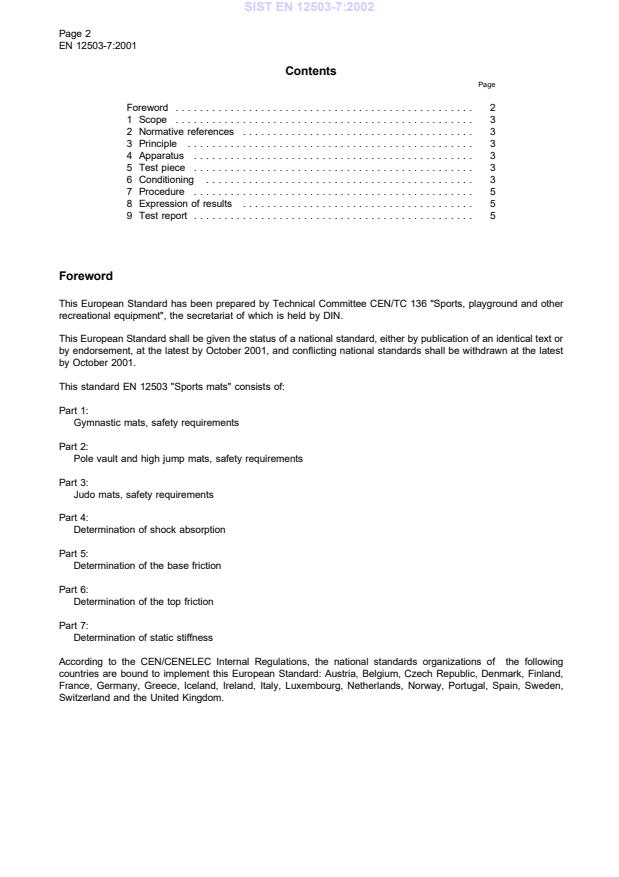
Page 2EN 12503-7:2001ContentsPageForeword .21
Scope .32
Normative references .33
Principle .34
Apparatus .35
Test piece .36
Conditioning .37
Procedure .58
Expression of results .59
Test report .5ForewordThis European Standard has been prepared by Technical Committee CEN/TC 136 "Sports, playground and otherrecreational equipment", the secretariat of which is held by DIN.This European Standard shall be given the status of a national standard, either by publication of an identical text orby endorsement, at the latest by October 2001, and conflicting national standards shall be withdrawn at the latestby October 2001.This standard EN 12503 "Sports mats" consists of:Part 1:Gymnastic mats, safety requirementsPart 2:Pole vault and high jump mats, safety requirementsPart 3:Judo mats, safety requirementsPart 4:Determination of shock absorptionPart 5:Determination of the base frictionPart 6:Determination of the top frictionPart 7:Determination of static stiffness
...