

oSIST prEN 13914-1:2026
(Main)Design, preparation and application of external rendering and internal plastering - Part 1: External rendering
General Information
- Abstract
This document specifies requirements and recommendations for the design, preparation and application of
- renders based on cement, lime or other mineral binders, and/or combinations thereof, masonry cement and polymer modified binder based external renderings, in accordance with EN 998-1 or site made renders;
- renders based on organic binders in accordance with EN 15824
on all common types of backgrounds. It includes rendering on both new and old backgrounds and the maintenance and repair of existing work. This document gives guidance on the use of established site, factory and semi-finished factory-made renders.
This document does not cover the following:
a) the use and application of special renders for liquid retaining structures, e.g. coatings, and for backgrounds to cladding systems;
b) the structural repair of concrete;
c) the installation of external thermal insulation composite systems (ETICS);
d) the specification and use of sealants used to seal joints for use with rendering;
e) the use of gypsum-based renders;
f) renders on historical monuments or buildings in protected areas;
g) the design and installation of flashings at windowsills and elsewhere.
Because of the many varied materials, practices and different climatic conditions, it is not possible for certain aspects of the standard to enter into sufficient detail to be fully usable by all practitioners.
NOTE Local or national regulations take precedence when applicable.
- Status
- Not Published
- Public Enquiry End Date
- 23-Jul-2026
- Technical Committee
- CAA - Mineral binders and masonry
- Current Stage
- 4020 - Public enquire (PE) (Adopted Project)
- Start Date
- 10-Jun-2026
- Due Date
- 28-Oct-2026

Overview
oSIST prEN 13914-1:2026 is a draft European standard developed by SIST, specifying the requirements and recommendations for the design, preparation, and application of external rendering. Targeted at construction professionals, architects, and contractors, this standard covers external renders based on cement, lime, mineral, masonry cement, polymer modified binders (in line with EN 998-1), as well as external renders based on organic binders per EN 15824. It applies to both new and existing backgrounds, addressing rendering for protection, decoration, and repair. The standard outlines best practices for site-made, factory-made, and semi-finished factory-made renders, helping ensure quality, durability, and compliance across a range of building projects.
Key Topics
- Types of External Renders: Guidance on the selection and preparation of mineral-based and organic-based render mixes, considering factors such as background type and environment.
- Background Preparation: Requirements for assessing and treating the surface on which rendering is to be applied, including cleaning, pre-treatment, and ensuring adequate mechanical key and adhesion.
- Mix Proportions and Application: Recommendations for designing the render mix, batching, mixing methods, and application techniques (manual and mechanical).
- Layer Structure: Considerations on the number and thickness of coats (undercoat, final coat), use of reinforcement, and selection of finishing textures and colors.
- Durability and Performance: Advice on designing render systems for resistance to cracking, impact, environmental exposure, rain penetration, water rising from the ground, freeze-thaw cycles, and atmospheric pollutants.
- Maintenance and Repair: Procedures for inspecting, repairing cracks and detached areas, overcoming unsatisfactory appearances, and addressing water penetration issues.
Note: The standard does not apply to the structural repair of concrete, special renders for liquid-retaining structures, ETICS, sealants, gypsum-based renders, historical structures, or the installation of flashings.
Applications
oSIST prEN 13914-1:2026 is crucial for:
- New Build Construction: Ensuring external renders are designed and applied according to proven best practices, enhancing durability and aesthetics.
- Renovation and Refurbishment: Specifying techniques for applying renders to existing buildings, including treatments for repairing or upgrading deteriorated surfaces.
- Maintenance: Outlining effective methods for routine inspection and repair of rendering to extend building lifespan and maintain appearance.
- Quality Assurance: Providing a uniform approach for contractors and designers to meet regulatory and client expectations for external render systems.
- Site and Factory-made Solutions: Supporting the use of both site-mixed and factory-produced renders, accommodating diverse project sizes and specifications.
Related Standards
Professional use of oSIST prEN 13914-1:2026 is enhanced by familiarity with associated standards, including:
- EN 998-1 – Specification for mortar for masonry - rendering and plastering mortars
- EN 15824 – Specifications for external renders and internal plasters based on organic binders
- EN 197-1 – Composition and conformity criteria for common cements
- EN 413-1 – Masonry cement specifications
- EN 459-1 – Building lime specifications
- EN 13139 – Aggregates for mortar
- EN 12878 – Pigments for coloring building materials
- EN 13658-2 – Metal lath and beads for external rendering
Note: Always consult local or national regulations, as they may take precedence over guidance in this European standard.
Using oSIST prEN 13914-1:2026 helps ensure robust, compliant, and long-lasting external render systems in residential, commercial, and industrial buildings. Its guidance supports consistent quality and optimal performance of external rendering across all common background types and construction scenarios.
Relations
- Effective Date
- 28-Aug-2024
Get Certified
Connect with accredited certification bodies for this standard

DIBt (Deutsches Institut für Bautechnik)
German Institute for Building Technology.
DIN CERTCO
DIN Group product certification.

Aboma Certification B.V.
Specialized in construction, metal, and transport sectors.
Sponsored listings
Frequently Asked Questions
oSIST prEN 13914-1:2026 is a draft published by the Slovenian Institute for Standardization (SIST). Its full title is "Design, preparation and application of external rendering and internal plastering - Part 1: External rendering". This standard covers: This document specifies requirements and recommendations for the design, preparation and application of - renders based on cement, lime or other mineral binders, and/or combinations thereof, masonry cement and polymer modified binder based external renderings, in accordance with EN 998-1 or site made renders; - renders based on organic binders in accordance with EN 15824 on all common types of backgrounds. It includes rendering on both new and old backgrounds and the maintenance and repair of existing work. This document gives guidance on the use of established site, factory and semi-finished factory-made renders. This document does not cover the following: a) the use and application of special renders for liquid retaining structures, e.g. coatings, and for backgrounds to cladding systems; b) the structural repair of concrete; c) the installation of external thermal insulation composite systems (ETICS); d) the specification and use of sealants used to seal joints for use with rendering; e) the use of gypsum-based renders; f) renders on historical monuments or buildings in protected areas; g) the design and installation of flashings at windowsills and elsewhere. Because of the many varied materials, practices and different climatic conditions, it is not possible for certain aspects of the standard to enter into sufficient detail to be fully usable by all practitioners. NOTE Local or national regulations take precedence when applicable.
This document specifies requirements and recommendations for the design, preparation and application of - renders based on cement, lime or other mineral binders, and/or combinations thereof, masonry cement and polymer modified binder based external renderings, in accordance with EN 998-1 or site made renders; - renders based on organic binders in accordance with EN 15824 on all common types of backgrounds. It includes rendering on both new and old backgrounds and the maintenance and repair of existing work. This document gives guidance on the use of established site, factory and semi-finished factory-made renders. This document does not cover the following: a) the use and application of special renders for liquid retaining structures, e.g. coatings, and for backgrounds to cladding systems; b) the structural repair of concrete; c) the installation of external thermal insulation composite systems (ETICS); d) the specification and use of sealants used to seal joints for use with rendering; e) the use of gypsum-based renders; f) renders on historical monuments or buildings in protected areas; g) the design and installation of flashings at windowsills and elsewhere. Because of the many varied materials, practices and different climatic conditions, it is not possible for certain aspects of the standard to enter into sufficient detail to be fully usable by all practitioners. NOTE Local or national regulations take precedence when applicable.
oSIST prEN 13914-1:2026 is classified under the following ICS (International Classification for Standards) categories: 91.100.10 - Cement. Gypsum. Lime. Mortar. The ICS classification helps identify the subject area and facilitates finding related standards.
oSIST prEN 13914-1:2026 has the following relationships with other standards: It is inter standard links to SIST EN 13914-1:2016. Understanding these relationships helps ensure you are using the most current and applicable version of the standard.
oSIST prEN 13914-1:2026 is associated with the following European legislation: EU Directives/Regulations: 305/2011. When a standard is cited in the Official Journal of the European Union, products manufactured in conformity with it benefit from a presumption of conformity with the essential requirements of the corresponding EU directive or regulation.
oSIST prEN 13914-1:2026 is available in PDF format for immediate download after purchase. The document can be added to your cart and obtained through the secure checkout process. Digital delivery ensures instant access to the complete standard document.
Standards Content (Sample)
SLOVENSKI STANDARD
01-julij-2026
Projektiranje, priprava in uporaba zunanjih in notranjih ometov - 1. del: Zunanji
ometi
Design, preparation and application of external rendering and internal plastering - Part 1:
External rendering
Planung, Zubereitung und Ausführung von Außen- und Innenputzen - Teil 1: Außenputz
Conception, préparation et application des enduits extérieurs et intérieurs - Partie 1:
Enduits extérieurs
Ta slovenski standard je istoveten z: prEN 13914-1
ICS:
91.100.10 Cement. Mavec. Apno. Malta Cement. Gypsum. Lime.
Mortar
2003-01.Slovenski inštitut za standardizacijo. Razmnoževanje celote ali delov tega standarda ni dovoljeno.
DRAFT
EUROPEAN STANDARD
NORME EUROPÉENNE
EUROPÄISCHE NORM
May 2026
ICS 91.100.10 Will supersede EN 13914-1:2016
English Version
Design, preparation and application of external rendering
and internal plastering - Part 1: External rendering
Conception, préparation et application des enduits Planung, Zubereitung und Ausführung von Außen- und
extérieurs et intérieurs - Partie 1: Enduits extérieurs Innenputzen - Teil 1: Außenputz
This draft European Standard is submitted to CEN members for enquiry. It has been drawn up by the Technical Committee
CEN/TC 125.
If this draft becomes a European Standard, CEN members are bound to comply with the CEN/CENELEC Internal Regulations
which stipulate the conditions for giving this European Standard the status of a national standard without any alteration.
This draft European Standard was established by CEN in three official versions (English, French, German). A version in any other
language made by translation under the responsibility of a CEN member into its own language and notified to the CEN-CENELEC
Management Centre has the same status as the official versions.
CEN members are the national standards bodies of Austria, Belgium, Bulgaria, Croatia, Cyprus, Czech Republic, Denmark, Estonia,
Finland, France, Germany, Greece, Hungary, Iceland, Ireland, Italy, Latvia, Lithuania, Luxembourg, Malta, Netherlands, Norway,
Poland, Portugal, Republic of North Macedonia, Romania, Serbia, Slovakia, Slovenia, Spain, Sweden, Switzerland, Türkiye and
United Kingdom.
Recipients of this draft are invited to submit, with their comments, notification of any relevant patent rights of which they are
aware and to provide supporting documentation.
Warning : This document is not a European Standard. It is distributed for review and comments. It is subject to change without
notice and shall not be referred to as a European Standard.
EUROPEAN COMMITTEE FOR STANDARDIZATION
COMITÉ EUROPÉEN DE NORMALISATION
EUROPÄISCHES KOMITEE FÜR NORMUNG
CEN-CENELEC Management Centre: Rue de la Science 23, B-1040 Brussels
© 2026 CEN All rights of exploitation in any form and by any means reserved Ref. No. prEN 13914-1:2026 E
worldwide for CEN national Members.
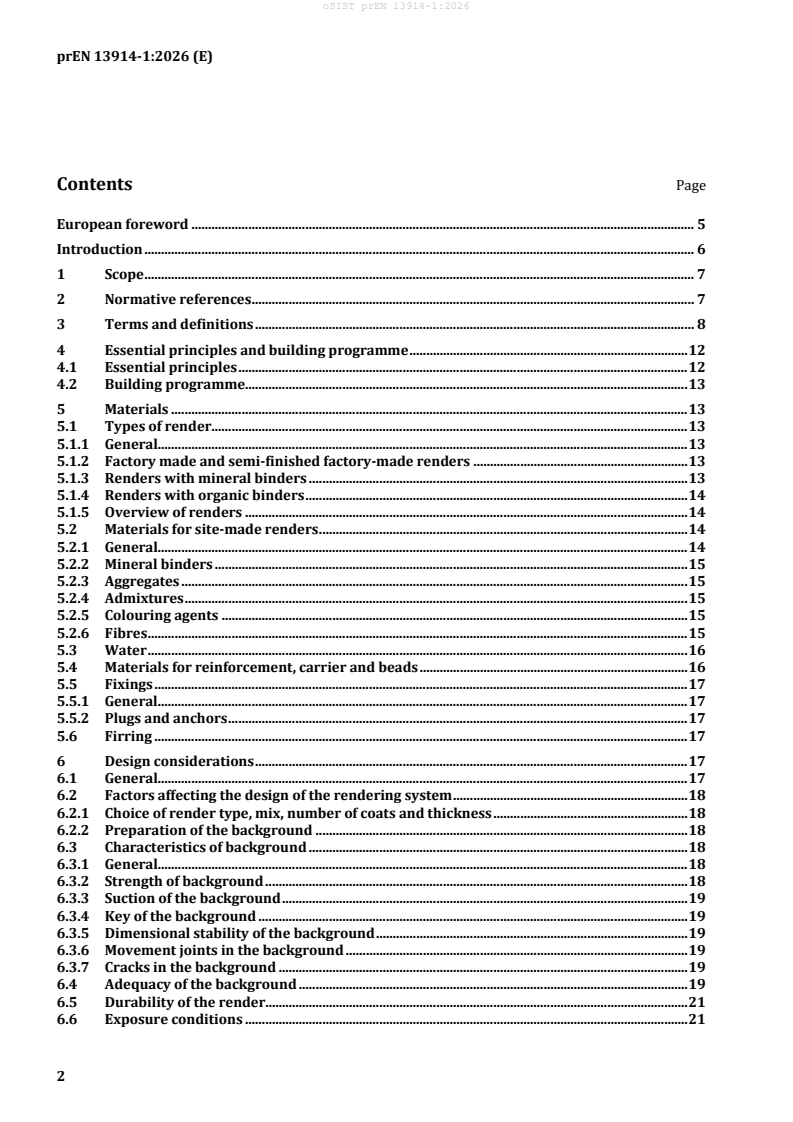
Contents Page
European foreword . 5
Introduction . 6
1 Scope . 7
2 Normative references . 7
3 Terms and definitions . 8
4 Essential principles and building programme . 12
4.1 Essential principles . 12
4.2 Building programme. 13
5 Materials . 13
5.1 Types of render . 13
5.1.1 General. 13
5.1.2 Factory made and semi-finished factory-made renders . 13
5.1.3 Renders with mineral binders . 13
5.1.4 Renders with organic binders . 14
5.1.5 Overview of renders . 14
5.2 Materials for site-made renders . 14
5.2.1 General. 14
5.2.2 Mineral binders . 15
5.2.3 Aggregates . 15
5.2.4 Admixtures . 15
5.2.5 Colouring agents . 15
5.2.6 Fibres . 15
5.3 Water . 16
5.4 Materials for reinforcement, carrier and beads . 16
5.5 Fixings . 17
5.5.1 General. 17
5.5.2 Plugs and anchors . 17
5.6 Firring . 17
6 Design considerations . 17
6.1 General. 17
6.2 Factors affecting the design of the rendering system . 18
6.2.1 Choice of render type, mix, number of coats and thickness . 18
6.2.2 Preparation of the background . 18
6.3 Characteristics of background . 18
6.3.1 General. 18
6.3.2 Strength of background . 18
6.3.3 Suction of the background . 19
6.3.4 Key of the background . 19
6.3.5 Dimensional stability of the background . 19
6.3.6 Movement joints in the background . 19
6.3.7 Cracks in the background . 19
6.4 Adequacy of the background . 19
6.5 Durability of the render. 21
6.6 Exposure conditions . 21
6.7 Resistance to rain penetration . 21
6.8 Resistance to water rising from the ground without pressure (capillary water) . 22
6.9 Soluble salts . 22
6.10 Effects of atmospheric pollution . 23
6.11 Effects of freeze–thaw cycles . 23
6.12 Resistance to impact or abrasion . 23
6.13 Corrosion of metals . 23
6.14 Occurrence of cracking . 24
6.14.1 General . 24
6.14.2 Movement of the background . 24
6.14.3 Movement of the rendering . 24
6.14.4 Evaluation of cracks . 25
6.14.5 Methods of minimizing the occurrence of cracks . 26
6.15 Thermal considerations . 27
6.16 Protection afforded by architectural features and functions . 27
6.16.1 General . 27
6.16.2 Parapet and screen walls . 28
6.16.3 Eaves and verges . 28
6.16.4 String courses and similar features . 28
6.16.5 Soffits and reveals . 33
6.16.6 Pipes and other services . 34
6.16.7 Rendering at the base of walls . 34
6.16.8 Render below ground level and to basements . 37
6.17 Selection of renders . 41
6.17.1 General . 41
6.17.2 Types of render in accordance with location of manufacture . 41
6.17.3 Types of renders and render mixes in accordance with purpose . 41
6.18 Number, thickness and relative strength of coats . 41
6.18.1 General purpose rendering mortar (GP) . 41
6.18.2 light weight render (LW) . 42
6.18.3 Spatterdash, primer and bonding agent . 43
6.18.4 Dubbing out . 43
6.18.5 Undercoats . 43
6.18.6 Reinforced coats . 43
6.18.7 Final coat . 44
6.18.8 Renders with specific properties . 44
6.19 Types of finish . 46
6.20 Renders with decorative elements. 47
6.21 Colour and texture . 47
7 Work on site, preparation and application of renders . 47
7.1 General . 47
7.2 Storage of materials . 47
7.3 Scaffolding . 48
7.4 Protection of adjacent surfaces . 48
7.5 Preparation of background . 48
7.5.1 General . 48
7.5.2 Preparatory treatment and pre-treatment . 48
7.6 Proportioning of mix materials on site. 51
7.6.1 Prescribed mixes . 51
7.6.2 Designed mixes . 51
7.6.3 Volume batching . 51
7.6.4 Weigh batching . 51
7.7 Mixing on site . 51
7.7.1 General. 51
7.7.2 Preparing mixes containing fibres . 52
7.8 Forming architectural features . 52
7.9 Application of the various coats . 52
7.9.1 General. 52
7.9.2 Curing . 52
7.9.3 Method of application by machine or hand . 52
7.9.4 Thermal insulating renders . 53
7.9.5 Renovation renders . 53
7.10 Flatness of the rendered finish . 53
8 Maintenance and repair (other than restoration) . 54
8.1 General. 54
8.2 Inspection . 54
8.3 Repairs to cracks . 55
8.3.1 General. 55
8.3.2 Cracks in rendering only . 55
8.3.3 Cracks in both rendering and background . 55
8.4 Repair of hollow or detached areas . 55
8.4.1 General. 55
8.4.2 Rendered finish only. 55
8.4.3 Spalled masonry backgrounds . 56
8.5 Overcoming unsatisfactory appearance . 56
8.5.1 General. 56
8.5.2 Cleaning . 56
8.5.3 Paint treatment . 56
8.5.4 Further rendering coats . 56
8.6 Overcoming water penetration . 56
8.6.1 General. 56
8.6.2 Colourless water repellent and micro porous treatments . 56
Annex A (informative) Example on the selection of site mixed prescribed renders mixed in
accordance with background type. 57
A.1 General. 57
A.2 Strong mixes . 57
A.3 Moderately strong mixes. 57
A.4 Weak mixes . 57
Annex B (informative) Restoration of renders on old and historic buildings . 58
B.1 General. 58
B.2 Preliminary investigations . 58
B.3 Preparatory work . 60
B.4 Restoration systems and measures. 60
B.5 Design . 61
B.6 Application . 62
Annex C (informative) Examples of types of finish . 63
Bibliography . 64
European foreword
This document (prEN 13914-1:2026) has been prepared by Technical Committee CEN/TC 125
“Masonry”, the secretariat of which is held by BSI.
This document is currently submitted to the CEN Enquiry.
This document will supersede EN 13914-1:2016.
This document includes the following significant technical changes with respect to EN 13914-1:2016:
a) update of normative references;
b) additions and revisions of terms;
c) revision of the content of all sections and Annexes A and B;
d) the former Annex C was deleted and the previous Annex D became the new Annex C.
The EN 13914 series consists of the following parts:
— EN 13914-1, Design, preparation and application of external rendering and internal plastering —
Part 1: External rendering;
— EN 13914-2, Design, preparation and application of external rendering and internal plastering —
Part 2: Internal plastering.
Introduction
This document gives requirements and recommendations for building details, design and materials
considerations, the selection of mixes and the application of renders based on cement, lime or organic
binders for use on external backgrounds.
NOTE The term ‘rendering mortar’ is used in the applicable product standard EN 998-1, but to reflect common
usage in relation to this document and for ease of reference the term ‘render’ (noun) has been used.
For the purposes of this document (except where stated in relation to a specific product standard) the
term ‘strength’ should be considered in terms of relative strengths between different types of
backgrounds compared with the nominal strengths of prescribed render mixes. Although it can be
possible to consider this in terms of compressive strength, this standard deals with aspects of a craft as
opposed to design calculations. Therefore ‘strength’ is not considered in terms of numerical values
derived from testing. Similar considerations also apply to terms such as ‘movement’, ‘absorbency’ and
‘permeability’, etc. used in this document.
This document refers only to the technical suitability of materials and/or procedures. During the
application the user needs to observe any legal obligations relating to health and safety at any stage.
Because this document is a code-like document as opposed to the more conventional European product
standard, it is appropriate to mention that, as with product standards, the use of the verbal form ‘shall’
denotes a requirement for which verification of compliance has to be able to be demonstrated.
Recommendations are denoted by the verbal form ‘should’ and should be followed unless there is a
justifiable reason for not doing so.
It is not the function of this standard to assign responsibility for the design and application of any work
or actions mentioned within to any specific party. Such responsibility is a matter for other documentation
associated with the work, e.g. the contract.
It has been assumed in the drafting of this document that the application of its provisions is entrusted to
appropriately qualified and experienced people, for whose guidance it has been prepared.
1 Scope
This document specifies requirements and recommendations for the design, preparation and application
of
— renders based on cement, lime or other mineral binders, and/or combinations thereof, masonry
cement and polymer modified binder based external renderings, in accordance with EN 998-1 or site
made renders;
— renders based on organic binders in accordance with EN 15824
on all common types of backgrounds. It includes rendering on both new and old backgrounds and the
maintenance and repair of existing work. This document gives guidance on the use of established site,
factory and semi-finished factory-made renders.
This document does not cover the following:
a) the use and application of special renders for liquid retaining structures, e.g. coatings, and for
backgrounds to cladding systems;
b) the structural repair of concrete;
c) the installation of external thermal insulation composite systems (ETICS);
d) the specification and use of sealants used to seal joints for use with rendering;
e) the use of gypsum-based renders;
f) renders on historical monuments or buildings in protected areas;
g) the design and installation of flashings at windowsills and elsewhere.
Because of the many varied materials, practices and different climatic conditions, it is not possible for
certain aspects of the standard to enter into sufficient detail to be fully usable by all practitioners.
NOTE Local or national regulations take precedence when applicable.
2 Normative references
The following documents are referred to in the text in such a way that some or all of their content
constitutes requirements of this document. For dated references, only the edition cited applies. For
undated references, the latest edition of the referenced document (including any amendments) applies.
EN 197-1, Cement — Part 1: Composition, specifications and conformity criteria for common cements
EN 413-1, Masonry cement — Part 1: Composition, specifications and conformity criteria
EN 459-1, Building lime — Part 1: Definitions, specifications and conformity criteria
EN 934-3, Admixtures for concrete, mortar and grout — Part 3: Admixtures for masonry mortar —
Definitions, requirements, conformity and marking and labelling
EN 998-1:2016, Specification for mortar for masonry — Part 1: Rendering and plastering mortar
EN 1008, Mixing water for concrete — Specification for sampling, testing and assessing the suitability of
water, including water recovered from processes in the concrete industry, as mixing water for concrete
EN 10088-1, Stainless steels — Part 1: List of stainless steels
EN 10346, Continuously hot-dip coated steel flat products for cold forming — Technical delivery conditions
EN 12004 (all parts), Adhesives for ceramic tiles
EN 12878, Pigments for the colouring of building materials based on cement and/or lime — Specifications
and methods of test
EN 13055, Lightweight aggregates
EN 13139, Aggregates for mortar
EN 13496, Thermal insulation products for building applications — Determination of the mechanical
properties of glass fibre meshes as reinforcement for external thermal insulation composite kits with renders
(ETIC kits)
EN 13658-2, Metal lath and beads — Definitions, requirements and test methods — Part 2: External
rendering
EN 15824, Specifications for external renders and internal plasters based on organic binders
EN ISO 1461, Hot dip galvanized coatings on fabricated iron and steel articles — Specifications and test
methods (ISO 1461:2022)
EN ISO 16120-2, Non-alloy steel wire rod for conversion to wire — Part 2: Specific requirements for general
purpose wire rod (ISO 16120-2)
3 Terms and definitions
For the purposes of this document, the following terms and definitions apply.
ISO and IEC maintain terminology databases for use in standardization at the following addresses:
— ISO Online browsing platform: available at https://www.iso.org/obp/
— IEC Electropedia: available at https://www.electropedia.org/
3.1
render
mix of one or more inorganic and/or organic binders, aggregates, water and sometimes admixtures
and/or additions used for protective and/or decorative reasons to obtain a surface finish which is applied
to walls and ceilings
3.2
rendering
application of render
Note 1 to entry: Rendering is used as a verb here.
3.3
factory-made render
render batched and mixed in a factory
Note 1 to entry: It can be ‘dry render’ which is ready mixed only requiring the addition of water and further
mixing or ‘wet render’ which is supplied ready to use.
3.4
ready mixed dry render
dry factory-made render
3.5
prebatched render
mortar whose constituents are wholly batched in a factory, supplied to the building site and mixed there
in accordance with the manufacturer’s specification and conditions
3.6
pre-mixed lime/sand
render constituents batched and mixed in a factory, supplied to the building site where further
constituents specified or supplied by the factory are added
Note 1 to entry e.g. cement
3.7
pre-bagged factory-made render
render completed on site using only materials permitted by the manufacturers
3.8
site made render
mortar composed of individual constituents batched and mixed on the building site
3.9
render mix
proportions of the constituent materials that are used to make the render
3.10
designed render
render whose composition and manufacturing method is chosen by the producer in order to achieve
specified properties (performance concept)
[SOURCE: EN 998-1:2016, 3.1.3.1, modified]
3.11
prescribed render
render made in pre-determined proportions, the properties of which are assumed from the stated
proportions of the constituents (prescription or recipe concept)
[SOURCE: EN 998-1:2016, 3.1.3.2 modified]
3.12
render system
sequence of coats to be applied to a background which can be used with a support and/or reinforcement
and/or a pre-treatment
Note 1 to entry: In some cases the pre-treatment can be regarded as a separate coat in addition to the specified
system.
[SOURCE: EN 998-1:2016, 3.1.6.3, modified]
3.13
renovation render
factory-made rendering mortar used on moist masonry walls containing water soluble salts
Note 1 to entry: These mortars have a high porosity and vapour permeability and reduced capillary action
3.14
thermal insulating render
render system containing of thermal insulating render, reinforced-render and final coat
3.15
undercoat
lower coat or coats of a system
[SOURCE: EN 998-1:2016, 3.1.6.5]
3.16
reinforcement
material incorporated within a render to improve resistance to cracking (e.g. welded wire mesh, glass
fibre mesh, fibres)
3.17
reinforcing coat
polymer modified mineral or organic render layer with a mesh embedded into it and applied over an
undercoat or defective background which contributes to the minimizing of cracks
3.18
final coat
last coat, decorative or not, of a render system
3.19
one coat render
for external use designed rendering mortar applied in one coat which fulfils all the functions of a
multicoat system used externally and which is usually coloured
Note 1 to entry: One coat mortars for external use can be manufactured using normal and/or lightweight
aggregates.
[SOURCE: EN 998-1:2016, 3.1.5.4, modified]
3.20
render sealer
waterproofing coat generally intended to be applied to the surface of renders to prevent the water
penetration from soil
3.21
background
surface of a construction element to which a render or a render system is to be applied
3.22
preparatory treatment
actions to be taken on backgrounds with devices, machines and/or tools, to remove dust and unstable or
deleterious material, e.g. efflorescence
3.23
key
property of a background or render coat which allows the bonding of a render without the need for a pre-
treatment or carrier
3.24
pre-treatment
application of a material on the background to improve the application properties of the render (e.g.
spatterdash, primer, bonding agent)
3.25
bond
mechanical and/or chemical adhesion between the render and the background
3.26
bonding agent
proprietary material used to provide or improve adhesion of the render or render system to the
background where necessary
3.27
primer
material for pre-treatment of the background
Note 1 to entry: For example primers can be used to reduce suction or to stabilize the surface of the background.
3.28
spatterdash
technique for pre-treatment characterized by brushing, throwing or spraying of site or factory-made
mortar onto a background to improve its bonding properties and/or to regulate the suction of the
background
3.29
dubbing out
process of filling large localized irregularities in the background, such as hollows, prior to the application
of an undercoat
3.30
carrier
product attached to the background to which a render is applied so that the render system is largely
independent of the background (e.g. lathing)
3.31
firring
additional support for the carrier
3.32
crazing
network of short, irregular and very fine cracks up to approximately 0,2 mm in width
Note 1 to entry: Hairline cracks do not impair the function of the render and are therefore acceptable to a limited
extent.
3.33
depth gauge
band of render or bead used in setting out for a required thickness or evenness
3.34
drying time
necessary hardening- and drying- time until the next layer or coating can be applied
3.35
efflorescence
deposit of salts on a surface during drying caused by the presence of soluble substances
3.36
fresh on fresh technique for base coat
application of a render base coat made in several passes while the material is still fresh to achieve the
required thickness
4 Essential principles and building programme
4.1 Essential principles
The design shall include drawings and specifications sufficiently detailed to provide suitable guidance for
the preparation of estimates and for the execution of the works.
Prior to the commencement of the contract there should be an exchange of information between all
parties concerned.
When preparing the details the following points shall be taken into account:
a) the nature and condition of the background; including any pre-treatment or substrate preparation
that can be required;
b) the conditions of exposure of the rendering;
c) the functional requirements;
d) the type of rendering;
e) the type of finish/appearance.
As soon as possible there should be an exchange of information between those responsible for the
constructional work, the rendering and any subsequent work, and with other trades whose work will
affect or be affected by the rendering.
All materials should be in accordance with the associated technical documentation if available; if not
available, the materials should be in accordance with the standards applicable at the place of use.
4.2 Building programme
In preparing a time schedule for the work involved in a building, each operation should be considered in
relation to the others.
Agreement shall be obtained between all the various parties on the programme times for all the necessary
operations and the correct sequence for carrying out these operations. The programme should be kept
up-to-date as the project proceeds and damage by subsequent trades should be avoided.
The following items shall be considered by all those involved in planning the programme:
a) the suitability of the weather conditions for the application of the render;
b) sufficient time for the background to be inspected and to dry out;
c) sufficient time for preparation of the background, application and drying out of each coat of
rendering;
d) sufficient time for any curing required;
e) the programme should be kept up to date as the project proceeds;
f) sufficient time for inspection of the work as it proceeds;
g) background and air temperatures shall not fall below 5 °C, except for silicate plasters, which shall not
be used below 8 °C during application, setting and drying. Alternatively, heating can be provided to
maintain these temperatures. A record should be kept of the dates of completion of each area.
5 Materials
5.1 Types of render
5.1.1 General
Factory made renders can be mixed entirely in the factory or partly in the factory and subsequently
completed on site. Alternatively, render can be mixed entirely on site.
Further detailed design recommendations and sub-division in accordance with location of manufacture
and purpose are given in 6.17.
5.1.2 Factory made and semi-finished factory-made renders
Factory made and semi-finished factory-made renders shall conform to the requirements of EN 998-1 or
EN 15824 for those parts of the process either wholly or partly carried out in the factory. For those parts
of the process for semi-finished factory-made renders completed on site, only materials permitted by the
manufacturer shall be used. No addition of any material is permitted for wet, ready-to-use renders. Unless
otherwise specified by the manufacturer, no addition, other than water in the recommended proportions,
shall be added to dry factory-made renders. Where permitted, only materials conforming to the
requirements of 5.1 and 5.2 should be used.
5.1.3 Renders with mineral binders
These renders harden mainly by chemical reaction. They shall fulfil the requirements according to
EN 998-1.
5.1.4 Renders with organic binders
These renders harden mainly by physical drying which can sometimes limit the coat thickness.
Silicate renders contain silicate and organic binders and harden by physical drying and chemical reaction.
Both types of renders shall fulfil the requirements according to EN 15824.
5.1.5 Overview of renders
Table 1 and Table 2 give an overview of the possible types of renders that can be used externally.
Table 1 — Types of render with mineral binders which can be used externally
Typical, indicative
category of compressive
Designation Description Application examples
strength based on
EN 998-1
Render mortar with air Weak backgrounds,
Air hardening lime mortar lime (air hardening lime) CS I or less preservation of historical
as the main active binder buildings
Render mortar with Most applications,
Hydraulic lime (NHL, HL)
hydraulic lime as the main CS I/CS II preservation of historical
mortar
active binder buildings
Render mortar that
Hydrated lime cement
contains hydrated lime CS II/CS III Most applications, plinth
mortar
and cement
Render mortar with
Cement mortar CS III/CS IV Pinth, cellar outer walls
cement as basic binder
Table 2 — Types of render with organic binders which can be used externally
Typical, indicative Typical, indicative
category of liquid water category of water
Designation Description
permeability based on vapour transmission
EN 15824 based on EN 15824
Render with silicate and
Organic-silicate render
W V
polymer emulsion as main
2 1
(silicate render)
binder
Render
...