

SIST EN ISO 15978:2003
(Main)Open end blind rivets with break pull mandrel and countersunk head - AIA/St (ISO 15978:2002)
- Abstract
ISO 15978 specifies dimensional and mechanical characteristics and application data for open end blind rivets with break pull mandrel and countersunk head, with an aluminium alloy body and a steel mandrel with nominal diameters from 2,4 mm up to and including 5 mm.
- Status
- Published
- Publication Date
- 30-Jun-2003
- Technical Committee
- ISEL - Mechanical elements
- Current Stage
- 6060 - National Implementation/Publication (Adopted Project)
- Start Date
- 01-Jul-2003
- Due Date
- 01-Jul-2003
- Completion Date
- 01-Jul-2003


SIST EN ISO 15978:2003 is the Slovenian adoption of EN ISO 15978:2002 for open end blind rivets with break pull mandrel and countersunk head. It specifies the dimensions, mechanical properties, application data, material and finish, and acceptance checks for rivets with an aluminium alloy body and a steel mandrel. In practice, it is used by people who specify, make, supply, inspect, or buy these blind rivets.
What does SIST EN ISO 15978:2003 specify?
SIST EN ISO 15978:2003 specifies open end blind rivets with break pull mandrel and countersunk head, with an aluminium alloy body and a steel mandrel, for nominal diameters from 2.4 mm to 5 mm inclusive. It covers the product’s dimensions, mechanical properties, application data, and the checks used to judge it in use and on receipt.
The document is organized into clauses for scope, normative references, dimensions, material and finish, mechanical properties, mandrel retention behavior, workmanship, acceptance testing, and designation. It also includes an informative annex with design formulae and a normative annex listing the referenced publications used with the standard.
| Annex | What it covers |
|---|---|
| Annex A | Informative design formulae and tolerances for the rivet |
| Annex ZA | Normative references to international publications and their European publications |
What are the key requirements of SIST EN ISO 15978:2003?
Dimensions and application data
SIST EN ISO 15978:2003 gives the rivet body and mandrel dimensions in its dimensional clause, with a figure and tables for the nominal sizes, blind length, and grip ranges. It also states the clearance hole diameters needed in the parts to be joined. For the user, this means the standard can be used to choose a rivet size and drill the joint correctly so the parts fit and the fastener can be set properly.
The standard also notes that the symbols and designations for dimensions come from ISO 14588. That matters because drawings, specifications, and supplier documents can use the same terms without ambiguity.
Hole size and joint fit
SIST EN ISO 15978:2003 specifies clearance hole diameters for the components to be fastened and warns that non-conforming hole sizes may cause assembly difficulty and reduce shear and tensile performance. It also allows only the access-side component to have a larger hole when alignment needs it, while noting the same performance reduction risk. In practice, the hole size is not just a workshop detail - it directly affects how easily the rivet sets and how much load the joint can carry.
Material and finish
SIST EN ISO 15978:2003 requires an aluminium alloy body and a steel mandrel. The rivet body surface is to be plain, in natural finish, while the mandrel finish is left to the manufacturer and may be oil, phosphate and oil, or zinc coating. This tells buyers what material combination to ask for and what surface appearance to expect.
Mechanical performance
SIST EN ISO 15978:2003 gives two rivet body strength grades, class L and class H, and defines minimum shear loads, minimum tensile loads, and maximum mandrel break loads in Table 3. These values are verified by testing in accordance with ISO 14589. For users, this is the main basis for selecting a rivet that matches the strength needed in the joint.
Mandrel behavior after setting
SIST EN ISO 15978:2003 requires mandrel push-out resistance to exceed 10 N when tested to ISO 14589. It also requires the remaining mandrel portion in the set rivet not to be ejected by the specified head retention test load. This matters where loose mandrel fragments could interfere with service, safety, or appearance.
Workmanship, inspection, and designation
SIST EN ISO 15978:2003 requires rivets to be free from burrs and harmful defects, with well-formed heads and shanks, and no visible cracking after setting at 5× magnification. Acceptance inspection follows ISO 3269 unless otherwise agreed. The designation clause gives the order format for stating the standard, diameter, length, material combination, and class, which helps buyers and suppliers order the same product consistently.
What terms does SIST EN ISO 15978:2003 define?
- Open end blind rivet - A blind rivet with an open body end, used when access is available from only one side of the joint.
- Break pull mandrel - The mandrel designed to break during setting after the rivet body has been formed.
- Countersunk head - A head shape intended to sit in a countersunk hole so the head can finish flush or nearly flush with the surface.
- AIA - The aluminium alloy body material identified by the standard.
- St - The steel mandrel material identified by the standard.
- Grip range - The range of joint thicknesses that a rivet size can clamp effectively.
- Mandrel break load - The load at which the mandrel is intended to break during setting.
- Clearance hole diameter - The hole size required in the joined parts so the rivet can pass through and be installed.
Who uses SIST EN ISO 15978:2003?
Manufacturers of blind rivets use SIST EN ISO 15978:2003 to design the product and confirm dimensions and test performance. Fastener suppliers and buyers use it to specify the right diameter, length, class, and material combination on orders and drawings.
Quality managers and inspection teams use it for acceptance inspection, dimensional checks, and workpiece conformance review. Assemblers and sheet metal fabricators use it to choose the correct clearance hole, grip range, and setting behavior for the joint they are making.
Which standards are used with SIST EN ISO 15978:2003?
- ISO 3269:2000 - Provides acceptance inspection for fasteners.
- ISO 14588:2000 - Provides terminology and definitions for blind rivets, including the symbols and designations used for dimensions.
- ISO 14589:2000 - Provides the mechanical testing method used for the shear, tensile, mandrel break, push-out, and head retention checks.
What does the SIST EN ISO 15978:2003 document contain?
The document contains a dimensioned figure of the rivet, tables for rivet dimensions and recommended grip ranges, and a table of clearance hole diameters. It also contains the mechanical property table for class L and class H, plus the head retention test loads by nominal diameter.
Annex A gives design formulae and tolerances for shank diameter, head diameter, head height, and clearance hole diameter. Annex ZA lists the referenced international publications and their relevant European publications. These parts are mainly used when designing the fastener, specifying it in procurement documents, or checking it during testing and acceptance.
Relations
- Effective Date
- 28-Jan-2026
- Effective Date
- 28-Jan-2026
- Effective Date
- 28-Jan-2026
Frequently Asked Questions
SIST EN ISO 15978:2003 is a standard published by the Slovenian Institute for Standardization (SIST). Its full title is "Open end blind rivets with break pull mandrel and countersunk head - AIA/St (ISO 15978:2002)". This standard covers: ISO 15978 specifies dimensional and mechanical characteristics and application data for open end blind rivets with break pull mandrel and countersunk head, with an aluminium alloy body and a steel mandrel with nominal diameters from 2,4 mm up to and including 5 mm.
ISO 15978 specifies dimensional and mechanical characteristics and application data for open end blind rivets with break pull mandrel and countersunk head, with an aluminium alloy body and a steel mandrel with nominal diameters from 2,4 mm up to and including 5 mm.
SIST EN ISO 15978:2003 is classified under the following ICS (International Classification for Standards) categories: 21.060.40 - Rivets. The ICS classification helps identify the subject area and facilitates finding related standards.
SIST EN ISO 15978:2003 has the following relationships with other standards: It is inter standard links to SIST EN 1337-2:2004, SIST EN 1097-9:1999/A1:2005, SIST EN 1999-1-4:2007. Understanding these relationships helps ensure you are using the most current and applicable version of the standard.
SIST EN ISO 15978:2003 is available in PDF format for immediate download after purchase. The document can be added to your cart and obtained through the secure checkout process. Digital delivery ensures instant access to the complete standard document.
Standards Content (Sample)
2003-01.Slovenski inštitut za standardizacijo. Razmnoževanje celote ali delov tega standarda ni dovoljeno.Slepe votle kovice z zarezanim zakovnim trnom in ugrezno glavo -AlA/St (ISO 15978:2002)Offene Blindniete mit Sollbruchdorn und Senkkopf - AIA/St (ISO 15978:2002)Rivets aveugles a rupture de tige a corps ouvert, a tete fraisée - AIA/St (ISO 15978:2002)Open end blind rivets with break pull mandrel and countersunk head - AIA/St (ISO 15978:2002)21.060.40KoviceRivetsICS:Ta slovenski standard je istoveten z:EN ISO 15978:2002SIST EN ISO 15978:2003en01-julij-2003SIST EN ISO 15978:2003SLOVENSKI
STANDARD
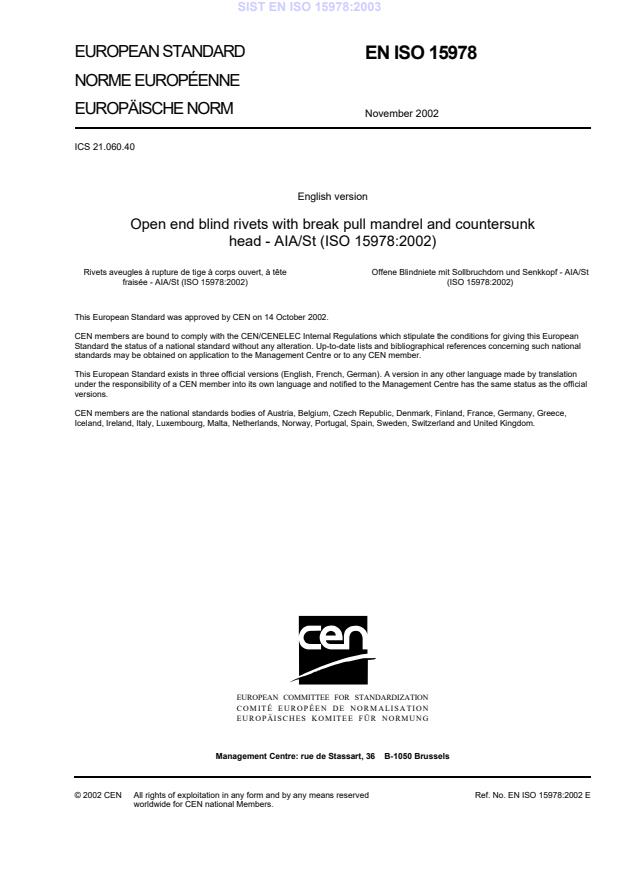
EUROPEAN STANDARDNORME EUROPÉENNEEUROPÄISCHE NORMEN ISO 15978November 2002ICS 21.060.40English versionOpen end blind rivets with break pull mandrel and countersunkhead - AIA/St (ISO 15978:2002)Rivets aveugles à rupture de tige à corps ouvert, à têtefraisée - AIA/St (ISO 15978:2002)Offene Blindniete mit Sollbruchdorn und Senkkopf - AIA/St(ISO 15978:2002)This European Standard was approved by CEN on 14 October 2002.CEN members are bound to comply with the CEN/CENELEC Internal Regulations which stipulate the conditions for giving this EuropeanStandard the status of a national standard without any alteration. Up-to-date lists and bibliographical references concerning such nationalstandards may be obtained on application to the Management Centre or to any CEN member.This European Standard exists in three official versions (English, French, German). A version in any other language made by translationunder the responsibility of a CEN member into its own language and notified to the Management Centre has the same status as the officialversions.CEN members are the national standards bodies of Austria, Belgium, Czech Republic, Denmark, Finland, France, Germany, Greece,Iceland, Ireland, Italy, Luxembourg, Malta, Netherlands, Norway, Portugal, Spain, Sweden, Switzerland and United Kingdom.EUROPEAN COMMITTEE FOR STANDARDIZATIONCOMITÉ EUROPÉEN DE NORMALISATIONEUROPÄISCHES KOMITEE FÜR NORMUNGManagement Centre: rue de Stassart, 36
B-1050 Brussels© 2002 CENAll rights of exploitation in any form and by any means reservedworldwide for CEN national Members.Ref. No. EN ISO 15978:2002 ESIST EN ISO 15978:2003
2002-12-18ForewordThis document (EN ISO 15978:2002) has been prepared by Technical Committee ISO/TC 2"Fasteners" in collaboration with Technical Committee CEN/TC 185 "Threaded and non-threaded mechanical fasteners and accessories", the secretariat of which is held by DIN.This European Standard shall be given the status of a national standard, either by publication ofan identical text or by endorsement, at the latest by May 2003, and conflicting national standardsshall be withdrawn at the latest by May 2003.According to the CEN/CENELEC Internal Regulations, the national standards organizations ofthe following countries are bound to implement this European Standard: Austria, Belgium, CzechRepublic, Denmark, Finland, France, Germany, Greece, Iceland, Ireland, Italy, Luxembourg,Malta, Netherlands, Norway, Portugal, Spain, Sweden, Switzerland and the United Kingdom.Endorsement noticeThe text of ISO 15978:2002 has been approved by CEN as EN ISO 15978:2002 without anymodifications.NOTE
Normative references to International Standards are listed in Annex ZA (normative).SIST EN ISO 15978:2003
Reference numberISO 15978:2002(E)© ISO 2002
INTERNATIONAL STANDARD ISO15978First edition2002-11-01Open end blind rivets with break pull mandrel and countersunk head — AIA/St Rivets aveugles à rupture de tige à corps ouvert, à tête fraisée — AIA/St
ISO 15978:2002(E) PDF disclaimer This PDF file may contain embedded typefaces. In accordance with Adobe's licensing policy, this file may be printed or viewed but shall not be edited unless the typefaces which are embedded are licensed to and installed on the computer performing the editing. In downloading this file, parties accept therein the responsibility of not infringing Adobe's licensing policy. The ISO Central Secretariat accepts no liability in this area. Adobe is a trademark of Adobe Systems Incorporated. Details of the software products used to create this PDF file can be found in the General Info relative to the file; the PDF-creation parameters were optimized for printing. Every care has been taken to ensure that the file is suitable for use by ISO member bodies. In the unlikely event that a problem relating to it is found, please inform the Central Secretariat at the address given below.
©
ISO 2002 All rights reserved. Unless otherwise specified, no part of this publication may be reproduced or utilized in any form or by any means, electronic or mechanical, including photocopying and microfilm, without permission in writing from either ISO at the address below or ISO's member body in the country of the requester. ISO copyright office Case postale 56 • CH-1211 Geneva 20 Tel.
+ 41 22 749 01 11 Fax
+ 41 22 749 09 47 E-mail
copyright@iso.ch Web
www.iso.ch Printed in Switzerland
ii © ISO 2002 – All rights reserved
ISO 15978:2002(E) © ISO 2002 – All rights reserved iii Foreword ISO (the International Organization for Standardization) is a worldwide federation of national standards bodies (ISO member bodies). The work of preparing International Standards is normally carried out through ISO technical committees. Each member body interested in a subject for which a technical committee has been established has the right to be represented on that committee. International organizations, governmental and non-governmental, in liaison with ISO, also take part in the work. ISO collaborates closely with the International Electrotechnical Commission (IEC) on all matters of electrotechnical standardization. International Standards are drafted in accordance with the rules given in the ISO/IEC Directives, Part 3. The main task of technical committees is to prepare International Standards. Draft International Standards adopted by the technical committees are circulated to the member bodies for voting. Publication as an International Standard requires approval by at least 75 % of the member bodies casting a vote. Attention is drawn to the possibility that some of the elements of this International Standard may be the su
...