


oSIST prEN 15780:2021
(Main)Ventilation for buildings - Ductwork - Cleanliness of ventilation systems
Ventilation for buildings - Ductwork - Cleanliness of ventilation systems
Standard for cleanliness of ductwork systems to include design, commissioning and maintenance aspects.
Lüftung von Gebäuden - Luftleitungen - Sauberkeit von Lüftungsanlagen
Diese Norm gilt für Lüftungs und Klimaanlagen und definiert die Kriterien für die erste Bewertung der Sauberkeit sowie die Reinigungsverfahren für diese Anlagen; die Überprüfung der Wirksamkeit der Reinigung gilt auch für Produkte, die EN 1505, EN 1506, EN 13053, EN 13180 und EN 13403 entsprechen und in Klima und Lüftungsanlagen innerhalb des Anwendungsbereichs des CEN/TC 156 verwendet werden.
Diese Norm legt Anforderungen und Verfahren fest, die zur Bewertung und Aufrechterhaltung der Sauberkeit von Lüftungsanlagen erforderlich sind, darunter:
Vorgehensweise bei der Bewertung des Reinigungsbedarfs (optisch, Messungen);
Bewertungshäufigkeit (allgemeine Hinweise);
Wahl des Reinigungsverfahrens;
Vorgehensweise bei der Bewertung des Ergebnisses der Reinigung.
Diese Norm ist eine parallele Norm zu EN 12097, in der Anforderungen an die Maße, die Form und die Lage von Zugangsdeckeln für die Reinigung und Wartung von Luftleitungssystemen festgelegt sind.
Diese Norm ist als Übersichtsnorm mit informativen Anhängen ausgelegt, zu denen im Laufe der Zeit folgende Themen hinzukommen können:
zentrale raumlufttechnische Geräte (zentrale RLT Geräte);
Filter;
Befeuchter;
Luftleitungen;
Luftdurchlässe.
Die Hauptzielgruppen dieser Norm sind Gebäudeeigentümer, Wartungs und Instandhaltungsunternehmen, Endverbraucher sowie Beratungs und Kontrollunternehmen.
Ventilation des bâtiments - Réseaux de conduits - Propreté des systèmes de ventilation
Cette norme concerne les systèmes de ventilation et de conditionnement d'air. Elle définit les critères d'évaluation initiale de la propreté et les procédures de nettoyage de ces systèmes. La validation de l'efficacité du nettoyage concerne aussi les produits conformes aux exigences des EN 1505, EN 1506, EN 13053, EN 13180 et EN 13403, utilisés dans des systèmes de conditionnement d'air et de ventilation définis dans le domaine d'application du CEN/TC 156.
Cette norme spécifie les exigences et les procédures nécessaires pour évaluer et entretenir la propreté de la ventilation, dont :
comment évaluer le besoin de nettoyage (inspection visuelle, mesures) ;
fréquence des évaluations (orientation générale) ;
sélection de la méthode de nettoyage ;
comment évaluer le résultat du nettoyage.
Cette norme est parallèle à la norme EN 12097, qui spécifie les exigences de dimension, de forme et de localisation des panneaux d'accès pour le nettoyage et les interventions techniques dans les réseaux de conduits.
Cette norme est conçue comme une norme générale avec des annexes informatives pouvant être complétées au fil du temps pour les sujets suivants :
caissons de traitement d'air ;
filtre ;
humidificateurs ;
conduit ;
bouches d'air.
Cette norme est destinée principalement aux propriétaires de bâtiments, entreprises d'entretien, entreprises de maintenance, utilisateurs finaux et entreprises de conseil et de contrôle.
Prezračevanje stavb - Kanali - Čistoča prezračevalnih sistemov
General Information
- Status
- Not Published
- Public Enquiry End Date
- 02-Jul-2021
- Technical Committee
- OGS - Heating for buildings
- Current Stage
- 98 - Abandoned project (Adopted Project)
- Start Date
- 13-Feb-2024
- Due Date
- 18-Feb-2024
- Completion Date
- 13-Feb-2024
Relations
- Revised
SIST EN 15780:2012 - Ventilation for buildings - Ductwork - Cleanliness of ventilation systems - Effective Date
- 18-Jan-2023
Overview
oSIST prEN 15780:2021:2021 is a European standard developed by CEN/TC 156, focusing on the cleanliness of ventilation ductwork systems in buildings. It applies to both new and existing ventilation, air conditioning, and kitchen extract systems used in human-occupied environments. The standard outlines requirements for assessing, maintaining, and verifying cleanliness through design, commissioning, inspection, and cleaning procedures. oSIST prEN 15780:2021:2021 supersedes EN 15780:2011 and aims to ensure ventilation systems are clean, hygienic, and efficient throughout their lifecycle.
Key Topics
Scope and Applicability:
The standard covers ductwork cleanliness criteria and cleaning procedures for air ventilation and kitchen extract systems. It excludes industrial, medical, and laboratory installations.Cleanliness Quality Classes:
Defines three levels of cleanliness quality (A - Low, B - Medium, C - High) to guide specifications depending on the building type and system demands.Criteria for Cleanliness and Assessment:
Sets acceptable levels of dust and contaminant accumulation. Visual inspection is the primary method, complemented by objective measurement methods where necessary.Design and Installation Considerations:
Emphasizes designing ventilation systems to facilitate cleanliness and maintenance by incorporating features like appropriate access doors, smooth surfaces, and moisture-tight components.Cleaning Intervals and Methods:
Cleaning frequency is determined based on inspection results and cleanliness levels. The standard advocates for documenting cleaning plans and specifying suitable cleaning methods, including wet cleaning where applicable.Assessment Methodology:
Includes a structured procedure involving inspection, visual evaluation, and, if needed, objective dust measurement techniques such as the European Vacuum test method (Annex I).Reporting and Documentation:
Requires comprehensive reporting of cleaning activities, inspection findings, and compliance with cleanliness criteria to maintain quality assurance.
Applications
Building Design and Engineering:
Architects and HVAC designers use oSIST prEN 15780:2021 to specify ventilation system cleanliness requirements from the design phase, ensuring components are easily cleanable and inspection-accessible.Commissioning and Handover:
Ensures that newly installed ventilation systems meet predefined cleanliness standards before operational use, with documentation guiding maintenance activities.Maintenance and Facility Management:
Facility managers and service companies apply the standard’s inspection and cleaning procedures to maintain indoor air quality, prolong system lifespan, and comply with hygiene requirements.Consultancy and Quality Control:
Environmental engineers and auditors utilize the assessment and measurement methods to verify system cleanliness, recommend maintenance schedules, and certify ventilation hygiene.Kitchen Extract Systems:
Specialized guidance for grease deposit controls and cleaning in kitchen extract ductwork prevents fire hazards and maintains air quality.
Related Standards
EN 12599: Test procedures and measurement methods for handing over air conditioning and ventilation systems.
EN 12097: Requirements for ductwork components to support maintenance.
EN 12792: Symbols, terminology, and graphical symbols for ventilation.
EN 13053, EN 1505, EN 1506, EN 13180, EN 13403: Pertinent standards for air handling units and components referenced for cleaning effectiveness validation.
EN 14799: Terminology related to air filters for general air cleaning.
EN 16798-3: Energy performance and indoor environment requirements supporting ventilation system design.
National Guidelines and REHVA Guidelines: Provide further detailed hygiene and product specification guidance complementing oSIST prEN 15780:2021.
Keywords: oSIST prEN 15780:2021, ventilation ductwork cleanliness, ventilation system cleaning, air quality maintenance, duct cleaning standards, HVAC system hygiene, kitchen extract system cleaning, ventilation system commissioning, European ventilation standards, CEN ventilation standards, building air quality.

Frequently Asked Questions
oSIST prEN 15780:2021 is a draft published by the Slovenian Institute for Standardization (SIST). Its full title is "Ventilation for buildings - Ductwork - Cleanliness of ventilation systems". This standard covers: Standard for cleanliness of ductwork systems to include design, commissioning and maintenance aspects.
Standard for cleanliness of ductwork systems to include design, commissioning and maintenance aspects.
oSIST prEN 15780:2021 is classified under the following ICS (International Classification for Standards) categories: 91.060.40 - Chimneys, shafts, ducts; 91.140.30 - Ventilation and air-conditioning systems. The ICS classification helps identify the subject area and facilitates finding related standards.
oSIST prEN 15780:2021 has the following relationships with other standards: It is inter standard links to SIST EN 15780:2012. Understanding these relationships helps ensure you are using the most current and applicable version of the standard.
oSIST prEN 15780:2021 is available in PDF format for immediate download after purchase. The document can be added to your cart and obtained through the secure checkout process. Digital delivery ensures instant access to the complete standard document.
Standards Content (Sample)
SLOVENSKI STANDARD
01-junij-2021
Prezračevanje stavb - Kanali - Čistoča prezračevalnih sistemov
Ventilation for buildings - Ductwork - Cleanliness of ventilation systems
Lüftung von Gebäuden - Luftleitungen - Sauberkeit von Lüftungsanlagen
Ventilation des bâtiments - Réseaux de conduits - Propreté des systèmes de ventilation
Ta slovenski standard je istoveten z: prEN 15780
ICS:
91.060.40 Dimniki, jaški, kanali Chimneys, shafts, ducts
91.140.30 Prezračevalni in klimatski Ventilation and air-
sistemi conditioning systems
2003-01.Slovenski inštitut za standardizacijo. Razmnoževanje celote ali delov tega standarda ni dovoljeno.
DRAFT
EUROPEAN STANDARD
NORME EUROPÉENNE
EUROPÄISCHE NORM
May 2021
ICS 91.140.30 Will supersede EN 15780:2011
English Version
Ventilation for buildings - Ductwork - Cleanliness of
ventilation systems
Ventilation des bâtiments - Réseaux de conduits - Lüftung von Gebäuden - Luftleitungen - Sauberkeit von
Propreté des systèmes de ventilation Lüftungsanlagen
This draft European Standard is submitted to CEN members for enquiry. It has been drawn up by the Technical Committee
CEN/TC 156.
If this draft becomes a European Standard, CEN members are bound to comply with the CEN/CENELEC Internal Regulations
which stipulate the conditions for giving this European Standard the status of a national standard without any alteration.
This draft European Standard was established by CEN in three official versions (English, French, German). A version in any other
language made by translation under the responsibility of a CEN member into its own language and notified to the CEN-CENELEC
Management Centre has the same status as the official versions.
CEN members are the national standards bodies of Austria, Belgium, Bulgaria, Croatia, Cyprus, Czech Republic, Denmark, Estonia,
Finland, France, Germany, Greece, Hungary, Iceland, Ireland, Italy, Latvia, Lithuania, Luxembourg, Malta, Netherlands, Norway,
Poland, Portugal, Republic of North Macedonia, Romania, Serbia, Slovakia, Slovenia, Spain, Sweden, Switzerland, Turkey and
United Kingdom.
Recipients of this draft are invited to submit, with their comments, notification of any relevant patent rights of which they are
aware and to provide supporting documentation.
Warning : This document is not a European Standard. It is distributed for review and comments. It is subject to change without
notice and shall not be referred to as a European Standard.
EUROPEAN COMMITTEE FOR STANDARDIZATION
COMITÉ EUROPÉEN DE NORMALISATION
EUROPÄISCHES KOMITEE FÜR NORMUNG
CEN-CENELEC Management Centre: Rue de la Science 23, B-1040 Brussels
© 2021 CEN All rights of exploitation in any form and by any means reserved Ref. No. prEN 15780:2021 E
worldwide for CEN national Members.
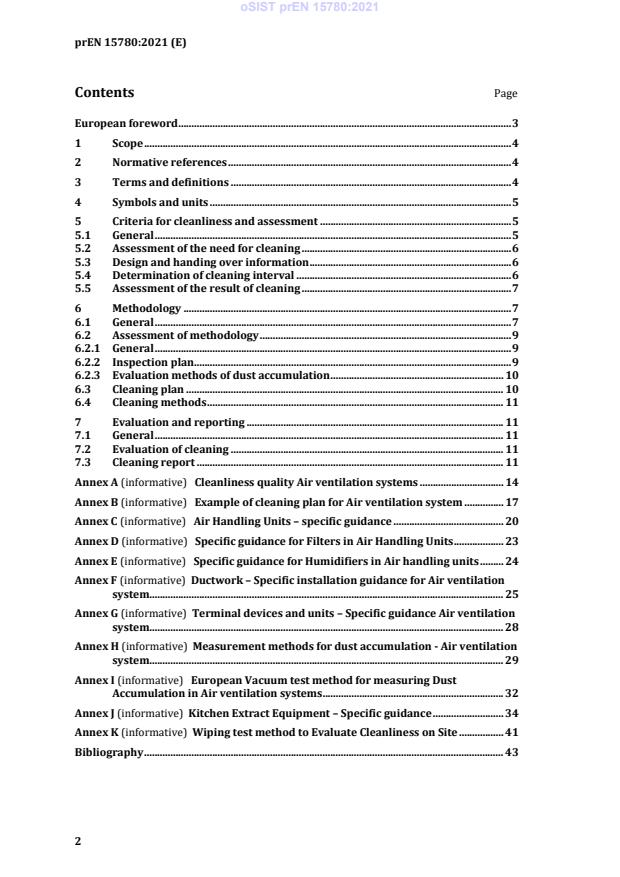
Contents Page
European foreword . 3
1 Scope . 4
2 Normative references . 4
3 Terms and definitions . 4
4 Symbols and units . 5
5 Criteria for cleanliness and assessment . 5
5.1 General . 5
5.2 Assessment of the need for cleaning . 6
5.3 Design and handing over information . 6
5.4 Determination of cleaning interval . 6
5.5 Assessment of the result of cleaning . 7
6 Methodology . 7
6.1 General . 7
6.2 Assessment of methodology . 9
6.2.1 General . 9
6.2.2 Inspection plan . 9
6.2.3 Evaluation methods of dust accumulation . 10
6.3 Cleaning plan . 10
6.4 Cleaning methods . 11
7 Evaluation and reporting . 11
7.1 General . 11
7.2 Evaluation of cleaning . 11
7.3 Cleaning report . 11
Annex A (informative) Cleanliness quality Air ventilation systems . 14
Annex B (informative) Example of cleaning plan for Air ventilation system . 17
Annex C (informative) Air Handling Units – specific guidance . 20
Annex D (informative) Specific guidance for Filters in Air Handling Units . 23
Annex E (informative) Specific guidance for Humidifiers in Air handling units . 24
Annex F (informative) Ductwork – Specific installation guidance for Air ventilation
system. 25
Annex G (informative) Terminal devices and units – Specific guidance Air ventilation
system. 28
Annex H (informative) Measurement methods for dust accumulation - Air ventilation
system. 29
Annex I (informative) European Vacuum test method for measuring Dust
Accumulation in Air ventilation systems . 32
Annex J (informative) Kitchen Extract Equipment – Specific guidance . 34
Annex K (informative) Wiping test method to Evaluate Cleanliness on Site . 41
Bibliography . 43
European foreword
This document (prEN 15780:2021) has been prepared by Technical Committee CEN/TC 156
“Ventilation for buildings”, the secretariat of which is held by BSI.
This document is currently submitted to the CEN Enquiry.
This document will supersede EN 15780:2011.
1 Scope
This document applies to both new and existing ventilation, air conditioning systems and kitchen
extract system and specifies the assessment criteria of cleanliness, cleaning procedures of these
systems. The validation of the effectiveness of cleaning applies also to products, which conform
to EN 1505, EN 1506, EN 13053, EN 13180 and EN 13403, used in air conditioning and
ventilation systems for human occupancy defined in the scope of CEN/TC 156. This document
does not apply to installations for industrial, medical and laboratory facilities.
This document specifies general requirements and procedures necessary in assessing and
maintaining the cleanliness of ducted ventilation, for air ventilation systems and kitchen extract
systems.
The main target groups of this document are specifiers of the cleanliness quality classes and
cleaning methods primarily system designers who also specify the system of access, building
owners, services companies, maintenance companies, end users and consultancy and control
companies.
2 Normative references
The following documents are referred to in the text in such a way that some or all of their content
constitutes requirements of this document. For dated references, only the edition cited applies.
For undated references, the latest edition of the referenced document (including any
amendments) applies.
EN 12599, Ventilation for buildings - Test procedures and measurement methods to hand over air
conditioning and ventilation systems
EN 12792:2003, Ventilation for buildings - Symbols, terminology and graphical symbols
EN 14799:2007, Air filters for general air cleaning — Terminology
EN 12097, Ventilation for Buildings - Ductwork - Requirements for ductwork components to
facilitate maintenance of ductwork systems
3 Terms and definitions
For the purposes of this document, the terms and definitions given in EN 12792:2003 and
EN 14799:2007 and the following apply.
3.1
acceptable cleanliness level
amount of dust or other contaminants not to be exceeded, according to the specified
measurement method
3.2
acceptable post-clean level
no loose dust or for kitchen extract equipment, adhered grease deposits are detected visually on
the duct surface after cleaning and the system can reach an acceptable cleanliness level according
to a defined measurement method
Note 1 to entry: In case of conflict (e.g. between the building owner and the user), or uncertainty
objective methods are needed to assess the cleanliness/dirtiness
3.3
acceptable dust accumulation level (new ductwork)
acceptable cleanliness level on new ductwork as handed over from builder to user
Note 1 to entry: In practice this means the quantity of pollution which is deemed acceptable
3.4
cleanliness
state or level of pollution defined as acceptable according to specification and a particular
measurement method
Note 1 to entry: Cleanliness is not absolute, it is defined by limit values. Dirtiness is the exceeding of such
a defined limit value
3.5
cleanliness quality class
level of cleanliness quality standard to be applied to various buildings and type of system,
consisting of three levels
— A: Low
— B: Medium
— C: High
3.6
visual inspection
subjective method to evaluate cleanliness level of surfaces
4 Symbols and units
For the purpose of this document, the symbols and units given in EN 12792:2003 apply.
5 Criteria for cleanliness and assessment
5.1 General
This chapter refers to ducted ventilation, for air ventilation systems. Kitchen extract systems are
dealt within Annex J
The key issue is to design, build and maintain the whole ventilation system so that it can be kept
clean enough during the whole lifetime of the installation. The following requirements, as well as
the methodology described in Clause 6, applies to the ductwork but can be also applied to air
handling units (according to EN 13053) and entire systems (see EN 16798-3and Annex A of this
document) Therefore it is necessary to specify the cleanliness quality class from the beginning
and include in the specification both design and installation issues and means to maintain a
sufficiently clean ventilation system for the whole of the lifetime. The design and installation
issues shall include (as a minimum):
— cleanliness quality class;
— cleanliness criteria and measurement method;
— production of the system components;
— delivery to site;
— site storage;
— installation;
— protection of components after installation;
— handing over the system according to EN 12599
NOTE Annex A presents, as a common classification, three classes of cleanliness, application examples
for ductwork, and recommendations for the frequency of regular inspections in accordance with EN 16798
part 17.
5.2 Assessment of the need for cleaning
Inspection of functionality and cleanliness of ventilation system is a part of proper maintenance
of the ventilation systems. Mostly the inspection of the cleanliness may arise from two purposes:
— to check if ventilation system is dirty and needs to be cleaned (exceeding of a “target level” of
cleanliness);
— to evaluate cleanliness after the cleaning work
NOTE The assessment methodology is presented in 6.2.
For existing buildings, the inspection shall include a study of the existing documentation and
recommendations to complete and update the documents.
Specific considerations for kitchen extract equipment, the frequency of cleaning should be
sufficiently frequent that grease deposit limits are not exceeded.
5.3 Design and handing over information
In the handing-over documents the cleanliness quality class, cleanliness criteria and
measurement methods shall be specified, recommendations for cleaning methods and guidelines
for reaching the points to be cleaned shall also be given.
The design information shall give consideration to the expected cleaning method. Where the
system has been designed to be cleaned by wet cleaning methods, warning regarding conditions
and restrictions of use should be given. For example, wet methods are applicable only where
ducts are sufficiently moisture-tight, internal surfaces are smooth, and slope and drainage
arrangements have been provided so that fluid and contaminant can be evacuated.
A sufficient number of access / cleaning doors shall be provided in the ductwork. Additionally,
special care shall be taken regarding obstacles to cleaning such as dampers, sound attenuators
etc., which are mounted in the ducts. In many cases additional cleaning doors are needed after or
before such obstacle. Requirements for location of and distance between access doors are
presented in EN 12097 and EN 16798-3.
5.4 Determination of cleaning interval
The cleaning interval shall in principle be defined by reference to the cleanliness or dirtiness of
the system. Cleanliness or dirtiness shall in the first instance be assessed visually and this may be
confirmed by means of measurement – see Annex A.
The inspection interval to determine the need for cleaning may be defined in the system
documentation in order to assist with maintenance planning or design considerations related to
cleaning methods.
5.5 Assessment of the result of cleaning
Methods for assessment of the need for cleaning can be also applied for assessment of the result
of cleaning.
The preferred methods of post-clean verification are given in Annex A.
6 Methodology
6.1 General
This chapter refers to ducted ventilation, for air ventilation systems. Kitchen extract systems are
dealt within Annex J
Figure 1 presents a procedure to control and maintain cleanliness of ventilation system. It does
not include the design stages or selection and specification of the system, or any of its
components.
The system shall be first checked visually, both in assessing the need for cleaning and in
verification of the result of cleaning. Objective measurements are needed if the visual inspection
results in disagreement or uncertainty about cleanliness or need for cleaning. See Figure 1 for an
explanatory flow-chart.
Objective measurements may be defined in advance as part of the cleaning or inspection plan.
NOTE 1 REHVA Guideline and some national guidelines like VDI 6022 and FiSIAQ Guideline give more
detailed guidance on product selection and specification from the hygienic point of view.
Key
1 control and maintenance of cleanliness of air handling 7 acceptable cleanliness level
system
2 commissioning 8 cleaning
3 periodic inspection 9 verification
4 visually clean 10 documentation
5 clearly unclean Y yes
6 objective measurements N no
Figure 1 — Schematic flow chart for procedures to maintain cleanliness of ventilation
system
If the components are certified for cleanliness or the cleanliness after production is otherwise
verified, and if the cleanliness instructions are properly documented, the commissioning may be
reduced to checking the documentation and random checking of the system cleanliness
(compliance with the documentation). See also 6.2.2.
The methods applied for objective measurements and verifications need to be consistent so that
the result of inspection is acceptable and give reliable grounds for decision making to order
cleaning work of the system when needed. Verification after cleaning is needed for quality control
of the cleaning work, and to verify the cleaning result.
NOTE 2 Annex I describe the preferred method of objective measurements.
NOTE 3 An example of acceptable levels of cleanliness (or dirtiness) is explained in Annex G.
Objective methods are needed if any guidelines or demands on cleanliness are set in official or in
voluntary documents. The methods to evaluate the cleanliness vary, and thus target values given
for the cleaning shall be accompanied by a description of the measurement method.
6.2 Assessment of methodology
6.2.1 General
Assessment of the characteristics of the contamination of the system is important in order to
define the cleaning method to be used.
System components are considered to be polluted when visual inspection and analytical
verification (according Annex I) give evidence of unacceptable dust level, microbial, or other
contamination. Assessment will be carried out through inspection. Dust accumulation, the type of
pollutants, such as “bacterial growth should determine the need for cleaning, cleaning methods
to be used and the required environmental controls.
Elements to be inspected for cleanliness start from the outdoor air intake and should include at
least:
— Air Handling Units (AHU’s). AHU’s assessment should include all their components and
sections: outdoor air intake, any mixing sections fan section, filters, plenums, heating and
cooling coils, condensate trays, sound attenuators, heat recovery section, and humidifier
section including droplet eliminators;
— supply air ductwork, including all types of terminal devices and terminal units, sound
attenuators, duct-mounted heating and cooling coils, dampers and valves;
— extract air ductwork, including all types of components;
— return and recirculation ductwork, including all types of components;
— fresh air intake ductwork.
6.2.2 Inspection plan
The inspection plan consists of the following information:
— review plan and reports, including cleanliness quality class and measurement methods;
— determining which systems will be inspected;
— determining where to inspect and sample (see note);
— choosing equipment and tools.
Additionally, the inspection plan describes the requirements of the specific qualification and
experience for inspectors before they are authorized to carry out inspection work. The
assessment frequency shall be specified.
For new buildings, the owner, specifier and builder may agree a particular inspection plan to suit
their requirements.
Recommendations for assessment frequency are given in Annex A. To obtain objective results a
representative number of samples from representative parts and sites in the ventilation system
should be selected for evaluation of the cleanliness of the whole system A good rule of thumb for
choosing sites or taking samples is to select areas where the dust deposits are obvious, or liable
to cause reduced indoor air quality (IAQ) For inspecting and sampling, the ventilation system can
be divided in two parts, the ductwork and the rest of the system. Before inspection or sampling,
the sites should be selected at random with the aid of the design documents. The sampling sites
in the ductwork should be selected from the main duct starting from the AHU, main ducts, and
branch ducts. The sampling sites should include straight duct lengths and ducts with changes of
direction or terminations. In the rest of the system, filters or humidifiers give usually a good
indication of the cleaning needs.
System cleanliness inspections should also make reference to other parts of the as described in
6.2.1, and with particular reference to critical components such as filters and wet areas.
6.2.3 Evaluation methods of dust accumulation
Different methods to evaluate cleanliness of ventilation systems are available. The simplest
methods are based on more or less subjective visual observation of the cleanliness of ventilation
system combined with use of some special instrumentation. The advanced techniques are able to
give relatively accurate results that are comparable to given limit values.
NOTE The various methods available are discussed in Annex H. In Annex A preferred measurement
methods and limit values are given which relate to various cleanliness quality classes, and to post-clean
verification of cleanliness.
6.3 Cleaning plan
If, as assessed according to 6.2, cleaning is needed, a cleaning plan shall be provided. The cleaning
plan shall include:
— a summary of the assessment including the list of the systems and parts that need to be
cleaned;
— detailed time schedule of cleaning;
— cleaning methods to be applied;
— description of how access will be gained to ducts and equipment not visible in the rooms
(ducts, air handling units);
— list of components to be removed for cleaning, and components to be replaced (when
relevant);
— protection of the rooms in which the cleaning equipment is used;
— how and when the occupants are informed (including protection and safety considerations);
— microbiological considerations when relevant, including considerations for the use of
disinfection;
— criteria to assess the need for involvement of a specialist on microbiological issues; technical
data, including an estimate of the present level of dust and impurities, and target levels for
cleanliness after cleaning; see Annex A;
— evaluation methods for cleanliness after cleaning.
One example of technical cleaning plan is presented in Annex B.
6.4 Cleaning methods
Cleaning methods shall be sufficient to achieve the required level of cleanliness without damage
to the system, to building users’ health and safety, and to the environment generally.
7 Evaluation and reporting
7.1 General
This chapter refers to ducted ventilation, for air ventilation systems. Kitchen extract systems are
dealt within Annex J.
7.2 Evaluation of cleaning
The final evaluation of cleaning shall be made after all parts of the ductwork or system subject to
cleaning have been assessed as visually clean.
Objective verification of post-clean cleanliness shall be carried out where necessary or as a result
of dispute or uncertainty.
The methods and limit value for post-clean verification of cleanliness are given in Annex A and J
methods may be selected voluntarily by agreement of parties to a cleaning contract.
7.3 Cleaning report
A report shall be prepared and signed. The report shall include at least the following details:
Details of the company executing the cleaning:
— the address and name;
— name of the responsible person carrying out the cleaning;
— the date of the inspection, cleaning and evaluation.
Details of the object (building, ventilation system, etc.):
— the address, name, or other unique identifier of the property;
— the owner or manager of the building.
List of the documents provided, including documentation of the product certificates and
manufacturer's or supplier's instructions, whenever available.
Details of the systems inspected:
— physical descriptions of the systems subject to inspection and cleaning;
— inventory of equipment.
Methods and equipment used for cleaning, and assessment before and after cleaning (visual,
measured):
— results of assessment before cleaning;
— scope of cleaning (entire system/ part of system);
— results of assessment after cleaning;
— pictures from each defined sampling point - before and after cleaning;
— documentation of the methods and equipment;
— recommendations (inclusive recommended time for next assessment and cleaning).
Annex A
(informative)
Cleanliness quality Air ventilation systems
A.1 General
This annex gives a summary of three cleanliness quality classes. It is a key issue to pay attention
to cleanliness in design of systems and especially in component selection and specification. It may
be modified to take better into account some existing national guidance. Application examples
are presented in A.2, and more specific applications in Annexes C, D and E. See Annex J for
Cleanliness quality classes for Kitchen extract ducts.
— The following four major contaminants from all components may deteriorate IAQ and should
be limited:
— residues of lubricant oils from duct manufacture;
— dust accumulated during manufacture and installation or debris from construction;
— dust accumulated during operation;
— deposited microorganisms, particularly when toxigenic species are present and conditions
are favourable for their survival and growth during storage, installation and operation.
A.2 Application in general
These levels of cleanliness quality class should be generally applied as follows:
Table A.1 — Typical applications of cleanliness quality classes
Quality Typical examples
Class
Low rooms with only intermittent occupancy
e.g. storage rooms, technical rooms
Medium offices, hotels, restaurants, schools,
theatres, residential homes, shopping
areas, exhibition buildings, sport
buildings, general areas in hospitals and
general working areas in industries
High Laboratories, treatment areas in hospitals
high quality offices,
A.3 Assessment frequency recommendation
Assessment frequency described on Table A.2 should be considered as the minimum
recommendations and the necessity of increasing them will depend on the environment
conditions, on the activity and on mechanical and human conditions in both building and its
surroundings.
In most cases inspection frequency should be specified rather than cleaning frequency since
changing and unknown conditions may alter the actual required cleaning frequency. Inspection
should be regular, cleaning subject to inspection.
Table A.2 —Inspection intervals according to cleanliness quality class, in months
a
AHU Filters Humidifiers Ducts Terminals
Low 24 12 12 48 48
Medium 12 12 6 24 24
High 12 6 6 12 12
a
Filters should be inspected and maintained according to the manufacturer’s recommendations, with these
intervals as the minimum ones.
Air handling units equipped with humidification or adiabatic cooling systems or located in mild
and wet weather conditions should be assessed at least twice a year, whatever the use of the
building.
A.4 Cleanliness class quality measurements
Air ventilation system:
The described vacuum test method detailed in Annex I is derived from the vacuum test method
whereby a gravimetric result is achieved – see Annex I for details of the European test method.
Annex K describes an additional test method.
This method is suitable for circular, flat-oval and rectangular sheet metal duct types.
For internally lined (or other irregular, porous surface) ductwork, the vacuum test method is not
applicable. Other methods such as gel tape method can be used. Further work is necessary to
establish comparable limit values using these methods, however voluntary agreements may be
made.
To comply with the cleanliness quality classification samples should show results below the limit
values given in Table A.3. Values in Table A.3 show limits according to measurements from the
preferred test method according to Annex I.
NOTE 1 See also REHVA: Cleanliness of Ventilation Systems 2007, Figures 15 and 16 for illustration of
visual comparison to measured levels.
Table A.3. — Acceptable cleanliness levels
Cleanliness Acceptable cleanliness Acceptable cleanliness Acceptable post-clean
quality level level level
class
Supply ductwork, Extract duct systems
recirculation and
secondary air ductwork
Low < 4,5 g/m2 < 9,0 g/m2 < 0,3 g/m2.
Medium < 3,0 g/m2 < 9.0 g/m2 < 0,3 g/m2.
High < 0,6 g/m2 < 9,0 g/m2 < 0,3 g/m2.
After cleaning the ductwork, and other relevant products or applications in the system all surfaces
should be visibly clean and capable of meeting the required Acceptable Post-clean Level.
For most normal duct cleaning work, the preferred method of establishing acceptable post-clean
level is to use the vacuum test method – see Annex I for technical details.
NOTE 2 Other criteria may be voluntarily agreed such as chemical standards e.g. absence of chlorides
after fire restoration work, freedom from asbestos fibres, microbiological or radiological contaminants.
A.5 Acceptable dust accumulation level (new ductwork)
Acceptable dust accumulation (new ductwork) defines acceptable cleanliness levels on new
ductwork as handed over from builder to user. In practice this means the quantity of fouling
which is deemed acceptable.
Table A.4 — Acceptable dust accumulation levels in new ductwork
Cleanliness Acceptable dust Acceptable dust
quality class accumulation level accumulation level
Supply, recirculation or Extract ductwork
secondary air ductwork
2 2
Low < 0,9 g/m < 1,8 g/m
2 2
Medium < 0,6 g/m < 1,8 g/m
2 2
High < 0,3 g/m < 0,9 g/m
Annex B
(informative)
Example of cleaning plan for Air ventilation system
B.1.1 General
This annex presents one example (according to UNE 100012) of a cleaning plan for dry dust. The
cleaning plan is needed in case the assessment reveals a need for cleaning. The tasks listed in the
right column are always optional, and also other tasks may be included in the cleaning plan.
B.1.2 Cleaning plan
The plan is not exhaustive and new technologies may be available to ensure acceptable post-clean
level.
CLEANING PLAN FOR AIR VENTILATION SYSTEM (example)
WORK TARGET TASKS
(examples; the list of tasks is drawn up case by
case as the result of assessment)
Achieving design air Brushing and vacuum
1 Cleaning of coils volume and thermal Detergent/solvent application
Exchange Brushing
Rinse with pressurized water
Compressed air
2 Drainage/ Removing the focus of Brushing and vacuum to dry
condensate tray infection and nutrients Detergent application - Disinfection product
cleaning that support Brushing
microbial pollution Rinse and dry
Brushing and vacuum
Achieving design air Detergent/solvent application
3 Fan cleaning volume and a reduction Brushing
of the dirtiness of the Rinse and dry
System downstream Compressed air
For all blades and casing
NOTE Designer may need to provide access to
fan blades.
Metallic:
4 Panels cleaning Avoiding airborne
to go into the ductwork
Lined with porous insulators
5 Anti corrosion Avoiding corrosion or
treatment corrosion increasing
6 System Reducing microbial Disinfection product spray or gas
colonisation to a defined
disinfection
level
Pollution to a defined level NOTE Careful risk assessment is necessary
to demonstrate the safety of the
procedure for workers, system users,
environment and the system itself.
AIR CONDITIONING SYSTEMS CLEANING PROTOCOL
WORK TARGET TASKS
1 Cleaning of the Removing dust
extract air ducts existing openings such as access panels
and other openings, then install new
access panels
Always begin from the
end of the air duct, if the
system is to be re-used by means such as brushing or
during the course of the air in combination with air/dust
work
2 Cleaning of Removing
extract air dust Brushing and vacuuming
Compressed air
terminals Detergent/solvent if necessary and
Rinse and dry if wet methods used
Re-assembly
3 AHU cleaning Removing
dust cleaning protocol
4 Diffusers cleaning Removing dust Disassembly where necessary
Brushing and vaccuming
Compressed air
Removing dust
existing openings such as access panels
and other openings, then install new
panels
5 Supply air duct Always begin from the Direct vacuum extraction, or dislodging
cleaning beginning of the air duct, by means such as brushing or
system is to be re-used air in combination with air/dust
extraction
during the course of the
work
6 Post-clean To confirm that expected Verify that acceptable post-clean level
verification outcome has been has been achieved
achieved and to record
system condition of 1. Visual inspection
Cleanliness 2. Vacuum test to confirm measured level
Annex C
(informative)
Air Handling Units – specific guidance
C.1 General
In manufacturing and construction, special attention should be paid to the following aspects:
— complete cleaning before shipment;
— during transportation and storage, sealing of the AHU in such a way that contamination is
avoided;
— preserve units during installation in such a way that contamination is avoided;
— inspection and cleaning after installation.
The following examples of material, access and installation requirements, based on EN 13053, are
for normal (e.g. residential, office) and advanced cleanliness quality classes (e.g. hospitals)
applications. For each criterion they can be applied independently of each other.
C.2 Recommendations for all cleanliness quality classes
C.2.1 Casing, including accessibility/access doors
EN 1886 gives requirements and recommendations for AHU casing, taking also into account
hygiene and cleanliness aspects, including the following aspects:
— construction and materials;
— accessibility to all components for cleaning and maintenance;
— protection of components from the weather.
The ingress of unfiltered air through casing leakage can cause hygiene problems. The following
tightness classes are therefore recommended as a minimum (classes according to EN 1886 under
revision).
C.2.2 Units operating under negative pressure only
The air leakage of the assembled air handling unit shall be tested at 400 Pa negative pressure and
it shall not exceed the applicable rate given in Table C.1.
Table C.1 — Casing air leakage classes of air handling units, 400 Pa negative test pressure
a
Leakage class of casing Maximum leakage rate Filter class (EN 779)
(f )
−1 −2
l × s × m
L1 0,15 superior to F9
L2 0,44 F8 to F9
L3 1,32 G1 to F7
a
The maximal leakage rates given in Table C.1 are according to the ductwork leakage classes specified in EN 1507
and EN 12237, (e.g. L2 = B), but the test pressures are different.
NOTE Table C.1 will be revised if EN 1507 and EN 12237 are modified.
C.2.2 Filters
The recommendations given in Annex D apply also for filters and filter sections in air handling
units.
C.2.3 Humidifiers
The recommendations given in Annex E apply also for humidifiers and humidification sections in
air handling units.
C.2.4 Coils
EN 13053, gives requirements and recommendations for heating and cooling coils in AHU's,
including:
─ construction of the coils, including maximum recommended fin depth and minimum distance
between fins;
─ special requirements for cleanliness of cooling coils that are designed to dehumidify,
including location, materials, accessibility etc.
If the inspection reveals a need for cleaning, the coil surfaces are cleaned according to the
instructions. If no instructions are available, it is preferred to use dry methods, such as vacuum
cleaning or pressurized air. The result of cleaning can be assessed either by visual inspection or,
if feasible, checking the coil pressure drop at the operating air flow.
For cooling coil sections, the same requirements for drainage, cleaning, materials and disinfection
apply as for humidifiers, see Annex E.
C.2.5 Sound attenuators
See EN 13053.
C.2.6 Fan position and cleaning, including fan motors
The position of the fans in the air-handling unit is important so that proper pressure conditions
are maintained to avoid any risks of leakage of contaminated air. This is especially important for
units where transfer of particles and gases are possible within the heat recovery section.
The fans and fan motors are cleaned by dry methods: brushing, vacuum or compressed air.
C.2.7 Drainage and prevention of condensation
Penetration of rain or snow into the unit should be prevented by protecting the outdoor air
openings against rain and snow and having low air speed into outdoor air openings. In cold
climates it can be necessary to have a water-tight plenum section between the outdoor opening
and the unit (or the first section) which guides the water immediately out of the building and/or
is connected to drain.
NOTE Cold bridges in cabinets introduce a risk of condensation on the inner or outer surfaces,
depending on which side of the unit is colder. The bridging factor class, as defined in EN 1886 is therefore
be selected to take into account the climatic conditions in which the unit is expected to operate.
C.3 Units for advanced cleanliness quality class
EN 13053 gives extended hygiene requirements for air handling units for special applications,
including:
— accessibility for cleaning purposes;
— smoothness of surfaces;
— inspection windows and lights;
— drainage and prevention of condensation.
C.4 Inspection aspects
It is recommended to look at filters and filter sections, as well as humidifiers and humidifier
sections at the early stage of the system inspection for cleanliness, because the condition of these
components is generally a good indicator of need for cleaning. See also Annexes D and E.
Annex D
(informative)
Specific guidance for Filters in Air Handling Units
Filter clogging and/or bad filter efficiency have a negative impact on indoor air quality and
increase energy consumption of the ventilation system. The side wall on the service side of the
filter section should be equipped with an inspection door. The width and height of the door should
be greater than the external dimensions of the replaceable filter elements. There should be
sufficient free space to the side of the access door, and immediately upstream of front access
filters, to allow unrestricted access for filter removal and replacement.
The condition of the filters and the filter section is generally a good indicator of need for cleaning,
so it is recommended to ensure that filter quality, integrity of fitting and maintenance is assessed
at the beginning of the inspection. Filters should be removed for AHU cleaning, preferably also
replaced in connection with AHU cleaning. After the AHU cleaning, cleanliness, fitting and function
of filters should be checked. See EN 16789-3 and EN 13053 for further guidance.
Annex E
(informative)
Specific guidance for Humidifiers in Air handling units
The cleanliness of humidifiers and associated sections (of AHU or duct) is critical to good hygiene
because the ready availability of moisture will strongly encourage microbiological growth. The
condition of the humidifiers is a good indicator of need for cleaning, so humidifiers should be
checked at an early stage of the inspection may also be started from the humidifiers.
For humidifiers for normal applications, the requirements and recommendations presented in
EN 13053 apply. These include:
— selection of materials;
— air filtering upstream and downstream;
— limit values for bacteria content;
— water treatment;
— overflow;
— use of disinfectants;
— arrangements to avoid droplet impingement;
— surface finishing of the humidifier casing;
— inspection and maintenance, including recording.
For additional aspects for humidifiers for special applications, EN 13053 apply.
Annex F
(informative)
Ductwork – Specific installation guidance for Air ventilation system
F.1 Acceptable dust accumulation (new ductwork)
Acceptable dust accumulation (new ductwork) defines acceptable cleanliness levels on new
ductwork as handed over from builder to user. In practice this means the quantity of fouling
which is deemed acceptable. See Table A.4.
Construction sites are inevitably dusty workplaces and so there are severe practical difficulties
in keeping duct systems clean. If defined levels of cleanliness are required, then it is often
necessary to carry out deliberate post-installation cleaning immediately before commissioning,
in order to achieve defined, measurable levels of cleanliness.
F.2 Protection, Delivery and Installation (PDI)
Guidance is given below regarding the preparation and protection of ductwork during
manufacture and installation with a view to minimizing unnecessary contamination of duct
systems.
Table F.1 — Recommendations
PDI Level Factory Protection Protection Site Cap off Post-
seal during during site clean on site installation
transit storage clean
Basic PDI No No No No Risers No
only
Intermediate No No Yes Yes Yes Not unless
PDI shown to be
necessary
Advanced PDI Yes No Yes Yes Yes Yes
Table F.2 — Locations
Quality Class Typical examples
Basic PDI rooms with only intermittent occupancy
e.g. storage rooms, technical roo
...
Questions, Comments and Discussion
Ask us and Technical Secretary will try to provide an answer. You can facilitate discussion about the standard in here.
Loading comments...