

SIST EN 61041-5:1999
(Main)Non-broadcast video tape recorders - Methods of measurement -- Part 5: High-band video tape recorders, including those equipped with Y/C video connectors (NTSC/PAL)
General Information
- Abstract
Specifies the general requirements for methods of measurement for high-band video tape recorders, including those equipped with Y/C video connector(s) (NTSC/PAL).
- Status
- Published
- Publication Date
- 31-Mar-1999
- Technical Committee
- AVM - Audio, video and multimedia systems and equipment
- Current Stage
- 6060 - National Implementation/Publication (Adopted Project)
- Start Date
- 01-Apr-1999
- Due Date
- 01-Apr-1999
- Completion Date
- 01-Apr-1999

Overview
EN 61041-5:1997 (CLC adoption of IEC 61041-5:1997) defines standardized methods of measurement for high-band non-broadcast video tape recorders, including devices equipped with Y/C (S‑video) connectors for NTSC/PAL systems. The standard describes how to prepare test tapes, set environmental and power conditions, and measure video and audio reproduction characteristics for high-resolution VTRs that exceed normal consumer video bandpass frequencies.
Key topics and technical requirements
- Scope and purpose
- Measurement methods for high-band video tape recorders (composite and Y/C inputs) used to verify recorded/reproduced video and audio characteristics.
- Measurement conditions
- Environmental: recommended ambient temperature 20 °C ± 2 °C and relative humidity 50 % ± 2 % (wider ranges permitted if results unaffected). Test tapes should be conditioned 24+ hours in measurement environment.
- Power supply: voltage regulation ±2.5 % (AC or DC as applicable); AC frequency deviation ±0.5 %.
- Video signal measurements (NTSC/PAL)
- Luminance: signal-to-noise ratio, horizontal resolution, vertical waveform distortion, diagonal resolution, two‑dimensional frequency response.
- Chrominance: signal-to-noise ratio, vertical displacement/distortion, flicker.
- Mutual characteristics: luminance/chrominance separation, crosstalk in conversion systems, color change point behavior.
- Test signals and diagrams
- Specifies composite and S‑video test signals, multiburst signals, waveforms (overshoot, pre‑shoot, smear), and block diagrams for measurement setups.
- Normative references
- Linked to related IEC/ITU/EIA documents for calibration tapes, tape properties and reference signals (e.g., IEC 60094‑2/3, IEC 60735, IEC 61105, ITU‑R 471).
Applications and who uses it
- Manufacturers of high‑band VTRs and professional/industrial video equipment for design verification and production testing.
- Test laboratories and compliance engineers performing standardized performance characterization and product comparison.
- R&D and quality assurance teams assessing luminance/chrominance fidelity, resolution and signal separation for NTSC/PAL systems.
- Calibrations services producing or validating reference tapes and test signals.
Related standards
- IEC 61041 (other parts: Part 1 general video/audio, Part 2 chrominance SECAM, Part 3 audio FM, Part 4 calibration tape)
- IEC 60094‑2 / IEC 60094‑3, IEC 60735, IEC 61105, ITU‑R Recommendation 471
This standard is essential for consistent, repeatable measurement and comparison of high‑resolution VTR performance across NTSC and PAL systems, especially where Y/C (S‑video) inputs are used.
Relations
- Effective Date
- 03-Feb-2026
- Effective Date
- 03-Feb-2026
- Effective Date
- 03-Feb-2026
- Effective Date
- 03-Feb-2026
- Effective Date
- 03-Feb-2026
Get Certified
Connect with accredited certification bodies for this standard

ANCE
Mexican certification and testing association.

Intertek Slovenia
Intertek testing, inspection, and certification services in Slovenia.

LNE (Laboratoire National de Métrologie et d'Essais)
French national laboratory for metrology and testing.
Sponsored listings
Frequently Asked Questions
SIST EN 61041-5:1999 is a standard published by the Slovenian Institute for Standardization (SIST). Its full title is "Non-broadcast video tape recorders - Methods of measurement -- Part 5: High-band video tape recorders, including those equipped with Y/C video connectors (NTSC/PAL)". This standard covers: Specifies the general requirements for methods of measurement for high-band video tape recorders, including those equipped with Y/C video connector(s) (NTSC/PAL).
Specifies the general requirements for methods of measurement for high-band video tape recorders, including those equipped with Y/C video connector(s) (NTSC/PAL).
SIST EN 61041-5:1999 is classified under the following ICS (International Classification for Standards) categories: 33.160.40 - Video systems. The ICS classification helps identify the subject area and facilitates finding related standards.
SIST EN 61041-5:1999 has the following relationships with other standards: It is inter standard links to SIST EN 60094-3:1999, SIST EN 60094-2:1999, SIST EN 60735:1999, SIST EN 61105:1999, SIST EN 62122:2003. Understanding these relationships helps ensure you are using the most current and applicable version of the standard.
SIST EN 61041-5:1999 is available in PDF format for immediate download after purchase. The document can be added to your cart and obtained through the secure checkout process. Digital delivery ensures instant access to the complete standard document.
Standards Content (Sample)
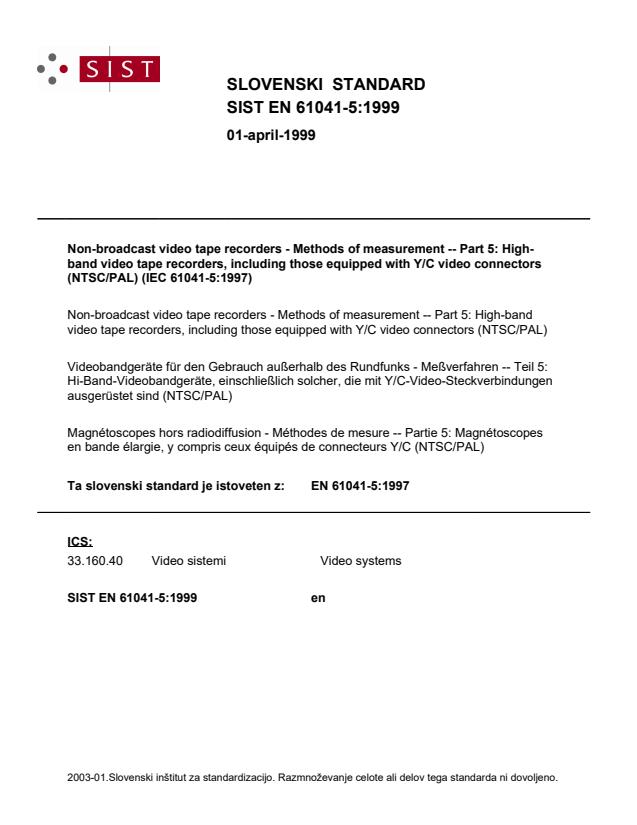
SLOVENSKI STANDARD
01-april-1999
Non-broadcast video tape recorders - Methods of measurement -- Part 5: High-
band video tape recorders, including those equipped with Y/C video connectors
(NTSC/PAL) (IEC 61041-5:1997)
Non-broadcast video tape recorders - Methods of measurement -- Part 5: High-band
video tape recorders, including those equipped with Y/C video connectors (NTSC/PAL)
Videobandgeräte für den Gebrauch außerhalb des Rundfunks - Meßverfahren -- Teil 5:
Hi-Band-Videobandgeräte, einschließlich solcher, die mit Y/C-Video-Steckverbindungen
ausgerüstet sind (NTSC/PAL)
Magnétoscopes hors radiodiffusion - Méthodes de mesure -- Partie 5: Magnétoscopes
en bande élargie, y compris ceux équipés de connecteurs Y/C (NTSC/PAL)
Ta slovenski standard je istoveten z: EN 61041-5:1997
ICS:
33.160.40 Video sistemi Video systems
2003-01.Slovenski inštitut za standardizacijo. Razmnoževanje celote ali delov tega standarda ni dovoljeno.
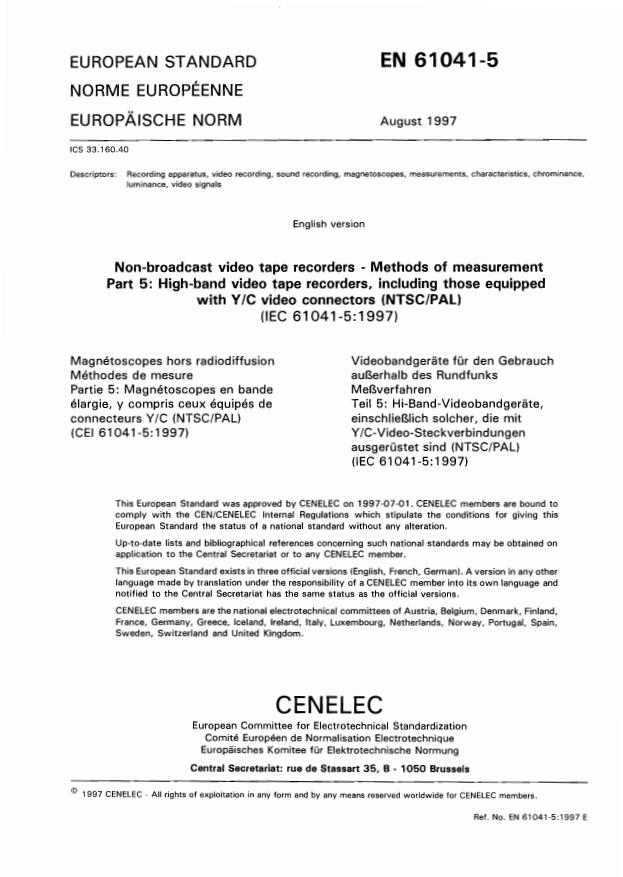
NORME
CEI
INTERNATIONALE
IEC
61041-5
INTERNATIONAL
Première édition
STANDARD
First edition
1997-06
Magnétoscopes hors radiodiffusion –
Méthodes de mesure –
Partie 5:
Magnétoscopes en bande élargie, y compris
ceux équipés de connecteurs Y/C (NTSC/PAL)
Non-broadcast video tape recorders –
Methods of measurement –
Part 5:
High-band video tape recorders, including those
equipped with Y/C video connectors (NTSC/PAL)
IEC 1997 Droits de reproduction réservés Copyright - all rights reserved
Aucune partie de cette publication ne peut être reproduite ni No part of this publication may be reproduced or utilized in
utilisée sous quelque forme que ce soit et par aucun any form or by any means, electronic or mechanical,
procédé, électronique ou mécanique, y compris la photo- including photocopying and microfilm, without permission in
copie et les microfilms, sans l'accord écrit de l'éditeur. writing from the publisher.
International Electrotechnical Commission 3, rue de Varembé Geneva, Switzerland
Telefax: +41 22 919 0300 e-mail: inmail@iec.ch IEC web site http: //www.iec.ch
CODE PRIX
Commission Electrotechnique Internationale
PRICE CODE V
International Electrotechnical Commission
Pour prix, voir catalogue en vigueur
For price, see current catalogue
61041-5 © IEC:1997 – 3 –
CONTENTS
Page
FOREWORD. 7
INTRODUCTION . 9
SECTION 1: GENERAL REQUIREMENTS
Clause
1.1 Scope and object . 11
1.2 Normative references. 11
1.3 Conditions of measurement.13
1.4 Definitions. 15
SECTION 2: VIDEO CHARACTERISTICS, LUMINANCE SIGNAL (NTSC/PAL)
2.1 Luminance signal-to-noise ratio .17
2.2 Horizontal resolution. 19
2.3 Vertically correlated waveform distortion (waveform distortion of
vertical luminance signal). 21
2.4 Diagonal resolution. 23
2.5 Frequency characteristics of diagonal resolution (i) (frequency response
in two-dimensional frequency domain). 25
2.6 Frequency characteristics of diagonal resolution (ii) (frequency response
in Y/C separation system) . 27
SECTION 3: VIDEO CHARACTERISTICS, CHROMINANCE SIGNAL (NTSC/PAL)
3.1 Signal-to-noise ratio. 29
3.2 Vertical picture displacement . 29
3.3 Vertical picture distortion (waveform correlation distortion of chrominance signal) . 31
3.4 Flicker. 33
SECTION 4: MUTUAL CHARACTERISTICS,
CHROMINANCE/LUMINANCE SIGNALS (NTSC/PAL)
4.1 Luminance signal separation (general). 35
4.2 Luminance signal separation at colour change points . 35
4.3 Chrominance signal separation. 37
4.4 Crosstalk in electromagnetic conversion system . 39
61041-5 © IEC:1997 – 5 –
Page
Figures
1 Composite video test signal . 41
2 S luminance test signal . 41
3 S chrominance test signal. 41
4 Block diagram for composite video input . 41
5 Block diagram for S video input .43
6 Composite video test signal . 43
7 Block diagram for composite video signal. 43
8 Block diagram for S video signal.43
9 Composite video test signal . 45
10 Waveform of overshoot. 45
11 Waveform of pre-shoot . 45
12 Waveform of smear . 45
13 Waveform of rise and fall times . 45
14 Waveform associated with reproduction of 1H /2H /3H pulses. 45
15 Test signal on a TV monitor . 47
16 Waveform for composite video signal. 47
17 Waveform for S video input. 47
18 Test signal on a TV monitor . 47
19 Waveform identifying measurement points. 49
20 Multiburst test signal . 49
21 Measurement of burst levels.49
22 Composite video test signal . 49
23 S luminance test signal . 51
24 S chrominance test signal. 51
25 Block diagram for composite video input . 51
26 Block diagram for S video input . 51
27 Composite colour window test signal. 51
28 S luminance window test signal . 53
29 S chrominance window test signal. 53
30 Block diagram for composite video input . 53
31 Block diagram for S video input . 53
32 Waveform of S luminance signal . 53
33 Waveform of S chrominance signal at line 0 (example measurement 1) . 55
34 Waveform of S chrominance signal at line +1/2 (example measurement 2). 55
35 Waveform of S chrominance signal at line +1 (example measurement 3). 55
36 Measurement of chrominance signal level. 57
37 Block diagram for measurement. 57
38 Example of colour vector measurement . 57
39 Block diagram for measurement. 57
40 Measurement of signal levels.59
41 Test signal. 59
42 Measurement of signal levels.59
43 Multiburst test signal . 59
44 Measurement of signal levels.59
45 Video frequency sweep test signal. 61
46 Block diagram for measurement. 61
47 Measurement of signal levels .61
61041-5 © IEC:1997 – 7 –
INTERNATIONAL ELECTROTECHNICAL COMMISSION
_________
NON-BROADCAST VIDEO TAPE RECORDERS –
METHODS OF MEASUREMENT –
Part 5: High-band video tape recorders, including those equipped
with Y/C video connectors (NTSC/PAL)
FOREWORD
1) The IEC (International Electrotechnical Commission) is a worldwide organization for standardization comprising
all national electrotechnical committees (IEC National Committees). The object of the IEC is to promote
international co-operation on all questions concerning standardization in the electrical and electronic fields. To
this end and in addition to other activities, the IEC publishes International Standards. Their preparation is
entrusted to technical committees; any IEC National Committee interested in the subject dealt with may
participate in this preparatory work. International, governmental and non-governmental organizations liaising
with the IEC also participate in this preparation. The IEC collaborates closely with the International Organization
for Standardization (ISO) in accordance with conditions determined by agreement between the two
organizations.
2) The formal decisions or agreements of the IEC on technical matters express, as nearly as possible, an
international consensus of opinion on the relevant subjects since each technical committee has representation
from all interested National Committees.
3) The documents produced have the form of recommendations for international use and are published in the form
of standards, technical reports or guides and they are accepted by the National Committees in that sense.
4) In order to promote international unification, IEC National Committees undertake to apply IEC International
Standards transparently to the maximum extent possible in their national and regional standards. Any
divergence between the IEC Standard and the corresponding national or regional standard shall be clearly
indicated in the latter.
5) The IEC provides no marking procedure to indicate its approval and cannot be rendered responsible for any
equipment declared to be in conformity with one of its standards.
6) Attention is drawn to the possibility that some of the elements of this International Standard may be the subject
of patent rights. The IEC shall not be held responsible for identifying any or all such patent rights.
International Standard IEC 61041-5 has been prepared by subcommittee 60B: Video recording,
then by subcommittee 100B: Recording, of IEC technical committee 100: Audio, video and
multimedia systems and equipment.
The text of this standard is based on the following documents:
FDIS Report on voting
100B/45/FDIS 100B/65/RVD
Full information on the voting for the approval of this standard can be found in the report on
voting indicated in the above table.
IEC 61041 consists of the following parts with the general title of: Non-broadcast video tape
recorders – Methods of measurement:
Part 1: 1990, General video (NTSC/PAL) and audio (longitudinal characteristics
Part 2: 1994, Video characteristics chrominance SECAM
Part 3: 1993, Audio characteristics for FM recording
Part 4: 1997, Calibration tape (NTSC/PAL/SECAM)
Part 5: 1997, High-band video tape recorders, including those equipped with Y/C video
connectors (NTSC/PAL)
61041-5 © IEC:1997 – 9 –
INTRODUCTION
This part of IEC 61041 has been prepared for the reasons given below.
Part 1 of IEC 61041 applies to non-broadcast video tape recorders which record the video
signal within the video bandpass frequencies of home-use TV receivers. This part of
IEC 61041, however, applies to other types of non-broadcast video tape recorders (hereinafter
referred to as high-band video tape recorders) which record the video signal with greater than
the normal video bandpass frequencies, for high resolution video recording.
This part of IEC 61041 is to be referred to particularly when characteristics of the video and
audio signals recorded and reproduced using high-band video tape recorders are to be
checked and measured.
61041-5 © IEC:1997 – 11 –
NON-BROADCAST VIDEO TAPE RECORDERS –
METHODS OF MEASUREMENT –
Part 5: High-band video tape recorders, including those equipped
with Y/C video connectors (NTSC/PAL)
1 Section 1: General requirements
1.1 Scope and object
This part of IEC 61041 specifies the general requirements for methods of measurement for
high-band video tape recorders, including those equipped with Y/C video connector(s)
(NTSC/PAL).
This part of IEC 61041 is applicable both to machines using normal input/output connectors for
the measurement of the composite video signal, and to machines using the Y/C video
connector(s) (herein after referred to as S video connectors) for the measurement of the Y/C
separated video signal.
This part of IEC 61041 is applicable when characteristics of the video and audio signals
recorded and reproduced using high-band video tape recorders are to be checked and
measured.
The object of this part is to describe the methods of measurement for non-broadcast video
tape recorders.
1.2 Normative references
The following normative documents contain provisions which, through reference in this text,
constitute provisions of this part of IEC 61041. At the time of publication, the editions indicated
were valid. All normative documents are subject to revision, and parties to agreements based
on this part of IEC 61041 are encouraged to investigate the possibility of applying the most
recent editions of the normative documents indicated below. Members of IEC and ISO maintain
registers of currently valid International Standards.
IEC 60094-2: 1994, Magnetic tape sound recording and reproducing systems – Part 2:
Calibration tapes
IEC 60094-3: 1979, Magnetic tape sound recording and reproducing systems – Part 3:
Methods of measuring the characteristics of recording and reproducing equipment for sound
on magnetic tape
IEC 60735: 1991, Measuring methods for video tape properties
IEC 61105:1991, Reference tapes for video tape recorder systems
ITU-R Recommendation 471-1: 1990, Nomenclature and description of colour bar signals
(Vol. X1-1)
EIA RS-189A: 1976, Encoded colour bar signal
61041-5 © IEC:1997 – 13 –
1.3 Conditions of measurement
1.3.1 Environmental conditions and preparation of the tape
For the environmental conditions for measurement and also for the preparation required for the
video test tape, see the following subclauses.
1.3.1.1 Ambient temperature and relative humidity
Carry out measurement under ambient temperature within a range of 20 °C ± 2 °C and relative
humidity within a range of (50 ± 2) %. Ambient temperature may be within a range 5 °C and 35 °C,
and relative humidity may be within a range 45 % and 75 % if these tolerances do not affect the
results of measurement. Record the temperature and the humidity at the time of measurement
with the results of measurement.
1.3.1.2 Preparation for the video test tape
Leave the video test tape for 24 h or more in the same conditions as the environmental
conditions of measurement so that the measurement can be carried out accurately under
steady conditions.
1.3.2 Power supply
Regarding the specifications of the power supply and warm-up time for the video tape recorder
to be measured, see the following subclauses.
1.3.2.1 For a video tape recorder which is operated from an a.c. power supply only
Use the a.c. power supply which conforms to the power requirements for the video tape recorder
under test. Voltage regulation shall be ±2,5 % or less. Frequency deviation shall be ±0,5 % or less.
1.3.2.2 For a video tape recorder which is operated from a d.c. power supply only
(including battery-operated video tape recorders)
Use the d.c. power supply which conforms to the voltage requirements for the video tape
recorder under test. Voltage regulation shall be ±2,5 % or less.
1.3.2.3 For a video tape recorder which can be operated from either an a.c. or d.c. power supply
Use the a.c. power supply. However, if there is doubt about the results of any measurement
obtained using only the a.c. power supply, repeat using the d.c. power supply.
1.3.2.4 Warm-up time
The video tape recorder to be tested should be switched to the standby mode for 3 h before
starting measurements. This time is required for video tape recorders equipped with a heater
on the cylinder of the head drum assembly.
1.3.3 Video test tape
Use the video test tape which conforms to the video tape specifications of the video tape recorder
under test. Record the type of the tape and the name of the manufacturer of the tape with the
results of measurement.
61041-5 © IEC:1997 – 15 –
1.3.4 Test signals
Use the test signals specified below for measurement.
1.3.4.1 The video signal
Use a video signal which has a 100 % amplitude level white signal of 4 μs inserted in every
horizontal period so that the results of measurement do not include errors caused by
disturbance of the video AGC circuitry of the video tape recorder under test. A video signal
which contains the 100 % level white signal over eight horizontal video periods inserted in
every vertical blanking period may be used as an alternative.
1.3.4.2 The colour bar signal
Use the standard colour bar signal which conforms to ITU-R Recommendation 471-1, type (b).
1.3.5 Conditions of recording
Carry out measurement of the video tape recorder under the following video and audio
recording conditions. Check first that conditions are normal, and then start the measurement.
1.3.5.1 Conditions of video recording
Choose the video test signal specified for each item of measurement, and apply it to the video
input connector of the video tape recorder under test. The level at the input connector shall
conform to the video input level specified by the manufacturer of the video tape recorder so
that recording can be made at the specified recording level.
1.3.5.2 Conditions of audio recording
Apply a 400 Hz or 1 kHz audio test signal specified in the format of the video tape recorder
under test at the level specified by the manufacturer at the same time when video recording is
made.
1.3.6 Statement of video tape speed for measurement
If the video tape recorder under test can operate at more than one tape speed, the tape speed
used for the test shall be stated.
1.4 Definitions
For the purpose of this part of IEC 61041, the following definitions apply.
1.4.1 high-band video tape recorders: Non-broadcast video tape recorders which
record a video signal of wider band width than that used by home-use TV receivers (4,5 MHz
for NTSC system and 5,5 MHz for PAL system) for the purpose of high resolution video
recording.
1.4.2 S video connector (Y/C video connector): Input or output connectors used for the
reception or transmission of the luminance signal and the chrominance signal, these being
separated from each other (not as a composite video signal). The luminance video signal
input to, or output from, the S connector is referred to as the S luminance signal. The
chrominance video signal input to, or output from, the S video connector is referred to as the
S chrominance signal. The letter "S" in S video signal is derived from the initial letter of the
word separate.
61041-5 © IEC:1997 – 17 –
1.4.3 diagonal resolution: Measurement made in the diagonal direction on the picture
screen. It can be obtained from the frequency response characteristics of the luminance signal.
1.4.4 frequency characteristic for diagonal resolution: The frequency characteristic of the
luminance signal in the diagonal direction of a picture screen is the ratio of the record/playback
level with respect to the reference level of the video signal. The frequency characteristic is
measured in the same way as for that of the horizontal direction (see clause 2.2). The
frequency characteristic around the chrominance signal frequencies is important for
determining the separation of the chrominance signal from the luminance signal; therefore,
these methods apply to measurement of the signal around those frequencies.
1.4.5 waveform distortion in vertical direction of a picture screen: Picture distortion in
vertical direction of a picture screen caused by horizontal (line) correlation process with a comb
filter. It is measured as waveform distortion of luminance signal.
1.4.6 colour flicker: Flicker resulting from amplitude and phase variations of the
chrominance signal from field to field.
1.4.7 colour change points: Transition points where the hue and/or level of the chrominance
signal changes in the horizontal direction of a picture screen.
1.4.8 colour displacement in vertical direction: Time delay of the chrominance signal with
respect to the luminance signal. It is measured as the number of horizontal lines.
1.4.9 colour distortion in vertical direction: Rise and fall time periods of the chrominance
signal in the vertical direction. It is measured as the number of horizontal lines.
1.4.10 Y signal: Abbreviated expression for luminance signal.
1.4.11 C signal: Abbreviation for chrominance signal. It is the colour subcarrier of the NTSC
or PAL system modulated by the chrominance signal.
2 Section 2: Video characteristics, luminance signal (NTSC/PAL)
2.1 Luminance signal-to-noise ratio
This is the ratio of the reference voltage level (100 % level is 0,714 V for NTSC and
p-p
0,700 Vp-p for PAL) of the video test signal, with respect to the r.m.s. voltage level of noise at a
flat part of the waveform of the luminance signal.
2.1.1 Test signal
The test signal shall be as follows:
a) for composite video input connector, see figure 1;
b) for S video input connector, see figures 2 and 3.
2.1.2 Block diagram
The block diagram for measurement shall be as follows:
a) for composite video input connector, see figure 4;
b) for S video input connector, see figure 5.
61041-5 © IEC:1997 – 19 –
2.
...