


SIST EN 340:2004
(Main)Protective clothing - General requirements
Protective clothing - General requirements
This European Standard specifies general requirements for ergonomics, ageing, sizing, marking of protective clothing and for information supplied by the manufacture.
Schutzkleidung - Allgemeine Anforderungen
Vetements de protection - Exigences générales
Varovalna obleka - Splošne zahteve
General Information
- Status
- Withdrawn
- Publication Date
- 31-Jan-2004
- Withdrawal Date
- 10-Sep-2013
- Technical Committee
- OVP - Personal protecting equipment
- Current Stage
- 9900 - Withdrawal (Adopted Project)
- Start Date
- 05-Sep-2013
- Due Date
- 28-Sep-2013
- Completion Date
- 11-Sep-2013
Relations
- Effective Date
- 01-Feb-2004
- Effective Date
- 01-Oct-2013

Frequently Asked Questions
SIST EN 340:2004 is a standard published by the Slovenian Institute for Standardization (SIST). Its full title is "Protective clothing - General requirements". This standard covers: This European Standard specifies general requirements for ergonomics, ageing, sizing, marking of protective clothing and for information supplied by the manufacture.
This European Standard specifies general requirements for ergonomics, ageing, sizing, marking of protective clothing and for information supplied by the manufacture.
SIST EN 340:2004 is classified under the following ICS (International Classification for Standards) categories: 13.340.10 - Protective clothing. The ICS classification helps identify the subject area and facilitates finding related standards.
SIST EN 340:2004 has the following relationships with other standards: It is inter standard links to SIST EN 340:1996, SIST EN ISO 13688:2013. Understanding these relationships helps ensure you are using the most current and applicable version of the standard.
SIST EN 340:2004 is associated with the following European legislation: EU Directives/Regulations: 2008/68/EC, 89/686/EEC, 93/68/EEC, 93/95/EEC, 96/58/EC; Standardization Mandates: M/BC/CEN/90/2. When a standard is cited in the Official Journal of the European Union, products manufactured in conformity with it benefit from a presumption of conformity with the essential requirements of the corresponding EU directive or regulation.
SIST EN 340:2004 is available in PDF format for immediate download after purchase. The document can be added to your cart and obtained through the secure checkout process. Digital delivery ensures instant access to the complete standard document.
Standards Content (Sample)
2003-01.Slovenski inštitut za standardizacijo. Razmnoževanje celote ali delov tega standarda ni dovoljeno.Protective clothing - General requirementsVarovalna obleka - Splošne zahteveVetements de protection - Exigences généralesSchutzkleidung - Allgemeine Anforderungen13.340.10Varovalna oblekaProtective clothingICS:SIST EN 340:2004enTa slovenski standard je istoveten z:EN 340:200301-februar-2004SIST EN 340:2004SLOVENSKI
STANDARDSIST EN 340:19961DGRPHãþD
EUROPEAN STANDARDNORME EUROPÉENNEEUROPÄISCHE NORMEN 340December 2003ICS 13.340.10Supersedes EN 340:1993English versionProtective clothing - General requirementsVêtements de protection - Exigences généralesSchutzkleidung - Allgemeine AnforderungenThis European Standard was approved by CEN on 3 November 2003.CEN members are bound to comply with the CEN/CENELEC Internal Regulations which stipulate the conditions for giving this EuropeanStandard the status of a national standard without any alteration. Up-to-date lists and bibliographical references concerning such nationalstandards may be obtained on application to the Management Centre or to any CEN member.This European Standard exists in three official versions (English, French, German). A version in any other language made by translationunder the responsibility of a CEN member into its own language and notified to the Management Centre has the same status as the officialversions.CEN members are the national standards bodies of Austria, Belgium, Czech Republic, Denmark, Finland, France, Germany, Greece,Hungary, Iceland, Ireland, Italy, Luxembourg, Malta, Netherlands, Norway, Portugal, Slovakia, Spain, Sweden, Switzerland and UnitedKingdom.EUROPEAN COMMITTEE FOR STANDARDIZATIONCOMITÉ EUROPÉEN DE NORMALISATIONEUROPÄISCHES KOMITEE FÜR NORMUNGManagement Centre: rue de Stassart, 36
B-1050 Brussels© 2003 CENAll rights of exploitation in any form and by any means reservedworldwide for CEN national Members.Ref. No. EN 340:2003 E
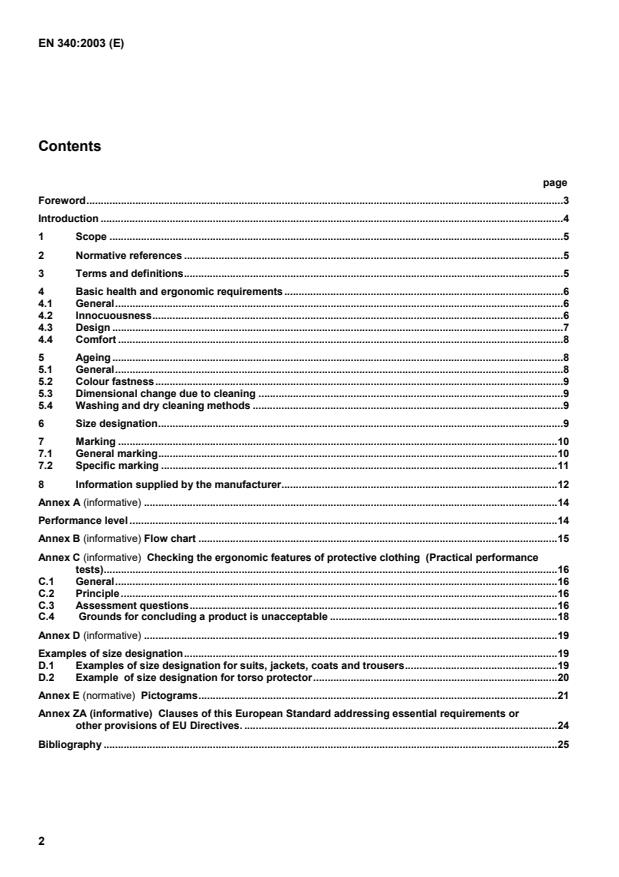
Checking the ergonomic features of protective clothing
(Practical performancetests).16C.1General.16C.2Principle.16C.3Assessment questions.16C.4 Grounds for concluding a product is unacceptable.18Annex D (informative).19Examples of size designation.19D.1Examples of size designation for suits, jackets, coats and trousers.19D.2Example
of size designation for torso protector.20Annex E (normative)
Pictograms.21Annex ZA (informative)
Clauses of this European Standard addressing essential requirements orother provisions of EU Directives.24Bibliography.25
Terms, definitions and body measurement procedure (ISO3635:1981, modified)EN 13402-2, Size designation of clothes - Part 2: Primary and secondary dimensionsprEN 13402-3, Size designation of clothes — Part 3: Measurements and intervals.prEN 14362-1, Textiles — Methods for the detection and determination of certain aromatic amines derived fromazo colorants — Part 1: Detection of the use of certain azo colorants accessible without extraction.EN 23758, Textiles — Care labelling code using symbols (ISO 3758:1991)EN 25077, Textiles; determination of dimensional change in washing and drying (ISO 5077:1984)EN ISO 3175-1, Textiles - Dry-cleaning and finishing - Part 1: Method for assessing the cleanability of textiles andgarments (ISO 3175-1:1998)EN ISO 3175-2, Textiles — Dry-cleaning and finishing — Part 2: Procedures for tetrachloroethene (ISO 3175-2:1998)EN ISO 4045, Leather - Determination of pH (ISO 4045:1977)EN ISO 6330, Textiles — Domestic washing and drying procedures for textile testing (ISO 6330:2000)EN ISO 105, Textiles — Test for colour fastness (all parts)ISO 7000, Graphical symbols for use on equipment - Index and synopsisISO 15797, Textiles — Industrial washing and finishing procedures for testing of workwear3 Terms and definitionsFor the purposes of this European Standard the following terms and definitions apply.3.1ageingchange of one or more initial properties of protective clothing materials during the passage of time
manytypes of protective clothing. For general ergonomic principles to be used in designing and specifying personalprotective equipment see prEN 13921-1[2].Protective clothing shall be designed and manufactured as follows.4.2 InnocuousnessProtective clothing shall not adversely affect the health or hygiene of the user. Protective clothing shall be made ofmaterials such as textiles, leather, rubbers, plastics that have been shown to be chemically suitable. The materialsshall not in the foreseeable conditions of normal use release or degrade to release substances generally known tobe toxic, carcinogenic, mutagenic, allergenic, toxic to reproduction or otherwise harmful. Information claiming thatthe product is innocuous shall be checked.NOTE1 - Information on the classification and identification of harmful substances can be
found e.g. in [7, 8] of theBibliography.
Materials should be selected to minimise the environmental impact to the production and disposal of protectiveclothing.NOTE 4 -
The following list of documents is given for information and as examples of documents to be examined:a) Information supplied by the manufacturer could include a declaration confirming that the product does not contain any substances at levels that are known or suspected to adversely effect user hygiene or health,b) Materials specifications,c) Safety data sheets relating to the materials,d) Information relating to the suitability of the materials for use with food, in medical devices, or other relevantapplications.e) Information relating to toxicological, allergenic, carcinogenic, toxic to reproduction or mutagenic investigations on the materials,f) Information relating to ecotoxicological and other environmental investigations on the materials,The examination should determine whether the claim that the materials are suitable for use in the protectiveclothing or protective equipment is justified. Particular attention has to be paid to the presence of plasticisers,unreacted components, heavy metals, impurities and the chemical identity of pigments and dyes.Materials of protective clothing shall comply with the following requirements:a) The chromium VI content in leather clothing shall comply with the requirements of EN 420.b) All metallic materials
which could come into prolonged contact with the skin (e.g. studs, fittings) shall have anemission of nickel of less than 0,5 µg/cm²
per week. The method of test shall be according to EN 1811.c) The pH value for protective clothing material
shall be greater than 3,5 and less than 9,5. The test method forleather shall be according to EN ISO 4045 and for other materials according to EN 1413.d) The colour fastness to perspiration of protective clothing
material to ensure user hygiene (e.g. no skin staining)shall be determined in accordance with EN ISO 105-A02 and shall be at least grade 4 of the Grey scale for thecolour change of the specimen. The test shall be conducted in accordance with EN ISO 105-E04.e) Azo colorants which release carcinogenic amines listed in prEN 14362-1 shall not be detectable by the methodin that standard.4.3 Design4.3.1The design of protective clothing should facilitate its correct positioning on the user and should ensure thatit remains in place for the foreseeable period of use, taking into account ambient factors, together with themovements and postures that the wearer could adopt during the course of work or other activity. For this purpose,appropriate means, such as adequate adjustment systems or adequate size ranges should be provided so as toenable protective clothing to be adapted to the morphology of the user.4.3.2The design of protective clothing shall ensure that no parts of the body get uncovered by expectedmovements by the wearer (e.g. a jacket should not rise above the waist when the arms are raised) if this is definedin the specific standard. The specific standard for protective clothing shall contain test criteria (e.g. checking thatthe garment can be put on and taken off easily, that arm and knee and bending movements are possible, thatunprotected body areas do not appear during movements, that there is an adequate overlap of jacket and trousers,and that the manufacturers information is adequate to explain the correct usage of the protective clothing (seeannex C).
strength of a garment shall bedefined.4.3.5 If required in the specific standard the mass shall be given for all sizes of the garment in the informationsupplied by the manufacturer or the marking. The mass shall be given for a garment at 20 °C, 65 % R.H. and innew condition; the mass tolerance or range shall be defined in the specific standard. The mass of one garment sizeshall be measured to check the mass indication in the information of the manufacturer or the marking.NOTE 1A lower mass will not always be beneficial.NOTE 2Protective clothing should be as light as possible taking into account comfort, water vapour resistance, design andprotection level.4.4 Comfort4.4.1Protective clothing should provide users with a level of comfort consistent with the level of protectionagainst hazard which is provided, the ambient conditions, the level of the user’s activity, and the anticipatedduration of use of the protective clothing. Specific product standards shall contain requirements related to thecomfort of particular types of protective clothing and methods for its assessment (e.g. assessment by manualinspection, visual inspection or wearer trial, see annex C). Protective clothing shall not¾ have rough, sharp or hard surfaces that irritate or injure the user;¾ be so tight that blood flow is restricted;¾ be so loose and/or heavy so that it interferes with movements. 4.4.2Where permissible, protective clothing shall be made of materials with low water vapour resistance and/orhigh air permeability and/or shall be sufficiently ventilated to minimise discomfort and thermal stress. In these casestest method(s) and requirement(s) for water vapour resistance of materials
or clothing, air permeability of materialsor ventilation of clothing shall be specified in the specific standard.NOTE 1An international test method is standardised in EN 31092 [1].NOTE 2For other purposes e.g. quality supervision a different reproducible method may be applied to test the water vapourpermeability for use other than classification or testing to meet specified values as laid down in related standards.NOTE 3For further information see prEN 13921-4 [3].4.4.3Protective clothing that imposes significant ergonomic burdens such as heat stress, or is inherentlyuncomfortable because of the need to provide adequate protection, should be accompanied in the informationsupplied by the manufacturer by specific advice or warnings. Specific advice on the appropriate duration forcontinuous use of the clothing in the intended application(s) should be given.5 Ageing5.1 GeneralAgeing can be caused by a single factor or several factors (see 4.8 of prEN 13921-1:2003 [2]). This standard isonly concerned with the detrimental effects of colour alteration, cleaning and dimensional change to the levels ofperformance and legibility of marking (see 5.2 to 5.4).
...
Questions, Comments and Discussion
Ask us and Technical Secretary will try to provide an answer. You can facilitate discussion about the standard in here.
Loading comments...